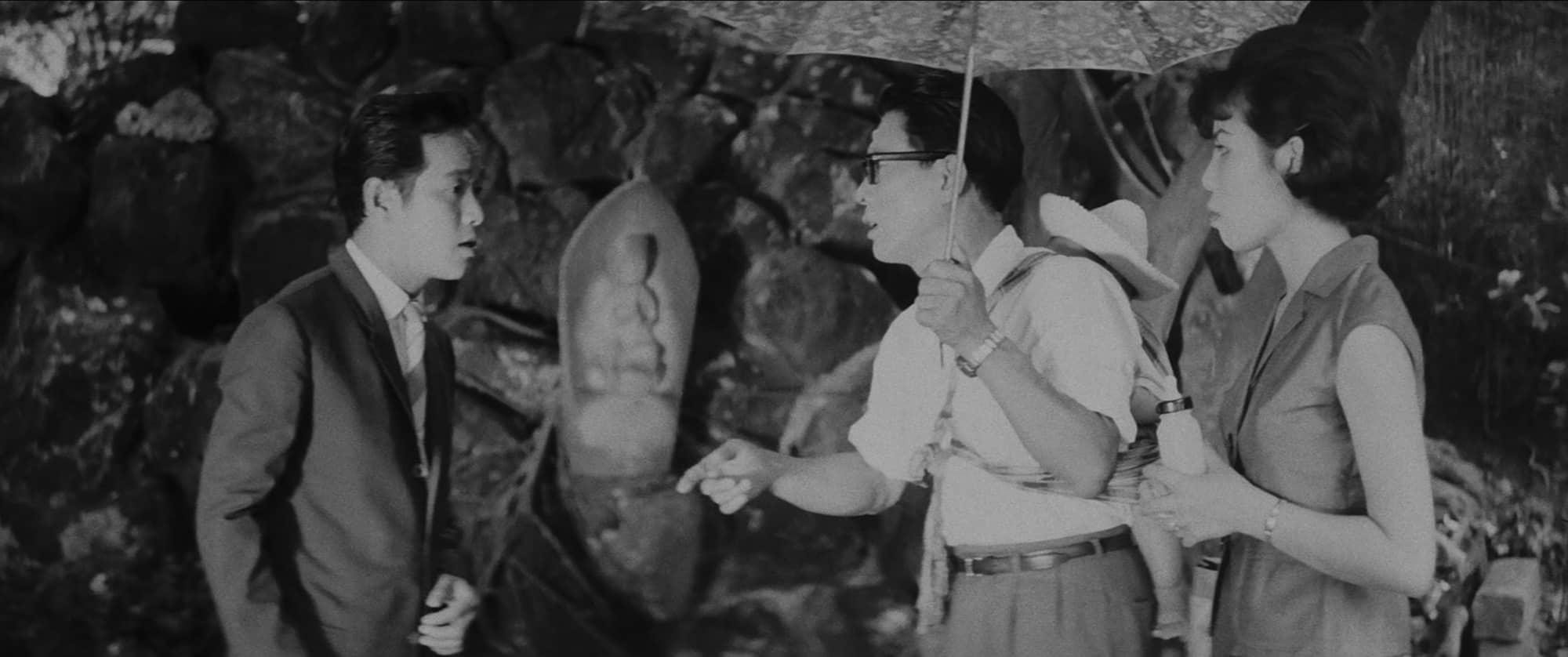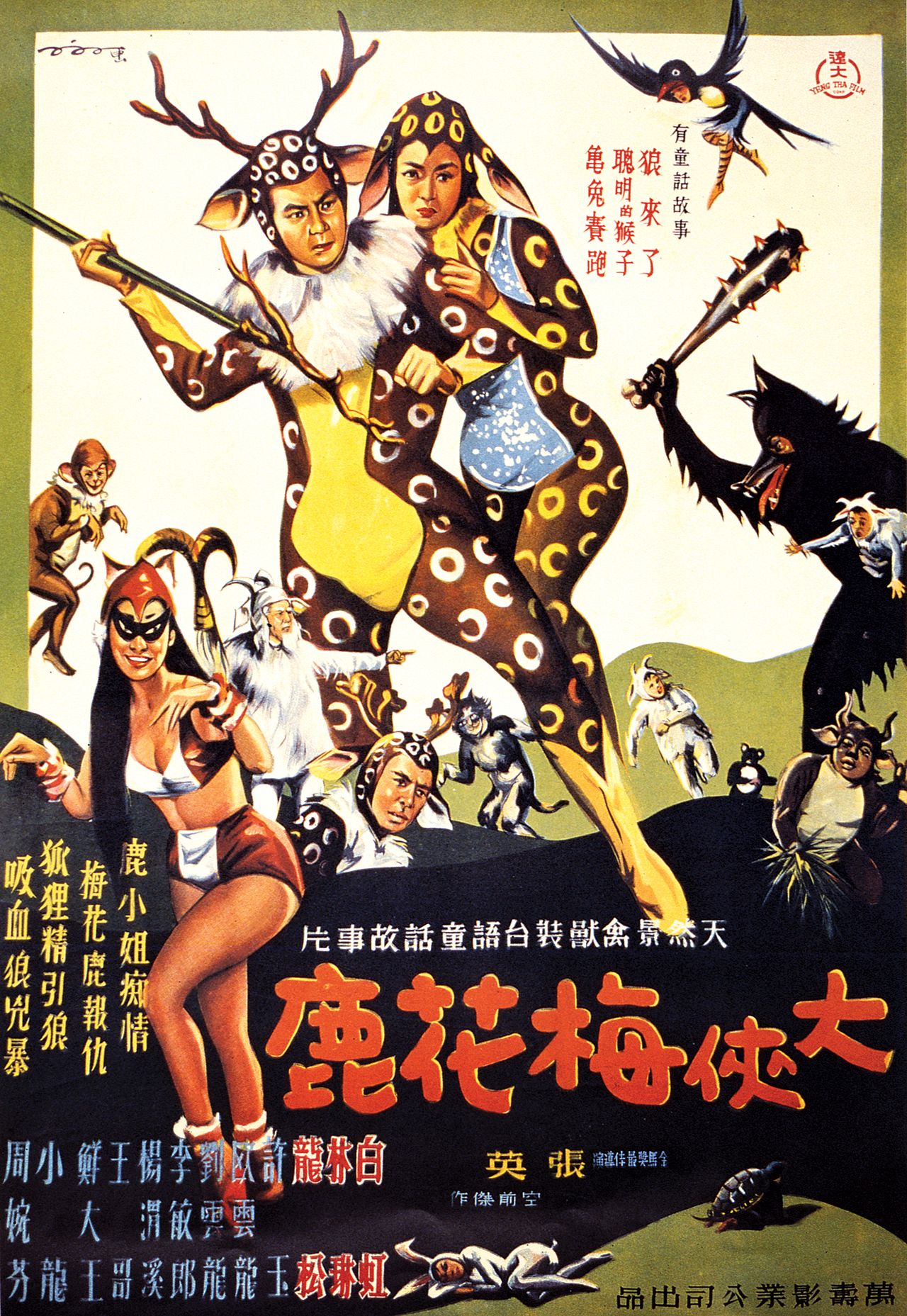
The Fantasy of Deer Warrior (大俠梅花鹿, Chang Ying, 1961)

A fearless warrior’s solipsistic priorities and obsession with male pride begin to endanger his community in Chang Ying’s incredibly bizarre Taiwanese-language forest fable, The Fantasy of Deer Warrior (大俠梅花鹿). Seemingly aimed at children with its series of moral messages and anthropomorphised animal characters, Chang’s drama is surprisingly violent not to mention a little on the raunchy side for a family film while ending on a note entirely at odds with the prevailing wisdom of children’s cinema as the righteous hero takes bloody revenge on his bound and defenceless enemies but is nevertheless embraced by his innocent love interest for having brought “justice” back to the forest. 

Opening with a surreal scene of children in animal outfits dancing to jingle bells in the middle of the forest, the cheerful atmosphere is soon disrupted by an incursion of “wolves” carrying nailed bats. An emissary is dispatched to fetch “Sika Deer” (Ling Yun), the forest’s most fearsome warrior, but he is busy having fight with love rival Elk (Li Min-Lang) over the beautiful “Miss Deer” (Pai Hung) who according to the mischievous Foxy (Lin Lin) has been kind of dating both of them. Foxy is incredibly jealous of Miss Deer and stirs the pot by suggesting that Elk and Sika Deer continue in a formal duel with the winner taking Miss Deer’s heart. Shockingly this is what they do and Sika Deer wins only to be immediately called away to the wolf attack, discover his father is already dead, and decide the best thing to do is not see Miss Deer again until he’s finished avenging his father’s death by killing Bloody Wolf. 

As you can see, Sika Deer has his priorities all wrong. First of all, he was off pointlessly fighting Elk while his family were eaten by wolves, then he decides to take the manly path by leaving Miss Deer alone and vulnerable not to mention his community largely defenceless. Later he does something similar when Miss Deer is kidnapped, stopping to lock horns with his love rival rather than devoting all their resources to tracking Bloody Wolf and saving Miss Deer. He does belatedly think to send her a letter explaining he’s busy with important revenge business and will call her later which foils Foxy’s plan to convince her he’s dead so she’ll date Elk instead (unclear why she wants this) but the fact remains that he basically just abandons everyone to selfishly pursue his own revenge ironically leaving the village vulnerable to attack.

Despite this and being absent for most of the picture, Sika Deer is still held up as the hero even when he marches Bloody Woolf and minion to his father’s grave and executes them with surprising violence while they are bound and gagged. Where most children’s films would end with some kind of forgiveness, a restoration of the forest’s harmony brokered by the hero’s magnanimity which in itself causes the villains to reform, Deer Warrior ends with quite the reverse which would seem to run contrary to most of the other moral messages presented throughout the film. 

Then again, “There is no justice in this world” Miss Deer is told on appealing first to a tree and then an elderly buffalo for a moral judgement on whether or not the wolf should be allowed to eat her even though she saved his life. As the tree points out, people took shelter under him but then they cut him down for firewood, while the buffalo complains that he’s been exploited all his life but as soon as he’s too old to work he’ll be killed and eaten. Miss Deer’s moral conundrum is as to whether a kindness ought to be repaid, convinced that Bloody Wolf is in the wrong for wanting to eat her and should let her go to repay the kindness of her saving his life. But Bloody Woolf is a wolf which is to say a creature without morals the only surprising thing being that he patiently waits while she makes all her petitions rather than just eating her as he pleases. Even so, the film seems to say not so much that Miss Deer is at fault for her innocent naivety in having trusted a wolf, but the world itself is wrong because one should never suffer for having been kind to another for kindness should always be repaid. 

Mildly critical as it is of an increasingly selfish society in which justice has become a casualty of increasing economic prosperity, Fantasy of Deer Warrior nevertheless ends on an uncomfortable note with the hero essentially delivering justice as vengeance. Meanwhile it’s also clear that prior to the arrival of the wolves which could perhaps be read either as a metaphor for Mainland China or indeed the KMT government threatening the natural harmony of the native Taiwanese society as represented by Sika Deer, the forest was not altogether harmonious before as evidenced by the rivalries between Miss Deer and Foxy and Elk and Sika Deer. These divides perhaps hint at a wounded unity, suggesting that the Taiwanese people are ill-equipped to defend themselves against external threat while preoccupied with petty disputes and personal concerns. 

Such messages are most likely above the heads of the target audience but then again, the film is curiously transgressive including several scenes of Foxy living up to her name, performing sexy dances and off “having fun” with Bloody Woolf in the forest while at one point talking Elk into attempting to rape Miss Deer to force her to marry him which whichever way you look at it is fantastically dark for a children’s film even if the metaphorical quality of the wolf as representing animalistic lust is still very much present in his determination to “eat” Miss Deer. To that extent it is also transgressive sexual energy which destabilises forest society in Foxy’s resentment of Miss Deer even if her implication that she’s been two-timing Elk and Sika Deer undercuts her otherwise innocent and pure nature which is in such contrast with Foxy’s chaotic and classically tricksy personality. 

Perhaps more of an ironic take on a kids film aimed at jaded adults, Fantasy of Deer Warrior is undeniably bizarre starring actors dressed in onesies mimicking their animal characters, deer with antlers on their heads fighting with antler staffs, and bird messengers hanging from obvious wires flapping their arms to mimic flight. Adopting the style of a classic fairytale, Chang incorporates several of Aesop’s fables such as a musical number themed around a strangely militarised tortoise and a cocky rabbit, or a literal instance of a boy crying wolf and never having the opportunity to learn his lesson. Yet the kind of justice with which the film concludes is disquieting suggesting perhaps that all is not so well in the forest after all. 


Remaster trailer (Traditional Chinese / English subtitles)
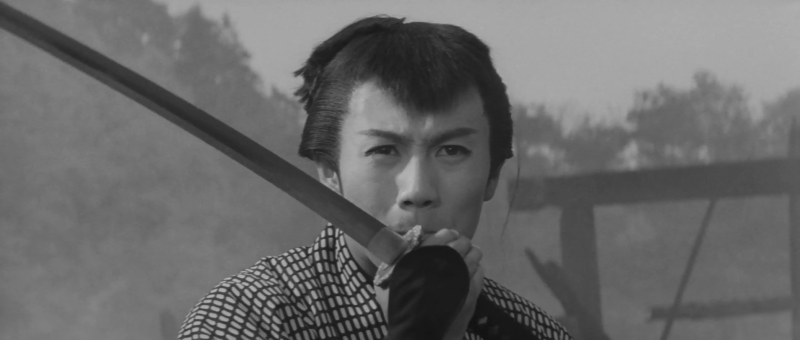
In a Ring of Mountains (中山七里, Kazuo Ikehiro, 1962)

A noble-hearted libertine stands up for love in an increasingly corrupt Edo in Kazuo Ikehiro’s adaptation of the well-known novel by Shin Hasegawa, In a Ring of Mountains (中山七里, Nakayama Shichiri, AKA 7 Miles to Nakayama). The son of a Daiei executive, Ikehiro joined the studio in 1950 working as an AD to Kenji Mizoguchi, Kazuo Mori, and Kon Ichikawa before being promoted to director in 1960 and then briefly demoted back to AD for annoying studio head Masaichi Nagata with the satirical content of his second film. Nevertheless, he later developed a close working relationship with top star Raizo Ichikawa and gained a reputation for unconventional jidaigeki displaying many of the techniques associated with the New Wave rather than the often more classically minded period films which were a Daiei mainstay. 

In this rather more modern tale set sometime in the Edo era, Ichikawa stars as big guy around town Masakichi who is nevertheless viewed with suspicion by local law enforcement officer Tohachi (Koh Sugita) who rebukes him for spending too much time with “yakuza” while out on the road conducting business for the lumber yard where he works. As we’ll come to discover this is a bit rich because Tohachi is as bent as they come, later raiding a gambling den in order to seize the proceeds for himself while in cahoots with equally corrupt magistrate who is also Masakichi’s boss but has designs on his girlfriend Oshima (Tamao Nakamura). After Masakichi proposes to her and goes so far as to set up a house and set a date to solemnise the union, his boss rapes Oshima which leads to her committing suicide and Masakichi killing him thereafter heading out on the run vowing to be Tohachi’s enemy for evermore. Sometime later, however, he gets himself mixed up in intrigue in another town where the corrupt magistrate is actually running the illegal gambling den and taking advantage of a naive young man, Tokunosuke (Koichi Ose), to press him into debt while trying to get his hands on his fiancée Onaka (also Tamao Nakamura) who happens to look exactly like Oshima. 

Something is very definitely rotten in Edo, the corruption so rampant as to be all but inescapable but Masakichi is so jaded that to begin with he doesn’t much care only to be reawakened on realising the same thing is happening again and to another woman who looks like his first love. Before he even sees her, he half-heartedly tries to warn Tokunosuke off gambling realising that he has no idea what he’s doing and seems to be having a run of very bad luck but Tokunosuke is a stubborn and insecure man who doesn’t know what’s good for him making one bad decision after another. When they are forced on the run together, Tokunosuke can’t help but feel his masculinity is being challenged by Masakichi’s infinite capability and is convinced that Onaka will eventually choose to leave with him. Consequently he repeatedly attempts to convince Onaka that Masakichi is a third wheel while quite obviously out of his depth and entirely incapable of protecting her from the mess that he has in part made through his series of poor decisions and general uselessness. 

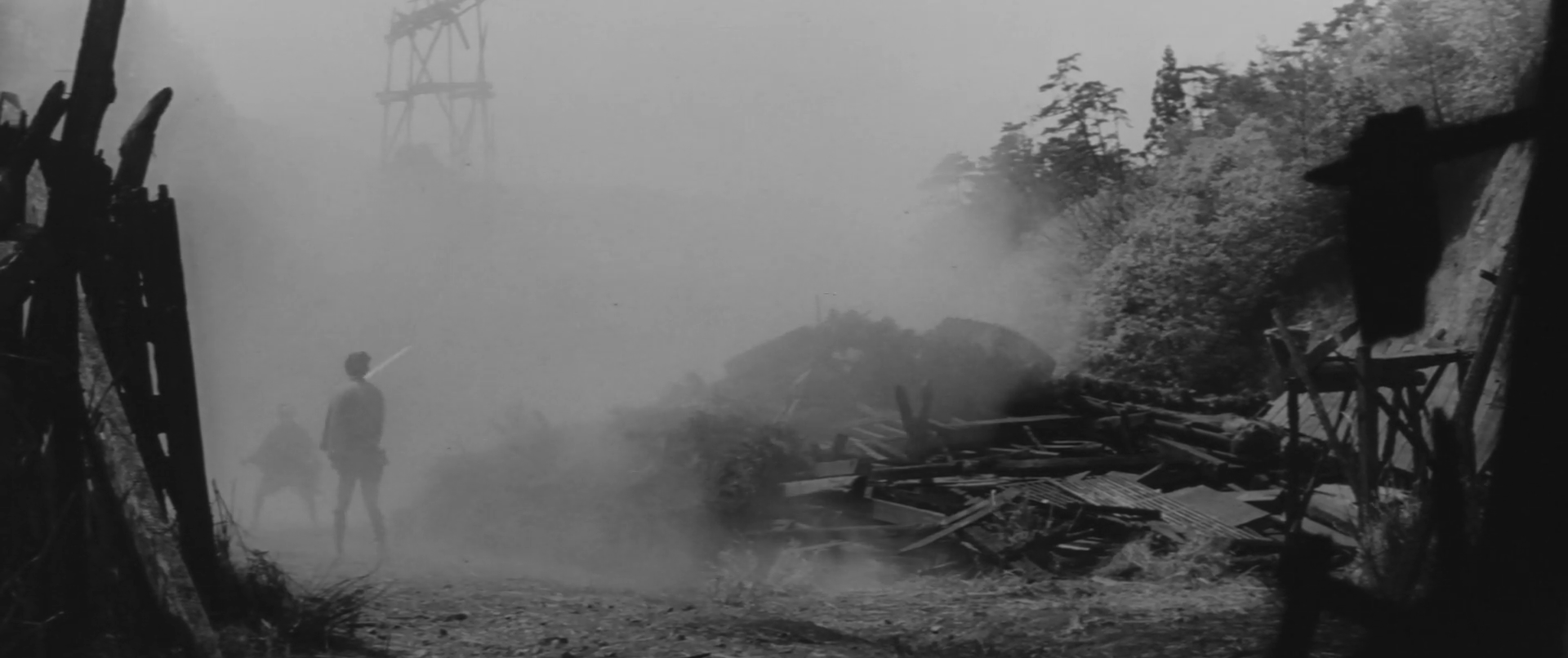
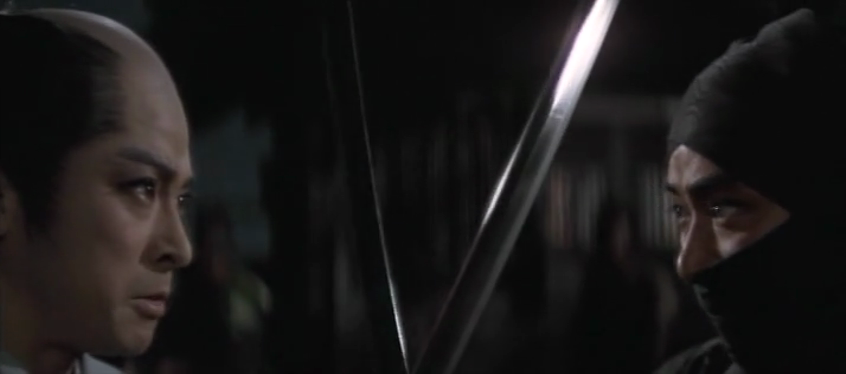
In this case, the hero isn’t so much standing up to injustice in the corrupt Edo-era society as standing up for love, exorcising his guilt over having been unable to protect Oshima by ensuring that Tokunosuke and Onaka’s romance is allowed to blossom. Even so, Onaka eventually concedes that his eyes frighten her while he remains trapped in the past reassuring her that he is aware she and Oshima are not the same and has no desire to intrude on her romantic destiny. The final showdown literally takes place in the ruins of the destroyed society as the trio take refuge in an abandoned village, an entire house later collapsing as Masakichi fights off Tohachi’s goons while beset by a heavy mist. Making frequent use of dissolves and canted angles to reflect Masakichi’s listlessness and sense of despair along with a couple of songs performed by Yukio Hashi, Ikehiro’s jidaigeki drama is an unusually romantic affair as the hero stands up to injustice only indirectly as means of rescuing love from the oppressive corruptions of Edo-era society. 


Trailer (no subtitles)

The Thief in Black (黒の盗賊, Umetsugu Inoue, 1964)

Best known as a master of the musical, Umetsugu Inoue had a long and varied filmography embracing almost every genre imaginable. He began his career at Shintoho and later joined Nikkatsu where he quickly became an in demand director often working with top star Yujiro Ishihara, but took the somewhat unusual step of going freelance in 1960 thereafter working at various studios including Shaw Brothers in Hong Kong. 1964’s The Thief in Black (黒の盗賊, Kuro no Tozoku) is not a musical but is characteristically playful even within the confines of the lighter side of Toei’s jidaigeki adventures. 

Set between the Battle of Sekigahara and the Siege of Osaka, the samurai corruption in play is essentially the burgeoning Tokugawa dictatorship, the heroes eventually uncovering Ieyasu’s secret plan for making sure his line (well, more himself in essence) remains in power for perpetuity through an insidious plot to weaken the feudal lords and ensure their loyalty to him. Meanwhile, the still developing city of Edo is beginning to turn against the Tokugawa who seem to be intent on exploiting ordinary people to enrich themselves most obviously through forcing the local workforce to renovate Edo castle rather than cleaning up the town which is apparently rampant with crime. Faced with such lack of leadership, the townspeople have come to admire a Robin Hood-like vigilante known only as the Thief in Black who alone is resisting overreaching lords. 

Part of the problem is that Ieyasu’s rule is still insecure because of the potential threat of Hideyori Toyotomi in Osaka. Consequently, they are fearful that some of the men working on the castle may be Toyotomi spies or otherwise disclose information that might benefit him if he chose to attack which is why they’ve refused the workers permission to return home to their families during the pause before beginning the second phase of works leading to further unrest. Meanwhile, corrupt local lord Tadakatsu (Ryutaro Otomo) and his sleazy priest buddy Tenkai (Minoru Chiaki) have an even darker plan in mind, preparing to simply kill the five master craftsmen in charge to ensure they present no threat. Alerted to the situation on the ground by idealistic samurai Jiro (Hashizo Okawa), their boss instructs Tadakatsu in no uncertain terms that he must treat the workers fairly in order to prevent civil unrest and/or disillusionment with the Tokugawa regime but the pair are entirely unfazed and determined to go on with their nefarious plan getting rid of Jiro if the occasion arises. 

As we later discover and in a typical jidaigeki plot device, Jiro is one of a pair of twins with his brother Kotaro (also Hashizo Okawa) abandoned because of the superstitious belief that multiple births are inauspicious. Though both men unwittingly lay claim to the name, Kotaro turns out to be the masked vigilante, his primary cause to regain the lands of the family who raised him unfairly displaced from their estates on the Musashino plains because of Tokugawa greed. Though Jiro, raised as a member of the establishment, is originally loyal to the Tokugawa who have after all brought about an era of peace, he soon begins to see that their rule is no good for the people of Edo. In his more egalitarian worldview, only by enriching the poor can they secure their rule which means less castle building and more infrastructural development along with paying people fairly for their work and absolutely not killing them afterwards. Kotaro too claims that his rebellion is for the good of the common people though unlike Jiro is much more transgressive in his ideology prepared to shake off his samurai status to become a wandering outlaw rather than content himself with the restrictive life of the heir to a samurai clan. 

Such messages are perhaps common in Toei’s brand of jidaigeki but seem unusually pronounced as the peasant workers are often given voice to lament their fate and resist their oppression more directly, pointing the finger not just at a rogue rotten lord but at the entire system built on exploiting their labour. Nevertheless, Inoue injects a hearty dose of whimsical humour to the politically charged narrative even going so far as to include a bumbling ninja claiming to be the famous Hattori Hanzo along with a comic relief magistrate and former samurai brothel owner taking his own kind of ironic revenge in getting the cowardly lords hooked on modernity with a load of faulty rifles. Obviously, Ieyasu couldn’t be stopped, but perhaps they slowed him down and reminded him of the dangers of underestimating the people. Shot with Inoue’s characteristic flare if remaining largely within the Toei house style, Thief in Black is a surprisingly direct attack on corrupt and entitled government but also a righteous romp as its idealistic heroes shuffle themselves back into their ideal positions while fighting Tokugawa oppression all the way. 


Devotion to Railway (大いなる驀進, Hideo Sekigawa, 1960)

In the early 1960s, Japan’s rail network might have felt a little uneasy with the Shinkansen already on the horizon. Hideo Sekigawa’s Devotion to Railway (大いなる驀進, Oinaru Bakushin) is in part a celebration of this essential service, the conductor and steward ever fond of reminding us that most passengers probably don’t realise that the Sakura sleeper service on which they are travelling from Tokyo all the way to Nagasaki is operated by only seven or eight people (though they don’t seem to be counting the staff from the dining car which hints at a minor source of division among the crew). While the Japanese title which means something more like “the great dash” might hint at a little more excitement, the film is less thriller than gentle ensemble drama in which the passengers and crew must come together to solve the improbable number of crises arising on this otherwise ordinary journey. 

Even so considering the film is directed by the left-leaning Sekigawa best known for his anti-war films such as Hiroshima and Listen to the Voices of the Sea, not to mention scripted by Kaneto Shindo, it is a little ironic that the central thrust of the drama revolves around junior steward Yajima’s (Katsuo Nakamura) rediscovery of his own devotion to the railway after at the beginning of the film declaring this will be his final journey. Mimicking the dilemma at the centre of Yoshitaro Nomura’s Stakeout, Yajima’s problem is that he has been engaged for two years and is sick of waiting to get married but his girlfriend Kimie (Yoshiko Sakuma) is the main breadwinner in her family and though his salary could support them as a couple it won’t stretch much further. Kimie, however, is dead against him taking the counter-productive decision to quit the railways even with the suggestion of going into business with a friend who owns a cafe, partly because it’s better to stick with a steady job than take a chance on something less certain, and partly because she knows he likes his work and all his experience will be wasted if he suddenly opts to switch careers. 

Despite its positive warmhearted message of people pulling together to overcome crisis, the film does skew a little conservative in essentially turning Kimie into a minor villain as if she were in a sense responsible for making Yajima doubt his devotion to the railway. After jumping aboard to make sure he doesn’t suddenly quit before the end of the line, she eventually has a heart to heart with the sympathetic conductor Matsuzaki (Rentaro Mikuni) that forces to her to admit that perhaps she’s just nervous about the nature of married life and has been making trouble where there needn’t be any, now certain that it’s better to just get married as soon as possible and let the rest figure itself out. 

Meanwhile, there’s additional tension seeing as a waitress from the diner car has an obvious crush on Yajima and is quite resentful on being presented with his fiancée, but even this is eventually solved with the two women becoming accidental friends during the climatic crisis, a landslide caused by a typhoon, that grants each of the passengers an epiphany about what it is they really want out of life. While waiting for the maintenance crew from the next station to arrive, Yajima, still in a bad mood, stands around doing not much of anything until coaxed into action by Kimie and Matsuzaki, Kimie too eventually jumping off the train to solve this literal roadblock in their relationship followed by the dining car girls and a young woman only on the train to transport blood to a hospital needed urgently by 2pm the next day. This sense of collective endeavour opening the way gives everyone on board a new sense of positivity, allowing Kimie and Yajima to repair their relationship and a man who tried to take his own life in the night to gain a new sense of hope for future. 

Several times Yajima is reminded that he has the lives of the passengers in his hands which is undoubtedly true given that there is always the chance of disaster yet also perhaps going a little far seeing as most of his job is checking tickets and providing travel information. Nevertheless, there is a lot going on on this train from eloping couples to yakuza assassins, not to mention the twin sights of a newly wed couple and a pompous politician momentarily disembarking at each stop to be feted either by workers at their factory or the local members of their political party. The snooty politician even gets a minor comeuppance from a famous pickpocket who steals his watch as a joke and then gives it back only to dismissively ignore his thank you message while eating a giant apple. 

Surprisingly handsome for a Toei programmer, Sekigawa’s deft direction lends a claustrophobic sense of dread to the interior of the train stalked by a vengeful assassin, while simultaneously making it an essentially safe space guarded by the ever solicitous crew keen to help an anxious young woman with a long journey ahead of her arrive on time to get home to her chronically ill mother. An effective piece of advertising for the Sakura sleeper service (which ran until 2005 albeit in slightly different forms), Devotion to Railway may surprise in its insistence that the hero rededicate himself to his employer but is nevertheless a charming ensemble drama which finds a new sense of positivity in the solidarity between friends and strangers coming together to overcome crisis through common endeavour. 


Original trailer (no subtitles)

The Golden Bat (黄金バット, Hajime Sato, 1966)

Named after Japan’s oldest brand of cigarettes, Golden Bat is regarded by some as the nation’s first superhero created as a character for Kamishibai in 1931 by Takeo Nagamatsu and Suzuki Ichiro. Drawing inspiration from mythological illustrations, Nagamatsu and Ichiro had however intended Golden Bat to be rooted in science rather than legend which might seem ironic on viewing Hajime Sato’s 1966 piece of Toei tokusatsu titled simply The Golden Bat (黄金バット, Ogon Bat). 

Though Toho might be more closely associated with big screen tokusatsu adventures, Toei also had a small sideline in special effects movies as well as a series of hugely popular television franchises. Back in the 1960s, however, Golden Bat was something of an outlier in that it shifts away from the predominant messages that underlined many post-war tokusatsu in the importance of responsible science favouring instead a kind of throwback to the 1930s serial origins of the title character. As the film opens a factory worker with an obsessive though amateur interest in astronomy, Kazahaya (Wataru Yamakawa), tries to convince a professor that the planet Icarus has left its regular orbit and is on an imminent collision course with the Earth. The professor, however dismisses him, stating that his story might appeal to the tabloids but “it is essential that scientists examine any situation carefully” (which he doesn’t seem interested in doing). An assistant then arrives to back him up, adding that as they live in a world in which mankind has been to the moon “the universe no longer poses any terror for us” which sounds like quite an irresponsible statement for a scientist to make. 

In any case, according to Kazahaya Icarus is going to collide with the Earth in under 10 days so there isn’t much time for careful investigation anyway. On his way out of the building he’s accosted by two scary looking guys, but contrary to expectation they aren’t from some shady government organisation carting him off because he knows too much but from the super secretive Pearl Research Institute which has apparently been following him closely and wants to offer him a job because he’s right about Icarus. In another break with the usual tokusatsu anti-nuclear messages, Pearl has developed the “Hyper Annihilator Beam Cannon” which, using a special lens they haven’t developed yet, can turn a ray of atomic light into a heat beam with the power of a thousand H-bombs. They plan use this to blow up Icarus before it hits the Earth (no mention is ever made about whether or not Icarus is also inhabited). It’s about this time that their expeditionary force begins sending distress signals and then drops out of contact, the gang then discovering Icarus is part of a master plan operated by the evil inter galactic villain Nazo who thinks that only he deserves to exist so wants the Earth destroyed. 

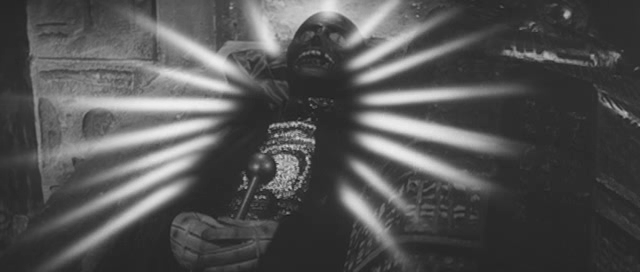
Nazo is Golden Bat’s arch enemy, here a man in a rat costume with four eyes and a large metal wrench for a hand. Travelling to find their fallen comrades, the gang discover Golden Bat in his sarcophagus hidden in what looks like an ancient temple with instructions to wake him up with a single drop of water should humanity be in crisis which he predicts will happen 10,000 years after he went into storage in Atlantis. Professor Pearl’s adorable 12-year-old granddaughter Emily (Emily Hatoyama) does just this and then becomes his point of contact, but in true tokusatsu fashion after simply gifting them the special lens and fighting off Nazo’s goons Golden Bat flies off into the sunset with important superhero business to attend to. Meanwhile, Captain Yamatone (Sonny Chiba) and the others attempt to save the Earth while battling Nazo’s three most dangerous henchmen: wolfman Jackal (Keiichi Kitagawa), fish woman Piranha (Keiko Kuni), and Keloid (Yoichi Numata) who has a large skin lesion on his face which honestly seems in poor taste. 

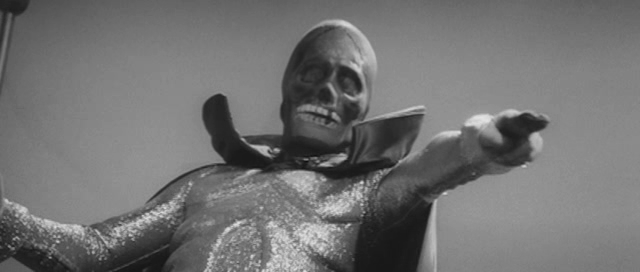
As in his other films, Sato appears to have his tongue very much in his cheek given that the performances of his cast are decidedly broad with a tendency towards evil glares and reaction shots, his camera often zooming in directly on villainy. Golden Bat meanwhile is often seen striking theatrical poses while uttering phrases such as “for justice alone do I fight!” and hitting people with his baton to make them behave. You might think children would find a skeleton man with an eyeless gold skull a little frightening, but Golden Bat seems to make it work while offering his own non-evil laugh as he cheerfully returns to save the day until finally forced to tap the sign he’s helpfully put up reading “those who attempt to subjugate the world through force by their own force shall perish”. Nazo meanwhile has a definite nautical theme, travelling by shark submarine/aeroplane and giant squid-shaped earth borer with laser eyes but is finally undone in surprisingly violent fashion by Golden Bat’s Baton of Justice. Defiantly irreverent and flying in the face of tokusatsu’s general responsible science stance, Golden Bat is exceptionally silly and makes little literal sense but is undeniably fantastic fun as the skeletal superhero does his best to ward off galactic imperialism. 


Original trailer (no subtitles)

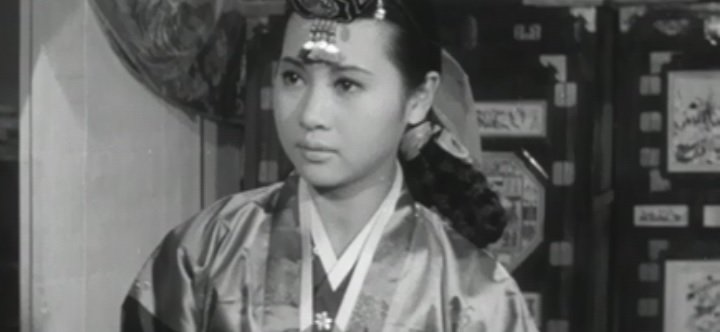
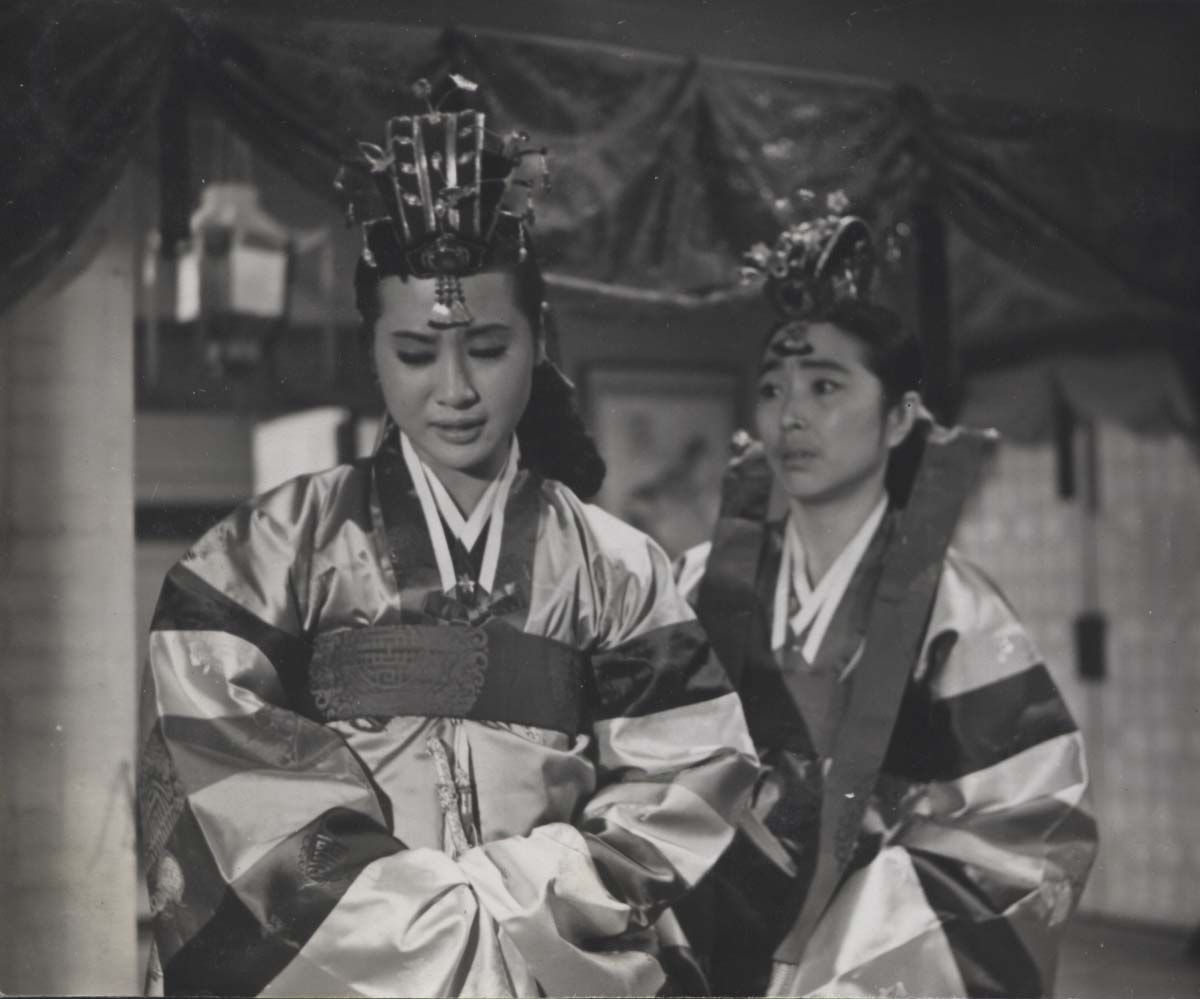
A Princess’ One-Sided Love (公主님의 짝사랑 / 공주님의 짝사랑, Choi Eun-hee, 1967)

“Those are the rules of the palace for a princess” the rebellious heroine of Choi Eun-hee’s second directorial feature A Princess’ One-Sided Love (公主님의 짝사랑 / 공주님의 짝사랑, Gongjunimui Jjaksarang) is told, though the “palace” is really the society and the “rules” those which all women are expected to “endure”. Quietly and perhaps subversively feminist, Choi’s humorous tale draws inspiration from Roman Holiday but unexpectedly engineers a happier ending for its lovelorn heroine who is permitted to transcend the constraints of her nobility if not quite of her womanhood. 

Tomboyish princess Suk-gyeong (Nam Jeong-im) is the youngest of six princesses and the last to remain at home in the palace yet to be married. Consequently, she is infinitely bored all the time and continually up to mischief in part because as a princess she is not permitted to leave the estate and has a natural curiosity about the outside world. That curiosity is further sparked when she lays eyes on handsome scholar Kim Seon-do (Kim Gwang-su) who picks up a shoe she had dropped while inappropriately running on the day of her mother’s birthday celebrations. Possibly the first young and handsome man she has even seen, Suk-gyeong cannot help but be captivated by him and manages to convince her sisters to help her escape the palace to venture in search of her probably impossible love under the pretext of visiting her grandparents whom she has apparently never visited before.  

Like Audrey Hepburn in Roman Holiday, what Suk-gyeong wants is a break from the “tedious and pathetic” life of a princess, but soon discovers herself to be entirely naive as to how the “real world” works. Her sisters agreed to help her in part because they acknowledge how difficult it was for them when they married and had to leave the palace with no understanding of how to live outside it. Having left in the clothes of a servant, the first thing that Suk-gyeong realises is that the outside world is governed by a different set of hierarchies and even if she’s a princess she is still a woman and therefore presumed to be “inferior” to men to whom she is expected to remain subservient. Her grandfather, who has never met her before, wastes no time exerting his patriarchal authority in his own, comparatively humble, home. “A woman, once married, must abide by the rules of her new family, the confucian ethics, and respect your father and husband and become a wise and obedient wife” he explains, striking her across the calves with a cane to teach her a lesson for her imperious tone in failing to pay him the proper respect. 

Failing to use appropriately polite language with those around her, forgetting that she should now be deferent both to men and to those who exceed her in age, gets her into constant trouble. Nevertheless, a trip to the marketplace gains her a further understanding of the extremes in her society firstly when she misunderstands a rice cake seller’s patter and assumes he intended to gift her some of his produce as he might to a princess, and secondly when she bumps into a woman with a baby on her back and breaks the pots she was hoping to sell to pay for her husband’s medical care. Introduced to such desperate poverty, the undercover princess knows not what to do but later gifts her a jade pin hoping perhaps to at least cure the husband’s malady, only to wander into another dangerous situation when she is mistaken for a sex worker by a trio of drunken noblemen who pull her into a drinking establishment which is in fact a brothel. Naively drinking with the men she mocks them for their attempts to play on their names each boasting of their famous fathers and personal connections to men she knows to be elderly cranks and obsequious fools. Shocked to discover what goes in establishments like these she tries to make her escape but is almost assaulted by one of the men, Shim, who is later posited as an ideal match by her unsuspecting mother laying bare another patriarchal double standard as Shim plays the part of the gentleman in order to effect his advancement. Luckily, she is saved by Seon-do who happens to be passing but mistakes her for a boy because of the disguise she is currently wearing. 

Selfish in her naivety, Suk-gyeong is warned that her impossible crush might end up harming Seon-do’s hopes of making it into the elite through success in the state exam while he, once made aware of the truth, immediately does the right thing by kindly rebuffing the princess’ inappropriate interest leaving her with a poetic love letter claiming he’s gone off to a temple for a spell of intensive study. Perhaps improbably it’s the love letter that eventually saves them, touching the king’s heart and convincing him to acquiesce to his sister’s wishes of escaping the gilded cage of nobility. Suk-gyeon’s pleas to renounce her royal title might also stand in for a desire to renounce womanhood in that it “stops us from doing anything we want. We are matched up with an unknown husband and we spend our youths in misery for our lives are tedious and pathetic”, reminding her brother that as a king but in truth as a man he cannot understand even while he reminds her that these are the “rules” endured by countless ancestors. The king is moved, he breaks with tradition and frees his sister yet he does so to allow her to become a wife even if he has also granted her the freedom to choose her husband and live in the outside world unconstrained by the strictures of nobility but nevertheless bound by oppressive patriarchal social codes. Nevertheless, it’s an unexpectedly progressive conclusion advocating for change and personal happiness over the primacy of duty and tradition. 


A Princess’ One-Sided Love streamed as part of the Korean Cultural Centre UK’s Korean Film NightsFilming Against the Odds 

Vengeance of the Phoenix Sisters (三鳳震武林, Chen Hung-Min, 1968)

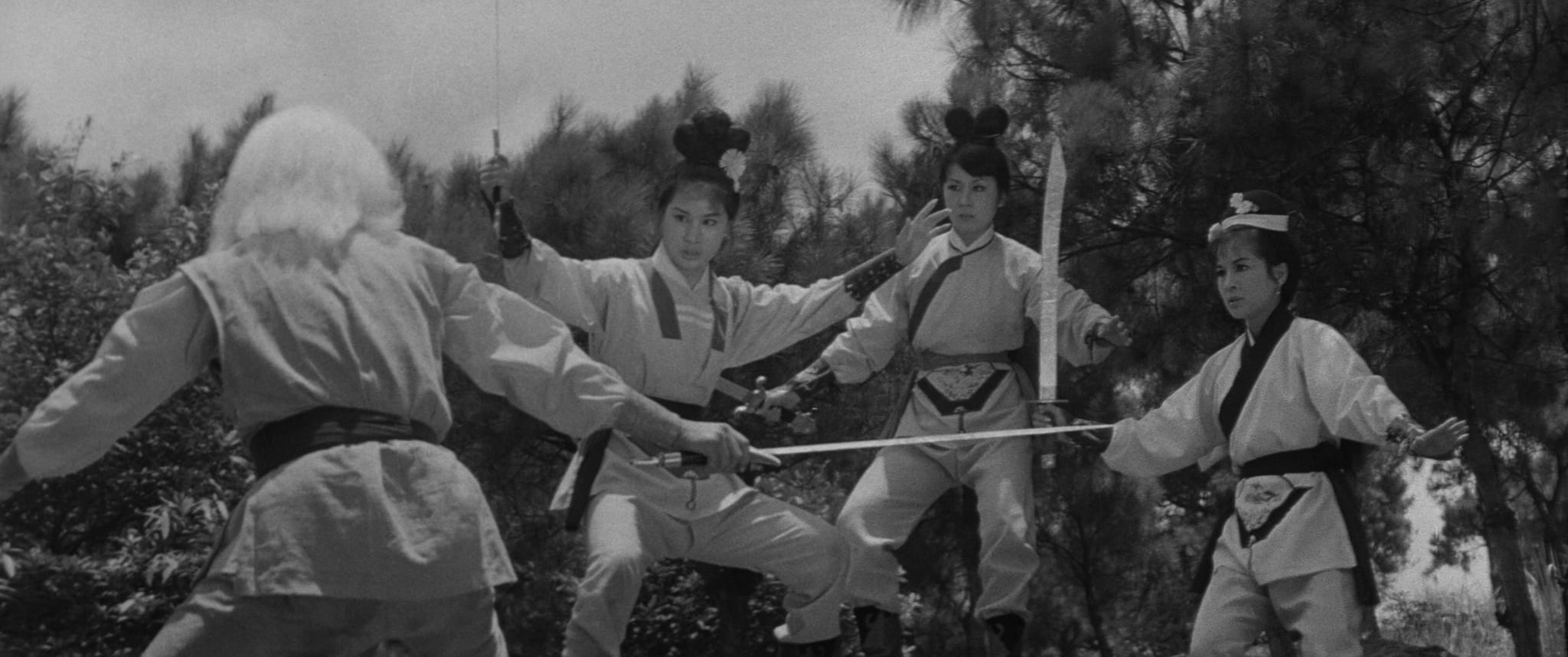
“We’re big, strong men. Why should we worry about three little girls?” a trio of bandits reflects on having allowed the children of their enemy to escape their massacre thereby leaving themselves open to future reprisals. As the title of Chen Hung-Min ’s Taiwanese-language wuxia Vengeance of the Phoenix Sisters (三鳳震武林) implies, however, they are quite wrong to be so dismissive of “three little girls” who will later grow up to fulfil their filial duty by avenging the deaths of their parents even though they are daughters rather than sons. 

During the exciting nighttime prologue, three bandits attack the house of Yang formerly a sheriff. The three men are taking “revenge” for his attempt to arrest them 15 years previously which they seemingly managed to evade and have been on the run ever since. Taken by surprise, Yang sends his three daughters away to safety with his servants, but is ultimately unable to do more than hold the bandits off before both he and his wife are killed. In the final moments before dying however, he is able to impart a few last words to second daughter Xiufeng instructing her to avenge their deaths while advising the nanny to take her to one of his sworn brothers way up in the mountains. 

This is where we meet Xiufeng (Yang Li-Hua) again 15 years later now dressing as a man and having apparently spent the remainder of her childhood perfecting her martial arts but now determined to set out alone to pursue vengeance as is her filial duty. The sisters have become scattered with the youngest, Zhifeng (Chin Mei), apparently unaware of her parentage having been brought up by the servant who helped her escape in a nearby town which is itself a victim of warlord Cao one of the bandits who killed her father who has now it seems become wealthy and powerful on the back of his life of crime. Cao is in fact so wealthy and powerful that he’s been exacting his droit du seigneur over the local population, Xiufeng rescuing a young woman in the middle of being carted off by Cao’s goons seconds after arriving in town only for Cao to ironically settle on Zhifeng as his next target despite being warned that she’s reputed to be highly skilled in martial arts. 

The the fact that each of the three bandits has become successful in the intervening 15 years is another wrong that sisters must right in their quest not only for vengeance but for justice and as the bandits seemingly have no children or family members the cycle of revenge will end only with them. Their actions will restore a kind of order not only in drawing a line under the deaths of their parents so that they can move on, but removing the bandits’ corruption so that the local population is no longer forced to live in fear of their cruel tyranny. This sense of anxious devastation is rammed home as, in a scene inspired either by contemporary samurai dramas or the western, Xiufeng slowly makes her way towards a low set camera to enter the town while in the foreground a lone figure collects debris from the otherwise empty streets. 

Xiufeng is, in genre tradition, dressing as man in order to pursue her revenge going under the name Lin Keding and exerting absolute authority unafraid of anything or anyone. Chen had worked as an editor on King Hu’s Dragon Inn and in true wuxia fashion includes a classic fight in a teahouse that also finds Xiufeng following her adoptive father’s advice to use her wits to win as she quickly realises that Lord Cao has set her up in revenge for robbing him of the girl by getting the innkeeper to poison her dinner. Meanwhile, in a repeated motif, the innkeeper’s wife keeps flirting with her adding to gender ambiguity. Older sister Qingfeng (Liu Ching) meanwhile whose protector apparently fell off a cliff and died some time ago sees no need for a similar pretence though she and Zhifeng later almost have a falling out after being distracted from their mission on encountering the “handsome hero” Lin Keding which is about as awkward a situation as one could imagine until they figure out that they’re after the same guy and Xiufeng’s true identity is confirmed simply by letting down her hair. 

In any case, the Pheonix Sisters are perhaps unusual even within the context of contemporary wuxia in that they pursue their revenge entirely independently with no male assistance or romantic involvement save the awkward flirtatious banter between the other two sisters prior to realising that Lin Keding is really Xiufeng. Nevertheless, on having completed their quest they throw away their swords, implying at least that they now intend to return to a more conventional femininity remaining strictly within the confines of patriarchal filiality rather than choosing to free themselves from it. Even so, the treatment they receive is perhaps harsher than that a male avenger may have faced, Cao sneering that he loves tough women who can fight while the other two bandits Ke and Lu eventually decide to burn Qingfeng and Zhifeng alive only for Xiufeng to arrive and dramatically save them just in the nick of time. 

Chen’s take on wuxia is indeed surprisingly violent, the cruelty in the bandits’ swords fully evidenced as they cut down not only Yang the former sheriff but his wife too. Meanwhile he makes good use of thematic symmetries typical of the genre, the trio of amoral bandits opposed by the trio of chivalrous sisters, pursuing them for a crime they committed 15 years previously to take revenge for a slight 15 years before that while the sense of circularity is further emphasised through repeated imagery in Chen’s elegantly framed widescreen composition. Despite the comparatively low budget typical of Taiwanese-language cinema which apparently saw Chen having to resort to car headlights in order to light the film during night shoots, he manages to craft fantastically entertaining period adventure filled with well choreographed action sequences and a playful sense of unease as the sisters strive to reunite their family through their quest for justice and vengeance. 


Encounter at the Station (難忘的車站, Hsin Chi, 1965)

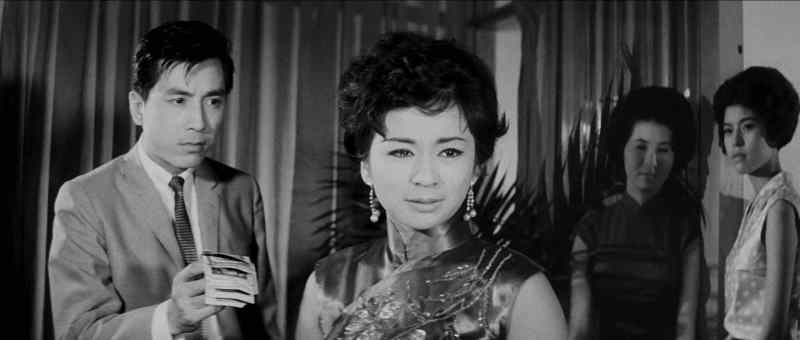
Destructive and outdated conservative patriarchal social codes drive a young man to madness, cause a young woman to lose her sight, and push another towards nervous breakdown in Hsin Chi’s subversive Taiwanese-language romantic melodrama Encounter at the Station (難忘的車站) which rather than reinforcing the status quo eventually argues that it’s time to leave the old ways behind. Adapting the popular novel Cold and Warm World/Human Fickleness by Chin Hsing-chih, Hsin swaps the wartime setting for a purely contemporary tale in which the major victim of a patriarchal society turns out to be a rich boy in love with a poor girl while the arch villain is in fact his status-obsessed mother.

As the title perhaps implies, Tshui-Giok (Chin Mei) and Kok-Liong (Shih Chun) share a brief encounter at a train station when she drops her ID on the way to school and he picks up and returns it to her. For each of them it is love at first sight, student Kok-Liong idly dreaming of Tshui-Giok at home envisioning her in differing settings and eventually wearing a wedding dress. They continue to meet “accidentally” at the station and develop an innocent romance but while Tshui-Giok has problems at home, her adoptive mother suffering a serious illness while her step father has a serious gambling problem, Kok-Liong is attempting to put off an arranged marriage set up by his mother to a girl of a similar background, Hun-Kiau (Ho Yu-Hua). 

To begin with, the barriers between them would seem to be those of money and class though it is a sense of shame leading to minor deception which finally keeps them apart. After her mother dies, Tshui-Giok’s step father indentures her to a hostess bar after which she stops going to the station and meeting Kok-Liong. When he runs into by her accident, she tells him that she’s dropped out to look after her sickly father and is taking night classes but continues to go on innocent dates with him on her days off. When he discovers the truth, Kok-Liong borrows money from his father to buy her contract at the bar and proposes marriage again lying to his mother that Tshui-Giok is the orphaned daughter of his former teacher. Interestingly enough, it is Kok-Liong’s father who fully sympathises with his son and convinces his wife to allow him to exercise his romantic freedom, his mother reluctantly agreeing that the pair can marry when Kok-Liong returns from studying abroad in America secretly hoping he’ll go off the idea while he’s away. 

Despite her conservatism, Kok-Liong’s mother does not lack compassion, in fact Tshui-Giok later describes her as “kind” while trying to reason with her once her past as a bargirl is discovered. Nevertheless, she cannot let go of her old-fashioned ideas of properness, persuading Tshui-Giok that her love for Kok-Liong is toxic. She agrees that Tshui-Giok is a good woman who has performed the role of the perfect daughter-in-law while living in the house waiting for Kok-Liong’s return and seems at least partly conflicted but insists that Tshui-Giok’s background disqualifies her as a suitable wife for the son of a prominent family. Again she forces her to lie, leaving a goodbye note stating that she’s tired of waiting and has chosen to marry a wealthy man she met by chance. Her exit paves the way for Hun-Kiau’s return, Kok-Liong agreeing to a rebound marriage believing his mother’s claims that Tshui-Giok ran off with another man while his father cautions his wife with irritation that all of this is likely to blow up in her face.

Unlike his wife, Kok-Liong’s father continues to sympathise with the young couple indifferent to Tshui-Giok’s past while worried that his wife’s decision to throw her out (taken in his absence) may leave her with no choice but to become a bargirl again. This is in fact what ends up happening, a minor comment on the economic situation revealing that Tshui-Giok cannot support herself with a job in a factory because the pay is so low and the hours are irregular. She finds herself ironically having to return to the fringes of the sex trade in order to earn back the money Kok-Liong used to free her from it. Kok-Liong’s mother may be keen to maintain the little power she has in a patriarchal social system in enforcing her choice for her son’s bride, but her obsession with reputation and social standing eventually ruins all three lives. The marriage between Hun-Kiau and Kok-Liong is understandably unhappy leaving Kok-Liong a resentful drunk which is how he ends up re-encountering Tshui-Gok in a Taichung bar at first angrily berating her, becoming violent and threatening rape until realising she is still wearing the necklace he gave her as a symbol of their love. 

In some ways, Kok-Liong is just as much of a prisoner of this system as either of the women manipulated into an arranged marriage by his overbearing mother. Having become economically prosperous, he now has the resources to support two households setting up a home with Tshui-Gok in Taichung while keeping his marriage a secret from her leading her to believe they are simply waiting for his parents to come around. The effects of this patriarchal mindset are further felt in the fact that Hun-Kiau’s baby is female, hinting at the wrongness of their union, while Tshui-Gok’s is male. A doting father to his son, Kok-Liong all but ignores his daughter and rarely returns to his “family” home in Fengyuan forcing Hun-Kiau’s hand as she, like his mother, forces the good and proper Tshui-Giok to accept that her existence is ruinous to Kok-Liong’s future. Hun-Kiau unfairly accuses her of “stealing” Kok-Liong’s affections, making her own daughter tearfully demand that Tshui-Giok return her husband to her. 

Whatever she thought she could accomplish with this gambit, it’s unlikely that it would spontaneously reignite Kok-Liong’s buried love for her but she could hardly have expected that it would finally push him into mental breakdown unable to accept the total lack of power he has in his family life while manipulated firstly by his mother and then by his wife. Caught in an impossible situation, the young women are unable to hate each other caring most for their children rather than tussling over a man but each in their own way constrained, Hun-Kiau guilty of the same mindset as her mother-in-law if to a lesser extent while Tshui-Giok, shamed by her past and conscious of the class difference, is also wedded to outdated ideals which force her to believe that she is not good enough and only ruins Kok-Liong’s life. Fearing her son will be disadvantaged by his illegitimacy, she entrusts him to Hun-Kiau and goes to look for her birth relatives while returning to seamstressing and general emotional strain eventually lead to her losing her sight. 

Yet where traditional melodramas often reinforce the current social order, Encounter at the Station eventually allows the two lovers to reunite insisting that the mother-in-law is in the wrong, the old ideas belong to an old society and should be abandoned to facilitate a greater happiness the couple eventually leaving the family home for new one of their own. The ending is however a little too happy given the solemnity of the previous scenes. Hun-Kiau becomes the greatest casualty having allied herself to the mother-in-law’s philosophy which cannot progress into the modern society, succumbing to a mental breakdown before finally giving her blessing to Tshui-Giok. The patriarchal society disables them all, the men weak and shallow while the women are resilient but equally unable to pursue their desires finally only able either to protect their children or unethically misuse the little power they have over them. Familial bonds are eroded by notions of social propriety that force everybody to lie, or at least to conceal the truth, in order to present the facade of respectability. Featuring a number of musical sequences recounting the lovers’ sorry tale of romantic woe, Hsin hints at tragedy but eventually offers them a happier future if only in actively stepping away from the constraints of the past. 


Trailer (English subtitles)

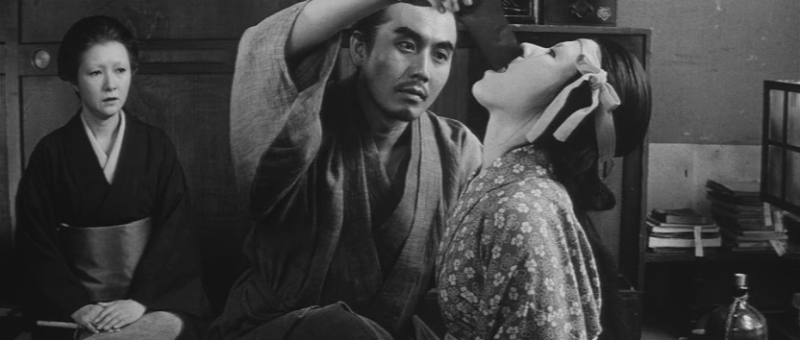
The Wife of Seishu Hanaoka (華岡青洲の妻, Yasuzo Masumura, 1967)

The close relationship between two women is disrupted by the reintroduction of a man in Yasuzo Masumura’s fictionalised account of the rivalry between the wife and mother of pioneering Japanese doctor Seishu Hanaoka. Scripted by Kaneto Shindo and adapted from the novel by Sawako Ariyoshi, the refocusing of the narrative is apparent in its title, not the life of but The Wife of Seishu Hanaoka (華岡青洲の妻, Hanaoka Seishu no Tsuma) less a tale of scientific endeavour than of domestic rivalry born of the inherently patriarchal social codes of the feudal society which cannot but help pit one woman against another while forcing each of them to play a role they may not wish to fulfil in order to secure their status and therefore their survival. 

Samurai’s daughter Kae (Ayako Wakao) first catches sight of the beautiful Otsugi (Hideko Takamine) at only eight years old and is instantly captivated by her, a fascination which persists well into adulthood when she is approached to marry into the Hanaoka household as wife to oldest son Seishu (Raizo Ichikawa) away studying to become a doctor like his father. Kae’s father originally objects to the match because of the class difference between the two families, Seishu’s father Naomichi (Yunosuke Ito) being only a humble country doctor of peasant stock whereas they had envisaged a grander station for their only daughter. Yet Kae is already old not to be married and continues to decline prospective suitors and so her mother and nanny (Chieko Naniwa) are minded to put it directly to her discovering that she is in fact more than willing to become a Hanaoka though mostly it seems in order to get close to Otsugi whom she has continued to idolise. 

The strange thing is that the wedding is conducted in Seishu’s absence, a medical text standing in for him while Kae in effect marries her mother-in-law Otsugi. These early days are spent in blissful tranquility as Kae does her best to be the ideal daughter-in-law, Otsugi even remarking that she’s come to love her more than a daughter. The two women share a room, Kae often staring longingly at the back of Otsugi’s head, their relationship one of mutual respect and affection that allows them to forget their respective stations but when three years later Seishu finally returns, it forces them apart in reverting to the roles of wife and mother their statuses conferred only by proximity to a man. 

Pregnant with her first child and about to become a mother herself, Kae’s resentment towards Otsugi begins to boil over. In an ironic premonition of the way the relationship between Masumura and his muse would eventually break down, she claims to have seen through Otsugi’s beauty and concluded that she is cold and calculating believing that she only brought her into the household as an unpaid servant forcing her to work a loom to raise money for Seishu’s medical training. Alternately jealous and condescending, Otsugi’s resentment is mediated through attempts to undermine her daughter-in-law’s authority finally leading to an ironic and absurdist battle between the two as they attempt to outdo each other volunteering to become test subjects for Seishu’s ongoing experiments to discover a safe anaesthetic in order save patients who require surgery but cannot endure the trauma. 

The marriage itself perhaps represents a moment of change in the feudal society, it becoming clear that the samurai are on their way down while skill and knowledge will define success in this new age of enlightenment. While Seishu works on his anaesthetic, the superstitious local community begins to view the Hanaokas with suspicion, believing that the misfortune that befalls them is the result of a curse owing to the large number of cats and dogs which have become casualties of Seishu’s failed experiments while a pedlar brings news of a mysterious disease attributed to the rain which is in fact due to mass malnutrition following a famine caused by the bad weather. When news of Seishu’s prowess as a doctor spreads they are soon overwhelmed with patients, many of whom cannot pay but are seemingly treated anyway. 

Seishu’s eventual victory is one of science over superstition, but it also requires faith which is the battleground contested between wife and mother. Having found a successful solution in cats, Seishu needs human test subjects with both instantly volunteering only to become locked into an absurd, internecine contest to prove who is the most self-sacrificing. The competition goes so far that it effectively becomes a game of dare with each determined to be the one to die for Seishu’s discovery but later realising that the stakes are even higher than first assumed because the winner will be dead but the loser saddled with guilt and possible ostracisation as someone who allowed their mother/daughter-in-law to die to in their place. 

Even so, the pair of them are described as “wonderful examples of womanhood” in their willingness to risk their lives for their “master’s success”. Kae is reminded that a woman’s job is to give birth to a healthy baby, later weaponising her ability to do so as currency in realising that Otsugi has all the control but the one thing she can’t do is bear Seishu’s child. Ironically enough, the cases Seishu is trying to treat are of aggressive breast cancer, the oft repeated maxim being that a woman’s breasts are her life and to remove them is as good as killing her contributing to the sense that maternity is the only thing that gives a woman’s life meaning. It’s not without irony that the first successful surgery under anaesthesia directly juxtaposes a massive tumour removed from a woman’s breast with a baby being removed from a pregnant Kae who, at this point having lost her sight as a consequence of Seishu’s experiments, must bear the pain with no relief. 

Brought together by tragedy, Kae comes to a better understanding of her relationship with her mother-in-law only after she dies learning to see her once again as the kind and beautiful woman she met at eight years old while her unmarried sister-in-law having witnessed their painful war of attrition prays that she won’t be reborn as a woman glad that she was never forced to become a bride nor a mother-in-law. “The struggles of the women in this house were in the end just to bring up one man” she laments, suggesting that Seishu most likely noticed the conflict between the two and used it to his advantage in getting them to participate in his experiments as they desperately tried to prove themselves the better through dying for his love. 

Going one step further, it seems that being a woman is an exercise in futility the only source of success lying paradoxically in birth or death alone, the natural affection between Otsugi and Kae neutered by the presence of Seishu who inserts himself as the pole around which they must dance for their survival. Kae becomes a local legend, a woman who sacrificed her sight in service of her husband but now rejects this mischaracterisation of her life along with the implication that it’s somehow a wife’s duty to deplete herself for her husband’s gain retreating entirely from the society of others while Seishu’s practice continues to prosper. Even so Masumura ends on a note of irony in the literal transformation of Kae into the figure of Otsugi recreating the opening scene as she walks among the bright flowers she can no longer see.


Original trailer (no subtitles)

Sun Above, Death Below (狙撃, Hiromichi Horikawa, 1968)

“Fighting is the only way I have to live my life” according to a hitman battling existential ennui in Hiromichi Horikawa’s Toho action B-movie, Sun Above, Death Below (狙撃, Sogeki). A starrier affair than the studio’s other forays into moody crime, Horikawa’s psychedelic exploration of a killer drawn to death nevertheless situates itself very much in the world of 1968 in which the hero’s attempt to escape his sense of emptiness through killing is directly linked to an increasing economic prosperity and its concurrent costs in the nation’s current geopolitical positioning. 

As if to signal this sense of societal anxiety, the first target Matsushita (Yuzo Kayama) knocks off is sitting in the back row of the last carriage on the Shinkansen out of Tokyo. His next job, however, will apparently be more complicated. A criminal gang want him to take out “five or six” targets at a specific location in order to intercept a fortune in gold smuggled by, as later becomes clear, an international Chinese gangster, though the men at the waterside greet each other in Arabic. The hit does not go entirely to plan but Matsushita is later able to bring the situation under control allowing the gang to get their hands on the gold. The smugglers, meanwhile, are obviously unhappy with this turn of events and send in their best hitman (Masayuki Mori), who permanently travels with a blonde companion, to take back what’s theirs. 

Matsushita is a killer for hire so he doesn’t really care very much about the gold and is even annoyed when the gang try to pay him with it, correctly surmising they didn’t really expect him to succeed so haven’t bothered bringing any cash. As he explains to love interest Shoko (Ruriko Asaoka), he doesn’t really care about anything. He simply shoots at the best target, man, with his favourite gun. He kills to feel alive, explaining that the intense concentration in which he becomes one with the gun as if it were an extension of his own body allows him to overcome his sense of existential dread which is why he’s so ice cool all the time. 

A fashion model obsessed with rare butterflies and the paradise to be found New Guinea Shoko dreams of a time in which they can become one under the sun, envisioning a future in which Matsushita has become friends with all the creatures of the forest. Yet as Matsushita tells an old friend, Fukazawa (Shin Kishida), running a secondhand gun shop near a US army base as a front for his revolutionary activities, he has no dream or ideal and knows nothing other than killing. Whereas as his friend is apparently working for some kind of never quite explained but seemingly left-wing/anarchist cause, Matsushita simply lives out his days of emptiness on some level knowing he’ll probably never make it to Shoko’s New Guinean utopia. 

Fukazawa nevertheless hints at the political instability all around them, firstly agreeing to pawn a gun for a pair of Americans after beer money, and then by handing Matsushita an AK47 apparently smuggled back from Vietnam via the American base. Matsushita’s sense of ennui is born of this growing unease with empty capitalistic consumerism and a concurrent sense of powerless in Japan’s ongoing complicity with American foreign policy in Asia. Displaying a sense of Sinophobia familiar from many similar films of this era, the big boss turns out to be Chinese while many that surround him are also from outside of Japan even if Matsushita’s rival is just a slightly older, crueller version of himself. 

One of Toho’s more serious crime dramas, Horikawa often veers into experimental territory with his psychedelic butterfly imagery Matsushita apparently having some kind of vision while experiencing carnal ecstasy that equates climax with literal gunshot, while his usage of stock footage featuring the New Guinean indigenous community along with an out of place blackface tribal dance performed in a hotel room clearly display some outdated attitudes otherwise unacceptable and potentially offensive in the present day. Nevertheless, Sun Above, Death Below largely lives up to its hardboiled title, the Japanese “Sniping” perhaps also hinting at the various ways Matsushita eventually strays into the crosshairs of his own inevitable destiny. 


Original trailer (no subtitles)