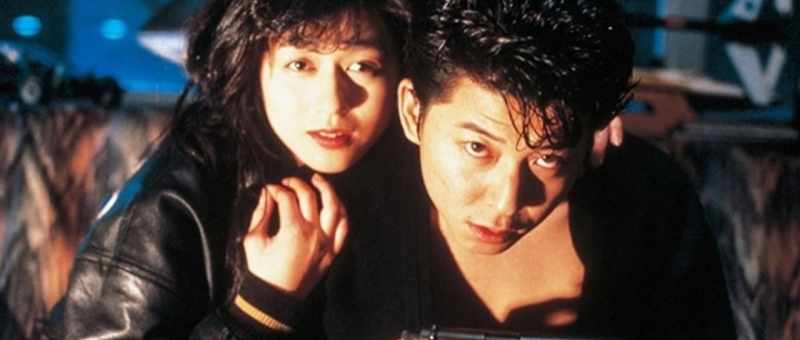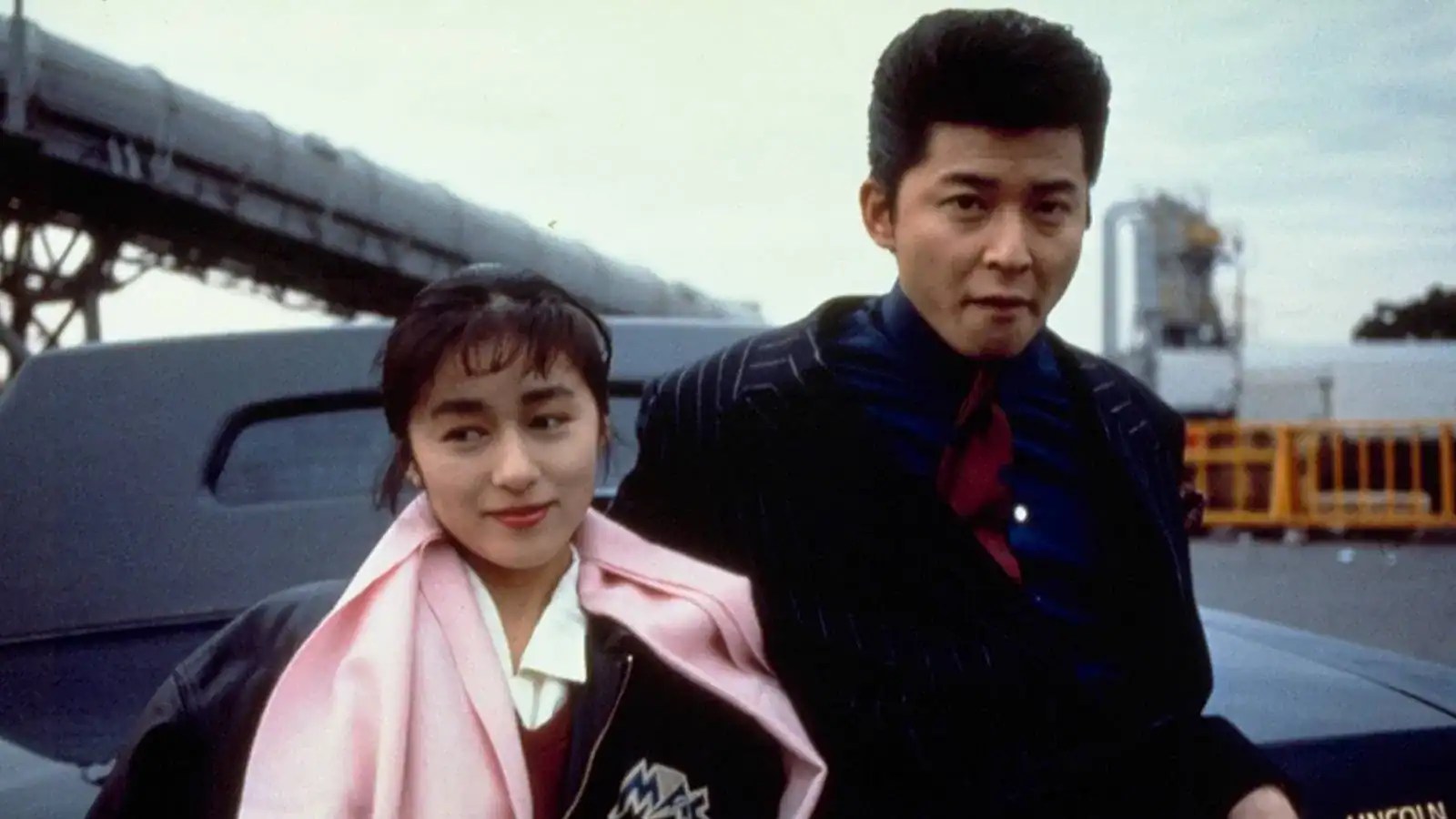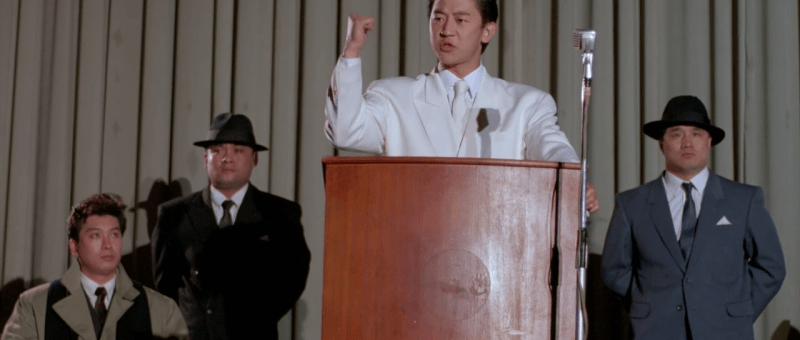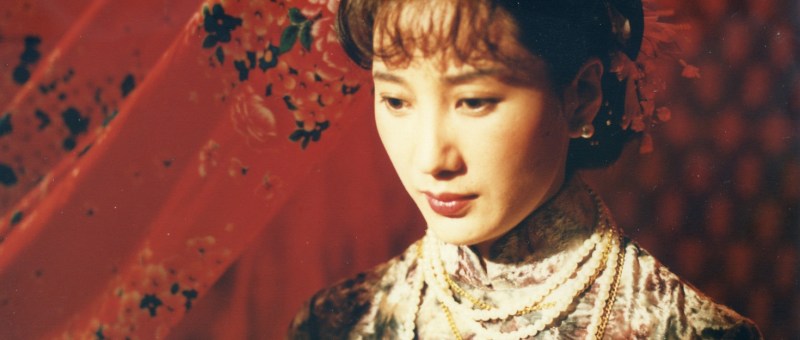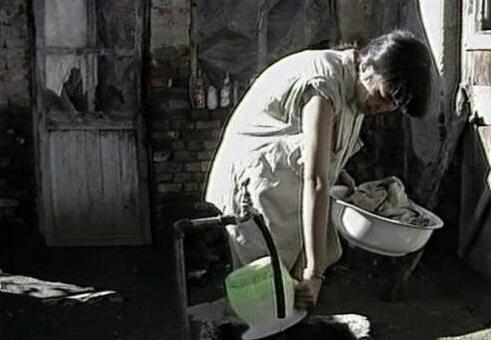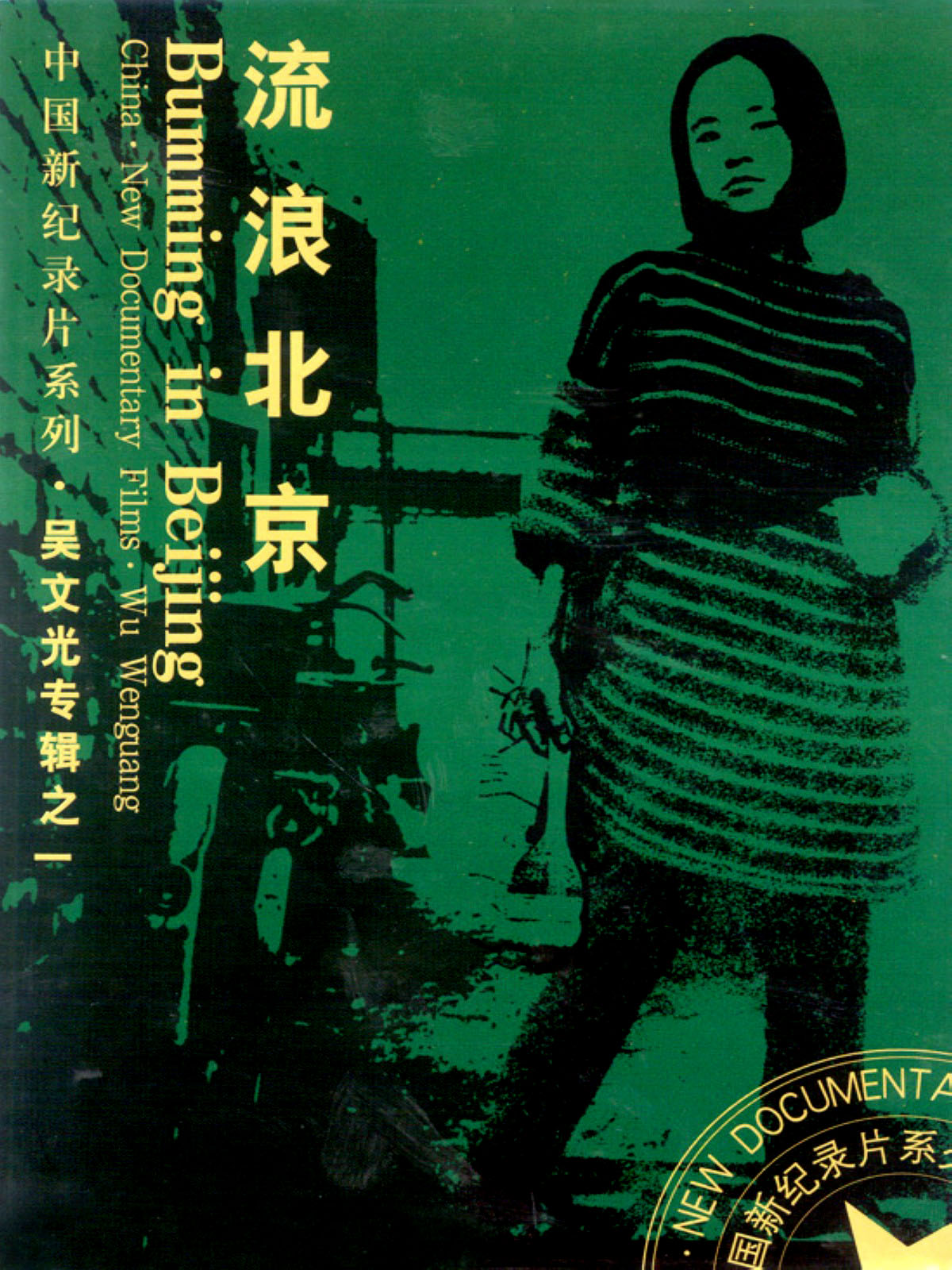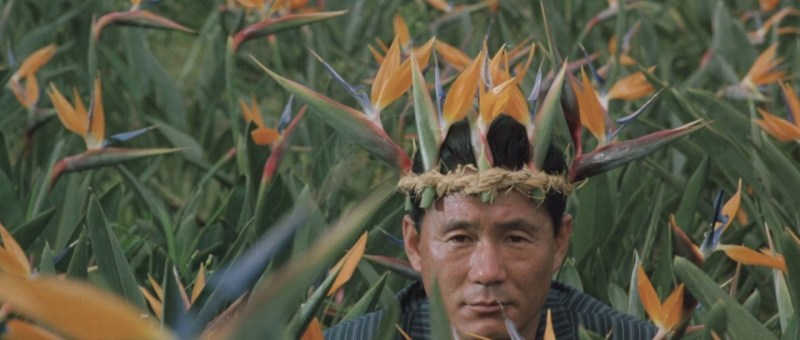
Neo Chinpira: Zoom Goes the Bullet (ネオ チンピラ 鉄砲玉ぴゅ~, Banmei Takahashi, 1990)

In the classic yazkua films of old, going to prison for the gang could be a badge of honour and one of the ways you could catapult yourself into the higher ranks. By the 1990s, however, the yakuza is a much depleted force and it seems few are willing to give up years of their lives on a point of honour for an uncertain reward. At least, that’s how it is for most of the gangsters at the centre of Banmei Takahashi’s Neo Chinpira: Zoom Goes the Bullet (ネオ チンピラ 鉄砲玉ぴゅ~, Neo Chinpira: Teppodama Pyu) , a slacker comedy in which a young hanger on faces a dilemma when he’s made the lookout on a squad sent to bump off a rival only for his squamates go to great lengths to injure themselves first so they won’t have to go through with it.

Junko (Sho Aikawa) is an unlikely hero. With a rockabilly quiff and a red jacket, he’s nominally the driver for gangster Yoshikawa (Toru Minegishi) which means he gets to drive his limo and act like a big man for a while making calls on his carphone. But as much as Junko shows off to his girlfriend Noriko, a hostess at a Korean bar, by instructing the landlady not to clear up his empty bottles because they’ll make a good weapon in an emergency, he’s otherwise something of a joke. The limo ends up getting “stolen” by a young woman who just likes American cars and sexually aroused by gunfire.

Even Yumeko (Chikako Aoyama) chuckles that Junko sounds like a girl when he says he wants to see the ocean while they’re driving around. “Junko” is ordinarily a girl’s name. He picked it up as a kind of hazing based on an alternate reading of his name kanji. She says the same thing again when he reveals he’s never brought a girl back to his place before, probably because it’s in a disused building he was given to manage where he’s surrounded by junk like an old barber’s chair and pinball machine while the figure of Humphrey Bogart in the Maltese Falcon looks down at him from a poster as if embodying his unattainable gangster dreams. As masculine icons go, Junko is also plagued by his uncle, Mizuta (Joe Shishido), a legendary gangster and representative of old school yakuza who take the code seriously and wouldn’t put up with people like Junko’s colleagues who engage in “zooming”, deliberately shooting themselves to get out of being ordered to carry out a hit. He’s not overly impressed by Junko either, unable to understand why he’d become an errand boy for a petty gangster rather than be his own boss as a small-time crook.

Junko’s dilemma is whether he’s really up to this task and will be to go through with it or will end up chickening out and injuring himself too. Crows are more cowardly than they seem, Yumeko explains in an obvious allegory for the yakuza. They pick a place and defend it as a group, while their numbers are way up lately so their individual turfs are shrinking. But now Junko’s all on his own and filled with uncertainty not knowing if he can pass this rite of passage and be accorded a man or will forever be trapped in a liminal space of adolescence never to be taken seriously or make any progress in his life. In an effort to toughen up, he swaps his red jacket for a suit and finally puts on a shiny leather overcoat, ripping off the buttons to bind it more tightly around him with the belt as if it were a kind of armour. 

Somehow the lighthearted ridiculousness of this world of bumbling yakuza and creepy corrupt cops lends an additional poignancy to Junko’s final gesture as he sets off on his path, not really believing he will return. He doesn’t even wait for the pictures he had taken at a photo booth. They won’t be much use to him where he’s going, but at the same time it’s like he’s treading water never quite getting closer to his destination but continuing along his long sad walk. Banmei Takahashi sticks firmly to his pink film roots, sticking in a weird sex scene at regular intervals as Yumeko becomes enraptured by pistols, but also has quite a lot of fun with his “uncool” gangsters and the lost young man who looks up to them while perhaps knowing that this image of stone cold masculinity only really exists in the movies.


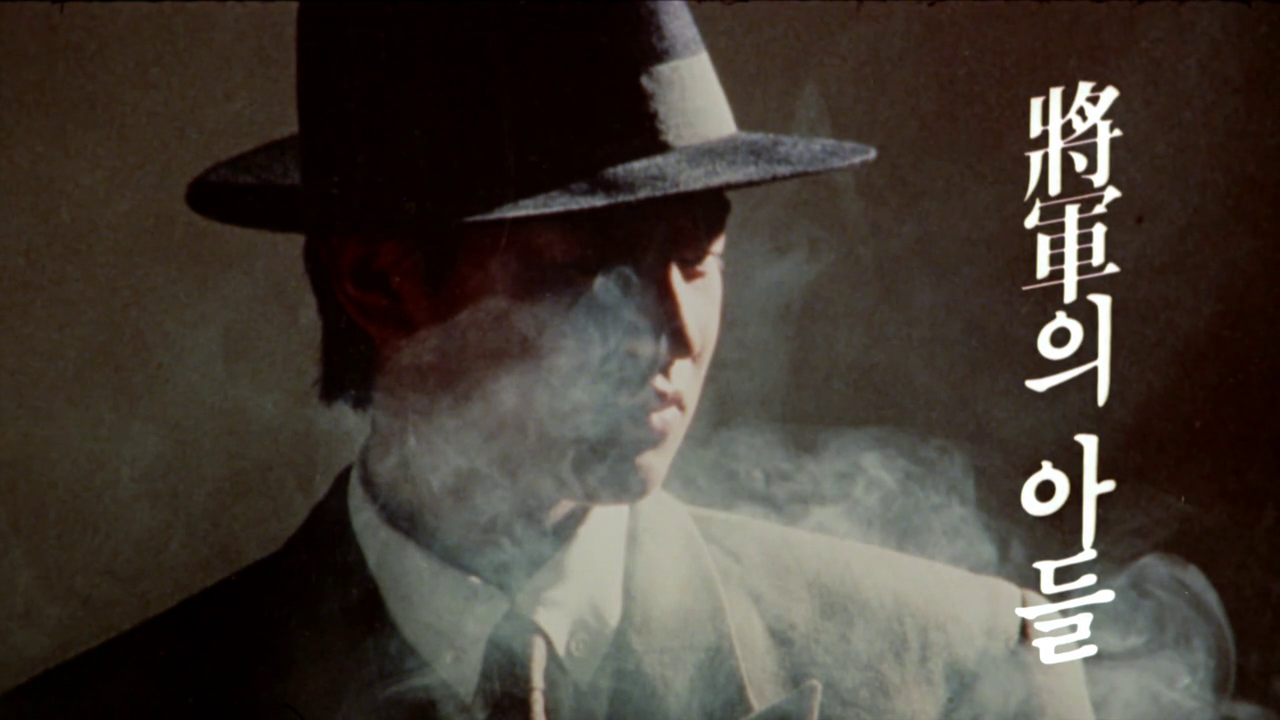
General’s Son (將軍의 아들 / 장군의 아들, Im Kwon-taek, 1990)

Im Kwon-taek may have been among the first Korean film directors to secure a spot on the international festival circuit, but his long and meandering career began with action cinema which is where his early ‘90s blockbuster trilogy General’s Son (將軍의 아들 / 장군의 아들, Jangguneui Adeul) returns him. Quite clearly influenced by recent Hong Kong martial arts movies, ninkyo eiga yakuza dramas from Japan, and episodic fighting comics, General’s Son creates legend from recent history in further mythologising a real life street king who eventually shifted into politics in the 1950s which might be one shift too far in terms of the film’s complicated politics. 

This first instalment in the trilogy opens with Doo-han (Park Sang-min) being released from prison after apparently having been picked up for sneaking into a Japanese cinema and getting into some kind of fight. An orphan, Doo-han has spent his life on the streets as a beggar but also has a deep love of the movies and is determined to get a job at the cinema, eventually landing one as a sandwich board/announcements guy parading through the streets shouting about what’s currently on for which he gets two tickets on top of his pay. The tickets become a bone of contention when some lowlife punks try to cheat him out of them, but Doo-han is a handy boy and so he manages to beat the guys up and get the tickets back despite being stabbed in the thigh. The altercation brings him to the attention of a local gang boss who decides to recruit him because he’s in need of street muscle and even helps him get a job at the cinema which turns out to be a hub for the local organised crime community. 

The complication is that this small area of Jongno which is ruled by the gangs is also the last remaining outpost of a “free” Korea where Japanese interference is apparently minimal. There is, however, a Japanese gang presence in the form of traditional yakuza led by the youthful and handsome Hayashi (Shin Hyun-joon), who becomes the central if not direct villain. In typical gangster origin fashion, Doo-han climbs the ranks by using his fists, taking down one big boss after another but, crucially, only while his own guys collectively decide to make way for him. As one after the other is killed or arrested, they each affirm that their era has passed, they’ve been beaten, and it’s all up to Doo-han now. In fact, in this highly ritualised setting, most fights ends with the defeated party solemnly admitting that they have lost and will politely leave Jongno at their earliest opportunity. 

As for Doo-han himself, he belongs to the noble brand of gangster and becomes something of a folk hero for his spirited defence of the ordinary man in the face of “Japanese tyranny”. Of course, that ignores all the ways in which the gangsters themselves could be quite oppressive and the film does indeed resist any mention of how they make their money other than a veiled allusion to collecting protection from the market traders in order to keep them safe from harassment by the Japanese.

At the end of the film, Doo-han receives an explanation for all the crytic hints to the film’s title to the effect that he is the son of a legendary general in the Independence Movement. His role is, in effect, to be the general in Jongno holding back the Japanese incursion and saving the soul of Korea from being despoiled by colonisers intent on erasing its essential culture. Just as his father is fighting in Manchuria, Doo-han is “fighting for our liberty” on the streets of Jongno while standing up for the oppressed wherever he finds them, including the gisaeng one of whom he saves from being sold into a Chinese brothel by her father by robbing wealthy Japanese officials to pay her debt. What he’s mostly doing, however, is fighting with fellow gangsters, proving himself in tests of strength which leave his opponents breathing but humiliated and thereafter removing themselves from the game in graceful defeat. It’s unlikely the Japanese will do the same, but Doo-han will be monitoring the streets until they do.


Peony Birds (牡丹鳥, Huang Yu-Shan, 1990)

Two women struggle with inter-generational conflict and the changing Taiwanese society in Huang Yu-Shan’s melancholy familial drama, Peony Birds (牡丹鳥, Mǔdan Niǎo). Perhaps the love birds of the title, mother and daughter find themselves at odds partly through a series of misunderstandings but also in the strange reversals of their social outlook, the older woman eventually becoming a successful industrialist rejecting the patriarchal social codes of her upbringing while the younger remains prudish and resentful, unfairly blaming her mother for her father’s early death. 

The film opens with two children accidentally releasing a pair of caged birds before the camera lights on the melancholy figure of Ah-chuan (Su Ming-ming), absentmindedly embroidering beneath a large picture which appears to be of herself. The portrait, a source of contention with her husband Cheng, will follow her throughout her life a symbol of herself as a young woman with choices falling in hopeless love with a Japanese-speaking doctor, Kuo, who never gave her a second glance and later married someone else. Seemingly on the rebound, Ah-chuan consented to an arranged marriage to the wealthy son of a rice merchant who thinks himself a member of the local aristocracy, forever throwing around his money and reminding people of his good name, but the marriage is unhappy Cheng frustrated that his wife loves someone else and Ah-chuan unable to let go of her idealised image of Kuo. Soon enough, Cheng drowns, falling into the river stumbling around in a drunken stupor. As they pull his body out of the water, doting daughter Shu-chin remembers her father bitterly exclaiming that her mother loved someone else and, noticing the comforting arm of childhood friend Chin-shui on her shoulder, assumes it must be him.  

It’s this fundamental misunderstanding that continues to colour the frustrated relationship between the two women, the grown-up Shu-chin (Vivian Chen Te-Yung) childishly complaining that Ah-chuan failed in her wifely responsibilities and has never been a mother to her, blaming her for Cheng’s death while criticising her commitment to her career almost as a betrayal of womanhood. By this point, Shu-chin is in her 20s and has a job as a record producer, later attempting to push her mother towards retirement claiming her salary is enough to support both her and her artistic brother but eventually leaving home entirely after beginning an affair with an unsuitable man defiantly ignoring Ah-chuan’s attempts to convince her she is making a huge mistake. 

Meanwhile, Chin-shui resurfaces in their lives having become a wealthy real estate magnate, a career we saw him start back in the village by taking advantage of the post-war land reforms to buy up the redistributed estates of formerly noble families, some of it Cheng’s. In some ways, former sharecropper Chin-shui is a villainous Lopakhin intent on paving over the beautiful Taiwanese countryside with towering high rise buildings, a symbol of the nation’s transformation from agrarian economy to financial powerhouse and of the hollowness it implies. Yet Ah-chuan’s business is floundering partly she claims because of protectionist US trade laws leaving her at the mercy of men like Chin-shui who, though not the man in her heart, has long carried a torch for her despite knowing of her impossible, unrequited love for Dr. Kuo. Shu-chin finds herself in a similar position in her affair with free-spirited colleague Li Kang whose previous girlfriend attempted to take her own life, discovering the mutability of his affections after he becomes famous with one of his solo compositions, while also drawn to a more suitable match in the more traditional Yi-cheng who eventually pledges his love to her, offering to make her a home explaining that having a home is what gives the young confidence to wander. 

Yet “home” is what Shu-chin continually rejects, yearning for her childhood in a more rural, quasi-feudal Taiwan while misunderstanding the tragedy of her parents’ toxic romance, only latterly reawakening to her mother’s love for her and discovering a new sense of security in a changing Taiwan as Ah-chuan frees them both in literally setting fire to the frustrated hopes of the past, reminding her “It’s always been our home”. A touching story of two women finally coming to understand each other while learning how to live in a changing society, Huang Yu-Shan’s maternal drama eventually bridges a generational divide as mother and daughter finally flee the coop but choose to fly together. 


Peony Birds streams in the UK 25th to 31st October as part of this year’s Taiwan Film Festival Edinburgh.

Clip (English subtitles)

Bumming in Beijing: The Last Dreamers (流浪北京, Wu Wenguang, 1990)

Wu Wenguang’s seminal documentary Bumming in Beijing (流浪北京, Liúlàng Běijīng) opens with a stark title card explaining that it was filmed between August 1988 and May 1990. Perhaps for obvious reasons, the film never mentions what happened between those dates and is in a sense defined by the things it doesn’t say. Often regarded as the father of Chinese independent documentary, Wu’s shooting style breaks with the accepted norms which had favoured meticulous control by shooting handheld and in 4:3 with a grainy camcorder as he interviews his counterculture friends accidentally documenting their lives on either side of an unbreachable divide. 

As the opening explains, his subjects are a group of 20-something bohemians who have each rejected their State assigned jobs and relocated to Beijing, without proper residence permits, to participate in an artistic and cultural revival in which anything seems possible. Zhang Ci was a magazine editor in her hometown but hated it and came to Beijing to be a freelance writer. Zhang Dali studied book binding in the city and stayed on living as a freelance painter, while his classmate Gao Bo did the same thing but is a freelance photographer. Also a freelance painter, Zhang Xiaping was working as a scenic artist in Yunnan and has only recently come to the capital, while Mou Sen, originally from Tibet, is a struggling avant-garde theatre director. 

While perhaps fulfilling the starving artist stereotype, what Wu discovers in the stories of his friends is a sense of despair and inertia at odds with the supposed hopefulness of the times. Ci often appears on the brink of tears as she talks about her life, obviously dissatisfied and uncomfortable with the harshness of her living conditions making use of the facilities at the near by university, offended and perplexed when foreigners compliment her on her bohemian lifestyle. Dali too declares himself bored with Beijing and its dull culture vultures while lamenting that it’s impossible to make a living as a freelance artist, only foreigners have money to buy his paintings and there aren’t many of those around. There is perhaps a sense of artistic rivalry between Dali and Xiaping who appears to have achieved a degree of success preparing for a big solo show while complaining that she hates selling her paintings and would almost rather sell her body. 

Dali and Bo expand on the phenomenon of “Cen Fan” as they sheepishly convince friends currently doing better to spot them dinner, while Bo declares himself a vagabond at heart but also remarks on the various anxieties of living on the margins trying to make rent in a fracturing Beijing. They each insist that they live for their art, Mou Sen certain that there could be no life for him without theatre, but some also dream of more conventional lives, Ci and Dali longing for materialist comforts of a decent home and a car even if in his case he wants these things to facilitate his art rather than to improve the quality of his life. Increasingly despondent, they discuss the idea of going abroad, Ci eventually making a, it’s implied, cynical marriage to an older American man to get a visa to emigrate while Dali eventually marries an Italian and Xiaping an Austrian. When Bo takes a job in Paris, Mou Sen is the only one left behind yet even he had mused on the idea of marrying a European in order to see Europe while admitting the possibility he may find a nice Chinese girl he likes and simply marry her. 

The artists’ mass exodus seems to run in tandem with the shockwaves of Tiananmen, as if they have given up on the prospect of social revolution and concluded that their only future lies abroad. Shortly before we are told she has left for Vienna, Xiaping appears to suffer a period of mental distress culminating in a public breakdown in a KFC from which Mou Sen and Wu himself had to rescue her, an incident which seems overly pregnant with symbolism as if the rapid changes of the modern China have fractured her mind. Wu never mentions Tiananmen, how could he, and it seems he encountered a degree of resistance including distressing footage of Xiaping’s manic episode (not for reasons of taste or privacy but shame on the part of the authorities), but the sense of painful defeat echoes all the same in a well placed title card as the artists make their exit signalling both the death and the failure of this short-lived counterculture movement. 


Bumming in Beijing: The Last Dreamers is currently available to stream in the UK as part of the Chinese Cinema Season.

Boiling Point (3-4X10月, Takeshi Kitano, 1990)

The heroes of Takeshi Kitano’s films are often gentle men, capable of great tenderness but also filled with quietly mounting rage permanently on the brink of explosion. Everyone perhaps has their Boiling Point, the straw that breaks the camel’s back and sends it careering towards a self-destructive attempt at restitution. “Boiling Point”, however, has absolutely nothing to do with the original Japanese title (3-4X10月) which references the score on the board at a baseball game and the originally scheduled month of the film’s release, October (it was later moved up to September making the whole thing even more meaningless). This perverse randomness was apparently another minor win for Kitano who had scored a critical hit with his debut feature Violent Cop but had struggled to convince the team around him to embrace his unconventional vision. Working with greater independence, Kitano minimises camera movement in favour long takes with static camera which perfectly compliment his deadpan sense of the absurd. 

He also relegates himself to a supporting role unseen on screen for over half of the running time. Our hero is small town loser Masaki (Yurei Yanagi) who we first meet hiding in a toilet during an amateur baseball game in which he is desperate to play but strikes out when given the opportunity in the first of many petty humiliations. He has been taken under the wing of the team’s coach, Iguchi (Taka Guadalcanal), a former yakuza attempting to go straight by running a dive bar, and has a part-time job at a petrol station. Masaki perhaps images himself as something greater, as evidenced by his extremely cool motorcycle jacket and bike, but is a dreamer at heart, nervous and tongue-tied, unable to unlock his hidden potential. Even he has a boiling point, however, which is later hit when he gets into an altercation with a teddy boy yakuza at the garage who starts a pointless argument about being kept waiting, pulling the old trick of goading Masaki into fighting back to get leverage over their shop and begin extorting it. Masaki has just got his boss into trouble through losing his cool, but is ironically offered a job by a visiting thug jokingly admiring his fighting prowess. 

Iguchi meanwhile is a man divided, permanently on the brink of boiling over. When some irritating sophisticates “ironically” visit his bar clutching their designer handbags and holding their noses, he’s obliged to be nice to them but he simply can’t. Unable to bear their snotty arrogance, he glasses one of the women on the way back from the bathroom and throws the whole gang out. The yakuza has it seems been reawakened, and though he was reluctant before, he to decides approach his old boss, Otomo (Hisashi Igawa), on Masaki’s behalf. The reception he receives is not as he expected. Iguchi is reminded that he chose the civilian life and being a yakuza isn’t a part-time job, you can’t just pick it back up again when it suits you. Not being able to help Masaki is another small humiliation, one he perhaps intends to overcome through turning violence on an old underling who disrespected him in refusing the customary deference. Predictably, it backfires, you can’t be half a yakuza after all. Iguchi is completely finished, boiling with rage but too humiliated to do much about it other than vow revenge by going to Okinawa to buy a gun in order to put an end to the lot of them. To protect his mentor, an oddly yakuza-esque gesture, Masaki volunteers to go in his stead, dragging his catcher friend Kazuo (Duncan) along for the ride. 

A complicated liminal space, Okinawa is both an enticing holiday destination and source of political contention thanks to the controversial presence of the US military bases. It’s indeed corrupt foreign influences who can provide our guys with guns, but Okinawa is also a place slightly out of time, trapped in the Showa-era past while the rest of Japan has already transitioned to an economically prosperous mid-Bubble Heisei. Consequently, these are Showa-era yakuza with fancy outfits and sunshades hanging out in neon-lit bars with butterflies on the walls. Uehara (Takeshi Kitano) is in the process of being humiliated in front of his gang for supposed embezzlement of collective funds. He too wants a gun to enact his revenge, something which he fantasises about in an eerie and fatalistic flash forward. Before that, however, he’s befriended our guys and taken quite a liking to Kazuo, hinting a latent homosexuality in another example of the unwelcome association of queerness and savagery often seen in yakuza movies. Uehara has a girlfriend but treats her with utter contempt, insisting that she sleep with his underling only to punish her for it afterwards and take over halfway through to rape him. In fact all of his subsequent sexual actions are rapes, his assaults on women cold and mechanical as if purely performative, implying that it is his repressed homosexuality which underpins the sense of humiliation that fuels his violence and his cruelty. 

Unlike Uehara and Iguchi, our guys have not even one foot in the yakuza world and despite their ingenious plan to get the guns on the plane have no idea what they’re going to do with them, marching all the way over to Otomo’s before realising they don’t know anything about the use of firearms with the consequence that they become useless lumps of metal in their hands. They are boys playing gangster out of a misguided ideal of heroic nobility in their desire to avenge Iguchi who by all accounts is still sulking alone at home. This is their greatest and final humiliation, failing as men in front of men. Yet, their friendship perhaps survives, patched up in silence over shared ice lollies. Even so, Masaki is about to boil over, travelling towards a split second moment of fiery self-destruction and misdirected rage. But then Kitano pulls the rug out from under us again. Was this all a dream after all, grim wish-fulfilment from a repressed young man longing to burn out bright, or perhaps a lengthy vision of the kind visited on Uehara which would at least explain Kitano’s many non-sequitur cuts and ellipses? Who can say, but the humiliating sense of impossibility is all too real for those unable to take a swing at life’s many opportunities.


Boiling Point is the second of three films included in the BFI’s Takeshi Kitano Collection blu-ray box set and is accompanied by a new audio commentary by Little White Lies’ David Jenkins, plus a featurette recorded in 2016. The first pressing includes a 44-page booklet featuring a piece on Boiling Point from Mark Schilling, an essay on Violent Cop by Tom Mes, an introduction to Kitano’s career & writing on Sonatine by Jasper Sharp, an archival review by Geoff Andrew, and an appreciation of Beat Takeshi by James-Masaki Ryan.

The Takeshi Kitano Collection is released 29th June while Violent Cop, Boiling Point, and Sonatine will also be available to stream via BFI Player from 27th July as part of BFI Japan.

Original trailer (English subtitles)

Dragon in Jail (獄中龍, Kent Cheng Jak-Si, 1990)

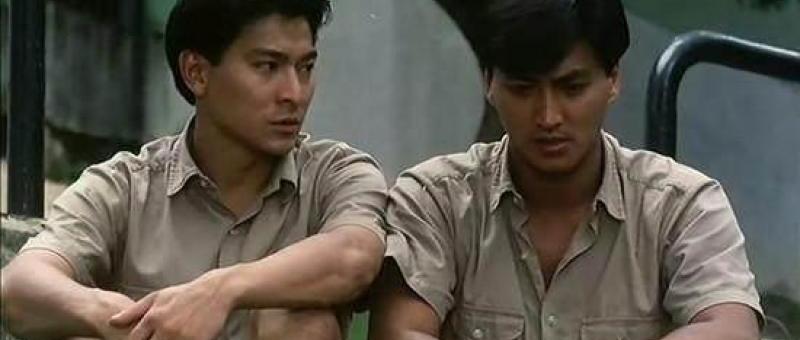
“For the poor life is a punishment” according to Henry (Andy Lau Tak-Wah), the embattled hero of Kent Cheng Jak-si’s Dragon in Jail (獄中龍), a subdued heroic bloodshed offshoot in which a poor boy and rich kid meet in juvie and become best friends for life even though fate seems to have very different paths in store for them. Less a critical expose of the cruelties of an increasingly stratified society than an ode to intense male friendship, Dragon in Jail puts its hero in a different kind of cell as he tries to escape the triad net but finds himself ensnared by past crime and present rage. 

Rich kid Wayne (Kenny Ho Ka-King) ends up in a reformatory for pulling petty stunts supposedly because he doesn’t like it that his widowed mother has remarried. Different from the other boys, he’s immediately hazed and asked for his gang affiliation, only he doesn’t have one. Tough boy Henry stands up for him, roping in his other friend Skinny (John Ching Tung) to take on the cell’s Mr. Big after which the boys become firm friends as they study together to sit their A Levels while inside. Wayne wasn’t planning to take his exams as a way of getting back to his mother, but Henry convinces him that education is the one way to show the world who’s boss. The boys come top in their class, Wayne gets out and decides to go the UK to study law, while Henry serves out the remainder of his sentence in an adult prison, sentenced to four years for manslaughter after accidentally killing a triad member during a fight over protection money at his family’s kiosk. 

Despite the differences in the scope of their possibilities, Henry and Wayne remain good friends, but once Henry gets out of prison he’s nothing much to look forward to. His hopes of attending a university are dashed by his defeatist father who thinks education is pointless and blames him for the failure of their business, while he struggles to find steady employment as a man with a criminal record. Eventually he decides to work as a mechanic by day and a cram school teacher by night with the aim of saving enough to apply for uni at later date so he can marry his longstanding girlfriend, Winnie (Gigi Lai Chi). Skinny, meanwhile, gets out of jail and heads straight back to the triads, trying to convince Henry he should join too. Henry doesn’t want to, but faces constant harassment from Brother Charlie (William Ho Ka-Kui), the boss of the man he killed in the fight. When his little brother is badly burned in a triad attack, he decides his only option is to become one himself to earn the protection of Boss Sean (Leung Gam-San) who mediates an uneasy truce with the psychopathic Charlie. 

When Wayne returns from the UK after graduating law school, Henry is married and a father-to-be living in a swanky apartment having risen in the triad ranks, but he’s also a hotheaded opium addict still sparring with the very present Charlie. “I’m a bad egg! I deserve it!” Henry wails on being confronted by Wayne who points out that it was he who was always encouraging him to study so that no one would ever look down on him. Henry thinks he’s not good enough to be Wayne’s friend and fully expects to be abandoned, but after some strong words of defence from Winnie, Wayne comes around, resolving to help get his friend off the stuff. The problem is the sense of futility which has already set in. Henry has become what everyone expected him to be, a thuggish triad, because they convinced him he could become nothing else.

Winnie berates Henry for keeping his sorrows to himself, remaining sullen and resentful at his inability to escape the triad world for an honest life of safety with his new family, though he once told Wayne that he should “speak up if you feel unhappy”. Despite everything the intense friendship between the two men endures. Cheng adds to the faintly homoerotic tone by shooting his early prison scenes with a lingering romantic gaze, while Wayne seems to pine for his broody friend, affirming that “no matter what you are, you are my buddy”. A caged dragon, Henry’s vengeance is swift and brutal but he retains his nobility even in the depths of his despair, eventually taking refuge in an unconditional friendship which transcends the forces which imprison him.


Nambugun: North Korean Partisan in South Korea (南部軍 / 남부군, Chung Ji-young, 1990)

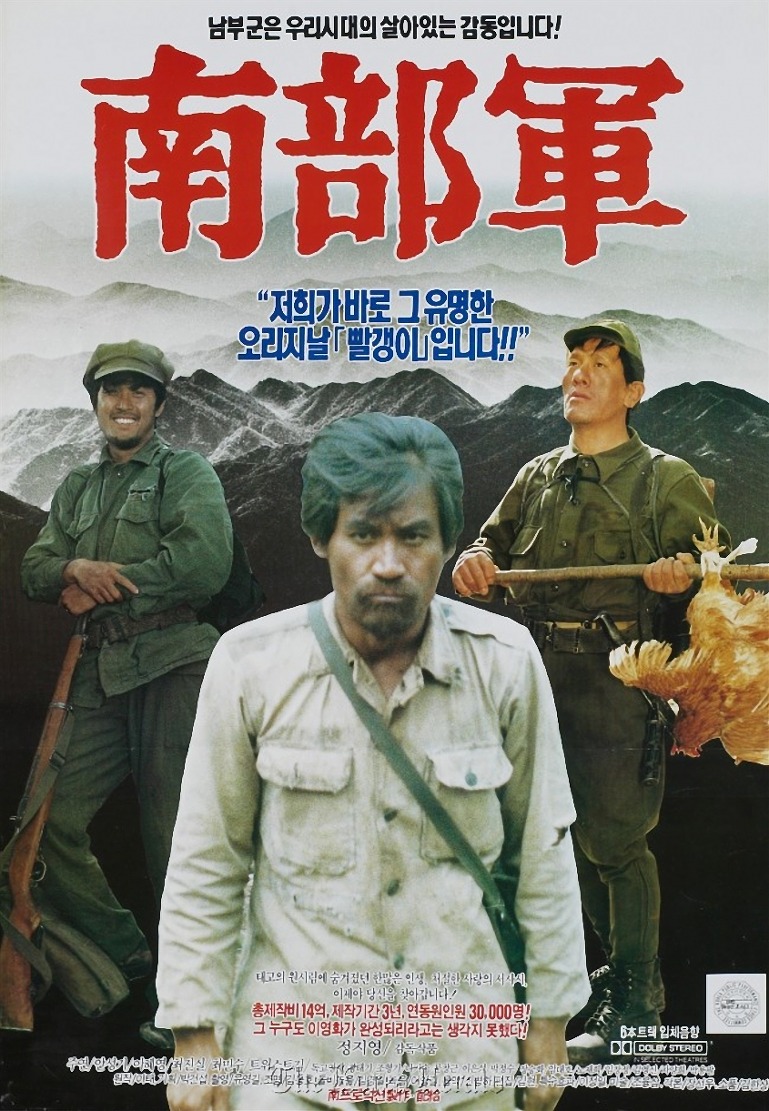
North Korean Partisan in South Korea poster 1Under the intense censorship of South Korea’s military dictatorships, “anti-communism” had become the single most important cultural signifier to the extent that all films were in some sense “anti-communist” even if some were more obviously anti-communist than others. As power shifted away from the dictators and towards a new era of democratic freedom, a more nuanced view of the recent past became possible with the “division film” taking the place of the old-fashioned anti-communist drama. Rather than demonise the North, the division film emphasised the tragedy of partition, painting the two Koreas as equal victims of geopolitical finagling.

Arriving in 1990 shortly after Korea’s democratisation, Chung Ji-young’s Nambugun: North Korean Partisan in South Korea (南部軍 / 남부군, Nambugun) is among the first to directly address the subject of the Korean War from the perspective of the North Korean partisans, albeit obviously from those who eventually came South. Adapting the memoirs of war correspondent Lee Tae, Chung ignores ideology in order to explore the gruelling experience of guerrilla warfare largely being fought by ordinary people with strong convictions rather than by career soldiers or committed revolutionaries.

Lee Tae (Ahn Sung-ki) himself is an “intellectual” North Korean newspaper reporter working as a correspondent in Jeonju which is currently in North Korean occupied territory. When they get word that the Americans and South Korean forces are on their way, the newspaper staff evacuates and eventually ends up heading into the mountains to join the partisans. As he has previous experience, Lee Tae is given command of a platoon and the instruction to try and make up for his bourgeois intellectualism with hard work on the job. To keep them all in one place, Lee is assigned a series of other “intellectual” recruits including conflicted student Kim (Choi Min-soo) who joined the fight to figure out what this “inhuman” war was all about.

One of the reasons Kim is so conflicted is that he brought his hometown, high school-age girlfriend with him and wonders if that was a very responsible thing to do, especially when they are eventually separated by the command chain who decide to send her to headquarters while Kim stays with the troops. Though we are shown that the North Korean soldiers are just ordinary men and women who call each other comrade, the regime itself still comes in for subtle criticism for its oppressive hardline austerity. On the run and separated from his unit, a wounded Lee is accompanied by an earnest nurse, Min-ja (Choi Jin-sil), with whom he falls in love, but when the romance is discovered by a superior officer Lee is taken aside and reminded that here there can be no love, only revolution. He must give all of himself to the cause, reserving nothing for such bourgeois affections as romance. Both Lee and Kim spend the rest of the picture trying and failing to reconnect with their respective women while fantasising about a different kind of life in which they would not have been kept apart.

Yet, despite the fact that we clearly see a world of near total equality among the partisans, it is clear that Lee’s own thinking at least is not quite as progressive as one might assume. Bonding with Min-ja and dreaming of the future, he envisages a life for himself as a reporter in Seoul at which point she asks what she’s supposed to do and receives the answer “have dinner ready for me”.  Min-ja, apparently an orphan whose brother was killed fighting for the South, found herself becoming a field nurse for the North and perhaps has a lower ideological consciousness as a result, freely offering her medical knowledge to anyone who might be in need of it. “Why is it that we’re fighting?” she asks Lee, “you both need me”, embodying the wounded innocence of the one Korea unfairly torn apart by forces beyond its control.

All gusto and determination, Lee and the others start out with pluck and positivity but gradual disillusionment accompanies the shift from the warmth of spring to the dead of winter as the partisans find themselves starving to death on a frozen mountain. Win or lose, the victory belongs to the US or USSR, one particularly dejected soldier intones laying bare his loss of faith in the primacy of North Korean communism and accepting that they are all playthings in a proxy war being fought by Koreans on Korean soil. Kim fails to find “meaning” in conflict and emerges only with shame and regret while others clutch at pamphlets dropped by the Americans promising an amnesty for those who surrender willingly. Lee trudges on alone, frostbitten and starving, encountering only the dead and finally contemplating suicide only to be given one last source of hope and to have that too crushed. Chung humanises the communists, but still they have to lose in the spiritual as well as the literal sense. Ending on a howl of existential despair, the film dedicates itself to all those on both sides who fell on Jirisan or sacrificed their lives for a vision of a better world but does so with pity more than admiration for all that they suffered as victims of their times.


Nambugun: North Korean Partisan in South Korea was screened as part of the 2019 London Korean Film Festival.

Black Republic (그들도 우리처럼, Park Kwang-su, 1990)

Black Republic still 1In the Korea of 1990, a revolution had been fought, won, and then betrayed by its people. Successfully petitioning for democracy, the newly minted Korean electorate went ahead and voted for the chosen successor of the dictator they’d just spent so long trying to oust. Change comes slow, but it comes even if not quite the way you wanted it. Park Kwang-su’s first film Chilsu and Mansu, released in 1988 and set in the contemporary Seoul running to catch up to its Olympic aspirations, had made its own quiet protest about a hypocritical society’s rising social inequality. His follow up, Black Republic (그들도 우리처럼, Keduldo Urichurum), takes a journey back in time while keeping one foot in the present to show us a nation engulfed by a darkness that crushes love, dreams, and possibility all while dangling the shining hope of a better future that seems impossibly far away.

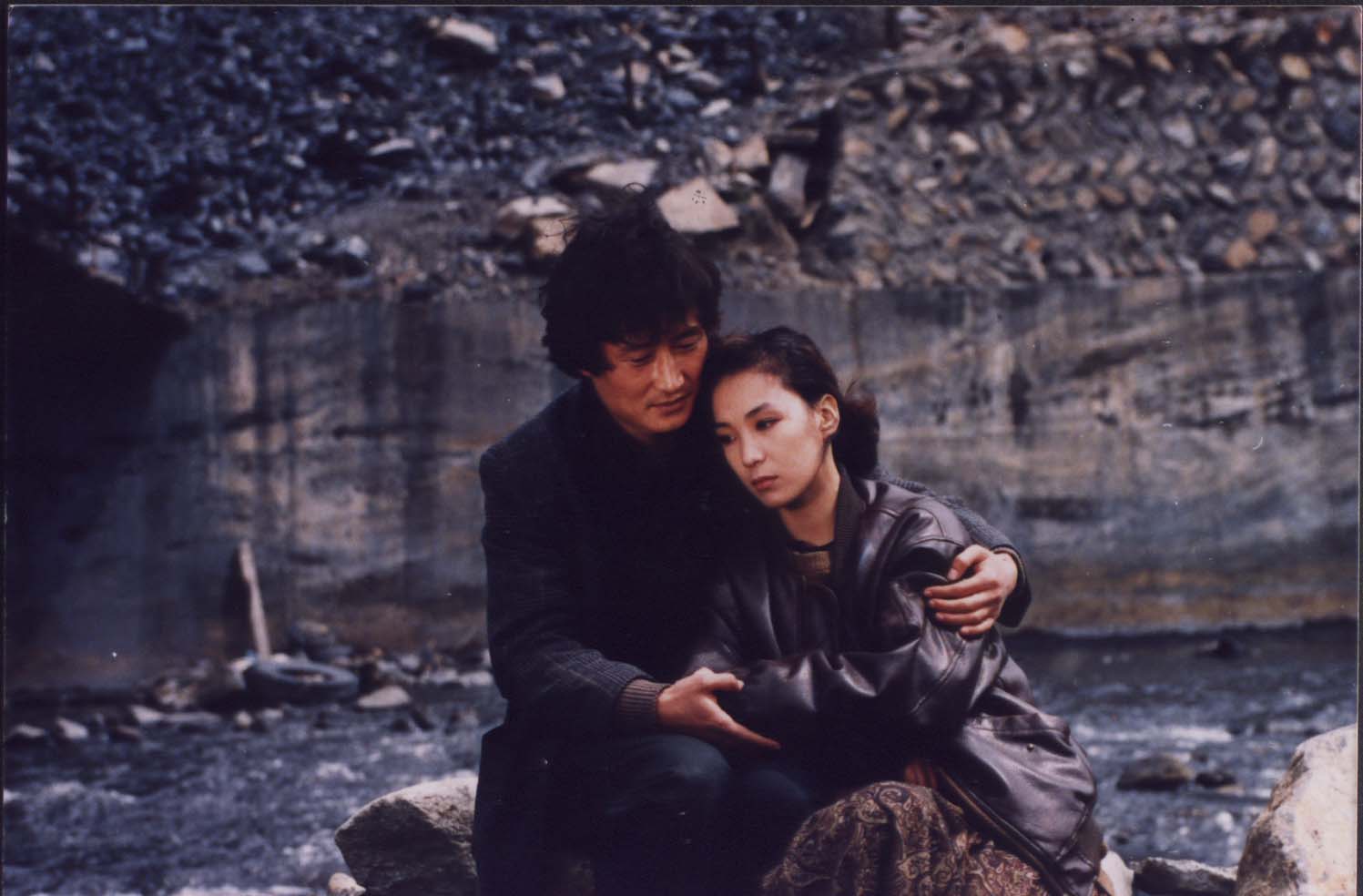
Tae-hun (Moon Sung-keun), a student protestor wanted by the police, heads into the mountains under an assumed name hoping to get a job in a mine. However, this is a period of intense economic volatility and the mining industry is collapsing. When his attempts to find work as a miner fail, Tae-hun (going under the name Gi-yeong) overhears a conversation in a cafe and manages to get a job in a local briquette factory.

Park opens in darkness as Tae-hun makes a phone call to his mother in which he never speaks and she reassures him that everything will be OK while the sound of a train gradually gathers in the background. When Tae-hun arrives at his destination, he finds himself in a barren, blackened land where everything is quite literally falling apart. The mines are closing and the landscape, desolate as it is, is peppered with derelict buildings and the modest, makeshift homes of the rural poor at the constant mercy of their greedy masters. As a newcomer, Tae-hun is not privy to the town’s secrets, but quickly comes to understand that though he may have escaped Seoul, the struggle is inescapable, because the struggle is Korea. The owner of the briquette factory is also some kind of loanshark involved in a suspiciously close arrangement with the local mine owner who is in the middle of a labour dispute with the miners who are petitioning for fair pay and better conditions. Haunted by the memories of his protest days, Tae-hun finds himself looking on at another candlelight procession calling for workers rights but rendered impotent, forced to remain silent or risk attracting the attention of the police.

Meanwhile, Tae-hun’s silence sees him unwittingly pulled into the orbit of those he would usually oppose. Seong-cheol (Park Joong-hoon), the illegitimate son of the factory boss, takes his own sense of crushing impossibility out on the entire town. Technically the “vice-president” of the factory, Seong-cheol is a sometime enforcer for his father’s greedy loan sharking business and thinks nothing of striding in and helping himself to the petty cash to spend on women and booze while gazing at the photo of his long absent mother. An invitation to dine with Seong-cheol and pals brings Tae-hun into contact with melancholy sex worker Yeong-sook (Shim Hye-Jin) who begins to fall for him when he skips out on her after Seong-cheol has pulled one of his usual tricks in giving her away in an attempt to buy friendship through influence.

Like Tae-hun, Yeong-sook is also trapped, running, and living under an assumed identity. Through her exposure to Tae-hun who is, after all, so different from the other men in the mountains, she begins to rediscover a sense of hope and possibility. Yeong-sook quits the illegal part of her job as a “coffee girl” and deepens her bond with Tae-hun through nursing him after he is arrested and beaten by the police who seem to harbour an innate suspicion towards him despite little evidence, but their love will require another act of faith and flight and the world in which they live may not let them to escape.

Everyone here is trapped, lying to themselves or others, wishing things were different than they are but has long since given up the hope they ever could be. While Tae-hun attempts to ride out the storm by burying his head in the coal dust, feeling it fill his lungs, struggling to breathe, Seong-cheol opposes his order with chaos, laying waste to half the town in a self destructive venting of his rage and resentment towards his selfish, unfeeling father, and a society he feels has already rejected him. Impossibility and hopelessness are the defining qualities of this world of corruption and exploitation in which there can be no escape or salvation, only crushing futility. Park closes with an ironic coda of swapped fates and tragic promise which places Tae-hun right where he was when we first met him, defeated by hope but still in motion, if for an uncertain direction.


Black Republic was screened as part of the Korean Cultural Centre’s Korean Film Nights 2018: Rebels With a Cause screening series. It is also available to stream online via the Korean Film Archive’s YouTube Channel.

Lovers of Woomuk-Baemi (우묵배미의 사랑, Jang Sun-woo, 1990)

The Lovers of Woomook-baemi posterJang Sun-woo, a former political activist and underground filmmaker, is best remembered for formal experimentation and pointed social commentary, but his third feature The Lovers of Woomook-Baemi (우묵배미의 사랑, Umukbaemi Eui Sarang), stands out in his filmography in its fiercely naturalistic portrayal of working class life on the margins of a society in flux. Based on a novel by Park Yeong-han, The Lovers of Woomook-baemi, is a classic melodrama with infidelity at its core but it’s also a story of futility, the destructive effects of patriarchal social codes and toxic masculinity, and the frustrated promises of a new era for those excluded from its various benefits.

Jang begins his tale in the middle as Bae Il-do (Park Joong-hoon), a frustrated husband, returns home late to a troubled “wife” (Yoo Hye-ri) who promptly kicks him out again. Complaining furiously, Il-do dreams of another woman, Gong-ryae (Choi Myung-gil), with whom he had a brief affair, idly thinking that he might have been happy if he hadn’t got his current partner pregnant and got himself stuck with her for life even if they aren’t technically “married” in the legal sense.

Moving backwards, we see Il-do, having failed in Seoul, returning to his home village with his common-law wife Sae-daek and infant child after an offer of work in a small seamstressing firm. The only man among a room full of mostly elderly women, Il-do is something of a novelty but is also taken by the woman on the machine next to him, Gong-ryae, who he later learns is also unhappily married and intensely lonely in her small-town existence. After some initial indecision, the pair embark on an affair, (still illegal at the time of the film’s release) but their prospects for future happiness seem slim given the restrictive quality of their lives.

The world that Jang depicts, for all its naturalistic flair, is intensely misogynistic. Il-do’s early recollections of Gong-ryae revolve around her bad marriage to an impotent man (Lee Dae-Geun) who mercilessly beats her. Indeed, we later see Gong-ryae turning up for work after suspicion has arisen about her relationship with Il-do with a black eye and bruises on her face while the other women giggle over the obviously awkward gossip. Domestic violence is, however, just a part of life in the village and the older women in particular view it as a sign of a healthy marriage. One woman even exclaims that she wishes she had a man to beat her, but thinks she’s unlikely to find anyone given her age and the fact that she already has numerous children.

Il-do, by contrast, proves somewhat popular among the ladies at the shop because of his relative lack of machismo. Like Gong-ryae, Il-do is also a victim of domestic violence. His wife beats, slaps, and attacks him verbally, later even dragging him home by the testicles along a very public walk of shame. He is not above violence or aggression, but as in much of Jang’s work, male violence is a sign of weakness rather than strength and each of Il-do’s violent episodes is more to do with defeat and repressed emotion than it is about strength or conquest. This also seems to be true for Gong-ryae’s husband whose violence and jealously is perhaps a reaction to his impotence, but when we later meet him we find a man much like Il-do. Chastened, Gong-ryae’s husband politely asks the man who bedded his wife if he knows where she is and if he sees her to please tell Gong-ryae that he’s sorry and wants her to come home.

As he does with Gong-ryae’s husband, Jang plays with our sympathies and allegiances, switching perspective to reveal to us that villains and victims are often one and the same. Sae-daek originally seems like our villain, a shrewish, henpecking “wife” who won’t let our hero go despite the evident toxicity of the pair’s non-marriage, but seen from her point of view we understand her plight. After running away from a violent home environment she winds up a bar hostess in the city where she builds up a spiky relationship with Il-do which goes south when he gets her pregnant. Despite this being the age of illegal adultery, it’s not so much a marriage certificate that binds a man and a woman together for good or ill but a child. As a neighbour puts it, a woman might leave her husband, but what sort of woman leaves a child? Sae-deok cannot care for her child alone and she cannot abandon it with Il-do and so she must keep him no matter how much personal suffering she must endure as the common law wife of a no good philandering ne’er do well.

Il-do likes to drift off into philosophical reveries in which he idly remarks on the futility of his existence, but in a very real sense he’s not wrong. He tried life in the city but it didn’t want him and he came home. Sae-deok, oddly enough, likes it in the village with its sense of community especially among the other put upon and oppressed women who attempt to support each other (whilst accidentally supporting the mechanisms which continue to oppress them), but there’s no pretending there’s anything more to life in Woomuk-Baemi than work and drink. Il-do knows this, as does Gong-ryae, and it’s their mutual sense of existential ennui which finally forces them together in an impossible attempt to rebel against the futility of their existence through transgressive sex and an attempt at emotional connection.

In the end, Il-do is dragged (by the short and curlies) back into the past, literally, as Sae-deok takes him back to his mother’s house to complain about the terrible way she’s been treated. Creating a scene outside, Sae-deok eventually manages to get through to her mother-in-law who had previously rejected her because of her lowly peasant background and history of sex work, enabling the two women to bond in their shared disappointment with Il-do who has now failed as a “man” on every possible level. Briefly reuniting with Gong-ryae in the greenhouse in which they used to meet, now reduced to ruins, Il-do declares that his love is like a mummy, wrapped so well it will endure for thousands of years without decay, but it’s already too late. Choices have been made, implicitly, which cannot be reversed. Jang leaves his protagonist where he started, frustrated and inert, suffering without hope in an oppressive environment which he knows, in his heart, he does not possess the courage to resist.


Available on region free blu-ray courtesy of the Korean Film Archive which also includes an audio commentary in English from film scholars Darcy Paquet and Marc Raymond, and Tony Rayns’ documentary The Jang Sun-woo Variations, as well as a 36 page bilingual booklet featuring essays by Rayns and film critic Lee Yeon-ho. Also available to stream via the Korean Film Archive’s YouTube Channel.

Look Out, Officer! (師兄撞鬼, Lau Sze-yue, 1990)

look out officer BD 1The thing about classic Hong Kong comedies is, they were made for a very specific time and place as a quick populist diversion not intended to have much of a life beyond their original release. Despite the thrown together, sketch show-style progression from one tenuously related set piece to the next held together by quick fire comedy, they could also be surprisingly subversive as in this 1990 comedy starring a young Stephen Chow. Look Out, Officer! (師兄撞鬼) is a silly buddy cop comedy and supernaturally tinged procedural but it also satirises the Hong Kong government’s response to the growing “boat people” crisis in which, as is declared in the film, those who’ve come from Vietnam for “economic reasons” will be regarded as illegal immigrants and deported. 

The film begins with two policeman as one berates the other for stopping to burn “ghost money” on the street, describing his need for ritual as like that of an old woman. The first policeman, Biao (Bill Tung), then gets a message on his pager to check out an abandoned warehouse. Piling into the police car, Biao and religious cop Chin (Stanley Fung) arrive but don’t find anything suspicious. Chin decides to leave while Biao wants to investigate further. Poking around, Biao finds himself directly above some kind of large scale drugs lab into which he heroically jumps and beats up most of the grunts waiting below before the head gangster turns up and throws him out of a window. Biao’s body lands directly on the top of Chin’s car who has returned after having second thoughts and wanting to make sure his partner is OK.

The “official” explanation is that Biao has killed himself because of his excessive gambling debts. Up in heaven he gets put on trial (alongside recently deceased dictators Ceausescu and Marcos) and the judges find that his death is indeed suicide despite his protestations. Eventually they agree to let him go back to Earth as a ghost to prove he was murdered and take revenge on the killer. Biao gets assigned a “saviour” whom he will know thanks to an unusual birthmark. The “saviour” turns out to be rookie cop, Sing (Stephen Chow), who is not exactly top of his graduating class but aided by Biao’s supernatural powers he just might be able to find the real killer after all.

As it turns out Chin dabbles in Taoist magic (to make his arms longer, for no particular reason) as do the gangsters who seem to have demonic forces on their side. Biao never saw the face of the man who killed him because he had him in a headlock, but he does remember his terrible body odour thanks to being shoved under his armpits. Victory in the final battle relies on conjuring a unique charm which consists of equally stinky ingredients including virgin’s urine, cat poo, and flatulence neatly bringing several of the film’s running jokes together into one satisfying punchline.

Running gags there are a plenty from the grumpy old cleaner at the police station they’ve nicknamed the 1000 year old virgin who likes to mop up the men’s toilets while they’re busy so she can assess the policemen’s “capabilities” for herself, to the cat who keeps defecting on the altar, and Sing’s general weediness. The supernatural procedural runs in tandem with the usual romantic comedy subplots including Chin’s over protective attitude to his grown up daughter who inevitably ends up in a relationship with Sing thanks to Biao’s supernatural wingman-ing. One of the “charms” Baio has been given to help him in his quest is a “lewd” spell which suddenly makes the victim randy for the first person they see. Biao uses this to get his own back on Chin for leaving him behind by making their austere superior officer suddenly come over all goey only to have her snap out of it and accuse him of sexual harassment.

The humour maybe distinctly lowbrow, but there is a degree of satire lurking in the background as Sing is sent into a “massage parlour” with a codeword in Vietnamese only to discover that all the girls in the place can understand it and immediately parrot back the recent ordinance of Vietnamese immigration. Later, a Vietnamese man threatens to commit suicide over the cruel and inhumane treatment he has received as a Vietnamese immigrant trying to make a life in Hong Kong, fearing he may be forcibly deported and will be killed if he has to go back to Vietnam losing everything he’s tried to build in Hong Kong.

When Biao eventually gets back to heaven they don’t want to let him in even though he’s cleared his name because heaven has a quota and he doesn’t meet the criteria. All is not lost, however, because you can buy your way in as an immigrant with ”special investor” status. In heaven, it seems, everything is fine so long as you have money. As above, so below. Another characteristically nonsensical, juvenile comedy from Shaw Brothers, Look Out, Officer! is as silly and of its time as one would expect but it is undeniably entertaining and unexpectedly moving in its final moments.


Remake of Philip Chan & Ricky Lau’s Where’s Officer Tuba? (1986)

Celestial Pictures trailer (English/traditional Chinese subtitles)