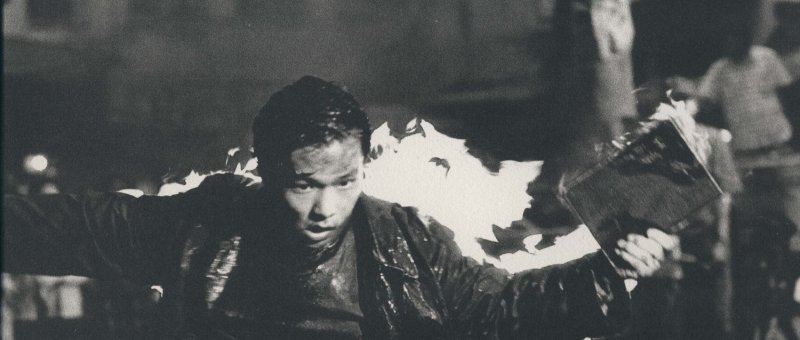
A Single Spark (아름다운 청년 전태일, Park Kwang-su, 1995)

In the present day, South Korea has become a prosperous society and leading world economy, but the miracle of its modernisation came at a heavy price. Socially committed filmmaker Park Kwang-su’s A Single Spark (아름다운 청년 전태일, Areumdaun cheongnyeon Jeon Tae-il) takes a trip back to the “truly dark days” of the Park Chung-hee dictatorship to expose the exploitation on which the modern society was, and in fact still is, founded, enabled largely by the wilful misuse of a fear of “communism” as manifested in the problematic presence of threat from “the North”.

Park filters his true life tale through the figure of a fictionalised author and activist, Kim (Moon Sung-Keun), who finds himself on the run from the authorities in 1975. Hiding out in a small town in a backroom rented by his pregnant factory worker girlfriend Jung-soon (Kim Sunjae), Kim is working on a biography of a labour rights activist, Jeon Tae-il, who self-immolated in order to protest the failure to properly enforce existing workers’ rights five years’ earlier in 1970.

Switching to crisp black and white, Park paints a bleak picture of working class life in the late 1960s as the oppressive Park Chung-hee regime imposed extreme export goals designed to boost the local economy. We first meet Jeon (Hong Kyeong-in), who was only 22 at the time of his death, selling umbrellas on the street before he is “lucky” enough to get a job in a tailoring factory. Committing himself to working hard and getting on, he is quickly disillusioned with conditions at the plant which has little light or ventilation and often forces its employees to work through the night without adequate breaks for food. When the young woman next to him begins vomiting blood and is sent home but subsequently fired, Jeon becomes radicalised. Told that there are no laws which protect workers, he is surprised to discover that there are but their existence has been wilfully kept from him. The law is written in a language which is almost impossible for him to understand, in highly formal text using Chinese characters which most ordinary Koreans, never mind those like Jeon denied a proper education, struggle to read.

Jeon begins agitating. He takes a copy of the statutes and a series of violations at the factory to those in charge, but no one is interested. Even when he convinces some of the other workers to come with him, the boss is eventually forced to make a token concession of listening to them but ultimately rolls his eyes and says it’s all very well but not good for business. Jeon isn’t asking for anything radical (save the later addition of provision for menstrual leave), only for better ventilation and for the existing laws to be obeyed.

Meanwhile, Kim meditates on his legacy in the dark days of 1975 where anti-communist sentiment runs high in the wake of the end of the Vietnam War. “Anti-communism” and the demonisation of the North were a central part of Park Chung-hee’s right-wing, nationalist military dictatorship and any attempts to form things like unions or left-leaning political associations were quickly decried as “communist”. Kim’s girlfriend Jung-soon is currently involved in trying to set up a union at her factory to combat many of the same kinds of issues that Jeon was fighting five years’ earlier, but she too is under a lot of pressure. Afraid of the authorities and of losing their jobs, many workers refuse to join and even after she reaches her quota the request for recognition is denied. She and the other activists are harassed by factory management beginning with a “friendly” meeting outside her home in which they try to bribe her with money and expensive fruits, and ending with a raid on the building in which some of the workers are holding a protest during which a woman falls ill and the others are badly beaten when they try to get her to a hospital.

Jeon and the others are lectured by management that they should try to feel more “patriotic” and be willing to suffer in order to raise the economy, bribed with false promises that they’ll all be driving luxury cars in 10 years’ time. Meanwhile, a woman coming to collect money from Jeon’s mother angrily exclaims that debtors should take rat poison and die (which seems counterproductive when they owe you money), and the managers dismiss workers’ concerns with the rationale that they obviously “aren’t hungry enough” to put up with starvation wages and poor working conditions. From the vantage point of 1975, Kim meditates on Jeon’s sacrifice as he witnesses the suicide of another young man, Kim Sang-jin – a student who quoted Thomas Jefferson’s words that democracy is an outcome of struggle at a rally at Seoul National University before publicly slashing his belly. He sees the tragedy of Jeon’s death as the “single spark” which lit a fire under the democracy movement, a torch he wants to pick up and keep aflame to guide them towards a better future.

20 years later, Park may be acknowledging that some battles have been won in a newly democratised Korea as Kim looks on with satisfaction in a peaceful marketplace while a student carries the book he has written about Jeon Tae-il under his arm, but implicitly suggests that not enough has changed and the same battles Jeon was fighting are still being fought. A melancholy meditation on political martyrdom, art, and legacy, A Single Spark pays tribute to those who gave their lives for a fairer world but is equally intent that their sacrifice must not be forgotten.


A Single Spark was screened as part of the 2019 London Korean Film Festival.
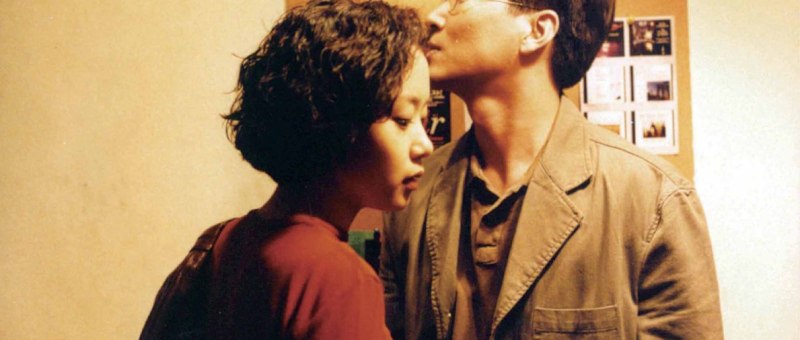
The Contact (접속, Chang Yoon-hyun, 1997)

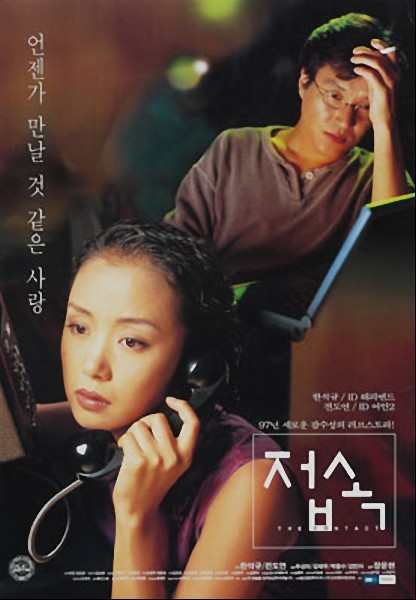
The Contact poster 1Even in 1997, it was supposedly much easier than ever before to make contact with pretty much anyone anywhere in the world, yet most of use chose not to. Twenty years later, perhaps not much has changed as we remain increasingly disconnected in an evermore connected world. Sometimes, however, as a radio host’s opening monologue reminds us, life has you take the long way round and it’s not until you hit a bump in the road that you start to think about what’s really important. The melancholy heroes of Chang Yoon-hyun’s The Contact (접속, Jeopsok) are each reeling from romantic disappointment, but brought together by a series of coincidences eventually find an outlet for their woes in the newfangled world of online chat.

Dong-hyeon (Han Suk-kyu) is the producer of a successful radio show but constantly in trouble with the suits for his uncommercial music choices. When someone anonymously sends in a battered copy of The Velvet Underground’s self titled album, he decides to switch up the order and play Pale Blue Eyes partly out of a sense of nostalgia and partly because he is hoping the woman he suspects may have sent it will be listening.

Meanwhile, across town, Soo-hyeon (Jeon Do-yeon) is sharing a moment with a cheerful young man, Ki-cheol (Choi Cheol-ho), who turns out not to be her boyfriend, but that of her roommate. To get away from the pain of seeing them cosied up together, she goes out for a drive and turns the radio on for company just as Dong-hyeon drops the needle on Pale Blue Eyes. So moved by the song that she only narrowly escapes a multi-car pileup, Soo-hyeon writes in to request it again which leads Dong-hyeon to wonder if she’s his old flame using an alias. Obviously, she isn’t, but excited to get an email from a radio show producer and not wanting to disappoint him she lies and says the request was for her friend who might be the one he’s looking for.

A pair of brokenhearted romantics, Dong-hyeon and Soo-hyeon are old souls who like rainy days and going to the movies in the afternoon but they’re also intensely online and attuned to the possibilities of indirect communication. Despite the “instant” nature of modern technology, the pair send intermittent emails, leave messages on answerphones, and fax each other, only sometimes replying in the moment via IRC but communicating on a much deeper level than they might have meeting face to face. Because they live in a city and have much more than they know in common, they unwittingly slip past each other with improbable frequency but would likely never meet, the act of making “contact” in person all but an impossibility.

The curiously analogue, nostalgia-laden, and above all physical device of the LP brings the pair together through a shared sense of loneliness born of frustrated love as they attempt to support each other through differing stages of romantic grief. While Dong-hyeon remains wilfully trapped in the past, mooning over an old flame while blaming himself for possibly coming between the woman he knew did not love him and the man she did, Soo-hyeon is in the thick of it struggling with her feelings for her roommate’s boyfriend. Calling himself “Happy End” because he’s read about them in books but doesn’t believe they exist in the “real” world, Dong-hyeon gives Soo-hyeon contradictory advice while making an ill-advised romantic overture to straightforward writer Eun-hee (Chu Sang-mi) who, unlike Dong-hyeon and Soo-hyeon, knows exactly what she wants and isn’t afraid to state it directly. “Why can’t you be honest with your feelings?” she repeatedly asks Dong-hyeon, but predictably gets no reply.

Soo-hyeon meanwhile has given herself the rather depressing name of “female 2” online, apparently inspired by a series of walk-on parts in plays, but perhaps hinting at her categorisation of herself as an invisible face in the crowd while also ironically pointing at her awkward position as the third wheel in her friend’s relationship. Berated for his emotional diffidence by Eun-hee, Dong-hyeon nevertheless tells Soo-hyeon she’s better off to forget Ki-cheol if she can’t find the courage to tell him how she really feels but as good as his advice sounds it’s primed to backfire, potentially costing not just one but two friendships and seeing Ki-cheol disappear from her life forever. Braver than Dong-hyeon, she resolves to give it a go and whatever happens it will at least answer a question, putting an end to the continued suffering of being merely friends with the man she loves.

Perhaps out of a sense of guilt for having selfishly prioritised his own feelings with tragic consequences, Dong-hyeon has decided to keep them to himself, but if so it’s also made him casually cruel and infinitely insensitive. Giving up on his romantic dream, he contemplates running away and starting a new life abroad, while Soo-hyeon risks everything in pursuit of love. Not knowing how to connect with her in the offline world, Dong-hyeon once again resorts to the physical in order to make contact, waving a tiny document like a one-way passport to love in order prove his identity and romantic destination. Finally finding the strength to let go of lost love and take a chance on new ones, the pair shift their relationship from digital to analogue as they, ironically, resolve to leave the past behind for more connected future.


The Contact was screened as part of the 2019 London Korean Film Festival.
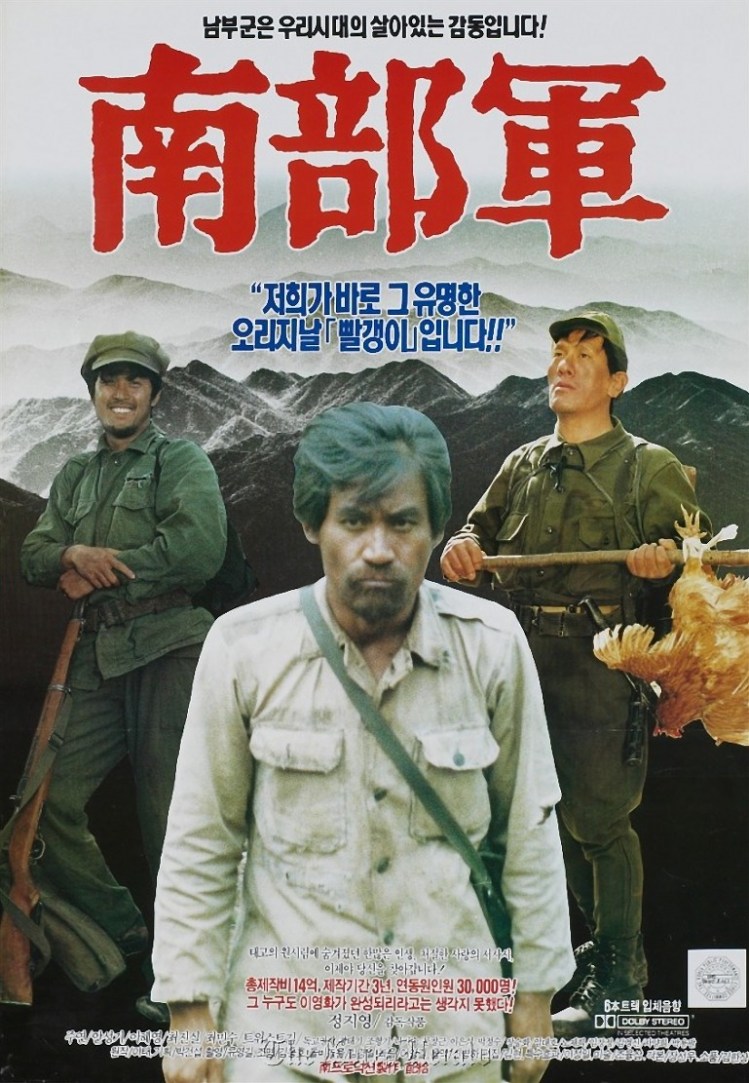
Nambugun: North Korean Partisan in South Korea (南部軍 / 남부군, Chung Ji-young, 1990)

North Korean Partisan in South Korea poster 1Under the intense censorship of South Korea’s military dictatorships, “anti-communism” had become the single most important cultural signifier to the extent that all films were in some sense “anti-communist” even if some were more obviously anti-communist than others. As power shifted away from the dictators and towards a new era of democratic freedom, a more nuanced view of the recent past became possible with the “division film” taking the place of the old-fashioned anti-communist drama. Rather than demonise the North, the division film emphasised the tragedy of partition, painting the two Koreas as equal victims of geopolitical finagling.

Arriving in 1990 shortly after Korea’s democratisation, Chung Ji-young’s Nambugun: North Korean Partisan in South Korea (南部軍 / 남부군, Nambugun) is among the first to directly address the subject of the Korean War from the perspective of the North Korean partisans, albeit obviously from those who eventually came South. Adapting the memoirs of war correspondent Lee Tae, Chung ignores ideology in order to explore the gruelling experience of guerrilla warfare largely being fought by ordinary people with strong convictions rather than by career soldiers or committed revolutionaries.

Lee Tae (Ahn Sung-ki) himself is an “intellectual” North Korean newspaper reporter working as a correspondent in Jeonju which is currently in North Korean occupied territory. When they get word that the Americans and South Korean forces are on their way, the newspaper staff evacuates and eventually ends up heading into the mountains to join the partisans. As he has previous experience, Lee Tae is given command of a platoon and the instruction to try and make up for his bourgeois intellectualism with hard work on the job. To keep them all in one place, Lee is assigned a series of other “intellectual” recruits including conflicted student Kim (Choi Min-soo) who joined the fight to figure out what this “inhuman” war was all about.

One of the reasons Kim is so conflicted is that he brought his hometown, high school-age girlfriend with him and wonders if that was a very responsible thing to do, especially when they are eventually separated by the command chain who decide to send her to headquarters while Kim stays with the troops. Though we are shown that the North Korean soldiers are just ordinary men and women who call each other comrade, the regime itself still comes in for subtle criticism for its oppressive hardline austerity. On the run and separated from his unit, a wounded Lee is accompanied by an earnest nurse, Min-ja (Choi Jin-sil), with whom he falls in love, but when the romance is discovered by a superior officer Lee is taken aside and reminded that here there can be no love, only revolution. He must give all of himself to the cause, reserving nothing for such bourgeois affections as romance. Both Lee and Kim spend the rest of the picture trying and failing to reconnect with their respective women while fantasising about a different kind of life in which they would not have been kept apart.

Yet, despite the fact that we clearly see a world of near total equality among the partisans, it is clear that Lee’s own thinking at least is not quite as progressive as one might assume. Bonding with Min-ja and dreaming of the future, he envisages a life for himself as a reporter in Seoul at which point she asks what she’s supposed to do and receives the answer “have dinner ready for me”.  Min-ja, apparently an orphan whose brother was killed fighting for the South, found herself becoming a field nurse for the North and perhaps has a lower ideological consciousness as a result, freely offering her medical knowledge to anyone who might be in need of it. “Why is it that we’re fighting?” she asks Lee, “you both need me”, embodying the wounded innocence of the one Korea unfairly torn apart by forces beyond its control.

All gusto and determination, Lee and the others start out with pluck and positivity but gradual disillusionment accompanies the shift from the warmth of spring to the dead of winter as the partisans find themselves starving to death on a frozen mountain. Win or lose, the victory belongs to the US or USSR, one particularly dejected soldier intones laying bare his loss of faith in the primacy of North Korean communism and accepting that they are all playthings in a proxy war being fought by Koreans on Korean soil. Kim fails to find “meaning” in conflict and emerges only with shame and regret while others clutch at pamphlets dropped by the Americans promising an amnesty for those who surrender willingly. Lee trudges on alone, frostbitten and starving, encountering only the dead and finally contemplating suicide only to be given one last source of hope and to have that too crushed. Chung humanises the communists, but still they have to lose in the spiritual as well as the literal sense. Ending on a howl of existential despair, the film dedicates itself to all those on both sides who fell on Jirisan or sacrificed their lives for a vision of a better world but does so with pity more than admiration for all that they suffered as victims of their times.


Nambugun: North Korean Partisan in South Korea was screened as part of the 2019 London Korean Film Festival.
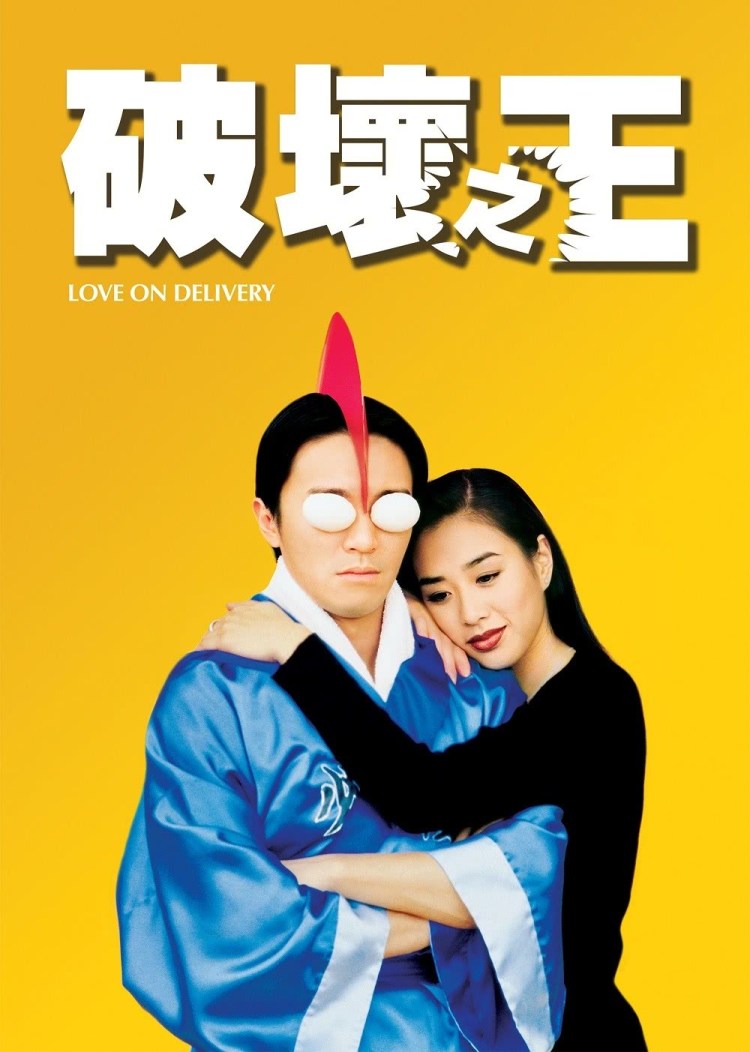
Love on Delivery (破壞之王, Stephen Chow & Lee Lik-Chi, 1994)

Love on Delivery posterBy the standards of ‘90s Hong Kong cinema, early Stephen Chow hit Love on Delivery (破壞之王) might seem refreshingly down to earth but make no mistake this under appreciated romantic comedy gem is as zany as you’d expect from the master of surrealist laugh a minute humour. A curious tale of cultural pollinations, Delivery once again stars Chow as an ineffectual loser trying to impress a girl but this time it’s a battle of wits he ends up winning when he unexpectedly finds himself standing up for “garbage” in the face of arrogant elitism.

The film opens not with its hero, but with judo champion Li (Christy Chung) who finds herself persistently sexually harassed by her slimy dojo leader who is apparently determined to win her because she’s the only woman capable of “throwing him over”. Seeing as his chat up lines are things like “my house is really big and my bed is really comfy come and see”, Li isn’t really interested which is why she ends up kissing in the right place at the right time delivery boy, He (not altogether against his will). He (Stephen Chow) is smitten, but Li has been looking for a “hero”, someone big, strong, and manly who can match her martial arts prowess but also respect her as a human being. Unfortunately, He is a weakling and a coward, as Li discovers when the boss of the dojo interrupts their first “date” and tries to thump He who activates his well honed coward skills and dodges the blow which lands squarely in the middle of Li’s face.

Fearing his romantic dreams have been well and truly shattered, He resolves to become stronger so he can fight back which is how he ends up meeting conman and stall owner “Devilish Muscle Man” (Ng Man Tat) who claims to be the last heir to “Ancient Chinese Boxing” as well as a close friend of Bruce Lee and Jackie Chan (only he doesn’t like to name drop). Devilish Muscle Man offers to “train” He in the ancient martial arts, for a “small” fee. Though all of Devilsh Muscle Man’s “training” is a sham, He starts to get quite good at it and eventually defeats the dojo boss whilst wearing a giant fluffy Garfield head. However, a new challenger soon enters the arena – a childhood friend of Li’s who went to Japan and has become an “elite” karate champion claims to be the mysterious Garfield head, stealing He’s thunder and Li’s heart along with it! 

Chow may be in a relatively restrained mood, but there are pop-culture references and in jokes galore which eventually culminate in a Hong-Kong vs Japan standoff in which Chow ends up inheriting Devilish Muscle Man’s kung fu persona which saw him fighting in a strange costume inspired by Ultraman (or possibly Chinese Ultraman rip off Inframan). Meanwhile, the big bad – Li’s ex Duan Shui Liu (Ben Lam Kwok-Bun), dresses in an old fashioned Japanese students’ uniform and rails about the “garbage” people of Hong Kong with their “garbage” kung fu which he plans to eradicate through affirming the primacy of karate as the best and only real martial art. He’s first problem is that he actually self identifies as “garbage” – he is only a poor delivery boy working for a tiny cafe which stoops to various scams to trick its customers out of their money and/or complaining and has no real prospects of being able to lift himself out of the gutter despite his new found fighting spirit and commitment to martial arts training. Nevertheless, He decides to own his “garbage” status to stand up for all the other “garbage” people resisting “Japanese imperialism” in the only way he knows how – by using his wits to trick Duan into allowing himself to be defeated.

He, a perpetually “nice guy” who gives away not only his entire wallet but all his clothes to a homeless father, eventually defeats the forces of “elitism” through an acknowledgement of his inferior fire power and an efficient use of the skills he does have to create a confusing atmosphere of chaos which ensures his final victory. A mildly subversive tale of fighting back against “the elite”, Love On Delivery is also a hilarious romantic comedy in which the nice guy gets the girl solely by demonstrating himself brave enough to face defeat with, well if not dignity, perhaps resolve.


Currently available to stream on Netflix in the UK (and possibly other territories)

Celestial Pictures trailer (Cantonese with English/Traditional Chinese subtitles)

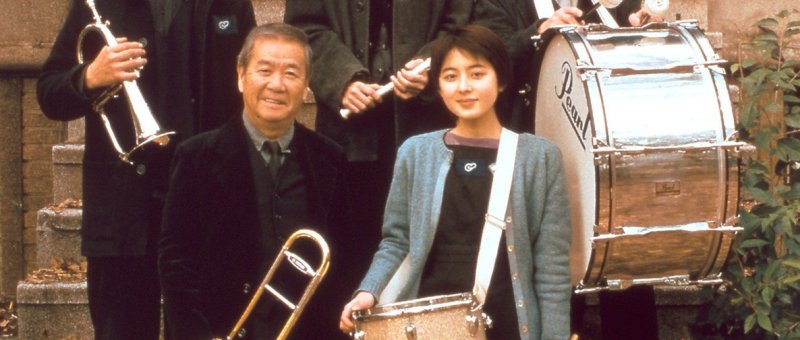
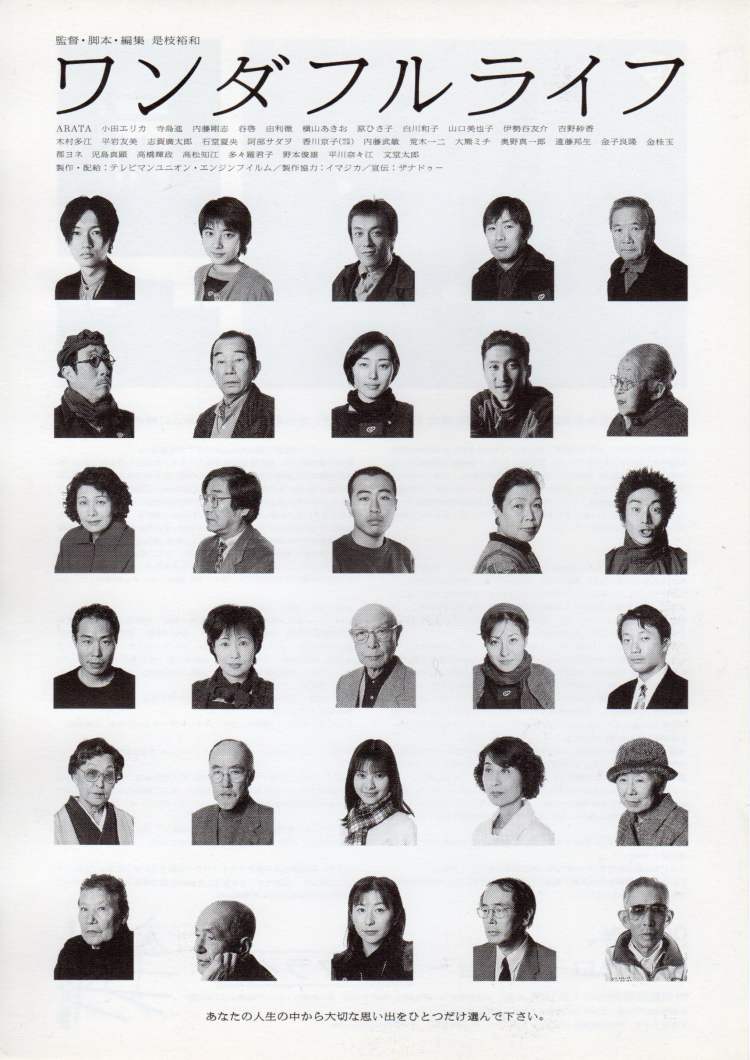
After Life (ワンダフルライフ, Hirokazu Koreeda, 1998)

Afterlife posterAt the end of your life, if someone asks you what it all meant, what will you say? It’s a question that can’t be answered until after you’ve turned the final page, but there is an idea at least that death brings clarity, rendering all things simple from a strange perspective of subjective objectivity. This is the central idea behind Hirokazu Koreeda’s meta existential fantasy After Life (ワンダフルライフ, Wonderful Life) in which the recently deceased are given seven days’ grace in order to decide on their most precious memory so that a small collection of clerks working in an old-fashioned government building can “recreate” it through the medium of cinema, allowing a departing soul to take refuge in a single memory preserved in eternity.

Heaven’s waiting room, as it turns out, is apparently located inside the ghost of the Japanese studio system. The recently deceased give their names at the door and patiently wait for their turn with their allotted case manager whose job it is to offer after life counselling designed to bring them to the point of boiling their existence down to the single moment which defines it within the arbitrary three day time limit which gives the crew the time to put their memories into pre-production complete with old-fashioned stage sets and studio-era special effects.

The purpose of all of this is not is exactly clear, though a clue is perhaps offered when we discover that the clerks are able to order VHS tapes of the entirety of their subjects’ lives in the event that they are struggling to think of relevant moments in an existence which seems to have disappointed them. The point is not so much the literal truth of the memory, be it accurate or not, but its sensation and the transience of feeling which is then re-experienced through the medium of cinema, captured in celluloid as momentary permanence.

Consequently, the chosen moments are necessarily often ones of stillness which promise the kind of peace and serenity one is supposed to find in death. The moments are ones of silent togetherness, of natural beauty, of childish innocence, or unbridled joy but is each is perhaps the key to unlocking the enigma of a life and as such is a solution which points towards a question. One older gentleman, Watanabe (Taketoshi Naito), finds himself unable to choose. He views his life as the epitome of mediocrity and can find nothing in it that seems worthy of “eternity”. Watching the videotapes of his life, he sees himself as a young man vowing to make a mark and is desperate to find some evidence that he lived but like many does not find it. His life was happy by virtue of being not unhappy for all that it was perhaps unfulfilled but only through communing with himself after death is he able to reclaim the memory of his late wife (Kyoko Kagawa) with whom he never quite bonded in mild jealousy of her lingering attachment to her first love who fell in war.

This being a film from 1998 and mostly featuring those in their 70s and above, the war looms large from painful battlefield memories of fear and starvation to unexpected reunions and the joy of simple pleasures found even in the midst of hardship. The clerks who died young may look on in envy of Watanabe’s “ordinary” life in the knowledge of all they were denied, while others mourn for a future they will never see. Yet there are shorter sad stories here too from a high school girl (Sayaka Yoshino) whose original choice of a day out at Disneyland is deemed too prosaic, to a middle-aged bar hostess (Kazuko Shirakawa) reminiscing about an old lover who let her down, and a rebellious young punk (Yusuke Iseya) who flat out refuses to choose because he feels that is the best way to accept responsibility. Forced into a reconsideration of his own life, even a clerk is eventually moved by the realisation that even if he had previously believed his existence devoid of meaningful moments he has achieved something by featuring in those of others and is therefore also a meaningful part of a considered whole.

Making the most of his documentary background, interspersing “genuine” memories among the imagined, Koreeda’s heavenly fantasy is one firmly tied to the ground where seasons still pass, time still flows, and the relentlessly efficient march of bureaucracy continues on apace undaunted by the presence of death. Death may give life meaning, but it’s living that’s the prize in all of its glorious complexity filled with both beauty and sadness but always with light even in the darkest corners.


After Life screened as part of an ongoing Koreeda retrospective currently running at BFI Southbank.

Original trailer (no subtitles)

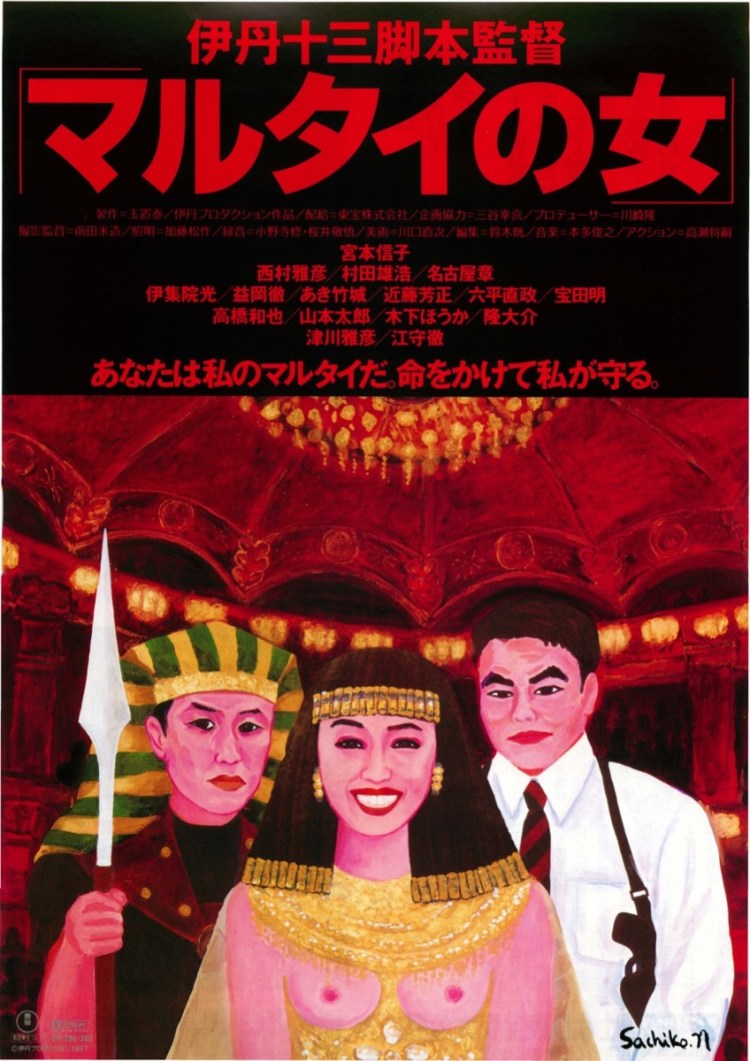
Woman in Witness Protection (マルタイの女, Juzo Itami, 1997)

woman in witness protection posterJuzo Itami’s fearless taste for sending up the contradictions and hypocrisies of his home nation knew no bounds, eventually bringing him into conflict with the very forces he assumed so secure it was safe to mock – his 1992 film Minbo led to brutal attack by a gang of yakuza unhappy with how his film portrayed the world of organised crime. Woman in Witness Protection (マルタイの女, Marutai no Onna), continuing the “Woman” theme from previous hits A Taxing Woman and the more recent Supermarket Woman, would be Itami’s final feature as he died in mysterious circumstances not long after its completion and like Minbo it touched an open nerve. In 1997, crazy cult violence was perhaps no laughing matter nor as ridiculous as it might have seemed a few years earlier, yet Itami makes the actions of brainwashed conspirators the primary motivator of a self-centred actress’ gradual progress towards accepting the very thing his previous films might have satirised – her civic duty as a Japanese woman.

Itami breaks the film into a series of vignettes bookended by title cards beginning with the first which introduces us to our leading lady – Biwako Isono (Nobuko Miyamoto). Biwako is currently in rehearsals for an avant-garde play about giving birth (“a woman’s moment of glory”) during which she reduces her assistant to tears prompting her resignation, decrying Biwako’s self-centred bitchiness as she goes. Chastened, Biwako spends the evening doing vocal exercises outside her apartment which is how she comes to witness the botched murder of a lawyer by a crazed cultist (Kazuya Takahashi) during which she is almost murdered herself and only survives because the killer’s gun jams. As the only witness Biwako suddenly becomes important to the police which works well with her general need for attention but less so with her loathing for hassle. Seeing as Biwako is a famous actress, her involvement also precipitates increased press interest for the murder and accidentally threatens the ongoing police investigation not least because Biwako likes to play up for the camera and isn’t quite sure how best to deal with her divided responsibilities. With the killer still at large, the police decide to give Biwako protection in the form of two detectives – Chikamatsu (Yuji Murata), a cultured man who’s a big fan of Biwako’s stage career, and Tachibana (Masahiko Nishimura), a rather stiff gentleman who never watches films and rarely indulges in entertainment.

Bringing up cult violence in 1997 just two years after Japan’s only real terrorist incident perpetrated by a crazed cult, might be thought taboo but taboo was not something that Itami had ever run away from. Crazed cults had also popped up during A Taxing Woman’s Return though back then they mostly represented the hypocrisy of the new yakuza as a front for organised crime that thought nothing of bleeding vulnerable people dry while feeding them a lot of semi-religious claptrap to make them feel a part of something bigger while the bubble economy continued its puffed up attempts to make them feel inadequate. This time around our cultists are less well drawn but clearly a collection of unlucky people duped into believing the strange philosophies of the “Sheep of Truth” which teach that the world can only be saved by its followers dividing the world into white sheep and black sheep. Like the policeman and later Biwako, the killer believes he is only doing “that which must be done” in the best interests of the world. He is unaware of the cult’s shadiness and shocked when their lawyer threatens his family in an effort to convince him not to talk once the police have managed to break his programming, ironically through exactly the same methods – manipulating his feelings towards his wife and son.

The cult is however merely background to Biwako’s ongoing character drama. Despite experiencing emotional trauma from witnessing a murder and then being threatened herself, Biwako enjoys being the centre of the attention with the police as well as the warm glow she feels in being able to help them with their enquiries, but balks at the additional hassle of having to be involved in the trial (even if she would be given quite a sizeable platform as a witness in a high profile court case). She resents having the two policemen follow her around – especially as she has quite a busy schedule which includes an affair with her married manager. Nevertheless she gradually allows them into her life with Tachibana even making his stage debut as spear carrier in a production of Anthony and Cleopatra. Tachibana’s steadfast defence of her person even at the risk of his own life begins to teach Biwako a few things about civic responsibility and the importance of duty, even if her final moment of realisation is another of her staged set pieces in which she conjures a poignant monologue from the accidentally profound mutterings of Tachibana, a little of Cleopatra, and the earlier line from the maternity play repurposed as she affirms that testifying against the cultists will be her “moment of glory”.

Rather than end on Biwako’s sudden moment of enlightenment, Itami cuts to an ironic epilogue in which a police detective watching the movie we have just seen complains about its authenticity while emphasising that no one in protective custody has ever been attacked. A little tongue in cheek humour from Itami that is followed by the more usual disclaimer before the credits resume, but perhaps anticipating another dose of controversy from both law enforcement and cult devotees. Lighter in tone and noticeably less surreal than some of Itami’s earlier work, Woman in Witness Protection is the story of a vacuous actress learning the purpose of her stage as her particular brand of artifice meets that of the less innocently self-centred cultists head on and eventually becomes the best weapon against it.


Original trailer (no subtitles)

Motel Cactus (모텔 선인장, Park Ki-yong, 1997)

Motel Cactus posterAs a pair of its patrons eventually begin to muse in a moment of easy reflection, Motel Cactus is an odd name for a love hotel. Then again, a prickly flower blooming in the desert perhaps captures the uniquely melancholy qualities of these illicit, temporary meetings filled with defeated hope and existential malaise. A breakthrough feature for Park Ki-yong, Motel Cactus (모텔 선인장, Motel Seoninjang) owes a significant debt to the world of Wong Kar-wai with which it shares a mild visual similarity thanks to cinematographer Christopher Doyle making his only (to date) foray into Korean cinema. Park’s explorations of romantic emptiness might not be particularly original but it’s hard to argue with the beauty in his sadness.

Each of our joyless encounters takes place in room 407 of the titular Motel Cactus stretching across ten years of turbulent Korean history. Park begins with politics as a young woman attempts to wash tear gas out of her eyes after wandering into a democracy demonstration by mistake. Time moves on and the room becomes home to a pair of students intent on shooting a film but trapped in a Godot-esque limbo waiting for a friend who has been unavoidably detained. The first woman suddenly reappears but with a different man, followed by the man again but now with an old flame whose life after love has proved disappointing.

Park bookends each of the episodes with a brief piece of to camera monologue taking place outside of the room. Hyun-Joo (Jin Hee-kyung), the woman from the first and third scenes, angrily berates an offscreen friend for being naive and getting her heart broken by another no good, cheating man. Of course, Hyun-Joo’s irritated speech could easily be directed at herself, abandoned and then abandoning in each of her unsuccessful encounters with men. Though her original assignation with the young and handsome Min-koo (Jung Woo-sung) begins with passionate intensity, it quickly turns cool – he calls another woman and lies about being with a client, emerging guilty and conflicted. Min-koo refuses to talk of love and eventually leaves early, offering the olive branch of a Saturday picnic that both of them know will probably never take place.

Suk-tae (Park Shin-yang), Hyun-joo’s second partner, begins with a “funny” story recited in a bar about a woman who may have been intending to commit suicide for love. Drunk out of their minds, Suk-tae and fellow drinker Hyun-joo head on up to room 407 where they have a total blowout, alternating between childish play and animalistic lovemaking. When the air cools and introspective chat takes over, he asks her if it’s true she always comes here when it rains to which she freely admits, reliving the ghost of past love and a rainy birthday with the presumably long gone Min-koo. This time, it’s Hyun-joo who leaves sadly before the sun has risen while Suk-tae is left behind in a blissful, drunken snooze.

When Suk-tae returns to the room, it’s for a less deliberate purpose. Reuniting with college sweetheart Hee-soo (Lee Mi-yun), he makes awkward small talk reminiscing about the old days while she sadly keys him in to her melancholy dissatisfaction with her later life which neatly echoes his own sense of defeated failure. They want to go back to a more innocent time, but they can’t and it’s clear their superficial reconnection is merely an echo of the past which won’t survive the room.

The room has its way of distorting itself, trapping the would be lovers in an imaginary space in which a part of them will always remain. The students attempt to subvert the nature of Motel Cactus through inching towards innocent romance, but they remain at odds with each other, playing childishly at love while attempting to take mastery of the room but repeatedly failing. Miscommunication reigns. Seo-Kyung (Kim Seung-hyun), the young actress in filmmaker Joon-Ki’s (Han Woong-soo) student project, gets waylaid on her way to the hotel by a TV vox popper who wants to ask her opinion about in a change in the law which would reverse a ban on people with the same surname marrying (a fairly big problem given Korea’s relatively small number of surnames even when only applying to a common ancestral branch). Seo-kyung, however, mishears them and launches into a consideration of same sex relationships on which she ultimately comes out in favour.

Hee-soo’s monologue was delivered to a fortune teller who’d previously advised her that her marriage was a bad idea – she didn’t believe him, but he was right. Motel Cactus is a sad place, drenched in neon half light with the greyness of rainy skies worrying at the windows. An old lady reappears to clear up after our careless lovers while the room’s decor undergoes minor changes, an ‘80s-style electric moving picture diorama an eerie fixture on the wall as its bright waterfalls threaten to tumble on for all eternity. Time stands still in here, marked only by the futility of true connection and the inescapable longing that accompanies it. Park’s naturalistic desires are occasionally swamped by Doyle’s characteristically stylish camerawork but it’s difficult to argue with the poetry of his images even whilst singing an old song.


Motel Cactus was screened as part of the 2018 London Korean Film Festival.
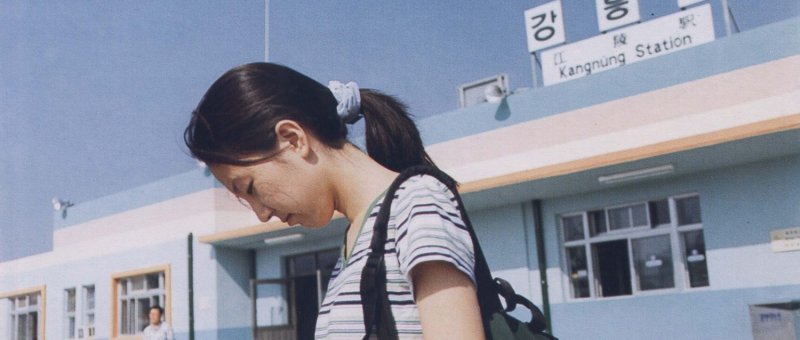
The Power of Kangwon Province (강원도의 힘, Hong Sang-soo, 1998)

Power of Kangwon province posterTogether, but separate, could serve as a thematic guide to the work of Hong Sang-soo for whom time is malleable and place even more so. The Power of Kangwon Province (강원도의 힘, Gangwon-do ui him), his second feature, is as playful as one might expect, employing the dual structure familiar from Hong’s later work to set a pair of lovers against each other as they endure the same holiday without ever crossing paths in an attempt to forget their doomed romance.

Jisook (Oh Yun-hong) takes a train to the titular Kangwon province – a popular holiday destination just far enough from the city to make it an attractive place to bury one’s sorrows. Together (but sort of separate) with two university friends she wanders around doing all the regular tourist stuff. For some reason the girls attract the attention of a local policeman (Kim Yu-seok) who starts hanging out with them. Over a tense dinner, Ji-sook argues with her friend over her failed affair with a married man, after which she ends up in an odd encounter with the policeman who is also married.

Meanwhile, married professor Sangkwon (Baek Jong-hak) is in a state of lovelorn depression over the end of an affair with a much younger woman who he claims is the only one he’s ever truly loved. Underappreciated at his current place of work, he spends some time sucking up to his sumo-loving boss but eventually comes to the conclusion it’s all been pointless and he’s never going to get tenure from this rigid old man. Still, despite his wife’s encouragement, he drags his feet applying to another university and continues to mope. Relief comes when his friend (Chun Jae-hyun) invites to him Kangwon for a few days to forget his troubles, but time away only seems to reinforce his sense of emptiness and inability to let go of a lost love.

In truth, we have little implication that the stories of Jisook and Sangkwon are connected at all until they finally intersect save that their movements mirror each other as they each attempt to erase the memory of their failed romance through a sad vacation. Jisook and Sangkwon are on the same train, going to the same place, where they do very similar things but their paths do not cross again – they are out of step with one another, unable to repair the rhythm of their romance but bound by an awkward togetherness just the same.

Meanwhile, a dark spectre haunts them in the form of a mysterious woman and her “fall” from a cliff. Jisook’s disappointing relationship with the married policeman is at least a natural connection, however ill advised it may turn out to be, whereas Sangkwon spends his time irritatedly chasing a lonely woman who got fed up of waiting for him and later walked into the path of another jealous and impatient man. Though in no particular hurry, both Jisook and Sangkwon are constantly annoyed by being forced to waste time hanging around. Jisook’s ballistic attack on the policeman who arrived late to collect her on a return visit to Kangwon is probably misdirected anger at Sangkwon and the illicit nature of her visit, but Sangkwon’s is a kind of arrogance – as if he believes the world exists at his leisure and that he is free to put it down and pick it back up again at his own choosing. Jisook wouldn’t wait for him any longer, but Sangkwon can’t quite accept the relationship is over. He never truly considers abandoning his wife and family to pursue a supposedly “true” love, but won’t give up on the romantic ideal.

Hong positions both lovers as lost, chasing distant ghosts of each other through the spooky environs of the picturesque holiday town, attempting to bury their loneliness in other bodies but emerging with only sadness and resentment. Connection is fleeting, and perhaps unsatisfying in itself. The power of Kangwon province may lie in making a grave for the impossible dream of enduring of love. Jisook buries the smoking embers of her romance even whilst still alight, leaving Sangkwon sadly gazing into a goldfish bowl made for two but now home to only one. Destined never to understand each other, we are all trapped in our own fishbowls sadly gazing out at an incomprehensible world where the only reward of longing is existential sadness. Sound familiar?


The Power of Kangwon Province was screened as part of the 2018 London Korean Film Festival.

Home video release trailer (no subtitles)

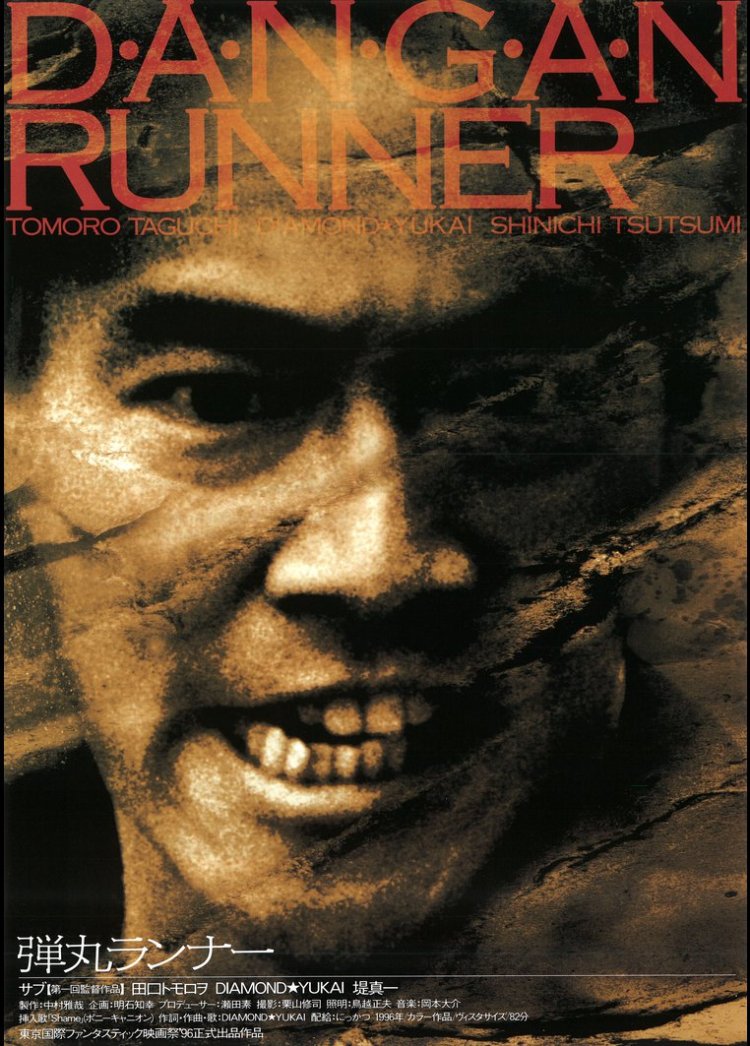
Dangan Runner (弾丸ランナー, SABU, 1996)

Dangan Runner posterIt’s not difficult to see what might send three young men running like stray bullets from a random gun in the Japan of the mid-90s, but each of the various protagonists of SABU’s debut feature Dangan Runner (弾丸ランナー, AKA Non-Stop) is reaching for a different target. Like much of the director’s later work, Dangan Runner pivots on random circumstance which somehow conspires to bring our three runners together as if bound by cosmic thread while they too are chased by an oncoming storm in the form of vengeful yakuza and the bumbling cops hot on their trail.

Kickstarting the whole affair, lowly restaurant worker Yasuda (Tomorowo Taguchi), fed up with the petty humiliations of his life, decides to rob a bank. He has everything planned, even rehearsed and choreographed down to the second, but when the time comes he makes a mistake. Having left his mask at home, he decides to buy one from a local combini but panics and accidentally shoplifts instead, attracting the attentions of bullet two – Aizawa (Diamond Yukai), who is wounded in the arm by Yasuda’s nervous shot when his gun accidentally goes off. A drug addict and former rockstar, Aizawa, intent on revenge for the disrespect he’s just been paid, retrieves the gun dropped by Yasuda and chases him through the streets of Tokyo. Aizawa in turn continues the chain reaction when he bumps into a yakuza, Takeda (Shinichi Tsutsumi), who is “triggered” by a deep seated trauma into chasing off after Aizawa, knife in hand. Meanwhile, a rival yakuza clan is also after Takeda because of gangland politics while they too are being monitored by the police who have gotten wind of a gang war in the offing.

Though SABU’s film is not in the least political, it is like much of his work a mild satire even if its sympathy lies firmly with its three central heroes each desperately trying and failing to outrun themselves. Yasuda, a small man with a slight frame, is the lowest of the low. He has a terrible job as a kitchen assistant in a small restaurant where he is constantly bullied by the head chef and belittled by the other kitchen staff who are all much taller and stronger than he is. It’s not difficult to see why he might bristle so much when one calls him “good for nothing”, yet he’s not the type to offer more than an angry stare in return. To make matters worse, he runs into an old girlfriend who appears to have moved on and up. Walking arm in arm with a wealthy salaryman, she has apparently jettisoned the “common” name of “Midori” for the relatively more sophisticated one of “Yasuko”, presumably hoping to hook someone who is indeed the polar opposite of a “loser” like Yasuda.

Aizawa also has his share of woman troubles though his are of an opposing dimension. A failed musician with a drug problem, Aizawa alienated his loving girlfriend while hoping his addiction would save him from his unattainable dreams. Of course, it’s an entirely different “shot in the arm” that starts him running, but like Yasuda in the end all he can think of is the girl and how he did everything wrong. Takeda, by contrast, is a yakuza through and through. His regrets are bound up with homosocial bonding and male loyalty, mourning the death of the trusted superior he failed to save in dodging the blows of a random assassin. Yet as his superior tells him, all living beings run towards the same thing. A yakuza cannot control his death but he can control his life and the effect he has on others. He urges Takeda to run and find life in the process, but perhaps Takeda’s destination is the run itself rather than where it will eventually take him.

Indeed, Yasuda, accidentally landing up in the middle of the yakuza gang war, affirms that he never felt so alive as when he was running for his life. All three men, running fast from failure, finally achieve the freedom they’d dreamed of through the intense exertion of their flight which later literally becomes orgasmic as all three fantasise about a pretty woman seen on the side of the road. Like bullets fired from a gun powered by social impossibility, each is destined to explode on reaching its chosen target. Like many of SABU’s later protagonists, these are men brought low by life and circumstance, driven slowly mad by a conspiracy of cosmic coincidence, mere playthings of fate without power or agency. Angry young men are a powder keg waiting to ignite, but in SABU’s whimsically surreal universe they usually sort things out amongst themselves. For the Dangan Runners, they only need to look in the mirror to figure out where it is they need to go.


Dangan Runner is available on dual format DVD & blu-ray from Third Window Films. On disc extras include a video essay on the history of V Cinema from film scholar Tom Mes, and an expansive audio commentary by Jasper Sharp providing detailed background on SABU’s career and the Japanese cinema landscape of the mid-90s.

Original trailer (English subtitles)

Swordsman II (笑傲江湖之東方不敗, AKA The Legend of the Swordsman, Tony Ching Siu-tung, 1992)

Swordsman II still 1In a world filled with chaos, is the answer to all life’s problems retreat or attack? After the unexpected success of Swordsman which survived the withdrawal of legendary director King Hu to go on to be a box office hit, a sequel was quickly set in motion to be directed by action choreographer Tony Ching Siu-tung. Swordsman II (笑傲江湖之東方不敗) would be the second in a trilogy inspired by Louis Cha’s novel The Smiling, Proud Wanderer and largely dispenses with the cast of the original film for a virtual reboot led by action star Jet Li and actress Brigitte Lin as an extraordinarily sympathetic villain.

Picking up soon after the end of the first film, Ling (Jet Li) and his female comrade nicknamed “Kiddo” (Michelle Reis) are on the run with the intention of retiring from the world of martial arts to live simply among honest people. However, they are about to ride straight into the heart of conflict. At this particular point in history, the “Highlanders” feel themselves oppressed by the ruling “Mainlanders” and would be set on rebellion if they weren’t so busy fighting amongst themselves. Meanwhile, a number of Japanese troops are also holing up in China to wait out political strife in Japan. “Invincible” Dawn (Brigitte Lin), a Highlander, appears to have gotten a hand on the first film’s MacGuffin – the “Sacred Volume” which holds the key to untold martial arts power. Teaming up with the displaced Japanese, Dawn plans to use the powers of the Sacred Volume to dominate the Highlanders and then eventually take over the entire nation.

Dawn happens to be the uncle of a woman, Ying (Rosamund Kwan), with whom Ling began something like a romance back in the first film. Ying’s father, Wu (Lau Shun), the chief of Highlander tribe Sun Moon Sect, has gone missing – presumed taken prisoner by Dawn as a prelude to seizing power. Despite his desire to escape the duplicitous world of martial arts, Ling finds himself on a quest to save Ying’s father and with it the Sun Moon Sect if not the entire nation from the tyrant that Dawn seems primed to become.

Ling, as heroes go, is very much of the wine, women, and song, school. Indeed, he’s not much for anything without a good cup of booze – something that provokes an instant connection with the unusual figure of Dawn when he spots her bathing in a local pool and she offers him some of her upscale alcohol in a pretty bottle. The powers of the Sacred Volume come with a price – in order to embrace them, Dawn must transform herself into a woman (or in the less poetic rendering of the text, simply cut off her penis). Dawn’s transformation is a gradual process and she continues to play her male role as the head her clan, even parading her mistress in front of her captives in a noticeably salacious manner. However, Dawn is also caught off guard by an unexpected attraction to the cheerfully tipsy Ling and the transformation seems to accelerate – she begins wearing makeup, her voice changes into a more feminine register, and her sexual relationship with her mistress appears to be definitively over.

Meanwhile, Ling is fighting a romantic war on three fronts – he’s captivated by the mysterious woman who avoided speaking to him never knowing she is really his enemy, but is still half in love with Ying, and the subject of Kiddo’s unrequited crush. While Dawn wrestles with a deeper transformation, Kiddo is also trying to process her place as a woman among men in attempting to shed her tomboyish image by styling her hair in more classically female fashions and wearing makeup – something which can’t help but arouse mild hilarity among her comrades who collectively think of her as a tough little sister. Trying to explain her new persona to her mistress, Dawn insists that she will never forget her and that essentially nothing has changed, while the guys partially mock Kiddo’s new desire to embrace her femininity by avowing that male/female/non-binary gender is an irrelevance. Even so, on realising Dawn is the person he’d been looking for and was once Ying’s uncle, Ling’s parting questions are all about whether he might have accidentally slept with a man which he seems to find embarrassing. Nevertheless, it’s “femininity” which finally does for Dawn as she finds herself weakened by love and eventually pushed towards a “heroic” act of romantic sacrifice.

Having defeated one tyrant, Ling finds himself threatened by another as Wu’s maniacal need for revenge provokes a wide scale purge of those who had “betrayed” him. Ling’s desire to remove himself from this world of betrayals, violence, and complex moralities seems ever more understandable but cannot be his answer even as he finds himself unwillingly exiled. If you turn your back on trouble, it will eventually engulf you and everything you love – as will a failure to resist a trusted ally’s descent into darkness. Strangely affecting in its hero/villain symmetries and air of tragic romance, Swordsman II’s beautifully choreographed action sequences are only surpassed by its fierce commitment to fantasy.


Swordsman II was screened as part of An Evening with Tony Ching Siu-tung presented by the Chinese Visual Festival.