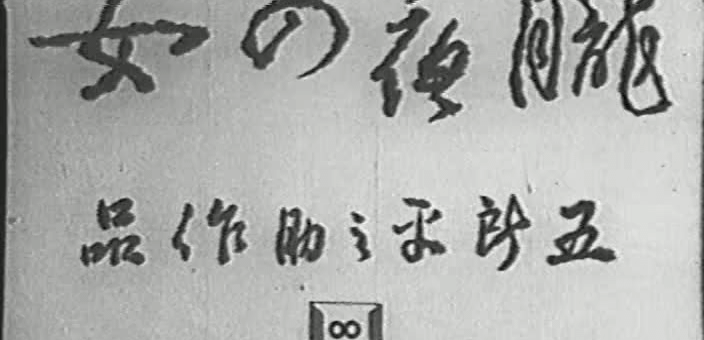
Woman of the Mist (朧夜の女, Heinosuke Gosho, 1936)

vlcsnap-2019-01-21-00h29m30s692The 1930s are often thought of as an era of social rigidity and implacable conservatism, yet even before the war things were changing. The young wanted something different than their parents often had and dared to dream of getting it even if their hopes were often dashed by the times in which they lived. Heinosuke Gosho’s Woman of the Mist (朧夜の女, Oboroyo no Onna) is the story of two youngsters who find themselves in a difficult situation and are offered a solution by elders acting kindness which they are persuaded to take only to find themselves progressively more miserable, burdened by the weight of the sacrifice their society has asked them to make.

Set in the jovial working class world of Shitamachi, Woman of the Mist opens with the hero of the tale, Fumikichi (Takeshi Sakamoto), enjoying a historical lecture regarding Edo era sacrifice for the common good during which his wife, Okiyo (Mitsuko Yoshikawa), comes to fetch him. Members of a local association he belongs to have come looking for him, it turns out for a favour. They want him to assist with some fundraising for a stone lantern to mark the association’s anniversary. Much to his wife’s exasperation, Fumikichi is only too happy to comply. It might seem that Fumikichi is a much respected pillar of the community only it is also true enough that he basks in the flattery of being regarded as someone to be depended upon and is therefore a soft touch (something undoubtedly well known to all around him).

Nevertheless, despite his slight tendency towards narcissistic attention seeking, Fumikichi is a salt of the earth type and willing to help those who need it for largely altruistic reasons. He therefore finds himself a surrogate father (though childless himself) to the son of his widowed sister Otoku (Choko Iida) who enlists him to talk some sense into his law student nephew, Seiichi (Shin Tokudaiji), who has apparently been “disrespecting” his mother and neglecting his studies by reading too many novels. Fumikichi has a word but counsels Seiichi that there’s nothing wrong with reading novels save that it obviously upsets his mum who has worked herself to the bone for the last 20 years dreaming of the day Seiichi becomes a fully fledged lawyer, which is to say a member of the middle classes.

Fumikichi, as he often will, becomes the conciliatory voice at the centre of generational conflict. Seiichi is a young man at the crossroads of life and finds himself torn between youthful idealism and a duty towards his family. He has become disillusioned with the law and would rather transfer to literature, secure in the knowledge that only in novels can you find the truly humane. Fumikichi is careful not to patronise but gives him a knowing look, realising that his confusion is partly born of resentment towards his well meaning yet accidentally possessive mother who has railroaded him into a career he doesn’t want to buy him a future which is her only dream. What he wants is control over his life, but when it comes to it he is still a boy and woefully unprepared for the demands of adulthood.

This becomes obvious when he falls in love and gets his girlfriend into trouble. Teruko (Toshiko Iizuka), a former geisha apparently known to Fumikichi in his younger days now working as a bar hostess, is not exactly the kind of wife his mother might have had in mind. The pair are careful to keep their relationship a secret for just this reason as Seiichi remains conflicted – one moment declaring that he no longer cares if everyone finds out and lying to his mother about her the next. Pregnancy forces the issue. Teruko, mindful of Seiichi’s bright future, declares that she can raise the child alone, glancing sadly at a picture of herself in her former life as a sex worker as if accepting what future sacrifices might be expected of her while half hoping Seiichi will rush forward to save her from such a fate. Seiichi doesn’t exactly rush but does tentatively accept his responsibility in reassuring her that he will soon come of age and is ready to become a father with all of the joys and obligations that entails.

Lost he turns to Fumikichi who hatches a plan which might be accounted a neat solution but is also another instance of the older generation making decisions on behalf of the young without really asking them. Despite being a rather feckless old man, Fumikichi tells his wife the child is his and asks for her forgiveness while also suggesting that they adopt the baby as their own. As expected, Okiyo is not exactly enthused but as Fumikichi calculated she would eventually comes around, ironically enough after a conversation with Otoku who has no idea the baby is really her grandchild. Once the decision is made, everyone rallies round to look after Teruko who finally becomes a (temporary) member of Seiichi’s family even whilst barred from ever becoming his wife and in fact of ever seeing him again as a result of the bargain which has been struck by Fumikichi. Nevertheless, Seiichi vacillates and attempts to change his mind by asking Teruko to marry him only for her to urge him to study hard and live well, sacrificing her happiness for his future.

Uncomfortably enough, it is Teruko who must pay for a series of transgressions against the norms of her society – for being a young woman with a past who seduced a nervous young man and dared to dream of a happier future with a person of her own choosing, though the very fact of her suffering is in itself an attack on these rigid and unfair social codes which do their best to destroy the happiness of ordinary, basically good people who have done nothing wrong other than attempt to live their lives. Fumikichi and his wife are doing their best and they too are good, compassionate people who have made good compassionate choices hoping for the best in a difficult situation even if their choices are defined by the prevailing conservative morality which places Seiichi’s future above a young woman’s life and love.

Then again, Fumikichi’s objections are largely practical – it’s hard to keep a family with no money coming in and Seiichi is still a student with no prospect of immediate employment that would pay enough for a wife and child. Could they be happy after a shotgun wedding and years of penury? Seiichi’s diffidence hints at no, but Teruko’s “purity” hints at yes as she vows to make the kind of sacrifice that proves her “goodness”. The youngsters find themselves beholden to the demands of their elders, torn between their personal desires and duties to those they love. Whatever they do, they lose and are destined to remain unhappy, unable to seize their individual chance of happiness in an oppressive, conformist society. Gosho may leave them at the mercy of such a system, but he does so with immense sympathy and not a little anger as we watch these good people making the best of things while asking ourselves if all of this is really for the best.
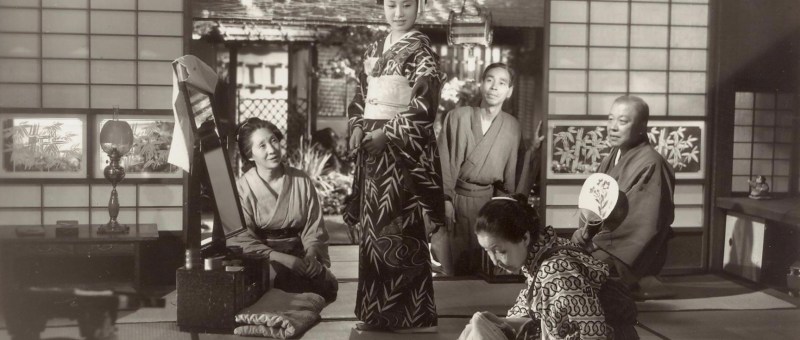
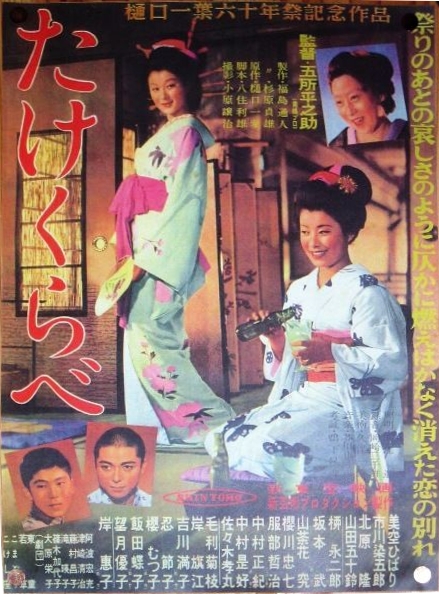
Growing Up (たけくらべ, Heinosuke Gosho, 1955)

Gosho Growing UpCaught in a moment of transition, it’s no great mystery that post-war Japanese cinema began to look back at the Meiji past. Progress had indeed been rapid but ended in national tragedy and collective madness. The post-war humanists were eager for a different outcome, to avoid the mistakes of the last fifty years and build a society that was kinder and freer than that which had come before. Though on the surface it might seem as if much had changed since the dawn of a new century, the problems were still the same and a failure to address them only likely to add new tragedies in place of the better future many hoped for. Among the foremost proponents of post-war humanism, Heinosuke Gosho made a rare trip back into the Meiji past in 1955’s Growing Up (たけくらべ, Takekurabe), an adaptation of the well known short story by Ichiyo Higuchi, finding that nothing much had really changed when it came to the fates of women and the poor in an often wilfully indifferent society.

The action opens on the outskirts of the Yoshiwara in 1894. Our heroes are a collection of children who find themselves dealing with typically adolescent problems but also, by modern standards, expected to grow up all too fast. Chief among them is 13-year-old Midori (Hibari Misora) whose sister, Omaki (Keiko Kishi), is the most famous courtesan of the red light district. Although she knows on some level that her parents have already sold her to the brothel owner in whose house they live as servants, Midori has not yet quite processed the full implications of her destiny or that her world of childhood innocence is rapidly drawing to a close. She is in love with a local boy, Shinnyo (Takashi Kitahara), who seems to return her feelings but is as awkward and confused by them as any teenage boy and treats her by turns with coldness and contempt mixed with grudging affection.

Shinnyo, meanwhile, is the son of a greedy and heartless monk (Takamaru Sasaki) who has decided to sell his older sister as a concubine to a wealthy man who already has a wife. As he loves his sister dearly and has a naive, childish sense of absolute morality, this is a sin Shinnyo cannot forgive. He argues with his father but has no real power to change the situation and then decides on rebelling against his father’s wishes that he not become a monk by leaving for the main temple in Kyoto to take holy orders. Of course, this also means he must sacrifice any youthful idea he might have had of pursuing his love for Midori.

The title, in a sense, could refer not only to the increasingly melancholy youngsters coming of age in an oppressive society, but also to Japan itself as it emerged into modernity in an effort to prove itself the equal of any other major power in the late 19th century. It is, however, an ironic a title as any could be. To “grow up” here is to abandon one’s humanity and conform to the kind of “real world” thinking that codifies cruelty and makes a virtue of heartlessness. Still an innocent child, Midori bounces her ball and basks in her somewhat elevated position as a wealthy young girl and sister of a “notorious” woman without fully understanding all that entails. When her sister tells her about a dream she had of climbing trees and picking persimmons, she is incapable of understanding her warning about the loss of innocence she’s about to experience, but her world is brought crashing down when a gang of rival boys rudely attack her and point out that all her finery was bought through “whoring” and that she is nothing more than a “whore” in waiting.

Another of the boys, Sangoro (Masanori Nakamura), whose family is poor, says he can’t wait to be “grown up”, reacting with less than sensitivity to Midori’s pained pleas that she wishes everything could stay as it was and they could be children forever. Sangoro sees adulthood as freedom. He’ll be free to earn his own living and maybe he won’t have to be like his father, too afraid to stand up to people with money because when you don’t have any you’re always reliant on their kindness. Sangoro may be poor, but he’s a man (or will be) and can’t process the total lack of agency that comes with being an adult female whose future is decided entirely by her closest male relative. Midori, like Shinnyo’s sister, has been sold by her father and there’s nothing she or anyone else can do about it now.

Nevertheless, confronted by her fate, Midori decides to own it. She encourages her parents to think of her as dead, cooly hitting back at their callousness but acknowledging an obligation as she goes. The final scenes preceding her passage across the small bridge which will forever sever her from her childhood are filled with dread and anger as if crying out for someone to stop the inevitable from happening, but of course, no one can. An old woman and former courtesan, Okichi (Isuzu Yamada), who owns a shop where Midori used to spend time and is indirectly responsible for Midori’s acceptance of her fate in some cruel, drunken words she threw at her, puts it best when she briefly feels as if she could have done something in affirming that it isn’t her fault, and it isn’t Midori’s, it’s simply “the world”.

Midori meets her fate not with resignation but rage and defiance. Shinnyo, who runs away from his inability to help his sister by becoming a monk, is forever incapable of declaring his real feelings in words but leaves a flower in front of her window in echo of another he gave her long ago. At first Midori picks it up and cherishes it for the innocent symbol of love that it is, but by the time she has travelled half way along the bridge which will take her to the Yoshiwara, she has realised this kind of innocence does not belong inside. She throws the flower to the mud and leaves her youthful dreams of love and happiness behind as she prepares to step through the doorway into a future which is not of her making and over which she has no say. To “grow up”, in this world, is a kind of spiritual death in which there exists nothing other than emptiness and indifference.


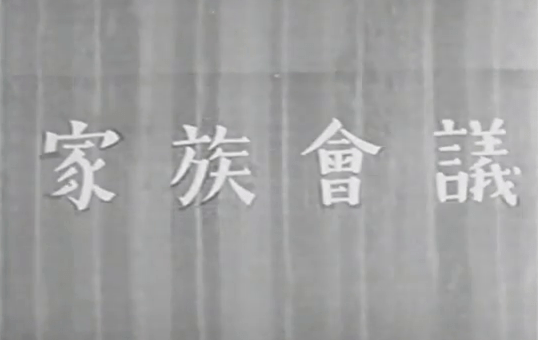
Family Meeting (家族会議, Yasujiro Shimazu, 1936)

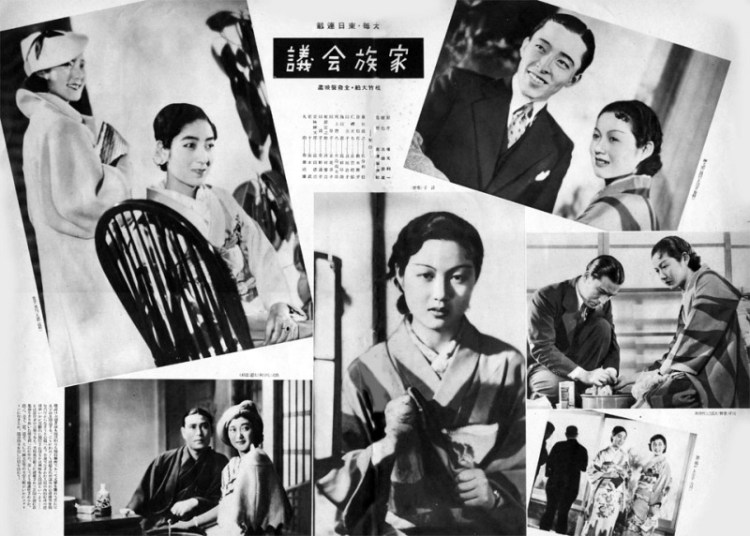
Family Meeting horizontal posterGiven the strident tone of the times, it was perhaps becoming more difficult to avoid politics altogether by the mid-1930s, but Yasujiro Shimazu manages it well enough in Family Meeting (家族会議, Kazoku Kaigi) – a romantic melodrama set in the world of the high stakes family business. Shimazu is best remembered as the pioneer of the shomingeki – stories of ordinary lower-middle class life in the contemporary era, but Family Meeting shifts up a little way in its focus on a young CEO who discovers it’s lonely at the top, not least because of the burden of family legacy and its unexpected impact on his difficult love life.

Shimazu opens on a noisy trading room floor at the Shigezumi Company before shifting to the equally chaotic boss’ office. Young CEO Takayuki (Shin Saburi) is called out by a family friend, Haruko (Yasuko Tachibana), who insists he come to the theatre to meet a young lady, Kiyoko (Michiko Kuwano), with whom she hopes to set him up. Takayuki’s love life is somewhat complicated in that he’s in love with “that woman from Osaka” – Yasuko (Michiko Oikawa) who also happens to be the daughter of a former business associate whose dodgy dealings some say pushed Takayuki’s late father to suicide. Yasuko is coming to Tokyo for the memorial service for Takayuki’s dad in company with her friend, Shinobu (Sanae Takasugi), but is also being pursued by another suitor – Rentaro (Kokichi Takada), a businessman who is secretly attempting to undermine Takayuki’s business through merging with another company.

Difficulties abound for Takayuki as his business suffers and he’s pestered from all sides as regards his romantic inclinations. Despite his personal feelings, he is unable to fulfil his romantic desires with Yasuko because of their difficult family history while Haruko attempts to push him towards Kiyoko. Kiyoko, the daughter of the businessman undercutting Takayuki’s business wouldn’t be such a good match either if anyone but she knew about the machinations, but currently they’re a well kept secret. Having fallen in love with Takayuki she eventually decides to spill the beans which gives him an all important advantage though he has to mortgage his house and approach Shinobu’s father, a wealthy Buddhist monk, for a loan in order to stay afloat. Takayuki isn’t interested in Kiyoko and finally has to resort to bluntness to make her understand but the eventual outcome is as positive as it could be and, in any case, works out well enough once she realises she’s developed an attraction for Rentaro who is finally beginning to go off Yasuko.

The romantic and the corporate increasingly overlap but the general message is that the modern business of commerce is chaotic and messy. The shouting of the trading floor and the backroom dealing of Rentaro’s nefarious plan are not exactly the rarefied world of gentleman’s agreements which often passes for the salaryman life in Japanese cinema, but the central irony is that the wealthiest man of all is the monk who “earns” his money passively through the largely silent practice of donation. The monk’s modern girl daughter, Shinobu, by contrast is a spendthrift with a taste for the spirt of the age – fast cars, feather boas, fancy hats and a confident forthrightness that stands in stark contrast to the shy diffidence of the permanently kimono’d Yasuko. The final irony is that it’s Shinobu who ultimately ends up “in charge” not only of Takayuki’s business arrangements – receiving the debt from her father and deciding to run the company herself with Takayuki as the boss, but also of his romantic life when she engineers a reunion with Yasuko before valiantly driving off alone into the mountains, her work here well and truly done.

Only once Takayuki is freed from his workplace burden is he able to address his romantic difficulties, and only by leaving the city behind is he able to free himself of his father’s legacy. Thanks to the gentle machinations of Shinobu, everyone is able to move forward with a little more certainty and little less preoccupation as she alone decides to shoulder all their burdens without thought for herself. Unlike many ‘30s films, Family Meeting’s central message seems to be slow down, let others help when things get hard, and try to avoid being so noble you make yourself unhappy. All good lessons though perhaps inexpertly delivered and without Shimazu’s usual wit.


Okoto and Sasuke (春琴抄 お琴と佐助, Yasujiro Shimazu, 1935)

Okoto to SasukeYasujiro Shimazu had been a pioneer of the “shomin-geki” – naturalistic tales of ordinary working people in the contemporary era, but 1935’s Okoto and Sasuke (春琴抄 お琴と佐助, Shunkinsho: Okoto to Sasuke) sees him step back from the modern world in adapting a soon to be classic novella by contemporary novelist Junichiro Tanizaki. Published in 1933 under the title Shunkinsho and set in late Meiji, Okoto and Sasuke is another in the author’s long series of dark erotic dramas which aim to explore the baser elements of the human heart while engaging in a kind of cultural soul searching. The first of many adaptations, Shimazu’s scales back on Tanizaki’s taste for the perverse as well as his wry sense of humour, spinning a tender tale of love which finally finds its home only in the shared darkness of two becoming one in self imposed exile from the visible world.

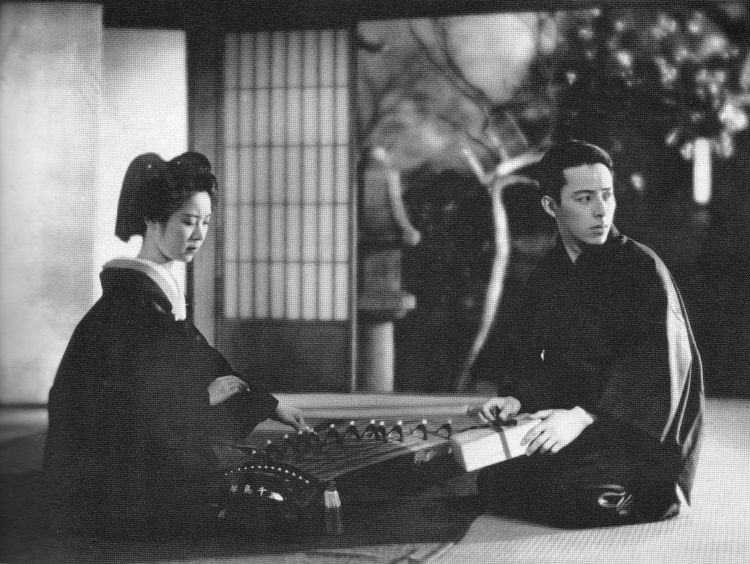
Okoto (Kinuyo Tanaka) has been blind since she was nine and, though her parents appear to dote on her, has a proud and imperious manner which sees her mistreat those who only seek her friendship. Fearing that, due to her disability, Okoto will never find a suitable husband, the family have decided to let her study the koto and shamisen (traditionally strong areas for the blind) so that she might be able to support herself and have some degree of accomplishment. Sasuke (Kokichi Takada), a young servant at the pharmacy run by Okoto’s father, began escorting Okoto to her classes for no especial reason but as he is one of the few who can cope with Okoto’s moods, and is one of the few Okoto seems to tolerate, he quickly became her personal companion.

Sasuke remains completely devoted to Okoto even when she treats him cruelly. So many areas of their relationship are an inversion of the customs of the time – Okoto is the mistress, while Sasuke is the servant, she is strong while he is weak, she is cruel and he is kind. She has all the power, and he has none but seems to revel in his degradation, obeying each and every one of Okoto’s commands and rarely minding even when she strikes him. Nevertheless, despite her outward contempt for him Okoto is also dependent of Sasuke – not only for the assistance he provides, but for the gentle touch of his hands and his willingness to place himself entirely under her authority in worshipful devotion.

The relationship between the pair is one of (seemingly) chaste sadomasochism in which both reject the “normal” romantic affectations of their time. Despite the obvious class difference, Okoto’s family are secretly hoping Okoto and Sasuke will someday marry – an idea floated with intense seriousness when it is discovered that Okoto has become pregnant though she refuses to name the father of the child, denying that her lover is Sasuke and vowing that she would find it “humiliating” to be married to a mere servant.

There is something, as uncomfortable as it is, which presents Okoto’s pride as a kind of rebellion born of her blindness, a rejection of the world which has rejected her as “imperfect” and which she literally cannot see. Despite her family’s reservations Okoto does acquire a suitor, but he is only interested in her precisely because of her blindness. A playboy, Ritaro has fetishised Okoto’s “difference” and sees her almost as a trophy, captivated by her intense beauty and only spurred on by her haughtiness. A friend of Sasuke’s, by contrast, hearing the rumour of Okoto’s pregnancy, expresses horror at the idea of a “disabled” woman with a child, avowing that society would never stand for such a thing, rejecting and salivating over the salacious rumour at the same time. Okoto will pay a heavy price for her violent rejection of Ritaro’s attempt to reduce her to a mere conquest, ironically allowing him to rob her of something, but eventually leading her towards the destiny which will bind her forever to her devoted servant, Sasuke.

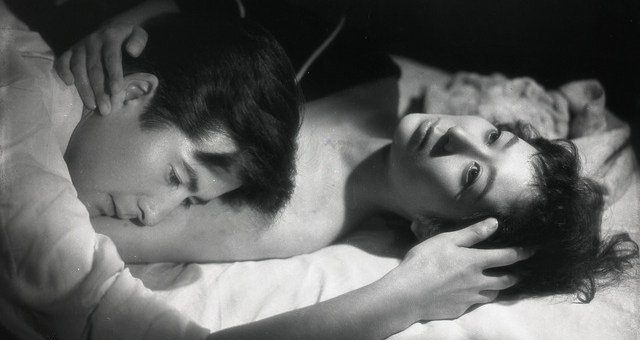
Okoto, having suffered facial disfigurement, comes to realise the true nature of her feelings for Sasuke but cannot bear for him to see her ruined face, and he, dutifully, resolves to keep his eyes closed as if blind. Ultimately Sasuke opts for the traditionally female act of sacrifice in deciding to shift from his own world into that of Okoto. Together they cut themselves off from the outside world, electing to live in a world made for two alone in which none else may enter. Their act is one of intense individualism taken as a pair who have become one in their mutual devotion, rejoicing in a love born of darkness. Shimazu undercuts Tanizaki’s need for discomfort to present the final union of Okoto and Sasuke as the uncomplicated realisation of a love deep and true – concluding with an intertitle rather than succumb to the inherently melodramatic resolution of Tanizaki’s eroguro love story. Nevertheless through the powerful performance of Kinuyo Tanaka as the increasingly conflicted Okoto, Shimazu manages to capture something of the “pure” love of equals who find their place in a changing world only by removing themselves from it.


The Eternal Breasts (乳房よ永遠なれ, Kinuyo Tanaka, 1955)

(c) Nikkatsu 1955

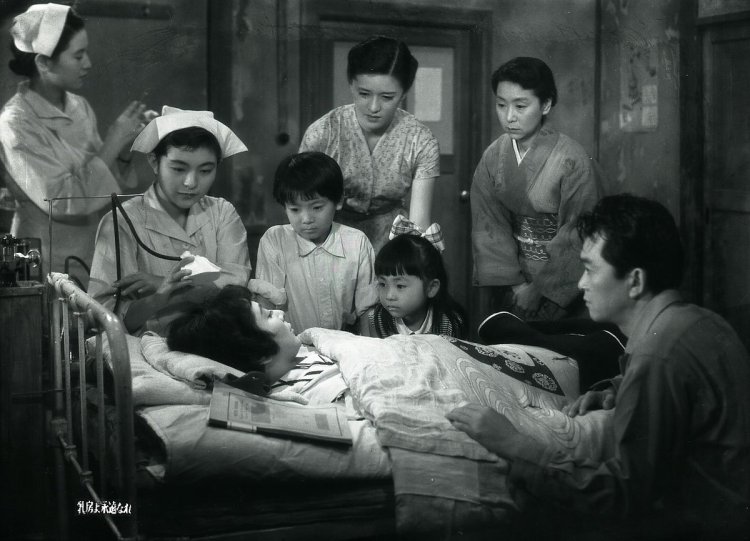
(c) Nikkatsu 1955Having made her directorial debut for Shin Toho with the beautifully drawn post-war romantic melodrama Love Letter scripted by Keisuke Kinoshita, and then moving on to her second film after being accepted as a career director at Nikkatsu – the Ozu scripted humorous romantic family drama The Moon Has Risen, Tanaka chose to work with female script writer Sumie Tanaka (no relation) for a tale of female resilience and resistance in the face of extreme suffering. Fumiko Nakajo was a real life figure who had died of breast cancer at the age of 31 in 1954. The Eternal Breasts (乳房よ永遠なれ, Chibusa yo Eien Nare) , a biopic of sorts, was released in 1955, barely a year later but makes no concession to the recency of Nakajo’s passing in examining both the still taboo subject of breast cancer and the effects of the disease and its treatment on the heroine who, arguably, finally learns to become herself through battling her illness.

Fumiko Shimojo, née Nakajo, (Yumeji Tsukioka) is the wife of a grumpy, resentful stock broker and the mother of their two children, Noboru and Aiko. It’s clear that things in the Shimojo household are far from peaceful with the discord between husband and wife a talking point throughout the local community. Despite her husband’s claims to the contrary, Fumiko is the dutiful “good wife” of the period, trying hard to make her marriage work even in the face of her husband’s ongoing resentment and thinly veiled inferiority complex given Fumiko’s slightly elevated class credentials and education. To get away from her disappointing home life Fumiko has joined a local poetry circle specialising in tanka and is well known for the gritty realism of her poems in which she expresses all of her suffering and unhappiness in regards to life with her husband. When she comes home early one day and finds a woman dressed in kimono entertaining her man, she decides it’s time for a divorce, reverts to her maiden name of Nakajo, and goes back to live with her mother and soon-to-be-married brother, regretting only that her husband insists on custody of their son, Noboru.

The early part of the film deals with the equally taboo subjects of divorce and family breakdown as Fumiko struggles to adjust to her life as a single mother as well as coming to terms with being separated from her son. Though she is often approached by matchmakers and encouraged to remarry, her experience of married life has left her reluctant to commit to a second round of matrimonial subjugation. Her mother, whom she partly blames for pushing her into a marriage she never wanted in the first place, and her brother are fully on her side as are her friends, the Horis – a Christian couple who champion her poetry and act almost as a set of second parents despite being only a little older than she is.

Released from matrimonial shackles, Fumiko is free to embrace her life as a poetess even if she never dreams of any kind of literary success. As the tactless women at the poetry circle put it, pain is good for art and it’s certainly true that each advance in Fumiko’s fortunes is accompanied by emotional suffering. Struggling to cope with the divorce and the children, Fumiko neglects chest pains and a strange feeling in her breast only to keel over when an unpleasant woman arrives to reclaim Noboru with whom she thought she’d finally been reunited.

Diagnosed with late stage breast cancer, Fumiko undergoes a double mastectomy. Refusing to shy away from the medical consequences, Tanaka films the surgery as a kind of fever dream as the bright surgery lights loom over Fumiko whose breasts appear in full view as the surgeons prepare to do their work. The loss of Fumiko’s breasts results in one of her most famous poems, published in a national newspaper, but the physical and emotional consequences are not so easily defined. Before her illness we’re constantly told that young Fumiko was a “tom boy”, and at times it appears as if she has been unsexed after being shorn of her femininity. According to her brother, however, Fumiko has become more like a child – something that rings true as she gaily sings in the bath and almost delights in shocking her friend by flashing her surgery scars unannounced. Mrs. Hori, Kinuko (Yoko Sugi), generally a kind and progressive sort, can hardly bear to look and is unwilling to engage with the physical reality of Fumiko’s condition as much as she would like to help her.

Despite proclaiming that at least she won’t be bothered with marriage proposals anymore, Fumiko’s “unsexing” appears to have the opposite effect in reawakening and intensifying her sense of desire. Earlier on, post-divorce and hiding out from her brother’s wedding at which she feels an awkward guest, Fumiko visits Hori (Masayuki Mori) and confesses her love for him though she knows nothing will come of it. Her love is, however, pure – she also loves and respects Hori’s wife Kinuko safe in the knowledge that Kinuko makes Hori happy. After her operation she returns to the Hori’s home and asks Kinuko to run her a bath so that she can bathe in the same water as her beloved – confessing to her friend that she had been in love with her husband. Kinuko seems to know already and is sympathetic, if a little embarrassed. This same boldness later manifests itself in Fumiko’s last great act of passion in which she embarks on a brief yet intense affair with the journalist (Ryoji Hayama) who is covering her career for a paper in Tokyo.

Fumiko’s relationship with the reporter is originally compromised by his overly gloomy copy which proclaims that her death is only a matter of time (then again, for whom is that not true?). Fearing that her death is being fetishised, that no one would be giving her a second glance if she were not dying, Fumiko refuses to write or have visitors. Just as she was “imprisoned” within her marriage, she is now “imprisoned’ by death. As she puts it in one of her poems, the hospital ward is a gloomy place in which she’s often framed by bars – through the windows, through the footboard of her bed, even the hospital kimono she is wearing is patterned with tiny railings. In an eerie, dream-like sequence she wanders out of her room and follows a parade of wailing relatives as a body is wheeled away but just as she is about to leave the metal gate slides shut in front of her, trapping Fumiko like a ghost in the purgatorial world of the hospital ward as she realises that that same gate will be her only exit route.

The same image is repeated at the end of the film as Fumiko’s own bed is wheeled through the mortuary gates which slam shut across the eyes of her confused children who have been left entirely on their own and without a proper explanation of where their mum is going. Fumiko’s final poem is crushing in its anger and ambivalence as it instructs her children to accept her death as the only thing she has to bequeath them. This terrible legacy seems too cruel, condemning her children to a life of grief and mourning even as she instructs them to “accept” her passing. Yet it also speaks of the final contradictions of her character – loving mother and passionate woman, fierce poet and shy genius. Unlike the sickly heroines of melodrama, Fumiko does not always bear her suffering with saintly stoicism but rages, finally embracing the “true self” she only dared to express through her poetry, learning to live only in the knowledge that she must die.


Screened at BFI as part of the Women in Japanese Melodrama season.

Wild Geese (雁, AKA The Mistress, Shiro Toyoda, 1953)

(C) Daiei, 1953In the extreme turbulence of the immediate post-war period, it’s not surprising that Japan looked back to the last time it was confronted with such confusion and upheaval for clues as to how to move forward from its current state of shocked inertia. The heroine of Shiro Toyoda’s adaptation of the Ogai Mori novel, Wild Geese (雁, Gan, AKA The Mistress), finds herself at a similar crossroads to the women of the 1950s, caught between tradition and modernity as they embrace the new freedoms but remain constrained by a conservative society. Toyoda, well known for his adaptations of great literature, makes a few key changes to Mori’s novel in effect placing a Showa era heroine in a recognisably “Meiji” world.
The Japan of the 1880s is one of extreme contrast and rapidly unfolding modernity. Having finally opened its doors to the outside world, the nation is in a big hurry to “catch up” to those it sees as its equals on the world stage. Consequently, Western thoughts and values are flooding into the country, bringing both good and ill. Arranged marriages are still common and Otama (Hideko Takamine) has been married once but the marriage has failed – she was deceived, the man she married already had a wife and child. Still, having lived with a man as his wife, Otama is considered “damaged” goods and will find it difficult to make a good match in the future (especially given the whiff of scandal from being involved in an illegitimate marriage with a bigamist).

When a matchmaker (Choko Iida) arrives with a potential husband it proves hard to turn down but the matchmaker is not quite on the level. Suezo (Eijiro Tono), she says, is a recently widowed man with a young child who is in need of a new wife but cannot marry again immediately for propriety’s sake. Otama will be his mistress and then in due course his wife. However, the matchmaker is an unscrupulous woman who has spun Otama a yarn in the hope of getting her debt written off by getting the shady loanshark she owes money to a pretty young woman to have some fun with.

The position Otama finds herself in is one of impossibility. A woman cannot survive alone in the Meiji era and its lingering concessions to feudalism. For a woman as poor and lowly as Otama whose marriage prospects are slim there are few options available. Otama’s neighbour (Kuniko Miyake) has managed to carve out a life for herself as a single woman through teaching sewing classes but such opportunities are few and far between, as Otama is warned when she considers following her example. The “arrangement” with Suezo may not seem too bad on the surface – he looks after her and her father, has set her up in a house, and treats her well even if his behaviour leans toward the possessive. Despite confessing to her father that she feels trapped and miserable, humiliated on learning she has been ostracised as the mistress of a married loanshark, Otama finds little sympathy as her father declares himself “very happy” and councils her against leaving because he has no desire to return to a life of poverty, remaining selfishly indifferent to his daughter’s suffering.

Resigned to her fate, Otama does her best to adapt to her new life but remains as trapped within Suezo’s house as the caged bird he presents her with “for company”. Jealous and fearing that his wife will find out about the affair, Suezo’s preference is for Otama to stay indoors waiting for him to call. His visits are routine and perfunctory. Handing the maid a few coins to go to the public bath, Suezo signals his intentions in the least romantic of ways, pausing only to lock the garden gate.

Catching sight of an earnest student who passes by everyday at 4, Otama begins to dream of something better. The student, Okada (Hiroshi Akutagawa), is a source of fascination for all the young women in the neighbourhood but he too is instantly captivated when he glimpses the beautiful Otama trapped behind the bar-like slats of Suzeo’s love nest. Adding a touch of biblical intrigue, it is a snake which eventually leads to their meeting but no matter how deep the connection this is a love destined to fail – Otama is the kept woman of a loanshark, and Okada is a medical student with international ambitions. They inhabit different worlds and, as his friend (Jukichi Uno) puts it, this is still the Meiji era, the times will not allow it.

Nevertheless, even if her brief infatuation seems doomed, the mere act of wanting something else provokes a shift in Otama’s way of thinking. This act of fierce individualism which prompts her to defy the dominant male forces in her life whose selfish choices have caused her nothing but misery would normally be severely punished in the name of preserving social harmony but Otama’s epiphany is different. The opening title card reminded us that this was a time wild geese still flew in the skies above Tokyo. It seems to imply that birds no longer fly here, that there is no true freedom or possibility for flight in the modern age of Showa, but Otama is a woman trapped in the cage of Meiji suddenly realising that the doors have been open all along. Her choices amount to a humiliating yet materially comfortable life of subjugation, or the path of individualistic freedom in embracing her true desires. Her dream of true love rescue may have been shattered, but Otama’s heart, at least, is finally free from the twin cages of social and patriarchal oppression.


Screened at BFI as part of the Women in Japanese Melodrama season.

The Trio’s Engagements (婚約三羽烏, Yasujiro Shimazu, 1937)

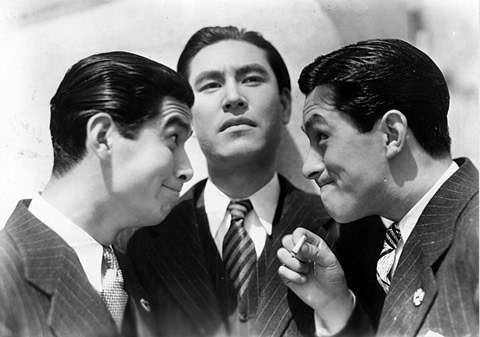
vlcsnap-2017-09-08-02h54m10s546Yasujiro Shimazu may not be as well known as some of his contemporaries such as the similarly named Yasujiro Ozu and Hiroshi Shimizu, but during in his brief yet prolific career which was cut short by his early death just before the end of the war, Shimazu became the father of one of the most prominent genres in Japanese cinema –  the “shomingeki”, which focussed on the lives ordinary lower middle-class people. Shimazu’s early films were noted for their unusual naturalism but 1937’s The Trio’s Engagements (婚約三羽烏, Konyaku Sanbagarasu) is pure Hollywood in its screwball tale of three silly young men and their respective romantic difficulties which are sorted out with the amusing kind of neatness you can only find in a 1930s cinematic farce.

Shuji Kamura (Shuji Sano) has been looking for a job in Japan’s depression hit Tokyo for some time and his long suffering girlfriend, Junko (Kuniko Miyake), has finally gotten fed up with his listlessness and decided it might be better if she left him on his own for a while to sort himself out. Slightly panicked, Shuji heads off to see about a job at a department store specialising in rayon fabrics. Undergoing a rather odd interview, he meets two other men in the same position – well to do Ken Taniyama (Ken Uehara), and down on his luck chancer Shin Miki (Shin Saburi). Luckily all three are employed that day and start working in the store but trouble brews when they each fall for the charms of the boss’ daughter, Reiko (Mieko Takamine).

Despite the contemporary setting and the difficulty of finding work for even educated young men providing a starting point for the drama, Shimazu creates a truly “modern” world full of neon lights and Westernised fashions. The trio work in a department store which sells rayon – a cheap substitute for silk being sold as the latest sophisticated import from overseas, and the store itself is designed in a modernist, art deco style which wouldn’t look out of place in any Hollywood film of the same period. Likewise, though the store is largely staffed by men catering to a largely female clientele, it maintains a sophisticated atmosphere with staff members expected to provide solicitous care and attention to each and every customer.

The guys do this with varying degrees of commitment as Shin and Ken pull faces at each other across the floor and Shuji wastes time on the roof. Shimazu packs in as many quick fire gags as possible beginning the the bizarre job interviews in which Shuji ends up doing some very in-depth role play while Shin expounds on the virtues of rayon as if he were some kind of fabrics genius. Shin Miki is your typical chancer, turning up to his job interview with a thick beard which he later shaves making him all but unrecognisable, and even cheating Ken out of a few coins he’s been using to show off his magic tricks before bamboozling his way into Shuji’s flat.

The central, slapstick conceit is that each of the guys is about to jettison their previous partners for a false infatuation with the beautiful Reiko. Shuji is mostly on the rebound from Junko who may or may not come back to see if he’s sorted himself out, while Ken is uncertain about an arranged marriage, and Shin has a secret country bumpkin girlfriend he doesn’t want anyone to know about. Their respective crushes nearly spell the end for their friendship but then Reiko has her own ideas about marriage which don’t involve shop boys or a future in the rayon business. Eventually the guys realise they’ve all been a little silly and run back into the arms of the women they almost threw over, finding happiness at last in their otherwise ordinary choices.

Shimazu makes brief use of location shoots as Shin and Reiko walk along the harbour but mostly sticks to stage sets including the noticeably fake cityscape backdrop on the shop’s roof. The major draw is the “trio” at the centre which includes some of Shochiku’s most promising young leading men who would all go on to become huge stars including 30s matinee idol Ken Uehara, Shuji Sano, and Shin Saburi. Light and filled with silly, studenty humour The Trio’s Engagements is a deliberately fluffy piece designed to blow the blues away in increasingly difficult times, but even if somewhat lacking in substance it does provide a window onto an idealised 1930s world of Westernised flappers, cheap synthetic products, and frivolous romance.


Burden of Life (人生のお荷物, Heinosuke Gosho, 1935)

Despite being at the forefront of early Japanese cinema, directing Japan’s very first talkie, Heinosuke Gosho remains largely unknown overseas. Like many films of the era, much of Gosho’s silent work is lost but the director was among the pioneers of the “shomin-geki” genre which dealt with ordinary, lower middle class society in contemporary Japan. Burden of Life (人生のお荷物, Jinsei no Onimotsu) is another in the long line of girls getting married movies, but Gosho allows his particular brand of irrevent, ironic humour to colour the scene as an ageing patriarch muses on retiring from the fathering business before resentfully remembering his only son, born to him when he was already 50 years old.

Rather than focussing on the main narrative right away, Gosho gives us a crash course in marital relations as we meet middle sister, Itsuko (Kinuyo Tanaka), who is currently posing for a raunchy portrait her starving artist husband is painting. Itsuko dresses in Western style, smokes openly and often, and her home is a bohemian one of the kind you’d imagine a (well to do) artist from the ‘30s would live in. The couple are interrupted by their brother-in-law who has come in search of his wife, Takako (Yoshiko Tsubouchi), with whom he’s had yet another argument causing her to storm off somewhere or other in a huff.

Takako has indeed stormed off, but has gone to her mother’s where her younger sister, Machiko (Mitsuyo Mizushima) is preparing for her own wedding and now feeling quite nervous hoping that it won’t be as tempestuous as Takako’s. The three sisters also have a little brother, Kanichi, who is doted on by the women of the family but has a strained relationship with his father, Shozo (Tatsuo Saito). The main conflict occurs once Shozo has successfully married off Machiko and begins happily contemplating a burden free life only to remember that little Kanichi is only eight and so there are twelve more years of fatherhood ahead of him and he’ll be 70 before he gets any peace. In order to speed up the process, he tells his wife Tamako (Mitsuko Yoshikawa) that maybe Kanichi doesn’t need to go school and should go out and get a job instead. Tamako, rightly outraged at her husband’s persistent coldness towards their son brings things to a head by leaving the family home.

The themes are common ones as a family faces the successful marriage of its youngest daughter but the pattern is complicated by the loose end that is Kanichi. Much younger than his sisters, it’s easy to believe Shozo’s assertions that his arrival was somewhat unexpected but far from a joyous surprise Shozo still seems to regard him with a degree of mild horror. Fearing becoming an elderly father Shozo’s concerns are fair given the additional burdens placed on him in having to find good husbands for three women and then pay for their weddings and dowries never mind a college education for a son he never wanted. Kanichi seems to be aware on some level of the way his father feels about him as a poignant scene implies when he begs some of the other neighbourhood children to keep playing with him even though it’s past tea time because he doesn’t want to go home if his dad is there.

Shozo fails to reform his opinion even after his wife leaves him. Almost delighting in a late life slice of batchelorhood, Shozo heads into the bar district for a night out where he ends up drinking with some younger guys, surrounded by students singing the Keio University song. His attention is momentarily taken by a small boy of around Kanichi’s age who is selling flowers to amorous patrons but it’s only once a hostess calls him “papa” that he seems to feel aged fatherhood reassert itself. Enquiring about her age he discovers she is only 19 – much younger than any of his daughters, and consequently Shozo begins to feel more like a ridiculous old man than a young buck on the prowl.

Gosho draws a number of contrasts within his “ordinary” family from the three sisters who seem to represent the changing times in their differing attitudes to the husband and wife and the division of their home. Itsuko, Westernised and brassy, is living well beyond her means and touching her parents for money in order to do it. Talking things over with the kimono’d Takako who offers to recommend a traditional hairstylist for Machiko’s wedding, Itsuko has some advice for dealing with men which she calls “reverse psychology”. Takako and her husband may not have children and fight all the time, but she is in other ways a model wife even if she thinks married life ought to be simpler than it is. Machiko is caught on the brink, though we never see her husband, wondering what her own married life will entail. Her father, Shozo, lamenting on his responsibilities remarks that women are like products for sale, requiring investments which will eventually pay off in terms of successful marriages but any investment in a son is, in a sense, a waste. Family, for him, is less a social unit and more a mini business enterprise from which he was looking forward to retiring.

In the end of course he changes his mind though more out of loneliness or a sense of mortality than any less selfish emotion. Slight at 66 minutes, Gosho packs in as much detail as possible whilst maintaining a broadly comic, almost screwball tone filled with selfish husbands and calculating wives all making the most of the relatively stable times. Life has many burdens but sometimes it’s better to rebrand those burdens joys and make the most of them before someone else decides to carry them for you and all you’re left with is an empty sort of lightness. You’re only old once, after all.


Nobuko (信子, Hiroshi Shimizu, 1940)

vlcsnap-2016-12-09-01h11m57s027The well known Natsume Soseki novel, Botchan, tells the story of an arrogant, middle class Tokyoite who reluctantly accepts a teaching job at a rural school where he relentlessly mocks the locals’ funny accent and looks down on his oikish pupils all the while dreaming of his loyal family nanny. Hiroshi Shimizu’s Nobuko (信子) is almost an inverted picture of Soseki’s work as its titular heroine travels from the country to a posh girls’ boarding school bringing her country bumpkin accent and no nonsense attitude with her. Like Botchan, though for very different reasons, Nobuko also finds herself at odds with the school system but remains idealistic enough to recommend a positive change in the educational environment.
Travelling from the country to take up her teaching job, Nobuko (Mieko Takamine) moves in with her geisha aunt to save money. When she gets to the school she finds out that she’s been shifted from Japanese to P.E. (not ideal, but OK) and there are also a few deductions from her pay which no one had mentioned. The stern but kindly headmistress is quick to point out Nobuko’s strong country accent which is not compatible with the elegant schooling on offer. The most important thing she says is integrity. Women have to be womanly, poised and “proper”. Nobuko, apparently, has a lot to learn.

As many teachers will attest, the early days are hard and Nobuko finds it difficult to cope with her rowdy pupils who deliberately mock her accent and are intent on winding up their new instructor. One girl in particular, Eiko (Mitsuko Miura), has it in for Nobuko and constantly trolls her with pranks and tricks as well as inciting the other girls to join in with her. As it turns out, Eiko is something of a local trouble maker but no one does anything because her father is a wealthy man who has donated a large amount of money to the school and they don’t want to upset him. This attitude lights a fire in Nobuko, to her the pupils are all the same and should be treated equally no matter who their parents are. As Nobuko’s anger and confidence in her position grow, so does Eiko’s wilfull behaviour, but perhaps there’s more to it than a simple desire to misbehave.

Released in 1940, Nobuko avoids political comment other than perhaps advocating for the importance of discipline and education. It does however subtly echo Shimizu’s constant class concerns as “country bumpkin” Nobuko has to fight for her place in the “elegant” city by dropping her distinctive accent for the standard Tokyo dialect whilst making sure she behaves in an “appropriate” fashion for the teacher of upper class girls.

This mirrors her experience at her aunt’s geisha house which she is eventually forced to move out of when the headmistress finds out what sort of place she’s been living in and insists that she find somewhere more suitable for her position. The geisha world is also particular and regimented, but the paths the two sets of female pupils have open to them are very different. Nobuko quickly makes friends with a clever apprentice geisha, Chako (Sachiko Mitani), who would have liked to carry on at school but was sold owing to her family’s poverty. Though she never wanted to be a geisha, Chako exclaims that if she’s going to have to be one then she’s going to be the world’s best, all the while knowing that her path has been chosen for her and has a very definite end point as exemplified by Nobuko’s aunt – an ageing manageress who’s getting too old to be running the house for herself.

Eiko’s problems are fairly easy to work out, it’s just a shame that no one at the school has stopped to think about her as a person rather than as the daughter of a wealthy man. Treated as a “special case” by the teachers and placed at a distance with her peers, Eiko’s constant acting up is a thinly veiled plea for attention but one which is rarely answered. Only made lonely by a place she hoped would offer her a home, Eiko begins to build a bond with Nobuko even while she’s pushing her simply because she’s the only one to push back. After Nobuko goes too far and Eiko takes a drastic decision, the truth finally comes out, leading to regrets and recriminations all round. Despite agreeing with the headmistress that perhaps she should have turned a blind eye like the other teachers, Nobuko reinforces her philosophy that the girls are all the same and deserve to be treated as such, but also adds that they are each in need of affection and the teachers need to be aware of this often neglected part of their work.

Lessons have been learned and understandings reached, the school environment seems to function more fully with a renewed commitment to caring for each of the pupils as individuals with distinct needs and personalities. Even Chako seems as if she may get a much happier ending thanks to Nobuko’s intervention. An unusual effort for the time in that only two male characters appear (one a burglar Nobuko heroically ejects assuming him to be Eiko playing a prank, and the other Eiko’s father) this entirely female led drama neatly highlights the various problems faced by women of all social classes whilst also emphasising Shimizu’s core humanist philosophies where compassion and understanding are found to be essential components of a fully functioning society.


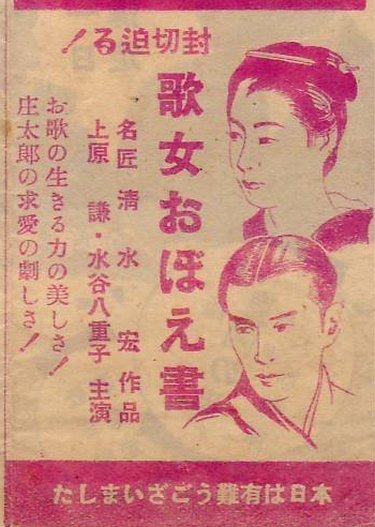
Notes of an Itinerant Performer (歌女おぼえ書, Hiroshi Shimizu, 1941)

notes-on-an-itinerant-performerFilmed in 1941, Notes of an Itinerant Performer (歌女おぼえ書, Utajo Oboegaki ) is among the least politicised of Shimizu’s output though its odd, domestic violence fuelled, finally romantic resolution points to a hardening of his otherwise progressive social ideals. Neatly avoiding contemporary issues by setting his tale in 1901 at the mid-point of the Meiji era as Japanese society was caught in a transitionary phase, Shimizu similarly casts his heroine adrift as she decides to make a break with the hand fate dealt her and try her luck in a more “civilised” world.

At 25 years old, Uta (Yaeko Mizutani) jumps ships from one acting company to another having been promised better work by a roguish fellow performer. Tired of the strenuous life of travelling from village to village, putting on folk plays and street performances, Uta is thinking of quitting the business and looking for a job as a maid or something similar which is at least in the same place everyday. In a stroke of luck, she comes into contact with a kindly tea merchant who takes pity on her and suggests she come to live with him where she can teach his teenage daughter how to dance.

Uta becomes a member of the Hiramatsu household but not all of the inhabitants are as generous of spirit as Mr. Hiramatsu (Hideo Fujino) himself. The oldest son is away at college but the daughter, Nuiko (Kyoko Asagiri), has no interest in learning to dance and resents her father’s “adoption” of such a “common” woman. Youngest son Jiro (Haruhiko Tsuda) is similarly unimpressed with Uta’s presence, making her new home less than welcoming. To make matters worse, Mr. Hiramatsu abruptly dies leaving his business and household in disarray. Oldest son Shotaro (Ken Uehara) returns and feels as if he ought to abandon his studies and take over the company, but as a student he has no experience of running a business and lacks his father’s knowledge of the tea industry. Uta encourages him to return to university and finish his studies if only so that the prestige of a degree might help him later if he decides to restart the business. She also volunteers to act as a guardian for Jiro and Nuiko though Shotaro is wary seeing as they know each other so little. He then makes a surprising suggestion – that he and Uta marry, making it perfectly natural that she take care of everything at home while he’s away studying in the city.

Like many a Shimizu hero, Mr. Hiramatsu is a good hearted man but perhaps lacking in practical skills. Though he seemed to be prosperous and successful, the business was on the rocks and he dies leaving a number of debts behind him and total admin chaos for Shotaro as there is no clear successor to keep the business running in Mr. Hiramatsu’s absence. Luckily for Uta, Shotaro is also a kindhearted man like his father (in contrast to his siblings) and has no desire to suddenly throw her out when his father promised to look after her. He is, however, at a loss as of how to take care of everyone with no money coming in.

Even before Mr. Hiramatsu died, not everyone was happy about his decision to take in a travelling performer and an old friend begins to warn him about the danger of rumours. Friend of the family Kajikawa feels he has a stake in this as he intends his daughter Ayako to marry Shotaro and thinks it’s a done deal (though Mr. Hiramatsu does not seem particularly wedded to the idea). Ayako and Nuiko are also good friends and Ayako does seem like the ideal bride for Shotaro as a member of his own social class and a business connection for the family. Shotaro, however, proposes to Uta without really thinking things through. It is, in one sense, a purely practical decision but one that is likely to meet with a degree of social opposition.

Uta left her life as a travelling performer because she wanted something more conventional. Her mother died when she was six and she never knew her father. Her only happy memory of family is the time spent with her grandmother who died when she was twelve. Uta resents her lack of status as a member of a lowly order of entertainers and longs for something grander but has also internalised a deep seated sense of inferiority. Hence when Jiro and his school friends refer to her as a “monster” living in the house, she half accepts their prejudiced view of her. Nevertheless, she wants to honour the kindness that Mr. Hiramatsu offered her and also deeply respects his son, Shotaro, possibly even developing romantic feelings for him. Despite continuing to feel herself unworthy, Uta does the unthinkable by almost singlehandedly resurrecting the tea business when presented with an opportunity from a foreign company. Even after becoming a formidable business woman and winning the respect of Nuiko and affection of Jiro, Uta still feels herself out of place in the mercantile world and ultimately opts to leave in order to pave the way for the “proper” union of Ayako and Shotaro.

When Shotaro and Uta meet again she tells him that she left because she found his middle class world of “decency” too rigid and full of dull formality. Her “housewife” life was a hard one – getting up early, no smoking, no drinking. At least as a travelling performer she can sleep in and have her share of fun. This produces a quite shocking and strange scene in which Shotaro strikes Uta violently, knocking her to the floor. He repeats his earlier promise to marry her and invites her to come home as his wife, a “decent” woman, and full member of his social class whatever anyone else might have to say about it. Shotaro is apparently a man of his word but there is real feeling implied in his actions as opposed to duty or obligation. Nevertheless, this quite surprising scene of domestic violence used as a tool of coercion does not speak to Shotaro’s otherwise kindly personality and undercuts the “romantic”, if melodramatic, quality of the scene. This may be another instance of Shimizu’s aversion to romantic resolutions or romance as a solution to crisis, but one expects better from a director generally so keen to underline the hardships faced by women in his society.

Despite being filmed well into the era of the talkies and long after Shimizu himself had made the jump to sound, Notes of an Itinerant Performer makes use of frequent intertitles setting the scene or providing explanatory background material. Conversely, it also anticipates a more recent trend by allowing the discussions between the “American” (actually heavily accented European) and his interpreter to take place in English with Japanese sidetitles for parts not subsequently translated in the dialogue. In fact, this broadly positive foreign presence seems an odd inclusion for the fraught political world of 1941 (the film was released in March, just nine months before outright hostilities would commence with the USA which had been effecting a series of trade sanctions with the expansionist nation since 1938) even if the deal itself is taking place in the comparatively more open society of 1901.

In many ways about transitionary periods both in terms of society and of the self, Notes of an Itinerant Perfomer seems conflicted right up until its “Reader, I married him” inspired intertitle. Uta crosses a class border, transcending her lowly origins through selfless sacrifice, pure heartedness, and perseverance yet finally she is dragged across by violence and condescension rather than self acceptance or personal transformation. Filled with ambiguity, Notes of an Itinerant Performer reflects the uncertainties of its times and is noticeably less forgiving than Shimizu’s general outlook as its problematic finale demonstrates.