Bloody Shuriken (赤い手裏剣, Tokuzo Tanaka, 1965)

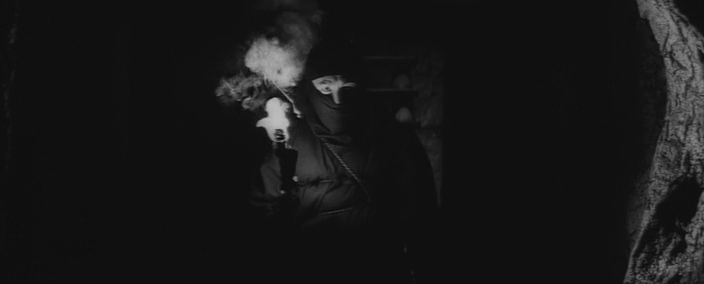
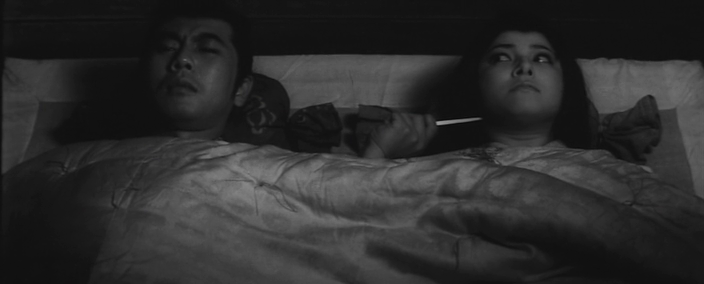
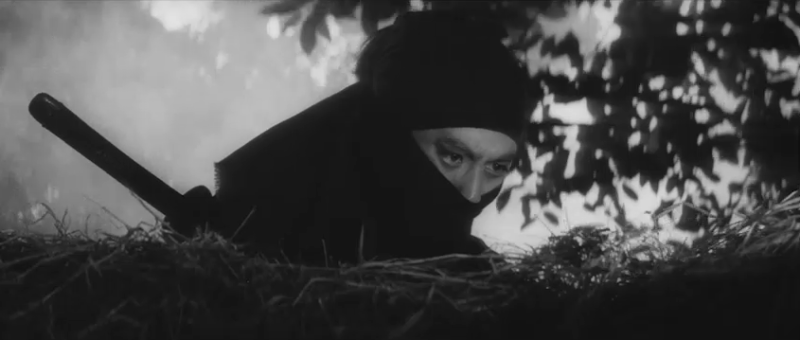
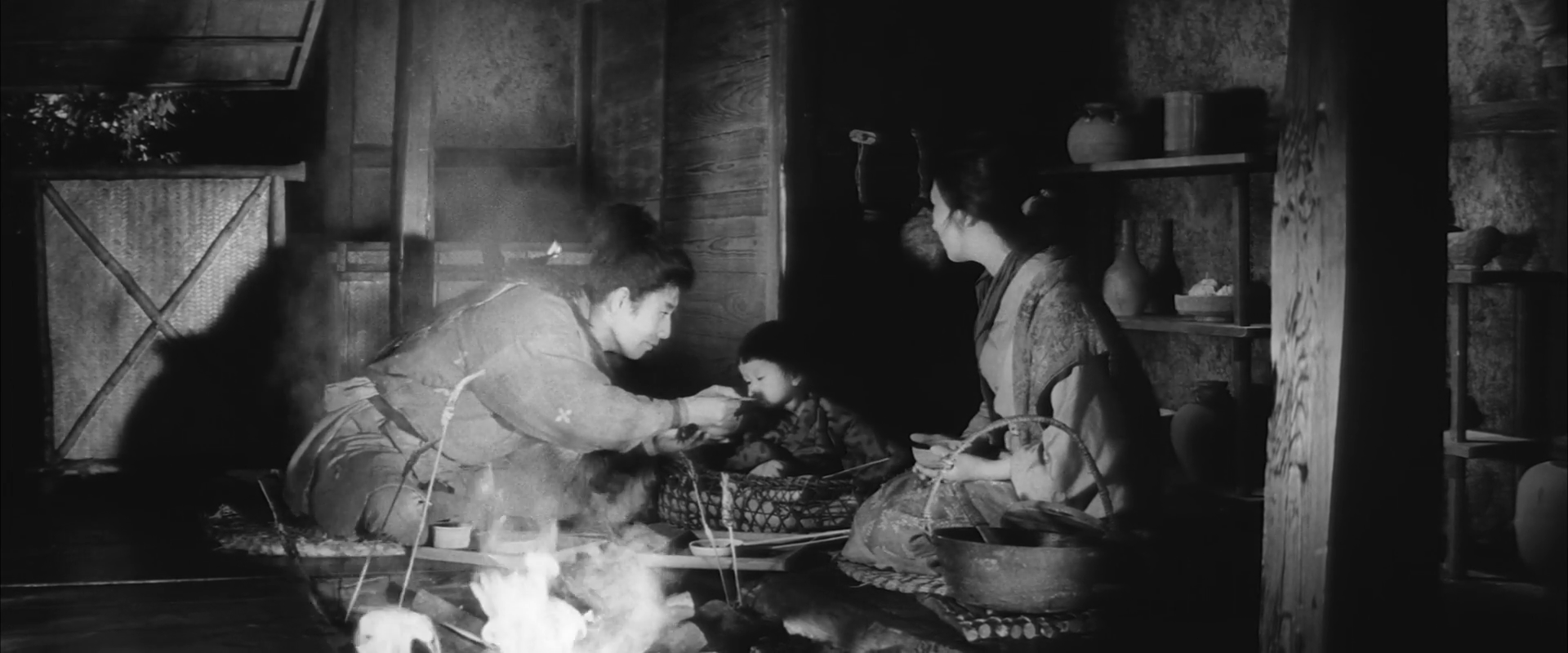
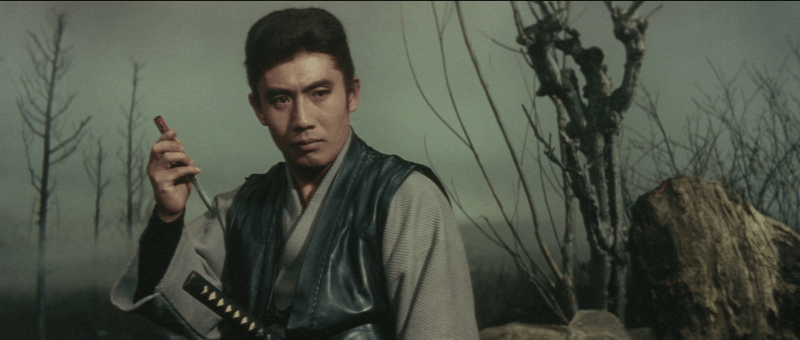
A cynical ronin spots a business opportunity when he rides into a town beset by gangsters in Tokuzo Tanaka’s samurai western, Bloody Shuriken (赤い手裏剣, Akai Shuriken). Despite the name, this is not a ninja movie. The title refers to the knives the hero throws with almost supernatural skill. Adapted from a short story by noir master Haruhiko Oyabu, the action may sound reminiscent of Yojimbo but there’s a different kind of irony in its humour and a lightheartedness to its cynicism even if its final message is that the wages of greed are death.

We can tell that Ibuki (Raizo Ichikawa) is both good man and bad in that he immediately breaks up a fight between rival gangs on entering town, depriving the men in question of their money, but then handing it straight to the owner of the bar they were fighting in to cover the damage. He’s concerned about his horse too, but can’t quite afford the lodging fees at the stable run by the grumpy Yuki (Chitose Kobayashi) who loathes samurai, and with good reason. After hearing about the complicated makeup of the town’s hierarchy, Ibuki decides to stay and make some money by essentially playing each of the three gang leaders off against each other so they end up taking care of themselves. 

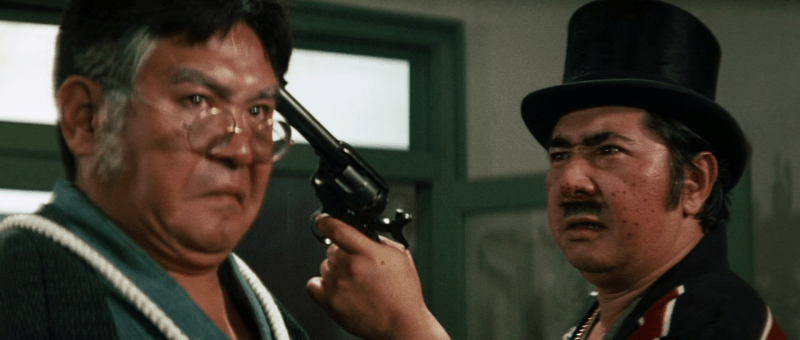
So far, so Yojimbo. But this town seems to be even further out, much more like a decrepit western outpost filled with scum and villainy. When the wind picks up, the dust blows through as if signalling the murky air and sense of futility. We’re told that the leader of the biggest gang, Hotoke (Isao Yamagata), is also the police chief, while his rival Sumiya (Yoshio Yoshida) complains that he’s usurped his position as his family has been there longer. Hotoke arrived a starving man three years previously and got back on his feet thanks to the support of the community, but then he turned around and got rich running a gambling den targeting local miners. Kinuya (Fujio Suga) has been here a little longer, but is otherwise biding his time until the other gangs fall from grace.

Of course, Ibuki foments conflict and strikes deals with all of them, but the real trouble is some missing gold that was stolen from the government causing even more disruption in the town with inspectors targeting ordinary people who weren’t even involved. Bar owner Chinami (Masumi Harukawa) is one of many interested in finding out what happened to the money, but she’s also in a precarious position, on the one hand throwing her lot in with Hotoke but on the other hating him and approaching both Ibuki and moody ronin Masa (Koji Nanbara ) to help her be free of the troublesome gangster. 

The fact that the two most prominent business owners are women is perhaps uncomfortably intended to signal the breakdown of the town in which Ibuki becomes the only real “proper” man amid bumbling gangsters and crazed ronin. Yet Chinami is directly contrasted with the pure and innocent Yuki who hates all the gangsters, as well as the samurai and generally everyone who isn’t a horse. Cynical and greedy, Chinami wants the gold and she’s prepared to use her body to manipulate men into doing what she wants, whereas Yuki defiantly keeps her head down and refuses to participate in gangster nonsense because she just wants to run her stables in peace. Only later does she develop a fondness for Ibuki on realising that he’s not so cynical after all and is interested in a kind of justice and getting rid of the corruption in the town for reasons other than money. Having discovered the location for the gold, he leaves the knowledge to Yuki so she can avenge her father who was killed during the robbery. 

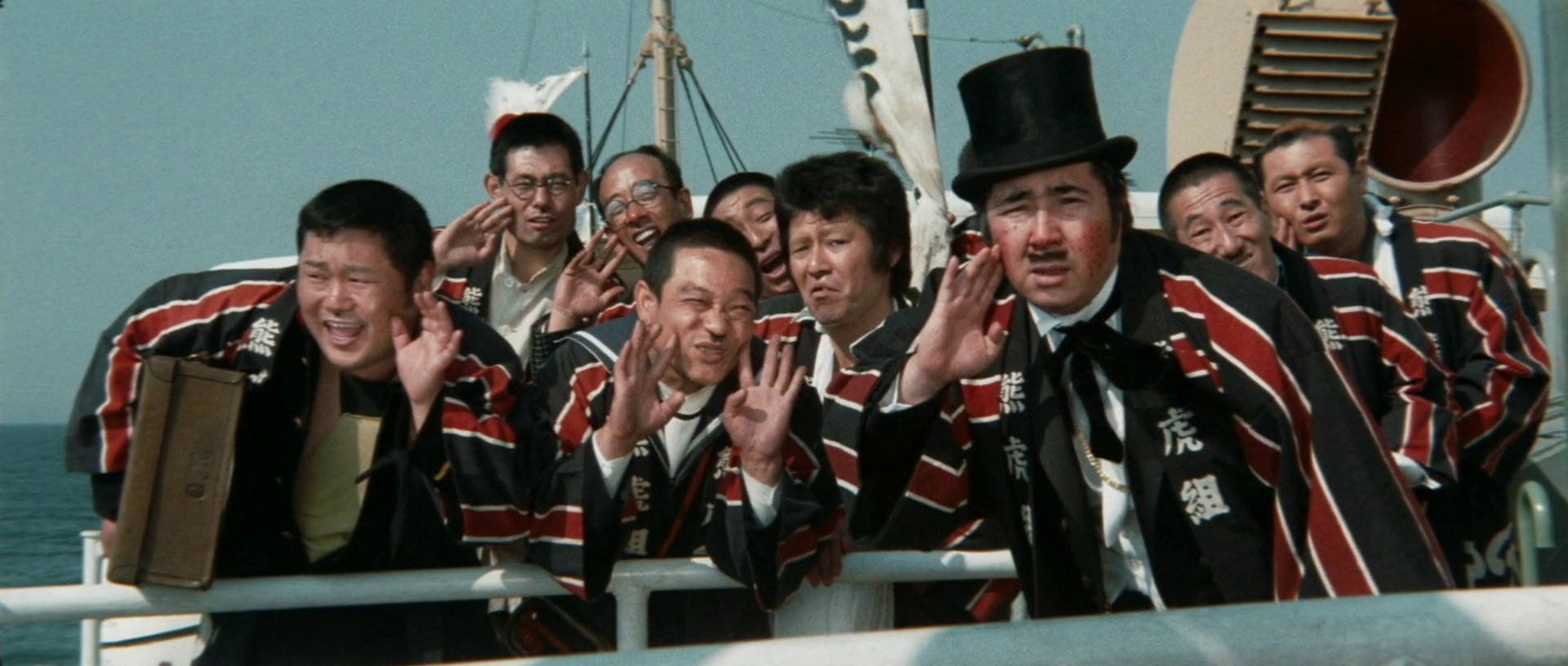
But in other ways, this is already a post-apocalyptic hellscape as Ibuki discovers on spotting a pair of crows feeding on a corpse in a river. Perhaps taking pity on one less fortunate than himself, he throws one of his darts and skewers them. Ibuki’s knife supply seems to be inexhaustible, and he never appears to go back and retrieve the ones he’s thrown though his skill does seem to lend him an almost supernatural quality. In any case, Tanaka injects a degree of weird humour in the strange town with its eccentric residents including ronin Masa who looks permanently evil yet has a strange love of dolls, while the fight scenes themselves are often somewhat comical as the gangs seem to clash like a pair of cats slapping each other. There’s even something quite funny about the way the film bluntly drops exposition at unexpected moments even in the midst of the farcical scheming between the gangsters and Ibuki running back and forth to stoke the fires of conflict. This land is so bleak, it seems to say, all you can do is laugh or you’ll end up face down in a river with crows picking at your back too, so you might as well ride off into the sunset like Ibuki looking for the next corrupt town to purify and onward towards the bounty on the horizon. 


Trailer (no subtitles)

Good Morning (お早よう, Yasujiro Ozu, 1959)

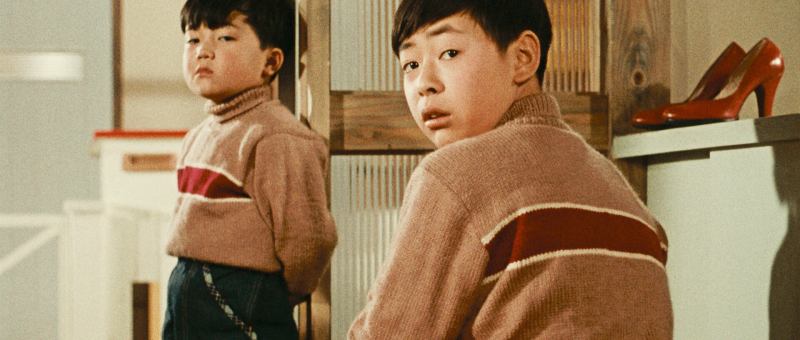
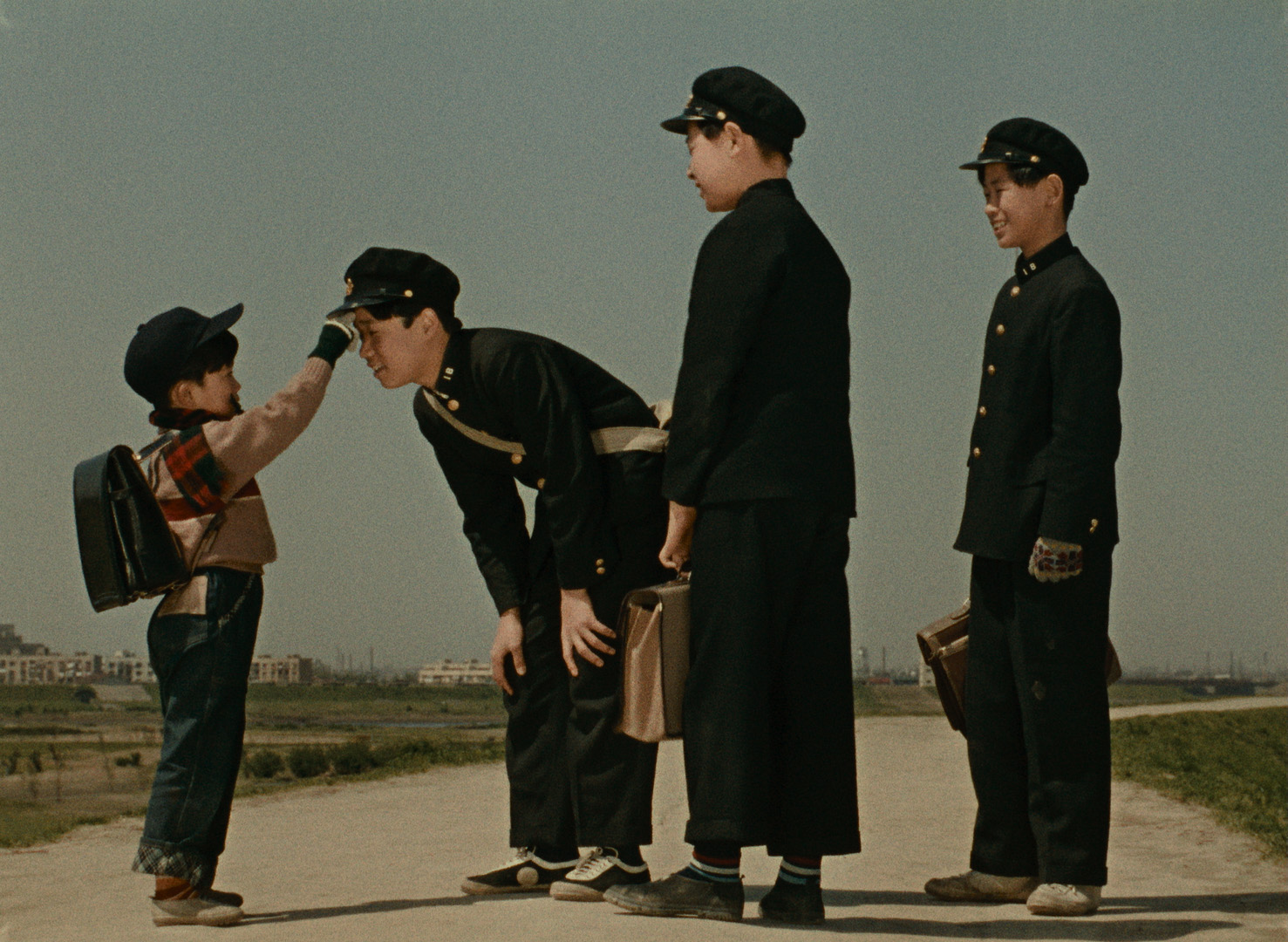
Even the most casual viewer of Japanese cinema will be aware that something as simple as “lovely weather today” can mean quite a lot more than it at first seems. Small talk isn’t really so small after all and without it, as one quite perceptive yet perennially tongue-tied translator points out midway through Yasujiro Ozu’s charming late career comedy Good Morning (お早よう, Ohayo), our lives would be quite boring. Boring it is not, however, when two young boys decide to rebel against the pointless politeness of the adult world by taking a vow of silence after being told off for going on in their constant tantrums over the unfairness of being denied a TV set. 

As he often did, Ozu repurposes the plot of an earlier film, in this case I Was Born But… and subverts it. The two boys at the centre of the 1932 silent film ended up going on a hunger strike out of humiliation and despair on realising that their dad, who they’d idolised, was also a soulless corporate lackey forced to debase himself in deference to his boss. The father is ashamed, he doesn’t want his boys to end up living a meaningless worker drone existence, but the boys’ decision not to eat also carries much more weight considering they are in living in a time of economic depression during which many do not have the luxury of choice. 

The Hayashi boys, Minoru (Koji Shitara) and Isamu (Masahiko Shimazu), by contrast are also rebelling against the meaningless adult world but for the opposite reasons. They don’t seem to have a lot of respect for their father and probably don’t really care if he humiliates himself on a daily basis so long as they can watch sumo on TV without needing to go next door. These are consumerist kids, they want what they want and they want it now. Minoru is really too old for screaming tantrums, but still rolls around on the floor kicking his legs in frustration because it’s all just so unfair that mum and dad won’t get him a TV even though it’s not a matter of money. The parents, for their part, are trying their best to resist the onset of consumerism. Mr Hayashi (Chishu Ryu) is against the TV because he fears the boys will stop studying and hours of vacant staring will ruin their young minds. He might have a point, but you can’t hold back the tides forever. 

It’s his scolding of the boys which eventually leads to all the subsequent problems as his insistence that they are being far too noisy and talk much more than children have a right to leads them to declare an ironic vow of silence in protest against the “meaningless” chatter of adults filled with random pleasantries such as “good morning”, “where are you off to today?”, “what lovely weather we’re having!”, etc. Their decision, however, comes at a bad moment. There has recently been some unpleasantness over misplaced money for a local community group and gossip about Mrs Haraguchi’s (Haruko Sugimura) new washing machine. The other housewives on the block also seem to be resistant to consumerist desires and do not approve of the purchase, channeling their resentment into assuming that Mrs Haraguchi may have embezzled the money. Grown up chatter isn’t always meaningless and the frivolous local gossip has a profound bearing on the social politics of the block. So when the boys don’t reply to Mrs Haraguchi’s good morning, she assumes they are deliberately snubbing her on their mother’s instruction because of a petty grudge over harsh words exchanged on account of the misunderstanding surrounding the missing club dues.

Meanwhile, we can see the shadows of a lingering economic instability. These are all modest homes where families make an effort to appear frugal, hence the outrage over the washing machine, but the family friend who teaches the boys English and has a crush on their aunt, Heiichiro (Keiji Sada), has been laid off after his company went bust. He’s supported by his older sister who remains unmarried and works at a car dealership (more consumerism) while doing translation on the side for extra money. The neighbour across the way is technically “retired” but looking for work partly because his pension’s not enough to live on and partly because what’s a man supposed to do all day in a society which expects everyone to be productive? The new neighbours next-door to the Hayashis who’ve caused all this trouble because of their TV set are viewed as scandalous because they live in their pyjamas and she used to be a cabaret bar girl. The middle-aged gossips don’t think they’re respectable while she eventually decides to move because the neighbours are too “annoying”. 

Ironically enough, it’s sumo the boys most want to watch, about as traditionally Japanese a pastime as is possible even as they yearn for colourful consumerist modernity. They communicate by refusing to communicate. As Heiichiro points out, small talk is a social lubricant but meaningless things are easy to say while important things are not. Which is not to say you can’t communicate something important by saying something seemingly as meaningless as “that cloud has an interesting shape”, but that you won’t get anywhere unless you listen to what people are actually saying even when they’re saying nothing at all. They boys can’t win against the inherent meaninglessness of adult life with its superficial conformities, petty resentments, and wilful misunderstandings but perhaps we can all learn something from their straightforward earnestness in their refusal to submit themselves to empty pleasantries. 


The Blind Menace (不知火検校, Kazuo Mori, 1960)

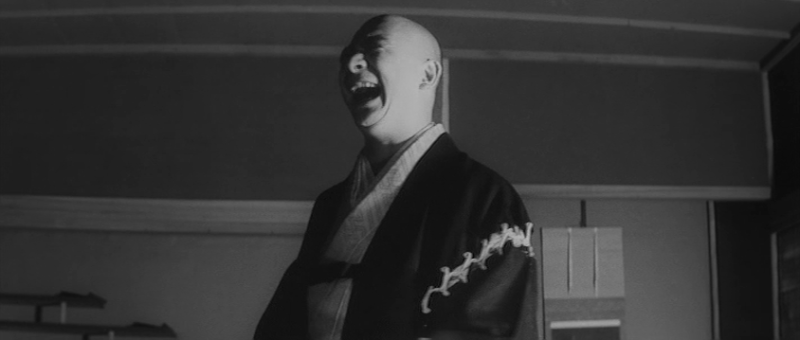
Two years before finding fame as Zatoichi, Shintaro Katsu starred as his mirror image in a tale of pure villainy, The Blind Menace (不知火検校, Shiranui Kengyo). As the title suggests, the film follows the upward trajectory and eventual downfall of an unsighted man who gleefully rapes and pillages his way to becoming the leader of his community aided and abetted by the ills of the feudal era which allow him to profit from his crimes until the past finally catches up with him.

After all as he later says, “as long you as you keep rising in the world, past misdeeds don’t matter.” In any case, even as a child the man who would later be known as Suginoichi (Shintaro Katsu) is incredibly unpleasant. In the opening festival sequence he picks his nose and flicks it in a barrel of sake so that the men drinking will abandon it. The only sign of possible goodness in him is that he takes the sake home for his mother to enjoy, though he seems to relish the idea of her unwittingly drinking his snot so perhaps that was the real purpose. Other hobbies of his include conning wealthy passersby out of a ryo with a well worn scam in which he asks them to read a letter from his uncle which mentions that it should include one ryo only what’s in there is a stone. When the reader explains the situation, he accuses them of trying to take advantage of his blindness and makes a fuss about it until they’re embarrassed into coughing up a ryo of their own (not a small sum for the time period). 

In some ways his poverty and disability might explain his behaviour. His family set up is subverted with his mother much like him money hungry and willing to do anything to get it while his saintly, henpecked father is gentle and honest. This might have taught him the wrong lessons about masculinity that lead him to see his father as weak in allowing the world to trample him while taking his mother’s advice to heart that if they only had a 1000 ryo they could get him trained up properly so that he might one day become a Kengyo which is a little bit like a community leader for the blind with social status and political influence. 

It’s this kind of social affirmation he seems to crave, but is essentially a narcissistic sociopath who takes advantage a stereotype that in some ways infantilises the blind and those with other disabilities who are believed to be pure-hearted and incapable of intrigue or evil. He seems to come to the rescue of a noblewoman who asked his boss, the Kengyo, to lend her money secretly because her brother has been caught embezzling but then rapes her, asks for the money back, and blackmails her into further acts of sexual exploitation offering her only 5 ryo a time knowing she needs 50. He thinks nothing of using his acupuncture skills to kill a man who was carrying 200 ryo to buy a “boneless girl” for a freak show and then framing a man who saw him do it but agreed to say nothing for a 50% cut for the crime. Suginoichi later teams up with “Severed Head” Kurakichi (Fujio Suga) to commit a series of burglaries including that of the Kengyo master who he also has killed to usurp his postion. 

But as he said, once his recognition is in sight with an invitation from the shogun everything begins to fall apart as all his wrongdoing starts to catch up with him. The feudal world had allowed him to prosper partly because of other people’s greed but also the social codes that favour shame and secrecy along with people’s unwillingness to accept that a blind man can also be selfish and evil despite a lot of evidence to the contrary. Elegantly lensed by Kazuo Mori who brings a sense of realism to the hardbitten backstreets of the feudal poor, the film may suggest that the wealthy only get that way by trickery and exploitation and the only way to rise to the loftiest place is to be like Suginoichi and not care what you do to get there but is clear that once you arrive you won’t stay very long because one day the past will really will come back to bite you. 


4K restoration trailer (no subtitles)

The Great White Tower (白い巨塔, Satsuo Yamamoto, 1966)

“It’s about the right thing to do, it’s about conscience, and Prof. Zaizen lacks conscience” according to a star witness at the conclusion of a medical malpractice trial in Satsuo Yamamoto’s adaptation of the novel by Toyoko Yamasaki, The Great White Tower (白い巨塔, Shiroi Kyoto). One of a series of films heavily critical of the medical system in the midst of rising economic prosperity, Yamamoto’s tense political drama presents the succession intrigue at a university hospital as an allegory for the nation as a whole implying that lingering feudalistic and authoritarian thinking has poisoned the contemporary society. 

This is in part reflected in the way in which major hospitals are often run as large family businesses where succession is a dynastic matter. In this case, however, the scene is a prominent university hospital in Osaka at which the head of the surgical department, Azuma (Eijiro Tono), is about to retire. Generally, one of his assistant professors would simply move up after being approved by a board comprised of other department heads but the problem is no one, and especially not Azuma, is particularly happy with the most likely candidate, Zaizen (Jiro Tamiya). The issue between them seems to be one of ambition and authority. Zaizen is regarded by all as an excellent doctor with a stellar track record but he is also cold and arrogant with no regard for departmental protocol all of which of course offends Azuma as does his background and person. The son of a country teacher, Zaizen prospered through the dedicated labour of his widowed mother along with family connections before marrying into the extraordinarily wealthy and influential Zaizen family who run a large obstetrics clinic. Consequently, he is free to pursue his interests and lacks the economic anxiety that might make another employee wary of pushing his luck. 

His humble background might have placed a chip on Zaizen’s shoulder but it’s also clear he’s part of a new generation that does things differently from the last, apparently keen to build a public media brand appearing in a glossy magazine which brands him “the magic scalpel” thanks to his success in treating pancreatic cancer. While they might not be able to argue with his track record, other doctors worry that Zaizen has developed a god complex and is slapdash with his practice often timing his operations and smugly pleased with himself when hitting a new record. Azuma first picks him up on this in the case of elderly patient, questioning his treatment decisions in accusing him of neglecting to fully consider the patient’s post-op wellbeing. This then becomes something of a recurring theme as good doctor Satomi (Takahiro Tamura) is minded to bring Zaizen in on the tricky case of a man, Sasaki (Nobuo Minamikata), he suspects may have pancreatic cancer but has been repeatedly diagnosed with chronic gastritis. 

Though it’s political intrigue that in some senses leads him to Zaizen, Satomi is otherwise depicted as the responsible physician who deeply cares for his patients’ wellbeing and not much at all for interoffice politics. Thus he continues to investigate Sasaki’s case even when other doctors tell him he’s wasting too much time on one patient and should just leave it at gastritis. Zaizen, meanwhile, is the exact opposite taking one look at the X-rays and deciding it is pancreatic cancer after all but thereafter ignoring Satomi’s advice after taking over the case refusing to run a CT scan to verify that the cancer hasn’t spread to the lungs as Satomi fears it might have. 

For Zaizen Sasaki ceases to matter, to him the human body is no different to a machine and he perhaps more engineer than doctor even as he proclaims medicine more art than science in insisting that he just knows the early signs of pancreatic cancer while others are unable to detect them. After the first operation we see him perform, a grateful wife stops to thank him profusely for saving her husband’s life though he treats her coldly and implies it’s all part of the job before going outside to celebrate his private glory in his record-breaking feat. It’s then a minor irony that he finds himself later slapped with a malpractice suit by Sasaki’s wife upset that he was unavailable as her husband was dying because he was preoccupied with the ongoing elections for Azuma’s successor.

The implication is that the dehumanisation of the health industry has reduced it to the status of any other company, the head doctors no better than ambitious salarymen whose lives are defined by their job titles. The various department heads eventually descend into factions with Azuma plumping for an external candidate, Kikukawa (Eiji Funakoshi), while others line up behind Zaizen or his internal rival Kasai (Koichi Ito). Influence is brokered largely by outright bribery or industry manipulation by external influential players including Zaizen’s wealthy father-in-law and a professor in Tokyo who can offer monetary perks, access to funding, and potential promotions to those willing to vote for their chosen candidate. The main argument against Zaizen is his bad character, yet the fact he has been carrying on an affair with a bar hostess is never used against him even as they prepare to smear a rival candidate with his mistress even suggesting they hire a hitman to take him out completely. Zaizen’s minions meanwhile make an ill-advised visit to Kikukawa to ask him to withdraw bizarrely stating the importance of maintaining “democracy” even as they themselves deliberately undermine it for their own gain.  

It’s this sense of feudalistic, fascistic authoritarian chumminess that Azuma’s daughter Saeko (Shiho Fujimura) later decries in asking her father why he did nothing to change such a destructive system while he himself had the power to do so the implication being that he saw no need because he continued benefit from it. Only she and Satomi present any kind of challenge to the hypocrisy that pervades the medical system but eventually discover that there is no place for integrity in the contemporary society. Zaizen miraculously falls upwards every time because his success is more expedient that his failure. Even the Tokyo professor brought in as an expert witness during the malpractice suit declares that Zaizen is unfit to be a physician because of his arrogance and total lack of human feeling but pulls back from testifying that he caused the death of his patient through negligence later explaining to a colleague that if a university professor were to be found guilty of malpractice it would undermine public faith in the medical system. 

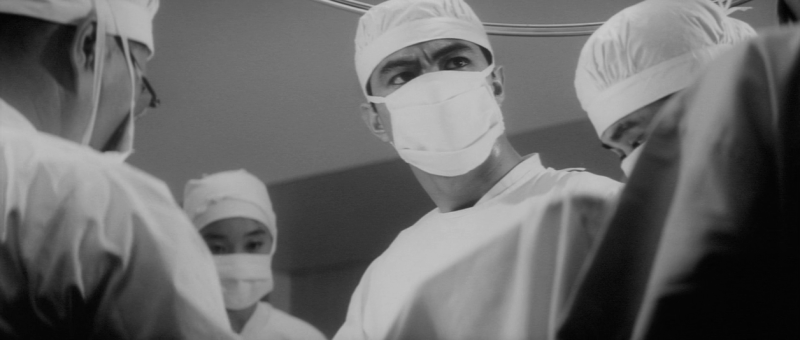
If can’t they can’t have faith in the medical system, the very people who are supposed to care for them when they are most in need, how can they have faith in anything else? As the rather bleak conclusion makes clear, the entire system is rotten to the core and no longer has any place for idealists like Satomi who are continually pushed to the margins by those jockeying for power in this infinitely corrupt society defined by hierarchy and cronyism while ordinary people, like Sasaki, continue to pay the price. Just as in his opening sequence, Yamamoto takes a scalpel to the operations of the medical industry to expose the messy viscera below but ultimately can offer no real cure in the face of such an overwhelming systemic failure. 


Original trailer (no subtitles)

The Rose on His Arm (太陽とバラ, Keisuke Kinoshita, 1956)

In the mid-1950s, a minor moral panic took hold over the so-called “Sun Tribe” movies which, inspired by the novels of Shintaro Ishihara, depicted a world of crazed abandon in which a collection of bored rich kids lost themselves in the hedonistic pursuits of sex and drugs rejecting the stability the wartime generation had striven so hard to create for their children. Shochiku, at that time the home of polite melodrama, nevertheless attempted to get in on the youth movie boom mostly through commissioning a series of young directors such as Kiju Yoshida and Nagisa Oshima in the hope that they could speak directly to their generation. Meanwhile, the by that point well-established Keisuke Kinoshita also made his own, perhaps surprising, take on the genre with The Rose on His Arm (太陽とバラ, Taiyo to Bara), a youth movie melodrama which nevertheless anticipated the questions others were beginning to ask about the Sun Tribe movies in their very particular view of contemporary class dynamics. 

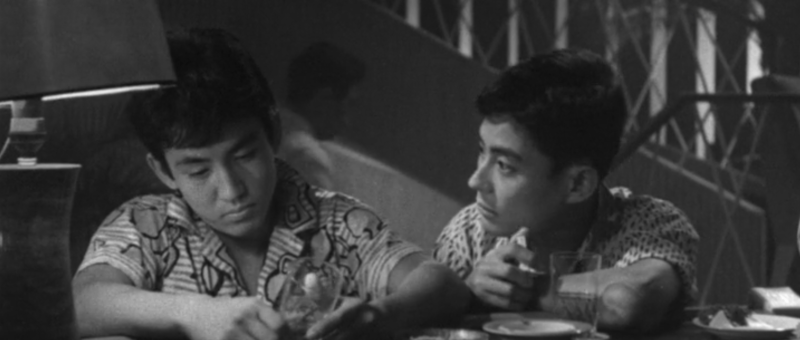
Our hero, Kiyoshi (Katsuo Nakamura), is like the (anti-)heroes of the post-Sun Tribe youth movies, a poor boy turned delinquent out of a sense of frustrated hopelessness. Quitting one job after another solely because the work is boring, he spends most of his days hanging out at the beach with other no good kids robbing unsuspecting bathers. Kiyoshi’s sense of inferiority is compounded by the fact that his mother (Sadako Sawamura) works as a maid for a wealthy family while making ends meet by crafting paper flowers by night. The young master of the house where his mother works, Masahiro (Akira Ishihama), never misses a chance to lord his wealth over him but later co-opts Kiyoshi into his group of wealthy friends as a source of entertainment (and because his delinquent friend, Yamanaka (Tamotsu Tamura), begins supplying them with drugs).

“I screwed up my life because I was poor, what’s your excuse?” Kiyoshi eventually asks an indifferent Masahiro after beginning to see him for what he is. Like the hero of Punishment Room, Kiyoshi’s internalised resentment is partly down to a paternal failure in that he is deeply ashamed of his late father who died, his mother claimed, saving him but also in the course of his activities as a black marketeer in which he’d forced his son to be complicit. The family had apparently tried to make a life for themselves in the new colonies, in this case Palau, but of course had to return to Japan and were then penniless. People did what they had to do, but no one trusts a black marketeer and it seems to be a stain Kiyoshi (whose name means “pure”) cannot wash off. As a poor boy with no education or prospects, he knows all that awaits him is drudgery, so why not make a fast buck stealing purses at the beach rather than slave away at the factory for a week making less than Masahiro gets in pocket money from his factory owner father? 

Convincing himself he’s no good, Kiyoshi consistently sabotages opportunities but resents himself for doing so. He begins to buckle down at the factory but quickly becomes “bored” and starts taking advantage of his supportive floor manager while sucked into Masahiro’s hedonistic lifestyle even after it becomes obvious that he’s keeping him around to be some kind of hired goon, good for punching other pasty rich boys and hooking him up with underworld thrills. Masahiro is a delinquent because his life is too easy, he has no economic imperative to be responsible and will most likely go to college and then either take over the factory or walk into a lucrative salaryman job. Kiyoshi is a delinquent because he’s desperate and has no other means of living. 

Meanwhile he resents his mother’s love, shamed, in more than one sense, by her continuing industry. She often tells him the story of how he fell ill on Palau only to make a miraculous recovery after which she collapsed into a rose a garden. To spite her, Kiyoshi gets the titular rose tattooed on his arm, something which forever marks him out as a ne’er do well in conservative Japanese society, all but guaranteeing he’ll never get an honest job (he even has to cover the tattoo with bandages in public places to avoid causing offence). Eventually he takes drastic action to end his sense of hopelessness, pursuing what is strangely a darker yet more romantic destiny than that of his post-Sun Tribe compatriots in taking a poetic stand, paper rose in hand, defying his despair only through embracing it. 


The Rose on His Arm is currently available to stream in the US via Criterion Channel.

Early Spring (早春, Yasujiro Ozu, 1956)

By the mid-1950s, Japan’s economy was beginning to improve but now that the desperation that went with hunger had dissipated it freed those who’d managed to climb out of post-war privation to wonder just what the point of their ceaseless toil was. Yasujiro Ozu’s primary subject matter remained the modern family, but 1956’s Early Spring (早春, Soshun) sees him heading in a darker direction as he weighs up the delusions of the salaryman dream and discovers that whichever way you swing it, life is disappointing. 

So it seems to be for salaryman Shoji (Ryo Ikebe). He and Masako (Chikage Awashima) married for love a long time ago, but it’s clear that there is distance in their relationship. They sleep in the same room but their futons are slightly too far apart, and the few words they exchange with each other in the morning are terse in the extreme. The truth is that for many a salaryman for whom long hours and interoffice bonding sessions are compulsory, work is the new family. Wives are welcome to join the Sunday hiking outings but it seems few do. Masako too declines, telling her mother she felt it to be too expensive, already irritated with her husband’s irresponsible spending on mahjong games and drinking with friends. 

Money is certainly a constant worry for her and as we learn from her mother they’re behind on the rent despite it being “very cheap”. Masako had made a visit home in part to ask for another loan, which her mother seems reluctant to give, offering her daughter a takeout of the oden her restaurant sells which is first declined but then accepted. Her mother also flags up the other problem in their marriage which is that they sadly lost a child in infancy and have had no more. Sorrow may have killed their love, but the fact her husband stays out all hours and wastes the little money he earns while failing to win promotions only makes the situation worse. 

As for Shoji, he is becoming very aware of the delusions of the “salaryman dream”. He is one of thousands of men identically dressed in white shirts and grey trousers that board the packed rush hour trains every day heading into the city. His life is one of pointless drudgery and its only victory is that keeps hunger from the door, not even quite stretching to a roof over his head. “All that’s waiting for us is disillusion and loneliness” according to a veteran salaryman growing close to his retirement and realising that he has little left to live on, his dream of buying a small stationary shop all but unobtainable. He was dead set against his own son joining the ranks of the salaryman, but in the end failed to prevent it.

It is perhaps this sense of frustration and impotence that draws Shoji into an affair with a younger woman, Chiyo (Keiko Kishi), who is admittedly very pretty but seems to hold little interest for him aside from her youth and beauty. Chiyo openly pursues her older colleague, declaring that she doesn’t care he has a wife but has come to hate her after the first time they slept together. Shoji meanwhile remains guilty and conflicted. He evidently continues seeing Chiyo, lying to Masako that he’s visiting a sick friend, but otherwise regards her as an irritation. When his co-workers figure out what’s going on they try to stage an intervention, but Shoji doesn’t show up and Chiyo angrily denies everything before arriving at Masako’s looking for Shoji only this time he really is out visiting a sick friend. 

Miura (Junji Masuda), the sick friend, is a true believer in the salaryman dream. Now that he’s ill, he misses the packed trains and elevators, not to mention his old workplace friends. All he wants is to be well enough to return to the office and his predicament perhaps has Shoji thinking that at least he has his health and things aren’t so bad for him after all. Masako, meanwhile, turns to other women for advice. The woman across the way recounts how she caught her husband out with his mistress and made a scene that’s rendered him docile and obedient ever since (a rare man in an Ozu film putting his socks neatly in the laundry basket and hanging up his own coat rather than throwing it on the floor for his wife to deal with). Her widowed friend is more sanguine, admitting that caution is necessary but it’s a little dark to envy the life of a widow for its “freedom”, while her mother thinks she’s overreacting because that’s just how men are in this generation or any other. 

Shoji’s old mentor agrees that “everyone’s disappointed” and all that remains is to try and make the most of it, but still he sees that Shoji has been reckless and inconsiderate in his treatment of both women. He avoids his wife because of the emotional distance between them born of grief, and only really has an affair with Chiyo because it was easier than refusing her. He didn’t even enjoy it, and doubtless it did not quite quell the sense of despair he feels with the utter pointlessness of the “salaryman dream”. Masako, in turn, is disappointed with married life, with her husband’s emotional cowardice, and with her own lack of options. Ultimately, Ozu sides with the mother, not quite condoning Shoji’s behaviour while perhaps excusing it as a direct consequence of dullness of his life while forcing Masako to accept complicity in her husband’s weakness. They may reunite, the stressors of their Tokyo life from the high cost of living to the lure of mahjong now absent, but there is a sense of futility in their eventual insistence that they will “make it work” through starting over in a new place while gazing at the train that, they assume, will eventually carry them back to the city and all of its false promises of a brighter future. 


Early Spring screens 19th/20th/21st October & 20th/23rd November at London’s BFI Southbank as part of BFI Japan. It is also available to stream in the UK via BFI Player and in the US via Criterion Channel.

Equinox Flower (彼岸花, Yasujiro Ozu, 1958)

Japanese golden age cinema is famed for its centring of female stories, but while it’s true that many of Yasujiro Ozu’s family dramas revolve around a young woman’s feelings towards marriage, the perspective is often surprisingly male. Equinox Flower (彼岸花, Higanbana), his first film in colour, marks something of a change in direction in its spirited defence of the young, but at heart is still a story as much about impending old age, the responsibilities of fatherhood, and changing times as it is about contemporary family dynamics or female agency. 

The father in question, Hirayama (Shin Saburi), is a high ranking executive with two daughters. The older, Setsuko (Ineko Arima), is working at another company, and the younger, Hisako (Miyuki Kuwano), is still in school. Marriage is on his mind because he’s just attended the wedding of an old school friend’s daughter at which he gave a speech, with his wife Kiyoko (Kinuyo Tanaka) sitting awkwardly next to him, describing the arranged marriage he had with her as “pragmatic, routine” while he envies the young couple’s “fortunate opportunity” to indulge in romance. He and Kiyoko idly discuss the idea of Setsuko’s marriage, it seems as if there is a promising match on the horizon, with Hirayama conflicted while Kiyoko is very much in favour of doing things the traditional way. She’s already mentioned it to her daughter, but all she does is smile demurely which seems to provoke different interpretations from each of the parents. 

While thinking about all of that, Hirayama receives a visit from an old friend who was a notable absence at the wedding asking him to check up on his daughter Fumiko (Yoshiko Kuga) who ran away from home two months ago to live with a musician after he tried to veto her intention to marry without consulting him. Hirayama is sympathetic, perhaps thinking his friend has acted foolishly and pushed his daughter away. After visiting the bar where she works, he comes to the conclusion that as long as she’s happy with her choice then everyone else should be too. That all goes out the window, however, when a young man, Taniguchi (Keiji Sada), visits him unexpectedly at work and asks for permission to marry Setsuko. Hirayama quite rudely asks him to leave and then irritatedly talks the matter over with Setsuko before petulantly refusing his consent, not because he objects to Taniguchi, but because he is hurt on emotional level that she hadn’t talked to him about this first (not least so that they stop worrying about arranging a marriage) while resentful that she’s gone behind his back and undercut his patriarchal authority. 

In addition to the changing nature of family dynamics, Hirayama is perhaps conscious of his advancing age, feeling himself increasingly obsolescent and therefore additionally wounded by this assault on his authority as a father. The generation gap, however, is all too present. Both Setsuko and Fumiko feel as if they simply cannot talk to their parents because they wouldn’t listen and will never understand. Yukiko (Fujiko Yamamoto), the daughter of another friend, feels something similar in her exasperation with her well-meaning single mother who keeps hatching plans to set her up with various men she isn’t interested in. Intellectually, Hirayama sides with the young, envying them their freedoms and advising Yukiko firstly not to marry at all, and then encouraging her desire to resist arranged marriages despite trying to foist them on his own daughters. 

Even Kiyoko eventually describes her husband’s continuing petulance as “inconsistent”. It seems obvious that Kiyoko is siding with her daughter, immediately taking a liking to Taniguchi who politely brought her home after she stormed out following an argument with her father, but she continues to behave as a “good wife” should, politely minding her husband while gently hoping that he will eventually come round. Only once pushed does she try to explain to him, again politely, that he’s being selfish and unreasonable, but he continues on in resentment while causing his daughter emotional pain simply for trying to find her own happiness rather letting him decide for her. Kiyoko is afraid that if it carries on like this, then Setsuko will, like Fumiko, eventually leave and they’ll lose her completely, something which Hirayama either hasn’t fully considered or is actively encouraging through his petulance. 

In the end the conclusion he comes to is that the parents will eventually have to give way or risk losing their children entirely. He tells both Fumiko and Yukiko that all parents want is for their children to be happy and so nothing else matters, but struggles to put his advice into practice when it comes to his own daughter. Like pretty much everyone in an Ozu film, Hirayama is a good, kind person, even if one struggling against himself as he contemplates a loss of authority, a change in standing, and the difficulty of dealing with complex emotions as a man in a patriarchal society. Predictably, it’s women who essentially bully him into making better decisions, Yukiko “interfering” in the nicest of ways, while his wife makes it clear that though she thinks he’s wrong she will continue to stand by him if only in the hope he will eventually see the light. “Life is absurd, we’re not all perfect” he admits, only later realising how his stubborn foolishness may have caused unnecessary suffering to those he loves the most.


Currently streaming in the UK via BFI Player as part of Japan 2020. Also available to stream in the US via Criterion Channel.

Original trailer (no subtitles)

Street of Love and Hope (愛と希望の街, Nagisa Oshima, 1959)

“You must sell your pigeons or you can’t survive in this world” a less progressive figure than he first seemed eventually admits in Nagisa Oshima’s ironically titled debut feature Street of Love and Hope (愛と希望の街, Ai to Kibo no Machi). As might be expected given the director’s later trajectory, there is precious little love or hope on offer and it seems his particular brand of grumpy pessimism ruffled studio feathers from the very beginning earning him a sixth month directing ban with a top executive complaining “this film is saying the rich and poor can never join hands”. The executive may have had a point in the increasing inequalities of the post-war society in which humanist hypocrisy offers only entrenched division and inevitable class conflict. 

As the film opens, the hero, Masao (Hiroshi Fujikawa), is selling his sister’s beloved pet pigeons because, as his social worker later explains, welfare payments are not enough to live on and his mother Kuniko (Yuko Mochizuki), who usually shines shoes for a living, has TB which leaves her unable to work. Kuniko is keen for Masao to stay in education and attend high school, but he acutely feels the burden on his mother and intends to work while attending evening classes. The trouble begins when Masao sells his pigeons to a wealthy young lady, Kyoko (Yuki Tominaga), who is the teenage daughter of an electronics factory boss. 

Well-meaning as she is, Kyoko tries to give Masao the change from her purchase after he explains he’s selling the birds because he needs money. Ironically she gives one of them to her sickly younger brother, but the problem is that Masao is effectively running a scam. The birds are homing pigeons. Assuming the new owners don’t cage them in properly, the birds will fly right back home and he can sell them again. He’s already done this a couple of times and is at least conflicted about it, especially as it upsets his sister Yasue (Michio Ito) so much, though what else really is he supposed to do?

This central question is the one that eventually comes between Masao’s progressive schoolteacher Miss Akiyama (Kakuko Chino) and Kyoko’s sympathetic older brother Yuji (Fumio Watanabe) who works in HR at his father’s factory. Another of Oshima’s mismatched, ideologically opposed frustrated couples, Miss Akiyama and Yuji find themselves on either side of a divide. It seems that the factory does not ordinarily employ city boys, preferring to recruit from the countryside and house employees in dorms because the boss is convinced rural youth is less corrupted by amoral urbanity. Hoping to help Masao, Kyoko and Miss Akiyama team up to convince him to change his mind and give Masao a chance, but they eventually fail him during the exam because it accidentally uncovers his pigeon scam and therefore proves the boss’ point. 

That isn’t all it exposes, however, as even the seemingly progressive Yuji expresses some extremely outdated, quite offensive prejudices even as he insists they didn’t fail Masao because he comes from a single-parent family. According to the boss, children of “broken families” become “twisted human beings” which is unfortunate because “corporations value stability”. Even while not disagreeing with his father’s logic, Yuji explains that he can’t employ Masao not because of his fatherless status but because he’s fundamentally dishonest as proved by his pigeon scam. Miss Akiyama who’d previously described him as the kind of boy who never lies, is shocked but later reflects on his circumstances and her own. In its own ways, her life is also hard and she can see how it might happen that she too may have to “sell her pigeons” (a handy piece of wordplay hingeing on the fact the Japanese for pigeon, “hato”, sounds similar to the English word “heart”) in order to survive. She can forgive Masao for doing the same in the knowledge he had no other choice, but believes Yuji wouldn’t nor would he forgive her if he discovered that she too had sold herself. She cannot be in a relationship with a man who is so “heartless” and unforgiving and it is this which creates the unbreachable gulf between them itself informed by their differing socioeconomic circumstances. 

These differences in standing are also brought out in the youthful idealism of Kyoko who wholeheartedly believes she can help Masao by giving him money and then trying to improve his circumstances by getting him a job in her father’s factory. Both her father and her brother dismiss her altruistic desire to help as childish, Yuji pointing out that there are millions of poor people not just one and you can’t help them all, while their cynicism is eventually validated in the exposure of Masao’s “fraud” which accidentally brands those living in difficult economic circumstances as duplicitous criminals even as it directly implies that it is an unfair society which turns honest boys like Masao who never lie and just want to take care of their mothers into “heartless” bird traffickers. You can see why Shochiku didn’t like it, the hope of the post-war era shot down by the gun of a conflicted industrialist. 


I, the Executioner (みな殺しの霊歌, Tai Kato, 1968)

Nephew of Sadao Yamanaka, Tai Kato joined Toho as an apprentice in 1937, returning after the war training under Daisuke Ito and Akira Kurosawa, but later moved to Toei where he became closely associated with ninkyo eiga yakuza movies and jidaigeki. From the mid-1960s, however, he made several movies at Shochiku which had, it has to be said, a house style that was almost the polar opposite with a clear focus on polite, family-friendly melodrama. 1968’s I, the Executioner (みな殺しの霊歌, Minagoroshi no Reika) meanwhile is a surprisingly dark affair even among the grittier examples of Shochiku’s similarly themed B-movie thrillers, an avant-garde noir and proto-giallo in which the fugitive, serial killer antihero sees himself as an agent of divine justice in a hellish and immoral post-war landscape. 

Kato opens with a shocking scene of sexualised violence in which a woman is knocked unconscious, stripped, bound with telephone cord, and finally revived, forced to write down the names of four other women before being brutally raped and murdered by a killer whose voice we have not yet heard nor face seen. The police are mystified, attributing the woman’s death to the fact that she had worked as a bar hostess and maybe things like this are an occupational hazard for women who are surrounded by too many men. Her landlord, however, laments that hers is the second death to occur recently after a laundry boy threw himself off the roof. All things considered, he wishes the boy had picked somewhere else. 

The police have no reason to connect the two unfortunate events and so remain largely clueless, but we gradually become aware that the killer, Kawashima (Makoto Sato), is targeting the women because he holds them directly responsible for the boy’s death. He is the inspector that calls, avenging the death of this young man who, he has learned, like him hailed from Hokkaido and had come to the city at only 16 years old to earn money to support his family, saving almost all of his wages in the hope of opening a shop. Kato shows us scenes of a city under construction, a land of girders casting shadows on the ground like prison bars trapping men like these who are building the new Japan but will be discarded as soon the job is done and their labour no longer so much in demand. Kawashima has another reason for living like this, but he perhaps admires something pure and innocent in the desire of a young man leaving home to seek his fortune so that he might take care of those he loves and that this world betrayed that desire is something he finds impossible to forgive.

The five women have apparently done quite well for themselves, despite the fact that more than one of them has worked on the fringes of the sex trade. Their treatment of the boy is attributed to their boredom in the relative ease of their lives as monied women with little to occupy their time other than getting their kicks abusing the less powerful. It’s an uncomfortable role reversal that places women in a position of power and then sees them abuse it in the exact same way that men do, slinging back the same pithy justifications that men offer for sexual violence while the police meditate on the relative connotations of rape when the word is applied to a man at the hands of women rather than the other way around. If it were their sister, they could understand the desire to kill the men who had done it but a part of them struggles to see that a teenage boy may still find unwanted sexual contact a traumatic enough experience to push him towards suicide. 

Yet Kawshima appears to have no real connection to the boy, and his “revenge” is also a product of his misogyny in that as we later learn he also has reason to feel betrayed by womanhood and is already on the run from previous crime. Nevertheless, he is drawn to the innocent Haruko (Chieko Baisho), a girl-next-door type who works in his favourite ramen restaurant, only to discover that she too has a dark and violent past which may be why she seems to be drawn to him. He struggles with himself, but believes that he is taking revenge on a brutalising society defined by violence and abuse while sublimating his sense of emasculation in the face of women’s growing social and sexual freedoms in the post-war era. It is perhaps the post-war era which is cast as the major villain, one of the women later escaping her protective custody to dance furiously a hip nightclub only to return to the scene of her crime while refusing to see that she has done anything so “wrong” as to merit this kind of persecution. 

“The cycle of divine punishment must be fulfilled” Kawashima finally laments, acknowledging his grim place within this series of post-war tragedies. Surprisingly avant-garde, Kato experiments with blown out negatives, extreme close up, and deep focus mixed with his characteristic low angle composition to add to the sense of noirish dread which paints the modern city as an inescapable hellscape while even the romantic place of refuge shared by Kawashima and Haruko is a gothic moorland lit by moonlight and filled with eerie mist. Lurid and sweaty, the film has a grim sense of humour even in its oppressive atmosphere with a running gag devoted to the lead investigator’s painful case of piles, but its overriding fatalism nevertheless offers the hero a sense of redemption if only in acceptance of his narrative destiny. 


Tokyo Twilight (東京暮色, Yasujiro Ozu, 1957)

Closely associated with the family drama, Yasujiro Ozu is perhaps the most socially conservative of golden age directors. Unlike Naruse or Mizoguchi, he cheerfully reinforces patriarchal social norms and foregrounds the paternal experience while upholding the primacy of the traditional family in a rapidly modernising society. In his later career he’d come to sympathise more strongly with the young, but 1957’s Tokyo Twilight (東京暮色, Tokyo Boshoku), perhaps his bleakest take on familial failure, is essentially a treatise on the legacy of corrupted motherhood and rebuke to growing post-war freedom in which a young woman is made to feel that her future is impossible because of maternal betrayal while her sister is forced back into an unhappy marriage to an abusive husband in order to avoid the same fate befalling her own daughter. 

Unlike most Ozu families, the Sugiyamas do not seem to be particularly happy in each other’s company, living in superficial politeness rather than true intimacy. This may partly be because the sisters had a brother who passed away young in a mountain climbing accident, but it also seems that Mr. Sugiyama (Chishu Ryu), though kind and polite, is a typically authoritarian, distant father. Oldest daughter Takako (Setsuko Hara) has returned home declaring herself unable to go on living with her professor husband Numata (Kinzo Shin) who, she says, has become increasingly erratic, taking out his petty professional disappointment on their small daughter Michiko whom he seems to resent. Younger sister Akiko (Ineko Arima) meanwhile is sullen and introverted. Unmarried, she lives at home and is studying to become a stenographer. 

As we later discover, the girls’ mother Kikuko (Isuzu Yamada) left the family during the war after falling in love with the junior officer Mr. Sugiyama enlisted to look in on the family while he was away in Seoul. Akiko was only three when their mother left and barely remembers her. Takako attributes her wayward behaviour to “loneliness”, that she has been forever corrupted through never knowing a mother’s love. Mr. Sugiyama admits he tried his best, but both agree that children need two parents and no matter how much he wants to a father cannot make up a mother’s share. 

This atmosphere of alienation is perhaps why Akiko feels as if she has no one to turn to in her own moment of maternal crisis. She has become pregnant by her college student boyfriend who has been avoiding her and even has the audacity to ask if the baby’s his when Akiko finally manages to pin him down. Trying to borrow money for an abortion, Akiko visits her aunt who declines to give it to her without knowing why, eventually turning to a family friend who apparently provides no questions asked. The woman at the clinic assumes she is a bar girl, as does a policeman who eventually “arrests” her for loitering in a sleazy cafe where her boyfriend has obviously stood her up which is quite openly being used as a place for men to pick up call girls. All of this contributes to Akiko’s increasing sense of shame and worthlessness. She sees herself as a fallen woman, convinced that she is all her mother’s child contaminated by her “bad blood” which makes a conventionally successful life as an ordinary wife and mother an impossibility. 

Akiko’s aunt wants to set her up with arranged marriage matches, but Akiko declares she has no intention of marrying or having children. Without knowing anything of Akiko’s circumstances, Takako assumes this is because of her obviously unhappy marriage, trying to convince her sister that there are plenty of happy couples she is merely unlucky. Mr. Sugiyama attempts to talk to his son-in-law but finds him strange and indifferent, offering treatises on familial love while implying that he has little of it. He regrets pressuring Takako to marry him when he knew that she preferred someone else while Takako is once again haunted by the spectre of corrupted maternity in her mother’s decision to leave the family for emotional fulfilment and is fearful of making the same mistake creating another troubled daughter just like Akiko in denying her a father’s love (which seems a moot point given that Numata does not care for the child). 

Neither woman is able to escape paying for their mother’s transgression. Akiko is punished firstly for embracing her sexuality and secondly for the rejection of motherhood in choosing to have an abortion. Alone and humiliated by her unreliable boyfriend, she is denied the opportunity to start over, while Takako meditates on female failure and believes that her only option is to live in misery with a cruel and narcissistic husband because that is the “proper” thing to do and the only way to bring her daughter up “right”. The absent mother, meanwhile, is denied reconciliation and left only with the painful separation from her daughter who finally rejects her in order to reclaim the image of the good wife and mother by returning to her unhappy home. Bleak as it is, all of this is presented as a kind of happy ending in that it restores the idea of the traditional family, increasingly threatened by post-war modernity, to its original primacy. We leave with Mr. Sugiyama rehiring his maid and heading cheerfully back to the male world of work, making the fresh start that his daughters have been so cruelly denied.  


Currently streaming in the UK via BFI Player as part of Japan 2020. Also available to stream in the US via Criterion Channel.