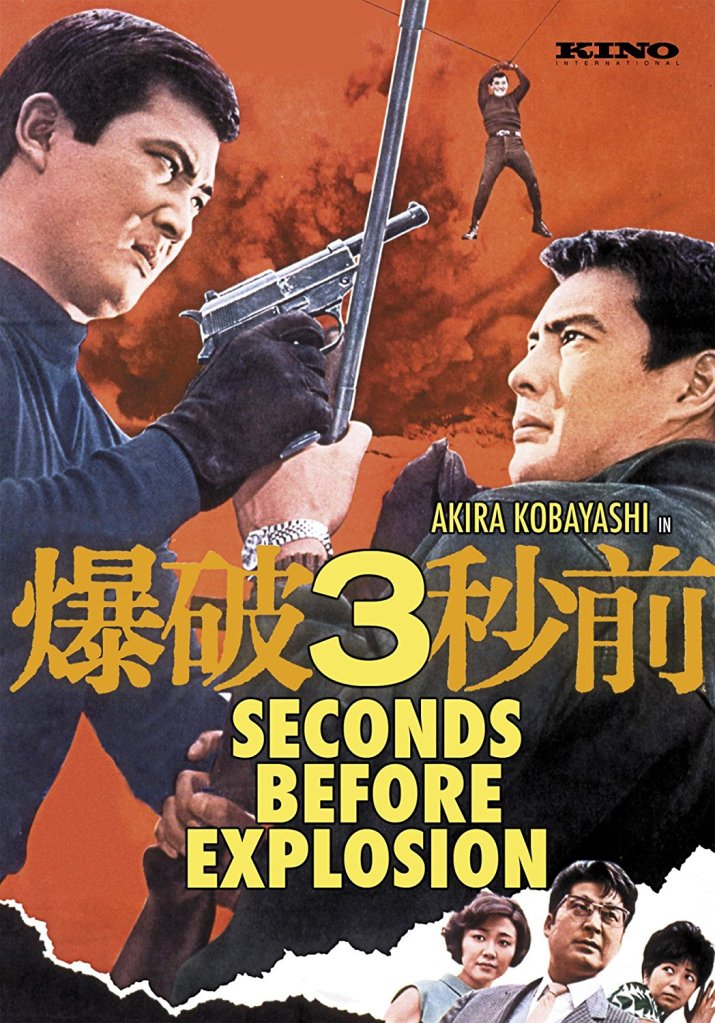
3 Seconds Before Explosion (爆破3秒前, Motomu Ida, 1967)

three-minutes-before-explosionIf Nikkatsu Action movies had a ringtone it would probably just be “BANG!” but nevertheless you’ll have to wait more than three rings for the Kaboom! in the admittedly cartoonish slice of typically frivolous B-movie thrills that is 3 Seconds Before Explosion (爆破3秒前, Bakuha 3-byo Mae). Once again based on a novel by Japan’s master of the hard boiled Haruhiko Oyabu, 3 Seconds Before Explosion is among his sillier works though lesser known director Motomu Ida never takes as much delight in making mischief as his studio mate Seijun Suzuki. What he does do is make use of Diamond Guy Akira Kobayashi’s boyish earnestness to keep things running along nicely even if he’s out of the picture for much of the action.
Like most of the more outlandish Nikkatsu action fests, 3 Seconds Before Explosion has a complicated relationship with narrative but we begin with former boxer Yabuki (Akira Kobayashi) in the middle of being brainwashed with flashing lights and high pitched noises until he agrees to become a shady government (?) assassin. Perhaps in an effort to save our sanities too, he relents and his first job is ensuring some jewels which were stolen during in the war don’t get into the hands of an evil nazi who will presumably be wanting them for evil nazi business. Anyway, Yabuki does his ninja stuff and thinks he’s tracked the jewels down but runs into a former colleague, Yamawaki (Hideki Takahashi), who is working for a businessman who already has the jewels and wants to keep them. Yamawaki quit being a super spy because he fell in love, which Yabuki thinks is a bit lame but still knows his friend has right stuff and would rather not have to kill him or anything.

Somewhere between the less serious yakuza/gang movies Nikkatsu were making in the late ’60s and a spy spoof, 3 Seconds Before Explosion has its fair share of oddness from strangled dogs to the mini Chinese theme in which one of the henchmen, Yang, wanders around in traditional Chinese garb while another girl at the club enjoys flirting in Mandarin for no apparent reason. It also goes without saying that the evil Nazi is played by an American spouting unconvincing German whilst chewing the scenery to a pulp. Realism is not where we are, but there’s something a little old fashioned about the way Ida chooses to stage his weirdness even if the film is filled with crazy contemporary youth touches such as in the achingly hip Club Casba.

The interpersonal drama comes as Yabuki and Yamawaki face off about their life choices much more than the case at hand. Yamawaki grew tired of the spy life and decided to leave it behind for his lady love, only to get mixed up in all of these petty gangster shenanigans. Still, if he can keep Yabuki away from the jewels until the time limit he’ll be free forever. Nothing is really said about Yabuki’s brainwashing at the beginning of the film, but Yamawaki’s choice does seem to prompt him into a consideration of his own lifestyle. That said, life as a government assassin doesn’t seem so bad – Yabuki doesn’t even really kill people much, just spends his life sneaking into places and leaping heroically between rooftops whilst making use of clever gadgets to evade his foes. The gangsters, however, are pretty evil and keep killing people after claiming to let them go which offends Yabuki’s sense of honour.

Yabuki may not kill, but the film does seem to make a point of killing off all the female characters in case they get in the way of the manly stuff like fighting and making bombs. An innocent kidnapped secretary who had nothing to do with anything is machine gunned down, another girl is murdered by the evil Nazi, and a final one gets marched into a mine field by her boyfriend before returning for revenge and getting unceremoniously taken down anyway. To lose one woman is careless but to kill off (all) three in a short time seems a step too far or perhaps too “realistic” for this otherwise cartoonish approach to violence.

Lacking the visual flair of other Nikkatsu efforts, 3 Seconds to Explosion is never as exciting as its title promises. Despite the athletic displays of the slightly bulkier Kobayashi, there’s a kind of clumsiness to the action and a straightforwardness in approach which does not gel with the ridiculousness of the premise. On lower end of Nikkatsu’s B-movie output, 3 Seconds to Explosion does not stint on the silliness but could do with enjoying itself a little more rather than trying to corral its non-sensical plot into something with serious intent.


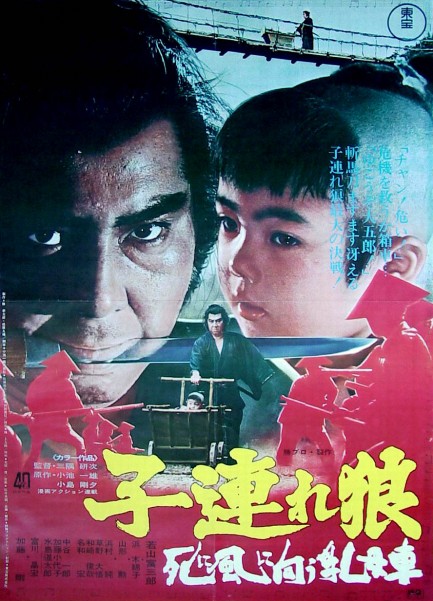
Lone Wolf and Cub: Baby Cart to Hades (子連れ狼 死に風に向う乳母車, Kenji Misumi, 1972)

lone-wolf-and-cub-baby-cart-to-hadesOgami Itto (Tomisaburo Wakayama) and his (slightly less) young son Daigoro (Akihiro Tomikawa) are going to hell in a baby cart in this third instalment of the six film series, Lone Wolf and Cub: Baby Cart to Hades (子連れ狼 死に風に向う乳母車, Kozure Okami: Shinikazeni Mukau Ubaguruma). The former shogun executioner, framed for treason by the villainous Yagyu clan intent on assuming his position, is still on the “Demon’s Way”, seeking vengeance and the restoration of his clan’s honour with his toddler son safely ensconced within a bamboo cart which also holds its fair share of secrets. In the previous chapter, Baby Cart at the River Styx, Ogami’s stoic personality came to the fore as he showed that sometimes there is more strategic value to be found in avoiding a fight rather than charging into one where it isn’t necessary. Baby Cart to Hades will further test this element of his life philosophy as he finds himself bound onwards, seeking his redemption.
Neatly attaching Daigoro’s cart for towing, Ogami boards a boat which appears to be being followed by underwater ninjas, if the reeds he notices whilst using his sword as a mirror are anything to go by. Also on the boat is a distressed young woman, apparently on her way to be sold to a brothel. Diagoro takes pity on the girl and catches her tiny bundle of belongings when the loquacious middle man knocks them overboard. Later they all end up at the same inn where the unfortunate woman kills her procurer when he attempts to rape her (bad business decision as that would be). Daigoro takes pity on the woman once again and Ogami decides to help her, especially after he notices the wooden memorial tablet among her belongings. Rather than fight off the brothel running samurai who come to find her, Ogami agrees to undergo the torture which is the alternative to entering a brothel on the girl’s behalf.

In addition to saving a life from fear and suffering, Ogami’s forbearance also earns him the respect of the madam in question, Torizo (Yuko Hama), who has another job for him. Her older sister was raped at the court of their lord and subsequently committed suicide, she and her father would like him dead and are willing to pay for it. Amusingly enough, the corrupt lord in question also tries to hire Ogami for another assassination for which he will pay double, but Ogami is an honest man. This latest mission brings him closer to his fated battle with the Yagyu but the Demon’s Way is long and Ogami is not yet approaching its end.

Directed once again by Kenji Misumi, this third instalment is much less psychedelic and action packed than the preceding film but seems keener to explore more of Ogami’s world which is often cruel and unforgiving. An early scene in the film features a discussion between four mercenaries, one a fine samurai who refuses to associate too much with the other three who are of a much more earthy character. Caring only for women and sake, the three men live a life of banditry by another name, fleeting from one clan to another participating in parades to bulk out an otherwise lacking show of force. Kanbei (Go Kato), by contrast, at least has a consciousness of the “true samurai” and a conflicted heart when it comes to his way of life. Having been a loyal retainer and later betrayed by the very lord he was seeking to protect over a matter of protocol, he has lost sight of his place in the world but knows himself to be superior to these venal, dishonest, empty scabbards for hire.

These same three men then attempt to have some sport with a well to do mother and daughter unwisely travelling with a single attendant. After despatching their escort, the three rape the two women before turning to Kanbei for help to clear up the giant mess they’ve just made. Kanbei does indeed clear it up by killing the two women in the gentlest and most elegant way he can before instructing the three culprits to draw lots – one of them will have to die and take the blame for everything to avoid getting entangled with the local police. Neither Kanbei or Ogami arrive in time to save the two women, whose deaths are both a solution to their “defilement” and the means to coverup a crime, leaving two thirds of the perpetrators free to commit the same crime again further along the road. Female life is both cheap and worth a lot of money to the right people, though there are precious few willing to defend it as a matter of honour – even Ogami’s decision to help the young woman about to be sold against her will has more to do with the cosmic coincidence of her memorial tablet than a desire to defend a vulnerable girl in trouble.

Where the dying monologue in Baby Cart at the River Styx was about the elegance and nobility of killing, Baby Cart to Hades focuses on the nature of the “true samurai” as the similarly disenfranchised Kanbei and Ogami discuss the “proper” way of life and death. Kanbei, like Ogami, is a brave man who served his lord in his own way, only to accomplish his mission and be cast out by those who disagreed with his methods. Is it really wrong to fight to live, rather than prepare to die? Both men say no, but the conclusion that is reached is that a samurai can only live by death. Meeting for the first time, Kanbei requests a dual from Ogami, promising to care for his son if only he survives. Ogami agrees but later sheaths his sword and declares the fight a draw. He would rather not fight a man who appears to be his equal in every way and has no quarrel with him, though the two will meet again for an unavoidable showdown.

Misumi is more straightforward his direction save for a few expressionist scenes of the bright sunset and a dramatic switch to POV as a head is severed from its body and rolls away. Nevertheless the ninja antics become ever more impressive, as do Ogami’s methods of detecting them. Once again Ogami attracts the attention of a grateful woman in the person of Torizo who, in keeping with the previous two chapters, watches him push his baby cart away with tears in her eyes (all accompanied by the first appearance of a closing ballad in the series). There are a lot more bodies behind him now as Ogami strides away from a battlefield littered with corpses, yet he’s seemingly no closer to achieving his goal despite his brush with the Yagyu. The price of vengeance is increasing, but the Demon Way is long, and Ogami must follow it to its end, no matter where it leads.


Original trailer (German subtitles for captions only, NSFW)

Outlaw: Heartless (大幹部 無頼非情, Mio Ezaki, 1968)

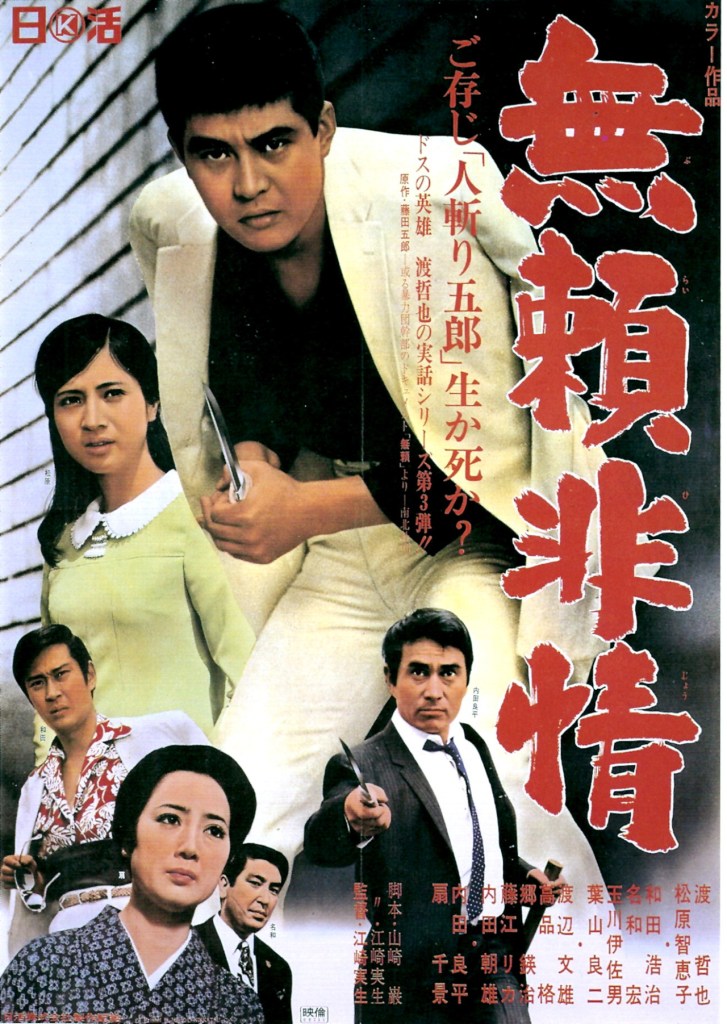
heartlessThings take a slight detour in the third of the Outlaw series this time titled “Heartless” (大幹部 無頼非情, Daikanbu Burai Hijo). Rather than picking up where we left Goro – collapsed on a high school volleyball court, it’s now 1956 and we’re with a guy called “Goro the Assassin” but it’s not exactly clear is this is a side story or perhaps an entirely different continuity for the story of the noble hearted gangster we’ve been following so far. The only constant is actor Tetsuya Watari who once again plays Goro Fujikawa but in an even more confusing touch the supporting characters are played by many of the actors who featured in the first two films but are actually playing entirely different people….
So, it’s 1956 and this time Goro is out on a job to take out a rival gangster only he has a change of heart when the man’s wife pleads with him. Goro tells the pair to leave through the back door but one of the other gangsters turns up before they can escape and takes care of the husband whilst casting a watchful eye on the now treacherous Goro. Right before his lights go out, the murdered man tells Goro that he’s been framed as part of the boss’ gambling scam and tasks Goro with taking his sickly wife to Nagoya for medical treatment. After cleaning out the bad guys at the gambling den, Goro takes off with wife in tow and even runs into an old friend along the way but as usual nothing’s quite a simple as it seems.

If the problem with Gangster VIP 2 was staying too close to the formula established in the previous film, then Heartless perhaps attempts to overcorrect this flaw by doing something completely different. It’s really not clear how this film links in with the other two and the presence of most of the same actors playing entirely different characters is more than a little confusing to say the least, though it is a problem which occurs quite frequently with these kinds of films and is largely due to the way they were produced at studio level.

Once again the roots of restless gangsters lie post-war turmoil as the fellow ex-mobster Goro runs into is another childhood friend from the streets – Goro actually saved his life when he became dangerously ill by sneaking onto a US military base to “acquire” some penicillin (quite a canny move for a young boy, it has to be said). There’s less harking back to the theme of homes and hometowns than in the first two movies – yakuza wives take on a bigger role instead, becoming the symbol of a more normal life that is somewhat denied to both gangsters (ex or otherwise) and also burdening their husbands with the need to ensure their safety.

As in the first two films, Goro is referred to as being “different” from the regular yakuza. His potential love interest (again played by Chieko Matsubara but not as Yukiko from the other two movies) argues with her father who was also a yakuza but gave up the gangster life for love of her mother – he warns her off men of Goro’s ilk as they rarely do anything from the kindness of their hearts, but she remonstrates with him that Goro isn’t that kind of gangster. This time he’s also carrying around a bracelet that belonged to an old flamed called “Natsuko” that we haven’t heard of before but gives his pleas not to take a man like him to heart a little more weight.

Heartless is the only film in the series to be directed by Mio Ezaki (the first being directed by Toshio Masuda and the others by Keiichi Ozawa) and has little of the visual style of the first two movies though the title sequence of Goro single handedly raiding the gambling den proves a stylish early highlight. In keeping with the other two films we still have a large scale fight sequence nearing the finale which is played against the song of a cabaret singer and there’s even a little strange slapstick as the final fight ends up in some kind of decorators’ warehouse with everyone sliding around and getting covered in paint. After taking care business Goro tries to exile himself again, staggering off in an uncertain direction whilst the song playing extols the lonely fate of a “wandering man” which is perhaps the only heart he carries – the ruined heart of a “heartless” man with no roots or anchor to tie him home, a wanderer with no clansmen and no hope of salvation.


Outlaw: Heartless is the third of six films included in Arrow films’ Outlaw: Gangster VIP The Complete Collection box set (which is region free on DVD and blu-ray and available from both US and UK).

English subtitled original trailer:

https://www.youtube.com/watch?v=lDu54sfiI78

The Yakuza Papers Vol. 3: Proxy War (仁義なき戦い: 代理戦争, Kinji Fukasaku, 1973)

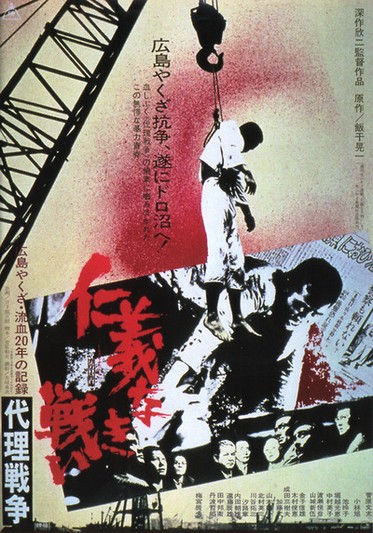
3-Battles-Without-Honor-and-Humanity-3-Proxy-WarThree films into The Yakuza Papers or Battles Without Honour and Humanity series, Fukasaku slackens the place slightly and brings us a little more intrigue and behind the scenes machinations rather than the wholesale carnage of the first two films. In Proxy War we move on in terms of time period and region following Shozo Hirono into the ’60s where he’s still a petty yakuza, but his fortunes have improved slightly.

It’s now 1960 – almost 15 years since Hirono came home from the war. The young people who are just coming of age grew up in the turbulent post-war era but probably don’t remember much of the conflict itself. These days the problem is the ANPO treaty and the wider world’s pre-occupation with communism. Russia and America are engaged in various “proxy wars” across the world in what would come to be known as the cold war. This tactic of indirect warfare has also taken root in the yakuza world as gangs and gang members form covert alliances, hatch secret plots to take out rivals, or otherwise try to manipulate the situation to their advantage. When the head of the Muraoka crime syndicate is assassinated in broad daylight and his underling, Uchimoto, does nothing, it kickstarts a chain of petty vendettas as each of the ambitious crime bosses vie to fill the power vacuum with the snivelling Uchimoto not least among them.

Bunta Sugawara returns to centre stage again with Hirono at the forefront of the action. One of the few yakuza guys who’s pretty happy with his lot and not seeking a higher position he’s in the perfect spot to become a very important player when it comes to supporting other people’s bids for power. Having originally backed Uchimoto he’s at something of a disadvantage following Uchimoto’s cowardly flip-flopping. However, having found himself back under the aegis of former boss Yorimoto, it does afford Hirono the possibility of finally getting revenge against him. Gangs merge several times while fracturing on the inside as the lower bosses try to get their guys in line whlst picking sides as to whom they support in the leadership battles (some with more of an eye on their own futures) but this time the action is a little more cerebral than the audacious violence of the immediate post-war period.

Changing up his style slightly, Fukasaku keeps the overall documentary approach with the news reel voice over relating the salient political and historical details plus the initial captions explaining the names and allegiances of the major players but reduces the freeze frame death announcements. The action is still frenetic with ultra naturalistic handheld camera and occasional strange angles but this time he opts for a muted colour effect in the final shoot out which increases the shocking nature of the scene. Blow for blow there’s less overt violence here though there is a fairly graphic and unpleasant rape scene which feels a little out of place though it does add to Fukasaku’s argument about the nature of aggression.

Once again the ruined the dome looms large over everything, reminding us that this isn’t just a story of gang warfare but a critique of the senselessness of a violent life. As the film says, young men are the first to die when the battles begin but their deaths are never honoured. Like Hiroshima Death Match, Proxy War also leads to the death of a youngster in pointless gang violence – another young man who ended up in the criminal underworld through lack of other options. The futility of the cycle of violence is becoming wearing – as is perhaps the point. One gang boss falls, another rises – only the names have changed. There’s no rest for an honest yakuza like Hirono when the less scrupulous are willing switch allegiance without a second thought. The only victory is staying alive as long as you can.


Proxy War is available on blu-ray in the UK as part of Arrow Video’s Battles Without Honour and Humanity: The Complete Collection box set.

The Yakuza Papers Vol. 2: Hiroshima Death Match (仁義なき戦い: 広島死闘篇, Kinji Fukasaku, 1973)

81ZkRgBFyyL._SL1378_If you thought the story was over when Hirono walked out on the funeral at the end of Battles Without Honour and Humanity think again – we’ve barely scraped the surface of the post-war Hiroshima criminal underworld chaos. The aptly named Hiroshima Death Match runs in parallel with the events of Battles Without Honour taking place in roughly the same time, 1950-1955, but features a new protagonist relegating Bunta Sugawara’s Hirono to the sidelines where he appears as a weary observer of the cruel yakuza world. This time our hero, Yamanaka, is younger – too young to have offered his life as a kamikaze in the war as he apparently wanted to, and is one of the thousands of young men who’ve found themselves alone and without futures thanks to both the after effects of World War II and the ongoing Korean War.

Hiroshima Death Match ties itself into Battles Without Honour and Humanity quite neatly when the protagonist, Shoji Yamanaka (Kinya Kitaoji), is sent to prison after taking a knife to a room full of guys who accused him of cheating in a gambling den. There he comes into contact with the first film’s hero, Hirono (Bunta Sugawara), who offers him some food whilst in solitary but then disappears for the vast bulk of the film. When he gets out, Shoji finds himself in trouble again when he can’t pay for his meal in a restaurant and offers to work off the bill. The waitress, Yasuko (Meiko Kaji), refuses and tells him to just forget about the money and leave when he’s done but Shoji is insulted by her “charity” and things kick off between him and a gang of yakuza also in the restaurant at the time. Yasuko turns out to be the widowed niece of a yakuza boss and after recovering in her care Shoji agrees to join the Muraoka gang to get revenge on the guys who beat him up.

Whereas Battles Without Honour and Humanity took as its protagonists the young men who’d returned from the war to a ruined and defeated country, Hiroshima Death Match focuses on the generation below who were too young to fight themselves but have still been marked by the after effects of the conflict. At the beginning of the film Shoji has nothing, he’s ashamed of cheating and gets upset when caught which only fuels his youthful and violent anger. He doesn’t seem to have any family to help him or honest work to go to and so, of course, he ends up a yakuza. Once again, the yakuza take the place of a traditional family offering both a place to belong and a degree of emotional and financial support – for a price.

When Shoji inevitably falls in love with Muraoka’s widowed niece, he discovers his surrogate father’s love is not quite unconditional. Yasuko has a young daughter and was married to a man who died a kamikaze war hero. Muraoka does not want her to remarry lest she shame her husband’s memory unless he keeps it in the family by marrying her off against her will to her huband’s brother. Shoji’s affair with Yasuko continues to cause a rift with Muraoka and he’s torn between a desire for a peaceful future with the woman he loves and loyalty to his gang boss to whom he owes so much. Muraoka’s own morals are shown to be far from the traditional yakuza ideals and he’s not above using Shoji’s strained loyalties to his own advantage eventually with tragic consequences.

Like Battles Without Honour and Humanity, Hiroshima Death Match is shot in the same quasi-documentary style with a weary sounding narrative voice over and frequent freeze frame captions identifying the characters along with their gangs and positions as well as their dates of demise at the appropriate time. The ruined Atomic Bomb Dome (now the Hiroshima Peace Memorial) continues to loom large over the proceedings as we’re reminded at the end that this isn’t the only blood that’s been shed here. Even more so than with Battles, Fukasaku rams home the senselessness and futility of violence. The film ends with Hirono attending another funeral (though this time in a black suit and melancholic air) where the bosses reap in consolation money and gamble at the wake. He gives his old bosses a sideways look as they laugh and joke while a young man who they all now account as some kind of legendary yakuza hero lies dead for no reason at all. What does this sort of life amount to in the end? The only reward for a life of violence is a lonely grave.


Hiroshima Death Match is available on blu-ray in the UK as part of Arrow Video’s Battles Without Honour and Humanity: The Complete Collection box set.


The Yakuza Papers Vol. 1: Battles Without Honour and Humanity (仁義なき戦い, Kinji Fukasaku, 1973)

Snapshot-2015-12-07 at 11_06_36 PM-930280086When it comes to the history of the yakuza movie, there are few titles as important or as influential both in Japan and the wider world than Kinji Fukasaku’s Battles Without Honour and Humanity (仁義なき戦い, Jingi Naki Tatakai). The first in what would become a series of similarly themed movies later known as The Yakuza Papers, Battles without Honour is a radical rebooting of the Japanese gangster movie. The English title is, infact, a literal translation of the Japanese which accounts for the slightly unnatural “and” rather than “or” where the “honour and humanity” are collected in a single Japanese word, “jingi”. Jingi is the ancient moral code by which old-style yakuza had abided and up to now the big studio gangster pictures had all depicted their yakuza as being honourable criminals. However, in Fukasaku’s reimagining of the gangster world this adherence to any kind of conventional morality was yet another casualty of Japan’s wartime defeat.

The story begins with a black and white image of a mushroom cloud with the film’s bright red title card and now famous theme playing over the top. This is Hiroshima in 1946. Things are pretty desperate, the black market is rife and there are US troops everywhere. Shozo Hirono (Bunta Sugawara) has just returned from the war (in fact he’s still in his uniform). He gets himself into trouble when he intervenes as an American soldier attempts to rape a Japanese woman in broad daylight in the middle of a crowded marketplace. He manages to cause enough of a commotion for the woman to escape but the Japanese cops just tell him not to mess with the GIs. Things don’t get much better as one of Hirono’s friends is assaulted by a yakuza. They get some rival yakuza to help them get revenge and in the commotion Hirono accidentally kills someone and is sent to prison for 12 years. In prison he meets another yakuza who wants to escape by pretending to commit harakiri and promises to get his yakuza buddies to bail Hirono out if he helps. From this point on Hirono has become embroiled in the new and dangerous world of the Hiroshima criminal underground.

Battles Without Honour and Humanity has a famously complicated plot entered around the various power shifts and machinations between different groups of yakuza immediately after the end of World War II. The film begins in 1946 and ends in 1956 though many of its cast of tough guys don’t last anywhere near as long. The picture Fukasaku paints of Japan immediately after the war is a bleak one. Even if some of these guys are happy to have survived and finally reached home, they’ve seen and done terrible things. Not only that, they’ve been defeated and now they’re surrounded by foreign troops everywhere who can pretty much do what they want when they want. They just don’t have a lot of options – if they don’t have connections to help them find work when there’s not enough to go around then it isn’t surprising if they eventually fall into to crime. Also, having spent time in the military, the yakuza brotherhood provides a similar kind of camaraderie and surrogate family that you might also find in an army corps.

It all gets ugly quite fast. Largely the yakuza are making their money profiting from the political instability, resenting the US occupation yet reaching deals with them to support their efforts in the Korean war and then selling new and untested drugs at home (with less than brilliant results). Betrayals, executions, assassinations in previously safe places like a bath house or the barbers – these are a long way from the supposedly honourable gangsters of old. One minute Hirono is offering to cut off his finger as a traditional sign of atonement (though no one knows exactly what you’re supposed to do in this situation and it all ends up seeming a little silly) and taking the rap for everyone else’s mistakes, but his friend faked harakiri to get out of jail and everyone is double crossing everyone else whichever way you look.

The whole thing is filmed in an almost documentary style with captions identifying the various characters and giving the exact time of their demise (if necessary) as well as a voice over giving background information about the historical period. The film is inspired by real life yakuza memoirs and there are parts which feel quite like a bunch of old guys sitting in a drinking establishment and recounting some of their exploits.

This new postwar world of heartless gangsters is a tough one and almost devoid of the old honour-bound nobility, however somehow Fukasaku has managed to make it all look very cool at the same time as being totally unappealing. You wouldn’t want to live this way and you definitely don’t want to get involved with any of these guys but somehow their self determined way of life becomes something to be admired. That said, there’s a sadness too – that even in the criminal underworld there used to be something noble that’s been obliterated by the intense trauma of the war. You can rebuild, you can move on from the destruction left by the war’s wake but there’s no going back to those days of “honour and humanity” – if they ever existed, they’re gone forever now.


Battles without Honour and Humanity is available in blu-ray in the UK as part of Arrow Video’s Battles Without Honour and Humanity: The Complete Collection box set.