Tsukigata Hanpeita (月形半平太, Kokichi Uchide, 1952)

Tusgikata Hanpeita still 1In the midst of post-war confusion, Japanese cinema increasingly looked back to Meiji in all of its chaotic possibility in order to ask what went wrong and what lessons it might have for a second kind of revolution as the nation tried to rebuild itself after decades of militarist folly and chastened wartime defeat. “Tsukigata Hanpeita” (月形半平太) is a “legendary” fictional character first imagined for a kabuki play in 1919 who finds himself swept up in Bakumatsu intrigue as he tries, along with daring revolutionaries Sakamoto Ryoma and Katsura Kogoro, to forge an alliance between the clans of Choshu and Satsuma in order to take on the corrupt shogun in defence of the Emperor and foster a new era of peace in an increasingly uncertain world.

When we first meet him, Tsukigata Hanpeita (Utaemon Ichikawa) is on the run from Kyoto-based special police force the Mimawarigumi but also making time for his mistress, Umematsu (Chizuru Kitagawa) – a geisha. This in particular is a problem which has left him dangerously exposed, even the Mimawarigumi leader Okudaira (Joji Kaieda) seems to be aware of the relationship and is apparently not above using it to his advantage. Meanwhile, he’s not only threatened by shogunate defenders, but by his own side – both by those who remain unconvinced by Sakamoto’s (Jotaro Togami) internationalist philosophy, and by those who simply hold a grudge against Satsuma because of a previous conflict and regard Tsukigata as a traitor for daring to talk to them at all. Despite everything, Tsukigata hides in the shadows and commits himself to living, and if necessary dying, to bring about a better world free of shogunate oppression.

Unlike other revolutionary legends, however, Tsukigata’s fervour has not made him cold or cruel even if he must sometimes act in ways which are mysterious and confuse those around him. Meeting a young man on a bridge, he applauds his studious nature, agreeing that “nothing is more important than to understand advanced civilisation”, and is as polite as he could be when the man tells him he has just joined the Mimawarigumi. Rather than attack or berate him, Tsukigata cheerfully wishes the young man well, allowing him the space to see that his present allegiance to the shogunate is perhaps misguided and out of line with his personal beliefs.

Indeed, his compassion extends even to Okudaira – his mortal enemy. Offering his condolences to a grieving Somehachi (Isuzu Yamada), Tsugikata laments that in a better world he and Okudaira may have been friends, that he had no personal grudge against him despite the fact that they clearly lived on different sides of an ideological divide. He could perhaps even harbour a kind of professional respect for him in his dogged defence of his duty for all he believes it to be misguided. “It’s so unfortunate”, he exclaims, “We have to make the world a better place”.

His desire to change the world is what keeps Tsukigata alive. Several times he faces certain death, but declares but he cannot die now with his great work left unfinished. He is not afraid of death and would gladly give his life in the service of his cause, only not just yet. “Would you please spare my life until I change the world?” he begs of someone he fully believes has a right to kill him, eventually winning their support and unexpected allegiance solely through his guileless goodness.

Yet for all that, his moral austerity does at times perhaps cause him problems in giving rise to emotional confusion. So it is that he winds up in an accidental love triangle with the smitten Somehachi – a former geisha turned madam whose patron is none other than Okudaira, and Umematsu an ageing courtesan with whom he has developed a more or less settled relationship. This is clearly the story of Tsukigata Hanpeita, but more than that it’s the story of the three women who support him without whom the revolution may even be impossible. Somehachi, despite her allegiance to Okudaira, has been a longstanding Tsukigata ally several times helping him escape from the oncoming Mimawarigumi, while Umematsu provides him with safe harbour and occasional message carrying services which is where teenage geisha Hinagiku (Hibari Misora) comes in, acting as a revolutionary go-between with deep-seated political passion.

Speaking strongly of female solidarity, the fallout from the love triangle is eventually minimised by the sisterly geishas who later bond in their shared support of Tsukigata and resolve to put past pettiness behind them. Meanwhile, Tsukigata is deceived by male treachery, only to finally receive the message he’s been waiting for which seems to make everything worthwhile. “I can see the dawn of a new era”, he exclaims, “the new era will be peaceful”. Suddenly he’s not just talking of himself anymore, but directly to the post-war era as he begins to see the way out of a “chaotic society” towards a prosperous future in the faces of his friends united in mutual support and the belief that his better world will soon be a reality.
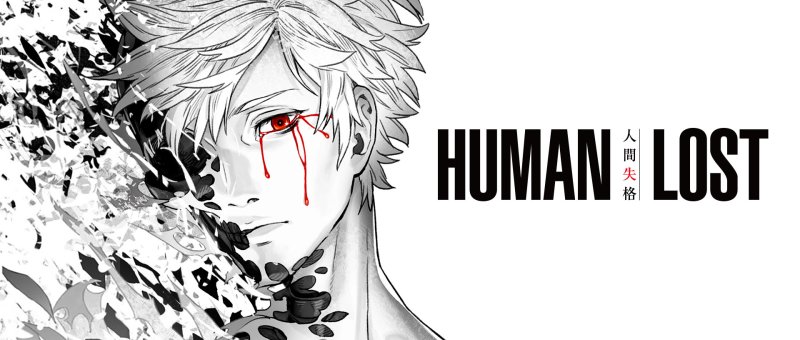
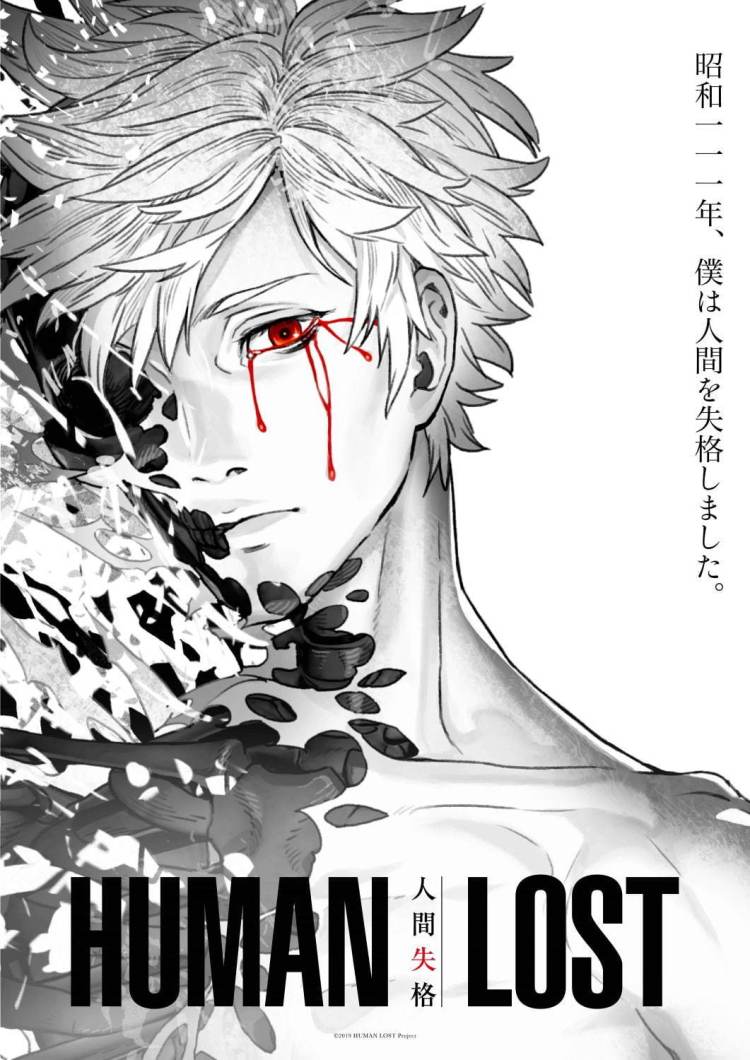
Human Lost (人間失格, Fuminori Kizaki, 2019)

Human lost animeOsamu Dazai’s 1948 masterpiece No Longer Human spins a tale of intense alienation in which a young man unable to connect with the world around him feels himself obliged to put on a mask of buffoonery. Years of trying and failing to fit in eventually take their toll. After meeting a man who turns out to be a bad influence in a painting class, he drifts into a life of dissipation and is committed to a mental institution. After his release, the hero reflects on the harm his actions have caused to others and declares that he is “no longer human”, electing to live a life of isolation rather than risk hurting anyone else.

Human Lost (人間失格, Ningen Shikkaku) is about as loose an adaptation as it’s possible to be, taking only the outlines of Dazai’s original and springing off from the midway point in which the protagonist, Yozo Oba (Mamoru Miyano), is living as a starving, drug addicted artist above a seedy bar. The year is Showa 111 (2036). A series of momentous advances have made natural death a thing of the past and thanks to the S.H.E.L.L. system suffering from disease has been eliminated. However, the future has not been equally distributed and while a cohort of increasingly elderly men and women rule the elite “Inside” as a kind of oligarchy, an oppressed underclass has formed on the outskirts of the city, their “immortal” bodies continually exploited in order to prop up the Inside economy but forever denied the full benefits of system they are prevented from accessing in its entirety.

Meanwhile, those who wilfully disconnect descend into a kind of monstrous barbarity becoming what is known as a “Lost”, a threat to “civilisation” which much be combatted by H.I.L.A.M. – a military organisation which exists to ensure the survival of the S.H.E.L.L. system. When Oba is dragged along by his childhood friend Takeichi (Jun Fukuyama) on a revolutionary raid instigated by the mysterious Masao (Takahiro Sakurai) targeting the Inside, he comes into contact with Yoshiko (Kana Hanazawa) – a young woman who deeply believes in the benefits and possibilities of the S.H.E.L.L. system, convinced that a utopian world in which its benefits are available to all will eventually come to pass.

What ensues is a battle between Yoshiko’s pure hearted idealism, Oba’s despair-fuelled cynicism, and Masao’s embittered nihilism in which he seeks to destroy the S.H.E.L.L. system and “reset” humanity to its original condition. Masao believes that humans need death in order to be human and that its absence from the modern world is an aberration which must be corrected at all costs. He encourages Oba and Takeichi to “take back” their “true form” as a revolutionary act designed to provoke the advent of a saviour who can help him destroy a system he himself created out of love but which later failed him. 

In an ageing society such as Japan’s, it’s impossible to ignore the subtext of a world in which the elderly cling on to power well beyond their right and relegate the young and healthy to a kind of underclass as a consequence. While some humans are “qualified” and afforded special rights, others are labeled as “unqualified” and exist in a kind of underworld locked out from the benefits of a modern society. As Masao points out, those who call themselves “happy” largely do so because of the S.H.E.L.L. system’s programming, while the only truly “free” are those like Oba and Takeichi who wilfully reject it and live a life of suffering.

Of course, Masao exploits them too. He brands Oba his Orpheus, but ironically forgets that the thing everyone knows about Orpheus is that his faith was weak and so he looked back and lost. Yoshiko sacrifices herself for Oba’s potential, further adding to Masao’s awkward metaphor as he declares that “the fate of this woman is to be used”, pushing Oba towards dragging her back from the hell they maybe creating together. Unlike Dazai’s original novel in which the hero is consumed by his sense of otherness and opts for self-exile, Human Lost finds a more positive solution in which Oba commits himself to fighting for Yoshiko’s better world where health and happiness are gifts given to all and not just a privileged few. A mild critique of a hierarchical, inherently unequal society Human Lost makes a passionate plea for idealistic utopianism over introverted despair while suggesting that technological advances set us free only when we share them freely.


Human Lost screens in select US cinemas on Oct. 22 (subtitled) and 23 (dubbed), and in Canada on Nov. 6 (subtitled) and 9 (dubbed) courtesy of Funimation. Check the official website to find out where it’s playing near you!

Original trailer (English subtitles)

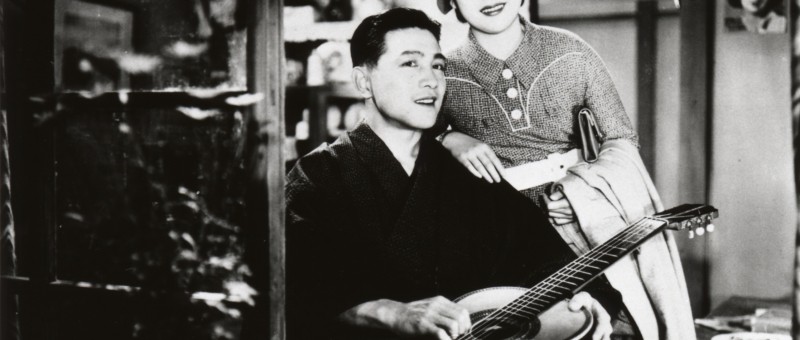
Wife! Be Like a Rose! (妻よ薔薇のやうに, Mikio Naruse, 1935)

Wife be like a rose posterIt’s tempting to view the cinema of the 1930s as a gloomy affair, facilitating the rise of militarism and increasingly at mercy of the censors, but the early sound era was nothing if not playful and generously open to international influences. It was also often surprisingly progressive, evidencing the fact that pre-war Japan was also changing or, at least, that there was an appetite for change especially among the young. Mikio Naruse’s delightfully charming (perhaps uncharacteristically so) comedy, Wife! Be Like a Rose! (妻よ薔薇のやうに, Tsuma yo bara no yo ni) dramatises just this change as its modern girl heroine tries to process the definitive end of her parents’ relationship as she prepares to marry.

Kimiko (Sachiko Chiba) has a job in an office which is more or less supporting herself and her mother seeing as her father, Shunsaku (Sadao Maruyama), left the family over 15 years previously and has been living with former geisha with whom he has two other children. Despite his long absence, Kimiko’s mother Etsuko (Toshiko Ito) has continued to pine for her absent husband and makes a little money on the side writing sad love poems for the newspapers. A request to stand as a go between at a wedding, traditionally a role only performed by married women, forces Etsuko to accept that she has been abandoned but the snag is that Kimiko and her boyfriend Seiji (Heihachiro Okawa) want to get married themselves and so his father wants to meet Kimiko’s dad which is obviously a problem.

Despite her “modern girl” appearance, Kimiko has some quite old fashioned ideas. She looks down on her maudlin mother, believing that she’s brought her apparent romantic heartbreak on herself through being a bad wife. Etsuko never seemed very interested in Shunsaku when he was around and never did any of the little wifely things Kimiko thinks a wife ought to do like vacuous chat and helping her husband change out of his work clothes. Kimiko thinks a good wife “acts childish and cajoling, or jealous sometimes, or motherly and protective”, believing that Etsuko knows this and has the ability to play the part of the ideal spouse but refuses to and therefore has only herself to blame. Kimiko’s uncle (Kamatari Fujiwara), however, corrects her. He piles the blame on the irresponsible Shunsaku who ran out on a wife and daughter to shack up with geisha.

Shunsaku, meanwhile, may be irresponsible in one sense, but perhaps it’s equally irresponsible to stay in an unhappy marriage. Now a gold prospector in the mountains, he is poor and unsuccessful but has built a happy family home with a kindly wife and two sweet children. Kimiko’s desire to drag him back to the city is partly practical in that she needs him to be her father so she can marry Seiji, but there’s also a part of her that thinks that her father’s transgression must be corrected by forcing him to resume his paternal role. Unlike Etsuko, however, Oyuki (Yuriko Hanabusa) is the classically “good” wife and Kimiko can’t deny she’s good for her father. Seeing him in the mountains and remembering him at home, Kimiko begins to realise that it would be wrong to take him away from his new family even if she thinks she has the better claim, especially when she finds out that it’s Oyuki who’s been sending her mother maintenance cheques every month for the past few years.

In fact, Oyuki feels so guilty about stealing Shunsaku away that she’s been putting money aside to pay for Kimiko’s wedding/education while keeping her own daughter home from school. Far from the gold digger Kimiko had assumed her to be, she’s been the one supporting the feckless Shunsaku as he pursues his get rich quick dream of gold prospecting. Realising that the pair of them “act in perfect harmony”, Kimiko comes to the conclusion that her father belongs in the mountains but finds her resolve wavering after returning to civilisation. She begins to wish he’d stay and hatches a plan to get her parents back together only to see how out of sync they are after 15 years apart. They swap pleasantries like strangers, and the mild-mannered Shunsaku visibly shrinks in the presence of the shrewish Etsuko who allows her pride to ruin any attempt at reconciliation.

What the modern girl Kimiko discovers is that sometimes things don’t work out like they’re supposed to, and that’s OK. Though it is in one sense a “happy” ending in that it obeys a justice born of human feeling, it’s also a melancholy moment of defeat both for the lovelorn Etsuko who has, as Kimiko says “lost”, and the now resigned Kimiko who harbours a degree of contempt towards her mother for not fighting harder for love. Standing at a crossroads of modernity, Kimiko looks both forward and back. She vows to be a “good wife” but her foundations have been shaken. Is this tragedy, or farce? She asks herself. It’s almost impossible to say.


Bu Su (BU・SU, Jun Ichikawa, 1987)

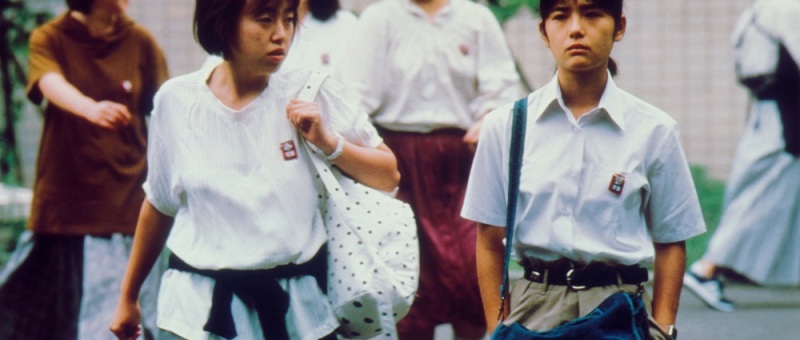
Busu poster 2Already a well respected and much in demand director of television commercials Jun Ichikawa released his debut feature, Bu Su (BU・SU), in 1987. “Bu Su” is, loosely translated, pejorative slang for a woman who is not considered to be attractive. The closest equivalent, in British English at least, would be something like “a dog”. It’s especially ironic then that the movie was conceived as a vehicle for a popular idol whose success was perhaps dependent on a perception of attractiveness, or at least of “kawaii” innocence. Yasuko Tomita was at that time at the height of her fame having shot to stardom through open audition leading to an award winning role in Aiko 16 Sai. Two years later she starred for Nobuhiko Obayashi, who was originally slated to direct Bu Su, in Miss Lonely, but even in comparison to Obayashi’s melancholy heroines, Bu Su’s Mugiko (Yasuko Tomita) is a particularly moody teen, the “ugliness” here apparently relating to her emotional isolation.

For reasons we never quite understand, Mugiko leaves her island home after a traumatic incident and moves in with her aunt in Tokyo with the intention of becoming a geisha. It seem’s Mugiko’s mother was once a famous geisha herself until she met Mugiko’s late father and left for a more conventional life in the peaceful countryside. Mugiko’s flight then has a peculiarly perverse quality in being both to and from her mother with whom she seems to be on bad terms despite her mother’s obvious affection for her. Unfortunately Mugiko is not a fantastic fit for the world of the geisha, being somewhat innocent and childishly clumsy, not to mention her ongoing grumpiness. Nevertheless, everyone at the geisha house is keen to help her if only out of loyalty to her mother.

At school, meanwhile, Mugiko is nervous and withdrawn, barely audible during her introduction to her new classmates and with her eyes permanently on the floor. Her teacher, taking her aside, adds to the mystery in remarking that she’s certainly been through a lot back in Izu and that she should leave all that behind and try to make a new start. Nevertheless, she remains sullen and isolated, barely speaking to anyone yet perhaps examining the dynamics of the people around her. Maybe that’s why she alone finds the strength to stand up to a popular kid bullying another girl (Yuriko Hirooka) considered to be “plain” with a mean trick teasing a nasty surprise lurking in a box which turns out to be nothing more than a hand mirror.

Mugiko might not be quite sure what it is that’s worrying her, or at least we can’t be sure because we don’t know exactly what happened in Izu, but the rest of her classmates have their own insecurities to deal with from Sakurako’s preoccupation with her perceived lack of looks to boxing enthusiast Tsuda (Masahiro Takashima) who knows he’s not much for studying but is less than convinced of the possibility of living off his fists. What they’re going through is the normal teenage process of figuring themselves out, which they begin to do through the time-honoured fashion of the school cultural festival which is an extra special event this year because it’s the school’s centenary. Goaded into it by the mean popular girl who meant to embarrass her by outing her as a geisha, Mugiko agrees to dance the dance of Yaoya Oshichi who was prepared to burn the world in the hope of meeting her love.

Yaoya Oshichi was burned at the stake for arson, and though Mugiko’s path eventually ends in flames they’re of a much less threatening variety. When she first arrives in Tokyo we see her taking in some of the iconic sights of the city, crossing at Shibuya Scramble and taking a stroll through upscale Ginza before taking a bite out of a fast food hamburger as if she were about to taste some famous local delicacy. When not training with the other geisha we see her wander through the city alone, sullen but also taking pleasure in exploring her new environment. It’s here that we hear the film’s title uttered, crudely, by a sleazy middle-aged man who picks Mugiko up and takes her to a coffeeshop where he embarks on weird chat up lines about the beauty of the local railway before trying to drag her into a love hotel. Luckily, Mugiko manages to get away from him only for the man to shout “busu” after her, implying that he didn’t want her anyway but also that her refusal is in someway arrogant.

By Ichikawa’s logic, Mugiko’s “busu”ness is not because she’s “ugly” but that she’s so sour faced, permanently sulky and angrily keeping a deliberate distance from everyone around her. We see her spikily refuse her mother’s tearful attempt to see her off to the train, and then speak rudely to her on the phone, while remaining aloof from most of the other geishas save her aunt’s daughter, primed to take over the business but unbeknownst to most longing for a more conventional life with a boring salaryman husband. Yet through all of these encounters, some friendlier than others, her heart finally begins to open and she’s no longer so closed off or aloof, eventually able to laugh along with her mother and pithily dismiss her questions with the generic answers that Tokyo is “fun” and yes she’s going to school. Mugiko’s path is certainly a meandering one, taking the scenic route through the charms of bubble era Tokyo, but it has its charms and even if she takes her time she gets there in the end, smiling at last having rediscovered the joys of being alive.


Short clip (Japanese subtitles only)

Dispersed Clouds (わかれ雲, Heinosuke Gosho, 1951)

Heinosuke Gosho made his name before the war as a master of “shomingeki” – often humorous but generally naturalistic portraits of lower middle class life. Becoming synonymous with a Chekhovian mix of laughter and tears later dubbed “Goshoism”, he continued into the post-war era as one of its most prominent humanists, less directly sentimental than Kinoshita but with no less faith in human goodness. Always ahead of the curve, he was among the first Japanese directors to break with the studio system, setting up his own production company (along with director Shiro Toyoda, cameraman Mitsuo Miura, and writers Jun Takami, Junji Kinoshita, and Sumie Tanaka), Studio Eight, after becoming embroiled in the industrial disputes which engulfed Toho in the late ‘40s. Gosho’s participation was apparently more out of a sense of loyalty to his mistreated colleagues than it was political conviction, but in any case he found himself unable to continue working in a system which prevented him from expressing himself to the fullest of his intentions.

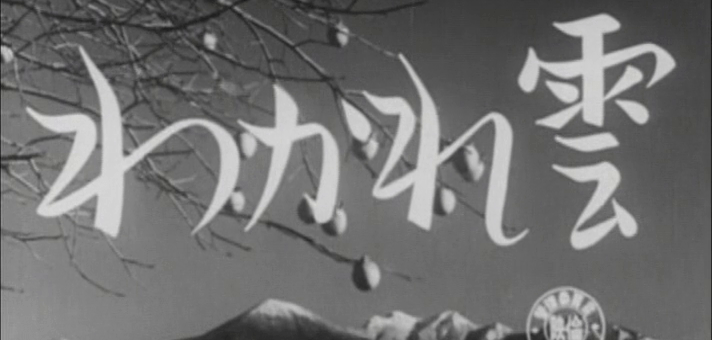
1951’s Dispersed Clouds (わかれ雲, Wakaregumo) was the first film released by Studio Eight, distributed by Shin Toho (the “new Toho” set-up by those same colleagues Gosho had supported in the ‘40s). In a sense it addresses similar themes to other post-war films making use of the familiar “cloud” metaphor, but these clouds are dispersing in more positive directions in that they are wilfully floating away from the traumatic past towards a brighter, more compassionate future, as perhaps was Gosho as he embarked on a new phase of his career.

The heroine, Masako (Keiko Sawamura), is a woman caught between old worlds and new. Very much of the post-war era, she is a university student who intends to work after graduation and values her independence but nevertheless is also looking back towards a childhood she feels she was denied, gradually coming to understand that it was she who denied herself in her resentful mistreatment of her young step-mother in mourning of the birthmother she lost at only six years old. The cloud from which she originally disperses is a group of five fellow students with whom she has gone on a walking holiday exploring rural Japan – an increasingly common pastime in the post-war era but one perhaps still a little unusual for five young women travelling alone. Accompanying her friend into a local photography shop in search of an extra roll of film for her camera, Masako receives the unwanted attentions of the storeowner and makes a speedy escape only to fall ill outside the station and cause the gang to miss their train. Irritated, Masako tells the others to go on without her while she stays in a nearby inn convalescing from what is apparently light pneumonia but also, it has to be admitted, an intense bad mood. 

Masako’s friends are keen to help her, but also exasperated. “You never accept the kindness of others” they lament to her passive aggressive desire not to bother them on their trip, while later plotting how best they can help her seeing as she wouldn’t accept their money if they tried to give to her so she’ll be able to pay for the doctor after they’ve left. They never really consider waiting for Masako to recover, resolving to continue on with their holiday, but do check in on her from time to time from the road with the offer to join them later seemingly open. Meanwhile, they’re all swooning over the improbably handsome country doctor, Minami (Yoichi Numata), who swoops in to treat Masako with a no-nonsense yet caring bedside manner.

Only six years older than Masako, Minami is a certain young man who has found his forward path in life. He has his own small practice which is woefully ill-equipped to cater for the entire town (he can’t admit Masako because he is already overflowing with patients sleeping on the floor), but dreams of building another clinic in an even smaller village further up the mountain where they don’t even have electricity. Despite her friends’ giggling, Masako is in too much of a mood to notice Minami much from her sick bed but later takes a liking to him though mostly in flight when her hated step-mother Tamae (Taeko Fukuda) finally arrives to take her back to Tokyo.

While at the inn, Masako bonds with the kindly maid, Osen (Hiroko Kawasaki), who brought her to there in the first place after noticing her in distress at the station. The innkeeper, who has a flighty modern daughter of her own, is not best pleased that Osen has brought sickness into the house and even less so that it’s a young woman whom she is not convinced is the right kind of clientele (her attitude changes when Tamae arrives laden with expensive gifts). Osen, who lost a husband in the war and daughter in infancy, takes to the young woman with maternal warmth – something which Masako has been seeking ever since losing her birth mother. A woman without a child and a child without a mother easily slip into a familial relationship, but rather than jealous Osen is only sad when she sees how much Tamae is trying and failing in the same role while Masako resolutely rejects her out of nothing more than childish resentment.

Masako, self aware to a point, describes herself as “spoiled, nervous, and selfish” and seems to want to change without knowing how. She tells Minami that she dislikes people in general because they’re all liars and can’t be trusted. Nevertheless, she finds herself hanging around Minami’s clinic in order to avoid Tamae and half convinces herself she is in love with him. An ill-advised five mile hike to the next village to find the earnest young doctor provokes an awkward encounter between the two in which it becomes perfectly obvious that Minami is devoted to his practice, sees Masako only as a patient, and is not really interested in her newfound desire to pursue a deeper union. He tells her, politely, that she is too much trouble and would only be an inconvenience. He doubts that she, a middle-class woman from Tokyo, will be able to adjust to the privations of life in the mountains and is perhaps unconvinced that she has acquired the sufficient maturity to try after just one night of having fun “helping people”.

Masako is not wounded by his words but is enlightened by them on discovering that Minami has lost people too – his brother and friends in the war, but where her childhood loss has made her self-involved and resentful, his grief has made him generous and openhearted. Minami has dedicated himself to the wellbeing of all mankind, which might or might not mean that he has little time for deeper individualised connections, but in any case though she doesn’t realise it herself what Masako is seeking isn’t Minami or a romance but a path back into the world as someone less closed off and unforgiving. Thanks to Osen’s warmth and Minami’s generosity she is able to escape her sense of self-imposed inertia and let her mother go.

Because of this she gives to Osen the precious silver spoon she had treasured as a keepsake from her mother, remarking that she doesn’t need it anymore, while Osen then gives her the rather ironic gift of a spoon case she’d knitted as a present. Though the ending is positive with Masako preparing to leave the transitory space of the mountain town to return to Tokyo “healed”, it is also filled with a quiet anxiety for the older Osen who has, in a sense, been bereaved twice in losing another daughter and being left all alone, knowing that Minami will soon be off to his own bright future. Osen made her new start some time ago after reaching the forward-thinking conclusion that she wasn’t happy with the idea that women must have soft hands. She declares herself happy in a calm sort of way, but is also filled with regrets from the past in having chosen to marry the man chosen for her over the one she loved and finding only unhappiness. Her counselling of Masako not to make the same mistake is perhaps one of the things that sends her, mistakenly, off towards Minami, but unlike the younger woman Osen seems primed to remain in the liminal space of the mountain town unable to leave the past behind in order to move forward in a more positive direction. 

“This world is not so easy” Masako is repeatedly told, but in true Gosho style, it needn’t be so hard if only you learn to live generously with a forgiving heart. The rather mercenary relationship between the innkeeper and her flighty but shrewd daughter is directly contrasted with the innocent yet melancholy one between Osen and Masako, but perhaps neither is really more positive than the other only different. In any case, Osen and Masako, like any parent and child, must eventually part. Masako boards the train into the future smiling brightly, a cloud dispersing from the whole, unburdened by the traumatic past and floating defiantly forward on a path of her own choosing resolved to live for others rather than fixating on her personal pain.


First Love (初恋, Takashi Miike, 2019)

First love poster 1Taking a deep dive into Showa era nostalgia repurposed for the modern era, Takashi Miike returns to the world of jitsuroku excess with an ironic tale of honour and humanity. Quite literally all about the jingi, First Love (初恋. Hatsukoi) takes a pair of exiled loners betrayed by the older generation, and allows them to escape their sense of futility through simple human connection while the nihilistic gangster underworld slowly implodes all around them.

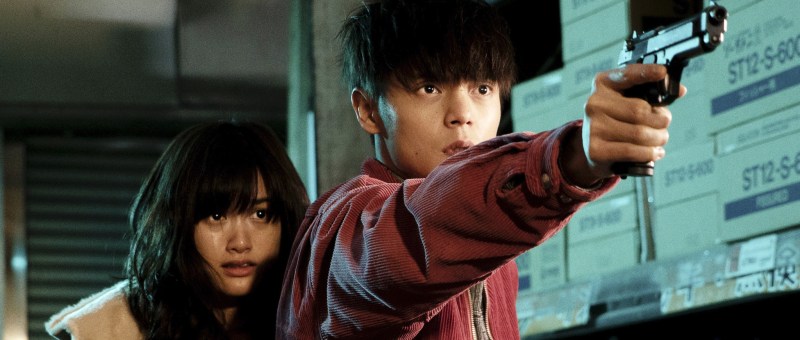
Sullen boxer Leo (Masataka Kubota) is so filled with ennui that nothing really excites him, not even success in the ring. An unexpected KO, however, sends him off to the doctor’s where he is told that he has a possibly inoperable brain tumour and very little time left to live. That is perhaps why he decides to punch a policeman in defence of a young woman running away and desperately pleading for help. Yuri (Sakurako Konishi), known as “Monica” to her captors, was sold to the yakuza by her father and has since become dependent on drugs. Little known to either Leo or Yuri, they are about to become embroiled in a long brewing turf war between the local yakuza and the Chinese Triads engineered by jaded underling Kase (Shota Sometani) who has enlisted rogue policeman Ohtomo (Nao Omori) to help in a plan to steal his gang’s drug supply and have Ohtomo sell it on in the same way he does with “confiscated” narcotics while blaming the whole thing on the Chinese.

Abandoned at birth, Leo is a man who doesn’t know his history and so doesn’t know himself. He tells a reporter that there is no particular reason that he boxes save that he doesn’t know how to do anything else, yet the fighter’s all that remains and “boxer” has become his entire identity. A passing fortune teller advises him that he loses because he only fights for himself and if he truly wants to win he needs to learn to fight for someone else, but Leo is used to being alone and believes he has no need of other people. Knowing he’s going to die means, paradoxically, that he has infinite potential because he has nothing left to lose.

Leo punching out the policeman reawakens in Yuri a memory of her “first love”, a high school classmate who tried to defend her against her abusive father whose ghost still haunts her in drug-fuelled hallucinations. The ultimate proof of the yakuza’s ironic lack of “jingi” or “honour and humanity” when it comes to the treatment of women, Yuri was betrayed first by her father and then by the petty street thug who got her hooked on drugs as a means of control and exploited her body for financial gain.

Ironically enough, it’s a Chinese Triad who proves the ultimate heir to “jingi” having come to Japan because of her love for classic Toei gangster hero Ken Takakura only to discover that kind of nobility is something you only see in the movies. While the yakuza lament that they’re at a disadvantage fighting the Chinese because they don’t need to worry about “honour” as dictated by their code, they are quick enough to scream vengeance when Kase convinces them that it was the Triads who offed their street fixer (Takahiro Miura) to get back at recently released gangster Gondo (Seiyo Uchino) who is the reason that the Triad boss is nicknamed One-Armed-Wang. Gondo and Wang are already on a collision course as representatives of their respective ideologies with Gondo perhaps the last true yakuza standing, faithful to his code to the end.

Sensing his strong sense of jingi, the romantic Triad allows Leo to escape with Yuri as if recognising that neither of them belong in this nihilistic world of pointless and internecine violence. Despite proclaiming that he had no need of other people, it’s Leo’s humanity that eventually saves him as he realises that he was always going to die and rediscovers his true strength through fighting to protect someone else. Yuri, meanwhile, finds the will to live again in making peace with the past and laying old ghosts to rest thanks to Leo’s altruistic decision to protect her. Echoing Fukasaku’s classic crime cycle in its severed heads and funky ‘70s jazz score remixing the iconic theme tune, Miike ups the ante with a series of outlandishly idiosyncratic gags as Kase’s nefarious scheme snowballs into a darkly humorous crescendo of ridiculous brutality, but ultimately rejects the futility of a world without jingi in allowing his pure hearted heroes the possibility of escape, saved rather than consumed by their sense of honour and humanity.


First Love was screened as part of the 2019 BFI London Film Festival.

Original trailer (English subtitles)

37 Seconds (Hikari, 2019)

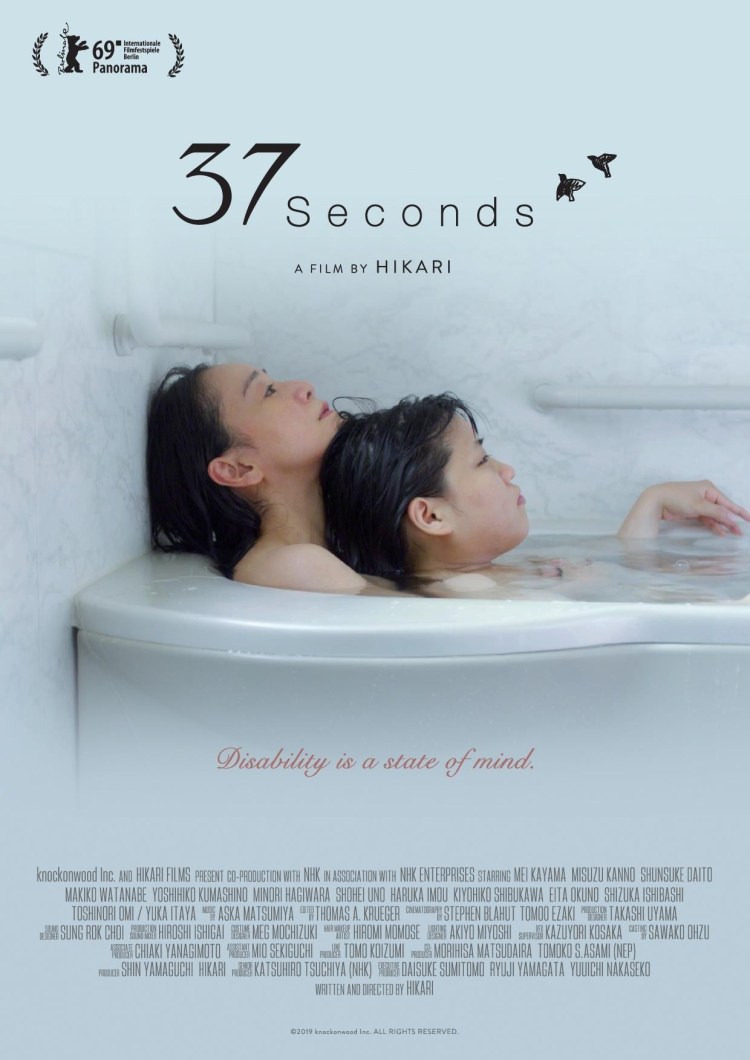
37 Seconds poster“We’re just like everybody else” the heroine of Hikari’s debut feature 37 Seconds replies in bemusement when a prospective date confesses he never thought he’d feel comfortable with “someone like” her. Quietly meditating on societal prejudice against disability, 37 Seconds takes its heroine on a journey of self discovery as a series of disappointments pushes her towards embracing a new side of herself as an individual in defiance of those who might feel they know what is best, or perhaps just most “appropriate”, for “someone like” her without bothering to consider how she might feel.

Softly spoken, 23-year-old Yuma (Mei Kayama) has cerebral palsy and uses a motorised wheelchair to get around. Although she has a degree of independence with a job as an assistant to a manga artist, her friend Sayaka now a giant YouTube star, to which she travels alone by train, Yuma otherwise has little life outside the home she shares with her increasingly overprotective mother Kyoko (Misuzu Kanno). Yuma’s dreams of becoming a manga artist in her own right are dealt a blow when she’s told that her style is too close to Sayaka’s, only Sayaka’s style is Yuma’s because Yuma is doing all the work while her friend steals the credit and gleefully gives interviews claiming she is 100% indie and has no assistants. Beginning to realise she’s being exploited, Yuma gets an idea when she spots some erotic manga abandoned in the park and starts ringing up magazines for work. One bites and likes her stuff but worries that her sex scenes lack authenticity because of her lack of experience. 

Though previously unbothered, Yuma decides to embrace her sexuality in the name of art but finds a series of obstacles in her way, not least among them her mother who continues to infantilise her claiming that she is too vulnerable to be allowed out alone because there are too many strange people in the world. Kyoko won’t let Yuma wear pretty dresses, or makeup, or go out in the same way other girls her age might, refusing to accept that her little girl has grown up and has the same desires as any other young woman including that to be independent. Unable to escape her mother’s control, Yuma begins lying to her to meet prospective dates but finds them all unsuitable until finally trying to hire a sex worker only for that to go horribly wrong too. It does however introduce her to the people who will change her life – empathetic sex worker Mai (Makiko Watanabe), and her assistant Toshiya (Shunsuke Daito), whom she meets in a love hotel corridor while waiting for a broken lift.

When Yuma first meets Mai, she’s in the company of another man with cerebral palsy using a wheelchair, Kuma – played by Yoshihiko Kumashiro, a real life activist raising awareness about sexuality in the disabled community whose life inspired Junpei Matsumoto’s 2017 feature Perfect Revolution. Seeing the warm and genuine relationship between Mai and Kuma gives Yuma a new hope that a different kind of life is possible, especially as Mai offers to take her under her wing. Having an older woman to confide in about things she could never discuss with her mother allows Yuma to explore her newfound desires with confidence knowing that there are people looking out for her and always ready to offer advice.

Not everyone, however, is quite so enlightened and Yuma’s problems are largely to do with the persistent social stigma she faces from the world around her as well as a resultant sense of internalised inferiority. Sayaka, her “friend”, views her as a kind of cash cow, taking advantage of her skills but denying her existence while Sayaka’s agent swings in the other direction by telling her she should go public because she’d get a lot of press once people know she employs a disabled woman as an assistant. The first place Yuma gets any kind of respect is the office of the erotic manga magazine where the boss treats her like any other prospective hire and offers her constructive advice. From the awful dates and bad faith friends to her mother’s well-meaning yet problematic attempts to trap her in childhood, Yuma struggles to find a sense of self-worth when everyone is telling her that her life is limited and she must conform to their stereotypical ideas of how “someone like” her should live.

Thanks to Mai and Toshiya, Yuma eventually gains the confidence to assert herself, but also the ability to accept that her mother’s actions, however misguided, came from a place of love tempered by regret and sadness she was unable to understand without engaging with her mother’s history. A beautifully empathetic exploration of a young woman’s gradual blossoming under the light of genuine connection, 37 Seconds is a unsubtle rebuke of a fiercely conformist society unwilling to accommodate difference but also a quiet hymn to defiance as its heroine learns to shake off the labels placed on her and claim her independence no matter what anyone else might have to say about it.


37 Seconds was screened as part of the 2019 BFI London Film Festival.

Festival trailer (English subtitles)

To the Ends of the Earth (旅のおわり、世界のはじまり, Kiyoshi Kurosawa, 2019)

To the Ends of the Earth poster 2“It’s like a little journey you can take without going too far from home” a bubbly variety TV presenter announces partway through To the Ends of the Earth (旅のおわり、世界のはじまり, Tabi no Owari Sekai no Hajimari), reporting from a rundown theme park the like of which she claims you hardly ever see in Japan anymore. It might as well encapsulate her life as the host of a TV travel programme directly aimed at people who prefer to take their pleasures vicariously. Kiyoshi Kurosawa’s long career has been, in an odd sense, moving into the light. Where death was once eternal loneliness, he now tells us love is what will save us in the end, if only we overcome our fear of each other.

Yoko (Atsuko Maeda), a 20-something TV “reporter” for a variety show, is an intensely anxious young woman. In her postcards home to her firefighter boyfriend, she tells him that she feels “safe” now that they’ve arrived in a big, modern city, but, somewhat ironically, asks him to try and stay away from dangerous places. Currently shooting in Uzbekistan, she finds herself doubly isolated – both because she is a lone woman travelling with an all male crew, and because she is the star and therefore not included as a part of their team. Though they call her a “reporter”, it’s clear that the temperamental, insensitive director Yoshioka (Shota Sometani) does not value her editorial opinion and sees Yoko more or less as a kind of prop.

When we first meet her, Yoko is being forced to deliver a direct to camera speech from the middle of a “fake lake” which, as she explains, is more like a big puddle created by accident during a Soviet-era irrigation project that didn’t quite go to plan. During the course of the filming, we watch her effortlessly switch between the super “kawaii’ presenter who has to pretend the undercooked food she’s just been handed (that will probably make her ill) is the best meal she’s ever tasted, and the dejected young woman growing ever more resentful about her corrupted authenticity. Nervous and under-confident, she finds herself bullied by the demanding director, feeling as if she’s obliged to put up with whatever he asks her to do even if it compromises her safety.

Later, at the theme park, the owner of the ride Yoko is supposed to “enjoy” expresses concern, firstly claiming that it’s not suitable for women, and then apparently mistaking Yoko for a child. He doesn’t clarify if there’s actually a safety issue, that the ride is calibrated for a certain size and weight and might be dangerous for a slight woman as opposed to a beefy man, but in any case Yoko is made to ride it three times in quick succession. Akin to something they put astronauts and fighter pilots in to prepare them for coping with G-force fluctuation, it is not particularly fun but still Yoko is obliged to giggle like a giddy school girl every time before finally collapsing as if she’s about to go into nervous shock. A few moments later, however, she stands in front of the camera to give another cheerful speech about just how much fun she’s having.

Yet we also see her attempt to fight back against her sense of anxious powerlessness by actively asserting her independence. She leaves her hotel and takes a bus, a complicated affair when she doesn’t speak the language or understand where she’s going, visiting a local bazaar where she attracts not a little attention, some of the saleswomen even attempting to physically grab her in order to sell their wares. She feels the male gaze constantly upon her and though you’ll rarely find a woman who says that skirting round groups of men in darkened alleyways doesn’t make her nervous, there is something about the unfamiliarity of the environment which has Yoko on edge. Men peek in through the windows of the van where she changes costumes to make it look like they were in Uzbekistan longer than they were, and like the ride owner, a fisherman they’d enlisted to help them catch a giant fish grows progressively more irritated, claiming that the fish aren’t coming because they don’t like a woman’s smell.

Exploring the town, Yoko’s mind quietens only when she begins to hear music pouring out of a local opera house. She wanders inside and sits down, envisioning herself on stage performing Ai no Sanka, a Japanese rendering of Edith Piaf’s Hymne à l’amour, but her reverie is cruelly interrupted by a security guard who sends her anxiously reeling away. Another encounter with authority provokes a similar reaction when she’s stopped for filming in a prohibited area but instead of calmly presenting the camera, she panics and runs away. As a sympathetic detective later tells her, if you run from the police they have to chase you, it’s the law. The detective is a little offended. Why was she so afraid of Uzbek policemen? Did they seem excessively mean, what does she know about Uzbeks anyway? If only she’d tried to listen to what they were saying, all of this could have been avoided.

The detective, echoed through sympathetic translator Temur (Adiz Rajabov), avows that if we don’t talk then we’ll never understand each other. Temur became a translator after hearing about the Japanese prisoners of war who built the theatre in which Yoko heard the music, painstakingly crafting rooms dedicated to six areas of a country which had been their enemy. Moved by their generosity, he learned Japanese to give something back. Identifying herself with a captive goat she longed to free from constraint and isolation, Yoko gains confidence from his words. She confesses that she’s preparing to follow her dream of becoming a singer, but worries that she lacks the emotional authenticity required to make the song resonate. Through her cross-cultural adventure, brush with the law, and a personal crisis back home, Yoko begins to realise that the world isn’t such a scary place after all. Yoko sings the song of love, less for the uncommunicative boyfriend she unconvincingly claimed it was her hope to marry, than for herself and for the world, now as open as her heart in the limitless vistas of the Uzbek mountains.


To the Ends of the Earth was screened as part of the 2019 BFI London Film Festival.

Original trailer (English subtitles)

Ai no Sanka as performed by Hibari Misora

Tochuken Kumoemon (桃中軒雲右衛門, Mikio Naruse, 1936)

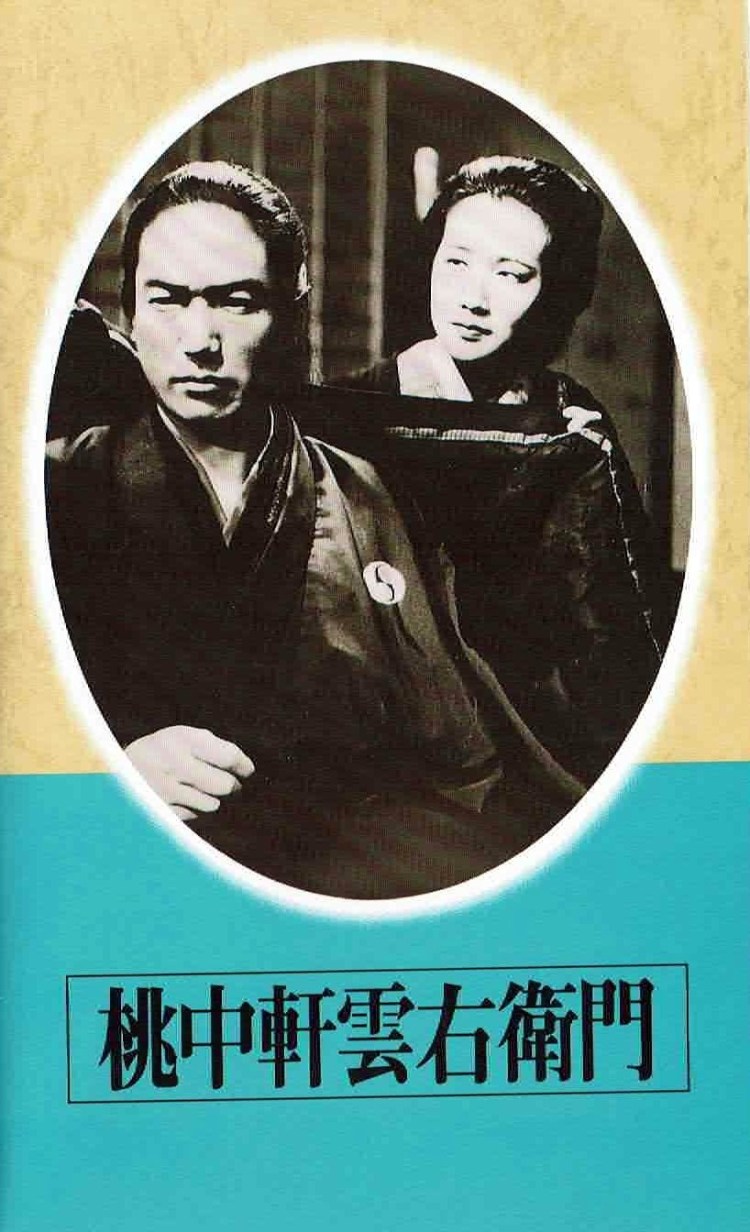
Tochuzen KazoemonIt’s an age old question, but does being a great artist give you the right to treat other people terribly? Hopefully, most people would say no, it does not. Most “great artists”, however, may have a different opinion. The hero of Mikio Naruse’s 1936 biopic Tochuken Kumoemon (桃中軒雲右衛門, AKA Man of the House) is very much of the opinion that inflicting suffering on others, and thereby vicariously suffering himself (but not really because who cares about them), is the source of all his supposedly “great art”.

Tochuken Kumoemon was in fact a real person who died twenty years before the film’s release and had his heyday as a renowned yet scandal ridden performer of “rokyoku” in late Meiji. To brings things full circle and explain why perhaps his life was fit for cinematic exploration in the politically fraught atmosphere of 1936, it’s helpful to remember that Tochuken Kumoemon’s performances of such patriotic fare as the 47 Ronin helped to rouse nationalist sentiment during the Russo-Japanese conflict. “Rokyoku”, also known as “naniwabushi”, is a traditional art of narrative singing accompanied by shamisen which found favour with the militarists for its essential Japaneseness and hearty rustic vulgarity.

In any case, we meet Tochuken Kumoemon (Ryunosuke Tsukigata) on a train drawing closer to his planned return to Tokyo after having been forced to flee it eight years previously because of a sex scandal which led him to separate from his first wife, leaving a son, Sentaro (Kaoru Ito), behind, and marry Otsuma (Chikako Hosokawa) – his shamisen player with whom he is currently travelling. The troupe are supposed to be breaking their journey at Kozu, but for reasons unexplained, Tochuken Kumoemon decides to get off the train at Shizuoka and promptly disappears without a word to anyone. 

The disappearance is problematic on several levels, the first being that the stop was only engineered to allow Tochuken Kumoemon to visit his estranged son Sentaro. Some in the group posit that Tochuken Kumoemon has come down with a rare case of stage fright seeing as this Tokyo show will be his biggest to date, while others assume he is embarrassed to go back to the city because of the scandals which previously engulfed him there, and some believe he is simply conflicted about visiting the son he abandoned to run off with another woman.

Anyone who knows him, however, might be better placed to realise that the great Tochuken Kumoemon rarely has a reason for doing anything save that it pleased him to do so at the time. Nevertheless, what we discover about him as he tours the inns of Kozu throwing his money about like some crazed libertine, is that he apparently liked his life better when he was poor but is bravely suffering under the burdens of wealth “for his art”. In fact everything in Tochuken Kumoemon’s life is “for his art”, including the thoughts and feelings of those closest to him.

Tochuken Kumoemon’s story may be intended as a kind of militarist parable about a man who devoted everything of himself to a particular ideal, in his case art but for the militarists perhaps country. The major problem here is that Tochuken Kumoemon never particularly suffers himself, grinning broadly throughout, but forces others to suffer on his behalf while he extracts from them qualities he can use to enhance his performance. Pain may be good for art, but it’s rarely good for life, and most would find themselves questioning why it is those around him remain contented to suffer solely to facilitate Tochuken Kumoemon’s artistic fulfilment.

Loyal wife Otsuma begins to reconsider, bravely challenging Tochuken Kumoemon on the inauthenticity of his performances which, though growing in popularity, she feels to be increasingly hollow. She remembers the early days of their courtship which were apparently marked by a fierce competitive rivalry which proved artistically beneficial to them both before spilling over into other kinds of offstage passion which now appears to have cooled. Otsuma, now weakened as she finds herself succumbing to the later stages of consumption, something Tochuken Kumoemon refuses to acknowledge, fears that she is now unable to inspire him with her playing which is why he’s been up to his old tricks consorting with geishas. Claiming that Otsuma wouldn’t care about his affairs because she’s an artist too and will therefore “understand”, Tochuken Kumoemon has taken up with a pretty little thing, Chidori (Sachiko Chiba), from whom he intends to steal “youth and innocence” for his performances, little caring what he might leave behind.

For Tochuken Kumoemon everything is simply fuel for art and so he’s excused himself from the need to treat others with respect or kindness. Sentaro, his rejected son, rejects this aspect of his father’s philosophy, immediately bonding with his kindly step-mother and resenting his absent father’s treatment of her. In “raising” his son, Tochuken Kumoemon bangs on about traditionally “militarist” values of manliness, explaining that he is imperfect because he is a “great artist” and that his life has been full of problems but that he has overcome them with strength and perseverance. He tells his son that “weakness is the worst thing in a man”, but appears primed to hit the roof on learning that Sentaro may be expelled from school for fighting with his schoolmates because they mocked his unconventional family setup. Worst of all he casts his son away as one of the many who unfairly demand “perfection” from him even though he is an artist and cannot be expected to abide by the rules of “normal people”.

Meanwhile, Otsuma lies dying in a hospital. Tochuken Kumoemon won’t see her because he refuses to view her as “just a woman”, preferring to remember her as “a woman who lived only for art”. The subtext being for “his” art, rather than her own. He betrays himself when he admits that he “doesn’t want to be any more sad” than he is now, simply refusing to deal with the unpleasantness and personal suffering of facing the fact that someone important to you is in pain and will soon be gone. Yet despite a brief rebellion after an ill-advised gift from Chidori, Otsuma eventually agrees to sacrifice herself for Tochuken Kumoemon’s art, to die “quietly” as an artist and not as a woman. 

It’s only at this point that Tochuken Kumoemon decides to embrace the romance of the moment, finally travelling to her deathbed in order to sing a song. If Tochuken Kumoemon is a militarist hero, he’s not a particularly sympathetic one. He remains monstrously self-involved, hypocritical, an emotional coward who uses the suffering of others for his own ends with only the justification of the primacy of his art. Naruse undercuts the propaganda potential of the piece by painting his patriotic singer as a ridiculous prig who embodies the militarists’ coldness towards the thoughts and feelings of their fellow humans but displays none of their supposedly romantic heroism in his empty swagger and well worn platitudes. Is naniwabushi really worth all this pain? No. Someone needs to tell Tochuken Kumoemon he’s not as important as he thinks he is. And while they’re at it, they could have a word with the militarists, too.


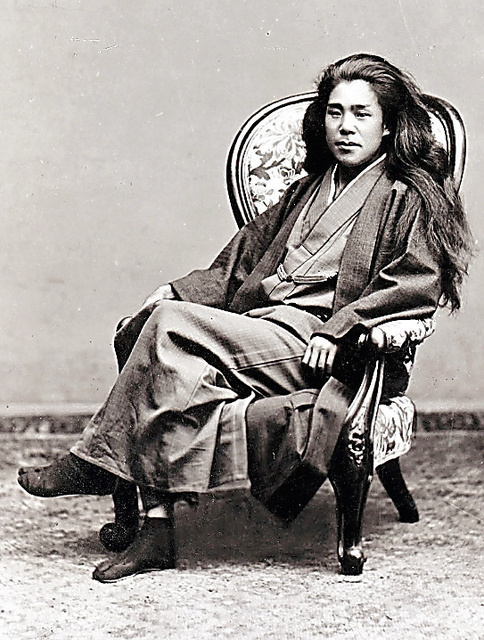
The real Tochuken Kumoemon

Real TOCHUKEN KUMOEMON

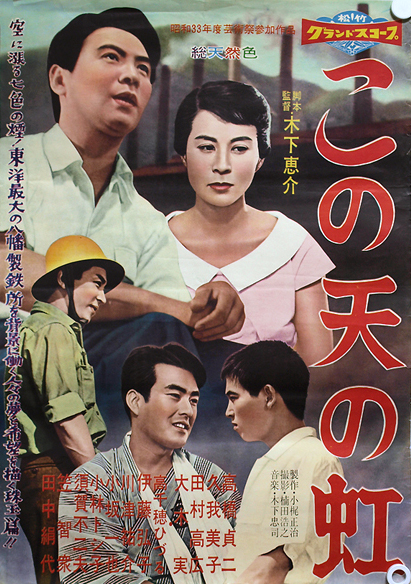
The Eternal Rainbow (この天の虹, Keisuke Kinoshita, 1958)

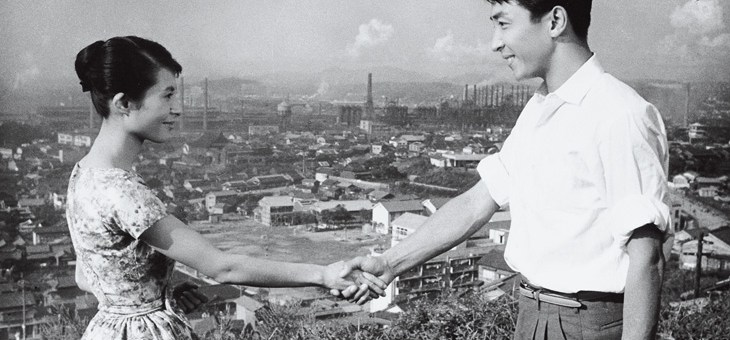
Eternal rainbow poster 1Famously, towards the end of the war, Keisuke Kinoshita got himself into trouble with a dialogue free scene of a mother’s distress as she sent away the son she’d so carefully raised “for the emperor” towards an uncertain future in the midst of hundred of other, identically dressed faceless boys. Army might have showcased the director’s propensity for resistance, but one could also argue that there was just as much propagandistic intent in the post-war films as their had been in the militarist era even if the messages they were selling were often more palatable. 1958’s The Eternal Rainbow (この天の虹, Kono Ten no Niji) is a case in point. A portrait so positive one wonders if it was sponsored by Yahata Steel, The Eternal Rainbow is nevertheless conflicted in its presentation of defeated post-war hope, exploitation, and growing social inequality even as it praises its factory city as a utopian vision of happy industry and fierce potential.

A lengthy opening sequence featuring voice over narration recounts the history of the Yahata Steel Works which began operations in 1901 in Northern Kyushu and now employs thousands of people, many of whom live nearby in the ever expanding company dorms the newer models of which feature bright and colourful modern designs in contrast to the depressing grey prefab of the traditional workers’ homes. Gradually we are introduced to our heroes – chief among them Mr. Suda (Yusuke Kawazu), a young man from the country who saw a factory job as his over the rainbow but is rapidly becoming disillusioned with its dubious gains. Rather than the company dorms, Suda rooms with the foreman, Kageyama (Chishu Ryu), and his wife Fumi (Kinuyo Tanaka) whose young son Minoru (Kazuya Kosaka) didn’t qualify for a factory job on account of his small frame and his been unable to stick at anything in the precarious post-war economy. Meanwhile, Suda has made friends with an older worker, Sagara (Teiji Takahashi), who has fallen for a secretary, Chie (Yoshiko Kuga), but her family are dead against her marrying a factory worker while she is also in a relationship with a college educated engineer, Machimura (Takahiro Tamura), but is beginning to doubt the seriousness of his intentions.

The drama begins when Sagara employs Kageyama to act as a go-between in a formal proposal of marriage to Chie’s parents, the Obitas. Kageyama didn’t really want to be a go-between because it’s gone badly for him before and he thinks this one is a non-starter too – women around here have their sights set on office workers, no one in the arranged marriage market is looking to marry someone on the shop floor. The Obitas feel much the same. Mrs. Obita is keen for Chie to marry up and is somewhat offended by the proposal, granting it only the customary consideration time to not seem rude in turning it down flat. Sagara is stoic about the matter, but the abruptness of the rejection greatly offends Suda who cannot stand for the Obitas snobbish put down of working people.

Herein lies the central conflict. Suda was a country boy who’d been sold an impossible dream. He believed that a job in the factory, for which he had to sit an exam and has been chosen out of thousands of other hopefuls, was his ticket out of rural poverty. Now that he’s working there he realises he is little more than a wage slave, working long hours for almost nothing with the only goal of his life being to earn enough to feed a family with a little (very little) left over for his old age. Minoru, the Kageyamas’ son, feels much the same and has already turned cynical and desperate. He can’t abide his father’s work ethic and wants more out of life than there perhaps is for it to give him. Suda repeatedly asks how people can learn to be happy in this sort of life, wondering if those that claim to be have simply given up their hopes and aspirations in resignation. When Minoru decides not to go to Tokyo it ought to be a victory, but then perhaps it is more that he has simply accepted that there is no hope there either.

Nevertheless, the depiction of Yahata as a place to work is ridiculously positive even as Kinoshita undercuts it with the disillusionment of both Suda and Sagara. A factory city, Yahata is characterised as a cornerstone of the burgeoning post-war economy, literally making the rails on which the new Japan will run. The works provides affordable accommodation for families, guaranteed employment, insurance, a “self service” supermarket right on site, social clubs, cultural activities, and festivals. They even get a large scale show from Tokyo every year.

Even so, an immense and seemingly unbridgeable gap exists between the steelworkers and the company men. Mrs. Obita might seem self serving and mercenary, but she’s had a hard life and perhaps it’s only natural that wants better for her daughter. Suda is angry to think a good man like Sagara who might be a bit old fashioned and unsophisticated but has taken the trouble to do things the “proper” way would be dismissed out of hand simply out of snobbery. His attitude is, however, somewhat problematic in that he begins bothering Chie to find out her reasons for declining the proposal, refusing to recognise that she doesn’t need to offer any reason besides her own will. Chie, meanwhile, is conflicted. A proposal of marriage from a man she doesn’t even really know is not something she was minded to consider in any case, but her feelings for Machimura are tested once she becomes aware that he is not quite in earnest and may have been messing around with his landlady while enjoying the attention he receives as an eligible bachelor around town.

Machimura, like Suda, Sagara, and Minoru, is somewhat listless and apathetic even if for the opposite reason in that his life is far too easy and he hasn’t had to make a lot of concrete decisions about his future. Chie doesn’t deny that his college education and urban sophistication are part of the reason she was attracted to him, but as she later tries to explain to Suda, she wasn’t simply angling to marry up – she just fell in love with someone who happened to be of a higher social class which isn’t the same as looking down on working people. She has a right to her feelings whatever political label an increasingly resentful Suda might like to put on them. Even so, if she had been trying to marry up who could really blame her for that? In a society in which women are still entirely dependent on a man, being largely prevented from pursuing a career in their own right, a marriage is effectively a job for life. Shouldn’t she pick the offer with the best benefits, just as Suda did when he chose to leave the country for a factory job?

Progressive factories are often presented as an ideal solution the problem of post-war poverty, but here Kinoshita does not seem so sure. Despite the emphatic tone of the infrequent voice over and the central messages that factory jobs are good jobs and looking down on manual work nothing more than snobbery, Suda and Sagara remain conflicted. This work is dangerous, pays little, and offers nothing more than false promise. If the vast cities like Yahata are the engines repowering the economic growth of a still straitened Japan, what will be the end result? Metropolis made flesh, the “eternal rainbow” is exposed as a self serving lie but what, Suda might ask, else is there for men like him in a society like this?


Original trailer (no subtitles)