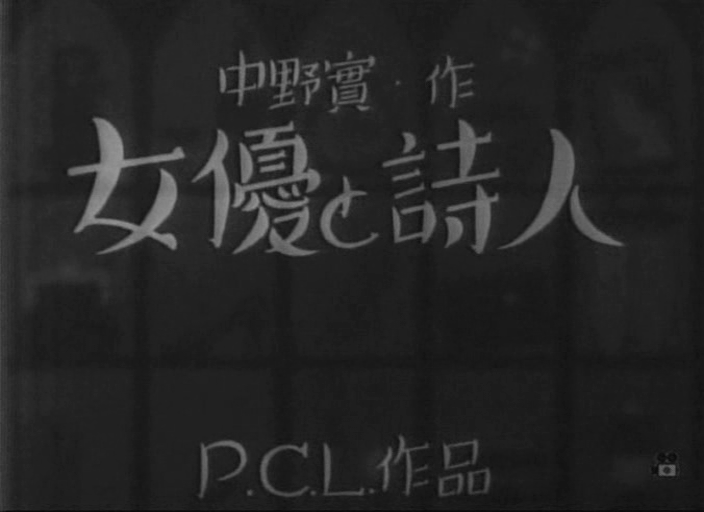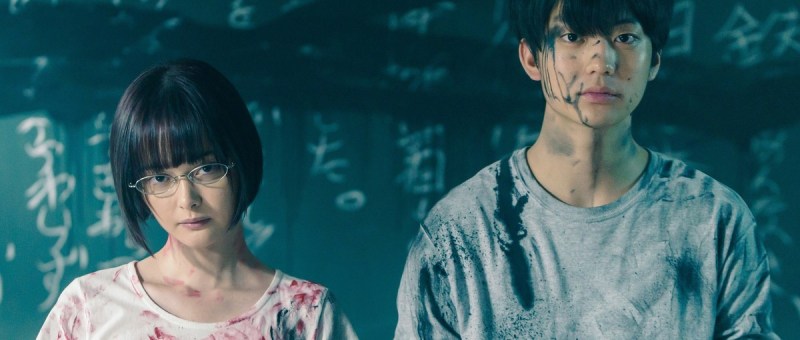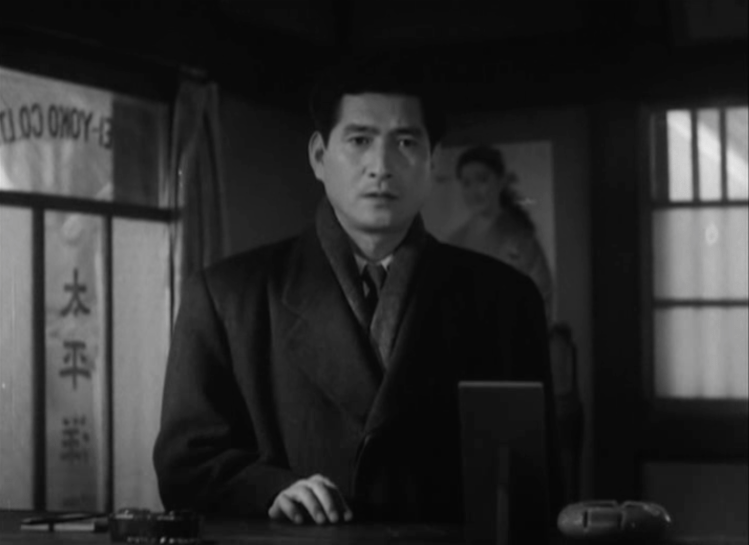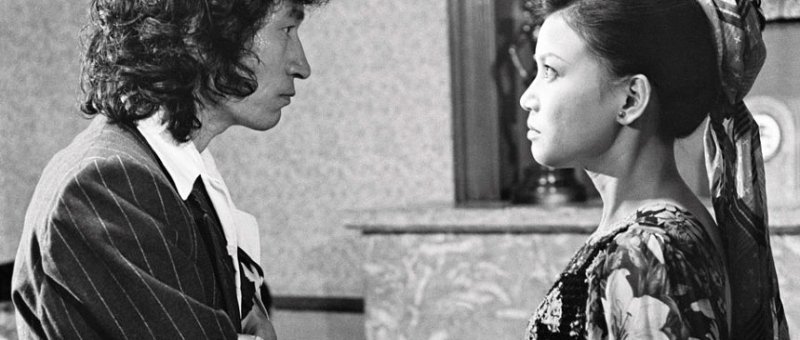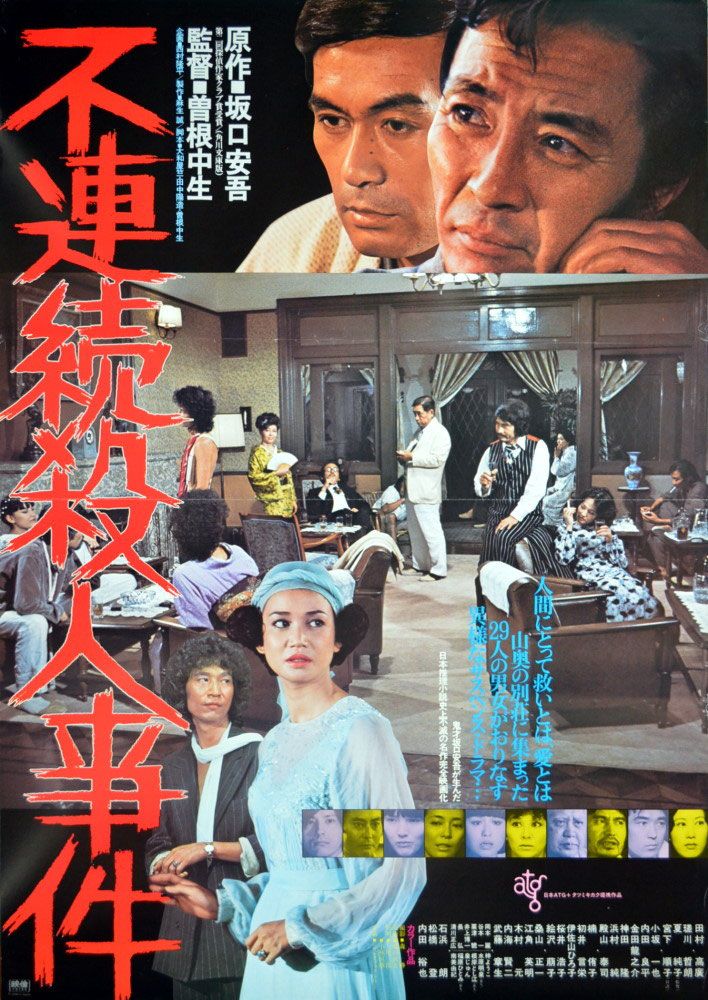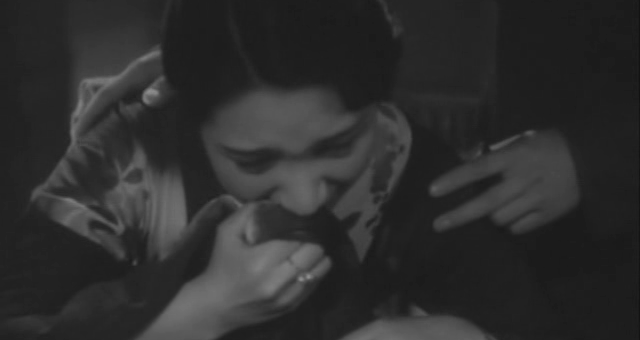
Tochuken Kumoemon (桃中軒雲右衛門, Mikio Naruse, 1936)

Tochuzen KazoemonIt’s an age old question, but does being a great artist give you the right to treat other people terribly? Hopefully, most people would say no, it does not. Most “great artists”, however, may have a different opinion. The hero of Mikio Naruse’s 1936 biopic Tochuken Kumoemon (桃中軒雲右衛門, AKA Man of the House) is very much of the opinion that inflicting suffering on others, and thereby vicariously suffering himself (but not really because who cares about them), is the source of all his supposedly “great art”.

Tochuken Kumoemon was in fact a real person who died twenty years before the film’s release and had his heyday as a renowned yet scandal ridden performer of “rokyoku” in late Meiji. To brings things full circle and explain why perhaps his life was fit for cinematic exploration in the politically fraught atmosphere of 1936, it’s helpful to remember that Tochuken Kumoemon’s performances of such patriotic fare as the 47 Ronin helped to rouse nationalist sentiment during the Russo-Japanese conflict. “Rokyoku”, also known as “naniwabushi”, is a traditional art of narrative singing accompanied by shamisen which found favour with the militarists for its essential Japaneseness and hearty rustic vulgarity.

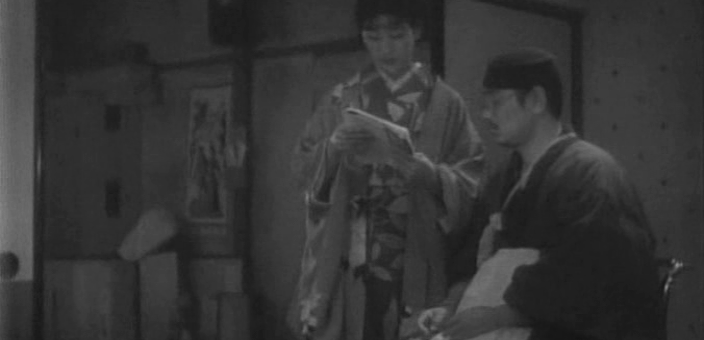
In any case, we meet Tochuken Kumoemon (Ryunosuke Tsukigata) on a train drawing closer to his planned return to Tokyo after having been forced to flee it eight years previously because of a sex scandal which led him to separate from his first wife, leaving a son, Sentaro (Kaoru Ito), behind, and marry Otsuma (Chikako Hosokawa) – his shamisen player with whom he is currently travelling. The troupe are supposed to be breaking their journey at Kozu, but for reasons unexplained, Tochuken Kumoemon decides to get off the train at Shizuoka and promptly disappears without a word to anyone. 

The disappearance is problematic on several levels, the first being that the stop was only engineered to allow Tochuken Kumoemon to visit his estranged son Sentaro. Some in the group posit that Tochuken Kumoemon has come down with a rare case of stage fright seeing as this Tokyo show will be his biggest to date, while others assume he is embarrassed to go back to the city because of the scandals which previously engulfed him there, and some believe he is simply conflicted about visiting the son he abandoned to run off with another woman.

Anyone who knows him, however, might be better placed to realise that the great Tochuken Kumoemon rarely has a reason for doing anything save that it pleased him to do so at the time. Nevertheless, what we discover about him as he tours the inns of Kozu throwing his money about like some crazed libertine, is that he apparently liked his life better when he was poor but is bravely suffering under the burdens of wealth “for his art”. In fact everything in Tochuken Kumoemon’s life is “for his art”, including the thoughts and feelings of those closest to him.

Tochuken Kumoemon’s story may be intended as a kind of militarist parable about a man who devoted everything of himself to a particular ideal, in his case art but for the militarists perhaps country. The major problem here is that Tochuken Kumoemon never particularly suffers himself, grinning broadly throughout, but forces others to suffer on his behalf while he extracts from them qualities he can use to enhance his performance. Pain may be good for art, but it’s rarely good for life, and most would find themselves questioning why it is those around him remain contented to suffer solely to facilitate Tochuken Kumoemon’s artistic fulfilment.

Loyal wife Otsuma begins to reconsider, bravely challenging Tochuken Kumoemon on the inauthenticity of his performances which, though growing in popularity, she feels to be increasingly hollow. She remembers the early days of their courtship which were apparently marked by a fierce competitive rivalry which proved artistically beneficial to them both before spilling over into other kinds of offstage passion which now appears to have cooled. Otsuma, now weakened as she finds herself succumbing to the later stages of consumption, something Tochuken Kumoemon refuses to acknowledge, fears that she is now unable to inspire him with her playing which is why he’s been up to his old tricks consorting with geishas. Claiming that Otsuma wouldn’t care about his affairs because she’s an artist too and will therefore “understand”, Tochuken Kumoemon has taken up with a pretty little thing, Chidori (Sachiko Chiba), from whom he intends to steal “youth and innocence” for his performances, little caring what he might leave behind.

For Tochuken Kumoemon everything is simply fuel for art and so he’s excused himself from the need to treat others with respect or kindness. Sentaro, his rejected son, rejects this aspect of his father’s philosophy, immediately bonding with his kindly step-mother and resenting his absent father’s treatment of her. In “raising” his son, Tochuken Kumoemon bangs on about traditionally “militarist” values of manliness, explaining that he is imperfect because he is a “great artist” and that his life has been full of problems but that he has overcome them with strength and perseverance. He tells his son that “weakness is the worst thing in a man”, but appears primed to hit the roof on learning that Sentaro may be expelled from school for fighting with his schoolmates because they mocked his unconventional family setup. Worst of all he casts his son away as one of the many who unfairly demand “perfection” from him even though he is an artist and cannot be expected to abide by the rules of “normal people”.

Meanwhile, Otsuma lies dying in a hospital. Tochuken Kumoemon won’t see her because he refuses to view her as “just a woman”, preferring to remember her as “a woman who lived only for art”. The subtext being for “his” art, rather than her own. He betrays himself when he admits that he “doesn’t want to be any more sad” than he is now, simply refusing to deal with the unpleasantness and personal suffering of facing the fact that someone important to you is in pain and will soon be gone. Yet despite a brief rebellion after an ill-advised gift from Chidori, Otsuma eventually agrees to sacrifice herself for Tochuken Kumoemon’s art, to die “quietly” as an artist and not as a woman. 

It’s only at this point that Tochuken Kumoemon decides to embrace the romance of the moment, finally travelling to her deathbed in order to sing a song. If Tochuken Kumoemon is a militarist hero, he’s not a particularly sympathetic one. He remains monstrously self-involved, hypocritical, an emotional coward who uses the suffering of others for his own ends with only the justification of the primacy of his art. Naruse undercuts the propaganda potential of the piece by painting his patriotic singer as a ridiculous prig who embodies the militarists’ coldness towards the thoughts and feelings of their fellow humans but displays none of their supposedly romantic heroism in his empty swagger and well worn platitudes. Is naniwabushi really worth all this pain? No. Someone needs to tell Tochuken Kumoemon he’s not as important as he thinks he is. And while they’re at it, they could have a word with the militarists, too.


The real Tochuken Kumoemon

Real TOCHUKEN KUMOEMON

The Eternal Rainbow (この天の虹, Keisuke Kinoshita, 1958)

Eternal rainbow poster 1Famously, towards the end of the war, Keisuke Kinoshita got himself into trouble with a dialogue free scene of a mother’s distress as she sent away the son she’d so carefully raised “for the emperor” towards an uncertain future in the midst of hundred of other, identically dressed faceless boys. Army might have showcased the director’s propensity for resistance, but one could also argue that there was just as much propagandistic intent in the post-war films as their had been in the militarist era even if the messages they were selling were often more palatable. 1958’s The Eternal Rainbow (この天の虹, Kono Ten no Niji) is a case in point. A portrait so positive one wonders if it was sponsored by Yahata Steel, The Eternal Rainbow is nevertheless conflicted in its presentation of defeated post-war hope, exploitation, and growing social inequality even as it praises its factory city as a utopian vision of happy industry and fierce potential.

A lengthy opening sequence featuring voice over narration recounts the history of the Yahata Steel Works which began operations in 1901 in Northern Kyushu and now employs thousands of people, many of whom live nearby in the ever expanding company dorms the newer models of which feature bright and colourful modern designs in contrast to the depressing grey prefab of the traditional workers’ homes. Gradually we are introduced to our heroes – chief among them Mr. Suda (Yusuke Kawazu), a young man from the country who saw a factory job as his over the rainbow but is rapidly becoming disillusioned with its dubious gains. Rather than the company dorms, Suda rooms with the foreman, Kageyama (Chishu Ryu), and his wife Fumi (Kinuyo Tanaka) whose young son Minoru (Kazuya Kosaka) didn’t qualify for a factory job on account of his small frame and his been unable to stick at anything in the precarious post-war economy. Meanwhile, Suda has made friends with an older worker, Sagara (Teiji Takahashi), who has fallen for a secretary, Chie (Yoshiko Kuga), but her family are dead against her marrying a factory worker while she is also in a relationship with a college educated engineer, Machimura (Takahiro Tamura), but is beginning to doubt the seriousness of his intentions.

The drama begins when Sagara employs Kageyama to act as a go-between in a formal proposal of marriage to Chie’s parents, the Obitas. Kageyama didn’t really want to be a go-between because it’s gone badly for him before and he thinks this one is a non-starter too – women around here have their sights set on office workers, no one in the arranged marriage market is looking to marry someone on the shop floor. The Obitas feel much the same. Mrs. Obita is keen for Chie to marry up and is somewhat offended by the proposal, granting it only the customary consideration time to not seem rude in turning it down flat. Sagara is stoic about the matter, but the abruptness of the rejection greatly offends Suda who cannot stand for the Obitas snobbish put down of working people.

Herein lies the central conflict. Suda was a country boy who’d been sold an impossible dream. He believed that a job in the factory, for which he had to sit an exam and has been chosen out of thousands of other hopefuls, was his ticket out of rural poverty. Now that he’s working there he realises he is little more than a wage slave, working long hours for almost nothing with the only goal of his life being to earn enough to feed a family with a little (very little) left over for his old age. Minoru, the Kageyamas’ son, feels much the same and has already turned cynical and desperate. He can’t abide his father’s work ethic and wants more out of life than there perhaps is for it to give him. Suda repeatedly asks how people can learn to be happy in this sort of life, wondering if those that claim to be have simply given up their hopes and aspirations in resignation. When Minoru decides not to go to Tokyo it ought to be a victory, but then perhaps it is more that he has simply accepted that there is no hope there either.

Nevertheless, the depiction of Yahata as a place to work is ridiculously positive even as Kinoshita undercuts it with the disillusionment of both Suda and Sagara. A factory city, Yahata is characterised as a cornerstone of the burgeoning post-war economy, literally making the rails on which the new Japan will run. The works provides affordable accommodation for families, guaranteed employment, insurance, a “self service” supermarket right on site, social clubs, cultural activities, and festivals. They even get a large scale show from Tokyo every year.

Even so, an immense and seemingly unbridgeable gap exists between the steelworkers and the company men. Mrs. Obita might seem self serving and mercenary, but she’s had a hard life and perhaps it’s only natural that wants better for her daughter. Suda is angry to think a good man like Sagara who might be a bit old fashioned and unsophisticated but has taken the trouble to do things the “proper” way would be dismissed out of hand simply out of snobbery. His attitude is, however, somewhat problematic in that he begins bothering Chie to find out her reasons for declining the proposal, refusing to recognise that she doesn’t need to offer any reason besides her own will. Chie, meanwhile, is conflicted. A proposal of marriage from a man she doesn’t even really know is not something she was minded to consider in any case, but her feelings for Machimura are tested once she becomes aware that he is not quite in earnest and may have been messing around with his landlady while enjoying the attention he receives as an eligible bachelor around town.

Machimura, like Suda, Sagara, and Minoru, is somewhat listless and apathetic even if for the opposite reason in that his life is far too easy and he hasn’t had to make a lot of concrete decisions about his future. Chie doesn’t deny that his college education and urban sophistication are part of the reason she was attracted to him, but as she later tries to explain to Suda, she wasn’t simply angling to marry up – she just fell in love with someone who happened to be of a higher social class which isn’t the same as looking down on working people. She has a right to her feelings whatever political label an increasingly resentful Suda might like to put on them. Even so, if she had been trying to marry up who could really blame her for that? In a society in which women are still entirely dependent on a man, being largely prevented from pursuing a career in their own right, a marriage is effectively a job for life. Shouldn’t she pick the offer with the best benefits, just as Suda did when he chose to leave the country for a factory job?

Progressive factories are often presented as an ideal solution the problem of post-war poverty, but here Kinoshita does not seem so sure. Despite the emphatic tone of the infrequent voice over and the central messages that factory jobs are good jobs and looking down on manual work nothing more than snobbery, Suda and Sagara remain conflicted. This work is dangerous, pays little, and offers nothing more than false promise. If the vast cities like Yahata are the engines repowering the economic growth of a still straitened Japan, what will be the end result? Metropolis made flesh, the “eternal rainbow” is exposed as a self serving lie but what, Suda might ask, else is there for men like him in a society like this?


Original trailer (no subtitles)

Night and Fog in Japan (日本の夜と霧, Nagisa Oshima, 1960)

night and fog in japan posterUnlike many of his contemporaries, Nagisa Oshima entered the world of filmmaking almost by chance. While studying law at Kyoto University, he’d become deeply involved in the leftist student movement and reportedly joined Shochiku’s assistant director program in 1954 solely because no other company would hire him. His path there too was hardly typical and saw him become a leading light of the studio’s extremely temporary bid to play Nikkatsu at their own game with a series of gritty youth dramas which included the melancholy Cruel Story of Youth and infinitely bleak The Sun’s Burial. It was his fourth film, however, which proved the most controversial perhaps unexpectedly given its otherwise dry subject matter. Named for Alain Resnais’ incendiary documentary, Night and Fog in Japan (日本の夜と霧, Nihon no Yoru to Kiri) was pulled from cinema screens following the assassination of the leader of Japan’s Socialist Party by a right-wing nationalist just three days after the film’s release.

Oshima’s film is in itself an attack on the left, though one from an entirely different angle. The failure of the student movement would become a preoccupation for the left-leaning avant-garde movement of the early ‘70s, but one could argue that though the movement had been dealt a huge blow by the failure to stop the renewal of the ANPO treaty despite the mass protests of 1960 it had not yet “failed”. Indeed, protests continued and intensified throughout the 1960s until weakened by a government crackdown in the run up to the treaty’s renewal in 1970 and were only really ended by the horror exposed by the Asama-Sanso Incident in 1972.

In a strange way, Oshima’s impassioned attack on the misguided rigidity of radical student politics almost presages the dark place into which the movement would eventually fall through the already emergent generation gap between the earnest contemporary students keeping up the fight, and the jaded post-war generation who have long since given up the struggle for bourgeois comforts. He opens, of all places, at a wedding notable for its solemnity as a young student radical, Reiko (Miyuki Kuwano), weds a newspaper reporter, Nozawa (Fumio Watanabe), she met at the climatic June 15 protest. The wedding is later interrupted by two melancholy outsiders – one the leader of the students currently on the run from the police, and the other an older man coming in from the cold, though both with the intention of confrontation.

As we might have assumed, the younger man, Ota (Masahiko Tsugawa), is not the jilted lover of the bride. It’s the revolution he’s come to accuse her of betraying through her rejection of their comrade, Kitami – missing since the failed raid on the Diet building, whom Ota assumes to have been her lover now thrown over for the “cage” of family. Reiko’s “betrayal” is mirrored in the drama between the older generation as we gradually discover the complicated history between the groom and Misako (Akiko Koyama), the dejected wife of the current head of the Socialist Party, Nakayama (Takao Yoshizawa).

The demands of ideological purity are mirrored in the strangely moralistic attempts to police female desire in suggesting that both women have made “practical” choices at the expense of their personal integrity. The major drama, however, revolves around the older students’ overreaction to having caught a “spy” in their dorm, keeping him imprisoned while they try to bully him into betraying his true masters. One student however, Takao (Masahiro Sakon) – nursing an unrequited crush on Misako, refuses to believe the man is guilty and is thereafter accused of betraying the movement by allowing him to escape. Takumi (Ichiro Hayami), the second ghost at the feast, has come to ask if it was the movement which betrayed Takao by ignoring his emotional fragility, causing him to abandon faith not only in it but in himself.

Throughout it all, Nakayama remains the stoical voice of authority, blaming anything negative on the nebulous figure of the “imperialists” while insisting on superficial “unity” which really means do as I say and don’t rock the boat. The students want more and they look to the older generation for guidance, but the old guard have lost the faith. Even among the youngsters, few think the cause can be won. The struggle is between those who give up, and those who keep fighting anyway for the right to “march towards a brighter tomorrow”. As a student, Nakayama had dismissed the “spy” as unworthy of their revolution because he was an uneducated worker, but now dismisses the students because they exist outside of the economic structure and therefore cannot occupy a space within a workers’ movement. This wedding, which might have been the unification bringing together the old and the new, has become a funeral that marks the death of post-war idealism, betrayed by the bourgeois need for respectability. The students know their movement will fail, but they move anyway. Nakayama, meanwhile, makes speeches about unity to his dejected contemporaries, berating the students for their lack of “realism” as if insisting that the route to social change lies in concession to populist conservatism.

“I feel empty and sad” the post-war students lament, watching their movement withering on the vine. Betrayed by the older generation, the contemporary students have no role models to follow and no real hope for the future, but still they fight on earnestly. A fierce condemnation of political hypocrisy, dogmatic rigidity, and bourgeois paternalism, Night and Fog in Japan sees no way out of its existential malaise as its would-be-revolutionaries remain lost in a fog confusion with no exit in sight.


Original trailer (no subtitles)

A Dobugawa Dream (ドブ川番外地, Asato Watanabe, 2018)

Dobugawa Dream Raindance posterCan you outrun sorrow or should you just accept defeat and remain within a bubble of despair? Forced out of his self-isolation, the hero of Asato Watanabe’s debut feature A Dobugawa Dream (ドブ川番外地, Dobugawa Bangaichi) tries to find out, looking for a home among those who’ve fallen through the cracks. This down and out ditch town maybe where you end up when you don’t know where else to go, but there’s comfort in knowing others got there before you, if not so much in realising that they have all failed to leave, either accepting the imperfect present in rejection of a possible future, or wilfully residing in the past.

Highschooler Tatsumi (Yuwa Kitagaki) is a lost young man filled with pent-up rage and frustration. He hasn’t filled in his career survey because he has no idea what to put in it and no amount of irritated cajoling from a less than well-meaning teacher is likely to change that. His only outlet is the dream of sailing away with his best friend on the makeshift raft they’ve crafted from refuse at a disused boatyard, but that dream dies when he discovers him hanging, barefoot his body swaying in the breeze. Unable to process his loss and the guilt that accompanies it, Tatsumi imprisons himself in his room watching VHS tapes of old TV shows until a series of angry voices from the other side of the door eventually forces him out of his place of safety and into a strange new world.

Running blindly, Tatsumi wanders through a dream until he is eventually engulfed by a cheerful street funeral which turns out to be in honour of a man still alive – Tsuchiro, a middle-aged former shogi champ now a drunken rogue and what passes around here for a guardian spirit. Questioned by the local bobby, Tsuchiro passes Tatsumi off as his own son, a ruse no one believes but one with a grain of truth. In Tsuchiro, an infinitely cool presence all sunshades, yukata, and shit-eating grin, Tatsumi finds both a father figure and a double. Just as he is chasing the ghost of a friend he couldn’t save, Tsuchiro is in flight from himself, uncertain of his own identity now he no longer sees it reflected in the eyes of an opponent.

Trapped in this strange netherland, Tsuchiro has chosen oblivion. He drowns his sorrows but secretly plays shogi alone by nights while Tatsumi listens in silent consternation from the next room as his tiles click down on the bloodied board. Originally reluctant, Tatsumi finds himself becoming the older man, dressing in the cast-off clothes of the street and drinking himself out his sorrow but quickly becomes disillusioned with what he sees as Tsuchiro’s hypocrisy. The older man offers him a home among those who have nowhere else to go, but the wily bar hostess, though trapped herself, cautions him that he might not want to stay here, among the perpetually lost, for evermore.

A climactic argument sees Tsuchiro offer some tough love, telling Tatsumi that if he wants to stay he needs to leave his darkness at the door, but Tatsumi doesn’t want the superficial solution the older man has found. He’s angry, and he’s powerless, and not yet ready to face his pain but there are other people he will fail to save precisely because of his solipsistic rage – a lesson age tried to teach him but he was too impatient to see. Further loss and an altruistic act of sacrifice push him towards a reckoning in a deeper dream which allows him to interrogate the ghosts of the traumatic past and, perhaps, make his peace with them.

Alternating between bleak despair and absurd humour, A Dobugawa Dream takes its broken hero on an oneiric odyssey through grief, despair, and eventual rebirth as he learns to reconnect with the world around him and prepares to sail away from the traumatic past into the dreamed of future. Escaping the Dobugawa dreamscape, he takes its wisdom with him, no longer running but moving forward all the same. A beautifully composed and remarkably assured debut from Asato Watanabe, A Dobugawa Dream is both a tale of marginalised lives and the corrosive effects of unresolved trauma, and a gentle hymn to the sadness of letting go.


A Dobugawa Dream made its international premiere at Raindance 2019 courtesy of Third Window Films.

Teaser trailer

Bento Harassment (今日も嫌がらせ弁当, Renpei Tsukamoto, 2019)

Bento harrassment posterChildhood’s a funny thing. Obviously lacking life experience and used to being the centre of someone’s universe, children can be curiously self-centred, little knowing the hard work their parents put in to try and make them happy until they suddenly realise years later that their mothers must have toiled through the night just to finish that costume for fancy dress that they didn’t really want to wear. Fed up with her teenage daughter’s sullen indifference, the heroine of Bento Harassment (今日も嫌がらせ弁当, Kyo mo Iyagarase Bento) comes up with an ingenious solution – increasingly elaborate lunchboxes designed to vent her frustration in a way that’s impossible for her daughter to ignore.

12 years previously Kaori (Ryoko Shinohara) was blissfully happy with her two little daughters, Wakaba (Rena Matsui) and Futaba (Kyoko Yoshine), but then her husband was killed in an accident and her life was turned upside down. Now she lives alone with her youngest daughter Futaba who has entered something of a rebellious phase, never directly talking to her mother but communicating through pithy, passive aggressive texts. In a bid to get her attention, Kaori decides to play her at her own game – by becoming so annoying that she’s impossible to ignore. From the day that Futaba enters high school she commits herself to making one “annoying” bento every day, eventually adding a message or two into the mix. Much to Futaba’s chagrin, her mother’s bento becomes a cause of daily excitement among her school friends who can’t wait to see how her mother has chosen to troll her on this particular day.

Perhaps tellingly, Kaori and her daughters live on a small island, Hachijojima, which is technically classed as “Tokyo” though in another sense almost as far from the bustling metropolis as it’s possible to get. There are no trains, or shopping malls, or convenience stores, just cows and wholesome wisdom. Caught between one thing and another, Futaba quits her after school athletics club to sit in a field and write angsty poetry about how she’s all alone in the universe. She doesn’t understand why her mum’s so extra and is confused by her attraction to a childhood friend (Kanta Sato) who has now become buff after developing an obsession with taiko drumming. Beginning to figure out why her daughter’s so moody lately, Kaori doubles down on the annoying bento plan but tries to put a little guidance in there too to push the indecisive Futaba towards making concrete decisions about her future.

Unlike the typically self-sacrificing mothers of “hahamono”, Kaori has her spiky side and never particularly looks for thanks or recognition from her daughters only basic civility. She works two jobs (one in a bento shop and another in a pub) and still makes time to devote herself to the petty art of annoying bento which she also posts online on a blog which becomes an instant hit with similarly stressed out parents looking for a little innocent revenge. Through the blog she finds herself bonding with Shunsuke (Ryuta Sato), a widowed father of a five-year-old boy who is struggling to perfect the art of bento though his aim is less revenge than trying to bond with his son who obviously misses his mum. Yet even “annoying” bento comes from a fundamental place of love – after all, you don’t spend all night cooking to send a passive aggressive message to someone you don’t like. Rising to the challenge, Futaba refuses to admit defeat and makes a point of eating all of the annoying bento without a word of complaint, allowing a kind of communication to arise between herself and her extremely patient mother.

Seeing all her dreams crushed on one extremely bad day, however, makes Futaba lose faith in her mother’s gentle wisdom. Kaori tries to convince her that nothing’s ever really “wasted” because even when things don’t work out the way you hoped they still teach you something else but that’s a hard lesson to learn when you’re young and unused to disappointment. Nevertheless, thanks to her mother’s relentless trolling and some careful words from her sister, she comes to realise just how much her mother has sacrificed on her behalf and understand her mother’s love. A warmhearted tale of mother daughter bonding and an ode to persevering through life’s various difficulties, Bento Harassment is a wholesome treat and inspirational tribute to living life without regrets.


Bento Harassment screens in Chicago on Sept. 27 as part of the ninth season of Asian Pop-Up Cinema.

Original trailer (English subtitles)

Wuthering Heights (嵐が丘, Kiju Yoshida, 1988)

Wuthering Heights poster“In this decadent age, who believes in the gods’ anger?” asks a cynical priest, willingly inviting evil into his home in the hope of brokering a change in his constraining circumstances. A key figure of the avant garde, Kiju (Yoshishige) Yoshida, like many of his contemporaries, struggled in the heavily commercialised cinema industry of the 1970s and beyond, finding the international arena more receptive to his arthouse concerns. 1988’s Wuthering Heights (嵐が丘, Arashi ga Oka), a distinctly Japanese take on Emily Brontë’s classic novel, found funding in France where it perhaps neatly sits alongside superficially similar efforts from his similarly constrained contemporaries, but as always Yoshida’s vision is darker, more disturbing than that of the big budget epics which aimed to recapture golden age glories.

Yoshida swaps the desolate Yorkshire moors for a smokey hellscape settled in ash on the side of an unpredictable volcano. The Yamabes are a priestly family in charge of conducting various rituals to keep the serpent god happy, preventing an eruption and ensuring good rains. The house is spilt in two with a feud underway between the East mansion and the West. The East mansion is where we lay our scene as old Yamabe returns from an extended sojourn in the city, bringing back with him a feral child he found starving under a bridge and later names “Onimaru” (Yûsaku Matsuda) in honour of his “demonic” appearance.

“Demonic” maybe an unkind word to use about any child and primed to become a self-fulling prophecy, but as someone later puts it Onimaru “does not belong to this world”. He is “an evil man” whose “cruelty knows no limits”, yet two women are drawn into his orbit and find themselves unable to break free of his passionate intensity. His step-sister, Kinu (Yuko Tanaka), our Cathy stand-in, bonds with him in childhood feeling a kind of elemental connection perhaps forbidden to her as a woman of feudal Japan subject to the whims of male society. Yet she alone sees through him to humanity buried below, “your curse is the proof you will never stop loving me” she offers darkly while seducing him the night before her marriage to another man (Tatsuo Nadaka). Later that man’s sister (Eri Ishida), positioning herself as potential bride, cites the fact that he is “consumed by jealousy” as further proof that he is more man than demon, but Onimaru himself seems uncertain so deep is he in rage and resentment.

That resentment is perhaps as much about class as about anything else. A feral child, living like an animal on the streets of an unforgiving city, he’s an ill fit for the rarefied mansion of a local lord with a spiritual mission, albeit one which imprisons him in his home and forbids him from associating with the world below. Yamabe took him in for his “boldness”, actively seeking his demonic dynamism while his own son, Hidemaru (Nagare Hagiwara), remains disappointingly conservative and wedded to his old-fashioned elite entitlement. Hidemaru’s resentment of Onimaru is not so much born of parental rejection in his father’s abrupt decision to go out and find a more satisfactory son than the one dutifully waiting at home, but irritation in Onimaru’s irregular status. He resents that a mere “peasant”, a man who should be among the servants, is permitted to share his space, and it seems, has usurped his position in his father’s eyes to be groomed as an heir to the illustrious Yamabe name.

Hidemaru eventually leaves in disgust, setting off to make a conventionally successful life for himself in the city, latterly returning with a wife and son to claim his birthright only after his father’s death. Yet Hidemaru suffers too. His wife is raped and murdered by bandits, agents of chaos and yet a product of the system he was so keen to uphold, leaving him a drunken, dissolute figure unable to fulfil his obligations to the god of fire while Onimaru prospers in a violent world and is eventually gifted that which he most wanted – stewardship of the Yamabe clan.

Even so, he cannot fully possess Kinu who remains lost to him, ruined by her own internal conflict between individualism and obedience. After coming of age, her father tells her women of the Yamabe clan must leave the mountain to serve as priestesses in the shrine, but Kinu wants to “live as a true woman”. She cannot have Onimaru, but does not want to leave him so she engineers a marriage with the rival West mansion and the kindly Mitsuhiko who brands his house as one of light as opposed to the gloomy shadows of the East. Kinu has attempted to seize her own future, at least in part, but finds herself conflicted, torn between her affection for Mitsuhiko who is gentleness personified and her need for Onimaru’s brooding intensity.

Yet Yoshida’s Wuthering Heights is less a story of forbidden, transgressive loves than it is of elemental destruction, the anger of the gods manifested as imploded repression and its fiery aftermath. Yamabe, the father figure, brings “evil” into his home, infecting it with dark desire and deep resentments seemingly in the knowledge it will burn it to the ground. The third generation, orphaned and finally independent, are left to make what restitution they can and so the tale begins to reset and repeat with cousins, Hidemaru’s grown and now subjugated son Yoshimaru (Masato Furuoya), and Kinu’s fiesty daughter (Tomoko Takabe), returning their ire to the force of their oppression – Onimaru, still fearsome and implacable though ageing and maddened by his unanswerable love for a dead woman whose corpse he has begun to covet.

Kinu, on her deathbed, promised to drag Onimaru to hell (assuming they weren’t already there) if only to protect her new family and finally does just that as he finds himself expelled by the next generation, dragging a coffin off into the fiery distance. “In every way, our world is accursed” insists an exasperated retainer. Everything here is corrupt, rotten, suppurating under the weight of oppressive traditions which restrict freedom and insist on order at the price of humanity. Yoshida’s noh-inspired aesthetics add to the atmosphere of fable as his embattled protagonists attempt to reconcile their natures with their civility but find there is no answer for repressed desire other than destruction and eventual rebirth.


The Enchantment (誘惑者, Shunichi Nagasaki, 1989)

“A broken romance affects everybody” a sympathetic psychiatrist tries to reassure a patient suffering a dangerous romantic obsession with a possibly imaginary woman. Like so much of his work, they’re soft words offered casually as a path towards something deeper but in this case it’s not the patient we need to worry about but the doctor. The aptly named The Enchantment (誘惑者, Yuwakusha), somewhat less subtly titled “Temptress” in Japanese, takes its “hero” on a dark journey into fascination, the male need for domination, and the self delusions of irresolvable disappointment.   

The film opens with genial psychiatrist talking to a patient, Hirayama (Tsutomu Isobe), who proclaims himself more or less cured from a nervous breakdown born of a broken heart. Hirayama’s love affair may be largely imaginary, and he seems far from “cured”, but Doctor Sotomura’s (Masao Kusakari) failure to challenge him on his new affirmation that he’s over her because he’s realised she was “just a bitch” who treated him “like trash” might be a worrying oversight. Hirayama was supposed to be his last patient of the day, but a last minute walk-in, Miyako (Kumiko Akiyoshi), piques his interest enough to keep him in the office rather than on a planned date with his receptionist fiancée and surgeon best friend.

Miyako, nervous and reticent, tells him the appointment is “about a friend” and takes some coaxing before beginning to explain that she has been physically assaulted by her female roommate apparently jealous over the unwanted attentions of a man who developed an attraction for her at her job as a tour guide. Miyako does not spell it out, but somewhat implies that her relationship with her roommate Kimie is romantic while Sotomura has the good sense not to push the issue, only to urge her that perhaps she should think about staying with a friend a while if she doesn’t feel safe at home. Miyako, however, doesn’t want to do that and is only worried about what might have provoked this sudden and unexpected change, fearing most of all that she herself will fall out of love with Kimie if her moodiness continues to intensify.

Overstepping the mark, Sotomura is fascinated with his mysterious new patient, particularly after he becomes a kind of white night rescuing Miyako from a dangerous encounter with Hirayama who is under the delusion that she is the embodiment of his romantic obsession “Junko”. The fascination only intensifies after he makes a surprising discovery – Kimie is not “real” but a secondary personality inside Miyako. Infuriated by Sotomura’s romantic overtures, Kimie takes control and stabs him in the leg while Miyako continues to visit him in the hospital, unable to remember what exactly happened between them.

Sotomura’s obsession is both sexual and professional, after all how many sufferers of MPD is he going to meet in the course of his career? He is indeed ambitious, casually dating his receptionist Harumi (Kiwako Harada) mostly because she’s the daughter of his former professor. Though the couple live together, Harumi is constantly frustrated by his indifference to their relationship and foot dragging over making it official. Sotomura’s best friend, Shinbori (Takashi Naito), is facing much the same dilemma but has resigned himself to an arranged marriage to further his career and keep his family happy. Sotomura instinctively thinks he ought to do the same and tells Harumi that he’ll sort things out with her father, but remains fixated on the mysterious Miyako and her unconventional love life. 

A more cynical friend warns him that sex is the only thing that matters and it’s essential to avoid emotional entanglements. Nevertheless, Sotomura finds himself desperate to unlock the mystery of Miyako, but it remains open to debate which part of her he wants to “fix” – her MPD, or her sexual orientation. As we find out, Sotomura might assume that Miyako’s love for another woman has driven her “mad”, but in reality it’s more that a sense of impossibility led her to believe that there was no solution to her suffering other than death. Faced with unreconcilable loss, she internalised the figure of her fixation, literally becoming one with her lost lover in order to avoid facing that she was alone once again. Uninterested in Sotomura, Miyako/Kimie becomes fascinated with Harumi who eventually becomes so intensely obsessed with Miyako that she is willing to erase her own identity and become “Kimie” for her in order to support her sense of reality and protect the integrity of the Miyako personality.

Again, Sotomura has a few issues. The first is multi-layered sexual jealousy. Now that Harumi has moved on, found someone who “needs” her, and seems to be happier he is instantly irritated that she left him (for a woman) and desperate to win her back (along with the career boost he romanced her for in the first place). He resents Harumi’s differing vision of medical care, that she is willing to embrace Miyako’s delusion in order to keep her stable while wilfully abnegating her sense of self in a profound act of love. Sotomura the clinician wants to “cure” Miyako of her delusion, but his intervention is brutal, intruding on the mental space of her traumatic memory with physical violence designed to rip her from her safety of her artificial reality. He tries to insert himself between the two women, asserting his masculine “right” to dominate, but is eventually ejected by another knife blow to the thigh as the women assert their right to their own reality in the absence of men.

A strange psychosexual odyssey, The Enchantment spins a dark tale of obsession, delusion, and jealousy but ends on a broadly positive, if perhaps uncomfortable, note, in which the dominant psychiatrist is forced to recognise his irrelevance and the legitimacy of realities outside of his own. Broken romance affects everyone, as Sotomura said, but perhaps he doesn’t have the right to intrude on the broken hearts of others or judge the various ways in which they attempt to patch them back together again. A chronicle of bubble era Tokyo bathed in garish neon and a sense of infinite possibility, Shunichi Nagasaki’s heady feature is a surprisingly subversive affair in which trauma cannot be overcome but can perhaps become integrated in a mutually beneficial whole.


The Sun’s Burial (太陽の墓場, Nagisa Oshima, 1960)

sun's burial poster

“Love and hope for the youth!” reads a prominent sign in the middle of a hopeless slum in Oshima’s bitterly nihilistic youth drama The Sun’s Burial (太陽の墓場, Taiyo no Hakaba). Then at Shochiku, home of polite melodrama, Oshima was one of a handful of youngsters (that also included Kiju Yoshida and Masahiro Shinoda) bumped up to director ahead of schedule in an attempt to find voices who could speak to youth in much the same way Nikkatsu was doing with its incendiary tales of the new bright young things. The Sun’s Burial would be Oshima’s penultimate film for the studio before he stormed out after they pulled his next film Night and Fog in Japan from cinemas fearing its fierce critique of a divided left torn apart by dogmatic rigidity and generational conflict was too on the nose in wake of the assassination of the Socialist Party leader by a right-wing nationalist.

Set in the slums of Kamagasaki, Osaka, The Sun’s Burial follows a collection of desperate adolescents trying to survive in an intensely hostile environment. Our “hero” the conflicted Takeshi (Isao Sasaki), is inducted into a street gang after getting beaten up by young tough Yasu (Yusuke Kawazu). Along with his friend Tatsu, he is originally quite taken with the idea of becoming a gang member, but blanches when he passes a room full of captive women, one of whom is being beaten for having conceived a child.

Meanwhile, across town, his polar opposite, the cynical survivor Hanako (Kayoko Honoo) is running a blood racket, literally bleeding the proletariat to sell their bodily fluids on to the cosmetics trade. Technically operating under the aegis of her petty thug father Yosematsu (Junzaburo Ban), Hanako is in business with a doctor and a couple of minions but later has her authority undercut by a mad old imperialist known as “The Agitator” (Eitaro Ozawa) who keeps insisting that the Russians are coming and they have to be ready.

Not permitted to maintain power in her own right, Hanako is forced to shuttle between male protectors, occasionally pitting one against the other in a bid to come out on top. In addition to her blood business, she also engages in casual sex work and seemingly has no qualms about wielding her sex appeal as a weapon in order to manipulate male power. Pushed out by The Agitator, she turns to gang leader Shin (Masahiko Tsugawa) for a temporary alliance. When he too cuts her out, she thinks about tipping off the area’s big Yakuza boss, Ohama (Gen Shimizu), to Shin’s whereabouts, always looking a few moves ahead while the callous Shin remains wary and ever vigilant.

In a move which surprises and disturbs the naive Takeshi who is nevertheless captivated by her cynical self assurance, Hanako is entirely indifferent to the suffering of other women, willingly co-operating with Shin while knowing that he runs an abusive prostitution ring. Takeshi’s loss of innocence comes early when he is sent to go out and find some victims with his friend Tatsu who convinces him to club a high school boy canoodling with his girlfriend over the head so they can rob him. Takeshi looks on in mild confusion and horror as Tetsu proceeds to rape the young woman, turning to Hanako for guidance but all she does is shrug. The high school boy later commits suicide, presumably unable to bear the shame of having failed to protect his girlfriend, leaving Takeshi feeling as if he has blood on his hands. To Hanako, however, the boy’s death is no one’s fault but his own, a product of his own weakness. A strong person, she posits, would have sought revenge. What sort of person ups and dies without a fight?

Meanwhile, back in the slum, a man hangs himself after falling victim to The Agitator’s latest scam – getting involved with a dodgy gangster’s exploitative scheme to buy up legitimate IDs from desperate people and sell them to even more desperate undocumented migrant workers. Full of tales of Empire, The Agitator declares that he’s going to march them all up to Tokyo and teach those noisy students a lesson, proving somehow that populist militarism is not yet dead in quiet corners of Japan. The Agitator has several followers among the middle-aged and older denizens of Kamagasaki, taken in by his bluster and lacking any other sources of hope. They follow him because he demands to be followed and because he made them a series of promises. Only when they realise his plans rest on exploiting people even more unfortunate than they are, and suddenly realising he never got round to paying them either, do they finally rebel, burning down the slum in protest of their hopeless circumstances.

Berated for her cynicism by the now compromised Takeshi, Hanako offers only the defence that she has survived and will continue to survive where others may not if they allow their consciences to take precedence over self-preservation. Bleak as it gets, Oshima ends on with a note of anxious industry as his determined heroine dusts herself off and gets “back to work”, escaping from the ruins of the burned out slum in the bright morning sun. “No hope for Japan now” an embittered member of the older generation laments, and Oshima, it seems, is apt to agree.


Original trailer (no subtitles)

It Was a Faint Dream (あさき夢みし, Akio Jissoji, 1974)

It was a faint dream posterFollowing his ultramodern Buddhist Trilogy, Akio Jissoji casts himself back to the Kamakura era for a tale of desire and misuse in It Was a Faint Dream (あさき夢みし, Asaki Yumemishi, AKA Life of a Court Lady). Taking its name from a Heian era Buddist ode to transience, Faint Dream follows its melancholy heroine on a fleeting path of love, loss, romantic disappointment, and finally spiritual rebirth while the nation faces the external threat of putative invasion by warlike imperialists hellbent on domination and conquest.

Shijo (Janet Hatta), an orphaned young woman taken as a concubine by the lord Tameie (Kotobuki Hananomoto), has returned home to await the birth of her child. The baby she is carrying, however, is not Tameie’s but that of another young noblemen, Saionji (Minori Terada), with whom Shijo had fallen in love before being taken by the lord. Hoping to pass the baby off as merely premature, Shijo has been deceiving Tameie and remains fearful she will be found out. Meanwhile, Saionji’s wife is also pregnant. When Saionji’s legitimate child is stillborn, an obvious solution presents itself and Shijo loses the first of her children.

A young woman without means or protectors, Shijo finds herself forced to indulge the whims of men in order to survive. Yet Tameie, falling ill, apparently thinks only of her when he pushes Shijo towards sleeping with other men in order to keep the peace, so that their resentment doesn’t become an all consuming evil. Thus it is that Tameie’s own brother, the high priest Ajari (Shin Kishida), falls for Shijo with a burning passion which Tameie fears could drag her down to hell with its implacable intensity. Reluctant and half disgusted, Shijo follows her lord’s advice, falling for the priest as she goes, and becoming pregnant with another child she must also lose.

Ajari’s radical Buddhist philosophy insists that chanting sutras is enough for salvation. It doesn’t matter if you’re high born or low or whether you believe or not, simply saying the words gets you into paradise. It’s a philosophy that appeals to Shijo for obvious reasons, but still she finds it near impossible to reconcile herself to her position of powerlessness within the court. A figure of desire, she is “courted” by just about every man she meets but has little right to refuse their attentions, especially as they often hold financial as well as social power over her. Tameie’s warning, ironic as it is in insisting that hell hath no fury like a man scorned, has its merit in bearing out the intensely destabilising properties of romantic love in a highly regimented society.

For all of that, however, Tameie is a romantic man, himself embittered by the disappointments of his life. Born to be a king, he prefers music and poetry to the sword but still laments his “betrayal” at the hands of the older generation who crowned him at three only to depose him at 16 and hand power to his 10-year-old brother with only a promise, apparently now broken, that his son would inherit the throne. Abandoned as a child, he has little sympathy for Shijo’s maternal pain on repeatedly having her children taken from her because of social propriety, merely reminding her that children and parents walk different paths and hers is evidently here, with him, at court.

Even so, men are content to have it both ways. Romance is a transient thing, Shijo is told, a flower which blooms in an instant of truth but then scatters. Attachment is the enemy of love, the wise man admires the flower as its falls but does not mourn its loss forever. Shijo finds this hard to understand, but continues to live her life as an object of desire rather than an active participant until she finally stops and makes a firm decision of her own in choosing to reject it. She becomes a nun and wanders the land looking for serenity despite being told that no woman can become a Buddha because of the five obstacles in her way no matter how nobly she might seek it.

Ironically enough, Shijo’s life is in itself a “faint dream”. She chooses to reject her desires, but admires other women for embracing theirs, and remains seemingly ageless while the fleeting loves of her youth grow old and fade. The lords sit around perfecting their poetry while boys are pulled off their farms to combat a Mongol invasion, and a deadly disease ravages the country. Shijo turns to ask her former lover about the child they conceived together, but it’s as if she were asking about someone else in another time. Having received her answer, she walks off into the distance, a nameless nun, free of the cares of the world and no longer burdened by desire.


It Was a Faint Dream is the fourth of four films included in Arrow’s Akio Jissoji: The Buddhist Trilogy box set.

Original trailer (no subtitles)

Poem (哥, Akio Jissoji, 1972)

Poem dvd coverThere might be a temptation to view Akio Jissoji’s “Buddhist Trilogy” as an intensely Japanese affair given its obvious preoccupation with Eastern religious thought and background dialogue with the political confusion of the day, but like fellow New Wave outsider Kiju Yoshida, Jissoji had studied French literature and there is something classically European about his nihilistic ennui in the midst of a decaying social order. Poem (, Uta), the trilogy’s final instalment, bears this out most of all as the servant boy of a noble house, secretly its spiritual heir, alone attempts to resist the march of time to save the natural essence of a culture about to eclipse itself in consumerist emptiness.

Jun (Saburo Shinoda), a strange young man, is a servant/legal clerk to a lawyer, Yasushi (Shin Kishida), who is the oldest son of the Moriyama family. Though he has inherited stewardship of the house and mountains, Yasushi and his wife Natsuko (Eiko Yanami) long to break free of its traditionalist constraints by ripping it apart and replacing tatami mat comfort with Western modernity. They can’t do that, however, because old Moriyama (Kanjuro Arashi), Yasushi’s father, is still alive and Yasushi doesn’t particularly want to have to talk to him. Meanwhile, the spacious mansion is also shared by a legal student, Wada (Ryo Tamura), who is kind of interning with Yasushi while repeatedly failing the bar exam, and the family’s maid Fujino (Hiroko Sakurai).   

Unlike Yasushi, Jun sees his life’s purpose as serving the Moriyama family. Intensely worried that a fire may engulf this fine house built with only the best Japanese cedar, Jun gets up every night at midnight and patrols with an electric torch, looking for loose sparks. One night he finds some, though not the kind he was expecting, on accidentally witnessing Wada make love to Fujino. Apparently uninterested, Jun looks it over and moves on while the lady of the house, Natsuko, starved of affection by her impotent husband, finds herself stirred by such unexpected eroticism.

Yasushi’s physical impotence is perhaps merely a manifestation emasculated powerlessness as the oldest son of a noble house who, nevertheless, wields no real power and is entirely unable to make decisions for himself. Yet his big case at work is thrown into confusion when his social climbing client suddenly tries to have his partner, Arita (Haruhiko Okamura), removed days before the court hearing because it might look nicer to have someone of Moriyama’s standing representing him. Even so, Yasushi is so clueless with the modern world that he needs Jun, a calligraphy enthusiast and advocate for the old, to operate the photocopier because he doesn’t know how (and neither does Wada). Only Jun, in another contradiction, insists on working to rule and leaving at 5pm because his “main job” is protecting the house and serving the Moriyama family, not Yasushi. Jun allows himself to be seduced by Natusko on the grounds that if she does not receive sexual satisfaction inside the house she will need to look for it outside which could bring shame on the Moriyama name. Finding out his wife is sleeping with another man, the weird servant boy no less, Yasushi doesn’t even care (besides being mildly turned on), as long as she doesn’t do anything which might arouse “rumours”.

The dirty secret that neither Yasushi or his debauched brother Toru (Eishin Tono) know is that Jun, whose name means “pure”, is their illegitimate half-brother that their father had with a maid. As we later discover, old Moriyama plans to divide his estate not in two but three, believing that it hardly matters anyway because division, in a break with the system of traditional succession by the oldest son, will be the end of the Moriyama family. He may well have a point as neither Yasushi, who eventually abandons the house to Toru and escapes to Kyoto, or his brother are interested in legacy. Once Moriyama passes, they plan to sell the entire plot, mountains and trees and all, to developers. In fact, the house already technically belongs to someone else because as soon as he moved in Toru started taking out exorbitant loans to fund his wastrel playboy lifestyle and has already figured out the jig is up and they’re all broke. Only Jun, who hears the voice of the mountains as if it were the voice of existence itself, is desperate to save the family name though he is at this point almost beyond saving himself.

Looking for the “absolute” in tombstones, Jun is told that only darkness exists inside. Yet he is certain that as long as form survives, content can return. He sees the Moriyamas’ forests as the essence of an older Japan and their untouched natural beauty the rock on which their souls are anchored. Yet his half-brothers oppose him. For them, Japan, even the world, is already ruined and nothing worth protecting remains. Existence itself is nothing more than a dream, and suicide no different. They no longer feel they can live “in such an age”.

Yet Jun, his father’s spiritual heir even if he doesn’t know it, keeps reaching, perhaps not quite hoping but demanding even in his powerlessness which may, in a sense result in a kind of transcendence in its purity. Unlike the ambiguously hopeful ending of This Transient Life, or the urgent ominousness of that of Mandala, Poem ends in defeat and futility, suggesting that time cannot be stopped or progress arrested even by those who seek the eternity of enlightenment. And so Jissoji brings us full circle by showing us a world in entropy unsalvageable in the cruelty of its contradictions.


Poem is the third of four films included in Arrow’s Akio Jissoji: The Buddhist Trilogy box set which also features an introduction and selected scene commentaries by scholar of the Japanese New Wave David Desser plus a 60-page booklet with new writing by Tom Mes and Anton Bitel.

Original trailer (English subtitles)