COSMIC RESCUE -The moonlight generations- (コスミック・レスキュー ザ・ムーンライト・ジェネレーションズ, Shinsuke Sato, 2003)

Cosmic RescueIt’s often posited that Japan rarely produces “science fiction” literature or movies and some say that’s because, well, they already live there. However, this isn’t quite true, there are just as many science fiction themed projects to be found in Japan as elsewhere you just have to look a little harder to find them. Depending on your point view, if you succeed in tracking down a copy of Cosmic Rescue -The moonlight generations- (コスミック・レスキュー ザ・ムーンライト・ジェネレーションズ), you may feel the quest was not entirely worth the effort.

Starring the younger half of the Johnny’s idol group V6 (referred to as “coming century”), Cosmic Rescue takes place in 2053 when space travel has become easy and commonplace enough to require the presence of galaxy wide emergency services. Cosmic Rescue is the AA of space travel – they float around waiting for disaster to strike whereupon they will swoop in and rescue those in peril among the stars.

However, the three crew members of the rundown rescue ship from the 89th Division of Japanese CR mostly spend their days clearing crash debris and changing batteries. The rookie of the group Sawada (Junichi Okada) longs for a spot of heroism just like in his favourite manga which inspired him to join the CR in the first place, whereas ship’s engineer Eguchi (Ken Miyake) gets on with the day to day work of maintaining the ship while the captain Nanjo (Go Morita) mopes about slumming it with this lowly crew of cleanup artists despite being a CR legend after he was involved in a heroic rescue which cost the life of his best friend. However, when Sawada receives an emergency distress call from a young woman who claims to the be sole survivor of a space crash, the gang find themselves embroiled in a corporate conspiracy.

Directed by a young Shinsuke Sato who would later go on to become one of the most successful directors of mainstream Japanese blockbusters including Gantz and Library Wars among other smash hit franchises, Cosmic Rescue is a very competently made science fiction adventure given its obvious budgetary constraints. It’s fair to say that it’s largely been created as a vehicle for its three (hugely popular) leading men and so falls back on their charisma to plug any holes in the rather generic script and lack of production values but generally acquits itself pretty well.

That said, there are no shoehorned in singing sections and even if a low budget, televisual atmosphere remains there’s still a fun sci-fi adventure underpinning it all. Sawada is the ostensible lead as he longs to prove himself as a real “hero” by saving lives in space just like his captain had done before yet Nanjo’s story becomes equally important as he battles to overcome the guilt and fear he feels after losing his friend in an earlier mission. Engineer Eguchi gets a little sidelined in a technical role but each of the three guys get fairly equal weighting as members of the maverick, underdog space crew who are going to expose this mass conspiracy and save the damsel in distress no matter what the cost.

There is a (fairly trite) message here spelt out in voice over at the end of the film that it’s easy to forget who you are when you’re used to being “tied down” by gravity but if you can’t learn to save yourself you won’t be able to save anyone else. Cosmic Rescue is what it is – it isn’t really pretending to have any kind of deeper message other than showcasing its leading actors in a fun, slightly retro space adventure. Though a fairly low budget, disposable affair aimed squarely at fans of the band, Sato adds some interesting direction plus a vaguely 1960s inspired production design which help to lift the proceedings above the bonus feature category.


The Japanese release of Cosmic Rescue includes English subtitles!

Unsubbed trailer:
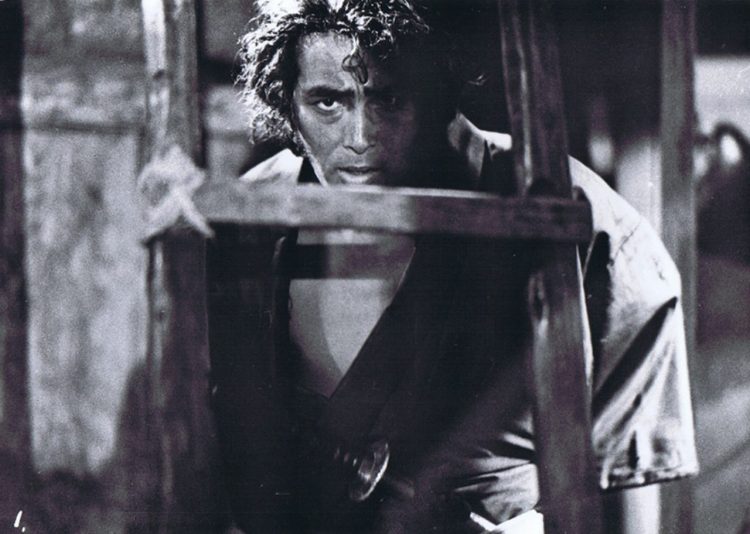
The Assassination of Ryoma (竜馬暗殺, Kazuo Kuroki, 1974)

Ryoma AnsatsuSakamoto Ryoma is a legendary revolutionary of Japan’s Bakumatsu period which encompasses the chaos that ensued after Japan was forced open after centuries of self imposed isolation. Ryoma was a low level samurai from a small town who resented the unjust treated of the arrogant true samurai above him and skipped out on his clan without the proper permission to go study sword fighting in the city. After the arrival of the Americans and witnessing their far superior technologies, Ryoma was one of several men who became convinced that Japan needed to modernise quickly or become a slave to more advanced cultures. However, this was a turbulent era and there was general infighting among all factions and all sides and Ryoma was mysteriously assassinated in 1867 along with his friend and ally Nakaoka Shintaro.
In thinking about the legacy of Sakamoto Ryoma, it’s important to try and separate the man from the legend. His legacy has become somewhat romanticised as his visionary ideas of a modernised Japan free of outside influence but also of outdated, feudalistic ideals have developed into an easily cop-opted set of talismans. Kuroki Kazuo’s 1974 film The Assassination of Ryoma (竜馬暗殺, Ryoma Ansatsu) attempts to place Ryoma firmly back within the mortal realm as it explores the events of his last days in late 1867 when he was brokering the new world from the shadows.

Played by Japan’s original ‘70s wild beast Harada Yoshio, this Ryoma is a slightly bumbling though thoughtful young man who likes to have a good time when he isn’t busy trying to overthrow the shogunate. An early scene sees him fiddling with a revolver which he claims is a better weapon to be in hiding with because it’s a little more portable and discreet than a traditional sword. However, he doesn’t quite know how to use it and can’t figure out how to make it fire in order to give his friend a demonstration. Later, having moved on slightly from his ideas of a peaceful revolution, his plan to buy a number of rifles backfires when he is sent a camera instead.

Ryoma is joined by two “allies” who both originally came in order to kill him but have apparently switched sides. The first is one of his oldest friends, Shintaro, who remained a member of a hard right revolutionary group in Ryoma’s home town which ran under the slogan “Revere the Emperor, Expel the Foreigners”. Understandably they haven’t taken too well to Ryoma’s change of heart regarding the modernisation of Japan and are committed to taking him out – hence dispatching Shintaro, though he proves reluctant to assassinate his friend. The other is a mysterious and largely silent assassin, Uta (played by Matsuda Yusaku), who also ends up forming an unlikely friendship with Ryoma which prevents him from carrying out his mission.

Kuroki shoots in black and white within a 4:3 frame and in gritty 16mm but also goes in handheld almost like newsreel footage shot by a frontline war correspondent. As well as using some silent cinema inspired compositional techniques, Kuroki also adds in a few intertitles either with historical information or to provide some additional commentary on the action such as when he tells us that violence from left wing samurai is a daily occurrence. Drawing a neat parallel between he chaos of the Bakumatsu era and its tussling between new and old, Kuroki leaves us with a sense of historical continuity by equating the left wing samurai rebellion of the 1860s with the left wing student moment of a whole century later.

However, Ryoma is just one man. In an enlightening metaphor about a cat who got stuck up a tree, Ryoma calls to it and tried to climb up to get the cat down but it just kept climbing higher and wouldn’t even take the mochi he tried to offer it on a stick. Eventually Ryoma wanted to cut the whole tree down in order to save the cat but everyone laughed at him – cut down a 10ft wide tree to save one skinny cat? At that time Ryoma laughed too but later it made him angry. He thought the idea of cutting down the tree should be allowed to be considered, that every option ought to be explored. The important thing is to see things from all angles and allow yourself the freedom to change your mind, reject all previous knowledge in the light of a new way of thinking. This kind of freedom is necessarily frightening and may lead others onto a path which you yourself do not wish to follow but all the same it is the very idea which gives birth to Ryoma’s entire philosophy.

Kuroki’s vision of this visionary hero is an unconventional one and one which was not universally accepted by the audience of the time. Just as radical as the man himself, Kuroki’s film portrays Ryoma as a modern revolutionary who lived a hundred years ago, yet wanted many of the same things that the youth of the day were still fighting for – personal freedom, equality for all, and a modern society which allowed his nation to stand independent, on an equal footing with its European counterparts. The assassination itself is brutal, bloody and efficient. It’s an uncinematic ending for a cinematic hero in which he’s violently cut down in a frenetic yet naturalistic fashion leaving a trail of polluting black blood spreading across the high contrast bright white background. His ideas were too radical for his era, and his tragic end a sadly predictable one but what does this say about the world of today and the would be revolutionaries whose voices appear to have been silenced?


(I’ve gone for surname first order here because that’s the most usual way of referring to historical figures – I accept that it’s confusing but it is at least consistant).

The life story of Sakamoto Ryoma has been dramatised many times, most recently as a Taiga drama, Ryomaden, directed by Rurouni Kenshin’s Ohtomo Keishi and starring Fukuyama Masaharu, which has apparently boosted Ryoma’s profile even more and created a raft of new tourist spots in various areas of Japan. (It’s obviously very long as it’s Taiga drama but is well worth the investment in time and effort.)

Unsubbed trailer:

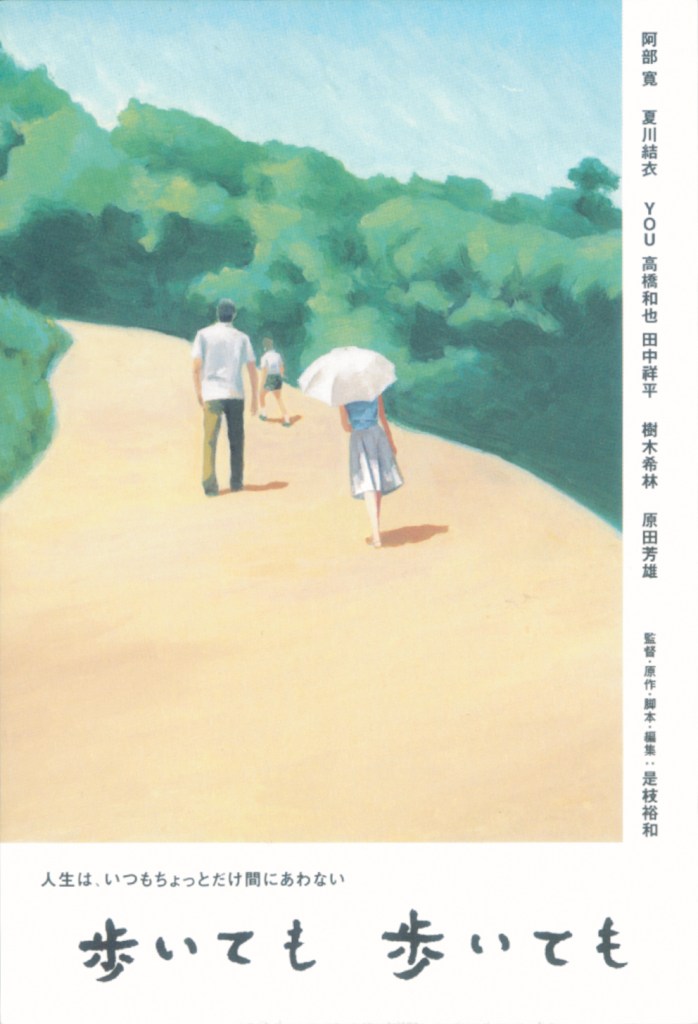
Still Walking (歩いても歩いても, Hirokazu Koreeda, 2008)

still walkingLife is full of choices, but the one thing you can’t choose is your family. Like it or not you’re stuck with them for life and even if you decide you want nothing to do with them ever again, they’ll still be hanging round in the back of your mind for evermore. Koreeda swings the camera back around the fulcrum of Japanese society for this dissection of the fault lines and earthquake zones rubbing up against this very ordinary family.
You’d be forgiven for thinking that some kind of celebration is about to take place at the beginning of Still Walking (歩いても歩いても, Aruitemo Aruitemo) yet the event that is about to bring scattered friends and family members back home is of a more somber nature. As the matriarch Toshiko (Kirin Kiki) peels vegetables with her daughter Chinami (YOU) she seems excited at the prospect of getting the family back together again yet melancholic and perhaps a little nervous.

Younger son Ryota (Hiroshi Abe) is taking the train in with his new wife and stepson. He urges Yukari (Yui Natsukawa) that they should make their excuses and leave in time for the last train but she feels obliged to stay over. It’s clear Ryota is not looking forward to a reunion with his family and also has some current worries over his working situation which are weighing on his mind and which he definitely does not want anyone in the family to find out about.

Ryota has a particularly strained relationship with his difficult doctor father, Kyohei (Yoshio Harada) who doted on his oldest son, Junpei, drowned at sea whilst saving the life of a little boy. Increasingly grumpy that he has no heir for his medical practice, Kyohei refuses to recognise Ryota as a grown man or accept his work as an art restorer as a “real” occupation. Tensions in the family are further brought out by the mild disapproval over Ryota’s choice of wife who was previously married and then widowed and has a young son by her first husband. Toshiko for one still harbours an old fashioned stigma towards second marriages and thinks Ryota could have done better than “buying second hand”. Though seemingly accepting of her new daughter-in-law and grandson, she perhaps treats them a little more like guests than fully fledged members of the family.

Set over the course of two days, Still Walking takes on a sense of Chekovian wit and melancholy as it paints a naturalistic picture of an ordinary family with all of the petty cruelties and indignation that involves. The deceased son, Junpei, has become a virtual saint, forever bathed in golden light by his grieving parents while Ryota remains very much alive yet pushed into the shadows. Feeling himself to raise only feelings of disappointment in his family, he adopts a truculent, defensive air which sees him unwilling to engage leaving the bulk of the work for his new wife who is eager to please her in-laws despite their frequent tactlessness in dealing with herself and her son.

Of course, Ryota and his father aren’t so different at all – both gruff, defensive, grumpy. Kyohei is a difficult man sinking into a miserable old age where he can no longer busy himself with the role which has given his life meaning, that of a respected small town doctor. When bubbly younger sister Chinami mentions having seen a newspaper report which referred to painting restorers as “art doctors”, neither man is very happy with being linked with the other yet there is a certain commonality between them that oddly forces them apart rather than ties them together.

Toshiko by contrast is the long suffering yet largely silent housewife whose maternal grief is the force which now defines her. Seemingly sweet and kind on the outside, there’s a tough core in the middle which gives way to some decidedly biting remarks lightly peppering the atmosphere with ancient resentments. Perhaps feeling a strange sort of kinship with the mystery guest-cum-kicking-boy-of-the-day – Yoshio, the boy who Junpei saved but has not made good on his investment as he’s turned into a slobbish and overweight 25 year old child who can’t seem to settle on one proper career, Ryota asks why his mother insists on inviting him every year knowing how painful it must be for him to come. Toshiko coldly replies that that’s exactly the reason she intends to keep making him visit, she feels wretched inside 24/7 so for one day every year she makes someone else feel dreadful too – will anyone blame her for that?

Grief and loss play a heavy part here, not only of the literal kind, but in the feeling of time wasted and the disappearing moments which can never be recaptured. Chinami’s son and daughter team up with Ryota’s stepson Atsushi to provide a melancholic mirror of the the three Yokoyama children playing in the same fields and staring at the same fleeting flowers as their forebears did years before. Time is always passing, you think there will always be another opportunity for saying something or other, forging a connection or new memory but soon enough the sand in the glass runs through. As Ryota notes, it’s always a little later than you think but you can’t see it until it’s already too late.

Dense with naturalistic detail, Still Walking is a warm if sad look at one ordinary family dealing with the aftermath of tragedy yet offers its own comments on the nature of human connection between fathers and sons, mothers and daughters, and between the living and the dead. A timely reminder of the transience of all things, Koreeda’s most straightforward take on the family drama proves a both profound and moving experience which only deepens with repeated viewing.


I rewatched this recently at an ICA members’ screening where it screened on 35mm but the print actually had an intermission built into it even though the film isn’t all that long – strange experience!

Still Walking is available on DVD and VOD in the UK from New Wave Films and was also released on blu-ray in the US as part of the Criterion Collection.

The film’s Japanese title Aruitemo Aruitemo is taken from the song made famous by Ayumi Ishida – Blue Light Yokohama which turns out to have a surprising significance within the film:


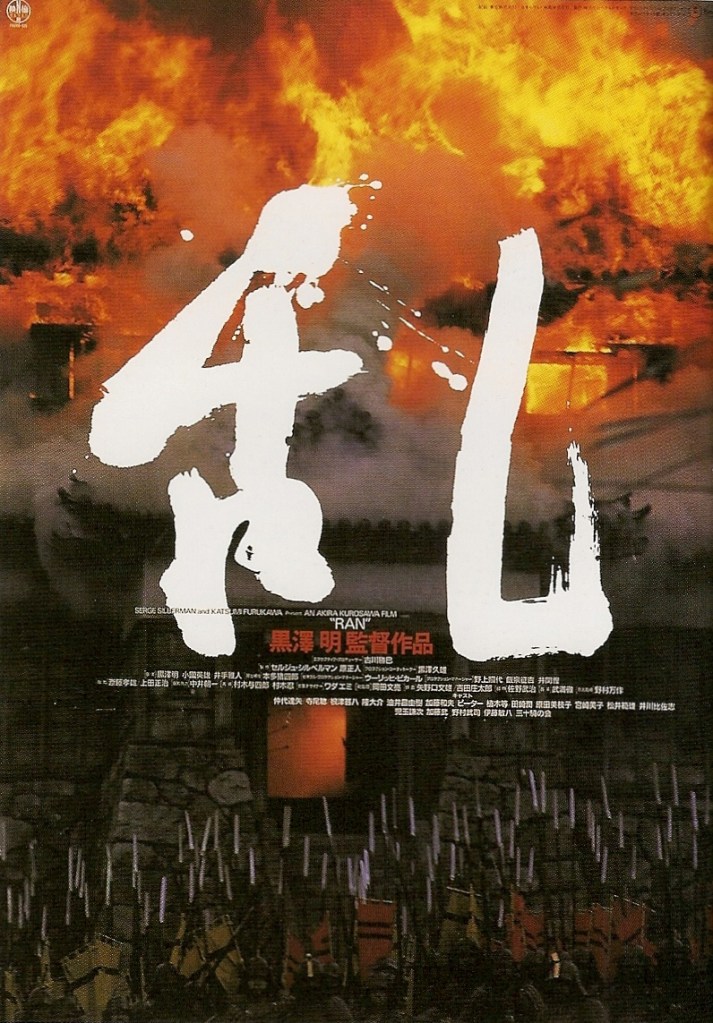
Ran (乱, Akira Kurosawa, 1985)

ran posterAkira Kurosawa is arguably the most internationally well known Japanese director – after all, Seven Samurai is the one “foreign film” everyone who “doesn’t do subtitles” has seen. Though he’s often thought of as being quintessentially Japanese, his fellow countryman often regarded him as too Western in terms of his filming style. They may have a point when you consider that he made three different movies inspired by the works of Shakespeare (The Bad Sleep Well – Hamlet, Throne of Blood – Macbeth, and Ran – King Lear) though in each case it’s clear that “inspired” is very much the right word for these very liberal treatments.
In the case of Ran (乱) – a loose adaptation of King Lear, Kurosawa moves the story to feudal Japan and an ageing king who this time has three sons rather than three daughters. This leaves Hidetora (Tatsuya Nakadai) with a smaller problem than Lear’s though in his original idea of making his eldest son his heir with the other two inheriting smaller roles it’s clear things aren’t going to end well. Just as in the original play, the oldest two sons Taro and Jiro sing their father’s praises with cynical glee but the youngest and most sincere, Saburo, refuses to play this game as his respect for his father is genuine. Unfortunately, Saburo’s honesty sees him banished from his father’s kingdom and his share of responsibility given over to his treacherous brothers. Predictably, neither is satisfied with what they’ve been given and it’s not long before a familial conflict has sparked into a bloody civil war.

How sharper than a serpent’s tooth it is to have a thankless child….Hidetora is not quite as far gone as Lear in Shakespeare’s original text at the beginning of the film yet he is still unable to see that his oldest two sons have placed personal ambition ahead of filial piety. Hidetora was once a fearsome, if cruel, warrior, famous for burning enemy villages and creating peace only through destruction. He’s old now, and tired and so he proposes to hand over the running of the kingdom to his eldest son, yet – he wants to remain the de facto leader until the very end. Of course, that doesn’t sit well with Taro, or more to the point his ambitious wife Lady Kaede. Hidetora is thrown out of Taro’s castle and then also from Jiro’s before all out war erupts between the two leaving him totally isolated – a king without a kingdom.

Hidetora’s true madness begins when he realises not only how little regard his eldest two sons hold for him, but also that his failure to recognise the true nature of the situation has lead to the deaths of the people in his care that have remained loyal to him to the very end. As the enemy begin to engulf the castle, concubines begin helping each other to commit suicide in order to avoid ravishment while others try to escape but are cut down by arrow fire. This is all his own fault – his ruthless cruelty has been filtered down to his two oldest sons who, as he did, will stop at nothing in the pursuit of power. What is a king if not the father of a nation, and as a father he has failed. Neither Taro or Jiro are worthy of the offices afforded to them and lack both basic humanity and the princely power one needs to become the unifying force of a people.

Only too late does Hidetora see the wisdom in Saburo’s words and finally understand that he has alienated the only one of his children that truly loved him. From this point on his madness increases and Nakaidai’s performance becomes increasingly mannered and theatrical as if Hidetora himself is acting in another play which only he can see. Wandering and lonely, the once great king is reduced to the estate of a beggar led only by his fool and sheltered by the ruins of a castle which he himself burned down.

However, as great as Nakadai is (and he always is), he’s very nearly upstaged by the young Mieko Harada as one of the all time great screen villainesses with the Lady Macbeth a-like Lady Kaede. Filled with a vengeful fury, Kaede is unafraid to use every weapon at her disposal to achieve her goal. No sooner is she brought the news of her first plan’s failure in the death of her husband than she’s embarking on a plot to seduce his brother which includes getting him to execute his wife. Vile as Kaede’s actions often are, her desire for revenge is an understandable one when you consider that Hidetora was responsible for the deaths of her family leaving her to become a trophy bride for the son of the man that killed them. Viewed from another angle, it would be easy to sympathise with Kaede’s desire to rid the world of these cruel and tyrannical lords were it not for her insistence on the death of Lady Sue – a woman in exactly the same position as herself whose death would not actually advance her cause very much at all.

Kurosawa films all of this from a distance. We, the audience, almost become the gods he speaks of – the ones who weep for us, watching silent and helpless, unable to save us from ourselves. We see the world for what it is – chaos, horses and men and blood. The battles aren’t glorious, they are frenetic, frightening and ultimately pointless. Though for all that there is a beauty to it too and the sheer scale of the production with its colour coded princes and immense armies is one the like of which we will never see again.

Ran presents us with a prognosis which is even more pessimistic than that of Lear. At the end of Shakespeare’s play, as profoundly tragic as it is, there is at least the glimmer of hope. There is a new, rightful king and the idea that something has been restored. Here there is no such resolution, we are the blind man casting a stick around the edge of a precipice, entirely alone and unable to see the gaping chasm which extends before us into which we may plunge headlong driven only by the chaos in our own hearts. In the end, Kurosawa’s message is not so different from Shakespeare’s – all the weight of this sad time we must obey, speak what we feel, not what we ought to say. Fathers and sons must strive to understand each other, and themselves, lest we fall into the eternal chaos which leads us to build our very own hell here on Earth.


Ran is currently playing in UK cinemas in a brand new 4K restoration courtesy of StudioCanal!


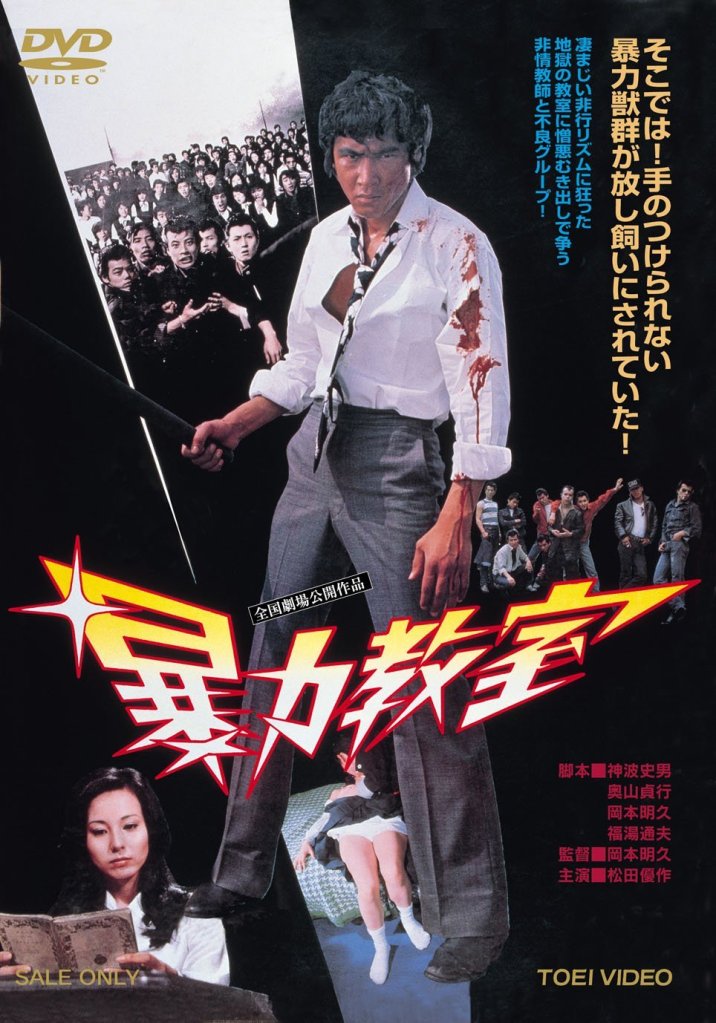
The Classroom of Terror (暴力教室, Akihisa Okamoto, 1976)

classroom of terrorWhen the teachers are as corrupt as the students are disruptive, society is going to wind up with a complex set of problems. Classroom of Terror (暴力教室, Boryoku Kyoshitsu) is, in some ways exactly what it sounds like – delinquents! Sex, drugs, fighting! etc but also subverts these aspects of the bad teen movie by turning the camera right back on the adults who are perpetuating this world of unruly adolescents. An early entry for action star to be Yusaku Matsuda, Classroom of Terror sees him cast in a recognisably manly role though one with a greater degree of nobility.
Mizoguchi is a rookie teacher at an ordinary high school with a falling reputation. Behind his back, the established teachers are virtually taking bets on how long he’s going to last with this “difficult” class that’s giving everyone grief. However, Mizoguchi is a tough, generally cool kind of guy, and he’s able to stand up to this rambunctious group of teenage boys pretty well.

That said, there’s a subset of “bousouzoku” biker gang kids in the school which seems intent on dominating not just the other kids but the entire infrastructure of the academy too. Led by Kitajo, the “Sidewinders” wear identical leather jackets with a snake on the back and all have rockabilly hairstyles which match their Brando-esque The Wild One attitudes. Delinquent doesn’t quite cover their activities and Kitajo in particular is not above seducing the principle’s daughter as part of a blackmail plot or even revenge raping the younger sister of an opponent. However, the kids are not the bad guys here as there’s an even bigger scandal going on in the school’s administration department and the Sidewinders, with Mizoguchi’s help, might be the only way to stop it.

Classroom of Terror mixes a number of genres together and then buckles them onto a typical kids gone wild delinquent movie. In actuality it has more in common with a yakuza crime pic as it turns out Mizoguchi is more or less a stooge brought in by the powers at be to quell rebellion but then realises he’s been working for the “bad guys” and switches sides. The Sidewinders operate more like rival gang, the area’s underdogs who definitely aren’t “good guys” but might be better than the corrupt administration that’s currently in place.

Of course, these guys are just teenagers and this is a school, not the back streets of some shady part of town. Mizoguchi’s class is boys only and extremely disruptive – bombarding a female teacher with paper aeroplanes made out of their test papers, developing a zip wire system to pass each other porn and just generally refusing to conform to any kind of expected behaviour. Kitajo in particular is seen to be rebelling against all kinds of authority thanks to an oppressive home environment controlled by his strict and violent father. When the older generation is shown to be corrupt as in the plot to defraud the school of money at the expense of its pupils, it’s the duty of youth to rebel and their refusal to follow the path that has been set down for them is in no way surprising.

A typical ‘70s exploitation picture, Classroom of Terror displays all the genre’s hallmarks from the swooping handheld camera shots, whip pans and zooms to the funky soundtrack. However, it does also fall into the unpleasantness associated with the lower end of these kinds of films in its use of rape as a plot device which takes on an unsavoury and salacious quality though the scenes themselves are not particularly graphic. Likewise, there is a fair amount of explicit nudity in the first half of the film during the seduction plot of the teenage daughter of the principal which is played for all its worth. Though not as sleazy as other examples of films of this kind, Classroom of Terror has a necessarily male viewpoint which runs close to generalised misogyny.

Perhaps most notable for providing early leading roles for Matsuda and also for Hiroshi Tachi who plays the leader of the Sidewinders and was at that time the lead singer of a popular rock group, The Cools, Classroom of Terror is a fairly typical youth gone wild movie though one which attempts to justify youth rebellion by pointing out the oppressive and hypocritical actions of the older generation. That said, it’s never entirely on youth’s side and the boys are very definitely unpleasant and out of control. Though the use of rape as a tactic is not exactly supported, it isn’t condemned either, rather just accepted as something that happens – but happens to men, largely, who lose face when “their” women are “damaged” by their enemies. Unpleasant yet often exciting in execution, Classroom of Terror is an interesting mix of exploitation genres though one which perhaps leaves a sour taste in the mouth.


Unsubbed trailer:


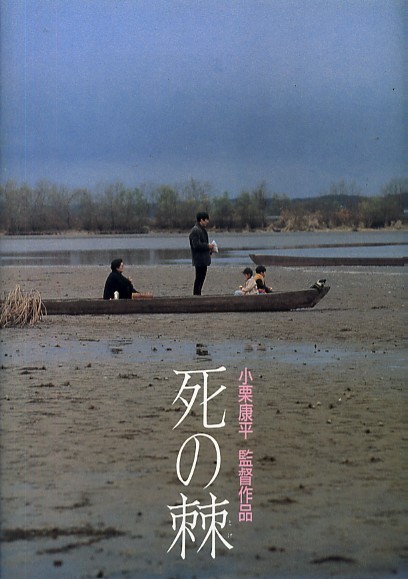
The Sting of Death (死の棘, Kohei Oguri, 1990)

Sting of Death

Kohei Oguri’s The Sting of Death (死の棘, Shi no Toge) won the prestigious jury prize at the Cannes film festival in 1990 but has since passed into obscurity. Adapted from the “I Novel” by Toshio Shimao, Sting of Death is an absurdist, caustic look at a collapsing marriage beset by difficulties on all sides as the pair try to navigate the confusing post-war society.

Toshio and Miho are a married couple with two young children. Miho has recently discovered that her husband has been carrying on with a neighbour for quite some time and is uncertain how to deal with this unexpected revelation. The film opens with a serious marital argument which is almost chilling in its calmness. Toshio is sorry, he doesn’t intend to leave his marital home and pledges to stop seeing this other woman – he’ll stay in 24/7 and not even go out without his wife and children if it means he can defend his family. Miho is definitely not happy with this compromise but accepts it and the couple attempt to get back to a kind of normality. However, the peace does not last long as Miho becomes increasingly depressed and paranoid before hurtling headlong into a nervous breakdown.

The “I Novel” is an integral part of Japanese literature and has often provided the basis for many of the country’s prestige films even though its specific style is a necessarily literary one which is hard to dramatise on screen. The genre is centred around the ideas of naturalism and the main tenet is that the writer is recounting real events from the world he sees around him, though perhaps through a thin veil of fictionalisation. That said, it’s never quite “autobiography” and it may sometimes be better to think of them as “hyperreal” rather than just naturalistic.

Oguri attempts to evoke this strange sense of uncanniness by opting for an ethereal, dreamlike tone akin to avant-garde or absurdist theatre. The couple speak to each other in a slightly heightened, deliberate manner, often posed unnaturally facing away from each other literally divided by the film’s framing. Toshio is also haunted by visions from his wartime service somewhere in the pacific where he seems to have received some kind of stomach injury. Emerging from a cave he suddenly sees saluting soldiers, or remembers a passing religious ceremony as if the past is always with him like a Fury tormenting his mind.

The Sting of Death is very close to the experiences of the author who uses his own name for that of the protagonist and that of his own wife for the central female character, Miho. Shimao’s own wife became seriously mentally ill during their marriage eventually having to be admitted to a hospital where Shimao took the unusual step of living with her. Though this uncommon gesture is widely praised as displaying his deep love for his wife, it was in part born of guilt as he believed he had caused her distress through his frequent infidelities, just as Toshio does in the film.

The couple live together in a perpetual nightmare world. Though Miho exclaims at one point that they both need to do their best now for their children they both consider suicide more than once, alternately saving or frustrating one another. They both suffer, they both try to go on but Miho’s position becomes increasingly difficult leading to a period of mental decline which climaxes in a strangely humorous yet violent episode in which she tries to exact revenge on her husband’s mistress only to be offered a lesson in civility – “I don’t know what’s going on here but none of us have the right to act like savages”, says the perfectly genial other woman (the silent casualty in all of this).

Oguri shoots the majority of the film in near darkness, as if the couple are enveloped in a night without end. They haunt each other like living ghosts, emerging from shadows moving slowly like those without hope or purpose. Oguri adds to the surreal, dreamlike atmosphere by sticking to static camera shots filled with strange tableaux and little discernible action. The film paints a bleak picture of marriage and the family unit as the central couple remain locked in an odd game-like battle of suffering while their two innocent children look on helplessly. A strange and beguiling film, The Sting of Death pulls no punches when it comes to describing the way in which adults wound each other with childish games but is also filled with quite beautiful, if sometimes unsettling, iconography.


The Sting of Death is available with English subtitles on R3 Hong Kong DVD as part of Panorama’s Century of Japanese cinema collection.

Opening scene of the film (unsubtitled)

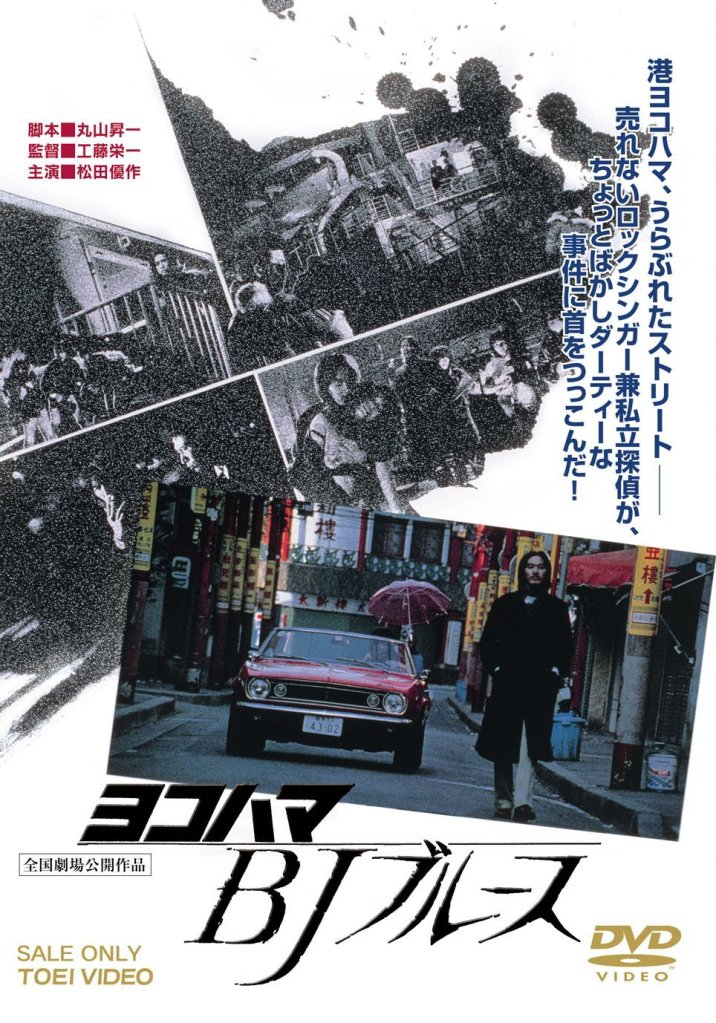
Yokohama BJ Blues (ヨコハマBJブルース, Eiichi Kudo, 1981)

Yokohama bj bluesYusaku Matsuda may have been the coolest action star of the ‘70s but by the end of the decade he was getting bored with his tough guy persona and looked to diversify his range a little further than his recent vehicles had allowed him. Matsuda had already embarked on a singing career some years before but in Eiichi Kudo’s Yokohama BJ Blues (ヨコハマBJブルース), he was finally allowed to display some of his musical talents on screen as a blues singer and ex-cop who makes ends meet through his work as a detective for hire.
After his set at a rundown jazz bar, BJ’s first job is tracking down a missing son. When he finds the guy, Akira, he seems to have become the employee (and possible sex slave?) of a gay gangster. Akira says he’s fine with his new life and wants his mother to leave him alone so BJ gets the hell out of there to give her the message but the unpleasantness of the situation lingers with him a little.

Shortly after, BJ receives a telephone call from an old police buddy, Ryo, who needs his help. Ryo got in too deep with the same gang BJ just came up against and is thinking of quitting the force in a bid to make the “Family” lose interest in him. However, Ryo is gunned down in broad daylight leaving his partner, Beniya, convinced that BJ is somehow responsible. BJ now doubly has it in for Family and starts working on his own behalf to try and find some answers and possibly a little vengeance too.

You see, back when Ryo and BJ were partners, they both liked the same girl, Tamiko, who eventually married Ryo. Beniya thinks BJ killed his friend to steal his wife and is much more interested in giving BJ a good kicking rather than investigating this very strange gang set up which seems to have some kind of drug smuggling gig going with the triads in Hong Kong.

BJ forms an odd sort of friendship with Akira in the hopes of tracking down the four gay, leather clad punk henchmen of Ali who probably gunned down his friend. However, the conspiracy only deepens and BJ finds himself suspecting even his closest of friends.

With its jazz soundtrack and melancholy tone, Yokohama BJ Blues is channelling hard boiled in a big way though does so in a distinctly modern fashion. BJ sings the blues whilst walking around this strange noir world which seems to endlessly disappoint him. Unfortunately for him, BJ is quite a good detective and quickly gets himself in way over his head only to end up finding out a few things it might be better not to know.

One of the film’s most notable components is its use of homoerotic themes with its gangs of gay gangsters, rent boys and punks. Indeed, though the wife of his former partner is floated as a possible motive, the love interest angle is never fully explored and all of BJ’s significant interactions in the film are with other men. Firstly his relationship with his former police partner Ryo which kick starts the entire adventure and then his strange almost date-like experience with Akira about half way through. BJ remains otherwise alone, a solo voice seeking justice for his fallen friends.

Of course, the film’s selling point is Matsuda’s singing so he’s allowed to play his own chorus in a sense by narrating the events from the stage in the form of the blues. Not quite “The Singing Detective”, but almost – BJ tries to bring some kind of order to his world by turning it into a song. In addition to adding to the noir tone, the bluesy soundtrack even allows for a New Orleans-esque musical funeral which oddly fits right in with the film’s weird, macabre atmosphere.

A surreal, noir inspired crime drama with musical elements, Yokohama BJ Blues is quite a hard film to categorise. Unusual for its homosexual milieu and overt homoerotic plotting the film occupies something of a unique place given its obvious marketing potential and star’s profile coupled with its decidedly murky noir tone. Difficult, yet interesting, Yokohama BJ Blues ultimately succeeds both as an intriguing crime drama and as a star vehicle for its versatile leading man.


This is a really, deeply, strange film.

Unsubtitled trailer:

I actually quite like Matsuda’s foray into the world of jazz, the title song from Yokohama BJ Blues which is heard in the trailer is called Brother’s Song and is included on Matsuda’s 1981 album Hardest Day. Here he is on a talk show singing Yokohama Honky Tonk Blues:

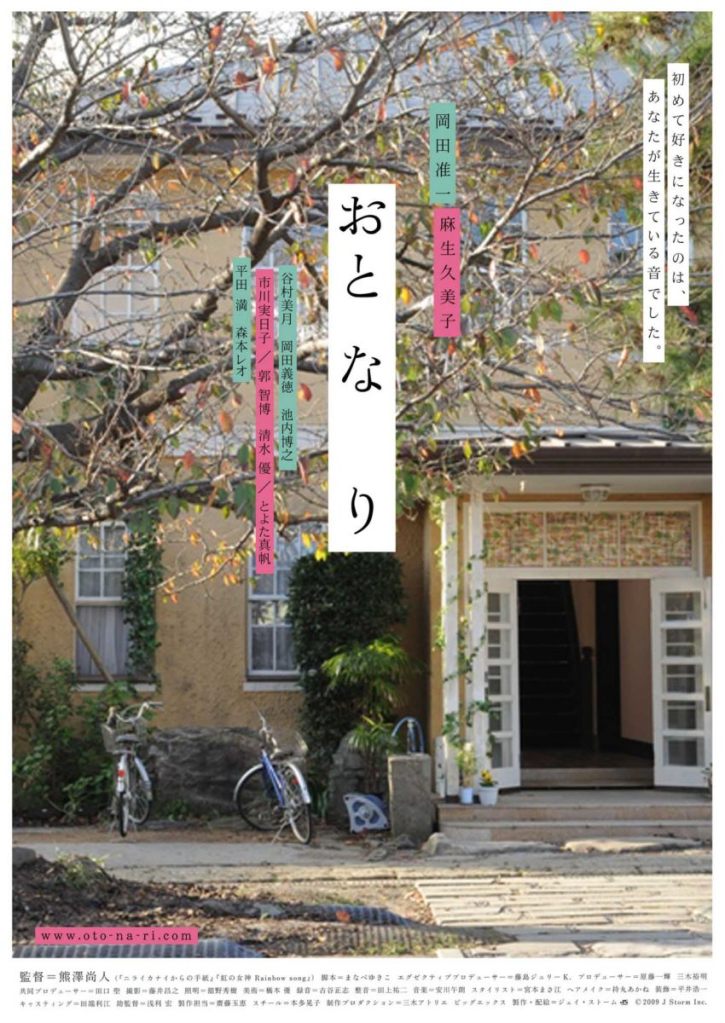
Romantic Prelude (おと・な・り, Naoto Kumazawa, 2009)

otonariSometimes when you live in the city it’s difficult to build meaningful connections with other people. You might find yourself a little lost, caught between the rat race and what it was that brought you to the city in the first place, but if you just close your eyes and listen, you can hear that you’re not alone. Romantic Prelude (おと・な・り, Oto-na-ri) is the story of two such people who build up a strange connection even though they’ve never really met.
Satoshi (Junichi Okada) and Nanao (Kumiko Aso) are next door neighbours in a small apartment block where the walls are paper thin. They’re both vaguely aware that a person of the opposite sex and around the same age lives next door, but they don’t know each other – in fact, they wouldn’t even recognise each other if they passed in the street. Still, they’re each aware of the other person through their particular soundscapes – Nanao hears Satoshi’s keys jangling on his belt as he leaves each morning and his rice cooker beeping in the evening, where as he thinks of Nanao as the humming girl and enjoys getting a free French lesson as he hears her language tapes through the wall.

Both are beginning to get frustrated with their lives in the city. Satoshi is a professional photographer doing fashion shoots but his real passion is landscape photography. He’s planning to go to Canada for a photo project but keeps getting held back as he only got into the fashion stuff because his childhood friend became a model and the two have now become entirely dependent on each other to keep working. When the friend, Shingo, finds out about Satoshi’s Canada plans, he goes missing causing his pregnant girlfriend Akane to come crashing into Satoshi’s life for a while.

Likewise Nanao is a lonely woman in her early thirties who works in a florist’s shop and plans to go to France to study flower arrangement after she’s passed the highest rank of exams. The guy at the local combini she often shops at seems to have developed a crush on her and Nanao isn’t really sure what to do with that but uses all of her time pursuing her dream of becoming a top florist.

Satoshi and Nanao are both feeling adrift, as if their lives are passing them by and it’s getting too late to not be getting anywhere. Just hearing the familiar sounds coming through the wall provides a comforting presence to not feel so alone. Though they don’t know each other, each has perhaps built up an image in their minds of the other person based on the sounds they create – keys, coffee, cooking vs French, classical music and humming an all too familiar song. Feeling the other person’s presence becomes reassuring and an absence of a familiar sound at its expected hour is unexpectedly disconcerting even if you really have no right to expect it.

Though Nanao is annoyed by the noisy and unprecedented arrival of Akane (who is not a good match for the rather uptight Satoshi) and slightly confused by her friendly greeting from the adjacent balcony, she still continues to derive comfort from the gentle presence of her neighbour. After having undergone a cruel humiliation and in something of a crisis, Nanao breaks down inside her apartment. Hearing her distress, Satoshi places his hand on the wall as if in comfort but rather than going next door to see if everything’s OK, he begins to hum and then sing the song he’s heard Nanao humming all along and eventually she too comes to sit beside the wall singing the song back to him.

As implied in the film’s English title, Romantic Prelude, music, and more particularly the symphony of sound that makes up a city, is the film’s major motif. This is further brought out by the original Japanese title which is a perfectly composed sonata of its own – Oto-na-ri. “Otonari” is Japanese for neighbour but the syllables which make up the word also have their own distinct meanings in that “oto” on its own means “sound” but put together “otona” means adult and then “nari” can also mean “to become”. Satoshi and Nanao are engaged in a blind slow dance where they’re falling in love with a stranger based on nothing other than a feeling of connection coupled with bond created by their shared soundscape.

Less a romance than an urban character study, Romantic Prelude is that rare case of a genuinely intriguing love story in which you’re really not sure which way things are going to go. This could just be another story of a tragic missed connection where Nanao heads off to France and Satoshi to Canada and they never even meet or it could give the audience the satisfying true love ending that it almost certainly wants but could have made either direction work. In the end, the important thing is seeing the pair work through their own difficulties and sort things out for themselves in the absence of each other before they finally begin to live the lives they’ve been yearning to lead.


The Japanese release of Romantic Prelude contains English subtitles.

Unsubtitled trailer:

and here’s the song they both keep singing – Kaze wo Atsumete by Happy End

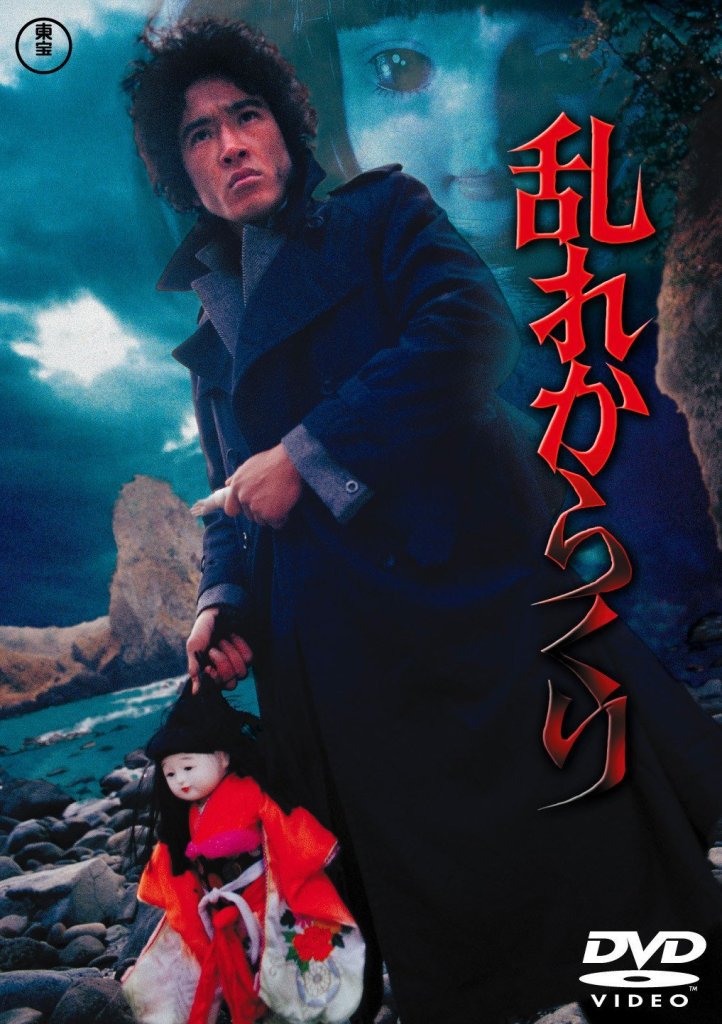
Murder in the Doll House (乱れからくり, Susumu Kodama, 1979)

murder in the doll houseYusaku Matsuda was to adopt arguably his most famous role in 1979 – that of the unconventional private detective Shunsaku Kudo in the iconic television series Detective Story (unconnected with the film of the same name he made in 1983), but Murder in the Doll House (乱れからくり, Midare Karakuri) made the same year also sees him stepping into the shoes of a more conventional, literature inspired P.I.

Toshio Katsu has had a bad day at the bicycle races, almost losing his entire salary before thinking better of it and retuning his last betting slips to buy himself some ramen. Originally hoping to write detective thrillers, Toshio had studied literature at university but later dropped out fearing he had no real talent as a writer. Spotting an ad for jobs at a P.I. firm he thinks it’s worth a shot. When he arrives at the Udai detective agency he finds it’s just one tiny office led by former police woman Maiko Udai. Being short on help, she hires Toshio right away and puts him to work on her number one case – investigating some interfamilial conflict at a top toy company. However, when their target is killed during a car chase, Maiko and Toshio find themselves trapped inside a maze of complicated tricks and devious puzzles.

Matsuda plays it a little straighter here as an, admittedly laid back, master detective with a knack for always being in the right place at the right time. The case at hand concerns an elderly toy magnate and his factory which is run by his son Soji as the president and his nephew Tomohiro as the manager of production. As might be expected there’s a fair amount of conflict between the two men which is exacerbated by an incident in which a series of racing cars the company was due launch had to be pulled following safety concerns leading Soji and Tomohiro to hold each other responsible for the failure. The old man wants the detectives to keep an eye on Tomohiro in case he decides to launch some sort of coup but just about everyone is acting suspiciously in this weird mansion which was built as some kind of folly with hundreds of built in tricks like a lakeside woodland labyrinth and secret underground passages. Oh, and there might even be some hidden Edo era treasure too. Before long people start dropping dead in increasingly bizarre ways.

In the best traditions of Japanese mystery stories which place fiendishly elaborate plots at their centre, Murder at the Doll House more than succeeds as a classic detective story. We’re presented with a set of strange occurrences which our master sleuth will explain to us in a long lecture at the end and even if one or two twists are a little obvious, the satisfaction involved in having figured them out ahead of time outweighs any kind of disappointment. Toshio may say he wants to be like Philip Marlowe but in actuality his detective is a little more in the European mould – almost like a more active Poirot or a slightly less obtuse Sherlock Holmes. Still, donning a trench coat with a turned up collar yet eschewing the classic hat which would have obscured his giant ‘70s perm, Matsuda once again turns in a very “cool” performance as super smart private eye.

Welcome to the Doll House isn’t quite as action packed as some of Matsuda’s other roles from this era even if it does have a genuinely thrilling finale. Making up for physical excitement with a more cerebral approach which mixes in a few horror tropes with the creepiness of the old house and “murder by doll” scenario, Murder at the Doll House makes for an enjoyably strange mystery adventure which also adds in a little quirky humour along the way for good measure.


Based on the novel by Tsumao Awasaka (not currently available in English).

Matsuda does some detecting (unsubtitled)


Dead Run (疾走, SABU, 2005)

Dead run posterSABU might have gained a reputation for his early work which often featured scenes of characters in rapid flight from one thing or another but Dead Run both embraces and rejects this aspect of his filmmaking as it presents the idea of running and its associated freedom as an unattainable dream. Based on the novel by Kiyoshi Shigematsu, Dead Run (疾走, Shisso) is the tragic story of its innocent hero, Shuji, who sees his world crumble before him only to become the sacrifice which redeems it.

The story begins in a voice over narration offered in the second person by Shuji’s older brother, Shuichi. Shuji, it seems was a curious, if shy, little boy full of the usual childish questions and a curiosity about the way his world works. The boys live with their parents in an area they call “the shore” which is next to a settlement created through reclaimed land which the shore people refer to as “offshore” and somewhat look down on. One day, Shuji gets marooned offshore when his bicycle chain snaps and is rescued by the unlikely saviour of “Demon Ken” (Susumu Terajima) – a local petty gangster whom everyone is afraid of, and his girlfriend, Akane (Miki Nakatani), who is some kind of bar hostess. Soon after, Demon Ken is found buried in a shallow grave dead of a gunshot wound to the stomach, but somehow this improbable act of kindness has stuck in Shuji’s mind.

Moving on a few years, a creepy looking priest moves into the offshore area and opens up a church in a small hut complete with shiny silver crosses. Just like with Demon Ken, there’s a rumour about town that the priest, Father Yuichi (Etsushi Toyokawa), is a former criminal and murderer. Shuji becomes intrigued by the strange figure of the priest and a young girl his age, Eri (Hanae Kan), who likes to spend time in the church. However, more gangsters soon turn up wanting to buy up the offshore area to build an entertainment complex and even though most of the other residents have agreed to be resettled elsewhere, Father Yuichi won’t budge. Akane returns to the area as one of the higher ranking gangsters trying to force the church out and is happy to realise that Shuji, at least, has not forgotten Demon Ken. This won’t be the last time the pair meet again as circumstances conspire against the young boy to drag him ever deeper into the darkness of the shady adult world.

As a young boy, Shuji’s life is the ideal pastoral childhood full of bike rides through green fields and under cloudless blue skies, yet his once happy family dissolves and though he tries to run from his destiny he can not escape it. After his over achieving older brother Shuichi is caught cheating at school and is suspended, he begins to lose his mind becoming obsessed with the idea of the priest as a murderer and is fixated on exposing some dark secret about him. Of course, it turns out not to be exactly as he thought it was and Shuichi becomes increasingly disturbed before becoming a suspect in a series of local crimes which see him sent away to reform school. After this string of tragedies, Shuji’s parents start to fall apart too – his father disappearing and his mother mentally absent. Eventually even Eri leaves as the relocation programme finally kicks in.

Around this point our narrative voice shifts to that of Father Yuichi who becomes Shuji’s only responsible adult figure. However, Father Yuichi’s decision to take Shuji on a trip proves to be a disastrous one as it backfires massively forcing him onto the run and, coincidentally, straight into the arms of Akane. Though Akane had originally seemed an austere and difficult woman, she harbours an affection for Shuji as one of the few people to remember Demon Ken and to remember him for his kindness. Though she wants to help Shuji she ends up pulling him into a the darkness of her own world filled with violence and exploitation. Shuji runs again and eventually makes his way to Tokyo and to Eri who is just as broken as he is but there’s no salvation here either. Even when the pair attempt to travel back to their once idyllic childhood town, their problems follow them and destiny catches up with everyone, in the end.

Early on Father Yuichi and Eri are having a discussion about the difference between fate and karma and which might be more frightening. Eri says fate is better because you can’t change karma but perhaps you can change your fate. The film seems to disagree with her. You can try to run but somehow or other something will always stop you so the cold hand of fate can stretch its icy fingers around your heart. Different in both tone and style from SABU’s previous work, Dead Run is a bleak tale filled with loneliness and melancholy which, though it offers a glimmer of hope for those who are left behind, is not afraid to make a sacrificial lamb of its holy fool of a protagonist.


The Hong Kong R3 DVD release of Dead Run contains English subtitles.

Based on the book of the same name by Kiyoshi Shigematsu (as yet unavailable in English).

Unsubbed trailer: