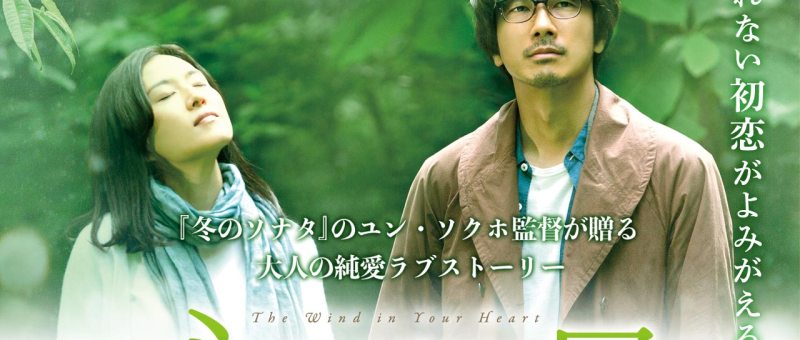
The Wind in Your Heart (心に吹く風, Yoon Seok-ho, 2017)

the wind in your heart posterYoon Seok-ho is best known for his work in Korean television drama which included several of the series thought of as kickstarting the “Hallyu” wave. Chief among these is Winter Sonata which proved extremely popular in Japan and is also cited as a major inspiration for the short-lived boom of “junai” or “pure love” movies in the early 2000s. The Wind in Your Heart (心に吹く風, Kokoro ni Fuku Kaze) brings things full circle – making his feature debut, Yoon brings his brand of romantic melodrama to Hokkaido for a re-evaluation of first love, middle-aged regrets, and an escape from real world cynicism to a world of beauty and innocence.

Video artist Ryosuke (Hidekazu Mashima) has been in living in London for many years but is currently staying with a friend in Hokkaido on a working holiday. When his pick up truck breaks down in the middle of nowhere he chances in to a nearby cottage in the hope of using the phone, only to find a ghost from the past standing in the doorway – Haruka (Masumi Sanada), his high school sweetheart whom he has not seen in 23 years. Obviously a lot has happened – Haruka is married with a grown-up daughter, but seems sad and lonely. Ryosuke is only in town for a couple more days, but the pair make the most of their time to reconnect and think about what might have been and why it wasn’t, as well as what might still be if someone finds the courage to boldly pursue their desires.

Well, that might be a little strong – this is a story of innocent, chaste love, rather than a hot and passionate affair. The Wind in Your Heart does indeed share much in common with the classic “junai” in its nostalgic look back to innocent teenage romance and yearning to return to a time when everything seemed so simple and love was all that mattered. It is, however, sadder – we’re not told exactly what made Haruka decide to forget Ryosuke after he left for university in Tokyo, only that she went through some tough times. Likewise we don’t really know why Ryosuke didn’t try harder to find out, save that perhaps he thought that was what she wanted and respected her decision. Nevertheless, Ryosuke has remained unmarried and apparently still carries a torch 23 years later. All the pair have are mutual regrets and a shared sense of nostalgia for a future they feel they lost because of things that happened to them in their youths.

Now, things might be different. Haruka is obviously miserable in her marriage. Her daughter has left for university, her husband is working away in Taiwan, and she’s left at home all alone with her horrible mother-in-law. Ryosuke asks her if she’s happy and she can’t answer. She doesn’t want to talk about her husband whom she doesn’t seem to like very much. When we eventually meet him he is drunk, bossy, and insensitive. It’s no wonder Haruka might dream of running off with her idealised first love but when all is said and done she lacks the conviction to do it. She is simply too conventional, too bound by social obligation, to consider throwing caution to the wind and embracing her own happiness.

It might be patronising to suggest that Haruka is a stand-in for the expected audience – unhappy, under appreciated middle-aged women who perhaps feel trapped by a conservative society and long for escape from their humdrum lives through an innocent romance, but then that does very much seem to be the screenwriter’s intention. Haruka hesitates – her hand always hovering over door handles as if they were triggers, unsure which door to open and which direction to choose, ultimately making her decisions far too late. Unlike the more positive resolutions of a junai romance which allow the left behind to come to terms with their loss and resolve to live on with happy memories rather than sorrow, Haruka is left only with the crushing realisation that it really might be too late and she’s made a lifetime’s worth of poor choices though she does at least begin to find a degree of fulfilment in re-embracing her youthful dreams previously crushed by the unforgiving attitudes of her family.

Filming in Hokkaido, Yoon maintains a notably Korean sensibility in his static camera and straightforward composition which prioritises simple conversation between two people, only occasionally wandering off into poetic reveries in which the sun embraces the wind in a bracing Hokkaido spring. Reaching for something deeper than it manages to grasp, The Wind in Your Heart lands in standard melodrama territory, never quite managing to lend its central romance the weight it seems to want, but nevertheless doing its best to strain the heart with a tale of inescapable middle-aged misery in lives lived through the power of what might have been.


Original trailer (no subtitles)
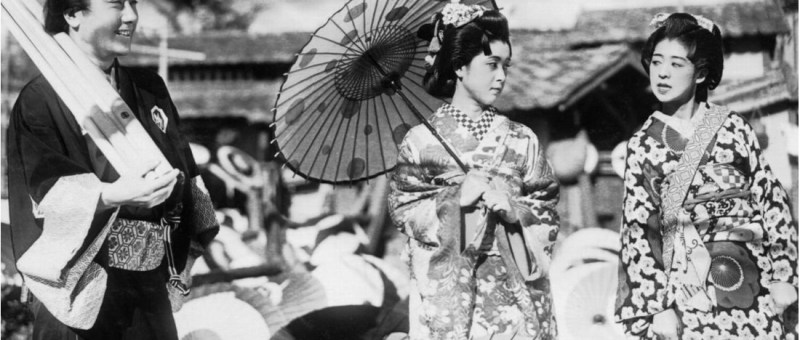
Singing Lovebirds (鴛鴦歌合戦, Masahiro Makino, 1939)

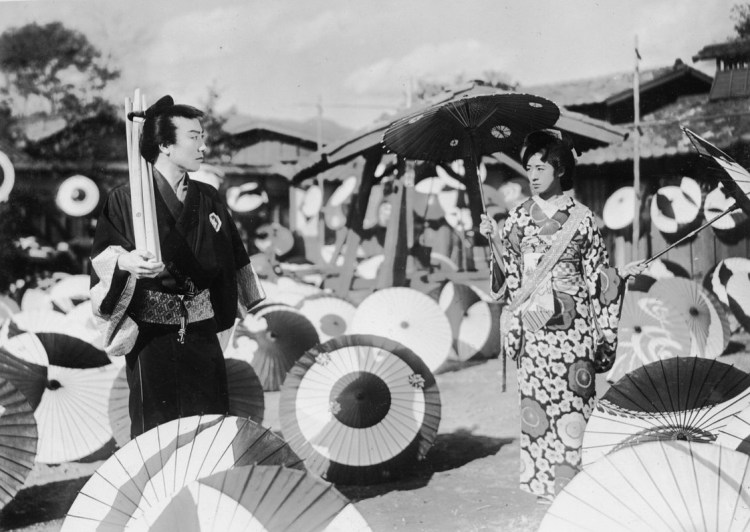
singing lovebirds still 5With things the way they were in the Japan of 1939, you might have expected cinema to have taken a universal turn to the dark side but surprisingly enough there was still room on the silver screen for silliness as the improbable marvel of Singing Lovebirds (鴛鴦歌合戦, Oshidori Utagassen) makes plain. Legend has it that musical master of the jidaigeki Masahiro Makino threw Lovebirds together in record time in order to fill a production gap after big time star Chiezo Kataoka was struck down by appendicitis in the middle of filming On the Road with Yaji and Kita. Kataoka is also Lovebird’s nominal male star though his appearance is understandably limited (his scenes were shot later and apparently in a matter of hours) leaving veteran actor Takashi Shimura to pick up the slack as an antiques obsessed disenfranchised former samurai who finds himself at the centre of a dastardly plot orchestrated by the higher ups to solve an ongoing romantic crisis among the youngsters.

The crisis revolves around the handsome Reizo (Chiezo Kataoka) – a young ronin betrothed to a young lady from a well to do family, Fujio (Fujiko Fukamizu), whose father is keen to make the marriage official as quickly as possible. Reizo, however, has fallen for Oharu (Haruyo Ichikawa) – the daughter of ronin umbrella maker Shimura (Takashi Shimura). Meanwhile, Reizo has also become an object of affection for the daughter of a wealthy local merchant, Otomi (Tomiko Hattori), who is spoilt and entitled to the extent that Reizo’s resistance only enflames her ardour. If all that weren’t enough to be going on with, a randy local lord (Dick Mine) is also actively chasing most of the women in the area and after getting turned down by Otomi has his sights set on Oharu.

Peaceful times allow for small bursts of chaos and ongoing romantic silliness which is where we find our conflicted heroes, yet there is a persistent strain of anxiety in the precarious lives of the disenfranchised ronin who find themselves trapped in a cycle of wilful degradation which prevents them from taking on work unbefitting of a gentlemen and, consequently, permanently on the brink of starvation. Umbrella making, a frequent ronin-friendly occupation in the world of the jidaigeki, is one such way of making ends meet, but Shimura can only afford to feed his daughter barley much to her consternation. Rather than use his meagre resources for short term satisfaction he’s decided to “invest” them in various “antiques” which he believes both bolster his status and can be sold to provide a dowry for Oharu when she decides to marry.

Unfortunately, Shimura is mistaken – he’s not got as good an eye for antiques as he thought and is a well known mark for the local hawker. Everything he has is a fake and he’s wasted a small fortune on useless trinkets. Shimura’s antiques mania also leaves him open to other kinds of scams and manipulation when he gets himself into a small amount of debt to the randy lord and Fujio’s dad (Mitsuru Toyama) who have tricked him in order to try and get Oharu out of the Reizo picture and into the lord’s bedchamber. Unlike many Jidaigeki dads, however, Shimura is a nice guy and tells the higher ups where to get off because what kind of father sells his daughter for the price of a pretty tea bowl?

Shimura’s logic might not make much sense to the lords, or to many other residents of the jidiaigeki world, but is perfectly in keeping with the film’s surprisingly humanist morality in which all are made to realise that greed is bad, money is silly, and at the end of the day all that really matters is true love (even if you have to live in a hovel and survive on barley gruel for the rest of your life). Even the spoilt Otomi is finally forced to realise that you can’t force love and the best you can do is try to support other people’s happiness while you wait for yours to come along (which it is more likely to do once you start being nicer to everyone including your long suffering manservant).

Bright, cheerful, and filled with zany humour Singing Lovebirds is a refreshingly warmhearted piece of eminently hummable escapist fluff providing a much needed distraction from the austere world of 1939 in which its particular brand of anti-capitalist humanism would seem to be extremely out of place. Nevertheless, the corrupt and oppressive samurai order gets a much needed comeuppance, the little guy realises he doesn’t need to play their game anymore, and a young woman realises the only person she needed to feel good enough for was herself. A happy ending for all and an umbrella wielding dance routine to boot – who could ask for anything more?


Brief clip (extremely poor quality, no subtitles)

Boyhood (少年期, Keisuke Kinoshita, 1951)

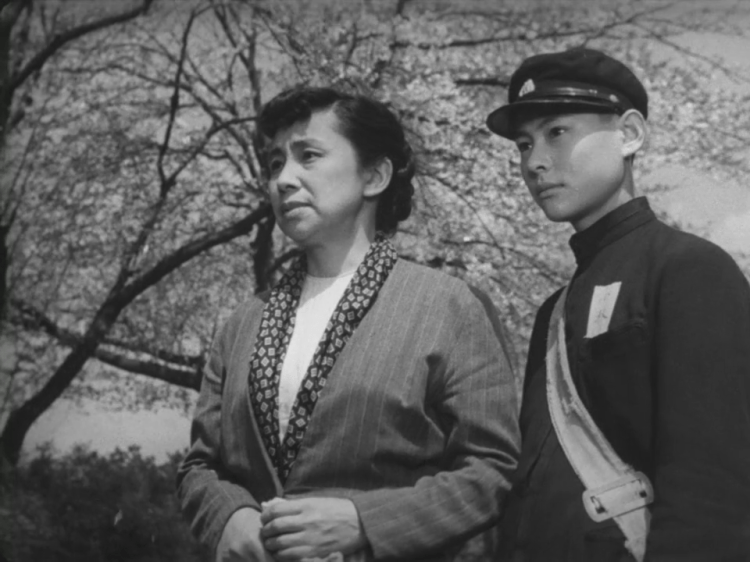
Boyhood (Kinoshita) screencapIt’s easy to look back in judgement with the benefit of hindsight, but much less so to see clearly in the moment. Keisuke Kinoshita’s Boyhood (少年期, Shonenki), arriving just six years after the events that it depicts, is a painful if sympathetic look at the conflicts of the age seen through the eyes of a conflicted adolescent as he struggles to understand his place in a world which is becoming ever colder.

In the spring of 1944, 16-year-old Ichiro (Akira Ishihama) and his mother (Akiko Tamura) investigate the possibilities of retreat, back to the country and away from the increasingly fraught and dangerous city. Their first prospect which offered the comfort of family nevertheless proves too inconvenient and so Ichiro’s mother decides perhaps Suwa, a rural area not quite so out of the way, might be better even if it would mean starting all over again with no friends or family to offer support. Ichiro, however, doesn’t want to leave at all. He is afraid of being thought a coward and doesn’t see why he should have to leave his school and classmates behind just because there’s a war on. If he had his druthers, he’d be a pilot dropping bombs, not a resentful schoolboy torn between his feelings for his family and the increasingly austere demands of militarism.

Ichiro may be 16, and if it were not for his poor health perhaps he might already have been drafted, but he seems younger and is trapped in the difficult gulf between boy and man which makes him petulant and occasionally unreasonable. His father (Chishu Ryu), a professor of English literature, is a well known social liberal which is a problem that eventually makes it impossible for the family to stay on in the city. They decide to sell the house and move to Suwa, allowing Ichiro to stay behind alone as a lodger for the family of greengrocers who are the new occupants, but despite his insistence on his independence Ichiro is not yet ready for self sufficiency and misses his family, especially his mother, dearly, while he also experiences harsh treatment from the military instructors at school thanks to his general lack of soldiering aptitude.

Like his nation, Ichiro is lost in a fog of confusion – torn between the prevailing ideology of the age and that of his gentle hearted father. His problem is that as he is still “a child” and the conditions in which they find themselves make openness difficult, nobody is willing to talk to him seriously about the issues at hand – his father perhaps less out of fear or reticence than because he is acutely aware that his son must come to his own conclusions even if those conclusions prove contrary to his own. Thus, much to Ichiro’s consternation, he refuses to allow him to enrol at a military academy but does not explicitly state why, leaving him with only the vague idea that his father is “anti-war” and therefore a social pariah in a nation where everyone is expected to do their duty.

Ichiro begins to resent his father for the family’s plight, certain that he is the reason they were forced out of their home and also the ongoing cause of his mother’s suffering as she finds herself becoming the family breadwinner as an unlikely milk lady – a job she was only able to get thanks to the friendship of a gregarious neighbour, herself a fellow evacuee in a similar position. Far from the community spirit such situations are said to engender, Ichiro and his family find themselves perpetually excluded, viewed with suspicion as “outsiders” and at the bottom of the pile when it comes to the distribution of resources. “Extra” people get only the extra after the real villagers have had their fill. Meanwhile, Ichiro is bullied by the full on fascists at school, one of whom is the son of a local military commander and has fallen completely under the militarist spell.

Everyone is always telling Ichiro that he will come to understand when he is older. Being young, he resents this intensely but eventually comes to see that they were right, some things can only be understood with the weight of experience. With the war’s end and the eventual defeat of militarism, the fog begins to lift, allowing him to see that the prevailing ideology is not always the correct one and that there’s something to be said for quiet resistance and sticking steadfastly to one’s principles even if it would be much easier to go along with the majority. His father, however, reminds him that those who chose to do just that can hardly be blamed and will likely suffer in whatever is to come. They will need the all love and compassion in the world in order to find a new, less destructive path than the one they had been obliged to walk through a time of fear and madness. Using imperialistic song and propaganda to ironic, somewhat chilling effect Kinoshita presents a characteristically empathetic portrait of a “difficult age” in the life of a young man and his country who each find themselves emerging from chaos and confusion into something completely unknown and perhaps frightening but open and filled with possibility.


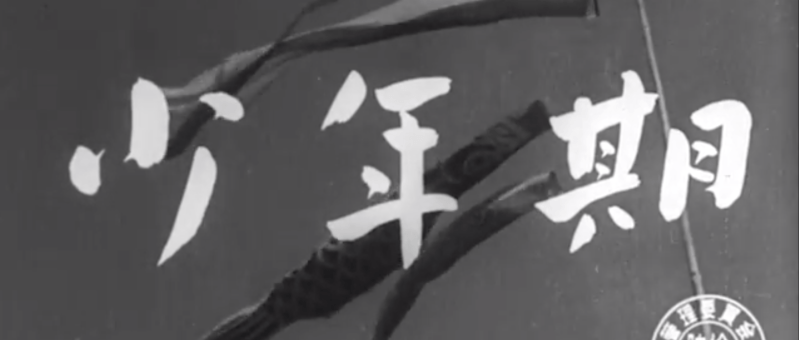
Title sequence and opening (no subtitles)

Something Like, Something Like It (の・ようなもの のようなもの, Taiichi Sugiyama, 2016)

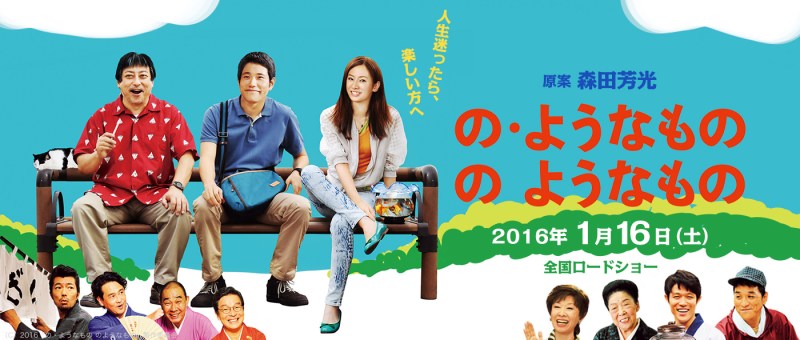
something like, something like it posterSadly passing away at the young age of 61 in 2011, Yoshimitsu Morita had been relatively prolific in his 25-year career, leaving behind him a hugely varied back catalogue that ran from zany idol movies to prestigious literary adaptations. His recurrent concerns, however, were relentlessly populist – he wanted to make films that ordinary people could enjoy which intensely reflected the time in which they were made. Five years after his death, one of his early ADs chose to pay tribute to his mentor by drawing inspiration from Morita’s 1981 feature debut, Something Like It. Something Like, Something Like It (の・ようなもの のようなもの, No Yona Mono no Yona Mono) brings the original cast back together with a few new faces from the late director’s more recent works to recreate yesterday’s pleasures for today’s audiences.

Our hero this time round is young Shinden (Kenichi Matsuyama). Well, he’s not really all that young despite being the lowest ranking rakugoka on the roster. Now 30 and beginning to lose hope, Shinden is a former salaryman well known for taking his time. Meanwhile, the 13th memorial service for the late master is fast approaching and the troupe’s patron has decreed she wants to see the return of an old friend – Shintoto (Katsunobu Ito) who abruptly disappeared right after the funeral. Seeing as Shinden is not so hot at rakugo, the other guys task him with tracking down Shintoto in the hope of convincing him to make a return to the stage so the patroness doesn’t decide to remove her patronage.

Rakugo – the traditional art of comic storytelling, is a rarefied affair. It requires extreme rigour from the performer in order to make often extremely familiar tales funny in all the right places. Shinden isn’t very good at it because he’s too stiff all over. Poor at reading social cues, he has an urge to point out tiny and embarrassing mistakes like a slightly frayed curtain or a wonky sign. He might not be best placed for finding and then convincing a sad old man to take back up the career he’d sworn to lay down. Nevertheless, once Shinden manages to find Shintoto and realises he’s made an extremely circular journey, he makes himself his disciple and commits himself to doing all Shintoho’s odd jobs in the hope he’ll finally finish the “Pop-Eyed Goldfish” routine that the patroness so wants to hear.

Taiichi Sugiyama* was an AD on Something Like It but is only making his own feature debut 25 years later. Reassembling the old cast, Sugiyama remains true to an old formula and his genial retro comedy certainly has an old fashioned quality right down to the cutesy jazz score which feels right out of the ‘80s. More modern additions come in the form of Kenichi Matsuyama (who starred in Morita’s final film, Train Brain Express) back on comedy form with a typically left of centre performance as the archetypal “cannot read the air” aspiring rakugoka whose tendency towards literalism as well as that to be distracted by minor imperfections threatens to ruin his career before it’s even really begun. That’s not to mention his nascent crush on his mentor’s daughter Yumi (Played by Keiko Kitagawa who made her feature debut in Morita’s Mamiya Brothers) and mild jealousy over the other various young and good looking men she seems to take an interest in.

Through getting closer to the now somewhat schlubby but basically good hearted Shintoto, Shinden learns to loosen up a bit and his Rakugo perhaps improves even if he also figures out when it’s best to make a sacrifice on someone else’s behalf. Shintoto too rediscovers his talent for comedy, if not the love. Morita never had much of a “signature” style – his films were in a sense tailor made to suit a particular purpose, but Sugiyama remains firmly within the world of early ‘80s comedy, allowing the everyday to brim with silliness as Shinden pursues his roundabout quest before coming quite literally full circle and then finding his feet again. A man pays tribute to his late mentor, mentors someone else, and then absents himself from the frame to let his pupil grow. One generation retreats and another rises – an age old story, but one that like a rakugo tale shines in the telling.


*IMDB and some other sites list his name as Yasukazu but according to the JFDB and Shochiku the official reading of his name is Taiichi.

Chinese release trailer (English & Traditional Chinese subtitles)

Woman of the Mist (朧夜の女, Heinosuke Gosho, 1936)

vlcsnap-2019-01-21-00h29m30s692The 1930s are often thought of as an era of social rigidity and implacable conservatism, yet even before the war things were changing. The young wanted something different than their parents often had and dared to dream of getting it even if their hopes were often dashed by the times in which they lived. Heinosuke Gosho’s Woman of the Mist (朧夜の女, Oboroyo no Onna) is the story of two youngsters who find themselves in a difficult situation and are offered a solution by elders acting kindness which they are persuaded to take only to find themselves progressively more miserable, burdened by the weight of the sacrifice their society has asked them to make.

Set in the jovial working class world of Shitamachi, Woman of the Mist opens with the hero of the tale, Fumikichi (Takeshi Sakamoto), enjoying a historical lecture regarding Edo era sacrifice for the common good during which his wife, Okiyo (Mitsuko Yoshikawa), comes to fetch him. Members of a local association he belongs to have come looking for him, it turns out for a favour. They want him to assist with some fundraising for a stone lantern to mark the association’s anniversary. Much to his wife’s exasperation, Fumikichi is only too happy to comply. It might seem that Fumikichi is a much respected pillar of the community only it is also true enough that he basks in the flattery of being regarded as someone to be depended upon and is therefore a soft touch (something undoubtedly well known to all around him).

Nevertheless, despite his slight tendency towards narcissistic attention seeking, Fumikichi is a salt of the earth type and willing to help those who need it for largely altruistic reasons. He therefore finds himself a surrogate father (though childless himself) to the son of his widowed sister Otoku (Choko Iida) who enlists him to talk some sense into his law student nephew, Seiichi (Shin Tokudaiji), who has apparently been “disrespecting” his mother and neglecting his studies by reading too many novels. Fumikichi has a word but counsels Seiichi that there’s nothing wrong with reading novels save that it obviously upsets his mum who has worked herself to the bone for the last 20 years dreaming of the day Seiichi becomes a fully fledged lawyer, which is to say a member of the middle classes.

Fumikichi, as he often will, becomes the conciliatory voice at the centre of generational conflict. Seiichi is a young man at the crossroads of life and finds himself torn between youthful idealism and a duty towards his family. He has become disillusioned with the law and would rather transfer to literature, secure in the knowledge that only in novels can you find the truly humane. Fumikichi is careful not to patronise but gives him a knowing look, realising that his confusion is partly born of resentment towards his well meaning yet accidentally possessive mother who has railroaded him into a career he doesn’t want to buy him a future which is her only dream. What he wants is control over his life, but when it comes to it he is still a boy and woefully unprepared for the demands of adulthood.

This becomes obvious when he falls in love and gets his girlfriend into trouble. Teruko (Toshiko Iizuka), a former geisha apparently known to Fumikichi in his younger days now working as a bar hostess, is not exactly the kind of wife his mother might have had in mind. The pair are careful to keep their relationship a secret for just this reason as Seiichi remains conflicted – one moment declaring that he no longer cares if everyone finds out and lying to his mother about her the next. Pregnancy forces the issue. Teruko, mindful of Seiichi’s bright future, declares that she can raise the child alone, glancing sadly at a picture of herself in her former life as a sex worker as if accepting what future sacrifices might be expected of her while half hoping Seiichi will rush forward to save her from such a fate. Seiichi doesn’t exactly rush but does tentatively accept his responsibility in reassuring her that he will soon come of age and is ready to become a father with all of the joys and obligations that entails.

Lost he turns to Fumikichi who hatches a plan which might be accounted a neat solution but is also another instance of the older generation making decisions on behalf of the young without really asking them. Despite being a rather feckless old man, Fumikichi tells his wife the child is his and asks for her forgiveness while also suggesting that they adopt the baby as their own. As expected, Okiyo is not exactly enthused but as Fumikichi calculated she would eventually comes around, ironically enough after a conversation with Otoku who has no idea the baby is really her grandchild. Once the decision is made, everyone rallies round to look after Teruko who finally becomes a (temporary) member of Seiichi’s family even whilst barred from ever becoming his wife and in fact of ever seeing him again as a result of the bargain which has been struck by Fumikichi. Nevertheless, Seiichi vacillates and attempts to change his mind by asking Teruko to marry him only for her to urge him to study hard and live well, sacrificing her happiness for his future.

Uncomfortably enough, it is Teruko who must pay for a series of transgressions against the norms of her society – for being a young woman with a past who seduced a nervous young man and dared to dream of a happier future with a person of her own choosing, though the very fact of her suffering is in itself an attack on these rigid and unfair social codes which do their best to destroy the happiness of ordinary, basically good people who have done nothing wrong other than attempt to live their lives. Fumikichi and his wife are doing their best and they too are good, compassionate people who have made good compassionate choices hoping for the best in a difficult situation even if their choices are defined by the prevailing conservative morality which places Seiichi’s future above a young woman’s life and love.

Then again, Fumikichi’s objections are largely practical – it’s hard to keep a family with no money coming in and Seiichi is still a student with no prospect of immediate employment that would pay enough for a wife and child. Could they be happy after a shotgun wedding and years of penury? Seiichi’s diffidence hints at no, but Teruko’s “purity” hints at yes as she vows to make the kind of sacrifice that proves her “goodness”. The youngsters find themselves beholden to the demands of their elders, torn between their personal desires and duties to those they love. Whatever they do, they lose and are destined to remain unhappy, unable to seize their individual chance of happiness in an oppressive, conformist society. Gosho may leave them at the mercy of such a system, but he does so with immense sympathy and not a little anger as we watch these good people making the best of things while asking ourselves if all of this is really for the best.


The Limit of Sleeping Beauty (リミット・オブ・スリーピング・ビューティー, Ken Ninomiya, 2017)

the limit of sleeping beauty posterCan you escape the past by evading it? The heroine of Ken Ninomiya’s The Limit of Sleeping Beauty (リミット・オブ・スリーピング・ビューティー) does her best to find out as she approaches the point at which she can no longer bear the weight of all her sorrows. A rising star of the Japanese indie scene, Ken Ninomiya had some minor festival exposure with his first film, post-apocalyptic cyberpunk drama Slum-polis, back in 2015 before making a complete about turn in releasing a terse mockumentary about a resilient actor hammering on the door of Japanese show business. Sleeping Beauty was, apparently, originally conceived as a mid-length picture before producers suggested expanding it into a full length feature and in many ways marries the twin concerns of Ninomiya’s earlier films in its high concept examination of a fracturing psyche unable to let the past go and move on from trauma and disappointment.

At 19, Aki (Yuki Sakurai) ran away from a bad family situation and ended up in Tokyo with the hope of becoming an actress. With nowhere else to go she wandered into a random bar which is where she met the love of her life, Kaito (Issey Takahashi) – a melancholy photographer and owner of cabaret club Aurora. Kaito takes her in and she begins working at Aurora as a magician’s assistant but ten years pass and, as a TV presenter later put it, it’s unheard of for a Japanese actress to make it in her 30s.

Her mind fracturing, Aki is often accompanied by “Butch” (Nino Furuhata), a strange clown with a scary white face who appears alternately supportive and enabling. Complaining that she feels unstuck in time, Butch reminds her that the idea of time as linear flow is a misconception and that all moments are indeed one moment which is one reason Aki never quite knows “when” she is. Accepting this fact she asks to be taken to the time at which she was happiest, only to be told that emotional time is not necessarily in sync with one’s perception of temporality. Nevertheless, her mind flies back to her first meeting with Kaito who we later surmise is no longer in her life but continues to define it all the same.

The picture we get of Aki is of a woman attempting to bury herself and her disappointments by revelling in a pleasant memory and then using it as raw material to read herself into an idealised version of her current life only one which is still marred by the tragedy of losing Kaito. Ninomiya opens with an orgy in dingy sex club where everyone is wearing creepy carnival masks and the older Aki is sporting a nasty bruise on her chin. The bruise, we later discover, was earned in a nasty encounter with a lascivious producer engineered by a soulless manager who promised her a career but in effect sold her to a man who assaulted and humiliated her. This final humiliation is only one of many acts of degradation that Aki suffers in her quest to make it as an actress – one of only two things Kaito urged her to do before disappearing from her life forever.

Unable to cope with the weight of lost love, defeated dreams, and a wasted youth Aki’s mind splinters into fragments, creating the strange entity known as Butch whom she seems to want to get rid of but cannot bear to be without. Aki’s quest is one of reintegration in which she must find the strength to put herself back together again and finally set light to the past, waking up from her self imposed slumber.

Kaito wants her to know the world is still wonderful, but his message seems curiously perverse considering his final course of action and Aki’s continuing descent into a spiral of depression, exploitation, and mental instability. Fantasy and reality remain hopelessly blurred, only gradually separating and becoming distinct as Aki begins to put herself back together. Ninomiya improves on Slum-Polis with similarly detailed production design and world building but occasionally allows his taste for music video aesthetics to slide into the indulgent with the success of such sequences depending on the viewer’s taste for the overused main titles song, Hummingbird by Kyla La Grange. Nevertheless there’s no disputing Ninomiya’s ambition and originality even if there is something unsettling in his urgency to inhabit the world he seems to be critiquing.


Original trailer (no subtitles)
The Garden of Women (女の園, Keisuke Kinoshita, 1954)

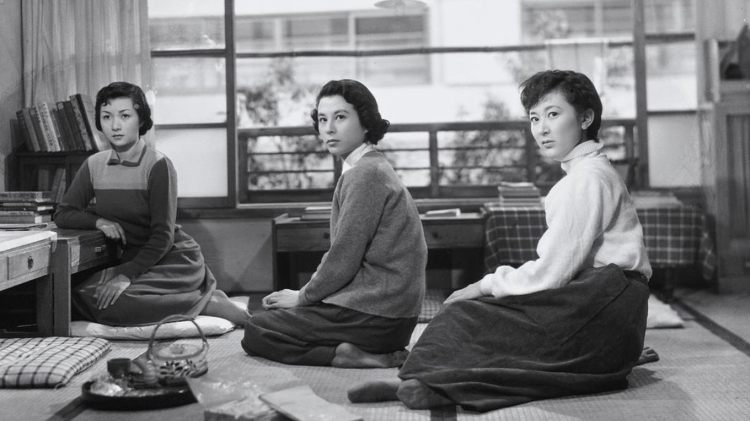
garden of women still 1Things changed after the war, but not as much as some might have hoped. Sadly still topical, Keisuke Kinoshita’s Garden of Women (女の園, Onna no Sono) takes aim both at persistent and oppressive patriarchal social structures and at a compromised educational system which, intentionally or otherwise, systematically stifles attempts at progressive social change. A short few years before student protests would plunge education into crisis, Kinoshita’s film asks why it is that the establishment finds itself in conflict with the prevailing moods of the time and discovers that youth intends to have its brighter future even if it has to fight for it all the way.

The setting is an exclusive private woman’s university in the elegant historical city of Kyoto. The ladies who attend this establishment are mostly from very wealthy families who have decided to educate their daughters at the college precisely because of its image of properness. As one student will later put it, there are two kinds of girls at the school – those who genuinely want to study in order to make an independent life for themselves and intend to look for work after graduation, and those who are merely adding to their accomplishments in order to hook a better class of husband. Everyone, however, is subject to a stringent set of rules which revolves around the formation of the ideal Japanese woman through strictly enforced “moral education” which runs to opening the girls’ private letters and informing their families of any “untoward” content, and requiring that permission be sought should the girls wish to attend “dances” or anything of that nature.

As might be expected, not all of the girls are fully compliant even if they superficially conform to the school’s rigid social code. Scolded for her “gaudy” hair ribbon on the first day of school, Tomiko (Keiko Kishi) rolls her eyes at the over the top regulations and enlists the aid of the other girls to cover for her when she stays out late with friends but her resistance is only passive and she has no real ideological objection towards the ethos of the school other than annoyance in being inconvenienced. Tomiko is therefore mildly irritated by the presence of the melancholy Yoshie (Hideko Takamine). Three years older, she’s come to college late and is struggling to keep up with classes but is, ironically enough, prevented from studying by the same school rules which insist she go to bed early.

Meanwhile, dorm mate Akiko (Yoshiko Kuga), from an extraordinarily wealthy and well connected family, is becoming increasingly opposed to the oppressive atmosphere at the school. However, as another already politically active student points out, Akiko’s background means there are absolutely no stakes for her in this fight. She has never suffered, and likely never will, because she always has been and always will be protected by her privilege. Fumie (Kazuko Yamamoto), a hardline socialist, doubts Akiko’s commitment to the cause, worrying that in the end she is only staging a minor protest against her family and will eventually drift away back to her world of ski lodges and summer houses. Despite her ardour, Akiko finds it hard to entirely dispute Fumie’s reasoning and is at constant battle with herself over her true feelings about the state of the modern world as it relates to herself individually and for women in general.

This is certainly a fiercely patriarchal society. Even though these women are in higher education, they are mostly there to perfect the feminine arts which are, in the main, domestic. They are not being prepared for the world of work or to become influential people in their own right, but merely to support husbands and sons as pillars of the rapidly declining social order that those who sent them there are desperate to preserve. For many of the girls, however, times are changing though more for some than others. Tomiko rolls her eyes and does as she pleases, within reason, and even if she eventually wants to see things change at the school it is mostly for her own benefit. She sees no sense in Akiko’s desire for reform as a stepping stone to wider social change, and perhaps even fears the kinds of changes that Akiko and Fumie are seeking.

Akiko and Fumie, and to an extent, Tomiko, seem to have a degree of agency that others do not as seen in the tragic story of Yoshie whose life has been largely ruined thanks to the selfish and heartless actions of her father. From a comparatively less wealthy family, Yoshie worked in a bank for three years during which time she met and fell in love with an earnest young man named Shimoda (Takahiro Tamura). However, her father, having become moderately successful, developed an appetite for social climbing and is determined she marry “well” to increase his own sense of superiority as a fully fledged member of the middle classes. He sees his daughter as nothing more than a tool or extension of himself and cares nothing for her thoughts or feelings. In order to resist his demands for an arranged marriage, Yoshie enrolled in school and is desperate to stay long enough for Shimoda to finish his education so they can marry.

Yoshie is trapped at every turn – she cannot rely on her family, she cannot simply leave them, she cannot yet marry, if she leaves the school she will be reliant on a man who effectively intends to sell her, but her life here is miserable and there is no one who can help her. All she receives from the educational establishment is censure and the instruction to buck up or get kicked out. She feels herself a burden to the other girls who regard her as dim and out of place thanks to their relatively minor age gap and cannot fully comprehend her sense of anxiety and frustration.

Finally standing up to the uncomfortably fascistic school board the girls band together to demand freedoms both academic and social, insisting that there can be no education without liberty, but the old ways die hard as they discover most care only for appearances, neatly shifting the blame onto others in order to support their cause. “Why must we suffer so?” Yoshie decries at a particularly low point as she laments her impossible circumstances. Why indeed. The oppressive stricture of the old regime may eventually cause its demise but it intends to fight back by doubling down and the fight for freedom will be a long one even if youth intends to stand firm.


Titles and opening scene (no subtitles)

Actress vs. Greedy Sharks (小判鮫 お役者仁義, Tadashi Sawashima, 1966)

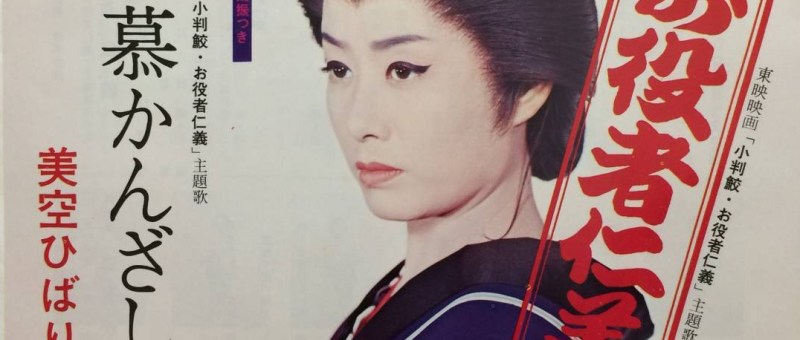
actress vs greedy sharks soundtrack albumA studio director at Toei, Tadashi Sawashima is best remembered for his work in the studio’s ninkyo eiga genre – prewar tales of noble gangsters, and samurai movies but he also made the occasional foray into the world of musical drama, teaming up with top name singing star Hibari Misora on a few of her historical action musicals. In 1966’s Actress vs. Greedy Sharks (小判鮫 お役者仁義, Kobanzame Oyakusha Jingi) Hibari once again plays a dual role though this time her casting is entirely arbitrary and the visual similarity of the legit actress and the acrobatic outlaw is never explicitly remarked upon.

The action opens with Shichi (Hibari Misora), an acrobat and member of a Robin Hood style band of outlaws (they don’t so much give to the poor as “share” with the less fortunate) interrupting the plot of Yamitaro (Yoichi Hayashi) – a nobleman in disguise to pursue revenge against corrupt lord Doi (Eitaro Shindo) who exiled his father to Convict Island when he began to raise questions about judicial corruption. Meanwhile, Yuki (also played by Hibari) is a top stage actress who is plotting against Doi for sending her father to Convict Island 20 years previously on a trumped up charge. Just as the “tomboyish” Shichi is beginning to fall for the mysterious Yamitaro, he teams up with Yuki to pursue their mutual quests for revenge which has Shichi feeling (needlessly, as it turns out) betrayed and vengeful.

Once again, the samurai order is shown to be corrupt beyond redemption. Doi, a greedy lord, is planning to sell off his only daughter, Ran (Yumiko Nogawa), as a concubine to the shogun. Meanwhile, he is also engaging in a rice profiteering scheme in order to bolster his financial resources. He is also still misusing his influence, just as he did when he had Yuki’s father sent to prison and got rid of Yamitaro’s so he couldn’t expose him.

As in her other movies, Hibari cannot allow this corruption to continue and becomes a thorn in the side of authority. However, the situation this time around is further complicated by her double casting in which she plays two visually identical characters who are, nevertheless, entirely unrelated and the resemblance between them entirely unremarked upon. The “tomboyish” Shichi, apparently falling in love for the first time much to the confusion of herself and others who regarded her lack of traditional femininity as a barrier to romance, becomes awkwardly resentful of the graceful Yuki whose charms she assumes will sway the handsome Yamitaro. Shichi does not seem to consider a class barrier between herself and Yamitaro as a problem but fears his natural affinity with a woman she perceives as superior to herself in her refinement, yet Yuki proves herself as staunch a fighter as Shichi and just as feisty. She appears to have little romantic interest in Yamitaro even if she resents Shichi’s rather blunt instructions to back off, and aside from concentrating on her revenge, spends the rest of the film dealing with the rescue of Doi’s daughter Ran who has drawn inspiration from her stage performances to rebel against her cruel fate and father.

Ran is just another symptom of her father’s corruption in his obvious disregard for her feelings as he prepares to send her off as a concubine to buy himself influence with only the mild justification that her ascendence to the imperial court is an honour even if she will never be a wife, only one of many mistresses. Unlike Ran, Yuki and Shichi have managed to seize their own agency, living more or less independently and as freely as possible within the society they inhabit. Experiencing differing kinds of bad luck and betrayal, they find themselves at odds with each other yet on parallel paths despite their obvious dualities.

With less space for song, Hibari’s dual casting does at least offer twice the fight potential as the outlaw and the actress finally find themselves on the same side to tackle the persistent injustice of Edo era society as manifested in the corrupt Doi and his slimy cronies gearing up for the mass brawl finale in which the wronged take their revenge on the wicked lord by proving him a villain in the public square and earning themselves not a little social kudos in the process. All of which makes the strangely melancholy ending exiling one aspect of Hibari to the outer reaches somewhat uncomfortable but then it does provide an excuse for another song.


Hibari’s musical numbers

Honey and Clover (ハチミツとクローバー, Masahiro Takada, 2006)

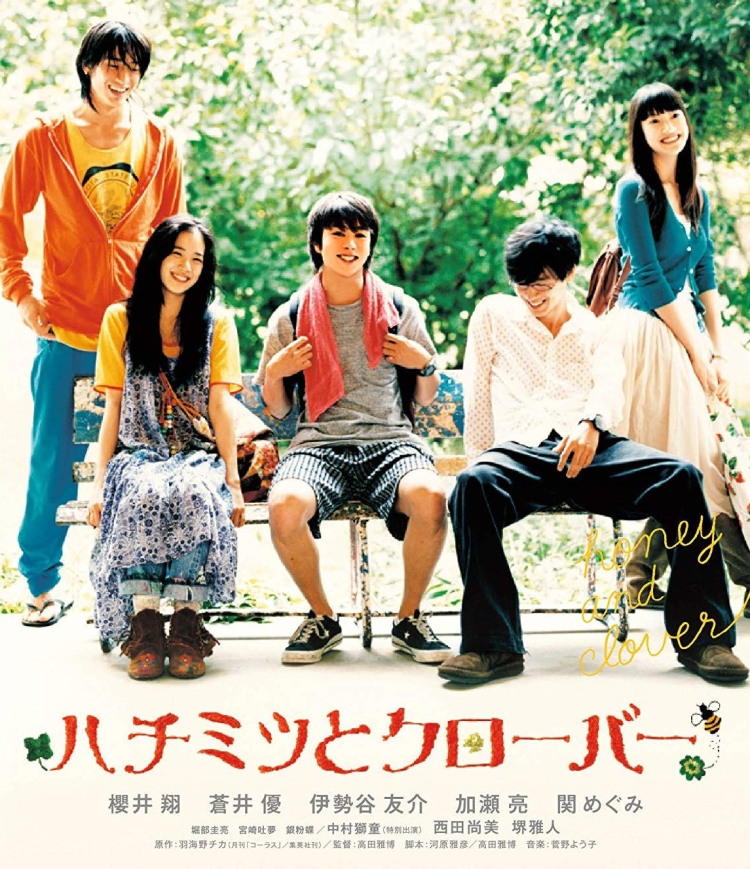
honey and clover blu-rayAh youth! Chica Umino’s phenomenally popular manga Honey and Clover (ハチミツとクローバー, Hachimitsu to Clover) is, essentially, a coming of age story in which love, requited and otherwise, plays a significant part. Masahiro Takada’s adaptation is no different in this respect as its central group of friends learn to come into themselves through various different kinds of heart break leading to soul searching and eventual self actualisation. The path to adulthood is rocky and strewn with anxieties, but has its own charms as our self branded Mr. Youth seems to have figured out, romanticising his own adolescence even while he lives it.

The action kicks off at an art college in Tokyo where a circle of friends is temporarily shaken by the arrival of a new student – a distant relative of a popular professor, Hanamoto (Masato Sakai). Our youth loving hero, Takemoto (Sho Sakurai), falls instantly in love with Hagu (Yu Aoi) – a genius self-taught painter with a dreamy, ethereal personality and negligible interpersonal skills. Hagu, however, seems to have developed a strange connection with conceited sculptor Morita (Yusuke Iseya) who continues to struggle with his conflicting interests in art and commerce. Meanwhile, geeky design student Mayama (Ryo Kase) has a problematic crush on his boss, Rika (Naomi Nishida), whose husband went missing some years ago, and has begun semi-stalking her. Unbeknownst to him, Mayama is also being semi-stalked by Yamada (Megumi Seki) – a spiky ceramicist who refuses to give up on her unrequited crush despite being fully aware of his one sided love for a brokenhearted middle-aged woman.

In actuality all of our protagonists are a little older than one might assume – all past the regular age for graduating college and either hanging around after being unable to complete their studies or pursuing additional training in the hope of furthering their art. They are all also hopelessly lost in terms of figuring out who they are – perhaps why they haven’t quite got a handle on their art, either. Hagu, younger than the others, seems to have an additional problem in existing outside of the mainstream, experiencing difficulties with communication and needing some additional help to get into the swing of college life. Perhaps for this reason, maverick professor Hanamoto palms her off on the “least arty” (read “most responsible”) of his students, Takemoto, who is tasked with accompanying her for meals – something for which he is quite grateful given his first brush with love on catching sight of her at her easel.

Hagu is also, however, the most sensitive and perceptive of the students even if she can only truly express herself through canvas. Her most instantaneous connection is with Morita, whose instinctive approach perhaps most closely mirrors her own though where Hagu is quiet and soulful, Morita is loud and impetuous. Watching him creating his centrepiece sculpture, Hagu is honest enough to tell Morita that he’s overdone it. Morita agrees but ends up exhibiting the piece anyway and not only that – he sells it for a serious amount of money despite knowing that it lacks artistic integrity. Hagu is unimpressed and her disapproval only adds to Morita’s sense of self loathing in his ambivalence towards to the fleeting rewards of superficial success versus the creation of artistic truth.

A similar sense of ambivalence imbues the romantic difficulties which neatly divide the group into a series of concentric love triangles. Takemoto, the selfless hero, realises the best thing he can do for Hagu is try to help Morita be less of a self-centred idiot while simultaneously dwelling on his fleeting youth and actively pursuing himself while debating whether or not to hit the road and leave his lovelorn friends to it. Mayama and Yamada, by contrast, are content to dance around each other, understanding the irony of their respective unreturned crushes while not quite bonding over them but both determined not to give up on their dreams (romantic and professional).

Despite the central positioning of our shy hero as he walks towards the end goal of being able to state his feelings plainly, the drama revolves around the enigmatic Hagu whose descent into an intense depression after an ill-advised moment on a beach is only eased by the careful attentions of her new friends finally realising that their artistic souls benefit from compassion for others rather than remaining solipsistically obsessed with their own romantic heartbreak. Despite its noble intentions, Honey and Clover misses the mark in charting the heady days of youth though our confused heroes do eventually manage to find themselves and each other along the road to adulthood as they chase down disappointments romantic and professional and discover what is they really want in the process.


Original trailer (no subtitles)

Woman in Witness Protection (マルタイの女, Juzo Itami, 1997)

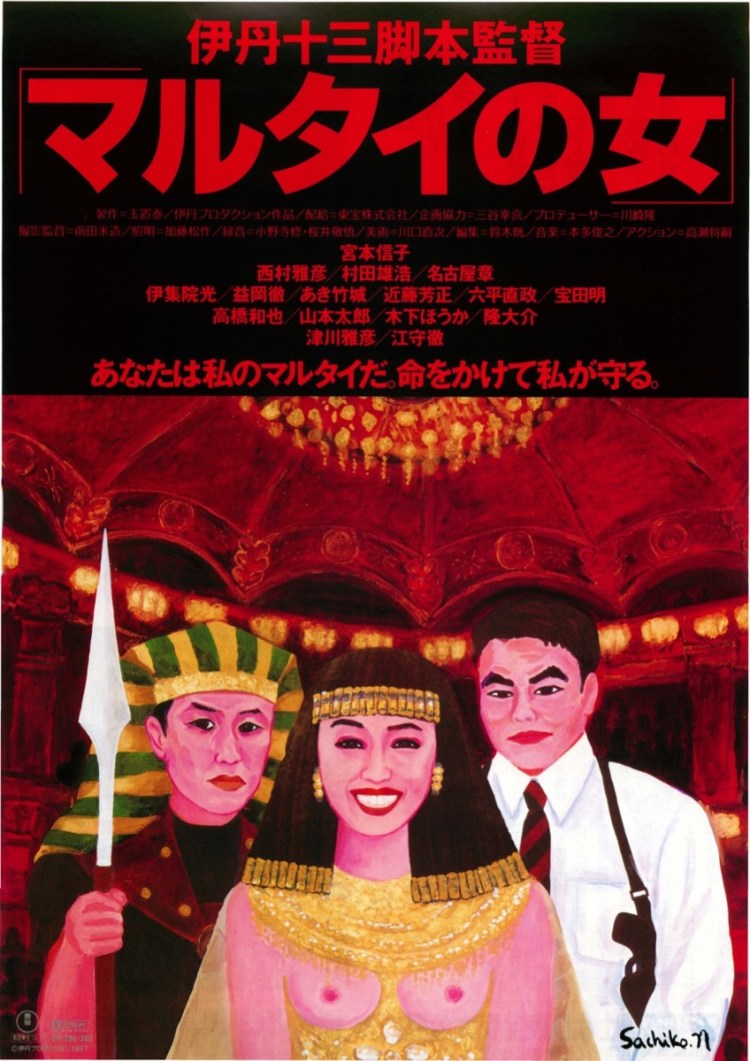
woman in witness protection posterJuzo Itami’s fearless taste for sending up the contradictions and hypocrisies of his home nation knew no bounds, eventually bringing him into conflict with the very forces he assumed so secure it was safe to mock – his 1992 film Minbo led to brutal attack by a gang of yakuza unhappy with how his film portrayed the world of organised crime. Woman in Witness Protection (マルタイの女, Marutai no Onna), continuing the “Woman” theme from previous hits A Taxing Woman and the more recent Supermarket Woman, would be Itami’s final feature as he died in mysterious circumstances not long after its completion and like Minbo it touched an open nerve. In 1997, crazy cult violence was perhaps no laughing matter nor as ridiculous as it might have seemed a few years earlier, yet Itami makes the actions of brainwashed conspirators the primary motivator of a self-centred actress’ gradual progress towards accepting the very thing his previous films might have satirised – her civic duty as a Japanese woman.

Itami breaks the film into a series of vignettes bookended by title cards beginning with the first which introduces us to our leading lady – Biwako Isono (Nobuko Miyamoto). Biwako is currently in rehearsals for an avant-garde play about giving birth (“a woman’s moment of glory”) during which she reduces her assistant to tears prompting her resignation, decrying Biwako’s self-centred bitchiness as she goes. Chastened, Biwako spends the evening doing vocal exercises outside her apartment which is how she comes to witness the botched murder of a lawyer by a crazed cultist (Kazuya Takahashi) during which she is almost murdered herself and only survives because the killer’s gun jams. As the only witness Biwako suddenly becomes important to the police which works well with her general need for attention but less so with her loathing for hassle. Seeing as Biwako is a famous actress, her involvement also precipitates increased press interest for the murder and accidentally threatens the ongoing police investigation not least because Biwako likes to play up for the camera and isn’t quite sure how best to deal with her divided responsibilities. With the killer still at large, the police decide to give Biwako protection in the form of two detectives – Chikamatsu (Yuji Murata), a cultured man who’s a big fan of Biwako’s stage career, and Tachibana (Masahiko Nishimura), a rather stiff gentleman who never watches films and rarely indulges in entertainment.

Bringing up cult violence in 1997 just two years after Japan’s only real terrorist incident perpetrated by a crazed cult, might be thought taboo but taboo was not something that Itami had ever run away from. Crazed cults had also popped up during A Taxing Woman’s Return though back then they mostly represented the hypocrisy of the new yakuza as a front for organised crime that thought nothing of bleeding vulnerable people dry while feeding them a lot of semi-religious claptrap to make them feel a part of something bigger while the bubble economy continued its puffed up attempts to make them feel inadequate. This time around our cultists are less well drawn but clearly a collection of unlucky people duped into believing the strange philosophies of the “Sheep of Truth” which teach that the world can only be saved by its followers dividing the world into white sheep and black sheep. Like the policeman and later Biwako, the killer believes he is only doing “that which must be done” in the best interests of the world. He is unaware of the cult’s shadiness and shocked when their lawyer threatens his family in an effort to convince him not to talk once the police have managed to break his programming, ironically through exactly the same methods – manipulating his feelings towards his wife and son.

The cult is however merely background to Biwako’s ongoing character drama. Despite experiencing emotional trauma from witnessing a murder and then being threatened herself, Biwako enjoys being the centre of the attention with the police as well as the warm glow she feels in being able to help them with their enquiries, but balks at the additional hassle of having to be involved in the trial (even if she would be given quite a sizeable platform as a witness in a high profile court case). She resents having the two policemen follow her around – especially as she has quite a busy schedule which includes an affair with her married manager. Nevertheless she gradually allows them into her life with Tachibana even making his stage debut as spear carrier in a production of Anthony and Cleopatra. Tachibana’s steadfast defence of her person even at the risk of his own life begins to teach Biwako a few things about civic responsibility and the importance of duty, even if her final moment of realisation is another of her staged set pieces in which she conjures a poignant monologue from the accidentally profound mutterings of Tachibana, a little of Cleopatra, and the earlier line from the maternity play repurposed as she affirms that testifying against the cultists will be her “moment of glory”.

Rather than end on Biwako’s sudden moment of enlightenment, Itami cuts to an ironic epilogue in which a police detective watching the movie we have just seen complains about its authenticity while emphasising that no one in protective custody has ever been attacked. A little tongue in cheek humour from Itami that is followed by the more usual disclaimer before the credits resume, but perhaps anticipating another dose of controversy from both law enforcement and cult devotees. Lighter in tone and noticeably less surreal than some of Itami’s earlier work, Woman in Witness Protection is the story of a vacuous actress learning the purpose of her stage as her particular brand of artifice meets that of the less innocently self-centred cultists head on and eventually becomes the best weapon against it.


Original trailer (no subtitles)