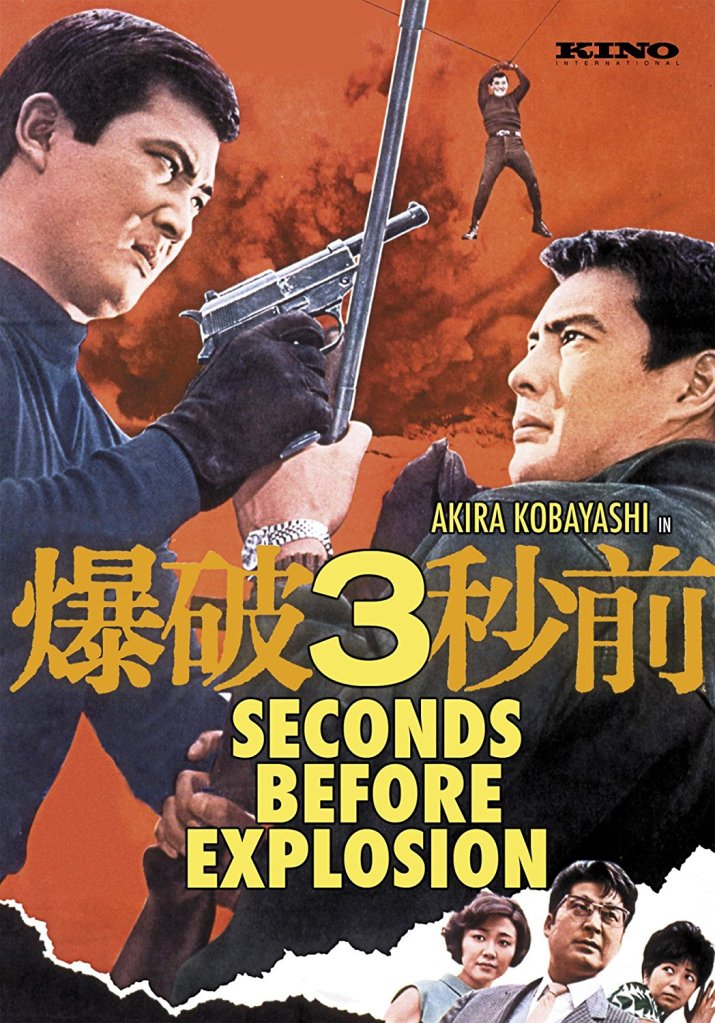
3 Seconds Before Explosion (爆破3秒前, Motomu Ida, 1967)

three-minutes-before-explosionIf Nikkatsu Action movies had a ringtone it would probably just be “BANG!” but nevertheless you’ll have to wait more than three rings for the Kaboom! in the admittedly cartoonish slice of typically frivolous B-movie thrills that is 3 Seconds Before Explosion (爆破3秒前, Bakuha 3-byo Mae). Once again based on a novel by Japan’s master of the hard boiled Haruhiko Oyabu, 3 Seconds Before Explosion is among his sillier works though lesser known director Motomu Ida never takes as much delight in making mischief as his studio mate Seijun Suzuki. What he does do is make use of Diamond Guy Akira Kobayashi’s boyish earnestness to keep things running along nicely even if he’s out of the picture for much of the action.

Like most of the more outlandish Nikkatsu action fests, 3 Seconds Before Explosion has a complicated relationship with narrative but we begin with former boxer Yabuki (Akira Kobayashi) in the middle of being brainwashed with flashing lights and high pitched noises until he agrees to become a shady government (?) assassin. Perhaps in an effort to save our sanities too, he relents and his first job is ensuring some jewels which were stolen during in the war don’t get into the hands of an evil nazi who will presumably be wanting them for evil nazi business. Anyway, Yabuki does his ninja stuff and thinks he’s tracked the jewels down but runs into a former colleague, Yamawaki (Hideki Takahashi), who is working for a businessman who already has the jewels and wants to keep them. Yamawaki quit being a super spy because he fell in love, which Yabuki thinks is a bit lame but still knows his friend has right stuff and would rather not have to kill him or anything.

Somewhere between the less serious yakuza/gang movies Nikkatsu were making in the late ’60s and a spy spoof, 3 Seconds Before Explosion has its fair share of oddness from strangled dogs to the mini Chinese theme in which one of the henchmen, Yang, wanders around in traditional Chinese garb while another girl at the club enjoys flirting in Mandarin for no apparent reason. It also goes without saying that the evil Nazi is played by an American spouting unconvincing German whilst chewing the scenery to a pulp. Realism is not where we are, but there’s something a little old fashioned about the way Ida chooses to stage his weirdness even if the film is filled with crazy contemporary youth touches such as in the achingly hip Club Casba.

The interpersonal drama comes as Yabuki and Yamawaki face off about their life choices much more than the case at hand. Yamawaki grew tired of the spy life and decided to leave it behind for his lady love, only to get mixed up in all of these petty gangster shenanigans. Still, if he can keep Yabuki away from the jewels until the time limit he’ll be free forever. Nothing is really said about Yabuki’s brainwashing at the beginning of the film, but Yamawaki’s choice does seem to prompt him into a consideration of his own lifestyle. That said, life as a government assassin doesn’t seem so bad – Yabuki doesn’t even really kill people much, just spends his life sneaking into places and leaping heroically between rooftops whilst making use of clever gadgets to evade his foes. The gangsters, however, are pretty evil and keep killing people after claiming to let them go which offends Yabuki’s sense of honour.

Yabuki may not kill, but the film does seem to make a point of killing off all the female characters in case they get in the way of the manly stuff like fighting and making bombs. An innocent kidnapped secretary who had nothing to do with anything is machine gunned down, another girl is murdered by the evil Nazi, and a final one gets marched into a mine field by her boyfriend before returning for revenge and getting unceremoniously taken down anyway. To lose one woman is careless but to kill off (all) three in a short time seems a step too far or perhaps too “realistic” for this otherwise cartoonish approach to violence.

Lacking the visual flair of other Nikkatsu efforts, 3 Seconds to Explosion is never as exciting as its title promises. Despite the athletic displays of the slightly bulkier Kobayashi, there’s a kind of clumsiness to the action and a straightforwardness in approach which does not gel with the ridiculousness of the premise. On lower end of Nikkatsu’s B-movie output, 3 Seconds to Explosion does not stint on the silliness but could do with enjoying itself a little more rather than trying to corral its non-sensical plot into something with serious intent.
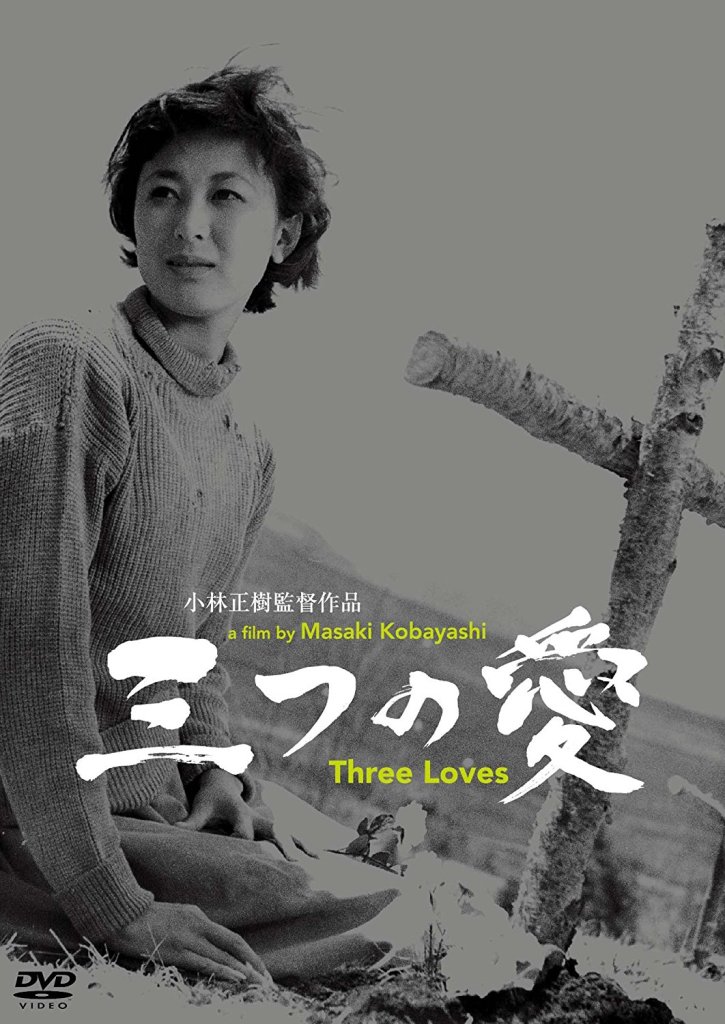


Three Loves (三つの愛, Masaki Kobayashi, 1954)

three-lovesMasaki Kobayashi had a relatively short career of only 22 films. Politically uncompromising and displaying an unflinching eye towards Japan’s recent history, his work was not always welcomed by studio bosses (or, at times, audiences). Beginning his post-war career as an assistant to Keisuke Kinoshita, Kobayashi’s first few films are perhaps closer to the veteran director’s trademark melodrama but in 1953 Kobayashi struck out with a more personal project in the form of The Thick-Walled Room which dealt with the fates of lower class war criminals. Based on a novel by Kobo Abe, the film was sympathetic to the men who had only been “following orders” but was careful not to let them off the hook. Still far too controversial, The Thick-Walled Room could not be released until 1957 and Kobayashi went back to more conventional fare such as this Christianity infused tale of three kinds of frustrated loves – romantic, spiritual, and familial, Three Loves (三つの愛, Mittsu no Ai).
Ikujiro is riding into town on a donkey cart, playing his flute which attracts the attention of a strange boy who exclaims that he is a butterfly. Following the death of his father, Ikujiro’s mother has apprenticed him to a man who owns a sake brewery but is also a member of the school board and has promised that he will get his education. Riding the same cart in is a down on his luck artist, Nobuyuki (Ko Mishima) – the lover of the town’s new music teacher, Michiko (Keiko Kishi), who has travelled to this remote country spot both for the benefit of her health and to help provide for her struggling artist boyfriend. This slightly unusual town is also home to a humble church whose Holy Father, Yasugi (Yunosuke Ito), came to the town as an evacuee alongside the now professor father of the little boy with a pigeon obsession, Heita.

Somewhat unusually, Three Loves opens with a choral rendition of a Christian hymn followed by a brief voice over and intertitle-style caption bearing the message that only those who live sincerely and seriously will be granted true joy but that this same joy is born from the bitterness and sadness of life. There are certainly an array of bitter circumstances on offer but Kobayashi choses to focus on them as filtered through three very different stories of love as children are separated from their parents, lovers are kept apart by cruel twists of fate and the love of God is both keenly and invisibly felt by those who take refuge at the underused church.

Ikujiro has been “sent away” by his mother who has been convinced to allow her oldest child to be raised by foster parents given that it will now be difficult for her to support all of the children in the absence of her husband. Feeling alone and unloved though missing his family, Ikujiro does not quite fit in at the local school but faces even more problems at his new home where it transpires that his foster father is not quite as altruistic as he originally claimed. Forming an odd friendship with Heita, Ikujiro begins to find some comfort in the place but nevertheless continues to suffer.

Heita, is, in many ways the heart of the film though his status as a kind of holy fool is perhaps uncomfortable from a modern standpoint. Yasugi, who has developed the closest relationship with the boy outside of his mother, describes him as beautifully sensitive and someone who requires especial care. Yet, his mother found it difficult to connect with him until he was allowed to return to nature, and his scholarly father mostly ignores him, describing his work as a kind of “atonement” for the way his son has turned out. Even given Heita’s unorthodox relationship to his environment in which he feels himself more bird or butterfly than human, he experiences only warmth and occasional exasperation from those around him rather than outright hostility.

These kinds of frustrated familial or social loves feed back into the intertwined romantic melodrama as tortured artist Nobuyuki has an attack of male pride in partially rejecting Michiko over her decision to become the major breadwinner despite her failing health. Professing love but remaining unwilling to marry because of his lack of financial security, he only wounds the woman he loves who wants nothing other than for him to go on painting and thinks of what he regards as a “sacrifice” of herself in working to support them both as part of their shared struggle. Becoming gloomy and depressed, Nobuyuki posits giving up on love, but eventually comes around, realising some things are more important than pride though old fashioned ideas about illness still pose a problem.

This in turn drives the central spiritual dilemma as Father Yasugi is forced to face his own emotional pain which he has long been trying to sublimate with service to something higher. Ten years previously, his wife left him for another man but his continuing love for her is the very reason he cannot bring himself to do what his own religion requires and forgive her for the pain and suffering which now cloud his heart. God is love, but love is pain and suffering without end. Thus he councils the romantically troubled couple against a marriage which may end suddenly creating even more heartbreak and everlasting sadness, which seems at odds with his own, and the film’s, insistence on the joy that life brings even whilst filled with sorrow and regret.

An early effort from Kobayashi, Three Loves is not as successful as his other work from the period offering none of the rawness or innovation of The Thick-walled Room, falling back on established melodrama techniques though making interesting use of montages and dissolves even if coupled with familiar horizontal wipes. The tone is more forgiving than Kobayashi’s later angry social tirades, but the muddled structure and strange use of religious themes make for a frustrating experience which ends in a traditionally melodramatic way offered abruptly and without further comment. A death of innocence may be Kobayashi’s concession to his own bleaker world view but feels like a standard Shochiku tearjerker ending, an afterthought tacked on as a concession to studio requirements. Still, an interesting meditation on the nature of love in all its different forms, Three Loves is an unusually contemplative piece even if frustrated by a slight clumsiness of execution.


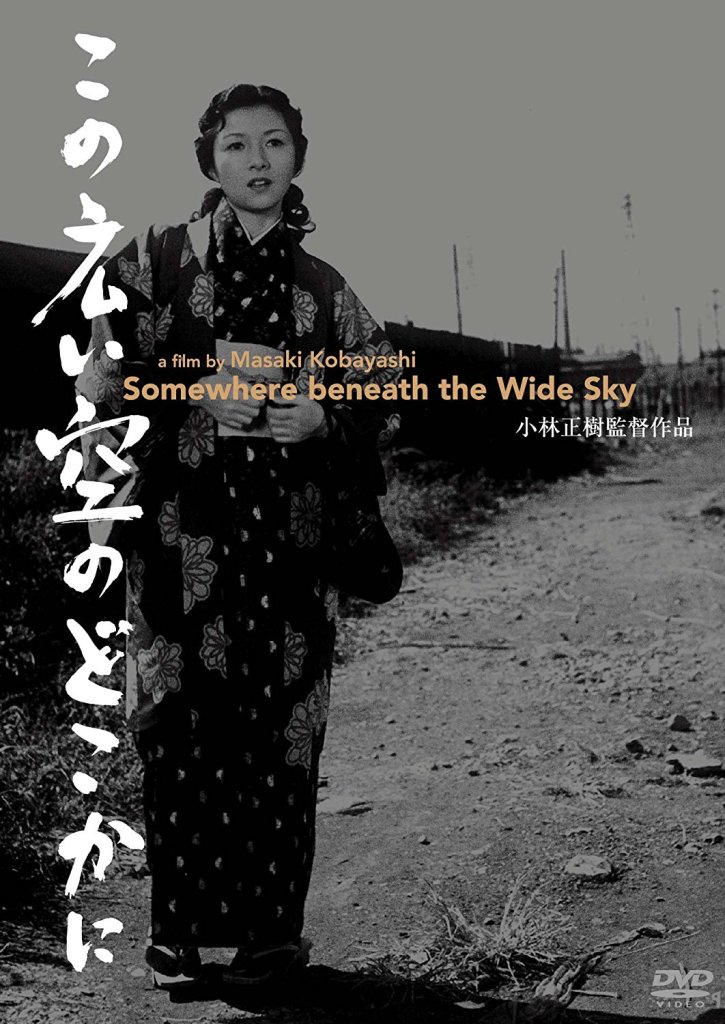
Somewhere Beneath the Wide Sky (この広い空のどこかに, Masaki Kobayashi, 1954)

somewhere-beneath-the-wide-skyOf the chroniclers of the history of post-war Japan, none was perhaps as unflinching as Masaki Kobayashi. However, everyone has to start somewhere and as a junior director at Shochiku where he began as an assistant to Keisuke Kinoshita, Kobayashi was obliged to make his share of regular studio pictures. This was even truer following his attempt at a more personal project – Thick Walled Room, which dealt with the controversial subject of class C war criminals and was deemed so problematic that it lingered on the shelves for quite some time. Made the same year as the somewhat similar Three Loves, Somewhere Beneath the Wide Sky (この広い空のどこかに, Kono Hiroi Sora no Dokoka ni) is a fairly typical contemporary drama of ordinary people attempting to live in the new and ever changing post-war world, yet it also subtly hints at Kobayashi’s ongoing humanist preoccupations in its conflict between the idealistic young student Noboru and his practically minded (yet kind hearted) older brother.

The Moritas own the liquor store in this tiny corner of Ginza, where oldest brother Ryoichi (Keiji Sada) has recently married country girl Hiroko (Yoshiko Kuga). The household consists of mother-in-law Shige (Kumeko Urabe), step-mother to Ryoichi, unmarried sister Yasuko (Hideko Takamine), and student younger brother Noboru (Akira Ishihama). Things are actually going pretty well for the family, they aren’t rich but the store is prospering and they’re mostly happy enough – except when they aren’t. Ryoichi married for love, but his step-mother and sister aren’t always as convinced by his choice as he is, despite Hiroko’s friendly nature and constant attempts to fit in.

As if to signal the dividing wall between the generations, Somewhere Beneath the Wide Sky opens with a discussion between two older women, each complaining about their daughters-in-law and the fact that their sons married for love rather than agreeing to an arranged marriage as was common in their day. These love matches, they claim, have unbalanced the family dynamic, giving the new wife undue powers against the matriarchal figure of the mother-in-law. While the other woman’s main complaint is that her son’s wife is absent minded and bossy, Shige seems to have little to complain about bar Hiroko’s slow progress with becoming used to the runnings of the shop.

Despite this, both women appear somewhat hostile towards Ryoichi’s new wife, often making her new home an uncomfortable place for her to be. Though Hiroko is keen to pitch in with the shop and the housework, Shige often refuses her help and is preoccupied with trying to get the depressed Yasuko to do her fair share instead. At 28 years old, Yasuko has resigned herself to a life of single suffering, believing it will now be impossible for her to make a good a match. Yasuko had been engaged to a man she loved before the war but when he returned and discovered that she now walks with a pronounced limp following an injury during an air raid, he left her flat with a broken heart. Embittered and having internalised intense shame over her physical disability, Yasuko finds the figure of her new sister-in-law a difficult reminder of the life she will never have.

A crisis approaches when an old friend (and perhaps former flame) arrives from Hiroko’s hometown and raises the prospect of abandoning her young marriage to return home instead. No matter how her new relatives make her feel, Hiroko is very much in love with Ryoichi and has no desire to leave him. Thankfully, Ryoichi is a kind and understanding man who can see how difficult the other women in the house are making things for his new wife and is willing to be patient and trust Hiroko to make what she feels is the right decision.

Ryoichi’s talent for tolerance is seemingly infinite in his desire to run a harmonious household. However, he, unlike younger brother Noboru, is of a slightly older generation with a practical mindset rather than an idealistic one. Ryoichi simply wants to prosper and ensure a happy and healthy life for himself and his family. This doesn’t mean he’s averse to helping others and is actually a very kind and decent person, but he is quick to point out that he needs to help himself first. Thus he comes into conflict with little brother Noburu from whom the film’s title comes.

Noburu is a dreamer, apt to look up at the wide sky as symbol of his boundless dreams. His fortunes are contrasted with the far less fortunate fellow student Mitsui (Masami Taura), who comes from a much less prosperous and harmonious family, finding himself working five different jobs just to eat twice a day and study when he can. Noburu wants to believe in a brighter world where things like his sister’s disability would be irrelevant and something could be done to help people like Mitsui who are struggling to get by when others have it so good. Ryoichi thinks this is all very well, but it’s pie in the sky thinking and when push comes to shove you have to respect “the natural order of things”. Ryoichi wants to work within the system and even prosper by it, where as Noburu, perhaps like Kobayashi himself, would prefer that the “natural order of things” became an obsolete way of thinking.

Nevertheless, it is the power of kindness which cures all. Gloomy Yasuko begins to live again after re-encountering an old school friend and being able to help her when she is most in of need of it. Being of use after all helps her put thoughts of her disability to the back of her mind and so, after hiding from a man who’d loved her in the past out of fearing his reaction to her current state (and overhearing his general indifference on hearing of it), she makes the bold decision to strike out for love and the chance of happiness in the beautiful, yet challenging, mountain environment.

Like many films of the era, Somewhere Beneath the Wide Sky is invested in demonstrating that life may be hard at times, but it will get better and the important thing is to find happiness wherever it presents itself. This is not quite the message Kobayashi was keen on delivering in his subsequent career which calls for a more circumspect examination of contemporary society along with a need for greater personal responsibility for creating a kinder, fairer and more honest one. A much more straightforward exercise, Somewhere Beneath the Wide Sky is Kobayashi channeling Kinoshita but minimising his sentimentality. Nevertheless, it does present a warm tale of a family finally coming together as its central couple prepares to pick up the reins and ride on into the sometimes difficult but also full of possibility post-war world.


A Silent Voice (聲の形, Naoko Yamada, 2016)

silent-voiceChildren – not always the most tolerant bunch. For every kind and innocent film in which youngsters band together to overcome their differences and head off on a grand world saving mission, there are a fair few in which all of the other kids gang up on the one who doesn’t quite fit in. Given Japan’s generally conformist outlook, this phenomenon is all the more pronounced and you only have to look back to the filmography of famously child friendly director Hiroshi Shimizu to discover a dozen tales of broken hearted children suddenly finding that their friends just won’t play with them anymore. Where A Silent Voice (聲の形, Koe no Katachi) differs is in its gentle acceptance that the bully is also a victim, capable of redemption but requiring both external and internal forgiveness.
Classmates Shoko (Saori Hayami) and Shoya (Miyu Irino/Mayu Matsuoka) are almost mirror images of each other, sharing the first syllable of their names (at least phonetically) but representing two entirely opposite poles. Before Shoko transferred into his school, Shoya was the class clown, behaving disruptively and acting as the leader of a group of mean kids who, if not exactly bullies, certainly exert a degree of superiority over their meeker classmates. Shoko, hard of hearing, remains necessarily quiet, communicating through messages written on a notepad. Though some of the other pupils are fascinated by the novelty of someone like Shoko suddenly appearing, delighting in writing messages back and for and eagerly embracing the opportunity to learn sign language in order to communicate with her more easily, the mean kids, with Shoya as the ringleader, delight in making her life a misery just because they can.

Though some of the other children object to the way Shoya and the others are behaving, they do little to defend their new friend. Some of the more impressionable kids even halfheartedly join in, perhaps feeling bad about it but also enjoying being part of the angsty pre-teen group of nasty kids, but when it all gets too much and Shoko decides to move on everyone is suddenly struck with remorse and a need to blame someone else for the harm they’ve caused. Hence, Shoya gets a taste of his own medicine, ostracised by his peers as the lowlife who hounded a deaf girl out of school. Who’d want to hang around with someone like that?

Humbled, the stigma follows Shoya on into his next school as feelings of guilt and self loathing intensify until he reaches a point at which he can’t go on. Intending to finally end it all, Shoya unexpectedly runs into Shoko again and eventually manages to make a kind of motion towards an apology, attempting to make friends after all this time and making use of the sign language he’s taught himself to show his sincerity.

Isolated both by the continuing rumours of his primary school days and an intense personal feeling of unworthiness, Shoya finds it impossible to interact with his fellow students whose faces are each covered by a large blue cross. Bonding first with another lonely outcast, Shoya’s world begins to open up again but the spectre of his past continues to haunt him. Reconnecting with some of the other kids from primary school he finds that not everyone remembers things the same way they’ve become engraved in his mind. Though a few are anxious to atone, one of his former friends, Naoka (Yuki Kaneko), takes a different approach to the problem in continuing to blame Shoko – for the “attention” her condition attracts, the “requirement” for others to modify their behaviour to suit her, for simply existing in the first place enabling the behaviour which took place (about which Naoka remains unrepentant), and being the root cause that her merry band of friends fell apart.

If it seems like the tale disproportionately focuses on Shoya’s guilt and and redemption rather than Shoko’s suffering the balance shifts back towards the end as the pair truly mirror each other with another suicide attempt forming the climax of the second act. Shoko responds to her often cruel treatment with nothing other than friendliness, smiling with hands outstretched even whilst continuing to receive nothing but rejection. Though she may seem all smiles and sweetness, her overly genial persona is itself an act as she tries to overcompensate for the “burden” she feels herself to be causing through her need for “special treatment”. Eventually, Shoko snaps – firstly in primary school as her well meaning attempts to bring Shoya over to her side fail once again, and then later in a much more final way as she decides that there is nothing left for her in a world which fails to accommodate for difference.

The story of a girl who struggles to be heard, and a boy who refuses to listen, A Silent Voice is a quiet plea for the power of mutual understanding and reconciliation. Director Naoko Yamada and screenwriter Reiko Yoshida bring the same kind of quirky slice of life humour which made K-On and Tamako Market so enjoyable along with the raw visual beauty which has come to define Kyoto Animation to this often dark tale, perfectly integrating the more dramatic elements into the otherwise warm and forgiving world in a believable and natural way. Nuanced, complicated and defiantly refusing total resolution, A Silent Voice is one of the more interesting animated projects to come out of Japan in recent times and further marks out Yamada as one of its most important animation auteurs.


Screened as part of the Japan Foundation Touring Film Programme 2017.

Original trailer (English subtitles)

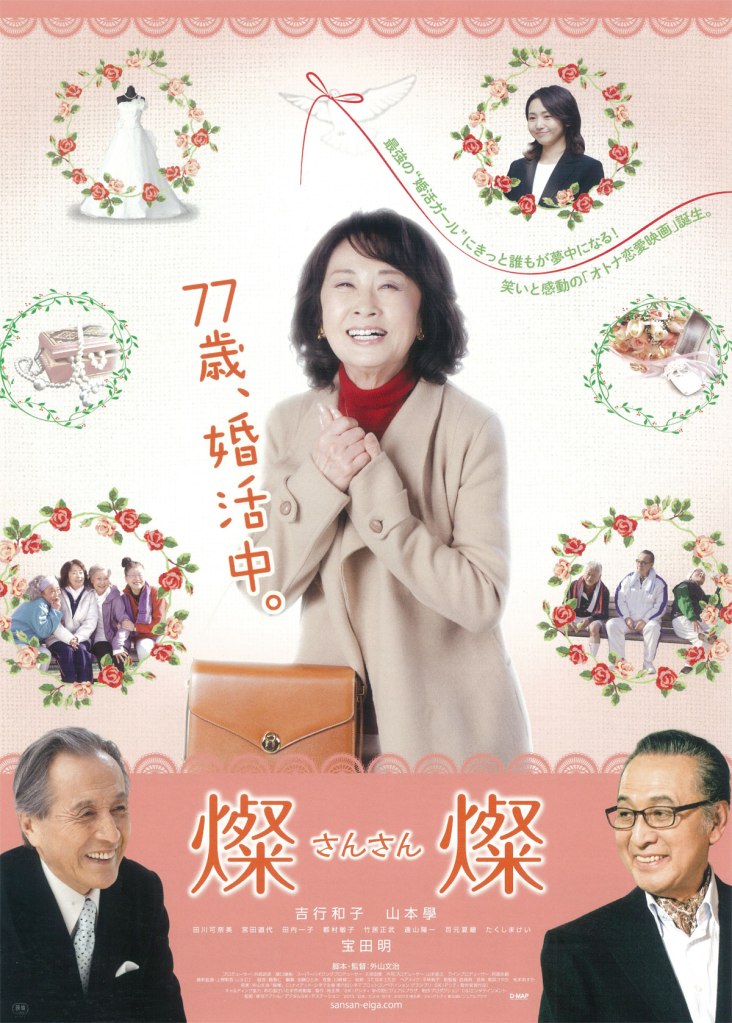
A Sparkle Of Life (燦燦 さんさん, Bunji Sotoyama, 2013)

sparkle-of-lifeAs Japan’s society ages, the lives of older people have begun to take on an added dimension. Rather than being relegated to the roles of kindly grandmas or grumpy grandpas, cinema has finally woken up to the fact that older people are still people with their own stories to tell even if they haven’t traditionally fitted established cinematic genres. Of course, some of this is down to the power of the grey pound rather than an altruistic desire for inclusive storytelling but if the runaway box office success of A Sparkle of Life (燦燦 さんさん, Sansan) is anything to go by, there may be more of these kinds of stories in the pipeline.
77 year old Tae (Kazuko Yoshiyuki) lost her husband some years ago after nursing him through a long illness. Spotting a pretty wedding dress in a shop window and examining the adverts on the outside, Tae ventures in and attempts to sign up with the matchmaking service which so prominently promises a happy ending at its doorway. The clerk is surprised, to say the least, after realising that Tae is not a pushy relative trying to find a spouse for an unmarried son or daughter but is seeking someone to brighten her remaining days. Now that she is totally free, Tae just wants to feel her heart flutter again and perhaps enjoy the warm glow of companionship one last time.

Looking it up on the computer, Ayako (Kanami Tagawa) – the assistant dealing with Tae’s application, is surprised to find there are a number of older men already on the books. Accordingly, she sets Tae up with some of the more promising candidates though it seems that men don’t really change all that much and not all of them are exactly after “a relationship” after all. Eventually Tae hits it off with a charming older gentleman, Yuichiro (Gaku Yamamoto), who seems to be everything she wants in a partner but there’s something else that seems to be keeping them apart.

Just as Ayako originally reacted with mild horror on learning that Tae herself was seeking a romantic partner, not everyone approves of her decision. Tae’s longtime friend (the best friend of her late husband), Shinji (Akira Takarada), is strangely angry and somewhat resentful though, predictably, he has reasons which are more personal than social or moral when it comes right down to it. Tae’s family, finding out by accident after letting themselves into her home while she’s out, are also outraged. Getting over the shock, Tae’s son announces that he supposes it’s OK for her to think about getting remarried but finds the idea of using a dating service embarrassing and orders her to stop right away.

Like Tae’s son, many people try to infantilise Tae and her friends, relegating them to a kind of second childhood now that their working or family lives have ended. Running into her friends from the Sunny Day Club, Tae is exasperated by their game of throwing hoops which, as Shinji says, they used to enjoy as children. Tae may be older but she still wants more out of life than being handed a juice box and told to sit in the corner while the grownups talk.

Dating is, however, harder with so much already in the past. Yuichiro may describe his relationship with Tae as being like a second stab at first love but with everything so different than it was before the situation presents its own set of difficulties. The essential problems are, of course, the same though Tae’s longed for second chance for love may have been right by her side all these years only too bound up with duty and tradition to have made his feelings plain.

Bunji Sotoyama’s approach is tailor made for his target audience but the warm and gentle atmosphere coupled with the often laugh out loud humour is sure to appeal to all age groups. Tae’s quest for love and determination to enjoy the time she has left to the fullest despite what anyone else might have to say about it is a quiet but firm bid for freedom and individual happiness in old age rather than the unwelcome relegation to the world of second childhood otherwise offered to women in Tae’s position. A comedic tale of late life love, A Sparkle of Life is a lesson in realising you only see the fireworks once it begins to get dark but that only makes them all the more precious.


Screened as part of the Japan Foundation Touring Film Programme 2017.

Original trailer (English subtitles)

Lady Maiko (舞妓はレディ, Masayuki Suo, 2014)

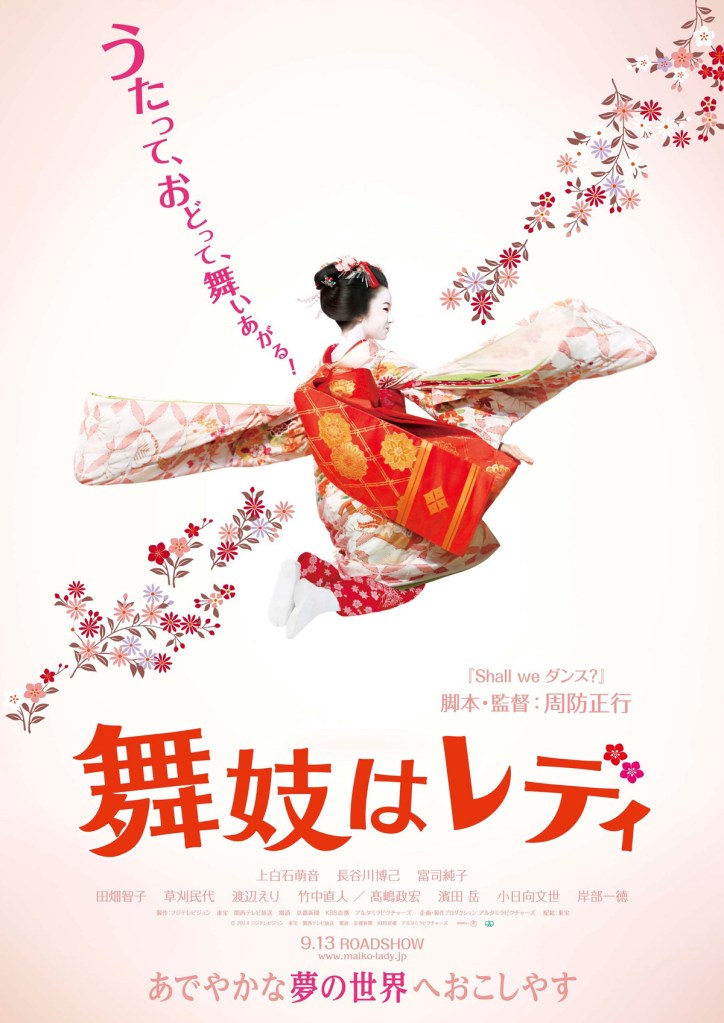
lady-maikoWhen Japan does musicals, even Hollywood style musicals, it tends to go for the backstage variety or a kind of hybrid form in which the idol/singing star protagonist gets a few snazzy numbers which somehow blur into the real world. Masayuki Suo’s previous big hit, Shall We Dance, took its title from the classic Rodgers and Hammerstein song featured in the King and I but it’s Lerner and Loewe he turns to for an American style song and dance fiesta relocating My Fair Lady to the world of Kyoto geisha, Lady Maiko (舞妓はレディ, Maiko wa Lady) . My Fair Lady was itself inspired by Shaw’s Pygmalion though replaces much of its class conscious, feminist questioning with genial romance. Suo’s take leans the same way but suffers somewhat in the inefficacy of its half hearted love story seeing as its heroine is only 15 years old.
Country bumpkin Haruko (Mone Kamishiraishi) arrives in the elegant Kyoto geisha quarters with only one hope – to become a maiko! However, despite the scarcity of young girls wanting to train, Haruko’s hopes are dashed by the head geisha who finds it impossible to understand anything she’s saying thanks to her extraordinarily rare accent which is an odd mix of north and south country dialects. Luckily for her, a linguistics professor who has an unhealthy obsession with rare dialectical forms overhears her speech patterns and is instantly fascinated. Striking up a bet with another tea house patron, Kyono (Hiroki Hasegawa) takes on the challenge of training Haruko to master the elegant Kyoto geisha accent in just six months.

The teahouses and the culture which goes with them are a part of the old world just barely hanging on in the bright new modern era. Haruko first became infatuated with all things maiko thanks to an online blog kept by the teahouse’s only current star, Momoko (Tomoko Tabata) – the daughter of the proprietor still only a maiko at age thirty precisely because of the lack of candidates to succeed her. Despite this intrusion of the modern, the way of the geisha remains essentially the same as it has for centuries with all of the unfairness and exploitation it entails. Hence, most of the women working in the teahouses are part-timers brought in for big events with only rudimentary training and even those who have spent a significant amount of time learning their craft lament that they don’t get paid a real salary and even their kimono and accessories technically belong to the teahouse.

Despite being on the fringes of the sex trade, as the professor’s assistant takes care to warn Haruko, there’s still something glamorous about the the arcane teahouse world bound up in ancient traditions and complicated rituals of elegance. Haruko faces a steep learning curve as a clumsy country girl who doesn’t even know how to sit “seiza” without her legs going numb. Learning to speak like a Kyoto native may be the least of her worries seeing as she has to learn how to dress in kimono, play a taiko drum and shamisen, and perform the traditional dances to perfection.

This is a musical after all and so the maiko dance routines eventually give way to more conventional choreography and large scale broadway numbers. The title song is particularly catchy and resurfaces at several points though the score as a whole is cheerful and inventive, incorporating a classic broadway sound with modern twist fused with the traditional music of the teahouse. Naoto Takenaka makes a typically creepy appearance displaying a fine voice for a comic number dedicated to the art of being a male maid to a geisha house but the big set piece is reserved for a comic take on the “Rain in Spain” in which the linguistics professor oddly wonders where all the water goes when it’s “pissing it down in Kyoto”. Unfortunately much of this revolves around linguistic jokes which are impossible to translate though the scene as a whole does its job well enough in introducing us to Haruko’s travails in the world of elocution. Other routines featuring the backstories of some of the minor characters also have a pleasantly retro quality inspired by period cinema complete with painted backdrops and old fashioned studio bound cinematography.

Though charming enough, Haruko’s progress is perhaps too conventional to move Lady Maiko far beyond the realms of cheerful fluff. Though Suo wisely keeps the romance to a minimum, Haruko’s growing feelings for the professor as well as a possible connection with his assistant are a little uncomfortable given her youth and the age differences involved even if the professor remains completely unaware. Unlike the source material Haruko’s passage is otherwise presented without complication (save for brief forays into the darkside of the geisha trade) as the country girl makes good, achieving her goals through hard work, perseverance, and the support of the community. In the end it’s all just far too nice, but then that’s not such a bad problem to have and there are enough pretty dance routines and warmhearted comedy to charm even the most jaded of viewers.


Screened as part of the Japan Foundation Touring Film Programme 2017.

Original trailer (no subtitles)

Someone’s Xylophone (だれかの木琴, Yoichi Higashi, 2016)

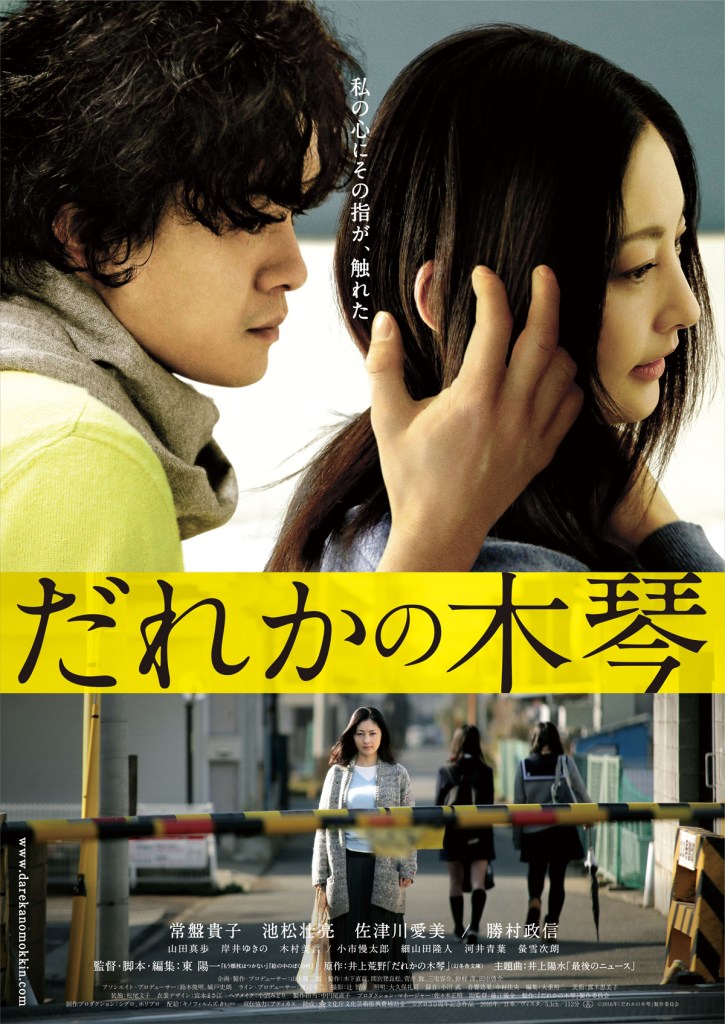
someones-xylophoneYoichi Higashi has had a long and varied career, deliberately rejecting a particular style or home genre which is one reason he’s never become quite as well known internationally as some of his contemporaries. This slightly anonymous quality serves the veteran director well in his adaptation of Arane Inoue’s novel which takes a long hard look at those living lives of quiet desperation in modern Japan. Though sometimes filled with a strange sense of dread, the world of Someone’s Xylophone (だれかの木琴, Dareka no Mokkin) is a gentle and forgiving one in which people are basically good though driven to the brink by loneliness and disconnection.
Middle aged housewife Sayoko (Takako Tokiwa) has just moved into a new area with her security alarm salesman husband, Kotaro (Masanobu Katsumura), and teenage daughter, Kanna (Mikoto Kimura). By all appearances the home seems to be a happy one, and the atmosphere is pleasant, if ordinary. Even so, stopping into an upscale salon one day Sayoko gets a haircut from the very good looking and warm hearted hairdresser Kaito (Sosuke Ikematsu). Hoping for repeat business Kaito gives her a business card and she reciprocates with one of her own so that she can be added to the mailing list. After some awkward chitchat, she leaves but when she gets a typical “thank you for visiting, please come again” text message, Sayoko makes the unusual decision to reply. Not wanting to seem rude, Kaito continues the strange text correspondence but Sayoko’s growing interest in the good looking young man, and later even in his girlfriend, soon crosses the line from harmless fixation to inappropriate obsession, threatening to derail her otherwise “normal” happy family life.

Higashi begins the film with a naturalistic sequence travelling from early morning light to bright sunshine as Kaito takes his bike out for a ride before returning to make breakfast for his still sleeping girlfriend, Yui (Aimi Satsukawa) – a model/store assistant at the upscale Lolita brand Baby the Stars Shine Bright. Accompanied by a thrumming, modern jazz funk soundtrack, these scenes reflect the film’s baseline reality. Kaito and Yui may live in the real world, to a point at least, whereas Sayoko has her head in the clouds and almost lives there too. A middle aged housewife, her life has begun to lose its purpose now that her daughter is almost grown and needs her much less than she ever has before. Though Sayoko and her husband appear to have a good relationship, she seems to want something more – bored with his caresses and long since past the point where there is nothing left to talk about.

The delivery of a new bed prompts a very particular fantasy of being fondled by both men at the same time though what exactly she wants from Kaito remains unclear. If her original decision to reply to a standard confirmation email could be dismissed as friendly innocence, sending a picture of your new bed to someone you just met is decidedly strange. Nevertheless, Kaito feels the need to keep replying even once it becomes clear that Sayoko has also tracked down his apartment and seems intent on further infiltrating his life. When she takes the decision to visit Yui at her work (the brand is not one which ordinarily caters to women of Sayoko’s age), the younger woman starts to get worried and eventually takes some direct action of her own.

Sayoko remains something of a cypher, a woman who can’t seem to figure herself out. The xylophone of the title refers to a dream or vision she has of a girl in far off window banging away at the instrument but never quite getting the tune – eventually she realises the girl is her, still trying to find her inner rhythm all these years later. Kotaro, by contrast, seems to have more worldly anxieties despite his outwardly calm and kindly manner. When his daughter asks him if they really need the security system they have at home he tells her about a long unsolved family murder before explaining that it just makes him feel safer when he can’t be there in person to protect his wife and daughter. Kanna, a bright child, points out that more threat is posed by accidents in the home than by intruders – to which Kotaro is forced to agree, lamenting that there is no alarm system to prevent a domestic accident. Thus when Kanna calls him to say that there has been an “incident” at home, the metaphor is an apt one – nobody was looking, and now everything’s falling apart.

Despite the expectation for grand scenes or bloody violence, Someone’s Xylophone consistently refuses to follow the signposted direction preferring a more adult resolution born of self reflection and mutual understanding. A subplot involving a very particular young man who comes to the salon solely for female contact hints at a darker path for unresolved loneliness and repressed emotion, but even if Sayoko and Kotaro make ill advised decisions in search of closeness their sojourns in alternate realities ultimately allow them to rediscover their mutual universe (for a time, at least). The xylophone finally plays out a recognisable tune as a more settled Sayoko fantasises about a phantom blanket rather than an illicit ménage à trois but whether this craving for warmth will provoke a similar crisis as the need for passion remains to be seen.


Screened as part of the Japan Foundation Touring Film Programme 2017.

Original trailer (no subtitles)

Flora on the Sand (砂の上の植物群, Ko Nakahira, 1964)

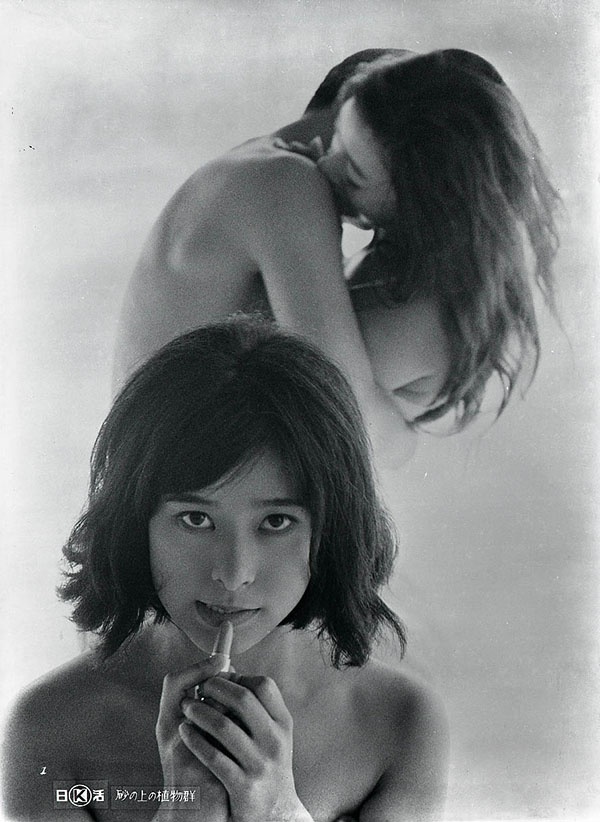
© 1964 Nikkatsu CorporationDespite being among the directors who helped to usher in what would later be called the Japanese New Wave, Ko Nakahira remains in relative obscurity with only his landmark movie of the Sun Tribe era, Crazed Fruit, widely seen abroad. Like the other directors of his generation Nakahira served his time in the studio system working on impersonal commercial projects but by 1964 which saw the release of another of his most well regarded films Only on Mondays, Nakahira had begun to give free reign to experimentation much to the studio boss’ chagrin. Flora on the Sand (砂の上の植物群, Suna no Ue no Shokubutsu-gun), adapted from the novel by Junnosuke Yoshiyuki, puts an absurd, surreal twist on the oft revisited salaryman midlife crisis as its conflicted hero muses on the legacy of his womanising father while indulging in a strange ménage à trois with two sisters, one of whom to he comes to believe he may also be related to.
After a brief prologue in which our hero, cosmetics salesman Ichiro Igi (Noboru Nakaya), imagines a scenario for a novel in which a dying husband becomes so jealous of the man that may succeed him in his wife’s life that he sets about plotting to make her the weapon of that very man’s destruction, Igi heads to his regular barber and longtime family friend where he takes the time to probe him about his late father’s womanising habits. Igi’s father died young at only 34 for years of age, three years younger than the age Igi is now. His father’s spitting image, Igi cannot help seeing him everywhere he goes and feels unable to evade his ongoing influence, almost as if he were possessed by his father’s (un)departed spirit.

The major preoccupation Igi has is that his wife (Yukiko Shimazaki) may have slept with his father before they were married while she was just a teenager. The barber tells him he’s pretty sure not, but Igi cannot let the idea go and repeatedly brings it up with his wife, creating discord in the family home. Meeting a precocious schoolgirl at the Marine Tower one evening, Igi finds himself taking her to a hotel and deflowering her even though she begins to resist him at the last minute. The girl, Akiko (Mieko Nishio), then makes a strange request of him – she wants Igi to seduce and “hurt” her older sister Kyoko (Kazuko Inano) whose sanctimonious attitude she can no longer stand. Igi does indeed visit the bar where Kyoko works as a hostess and embarks on an intense affair with her but Akiko’s pleas to “hurt” her sister are complicated by Kyoko’s masochistic tendencies and Igi’s descent into a kind of madness.

Beginning with the painting by Paul Klee which gives the film its name, Nakahira asks us to imagine what would happen if a large dash of red were suddenly to appear, disrupting the comforting harmony of Klee’s perfectly matched colours. The discomforting redness does dutifully appear as strangely shaped squares on the canvas but the symbolic value of the colour is felt throughout the black and white narrative from the dark stain of Akiko’s broken maidenhead to the affectation of her lipstick and constant references to red seas and suns.

Though Igi’s world may have seemed just as perfectly ordered as Klee’s painting from the outside, his constant preoccupations with his father become the disruptive influence which leads to all of the redness later leaking in. Haunted by his father as he is, seeing his face everywhere from train windows to the barber shop mirror, Igi’s attempt at a plot for a murder mystery takes on a strangely Oedipal quality as we begin to wonder if it’s his father rather than Igi himself who has assumed the role of the “protagonist”, leaving a time bomb for his wayward son, the inheritor of his woman, just as Igi laid out in his prologue. Bizarre reality or another symptom of Igi’s increasingly fractured mind, the plot seems likely to succeed at least in a sense as Igi declines into a dishevelled mess, prone to hallucinations and uncertain visions.

Nakahira gives us several of these as Igi panics and struggles with a key only to open a door into bright white light and nothingness or another in which he and Kyoko dine in an empty restaurant which is suddenly filled with the noisy chatter of other diners. Strange touches such as the German beerhall with a Spanish guitarist, or the odd peepshow in which Igi and his two friends take on the appearance of demons or impassive Buddhist statues thanks to the light reflected into their eyes, add to the unbalanced atmosphere as do the frequent closeups of lips and hands, and the symbolic value of seeds never meant to be planted which nevertheless flower at an unintended moment. Shooting in black and white, Nakahira begins with a colour sequence featuring the abstract artwork with occasional flashes of colour as well as voice over and occasional intertitle-style captions adding to the absurdist atmosphere.

A surreal and complex psychological exploration of sex, power, obsession, identity, and legacy Flora on the Sand finds Nakahira flexing his experimental mussels for a drama rife with ambiguity and strangeness. Sadly this brand of innovation was not entirely welcome at Nikkatsu head offices and so he found himself left out in the cold eventually ending up in Hong Kong making action movies for Shaw Brothers. Despite some later success at international festivals, Nakahira’s work remains sadly neglected but the unusual degree of sophistication and almost playful atmosphere seen in Flora on the Sand make him worthy of attention as more than just an almost was of the rising New Wave.


Screened as part of the Japan Foundation Touring Film Programme 2017.

A Stitch of Life (繕い裁つ人, Yukiko Mishima, 2015)

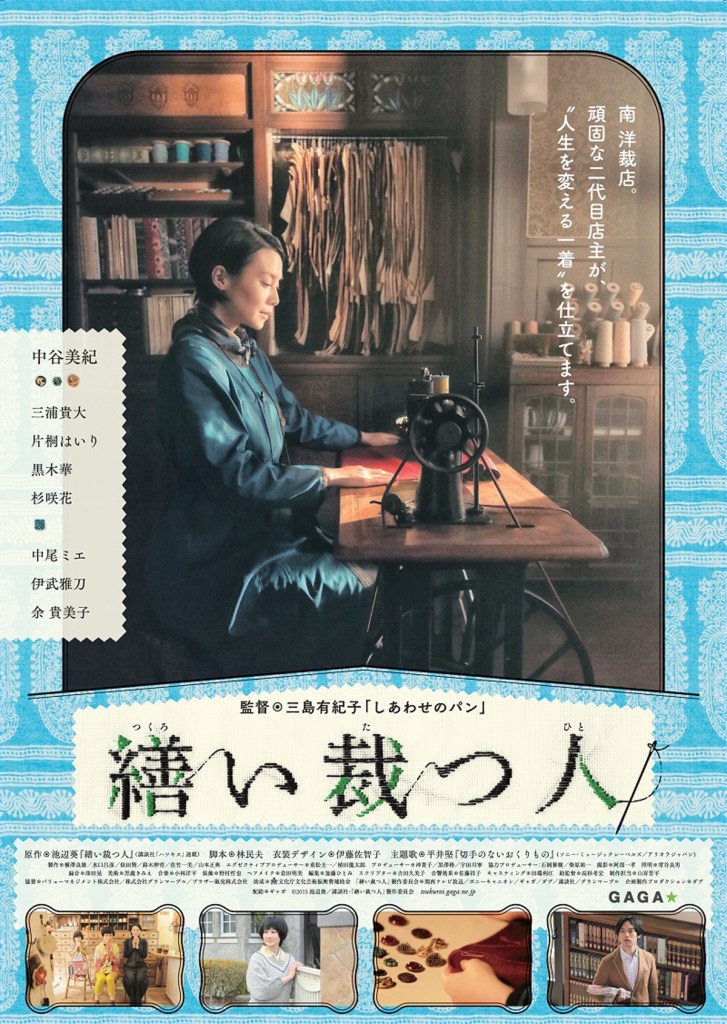
stitch-of-lifeTradition vs modernity is not so much of theme in Japanese cinema as an ever present trope. The characters at the centre of Yukiko Mishima’s adaptation of Aoi Ikebe’s manga, A Stitch of Life (繕い裁つ人, Tsukuroi Tatsu Hito), might as well be frozen in amber, so determined are they to continuing living in the same old way despite whatever personal need for change they may be feeling. The arrival of an unexpected visitor from what might as well be the future begins to loosen some of the perfectly executed stitches which have kept the heroine’s heart constrained all this time but this is less a romance than a gentle blossoming as love of craftsmanship comes to the fore and an artist begins to realise that moving forward does not necessarily entail a betrayal of the past.
Ichie Minami (Miki Nakatani) has taken over the tailoring business started by her grandmother, using her grandmother’s vintage treadle sewing machine and mostly occupying her time by making alterations on her grandmother’s existing patterns. To make ends meet, she’s also been reproducing some of her grandmother’s designs for sale at a local shop which brings her to the attention of department store employee and fashion enthusiast Fujii (Takahiro Miura) who has the idea of getting Ichie to work on some new items for a branded fashion line. Ichie, however, is devoted to her grandmother’s legacy and has committed herself to continuing the work her grandmother started with no deviation from the current model. Undeterred, Fujii continues to visit Ichie while she works, reaching even deeper levels of understanding both of her craft and of her person. Something inside Ichie begins to move too, but the pull back to the past is a strong one and it takes more than just courage to decide to finally embrace all of your hopes and dreams.

When Fujii hands the portfolio pitch he’s designed to his boss at the department store she loves the clothes and exclaims that the person who made them must be nice too, to which Fujii sheepishly admits that Ichie is more like a stubborn old man. Rigid in her habits and a little standoffish, perhaps even austere, Ichie does indeed seem harsh and unforgiving. Yet the irony is that her work requires the opposite of her. The clothes Ichie makes, and those her grandmother made before her, are perfectly tailored to the person in question, not just in terms of their measurements but designed to bring out each person’s personality, to help them become more of themselves and live a little happier in beautifully made outfits. Thus, Ichie must look closely at each person she meets in order to understand them fully and arrange her craft in perfect symbiosis with their individual needs. Perhaps for this reason Ichie finds her solitary time listening to the rhythmical beat of the sewing machine particularly relaxing, but the shop remains somewhere the local people gather in search of something more than just a simple hem repair.

Ichie’s grandmother sought to create clothes that could be worn for a lifetime, remaining long after both she and the person they were made for have disappeared. This approach may seem odd from a modern perspective of wash and wear disposable clothing intended to be replaced in a matter of months, but the idea here was never about the fashionable but one of engineering personal happiness through attire. The clothes make the man, in a sense, but the man also makes the clothes. As she made her alterations, Ichie’s grandmother recorded the various goings on in her customers’ lives in her notebook, allowing the clothes themselves to become the story of someone’s life. As Ichie’s former teacher puts it when trying to explain the art of making tea, it takes more than just heart – it takes experience, and care, and dedication. Ichie’s grandmother was meticulous – a trait which her granddaughter has inherited, with every stitch perfectly placed, each hem perfectly straight, and garment perfectly tailored for its intended wearer.

Ichie may keep herself contained for good reason, but now and then something else comes through such as a love of truly giant cheesecakes or a sudden bout of worry on being asked to craft a funeral dress for a good friend, but Fujii’s gentle prodding does indeed lead her towards a period of self reflection on what exactly it is she wants to do with her grandmother’s legacy. A cynical person might regard the annual “soirees” Ichie’s grandmother began in the small town as an excuse to get people to buy an outfit they’ll only wear once a year but the event, like the clothes, becomes an occasion for the artifice which lays bare the truth. Eventually, her grandmother’s gentle spell works on Ichie too (with a little help from Fujii) as the love of the craft of tailoring helps her to become herself, cast off her grandmother’s shadow whilst honouring her legacy, and learn to take pleasure in doing the things which only she can do.


Screened as part of the Japan Foundation Touring Film Programme 2017.

Original trailer (no subtitles)

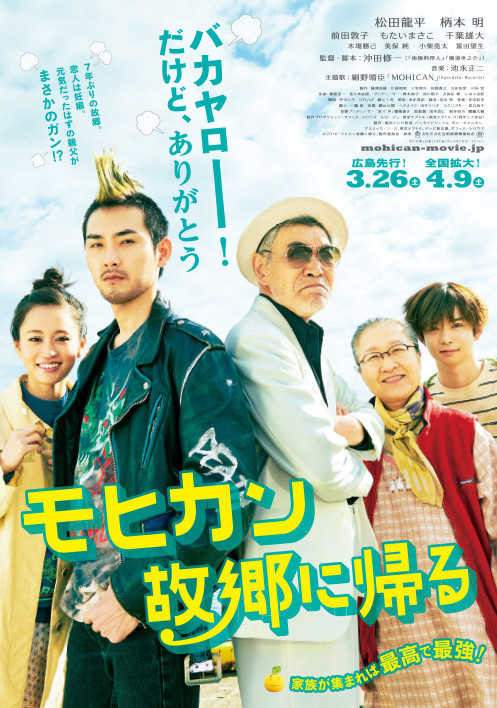
The Mohican Comes Home (モヒカン故郷に帰る, Shuichi Okita, 2016)

mohican-comes-homeJapan may be famous for its family dramas, but there is a significant substrain of these warm and gentle comedies which sees a prodigal child return to their childhood home either to rediscover some lost aspect of themselves or realise that they no longer belong in the place which raised them. Shuichi Okita’s The Mohican Comes Home (モヒカン故郷に帰る, Mohican Kokyo ni Kaeru) includes an obvious reference in its title to Keisuke Kinoshita’s colourful 1954 escapade Carmen Comes Home which cast legendary actress Hideko Takamine somewhat against type as a ditsy airhead show girl eager to show off all her city sophistications to the rural backwater she abruptly ran out of some years before. Like Carmen, the hero of Mohican Comes Home makes an unexpected trip to visit his family in the picturesque Hiroshima island village where he grew up only to find not very much has changed but an equally unexpected tragedy prompts him into a wider consideration of his past and future as he faces life’s two extremes in the very same moment.

Eikichi (Ryuhei Matsuda) left his island home some years ago for the bright lights of Tokyo where he fronts a punk band by the name of Grim Reapers. The band has some moderate underground success, but the guys are getting old for the punk scene and finding themselves with real world responsibilities from healthcare costs to the prospects of supporting wives and children. Eikichi, sporting a prominent bleached mohawk, feels this more than most as he’s soon to become a father and is intending to marry his pregnant girlfriend, Yuka (Atsuko Maeda), if only he had the money. He’s been promising to take his future wife to meet his parents for some time but so far they’ve never actually made the trip.

This time, things are different and so Eikichi makes a shocking return after seven years only to wander in during an awkward scene as his mother and younger brother try to manoeuvre his drunken father into a more convenient position whilst protecting his precious white suit from alcohol born ruin. Eikichi’s family own the village liquor store but his father’s passion is for music and he also coaches the local middle school band. A devotee of legendary Hiroshima born superstar Eikichi Yazawa, Osamu (Akira Emoto) insists the kids play his favourite tune ad nauseam to much eye rolling from the youngsters forced to associate themselves with such an uncool and old fashioned song.

Eikichi’s homecoming has not got off to the best start, especially after his father begins to sober up and recommends a hair cut and real job, both of which Eikichi resolutely refuses. Things take a more serious turn when Osamu realises his son is being financially supported by his girlfriend whom he has also got pregnant but is not yet married to. Experiencing extreme moral outrage at his responsibility shirking son, Osamu chases him around the table in what appears to be a scene often repeated during Eikichi’s childhood but the situation soon ends in an unexpected way foreshadowing Osamu’s decline into ill health.

Deciding to stay a little longer than intended, Eikichi and Yuka blend into the family home trying to help mother Haruko (Masako Motai) and boomerang younger brother Koji (Yudai Chiba) adjust while Osamu is in the hospital. The contrast between town and country, traditional and modern is never far from view whether in Yuka’s kindhearted decision to finish off preparing the family dinner though she has to consult a youtube video to find out how to gut fish, or in her astonishment at the very ordinary way in which her future in-laws met (i.e. simple propinquity). While the women begin to bond over their shared concern for their men as Haruko decides to teach Yuka some home style tips and tricks, Eikichi and his father spar with each other warmly as Eikichi takes charge of a band rehearsal and allows them to let loose on the much hated song with an energised punk fuelled twist.

Despite a strained relationship with his father, Eikichi is a good person who also wants to offer some kind of comfort to the old man in his final days. Going to great lengths to track down a particular pizza Osamu suddenly requests (the last time he ate pizza was on his 60th birthday) or eventually pretending to be Yazawa himself whom Osamu is very proud to have made eye contact with during a Tokyo concert in 1977, Eikichi comes to a kind of understanding of the man his father was as well as the man he is. Full of warm, naturalistic humour giving way to two elaborately constructed set pieces, The Mohican Comes Home is a typically well observed family drama from Okita which neatly undercuts its essentially melancholy set up with a layer of stoical perseverance.


Screened as part of the Japan Foundation Touring Film Programme 2017.

Original trailer (no subtitles)