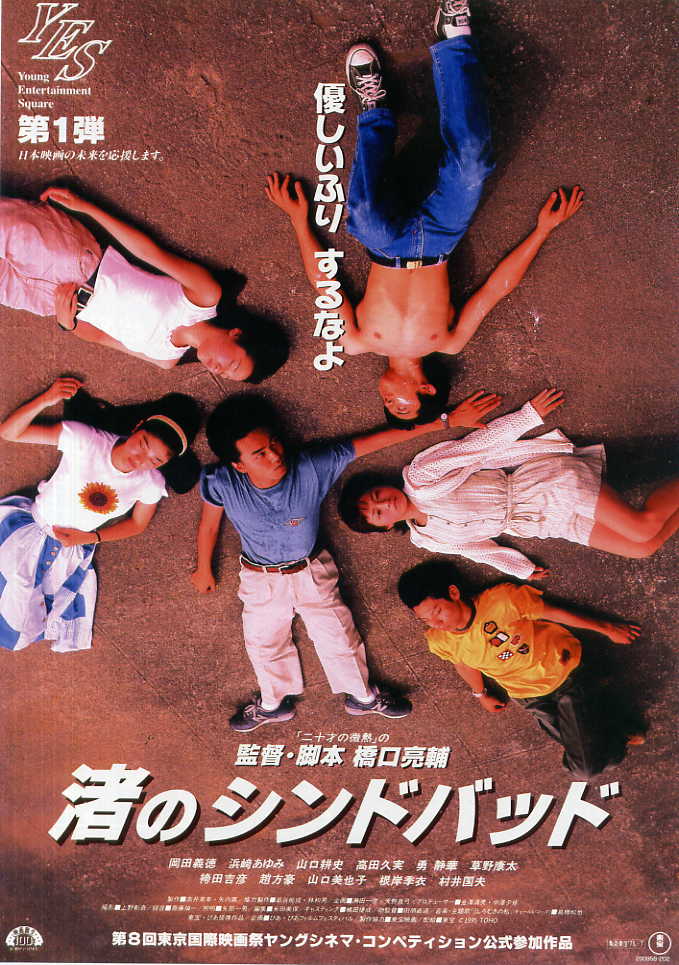
Like Grains of Sand (渚のシンドバッド, Ryosuke Hashiguchi, 1995)

Like grains of sand posterAdolescent romance is complicated enough at the best of times but the barriers are ever higher if you happen to be gay in a less than tolerant society. Ryosuke Hashiguchi’s second feature Like Grains of Sand (渚のシンドバッド, Nagisa no Sinbad) takes a slight step back in time from A Touch of Fever but retains its very ordinary world as a collection of boys and girls embark on a process of self discovery whilst also locked into the unbreakable straightjacket of the high school world.

Ito (Yoshinori Okada) is an ordinary high school boy with a crush on his oblivious best friend, Yoshida (Kouta Kusano). Though Yoshida defends him from the homophobic bullies in his class, he seems confused about his true feelings, at once stating that what he feels for Ito is more that friendship but also unwilling to address what that “more” may mean. After Ito’s father intercepts a reply to a personal ad he placed hoping to meet older men, Ito ends up at a psychiatrist’s office where his father hopes he might be “cured” though the doctor is quick to point out that they no longer view homosexuality as a medical matter.

Whilst at the clinic, Ito strikes a up a friendship with another girl from his class, Aihara (Ayumi Hamasaki) – a recent transfer student, who, we learn, has experienced a traumatic event which is also the reason she had to leave her previous place of education. Aihara is the only person with whom Ito can discuss his sexuality honestly though he’s also sure to “protect” Yoshida by claiming he rejected his advances outright rather than explaining the confusing series of events as they actually occurred. When Aihara and Ito accidentally end up on an awkward double date with Yoshida and his girlfriend Shimizu (Kumi Takada), Yoshida also begins to develop an (unreturned) attraction to Aihara which only further complicates the delicate nature of the growing emotional ties among this small group of young people.

A real step up from the promising yet flawed A Touch of Fever, Like Grains of Sand proves Hashiguchi’s skill in building an extremely natural environment filled with believable well rounded characters. The high school world is a cruel one populated by unsteady teenagers, each by times rebellious and insecure. Aihara, as a recent transfer student, is already an outsider but finds herself excluded even further thanks to her direct and aloof character. Early on in the film two of the other girls, evidently the popular set, begin running a bizarre extortion scam in which they claim a friend of theirs has fallen pregnant and needs to get an abortion right away so they’re collecting money to help her. Shimizu doesn’t seem to buy their explanation but is bamboozled into paying up to not cause offence. Aihara, however, brands the pair “sympathy fascists” and abruptly walks away.

Ito is also an outsider, though partially a self-exile, longing yet fearful. At the beginning of the film he’s overwhelmed watching the unexpectedly sensual action of Yoshida pouring a bag of sand into a container destined for the sports field. After they’ve finished, Ito faints right in front of his fellow schoolmates, though at least the convenient hot weather might prove his ally. When the other boys draw a lewd drawing on the blackboard and start teasing Ito, Yoshida comes to his rescue even though he knows that’s likely to cause trouble for himself. Reassuring his friend that it would be OK even if it was true, Yoshida continues to act in a non committal manner. Ito confesses, Yoshida accepts the confession but at the same time is uncertain permitting both a kiss and an embrace before pushing his friend away and leaving as if nothing out of the ordinary had happened.

After an impromptu hug on a rooftop, Shimizu makes attempt to ask Aihara is she’s gay with no particular judgement attached except a slight reticence in terms of language. Aihara seems slightly confused, replying only that Shimizu is preoccupied with the wrong questions. Later, Ito ends up escorting the smitten Yoshida to Aihara’s childhood home where things come to a climax during an intense finale on a secluded beach. Night is falling and Ito has put on Aihara’s white dress and hat while she goes for a swim just as Yoshida returns for a second stab at confessions. Hiding behind a rock while Yoshida thinks Ito is her, Aihara continues to conduct a philosophically based dissection of Yoshida’s approach to sexuality. She asks him, would you still love me if I were a man, and if not, is it more that what you want is a woman and not really “me” at all, along with other questions designed to prompt a response as to the importance of gender when it comes to love. That all this happens as a kind of Cyrano de Bergerac-like three way sequence with Ito dressed as Aihara, and Yoshida talking to Aihara through someone else only lends to the surreal, increasingly symbolic atmosphere.

Gentle and softly nuanced, Like Grains of Sand is a delicate exploration of ordinary young people caught in a confusing storm of emotions as they each address their burgeoning sexuality. Rich with complexity yet also effortlessly straightforward, Hashiguchi has created a beautifully naturalistic portrait of adolescence in flux which is filled with empathy and acceptance for each of its angst ridden teens and even for their less forgiving friends and relatives. A noticeable progression from Touch of Fever, Like Grains of Sand further proves Hashiguchi’s skill for character drama and marks him as one of the most incisive writer/directors working today.


Original trailer (no subtitles)

The Japanese title of the film, Nagisa no Sinbad, is also the title of a hit single by 1970s super duo Pink Lady! (Beware – extremely catchy)
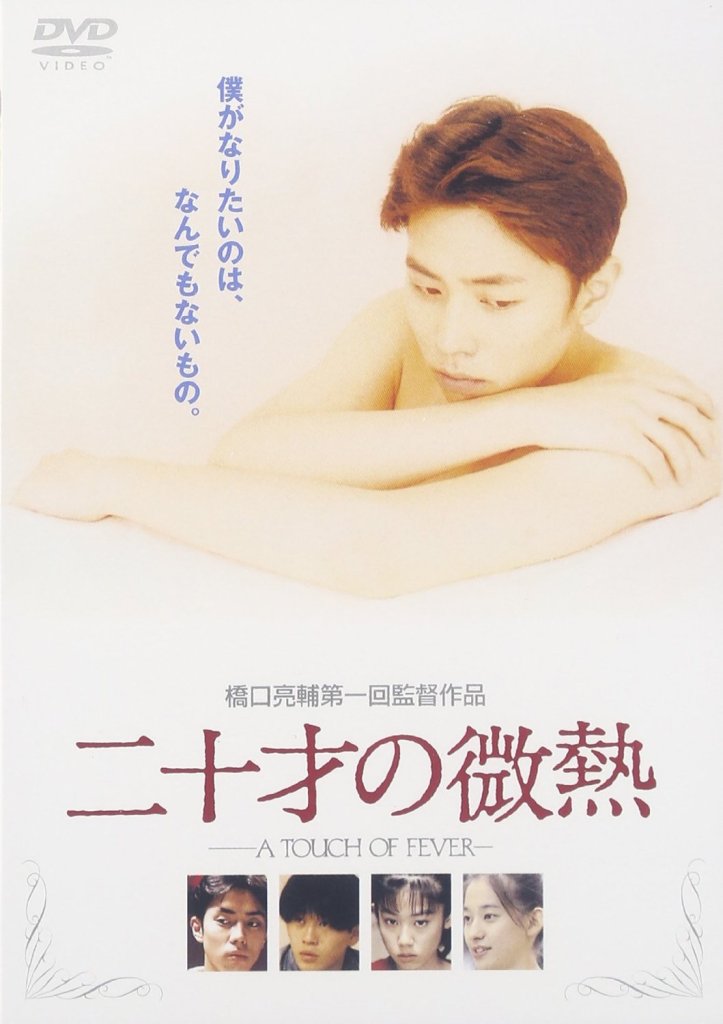
A Touch of Fever (二十才の微熱, Ryosuke Hashiguchi, 1993)

Touch of FeverRyosuke Hashiguchi’s debut feature A Touch of Fever (二十才の微熱, Hatachi no Binetsu) proved a surprise box office hit in Japan and is also credited for helping to bring male homosexuality into the mainstream. A no-budget movie shot on 16mm, A Touch of Fever is the story of two ordinary boys each going about their everyday lives whilst also beginning to understand themselves in terms of their sexualities, mirroring each other perfectly in their inner confusion.
Tatsuru is a college student by day, but he spends his nights working at Pinocchio’s where he entertains male customers looking for some no strings action with a disinterested young man. Among the other youngish guys working at the club is Shin who is actually still in high school. Shin is out to his parents, but they haven’t taken it well so he’s couch surfing, leading to him to ask Tatsuru if he could temporarily move in with him. Along with all of the practical problems this may raise, Shin has something of a crush on his older colleague, but Tatsuru is filled with doubts about many things and his apartment is in no way big enough to contain this particular elephant in the room.

Tatsuru is about as detached as they come. He claims that he can separate love and sex and that for him his work is just a mechanical action that he happens to be pretty good at. The first client we see him with interrogates him about his non-compensatory love life, assuming that he must have a girlfriend. Tatsuru gives a non-committal answer about whether he also sleeps with women which offers the first indication of his slight resistance to the idea of being gay even if he has no problem earning a living through sleeping with men. Throughout the film he also conducts a parallel (platonic, if fliratious) relationship with an older female student, though when he decides to try and take things further she more or less shuts him down explaining that she’s confused about her feelings for him – she wants him in her life, but probably not in a romantic way. As if to underline the point, an attendant begins to spray cleaning fluid over the passenger side window of the car Tatsuru is sitting in, effectively painting him out of the picture.

Shin, on the other hand, is very clear about his sexuality but less so about the idea of selling it for money. Uncomfortable with the atmosphere at the club, Shin has decided he only wants to do it with people he likes, as impractical as that may turn out to be. What Shin wants is romance, but that’s exactly what Tatsuru is currently unable to acknowledge. When taken to task by one of Shin’s female friends, Tatsuru offers a series of justifications about different kinds of love but remains rational and closed down. At the moment it appears something may happen between the pair, it’s Shin who ultimately can’t follow through. Whether due to “chickening out” as his friend accuses, a lack of belief in his object of affection, or simple vulnerability, Shin is not quite ready to acknowledge his true feelings either.

Both boys have also become estranged from their families and particularly with their fathers. Tatsuru’s father leaves gruff answerphone messages and then when he finally gets through, suggests that his son is a drain on his resources that he could well do without. Having left Tatsuru’s mother for another woman, dad is now cash strapped – so much so that his new partner has had to have an abortion because of all the loans he’s taken out for Tatsuru’s fees. The final parting blow is to say that (contrary to the suggestion of a complete divorce between father and son) Tatsuru is now the sole heir of the Shinomori name which is yet another burden for guy who may be gay and therefore may not necessarily be looking to pass that name on. Shin’s father had something of an apoplexy when he found out his son was gay and threatened to have him sent away to the self defence force for some “toughening” up, going so far to trample all over Shin’s dreams of becoming a fashion designer and leading him to leave home at such a young age.

Hashiguchi’s first feature is his most melancholy but also oddly innocent. A theme which recurs throughout his career – that love is sad and ultimately impossible, rears its head during the film’s final scene in which Hashiguchi himself plays a sinister customer. This uncomfortably long sequence which breaks with the formalist camera movements of the the earlier part in favour of destabilising, unbroken handheld, acts as the climax of the film as the pair are once again symmetrically opposed. Tatsuru likes things impersonal but this guy wants to talk, whereas Shin craves connection but finds the customer unpleasant in his wheedling, direct and almost forceful approach. “You wouldn’t know the pain of being unable to speak out about how you really feel”, says the customer, oblivious to the obvious subtext. This long, strange, and uncomfortable encounter does at least lead both boys into the centre ground, making each clearer both about themselves independently and about whatever it is that exists between them.

Contrary to the customer’s assertion about the impossibility of true connection, the film ends on a note of hope as the boys walk home together with a little more lightness in their steps. When Shin enquires how much Tatsuru was paid for something that he previously disapproved of but seems to have got over now, he tells him he’s underselling himself and ought to value himself more. Tatsuru says he’ll bear that in mind – that has, after all, been the problem all along. In one sense, the “fever” has broken – a weight has been lifted, leaving both boys freer to go about their lives with more clarity and less angst. Perhaps it isn’t all so sad and impossible after all.


Original trailer (no subtitles)

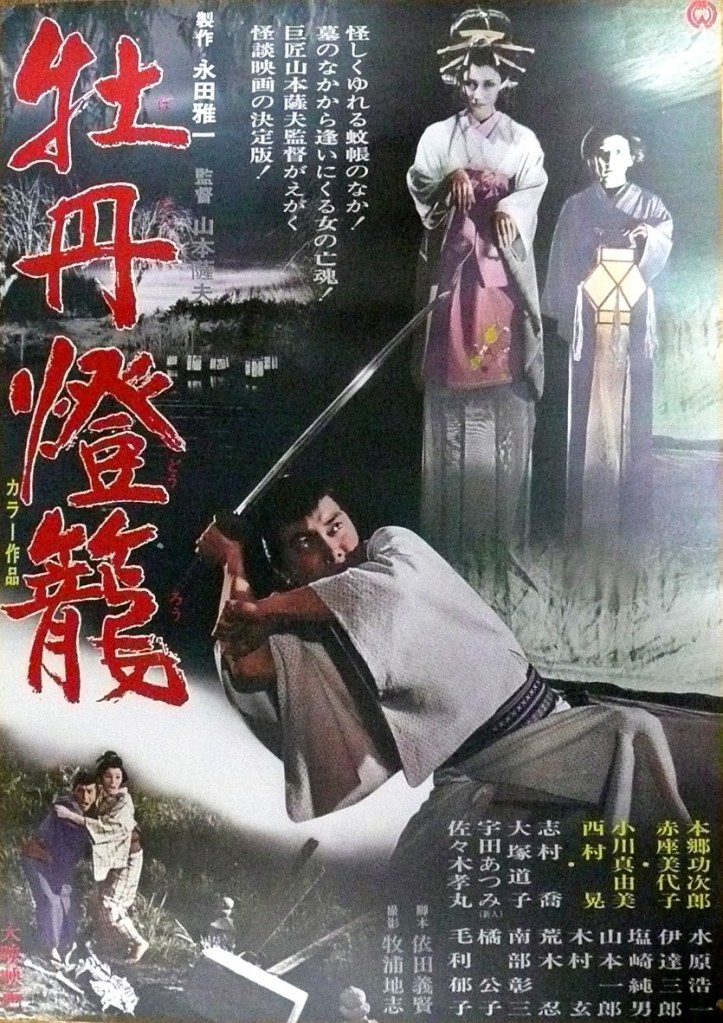
Peony Lantern (牡丹燈籠, Satsuo Yamamoto, 1968)

peony lanternThe Peony Lantern (牡丹燈籠, Kaidan Botan Doro) has gone by many different names in its English version – The Bride from Hades, The Haunted Lantern, Ghost Beauty, and My Bride is a Ghost among various others, but whatever the title of the tale it remains one of the best known ghost stories of Japan. Originally inspired by a Chinese legend, the story was adapted and included in a popular Edo era collection of supernatural tales, Otogi Boko (Hand Puppets), removing much of the original Buddhist morality tale in the process. In the late 19th century, the Peony Lantern also became one of the earliest standard rakugo texts and was then collected and translated by Lafcadio Hearn though he drew his inspiration from a popular kabuki version. As is often the case, it is Hearn’s version which has become the most common.
The central figure in Satsuo Yamamoto’s 1968 prestige picture for Daiei is the third son of a samurai household, Shinzaburo (Kojiro Hongo). This is the first Obon festival since his older brother died leaving a young widow behind him. Kiku, his sister-in-law, is becoming a problem for the clan as her birth family have not called her back and it’s embarrassing for them to have an unattached woman of age wasting away at home. Accordingly, they think the best option is for Shinzaburo to marry his brother’s wife. Shinzaburo is having none of it. A progressive kind of samurai, he spends his time teaching poor children to read and even dreams of opening a school one day but his family most definitely do not approve and see this marriage as an opportunity to put an end to his improper ideas about social justice.

Heading back to the village under a cloud, Shinzaburo helps one of the children push two of the lanterns which had got stuck by the shore out onto the lake. Suddenly two lantern carrying women appear from nowhere and thank him. Later, the same two women arrive at Shinzaburo’s home to thank him again and relate a sad tale – the older woman, Oyone (Michiko Otsuka), is a servant of the younger one, Otsuyu (Miyoko Akaza), and they’ve come from the red light district. Otsuyu apparently hailed from a samurai background but was tricked and forced into the yoshiwara after her father was abandoned by his clan and subsequently fell ill. She is still a virgin but has attracted the attentions of an older wealthy client and is expected to acquiesce to his desires after the Bon festival is over. Shinzaburo seems like such a nice guy that she’d much prefer to stay with him, at least until Bon is over. There is one quite important detail which Oyone and Otsuyu have omitted from their history.

Despite it being Bon – the Japanese summer festival in which the dead return to the land of the living, Shinzaburo never stops to think about where these two women might have come from. Truth be told, he’s in something of a dark place what with the current familial discord which might see him either exiled from his clan (which would entail the loss of his living as well as his status), or an arranged marriage to a woman he doesn’t love who also was previously married to his brother. The villagers are very fond of Shinzaburo and grateful for his efforts with the children. Should they lose him, they would never find a replacement and the children would remain uneducated.

Despite having contributed to the war effort by making a series of propaganda films, director Satsuo Yamamoto was an openly committed communist and though Peony Lantern is in no way overtly political or at least not in the same sense as some of his other work, it nevertheless manages to work in the cruelty and indifference of feudal elites towards the ordinary people below them. This is a theme which is common in kaidan/horror films from this era and particularly from Daiei, but Shinzaburo is something of an exception to the rule as he stems from the samurai order himself. His family find his commitment to educating the peasantry at best eccentric and at worst embarrassing though Shinzaburo is determined to live in a more altruistic way than his rigid, tradition bound relatives.

This does leave him feeling slightly adrift as he’s at odds with both the samurai class of his birth but also with the villagers who see him as a teacher and someone to look up to, but definitely not as one of them. When the pretty Otsuyu and her maid arrive with a tragic story also involving the harshness of the samurai class, it’s primed to catch Shinzaburo’s attention and lonely as he is perhaps he doesn’t quite stop to ask questions when offered the opportunity to play kindly saviour to a sad young woman about to be robbed of her right to choose her own destiny (much as he will be, only worse). His relations with Otsuyu leave him feeling progressively weaker but still he can’t seem to bring himself to the decision to send her away entirely.

Perhaps it’s death Shinzaburo craved all along, an end to his tormented existence and the loneliness that comes of being caught between two social strata in a strictly controlled class hierarchy. The two ghosts are not malicious, they’ve come craving love and kind words from an honest man and hit the jackpot with the softhearted Shinzaburo. Tragic as it all is, perhaps everyone ultimately got what they wanted – an end to the eternal loneliness of having been cast out from one world and unable to fully embrace another.

Despite the emphasis on the indifference of the samurai class, the poor aren’t all saints either as seen in the feckless servant character, Banzo (Ko Nishimura), who begins as comic relief but ends up very much not. He is the first to witness the ghostly nature of the two visitors and to try and save Shinzaburo from their clutches, but when his wife comes home for her Obon holiday everything changes. Banzo’s wife orders him to blackmail the ghosts for money which they eventually get by digging up a neighbouring grave. Little to they know that it’s not supernatural forces which they will need to be worrying about in the future and they will pay a heavy price for their greed.

Yamamoto captures the eeriness of his undead visitors perfectly as they float and glide across the screen. The first scene in which Banzo peeks in on them with Shinzaburo and sees them as they really are is truly shocking as is the raw power with which Oyone later confronts him. Switching effortlessly between nervous, melancholy women seemingly caught in a more Earthly kind of purgatory, and etherial escapees from the underworld, Otsuyu and Oyone continually carry a kind of death-tinged strangeness around with them. A beautifully filmed, supremely creepy adaptation of the classic story, Yamamoto’s Peony Lantern is a suitably macabre, gothic affair which is entirley unafraid to explore the essential darkness of the tale at hand.


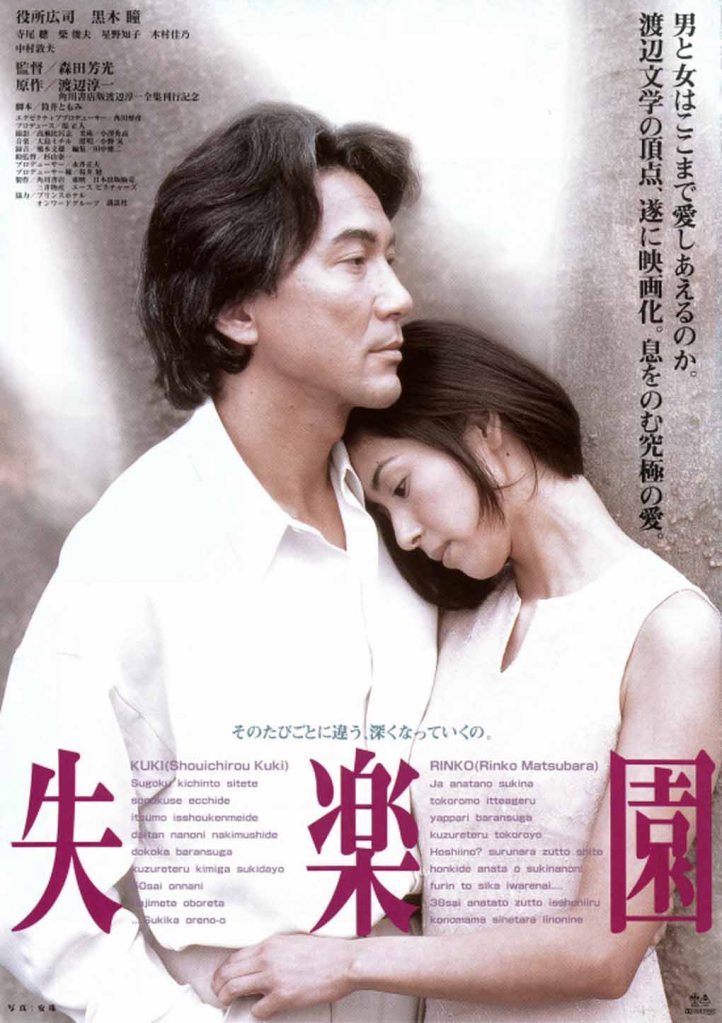
Lost Paradise (失楽園, Yoshimitsu Morita, 1997)

lost paradiseYoshitmitsu Morita tackled many different genres during his extremely varied career taking in everything from absurd social satire to teen idol vehicles and high art films. 1997’s Lost Paradise (失楽園, Shitsurakuen) again finds him in the art house realm as he prepares a tastefully erotic exploration of middle aged amour fou. Based on the bestselling novel by Junichi Watanabe, Lost Paradise also became a breakout box office hit as audiences were drawn by the tragic tale of doomed late love frustrated by societal expectations.
We meet Kuki (Koji Yakusho) and Rinko (Hitomi Kuroki) about to bid each other goodbye for the day, playfully in love though perhaps self conscious. It’s not until later that we realise they are both already married – just not to each other. Kuki, 50 years old, has reached an impasse in his life. Effectively demoted and sidelined at work, his homelife is not exactly unhappy but has long since lost his interest. His daughter is grown up and married herself, his wife has a career of her own, his mortgage is already paid off. There is really nothing left for him to do. That is until he meets calligraphy teacher Rinko and falls passionately in love for the first time in his life.

Rinko, 38, entered into an arranged marriage at 25 though the kindest way of describing it would be “unfulfilling”. Haruhiko (Toshio Shiba), her husband, is a doctor by profession and cuts a cold and distant figure. Prone to violent outbursts and pettiness, he treats Rinko more as a house keeper than a wife ordering her to buy his favourite kind of cheese (even urging her to travel to a different shop if the first one doesn’t have it) but then not even looking up when she brings it into his study for him. Lasciviously poking a spoon into the soupy mess, he pauses only briefly after savouring his first taste to give Rinko her next set of orders with no word of thanks or even acknowledgement of her success in obtaining this oddly specific cheese related request.

Finally in each other Rinko and Kuki find completeness long after they’d stopped seeking it. Rinko is unhappy in an arranged marriage which offers scant comfort, though Kuki’s problems are more akin to a mid life crisis as he finds himself an unnecessary presence at home whilst also realising that he’s already passed the high point of his career. Though there are no real barriers to Rinko and Kuki simply leaving their spouses and starting again together, it’s never quite that simple as the social stigma of an extra-marital affair continues to undermine their new found romance.

As in many of Morita’s films, the overall tone is one of pessimism as Rinko and Kuki face opposition from all sides whilst falling ever deeper into a whirlwind of self destructive passion. Rinko confides in a recently divorced friend who has guessed her secret and urges her to try and be happy, but Kuki keeps matters to himself whilst listening to the romantic problems of his workmates many of whom state that they too would like to fall madly in love, just once. When one of Kuki’s most valued colleagues falls ill, he laments having lived his life in the straightforward way expected by society. He’s done everything right – spent all his time working hard, built a career which was about to go south anyway. If all that happens is that you get old and die what was it all for – perhaps you’re better off just doing as you please, social expectations be damned.

Eventually the pair get an apartment and indulge in some part-time domesticity though an ill thought out blackmail plot soon changes things for both of them. Haruhiko refuses to divorce Rinko but Kuki’s wife is more sympathetic and open to the idea of sorting things out as quickly as possible. Though he suffers in other ways, Kuki finds it easier to accept the idea of moving on than Rinko who also faces opposition from her own mother who brands her as immoral and someone to be pitied for having given in to weakness and allowed her baser instincts to take over. Soon the couple find themselves thinking about a way to be together for eternity even if it lies in another world than this one.

Likened to the famous case of Sada Abe (also the inspiration for Oshima’s In the Realm of the Senses), Rinko and Kuki are consumed by their own passion and ultimately unable to continue living outside it. Morita opts for an artful aesthetic and keeps his eroticism on the classy side rather than descending into exploitation or salaciousness. Making use of frequent handheld camera and odd angles to bring out the giddy, unbalanced mindset of the central couple Morita also experiments with colour often cutting to black and white or sepia mid-scene. The tragedy of this love story is that it occurs at a societally inconvenient time – there is nothing wrong in Rinko and Kuki’s romance save that it started after they were already married to other people. This may not seem such a great problem but in a society which demands conformity and adherence to its rules, those who break them must be prepared to pay a heavy price. Perhaps the last words ought to belong to Kuki’s poetic friend who points out that life if short and rarely rewards those who play by the rules, it may be better to burn out brightly rather than flicker away for an eternity.


Original trailer (no subs)

Ten Dark Women (黒い十人の女, Kon Ichikawa, 1961)

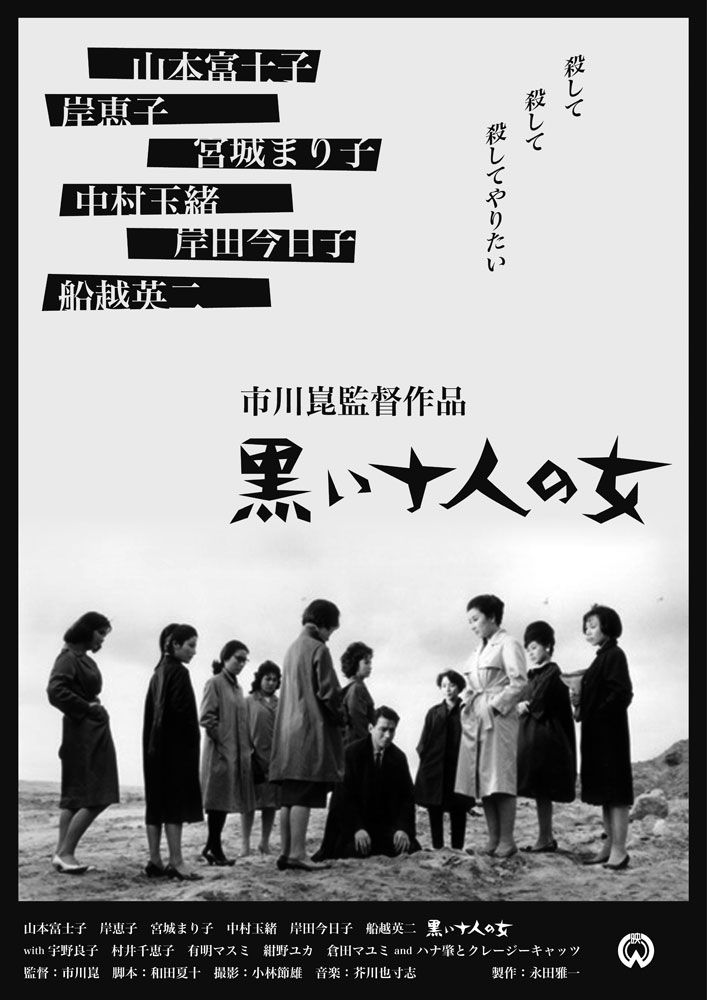
Ten Women in BlackKon Ichikawa, wry commenter of his times, turns his ironic eyes to the inherent sexism of the 1960s with a farcical tale of a philandering husband suddenly confronted with the betrayed disappointment of his many mistresses who’ve come together with one aim in mind – his death! Scripted by Natto Wada (Ichikawa’s wife and frequent screenwriter until her retirement in 1965), Ten Dark Women (黒い十人の女, Kuroi Junin no Onna) is an absurd noir-tinged comedy about 10 women who love one man so much that they all want him dead, or at any rate just not alive with one of the others.
Kaze (Eiji Funakoshi) is a TV producer by profession, though it might be better to think of him as a professional ladies’ man. He’s married to a woman who owns a bar, but is also carrying on affairs with nine (!) other women plus occasional one night stands with 30-50 others he meets through his work. His wife knows about his affairs and, while not happy about it, is putting up with things like decent wives are supposed to do. However, many of Kaze’s “mistresses” have inconveniently discovered each other’s existences and bonded in their mutual frustration with him. Strangely they all think he’s a great guy and remain very much in love with him but the situation being what it is the entirety of the betrayed wife and mistress support club eventually comes to the same conclusion – Kaze must die!

However, the women are all so devoted to Kaze, they don’t quite want him to disappear so much as for him to pick them and only them to live with happily ever after. One of the women foolishly warns Kaze about their plot as leverage for her marriage proposal but unfortunately for her he still turns her down and returns home to ask his wife what’s going on. She doesn’t deny her murderous intentions and in fact tells him in great detail how they intend to do him in. Kaze, to his credit, says he doesn’t mind very much and only worries about his wife’s future life as a murderess. Together they hatch a plan to fool the other women involving a pistol loaded with blanks and a tomato but nothing quite goes to plan.

An absurdist satire about the intense vanity of the womanising male, Ten Dark Women looks forward to Fellini’s similarly themed 8 1/2 or City of Women though here the idiotic husband at the centre becomes both prey and foil for the group of plotting women seeking revenge against his disloyal ways. Kaze, as he himself admits, is not particularly appealing to women though his position at the TV studio undoubtedly proves useful to some of them. He’s a curiously passive presence, not so much seeking out female company as acquiescing to it. It’s not quite clear if his concern for his wife should she decide to kill him is genuine or a means of manipulative self preservation but at any rate he takes the threat to his life extremely calmly.

Each of the women has their own claims on Kaze but the other thing they all have in common is being the prisoner of an extremely sexist society. Some of the women are with Kaze for careerist reasons, but it’s clear that there is a definite limit placed on a woman’s potential both inside and out of the creative industries. The commercial model makes a play for a more official relationship by bringing up the fact that Kaze’s wife has a job and therefore cannot devote herself entirely to Kaze’s wellbeing as proper wife should (as by implication would she after marrying and retiring from the modelling world). Kaze helped his wife set up her bar which she runs herself though constantly plays hostess to her husband’s industry friends. It appears what Kaze wants is less a devoted wife than an indifferent one who will permit his frequent “indiscretions” whilst also providing him with a conventional “home”.

Another of the women tries to get herself a promotion but her boss, though broadly sympathetic and dangling the idea of a raise, brings up the oft repeated notion that there’s no sense in giving her the job because a woman should leave at some point to marry and have children. When the woman criticises the behaviour of her male colleagues, her boss simply shrugs and admits men in TV aren’t “serious”, yet when she points out that she is serious and works hard she is told that women are better off at home. Women, he says, express themselves through their children whereas men make their mark through a career. The woman says that she believes everyone should try to reach their own potential in whatever way they can but her pleas fall on deaf ears. This notion is repeated later on when the women try to take revenge on Kaze by tricking him into resigning from his job – a man is his work, he claims. A man without a job is nothing at all and a man who is kept by a woman is less than nothing – Kaze is suddenly panicked, losing his occupation and social position is much more frightening to him than losing his life.

The women couldn’t kill the system or the TV, but they could kill Kaze so who can blame them for trying. Another of the women states that the imposed isolation of a man’s working life has cost him the ability to connect with other people on a human level and so his erasure is simply the end of a long process of social death. If some of the women triumph, others retreat as one does in suicide only to return as a ghost longing for the murder plot to succeed so that she and Kaze can be alone together at last. Kaze thinks he’s using each of them, but they have all been using him in one way or another and his only way out lies either in death or becoming a trophy for the most needy of his paramours.

Cynical in tone, Ten Dark Women is an amusingly absurd look at gender roles in early 1960s Japan as each of our women attempts to usurp male power for their own ends, some with more success than others. Ichikawa employs beautiful noir lighting in his elegantly composed black and white photography which, along with its jazzy score, gives the film a familiar feeling of crime laced modernity. An early instance of the feminist revenge film, Ten Dark Women is very much a comedy which avoids making its group of frustrated, resentful women mistreated by a buffoon of a TV exec the butt of its own joke, neatly highlighting the precarious nature of their existence which obliges them to rely on so hollow a support.


Original trailer (no subtitles)

Pandora’s Box (パンドラの匣, Masanori Tominaga, 2009)

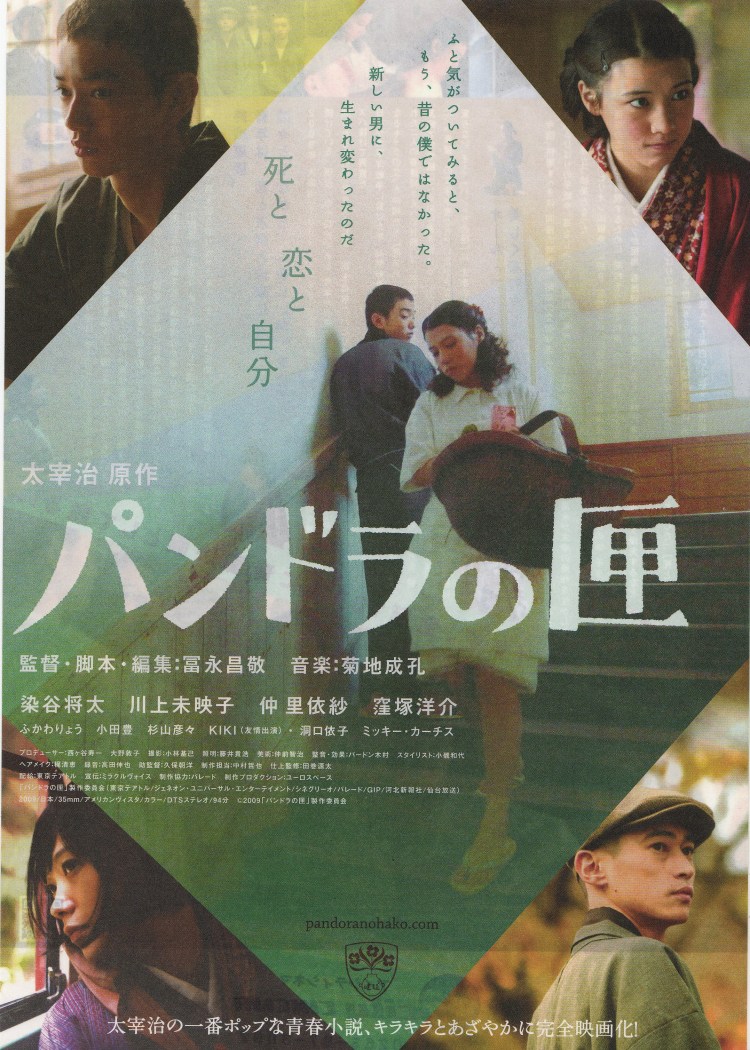
Pandora's BoxOsamu Dazai is one of the twentieth century’s literary giants. Beginning his career as a student before the war, Dazai found himself at a loss after the suicide of his idol Ryunosuke Akutagawa and descended into a spiral of hedonistic depression that was to mark the rest of his life culminating in his eventual drowning alongside his mistress Tomie in a shallow river in 1948. 2009 marked the centenary of his birth and so there were the usual tributes including a series of films inspired by his works. In this respect, Pandora’s Box (パンドラの匣, Pandora no Hako) is a slightly odd choice as it ranks among his minor, lesser known pieces but it is certainly much more upbeat than the nihilistic Fallen Angel or the fatalistic Villon’s Wife. Masanori Tominaga had made an impact with his debut film The Pavillion Salamandre and seemed to be a perfect fit for the quirkier, darkly comic Pandora’s Box but perhaps in the end it was too perfect a fit.
Inspired by events from Dazai’s own life, the story centres around a young man at the end of the second world war who has been suffering from tuberculosis for some time but kept quiet about it expecting to die soon and remove the burden on his family. However, when the war finally ends Risuke (Shota Sometani) inherits a new will to live and commits himself to a sanatorium to treat his lung condition. Whilst in the hospital he comes into contact with writers and poets as well as pretty nurses all the while proceeding with his plan to become a “new man” for this “new era”.

At once both hopeful and nihilistic, Pandora’s Box mixes gallows humour and denial in equal measure as the motley collection of inpatients waste their days away in this eccentric establishment which looks after them well enough but promises no real progress in terms of their health. Each of the patients receives a nickname when they enter the sanatorium so Risuke quickly becomes Hibari (sky lark). Tellingly, these nicknames overwrite real world personas – original names are recalled only at the time of death. Deaths do indeed occur but aside from these unhappy events, no one acknowledges the seriousness of their condition or the possibility that they may die from it, never leaving the hospital again. Physical pain and suffering is almost entirely absent though Risuke gives ample vent to his mental anguish through his letters to a fellow patient who has now been discharged back into the unseen chaos of the post-war world.

Indeed, the sanatorium might be a kind of idyll in this era of instability. Well fed and well cared for, the patients are far better off than many left adrift in the starving cities but the outside world rarely impinges on the isolated atmosphere of the sanatorium. Events change slightly when a friend of Risuke’s, Tsukushi (Yosuke Kubozuka), is discharged and a new nurse, Take (Mieko Kawakami), arrives stirring up various different emotions amongst the male patients in Risuke’s ward. Striking up a friendship with the younger nurse, Mabo (Riisa Naka), Risuke finds himself torn between two very different women.

Although its tone is necessarily one of depression and numbness, Pandora’s Box ends on an improbably upbeat note in which Risuke remarks that just like a climbing plant he may not know where he’s going, but it will certainly be a place of bright sunlight. A minor work filled with dark, ironic humour it’s perhaps unfair to expect the same kind of impact as Dazai’s more weighty efforts but Pandora’s Box is a lower budget affair which, although interesting enough in terms of direction, fails to make much of an impression outside of its obvious pedigree. The light jazzy score and deadbeat voice over add to the period feel whilst also lending an air of hopeless yet buoyant resignation to Risuke’s ongoing journey into the post-war world. This, in many ways, is what we’re here for – Risuke, unlike Dazai, has made a commitment to forge a way forward in which he plans to fight for the sun rather sink below the waves.


Original trailer (no subtitles)

Whistling in Kotan (コタンの口笛, Mikio Naruse, 1959)

vlcsnap-2016-08-03-02h37m50s119The Ainu have not been a frequent feature of Japanese filmmaking though they have made sporadic appearances. Adapted from a novel by Nobuo Ishimori, Whistling in Kotan (コタンの口笛, Kotan no Kuchibue, AKA Whistle in My Heart) provides ample material for the generally bleak Naruse who manages to mine its melodramatic set up for all of its heartrending tragedy. Rather than his usual female focus, Naruse tells the story of two resilient Ainu siblings facing not only social discrimination and mistreatment but also a series of personal misfortunes.

Masa and Yutaka are a teenage brother and sister living with their alcoholic father who has been unable to get things together since their mother passed away. They also have their grandmother and cousin, but otherwise they’re pretty much fending for themselves. At school, both children are shunned and picked on by some of their classmates solely for being Ainu. When one girl reports that her purse has gone missing, she immediately points to Masa and though another girl defends her, the obvious racial overtones continue to get to her. Similarly, Yutaka finds himself getting into trouble with one of the other boys after he beats him on a test. Yutaka pays a heavier price (at least physically) but both children are left wondering about their place in the world and what the future might hold for them.

Masa’s bright hope revolves around her art teacher who draws a picture of her at a local watering hole which he intends to enter into a competition. The teacher has his sights firmly set on a career as an artist in Tokyo but like everyone else’s dreams, it proves harder to realise than he might have hoped. Perpetually left behind, Masa’s dreams crumble too as do those of her friend who has her romantic hopes crushed firstly by her well meaning grandmother and then secondly by an unexpectedly racist action by someone who had always been seen as a friend. If all of these difficulties weren’t enough, fate is about to deal Masa and Yutaka a very cruel blow indeed which leaves them at the mercy of an evil uncle worthy of any Dickens novel.

Like much of Naruse’s work, the outlook is extremely bleak. The children face such a hopeless future that the most they can do is affect a kind of false cheerfulness to try and raise their spirits. Masa and Yutaka are both mistreated by the general population, leaving them with a lingering sense of anger and resentment towards those that seem incapable of treating them like regular human beings. Their cousin, Koji, has apparently come to the conclusion that he has to stand up against such mistreatment, however, the ultimate harm that is done to the pair is done by a member of their own family acting with total disregard their feelings and wellbeing. At this point Koji reconsiders and says he understands now that it isn’t about Ainu or Japanese, there are just awful people everywhere. An odd, if depressingly stoic, late in the game plea for empathy and tolerance, this ironically positive statement sits very well with Naruse’s general feelings on human nature.

Whistling in Kotan is not one of Naruse’s more subtle efforts. The tone is relentlessly bleak as the children experience ever more degrading treatment solely because of their ethnic group. Even their supposed ally eventually turns on them exposing the last lingering threads of prejudice among even those who portray themselves as forthright liberals. The message is one of forbearance and patience, that times have changed and will change more but that one has to grin and bear it while they do. Pragmatic as that is, it does let society of the hook when it comes to the refusal to acknowledge and deal with consistent prejudice. Filled with Naruse’s sense of despair, Whistling in Kotan is an uneven yet interesting exploration of this sensitive subject though perhaps undoes much of its good work with its ambiguous and often blunt approach to the material.


Summer of Ubume (姑獲鳥の夏, Akio Jissoji, 2005)

Summer of the UbumeAkio Jissoji has one of the most diverse filmographies of any director to date. In a career that also encompasses the landmark tokusatsu franchise Ultraman and a large selection of children’s TV, Jissoji made his mark as an avant-garde director through his three Buddhist themed art films for ATG. Summer of Ubume (姑獲鳥の夏, Ubume no Natsu) is a relatively late effort and finds Jissoji adapting a supernatural mystery novel penned by Natsuhiko Kyogoku neatly marrying most of his central concerns into one complex detective story.
Freelance writer Tatsumi Sekiguchi (Masatoshi Nagase) and occult expert Kyogokudo (Shinichi Tsutsumi) become intrigued by the bizarre story of a woman who has apparently been pregnant for twenty months. If that weren’t enough weirdness, the woman’s husband also went missing a year ago and now her sister has approached the pair hoping they can investigate and figure out what’s really going on. Unbeknownst to him, Sekiguchi has a longstanding connection with several of the people involved and himself plays a role in the central mystery. Demons foreign and domestic, past trauma, infanticide and multiple personality disorder are just some of the possible solutions but as Kyogokudo is keen to remind us, there is nothing in this world that is truly strange.

The mystery conceit takes the form of a classic European style detective story complete witha drawing room based finale in which each of our potential suspects is assembled for Kyogokudo so that he can deliver his final lecture and tick them all off the list as he goes along. The tale takes place in the summer of 1952 and so the spectre of Japan’s wartime past, as well as its growing future, both have a part to play in solving this extremely complex crime. The original supernatural question concerns two otherworldly entities which have become conflated – the Chinese Kokakucho which abducts children, and the Japanese Ubume which offers its child to passersby. Needless to say, the answer to all of our questions lies firmly within our own world and is in no small part the result of relentless cruelty masked as tradition.

The opening scene includes a lengthy discussion between Kyogokudo an Sekiguchi debating the nature of reality. We only experience the world as we perceive it, seeing and unseeing at will. Everybody, to an extent, sees what they need to see, therefore, memory proves an unreliable narrator when it comes to recalling facts which may run contrary to the already prepared narrative.

Jissoji brings his trademark surrealist approach to the material which largely consists of interconnecting flashbacks often intercut with other dreamlike imagery. Filming with odd angles and unusual camera movements, Jissoji makes the the regular world a destabilising place as the strange mystery takes hold. The canted angles and direct to camera approach also add to a slight hardboiled theme which creeps in around the otherwise European detective drama though this mystery is much more about solving a series of puzzles than navigating the dangerously dark world of the noir. That said this is a very bleak tale which, for all its frog faced children weirdness, has some extremely unpleasant human behaviour at its roots.

Supernatural investigator Kyogokudo quickly dispenses with the demonic in favour of the natural but the solutions to this extremely complicated set of mysteries are anything but simple. Making space for the original novel’s author to show up as a travelling picture storyteller with some Shigeru Mizuki inspired illustrations on his easel, Summer of Ubume is not entirely devoid of whimsy but its deliberately arch tone is one which it manages to make work with its already bizarre set up. The enemy is the unburied past, or more precisely the unacknowledged past which generates its own series of ghosts and phantasms, always lurking in the background and creating havoc wherever they go. Occasionally confusing, Summer of Ubume is a fascinating supernatural mystery which takes its cues much more from European detective stories and gothic adventure than from supernatural horror or fantastical ghost story.


Natsuhiko Kyogoku’s source novel is available in an English translation by Alexander O. Smith (published by Vertical in the US).

Original trailer (no subs):

With Song in Her Heart (希望の乙女, Yasushi Sasaki, 1958)

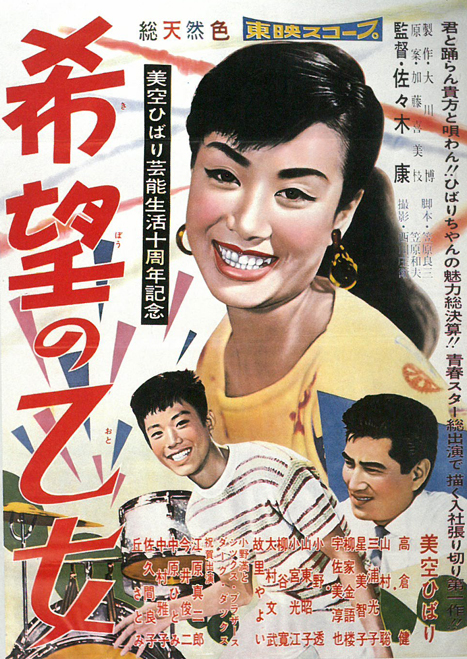
song in her heartAnother vehicle for post-war singing star Hibari Misora, With a Song in her Heart (希望の乙女, Kibo no Otome) was created in celebration of the tenth anniversary of her showbiz debut. As such, it has a much higher song to drama ratio than some of her other efforts and mixes fantasy production numbers with band scenes as Hibari takes centre stage playing a young woman from the country who comes to the city in the hopes of becoming a singing star.

After beginning with a rural, almost cowboy-style number in which Hibari appears as the well dressed lady of the manor, Sayuri, riding her horse across the wide pastureland, the action quickly moves to the city when Sayuri’s mentor finally convinces her uncle that her future lies in showbiz and not an early marriage as he had envisioned. However, once she gets there she finds her potential tutor extremely unwilling to fulfil his promise to take her on. After winning him over, she quickly makes friends with the locals who also want the singing teacher to become the leader of a band they’ve formed in the hopes of raising some money to build a proper children’s playground to stop them playing in dirty ditch land nearby which is a well known health hazard. Soon enough the band takes off but there’s more trouble ahead for Hibari and co. as they are betrayed by those closest to them.

Working as a celebration of Hibari’s career so far With a Song on Her Heart is filled with excuses for Hibari to sing both as a music student and band vocalist as well as fantasy production numbers some of which are even bigger on dance than on song. The plot is quite simple but there is a lot of it, in contrast to other films of this kind, as Hibari sets about healing the grief stricken heart of her bandleader and fulfilling the hopes of the ordinary people turned musicians through the power of song. The romance element is a light one and not the focus of the film but bears mentioning as Hibari’s love interest is played by Ken Takakura – the archetypical star of the yakuza movie who was to marry fellow singing sensation (and frequent Hibari Misora co-star) Chiemi Eri the following year.

Despite its nature as a celebratory project, With a Song in Her Heart doesn’t quite meet the high production standards of other Misora starring films. Shot in colour and in 2.35:1, the majority of the film is studio bound (often very obviously so) with simple sets and a straightforward directing style. Nevertheless, even if it fails to impress on a technical level, With a Song in Her Heart knows what it’s about and so it makes sure to fill its relatively short duration with as many songs as possible, light romance and a cheerful atmosphere of people coming together to try and solve a social problem through spreading love and joy in the form of music. The musical styles are unusually varied embracing Hibari Misora’s regular ballads as well as mixing in world influences from mariachi to african drums with a strong big band jazz undercurrent.The overall feeling is one of goodnatured wholesomeness and even if low on impact With a Song on Her Heart is a decent showcase for Hibari Misora’s talents as she celebrates her tenth year in the business at the age of only 21.


Shark Skin Man and Peach Hip Girl (鮫肌男と桃尻女, Katsuhito Ishii, 1999)

Shark_Skin_Man_And_Peach_Hip_Girl_(1998)If you’re going on the run you might as well do it in style. Wait, that’s terrible advice isn’t it? Perhaps there’s something to be said for planning a cunning double bluff by becoming so flamboyant that everyone starts ignoring you out of a mild sense of embarrassment but that’s quite a risk for someone whose original gamble has so obviously gone massively wrong. An adaptation of a manga, Katsuhito Ishii’s debut feature Sharkskin Man and Peach Hip Girl (鮫肌男と桃尻女,  Samehada Otoko to Momojiri Onna) follows a mysterious criminal trying to head off the gang he just stole a bunch of money from whilst also accompanying a strange young girl, also on the run but from her perverted, hotel owning “uncle” who has also sent an equally eccentric hitman after the absconding pair with instructions to bring her back.

Like Ishii’s subsequent efforts, Shark Skin Man and Peach Hip Girl is a riot of full on craziness from the get go, though he largely manages to avoid manga adaptation cliches. The gangster, Samehada (Tadanobu Asano), is pursued by an eccentric set of former gang members – the sanest amongst them being Sawada (Susumu Terajima), his former partner who wants to track him down first to prevent the bloody retribution his guys have in store for him. The gang’s boss (Ittoku Kishibe), lovingly caresses a harpoon, dresses in a gestapo style shiny black leather overcoat, wears one glove, and is on a quest to track down rare vintage posters of much loved Japanese comedian Kon Omura. One of his henchmen is a guy with bleach blond hair who dresses all in white and has an extremely sensitive sense of smell but an intense aversion to water.

The heat coming from the other side is equally strange as the leacherous uncle is apparently friends with Japan’s weirdest hitman, Yamada, who dresses in a retro style and has a unibrow and a high pitched voice. In fact, he’s basically Ken Omura himself, creeping about, being odd in a ridiculous cartoon character way. Unfortunately, Yamada has a weakness and just as he’s about to complete his mission he falls in love with his target! Apparently this is something that happens to him often though you’d think it would be quite a liability given his line of work. In this instance who could really blame him, but his new found romance means he won’t be able to pull the trigger  – and not only that, he can’t bring the girl back either because he doesn’t want to break the beautiful gangster’s heart! Ah, true love!

There is quite a lot going on. Too much, really. For all the craziness which ensues, it’s hard to build up an attachment to any of our strange little gangsters and their petty plots or bids for freedom. Things build to a whirlwind of chaos in the final stretch but when it’s all supposed to calm down for a little spiritual contemplation at the end, the effect begins to fall apart.

There are however a few quieter sections such as a surprisingly maudlin one in which yakuza sons of yakuza fathers lament their unhappy childhoods which saw them bullied and excluded by their law abiding peers. One even says that he thought the tattoos were something which just appeared on everyone when they grew up. Ishii employs some strange jump cuts, moving us ahead a little jerkily as the time passes slowly for this motley crew of veteran bad guys. He later employs a similar technique where he shifts some of his violence into the expressionist realm by cutting on the sound of landing punches.

As the title suggests, Shark Shin Man and Peach Hip Girl is the story of two crazy kids on the run, and the bizarre collection of people who end up chasing them. Ishii could never be accused of subtlety but the punk infused, anarchic and ironic tone are difficult to resist even if the end result is a necessarily slight one. An imperfect, though impressive debut, Shark Skin Man and Peach Hipped Girl is an interesting genre infused tale that uses absurd humour as a foil for the darkness and violence which underpins it.


Original trailer (no English subs – French subs available via settings menu)

Midway through this film someone starts singing a Japanese language cover of Donna Donna which was a surprise! Can’t find a clip so here’s Joan Baez’s version live in Japan in 1967!