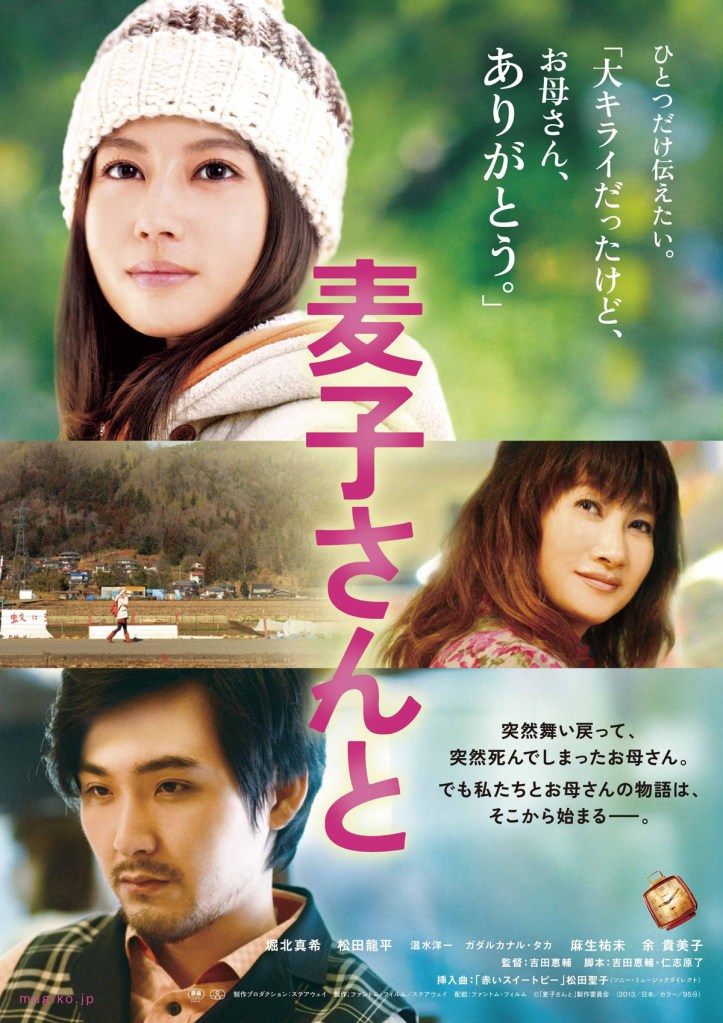
My Little Sweet Pea (麦子さんと, Keisuke Yoshida, 2013)

My Little Sweet PeaHow many times were you told as a child, someday you will understand this? There are so many things you don’t see until it’s too late, and children being as they are, are almost programmed to see things from a self directed tunnel vision. Such is the case for Mugiko – a young woman with dreams of becoming an anime voice actress who is suddenly reunited with her estranged mother of whom she has almost no memory.

Mugiko (Maki Horikita) has a part time job in a manga store and is saving money to go to voice actress school. Raised by her father who has since passed on, she lives in a small flat with her older brother Norio (Ryuhei Matsuda) who also has a low wage job in a pachinko parlour. The pair’s lives change entirely when their long absent mother, Saiko (Kimiko Yo), arrives on their doorstep one day and begs to live in with them. Norio is dead against it but eventually Mugiko is persuaded and Saiko moves in. However, right after, Norio moves out to live with his girlfriend leaving Mugiko alone with the virtual stranger who is also her mother. Mugiko has a difficult time adjusting to living with a maternal figure and harsh words follow frequent misunderstandings until Saiko suddenly dies. Mugiko then travels back to Saiko’s hometown to inter her ashes and begins to forge a connection with the mother she barely knew.

The “haha mono” or “mother movie” is a subset of Japanese melodrama which focuses on the pain and heartbreak inherent in being a mother. Making countless sacrifices, the often saintly mothers do everything they can to ensure the best for their children even if their efforts cause nothing but suffering for themselves. My Little Sweet Pea (麦子さんと, Mugiko-san to) turns the genre on its side to look at things from the point of view of one of the “ungrateful” children, Mugiko, who is filled with resentment over having been “abandoned” only to have her mother suddenly return as if expecting to forget all the years of absence with one home cooked meal.

On journeying back to her mother’s remote rural town, Mugiko begins realise they weren’t so different from each other after all. Everyone in the village is stunned by Mugiko’s appearance which turns out to be the spitting image of her mother at around the same age. Saiko had also been something of a local celebrity thanks to her beauty, charm and popular presence. She left the town for the city with dreams of becoming a famous singer just like Seiko Matsuda and her rendition of the singer’s famous song Akai Sweet Pea is fondly remembered by the older generation.

Saiko’s dreams of hitting it big in the music business were never fulfilled though we know almost nothing about what happened to her between the end of her marriage and reappearance in her children’s lives save that she obviously had enough financial security to be able to send them money every month. Through meeting her mother’s old friends (and more than a few admirers), Mugiko comes to see something of herself in the distant figure of her mother as a young woman. Even if she couldn’t be there for reasons which are never fully explained, it wasn’t because she didn’t want to be or because she’d forgotten about or rejected her children, she suffered everyday thinking of and missing them and was tragically unable to rebuild that connection even at the very end.

Mugiko has been a little unsettled in her life, floating from one dream to the next and who really knows if voice acting is really the thing that she was meant to do. Saiko may have been more certain in her objective but whatever happened later it seems she found fulfilment in being a mother even if her dream of becoming a singer didn’t work out. Having been able to meet her mother even if vicariously, Mugiko is able to understand something about herself and perhaps repair a relationship that never quite took place. Striding out boldly with her mother in spirit beside her, Mugiko is finally able to step into the adult world and everything that is waiting out there for her with a new found confidence that comes with embracing the beauty of a distant scar.


Trailer (with English subtitles)

and here is the hit song from Seiko Matsuda – Akai Sweet Pea (1982)

Robinson on the Beach (砂の上のロビンソン, Junichi Suzuki, 1989)

Robinson on the Beach

“Family Drama” is often said to be the mainstay of Japanese film. From Ozu to Koreeda, drama in the basic social unit has often been exploited to create a wider dialogue about society at large. However, In the wake of Yoshimitsu Morita’s condemnation of modern family values in The Family Game the nature of the conversation shifted. As Japan eased into its bubble era, concerns began to grow about what exactly the rise of consumerism meant for traditional values. Robinson on the Beach (砂の上のロビンソン, Suna no Ue no Robinson, AKA A Sandcastle Model Family Home) takes things one step further than The Family Game in that it repackages the entire idea of “the ideal family” as something that can itself be bought and sold and therefore manipulated as the perfect marketing tool.

At the beginning of the film, the Kidos are a fairly ordinary lower middle class family of five all living a modest apartment. They’re a little cramped – in fact so much so that mum and dad have to sneak into the wardrobe to get some alone time together just watching movies on a tiny TV set and sharing a set of earphones between them. The kids are always at each other’s throats but broadly they’re happy. However, when both husband Shouhei and wife Ryoko spot an advert for a new scheme which promises a “free” house to a “model family” they decide that this is their best chance at a new life. The deal does have a few drawbacks – they all have to play the part of a perfect family for a whole year and let the public into their lives to prove it.

Things were a little more innocent back in 1989. Reality TV hadn’t yet kicked in and the Kido’s don’t quite understand what it is they’re letting themselves in for when they agree to this too good to be true offer. The house they’ve been given is a veritable mansion – a huge, sprawling Western style home with a bedroom each for the children, a dedicated study for Shouhei and as many walk-in closets as anyone could wish for. However, the cars in the garage are only for show and even if the house is in the same general area as their old flat, Shouei still has to cram himself inside the sardine tin of the morning commuter train every day just like before.

He does at least have the luxury of being allowed to leave the house, unlike Ryoko who becomes a bizarre “first lady” to this new show home empire expected to play a role somewhere between real estate agent and princess as she welcomes prospective buyers and allows them to poke and prod all over her nice new home spreading thinly veiled judgement wherever they go. Suddenly she has people going through her fridge and oggling her washing left hanging up to dry . The liaison lady from the company even has the gaul to criticise Ryoko’s nightwear as “frumpy” and orders her to buy something a little more glamorous which will match the “upmarket” appeal of the house.

After she gives in and does this she just has to listen as two visitors describe the new nightwear as “slutty” and wonder how a “respectable” wife could wear such a thing (it’s just a regular pink negligee nightdress, nothing unusual about it at all save for being a little more career woman than mumsy in appeal). In fact, the family’s new found circumstances only cause resentment in those around them and Ryoko in particular is plagued by nuisance callers who repeatedly accuse her of having prostituted herself to win the house.

In the economic reality of Tokyo at the time, there was just no feasible way a family like the Kidos would ever be able to afford to own their own house. They probably wouldn’t even be able to rent one or get anything bigger than the apartment they occupied at the beginning of the film. Shohei provokes the ire of his boss after moving into the show home because it’s already better than anything his boss could afford and he already owns a small home far out in the suburban commuter belt. Now everyone has it in for Shohei and he does get a kind of demotion as the company send him to demonstrate their “super slicer” kitchen gadget in a local department store. This is doubly worrying as Shohei is a very shy and nervous man who is not well suited to public speaking leaving the company’s excuse of making use of his new found celebrity as an ironic way of taking revenge on his jumping up the social order through unorthodox means.

All of these stresses gradually build up as even the children are subject to attacks from outside (and some of them very cruel and disturbing in nature). Before long this once happy family begins to buckle under the strain of pretending to be what they once really were. One particularly perverse episode sees them sitting down to a pre-scripted dinner while an audience of onlookers silently judge them as if they were engaged in some kind of performance art – which, of course, they are albeit almost unconsciously. Having gained everything they’d ever wanted, they discover that the costs far outweigh the benefits with Shohei hit hardest after he succumbs to a streak of selfish individualism that has dire consequences for everyone.

Eventually the value of the traditional family is reinforced as everyone starts to realise that the fancy house was never as important as the simple happiness they felt being crammed together in their tiny apartment. Though there is a hopeful resolution at the end, whether or not the damage can be repaired may be a matter for debate though the overriding message of caution about the corrupting influences of rampant consumerism including classism, petty jealousy and a growing tendency towards the voyeuristic is one which finds its way into many of the films from this period and is sadly still worth restating even today.


Scene from near the beginning of the film (with English subtitles):

Dr. Akagi (カンゾー先生, Shohei Imamura, 1998)

Dr AkagiA late career entry from socially minded director Shohei Imamura, Dr. Akagi (カンゾー先生, Kanzo Sensei) takes him back to the war years but perhaps to a slightly more bourgeois milieu than his previous work had hitherto focussed on. Based on the book by Ango Sakaguchi, Dr. Akagi is the story of one ordinary “family doctor” in the dying days of World War II.
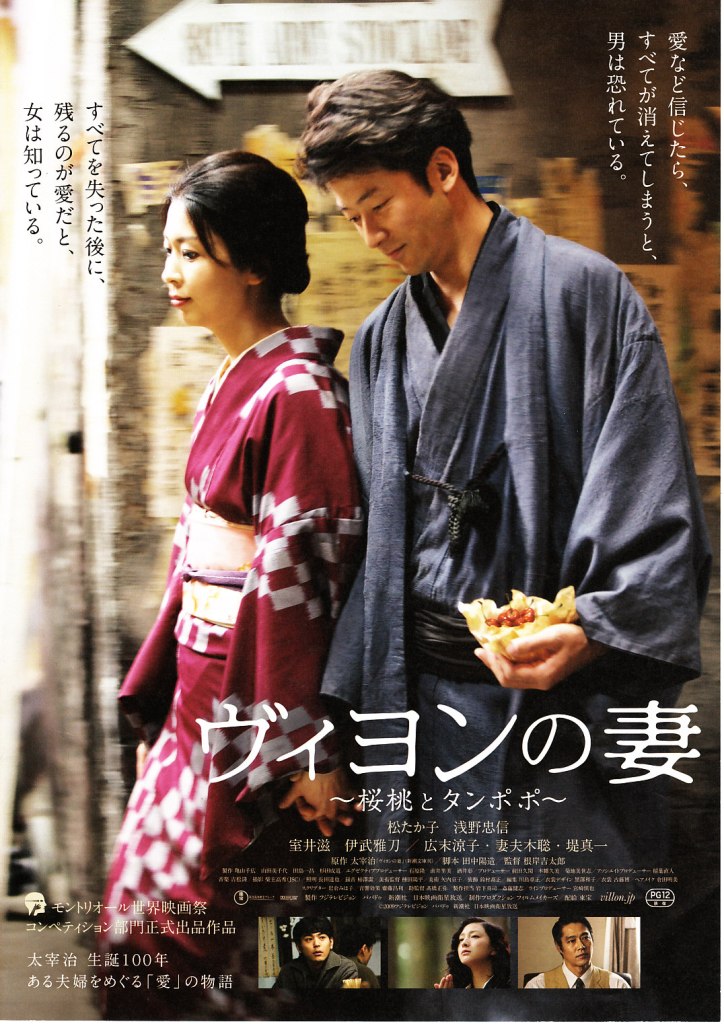
As Dr. Akagi (Akira Emoto) puts it, much of the the life of a family doctor involves running. If he breaks one leg, he’ll run on the other, if he breaks both legs, he’ll run on his hands, but he’ll do whatever it takes to get to his patients. Some of the villagers have branded him as a quack and nicknamed him “Doctor Liver” because his most frequent diagnosis is for hepatitis. Doctor Akagi is convinced that there really is an epidemic of contagious hepatitis plaguing the population and even has the evidence to back his theory up but with the war in crisis and so much else going on he’s having trouble getting anyone to listen to him. Nevertheless, Akagi fearlessly tries to find out what it is that’s causing this deadly disease to spread and hopefully put an end to it for good.

Imamura strikes an oddly comic tone here. Though the above synopsis may sound overly serious, for the vast majority of its running time Dr. Akagi is the story of a small fishing village going about its everyday life with the war just simply background. The town narrowly escapes being bombed by an American raid because it’s known that there’s prisoner of war camp nearby filled with allied soldiers and red cross personnel and there are certainly a lot of troops on the ground more or less running the show. However, despite the obvious hardships – lack of food being the biggest one, the townspeople are getting on with things in a fairly cheerful way.

Following a spot of pastoral care, Dr. Akagi ends up taking in a local girl as his assistant and housekeeper after her father has died leaving her to support her two younger siblings. Though a married woman with a husband away at the front, Sonoko (Kumiko Aso) has been making ends meet through prostitution with the rather unwelcome result that one of her regular customers wants to marry her (she does not reciprocate and after all already has a husband). Akagi doesn’t necessarily disapprove of the idea of prostitution or of openly expressed sexuality, but accepts that society does object to these ideas and takes Sonoko in so that she won’t have to sell herself (though she actually didn’t really mind very much and still finds herself called upon to provide her “services” even after she’s officially given up).

Akagi’s other supporters include a fellow doctor, Tomomi, who has become addicted to morphine after his wartime service and a drunken and lecherous buddhist monk who proves an essential ally when it comes to body snatching a recently buried corpse. Akagi gets himself into even more trouble when he takes in and treats an escaped Dutch POW who bears the scars of extreme torture by Japanese forces who are paranoid about possible spy action. Imamura is never afraid of raising the spectre of wartime brutality as his soldiers flit between righteous zealots committed to the letter of the law and bumbling idiots who can’t see that each of their actions is entirely counterproductive to their cause.

The most surprising moment comes when Akagi has a dream about his son who is an army doctor serving in Manchuria. After Akagi and his friend have conducted an autopsy to gain a fresh liver sample, Tomomi starts talking about his time in the army and a rumour about a group of doctors doing live dissections and possibly researching chemical weapons. Akagi is aghast and horrified but recounts his dream in which he stood before his son whose bloodied hands are extended towards him with a living patient writhing below. Akagi reminds him that he is a doctor and urges him to stop this barbaric practice but the nightmarish vision of this gloomy, blood-soaked room persists.

At the end of the film Sonoko and Akagi unwittingly end up viewing the giant mushroom cloud which arises after the atomic bomb blast in Hiroshima. Not knowing what it is, Akagi predictably sees it as a giant infected liver and wonders if the donor for his liver sample is angry with him but then thinks again and says the cloud is a representation of everybody’s anger towards this war. Akagi loses himself a little in the quest to solve the hepatitis question and after it leads him to neglect a patient he begins to question himself over his true motives and whether there’s really any point to what he’s trying to do. However, Dr. Akagi is a good and a kind man and eventually remembers what his true calling is – as a family doctor, running from one emergency to the next but always making sure his patients are well looked after. War or no war, life goes on – people get sick and they need to know there are men like Akagi out there that can always be relied upon to do the very best they can.


Dr. Akagi was originally released in the US by Kino Lorber but seems to be out of print. The good news is that the region free Korean disc comes with English subtitles.

Unsubbed trailer:

Villon’s Wife (ヴィヨンの妻 〜桜桃とタンポポ, Kichitaro Negishi, 2009)

Villon's Wife2009 marked the centenary year of Osamu Dazai, a hugely important figure in the history of Japanese literature who is known for his melancholic stories of depressed, suicidal and drunken young men in contemporary post-war Japan. Villon’s Wife (ヴィヨンの妻 〜桜桃とタンポポ, Villon no Tsuma: Oto to Tampopo) is a semi-autobiographical look at a wife’s devotion to her husband who causes her nothing but suffering thanks to his intense insecurity and seeming desire for death coupled with an inability to successfully commit suicide.

Beginning in the immediate post-war period of 1946, Sachiko (Takako Matsu) is a fairly ordinary housewife with a young son who generally waits around the house for her husband’s return. Only, she’s married to one of the most brilliant writers of the age, Joji Otani (Tadanobu Asano), whose book on the French poet François Villon is currently a best seller. Despite his obvious literary talents, Otani is a drunkard who spends most of his time (and money) in bars and with other women. When he crashes home one night only to be pursued by two bar owners who reveal that he ran off with their takings (around 5000 yen), Sachiko is not exactly surprised but still embarrassed and eventually takes matters into her own hands by volunteering to offer herself as a “hostage” by working at the bar until the debt is repaid.

“Men and women are equal now, even dogs and horses” says one customer, impressed with this sudden arrival of a beautiful woman in a low life drinking spot. To her own surprise, Sachiko actually enjoys working at the bar, it gives her purpose and proves more interesting than being stuck at home waiting to see what her drunken fool of a husband has got up to next. She’s good at it too – Sachiko is a beautiful and a fundamentally decent and kind person, in short the sort of woman that everyone falls a little bit in love with. That said, she isn’t a saint. She’s perfectly aware of the power she is able to wield over men and is unafraid to make use of it, though only when absolutely necessary.

Otani himself is a fairly pathetic figure. He may be a great artist but he’s a hollow human being. He admits the reason for all of his vices is fear – he’s a afraid to live but he’s also afraid to die. He seems to love his wife, though he’s insecure about losing her and dreads the embarrassment involved in becoming a cuckold. So afraid to face the possibility of failure, Otani satisfies himself in an underground world of drunks and easy women rather than facing his own self loathing as reflected in the faces of his unconditionally loving family.

Perhaps because Villon’s Wife is a commemorative project, the film has been given the prestige picture treatment meaning the darker sides of Dazai’s original novella have been largely excised. The chaos of the post-war city with its starving population, soldiers on the streets and generalised anxiety is all but hidden and some of the more serious travails Sachiko undergoes in devotion to her husband as well as Otani’s tuberculosis (from which Dazai also suffered in real life) have also largely been removed. What remains is the central picture of a self destructive husband and the goodly wife who’s trying to save him from himself but risks her own soul in the process.

The one spot of unseemliness of post-war life that the film lets through is in a brief scene which features a group of pan pan girls hanging around ready to try and snag some passing GIs. Sachiko buys some lipstick from them to use in attempt to convince an ex who is also a top lawyer to try and help her husband after his latest escapade lands him in jail on a possible murder charge. After visiting him, Sachiko wanders out slightly dazed to see the pan pans atop a military jeep cheerfully waving and shouting “goodbye” in English. Sachiko is confused at first but eventually shouts “goodbye” back in a way which is both excited and a little bit sad, perhaps realising she is not so different from them after all. Finally she wipes the lipstick from her face and leaves the small silver tube behind where the pan pans were sitting, hoping to bury this particular incident far in the past.

In actuality the pan pan girls are depicted in a fairly matter of fact way rather than in the negative light in which they are usually shown, just another phenomenon of occupation. At the end of the film Otani calls himself a monster whilst acknowledging that he’s a terrible father who would steal the cherries from his own son’s mouth. Sachiko replies that it’s OK to be a monster – as long as we’re alive, it’ll be alright. Oddly for someone so suicidal, this fits in quite well with Dazai’s tenet of embracing the simple gift of a dandelion. The film ends on an ambiguous note in which there seems to have been some kind of restoration but it’s far from a happy one as the couple remain locked in a perpetual battle between light and darkness albeit with the balance a little more equalised than it perhaps was before.


The R3 Hong Kong DVD release of Villon’s Wife includes English subtitles.

COSMIC RESCUE -The moonlight generations- (コスミック・レスキュー ザ・ムーンライト・ジェネレーションズ, Shinsuke Sato, 2003)

Cosmic RescueIt’s often posited that Japan rarely produces “science fiction” literature or movies and some say that’s because, well, they already live there. However, this isn’t quite true, there are just as many science fiction themed projects to be found in Japan as elsewhere you just have to look a little harder to find them. Depending on your point view, if you succeed in tracking down a copy of Cosmic Rescue -The moonlight generations- (コスミック・レスキュー ザ・ムーンライト・ジェネレーションズ), you may feel the quest was not entirely worth the effort.
Starring the younger half of the Johnny’s idol group V6 (referred to as “coming century”), Cosmic Rescue takes place in 2053 when space travel has become easy and commonplace enough to require the presence of galaxy wide emergency services. Cosmic Rescue is the AA of space travel – they float around waiting for disaster to strike whereupon they will swoop in and rescue those in peril among the stars.

However, the three crew members of the rundown rescue ship from the 89th Division of Japanese CR mostly spend their days clearing crash debris and changing batteries. The rookie of the group Sawada (Junichi Okada) longs for a spot of heroism just like in his favourite manga which inspired him to join the CR in the first place, whereas ship’s engineer Eguchi (Ken Miyake) gets on with the day to day work of maintaining the ship while the captain Nanjo (Go Morita) mopes about slumming it with this lowly crew of cleanup artists despite being a CR legend after he was involved in a heroic rescue which cost the life of his best friend. However, when Sawada receives an emergency distress call from a young woman who claims to the be sole survivor of a space crash, the gang find themselves embroiled in a corporate conspiracy.

Directed by a young Shinsuke Sato who would later go on to become one of the most successful directors of mainstream Japanese blockbusters including Gantz and Library Wars among other smash hit franchises, Cosmic Rescue is a very competently made science fiction adventure given its obvious budgetary constraints. It’s fair to say that it’s largely been created as a vehicle for its three (hugely popular) leading men and so falls back on their charisma to plug any holes in the rather generic script and lack of production values but generally acquits itself pretty well.

That said, there are no shoehorned in singing sections and even if a low budget, televisual atmosphere remains there’s still a fun sci-fi adventure underpinning it all. Sawada is the ostensible lead as he longs to prove himself as a real “hero” by saving lives in space just like his captain had done before yet Nanjo’s story becomes equally important as he battles to overcome the guilt and fear he feels after losing his friend in an earlier mission. Engineer Eguchi gets a little sidelined in a technical role but each of the three guys get fairly equal weighting as members of the maverick, underdog space crew who are going to expose this mass conspiracy and save the damsel in distress no matter what the cost.

There is a (fairly trite) message here spelt out in voice over at the end of the film that it’s easy to forget who you are when you’re used to being “tied down” by gravity but if you can’t learn to save yourself you won’t be able to save anyone else. Cosmic Rescue is what it is – it isn’t really pretending to have any kind of deeper message other than showcasing its leading actors in a fun, slightly retro space adventure. Though a fairly low budget, disposable affair aimed squarely at fans of the band, Sato adds some interesting direction plus a vaguely 1960s inspired production design which help to lift the proceedings above the bonus feature category.


The Japanese release of Cosmic Rescue includes English subtitles!

Unsubbed trailer:

The Assassination of Ryoma (竜馬暗殺, Kazuo Kuroki, 1974)

Ryoma AnsatsuSakamoto Ryoma is a legendary revolutionary of Japan’s Bakumatsu period which encompasses the chaos that ensued after Japan was forced open after centuries of self imposed isolation. Ryoma was a low level samurai from a small town who resented the unjust treated of the arrogant true samurai above him and skipped out on his clan without the proper permission to go study sword fighting in the city. After the arrival of the Americans and witnessing their far superior technologies, Ryoma was one of several men who became convinced that Japan needed to modernise quickly or become a slave to more advanced cultures. However, this was a turbulent era and there was general infighting among all factions and all sides and Ryoma was mysteriously assassinated in 1867 along with his friend and ally Nakaoka Shintaro.
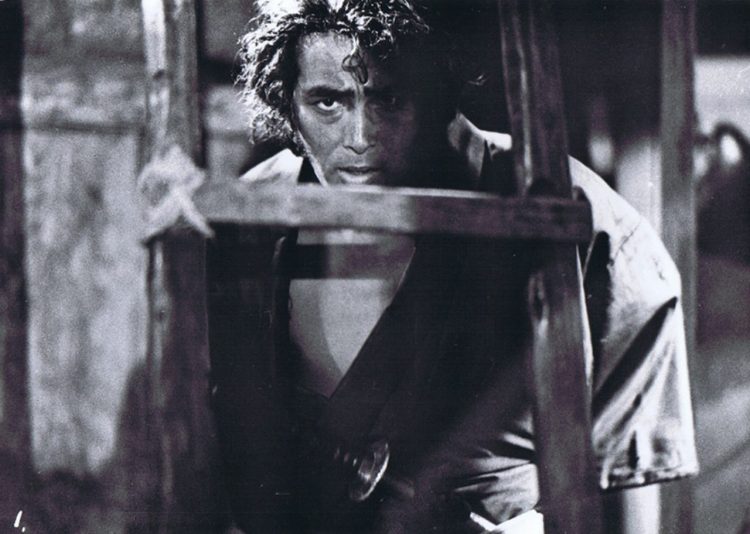
In thinking about the legacy of Sakamoto Ryoma, it’s important to try and separate the man from the legend. His legacy has become somewhat romanticised as his visionary ideas of a modernised Japan free of outside influence but also of outdated, feudalistic ideals have developed into an easily cop-opted set of talismans. Kuroki Kazuo’s 1974 film The Assassination of Ryoma (竜馬暗殺, Ryoma Ansatsu) attempts to place Ryoma firmly back within the mortal realm as it explores the events of his last days in late 1867 when he was brokering the new world from the shadows.

Played by Japan’s original ‘70s wild beast Harada Yoshio, this Ryoma is a slightly bumbling though thoughtful young man who likes to have a good time when he isn’t busy trying to overthrow the shogunate. An early scene sees him fiddling with a revolver which he claims is a better weapon to be in hiding with because it’s a little more portable and discreet than a traditional sword. However, he doesn’t quite know how to use it and can’t figure out how to make it fire in order to give his friend a demonstration. Later, having moved on slightly from his ideas of a peaceful revolution, his plan to buy a number of rifles backfires when he is sent a camera instead.

Ryoma is joined by two “allies” who both originally came in order to kill him but have apparently switched sides. The first is one of his oldest friends, Shintaro, who remained a member of a hard right revolutionary group in Ryoma’s home town which ran under the slogan “Revere the Emperor, Expel the Foreigners”. Understandably they haven’t taken too well to Ryoma’s change of heart regarding the modernisation of Japan and are committed to taking him out – hence dispatching Shintaro, though he proves reluctant to assassinate his friend. The other is a mysterious and largely silent assassin, Uta (played by Matsuda Yusaku), who also ends up forming an unlikely friendship with Ryoma which prevents him from carrying out his mission.

Kuroki shoots in black and white within a 4:3 frame and in gritty 16mm but also goes in handheld almost like newsreel footage shot by a frontline war correspondent. As well as using some silent cinema inspired compositional techniques, Kuroki also adds in a few intertitles either with historical information or to provide some additional commentary on the action such as when he tells us that violence from left wing samurai is a daily occurrence. Drawing a neat parallel between he chaos of the Bakumatsu era and its tussling between new and old, Kuroki leaves us with a sense of historical continuity by equating the left wing samurai rebellion of the 1860s with the left wing student moment of a whole century later.

However, Ryoma is just one man. In an enlightening metaphor about a cat who got stuck up a tree, Ryoma calls to it and tried to climb up to get the cat down but it just kept climbing higher and wouldn’t even take the mochi he tried to offer it on a stick. Eventually Ryoma wanted to cut the whole tree down in order to save the cat but everyone laughed at him – cut down a 10ft wide tree to save one skinny cat? At that time Ryoma laughed too but later it made him angry. He thought the idea of cutting down the tree should be allowed to be considered, that every option ought to be explored. The important thing is to see things from all angles and allow yourself the freedom to change your mind, reject all previous knowledge in the light of a new way of thinking. This kind of freedom is necessarily frightening and may lead others onto a path which you yourself do not wish to follow but all the same it is the very idea which gives birth to Ryoma’s entire philosophy.

Kuroki’s vision of this visionary hero is an unconventional one and one which was not universally accepted by the audience of the time. Just as radical as the man himself, Kuroki’s film portrays Ryoma as a modern revolutionary who lived a hundred years ago, yet wanted many of the same things that the youth of the day were still fighting for – personal freedom, equality for all, and a modern society which allowed his nation to stand independent, on an equal footing with its European counterparts. The assassination itself is brutal, bloody and efficient. It’s an uncinematic ending for a cinematic hero in which he’s violently cut down in a frenetic yet naturalistic fashion leaving a trail of polluting black blood spreading across the high contrast bright white background. His ideas were too radical for his era, and his tragic end a sadly predictable one but what does this say about the world of today and the would be revolutionaries whose voices appear to have been silenced?


(I’ve gone for surname first order here because that’s the most usual way of referring to historical figures – I accept that it’s confusing but it is at least consistant).

The life story of Sakamoto Ryoma has been dramatised many times, most recently as a Taiga drama, Ryomaden, directed by Rurouni Kenshin’s Ohtomo Keishi and starring Fukuyama Masaharu, which has apparently boosted Ryoma’s profile even more and created a raft of new tourist spots in various areas of Japan. (It’s obviously very long as it’s Taiga drama but is well worth the investment in time and effort.)

Unsubbed trailer:

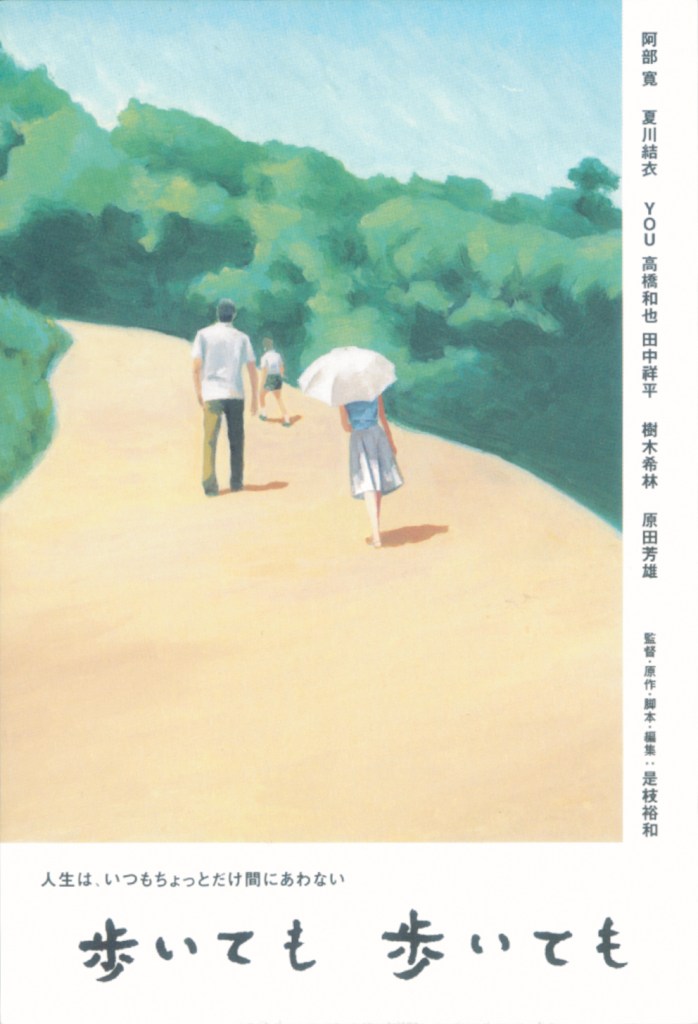
Still Walking (歩いても歩いても, Hirokazu Koreeda, 2008)

still walkingLife is full of choices, but the one thing you can’t choose is your family. Like it or not you’re stuck with them for life and even if you decide you want nothing to do with them ever again, they’ll still be hanging round in the back of your mind for evermore. Koreeda swings the camera back around the fulcrum of Japanese society for this dissection of the fault lines and earthquake zones rubbing up against this very ordinary family.
You’d be forgiven for thinking that some kind of celebration is about to take place at the beginning of Still Walking (歩いても歩いても, Aruitemo Aruitemo) yet the event that is about to bring scattered friends and family members back home is of a more somber nature. As the matriarch Toshiko (Kirin Kiki) peels vegetables with her daughter Chinami (YOU) she seems excited at the prospect of getting the family back together again yet melancholic and perhaps a little nervous.

Younger son Ryota (Hiroshi Abe) is taking the train in with his new wife and stepson. He urges Yukari (Yui Natsukawa) that they should make their excuses and leave in time for the last train but she feels obliged to stay over. It’s clear Ryota is not looking forward to a reunion with his family and also has some current worries over his working situation which are weighing on his mind and which he definitely does not want anyone in the family to find out about.

Ryota has a particularly strained relationship with his difficult doctor father, Kyohei (Yoshio Harada) who doted on his oldest son, Junpei, drowned at sea whilst saving the life of a little boy. Increasingly grumpy that he has no heir for his medical practice, Kyohei refuses to recognise Ryota as a grown man or accept his work as an art restorer as a “real” occupation. Tensions in the family are further brought out by the mild disapproval over Ryota’s choice of wife who was previously married and then widowed and has a young son by her first husband. Toshiko for one still harbours an old fashioned stigma towards second marriages and thinks Ryota could have done better than “buying second hand”. Though seemingly accepting of her new daughter-in-law and grandson, she perhaps treats them a little more like guests than fully fledged members of the family.

Set over the course of two days, Still Walking takes on a sense of Chekovian wit and melancholy as it paints a naturalistic picture of an ordinary family with all of the petty cruelties and indignation that involves. The deceased son, Junpei, has become a virtual saint, forever bathed in golden light by his grieving parents while Ryota remains very much alive yet pushed into the shadows. Feeling himself to raise only feelings of disappointment in his family, he adopts a truculent, defensive air which sees him unwilling to engage leaving the bulk of the work for his new wife who is eager to please her in-laws despite their frequent tactlessness in dealing with herself and her son.

Of course, Ryota and his father aren’t so different at all – both gruff, defensive, grumpy. Kyohei is a difficult man sinking into a miserable old age where he can no longer busy himself with the role which has given his life meaning, that of a respected small town doctor. When bubbly younger sister Chinami mentions having seen a newspaper report which referred to painting restorers as “art doctors”, neither man is very happy with being linked with the other yet there is a certain commonality between them that oddly forces them apart rather than ties them together.

Toshiko by contrast is the long suffering yet largely silent housewife whose maternal grief is the force which now defines her. Seemingly sweet and kind on the outside, there’s a tough core in the middle which gives way to some decidedly biting remarks lightly peppering the atmosphere with ancient resentments. Perhaps feeling a strange sort of kinship with the mystery guest-cum-kicking-boy-of-the-day – Yoshio, the boy who Junpei saved but has not made good on his investment as he’s turned into a slobbish and overweight 25 year old child who can’t seem to settle on one proper career, Ryota asks why his mother insists on inviting him every year knowing how painful it must be for him to come. Toshiko coldly replies that that’s exactly the reason she intends to keep making him visit, she feels wretched inside 24/7 so for one day every year she makes someone else feel dreadful too – will anyone blame her for that?

Grief and loss play a heavy part here, not only of the literal kind, but in the feeling of time wasted and the disappearing moments which can never be recaptured. Chinami’s son and daughter team up with Ryota’s stepson Atsushi to provide a melancholic mirror of the the three Yokoyama children playing in the same fields and staring at the same fleeting flowers as their forebears did years before. Time is always passing, you think there will always be another opportunity for saying something or other, forging a connection or new memory but soon enough the sand in the glass runs through. As Ryota notes, it’s always a little later than you think but you can’t see it until it’s already too late.

Dense with naturalistic detail, Still Walking is a warm if sad look at one ordinary family dealing with the aftermath of tragedy yet offers its own comments on the nature of human connection between fathers and sons, mothers and daughters, and between the living and the dead. A timely reminder of the transience of all things, Koreeda’s most straightforward take on the family drama proves a both profound and moving experience which only deepens with repeated viewing.


I rewatched this recently at an ICA members’ screening where it screened on 35mm but the print actually had an intermission built into it even though the film isn’t all that long – strange experience!

Still Walking is available on DVD and VOD in the UK from New Wave Films and was also released on blu-ray in the US as part of the Criterion Collection.

The film’s Japanese title Aruitemo Aruitemo is taken from the song made famous by Ayumi Ishida – Blue Light Yokohama which turns out to have a surprising significance within the film:


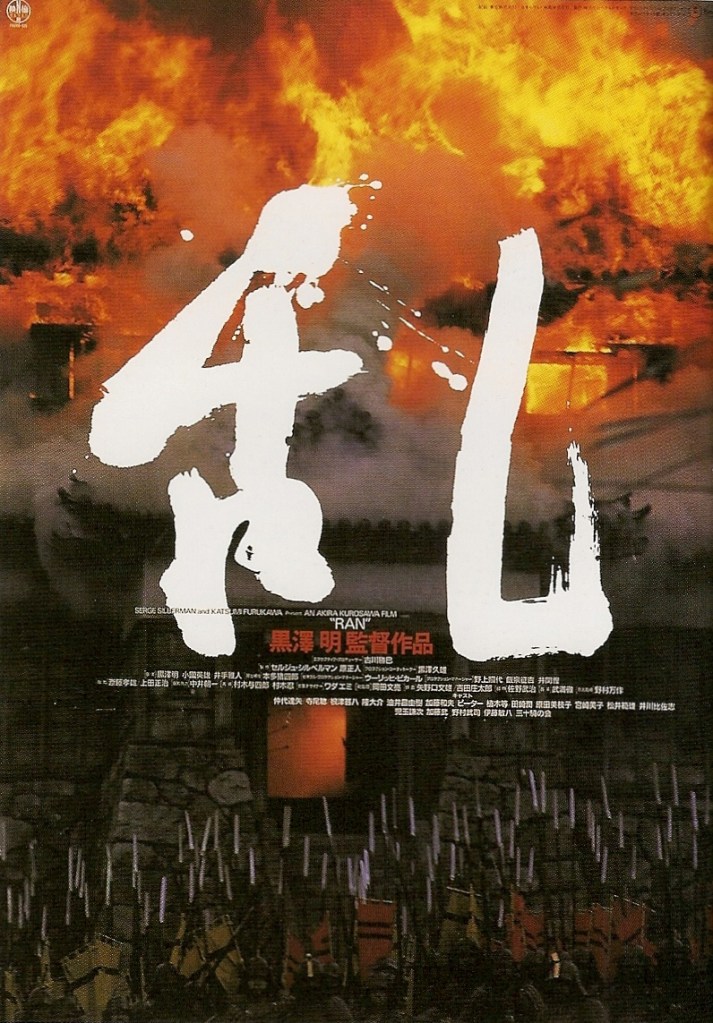
Ran (乱, Akira Kurosawa, 1985)

ran posterAkira Kurosawa is arguably the most internationally well known Japanese director – after all, Seven Samurai is the one “foreign film” everyone who “doesn’t do subtitles” has seen. Though he’s often thought of as being quintessentially Japanese, his fellow countryman often regarded him as too Western in terms of his filming style. They may have a point when you consider that he made three different movies inspired by the works of Shakespeare (The Bad Sleep Well – Hamlet, Throne of Blood – Macbeth, and Ran – King Lear) though in each case it’s clear that “inspired” is very much the right word for these very liberal treatments.
In the case of Ran (乱) – a loose adaptation of King Lear, Kurosawa moves the story to feudal Japan and an ageing king who this time has three sons rather than three daughters. This leaves Hidetora (Tatsuya Nakadai) with a smaller problem than Lear’s though in his original idea of making his eldest son his heir with the other two inheriting smaller roles it’s clear things aren’t going to end well. Just as in the original play, the oldest two sons Taro and Jiro sing their father’s praises with cynical glee but the youngest and most sincere, Saburo, refuses to play this game as his respect for his father is genuine. Unfortunately, Saburo’s honesty sees him banished from his father’s kingdom and his share of responsibility given over to his treacherous brothers. Predictably, neither is satisfied with what they’ve been given and it’s not long before a familial conflict has sparked into a bloody civil war.

How sharper than a serpent’s tooth it is to have a thankless child….Hidetora is not quite as far gone as Lear in Shakespeare’s original text at the beginning of the film yet he is still unable to see that his oldest two sons have placed personal ambition ahead of filial piety. Hidetora was once a fearsome, if cruel, warrior, famous for burning enemy villages and creating peace only through destruction. He’s old now, and tired and so he proposes to hand over the running of the kingdom to his eldest son, yet – he wants to remain the de facto leader until the very end. Of course, that doesn’t sit well with Taro, or more to the point his ambitious wife Lady Kaede. Hidetora is thrown out of Taro’s castle and then also from Jiro’s before all out war erupts between the two leaving him totally isolated – a king without a kingdom.

Hidetora’s true madness begins when he realises not only how little regard his eldest two sons hold for him, but also that his failure to recognise the true nature of the situation has lead to the deaths of the people in his care that have remained loyal to him to the very end. As the enemy begin to engulf the castle, concubines begin helping each other to commit suicide in order to avoid ravishment while others try to escape but are cut down by arrow fire. This is all his own fault – his ruthless cruelty has been filtered down to his two oldest sons who, as he did, will stop at nothing in the pursuit of power. What is a king if not the father of a nation, and as a father he has failed. Neither Taro or Jiro are worthy of the offices afforded to them and lack both basic humanity and the princely power one needs to become the unifying force of a people.

Only too late does Hidetora see the wisdom in Saburo’s words and finally understand that he has alienated the only one of his children that truly loved him. From this point on his madness increases and Nakaidai’s performance becomes increasingly mannered and theatrical as if Hidetora himself is acting in another play which only he can see. Wandering and lonely, the once great king is reduced to the estate of a beggar led only by his fool and sheltered by the ruins of a castle which he himself burned down.

However, as great as Nakadai is (and he always is), he’s very nearly upstaged by the young Mieko Harada as one of the all time great screen villainesses with the Lady Macbeth a-like Lady Kaede. Filled with a vengeful fury, Kaede is unafraid to use every weapon at her disposal to achieve her goal. No sooner is she brought the news of her first plan’s failure in the death of her husband than she’s embarking on a plot to seduce his brother which includes getting him to execute his wife. Vile as Kaede’s actions often are, her desire for revenge is an understandable one when you consider that Hidetora was responsible for the deaths of her family leaving her to become a trophy bride for the son of the man that killed them. Viewed from another angle, it would be easy to sympathise with Kaede’s desire to rid the world of these cruel and tyrannical lords were it not for her insistence on the death of Lady Sue – a woman in exactly the same position as herself whose death would not actually advance her cause very much at all.

Kurosawa films all of this from a distance. We, the audience, almost become the gods he speaks of – the ones who weep for us, watching silent and helpless, unable to save us from ourselves. We see the world for what it is – chaos, horses and men and blood. The battles aren’t glorious, they are frenetic, frightening and ultimately pointless. Though for all that there is a beauty to it too and the sheer scale of the production with its colour coded princes and immense armies is one the like of which we will never see again.

Ran presents us with a prognosis which is even more pessimistic than that of Lear. At the end of Shakespeare’s play, as profoundly tragic as it is, there is at least the glimmer of hope. There is a new, rightful king and the idea that something has been restored. Here there is no such resolution, we are the blind man casting a stick around the edge of a precipice, entirely alone and unable to see the gaping chasm which extends before us into which we may plunge headlong driven only by the chaos in our own hearts. In the end, Kurosawa’s message is not so different from Shakespeare’s – all the weight of this sad time we must obey, speak what we feel, not what we ought to say. Fathers and sons must strive to understand each other, and themselves, lest we fall into the eternal chaos which leads us to build our very own hell here on Earth.


Ran is currently playing in UK cinemas in a brand new 4K restoration courtesy of StudioCanal!


The Classroom of Terror (暴力教室, Akihisa Okamoto, 1976)

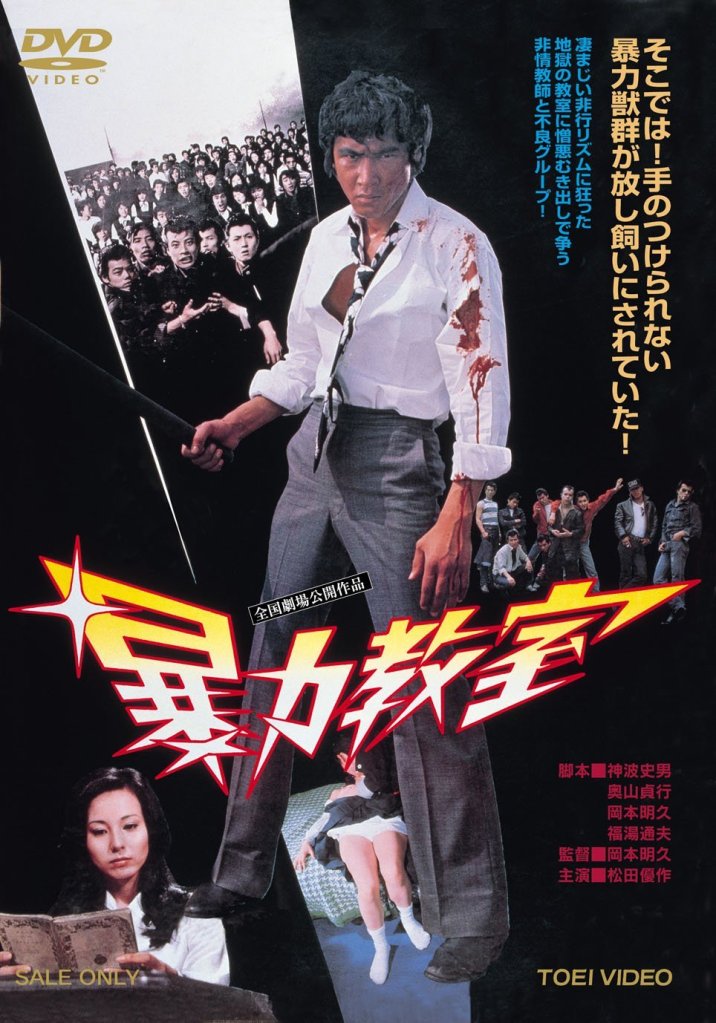
classroom of terrorWhen the teachers are as corrupt as the students are disruptive, society is going to wind up with a complex set of problems. Classroom of Terror (暴力教室, Boryoku Kyoshitsu) is, in some ways exactly what it sounds like – delinquents! Sex, drugs, fighting! etc but also subverts these aspects of the bad teen movie by turning the camera right back on the adults who are perpetuating this world of unruly adolescents. An early entry for action star to be Yusaku Matsuda, Classroom of Terror sees him cast in a recognisably manly role though one with a greater degree of nobility.
Mizoguchi is a rookie teacher at an ordinary high school with a falling reputation. Behind his back, the established teachers are virtually taking bets on how long he’s going to last with this “difficult” class that’s giving everyone grief. However, Mizoguchi is a tough, generally cool kind of guy, and he’s able to stand up to this rambunctious group of teenage boys pretty well.

That said, there’s a subset of “bousouzoku” biker gang kids in the school which seems intent on dominating not just the other kids but the entire infrastructure of the academy too. Led by Kitajo, the “Sidewinders” wear identical leather jackets with a snake on the back and all have rockabilly hairstyles which match their Brando-esque The Wild One attitudes. Delinquent doesn’t quite cover their activities and Kitajo in particular is not above seducing the principle’s daughter as part of a blackmail plot or even revenge raping the younger sister of an opponent. However, the kids are not the bad guys here as there’s an even bigger scandal going on in the school’s administration department and the Sidewinders, with Mizoguchi’s help, might be the only way to stop it.

Classroom of Terror mixes a number of genres together and then buckles them onto a typical kids gone wild delinquent movie. In actuality it has more in common with a yakuza crime pic as it turns out Mizoguchi is more or less a stooge brought in by the powers at be to quell rebellion but then realises he’s been working for the “bad guys” and switches sides. The Sidewinders operate more like rival gang, the area’s underdogs who definitely aren’t “good guys” but might be better than the corrupt administration that’s currently in place.

Of course, these guys are just teenagers and this is a school, not the back streets of some shady part of town. Mizoguchi’s class is boys only and extremely disruptive – bombarding a female teacher with paper aeroplanes made out of their test papers, developing a zip wire system to pass each other porn and just generally refusing to conform to any kind of expected behaviour. Kitajo in particular is seen to be rebelling against all kinds of authority thanks to an oppressive home environment controlled by his strict and violent father. When the older generation is shown to be corrupt as in the plot to defraud the school of money at the expense of its pupils, it’s the duty of youth to rebel and their refusal to follow the path that has been set down for them is in no way surprising.

A typical ‘70s exploitation picture, Classroom of Terror displays all the genre’s hallmarks from the swooping handheld camera shots, whip pans and zooms to the funky soundtrack. However, it does also fall into the unpleasantness associated with the lower end of these kinds of films in its use of rape as a plot device which takes on an unsavoury and salacious quality though the scenes themselves are not particularly graphic. Likewise, there is a fair amount of explicit nudity in the first half of the film during the seduction plot of the teenage daughter of the principal which is played for all its worth. Though not as sleazy as other examples of films of this kind, Classroom of Terror has a necessarily male viewpoint which runs close to generalised misogyny.

Perhaps most notable for providing early leading roles for Matsuda and also for Hiroshi Tachi who plays the leader of the Sidewinders and was at that time the lead singer of a popular rock group, The Cools, Classroom of Terror is a fairly typical youth gone wild movie though one which attempts to justify youth rebellion by pointing out the oppressive and hypocritical actions of the older generation. That said, it’s never entirely on youth’s side and the boys are very definitely unpleasant and out of control. Though the use of rape as a tactic is not exactly supported, it isn’t condemned either, rather just accepted as something that happens – but happens to men, largely, who lose face when “their” women are “damaged” by their enemies. Unpleasant yet often exciting in execution, Classroom of Terror is an interesting mix of exploitation genres though one which perhaps leaves a sour taste in the mouth.


Unsubbed trailer:


The Sting of Death (死の棘, Kohei Oguri, 1990)

Sting of Death

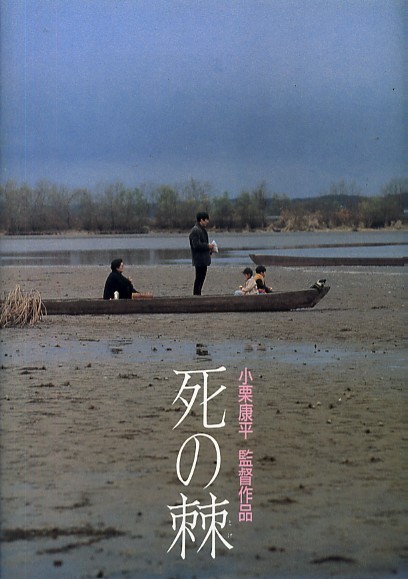
Kohei Oguri’s The Sting of Death (死の棘, Shi no Toge) won the prestigious jury prize at the Cannes film festival in 1990 but has since passed into obscurity. Adapted from the “I Novel” by Toshio Shimao, Sting of Death is an absurdist, caustic look at a collapsing marriage beset by difficulties on all sides as the pair try to navigate the confusing post-war society.

Toshio and Miho are a married couple with two young children. Miho has recently discovered that her husband has been carrying on with a neighbour for quite some time and is uncertain how to deal with this unexpected revelation. The film opens with a serious marital argument which is almost chilling in its calmness. Toshio is sorry, he doesn’t intend to leave his marital home and pledges to stop seeing this other woman – he’ll stay in 24/7 and not even go out without his wife and children if it means he can defend his family. Miho is definitely not happy with this compromise but accepts it and the couple attempt to get back to a kind of normality. However, the peace does not last long as Miho becomes increasingly depressed and paranoid before hurtling headlong into a nervous breakdown.

The “I Novel” is an integral part of Japanese literature and has often provided the basis for many of the country’s prestige films even though its specific style is a necessarily literary one which is hard to dramatise on screen. The genre is centred around the ideas of naturalism and the main tenet is that the writer is recounting real events from the world he sees around him, though perhaps through a thin veil of fictionalisation. That said, it’s never quite “autobiography” and it may sometimes be better to think of them as “hyperreal” rather than just naturalistic.

Oguri attempts to evoke this strange sense of uncanniness by opting for an ethereal, dreamlike tone akin to avant-garde or absurdist theatre. The couple speak to each other in a slightly heightened, deliberate manner, often posed unnaturally facing away from each other literally divided by the film’s framing. Toshio is also haunted by visions from his wartime service somewhere in the pacific where he seems to have received some kind of stomach injury. Emerging from a cave he suddenly sees saluting soldiers, or remembers a passing religious ceremony as if the past is always with him like a Fury tormenting his mind.

The Sting of Death is very close to the experiences of the author who uses his own name for that of the protagonist and that of his own wife for the central female character, Miho. Shimao’s own wife became seriously mentally ill during their marriage eventually having to be admitted to a hospital where Shimao took the unusual step of living with her. Though this uncommon gesture is widely praised as displaying his deep love for his wife, it was in part born of guilt as he believed he had caused her distress through his frequent infidelities, just as Toshio does in the film.

The couple live together in a perpetual nightmare world. Though Miho exclaims at one point that they both need to do their best now for their children they both consider suicide more than once, alternately saving or frustrating one another. They both suffer, they both try to go on but Miho’s position becomes increasingly difficult leading to a period of mental decline which climaxes in a strangely humorous yet violent episode in which she tries to exact revenge on her husband’s mistress only to be offered a lesson in civility – “I don’t know what’s going on here but none of us have the right to act like savages”, says the perfectly genial other woman (the silent casualty in all of this).

Oguri shoots the majority of the film in near darkness, as if the couple are enveloped in a night without end. They haunt each other like living ghosts, emerging from shadows moving slowly like those without hope or purpose. Oguri adds to the surreal, dreamlike atmosphere by sticking to static camera shots filled with strange tableaux and little discernible action. The film paints a bleak picture of marriage and the family unit as the central couple remain locked in an odd game-like battle of suffering while their two innocent children look on helplessly. A strange and beguiling film, The Sting of Death pulls no punches when it comes to describing the way in which adults wound each other with childish games but is also filled with quite beautiful, if sometimes unsettling, iconography.


The Sting of Death is available with English subtitles on R3 Hong Kong DVD as part of Panorama’s Century of Japanese cinema collection.

Opening scene of the film (unsubtitled)