My Brother, the Android and Me (弟とアンドロイドと僕, Junji Sakamoto, 2022)

“You’re a real weirdo, aren’t you?” the lonely hero of Junji Sakamoto’s existential psychodrama My Brother, the Android and Me (弟とアンドロイドと僕, Ototo to Android to Boku) is constantly told not least by his exasperated and unsympathetic boss but on another level may be the most human of them all longing for a sense of connection in a world which seems to have rejected him to the point that he is no longer sure whether or not he actually exists. Quite clearly drawing inspiration from Mary Shelly’s Frankenstein, the Modern Prometheus as well as its many film adaptations though most obviously the 1931 Universal Horror classic, Sakamoto’s oblique chronicle of crippling loneliness presents a man estranged from himself but looking for comfort in his reflected image. 

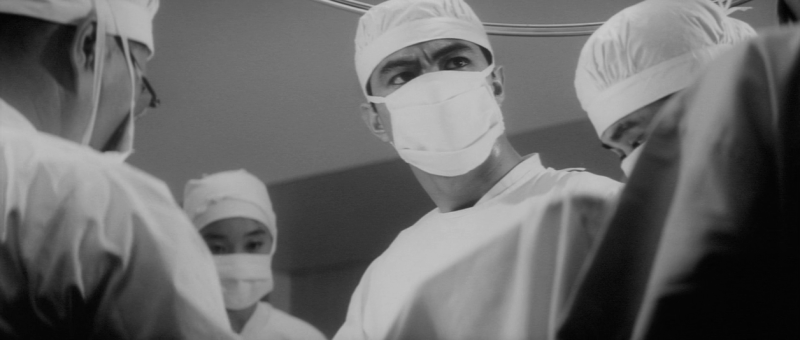
Sakamoto opens the film in true gothic fashion, his hero Kaoru (Etsushi Toyokawa) a dark and mysterious figure obscured by an oilskin coat amid the ever falling rain illuminated only by the light of an ominous moon. As we discover he works as a university professor but says nothing to his students other than making an apology for his poor handwriting, sometimes writing with both hands at once as he recreates complex algorithms on an old-fashioned chalkboard. The students all mock him, not least because of a curious neurological condition which prevents him from fully controlling his right leg with the consequence that he is often compelled into strange, jerking movements or else to hop on one foot from place to place. In truth, his errant right leg is a symptom of Kaoru’s sense of displacement in that he does not quite feel it to be his own and experiences only pain when his right heel is in contact with the floor. 

It’s this problem with his leg that seems to most irk his boss who later invasively barges in to the gothic western-style mansion/disused hospital where he lives in the company of his nephew, a psychiatrist, who probably means well but offers little more than platitudes in insisting that Kaoru’s leg has simply been left off his internal schematics so all they need to do is mentally reconnect it. His boss meanwhile bizarrely states that Kaoru needs to get well “so that cracked roads can be fixed”, ironically treating his body like a machine that needs to be repaired so that it is optimised for work rather than out of care for another human being who may be in pain. Having barged into Kaoru’s office, he’d discovered his secret project in a highly complex, lifelike robotic arm which was a problem for him because he was supposed to be working on a robot that fixes potholes which seems almost ironic in its banality. In any case, Kaoru also has the rather unfortunate habit of entirely ignoring the person talking to him as if they weren’t even there which is in itself an ironic inversion of the way others see, or more to the point don’t see, him. Kaoru’s boss describes him as creepy because he has no presence, you’re never sure if he’s there or not, but can immediately sense the “giant” presence of his other self, the lifelike android he’s building in his spare time. 

The android is in its way his Frankenstein’s monster, an ironic attempt to rebirth himself constructed in the ruins of his family’s abandoned obstetrics hospital. By chance, he meets a young woman (Yuki Katayama) who closely resembles himself and carries her into his laboratory like the Bride of Frankenstein but treats her only with tenderness and sympathy while attempting to fend off his estranged half-brother (Masanobu Ando) constantly hassling him for money to pay for medical care for the father who abandoned him. His mother had instructed him to find his other self which is perhaps what he’s been doing if caught between the Id and Superego of his brother and father. Constant fire imagery including the repeated motif of a burning body in a conventional fireplace keys us in to Kaoru’s positioning as a “modern Prometheus” whose duty it is to keep the fire in while giving birth to himself as manifested in a perfect manmade creation that others may find frightening or uncanny though the android itself has done nothing wrong because it is in essence the embodiment of Kaoru’s frustrated humanity. Featuring sumptuous gothic production design with sci-fi sheen, Sakamoto’s steely, fragmentary drama finds a man in search of himself while also a perpetual exile but discovering a sense of warmth in the uncanniness of a reflected image. 


My Brother, the Android and Me streams in the US until March 27 as part of the 14th season of Asian Pop-up Cinema

International trailer (English subtitles)

To Be Killed by a High School Girl (女子高生に殺されたい, Hideo Jojo, 2022)

Are there some desires so taboo that they can never be spoken of even if they cause no harm to others? Adapted from the manga by Usamaru Furuya, Hideo Jojo’s To Be Killed by a High School Girl (女子高生に殺されたい, Joshikosei ni Korosaretai) is indeed about a man fixated with the idea of being strangled by a teenage girl but one who also embodies the inspirational teacher stereotype planning to leave behind him a kind of manifesto instructing his pupils to live their lives to the full while remaining true to their authentic selves in the knowledge that their lives will be defined by the manner of their deaths. 

Subverting a trope from shojo manga, Higashiyama (Kei Tanaka) is the hot new teacher at school proving an instant hit with most of the girls in his class but he’s come with an ulterior motive in that his ultimate fetish is being murdered by a high school girl. Even so, he claims to feel no attraction to his teenage pupils and is sickened by teachers who abuse their position later revealing he orchestrated his predecessor’s downfall by accelerating a complaint that had already been registered against him for inappropriate contact with students. His fetish lies solely in being overpowered by someone he would ordinarily perceive as being weaker than himself after fighting for his life with all his strength. 

Then again, as Satsuki (Yuko Oshima), a councillor brought into the school following a traumatic incident who also happens to be Higashiyama’s uni ex, points out his techniques for manipulating the girls are little different than those of a predatory sex offender grooming their prey. He figures out their weaknesses and goes out of his way to make each of them feel special while simultaneously provoking a sense of jealousy so he can bend them to his will in enacting a plan that will eventually lead to his murder in the middle of the school cultural festival. On the other hand, he crafts his plan in such a way as to protect his killer, his fetish won’t be fulfilled unless it’s a perfect crime, and because of the nature of the girl he’s selected he’s confident she won’t even remember having killed him and therefore will remain largely unaffected. 

Higashiyama doesn’t give much an explanation for his fetish save an allusion to having been born with the cord around his neck, a sensation he claims to remember only later admitting that he “recovered” a memory of it after his mother described the event to him. He later says something similar to Satsuki after suffering with amnesia, claiming to remember how he ended up in the hospital but then confessing that Satsuki had explained it to him on a previous occasion. He claims that he’s not suicidal but continues to fixate on death as force which gives life meaning, paradoxically insisting on living with all his might while otherwise drawn towards mortal extremity and fearing a “bad” ending such as being pushed off a cliff or poisoned with carbon monoxide neither of which would satisfy his fetish in their distinct lack of romance.  

Even so as another pupil suggests is he just a regular “pervert” after all despite his rather high minded-view of his proclivities? Despite all his manipulations, the various girls which he targets all seem to begin making progress in their lives, an angry judo enthusiast kicking back against a boy who’d long been bullying her, a shy theatre kid turning popular girl, and a young woman beginning to overcome her trauma thanks to the power of unconditional friendship. His replacement, a middle-aged man with a bad wig, is completely ignored by his pupils hinting perhaps that Higashiyama’s teaching practice was effective no matter now uncomfortable if not quite inappropriate some of his conduct may have turned out to be. After all he argues, he’s not a “pervert” just someone who wanted to be murdered by a teenage girl insisting that his fetish is essentially harmless because he has no sexual interest in the girl herself yet as we later see it does indeed involve inflicting violence on her. 

Playing with a series of B-movie tropes aside from Higashiyama’s taboo fetish from multiple personality disorder to premonition, traumatic memory, and fatalistic obsession, Jojo’s approach is arch in the extreme fully embracing the outlandishness of the material while both lending the troubled Higashiyama a degree of sympathy and hinting at the buried darkness beneath his handsome facade even as that darkness is essentially directed within, his death dictated by the circumstances of his birth as he “remembers” them. Occasionally shifting into the realms of giallo with creepy spiders and ominous red lighting, To Be Killed by a High School Girl never takes itself too seriously but revels in the inherent absurdity of its premise while remaining strangely respectful not only of the hero’s unique dilemma but of the ordinary problems among the otherwise besotted teens. 


To Be Killed by a High School Girl screened as part of Osaka Asian Film Festival 2022

Original trailer (no subtitles)

The Warped Forest (あさっての森, Shunichiro Miki, 2011)

“Life is about making the most of what you get” according to a former blackmailer seeing the error of his ways when his attempt to use his ill-gotten gains to woo a lover abruptly fails, but you can always dream in the wild and wacky world of Shunichiro Miki’s The Warped Forest (あさっての森, Asatte no Mori). A quasi-sequel to Funky Forest: The First Contact which Miki also co-directed, Warped Forest is in someways more conventional lending a loose overarching narrative to its otherwise disconnected scenes set in a bizarre village where the residents can spend acorns and pinecones to tinker with their dreams assuming they don’t mind the possibility of emerging with a curse. 

Like Funky Forest, the film revolves around three trios in the black and white sequence which opens the film two staying at the same inn but adopting vastly different personas in the full colour alternate universe to which we are soon transported. The older male trio are informed they’ve been “missing” for two days though they don’t remember going anywhere and are very confused by the apparent forward motion of time. One does remember, however, that some of his students with whom he’d been on a camping trip turned up at his door and explained they’d been mysteriously beamed to a forest and had to hike their way back. 

The Japanese title simply means the forest of two days from now, but warped might be a good way to describe it if it weren’t for its judgemental implications seeing as it is indeed somehow out of shape seemingly inhabited by giants and tiny people who co-exist in the same space with tinys prioritised, the giants squashing themselves into tiny chairs and drinking tiny coffees while appearing to also occupy spaces of their own (in which tiny people are not really seen). In any case, this is also a place where everyone is obsessed with the very suggestive Kattka fruit which pulses and gyrates, oozing a sweet liquid and growing from trees in the form of human women which Miss Au Lait, one of the sisters from the inn but here in kimono and walking with a cane, waters by drinking from her flask and passing liquid via her mouth. 

Even here, everyone is lovelorn and unhappy. “If only we could have fun in our dreams” one young man laments after trying out a positive thinking training hall where they’re told to repeat the phrase “I am happy” only to discover their instructor is far from happy himself. They know they can’t have real happiness, so all they can do is dream of it which is why some of them are intent on “dream-tinkering” despite the rumours of negative consequences and vast costs required. Each of the inn trio, all romantically frustrated store owners in this reality, eventually decide to give it a go after one of them gets hold of a special guide that apparently allows them to bypass the curse by promising to sacrifice two days. Appli (Fumi Nikaido) meanwhile is wracked with guilt after having asked to see her whole family happy in her dreams only for her sister to encounter an accident which is why she roams the forest with a gun which shoots white liquid from its penis-shaped tip to trap a “pinky panky” monster and get hold of a weird bug to get the worms out of Miss Au Lait’s leg. 

As for Miss Au Lait, “dreams are just dreams. I have to accept reality” she sadly remarks on turning down a invitation, “I’ll leave my beautiful dream untouched” too fearful and insecure to chase happiness while her suitor later echoes her words unwilling to run away in flights of fancy. Even so we might wonder which is the dream world and which the real, the hotel guests later finding each other and experiencing a kind of true happiness in togetherness unknown in the forest where everything seems to be not quite right. Continuing the slightly vulgar aesthetic of Funky Forest with his fleshy fruits and frequent innuendo, Miki conjures a bizarre world which nevertheless possesses an internal normality in which people are distanced from one another, not least by their respective size differentials, but each longing for something more which they fear cannot be found not even in dreams. 


The Warped Forest is released on blu-ray in the UK on 21st March courtesy of Third Window Films alongside Funky Forest: The First Contact in a set which also includes a feature length commentary, director interview, and introduction.

Original trailer (English subtitles)

.

Funky Forest: The First Contact (ナイスの森 The First Contact, Katsuhito Ishii & Hajime Ishimine & Shunichiro Miki, 2005)

“Is that normal?” someone asks watching a previously mild-mannered doctor having a right old go at a tiny man baby currently attached to a high school girl’s armpit after being pulled free of its aquatic carapace, “don’t be rude” his companion shushes him. Katsuhito Ishii, Hajime Ishimine, and Shunichiro Miki’s Funky Forest: The First Contact (ナイスの森 The First Contact, Nice Mori: The First Contact) became the best known example of the short-lived trend in surreal comedy which came to dominate a certain kind of Japanese cinema from the late ’90s to early 2000s while perhaps surviving into the present day in a more arthouse friendly form in the deadpan absurdist cinema of filmmakers such as Akira Ikeda (Ambitious Places, The Blue Danube) or Isamu Hirabayashi (Shell and Joint).  

Even so, Funky Forest is wilfully anarchic skipping between a series of interconnected skits that eventually coalesce as something like a unique universe loosely revolving around three “unpopular with women” brothers and a “delusional” high school teacher in a non-relationship with a former student who thinks he’s seen a UFO and is engaged in a battle to save the aliens from the planet Piko-Riko. Two and a half hours long, which is admittedly pushing it for a non-linear sketch comedy, the film is split into two parts, Side A and Side B, joined by a short intermission after which the surrealism intensifies, the design of the title cards changes, and the action shifts in focus from a quiet onsen to an ordinary high school where the teacher and the two adult brothers each work. 

The action begins however with a pair of manzai comedians seemingly performing on some kind of space ship and to an audience consisting of identical military personnel each like the comedians dressed in white and silver while the show is broadcast to a man sitting in a tiny pod-like dream ship. The “Mole Brothers” recur throughout, their set routinely dividing one skit from another while one, Kazushi, also turns up on his own in a couple of other sketches as part of the great connected universe, and though their act being kind of a dud is part of the joke their variety-style humour is an otherwise key indicator of the kind of comedy which is being employed and subverted even as the action becomes ever more surreal. As it happens, each of the major plot strands seems to lead us towards a dance sequence such as that which closes the first half in Takefumi’s (Ryo Kase) strange fever dream which culminates in a Mandarin-language group routine and the first appearance of the weird, shrimp-like creatures which dominate Side B. 

Side B is indeed somewhat through the looking glass as we find the high school kids literally playing these alien creatures like musical instruments some of which need to be plugged in to the human body in one way or another such as the strangely cute rat/shrimplike beings which attach directly to the tongue. Sitting right in front of the high school class which is taught by lovelorn brother Katsuichi (Susumu Terajima) is none other than the film director and Neon Genesis Evangelion creator Hideaki Anno who later turns up again to discuss contemporary anime with guitar bother Masaru (Tadanobu Asano) in one of his many part-time jobs, though the class also includes the young primary school student who featured in the first skit in which she lamented having so much homework and escaped to the dreamscape in order to fight giant orbs with her mind. 

In an odd way perhaps that’s what our three directors are doing too, away on flights of fancy which make little literal sense but seem to have their own internal logic even though the directorial force the film presents is an adorable little scottie dog whose thoughts are translated by someone wearing a giant papier-mâché head. “Thinking is too scary, so I’ll forget about it”, someone explains which may be good advice in deciding to just accept the crazy randomness and play along. Often interrupting the action by cutting to black to mimic old-fashioned channel hopping the directors also throw in a random 20s intermission in the middle of a scene, animation of various styles, and surreal body-horror-adjacent practical effects, before winding up at the funky forest itself, a weird dreamscape somewhere in Hokkaido ruled by a dream-hopping girlband.  “What a strange dream” one character exclaims though in the great scheme of things perhaps it’s easier to make sense of a dream than a defiantly surreal reality.  


Funky Forest: The First Contact is released on blu-ray in the UK on 21st March courtesy of Third Window Films alongside quasi-sequel Warped Forest in a set which includes a feature length commentary from all three directors and a series of deleted scenes.

Original trailer (English subtitles)

Angry Son (世界は僕らに気づかない, Kasho Iizuka, 2022)

A resentful young man struggles to orient himself amid constant xenophobia and social prejudice in Kasho Iizuka’s sympathetic coming-of-drama Angry Son (世界は僕らに気づかない, Sekai wa Bokura ni Kizukanai). At a difficult age, he flails around lashing out at all around him without fully comprehending the consequences of his actions, but eventually comes to understand a little more about his mother’s past, his place in Japan, his relationships with his extended family, and his possibilities for the future while searching for the father he has never really known save for a name on his maintenance payments. 

Jun’s (Kazuki Horike) main source of resentment is towards his mother, Reina (GOW), a Filipina bar hostess by whom he feels emotionally neglected while unfairly blaming her for the discrimination he faces for being mixed ethnicity. The pair live incredibly modestly as Reina sends all her money back to her family in the Philippines even telling Jun to use his child support payments to get the electric turned back on if it bothers him that much, leaving Jun feeling as if he isn’t really included her definition of “family” or that perhaps she resents him as a burden that causes her to hold back even more of her pay. That’s one reason that he becomes so irate on coming home one day and unexpectedly finding an unfamiliar man in his pants in their living room only to be told he’s his mum’s new boyfriend, Mr. Morishita, who will be moving in the week after next because they’re getting married. Granted, this is not an ideal way to find out about such a drastic change in his living circumstances but Jun just can’t accept it, fearing firstly that Reina is after his money only to discover to his further bemusement that Morishita is also unemployed.  

News of his mother’s impending wedding has Jun feeling even more pushed out than before, especially when Reina confirms that if he’s forcing her to choose she’s going to choose Morishita and he’ll have to fend for himself. Meanwhile, his high school boyfriend Yosuke is already talking up the possibilities of marriage seeing as their prefecture has recently brought in a same sex partnership scheme. Though Yosuke excitedly talks it over with his supportive parents, Jun is noticeably sullen replying honestly that he really isn’t sure if it’s a such a good idea mostly because he doesn’t want Yosuke to get “dragged” into his ever increasing financial responsibilities to his extended Filipino family. Like many of the other kids, Jun has left his careers survey blank and it’s his refusal to think seriously about his future that eventually disrupts his relationship with Yosuke. 

In response to all of these crises, he decides to try tracking down his birth father whom he has never met a quest which takes him through a series of Filipino hostess bars across their largely rural area and eventually to a man, Watanabe, who was once married to “Loopy Lisa” as she was then but is not actually his dad. Even so, Watanabe begins to open his eyes and change his perspective on his mother’s occupation for which he had previously looked down her beginning to understand the sacrifices she is making not only for her family back home but for him too and that while her love may be difficult for him to understand it is not absent. Meanwhile, she too faces prejudice and discrimination on more than one level, a co-worker at a part-time job at a bowling alley she took while laid off from a bar struggling in the post-corona economy expressing openly racist sentiment even in front of their boss, and from the local council when she tries to apply for rent relief which she is denied on the grounds that those working in the “adult entertainment” industry are not eligible for benefits. 

Reina gives as good as she gets and refuses to let discrimination slide, but Jun finds it all quite embarrassing and is carrying a degree of internalised shame which later leads her challenge him on his fragile sense of identity that he too looks down on her as an inherently dishonest foreigner just like any other prejudiced Japanese person no different from her unpleasant colleague or the kids at school who’d bullied him for being half-Filipino, gay, and the son of a bar hostess. Confronted with his own bad behaviour and gaining a new perspective thanks both to Mr Watanabe and Morishita whom he realises is sensitive, kind, and genuinely cares for his mother he begins to envisage a future for himself only to have his horizons broadened once again when Yosuke introduces him to a young woman at the school, Mina, who is asexual but wants to raise a family and is looking for another kind of partnership that hints at a new evolution of the family unit. 

A willingness to embrace the idea of family and of being a part of one himself marks Jun’s passage into adulthood, coming to an understanding of his mother and her relationship with her family in the Philippines and willing to take on the responsibilities of a committed relationship in mutual solidarity and support. A highly empathetic coming-of-age tale, Angry Son never shies away from societal issues such as widespread xenophobia, homophobia, bullying, prejudice, and discrimination but eventually allows its enraged hero to discover a new sense of confidence in his identity in order to forge his own future in a sometimes hostile environment. 


Angry Son screened as part of Osaka Asian Film Festival 2022

International trailer (dialogue free)

Images: ©2022「世界は僕らに気づかない」製作委員会

Baby Assassins (ベイビーわるきゅーれ, Yugo Sakamoto, 2021)

“Drugs and pimping are outdated. We’re in the age of “moe”” according to a surprisingly progressive gang boss who takes his son to task for his sexism and insists that even the yakuza has a duty to create a comfortable working environment for women. Yugo Sakamoto’s anarchic deadpan action comedy Baby Assassins (ベイビーわるきゅーれ, Baby Valkyrie) is at heart a slice of life slacker drama about two young women reluctantly trying to make their way towards adulthood only the two young women are also elite assassins recently graduated from high school having been raised as coldblooded killers. 

For whatever reason it’s decided that the shy and socially awkward Mahiro (Saori Izawa) and the manic extrovert Chisato (Akari Takaishi) should become roommates occupying a furnished apartment paid for by their handler while they cover their other expenses through part-time jobs that will help them figure out how to live as “members of society”. The problems they face are perhaps those faced by many in the contemporary era just trying to make it through an unfulfilling side gig without killing anyone only for them the stakes are higher as Chisato discovers on braining a customer and strangling a moody coworker without realising she’s not just fantasising. Mahiro meanwhile finds herself entering a daydream in which she offs the combini manger interviewing her after his boring rant about kids today who think they can earn a living playing video games only to realise the store is staffed by yakuza-esque minions determined to avenge their boss. 

Already very efficient in their killing game, the girls never need to worry about cleaning up after themselves even if Chisato does get a lengthy lecture from the long suffering Mr. Tasaka who as it turns out has a lot of unsolicited advice about how she’s doing her job wrong or at least in ways which are inconvenient to him. Nevertheless while trying to live their normal lives they wind up sucked into gangland intrigue having accidentally offed a major supplier and thereafter engaged in a vendetta with equally crazed yakuza daughter Himari (Mone Akitani) who in a recurring motif proves much more in tune with contemporary gangsterdom than her “sexist” bother Kazuaki (Satoshi Uekiya). 

Gangsterdom has indeed changed, the boss declaring that they need to find a more “female-centric” business which is what brings them to a maid cafe as they declare themselves mystified by “moe”, rapidly becoming extremely irritated by the sickly sweet aesthetic of the cafe which requires them to order food through a series of annoyingly cutesy codewords while young women in ridiculous outfits call them “master” and satisfy their every whim. In some ways the Baby Assassins are a subversion of the kawaii ideal while also to some extent embodying its essential traits in their mix of infinite competence and adorable cluelessness, Chisato forever forgetting what’s she’s done with her weapons while Mahiro constantly mutters to herself under her breath. 

For them, killing is just another job which they mostly enjoy but can also be annoying, just like each other’s company. A mismatched pair, their dynamic strangely recalls Saint Young Men only they’re highly trained assassins trying to perfect a cover identity rather than peaced-out deities engaged in an ethnological study of life on Earth. They have a brief falling out over the same thing most roommates fight about, one feeling the other is not pulling their weight, Chisato irritated by Mahiro’s inability to find a job and Mahiro frustrated that Chisato devotes too much time to her side gig and not enough to their main job as killers for hire. Meanwhile, they’re suddenly plunged into a very adult world of bills and taxes and insurance, their handler promising to handle some of that for them because ironically enough they’re much more afraid of the taxman than they’ve ever been of the police. 

Surreal and filled with deadpan humour not to mention expertly choreographed fight sequences by Hydra’s Kensuke Sonomura, Baby Assassins is a perfectly pitched coming-of-age tale in which two young women attempt to find a place for themselves while contending with a still patriarchal society, eventually discovering a complementary sense of solidarity in their opposing natures as they come together to clean up their own mess while defiantly striking out for their futures as “members of society” whatever that may mean. 


Baby Assassins screened as part of this year’s Glasgow Film Festival.

Original trailer (English subtitles)

Inu-Oh (犬王, Masaaki Yuasa, 2021)

“Unity demands order” according to an ambitious politician near the end of Masaaki Yuasa’s stunning anime prog rock opera, Inu-Oh (犬王). Inspired by Hideo Furukawa’s novel Heike Monogatari Inu-Oh no Maki, Yuasa’s spirited drama is as much about the liberating power of artistic expression as it is about the danger it presents to those in power, while reclaiming the stories wilfully hidden in history or as the narrator puts it “stolen and forgotten” in order to exorcise a degree of historical trauma lingering in the cultural aura.

Set in the Muromachi period in which two imperial courts contested hegemony, the tale opens with the retrieval of a set of cursed remnants buried at the bottom of the sea after the battle of Dan-no-ura in which the Heike clan were famously defeated. Ashikaga Yoshimitsu (Tasuku Emoto) is convinced that possessing imperial treasures would lend credence to his claim, but their resurfacing creates nothing but misery leaving the boy who discovered them, Tomona (Mirai Moriyama), blind and his father dead. Setting off for Kyoto in search of revenge, Tomona is taken in by an elderly Biwa player and eventually runs into a strange creature wearing a gourd mask and behaving like a dog, striking up a friendship that later leads to the realisation that the boy is also cursed, haunted by the spirits of fallen Heike warriors desperate for their stories to be told. 

In true fairytale fashion, curse later begins to dissipate as the pair exorcise the ghosts by telling their stories never singing the same song twice but always in search of new songs to be sung. Tomona changes his name several times, adopting that of “Tomoichi” in keeping with the requirements of his Biwa school and later choosing for himself that of “Tomoari” in his partnership with Inu-Oh in emphasis of the fact that “we are here”. Yet as the ghost of his father reminds him, changing his name makes him difficult to find literally losing touch with his roots in becoming invisible to friendly spirits. He and the cursed boy Inu-Oh are interested in a new kind of Biwa that is opposed by the Biwa priests for its transgressive modernity some feeling that Tomona’s transformation with his long hair and makeup brings the profession into disrepute though the act proves undeniably popular with Inu-Oh the biggest star of the age. 

Having begun in the classical register with images resembling ink painting and a score inspired by traditional noh, Yuasa introduces electric guitar as the film shifts into rock opera, the pair’s stagecraft incredibly modern as they adopt all kinds of elaborate staging to add atmosphere to their tales including at one point a large lantern silhouette mimicking the big screen graphics of the present day. Yet Inu-Oh’s fame comes with a price. His popularity threatens both the pride of a jealous rival and the ambitions of the Ashikaga clan who fear his tales of the Heike are simply too bold and radical, later condemning them as an affront to the glory of the shogun and insisting that their official version must be the only record of the Heika warriors. 

The sense of freedom the pair had felt in their ability to express themselves through music and dance is quickly crushed by cultural authoritarianism, Inu-Oh reduced to a kind of court jester performing only for the lord while as the closing credits tell us becoming the biggest popular star of his age though now too forgotten along with his songs while his more elegant counterpart, Fujiwaka, is remembered for shaping the art of contemporary noh though there is perhaps something in Tomona’s defiant reclaimation of his name along with the essential right to choose it for himself that grants him a greater liberty in simply refusing to allow himself to be subjugated by feudal power. A psychedelic rock opera set in 14th century Japan that remembers even noh was once new and malleable, Inu-Oh insists on art’s danger in its capacity to challenge the status quo not only directly but through a series of internal revolutions born of the masks we choose to wear and those we choose to remove in the radical act of self-expression which is in its own way the truest form of liberty. 


Inu-Oh screened as part of this year’s Glasgow Film Festival 

International trailer (English subtitles)

Love, Life and Goldfish (すくってごらん, Yukinori Makabe, 2021)

An emotionally repressed salaryman discovers that it really is all about connection in Yukinori Makabe’s absurdist musical, Love, Life, and Goldfish (すくってごらん, Sukutte Goran). Adapted from the manga by Noriko Otani, the Japanese title is itself a minor pun in that it could be translated either as “please try to save me”, or “please have a go at scooping” as in goldfish which is a popular activity at Japanese summer festivals. A fish out of water, former top banker Makoto (Matsuya Onoe) is in a sense saving himself, biding his time until he’s scooped back up again, but discovers his true purpose may be to save someone else in this strange, goldfish-obsessed tranquil country town. 

Defiantly aloof, Makoto arrives a wounded man resentful that one mistake could have derailed his career to the extent that he’s gone from a cushy job in the Tokyo head office to a regular clerk in a rural branch of a nationwide bank. Viewing himself as an elite, infinitely better than all these country bumpkins with their weird goldfish obsession, Makoto is scrupulously polite but abruptly deflects the attempts of his new colleagues to make him feel welcome. He does however, develop a fascination for a melancholy young woman dressed in kimono, Yoshino (Kanako Momota), whom he firstly mistakes for a geisha running a house of ill-repute only to realise that her establishment caters to a different clientele in that she runs a goldfish scooping emporium. Meanwhile, he also becomes an object of fascination for Asuka (Nicole Ishida), a young woman running a bar with her brother. 

Makoto is fond of saying that “numbers don’t lie”, devoting himself entirely to work and insisting that he has no need of things like love or friendship but is in fact deeply lonely and trying to fill the void with industry. Though we never see much of his previous life, it’s easy to assume that he has at some point been deeply hurt and has affected this impervious persona as a means of self defence. Nevertheless, bottling up his emotions is apparently what caused his career to implode leading him to break with salaryman protocol and tell his boss what he actually thought in a less than polite manner. In a repeated motif, Makoto is no longer sure if and when his interior monologue has become exterior with the unwanted consequence that some of his less than charitable thoughts and inner insecurities accidentally leak into the outside world. 

More self aware than he seems, Makoto is moved to tears on hearing a heartfelt song from Asuka who, like him, is a Tokyo “reject” having come back after failing to achieve her dreams of becoming an actress. Overwhelmed by the sight of someone expressing their emotions without embarrassment he can’t help crying but continues to struggle with his feelings for Yoshino who is herself perhaps also feeling something similar. Once a promising pianist, she now only plays alone too afraid of judgement or rejection to risk playing for others. 

Tellingly Makoto’s Tokyo outburst had been over a business plan for an AI robot massage parlour which his boss dismissed on the grounds that it’s human warmth and kindness which are essential for healing. Of course Makoto didn’t want to hear that because he wants to live in a cold world of order ruled by the unassailable logic of numbers, but through gradually bonding with the townspeople comes to accept that it’s human connection that’s most important after all. “Sometimes you have to face reality even if it’s painful”, he remarks eventually realising that “you can’t save anyone if you obsess over numbers” after failing to scoop an arbitrary number of goldfish with a broken paddle. 

Realising life’s not a numbers game gives Makoto the courage to sing with his heart no longer quite so repressed as he prepares to escape this strange holding tank for the oceans of the metropolis. An old-fashioned integrated musical, the whimsical score skips through several genres from j-pop to rap though it’s true enough that some of the melodies stray uncomfortably close to popular hits from recent musical theatre and family animation. Nevertheless, the quirky production design and absurdist direction make Love, Life, and Goldfish difficult to resist as the repressed salaryman its centre learns to open his heart while swimming in a different river to realise that it really is all about feeling after all. 


Love, Life and Goldfish screened as part of this year’s Glasgow Film Festival.

Original trailer (no subtitles)

Tomodachi (ともだち, Yukihiro Sawada, 1974)

As the Japanese studio system began to implode in the late 1960s, Nikkatsu which had specialised in youth cinema, pivoted towards softcore pornography rebranding itself as Nikkatsu Roman Porno. At the same time, however, they also launched an unexpected sideline of family films with strong educational aims under the Nikkatsu Children’s Films banner. Selected by the Ministry of Education and recommended by various educational and parent and teacher associations, the second feature put out under the label, 1974’s Tomodachi (ともだち), is in its own way instructional with a strong anti-bullying theme but also has something to say about the literal pollution of the contemporary society. 

As such, the film revolves around the originally unsympathetic hero, Shinta (Hitoshi Abe), who openly bullies a girl in his class by kicking a football at her because she alone has been excused the after school duty of sweeping the school yard. Having transferred from rural Tohoko, Yoshiko (Noriko Suzuki) has developed serious asthma from living in the centre of industrial Kawasaki and has been instructed to avoid physical exertion or activities which might cause her to breath in additional dust and smoke. Shinta and his friends are however entirely insensitive, literally surrounding Yoshiko while they hound her with questions insisting she’s not really “ill” and merely shirking her duty. When the teacher tries to explain to them that Yoshiko has been excused because it would be bad for her heath to be sweeping dust, Shinta and his friends all immediately claim to be ill too, fake coughing and wheezing despite having just been playing football rather than doing their after school chores like the other kids. 

What doesn’t occur to Shinta is the loneliness, isolation, and embarrassment Yoshiko must feel on being singled out because of her illness. Rather poignantly, the school nurse and others describe how cheerful and friendly Yoshiko was when she first arrived only to reflect on how depressed and withdrawn she’s since become. This is partly as Shinta later learns because her classmates rejected her once she became ill. Asthma is obviously not a contagious disease, yet many of the other parents stopped their kids playing with her because of the stigma surrounding any kind of “illness” while simulataneously unwilling to bear the responsibility of needing to care for her if she should undergo an asthma attack while in their home or under their care fearing they would then suffer a reputational loss if they failed to treat her properly. 

For his part, Shinta is intensely resentful when the teacher sits him next to Yoshiko in the hope that his cheerfulness will help bring her out of her shell. Exclaiming that he hates sick people and thinks that Yoshiko is boring and creepy because she doesn’t really say anything, he begins to have second thoughts when the teacher implores him to help “as a man” suddenly discovering a sense of honour and justice that he doesn’t want to let down. His first action however is to continue kicking footballs at her, but strangely it works rather well providing a physical activity which is compatible with her asthma in not needing to move around while allowing her to feel part of the game. As he gets to know her more, Shinta comes to sympathise with his new friend and is angry with the other kids who reject her but discovers that his own parents are not much different refusing him permission to invite Yoshiko over on talking to other parents at the PTA in part because they run a bento store and are nervous of coming under suspicion if anyone notices a girl with a heavy cough coming and going and questions their hygiene practices. 

Shinta does, however, visit her small apartment which is unfortunately right behind a dusty construction site. As she explains, Yoshiko’s parents were part of a new agricultural drive which later failed and left them with massive debts which is why they had to leave the country to work in a factory in Kawasaki. As her parents often work late shifts for the extra money, she has to look after not only herself but her younger brother with only a pet squirrel for company. Constant references are made to other children having to change schools because their parents moved into a company dorm, while the poor quality of the air is repeatedly given as the cause of Yoshiko’s illness literally choked by the thoughtless post-war economic drive that continues to disrupt not only family lives but the local environment, Shinta also revealing that his parents used to farm seaweed but were forced to stop because of industrial pollution in local rivers. 

This destructive industry also creates unintended divisions among the children along class lines between those whose parents work manual jobs in the factories and those whose families are wealthier and involved in white collar work. The ring leader of the girls who reject Yoshiko, Ayako (Masayo Koga) is the daughter of a wealthy conservative family living in a large house with a mother (Yoshie Kitsuta) who wears kimono. When Ayako shuns her the other girls follow, Yoshiko inviting them to her birthday party only to discover them all together eating cake at Ayako’s house instead. She’d invited them partly out of worry that they were offended she hadn’t invited them to her small apartment, only then realising that they rejected her because of the stigma towards her illness leaving her feeling hopeless and dejected. As Shinta later points out, this kind of emotional pain negatively impacts her medical condition coming to despise the adult world describing his father as the worst in his class for his insistence that he should accept the way the world works rather than idealistically trying to help his new friend. 

The message of the film, however, is that it’s wrong to leave people out and that children in particular should always attempt to friendly with each other. Developing appendicitis, Shinta comes to a new appreciation of how difficult it can be being ill while his mother too starts to regret her decision finally inviting Yoshiko to come and visit them at their home after spotting her sadly walking around outside uncertain if it’s alright to come and visit Shinta on his sickbed. Shinta’s two best friends had also been not entirely supportive of his decision to bring Yoshiko into their group, referring to her as “goldfish poo” in her tendency to trail along behind them, though partly out of jealousy along with the natural awkwardness of a girl suddenly being introduced into a previously all male club but even they eventually come round and decide to reaffirm their friendship. Despite this rosy conclusion in which the other children are convinced to abandon their unfair prejudices and become friends with each other, the eventual conclusion seems rather cruel if returning to the minor theme of the destructive effects of increasing industrialisation even as Shinta’s father is also reminded of the importance of friendship in stating an intention to attend his own primary school reunion. A touching coming-of-age tale, Tomodachi puts its young hero through the emotional wringer but also allows him to discover a strong sense of justice and empathy towards those rejected by their society. 


Step on the Gas! (新宿アウトロー ぶっ飛ばせ, Toshiya Fujita, 1970)

A recently released former gangster and the bored son of a CEO look for new directions in early ‘70s Japan in Toshiya Fujita’s Step on the Gas! (新宿アウトロー ぶっ飛ばせ, Shinjuku Outlaw: Buttobase). Released between his two instalments in the Stray Cat Rock series, Fujita’s freewheeling underworld drama is high on irony and shot in a surprisingly warm colour palate replete with pastels seemingly eschewing the seriousness of Nikkatsu’s earlier youth dramas for sense of youthful ennui eventually granting its mismatched heroes if not the direction they seek then at least possibility in their forever floating existence. 

“Angel of Death” Yuji (Tetsuya Watari) waltzes out of prison to be met by no one, only for another man it later transpires he does not know to attempt to flag him down in his military jeep. Ignoring him, Yuji jumps in a taxi and asks to go to Shinjuku, presumably his old stomping ground, before changing his mind and travelling on to Yokohama instead. This would indeed be a fantastically expensive journey, Yuji ironically taking the cabbie for a ride only for the mysterious man to appear and pay his fare for him. Giving his name as Nao (Yoshio Harada), he eventually explains that he’s trying to recruit Yuji for a job hoping to make use of his fearsome reputation to help him recover some missing drugs and get a gang of bikers off his back. 

As we later discover, however, Nao is not some street punk but the son of a wealthy businessman if one obviously at odds with this conservative father. That might be why he seems so hopelessly out of his depth in his relationship with the delinquent bosozoku motorcycle gang led by Rikki (Masaya Oki) who is perhaps equally in over his head in his rather naive approach to criminal enterprise. Nao and his friend Shuhei were supposed to handle a shipment of marijuana for the gang, but the deal went south and the drugs went missing along with Shuhei so now Nao owes them big time. He wants to use Yuji’s “Angel of Death” skills to find out what happened to Shuhei and retrieve the drugs to settle things with Rikki. 

Inevitably, events have a connection to Yuji’s former Shinjuku life Nao employing a woman he used to know, Shoko (Meiko Kaji) who is also Shuhei’s sister, to run his bar, while the icy enforcer working for the big enemy, corporatised yakuza, also turns out to be someone he knew before in the aptly named and distinctly creepy “Scorpion” (Mikio Narita) a former policeman turned amoral gangster. “His power lies not in fearlessness or being a good shooter but in the fact he doesn’t care about anything” Yuji later explains, describing him as the kind of man willing to knock off anyone in his way without a second thought be it a woman or a partner. One might have thought the same of Yuji in his breezy insouciance, but he is at heart noble despite his fearsome nickname displaying compassion and empathy for those around him along with old-fashioned values like loyalty siding with Nao against the twin threats of Scorpion and the biker gang with whom he later proposes a mutually beneficial alliance. 

Skipping between strangely whimsical folk music and a melancholy jazz score, Fujita’s freewheeling crime drama hints at a kind of aimless ennui Yuji and Nao both in differing ways emerging from a obsolescent past into a new and confusing world, Yuji realising the kind of life he lived before is no longer viable while Nao rejects his wealthy upbringing for a life of unglamorous crime engaging in drug use which he at one point hints has left him impotent. Meanwhile, the fading grandeur of old school yakuza is very much apparent in the cowardliness of the gang’s corporatised boss who hires a man like Scorpion to protect him because he cannot defend himself, planning to make off with the stolen money in a helicopter he has waiting rather than honourably facing off against Nao and Yuji in their quest to retrieve what was stolen from them. Constant red and white imagery recalling the Japanese flag clues us in to the sense of futility in their violence, but even so Fujita closes on an ironic note cementing the friendship of the two men but leaving them free floating with no clue how to land floundering for direction above an increasingly confusing society.