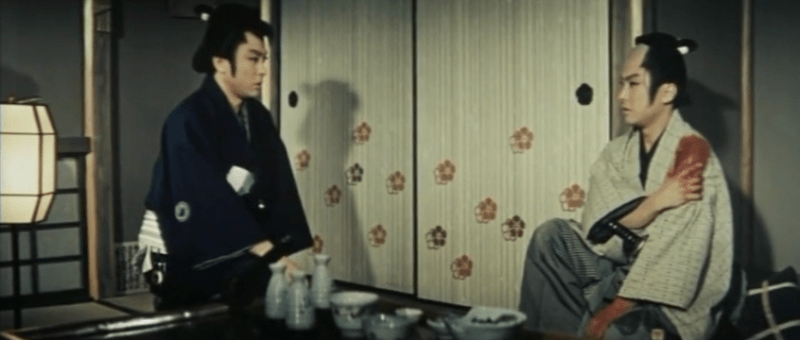

“Everything is money these days” as a pirate king cheerfully proclaims in Nobuo Nakagawa’s tale of Edo-era corruption, Phantom Goblin (まぼろし天狗, Maboroshi Tengu). Perhaps named to capitalise on Nakagawa’s reputation for spookiness, Phantom Goblin features no real ghosts and only metaphorical goblins in the bright red tengu masks sported by the hero’s mysterious clan while otherwise conforming to the Toei programmer house style and starring jidaigeki superstar Hashizo Okawa in a double role as brothers separated at birth and reunited by their resistance towards the inherently corrupt authority of Edo society.
Drawing parallels with the present day, the film opens at a bawdy banquet at which corrupt councillor Tanuma (Isao Yamagata) is being entertained by a pair of local social climbers with a floor show of dancing girls. Shortly after the performance begins, however, one of the women collapses writhing in agony and loudly crying out for drugs. Embarrassed, the lords would rather this not get out deciding to finish the woman off and dump her body in a nearby well. Unfortunately for them, the plan is interrupted by local policeman Shuma Moriya (Hashizo Okawa) who arrives in time to hear the woman exclaim the words “drugs” and “mastermind” before she passes away. Determined to figure out the truth, Moriya heads to the not so secret hideout of a local gang but is shot in the arm and has to take refuge in an inn where he encounters a man who looks just like himself, Kyonosuke Asakawa (also Hashizo Okawa) of the Goblin clan, who eventually sends him to his estate to recover and assumes his position as policeman in order to root out the truth.
A former hatamoto who apparently resigned his position after finding himself unable to support corrupt lords, Kyonosuke declares himself “frustrated with how things are run”, realising that the system is rotten beyond repair on hearing that Moriya has been fired by a corrupt magistrate apparently in league with the conspirators. While comparatively rare in Edo-era dramas, drugs are a controversial subject in any age but in keeping with the sensibilities of the early ‘60s Phantom Goblin eventually slips into the Sinophobia then rampant in contemporary crime dramas as it becomes clear the drugs trade in the feudal economy is being driven by Chinese pirates trafficking it in from overseas while weak willed lords enable their rise to power.
There is however a touch of conservatism in Kyonosuke’s desire to see justice served in that he fears a world in which “if you can buy power and position with money, then one day we will have a chief counsellor who is a pirate”. While he’s undoubtedly got a point, it’s also true that he is in a sense protecting his own privilege conveyed by birth rather than worth in addition to rejecting the influence of the “foreign” as he raises his sword against a Chinese pirate in order to target the corrupt lords who’ve been collaborating with him in order to bolster their own power and position. Kyonosuke wanted to “clean out evil in Edo”, but eventually succeeds rather ironically in simply becoming a part of the system himself after having supposedly cleaned it out by getting rid of the “obviously” corrupt elites.
Recovering from his shoulder injury and flirting with the adopted sister of Kyonosuke, Moriya is largely relegated to a secondary role though the secret brotherhood of the two never develops into much of a plot point even as they bond as men too honest for the world in which they live. Nor do the respective romantic dilemmas ever materialise even as the conflicted figure of a female bandit in love with the noble policeman is forced to pay for her crimes with her life, unable to progress into the purified world the brothers are about to create. Working in the Toei house style, Nakagawa abandons his taste for the strange or otherworldly contenting himself only with a few ironic tengu masks and the literal shadows surrounding the shady mastermind while indulging in genre staples such as the comic relief provided by Kyonosuke’s bumbling retainers and the double casting of Hashizo Okawa as two brothers alike in both appearance and sensibility who find themselves unable to accept the increasing corruption of their society and determine to oppose it.


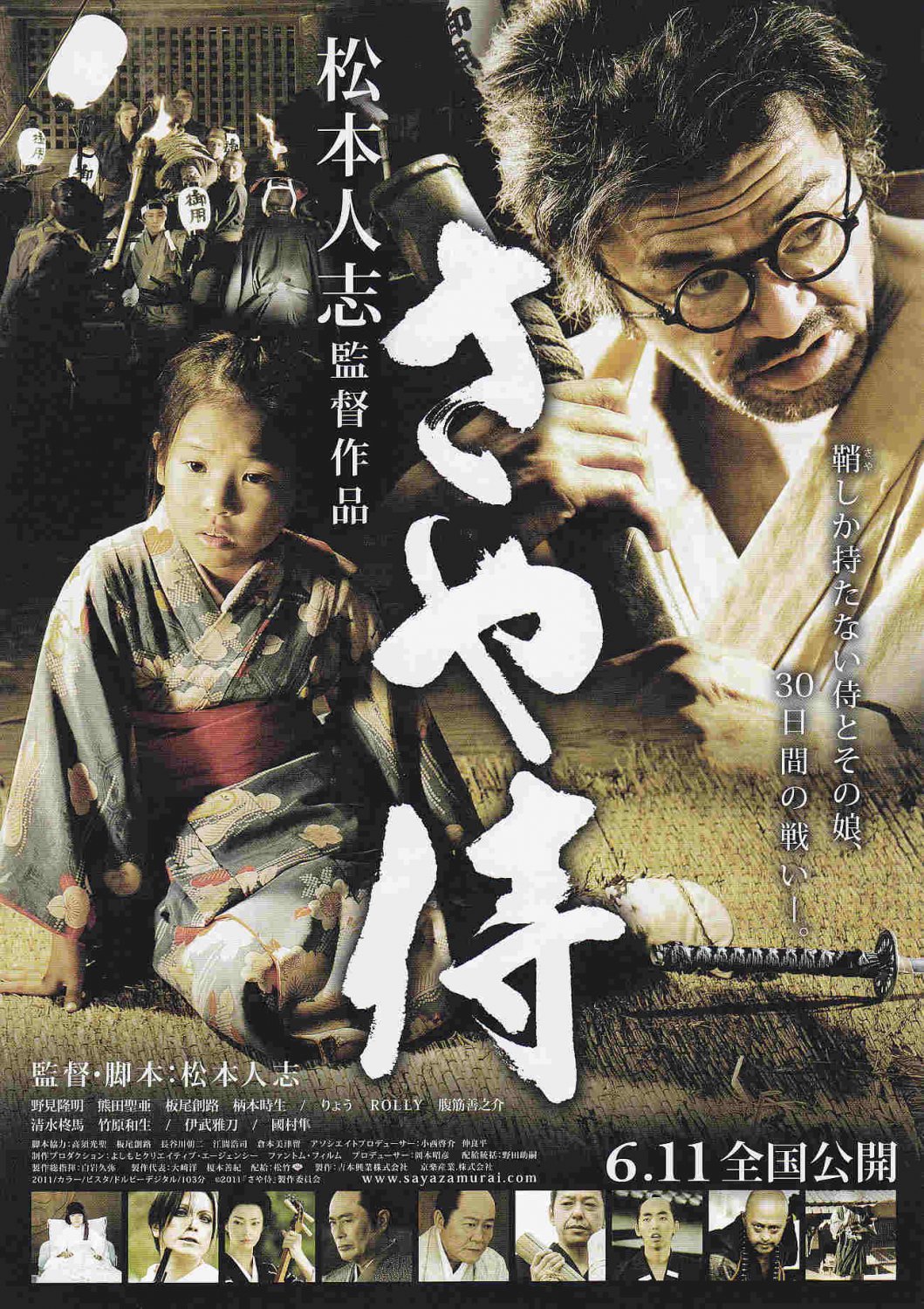 A samurai’s soul in his sword, so they say. What is a samurai once he’s been reduced to selling the symbol of his status? According to Scabbard Samurai (さや侍, Sayazamurai) not much of anything at all, yet perhaps there’s another way of defining yourself in keeping with the established code even when robbed of your equipment. Hitoshi Matsumoto, one of Japan’s best known comedians, made a name for himself with the surreal comedies Big Man Japan and
  “Sometimes it feels good to risk your life for something other people think is stupid”, says one of the leading players of Masaki Kobayashi’s strangely retitled Inn of Evil (いのちぼうにふろう, Inochi Bonifuro), neatly summing up the director’s key philosophy in a few simple words. The original Japanese title “Inochi Bonifuro” means something more like “To Throw One’s Life Away”, which more directly signals the tragic character drama that’s about to unfold. Though it most obviously relates to the decision that this gang of hardened criminals is about to make, the criticism is a wider one as the film stops to ask why it is this group of unusual characters have found themselves living under the roof of the Easy Tavern engaged in benign acts of smuggling during Japan’s isolationist period.
 Ogami (Tomisaburo Wakayama) and his son Daigoro (Akihiro Tomikawa) have been following the Demon Way for five films, chasing the elusive Lord Retsudo (Minoru Oki) of the villainous Yagyu clan who was responsible for the murder of Ogami’s wife and his subsequent framing for treason. The Demon Way is never easy, and Ogami has committed himself to following it to its conclusion, but recent encounters have broadened a conflict in his heart as innocents and seekers of justice have died alongside guilty men and cowards. Lone Wolf and Cub: White Heaven in Hell (子連れ狼 地獄へ行くぞ!大五郎, Kozure Okami: Jigoku e Ikuzo! Daigoro) moves him closer to his target but also further deepens his descent into the underworld as he’s forced to confront the wake of his ongoing quest for vengeance.
 Ogami (Tomisaburo Wakayama), former Shogun executioner now a fugitive in search of justice after being framed for treason by the villainous Yagyu clan who are also responsible for the death of his wife, is still on the Demon’s Way with his young son Daigoro (Akihiro Tomikawa). Five films into this six film cycle, the pair are edging closer to their goal as the evil Lord Retsudo continues to make shadowy appearances at the corners of their world. However, the Demon’s Way carries a heavy toll, littered with corpses of unlucky challengers, the road has, of late, begun to claim the lives of the virtuous along with the venal. Conflicted as he was in his execution of a contract to assassinate the tragic Oyuki in the previous instalment,
 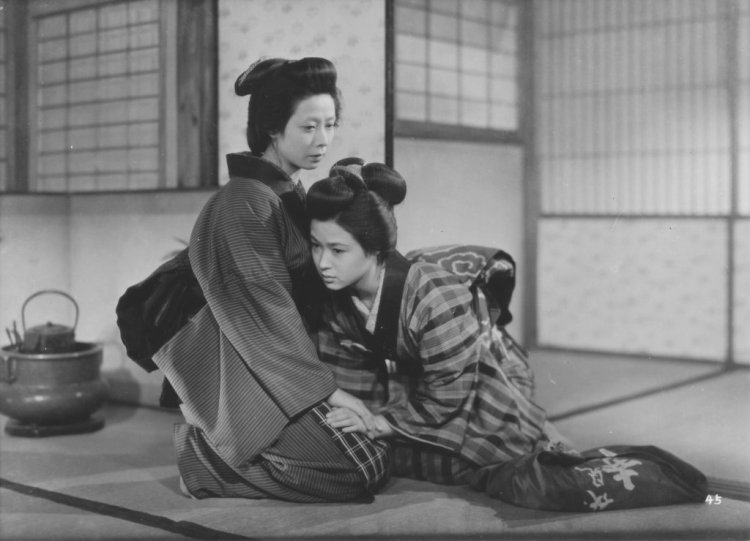 History marches on, and humanity keeps pace with it. Life on the periphery is no less important than at the centre, but those on the edges are often eclipsed when “great” men and women come along. So it is for the long suffering Tose (Chikage Awashima), the put upon heroine of Heinosuke Gosho’s jidaigeki The Fireflies (螢火, Hotarubi). An inn keeper in the turbulent period marking the end of the Tokugawa shogunate and with it centuries of self imposed isolation, Tose is just one of the ordinary people living through extraordinary times but unlike most her independent spirit sparks brightly even through her continuing strife.
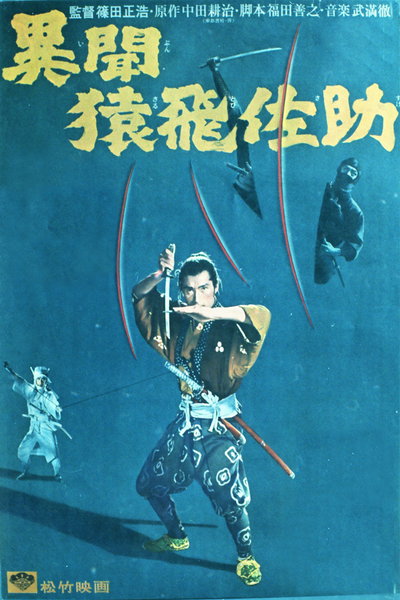 Nothing is certain these days, so say the protagonists at the centre of Masahiro Shinoda’s whirlwind of intrigue, Samurai Spy (異聞猿飛佐助, Ibun Sarutobi Sasuke). Set 14 years after the battle of Sekigahara which ushered in a long period of peace under the banner of the Tokugawa Shogunate, Samurai Spy effectively imports its contemporary cold war atmosphere to feudal Japan in which warring states continue to vie for power through the use of covert spy networks run from Edo and Osaka respectively. Sides are switched, friends are betrayed, innocents are murdered. The peace is fragile, but is it worth preserving even at such mounting cost?
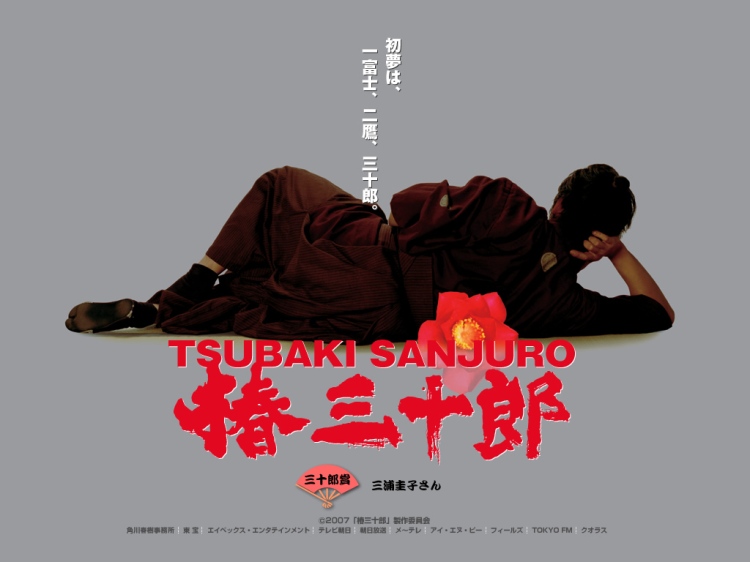 Generally speaking, where a film has been inspired by already existing source material, it’s unfair to refer to it as a “remake” even if there has been an iconic previous adaptation. That said, in the case of Tsubaki Sanjuro (椿三十郎), “remake” is very much at the heart of the idea as the film uses the exact same script as the massively influential 1962 version directed by Akira Kurosawa which also starred his muse Toshiro Mifune. Director Yoshimitsu Morita is less interested in returning to the story’s novelistic roots than he is in engaging with Kurosawa’s cinematic legacy.
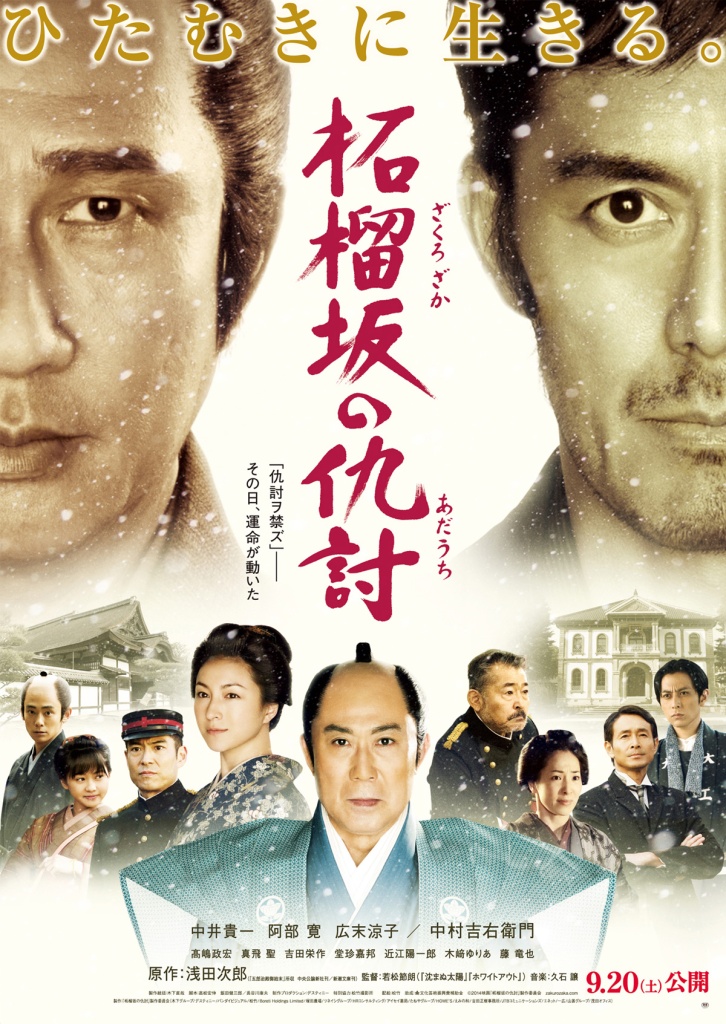 Times change, and men must change with them or they must die. When Japan was forced to open up to the rest of the world after centuries of isolation, its ancient order of samurai with their feudal lords and subjugated peasantry was abandoned in favour of a more Western looking democratic solution to social stratification. Suddenly the entirety of a man’s life was rendered nil – no more lords to serve, a man must his make his own way now. However, for some, old wounds continue to fester, making it impossible for them to embrace this entirely new way of thinking.
 Windows on Worlds