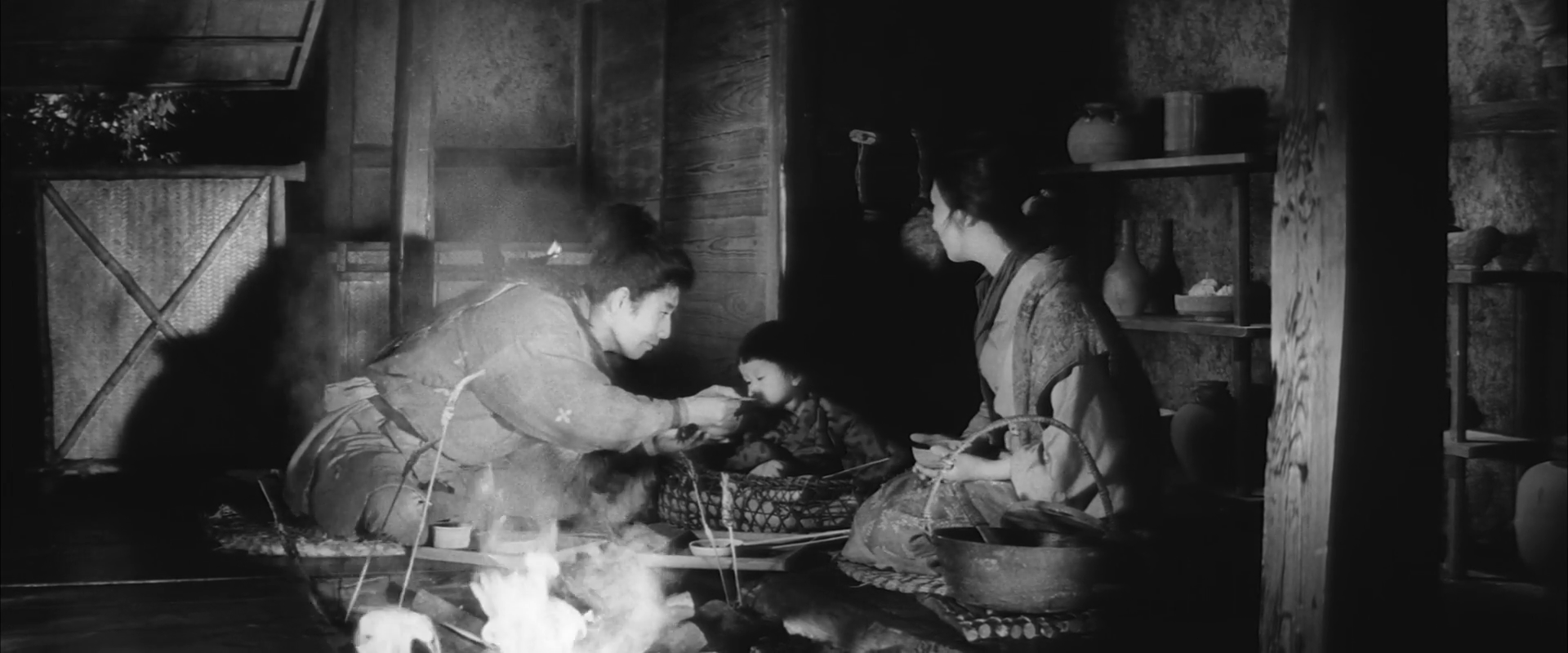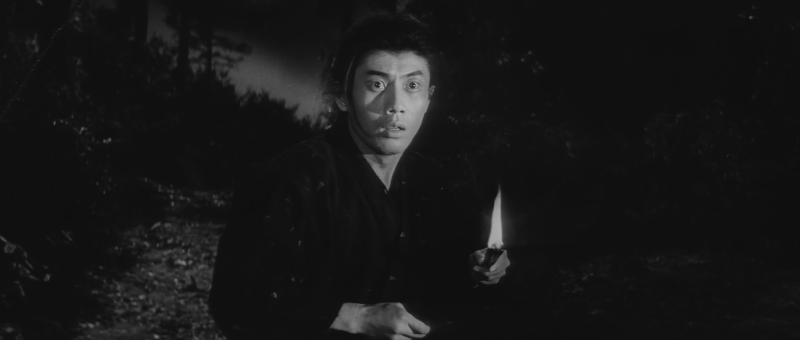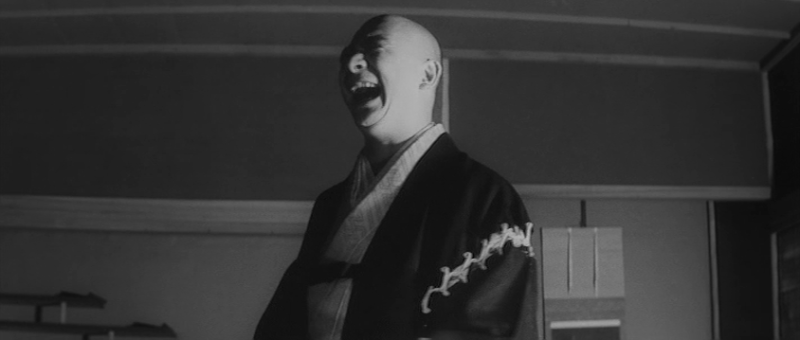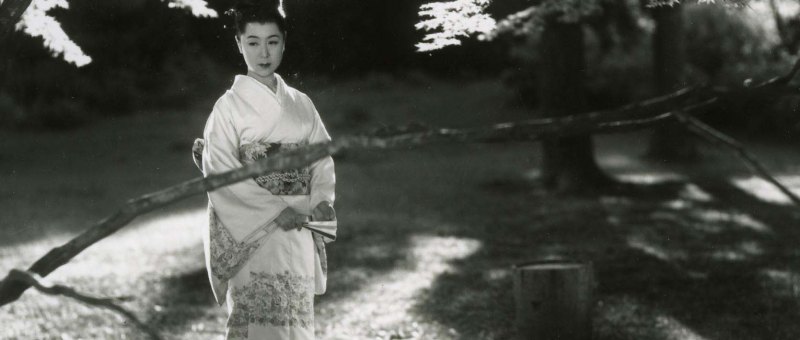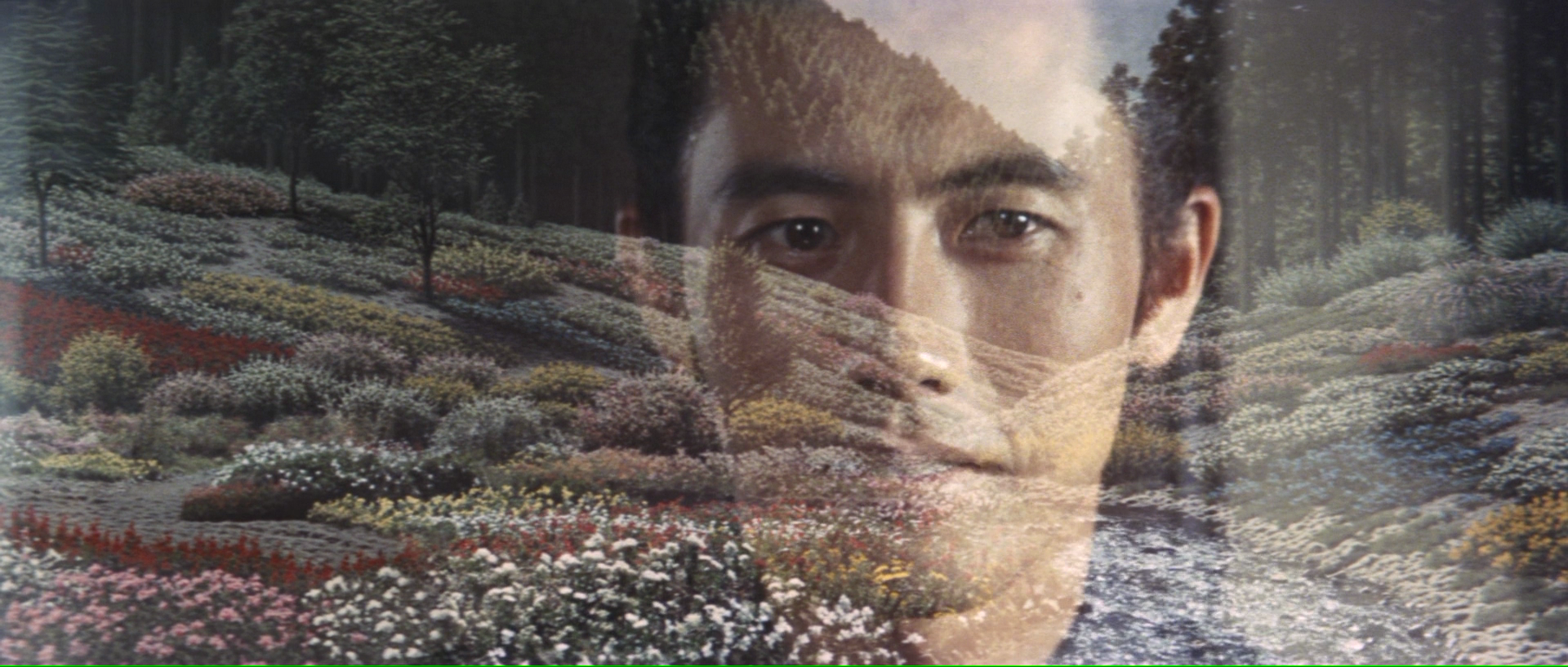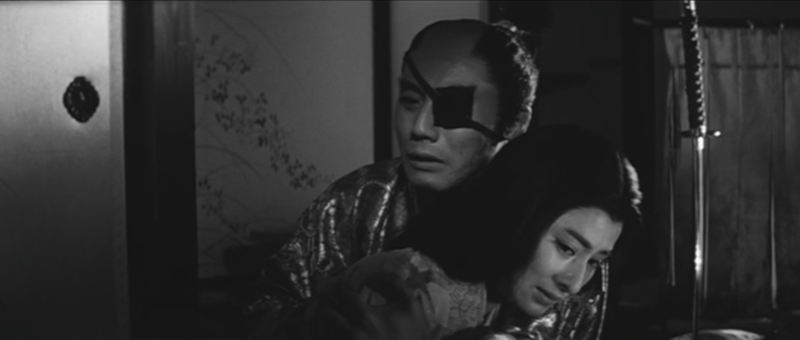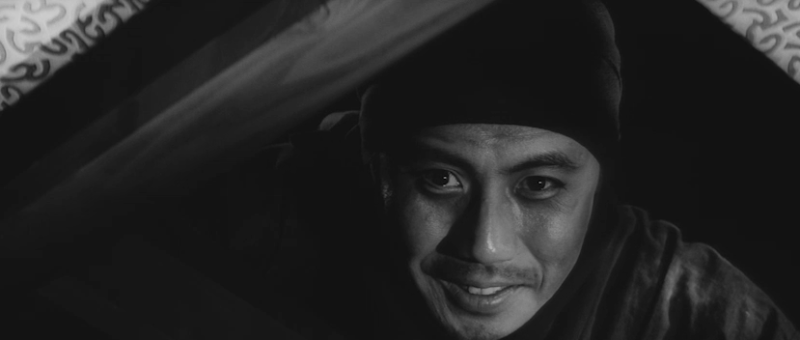
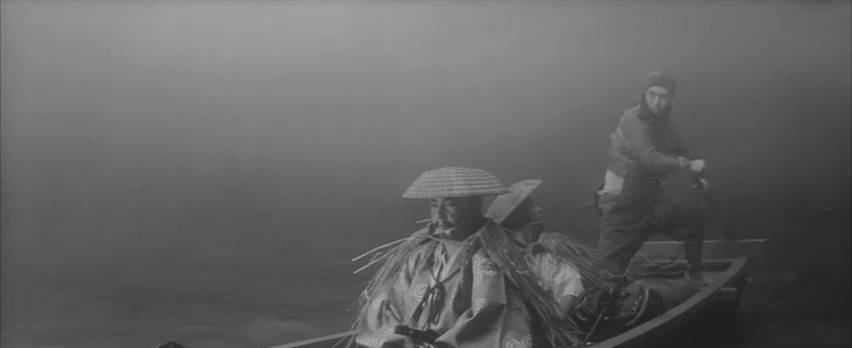
Shinobi No Mono 5: Return of Mist Saizo (忍びの者 続・霧隠才蔵, Kazuo Ikehiro, 1964)

At the end of the previous instalment, Saizo (Raizo Ichikawa) had escaped from the fall of Osaka Castle spiriting away Sanada Yukimura (Tomisaburo Wakayama) who, in contrast to what the history books say, did not die. The pair make their way towards Shimazu, where they are also not well disposed to Ieyasu (Eitaro Ozawa), but as Saizo is informed the Tokugawa clan will never die. Knocking off Nobunaga put an end to the Oda clan, getting rid of Hideyori took the Toyotomi out of the running, but killing Ieyasu will make little difference because another retainer will swiftly take his place.

As a reminder, that’s bad for Saizo because what he wanted was the chaos of the Warring States era back to restore the ninja to their previous status. Nevertheless, at the end of the previous film he claimed to have rediscovered a human heart in his devotion to Yukimura though it may of course be simply another ruse to meet an end. In any case, Ieyasu seems to be putting his ninjas to good use and is once again waiting it out apparently aware that Yukimura is alive and well in Shimazu.

Meanwhile, times are changing. Yukimura is convinced the future of warfare lies in firearms and whoever controls Tanegashima where the weapons are made will prove victorious. They think they can gain it by figuring out how they get access to high-quality iron when trading with anyone outside of Portugal is illegal and the Portuguese don’t have any. It’s access to foreign trade which is becoming a crunch issue as Ieyasu tries to solidify his power, later giving a deathbed order to ban Christianity to stop European merchants taking over the country. Saizo travels to Tanegashima to investigate and figures out that the secret is they’re trading with China, which is pretty good blackmail material, but also encounters two sisters who turn out to be the orphaned daughters of a Tokugawa ninja with vengeance on their mind.

In a surprising turn of events, it turns out that his main adversary is Hanzo Hattori (Saburo Date) but the fact he keeps outsmarting him eventually convinces Ieyasu that the ninja have outlived their usefulness. Hanzo becomes determined to kill Saizo to restore his honour, filling the palace with various ninja traps though unlike Goemon Saizo seems to be one step ahead of them. This lengthy final sequence is played in near total silence, and ironically finds Goemon just waiting, after dispatching several of Hanzo’s men, to see if his poison dart has taken effect and Ieyasu is on his way out. Only in the end Ieyasu just laughs at him. He’s 75. Saizo’s gone to too much effort when he could have just waited it out. Ieyasu has already achieved everything he wanted to. His control over Japan is secured given he’s just been appointed chancellor. He can quite literally die happy because nothing matters to him anymore. A title card informs us that when Ieyasu did in fact die, no one really cared. The Tokugawa peace continued. 

Here, once again, the Ninja too are powerless victims of fate despite their constant machinations. Yukimura tells Saizo to live and be human, advice he gives to the sisters in Tanegashima but does not take for himself staking everything on his revenge against Ieyasu which is, as he points out, pointless for Ieyasu was at death’s door anyway and his demise changed nothing. In his first of two entries in the series, Kazuo Ikehiro crafts some impressive set pieces beginning with a mist-bound underwater battle as Saizo and Yukimura make their escape by water to an epic flaming shuriken battle, though this time around the deaths are noticeably visceral. Men are drowned, stabbed, or caught on wooden spikes. Those who do not obey the ninja code are stabbed and pushed off cliffs while once again emotion is a weakness that brings about nothing more than death. Ikehiro’s frequent use of slow dissolves adds to the dreamlike feel of Saizo’s shadow existence even as the ninja themselves seem to be on the point of eclipse for what lies ahead for them in a world of peace in which there is no longer any need for stealth?
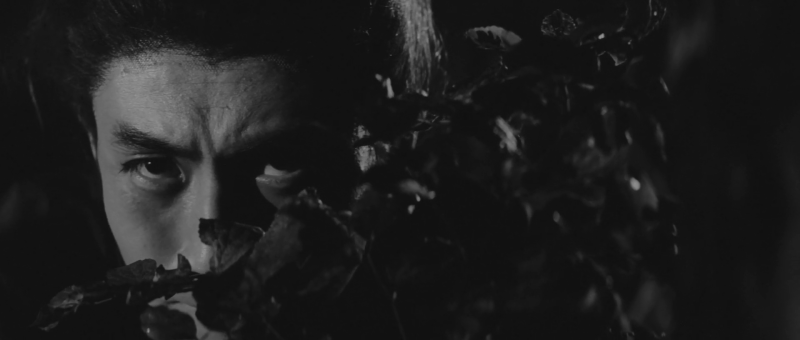
Shinobi no Mono 3: Resurrection (新・忍びの者, Kazuo Mori, 1963)

At the end of the second film in the Shinobi no Mono series, Goemon (Raizo Ichikawa) was led away to be boiled alive in oil after failing to assassinate Hideyoshi Toyotomi. Obviously, Goemon did not actually die, but exchanged places with a condemned prisoner thanks to the machinations of Hanzo Hattori (Saburo Date) which is a clear diversion from the accepted historical narrative to which the film otherwise remains more or less faithful. However, in this instalment more than all the others, Goemon is very much a shadow figure, pale and gaunt, who appears much less frequently on screen and mainly relies on stoking the fires of an already simmering succession conflict in the Toyotomi camp.

At this point, Hideyoshi has already made himself de facto leader of a unified Japan having been made the “kampaku”, advisor to the emperor, only to cede that position in favour of his adopted heir, Hidetsugu (Junichiro Narita) taking the title of “Taiko.” Hideyoshi has been childless for many years which is why he adopted his nephew, but the birth of his son by blood has dangerously unbalanced the palace order with Hidetsugu increasingly certain he’s become surplus to requirements. Meanwhile, in an effort to secure his position Hideyoshi has also embarked on an ambitious plan to conquer Korea as a means of getting to Ming China and circumventing the tributary requirements necessary for trading with it. 

This plan necessarily means that they need more money with Hideyoshi calling an end to all building and renovation projects including that of a Buddhist temple playing into the series’ themes about hubris in the face of Buddha though by this point Goemon too has lost faith in Buddhism in the clear absence of karmic retribution. As Ieyasu (Masao Mishima) points out, this works out well for him as it will stir discord among local lords who will be forced to squeeze their already exploited subjects even more earning nothing more than their resentment which will then blow back on oblivious Hideyoshi.  

Thus Goemon’s role mostly involves sneaking in and telling various people that others are plotting against them and they’d be better to get ahead of it. A secondary theme throughout the series has been a sense of powerlessness which is perhaps inevitable in a historical narrative in which we already know all of the outcomes. Ieyasu scoffs at Goemon, remarking that he thinks he’s walking his own path but is really being manipulated into walking that which Ieyasu has set down for him, though Goemon effectively rejects this stating at the conclusion that as Ieyasu believed he was using him he was also using Ieyasu to achieve his revenge on Hideyoshi for the death of his wife and son. In the historical narrative, Hideyoshi dies of a sudden illness as he does here with Goemon lamenting that his revenge is frustrated by the fact that Hideyoshi is now old and frail though he achieves it through symbolically cutting off his bloodline but explaining to him that Hideyoshi will not become the heir to anything because Ieyasu will be taking the role he has so patiently waited for. Hideyoshi has in any case perhaps disqualified himself as the father of a nation by wilfully sacrificing his adopted son, Hidetsugu, who was ordered to commit suicide to avoid any challenge to Hideyori after becoming desperate and debauched in the knowledge that his days were likely numbered anyway.

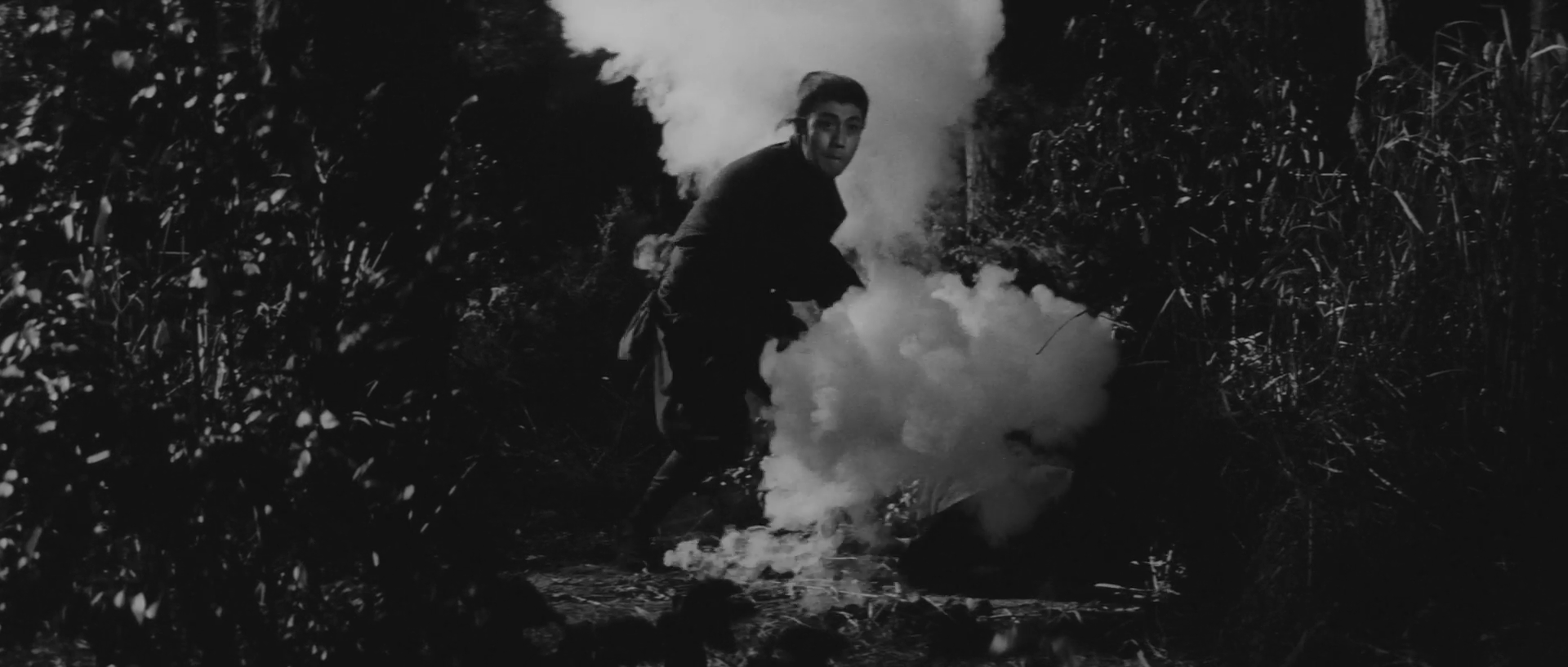
In any case, Goemon perhaps declares himself free in asking why he should care who’s in charge after Hanzo once again tries to recruit him to work for a now triumphant Ieyasu whose long years of simply waiting for everyone else to die have paid off. This is what passes for a happy ending in that he has thrown off the corrupt authority of the feudal era and discovered a way to live outside of it as a “free” man though as others point out the system hasn’t changed. Poor peasants continue to be exploited by lords who are greedy but also themselves oppressed by an equally ruler playing petty games of personal power. Fittingly, ninja tricks mainly revolve around smoke bombs and the covert use of noxious fumes to weaken the opposition as they creep in to spread their poison. Never shedding the series’ nihilistic tone, the film ends on a moment of ambivalent positivity albeit one of exile as Goemon declines the invitation to the fold instead wandering off for a life of hidden freedom in the shadows of a still corrupt society. 

Shinobi no Mono 2: Vengeance (続・忍びの者, Satsuo Yamamoto, 1963)

Though Goemon might have thought himself free of his ninja past at the conclusion of the first film, he was unfortunately mistaken. Shinobi no Mono 2: Vengeance (続・忍びの者, Zoku Shinobi no Mono) sees him trying to live quietly with Maki and their son in a cabin in the woods, but Nobunaga is more powerful than ever. He’s wiped out the Iga ninja and is currently hunting down stragglers. Try as he might, what Goemon discovers the impossibility of living outside of the chaos of the feudal era. 

After he’s caught and suffers a family tragedy, Goemon and Maki (Shiho Fujimura) move to her home village in Saiga which is the last refuge of the Ikko rebels who oppose Nobunaga. This time around, the film, based on the novel by Tomoyoshi Murayama, even more depicts the ninja as backstage actors silently shuffling history into place. Thus Goemon takes advantage of a rift between the steady Mitsuhide (So Yamamura) and loose cannon Nobunaga (Tomisabur0 Wakayama) in an attempt to push him into rebellion. But what he may discover is that even with one tyrant gone, another will soon rise in its place. Hideyoshi (Eijiro Tono) seems to be forever lurking in the background, while Ieyasu makes a few experiences explaining that he intends to wait it out, allowing his rivals to destroy each other so he can swoop down and snatch the throne at minimal cost. 

But he too has his ninja such as the legendary Hanzo Hattori (Saburo Date) who arrives to complicate the intrigue and tempt Goemon away from his attempts to live a normal life. Interestingly enough, one of the factors leading to Nobunaga’s downfall is his disregard for Buddhism in frequently burning temples associated with ninja along with everyone inside them. Burning with a desire for vengeance, Goemon describes Nobunaga as inhuman, a demon, though he also embodies the vagaries of the feudal era in which no one is really free. Nobunaga has built a large castle estate for himself while ordinary people continue to suffer under onerous demands from local lords. Hideyoshi has also done something similar in an attempt to bolster his status and prepare for his own inevitable bid for national hegemony. 

The implication is that though the constant warfare of the Sengoku era is of course bad for farmers in particular, the political machinations which revolve around the egos of three men are far removed from the lives of ordinary people. Even so, the code of the ninja continues to be severe as we’re reminded that love and human happiness are not permitted to them. A female ninja spy working for Hanzo is despatched to Nobunaga’s castle to seduce his retainer Ranmaru but is cautioned that she must not allow her heart to be stirred. Predictably this seems to be a promise she couldn’t keep, eventually dying alongside him during an all out attack on the castle. 

Goemon discovers something much the same in encountering further losses and personal tragedies, but takes on a somewhat crazed persona in his continuing pursuit of Nobunaga, grinning wildly amid the fires of his burning castle while taunting Nobunaga that he is the ghost of the Iga ninjas he has killed. Then again, he’s laid low by his own ninja tricks on discovering that Hideyoshi has had a special “nightingale floor” installed that lets out a song whenever someone crosses it, instantly ruining his attempt to infiltrate the castle. “The days when a few ninja could control the fate of the world are over,” Ieyasu ironically reflects though perhaps signalling the transition he embodies from the chaos of the Sengoku era to the oppress peace of the Tokugawa shogunate.

Somehow even bleaker than its predecessor, Yamamoto deepens the sense of nihilistic dread with increasing scenes of surreal violence and human cruelty from a baby been thrown on a fire to a dying commander teetering on his one leg and holding out just long enough to gesture at a sign requesting vengeance against those who have wronged him. Echoing the fate of the real Goemon, dubbed the Robin Hood of Japan for his tendency to steal from the rich to give to the poor, the conclusion is in its own way shocking but then again perhaps not for there can be no other in this incredibly duplicitous world of constant cruelty and petty violence. 


Ninja, A Band of Assassins (忍びの者, Satsuo Yamamoto, 1962)

Ninja in Japanese cinema had largely been relegated to the realms of childish fantasy prior to Satsuo Yamamoto’s Ninja, A Band of Assassins (忍びの者, Shinobi no Mono) which cast a distinctly less heroic light on the famed mercenary spies of the feudal era. Indeed, there’s something reminiscent of the cult of militarism in the repressive nature of the ninja code and the hero Goemon’s (Raizo Ichikawa) original allegiance to it despite his father’s wariness and attempt to warn him that human happiness has no place in the life of a ninja. 

As the leader of Goemon’s clan, Sandayu (Yunosuke Ito), explains the ninja are obliged to serve whichever lords require their service, but he refuses to work with Oda Nobunaga (Tomisaburo Wakayama, billed as Kenzaburo Jo) owing to his famous animosity towards them. He even goes so far as to call Nobunaga a greater threat to the ninja than demons or devils. Opening in 1573, the film takes place at a tumultuous moment as Nobunaga continues to solidify his plan to unite the whole of the land under his banner by absorbing or defeating rival clans. The pre-credits sequence finds Goemon playing dead on a battlefield surrounded by ominous crows and encountering another ninja from a rival clan, Kizaru (Ko Nishimura), who has become a more literal kind of vulture in stealing from the dead.

Stealing is against the ninja code and something of which the young and idealistic Goemon fiercely disapproves. Nevertheless, in a cruel irony he’s forced to become a burglar in an effort to raise funds for more weapons to combat Nobunaga whom he has also been ordered to assassinate in return for his life after having been caught having an affair with Sandayu’s wife, Inone (Kyoko Kishida). Goemon is inspired by the legendary figure dubbed the Japanese Robin Hood for his mission stealing money from the rich to give to the poor, but here is far from heroic. When his affair with Inone is discovered by a servant, Goemon kills him to maintain the silence. He then believes that Inone has also been killed after falling into a well and attempts to flee the scene only to be confronted by Sandayu. 

Only too late does to he begin to understand what his father tried to warn him about, that the code of the ninja is cruel and unforgiving. It cannot grant him pride or happiness despite the self-satisfied glow he feels on having been singled out by Sandayu as a protege. A ninja must be ready to sever all ties to those he loves and endure intense torture without speaking. If caught in an impossible situation he must scar his face and take his own life as one of Goemon’s acquaintances eventually does after being captured by Nobunaga. Goemon assumes he has no reason to be afraid because he is the most skilled ninja in the garrison and a single ninja can take down a fortress all on his own, but in reality he is powerless, merely a puppet manipulated by Sandayu for his own ends. After falling in love with a sex worker, Maki (Shiho Fujimura), he grows tired of his missions, gives up on burglary, and makes no move to assassinate Nobunaga but is pursued by Sandayu’s minions, the irony being that not even a ninja can escape from the confined space of ninjadom.

This world is so steeped in secrecy that nothing is as it seems and Goemon discovers the rug pulled out from under him in more ways than one before beginning to realise that Sandayu has deliberately engineered his downfall and was most likely behind his father’s murder in an attempt to get his hands on his recipe for gunpowder which is, as Nobunaga says, the future of warfare. Nevertheless, even within its commitment to realism the film contains plenty of ninja tricks from sudden appearances to superhuman leaps and expert shuriken throwing and grappling hooks.  The sense of melancholy futility implied by the presence of the crows in the opening scenes never recedes, Yamamoto frequently descending into mists as Goemon sinks into his confusion and eventual disillusionment with the tenets of ninjadom. Rival ninja clans more obsessed with their reputation and status vie for the head of Nobunga while all Goemon wants is the right to live a quiet life with Maki though that’s something that largely cannot be found amid the constant chaos of the feudal era. 

The Blind Menace (不知火検校, Kazuo Mori, 1960)

Two years before finding fame as Zatoichi, Shintaro Katsu starred as his mirror image in a tale of pure villainy, The Blind Menace (不知火検校, Shiranui Kengyo). As the title suggests, the film follows the upward trajectory and eventual downfall of an unsighted man who gleefully rapes and pillages his way to becoming the leader of his community aided and abetted by the ills of the feudal era which allow him to profit from his crimes until the past finally catches up with him.

After all as he later says, “as long you as you keep rising in the world, past misdeeds don’t matter.” In any case, even as a child the man who would later be known as Suginoichi (Shintaro Katsu) is incredibly unpleasant. In the opening festival sequence he picks his nose and flicks it in a barrel of sake so that the men drinking will abandon it. The only sign of possible goodness in him is that he takes the sake home for his mother to enjoy, though he seems to relish the idea of her unwittingly drinking his snot so perhaps that was the real purpose. Other hobbies of his include conning wealthy passersby out of a ryo with a well worn scam in which he asks them to read a letter from his uncle which mentions that it should include one ryo only what’s in there is a stone. When the reader explains the situation, he accuses them of trying to take advantage of his blindness and makes a fuss about it until they’re embarrassed into coughing up a ryo of their own (not a small sum for the time period). 

In some ways his poverty and disability might explain his behaviour. His family set up is subverted with his mother much like him money hungry and willing to do anything to get it while his saintly, henpecked father is gentle and honest. This might have taught him the wrong lessons about masculinity that lead him to see his father as weak in allowing the world to trample him while taking his mother’s advice to heart that if they only had a 1000 ryo they could get him trained up properly so that he might one day become a Kengyo which is a little bit like a community leader for the blind with social status and political influence. 

It’s this kind of social affirmation he seems to crave, but is essentially a narcissistic sociopath who takes advantage a stereotype that in some ways infantilises the blind and those with other disabilities who are believed to be pure-hearted and incapable of intrigue or evil. He seems to come to the rescue of a noblewoman who asked his boss, the Kengyo, to lend her money secretly because her brother has been caught embezzling but then rapes her, asks for the money back, and blackmails her into further acts of sexual exploitation offering her only 5 ryo a time knowing she needs 50. He thinks nothing of using his acupuncture skills to kill a man who was carrying 200 ryo to buy a “boneless girl” for a freak show and then framing a man who saw him do it but agreed to say nothing for a 50% cut for the crime. Suginoichi later teams up with “Severed Head” Kurakichi (Fujio Suga) to commit a series of burglaries including that of the Kengyo master who he also has killed to usurp his postion. 

But as he said, once his recognition is in sight with an invitation from the shogun everything begins to fall apart as all his wrongdoing starts to catch up with him. The feudal world had allowed him to prosper partly because of other people’s greed but also the social codes that favour shame and secrecy along with people’s unwillingness to accept that a blind man can also be selfish and evil despite a lot of evidence to the contrary. Elegantly lensed by Kazuo Mori who brings a sense of realism to the hardbitten backstreets of the feudal poor, the film may suggest that the wealthy only get that way by trickery and exploitation and the only way to rise to the loftiest place is to be like Suginoichi and not care what you do to get there but is clear that once you arrive you won’t stay very long because one day the past will really will come back to bite you. 


4K restoration trailer (no subtitles)

Miss Oyu (お遊さま, Kenji Mizoguchi, 1951)

“I never realised how heavy this kimono was” a young woman exclaims towards the conclusion of Kenji Mizoguchi’s Miss Oyu (お遊さま, Oyu-sama), adapted from the Junichiro Tanizaki short story The Reed Cutter, finally collapsing under its weight having committed what amounts to an act of spiritual suicide in an internalised betrayal. Mizoguchi’s highly selective adaptation excises much of Tanizaki’s trademark perversity and targets instead the repressive social codes of the era which proceed to ruin three lives in frustrated affection, shame, and self-harming guilt. 

The trouble begins when Shinnosuke (Yuji Hori), a young man in search of a wife, mistakes his prospective bride for her sister and is forever smitten. Oyu (Kinuyo Tanaka), a widow with a young son, is only accompanying her younger sister, Oshizu (Nobuko Otowa), but is perhaps herself taken with the handsome suitor whom she repeatedly brands a “fine gentleman”. Having objected to all of Oshizu’s previous matches, she encourages her sister to marry this one not least because of his physical proximity that would allow the pair to visit each other regularly. The pain on Oshizu’s face is however readily apparent as Oyu relates the amusing incident to their brother, the younger sister clearly consumed with an inferiority complex in the shadow of the beautiful and elegant Oyu. 

It’s never quite clear to what extent Oyu is aware of her sister’s feelings, if she says these things thoughtlessly or with an intent to wound though she obviously cares deeply for Oshizu. Similarly the extent of her feelings for Shinnosuke remains oblique. As a woman well aware of her beauty and its power, perhaps she simply enjoys being desired or is so accustomed to male attention as to barely notice that Shinnosuke has fallen in love with her. Then again perhaps she knows all too well and for the sake of politeness pretends not to though in that case the decision to encourage her sister to marry him would seem perverse or suggest that she is attempting to deny her own feelings which she may not even understand by rendering Shinnosuke a “brother” in an attempt to remove him from the pool of potential romantic suitors. 

Even so there is an underlying quality of incestuous desire of Oshizu for her sister to whom she remains devotedly besotted, willing to sacrifice her own happiness in the hope of ensuring Oyu’s. After agreeing to marry Shinnosuke, she explains to him that she intends their marriage to be purely symbolic. She refuses to consummate their union on the grounds that it would be a betrayal of Oyu whom she knows to be in love with Shinnosuke while realising that he has married her only to be connected with her sister. When the trio take a trip together the strangeness of the ménage à trois is brought home by the confusion of the hotel maid who assumes that Oyu and Shinnosuke are the married couple, commiserating with Oshizu for being a third wheel. While Oyu childishly makes light of it, Oshizu is hurt and confused, jealous in two directions but pleading with Shinnosuke to be only his sister rather than a wife. 

Yet the wrongness of the arrangement is signalled on Oyu’s return home when she discovers not only that her son, Hajime, has fallen mortally ill in her absence but that rumours have begun to circulate about her unusual relationship with her brother-in-law. It is impossible to avoid the implication that Oyu is being punished firstly for betraying her maternity in having gone on holiday without her son to experience freedom as a woman, secondly for feeling sexual desire, and thirdly for feeling it for a married man who is now technically a brother in being her sister’s husband though as we know no one’s sexual desires are currently being fulfilled in this incredibly complicated and destructive arrangement. 

Though Tanizaki might have been more interested in exploring the darker aspects of human sexuality, Mizoguchi pulls back from the author’s trademark perversity to take aim at the repressive social codes of a patriarchal society which brought such a fraught situation into being. Oyu is unable to marry Shinnosuke because she is bound to her late husband’s family and by the responsibility to her son whom she would have to leave behind even if she were given permission to take another husband. Once her son dies, her ties to marital family are severed and they, disapproving of the rumours surrounding her unconventional relationship with her sister and brother-in-law, send her back to her brother who is also reluctant to accept her. On learning of the reality of her sister’s marriage, she decides to accept a proposal from a sake merchant in another town but the separation breeds only more destruction. Oshizu and and Shinnosuke move to Tokyo and three years later are living in poverty, Shinnosuke now dishevelled and dressing in Western suits with a modern haircut and a scraggly, half-hearted moustache. Oshizu’s eventual pregnancy which confirms that theirs is now a “full” union while Oyu’s is “symbolic” only the slows implosion of the trio’s repressed desires. 

Mizoguchi stops short of arguing for a transgressively new arrangement that would have allowed the trio to live together as a family but nevertheless attacks the repressive social codes that prevent them from speaking honestly about their feelings and force them into self-sacrificing acts of subterfuge which create only more suffering. He dramatises the claustrophobia of their lives through the obvious artificially of the stage sets which stand in such stark contrast to the expansive beauty of nature albeit sometimes unruly but always free, while lending their tragic tale a hint of the parabolic in its mists and rugged gardens as Shinnosuke finds himself alone under the cold light of the moon on a distant shore, a romantic exile from a repressive society. 


Sword Devil (剣鬼, Kenji Misumi, 1965)

An orphaned son’s attempts to overcome his cursed destiny are poisoned by the duplicities of the samurai society in third part of Kenji Misumi’s loose “Sword Trilogy”, Sword Devil (剣鬼, Kenki). Perhaps unfairly dismissed by some as a mere genre craftsmen, Misumi was also an intense visual stylist, a quality very much on show in this vibrant drama which pits the beauty of the natural world against the samurai order but eventually finds its hero succumbing to cruelties of his age unable to outrun himself or his destiny. 

In the prologue which opens the film, shot in an arty theatrical style, a young peasant woman formerly a maid to the late Lady Makino gives birth to a “stranger’s” child after having been promoted and given a place in the women’s quarters as a reward for her loyalty in continuing to serve her mistress in the depths of her “madness”. Lady Makino claims that Kin’s kindness brought her back to reality and is keen to ensure she continues to be taken care of after her death, but also asks her to take charge of her precious pooch hoping that she will treat it “as herself”. This is perhaps why it is rumoured that the child, given the name “Hanpei” which ironically is in part inspired by the dog-like “Spot” coupled with a suffix which implies a lowly rank, is in fact the product of a taboo union between the maid and the dog (rather than admit he is almost certainly the illegitimate son of Lord Masanobu). For some reason this bizarre rumour persists throughout the boy’s life, cast out as he is from the palace and raised in an ordinary village as the son of a low-ranking samurai who appears to be kind and loving, worried enough about Hanpei’s (Raizo Ichikawa) future to advise him to find a special skill that will allow him to support himself and perhaps overcome some of the persistent prejudice against him after the old man’s death. 

The skill he perfects, however, continues to set him apart from his fellow men in that he chooses the cultivation of flowers. A particularly snotty neighbour describes Hanpei’s art as “annoying”, though others are impressed enough by his skill to marvel that they have such a man in their clan while also pointing out that in these times of peace becoming a samurai florist might be much more useful than perfecting the art of the sword. Ironically, however, it drags him back towards the court and intrigue when he’s invited to craft a flower garden to cheer up the present young lord who seems to be succumbing to the same “madness” as his mother. The trouble starts when the garden is completed to the lord’s satisfaction but marred by the sudden and apparently unexpected arrival of a bumblebee which damages the lord’s tranquility and provokes a violent outburst in which he begins to hack at the flowers hoping to punish the one which “rudely” invited the bee to the garden. Hiding behind a tree, Hanpei perfectly aims a rock at the lord’s head to prevent him destroying his precious work and is spotted by his chief retainer, Kanbei (Kei Sato), who earmarks him for future use in his nascent conspiracy. 

Hanpei finds himself at the centre of intrigue, increasingly seduced by promises of advancement that he might be “titleless” no more and perhaps in fact escape his lowly position as the son of a dog. He ingratiates himself by, like his mother, being one of the few servants willing to bear the lord’s violent rages in volunteering to accompany his horse even though he has none of his own and has to run along behind thereby demonstrating his slightly supernatural athletic ability that gives further credence to his canine origins. In similar fashion he learns by observation, captivated rather than appalled on witnessing an old ronin practicing his sword technique by cutting in half a butterfly in the forest. Preoccupied by his lowly status and consequent lack of sword skills, Hanpei is reassured by the man’s explanation that there’s nothing more to it than draw, strike, and sheath but takes yet another step towards the samurai dark side in accepting the gift of a sword. Later he breaks it, meaning to break with the cruel path on which fate has set him, only to pick up another, supposedly cursed sword to which he was attracted because of its “evil spirit”.

Osaki (Michiko Sugata), a kind and innocent woman seemingly attracted to Hanpei because of his difference in his gentle sensitivity in contrast to the rough men around her, refuses to believe the rumours he has become an assassin working for Kanbei because no one who loves flowers like he does could be a coldblooded killer. This is in fact what he has become, sent, like a dog, after Kanbei’s enemies killing without even knowing who it is who must die only to be remorseful on discovering he has killed someone known to him. There is division and sedition within the court caused by the lord’s madness, Kanbei and his associates keen to rule in his stead while keeping his mania secret from the shogun while others, a small group of lower samurai rebels, prefer to depose him in favour of his adopted heir. Hanpei is once again a pawn, taking no side in this debate but unthinkingly doing Kanbei’s dirty work in the service of his sword. He hopes that by taking the “evil” instrument in his hands he might double his bad luck to overcome his unhappy destiny, gazing at his distorted face in its reflection, but discovers himself merely outcast once again as the villagers begin to realise he is an obstacle to their rebellion and responsible for the assassinations of their loved ones. 

The ironic conclusion finds the hero’s planned flower garden, a shared endeavour with love interest Osaki, rendered a bloody graveyard, men cut down like weeds as Hanpei’s quick draw philosophy makes a mockery of their fancy samurai fencing. The poisonous samurai legacy, infected with madnesses literal and figural, destroys everything, all beauty and grace falling under Hanpei’s “evil” sword as he finds himself, quite literally, chased out of town like a stray dog condemned to wander exiled from human society. 


Destiny’s Son (斬る, Kenji Misumi, 1962)

“Sad is his destiny” laments a seemingly omniscient lord in Kenji Misumi’s elliptical tale of death and the samurai, Destiny’s Son (斬る, Kiru). A chanbara specialist, Misumi is most closely associated with his work on long running franchises such as his contributions to the Zatoichi series and Lone Wolf and Cub cycle, and though sometimes dismissed as a “craftsman” as opposed to “auteur” is also known as a visual stylist capable both of the most poetic imagery and breathtaking action. 

Scripted by Kaneto Shindo, Destiny’s Son follows cursed samurai Shingo (Raizo Ichikawa) who finds himself the victim of cruel fate and changing times during the turbulent years of the bakumatsu. His mother, Fujiko (Shiho Fujimura), a maid misused by a plotting courtier and talked into murdering the inconvenient mistress of a wayward lord, was executed for her crime by the man she loved, Shingo’s father who later renounced the world and became a monk. In a sense, it’s Shingo’s sense of displacement which later does for him, allowed the rare freedom of a three year pass from the apparently compassionate lord of the clan which took him in to go travelling during which he learns superior sword style something which came as a surprise to his old friends on his return who’d always thought him gentle and bookish. His talent makes him dangerous to an unexpected rival in his strangely mild-mannered neighbour who happens to have a crush on his sister Yoshio (Mayumi Nagisa) but is quite clearly under the thumb of his finagling father, Ikebe (Yoshio Inaba), who is convinced the family can “do better” as long as he triumphs in a contest of martial prowess with a passing master to whom the clan has given temporary shelter after he was cast out of his own. Of course, nothing goes to plan. The master easily defeats even the clan’s most talented warriors until Shingo is called up as a last resort only to best him with his signature move learned out on the road, a dangerous throat thrust. 

In a theme which will be repeated, Shingo finds himself in the middle of accidental intrigue through no fault of his own though the ill-conceived Ikebe revenge plot does at least allow him to discover the sad truth of his family history even as it deepens his sense of displacement. Slashing right into the mores of the chanbara, Misumi pares Shindo’s screenplay down to its poetic minimum as the hero sets off on his elliptical journey, achieving his revenge as the first stop before walking back into the past and then into an accidental future as a retainer to Lord Matsudaira (Eijiro Yanagi) himself at the centre of bakumatsu intrigue in trying to quell the divisions within the Mito clan some of whom have been involved in anti-shogunate terrorism setting fire to the British Legation shortly after the nation’s exit from centuries of isolation. An eternal wanderer, he resolves to have no wife and wanted no ties, haunted by the trio of women he couldn’t save from the mother who birthed him in part as a bid for mercy, to the sister who died a pointless and stupid death because of samurai pettiness, to another man’s sister whose name he never knew who stripped naked and threw her kimono at her assailants to save her brother’s life while they too were on the run after standing up to samurai corruption. He loses three women, and then three fathers, the first he never knew, the second taken from him in more ways than one, and the third betrayed by the complicated world in which they live. 

“I cannot be forgiven” Shingo exclaims, his end tied to that of his mother as a sword glints gently in the bright sunshine and blood drips, the only blood ever we see, on another woman’s breast. Elegantly composed and often set against the majestic Japanese landscape, Misumi’s ethereal camera with its dynamic tracking shots, controlled dolly movement, and frequent call backs to the setting sun lend Shingo’s journey an elegiac quality even in its evident nihilism as he finds himself consumed by the samurai legacy, discovering only futility in his rootlessness unable to protect himself or others from the vagaries of the times in which he lives. 


Original trailer (no subtitles)

The Third Shadow Warrior (第三の影武者, Umetsugu Inoue, 1963)

“In this world the weak are playthings of the strong” according to the hidden villain concealing himself slightly to the side in Umetsugu Inoue’s dark identity drama The Third Shadow Warrior (第三の影武者, Daisan no Kagemusha). Adapting a novel by Norio Nanjo, Inoue, most closely associated with sophisticated musicals, shoots in the manner of a ghost story adapting the trappings of a minor parable on the consequences of selling one’s soul for advancement in complicity with an inherently broken feudal order. 

Opening in 1564, the film wastes no time reminding us that the samurai were cruel and duplicitous, a troop of them riding through the contested mountain territory of Hida bearing the severed heads of their enemies casually insulting peasants as they go. Young farmer Kyonosuke (Raizo Ichikawa), however, can’t help but think that they’re heroic and dashing, longing like many young men as the voiceover explains to make his fortune as a samurai in this the age of war. Kyonosuke gets his wish when retainer Shinomura (Nobuo Kaneko) turns up and offers him a job at the castle, only it’s not quite what he expected. Bearing a striking similarity to lord Yasutaka, he has been hired as his third “shadow”, a decoy intended to shield the lord from harm. 

Sitting down with his two new brothers, Kyonosuke remarks how ironic it is that he’s here to escape the land but Kuwano (Katsuhiko Kobayashi) is patiently saving up his pay with the intention of using it to buy a farm and settle down with a beautiful wife. His is the most dangerous of doubling roles as the lord’s battlefield stand-in, while Ishihara (Yuji Hamada), a former actor apparently not much good with the sword, takes his place behind closed walls. Kyonosuke is quite taken with the world of the samurai, but Ishihara cautions that he’ll soon tire of this “phoney life”. In accepting this devil’s bargain, Kyonosuke has in essence consented to his own murder. A shadow man, he can no longer call himself Kyonosuke, but nor can he say he is Yasutaka. He has no fixed identity and is merely in waiting for a veil. Worse still as Ishihara has begun to suspect, they no longer have bodily autonomy because their physicality must match that of the lord. When he is blinded in a battlefield mishap with an arrow, so must they be. Deciding he’d rather not lose an arm, Kyonosuke finds himself in an altercation with his other self which leads to his demise. He intends to make a life for himself under his own name with another clan, but is forced to permanently assume Yasutaka’s identity after being cornered by Shinomura intent on manipulating him for his own ends. 

“I’m no puppet, I no longer need a puppeteer” Kyonosuke exclaims drawing strength from embracing his new identity as a samurai lord, but perhaps overreaches himself in ambitious desire failing to see the various ways he is still merely a pawn in a bigger game as Yasutaka himself once was because the lord is only ever an empty vessel and far more expendable than might be assumed. Princess Teru (Hizuru Takachiho), Yasutaka’s conquest bride, declares that she is “just a doll, the strongest will win me” but is of course playing a role herself, one which she does not desire but has been thrust upon her while her cousin, Sadamitsu (Shigeru Amachi), is engaged in a much more active piece of long form role play. Only the lord’s concubine (Masayo Banri) sees through him, falling for the gentle peasant after the rough lord who toyed with her, but their complicated love eventually seals his fate even as he believes it offers him victory. Kyonosuke became a samurai to escape his lack of agency but is arguably much less free than he ever was, driven slowly out of his mind by his fractured sense of identity and realising that in killing the only man who knew who he “really” was, he also killed himself. 

Quite literally imprisoned, Kyonosuke finds himself a shadow once again neither one man nor another, denied an identity and forever a puppet of duplicitous game players better versed in the realities of the samurai existence. “How ugly fighting over this transient kingdom” the princess disdainfully remarks while herself engaging this apparently meaningless foolishness, reminded by her cousin that a princess may hold the keys to a castle or even a nation even if he implies she is little more than his tool, a puppet to be manipulated if knowingly. Shooting with deep, expressionist shadows, chiaroscuro lighting, and a melancholy voiceover Inoue frames his tale as a parabolic caution against selling one’s soul for gold but also a crushing indictment of the inequalities of the feudal order built on wilful hypocrisy and cynical exploitation. 


A Lustful Man (好色一代男, Yasuzo Masumura, 1961)

“Why are women in Japan so unhappy?” the carefree Casanova at the centre of Yasuzo Masumura’s 1961 sex romp A Lustful Man (好色一代男, Koshoku Ichidai Otoko) laments, never quite grasping the essential inequalities of the world in which he lives. Masumura is best known for extremity, a wilful iconoclast who flew in the face of golden age cinema’s genial classism, but shock was not his only weapon and he could also be surprisingly playful. Adapted from a well known novel by creator of the “floating world” Ihara Saikaku, A Lustful Man finds him indulging in ironic satire as his hero sets out to “make all the women in Japan happy” chiefly by satisfying their unfulfilled sexual desire while resolutely ignoring all of the entrenched patriarchal social codes which ensure that their lives will be miserable. 

Set in the Edo era, the film opens not with the hero Yonosuke (Raizo Ichikawa) but with his miserly father who berates a servant after discovering a single grain of rice on the hall floor. According to him, the central virtues necessary to become rich are endurance, diligence, and vitality. You must treasure each and every grain of rice in order to accumulate. A cruel and austere man who only thinks of money, Yonosuke’s father keeps his wife in earnest poverty despite their wealth, angrily grabbing an obviously worn kimono out of her hands and insisting that it’s still good for another year, apparently caring nothing for appearances in the otherwise class conscious Kyoto society. It’s this meanness that Yonosuke can’t seem to stand. He hates the way his father disrespects his mother, and her misery is a primary motivator in his lifelong quest to cheer up Japan’s melancholy women though the weapon he has chosen is sex, a convenient excuse to live as a genial libertine to whom money means essentially nothing. 

Yonosuke’s father has set him up with an arranged marriage into a much wealthier family, which is not something he’s very interested in despite the fact she seems to be quite pretty but on learning that she has transgressively found love with the family butler he determines to help her instead, ending the marriage meeting by chasing her round the garden like a dog in heat. Several similar stunts eventually get him sent away from his native Kyoto to Edo but he takes the opportunity to escape, travelling all over Japan making women “happy” as he goes. 

As the first example proves, Yonosuke genuinely hates to see women suffer. His own pleasure, though perhaps not far from his mind, is secondary and he never seeks to take advantage of a woman’s vulnerability only to ease her loneliness. Despite that, however, he remains essentially superficial opting for the transience of postcoital bliss while ignoring the very real societal factors which make an escape from misery all but impossible. During an early adventure, he spends all of the money he conned out of his new employer on redeeming a geisha (at more than three times the asking price) so that she can be with the man she loves, but he continues to visit sex workers without interrogating their existence as indentured servants, “merchandise” which is bought and sold, traded between men and entirely deprived of freedom. In fact, he proudly collects hair cuttings from the various geishas he has known as a kind of trophy only to later discover the grim truth, that the hair likely doesn’t belong to the geisha herself but is sold to them by middlemen who get it by digging up dead bodies. 

Yonosuke remains seemingly oblivious to the duplicitous hypocrisy of the yoshiwara, but is repeatedly confronted by the evils of Edo-era feudalism with its proto-capitalist cruelty where everything is status and transaction. He is often told that as he is not a samurai he would not understand, but seems to understand pretty well that “samurai are idiots” and that their heartless elitism is the leading cause of all the world’s misery. To some a feckless fool, Yonosuke refuses to give in to the false allure of worldly riches. As soon as he gets money he spends it, and does so in ways he believes enrich the lives of women (even if that only extends to paying them for sex), eventually getting himself into trouble once again reneging on his taxes after trying to prove a geisha is worth her weight in gold. 

Yogiri (Ayako Wakao) complains that women are but “merchandise”, valued only as toys for men. “Japan is not a good country for women” Yonosuke agrees, suggesting they run away together to find a place where women are respected, indifferent to Yogiri’s rebuttal “no, wherever you go, no one can change women’s sad fate”. Yonosuke’s naive attempts to rescue women from their misery often end in disaster, a runaway mistress is dragged back and hanged, the woman he was set to marry goes mad after her father and lover are beheaded for having the temerity to speak out about corrupt lords, Yogiri is killed by a samurai intent on arresting him for tax evasion, and his own mother dies seconds after his father only to be immediately praised as “the epitome of a Japanese wife”. Yet he remains undaunted, wandering around like an Edo-era Candide, setting off into exile to look for a supposed female paradise without ever really engaging with the systems which propagate misery or with his own accidental complicity with them. Nevertheless, he does perhaps enact his own resistance in refusing to conform to the rules of a society he knows to be cruel and unfair even if his resistance is essentially superficial, self-involved, and usually counterproductive which is, in its own way, perfectly in keeping with Masumura’s central philosophies on the impossibilities of individual freedom within an inherently oppressive social order.