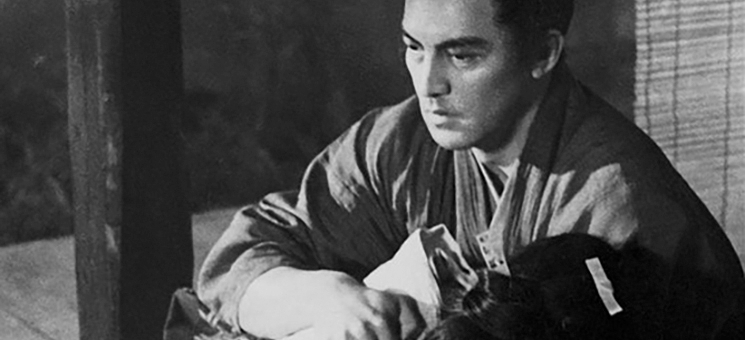
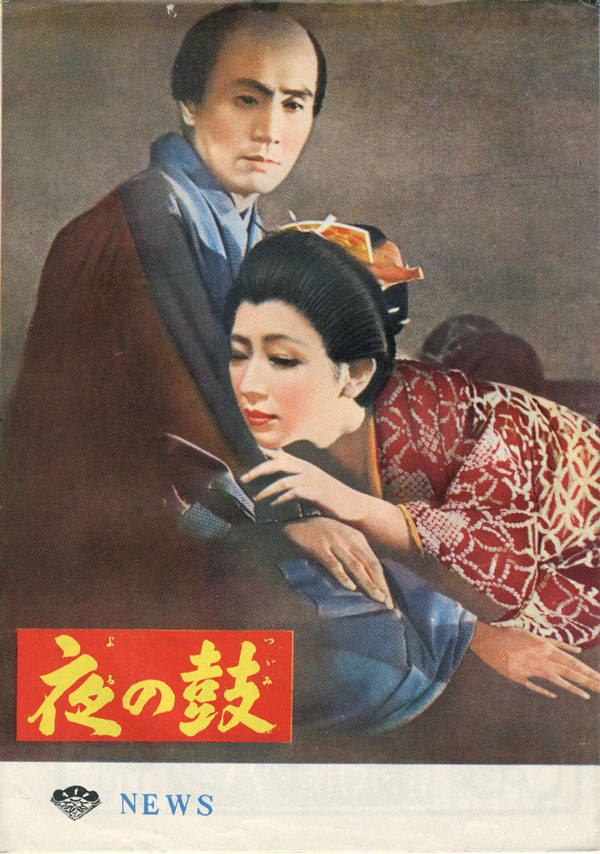
The works of Chikamatsu Monzaemon continue to have a large influence over Japanese drama even if not as frequently and directly adapted as they were in the immediate post-war period. Famous for tales of tragic love suicides and romantic heroes who risk all in the service of deep emotion, Chikamatsu’s works perhaps found even greater resonance in the turbulent years in which individual freedom and adherence to tradition found themselves in even greater conflict than ever before. Tadashi Imai makes the most of Chikamatsu’s melancholy fatalism to take a sword to the samurai order itself with all of its arcane rules and the essential hypocrisy which underlines its cruelty.
Hikokuro Ogura (Rentaro Mikuni) has been in Edo for a year with the shogun and is now on his way home. Stopping at an inn, he has a low level argument with his brother-in-law who warns him the men are getting restless and need to blow off some steam preferably with some sake. Hikokuro is in charge of the purse strings and knows all of this pageantry costs money the clan do not quite have hence he’s reluctant to fritter it away on alcohol no matter how much the men might resent him for it.
That’s not to say Hikokuro is a particularly officious person, he’s kind and cheerful by nature but also tired and eager to get home after such a long time away. His wife, Otane (Ineko Arima), is very happy to see him but something seems different about her and there’s a tension in the air among some of the other women. It seems, there are rumours about Otane and a travelling musician (Masayuki Mori) who frequented the house during the summer while Hikokuro was away. Rumours are often just that, especially in these petty circles of nobility, but female adultery is punishable by death and so is not something to be gossiped about idly.
Night Drum (夜の鼓, Yoru no Tsuzumi) begins with the ominous sound of the drum itself, beating out the inevitably tragic fate of all concerned with a melancholy fatality. The tale proceeds in a procedural fashion as the authorities become involved, hearing witness testimonies and trying to discover if there could be any truth at all in these unpleasant rumours. Matters are further complicated by the pecuniary difficulties the clan currently finds itself in – the elders are half hoping it is true because it would be a good excuse to expel the Ogura household and thereby save the money which goes on its upkeep. They are aware, however, that they’re talking about the life of a previously unblemished woman as well as the ruin of her extended family.
The life of a retainer is not as easy as it sounds and we’re constantly reminded of just how much money is necessary to keep up appearances. The clan authorities are dismayed when they hear of Otane earning money on the side through needlework though other retainers are quick to confess their wives also help out, they just can’t survive on such meagre stipends. Each lord is required to hire servants as befits their status but they aren’t given the money to do so. Hikokuro is also required to serve the shogun in Edo every other year for at least twelve months meaning Otane is left alone at home with almost nothing other than her needlework to do except wait patiently for her husband’s return.
Given these circumstances, it’s easy to understand how such pernicious rumours might begin. The sole basis of the evidence seems to rest on a tip off that Otane is thought to have been alone in a room with a man who is not her husband. That she may be put to death solely for the crime of sharing the same space as someone of the opposite sex seems extreme, but this is the feudal world where rules and propriety are all. The men can cavort with geishas to their heart’s content, but Caesar’s wife must be above suspicion.
The action unfolds piecemeal as each of the various witnesses offers their testimony of events. Given the gravity of the situation, few are eager to recount their suspicions – especially the other women who fear the rumour may be true but are also unwilling to believe it. Hikokuro does not want to believe it either but faced with such convincing, if circumstantial, evidence doubt creeps into his mind and finds an anchor in Otane’s guilt ridden behaviour. Ironically, this entire situation developed only because of Otane’s attempts to avoid it – remaining at an inn rather than travelling with a man on the road only for one of her husband’s friends to attempt to rape and blackmail her. Having had far too much to drink in an attempt to steel her nerves and cover up the embarrassing assault, Otane finds herself at the mercy of man who should have known better than to take advantage of another man’s wife in such a moment of weakness.
One stupid mistake born of alcohol, loneliness, and a series of male betrayals is enough to bring down the social order all on its own. Rentaro Mikuni plays the part of the previously affable wounded spouse with an exceptional level of nuance as he accepts his part in his wife’s downfall thanks to the the circumstances of their lives which have kept them apart and left her at the mercy of untrustworthy lords. There is anger here, and shame, but there is still love too which only makes the inevitable outcome all the more painful for everyone concerned. Hikokuro plays the part he’s expected to play, but it pains him and you can’t wipe a slate clean with blood. Imai has his eyes firmly on the civilised society with all of its rigid yet often cruel and unfair rules for living. Shot with a kind of hypnotic dreaminess in which each of our unfortunate players is swept along by events they are powerless to influence, Night Drum beats out the death knell of those who allow their individual desires to overwhelm their “civilised” conformity but it does so with a rhythm that is filled with anger rather than sorrow, for those who are forced to leave half their lives unlived in maintenance of the very system which oppresses them.
 Junichiro Tanizaki is widely regarded as one of the major Japanese literary figures of the twentieth century with his work frequently adapted for the cinema screen. Those most familiar with Kon Ichikawa’s art house leaning pictures such as war films The Burmese Harp or Fires on the Plain might find it quite an odd proposition but in many ways, there could be no finer match for Tanizaki’s subversive, darkly comic critiques of the baser elements of human nature than the otherwise wry director. Odd Obsession (鍵, Kagi) may be a strange title for this adaptation of Tanizaki’s well known later work The Key, but then again “odd obsessions” is good way of describing the majority of Tanizaki’s career. A tale of destructive sexuality, the odd obsession here is not so much pleasure or even dominance but a misplaced hope of sexuality as salvation, that the sheer force of stimulation arising from desire can in some way be harnessed to stave off the inevitable even if it entails a kind of personal abstinence.
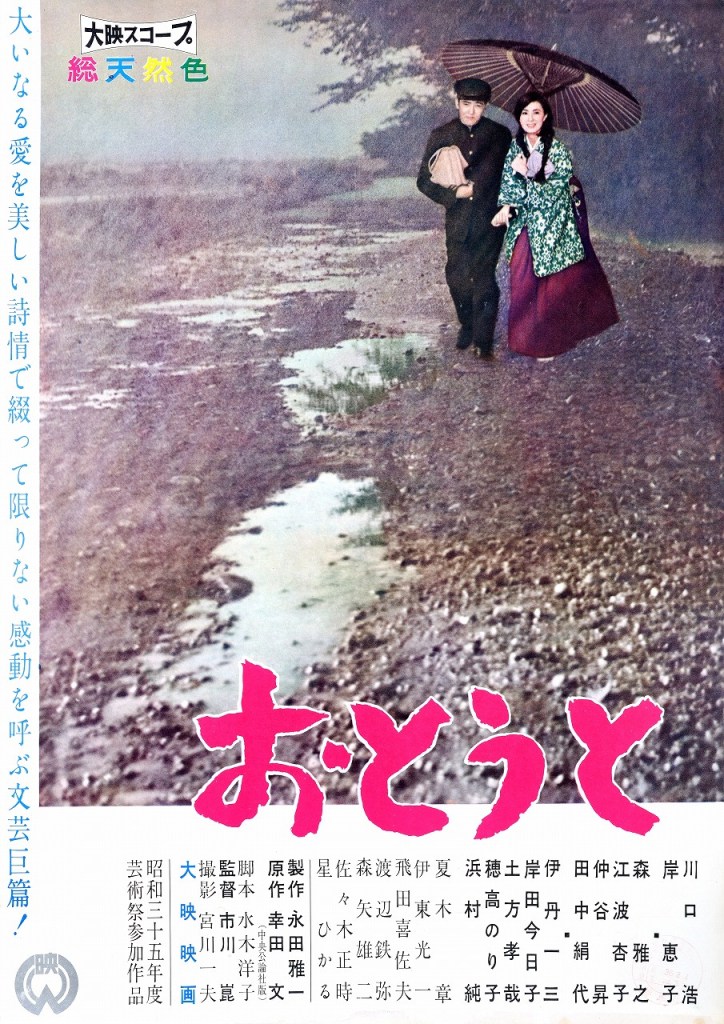 Perhaps oddly for a director of his generation, Kon Ichikawa is not particularly known for family drama yet his 1960 effort, Her Brother (おとうと, Ototo), draws strongly on this genre albeit with Ichikawa’s trademark irony. A Taisho era tale based on an autobiographically inspired novel by Aya Koda, Her Brother is the story of a sister’s unconditional love but also of a woman who is, in some ways, forced to sacrifice herself for her family precisely because of their ongoing emotional neglect.
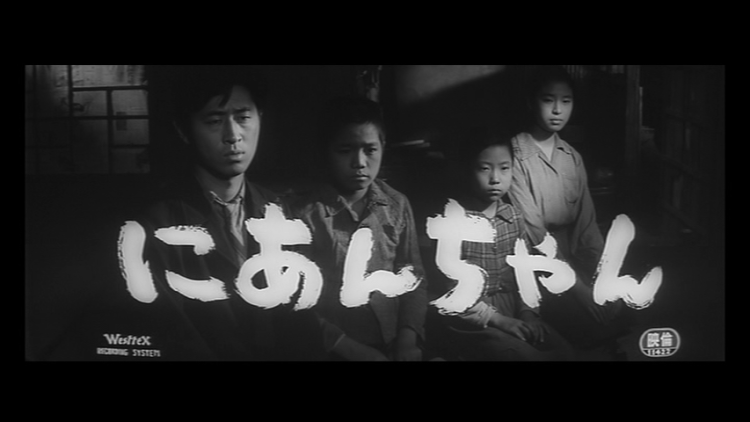 Like most directors of his era, Shohei Imamura began his career in the studio system as a trainee with Shochiku where he also worked as an AD to Yasujiro Ozu on some of his most well known pictures. Ozu’s approach, however, could not be further from Imamura’s in its insistence on order and precision. Finding much more in common with another Shochiku director, Yuzo Kawashima, well known for working class satires, Imamura jumped ship to the newly reformed Nikkatsu where he continued his training until helming his first three pictures in 1958 (Stolen Desire, Nishiginza Station, and Endless Desire). My Second Brother (にあんちゃん, Nianchan), which he directed in 1959, was, like the previous three films, a studio assignment rather than a personal project but is nevertheless an interesting one as it united many of Imamura’s subsequent ongoing concerns.
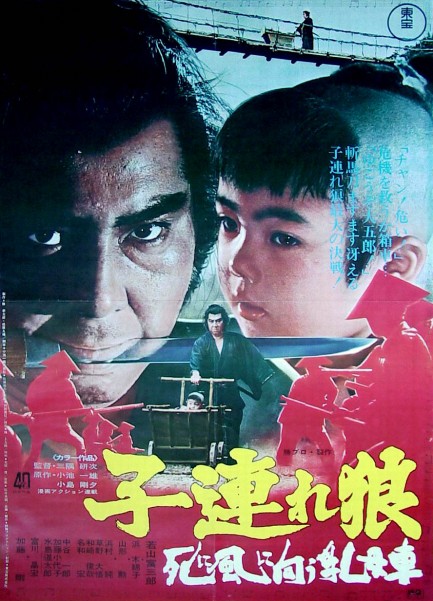 Ogami Itto (Tomisaburo Wakayama) and his (slightly less) young son Daigoro (Akihiro Tomikawa) are going to hell in a baby cart in this third instalment of the six film series, Lone Wolf and Cub: Baby Cart to Hades (子連れ狼 死に風に向う乳母車, Kozure Okami: Shinikazeni Mukau Ubaguruma). The former shogun executioner, framed for treason by the villainous Yagyu clan intent on assuming his position, is still on the “Demon’s Way”, seeking vengeance and the restoration of his clan’s honour with his toddler son safely ensconced within a bamboo cart which also holds its fair share of secrets. In the previous chapter,
 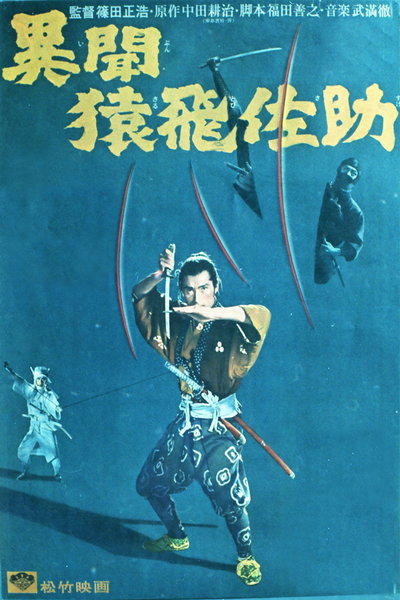 Nothing is certain these days, so say the protagonists at the centre of Masahiro Shinoda’s whirlwind of intrigue, Samurai Spy (異聞猿飛佐助, Ibun Sarutobi Sasuke). Set 14 years after the battle of Sekigahara which ushered in a long period of peace under the banner of the Tokugawa Shogunate, Samurai Spy effectively imports its contemporary cold war atmosphere to feudal Japan in which warring states continue to vie for power through the use of covert spy networks run from Edo and Osaka respectively. Sides are switched, friends are betrayed, innocents are murdered. The peace is fragile, but is it worth preserving even at such mounting cost?
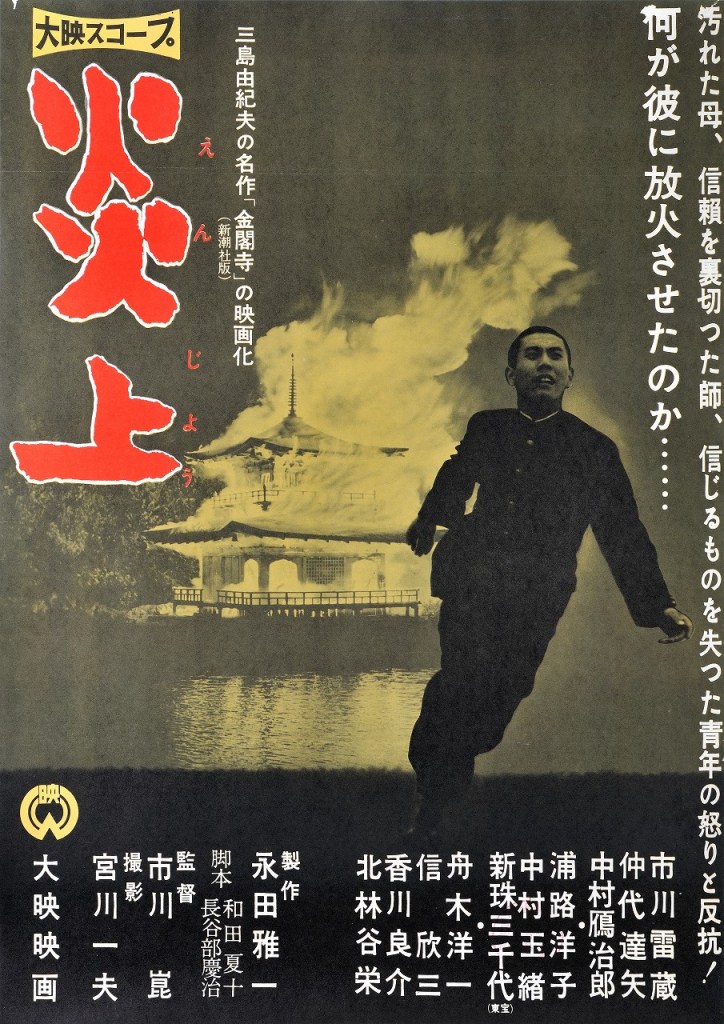 Kon Ichikawa turns his unflinching eyes to the hypocrisy of the post-war world and its tormented youth in adapting one of Yukio Mishima’s most acclaimed works, The Temple of the Golden Pavilion. Inspired by the real life burning of the Kinkaku-ji temple in 1950 by a “disturbed” monk, Enjo (炎上, AKA Conflagration / Flame of Torment) examines the spiritual and moral disintegration of a young man obsessed with beauty but shunned by society because of a disability.
 Despite being one of the most prolific directors of the ‘80s and ‘90s, the work of Yoshimitsu Morita has not often travelled extensively overseas. Though frequently appearing at high profile international film festivals, few of Morita’s films have been released outside of Japan and largely he’s still best remembered for his hugely influential (and oft re-visited) 1983 black comedy, The Family Game. In part, this has to be down to Morita’s own zigzagging career which saw him mixing arthouse aesthetics with more populist projects. Main Theme is definitely in the latter category and is one of the many commercial teen idol vehicles he tackled in the 1980s.
 Windows on Worlds