
 Written by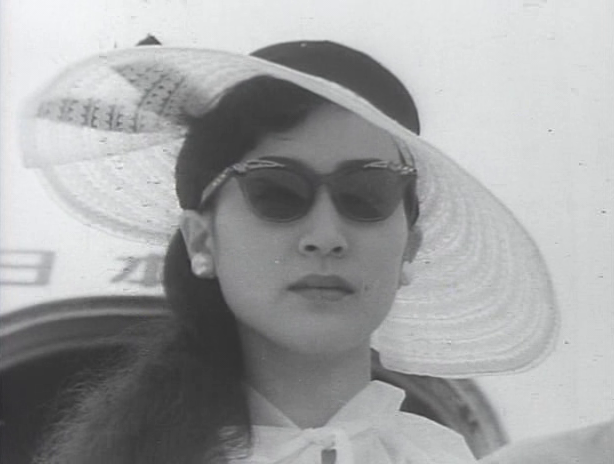
Born amid the labour disputes that engulfed Toho in the late 1940s, Shintoho began as a rather lofty endeavour mostly geared towards artistic films, but after a series of box office failures was soon in the red. Impresario Mitsugu Okura was brought in to turn the company around, but his ethos was decidedly populist. He shifted the studio away from the auteurist focus of its early days towards the racy dramas and ghost films with which it would become associated.
Revenge of the Pearl Queen (女真珠王の復讐, Onna shinju-o no fukushu) was key to this transformation and made a star out of its leading lady Michiko Maeda who had been discovered working in the kimono department of the Mitsukoshi department store. Though sometimes billed as the first mainstream feature to depict full female nudity, what it really sells is the promise rather than the reality. The nudity in the film is generally abstract or artistic, shooting Maeda from behind and at a distance amid nature or capturing brief shots of her rear as her skirt flutters in the wind. Otherwise, she is seen in loose, torn clothing or with her hands covering her bare breasts as she, ironically, tries to escape from a series of men trying to assault her.
Adapted from a novel by Yoshihisa Aoki, the film is also inspired by a real life incident in which a group of men and one woman were marooned on Anatahan island at the end of the war. The men eventually ended up killing each other over the woman. The same incident inspired the 1953 film by Josef von Sternberg. Natsuki (Michiko Maeda), an office worker, is engaged to diligent employee Kizaki (Ken Utsui) and about to undertake a trip abroad with her boss, Asamura (Susumu Fujita). An early scene sees their passports arrive with some fanfare as it was still difficult at this time for ordinary people to acquire one or indeed to travel outside of Japan. But it soon turns out that her boss has an ulterior motive. Kizaki is framed for the murder of the company president, while Asamura first attempts to blackmail Natsuki into entering a sexual relationship with him, then tries to assault her when she refuses. She manages to get away from him, but he chases her and she ends up being thrown overboard.
She then washes up on an island and is “rescued” by five shipwrecked sailors. Three of them are desperate to rape her, while the oldest of the men Ishizuka (Saburo Sawai) is against it and tries to protect her along with his son-in-law to be Yuzo (Shigeru Amachi). Ishizuka takes the men to task and asks them how they could show their faces in Japan having done something so heinous, but they just laugh at him. In some ways, this seems to be an echo of wartime atrocities and the fishermen stand-ins for men who did terrible things overseas and then were able to forget about it and live normal lives in post-war Japan. The same is true of Asamura whose wartime service in intelligence is often referenced, though his subordinate Noguchi (Tetsuro Tanba) later suggests he’s embellished his record. Asamura isn’t even his real name, though he’s been able to build a business empire for himself largely based on fraud, tax evasion, forgery, and apparently also drug smuggling. He used Kizaki as a foil to kill his boss and take over the company, while hoping to also bed Natsuki at the same time.
Nevertheless, after the three aspiring rapists turn on each other and are killed, Natsuki discovers a wealth of riches under the sea while attempting to save one of them from a whirlpool. Spending her entire time diving for pearls, she becomes incredibly wealthy and is able to rebrand herself as “Helen Minami”, a Japanese-American “pearl queen”, on her return to Japan. Sharing her riches with Ishizuka and Yuzo, the trio plot revenge hoping to clear Kizaki’s name and expose Asamura’s corruption. They use the money to attack them through the stock market while also discouraging their clients from doing business with them until the company is finally on its knees. The crows are coming home to roost for Asamura with Natsuki returning to expose all his wrong doing, though such occurrences were perhaps rare for other men like him in reality. By reinventing herself, Natsuki is at least able to cure this corruption and restore her innocent connection with Kizaki in a dramatic nightclub showdown in which justice is finally served.

