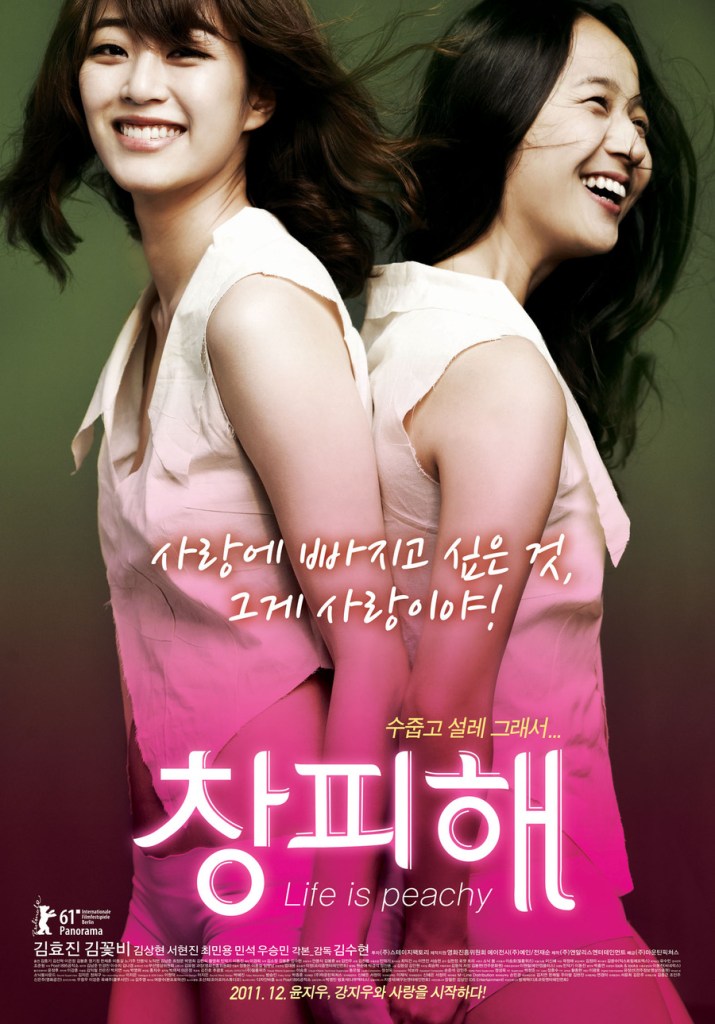
Ashamed (창피해, AKA Life is Peachy, Kim Soo-hyun, 2011)

ashamedOne of the very earliest films to address female same sex love in Korea, Ashamed (yes, really, but not quite – we’ll get to this later, 창피해, Changpihae, retitled Life is Peachy for US release) had a lot riding on it. Perhaps too much, but does at least manage to outline a convincing, refreshingly ordinary failed love romance even if hampered by a heavy handed structuring device and a lack of chemistry between its leading ladies.
Beginning in the film’s “present”, embittered art professor Jung Ji-woo (Kim Sang-hyeon) is auditioning models for an art project, whereupon she bonds with two students currently undergoing some kind of unresolved drama of their own. Hee-jin (Seo Hyun-jin), Jung’s pupil, has roped in her friend also coincidentally named (Youn) Ji-woo (Kim Hyo-jin) who, as she recounts in a lengthy flashback, she met in odd circumstances whilst drinking with layabouts in an alley. Eventually, Youn Ji-woo confessed to her that she’s attracted to people of the same sex, which has left Hee-jin feeling kind of awkward.

Trying to console her student, Jung encourages the younger woman to recount the story of her own great yet failed romance with a pickpocket named, yes, again (Kang) Ji-woo (Kim Kkobbi). Youn had been leading a dull and unfulfilling life as a shopgirl in a department store, baby sitting middle aged housewives. Disillusioned with her disappointing boyfriends, Yoon has entered a dark place where the thing she’s most sorry about in life is that she won’t be able to witness her own suicide. Accordingly she dresses up one of the department store mannequins in her clothes and pushes it off a roof, only it hits a car below and causes an accident.

Not exactly a traditional “meet-cute”, Youn and Kang first encounter each other surrounded by broken glass and are then handcuffed together by the investigating policeman (Choi Min-Yong) who was also just stabbed by one of Kang’s gang members after he spotted her pickpocketing on the metro. The policeman then randomly takes them to his friend’s Chinese restaurant which affords them an opportunity to escape even if they’re still chained at the wrists.

Though this very improbable situation points to a cute and quirky romance, Ashamed takes a non committal stance as regards to tone, throwing in odd details like strange priests living in the woods and Kang’s constantly unreliable self narratives but then retreating to something more straightforwardly melancholy. Love falls slowly as Youn recounts her lack of satisfaction with men only to find herself strangely attracted to her new handcuffs buddy while she, somewhat rudely, has sex with an ex-boyfriend she invited over for help with Youn lying mortified beside them. Suddenly realising why none of her boyfriends ever worked out, Youn feels, understandably, awkward alone with Kang and her ex and but is encouraged by Kang’s tentative but ultimately decisive grasping of her hand during the taxi journey onwards.

Kim’s attempt to avoid prurience whilst also pushing boundaries for sexual content unavoidably feels tame, hampered by the lack of chemistry between the leading actresses and lingering sense of embarrassment in his choice of camera angles. Though painted as a grand and heartbreaking love affair of a lifetime in the opening sequences, Youn and Kang’s romance never takes on the weight of tragedy or moves much beyond the very ordinary tale of two people who couldn’t make it work. This indeed may be the point, but given the melancholy atmosphere of the the three women discussing lost love on a lonely beach, Youn and Kang’s missed opportunity can’t help but feel slighting underwhelming.

Rather than the strongly negative “ashamed” the meaning of the original Korean might be more generously translated as “shy” or “embarrassed”, at any rate the film does not imply any of its characters have reason to feel shame. The title word surfaces a handful of times, most notably when the loosened up professor declares she has no need for it anymore, and in the final showdown with Kang as Youn attempts to challenge her on her problems with intimacy and commitment but fails to push her into a more honest space. Kang’s sense of “shame”, if that would be the right word, seems to be unconnected to sexuality but has deeper roots in the past which she remains unwilling to reveal. This sense of personal inadequacy fuels Kang’s drifting life as she feels the need to move on each time someone gets too close, afraid or perhaps on some level “ashamed” to commit herself fully.

Kim’s multi layered flashback structure mixed with imagined sequences and expressionist scenes inspired by Jung’s artwork proves an unwieldy concept which often detracts more than it gives. With a running time of over two hours and a romance which doesn’t start until many indie films have already ended, Ashamed bites off much more than it can chew but at the same time never fully engages with the most interesting elements of its subject matter. Flawed, if interesting, Ashamed is a bold and worthy effort yet one which falls far short of its target despite the committed performances of its central trio.


Original trailer (English subtitles)

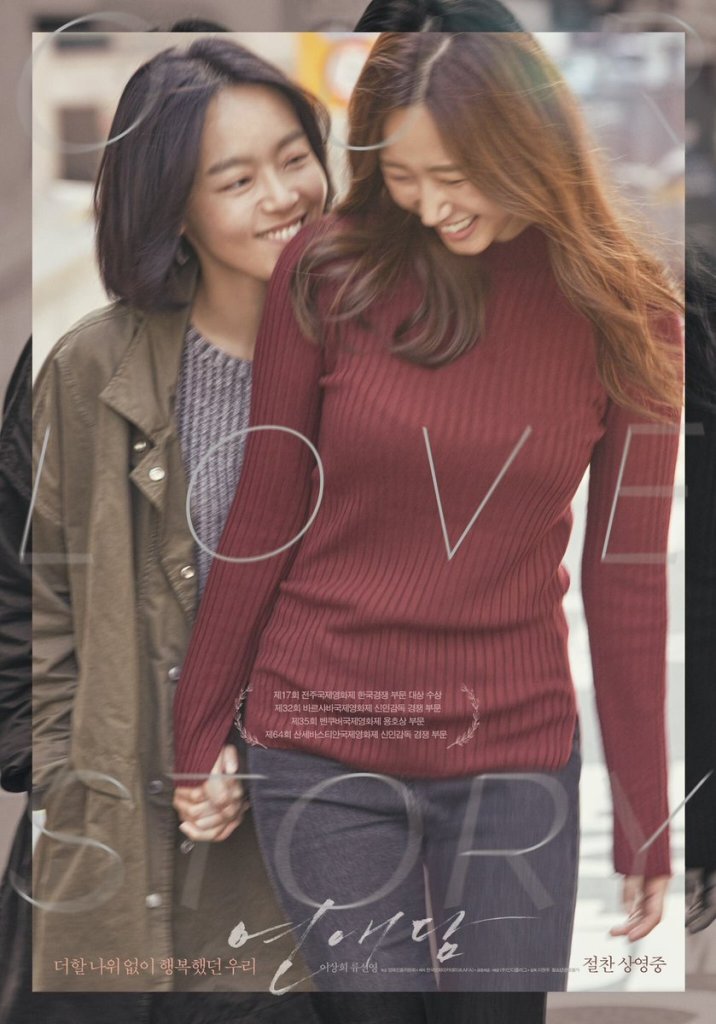
Our Love Story (연애담, Lee Hyun-ju, 2016)

cyaykwjucaav5frThe history of LGBT cinema in Korea is admittedly thin though recent years have seen an increase in big screen representation with an interest in exploring the reality rather than indulging in stereotypes. The debut feature from Lee Hyun-ju, Our Love Story (연애담, Yeonaedam), is among the first to chart the course of an ordinary romance between two women with all of the everyday drama that modern love entails. A beautiful, bittersweet tale of frustrated connection, Our Love Story is a realistic look at messy first love taking place under the snowy skies of Seoul.
Yoon-ju (Lee Sang-hee) is a busy fine arts graduate student working on her final project. Busy as she is, none of Yoon-ju’s friends can get their heads around her lack of interest in dating, but Yoon-ju is happy enough on her own and doesn’t get what all the fuss is about. Whilst perusing a local junk yard looking for interesting things for her art project, something unexpected catches her eye in the form of a young woman delivering magazines but after the woman completes her business she leaves Yoon-ju’s slightly stunned field of vision, presumably forever.

Because these things happen in a city, Yoon-ju runs into the same woman again in a convenience store where she is having trouble buying cigarettes because she’s forgotten her ID and the cashier is being pedantic about the rules. Coming to the rescue, Yoon-ju buys the cigarettes for her with her ID, which leads to the opportunity of sharing one outside. The mysterious woman is named Ji-soo (Ryu Sun-young) and works part-time at a nearby bar to which she invites Yoon-ju if she happens to fancy a drink of an evening. Yoon-ju doesn’t drink, particularly, but convinces some friends to accompany her to to Ji-soo’s bar – a plan which backfires when they drink too much and argue with each other causing a scene. The two women don’t get much of an opportunity to chat and it all seems like it might end there with Yoon-ju heading home to bed only to receive an unexpected phone call from Ji-soo inviting her over for a late night drinking session.

So begins Yoon-ju’s first romance, and Ji-soo’s 78th as she later jokes. The first night slips into the first day and before long the pair have established a happy domesticity but their original euphoria is short lived as Ji-soo is due to be moving back to her hometown to live with her recently widowed father for a while. The relationship also has adverse effects on Yoon-ju’s life as she begins to neglect her art project and lets her colleagues down by forgetting important meetings, while other events leave her questioning if Ji-soo is really as committed to Yoon-ju as Yoon-ju is to her.

After Ji-soo moves back home, the pair make sure to meet up every so often either in Ji-soo’s hometown of Incheon or in Seoul but there’s an undeniable change in their relationship aside from the distance. In the city, Ji-soo had been outgoing and unafraid but in Incheon she’s a completely different person, closed off and permanently anxious. Ji-soo’s father is a more conservative and religious type who has no idea that his daughter is gay and still expecting her to get married, preferably as soon as possible. Worried that Ji-soo “does not date” he sets her up with a family friend and she has little choice but to play along even if she’s not intending to let it get anywhere. Yoon-ju’s first visit occurs while Ji-soo’s father is away, but even so Ji-soo is uncomfortable with having her in the house. When her father turns up unexpectedly one day while Yoon-ju is there, Ji-soo describes her as “a friend” and makes a point of answering all of Yoon-ju’s questions for her in case she lets something slip.

Hurt and confused, spending time in Incheon becomes a painful experience for Yoon-ju considering the permanently jumpy Ji-soo doesn’t even want her father to know she smokes, let alone anything else he might not approve of. Earlier on the relationship, Yoon-ju made the decision to confide in an old friend from her hometown and found him broadly supportive, once he got over the surprise. Ji-soo, more experienced, warns Yoon-ju that she’ll lose friends if she isn’t careful. This Yoon-ju finds out to her cost when she decides to try talking to her roommate about her troubles with Ji-soo as even someone she felt close to and had trusted suddenly rejects her. Realising you’ve placed your trust in someone who wasn’t worthy of it is a terrible feeling, but it isn’t just familial opposition the two women will be facing if they decide to make a go of things together, even in the big city.

Post Incheon, awkwardness grows and the distance deepens prompting one to fight back and the other to retreat but eventually Ji-soo appears to make her choice in way which seems cuttingly final in its coldness. Later trying to fix what she broke, Ji-soo again goes about things in an inadvisable way, still only superficially committed and unable to fully connect on a deeper level. Ending on an ambiguous, bittersweet note which seems to offer either hope or the despairing vision of an ever repeating cycle of pain, Our Love Story is a beautifully nuanced and interestingly composed addition to the Korean indie scene finally bringing a very ordinary romance to the cinema screen in all of its everyday melodrama.


Reviewed at the 2016 London Korean Film Festival.

Clip from halfway through the film (English subtitles)

A Bride for Rip Van Winkle (リップヴァンウィンクルの花嫁, Shunji Iwai, 2016)

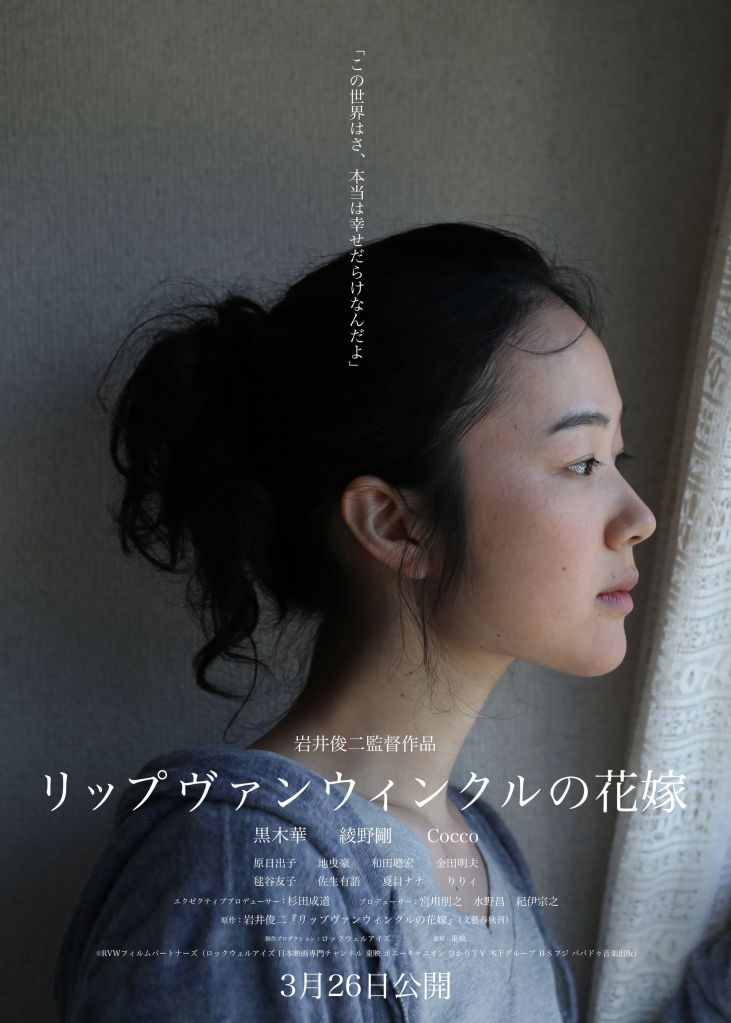
the_bride_of_rip_van_winkle“Being naked in front of people is embarrassing” says the drunken mother of a recently deceased major character in a bizarre yet pivotal scene towards the end of Shunji Iwai’s aptly titled A Bride for Rip Van Winkle (リップヴァンウィンクルの花嫁, Rip Van Winkle no Hanayome) in which the director himself wakes up from an extended cinematic slumber to discover that much is changed. This sequence, in a sense, makes plain one of the film’s essential themes – truth, and the appearance of truth, as mediated by human connection. The film’s timid heroine, Nanami (Haru Kuroki), bares all of herself online, recording each ugly thought and despairing notion before an audience of anonymous strangers, yet can barely look even those she knows well in the eye. Though Namami’s fear and insecurity are painfully obvious to all, not least to herself, she’s not alone in her fear of emotional nakedness as she discovers throughout her strange odyssey in which nothing is quite as it seems.
We first meet Nanami on an internet blind date with the man who will later become her husband. Looking lost and alone, she passively waits for her online suitor to find her in the busy city streets. Tetsuya (Go Jibiki) does indeed turn up and assume control of the situation, to which Nanami submits just as she has to everything else. Bonding over little more than their shared vocation of teaching the pair drift into a relationship and then later into a marriage, as is the natural order of things.

Though she seems happy enough, Nanami vents her frustrations in her caustic online blog. Isn’t this all just too easy? She asks herself. It’s almost like online shopping, she simply added a boyfriend to her basket and now she’s about to check out. A failure to win over Tetsuya’s mother adds to her sense of unease as does the fact she has no close friends or relatives (aside from her soon to be divorced parents) to invite to the wedding. Her decision to take the advice of an online friend and employ the shady fixer Amuro (Go Ayano) to hire a selection of professional party goers to bulk out her side of the hall will prove to be a disastrous one (though perhaps more in the short term), turning her entire life inside out.

Nanami’s essential personality trait is her passivity. Like Rip Van Winkle, she is largely asleep while things happen all around her. Though she dreamed of being a teacher, Nanami has only been able to find temporary supply roles with an agency but even this seems unlikely to last thanks to her softly spoken nature which makes classroom teaching a poor fit for her shy, attention avoidant personality. Discovered at her part time combini job by an old university friend, Nanami is embarrassed and has even been wearing a (useless but endearing) disguise in case any of her students come by despite the fact she chose a store far away from the school. Her friend now works at a hostess bar which Nanami finds a little bit shocking. That kind of unconventional way of living is not something she would contemplate, and so when offered the extremely dull but comfortable life alongside the dull but comforting Tetsuya, Nanami settles.

After Amuro spectacularly derails her non-happiness, Nanami is cast adrift which eventually leads her straight back into Amuro’s web of morally dubious activities. Taking a job as a maid at the cheap hotel she ends up in after leaving Tetsuya, Nanami also works part time as another of Amuro’s professional guests which is where she meets motivator no. 2 – Mashiro (Cocco), “actress” and all round live wire. Bonding over sad karaoke, Nanami and Mashiro later wind up working together as live in maids in a creepy, isolated mansion filled with poisonous animals. Enforced proximity leads to genuine friendship and then to more than that, but, ironically enough, Mashiro has not been entirely honest about her intentions and Nanami is soon adrift once again.

Undergoing a “fake” wedding that’s sort of real (in contrast with the “real” wedding which was sort of “fake”), at least in sentiment, Nanami looks much happier than in the extremely bizarre ceremony which bound her to Tetsuya. Nanami and Mashiro’s union was “engineered” yet mutually beneficial and ultimately genuine despite its artificial genesis. Making a last, heartbreaking speech, Mashiro attempts to explain herself and her life philosophy in a final act of nakedness. She prefers to pay for connection because, she says, the world is too full of kindness. There is so much happiness out there that it’s completely overwhelming. Sometimes there’s more truth in the lie than there is in the reality.

The resurfaced Iwai is both more cynical and more romantic than he has ever been before. He has serious things to say about constructed identities and disconnectedness, that the increasingly open nature of the anonymous online world only makes the real one seem less reliable and harder to navigate. We’ve all been wearing masks but we turned them round when we went online, and now perhaps we’re forgetting that we made them in the first place. Nanami may be adrift again at the film’s conclusion but she finds herself in a world of infinite possibilities. Emerging with more certainty and firmer sense of self, Nanami has retaken control and even if she doesn’t know where she’s going, the choice is entirely her own. Another beautifully nuanced, endlessly affecting character study from Iwai, A Bride for Rip van Winkle is a gloriously rich experience, filled with both hope and despair, but told with all the ethereal warmth and strangeness of the best of dreams.


This review refers to the 180 minute director’s cut, rather than the shorter international or four hour TV version.

Original trailer (English subtitles)

Blue (ブルー, Hiroshi Ando, 2003)

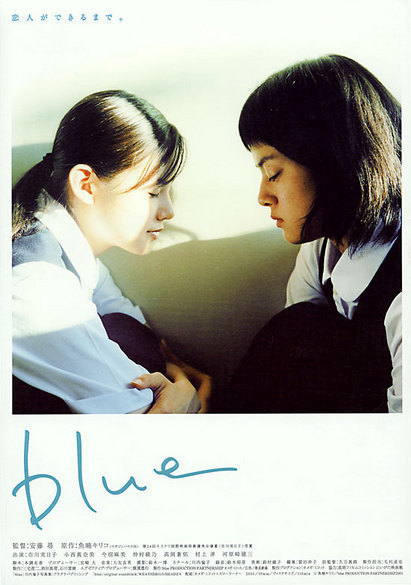
blue03Growing up is hard to do. So it is for the teenage protagonists of Hiroshi Ando’s debut mainstream feature, Blue (ブルー), adapted from the manga by Kiriko Nananan. Like Nananan’s original comic, the cinematic adaptation of Blue is refreshingly angst free in its examination of first love and the burgeoning sexuality of two lonely high school girls. Shot with a chilly stillness which echoes the emptiness of this small town existence, Blue is no nostalgic retreat into cosy teenage dreams but a cold hard look at the messiness and pain of adolescent love.
Kayako’s (Mikako Ichikawa) life changes one day as she sees a fellow pupil at her all girls school being carried into an ambulance and spirited away. Curious yet unknowing, Kayako continues with her day to day existence until she happens to catch sight of another girl from her school, Masami (Manami Konishi), on the local bus. The two become friends after Masami expresses sympathy for Kayako when their teacher humiliates her in class. Masami is repeating the year after completing a long term suspension and has been ostracised by the other girls though no one quite seems to know exactly what happened. Before long Kayako’s feelings for her new acquaintance have transcended friendship but confused and jealous of Masami’s other friends, Kayako is at a loss. Eventually revealing her true feelings she discovers they aren’t unrequited after all, but Masami’s past contains its share of troubles which threaten to place a barrier between the two girls and destroy their growing romance.

Kayako is quiet and a bit of a dreamer. She eats lunch everyday with the same three girls on the rooftop but seems to feel isolated and listless in her small town existence. Masami, by contrast, is chattier and more outgoing but much of the persona she presents to the world is a way of coping with the circumstances which led to her leaving school. Kayako is drawn to Masami because of her outward sophistication – smoking, drinking, listening to foreign music, and reading books about impressionist artists. Later it transpires that at least some of these tastes were acquired from an older man with whom Masami had had an inappropriate relationship and are both a symptom of her desire to import personality traits from others because her own identity is so ill defined, and of wanting to seem much more mature than she really is.

Whilst Kayako is introverted yet solid and growing to be confident in who she really is, Masami, by contrast, appears only half formed but making up for her lack of self esteem with bravado and cheerfulness. It is this lack of certainty which eventually threatens to drive a wedge between the pair as Masami is unable to accept the kind of intimacy that Kayako wants to offer her. Repeating that she is “nothing”, has no future, and is an entirely passive presence simply floating along on the breeze, Masami is unable to make the kind of active choice which Kayako has already made, and may never be in a position to make it entirely of her own volition. Masami is always looking to run away, talking of moving to somewhere like Tokyo with a city’s anonymity, but when it comes down to it she lacks the courage to act.

Ando shoots at a stately pace mostly using static shots and distance takes though his slow pans across empty corridors help to bring out the utter loneliness and emptiness of the girls’ lives. Similarly a mild POV effect takes over panning around school windows as Masami looks for Kayako hoping to make a mends but finds her hurt, conflicted, and unwilling to engage. The two leads each give fantastically nuanced performances despite the plainness of the script and share an intense chemistry lending weight to the emotional resonance of the film. Ando creates a melancholy atmosphere of longing punctuated by fleeting glances and accidental touches, allowing the space and time for the physical performances to come to fruition. A subtly affecting tale of a difficult, yet mutually rewarding, teenage romance Blue has its share of early feature jitters, but makes up for them with an unusual dose of realism perfectly anchored by the strong performances of its leading ladies.


The Handmaiden (아가씨, Park Chan-wook, 2016)

handmaiden.jpgPark Chan-wook has something of a track record when it comes to bending literary sources in unexpected ways – who else would have thought of adding vampires to Thérèse Raquin and actually managed to make it work? In The Handmaiden (아가씨, Agasshi), his first return to Korean filmmaking after Stoker’s foray into American Gothic, Park adapts Sarah Waters’ Fingersmith – a Dickensian tale of love and the multilayered con, and relocates it to 1930s Korea under Japanese rule.

Ambivalent attitudes to the Japanese is a key element exploited by a ruthless conman posing as “Count Fujiwara” (Ha Jung-woo) in order to seduce a lonely heiress. To complete his elaborate plan, he needs the help of pickpocket extraordinaire, Sook-hee (Kim Tae-Ri), whom he will install as a maid in the household so she can subtly sell the virtues of the dashing nobleman to the innocent flower trapped in a well of opulence.

On arriving at the curiously constructed mansion which is an elegant architectural mix of Korean, Japanese, and English country estate, Sook-hee is quite literally out of place in the upperclass environment a world away from her home in a den of petty of thieves doubling as a baby farm. Another thing she had not quite banked on was that her new mistress, Hideko (Kim Min-hee), would be quite so pretty. A serious spanner is thrown in the works as a mutual attraction builds up between the two women who, for reasons which become apparent, are being pulled in separate directions by other desires.

Park retains Waters’ tripartite structure even if he jettisons the final plot reveal for a less intricate tale of liberation and escape. Beginning with Sook-hee’s narrative he introduces us to the first layer of the con but also to Sook-hee and her down and dirty home in the criminal underworld. Chosen by the Count for her supposed lack of intellect and innocent naivety, Sook-hee is not quite at home among her family either. Both believing the promise that the babies they collect and sell in Japan will be going on to better lives and lamenting the cruelty of the whole business in wanting to mother the lot of them, Sook-hee is soft presence yet she also wants to prove herself as adept at criminality as her legendary, now deceased, mother.

It’s this essential warmth which eventually attracts Hideko’s attention. The much talked about tooth filing scene in which Sook-hee takes out a thimble to soften a lacerating sharpness in her mistress’ mouth is not just notable for the oddly erotic quality born of the obvious suggestive motion, unavoidable intimacy created by the closeness of bodies, and the growing desire of fleeting, furtive glances, but for its essential kindness. Moving into Hideko’s perspective for the second chapter, more is learned about her damaged past filled with cruelty and abuse. Orphaned and brought to Japan as a small child by her pornography obsessed uncle so that he might train her to entertain him with readings of erotic literature before he eventually marries her to inherit the family fortune, Hideko has never known anything as simple as unguarded goodness.

Caught up in a long con, the choice remains whether to blow cover and declare one’s hand or play the thing through to the end, however painful it may be. Park takes a different route than in the original novel which makes both of its heroines the victims of someone else’s avaricious plot of revenge against the cruelty of an unequal world, eventually reinforcing their bond by a shared rejection of their victimhood, but even when their passions eventually erupt the lovemaking begins as a another “con” where Sook-hee takes on the role of the Count, “educating” the assumedly “innocent” Hideko in the ways of desire.

Trapped within an oppressive gilded cage of a prison, Hideko has become the embodiment of desire for her cruel and eccentric uncle and the groups of men he invites to listen to her read erotic literature as if reciting a classical play. Complete with sideshows of sex dolls and theatrical scenery, Hideko is forced to act out the scenes from the books as an actress on the stage for an audience rapt in silence. Unable to escape alone, Hideko is offered new hope by Sook-hee’s straightforward outrage which allows the pair to destroy or repurpose the instruments of their oppression for their own pleasure. This is, in essence, their form of revenge in which they simply remove themselves from an abusive environment leaving the men behind to wonder at what’s gone wrong and later to destroy themselves without any additional help.

Filled with a gothic sense of impossible desires and uncertain judgements, The Handmaiden is unafraid of the genre’s melodramatic roots but is all the better for it. Beautifully photographed, this opulent world of swishing ball gowns and gloved hands is undercut by the ugliness of quisling collaborator Kouzuki and his basement of horrors. Erotically charged but ultimately driven by love, The Handmaiden is another unconventionally romantic effort from Park albeit one coloured by his characteristic sense of gothic darkness.


Reviewed at 2016 London East Asia Film Festival.

Original trailer (English subtitles)

Bad Film (Sion Sono, 1995/2012)

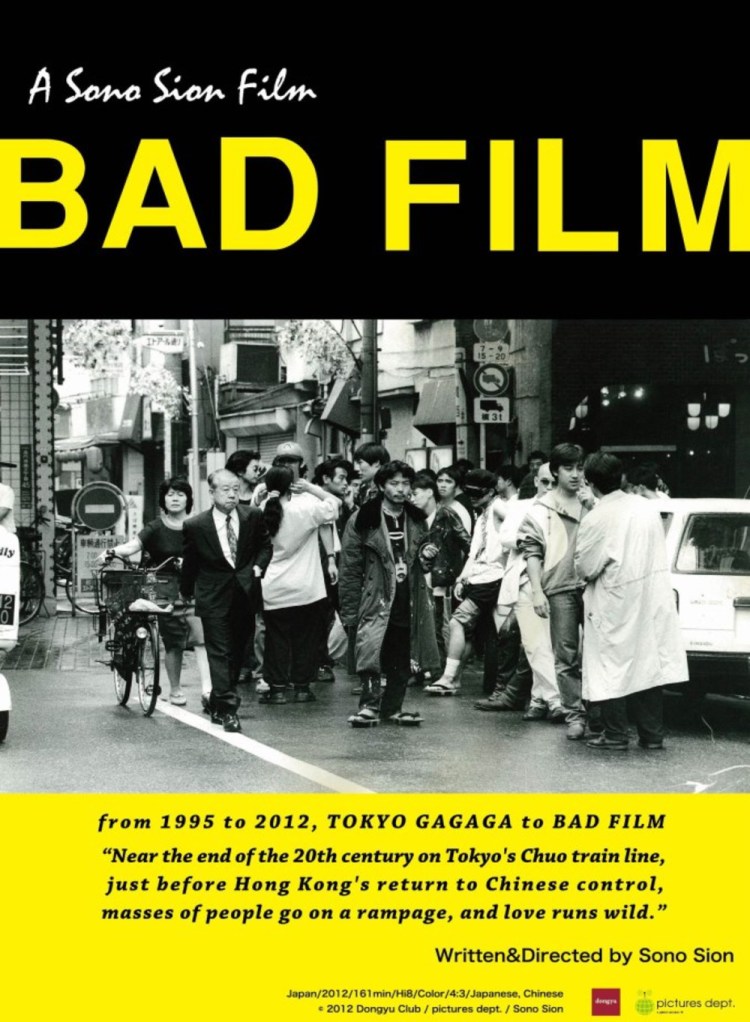
Bad_FilmThe recently prolific Sion Sono actually has a more sporadic film career dating back to the early 1980s though most would judge his real breakthrough to 2001’s Suicide Club. Back in the ‘90s Sono was most active as the leader of anarchic performance art troupe Tokyo Gagaga. Taking inspiration from the avant-garde theatre scene of the 1960s, Tokyo Gagaga took to the streets for flag waving protests and impressive, guerrilla stunts. Bad Film is the result of one of their projects – shot intermittently over a year using the then newly accessible Hi8 video rather the traditionally underground 8 or 16mm, Bad Film is near future set street story centring on gang warfare between the Chinese community and xenophobic Japanese petty gangsters with a side line in shifiting sexual politics.

Momentous things were at play in 1997, not least amongst them the looming handover of Hong Kong when it would cease to operate under British rule and embark upon the “one country, two systems” era with ultimate authority passing to Beijing. Fascism has bloomed in Tokyo with intense anti-foreigner activity targeting all non-Japanese including those from other areas of Asia. By 1997, the yakuza have infiltrated the fascist infrastructure and amped up gang violence between the Chinese community and the ultra-nationalist Japanese.

Fast forward a little and the Chinese and Japanese groups have managed to iron out some of their differences largely thanks to a different kind of divide which ultimately proves a unifying factor – many of the men and women on either side are gay and are sick of the prevailing “hetero hegemony”. Eventually the gay contingent manages to assume control of their respective factions and enact the gay alliance. This is very successful and brings peace and love to the city but unfortunately two members of opposing factions just can’t get over their cultural differences and are prepared to go to great lengths to restart the Japan/China gang war.

Sono shot the entirety of the movie back in 1995 ending up with around 150 hours before abandoning the project for financial reasons. In 2012 Sono re-edited his existing footage into something resembling a feature length film. The project was designed to make use of the entire Tokyo Gagaga company (over 2000 people took part) and was shot guerrilla style with no permits or warnings (you can see at least one face blurred out during their city centre protests). This goes someway to explaining why the narrative diverges unexpectedly at random junctures and the voiceover is there largely to corral the footage into some kind of coherent structure aided by the occasional on screen text. It’s a “Bad Film” in that it’s not quite a film at all but an activist’s poetic documentation of his artistic street warfare even including going so far as to include a justification for the visibility of the cameraman.

Hi8 was what it was – a convenient low-res format for the domestic market. Bad Film is not a pretty film, it looks rough and low rent though that often works in its favour and the film takes on a considered aesthetic that is never concerned with trying to be more than it is. Consequently, it makes the most of its roughness to bring out the grungy, time capsule-esque atmosphere that it’s looking looking for. Sono also experiments with fish eye lenses, odd angles and hand held multi-camera chaos to bring the streets to life. His world is weird, and it’s filmed weird, but it always makes sense in terms of its own particular look.

The action turns on the unexpected love story between two women – one Japanese, and one Chinese, and despite all of the resulting chaos and carnage, the final image we’re left with is one of love. The forces of destruction are those who cannot abandon their hate to live in harmony, subverting this very force for peace and using it to wreak vengeance. Sono launches into absurd mode at full throttle and, as per usual, it’s hard to tell when he’s in earnest and when just being facetious. Bad Film is, loosely speaking, an anti-prejudice themed performance art piece documenting the passion and commitment of the Tokyo Gagaga collective. An interesting case of a belated “director’s cut” Bad Film is necessarily an imperfect beast, but perhaps all the more interesting for it.


Opening sequence (no subtitles)

Harmony (ハーモニー, Michael Arias & Takashi Nakamura, 2015)

Harmony PosterHarmony – the word itself sounds peaceful. A coalescence of sympathetic sounds, the feeling of wholeness and happiness. However, if given the choice, would you like to live in a world of peace and plenty in which your body is almost government property and your personal freedom is limited in favour of ensuring the survival of the species, or would you rather take your chances with the world as it is complete with its violence, sadness and pain if it meant you could be free to live in which ever way you see fit? Michael Arias’ adaptation of the Project Itoh novel addresses just this question in all its complexity as utopia turns out to have a heavy entrance fee.

Fifty years after a devastating nuclear war humanity has recovered itself and the elite now live in spotlessly clean, futuristic cities. A healthcare monitoring system administered through nanotechnology ensures proper adherence to health guidelines including sending alerts about unhealthy food and heart rate fluctuations making it almost impossible to cheat the system even if you wanted to. Everyone also has “augmentations” including a heads up display in the eyes which flags all the aforementioned info as well as a break down on your fellow humans which also includes their “social aptitude quotient” based on how well they treat others and how good they are at following the rules.

For some, all of this nannying is nothing other than an infringement on their personal freedom. After all, shouldn’t you have the right to eat what you want, drink, smoke, take risks, if that is your personal choice? Camus said that the only way to deal with an unfree world is to become so absolutely free that your very existence becomes an act of rebellion. Our heroine, Tuan, has opted for a similar solution as she finds herself working for enemy as a Helix Inspector allowed to life on the margins of society where the the rules are more easily breached. She flaunts the regulations and cares little for anything or anyone. Once, long ago, she cared deeply for a girl in high school who was so opposed to the constant invasions of the modern world that she chose the only way out that was available to her – suicide. The pair intended to die together but Tuan alone survived.

Tuan is then recalled to Tokyo following an incident of mass suicides only for another high school friend to kill herself in a violent and bloody way right in front of her. Tuan is about to discover that she herself is at the centre a complicated conspiracy which intends either to save or to destroy humanity depending on your point of view.

Harmony is an extremely complex dissection of the human need for self protection from threats real or imagined. Following a large scale humanitarian disaster, fear rules the day and humans must be protected from their bad decisions by gentle reinforcement but isn’t the right to slowly destroy yourself, should you choose to do so, exactly what wars are fought for? Is it worth surrendering such basic rights to live in a world without disease or hunger (for the wealthy nations, at least) or does this level of being looked after rob humanity of the thing that defines it? The “Harmony” of the title is a medical treatment designed to spread peace and love throughout the land, yet it eventually robs the patient of a self-aware soul leaving them without the individual desires and emotions which cause human conflict. What should the future look like – cold, sterile but long and peaceful or shorter but filled with all the richness of human passions?

Arias had been working on a live action adaptation of Harmony which apparently fell though and though asked to helm Genocidal Organ managed to get them to allow him to switch back to the anime version instead. Here he’s billed as a co-director along side Takashi Nakamura and it seems there was more than a little conflict involved in the process. In any case, the finished product is vastly different in approach from Arias’ original concept though sticks fairly close to Itoh’s novel.

Made on a very tight budget and in an extremely short time, Harmony makes the best of its difficult production circumstances with a complex mix of CG and hand drawn animation styles. The production design is prescient and interesting as it presents its utopic city as a serene place of muted colours and stress free round buildings. Even the monolith presented in the framing sequence looks exactly like what a traditional Japanese tombstone would look like if it was designed by Apple. However, the natural pops right out of the screen with its vibrant colours such as in an early scene where a field of sunflowers looks almost like stop motion in its highly textured 3D CGI. Though occasionally falling back on static conversations, the composition and directing style is also interesting with unsettling circular shots, frequent dissolves and montages, and even a light jazzy soundtrack which definitely lends to the Lynchian atmosphere.

Harmony is certainly a complex film and arguably succeeds much more because of its nuanced source material than the production itself, yet like the best sci-fi it does offer an in-depth philosophical discussion along side exciting acting scenes and moving character drama. Unfortunately, the film does fall into the trap of ponderous monologuing at times and is sometimes guilty of stilted, expository dialogue but largely manages to maintain goodwill even as it does so. In many ways imperfect, Harmony is an undoubtedly ambitious project and one of the better science fiction themed anime movies to emerge in recent years.


Reviewed as part of the “biennial” Anime Weekend at BFI Southbank. Harmony has also been licensed for UK distribution by All the Anime (and Funimation in the US). Project Itoh’s original Harmony novel is also available in English translation (by Alexander O. Smith) published by Haikasoru.

Unsubbed trailer:

Manji (卍, Yasuzo Masumura, 1964)

8127Ur2xnXL._SL1500_For arguably his most famous film, 1964’s Manji (卍), Masumura returns to the themes of destructive sexual obsession which recur throughout his career but this time from the slightly more unusual angle of a same sex “romance”. However, this is less a tale of lesbian true love frustrated by social mores than it is a critique of all romantic entanglements which are shown to be intensely selfish and easily manipulated. Based on Tanizaki’s 1930s novel Quicksand, Manji is the tale of four would be lovers who each vie to be sun in this complicated, desire filled galaxy.

The story begins with a framing sequence in which Sonoko sits down with a male mentor to recount her sorry tale from some later vantage point. As she would have it, she was an unfilled, unhappy housewife taking a series of art classes when the principal of the college noticed that the face in her sketch of the Goddess of Mercy doesn’t look much like the model. Her technique is good though so he asks her why she gave her drawing a different face and who it might belong to. She tells him it’s merely an ideal and isn’t based on any real person. However, it does look quite like another, very beautiful, pupil at the school – Mitsuko, and a rumour quickly starts that the two women are lovers. Though barely knowing each other before, the pair laugh it off and decide to become friends anyway. Gradually, something more than friendship begins to grow but not everyone is being honest with each other and the added complication of the men in their lives is set to make the road even harder for Sonoko and Mitsuko’s love affair than it might otherwise be.

Sonoko narrates things from her perspective, though you get the feeling she may not be a completely reliable narrator. She seems shy, innocent, wounded though she speaks of her great tragedy with ease and a surprising frankness considering its sensitivity. The object of her obsession, Mitsuko, by contrast plays the innocent but also seems to know perfectly well what she’s doing. Manipulative in the extreme she plays each of the other three lovers off against each other in an attempt to become the centrifugal force in each of their lives. All things to all people, Mitsuko doesn’t seem to know what she wants, other than to be adored by anyone that’s around to adore her.

At the beginning of the film Mitsuko reveals that she’d been involved in marriage negotiations with a young man from a high profile family and she believes the rumours at the art school were started deliberately to try and disrupt her matrimonial ambitions. Sure enough that liaison falls through but she neglected to mention that she also has another fiancee, the slimy Watanuki, that she longs to be rid of but can’t seem to shake off. After Sonoko finds out about Watanuki, Mitsuko feigns not only a pregnancy but a bloody miscarriage to get her female lover to return to her. However, Watanuki fights back by trying to form a bilateral alliance with Sonoko to ensure Mitsuko doesn’t suddenly take up with a third party – he even gets her to sign a contract saying that she’ll help get Mitsuko to marry him and in return he won’t interfere with the two women’s relationship even once they’re married.

Sonoko’s husband completes the quartet, becoming increasingly frustrated by his wife’s infatuation with another woman, her coldness towards him and her growing boldness. Sonoko labels Kotaro cold and passionless and claims never to have enjoyed any of their married life together. She’s also been taking illegal birth control medication to avoid having children with him. Trying to be an understanding husband, Kotaro ends up tangled in a web of desire after being seduced by Mitsuko. For a time, the three form an unlikely romantic trio (with Watanuki hanging around disdainfully on the edges) though even between the three of them petty jealousies sap their strength and keep them all guessing as to the exact motives of the other pair.

Just like the four pronged arms of the manji itself, our four lovers lie in a tangled and twisted crisscross of desire, each trying to eclipse the other in the eyes of the radiant Mitsuko. Anything but merciful herself, Mitsuko adeptly plays on the insecurities of the others to keep them all dancing along to her tune. This is not a story of true love, but of misused desires, almost of the inverse of love where lust becomes a weapon of control and self satisfaction. Even at the end, Sonoko can’t decide if she’s been saved or betrayed and if what happened to her was love or a kind of madness. Whatever it was, each has paid a high price for their selfish pursuit of romance or dominance or whatever Mitsuko really represents for them (clearly not the reincarnation of the Goddess of Mercy after all). Years ahead of its time and still just as dark and fascinating as it always was, Manji is a sadly universal tale of the destructive power of love that plays almost like a ghost like story and is likely to haunt the memory long after the screen falls dark.


Manji is available with English subtitles on R2 UK DVD from Yume Pictures.

Original trailer (no subtitles)

Pepi, Luci, Bom… + Q&A with Alaska

Pedro Almodóvar’s debut film may not be as polished as his later work, in fact it may be a bit messy and very rough around the edges but the trademark energy, wit, and charm are all here, and in abundance. Pepi (Maura), is listening to some music and playing with a sticker book when a policeman calls because he’s been noticing her funny looking plants. Fearing prosecution Pepi offers him other compensations, but the policeman takes things further than she was thinking, raping her and ‘stealing’ the virginity which she’d been planning to sell! Seeking revenge, Pepi enlists the help of her friends in a punk group, including Bom (Alaska), to beat him up, but it doesn’t quite go to plan. Later Pepi runs into the rapist policeman’s wife, Luci, (Silva) and convinces her to give her knitting lessons, where she finds out that Luci is a masochist upset that her husband treats her like his mother. These are our three crazy girls trying to make it in La Movida. The film is extremely funny, though dipping a little into poor taste at times which may spoil it a little for some. Even if it’s not an especially well made film, and its lack of budget and complicated production circumstances are very much in evidence it’s still a lot of fun and it’s very interesting for fans of Almodóvar’s more recent work to look at where it all started.

After the film the BFI brought out the actress and singer Alaska (Bom) to talk and answer a few questions about her work on this film. She began by commenting on the film’s genesis, that she was offered the part because she was friends with some artists that were also friends of Almodóvar’s and had read the script and recommended her. As there was no money at all to make the film filming would take place when enough money had been raised to buy the negative, consequently the film took a few years to actually complete filming here and there when possible. Other than Carmen Maura and Felix Rotaeta most of the cast were not professional actors but friends and other people from that particular underground scene at the time. Someone from the audience asked if she’d influenced her character seeing as there was a superficial similarity there with Alaska’s also being in a punk group, to which she replied no. She provided her own clothes/look etc seeing as there wasn’t a costume designer or stylist or even any money for costumes but the character was already 100% scripted before she got the part and Almodóvar was very strict about sticking to his script and did not allow any deviations from it whatever. However she did mention that the seen with the postman was originally intended to just be ‘hello’ but that the actor decided to go for it, much to the consternation of the producer because they only had the right amount of film for what was already planned out, but Almodóvar liked it so it worked out in that instance. A few questions also raised the question of how Alaska felt at the time regarding the changes in Spanish Society, whether she felt herself to be living in momentous times, she replied that being only fifteen or so at the time she just didn’t really react to it in that way. She felt sure that other people did, but being so young she was just really living her life. Someone then asked how she felt about Spanish society at the moment and she answered that she was old enough now to see that each generation criticises the next one for failing to react enough but perhaps it was just a case of times moving on and general apathy. Another questions asked if the film was representative of the youth of Spain during La Movida but she she pointed out that no, this was a definite minority subscene of people that were seen as ‘weird’ and that maybe the film was adopted by youth culture a bit later but at that moment didn’t really reflect it at the time of making. The question of reviews and reaction to the film was also brought up and it was pointed out that the film was more or less panned everywhere, there was not a good reaction anywhere. The film was screened at a couple of festivals where it received an adverse reaction particularly from feminist critics. One of the last questions asked for clarification on the film’s message and purpose, which in Alaska’s opinion (one that she was sure Almodóvar would share) were nil. She felt that if there was a message or purpose it was that there wasn’t one, and if anything simply a statement of intent – we are here and this is who we are, this is how we choose to live. What better message could there possibly be?