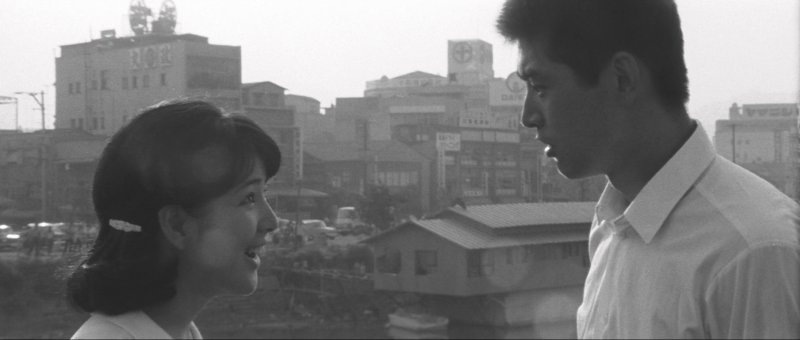
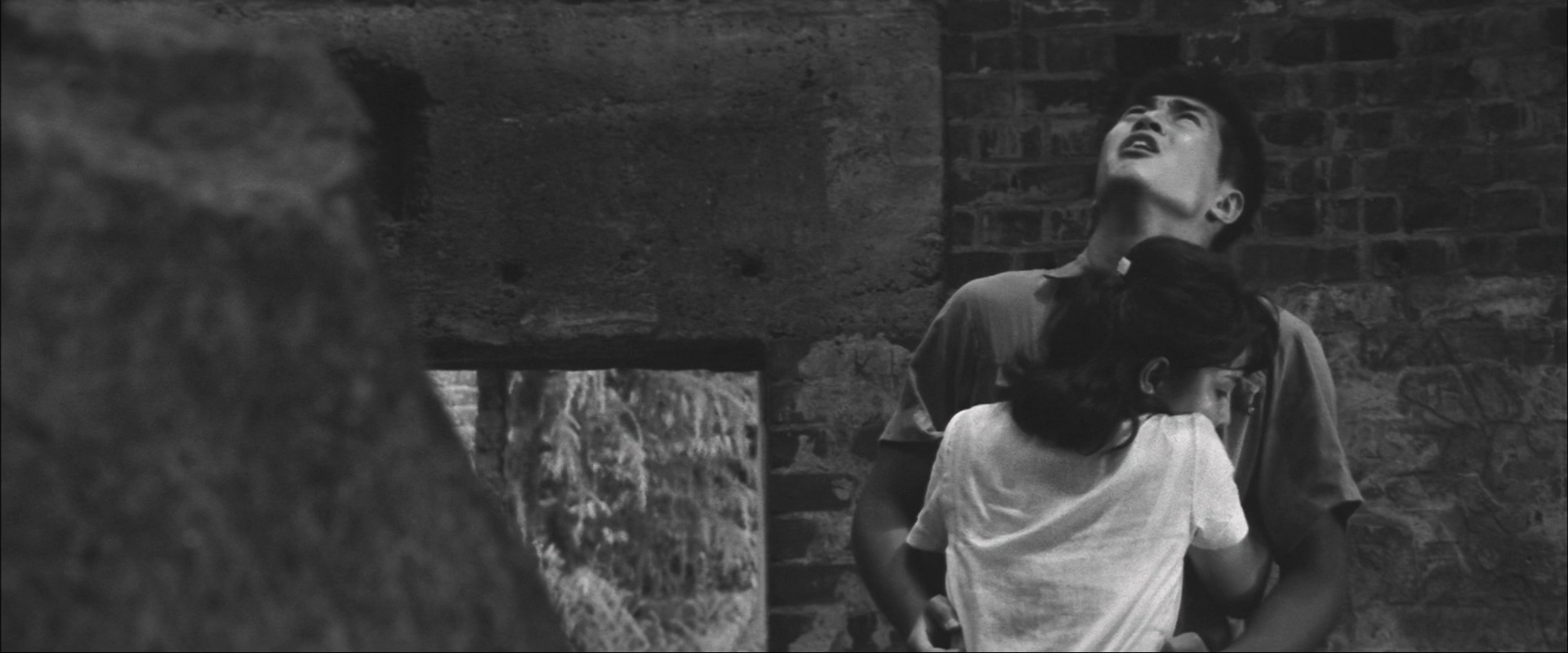
Sayuri Yoshinaga was the top female star at Nikkatsu in the mid-1960s. Together with her regular co-star Mitsuo Hamada, she starred in a series of hit youth romances such as The Mud-Spattered Pure Heart, The Sound of Waves, and Gazing at Love and Death which was Nikkatsu’s biggest box office success at the time. The Heart of Hiroshima (愛と死の記録, Ai to Shi no Kiroku) was intended as the latest in the series, but Mitsuo Hamada was attacked by a drunk customer at a bar shortly before filming after which he needed surgery to save his eyesight. Normally, the film would be postponed, but Nikkatsu was having financial difficulties at the time and refused to wait despite pleas from Yoshinaga and even from the actor who replaced him, Tetsuya Watari, who was a good friend of his.
At the same time, Yoshinaga was now 21 years old and uncertain how long she could convincingly go on performing in Nikkatsu’s typical teen dramas. The studio was also worried about the possibility of losing their top star if she decided to move into more serious dramatic roles while they did not believe they had a suitable replacement. They were currently on bad terms with Ruriko Asaoka who ended her exclusive contract that year and moved to Ishihara Pro, and were worried that their other popular actresses such as Chieko Matsubara weren’t ready to take on that kind of responsibility. To try to convince Yoshinaga that the film would be more artistic in nature they hired New Wave director Koreyoshi Kurahara rather than studio stalwarts like Buichi Saito who’d directed Gazing at Love Death, but when she again tried to refuse insisting they wait for Hamada, they forced her hand by simply beginning to shoot the film on location in Hiroshima without her. Casting Tetsuya Watari may have also been an attempt to shake up the franchise as at that point he was known more for action and hadn’t really played this kind of very intense, romantic role before.
Though it follows a familiar pattern in exploring a doomed romance between a boy and a girl whose pure love is obstructed by social division, the film does deal with some quite controversial themes in touching on the discrimination faced by those who were affected by the atomic bomb. Yukio (Tetsuya Watari) lost his whole family in the blast and was taken in by Mr Iwai (Asao Sano) after being released from a long-term hospital stay. He’s doing well working at Mr Iwai’s print shop and has no current health worries when he has a meet cute with Kazue (Sayuri Yoshinaga) knocking into her on his bike and smashing some records she was carrying which he insists he compensate her for, though he doesn’t know she works in a record shop so it doesn’t really matter. After a comical misunderstanding in which Yukio mistakenly thinks Kazue is dating his friend, and she thinks he’s a creep who’s coming on to her while dating another girl from the shop, they fall in love and want to get married.
However, Yukio’s symptoms start to resurface and he asks himself if he really has a right to start a romantic relationship and get married, especially as there’s a risk any children he may have could be born with genetic abnormalities. Because of the stigma directed towards those who were affected by radiation from the bomb, he feels he can’t explain any of this to Kazue and continues to blow hot and cold, while she too is close to a young woman (Izumi Ashikawa) who seems to have had a romantic past with her brother but once tried to take her own life because she has a large radiation scar on her face. She has since resigned herself to living for her parents, suggesting that she will not marry. When Yukio eventually has to tell Kazue, he does it inside the dome at the Hiroshima Peace Memorial Park where she, of course, says it doesn’t matter and is only hurt and upset that he suggested they break their engagement.
The underlying suggestion is that those who were affected by the atomic bomb are being denied love by an unforgiving society that has avoided fully processing its traumatic past. Though it’s strongly suggested to her that Yukio will not survive his leukaemia, Kazue remains devoted to nursing to him but is also placed into an impossible position. She tells Yukio that she is already his wife and will stay with him, but is persuaded to leave by her mother and sister-in-law who tell her it’s “improper” for her to be with him overnight in the hospital despite the fact he’s in a communal ward with several other people there all the time as well as the medical staff. Her friend advises her to leave permanently, but then also calls her heartless knowing Yukio has no one else when Kazue begins to waver and suggests he may give in to the pressure given the emotional toll the whole experience is already taking on her. Nevertheless, she never really gives up on Yukio and is ultimately unable to reconcile herself to a world in which he would become “a man that no one could love”. The film ends on a rather bleak and ghostly note as a group of school children walk past the dome, suggesting that to some these comparatively recent events have already become history rather than a living memory and lingering trauma hanging over a rapidly changing society.


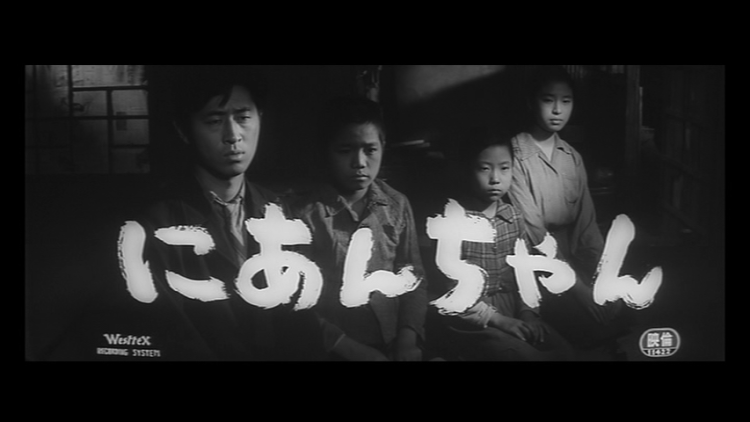 Like most directors of his era, Shohei Imamura began his career in the studio system as a trainee with Shochiku where he also worked as an AD to Yasujiro Ozu on some of his most well known pictures. Ozu’s approach, however, could not be further from Imamura’s in its insistence on order and precision. Finding much more in common with another Shochiku director, Yuzo Kawashima, well known for working class satires, Imamura jumped ship to the newly reformed Nikkatsu where he continued his training until helming his first three pictures in 1958 (Stolen Desire, Nishiginza Station, and Endless Desire). My Second Brother (にあんちゃん, Nianchan), which he directed in 1959, was, like the previous three films, a studio assignment rather than a personal project but is nevertheless an interesting one as it united many of Imamura’s subsequent ongoing concerns.
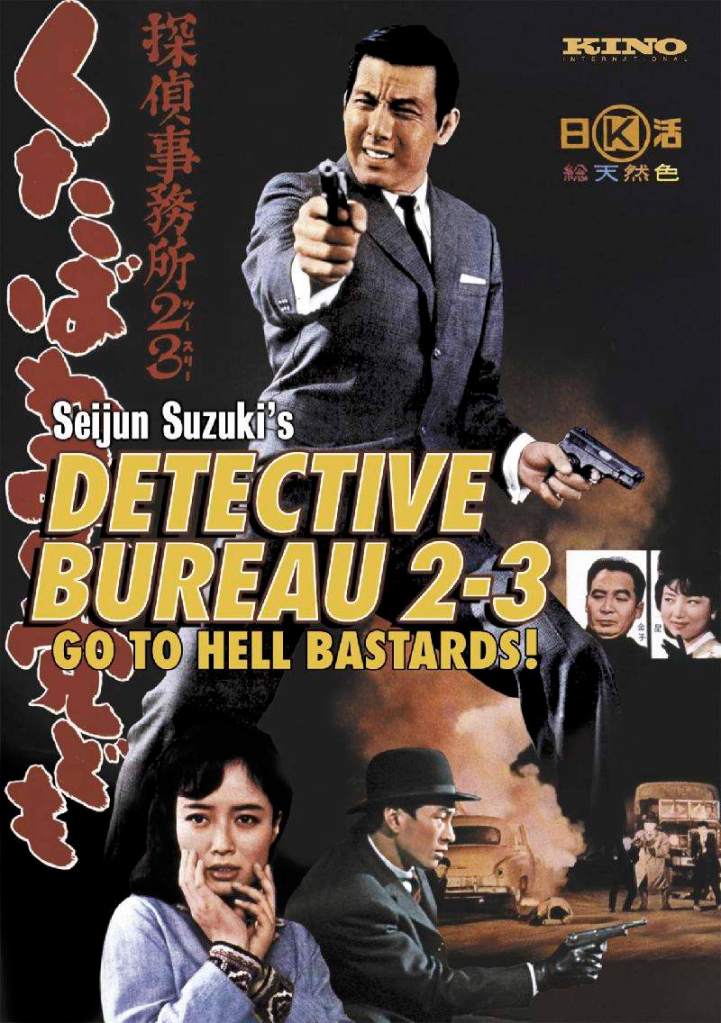 Before Seijun Suzuki pushed his luck too far with the genre classic
  Where there’s danger, there’s money! Or, maybe just danger, who knows but whatever it is, it certainly doesn’t lack for excitement. Ko Nakahira is best known for his first feature, Crazed Fruit, the youthful romantic drama ending in speed boat murder which ushered in the Sun Tribe era. Though he later tried to make a return to more artistic efforts, it’s Nakahira’s freewheeling Nikkatsu crime movies that have continued to capture the hearts of audience members. Danger Pays (AKA Danger Paws, 危いことなら銭になる, Yabai Koto Nara Zeni ni Naru) is among the best of them with its cartoon-like, absurd crime caper world filled with bumbling crooks and ridiculous setups.
 Windows on Worlds