The Sands of Kurobe (黒部の太陽, Kei Kumai, 1968)

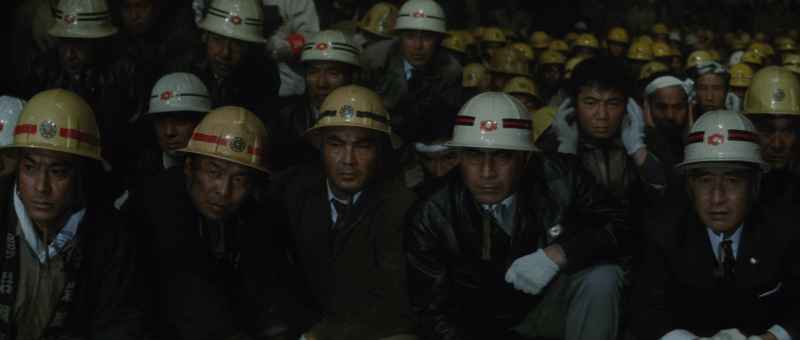
Kei Kumai’s three-hour epic of human engineering The Sands of Kurobe (黒部の太陽, Kurobe no Taiyo) opens with a titlecard to the effect that the film testifies to the courage of the Japanese people who brought the nation back to life after the war. Partly produced by Kansai Electric Power along with the production agencies of stars Toshiro Mifune and Yujiro Ishihara, the film is therefore somewhat conflicted, part bombastic celebration of Japanese engineering skill and ambivalent critique of the wilful decision to place success above all else including the welfare and safety of ordinary workers.

This critique is most evident to the flashbacks to the construction of Kuro 3 in 1938 which as many point out was conducted by the military under brutal and primitive conditions. The construction of the new Kurobe hydroelectric dam, by contrast, is a much more modern, enlightened affair in which workers have proper equipment and are not simply hacking at rocks with pickaxes wearing only a vest. But then as the conflicted Takeshi (Yujiro Ishihara) points out, it’s all effectively the same. Just because no one is pointing a gun at their heads, it doesn’t mean the men actually building the dam aren’t being exploited rather simply pressured by a vague notion of national good that they should be ready to lay down their lives. Could it be that “prosperity” is worse thing to die for than “patriotism”, especially when it appears as if your employer cares little for your physical wealth and economic wellbeing simply pledging that they will support the families of men killed during the dam’s construction. 

That there will be deaths seems inevitable. The man placed in charge of building a tunnel through the mountain, Kitagawa (Toshiro Mifune), is haunted by the vision of a man falling from a cliff that he witnessed when they first hiked to the dam site. He originally described the project as “crazy” and wanted to resign but was convinced to stay on. Kitagawa is himself fond of insisting on safety first where others are minded to cut corners, but also troubled by domestic issues in the film’s sometimes insensitive use of his daughter’s terminal leukaemia as a mirror for the dam project in considering what is and isn’t possible through human endeavour. The suggestion is that Kitagawa wants to believe the miracle of the dam is possible because needs to keep believing in a scientific miracle that can save his daughter, though obviously even if it is ultimately possible to build this dam that’s designed to fuel the post-war rocket to economic prosperity there are limits and unfortunately decades later we have still not found a cure for cancer though treatment may be more effective. 

Takeshi meanwhile has a similar battle with his hard-nosed father whose devotion to the dam project he describes almost like an addiction, suggesting that he values nothing outside of tunnelling and is willing to sacrifice everything in its name including the lives of himself and others. A flashback to to 1938 reveals that he asked his own teenage son to place dynamite and inadvertently caused his death though lax safety procedures which is the understandable reason why his wife eventually left him taking Takeshi with her. But the strange thing is for all his original opposition, Takeshi too is later captivated by the immensity of the challenge if also wary that the workers are falling victim to the same sickness as his father and are still being exploited by those like him who expect them to offer up their lives while paying them a pittance and complaining when the project does not proceed along their schedule. 

The almost nationalistic, bombastic quality of the film seems at odds with some of Kumai’s previous work save the discussion of the building of the 1938 tunnel though this largely serves as a contrast to imply that this time is different because they’re doing it for love of country rather the forced patriotism of the militarist past. Kitagawa justifies himself that if they don’t build the dam, economic prosperity will stall, companies will go bust, and people will lose their jobs but it seems somewhat hollow in the knowledge many men are certain to die while building this dam. Kumai undercuts the bombast with a series of scenes shot like a disaster movie in which supports collapse and the tunnel floods, or men are hit by falling rocks, eventually closing on an ironic Soviet-style statue dedicated to the labour of the workers that seems to question the immense loss of life along with the destruction of the natural beauty of Mount Kurobe but cannot in the end fully reconcile himself, torn between a celebration of human endeavour and its equally human costs. 


Original trailer (no subtitles)
The Phoenix (火の鳥, Kon Ichikawa, 1978)

The people of early Japan contemplate different visions of immortality in Kon Ichikawa’s sprawling adaptation of the first chapter in Osamu Tezuka’s manga series, The Phoenix (火の鳥, Hi no Tori). Featuring a mix of animation and live action, the film takes place in an ancient, pre-modern Japan in which just about everyone chases the mysterious fire bird in belief that drinking its blood will confer eternal life. They each want it for different reasons, some more to stop someone else getting it than for themselves but all discover that there are other ways of living on than the strictly literal. 

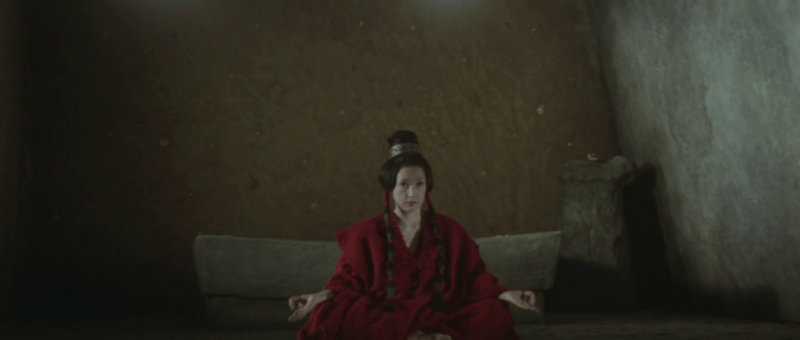
Broadly speaking the film takes place during the era of possibly mythical sorceress queen Himiko (Mieko Takamine) who rules over the nation known as Yamatai which is the name given to a kingdom in Japan in ancient Chinese sources. Himiko wants the phoenix because she fears that her power is founded on a youth and beauty which has begun to fade while the people are beginning to lose faith in her magic, not least because her rule is oppressive and authoritarian. She also fears that should the Chinese emperor drink the phoenix blood first, they will forever be under his yoke yet the seal that confers her rule was in fact given by him so perhaps they are already. Her brother, Susano (Toru Emori) whom she also fears may usurp her, enlists famed hunter Yumihiko (Masao Kusakari) from the state of Matsuro to help them capture the phoenix seeing as the two nations have some kind of treaty. Yumihiko says he doesn’t really care about that, but ends up helping anyway.

In any case, Matsuro is soon overrun in a surprise attack by warlord Jingi (Tatsuya Nakadai) from Takamagahara who is set on colonisation, which is in its way another bid for “immortality” if culturally rather than literally. After all, he claims “I will implant our civilisation in these lands” before explaining that “not even the greatest kings live forever” but history will. Meanwhile, Yamatai doctor Guzuri (Ryuzo Hayashi) is washed up on the shores of remote kingdom Kumaso where Uraji (Masaya Oki) is hunting the phoenix in the hope of saving his seriously ill wife Hinaku (Reiko Ohara). Uraji is soon burnt to a crisp by the Phoenix’s light, but Guzuri is able to save Hinaku using “modern” medicine, that is by applying “blue mould” which as the onscreen text explains contains penicillin. Perhaps feeding someone mould doesn’t sound much more scientific than the bizarre folk medicine proposed by the witchdoctor which involves rubbing the severed heads of cats and ravens together and putting fish bones on the patient’s head while burning their buttocks, but it works which is not exactly a means of “immortality” but does promise the ability of temporarily overcoming death without the Pheonix’s help. 

But medicine can’t help you with an invasion, and when the Yamatai suddenly turn up and raze the village to get better access to the phoenix after realising it lives in a nearby volcano only Hinaku and her brother Nagi (Toshinori Omi) survive. Hinaku reluctantly remains with Guzuri and vows to rebuild her kingdom through childbirth vowing that she will enable the survival of Kumaso by passing her culture on through successive generations. Uzume (Kaoru Yumi), a dancer from Matsuro, later says something similar to Jingi in reminding him that “women have their own weapons” and he will “never be able to destroy life” as an abstract concept. There might be something a little uncomfortable in the implication that the phoenix is an allegory for childbirth in suggesting that one body is born in the ashes of another, but it is in the end the continuity of a lifecycle which wins out as the natural order of things. In the film’s concluding moments, the son of Hinaku and Guzuri in a sense experiences a kind of rebirth as, guided by the phoenix, he climbs out of the cave in which he has lived all his life and gazes at the vast expanses of a new world all around him. 

Ichikawa originally trained as an animator and includes several animated sequences throughout the film from cartoonish special effects when an elderly courtier bangs his head to a trio of foxes dancing to pink lady. His visual design is also heavily influenced by Tezuka’s manga with the young boy Nagi in particular striking Tezuka-esque poses and otherwise resembling Astroboy who does in fact make a surprise appearance in a brief animated sequence in which Nagi is kicked by a horse. Similarly, the conflicted general Saruta (Tomisaburo Wakayama) later gains a ridiculous Tezuka-style nose after being locked in a room filled with wasps, and Ichikawa’s vistas sometime echo the centrefold of a manga with the heroes reduced to tiny figures dwarfed by the majesty of the landscape. Even so, a rain-soaked battle pays ironic homage to Seven Samurai, while Ichikawa otherwise keeps violence to a minimum. The heads are chopped off horses and fall like cushions, entirely bloodlessly, but there is also a scene of implied attempted rape which may be out of keeping with the otherwise family-friendly approach. Despite the sense of defeat which may colour some of the closing scenes, the film ends on a note of optimistic wonder in a new journey for humanity emerging from scenes of desolation towards a bright new world. 


Here Because of You (君たちがいて僕がいた, Ryuichi Takamori, 1964)

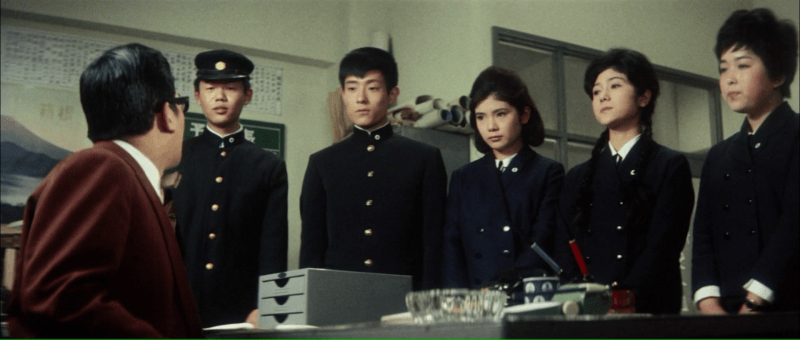
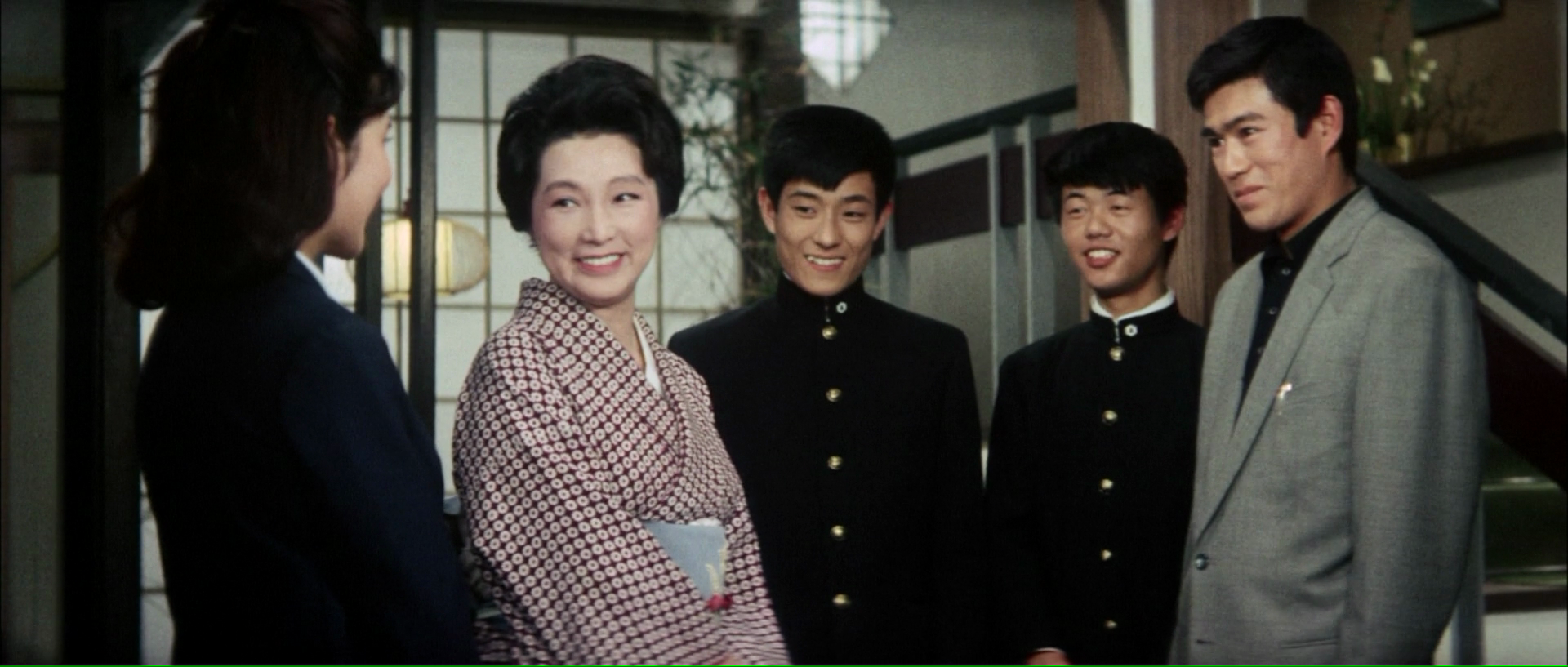
“The strength of our modern generation is that we never let anything get us down, and we’ll go after what we want without a moment’s hesitation.” The heroine of Ryuichi Takamori’s cheerful teen comedy Here Because of You (君たちがいて僕がいた, Kimitachi ga Ite Boku ga Ita) encapsulates a sense of post-war youth while trying to convince a sullen friend to join her in standing up to injustice when their teacher is smeared in the press, but he for his own reasons remains indignant and defeatist certain that nothing they do will make any difference. 

Essentially a vehicle for Toei teen stars Chiyoko Honma and Kazuo Funaki, the film is like many similarly themed youth movies of the time a progressive appeal to a new generation intent on rebelling against the social conservatism of their parents along with the injustice and inequality that accompanied it. The villain of the piece is the father of one of the students, Akira (Masaaki Sakai), who has become wealthy and is intent on throwing his weight around. Tanaka (Ken Sudo) wants his son to go to the best university in Japan and does not take kindly to the advice of his teacher, Mr. Yamabuki (Sonny Chiba), that Akira is just not up to it academically and putting so much pressure on him to achieve something which is almost certainly beyond him will only make the boy suffer. 

Akira is one of those kids with his head in the clouds who isn’t particularly good at anything. School is in general a torture for him and he himself knows that Tokyo University is not a possibility though he’s prepared to do his best if only his father would lower his expectations and let him apply to a college that is more within his capabilities. Both Tanaka and Mr. Yamabuki are however partially at fault when Akira is injured during a PE lesson that he was supposed to be excused from, Tanaka having told him not to participate in sports but to spend the lesson doing extra study instead. Mr. Yamabuki had thought that Akira had just not been applying himself, but a combination of a lack of physical agility due to being kept off PE and being encouraged to push himself further than he should lead to him falling from some climbing bars and spraining his ankle.

As might be expected, Tanaka is not happy and even asks for a second opinion on his son’s minor leg injury while deepening his grudge against Yamabuki. Tanaka also has a minor grudge against fellow student Hiroshi (Kazuo Funaki) who threw a bucket of frogs at him (to which he is allergic) for reasons Hiroshi doesn’t fully understand after hearing him kick off about Akira’s college prospects. It’s Hiroshi who fulfils the role of rebellious youth in the angry impulsivity that he often cannot explain. He’s been saying he doesn’t want to go to college but it’s because his older sister was forced to leave education during in middle school because of the family’s poverty and has become a geisha in order to pay for his tuition. Yamabuki and Hiroshi’s sister Yukiko (Junko Miyazono) develop a fondness for each other while discussing Hiroshi’s education, and it’s this suggestion of there being some impropriety in a schoolteacher dating a geisha that Tanaka takes to papers in effort to get Yamabuki fired. 

Meanwhile, Hiroshi’s cheerful classmate Chieko (Chiyoko Honma) has also developed a crush of Yamabuki. Claiming that she intends to marry him, she goes so far as to turn up at his house and insist on doing his laundry but he quite reasonably tells her that as an adult man his wife would have to be an adult woman. Surprisingly, she gets over it quite quickly and realises that Hiroshi is a much better match for her instead, but nevertheless springs into action when Yamabuki is unfairly smeared in the press. Even she is originally scandalised by the suggestion that her long widowed mother (Mieko Takamine) may have feelings for a local doctor (Shuji Sano), but soon comes round to the idea that there’s nothing wrong with it if she has just as there’s no problem with a teacher dating a geisha. She claims she would be more offended if each of them were forced to deny their feelings for each other because of social propriety and is intensely annoyed by the network of local corruption she uncovers in investigating the origins of the false news report which also suggests Yamabuki may have been inappropriately carrying on with a student, presumably herself. 

As chairman of the parent teacher association, Tanaka tries to railroad the headmaster into firing Yamabuki by holding a kangaroo court at which Yamabuki is prevented from speaking in his own defence all while his character is assassinated. But the kids, who previously witnessed a drunken Tanaka harassing Yukiko, aren’t having any of it and abandon their lessons to surround the meeting vowing that they’ll go on hunger strike if they aren’t listened to which won’t look very good in the national papers. What they bring about is a kind of democratic revolution in which the corrupt authority of Tanaka is deposed in favour of the more evenhanded chairpersonship of Chieko’s grandmother who turns out to be the oldest person in the room at 63. The children will not be ordered around or told what to think and will stand up to injustice where they find it, which is very bad news for those like Tanaka who are used to getting their way because of their privilege and social status. It’s all very wholesome and innocent, perfectly in keeping with the zeitgeist while remaining cheerful and upbeat even with Hiroshi’s continued brooding until Chieko finally manages to win him over. A charming teen musical adventure with a handful of songs performed by its idol stars, the film’s infectious energy is difficult to beat.


Wife (妻, Mikio Naruse, 1953)

The post-war world, to a certain way of thinking at least, promised a greater degree of freedom in which it might no longer be necessary to go on stoically bearing unhappiness in service to a social ideal. Then again, old habits are hard to break and not everyone is quite so equipped to acknowledge that misery can in a sense be a choice. Mikio Naruse’s Wife (妻, Tsuma) finds itself at a moment of transition in which the meaning of everything the word meant was perhaps beginning to change while the idea that a woman might choose to reject the role was no longer a taboo but an increasingly viable possibility. 

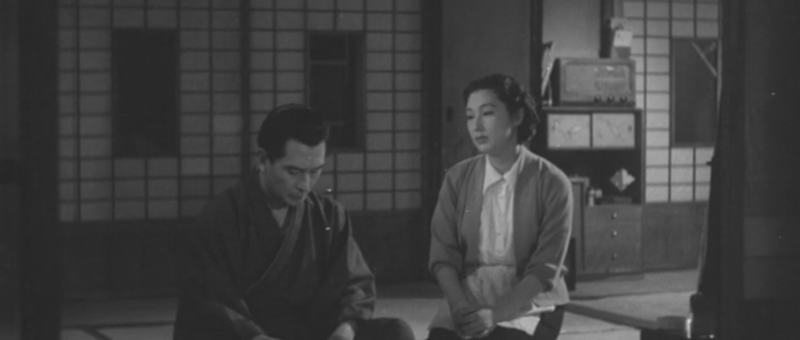
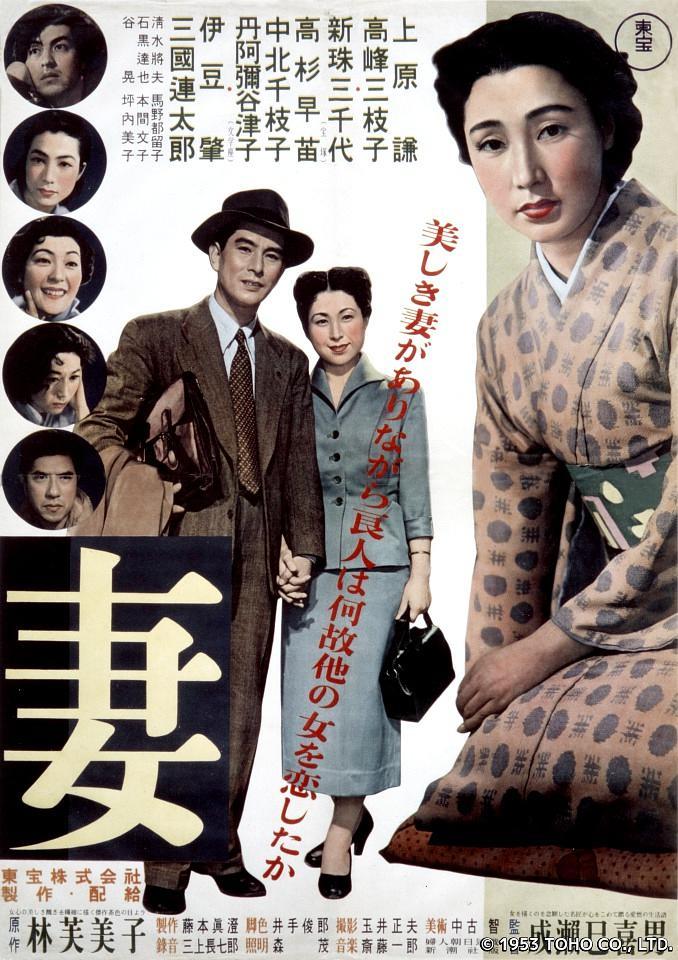
To the unhappily married Mineko (Mieko Takamine), however, the idea of independence remains somewhat distasteful. Each morning her husband, Nakagawa (Ken Uehara), leaves the house without a word. In fact, he doesn’t even look at her before silently walking away. She complains that she has no idea what he’s thinking, all he ever tells her is that he’s “tired” but she also resents him for failing to provide for her in the way that she perhaps expected. The couple live in a sizeable home, but Mineko has to rent out the upstairs to a series of lodgers as well as taking in sewing as a side job to make ends meet. What seems perfectly apparent is that the couple are ill suited, both in terms of temperament and of personal desires. Nakagawa is a soft hearted, romantic sort of man who isn’t particularly bothered if their lodgers pay their rent or not, while his wife is emotionally distant and infinitely practical as perhaps life has taught her to be. 

The peculiarities of life in Japan in 1953 place considerable strain on not only on the Nakagawas but on each of the other couples that we see. Those who married in haste during the war may be regretting their choices, while others, like Eiko (Chieko Nakakita) who rents the upstairs room with her husband Matsuyama (Hajime Izu), complain that the men they waited so long for came back changed. That Matsuyama cannot find a job in the difficult economic circumstances of the post-war society may not be his fault, but the necessity of relying on his wife for economic support has nevertheless eroded his sense of masculinity and left him a resentful drunk, destroying his wife’s love for him. Mineko is slightly scandalised when another tenant, art student Tanimura (Rentaro Mikuni), reveals that Eiko works not in a store but in a bar in Ginza, that being in truth the only kind of job that pays enough to support a married couple and a mother-in-law that a woman can get in 1953. Eventually Eiko leaves her husband, something else that scandalises Mineko, and resolves to live an independent life rather than remarry.

The idea of independence is repeatedly mentioned to her, but Mineko continues to reject it. Her sister jokingly suggests going into business together, while another customer, a widow with a young son, floats the idea of leaving the home of her late husband and opening a shop to support herself independently. She believes remarriage is not a viable option because she has a child, a thought echoed by another widow, Fusako (Yatsuko Tanami), who eventually decides to do something similar by returning to her hometown and going into business with a friend. Opening a shop is a popular option, but it of course requires investment and relies on having strong support, in Fusako’s case from female solidarity in teaming up with another woman in a similar situation. 

It might be easy enough to say that becoming financially independent is a choice on offer only to widows with children who have, in some way, already fulfilled their social obligations, while women like Eiko who chose childless self-sufficiency would still struggle to find acceptance even if their career were not dependent on an industry still itself taboo. That Nakagawa and Mineko have no children perhaps places an additional strain on the marriage. Nakagawa tells a colleague complaining about his family that he wonders if children might have made his life easier, while his only moment of contentment seems to be in playing with Fusako’s young son on the morning after spending an illicit night with her in an inn at Osaka. She sadly tries to ask what might be next for them, but he only wants to live in that moment knowing that their future is an impossibility. 

Despite his unhappiness, Nakagawa doesn’t seem motivated towards ending his marriage, perhaps out of guilt or because as friend later suggests it’s not so much Fusako that he loves as the possibility of a different future. On his return from his Osaka trip, he encounters a new tenant, Mineuchi, who has found her own way to be independent in becoming a mistress. Nakagawa seems to find the arrangement mildly distasteful, though it’s perhaps not so far off what he’s planning to do with Fusako. Mineuchi paid premium for the room and has even brought her own refrigerator and an electric gramophone so she is in a sense living the dream, especially as her “patron”, a furniture store owner, only visits twice a month. 

After learning that Nakagawa has fallen in love with Fusako, Mineko wonders if she should pay her a visit, but then receives one herself from the furniture store owner’s tearful wife who reveals that he is not a wealthy man and has ruined himself, and therefore her, after being bewitched by a Ginza bar hostess. Later, Mineko discovers that the furniture store owner’s wife took her own life in humiliation, lamenting that she didn’t have to go so far just because of her husband’s indiscretion, but also threatens to do the same herself to try and guilt Fusako into giving up her husband. 

Yet, pretty much everyone seems to tell Mineko that this is all her own fault and the reason her perfectly good husband has looked elsewhere is because she has failed as a wife. Sharp and emotionally distant, she alienates those around her but is devastated to realise that she’s lost her husband’s love and will most likely never be able to regain it. Her decision to talk not to him but to Fusako hints at the way in which women see each other as rivals and not as friends, actively holding each other back, as her sister Yoshimi (Michiyo Aratama) also does in insisting on the social order over personal feeling, rather than attempting to find understanding or mutual support. It doesn’t seem to occur to her that ending her husband’s dream of romantic escape through emotional manipulation is unlikely to improve the quality of her married life. 

Mineko, however, never contemplates independence. She tells Fusako that she won’t consent to a divorce just to claim alimony, but privately wonders what would become of her if she left her husband. She might be able to put a stop to it this time, but who’s to say he won’t find someone else. What she seems primed to choose is socially mandated misery, rejecting the “freedoms” of the post-war age to end an unhappy marriage because she can’t conceive of herself as anything other than a “wife” and being miserable is apparently better than being nothing at all. 


Brothers and Sisters of the Toda Family (戸田家の兄妹, Yasujiro Ozu, 1941)

Yasujiro Ozu made only two films during the height of the war. After being drafted for the second time in 1943, he famously sat out the main action from the relative safety of Singapore where he was able to indulge his love of Hollywood cinema to an extent impossible in Japan. Somewhat surprisingly, 1941’s Brothers and Sisters of the Toda Family (戸田家の兄妹, Toda-ke no Kyodai) does not seem to fit the censor’s ideal in that it contains little to no patriotic content and never mentions the war save for presenting the idea of “Manchuria” as a place to start again free of burdensome codes of social oppression but, crucially, embraces classic ideas of filial piety which is presumably how it came to be approved by the powers that be. 

Shortly after the Toda family gathers for the first time in quite a while to celebrate Mrs. Toda’s (Ayako Katsuragi) 61st birthday, Mr. Toda (Hideo Fujino) drops dead of a heart attack and it is discovered that the family firm is near bankruptcy. The large, Western-style mansion where the family photo so recently took place will have to be sold and Mrs. Toda and her unmarried daughter Setsuko (Mieko Takamine) will have to move in with one of the married children. 

Like the later Tokyo Story, Brothers and Sisters of the Toda Family concerns itself with the failure of filial piety in an increasingly corrupt society. Multigenerational homes might once have been a cultural norm, but perhaps it’s understandable that few people might be excited about the prospect of their mother suddenly moving in with them especially as the traditional Japanese house is not designed with personal space in mind. Power dynamics seem to be the problem at the first home where daughter-in-law Kazuko (Kuniko Miyake) makes no secret of the fact that the two women are in the way. She resents having to shift everything around and reorder her home to give them space upstairs, complains about their noisy pet bird, and is then put out when Setsuko and her mother fail to greet her guests even though she specifically asked them to absent themselves in order to avoid meeting them. 

At the next home, however, it’s more a question of maternal heirarchy. Daughter Chizuru (Mitsuko Yoshikawa) has two children and the oldest, her son Ryokichi (Masao Hayama), is very attached to his grandma, so much so that he confides in her about skipping school because he got into a fight and is worried about reprisals. Chizuru’s main objection to them moving in had been that it might distract Ryokichi from his studies, and it’s clear that she finds it difficult to assert her own maternity with her mother hovering in the background. She accuses Mrs. Toda of interfering by keeping her promise to Ryokichi and not telling her about skipping school, making it impossible for them to keep living in the same house. 

Rather than descend on the home of the last daughter, Ayako (Yoshiko Tsubouchi), who is hurt but perhaps relieved to hear they won’t be living with her, Mrs. Toda and Setsuko decide to move into a dilapidated summer house the family thought too worthless to sell. They are now thoroughly marginalised, living in a literal half-way home having lost their position in society. Setsuko, naive but earnest, is the keenest to adapt to her circumstances. Her best friend Tokiko (Michiko Kuwano) is from an “ordinary” family and tries to point out, as nicely as possible, that Setsuko is going to find it much more difficult than she thinks to move beyond her privilege. Aware of her precarious circumstances, she expresses the intention to work but is quickly shut down by Chizuru who finds the idea highly offensive and in fact embarrassing. She urges her to think about a socially advantageous marriage instead.  

Shojiro (Shin Saburi), the youngest and as yet unmarried son, urges her to do something much the same at the film’s conclusion but also offers his sister the freedom to fulfil herself outside the home by accompanying him to the land of the possible, Manchuria. Previously regarded as a feckless failure, Shojiro decided to take up the opportunity to make something of himself in Japan’s new colonial endevour. On his brief return to mark the first anniversary of his father’s passing, he appears in a China-style suit and fiercely takes his siblings to task for their disrespect of his mother. It has to be said, however, that he does not particularly take Mrs. Toda’s feelings into account and foregrounds his own duty of filial piety in insisting that she live with family rather than alone excluding the possibility that she too may prefer her freedom. In any case, it’s freedom he dangles before Setsuko in suggesting that in Manchuria you can do as you please without needing to worry about what others think. He offers her the possibility of marriage, but also of working and a kind of independence which is bound within the family. For herself, Setsuko wants to bring Tokiko too, positing a possible arranged match between her friend and her brother which other members of the family may find inappropriate in its transgressive breach of the class divide. 

The family is both dissolved and restored as the three Todas prepare to remove themselves from a corrupted Japan for, ironically, a new start in the home of old ideas, China, where there is both the promise of modernity and all the “good” aspects of the traditional, to whit filiality. Fulfilling the censors demands in subtly criticising the decadent, selfish, and hypocritical lifestyles of an impoverished nobility while presenting Manchuria as an opportunity remake a better, purer (and subversively progressive) Japan through imperialist pursuits, Brothers and Sisters of the Toda Family offers an ambivalent portrait of contemporary Japanese society in which the young save themselves but only by saving their parents first. 


Brothers and Sisters of the Toda Family is available on blu-ray in the UK as part of the BFI’s re-release of Tokyo Story in its recent 4K restoration which also includes an introduction to Tokyo Story from Tony Rayns, and Talking with Ozu: a tribute to the legendary director featuring filmmakers Lindsay Anderson, Claire Denis, Hou Hsiao-hsien, Aki Kaurismäki, Stanley Kwan, Paul Schrader and Wim Wenders. The first pressing also comes with a booklet featuring an essay by Professor Joan Mellen, archival writing by John Gillett and Lindsay Anderson, and a biography of Yasujiro Ozu by Tony Rayns.

It is also available to stream online via BFI Player as part of the BFI Japan Yasujiro Ozu collection.

Titles and opening (no subtitles)

Love Under the Crucifix (お吟さま, Kinuyo Tanaka, 1962)

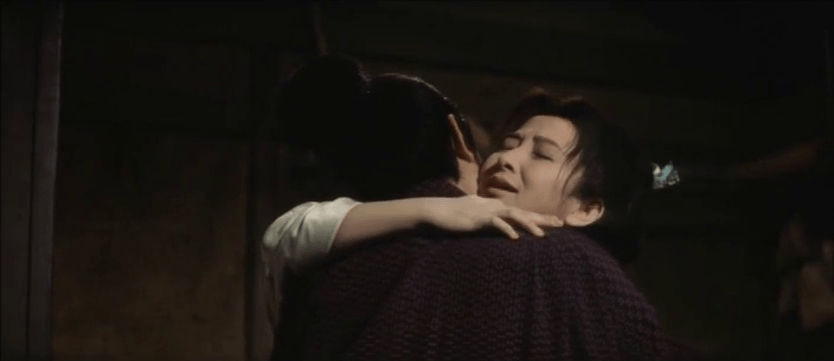
Love Under the Crucifix cap 1A legendary screen actress, Kinuyo Tanaka completed only six films in her career as a director. The last film that she would ever make, Love Under the Crucifix (お吟さま, Ogin-sama), is the only one to be set in the historical past taking place against the backdrop of turbulent late 16th century politics just forty years or so before the nation would embark on 200 years of self imposed isolation undertaken in the name of preserving the national character while solidifying a political regime. As in her other films, however, Tanaka employs a standard melodrama narrative in order to subvert it. Her heroine defies all “for love”, but not so much in itself as for the right to it and to the legitimisation of her feelings as a human woman with all the rights and freedoms that ought to entail.

The film begins in the 15th year of Tensho (or 1587). Toyotomi Hideyoshi (Osamu Takizawa) is attempting to solidify his command over a Japan which is in a state of constant warfare. Meanwhile, foreign trade and influences, including Christianity, are flooding into the nation. There is growing suspicion among Hideyoshi’s advisors that Christian converts are nothing more than foreign spies working to undermine the social order and cannot be trusted. Therefore, Christianity is a spanner thrown in the works of Hideyoshi’s plans for peace and unification, only no one is quite sure as yet what to do about it except disapprove.

Meanwhile, our heroine, Ogin (Ineko Arima), is the step-daughter of prominent tea master Rikyu (Ganjiro Nakamura). She has long been in love with Ukon (Tatsuya Nakadai) – a young lord who has converted to Christianity and is in fact already married. Despite the impossibility of her love, Ogin holds fast to its purity and has refused all entreaties to marry. However, she is placed in a difficult position when it is made clear that a prominent suitor affiliated with the local lord desires her. Rikyu affirms that he will follow Ogin’s will, but Mozuya (Hisaya Ito) is too important a man to be refused out of hand and the consequences of turning him down may be severe. Ogin searches for a sign from Ukon, but he coldly tells her to marry, refusing any confirmation of the feelings which she believes to exist between them.

The film’s English title, Love Under the Crucifix, reminds us that this is not so much a story of religious freedom as social oppression. Divorced form its Christianising context, the crucifix was in this era the primary punishment for sexual transgression, most often for both men and women committing adultery or daring to love in places where society would not approve. Thus Ogin lives her life under it in being reminded of the potential costs of her inappropriate emotions. Even so, observing a young woman tied to the cross (Keiko Kishi) and apparently electing to go to her death rather than become the concubine of the local lord against her will, Ogin sees in it not censure but defiance and path towards personal empowerment if only in ultimate negation.

The literal crucifix becomes a noose around Ogin’s neck in the form of the necklace given to her by Ukon. Ogin remains unconvinced by Ukon’s religiosity even if she respects it but later resents the austerity it provokes in him while wondering if his friendship with her was only ever a pathway to conversion. Ukon’s troubles are multiple, not only is he oppressed by the social strictures of his time but also by an additional burden of Christianising morality which instructs him that his feelings are sinful and must be rejected.

Later, Ogin berates Ukon insisting that all of this suffering and the predicament they now find themselves in might have been avoided if only he had not kept his feelings hidden. Ukon’s religiosity obliges him to behave in ways which are cruel and selfish, and which ultimately bring him little other than additional suffering and unhappiness. This emotional tension has also played into the hands of the ruling regime who are content to use their feelings, and the prevailing tendency towards properness, against them as a plot against Rikyu and to prevent Ukon’s return as a military rival.

Despite Rikyu’s best efforts, Ogin has indeed become a pawn in the hands of men. Rikyu, as we’re reminded at the film’s conclusion, fell from favour and committed ritual suicide at the age of 70. Like Ogin, he remained true to himself even when politically unwise, advancing his philosophies of simplicity and respect for the natural world in the face of what he saw as Hideyoshi’s increasingly gaudy superficiality. Thus he councils Ogin that there is nothing wrong in her feelings and her only duty to him or to anyone else is to try to live happily even if that means she must live in hiding with the less courageous Ukon who refuses to abandon his faith but struggles to find the courage to fight for love, or more specifically for the right to love, as Ogin has done all her life.

Ogin is, in a sense, already on the cross as she continues to suffer not for faith but for faith in love and in her own right to her individual feelings and agency. Faced with being forced to surrender her body to a man she does not love because of a cruel game played by men for men, Ogin prefers death and finds in it the ultimate expression of her personal freedom and emotional authenticity.


The Inugami Family (犬神家の一族, Kon Ichikawa, 1976)

the inugami family 1976 posterUnlike many of his contemporaries, Kon Ichikawa was able to go on working through the turbulent ‘70s and ‘80s because he was willing to take on purely commercial projects. The phenomenal and hugely unexpected success of 1976’s The Inugami Family (犬神家の一族, Inugami-ke no Ichizoku) set him in good stead for the rest of the decade during which he followed up with another four movies starring Koji Ishizaka as the eccentric detective Kosuke Kindaichi as featured in the novels of Seishi Yokomizo each of which was a bonafide box office success partially thanks to the effect of Haruki Kadokawa’s intensive multimedia marketing strategy then still in its infancy. In fact, Ichikawa would return to the sordid world of the Inugamis for his final picture in which he dared to remake his “greatest hit” with a now much older Koji Ishizaka reprising his role exactly 30 years later. Ichikawa might have been making “commercial” movies, but he never lost his experimental spirit.

Old Sahei Inugami (Rentaro Mikuni) finally drops dead in 1947 after a lifetime of seemingly doing exactly as he pleased. As a 17-year-old orphan he was taken in by a kindly priest and thereafter founded one of the biggest pharmaceuticals companies in Japan which is to say he leaves behind him a vast estate and desirable name. Unfortunately, he also leaves a messy family situation. Sahei was never legally married, but fathered three daughters with three different women who each have a son. In his 50s, he also fathered a son with his maid who would be about the same age as the grandchildren if anyone knew where he was. Sahei’s will, which in dramatic fashion can only be read with everyone present, leaves everything to a young woman, Tamayo (Yoko Shimada), who isn’t even part of the family but was doted on all the same by the elderly patriarch. In order to inherit, Tamayo must consent to marry one of the three grandsons – Suketake (Takeo Chii), Suketomo (Hisashi Kawaguchi), or Sukekiyo (Teruhiko Aoi) with whom she seems to have shared a past attachment. The will stresses that she is free to choose though if she decides to marry someone else entirely, the fortune will be divided in five with one part each to the grandsons and the rest to the maid’s son. As one can imagine, the daughters are furious.

Kindaichi is called in by a clerk (Hajime Nishio) at the solicitor’s office who has seen the will and finds it all decidedly strange (plus he’s in love with Tamayo so it’s very bad news for him). The clerk gets murdered before he can spill the beans, but the solicitor himself, Furudate (Eitaro Ozawa), decides to enlist Kindaichi’s help in figuring all of this out before it claims any more lives. Unfortunately, claim more lives it will.

Greed, as ever, is at the root of all evil but like the other entries in the Kindaichi series the crimes are largely a result of the world which surrounds them. Old Sahei made his money in some dubious ways. Ingratiating himself with the rich and powerful, later becoming a militarist for what seems like opportunistic reasons, he got himself special dispensation to grow poppies for their medicinal properties. Which is to say, he got rich selling opium to the masses. Inugami pharmaceuticals profited hugely from suffering incurred in wars spanning the century – with Russia, with China, through the first world war and the second. There was Inugami, ready to fuel the fire by numbing the pain.

Yet it’s his own unresolved emotional suffering that seems to have sent him such a dark and amoral path. Later we discover that a strange and emotionally difficult set of circumstances involving a quasi-incestuous, bisexual love triangle seem to have left him craving something to numb his own pain but only succeeding in passing it on to those around him. Firstly through the women he kept around to satisfy his carnal desires and then sent away, keeping the children with him but in a loveless, austere home. The sisters – Matsuko (Mieko Takamine), Takeko (Miki Sanjo), and Umeko (Mitsuko Kusabue) share an uneasy sort of camaraderie but are quick to turn on each other when it becomes clear that only one of them will inherit the family fortune and that they are now each rivals for the hand of Tamayo.

Like their grandfather, the Inugami boys are not an especially good catch. Two of them eventually attempt to rape Tamayo in an attempt to force her into marriage through shame (despite the fact that one has already fathered a child with his cousin), while she also has her doubts that Sukekiyo, with whom she has always felt a connection, is really who he says he is. Having gone away to the war, Sukekiyo did not return home after being demobbed because of intense survivor’s guilt. He also sustained severe burns to his face which require him to wear a latex mask over his entire head making positive identification difficult seeing as his voice, which he rarely uses, is also changed.

Rather than submit himself to the necessarily pokerfaced approach common to prestige murder mysteries from across the globe, Ichikawa uses the saleability of the property as an excuse to go all out. His tone varies wildly, almost to the point of parody in his frequent cuts to Kindaichi causing another of his famous anxiety induced dandruff avalanches. The blood eventually flies as do severed heads while upended corpses do handstands in lakes. The story of the Inugami family is a strange one filled with moments of bizarre whimsy but somehow it all works. As in many a Japanese mystery, the past refuses to die and the guilty eventually realise how misguided their enterprise has been, but there is hope for those left behind if they can free themselves from the cycle of guilt and suffering on which the Inugami name was built.


Original trailer (no subtitles)
The Garden of Women (女の園, Keisuke Kinoshita, 1954)

garden of women still 1Things changed after the war, but not as much as some might have hoped. Sadly still topical, Keisuke Kinoshita’s Garden of Women (女の園, Onna no Sono) takes aim both at persistent and oppressive patriarchal social structures and at a compromised educational system which, intentionally or otherwise, systematically stifles attempts at progressive social change. A short few years before student protests would plunge education into crisis, Kinoshita’s film asks why it is that the establishment finds itself in conflict with the prevailing moods of the time and discovers that youth intends to have its brighter future even if it has to fight for it all the way.

The setting is an exclusive private woman’s university in the elegant historical city of Kyoto. The ladies who attend this establishment are mostly from very wealthy families who have decided to educate their daughters at the college precisely because of its image of properness. As one student will later put it, there are two kinds of girls at the school – those who genuinely want to study in order to make an independent life for themselves and intend to look for work after graduation, and those who are merely adding to their accomplishments in order to hook a better class of husband. Everyone, however, is subject to a stringent set of rules which revolves around the formation of the ideal Japanese woman through strictly enforced “moral education” which runs to opening the girls’ private letters and informing their families of any “untoward” content, and requiring that permission be sought should the girls wish to attend “dances” or anything of that nature.

As might be expected, not all of the girls are fully compliant even if they superficially conform to the school’s rigid social code. Scolded for her “gaudy” hair ribbon on the first day of school, Tomiko (Keiko Kishi) rolls her eyes at the over the top regulations and enlists the aid of the other girls to cover for her when she stays out late with friends but her resistance is only passive and she has no real ideological objection towards the ethos of the school other than annoyance in being inconvenienced. Tomiko is therefore mildly irritated by the presence of the melancholy Yoshie (Hideko Takamine). Three years older, she’s come to college late and is struggling to keep up with classes but is, ironically enough, prevented from studying by the same school rules which insist she go to bed early.

Meanwhile, dorm mate Akiko (Yoshiko Kuga), from an extraordinarily wealthy and well connected family, is becoming increasingly opposed to the oppressive atmosphere at the school. However, as another already politically active student points out, Akiko’s background means there are absolutely no stakes for her in this fight. She has never suffered, and likely never will, because she always has been and always will be protected by her privilege. Fumie (Kazuko Yamamoto), a hardline socialist, doubts Akiko’s commitment to the cause, worrying that in the end she is only staging a minor protest against her family and will eventually drift away back to her world of ski lodges and summer houses. Despite her ardour, Akiko finds it hard to entirely dispute Fumie’s reasoning and is at constant battle with herself over her true feelings about the state of the modern world as it relates to herself individually and for women in general.

This is certainly a fiercely patriarchal society. Even though these women are in higher education, they are mostly there to perfect the feminine arts which are, in the main, domestic. They are not being prepared for the world of work or to become influential people in their own right, but merely to support husbands and sons as pillars of the rapidly declining social order that those who sent them there are desperate to preserve. For many of the girls, however, times are changing though more for some than others. Tomiko rolls her eyes and does as she pleases, within reason, and even if she eventually wants to see things change at the school it is mostly for her own benefit. She sees no sense in Akiko’s desire for reform as a stepping stone to wider social change, and perhaps even fears the kinds of changes that Akiko and Fumie are seeking.

Akiko and Fumie, and to an extent, Tomiko, seem to have a degree of agency that others do not as seen in the tragic story of Yoshie whose life has been largely ruined thanks to the selfish and heartless actions of her father. From a comparatively less wealthy family, Yoshie worked in a bank for three years during which time she met and fell in love with an earnest young man named Shimoda (Takahiro Tamura). However, her father, having become moderately successful, developed an appetite for social climbing and is determined she marry “well” to increase his own sense of superiority as a fully fledged member of the middle classes. He sees his daughter as nothing more than a tool or extension of himself and cares nothing for her thoughts or feelings. In order to resist his demands for an arranged marriage, Yoshie enrolled in school and is desperate to stay long enough for Shimoda to finish his education so they can marry.

Yoshie is trapped at every turn – she cannot rely on her family, she cannot simply leave them, she cannot yet marry, if she leaves the school she will be reliant on a man who effectively intends to sell her, but her life here is miserable and there is no one who can help her. All she receives from the educational establishment is censure and the instruction to buck up or get kicked out. She feels herself a burden to the other girls who regard her as dim and out of place thanks to their relatively minor age gap and cannot fully comprehend her sense of anxiety and frustration.

Finally standing up to the uncomfortably fascistic school board the girls band together to demand freedoms both academic and social, insisting that there can be no education without liberty, but the old ways die hard as they discover most care only for appearances, neatly shifting the blame onto others in order to support their cause. “Why must we suffer so?” Yoshie decries at a particularly low point as she laments her impossible circumstances. Why indeed. The oppressive stricture of the old regime may eventually cause its demise but it intends to fight back by doubling down and the fight for freedom will be a long one even if youth intends to stand firm.


Titles and opening scene (no subtitles)

So Goes My Love (愛より愛へ, Yasujiro Shimazu, 1938)

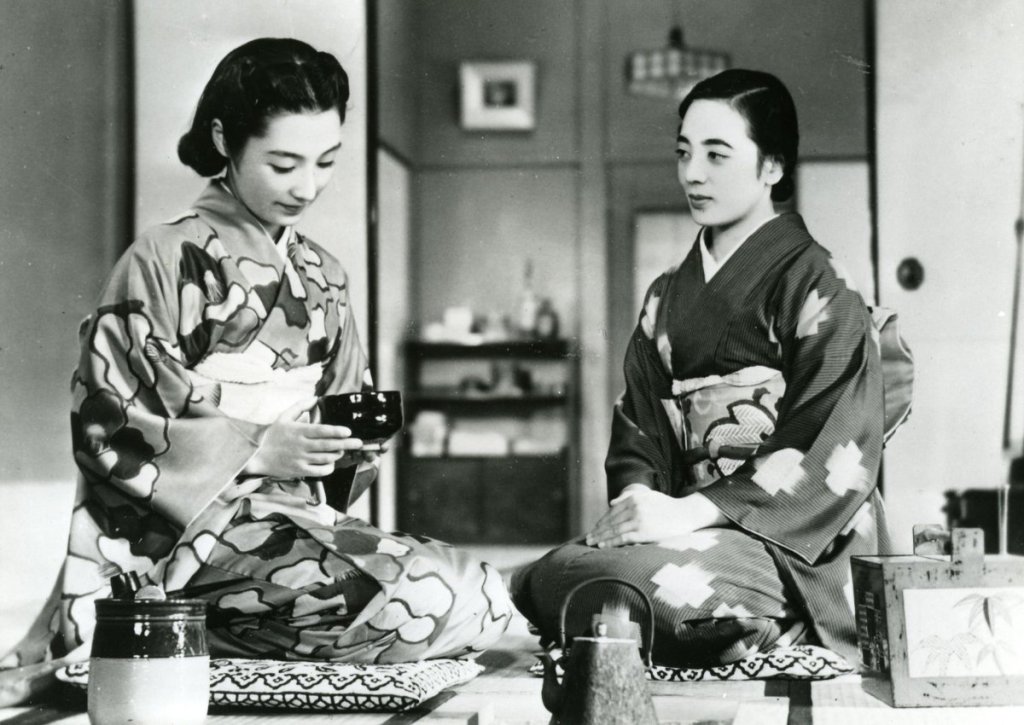
(C) Shochiku 1938Yasujiro Shimazu had been a pioneer of the “shomingeki” – naturalistic stories of ordinary lower middle class life, and his early career included several forays into the world of the “tendency film” which carried strong left-wing messages. By the late 1930s however his films have shifted upwards a little and often deal with the lives of the upper middle classes as they find themselves at another moment of transition during the turbulent militarist years. In contrast with many contemporary films, Shimazu’s may seem curiously apolitical but speak volumes solely through their subtlety and direct refusal to engage with the propagandist concerns of the ruling regime.
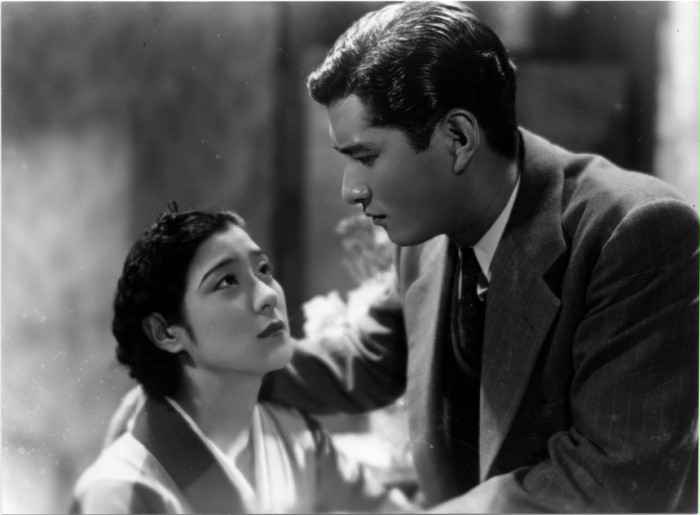
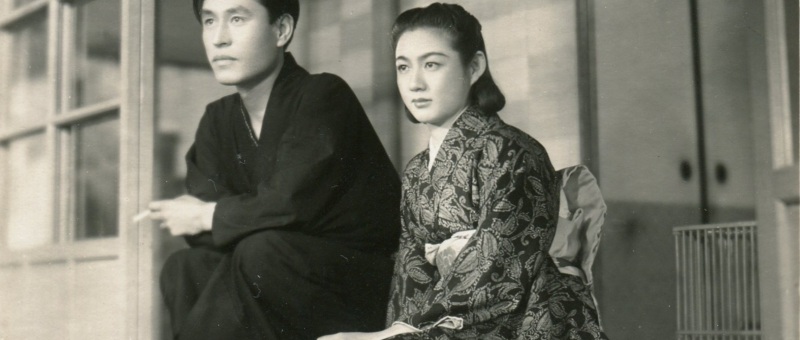
In So Goes My Love (愛より愛へ, Ai yori Ai e), our lead, Shigeo (Shuji Sano), is a struggling writer living with his girlfriend, Miyako (Sanae Takasugi), who supports them both with her meagre earnings as a bar hostess. As we later discover, Shigeo is the eldest son of a prominent family who have (temporarily) disowned him because they don’t approve of his relationship with Miyako. Realising his dreams of becoming a successful writer are unlikely to be fulfilled, Shigeo has become moody and taciturn. He wants to find a job but isn’t exactly equipped to get one especially when the times are as hard as they are. He asks his uncle for help and gets an interview at a newspaper, but quickly realises that his uncle has set him up – he can only have the job if he “legitimises” his living arrangements. Shigeo leaves in a huff but there’s no denying he’s in a financial fix.

Things start to change when Shigeo runs into his younger sister, Toshiko (Mieko Takamine), by chance at a cafe. Toshiko insists on coming back with him to his lodgings “for future reference” but also out of morbid curiosity as a kind of touristic exercise in surveying the lives of those less fortunate. Shigeo thought Miyako would have already gone out but walks in just as she’s leaving. Though Miyako is shy and quiet, a little perturbed over being suddenly ambushed with a visitor, she does her best to ease the awkwardness between herself and her potential sister-in-law with black tea (foregoing a cup herself) until Toshiko finally consents to sit on their floor cushion. Toshiko looks around the bare, depressing flat and spots Miyako’s sewing box with a pair of freshly darned socks sitting on top. It’s immediately clear to her that Miyako is not, as her parents had suggested, some kind of gold digger (no self-respecting gold digger darns their socks, after all). More than that, she seems “nice”, which is perhaps why she’s able to put up with the petulant Shigeo with so little complaint.

The central problem is a two fold one – Shigeo has attempted to choose his own bride and therefore “modernity” over the “traditionalism” of an arranged marriage. He doesn’t particularly care about being the head of a household or about living in relative squalor save for guilt and wounded male pride that he’s condemned Miyako to live there with him (not to mention sending her out to the degrading world of hostess bars and cabarets just so they can survive). The parents have reacted badly and produced a stand-off. Shigeo’s uncle is trying to manipulate the situation to his advantage by convincing Shigeo to leave Miyako and come home, but Shigeo is a proud young man, even if he leaves Miyako there’s no way he’ll come home with his tail between his legs. If the older generation wants to win the younger one over, it will have to compromise and learn to play by less stringent rules.

Making a knee-jerk judgment, Shigeo’s father and uncle have decided that Miyako is just a passing fad, a floozy or a gold digger best worked out of one’s system young and then forgotten about (preferably so that it wounds you so badly you’re ready to accept the cold comforts of a proper arranged marriage). Rather than the uncle, it’s Toshiko who becomes the bridge when she realises how kind and devoted Miyako really is. Shigeo’s mother is also sympathetic but, sadly, it’s still the men who have the final say and it’s not until uncle pays a Miyako a visit to try and persuade her to leave Shigeo that he too begins to see how “sweet” she is and that allowing her into their family wouldn’t be such a bad thing after all. In fact, as we later realise, Shigeo’s father perhaps wasn’t so opposed as he pretended to be and was simply playing his son at his own game, planning to consent to the match once he proved that it was really “serious” and not just a passing fling. Nevertheless, Miyako’s own meekness proves the final barrier as she finds herself suddenly afraid that Shigeo’s family might think her inherent goodness is some kind of trick and she’s been plotting all along. Only when Toshiko comes to fetch her and Shigeo himself calls her to come does she finally understand it’s going to be alright.

For 1938, this rather frivolous story might seem decadent especially with its warmhearted liberalism as the union of a lower-class woman and upper-class man is finally blessed through nothing more than common sense and empathy. Though Shimazu otherwise steers clear of political concerns, he does send Shigeo, Miyako, and Toshiko to the pictures where they end up watching part of a film made by Leni Reifenstahl featuring beautifully photographed visions of lithe young men in swimming trunks after which Shigeo gets up in a huff to smoke a cigarette. Toshiko didn’t seem to enjoy it much either and tries to improve Shigeo’s mood by insisting that the next one will be better but the message is clear – Shimazu didn’t like that film and he doesn’t think you did either. Among fans of Shimazu, at least, modernity is winning. It may not be perfect (Shigeo is an obvious prig whose self-conscious masculine posturing is almost a self parody), but it’s getting there and if everyone would just forget about the “rules” and treat others with respect, decency, and understanding then perhaps things wouldn’t be in such a mess.


Short scene in which the trio go to the cinema

https://www.youtube.com/watch?v=ZPJHmiNP_cM

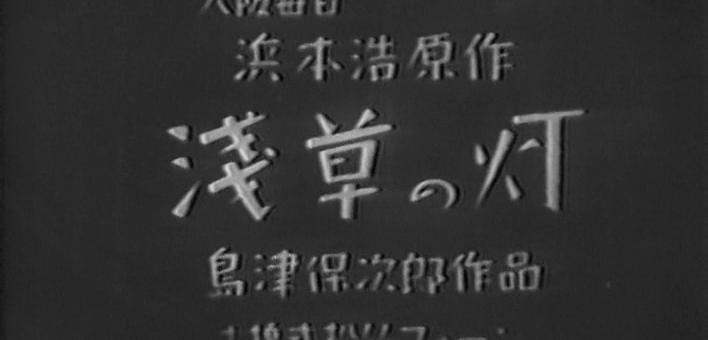
The Lights of Asakusa (浅草の灯, Yasujiro Shimazu, 1937)

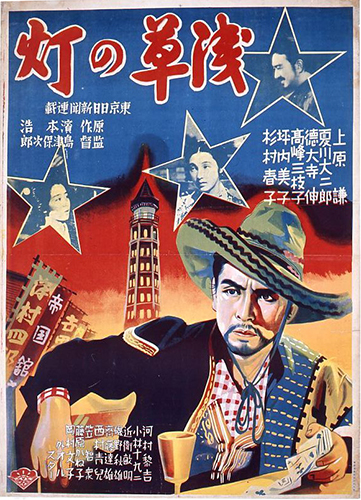
Lights of Asakusa posterThe lights of Asakusa (浅草の灯, Asakusa no Hi) still shone bright before the war. In this tiny corner of Tokyo well known for “low” entertainment, actors mingle with gangsters, lonely owners of amusement stalls, starving artists, bar girls, and wealthy industrialists each just trying to survive in an increasingly jittery city. Yasujiro Shimazu had been a pioneer of the “shomingeki” – stories of ordinary lower middle class people, and brings his characteristic wit and humanity to a tale of backstreet life where danger and ruin lurk on every corner and the only way to ensure one’s safety is to ensure you have the right defenders.

The main stage, if you will, is that of the Nippon-za “opera” company. This is, however, no great opera house but a run down little theatre presenting classical European opera for vaudeville audiences. The currently running show is Carmen, which will turn out to be appropriate for the events at hand. The trouble starts (or perhaps merely intensifies) when a young chorus member, Reiko (Mieko Takamine), begins attracting a range of wanted and unwanted male attention. Reiko, an orphan, had been taken in by a local bar mistress who later pushed her into the opera company but still expects her to make good on her investment by becoming a casual prostitute and taking on “customers” who present themselves at the bar (Reiko is around 16 or so, and therefore has just reached the age her foster mother thinks appropriate to join the business). The complication is that the man who’s taken a fancy to Reiko, Handa (Shunro Takeda), is a steel magnate who also finances the opera troupe meaning it’s not just the bar owner who’s coming under pressure but the financial security of the troupe too.

Being so young, Reiko finds her foster mother’s demands hard to refuse but is rescued by Sasaki (Seiji Nishimura) – the leading actor, married to leading lady Marie (Haruko Sugimura). The situation with Reiko exposes cracks already present in the group when Handa sends his goons in to disrupt the show, irking Sasaki to the point he takes off in a fit of artistic temperament. Meanwhile, another actor Yamagami (Ken Uehara), gets together with the rest of the troupe to ensure Reiko’s safety by hiding her with a feeble minded fan, Pokacho (Daijiro Natsukawa), so that she won’t be forced into a potentially life ruining situation.

Reiko’s plight is perhaps all too common on the streets of Asakusa. Having been orphaned she feels herself indebted to the bar mistress who took her in even if the relationship between them is not especially warm. She also feels grateful to have found a third family in the opera troupe and is afraid to lose her place there. Nevertheless, she is under extreme pressure to submit herself to this system of reciprocal arrangements and sleep with Handa solely to save making trouble for everyone else. Meanwhile her (sometimes) sympathetic roommate Beniko (Kayako Fujiwara) knows exactly what’s at stake through having been in a similar situation herself. She’s long been in love with the pure hearted Yamagami and is harbouring a degree of jealously in believing that Yamagami has a soft spot for Reiko, but she also half wants things to work out between them seeing as she has lost the “right” to love a man like Yamagami because she is no longer a virgin.

Shimazu had often been of a progressive mind, but sadly Beniko falls by the wayside, merely a sacrificial lamb prepared to give up on her dreams on Reiko’s behalf, so we never find out the limits of Yamagami’s justice loving heart or if he would be as bothered about Beniko’s past as she seems to fear he might be. Yamagami, brooding but righteous, would become one of matinee idol Ken Uehara’s best known roles though he too is teetering on the brink in Asakusa. Committed to defending the innocent, he tries to save Reiko’s honour but fails to declare a personal interest, entrusting her to the rather odd painter Pokacho who claims that his love for Reiko is of a spiritual, rather than carnal kind. Yamagami may succeed in his primary goal but still ends up in defeat, running away from the most important fight by retreating from Tokyo completely with a rebound girlfriend in tow, hoping to find kinder light in Osaka than he had on the dog eat dog streets of Asakusa.

Based on a novel by Hiroshi Hamamoto, Shimazu’s portrait of backstreet life sparkles with authenticity but also with a kind of hopelessness as each of these down on their luck “opera” stars laments their sorry fates and longs for a better gig somewhere less down and dirty. Meanwhile, the spectre of war lingers – when Carmen comes off the next show is to be “Two Honourable Soldiers”, filled with maudlin anthems of war which push the messages of patriotism and the glorification of offering one’s life for one’s country. The slimy Handa may have been defeated for now, but his kind are in the ascendent and the streets of Asakusa are unlikely to improve with only war and depression on the horizon.