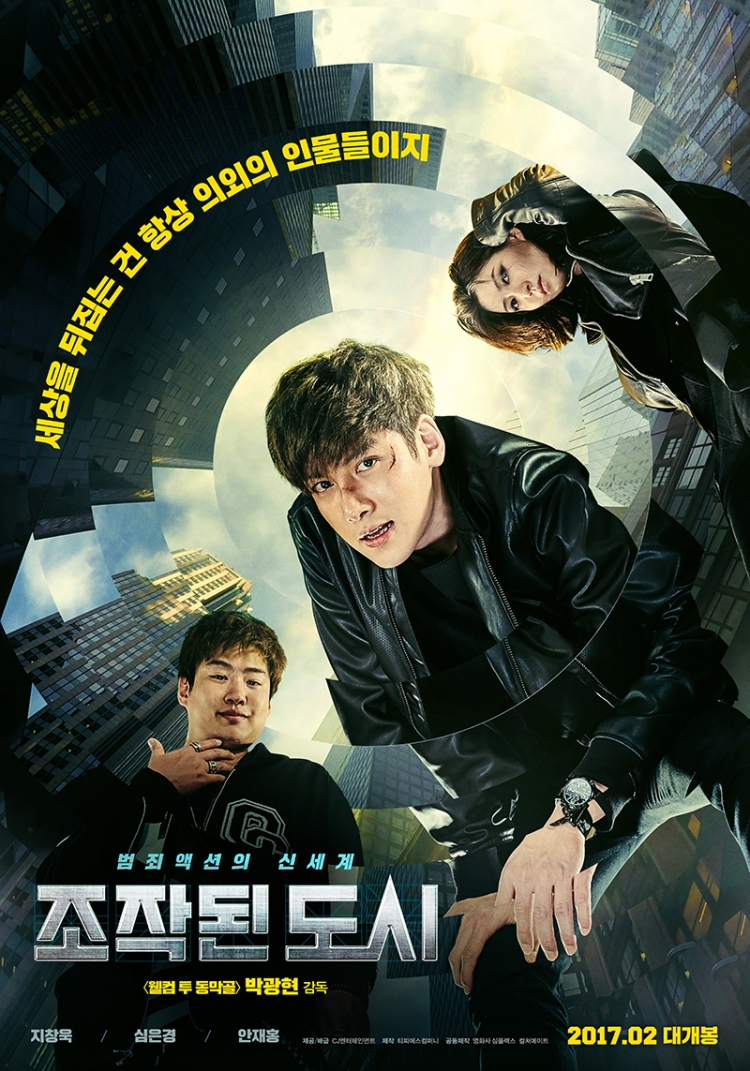
Fabricated City (조작된 도시, Park Kwang-hyun, 2017)

fabricated cityThe real and the unreal. In the era of fake news, it’s become ever harder to draw a clear line between the two but when you live online, the borders are even more permeable. Twelve years after the wartime comedy Welcome to Dongmakgol, director Park Kwang-hyun finally makes a return to the director’s chair with an action packed cyberpunk thriller which joins the ranks of recent Korean films bemoaning the country’s hardwired tendency to social inequality where the rich and powerful are free to run roughshod over the merely ordinary. Fabricated City (조작된 도시, Jojakdwen Doshi) refers to more than just the literally manufactured online world, but to the social reality in which unseen forces govern and define the lives of others, operating in secret behind a government backed curtain.

Kwon Yoo (Ji Chang-wook) was once a national athlete – a rising star of the Korean Taekwondo team. Starting fights when he wasn’t supposed to put paid to that dream and now Kwon Yoo is an aimless wastrel. Too sad and ashamed to have anything more to do with Taekwondo, Kwon Yoo spends all his time in gaming cafes, living a more successful life online. In his favourite game he’s known as the Captain, and the dashingly heroic leader of his party known as Resurrection.

One evening someone leaves their phone behind. It rings and Kwon Yoo answers it. Irritated, he’s about to hang up on the frantic sounding woman who wants him to bring the phone to her but her offer of money changes his mind. Kwon Yoo delivers the phone but the whole thing seems weird especially as the door was open and the woman in the shower when he arrived. Next thing he knows, Kwon Yoo is arrested for a brutal rape and murder. The police have a lot of evidence against him, and so Kwon Yoo winds up in jail where he’s branded a sex offender. Luckily a crazed serial killer realises this kid is no killer and helps him get out whereupon his loyal Resurrectionists valiantly come to the aid of their Captain in the real world, exposing the impressive fit up job that got him put away in the first place.

The deeper Kwon Yoo and his team dive the more corruption they discover. Kwon Yoo is not the only innocent sacrificed for someone else’s grand plan, there are others and the pattern is disturbing. Like Kwon Yoo, the other victims are usually people living on the margins – ones that no one would miss or the uncharitable might say were “unnecessary”, lives that can be exchanged for those of the rich and famous finding themselves in a fix. Kwon Yoo’s fate becomes an extreme version of that meted out to the young men and women of Korea unlucky enough to have been born without wealth, connections, or familial status – expendable and condemned to live without hope.

The fabricated city, in its more literal sense is the online world Kwon Yoo and his team have chosen and in part created for themselves in an attempt to escape the aspects of their lives and personalities which most disappoint them. Kwon Yoo, kicked off the Taekwondo team, has made a warrior hero of himself online, backed by a similarly escapist squad he doesn’t really know. His saviour turns out to be a shy computer genius who can only bear to talk via telephone even when in the same room yet has broken out of her self imposed isolation in order to save the life of her online friend. Other members of the team follow suit bearing similar backstories, attempting to live up to their fantasy selves for real with varying levels of success. Yet the fantasy world was all they had, locked out of all means of escape or advancement by the rigid social codes which make their present predicament possible, even if the fact remains that Kwon Yoo was doing a pretty good job of wasting his life all on his own.

Fabricated City’s biggest selling point is in its unusually well developed production design which takes its cues from the video game world with fantastical images from a prison carved into a mountain to the relatively more familiar cyberpunk influenced technological hybridity as floors become giant computer screens and everything really does exist online. Jumping genres from the classic wrong man to prison drama and eventually techno thriller, Fabricated City bites off more than it can chew but its well choreographed action and typically Korean sense of subtly ironic humour help to smooth over some of the film’s more outlandish moments.


Fabricated City was screened at the 19th Udine Far East Film Festival.

International trailer (English subtitles)

Petty Romance (쩨쩨한 로맨스, Kim Jung-hoon, 2010)

petty-romanceKorea is quite good at rom-coms. Consequently they make quite a lot of them and as the standard is comparatively high you have to admire the versatility on offer. Korean romantic comedies are, however, also a little more conservative,  coy even, than those from outside of Asia which makes Petty Romance (쩨쩨한 로맨스,  Jjae Jjae Han Romaenseu) something of an exception in its desire to veer in a more risqué direction. He’s too introverted, she’s too aggressive – they need each other to take the edges off, it’s a familiar story but one that works quite well. Petty Romance does not attempt to bring anything new to the usual formula but does make the most of its leads’ well honed chemistry whilst keeping the melodrama to a minimum.

Manhwa artist Jeong Bae (Lee Sun-kyun) is not having much success with his latest project. In fact, his publishing house has been using his submitted drafts as scrap paper. He’s also got a problem in that a gallery owning friend of his late father has been the caretaker of a precious painting left to him in his father’s will but now wants to call in a loan or sell it to get the money back and so Jeong bae is in desperate need of fast cash.

Across town, Da-rim (Choi Kang-hee) has managed to bag a writing gig on her friend’s woman’s magazine but finds herself out of her depth working on a sex advice column when she has no direct experience of love or dating. Given the axe by her friend and living with her moody twin brother to whom she owes money, Da-rim is also in need of something to sink her teeth in to.

When a friend of Bae’s lets him know about a new competition with a $100,000 cash prize it sounds like just what he needs. The only snag is the competition is for “adult” manhwa which has not generally been Bae’s thing. Taking his editor’s advice, Bae decides to work with a writer but most of his interviewees are not exactly what he’s looking for. Da-rim with her “experience” in translation and publishing, as well as her unusual forthrightness concerning the subject matter very much fits the bill.

Kim doesn’t waste much time in getting the two together though their love/hate relationship is a definite slow boil as both Bae and Da-rim spend most of their partnership playing each other to try and get the upper hand. Bae’s trouble, according to his editor, is a talent for action but a failure with narrative – hence the need for a writer. Da-rim, by contrast, has altogether too much imagination coupled with the kind of arrogance which masks insecurity. Having blagged her way into the job, Da-rim spends most of her time ensuring that she’s in a superior position to Bae so that he will have to do most of the work while she enjoys freshly made coffee ordered to distract him from the fact that she has no idea what she’s doing.

Despite coming up with a promising storyline about a sex obsessed female assassin, Da-rim’s naivety is palpable in her attempts to come up with a suitably “adult” atmosphere. Disney-esque scenarios of handsome princes and desert islands, even if spiced up (in the most innocent of ways), isn’t quite striking the tone for the kind of prize winning raunchy manga that the pair are aiming for. Pushed further, Da-rim’s extrapolations from “research” are so unrealistic as to set Bae’s alarm bells ringing but offered with such insistence as to have him momentarily doubt himself.

Kim makes good use of manhwa as a visual device allowing him to include slightly more erotic content than usual in a Korean romantic comedy in an entirely “safe” way. Refreshingly he keeps the usual plot devices to a minimum though there is the “sibling mistaken for lover”, “mistimed job offer,” and “aggressive rival” to contend with, even if the major barriers are entirely centred around the personalities of the protagonists who are each fairly self involved in their own particular ways. Despite making good use of the chemistry generated by previous collaborators Lee Sun-kyun and Choi Kang-hee, Petty Romance lives up to its name in providing enough low-key drama to keep rom-com fans happy but never quite moves beyond the confines of its genre.


Available to stream on Mubi (UK) until 15th March 2017 courtesy of Terracotta Distribution.

Original trailer (English subtitles)

King of Pigs (UK Anime Network Review)

image-8-king-of-pigsFirst Published on UK Anime Network in May 2013


Korea has a long tradition of animation but is perhaps more famous overseas for providing technical services to higher profile productions from other countries. The King of Pigs is the first feature length Korean animation to be shown at Cannes and has been screened at several other film festivals worldwide, picking up a few awards along the way too. Korean live action cinema of recent times has earned itself a reputation for being unafraid of violence and difficult subject matters – an ethos which appears to have directly penetrated into King of Pigs which nothing if not extremely bleak.

As the film begins, failed businessman Kyung-min weeps naked in a shower while the contorted face of a strangled woman lingers hauntingly in the next room. He makes a phone call hoping to track down an old childhood friend – perhaps because he feels he’s the only one who can help him understand what he’s done or because he feels somehow as if this person represents a fracture point in his life where everything started to go wrong. This long lost friend, Jong-suk, seems to be in a similarly dismal situation – an under appreciated ghost writer who’s constantly berated for writing unemotional prose, he returns home to beat his wife after accusing her of having an affair (which turns out to be doubly wrong as she’d been meeting with a publisher about Jong-suk’s own novel). The two men meet and talk over a traumatic period in their childhood when their only protector was another boy, Chul – self titled King of Pigs.

The school system was divided rigidly along lines of economic/social status and academic prowess and neither Kyung-min nor Jong-suk found themselves in the elite camp. Beaten, humiliated and molested the boys appear to have no recourse except to grin and bear it – even the teachers and authorities appear complicit in this unofficial caste system. That is until Chul dares to fight back, violently, on behalf of not only himself but all the other ‘pigs’ too. The three end up becoming a team bound by mutual suffering much more than friendship or human emotion. It takes more than one boy to destroy a system though and circumstances conspire to ruin whatever headway they might have made. These times will affect each boy more than he could ever have guessed and these changes will not be for the better.

The King of Pigs is certainly not an optimistic film. Though it seeks to depict a corrupt system based on arbitrary and unfair principles, perpetuated by the adults in charge and those trapped inside it, it has to be said that by the time we meet the young counterparts none of them is especially sympathetic. It’s an unfortunate part of the film’s message but the fact that both the young boys are so passive and complicit in their own degradation makes it very difficult to build up a sense of sympathy for them. You might think then that Chul would be the natural hero of this piece as the self appointed ‘savior’ of the hopeless cases but his manifesto rapidly turns so repellant that you can’t get behind him either. What you’re left with is a group of misogynistic ‘little men’ who in turn transfer the frustration they feel with their own sense of inferiority on to those they believe to be even weaker than themselves. The film tries to imply that the grown up failures of these men are a direct consequence of a broken school system, yet as we meet them already in the system rather than as totally innocent children, it’s not possible to follow this line of reasoning as the boys appear deeply unpleasant from the offset.

Unfortunately, another thing the film isn’t is subtle. The director really wants to hammer home his message about the socio-economic unfairness that seems to penetrate every area of society and prevent any sort of social mobility, but often it’s akin to being hit over the head with the same idea repeatedly several times over the course of the film. It is extremely violent in a deeply uncomfortable way to the extent that you could call this a ‘nasty’ film – the scene of animal cruelty alone feels both like an underdeveloped cliché and a thinly veiled attempt at shock value. In short, the film constantly undermines itself by shooting straight for the extreme where a more nuanced approach may have made its subject matter all the more powerful.

As it stands, it’s quite difficult to recommend The King of Pigs either as an entertainment piece or as a serious art film seeking to examine Korea’s attitudes to social class. The film was made on an independent basis and some may find its aesthetic a little basic in terms of animation quality yet it does have some interesting directorial ideas and composition. Though it ultimately fails, the film does deserve some praise for tackling such a difficult subject matter – genuinely adult contemporary animation can often be difficult to find. However it’s partly its desire to be ‘adult’ that destroys its ability to be taken seriously – by skewing towards the ‘extreme’ audience who may only be interested in the violence rather the problems that underly it, The King of Pigs risks been seen as a schlocky horror story rather than a parable about some very real social issues.


Available now in the UK from Terracotta Distribution.

Review of Yeon Sang-ho’s second and much improved animated feature The Fake.