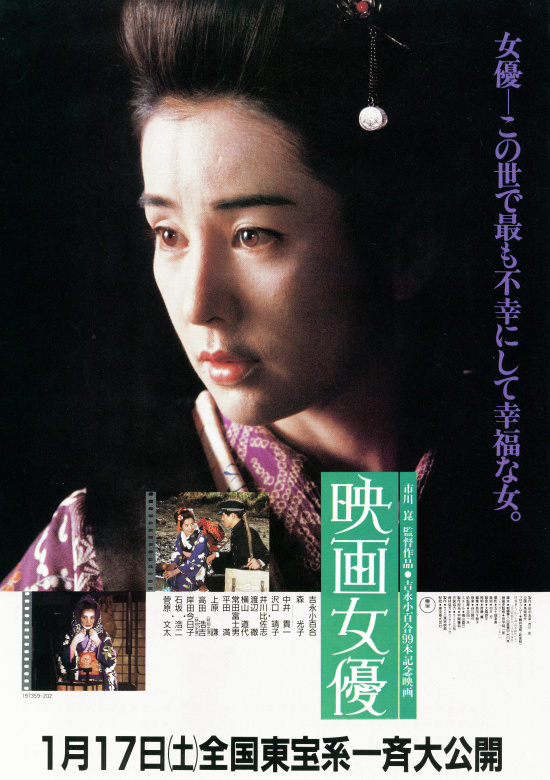
 Kon Ichikawa was born in 1915, just four years later than the subject of his 1989 film Actress (映画女優, Eiga Joyu) which uses the pre-directorial career of one of Japanese cinema’s most respected actresses, Kinuyo Tanaka, to explore the development of Japanese cinema itself. Tanaka was born in poverty in 1909 and worked as a jobbing film actress before being “discovered” by Hiroshi Shimizu and becoming one of Shochiku’s most bankable stars. The script is co-written by Kaneto Shindo who was fairly close to the action as an assistant under Kenji Mizoguchi at Shochiku in the ‘40s before being drafted into the war. A commemorative exercise marking the tenth anniversary of Tanaka’s death from a brain tumour in 1977, Ichikawa’s film never quite escapes from the biopic straightjacket and only gives a superficial picture of its star but seems content to revel in the nostalgia of a, by then, forgotten golden age.
The film begins with the young Tanaka awaiting a visit from her mentor, Hiroshi Shimizu (Toru Watanabe), whom her family are keen to thank for bringing them all to Tokyo away from their life of hardship. Although everyone is very happy for Tanaka’s success, there is shadow hanging over the party in the form of missing oldest brother Ryosuke who went on the run to avoid the draft and has not been heard of since.
Shimizu gives Tanaka (Sayuri Yoshinaga) her first roles at Shochiku where she becomes a contract player but is put out when another director, Heinosuke Gosho (Kiichi Nakai), wants to give her a leading role. Overruled by studio bosses, Shimizu becomes increasingly jealous of Tanaka’s career – a situation which is further complicated by the couple’s growing romantic entanglement which sees them living together in an unofficial marriage allowing Tanaka to continue acting. However, Shimizu continues to meddle in Tanaka’s professional life whilst also continuing his hard drinking, womanising playboy lifestyle. The couple eventually divorce but reunite from time to time on the film set.
Vowing never to marry again, the rest of Tanaka’s life is dedicated to acting and sees her working with some of the best directors of the age including Ozu (Shigemitsu Ogi) and later Mizoguchi (Bunta Sugawara). It is Tanaka’s professional and personal relationship with Mizoguchi which occupies the second half of the film. Judging by the first experience on the now lost Woman of Osaka in 1940, you wouldn’t think the two would ever wish to work together again though they eventually completed fifteen films together over the next fifteen years.
Mizoguchi’s process is completely different from any other Tanaka had worked with. Rather than meeting to rehearse and discuss the work, Mizoguchi abruptly sends her a lifetime’s supply of books about bunraku and changes the script that she has painstakingly committed to memory with on set rewrites communicated via a large blackboard he expects the actors to read from. Exasperated, Tanaka finally asks him for actual direction but he coldly states that she’s the actress and her acting is not part of his job description. Mizoguchi and Tanaka are very different people but each driven and ambitious so their frequent locking of horns produces a fiercely creative collaboration in which each was able to find worth even if it was frequently difficult.
The film ends around the time of Life of Oharu which would mark the final time the pair would work together. In terms of the film’s narrative, this unspoken development is foreshadowed by the idea that the two artists are heading in different directions but in the real world the reasons are a little less clear. Tanaka became the second woman to direct a feature film with Love Letters in 1953 which was even featured at Cannes, but for reasons unknown Mizoguchi attempted to block her access to the Director’s Guild of Japan, effectively ending both their friendship and any professional relationship. Ironically enough, Actress seems to imply that Tanaka’s desire to direct may have been inspired by Mizoguchi and his all powerful on set status prompting her to wonder how he does it, and, perhaps how she could do it too.
Ichikawa weaves the history of Japan through its cinema into the narrative to recount the changing tastes of the eras as naturalism came in and out of fashion and Japanese films began to experience international as well as domestic acclaim. Skipping huge portions of time to focus on the two directors – Shimizu and Mizoguchi, Ichikawa avoids mentioning Tanaka’s post-war visit to America which had a profound impact on her later career, not only in what she learned there but also in the extremely hostile reception she received on returning home. The main takeaway from his depiction of Tanaka is a woman ahead of her time, independent and headstrong, willing to work hard to achieve the things she wanted to achieve even if flying in the face of social convention though it makes no particular judgement on her character other than in her success as an actress.
Taking on the conceit of being a film about film, Ichikawa’s sets are theatrical, creating a deliberately artificial, half unreal world. This also extends into the scriptwriting which is extremely talky and more like a stage play than film, offering pointed, long stretches of monologuing which are already far away from the more naturalistic approach of early talking cinema. Characters have improbable, exposition filled conversations in which they each tell each other things they already know for the audience’s benefit – an effect which enhances the overall theatricality, but does draw attention to itself and eventually becomes wearing. Ichikawa’s picture of Tanaka is one of steely determination and of a woman ahead of her time, but even if Actress proves less than enlightening regarding its subject it does help to shed some light on both classic Japanese cinema and that of the late 1980s.
Original trailer (traditional Chinese subs only)
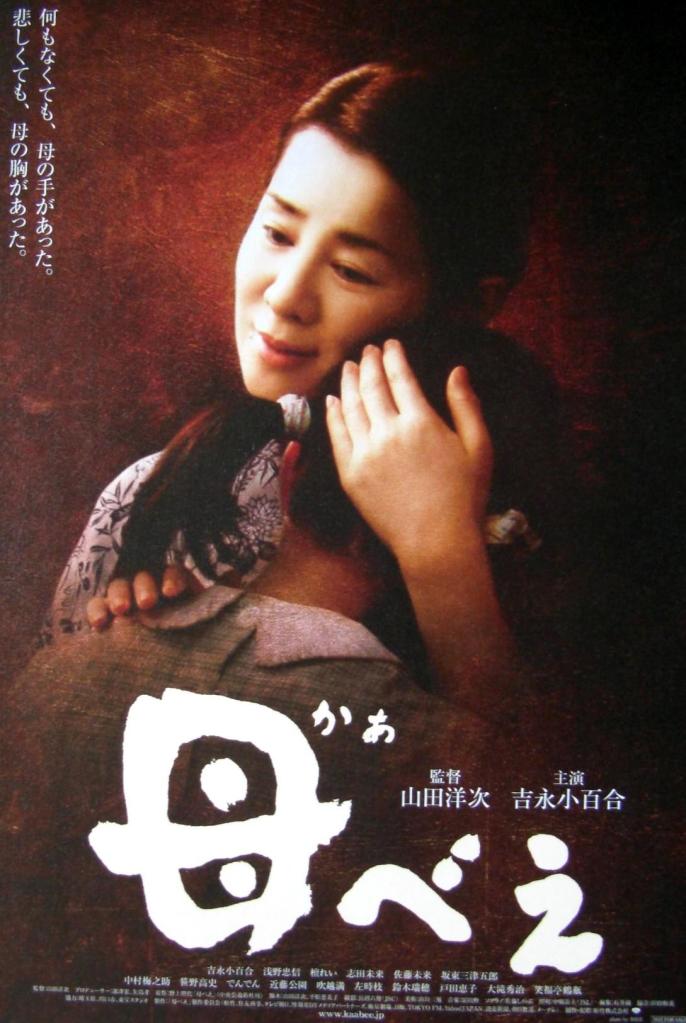 Yoji Yamada’s films have an almost Pavlovian effect in that they send even the most hard hearted of viewers out for tissues even before the title screen has landed. Kabei (母べえ), based on the real life memoirs of script supervisor and frequent Kurosawa collaborator Teruyo Nogami, is a scathing indictment of war, militarism and the madness of nationalist fervour masquerading as a “hahamono”. As such it is engineered to break the hearts of the world, both in its tale of a self sacrificing mother slowly losing everything through no fault of her own but still doing her best for her daughters, and in the crushing inevitably of its ever increasing tragedy.
 As you read the words “adapted from the novel by Kanae Minato” you know that however cute and cuddly the blurb on the back may make it sound, there will be pain and suffering at its foundation. So it is with A Chorus of Angels (北のカナリアたち, Kita no Kanariatachi) which sells itself as a kind of mini-take on Twenty-Four Eyes (“Twelve Eyes” – if you will) as a middle aged former school mistress meets up with her six former charges only to discover that her own actions have cast an irrevocable shadow over the very sunlight she was determined to shine on their otherwise troubled young lives.
