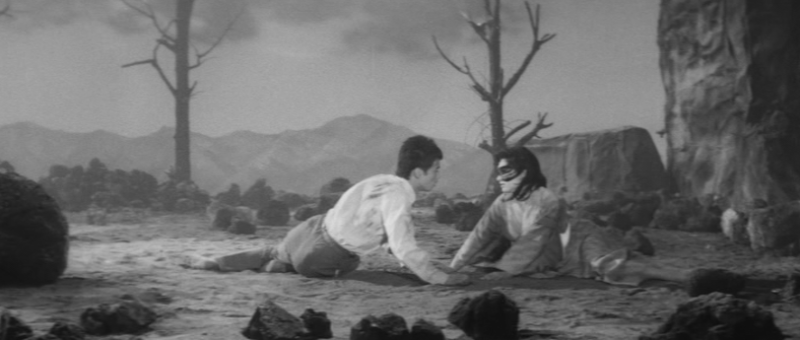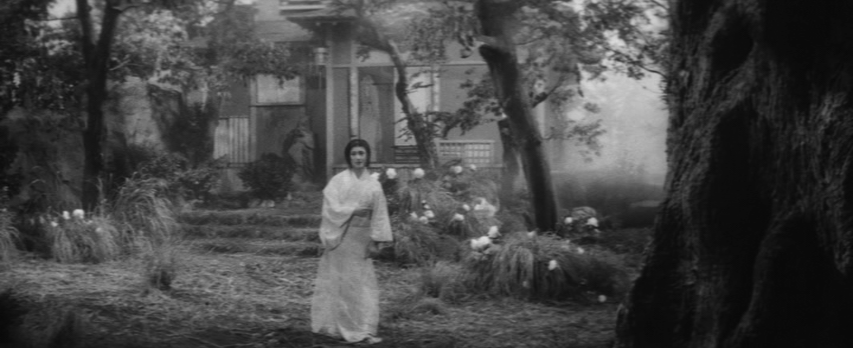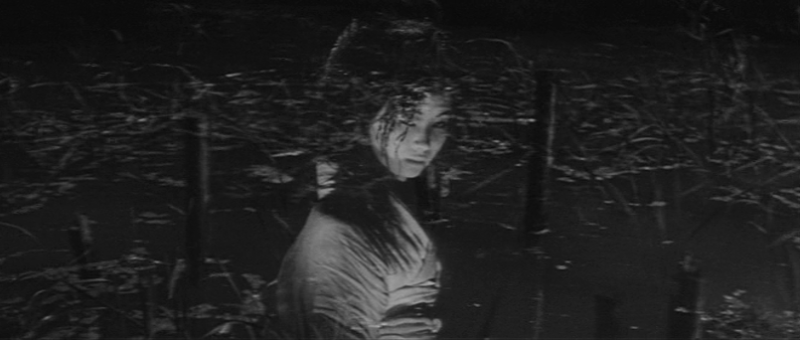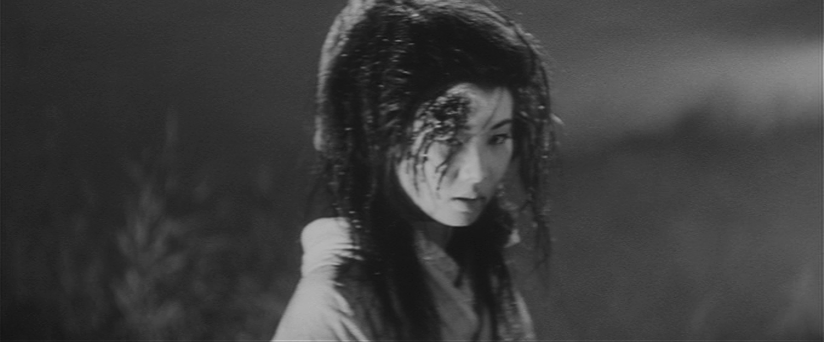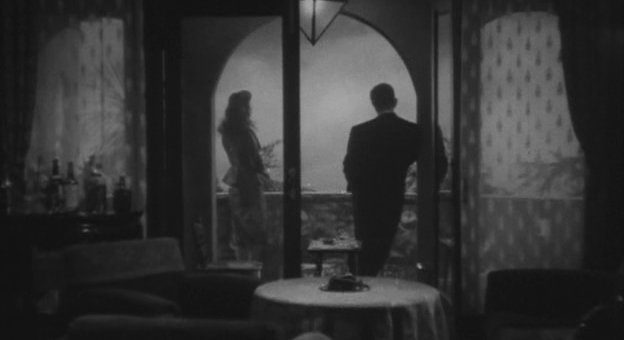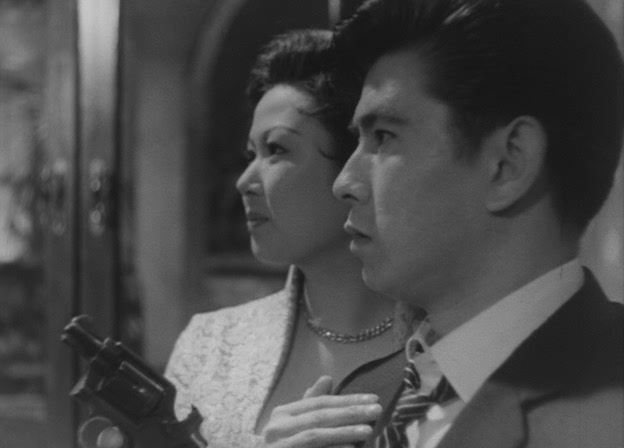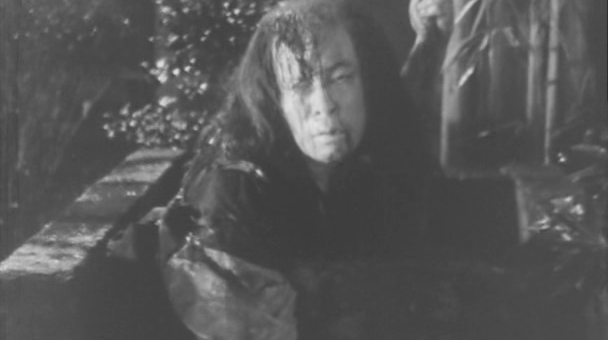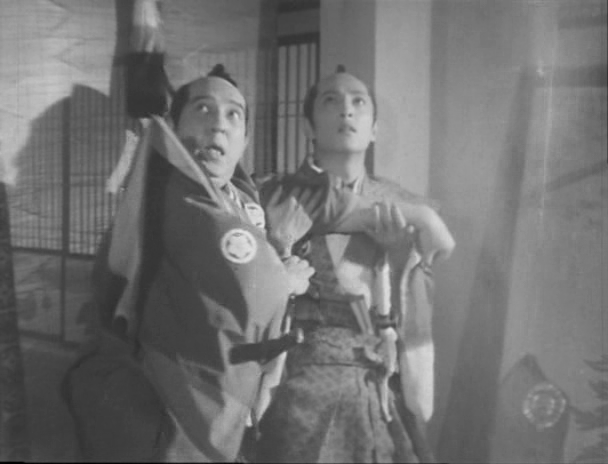
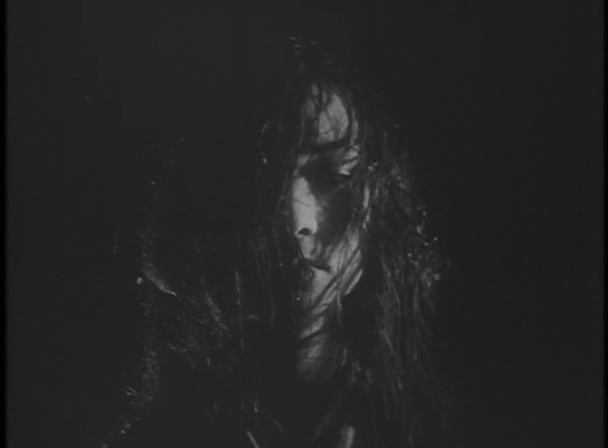
The Military Policeman and the Dismembered Beauty (憲兵とバラバラ死美人, Kyotaro Namiki, 1957)

The Military Policeman and the Dismembered Beauty (憲兵とバラバラ死美人, Kenpei to Barabara Shibijin) was apparently a substantial hit on its release, though to modern eyes at least it doesn’t quite live up to the salaciousness of its title. In fact, it seems a little more interested in reassessing the militarist past while attempting to rehabilitate an authoritarian power and reframing it as good and compassionate unlike the corrupted killer who is selfish and ambitious to the extent that he’s literally poisoning the militarist wells. 

What we’re first introduced to, however, is a rather familiar tale of a soldier who’s gotten a girl pregnant but now won’t marry her mainly because he’s onto a good thing with a pretty girl from a prominent family so his girlfriend’s in the way. Though we see a prelude to the murder, we don’t get good a look at the soldier’s face (though we do hear his voice) which on one level hints at the generalised violent threat of the militarist machine but is also a neat plot device that allows us to into the crime but still maintains the mystery. When we do see the actual killing, it’s surprisingly frank for the time period and disturbing in its sexual charge though there is no gore involved save a grisly discovery in yet another well. 

The killing occurred shortly before the regiment left for Manchuria, which seems to be one way the killer sought to move on and leave his crime behind. The first hint of the corruption is discovered by a gang of new recruits as yet unused to the militarist machine. They notice that the water in the well in the barracks is bad, but are at first bullied and insulted by another soldier who’s been there longer and gives them a rather priggish speech about the sanctity of the regimental water. What they discover is that the water tastes bad because there’s a dismembered torso in there and has been for the last six months. One has to wonder why the culprit would think this a good place to hide a body given the risk of discovery and increasing suspicion but as it turns out no one is all that interested. The Military Police aren’t that keen on investigating themselves, and then we get the familiar conflict between the local cops and the specialists as a top investigator, Kosaka (Shoji Nakayama), is assigned to investigate the crime and insists on doing so thoroughly rather than just beating their favourite subject into a false confession. 

Kosaka is then posited as a nice Military Policeman, an emissary of legitimate authority rather than bumbling provincials who are ridiculous and self-serving not to mention incompetent and resentful. We’re told repeatedly that Kosaka is prepared to work with the civilian police unlike the other military policemen who insist on militarist primacy and refuse to allow the detectives onto the base to investigate. He’s a representative of a less authoritarian age that looks forward to the democratic future, but he is also a part of that organisation himself no matter how different he may seem to be and cannot escape the overarching structures of militarism. Nevertheless, his edges are further softened by a nascent romance with the middle-aged innkeeper at his lodging house while his assistant is after her sister, a childhood friend who can’t stop calling him by his old nickname. 

The two of them investigate scientifically, making frequent trips to the pathologist to discuss theories and evidence though Kosaka is eventually guided towards the solution after seeing the young woman’s ghost. The local military police meanwhile fixate on another soldier who has a reputation for using sex workers, one of whom has recently disappeared, though Kosaka thinks the man is a just a crook with what modern viewers make think of as a sex addition that sees him steal supplies from the kitchen to sell in order to finance his visits to the red light district. The military police whip him in an oddly sexually charged manner to try to get him to confess, but he maintains his innocence. One of the motives for the murder was seemingly that the victim planned to expose the affair, taking her concerns to the killer’s superior officer in an effort to force him to marry her which would have ruined his career prospects in what is supposed to be an organisation of honourable men. Unlike Kosaka who shares his name with the writer of the novel the film is based on which may have been inspired by true events, the other military police are largely like the killer, arrogant, selfish and unfeeling though all Kosaka himself represents is a supposedly more benevolent authority that for his niceness may not actually be all that much nicer.


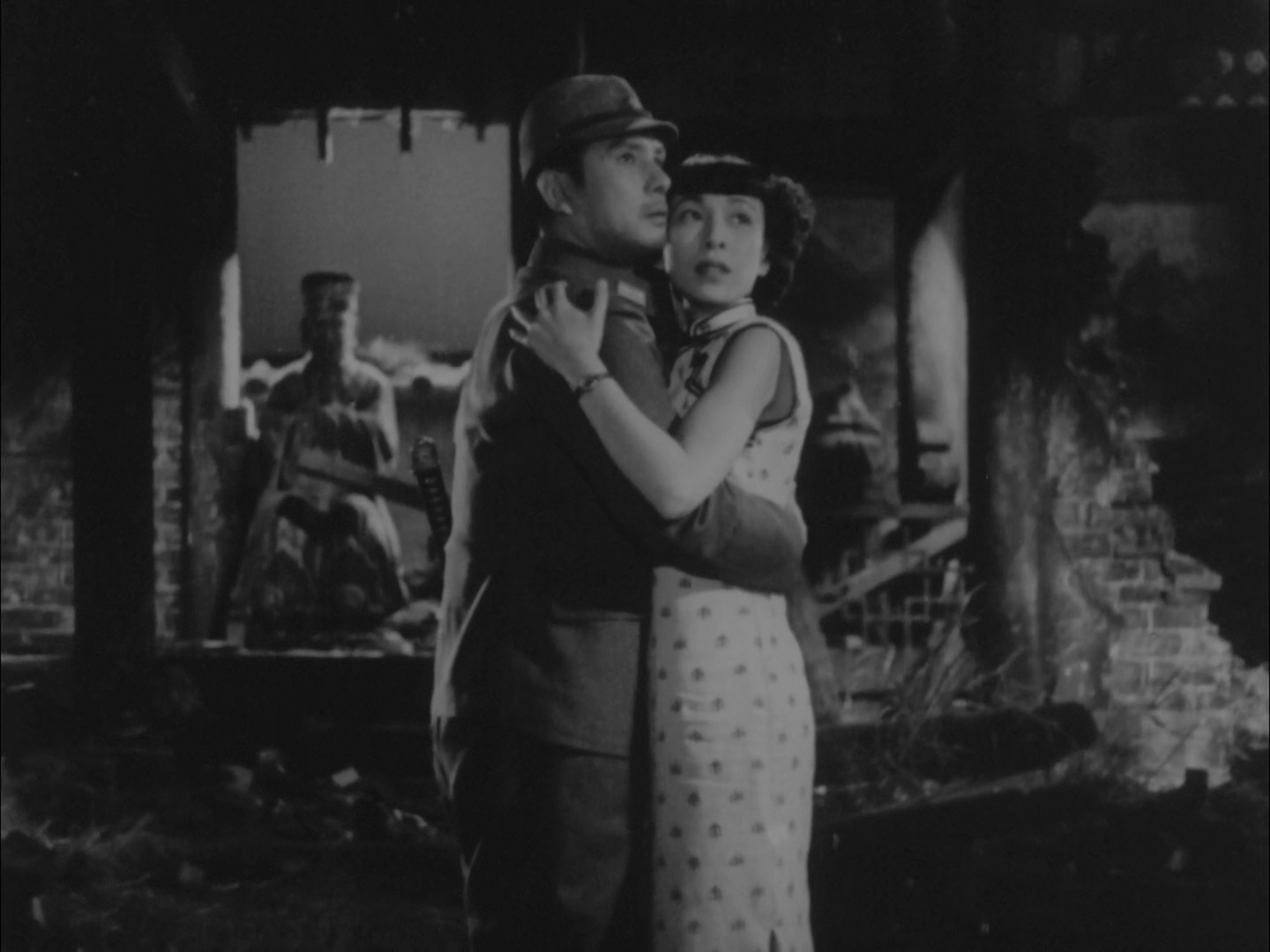
365 Nights (三百六十五夜, Kon Ichikawa, 1948)

For his second film at Shintoho, Kon Ichikawa had wanted to adapt a story by Ryunosuke Akutagawa that later inspired Rashomon, but was handed a standard melodrama to direct first. Ichikawa apparently did not think much of the novel the film was to be based on nor the script by Kennosuke Tateoka which he subsequently brushed up with the help of his new wife Natto Wada, and it’s not difficult to see why he might have felt he had an uphill battle. Melodrama is after all a genre that is founded on coincidence, though 365 Nights (三百六十五夜, Sambyaku-rokujugo ya) quickly strains credulity with the sheer number of unlikely events and surprise reappearances along with its rather strange take on the contemporary post-war society which is undoubtedly influenced by the demands of the Occupation censorship regime. 

Indeed, the setting itself seems reminiscent of 1930s cinema following the dashing hero Koroku, played by the equally dashing Ken Uehara, an architect who has walked away from his privileged upbringing as the son of a successful construction magnate. His problem is that he’s being aggressively courted by the haughty Ranko (Hideko Takamine), also the daughter of a successful but shady businessman, who to modern eyes is basically stalking him. Grinning with an evil glint in her eye, she tells her minion Tsugawa (Yuji Hori) that she’ll have seduced Koroku within 365 days which by melodrama standards seems to give her quite a lot of leeway.

Clueing us up to her villainy, Ranko is always seen wearing incredibly stylish Western outfits but otherwise behaves in a transgressively masculine fashion ordering her male employees about while set on the sexual conquest of Koroku who despises her for everything she is. It’s difficult not to see an inherent criticism of the new post-war woman and an anxiety regarding the power that comes with wealth being wielded by someone who is not a man. The contrast between Ranko and traditional femininity is rammed home by the fact that Teruko (Hisako Yamane), the daughter of the landlady in the house where Koroku finds new lodging after moving home to escape Ranko, is always dressed in kimono and otherwise naive and innocent. 

This positions Ranko, and her minion Tsugawa who is also in love with her, as the villains who are rebelling against the kind of earnestness expressed by Koroku and Teruko. From more humble origins, Tsugawa is deeply resentful of Kokoku’s class privilege and feels that he looks down on him which is one reason he seeks revenge by destroying his life along with his sexual jealously that Ranko pays him no attention yet is fixated on Kokoku perhaps precisely because he is entirely uninterested in her though it remains mystery why you’d want to be married to someone who strongly dislikes you. 

Yet for all his own earnestness, Koroku is almost betrayed by the capitalist father of whom he also seems to disapprove when he asks him to consent to an arranged marriage with Ranko to save his business. Meanwhile, it also transpires that Teruko’s father has been absent from her life because he two has a criminal past further tainting the legacy each of them bear. Ichikawa stages each evolution of their relationship at the same, noirish street corner that seems to exist as a kind of border between the illicit underworld that seeps out from Tsugawa’s bar into the post-war society, and the geniality represented by Teruko’s otherwise nice, middle-class home. 

It’s the this transgressive quality, of being caught between these two worlds, that starts to eat away at Koroku leaving him a broken and shabby man little better than a tramp. In a break with melodrama norms, though he is aware that he has led Teruko into Tsugawa’s trap he comes to believe that she has betrayed him while she clings fiercely to her love and in the end attempts to sacrifice it basically giving Koroku to Ranko whom she believes can better care for him in his now corrupted state. Though events become grim with a wedding that is staged like a funeral and takes place at a death bed, there is also the sense that something must come right that seems a little incongruous and perhaps a concession to the censors board as may be the coda implying that Ranko, despite having undergone a kind of redemption, will also have to pay for all her dodgy dealings. Though clearly hampered by the material, Ichikawa crafts some stunning images such as the final scene at Tsugawa’s bar along with a surprisingly energetic action sequence during which Koroku fights off burglars at Teruko’s home and wins her heart with his manliness. In any case despite the hints at redemption the implication remains that this is a world dark at its core in which not even the earnest can escape its creeping corruption. 


Nightshade Flower (夜来香, Kon Ichikawa, 1951)

A couple who met briefly in Manchuria are reunited in Kobe five years later but find their joy short-lived amid the vagaries of the post-war society in Kon Ichikawa’s tragic romance, Nightshade Flower (夜来香, Ieraishan). The film takes its name from a song “夜来香” known as “Ieraishan” in Japanese, a transliteration of the Mandarin pronunciation (yèláixiāng) in katakana, which was released in a Chinese-language version in Shanghai in 1944 performed by Manchurian Japanese actress Yoshiko Yamaguchi (山口淑子) who also went by the names Ri Koran/Li Hsiang-lan (李香蘭) and later Shirley Yamaguchi at various times in her career. A song of lost love, it seems to echo a sense of despair among the wartime generation who cannot reconcile their pasts with the post-war present. 

Akiko (Asami Kuji), a sex worker, first meets Seki (Ken Uehara), an army doctor, when he pulls her out of the way of an oncoming vehicle in a crowded market place in Northern China in June, 1944. As she is dressed in cheongsam and angrily shouts at him in Mandarin, he assumes her to be Chinese and carries on along his way while she remains ambivalent about the encounter especially as the sleeve of her dress has been torn. In any case, it’s clear that the situation has become precarious and most of the Japanese population are preparing for evacuation. The owner of the brothel where Akiko and her friend Gin (Harue Tone) are employed has hopes of carrying on her business further behind the lines where army bases are still in operation though the pair would prefer to head home as soon as possible, jumping off the repatriation truck organised for them by the madam with the intention of returning to the city and boarding the next one bound straight for the mainland. 

But Gin falls off a cliff and injures her leg, leaving Akiko to go in search of a doctor incongruously rocking up at Seki’s medical clinic. Though she is originally unwilling to have him treat Gin, she soon comes around and the pair begin seeing each other with Akiko pledging to stay behind after putting Gin on a truck. Nevertheless the pair are separated during an air raid with Akiko believing that Seki has been killed in a direct hit to the shrine they were sheltering in when he left their foxhole to check on a crying baby. Five years later, Seki has returned to Kobe to look for Akiko but has had no luck while staying with the family of one of his men, Toshio (Yuji Kawakita), who has fallen into post-war despair and given up his promising future in medicine to peddle black market drugs with shady fixer Kameyama (Reikichi Kawamura). 

The crisis comes when Seki realises he is losing his sight, apparently a delayed reaction to the head injury he sustained in Manchuria which was not fully treated due to the war’s end. Though he reunites with Akiko, he believes that he can no longer have a future with her because of his impending blindness and in fact that his life is now over. Akiko meanwhile has also fallen into despair. Believing Seki was dead she gave up on the idea of finding him and has returned to sex work, she and Gin working in a small backstreet bar and living in adjacent rooms of a rundown tenement block. Seki had always known that she was a sex worker, but she believes he may now reject her because she has failed to live up to the promise she made him of living a more “honest” life ironically because without him she had no reason to do so. 

Meanwhile, Seki is intent of saving Toshio whom he had first met as a naive private openly crying over the death of his mother having picked up a venereal disease after losing his virginity to a sex worker in an attempt to overcome his grief. Toshio is an embodiment of the despair felt by young men who went to war as innocent teenagers and are filled with disillusionment and confusion. Though Toshio is luckier than most who struggle to find work in the difficult post-war economy, he came from a middle-class medical family and if he finishes his training of which he only has a year left he would inherit his father’s clinic, he no longer sees a future for himself and actively rejects his privilege as an act of self-harm by taking up with Kameyama and becoming involved with crime. He resents his father for remarrying soon after his mother died, taking the family maid as his second wife, and is reluctant to marry their nurse, Chiyo (Chiaki Tsukioka), who is also Kameyama’s younger sister, as everyone expects him to despite otherwise carrying on an affair with her which later results in a pregnancy. He says that he wants to earn his own living and be his own man but claims he cannot see the bright future Seki speaks of for him and continues along a dark path of crime and vice. 

The constant rumblings of the train along with its flickering light strongly foreshadow the tragic denouement but also hint at the automatic motion of society that damns the trio and frustrates their attempts to move on from the war and find happiness in its aftermath. Even so, to modern eyes the motif of Seki’s literal blindness which robs him of the ability to perceive a happy future with Akiko cannot but seem a little ableist even as Akiko points out that many men lost their sight in the war but are living good lives with wives and children and that she does not see his disability as a barrier to their ability to make new lives for themselves in the post-war society much as he doesn’t regard her past in sex work as a reason to reject her.

Even so, Seki is dragged into the post-war morass after becoming involved with Kameyama in a futile attempt to save Toshio only to discover that Kameyama has betrayed them by getting them both to work on the same job as a payment for a debt taken out by Seki on Toshio’s behalf to free him from his life of crime. Ichikawa embraces a sense of melodrama with frequent closeups and an underlying theatricality, but also captures something of post-war confusion in the noirish fog that surrounds Akiko as she considers one last job to pay for probably useless medical treatment to save Seki’s sight. The cruelty of the ending is in its way too difficult to bear but perhaps apt for the view from 1951 in which the possibility of escaping the legacy of wartime corruption lies only in painful memories. 


Lust of the White Serpent (蛇精の淫, Morihei Magatani, 1960)

The lingering inequalities of the feudal society are manifested in a snake woman’s thwarted desire for love in Morihei Magatani’s Shintoho horror Lust of the White Serpent (蛇精の淫, Jasei no In). Not quite as salacious as its title may imply, Magatani’s film takes a sympathetic view of the classic snake lady painting her as a tragic heroine betrayed by the codes of the mortal world with its persistent classism and misogyny while offering the conflicted hero caught between the old and the new only a compromised escape in spirituality. 

In what the opening voiceover describes as a local legend that has been passed on “since ancient days” though seemingly taking place in the relatively recent past, village boy Minokichi (Hiroshi Asami) hears a woman’s screams while walking along a mountain path and investigates to find her writhing around in the long grass. Having been attacked by a snake, the woman, Kinu (Kinuko Obata), seems confused though Minokichi recognises her as the daughter of the village headman and offers to carry her home. Unfortunately Kinu’s retinue immediately jump to the conclusion that filthy peasant boy Minokichi must have abducted her, roundly beating him for having dared to lay his hands on such a fine lady. “Even if you try to interact with them, they won’t treat you as an equal. This our fate” his mother reminds him cautioning him against any further attempts at interclass friendship. 

The problem is that the half-crazed Kinu has apparently imprinted on Minokichi and insists that she will marry only him or else die. This is unwelcome news for her father who had been considering marrying her off to the son of a local businessman who has learning difficulties on the promise of a seat on the prefectural council. As for Minokichi, he is technically betrothed to childhood friend Kiyo (Yumiko Matsubara) but is growing resentful having fallen for Kinu but knowing that their romance is impossible because of the barrier of social class. In a surprising move, Kinu’s father chooses his daughter’s happiness over both the current social order and his own financial gain in formally offering Kinu to Minokichi who is then conflicted, at first reassuring Kiyo that he cannot accept only for her to tell him that he must on hearing the rather naive conviction of the local policeman that this taboo-breaking interclass union will liberate the villagers from their subjugation by the townspeople and they’ll never be looked down again. 

As it turns out, Kinu has been possessed by the spirit of a snake woman, Sakurako, who fell in love with Minokichi after he saved her when she became trapped on a rock. The pair had had a brief affair a year earlier which Minokichi’s mother had put a stop to fearful that Minokichi was falling victim to a curse and that Sakurako meant to drain him of his energy and move on. “My background doesn’t matter, does it?” Sakurako had ironically asked having explained to Minokichi that she was just “a poor girl with no one to turn to” echoing the forbidden quality of Minokichi’s romance with Kinu. Yet their relationship is also transgressive in spanning two worlds. “Intimacy with an animal is non-Buddhistic behaviour” Minokichi is later scolded by an intense priest though still finding himself drawn to Sakurako despite the entreaties of his mother and Kiyo trying to drag him back to the village and his “proper” place in the contemporary social order. 

As for Kinu little thought is given to this reckless usurpation of her body, Sakurako seemingly having chosen her to appeal to Minokichi’s desire for social advancement. Once everyone knows she is possessed by a snake spirit things get even stranger with some of the men in the village believing that the only way to tell is to sleep with her. Having tried a shinto shamaness who confirmed a diagnosis of possession by a white snake, Kinu’s father tries a Western doctor branded a “horny weirdo” by the villagers. Despite everyone knowing this and that he is clearly drunk, the doctor is left alone in a room with Kinu and proceeds to rape her while the servant Sakuzo who had beaten Minokichi merely for touching his mistress watches silently from outside. When Sakurako strangles the doctor, winding her snake body around his chest, it is read as an expression of the snake’s curse, everyone instantly understanding what the doctor had done but merely covering up the crime while later petitioning Kinu’s father to have her sent away to save them from the havoc she is wreaking with storms, droughts, and floods in protest at her unhappy fate. 

Minokichi who was supposed to unite two worlds and dissolve barriers finds himself in a liminal state no longer a member of either, Kiyo’s father refusing to welcome him back into the village while having separated from Kinu on realising she is a snake woman denies him a place in the town. While he tells himself that he should know his place, reintegrate himself into the village and accept his proper social role by settling down and marrying Kiyo as he was supposed to do he cannot let go of his desire for Sakurako/Kinu and in the end cannot resist following her even if or perhaps precisely because it may lead to his death. When the “curse” is broken he is led away once again only this time by the priest as a new devotee of Buddhism reinforcing a spiritual message but ironically also implying that Minokichi’s fault was in trying to help others, firstly the snake and secondly Kinu, when he should like his mother advised have minded his own business and refrained from interacting with those outside of his immediate community be they beautiful noblewomen or alluring snake spirits. Though light on effects, Magatani ups the atmosphere with copious fog while employing a series of dissolves for the snake women’s transformations and some superimposition for their wrathful curses. The message may be know your place or you’ll end up nowhere, but the film nevertheless has unexpected sympathy for the lonely Sakurako beaten into submission by a cruel and misogynistic society. 


Original trailer (no subtitles)

The Ghosts of Kagami Pond (怪談鏡ケ淵, Masaki Mori, 1959)

“How could you do this to me?” asks a wandering ghost in Masaki Mori’s 1959 Shintoho kaidan Ghosts of Kagami Pond (怪談鏡ケ淵, Kaidan Kagami-ga-fuchi). Based on a story by Kozo Hayama, Mori’s supernatural morality tale is in many ways fairly typical for the genre save that the vengeance wreaked by the wronged spirit is extremely targeted rather than the sometimes indiscriminate curses aimed more at a corrupt society than the figures directly responsible for the death and mistreatment inflicted on the now wrathful ghost. 

The good-hearted hero, Yasujiro (Shozaburo Date), was forced to move to Edo after his father fell into disgrace with the Shogunate authorities and is grateful to have been taken in by the owner of kimono shop Ejimaya. However, his presence is intensely resented by veteran employee Kinbei (Joji Ohara) who had been expecting to inherit the business. Overhearing the boss, Jiemon (Hiroshi Hayashi), and his wife (Fumiko Miyata) discussing a possible marriage between Yasujiro and his childhood friend Kiku (Noriko Kitazawa) reunited by chance in the city, Kinbei realises that he intends to make Yasujiro his heir and hatches a plan to ensure that doesn’t happen beginning with selling Kiku’s sister Sato (Reiko Seto) a knock off wedding kimono that tears during the ceremony leading her intended’s family to cancel the marriage entirely leaving Sato a shamed woman in an impossible situation. Wandering the streets in despair intending to throw herself into Kagami Pond and thereafter become a vengeful ghost cursing the house of Ejimaya, Sato encounters Kinbei again and is killed in the ensuing struggle only to tumble into Kagami Pond sinking without trace. 

“No one ever floats up out of there” Kinbei later insists suggesting the pond as a possible dumping ground for additional bodies of which there are a fair few. As kaidan villains go, Kinbei is of the one note variety in simply being evil for no particular reason the only justifications offered for his ill conduct being his previous devotion to the kimono store and the fear that all his hard work will go to waste if Yasujiro is allowed to inherit. Even so, this seems disingenuous given an early scene in which an angry customer brings a kimono back complaining of shoddy work and suggesting she’s been fobbed off with a substandard product. Kinbei blames the whole thing on new employee Yasujiro though it later seems clear that he probably sold her a cheap kimono and pocketed the difference in price. 

He even goes so far as to mug Yasujiro in disguise, stealing 15 Ryo which he’d been transporting on behalf of the store attempting to sink his rival in debt. When Yasujiro’s disgraced father offers to sell a precious family sword to pay back Jiemon, Kinbei kills him too while 15 Ryo is also the amount for which he indentures Kiku to a brothel after framing her for adultery (illegal at the time) with the help of his sex worker co-conspirator Naka (Keiko Hamano) who bumps off Jiemon’s wife and quickly takes her place. Jiemon, who had previously been kind and fatherly insisting that Yasujiro and Kiku are like his own children to him, undergoes an unexplained and abrupt change of character becoming cruel and greedy, loaning money to another store holder in the assumption he won’t be able to pay it back in order to get his hands on his business and eventually party to all of Kinbei’s scheming little realising he most likely intends to bump him off too after he’s married Naka so that they will have full control of the business. 

Kinbei is occasionally haunted by the rising ghost of Sato who chillingly repeats the phrase “How could you do this to me?” but carries on with his dastardly deeds anyway. As in most kaidan tales, she cannot hurt him directly but leads him to hurt himself by causing him to hallucinate, as do the ghosts of Yasujiro’s dad and the storeowner eventually calling him towards Kagami Pond and his watery fate. Some disjointed storytelling aside, the introduction of a potential ghost cat for example is never followed up, Ghosts of Kagami Pond is a fairly typical B-movie kaidan running a tight 60 minutes even if the effects and supernatural imagery are perhaps muted in comparison with Shintoho’s similarly themed ghostly morality tales. 


Clip (no subtitles)

Flesh Pier (女体桟橋, Teruo Ishii, 1958)

Teruo Ishii may be most closely associated with his exploitation work for Toei in the late ‘60s and ‘70s but in actuality he began his career at Toho, later joining Shintoho where he served as an AD to among others Mikio Naruse whom he regarded as a lifelong mentor. After making his debut with boxing movie King of the Ring: The World of Glory in 1957, he worked mainly in children’s sci-fi tokusatsu serials before sliding into B-movie noir of which 1958’s Flesh Pier (女体桟橋, Nyotai sanbashi) is an early example. 

Set firmly in the contemporary era, Ishii opens with a documentary-style voiceover exoticising the seedy underbelly of the city’s entertainment district hidden away in otherwise sparkling Ginza. Shooting in a bold reportage style, he captures a sense of natural spontaneity reminiscent of early American independent cinema transitioning directly into nightclub Arizona where a woman is furiously dancing. Arizona is as we’ll see the nexus of the recent proliferation of “call girl” businesses which have arisen since sex work was criminalised and in this case at least dependent on an international sex trafficking network backed by an American gangster, Thompson (Harold Conway). Salaryman Keizo (Ken Utsui) is a new customer, double checking that the business is “safe” before being reassured that they don’t deal with anyone they don’t know and have already vetted his identity, but when he reaches the hotel room he’s been handed the key for, he discovers the body of a woman lying in the bathtub and is forced on the run. The twist is that Keizo isn’t a bored executive after all but an undercover policeman working on breaking the trafficking ring. 

Co-scripted by Akira Sagawa, Flesh Pier seems to draw frequent inspiration from Casablanca only with the roles slightly reversed as replacement hostess Rumi (Yoko Mihara) finds herself wondering why of all the gin joints in Ginza Keizo had to walk into hers while the bar’s musician, Teruo (Teruo Hata), quite clearly in love with her himself, completes the triangular relationship. The couple even enter a Moroccan-style room while echoing Rick and Ilsa’s painful rehash of their Paris break up as Rumi tries and fails to explain why she left him on some previous occasion, Keizo remembering that she wore a white sweater and a blue coat to mimic Rick’s “the Germans wore grey, you wore blue” while the film’s ending is also hugely reminiscent of Casablanca’s “beginning of a wonderful friendship” only with additional romance. 

Nevertheless, the crime here is bigger and darker than most contemporary noir with awkward echoes of Japan’s prewar sex trafficking industry embodied by the karayuki as it becomes clear the gang’s business model relies on finding young women and luring them abroad with promises of good jobs only to force them into them sex work. Meanwhile one of the regular policemen, Hayami (Hiroshi Asami), gets a shock when he sets up a meeting with one of the call girls and is met by his own fiancée who, unbeknownst to him, has resorted to sex work in order to fund her brother’s tuition. “What else could I do?” she tearfully asks him making plain that in the difficult if improving economic environment of late 50s Japan sex work is still the only viable option for many women needing to support their families in the absence of men given persistent societal sexism which often locks them out of other kinds of well-paying jobs. Hayami perhaps understands this, drowning his sorrows with his veteran partner insisting that he’s sick of being a policeman and plans to quit only for the older man to sympathetically tell him not to give up so easily. 

Then again, Keizo’s secondary love interest Haruko (Akemi Tsukushi) is an intrepid undercover reporter posing as a model in order to bait the trafficking ring. Even so the primary drama revolves around Keizo and Rumi’s unfinished business along with her musician’s jealousy, the implication being more that her feelings for Keizo have clouded her judgement rather than reawakened a sense of moral goodness. Like many femme-fatales in post-war B-movie noir she is made to pay the ultimate price for her transgressive femininity in having firstly climbed the in-gang ladder and then damned herself in her conflicted love for the earnest Keizo even while suspecting he may be an undercover cop despite his acting like an underworld thug. These are indeed a new breed gangster much more like those seen in European and American noir rather than traditional yakuza while the environment of the Arizona is also something of a liminal space as the opening voiceover puts it in but not of Japan. 

While nowhere near as lurid as some of Ishii’s later work, Flesh Pier is certainly daring for the time period in the griminess with which it depicts the successor to the red light districts along with its air of forbidden allure even while its club scenes are in keeping with those found in other contemporary gangster tales if lent a little more realism in the immediacy with which Ishii shoots them making full use of documentary-style handheld. Expressing a degree of anxiety as regards Japan’s increasingly global outlook along with that of increasing social change, Flesh Pier is formally daring from the young Ishii artfully playing with classic noir while fully embracing the transgressive thrills of B-movie crime. 


The Ceiling at Utsunomiya (怪異宇都宮釣天井, Nobuo Nakagawa, 1956)

Crime does not pay for a series of conspirators at the centre of Nobuo Nakagawa’s supernaturally-inflected historical tale, The Ceiling at Utsunomiya (怪異宇都宮釣天井, Kaii Utsunomiya Tsuritenjo). As the title implies, Nakagawa’s ominous jidaigeki is inspired by a historical legend in which a retainer supposedly attempted to assassinate the shogun through the rather elaborate device of a mechanical ceiling designed to crush him as he slept. In actuality no such thing took place, the shogun changed his route and subsequent investigations of Utsunomiya Castle found no sign of a false ceiling, yet the story took on a life of its own as local folklore. 

In this version of the tale, conspirators Councillor Kawamura (Ureo Egawa) and local yakuza Kagiya (Masao Mishima) are conspiring to depose Tokugawa Iemitsu (Yoichi Numata) in favour of his brother, manipulating Lord Honda (Shuntaro Emi) of Utsunomiya Castle by convincing him that his clan will prosper when the other retainers fall in behind the new shogun. The pair have arranged for nine talented craftsmen to be shut up in the castle to install “the mechanism” in time for the arrival of the shogun who is due to stay at the castle on his way to Nikko. Meanwhile, Kawamura is also intent on sleeping with the daughter of head carpenter Toemon (Yoji Misaki), Ofuji (Konomi Fuji), whom chief minion Tenzen (Tetsuro Tamba) is supposed to kidnap once the workmen have gone into isolation in the castle. Righteous samurai Ryutaro (Hiroshi Ogasawara) however, an undercover shogunate bodyguard, begins to disrupt their plan saving Ofuji while bonding with a friendly bar hostess, Onobu (Sachiko Toyama), and secret princess forest woman Oshino (Akemi Tsukushi). 

The plot represents in itself a malfunctioning of the feudal order in the essential weakness of Lord Honda, the ambition of his underling Kawamura, and the cruel greed of Kagiya. As the two men conspire, Kagiya jokingly laments that he isn’t a samurai while Kawamura reminds him that if the plan comes off he’ll be fantastically rich. Kagiya, a yakuza who sends his thugs to extort protection money from the local market, is representation of the threat of the rising merchant class whose financial power presents a challenge to the authority of the samurai. Toemon, meanwhile, a master craftsman, is manipulated into participating in the plan because he is in debt to Kagiya, later promised that he too will be “promoted” in being given permission to carry a sword little knowing that Kawamura and Kagiya not only plan to kidnap and rape his daughter but never intend to allow any of the craftsmen to live because they simply know too much. 

The Ceiling at Utsunomiya is not a ghost story in the manner for which Nakagawa is best known but it certainly plays like one, Kagiya eventually haunted by the figure of a betrayed Toemon which in turn leads him to a self-destructive attack on Tenzen and his eventual demise collapsed over his ill-gotten gains, a koban falling from his hand. Greed and violence will only repay in the same, the weak-willed Lord getting his comeuppance from the ever confident shogun even if he himself coolly stands back while others risk their lives to protect him. Even so, the eventual operation of “the mechanism” is intensely startling, the ceiling abruptly collapsing with alarming ferocity though one wonders what the advantage is in such an expensive, elaborate contraption aside from its ironic symbolism when the point of a sword will do. 

Then again, the heroic Ryutaro is almost assassinated while crossing a river via zip wire later fished out of the river by sullen forest woman Oshino, first encountered hunting birds with darts but later revealed to be the illegitimate child of samurai parents who fell foul of political intrigue. In a sense this revelation emphasises the restoration of the political order, Ryutaro permitted to fall in love with Oshino because they are of the same social class, while the romance between Ofuji and craftsman Yoshichi (Kotaro Sugiyama) also comes to fruition eliding the minor class difference between them in allowing the boss’ protege to marry the now orphaned daughter. Onobu meanwhile pays heavy price for her misplaced love for Ryutaro, denied romantic fulfilment in her liminal existence as a bar hostess. In any case, the corruption is exorcised and the normal order resumes reinforcing the hierarchical shogunate society with each of the players back in their rightful positions and possessing new hope for the future as Ryutaro and the shogun continue their tour while their former comrades kneel at the roadside. 


Ghost Cat of Nabeshima (鍋島怪猫伝, Kunio Watanabe, 1949)

When is a ghost cat not a ghost cat? Drawing inspiration from classic folklore and kabuki theatre, the ghost cat movie had been a popular genre of pre-war cinema yet thereafter fell out of favour before a brief resurgence in the 50s and 60s. Inspired by the classic vampire cat legend, 1949’s Ghost Cat of Nabeshima (鍋島怪猫伝, Nabeshima Kaibyo-den) was part of a wave of post-war kaibyo yet in a slightly meta touch features no actual “ghost cat” leveraging instead the superstitious fear of their existence along with a mild prejudice towards otherwise supernaturally cute kitties. 

Set in the feudal era, the central drama revolves around a weakened lord, a supposedly cursed Go board, and local hysteria about a dangerous ghost cat lurking round the palace that has the townspeople nervous enough to have organised a patrol on the look out for suspicious-looking felines. A store owner has recently taken in an ornate Go board which has sent his wife into a minor frenzy because it looks just like the one from the local temple which she knows to be haunted by the vengeful spirit of a man who was killed during a dispute over a particularly heated game. As such, she pushes him to sell it as quickly as possible which he does to a lower level samurai whose gaming companion is so weirded out by the bad vibes emanating from the board that he gives it away to villainous retainer Tanuma (Ureo Egawa). Tanuma then gifts it to the rather effete lord ignoring the advice of his noble rival Komori (Denjiro Okochi) that Go is bad for the lord’s health both mental and physical. 

Komori may in a sense be proved right when, lacking a companion, the lord decides to summon Matashichiro (Haruo Tanaka) who is reputed to be a good player. Matashichiro is something of a Go obsessive and had been planning to leave for Edo in order to train with a true master partly it seems because he is carrying a chip on his shoulder as his family has been reduced in circumstances leaving him with few opportunities. On seeing the board, however, he appears to have something of an episode repeating the earlier tragedy in insisting the lord is playing “unfairly” before starting a fight during which the lord accidentally kills him, Matashichiro’s adorable black kitten Kuro leaving tiny bloody footprints as he scuttles away to relative safety glaring at the lord as he goes.

The lord thereafter develops an intense fear of cats, half-believing Kuro has become a bakeneko out to get him. All of this plays directly into the hands of Tanuma who is secretly plotting against the lord and hopes to capitalise on the ghost cat rumours while simultaneously making the lord seem mad in order to usurp and manipulate him. Tanuma had rejected concern over the cursed nature of the board insisting that “supernatural things don’t exist” while suggesting “weak government” is the reason such rumours were allowed to arise in the first place though it later becomes clear he too is manipulating them later sending out one of his minions in a ghost cat outfit with the instruction to cause trouble to keep the townspeople afraid. Komori, meanwhile, the good samurai later reminds the lord that he brought some of this on himself in his selfishness, failing to properly care for his subjects such as the rebellious Sanpei (Yataro Kurokawa) who openly disparages him while encouraging a peasant revolt in the face of samurai indifference. 

In this, there is perhaps a message for the immediate post-war world in the peasants’ frequent mistaken assertion that greed is good and a necessary tool for survival, Sanpei and the others half-heartedly taking part in a cat cull ordered by the increasingly paranoid lord which creates further animosity towards the samurai authorities from local people who love their cats and won’t stand for their beloved pets being sold off and killed because of a bizarre rumour about a vengeful feline spirit. One of the reasons cited for the decline in popularity of the ghost cat film is that post-war audiences simply no longer took such things seriously and some of that flippancy is indeed seen in the attitudes of some of the townspeople who are quick to dismiss such ridiculous superstition. Yet there are ghostly apparitions only they’re very much human if perhaps mildly linked to feline activity, a dishevelled Matashichiro appearing in front of the lord to remind him of his crime while Tanuma does his best to cover it up. Here more than most, there’s a heavy implication that the spirits of the deceased are mere hallucinations of a guilty mind, but could the Go board really be responsible, it did provoke a violent rage in the otherwise dejected Matashichiro after all?

Then again, when the townspeople regain it, they realise the Go board is just a Go board experiencing very few supernatural incidents despite having it in their possession for over two months and as any cat owner knows, footprints on the tatami are hardly an unusual occurrence. “Did anyone actually see the ghost that everyone was fussing about?” a woman asks to confused silence before someone jokingly points at Matashichiro’s former girlfriend Otoyo (Michiyo Kogure) now guardian to the adorable Kuro looking like butter wound’t melt. Order has in any case been restored, the disruptive Tanuma’s schemes unmasked, the lord reminded of his proper responsibilities whether by supernatural intervention or not, and the townspeople laying aside their “greed” while rediscovering a sense of mutual solidarity not to mention affection for their feline companions. Playful to the last, Watanabe closes with a handheld zoom into the cute kitten sitting innocently atop the cursed board while the drunken townsmen snooze all around him in ominous tranquility. 


Black Cat Mansion (亡霊怪猫屋敷, Nobuo Nakagawa, 1958)

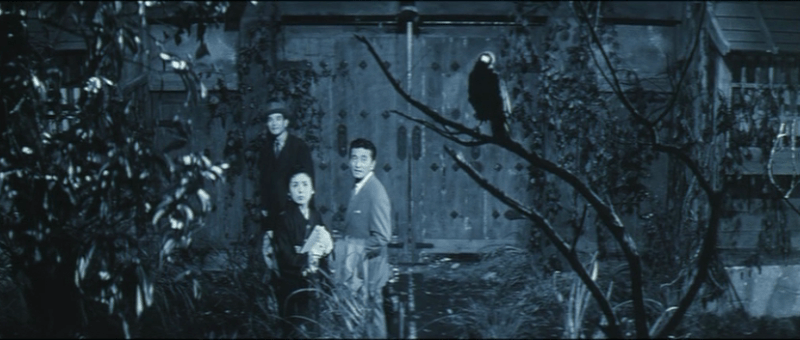
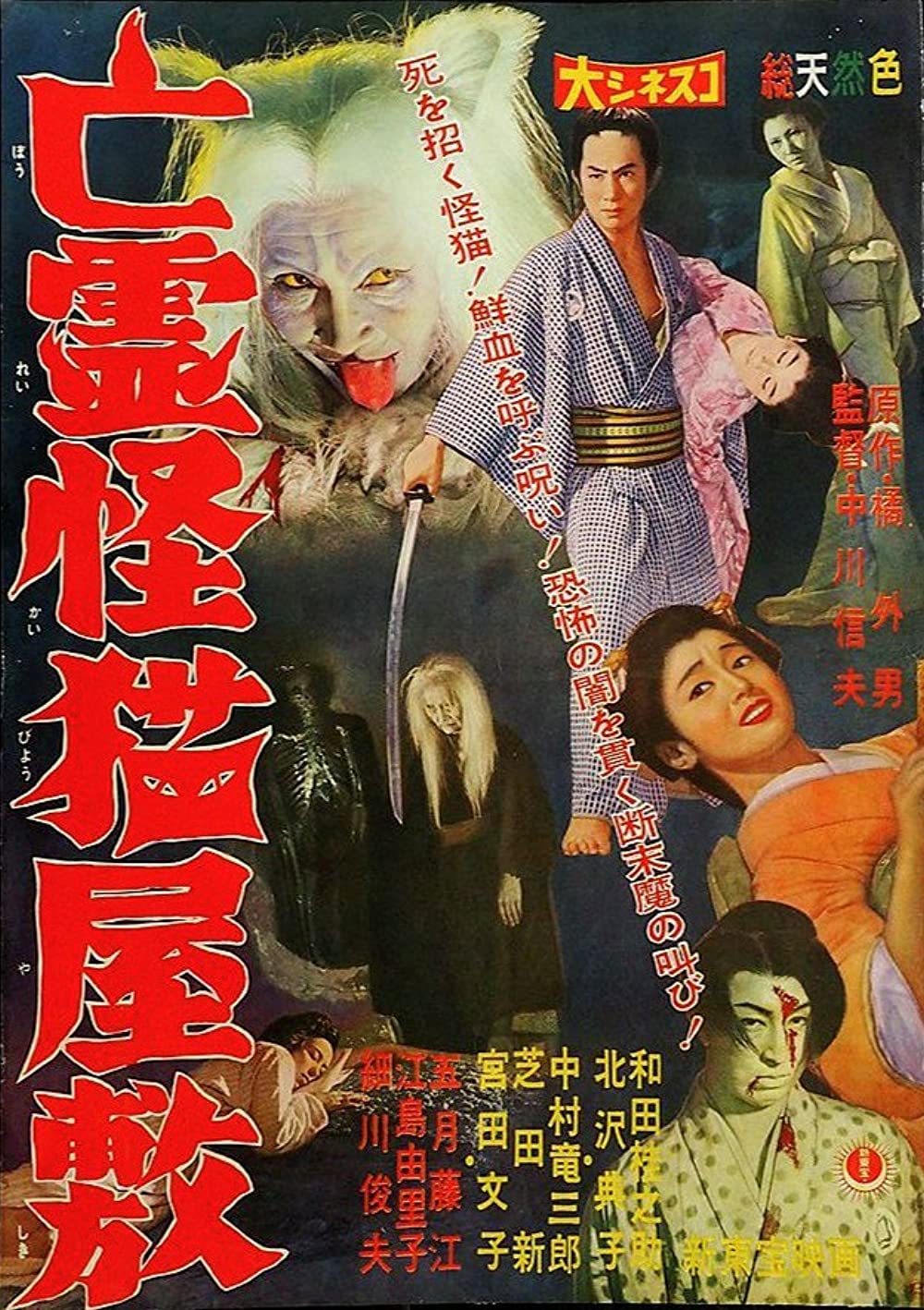
A doctor and his wife find themselves at the mercy of an ancestral curse in Nobuo Nakagawa’s eerie gothic horror, Black Cat Mansion (亡霊怪猫屋敷, Borei Kaibyo Yashiki, AKA Mansion of the Ghost Cat). Most closely associated with the supernatural, Nakagawa’s entry into the ghost cat genre is among his most experimental outside of avant-garde horror Jigoku released two years later. Employing a three level flashback structure spanning the modern day, six years previously, and then all the way back to Edo, Nakagawa positions contemporary Japan as a kind of haunted house with skeletons in its closet which must finally be exposed and laid to rest if society is to recover from the sickness of the feudal legacy. 

Nakagawa opens, however, with an ethereal POV shot in blue-tinted monochrome of a doctor walking through a darkened hospital armed only with a torch while a pair of orderlies silently remove a corpse on a gurney right in front of him. A man of science, the doctor, Tetsuichiro (Toshio Hosokawa), confesses that he’s tormented by the sound of footsteps on this “evil night” which remind him of a strange series of events that took place six years previously while his wife Yoriko (Yuriko Ejima) was suffering from advanced tuberculosis. In an effort to aid her recovery the couple left Tokyo to return to her hometown in the more temperate Kyushu. Yoriko’s brother Kenichi (Hiroaki Kurahashi) expresses concern over his sister’s health, wondering if she wouldn’t be better to have an operation but Tetsuichiro explains that at this stage an operation might only make things worse so they’re hoping the quiet and fresh air will allow her lungs to recover more quickly. Kenichi has sorted out a place for them to live in an abandoned mansion but the house is extremely dilapidated and in fact barely habitable especially for someone suffering with a debilitating medical condition in which it might be sensible to avoid dusty environments. Nevertheless, the couple fix the place up and Tetsuichiro opens a surgery in the front room. 

For Yoriko, however, the house is full of foreboding. On their journey there, the driver had to swerve to avoid a black cat running out in the road, nearly careering off the side of mountain, while she is also alarmed to see a crow malevolently perching on a tree outside the mansion. Once inside, she glances into a storehouse by the entrance and thinks she sees a creepy old woman silently grinding corn. Tetsuichiro sees nothing when he checks it out, but is strangely unperturbed when Yoriko spots what seems to be a bloodstain on a bedroom wall insisting that they can paint over it while the footprints of someone walking barefoot through the dusty house are probably unrelated and belong to a homeless person who’s since moved on. For a man of science, Tetsuichiro is doing a lot of overlooking but seems to believe that his wife’s distress as she continues to complain of bad dreams featuring rabid cats and the creepy old woman is mere “hysteria” provoked by the mental stress and anxiety of living with a potentially fatal medical condition. 

Unfortunately for him, however, vengeful cat spirits don’t care if you believe in them or not, what sort of person you are, or even if you have any real connection to whatever it was that turned them into a vengeful cat spirit in the first place. A visit to a local Buddhist priest reveals, in a vibrant colour filled with kabuki-esque shadows on the shoji, the reasons everyone thought the house was haunted which stem back to the Edo era and an entitled samurai lord with anger management issues, Shogen (Takashi Wada). Shogen hires a local Go master, Kokingo (Ryuzaburo Nakamura), to teach him the game and is enraged by Kokingo’s lateness for the appointment which is attributed to the fact that his mother is blind but is actually more to do with his cat’s severe separation anxiety. 

Taking this as a personal slight to his position, Shogen attacks his loyal servant Saheiji (Rei Ishikawa) and is only prevented from killing him by his levelheaded son (Shin Shibata) who makes a point of asking his grandmother to keep an eye on his dad because he’s worried his famous temper will cause embarrassment to the family. He is right to worry. Shogen takes exception to Kokingo right away, insisting on playing a “real” game but asking for take backs every five seconds when Kokingo makes a winning move. Fed up with Shogen’s behaviour, Kokingo brands him a cheat and threatens to leave the game. Shogen is once again enraged and fight develops during which Kokingo is killed. Shogen threatens Saheiji into helping him dispose of the body by walling it up inside an adjacent room while telling his mother that Kokingo was so embarrassed over losing to him that he’s gone off  in a huff for additional study in Kyoto and Osaka. Shogen doesn’t even stop there, raping Kokingo’s mother when she starts asking questions after seeing her son’s ghost leading her to commit suicide after cursing his entire family and instructing Kokingo’s beloved cat to lap up her blood and imbibe her wrath to become a vengeful cat spirit. 

Shogen is all the worst excesses of the samurai class rolled into one, narcissistic, angry and entitled as he uses the exploitation of those below him to foster a sense of security in his authority. As in any good ghost tale, the vengeful spirits distort his sense of reality forcing him to destroy himself out the guilt he refuses to feel. His son, Shinnojo, meanwhile is positioned as a good, progressive samurai determined to marry the woman he loves even though she is only a maid and therefore of a lower social class while often transgressively denouncing his father’s bad behaviour. That matters not to the ghost seeing as the curse is to Shogen’s entire bloodline meaning Shinnojo must to die and most likely at the hands of his father caught in a delusion trying to fight the ghosts of his past crimes. 

Tatsuichiro and Yoriko are “innocent” too though as it turns out Yoriko does have a connection to the house and the crimes of the past. They are still, however, trapped within the embodiment of the feudal legacy that is the former samurai mansion. Tatsuichiro’s determination that they can simply “paint over” the bloodstain is in many ways the problem and one reaching a crescendo in post-war Japan as it struggles to deal with the trauma of the immediate past while freeing itself of the latent feudalism which in part caused it. Only by facing the ghost, unearthing the bodies buried in the walls and laying them to rest, can they ever hope to make a recovery both spiritually and medically. Tatsuichiro at least seems to have cured himself even if left with a lingering sense of unease while his apparently now healthy wife seems to have overcome her fear of cats in the relative safety of modern day Tokyo. 


Original trailer (no subtitles)

Ginza Cosmetics (銀座化粧, Mikio Naruse, 1951)

1951’s Ginza Cosmetics (銀座化粧, Ginza Kesho) is often said to mark a kind of rebirth in the career of director Mikio Naruse whose output in the 1940s was perhaps unfairly denigrated not least by Naruse himself. As in much of his golden age work and in anticipation of When a Woman Ascends the Stairs, Ginza’s heroine is a resilient bar hostess whose brief hopes of escape through romance are doomed to failure, but it’s also, like the slightly later Tokyo Profile (Hiroshi Shimizu, 1953) and Tales of Ginza (Yuzo Kawashima, 1955) an ode to the upscale district and all the defeated hopes of its illusionary glitz and glamour. 

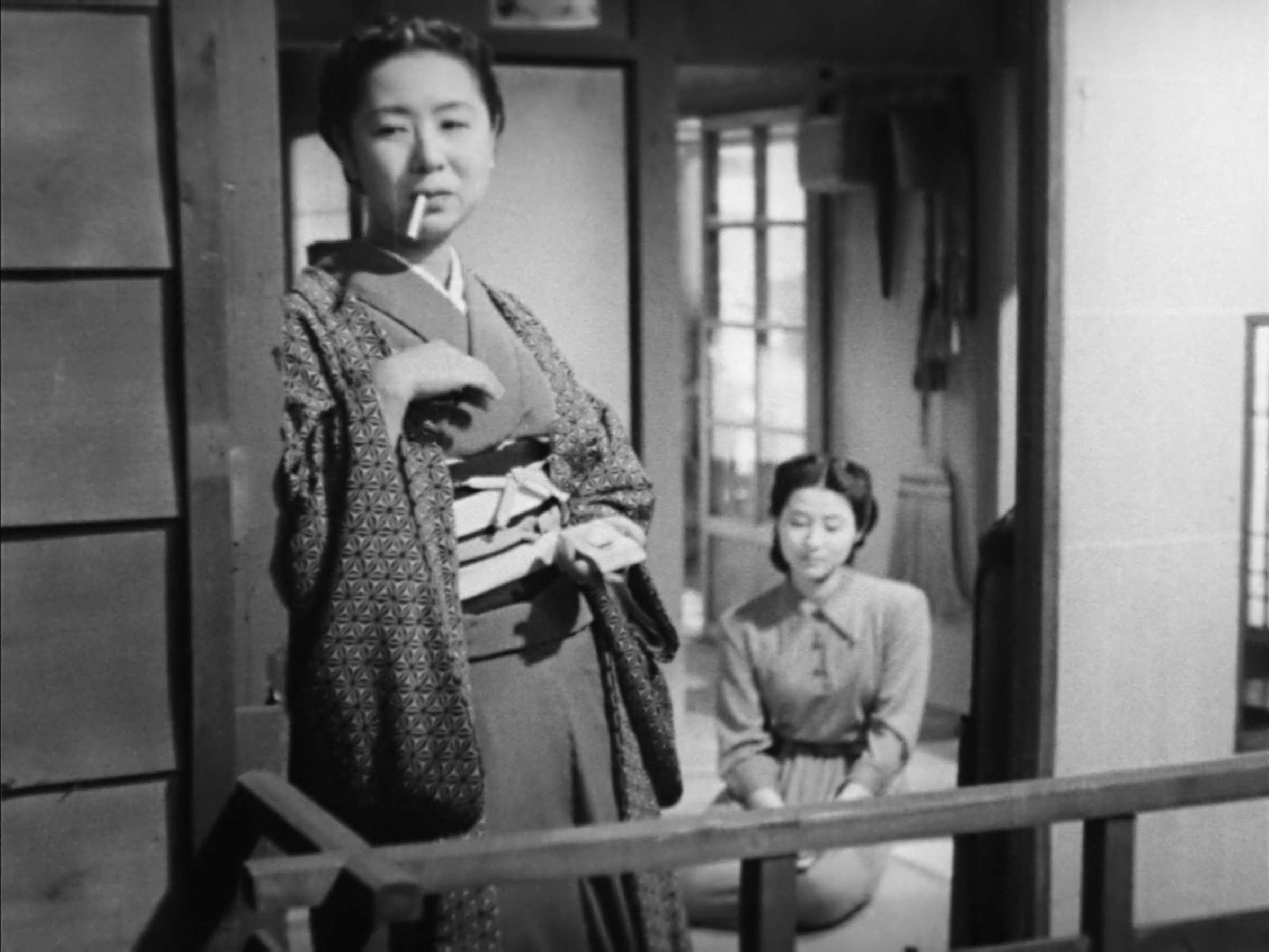
Yukiko (Kinuyo Tanaka), the heroine, is a single-mother approaching middle age and working as a hostess in a Ginza bar. Her landlady who runs a nagauta school on the ground floor and constantly complains about her feckless though goodnatured unemployed husband seems to think she could do better, pointing out that she is an educated woman who seems slightly out of place in the rundown backstreets of this otherwise aspirational area. Even for educated women, however, there may not be many other opportunities in the straitened and socially conservative post-war economy especially for those without connections, and Yukiko also needs to provide for her young son Haruo (Yoshihiro Nishikubo), born out of wedlock after an affair with a customer with whom she had fallen in love but abandoned her when she became pregnant. 

As a slightly older woman who has been working at the Bel Ami bar for many years, seemingly from war to occupation, Yukiko is both looked up to by the younger women and resented as a stern older sister who does not approve of the way some of them ply their trade. She’s taken one, Kyoko (Kyoko Kagawa), who often babysits for her, under her wing, cautioning her against making the same mistakes that she once made in taking the kinds of men that come into the bar at their word. “Men are all animals” she warns her, supporting her desire not to give in to her parents’ attempts to arrange for her not a marriage but a “position” as a mistress. Unlike Yukiko, Kyoko still has hope of leaving the Ginza bar world behind to become a respectable wife even if those hopes are fading with the relative unlikelihood of finding a “good” man with a salary good enough to support a wife who is not already married and can be understanding of her bar girl past. 

The bar world may be on the fringes of the sex trade, but the bar girls are not necessarily sex workers even if some of the younger women are clearly engaging in the kinds of casual sex work of which Yukiko clearly disapproves even while not against consensual romantic liaisons. For her own part, she finds herself in the awkward situation of a continuing non-relationship with a failed businessman, Fujimura (Masao Mishima), who was fairly wealthy during the war but apparently no longer. Yukiko attributes this to him being in someway too good to prosper, though having money in the war which disappeared afterwards perhaps implies the opposite. She does not love him and seems to find his presence a little irritating, but feels indebted because he stood by her when she was pregnant and alone. In any case, he has a wife (whom he apparently resents) and children (whom he claims to adore) and so she feels at best conflicted, especially as the tables have turned and it’s him now constantly asking her for money. Money is not something Yukiko has a lot of, but she isn’t mean and often consents to losing it with a resigned shrug as she does by taking on Kyoko’s bar debt after a customer runs out on the bill and then tricks Yukiko into buying more drinks while waiting for a “friend” to arrive. 

Men, it seems, will always be predatory and unreliable. On hearing from her boss and longtime friend that the bar is in trouble and may have to close, Yukiko ends up acting on an introduction from an acquaintance, Shizue (Ranko Hanai), to meet a “stingy” industrialist who had expressed an interest in her. Shizue has escaped the bar world by becoming a wealthy man’s mistress and with it has claimed a kind of independence. He splits his time between Tokyo and Osaka, leaving her free to do whatever she likes (including meeting other men) for most of her time with none of the strings that go with being a wife. Yukiko is perhaps too “pure” for that kind of arrangement, hinting at the Ginza paradox that only those who learn to accept a certain level of complicity can ever truly be happy there. She agrees to meet Kanno (Eijiro Tono), the businessman, in order to ask him to “invest” in the bar, suggesting they talk things over in a coffeeshop while he tries to pull her into various shady establishments before pushing her into a warehouse and attempting to rape her to get his money’s worth. Yukiko escapes and resolves not to see him again. After all, the point of getting the money to keep the bar open was precisely to avoid having to make arrangements with men like Kanno. 

It’s Shizue, however, who later gives her a last shot at escape when she introduces her to her “true love”, Ishikawa (Yuji Hori), making a brief trip into the city. Shizue can’t entertain him herself because her patron is in town and so entrusts him to Yukiko with the strict instruction not to try it on. Despite herself, however, Yukiko becomes fond of him, reassuming something of a past persona in engaging in intellectual conversation, once again an educated, middle-class woman rather than a bar hostess used to telling men what they want to hear. She has been warned, however, that Ishikawa hates anything “low culture” which is why Shizue has told him they are both war widows and discovers that he has a strong dislike for Ginza which sees him longing for the wholesome charms of home. 

The crisis occurs when Yukiko has to break a promise to Haruo to take him to the zoo in order to look after Ishikawa, causing him to go temporarily missing when he wanders off on his own roaming all over the endless construction site of the contemporary city standing in for the makeshift, in-progress reconstruction of the post-war society. She perhaps feels she’s being punished for choosing to disappoint her son in order to pursue a dream of romantic escape she might also feel is somehow undeserved, but pays in quite a different way after accidentally setting Ishikawa up with Kyoko whom she introduced as her “sister”. Originally angry and resentful, proclaiming herself disappointed with Kyoko in assuming she is the same as the other young women at the bar, Yukiko’s good nature eventually wins out as she realises that Kyoko and Ishikawa seem to have fallen in love in a single night. She has told him everything, and he apparently wants to marry her anyway. Kyoko, at least, is getting out, and Yukiko can be happy about that while privately internalising defeat. Acknowledging that Haruo is the only one on whom she can depend, she resolves to live on as a mother only, trapped in the deceptive diminishing returns of a Ginza bar life even while knowing it has increasingly little place for her.