Summer of Ubume (姑獲鳥の夏, Akio Jissoji, 2005)

Summer of the UbumeAkio Jissoji has one of the most diverse filmographies of any director to date. In a career that also encompasses the landmark tokusatsu franchise Ultraman and a large selection of children’s TV, Jissoji made his mark as an avant-garde director through his three Buddhist themed art films for ATG. Summer of Ubume (姑獲鳥の夏, Ubume no Natsu) is a relatively late effort and finds Jissoji adapting a supernatural mystery novel penned by Natsuhiko Kyogoku neatly marrying most of his central concerns into one complex detective story.

Freelance writer Tatsumi Sekiguchi (Masatoshi Nagase) and occult expert Kyogokudo (Shinichi Tsutsumi) become intrigued by the bizarre story of a woman who has apparently been pregnant for twenty months. If that weren’t enough weirdness, the woman’s husband also went missing a year ago and now her sister has approached the pair hoping they can investigate and figure out what’s really going on. Unbeknownst to him, Sekiguchi has a longstanding connection with several of the people involved and himself plays a role in the central mystery. Demons foreign and domestic, past trauma, infanticide and multiple personality disorder are just some of the possible solutions but as Kyogokudo is keen to remind us, there is nothing in this world that is truly strange.

The mystery conceit takes the form of a classic European style detective story complete witha drawing room based finale in which each of our potential suspects is assembled for Kyogokudo so that he can deliver his final lecture and tick them all off the list as he goes along. The tale takes place in the summer of 1952 and so the spectre of Japan’s wartime past, as well as its growing future, both have a part to play in solving this extremely complex crime. The original supernatural question concerns two otherworldly entities which have become conflated – the Chinese Kokakucho which abducts children, and the Japanese Ubume which offers its child to passersby. Needless to say, the answer to all of our questions lies firmly within our own world and is in no small part the result of relentless cruelty masked as tradition.

The opening scene includes a lengthy discussion between Kyogokudo an Sekiguchi debating the nature of reality. We only experience the world as we perceive it, seeing and unseeing at will. Everybody, to an extent, sees what they need to see, therefore, memory proves an unreliable narrator when it comes to recalling facts which may run contrary to the already prepared narrative.

Jissoji brings his trademark surrealist approach to the material which largely consists of interconnecting flashbacks often intercut with other dreamlike imagery. Filming with odd angles and unusual camera movements, Jissoji makes the the regular world a destabilising place as the strange mystery takes hold. The canted angles and direct to camera approach also add to a slight hardboiled theme which creeps in around the otherwise European detective drama though this mystery is much more about solving a series of puzzles than navigating the dangerously dark world of the noir. That said this is a very bleak tale which, for all its frog faced children weirdness, has some extremely unpleasant human behaviour at its roots.

Supernatural investigator Kyogokudo quickly dispenses with the demonic in favour of the natural but the solutions to this extremely complicated set of mysteries are anything but simple. Making space for the original novel’s author to show up as a travelling picture storyteller with some Shigeru Mizuki inspired illustrations on his easel, Summer of Ubume is not entirely devoid of whimsy but its deliberately arch tone is one which it manages to make work with its already bizarre set up. The enemy is the unburied past, or more precisely the unacknowledged past which generates its own series of ghosts and phantasms, always lurking in the background and creating havoc wherever they go. Occasionally confusing, Summer of Ubume is a fascinating supernatural mystery which takes its cues much more from European detective stories and gothic adventure than from supernatural horror or fantastical ghost story.


Natsuhiko Kyogoku’s source novel is available in an English translation by Alexander O. Smith (published by Vertical in the US).

Original trailer (no subs):

Shark Skin Man and Peach Hip Girl (鮫肌男と桃尻女, Katsuhito Ishii, 1999)

Shark_Skin_Man_And_Peach_Hip_Girl_(1998)If you’re going on the run you might as well do it in style. Wait, that’s terrible advice isn’t it? Perhaps there’s something to be said for planning a cunning double bluff by becoming so flamboyant that everyone starts ignoring you out of a mild sense of embarrassment but that’s quite a risk for someone whose original gamble has so obviously gone massively wrong. An adaptation of a manga, Katsuhito Ishii’s debut feature Sharkskin Man and Peach Hip Girl (鮫肌男と桃尻女,  Samehada Otoko to Momojiri Onna) follows a mysterious criminal trying to head off the gang he just stole a bunch of money from whilst also accompanying a strange young girl, also on the run but from her perverted, hotel owning “uncle” who has also sent an equally eccentric hitman after the absconding pair with instructions to bring her back.
Like Ishii’s subsequent efforts, Shark Skin Man and Peach Hip Girl is a riot of full on craziness from the get go, though he largely manages to avoid manga adaptation cliches. The gangster, Samehada (Tadanobu Asano), is pursued by an eccentric set of former gang members – the sanest amongst them being Sawada (Susumu Terajima), his former partner who wants to track him down first to prevent the bloody retribution his guys have in store for him. The gang’s boss (Ittoku Kishibe), lovingly caresses a harpoon, dresses in a gestapo style shiny black leather overcoat, wears one glove, and is on a quest to track down rare vintage posters of much loved Japanese comedian Kon Omura. One of his henchmen is a guy with bleach blond hair who dresses all in white and has an extremely sensitive sense of smell but an intense aversion to water.

The heat coming from the other side is equally strange as the leacherous uncle is apparently friends with Japan’s weirdest hitman, Yamada, who dresses in a retro style and has a unibrow and a high pitched voice. In fact, he’s basically Ken Omura himself, creeping about, being odd in a ridiculous cartoon character way. Unfortunately, Yamada has a weakness and just as he’s about to complete his mission he falls in love with his target! Apparently this is something that happens to him often though you’d think it would be quite a liability given his line of work. In this instance who could really blame him, but his new found romance means he won’t be able to pull the trigger  – and not only that, he can’t bring the girl back either because he doesn’t want to break the beautiful gangster’s heart! Ah, true love!

There is quite a lot going on. Too much, really. For all the craziness which ensues, it’s hard to build up an attachment to any of our strange little gangsters and their petty plots or bids for freedom. Things build to a whirlwind of chaos in the final stretch but when it’s all supposed to calm down for a little spiritual contemplation at the end, the effect begins to fall apart.

There are however a few quieter sections such as a surprisingly maudlin one in which yakuza sons of yakuza fathers lament their unhappy childhoods which saw them bullied and excluded by their law abiding peers. One even says that he thought the tattoos were something which just appeared on everyone when they grew up. Ishii employs some strange jump cuts, moving us ahead a little jerkily as the time passes slowly for this motley crew of veteran bad guys. He later employs a similar technique where he shifts some of his violence into the expressionist realm by cutting on the sound of landing punches.

As the title suggests, Shark Shin Man and Peach Hip Girl is the story of two crazy kids on the run, and the bizarre collection of people who end up chasing them. Ishii could never be accused of subtlety but the punk infused, anarchic and ironic tone are difficult to resist even if the end result is a necessarily slight one. An imperfect, though impressive debut, Shark Skin Man and Peach Hipped Girl is an interesting genre infused tale that uses absurd humour as a foil for the darkness and violence which underpins it.


Original trailer (no English subs – French subs available via settings menu)

Midway through this film someone starts singing a Japanese language cover of Donna Donna which was a surprise! Can’t find a clip so here’s Joan Baez’s version live in Japan in 1967!

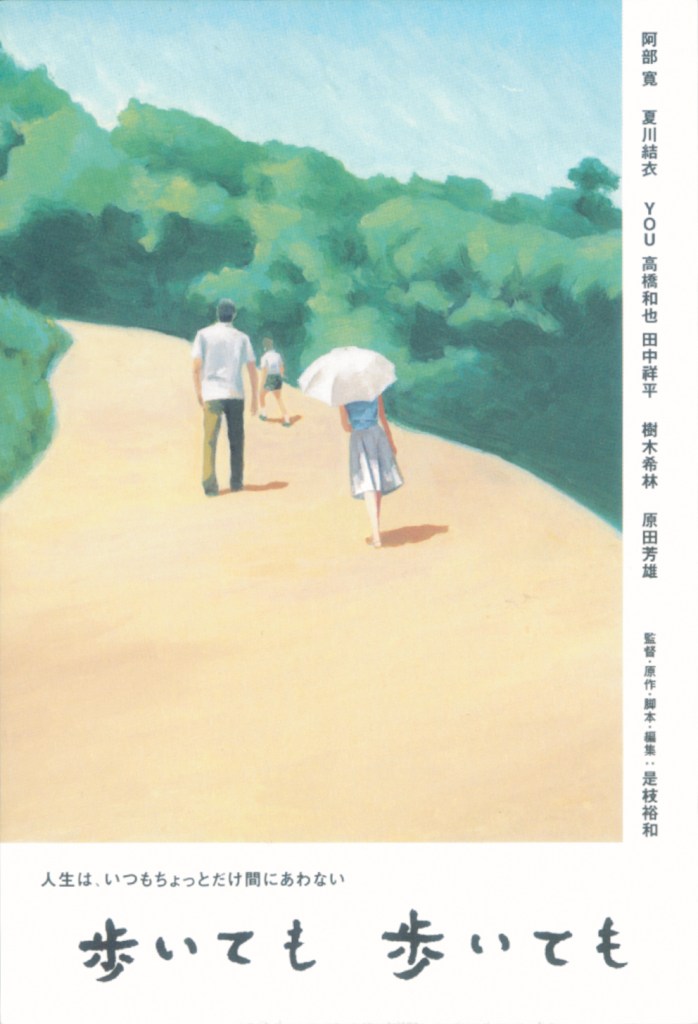
Still Walking (歩いても歩いても, Hirokazu Koreeda, 2008)

still walkingLife is full of choices, but the one thing you can’t choose is your family. Like it or not you’re stuck with them for life and even if you decide you want nothing to do with them ever again, they’ll still be hanging round in the back of your mind for evermore. Koreeda swings the camera back around the fulcrum of Japanese society for this dissection of the fault lines and earthquake zones rubbing up against this very ordinary family.
You’d be forgiven for thinking that some kind of celebration is about to take place at the beginning of Still Walking (歩いても歩いても, Aruitemo Aruitemo) yet the event that is about to bring scattered friends and family members back home is of a more somber nature. As the matriarch Toshiko (Kirin Kiki) peels vegetables with her daughter Chinami (YOU) she seems excited at the prospect of getting the family back together again yet melancholic and perhaps a little nervous.

Younger son Ryota (Hiroshi Abe) is taking the train in with his new wife and stepson. He urges Yukari (Yui Natsukawa) that they should make their excuses and leave in time for the last train but she feels obliged to stay over. It’s clear Ryota is not looking forward to a reunion with his family and also has some current worries over his working situation which are weighing on his mind and which he definitely does not want anyone in the family to find out about.

Ryota has a particularly strained relationship with his difficult doctor father, Kyohei (Yoshio Harada) who doted on his oldest son, Junpei, drowned at sea whilst saving the life of a little boy. Increasingly grumpy that he has no heir for his medical practice, Kyohei refuses to recognise Ryota as a grown man or accept his work as an art restorer as a “real” occupation. Tensions in the family are further brought out by the mild disapproval over Ryota’s choice of wife who was previously married and then widowed and has a young son by her first husband. Toshiko for one still harbours an old fashioned stigma towards second marriages and thinks Ryota could have done better than “buying second hand”. Though seemingly accepting of her new daughter-in-law and grandson, she perhaps treats them a little more like guests than fully fledged members of the family.

Set over the course of two days, Still Walking takes on a sense of Chekovian wit and melancholy as it paints a naturalistic picture of an ordinary family with all of the petty cruelties and indignation that involves. The deceased son, Junpei, has become a virtual saint, forever bathed in golden light by his grieving parents while Ryota remains very much alive yet pushed into the shadows. Feeling himself to raise only feelings of disappointment in his family, he adopts a truculent, defensive air which sees him unwilling to engage leaving the bulk of the work for his new wife who is eager to please her in-laws despite their frequent tactlessness in dealing with herself and her son.

Of course, Ryota and his father aren’t so different at all – both gruff, defensive, grumpy. Kyohei is a difficult man sinking into a miserable old age where he can no longer busy himself with the role which has given his life meaning, that of a respected small town doctor. When bubbly younger sister Chinami mentions having seen a newspaper report which referred to painting restorers as “art doctors”, neither man is very happy with being linked with the other yet there is a certain commonality between them that oddly forces them apart rather than ties them together.

Toshiko by contrast is the long suffering yet largely silent housewife whose maternal grief is the force which now defines her. Seemingly sweet and kind on the outside, there’s a tough core in the middle which gives way to some decidedly biting remarks lightly peppering the atmosphere with ancient resentments. Perhaps feeling a strange sort of kinship with the mystery guest-cum-kicking-boy-of-the-day – Yoshio, the boy who Junpei saved but has not made good on his investment as he’s turned into a slobbish and overweight 25 year old child who can’t seem to settle on one proper career, Ryota asks why his mother insists on inviting him every year knowing how painful it must be for him to come. Toshiko coldly replies that that’s exactly the reason she intends to keep making him visit, she feels wretched inside 24/7 so for one day every year she makes someone else feel dreadful too – will anyone blame her for that?

Grief and loss play a heavy part here, not only of the literal kind, but in the feeling of time wasted and the disappearing moments which can never be recaptured. Chinami’s son and daughter team up with Ryota’s stepson Atsushi to provide a melancholic mirror of the the three Yokoyama children playing in the same fields and staring at the same fleeting flowers as their forebears did years before. Time is always passing, you think there will always be another opportunity for saying something or other, forging a connection or new memory but soon enough the sand in the glass runs through. As Ryota notes, it’s always a little later than you think but you can’t see it until it’s already too late.

Dense with naturalistic detail, Still Walking is a warm if sad look at one ordinary family dealing with the aftermath of tragedy yet offers its own comments on the nature of human connection between fathers and sons, mothers and daughters, and between the living and the dead. A timely reminder of the transience of all things, Koreeda’s most straightforward take on the family drama proves a both profound and moving experience which only deepens with repeated viewing.


I rewatched this recently at an ICA members’ screening where it screened on 35mm but the print actually had an intermission built into it even though the film isn’t all that long – strange experience!

Still Walking is available on DVD and VOD in the UK from New Wave Films and was also released on blu-ray in the US as part of the Criterion Collection.

The film’s Japanese title Aruitemo Aruitemo is taken from the song made famous by Ayumi Ishida – Blue Light Yokohama which turns out to have a surprising significance within the film:

https://www.youtube.com/watch?v=MZ7RiVZvc-Y


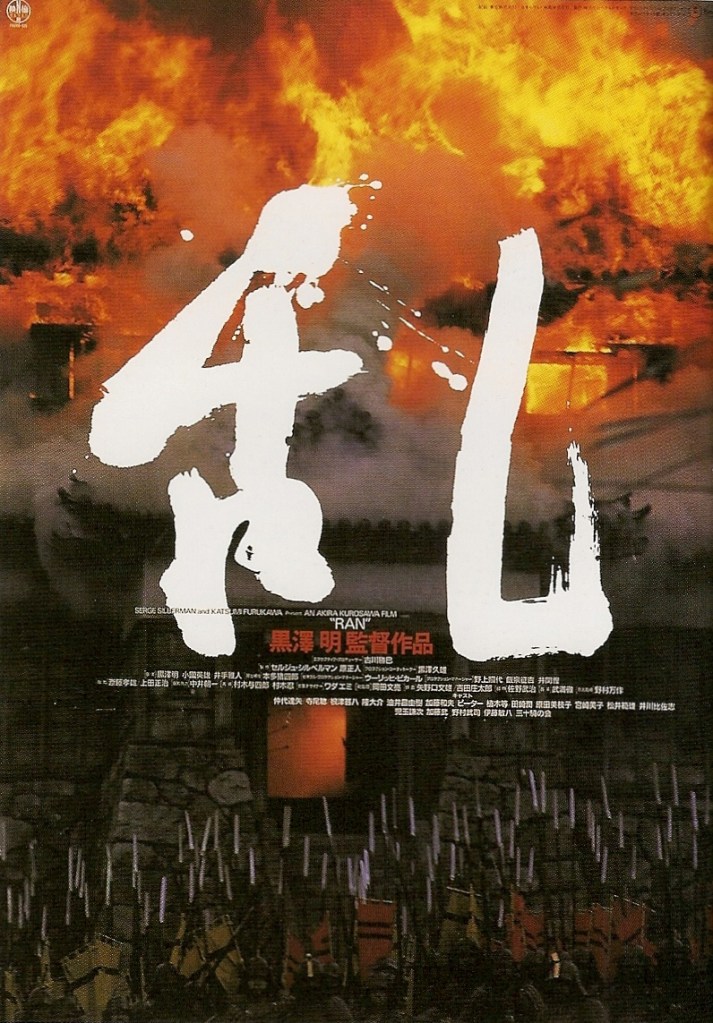
Ran (乱, Akira Kurosawa, 1985)

ran posterAkira Kurosawa is arguably the most internationally well known Japanese director – after all, Seven Samurai is the one “foreign film” everyone who “doesn’t do subtitles” has seen. Though he’s often thought of as being quintessentially Japanese, his fellow countryman often regarded him as too Western in terms of his filming style. They may have a point when you consider that he made three different movies inspired by the works of Shakespeare (The Bad Sleep Well – Hamlet, Throne of Blood – Macbeth, and Ran – King Lear) though in each case it’s clear that “inspired” is very much the right word for these very liberal treatments.

In the case of Ran (乱) – a loose adaptation of King Lear, Kurosawa moves the story to feudal Japan and an ageing king who this time has three sons rather than three daughters. This leaves Hidetora (Tatsuya Nakadai) with a smaller problem than Lear’s though in his original idea of making his eldest son his heir with the other two inheriting smaller roles it’s clear things aren’t going to end well. Just as in the original play, the oldest two sons Taro and Jiro sing their father’s praises with cynical glee but the youngest and most sincere, Saburo, refuses to play this game as his respect for his father is genuine. Unfortunately, Saburo’s honesty sees him banished from his father’s kingdom and his share of responsibility given over to his treacherous brothers. Predictably, neither is satisfied with what they’ve been given and it’s not long before a familial conflict has sparked into a bloody civil war.

How sharper than a serpent’s tooth it is to have a thankless child….Hidetora is not quite as far gone as Lear in Shakespeare’s original text at the beginning of the film yet he is still unable to see that his oldest two sons have placed personal ambition ahead of filial piety. Hidetora was once a fearsome, if cruel, warrior, famous for burning enemy villages and creating peace only through destruction. He’s old now, and tired and so he proposes to hand over the running of the kingdom to his eldest son, yet – he wants to remain the de facto leader until the very end. Of course, that doesn’t sit well with Taro, or more to the point his ambitious wife Lady Kaede. Hidetora is thrown out of Taro’s castle and then also from Jiro’s before all out war erupts between the two leaving him totally isolated – a king without a kingdom.

Hidetora’s true madness begins when he realises not only how little regard his eldest two sons hold for him, but also that his failure to recognise the true nature of the situation has lead to the deaths of the people in his care that have remained loyal to him to the very end. As the enemy begin to engulf the castle, concubines begin helping each other to commit suicide in order to avoid ravishment while others try to escape but are cut down by arrow fire. This is all his own fault – his ruthless cruelty has been filtered down to his two oldest sons who, as he did, will stop at nothing in the pursuit of power. What is a king if not the father of a nation, and as a father he has failed. Neither Taro or Jiro are worthy of the offices afforded to them and lack both basic humanity and the princely power one needs to become the unifying force of a people.

Only too late does Hidetora see the wisdom in Saburo’s words and finally understand that he has alienated the only one of his children that truly loved him. From this point on his madness increases and Nakaidai’s performance becomes increasingly mannered and theatrical as if Hidetora himself is acting in another play which only he can see. Wandering and lonely, the once great king is reduced to the estate of a beggar led only by his fool and sheltered by the ruins of a castle which he himself burned down.

However, as great as Nakadai is (and he always is), he’s very nearly upstaged by the young Mieko Harada as one of the all time great screen villainesses with the Lady Macbeth a-like Lady Kaede. Filled with a vengeful fury, Kaede is unafraid to use every weapon at her disposal to achieve her goal. No sooner is she brought the news of her first plan’s failure in the death of her husband than she’s embarking on a plot to seduce his brother which includes getting him to execute his wife. Vile as Kaede’s actions often are, her desire for revenge is an understandable one when you consider that Hidetora was responsible for the deaths of her family leaving her to become a trophy bride for the son of the man that killed them. Viewed from another angle, it would be easy to sympathise with Kaede’s desire to rid the world of these cruel and tyrannical lords were it not for her insistence on the death of Lady Sue – a woman in exactly the same position as herself whose death would not actually advance her cause very much at all.

Kurosawa films all of this from a distance. We, the audience, almost become the gods he speaks of – the ones who weep for us, watching silent and helpless, unable to save us from ourselves. We see the world for what it is – chaos, horses and men and blood. The battles aren’t glorious, they are frenetic, frightening and ultimately pointless. Though for all that there is a beauty to it too and the sheer scale of the production with its colour coded princes and immense armies is one the like of which we will never see again.

Ran presents us with a prognosis which is even more pessimistic than that of Lear. At the end of Shakespeare’s play, as profoundly tragic as it is, there is at least the glimmer of hope. There is a new, rightful king and the idea that something has been restored. Here there is no such resolution, we are the blind man casting a stick around the edge of a precipice, entirely alone and unable to see the gaping chasm which extends before us into which we may plunge headlong driven only by the chaos in our own hearts. In the end, Kurosawa’s message is not so different from Shakespeare’s – all the weight of this sad time we must obey, speak what we feel, not what we ought to say. Fathers and sons must strive to understand each other, and themselves, lest we fall into the eternal chaos which leads us to build our very own hell here on Earth.


Ran is currently playing in UK cinemas in a brand new 4K restoration courtesy of StudioCanal!


Dead Run (疾走, SABU, 2005)

Dead run posterSABU might have gained a reputation for his early work which often featured scenes of characters in rapid flight from one thing or another but Dead Run both embraces and rejects this aspect of his filmmaking as it presents the idea of running and its associated freedom as an unattainable dream. Based on the novel by Kiyoshi Shigematsu, Dead Run (疾走, Shisso) is the tragic story of its innocent hero, Shuji, who sees his world crumble before him only to become the sacrifice which redeems it.
The story begins in a voice over narration offered in the second person by Shuji’s older brother, Shuichi. Shuji, it seems was a curious, if shy, little boy full of the usual childish questions and a curiosity about the way his world works. The boys live with their parents in an area they call “the shore” which is next to a settlement created through reclaimed land which the shore people refer to as “offshore” and somewhat look down on. One day, Shuji gets marooned offshore when his bicycle chain snaps and is rescued by the unlikely saviour of “Demon Ken” (Susumu Terajima) – a local petty gangster whom everyone is afraid of, and his girlfriend, Akane (Miki Nakatani), who is some kind of bar hostess. Soon after, Demon Ken is found buried in a shallow grave dead of a gunshot wound to the stomach, but somehow this improbable act of kindness has stuck in Shuji’s mind.

Moving on a few years, a creepy looking priest moves into the offshore area and opens up a church in a small hut complete with shiny silver crosses. Just like with Demon Ken, there’s a rumour about town that the priest, Father Yuichi (Etsushi Toyokawa), is a former criminal and murderer. Shuji becomes intrigued by the strange figure of the priest and a young girl his age, Eri (Hanae Kan), who likes to spend time in the church. However, more gangsters soon turn up wanting to buy up the offshore area to build an entertainment complex and even though most of the other residents have agreed to be resettled elsewhere, Father Yuichi won’t budge. Akane returns to the area as one of the higher ranking gangsters trying to force the church out and is happy to realise that Shuji, at least, has not forgotten Demon Ken. This won’t be the last time the pair meet again as circumstances conspire against the young boy to drag him ever deeper into the darkness of the shady adult world.

As a young boy, Shuji’s life is the ideal pastoral childhood full of bike rides through green fields and under cloudless blue skies, yet his once happy family dissolves and though he tries to run from his destiny he can not escape it. After his over achieving older brother Shuichi is caught cheating at school and is suspended, he begins to lose his mind becoming obsessed with the idea of the priest as a murderer and is fixated on exposing some dark secret about him. Of course, it turns out not to be exactly as he thought it was and Shuichi becomes increasingly disturbed before becoming a suspect in a series of local crimes which see him sent away to reform school. After this string of tragedies, Shuji’s parents start to fall apart too – his father disappearing and his mother mentally absent. Eventually even Eri leaves as the relocation programme finally kicks in.

Around this point our narrative voice shifts to that of Father Yuichi who becomes Shuji’s only responsible adult figure. However, Father Yuichi’s decision to take Shuji on a trip proves to be a disastrous one as it backfires massively forcing him onto the run and, coincidentally, straight into the arms of Akane. Though Akane had originally seemed an austere and difficult woman, she harbours an affection for Shuji as one of the few people to remember Demon Ken and to remember him for his kindness. Though she wants to help Shuji she ends up pulling him into a the darkness of her own world filled with violence and exploitation. Shuji runs again and eventually makes his way to Tokyo and to Eri who is just as broken as he is but there’s no salvation here either. Even when the pair attempt to travel back to their once idyllic childhood town, their problems follow them and destiny catches up with everyone, in the end.

Early on Father Yuichi and Eri are having a discussion about the difference between fate and karma and which might be more frightening. Eri says fate is better because you can’t change karma but perhaps you can change your fate. The film seems to disagree with her. You can try to run but somehow or other something will always stop you so the cold hand of fate can stretch its icy fingers around your heart. Different in both tone and style from SABU’s previous work, Dead Run is a bleak tale filled with loneliness and melancholy which, though it offers a glimmer of hope for those who are left behind, is not afraid to make a sacrificial lamb of its holy fool of a protagonist.


The Hong Kong R3 DVD release of Dead Run contains English subtitles.

Based on the book of the same name by Kiyoshi Shigematsu (as yet unavailable in English).

Unsubbed trailer:

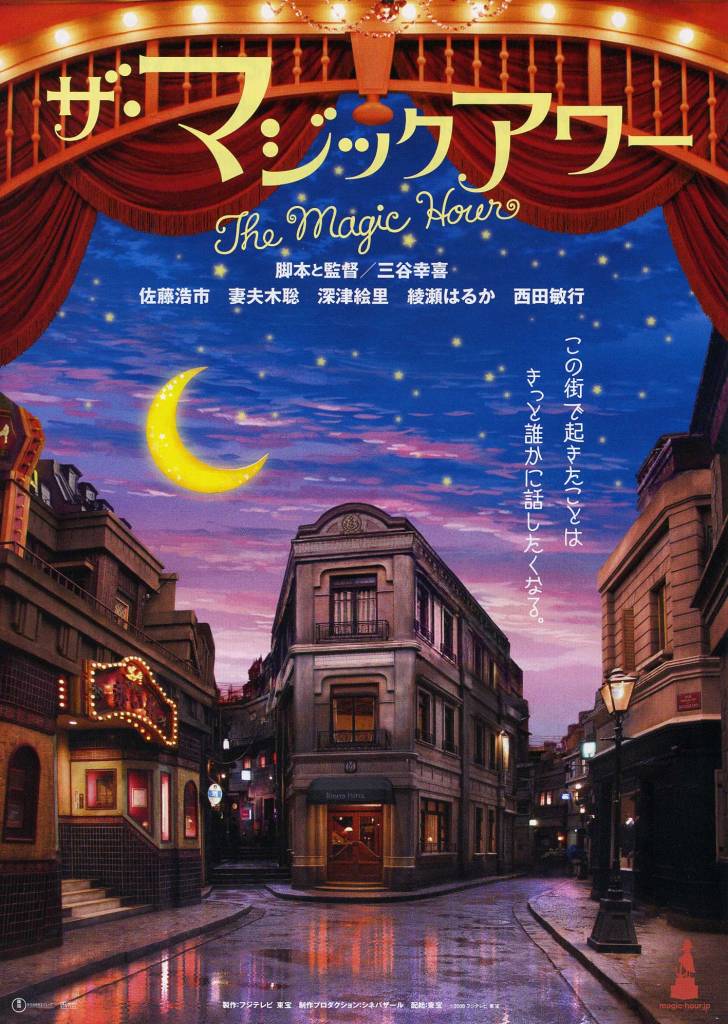
The Magic Hour (ザ・マジックアワー, Koki Mitani, 2008)

Magic Hour PosterIf there’s one thing you can say about the work of Japan’s great comedy master Koki Mitani, it’s that he knows his cinema. Nowhere is the abundant love of classic cinema tropes more apparent than in 2008’s The Magic Hour (ザ・マジックアワー) which takes the form of an absurdist meta comedy mixing everything from American ‘20s gangster flicks to film noir and screwball comedy to create the ultimate homage to the golden age of the silver screen.
In classic style the film opens with a bunch of goons chasing a scantily clad club owner out of a hotel window. Bingo (Satoshi Tsumabuki) has been hitting the jackpot with the boss’ girl, Mari (Eri Fukatsu), so the two are about to be given a new set of kicks in the latest fashion – cement. Luckily Bingo overhead some of the other guys talking about looking for another gangster, Della Togashi, so he quickly starts talking about him as if he were a long lost friend. The boss, Tessio (Toshiyuki Nishida), gives the pair a reprieve on the condition Bingo tracks down Togashi and brings him in within five days. Slight hitch – Bingo had never heard of Togashi before today and has no idea where to start. Finally, with the help  of some of his bar staff he hatches on the idea of getting a random actor to play the part, seeing as no one knows what Togashi looks like. However, the actor, Murata (Koichi Sato), plays his part a little too well and gets hired to work for the gang all the while thinking it’s just a movie! Pretty much everyone is getting a little more than they bargained for…

If you’re thinking that the oddly American looking 1920s street scene looks a little fake and everyone seems to be overacting like crazy, you wouldn’t be wrong but like everything else there’s a reason for that. What originally looks to be the primary setting for the film is a strange bubble which seems to co-exist with the modern world only its filled with people straight out of The Public Enemy or Scarface who think cement shoes is an efficient way of dealing with traitors. Murata, by contrast, is from our world and is completely oblivious to the strangeness of this movie gangster sound stage universe.

Murata is fixated on the Casablanca-esque final scene of his favourite movie in which a dyed in the wool tough guy entrusts the love of his life to a loyal friend before heading off to face certain death. His own career has not been going particularly well and even if he originally turns down Bingo’s offer as working with a first time director on a film where there’s no script sounds pretty fishy to begin with, circumstances soon find him throwing himself into the mysterious leading role with aplomb. Indulging his long held gangster dreams, Murata becomes the archetypal movie hit-man. He’s giving the performance of his life but has no idea there is no film in the camera.

The “Magic Hour” of the title refers to the twilight time near the end of the day when the light is dying but the conditions are perfect for making a movie. Mitani doesn’t fail to remind us we’re watching a film with constant exclamations of “just like a movie” or “doesn’t this look like a film set”. It’s a Barnum & Bailey world, just as phoney as it can be – but somehow it all just works despite its rather arch, meta approach. By the point we’ve hit Mari sitting on a crescent moon to give us her rendition of I’m Forever Blowing Bubbles (we’re back to The Public Enemy again) we’ve hit peak ‘20s though we scarcely mind at all.

Though he is indeed sending a lot of these classic ideas up, there’s real love here particularly for those golden age Hollywood movies with their wounded tough guys and beautiful chorus girls in need of rescue. Mitani adopts a primarily theatrical tone which meshes well with the absurdist, artificial atmosphere but always makes sure to leave us a fair few clues in the way of laughs. However, probably correctly assuming we know these films as well as he does, Mitani doesn’t give us the typical narrative that would almost write itself (or allow Bingo to write it based on his own trips to the motion picture house). The “bad” guy turns out to be not so bad, the “hero” wasn’t who we thought he was and none of our central guys winds up with a girl. Beautifully silly yet intricately constructed, The Magic Hour is another comedy masterpiece from Mitani which is filled with his characteristic warmth, mild sentimentalism and plenty of off-centre humour of the kind only Mitani can come up with.


The Japanese DVD/blu-ray release of The Magic Hour includes English subtitles.


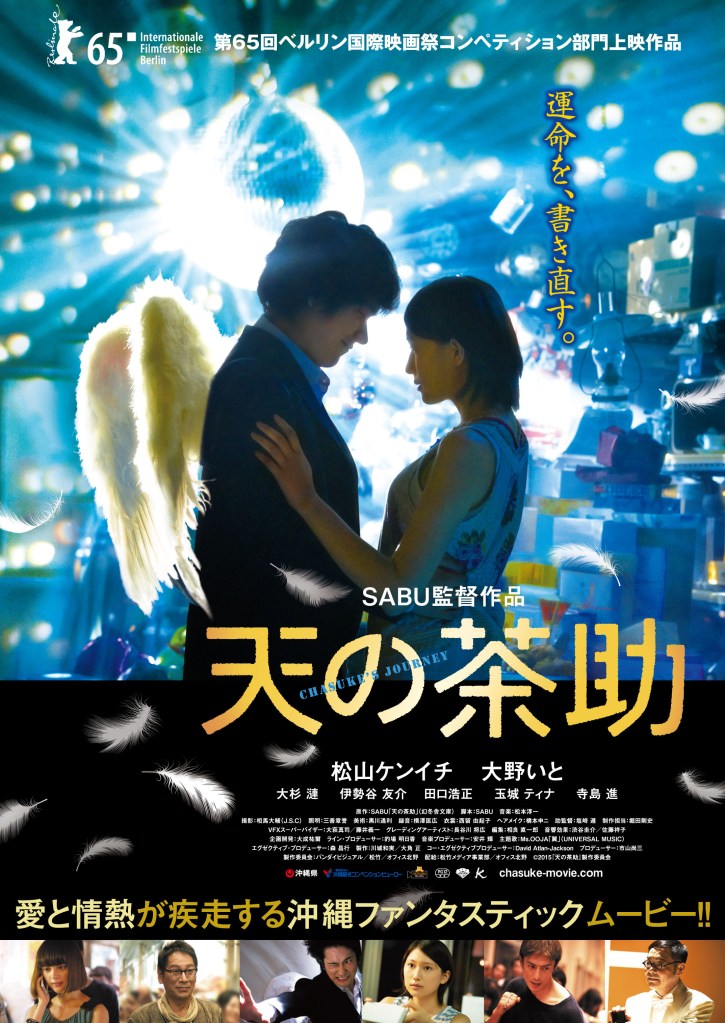
Chasuke’s Journey (天の茶助, SABU, 2015)

jon_chirashiNo fate but what we make – to steal the lines from another film just as one of the heavenly scriptwriters might in the latest film from the prolific Japanese director SABU (otherwise known as the actor Hiroyuki Tanaka), Chasuke’s Journey (天の茶助, Ten no Chasuke). Adapting his own novel for the screen (though the book was actually published after the film was completed), Sabu creates a romantic fantasy in which a lowly tea boy from heaven descends to Earth on a quest to save the woman he loves from certain death.

Chasuke (Kenichi Matsuyama) is the tea boy in “heaven” (his name, “Chasuke” literally means “tea assistant”). Here, there is a room full of scriptwriters who draft life stories for the people down below in service to The Man. Their task is a difficult one as each change in one person’s screenplay necessitates a change in all the others. It’s the butterfly effect gone mad. So, when The Man sends in a request for everything to suddenly go “more avant-garde” everyone is a little bit overworked. One writer asks Chasuke’s advice on what this might mean but all he comes up with is moving the action to a karaoke booth which has the unfortunate effect on the scene of getting the man’s proposal of marriage rejected causing him to leave in a mood and callously run Yuri (Ito Ono), whom Chasuke has developed a fondness for, over. Yuri’s screenwriter begs Chasuke to go down to Earth and use his unique powers to save her before it’s too late.

Luckily two of the other scriptwriters have pledged to support Chasuke’s mission from up above so he gets help from a former aspiring actor who now runs a small antique shop (Ren Osugi) and a broken hearted former boxer who now runs a ramen bar (Yusuke Iseya). Co-incidentally, both know and like Yuri who is a regular customer at both of their establishments. Coming from up above, Chasuke is already quite familiar with each of the character’s backstories and is able to fill us in with a touch of storytelling of his own. SABU has a dig here at unimaginative screenwriters who’ve ripped off most of their best ideas from other movies, which is sort of ignoring the fact that someone must have crafted the movies from up above anyway though the thought of screenwriters scripting screenwriters writing scripts about scriptwriters sort of makes your head spin.

Anyway, without venturing too far into spoiler territory, Chasuke’s quest is finished within the first half of the film with the remainder given over to a confused series of episodes featuring him as a celebrity healer committed to correcting all the awful scripts full of misery that his hack friends have come up with. That’s in addition to the constant threats of correction to Chasuke’s edits threatened by the jilted lover and a policeman who’ve both been given white painted faces (to be more “avant-garde”, as requested). Oh, and Chasuke’s memories of a former mortal life also start to return with a fairly surprising backstory of his own.

In truth, it’s all a little messy – almost as if someone were still working on the second draft even as we’re watching it. However, that’s sort of the point – we are watching someone re-writing on the hoof, trying to accommodate for someone else’s notes right as the keys are hitting the paper (or in this case, the ink splashing the parchment). When you come right down to it, life is a messy business and rarely makes any kind of sense during the “live broadcast”. Chasuke’s final message proves something of a riddle as he at once advises you to stick to The Man by living your own life and forging your own destiny whilst also putting his salvation down to the power of prayer which is about as close as you can get to an existential paradox.

Often beautifully photographed with Chasuke’s escape from up above an early highlight, Chasuke’s Journey is certainly a handsome looking film whatever faults it may have. Though the performances are committed, it never quite makes the jump from gentle satire to anything more emotionally engaging undermining the impact of its final sequence. However, for the vast majority of its running time Chasuke’s Journey does prove an interesting, if slightly flippant, take on freewill versus predestination with a hearty dose of social criticism thrown in to boot.


The Japanese blu-ray/DVD release of Chasuke’s Journey includes English subtitles.

(Unsubtitled trailer again though, sorry).


Hana-bi (はなび, AKA Fireworks, Takeshi Kitano, 1997)

Original quad poster from UK theatrical release (some of these cinemas no longer exist. Also, sponsored by Yo! Sushi.)

Review of Takeshi Kitano’s Hana-bi (はなび) first published by UK Anime Network.


Takeshi Kitano might still be best known for his ultra violent gangster pics, but after making it into the international arthouse repertoire with Sonatine back in the early ‘90s it was Hana-bi which put him on the map as one of Japan’s most prominent exports. Kitano plays the lead in the film once more adopting his cooler than cool persona with occasional flashes of violence only this time on the side of the law (to begin with, anyway).

Told in an initially confusing, flashback structure, Hana-bi follows middle aged policeman Nishi who experiences several life changing events in a short space of time. At the beginning of the film he’s let off a stakeout and told to go visit his wife who’s ill in hospital. Unfortunately, as we later find out, this will prove to be a poor decision as pretty much everything goes wrong – Nishi’s partner, Horibe, is shot and ends up paralysed, one of his other men is wounded and tragically another killed right in front of Nishi’s eyes. After being told that nothing more can be done for his wife and it’s better that she just come home from the hospital, Nishi quits the police force, gets involved with the yakuza and robs a bank before taking off with his wife for one last holiday.

Actually, the film skips over its climactic event until quite a way into its running time. Kitano unsettles us right away by giving us very little explanation for what we’re seeing. He shows us Nishi meeting with the widow of a man we didn’t even know was dead yet (not that he really told us who she was anyway). We’re left to piece events together like a detective listening to a confused witness testimony only our information is primarily visual – there isn’t even a lot of dialogue to guide us on our way. This refreshing technique is one the generally laconic Kitano seems to favour and greatly adds to Hana-bi’s low-key style.

Kitano never says too much in his movies anyway, but this time his is wife also near silent uttering the grand total of two words in the entire film and both of those come in the final scene. We know that she has a terminal illness (though it isn’t clear that she knows this, or how much she understands). Nishi and his wife also apparently lost their young daughter not long ago and it’s implied that perhaps she just hasn’t been fully present ever since. Her lack of speech, shyness and constant game playing coupled with her outwardly cheerful (if sometimes vacant) demeanour give her a childlike quality but the two words she does offer at the film’s conclusion imply (at least in that moment) that she knows what’s going on and understands what is about to happen.

Nishi and his wife have an extremely close relationship, they rarely need to speak to each other. However, Nishi’s partner, Horibe, discovers that his marriage was not as secure as he assumed as his wife and daughter walk out on him after his accident. In an effort to give him something to strive for, Nishi sends him some painting supplies and henceforth Horibe’s artwork (actually designed by Kitano himself) becomes a prominent motif in the film. The first series takes animals and then people and paints them with the heads of flowers but this then gives way to more complicated pointillist scenes. Many of Horibe’s works feature a repeated motif of a man, woman and child (neatly echoed in the films closing scenes) seemingly enjoying a happy family occasion. Perhaps this is an odd sort of masochism on Horibe’s part, lamenting everything he’s lost since his accident but the two figures could also represent the Nishis reunited with their lost daughter.

Shot in Kitano’s trademark blues, Hana-bi is a melancholy tale. Flowers and fire, Kitano shows us both extreme tenderness and fits of violence as he’s both the loving husband, grieving father, nurturing best friend and hardline cop who bears personal responsibility for the loss of his own. This path only leads in one direction and we’ve figured out where we’re headed long before nearing the end of our journey. Nevertheless, Hana-bi is a rich, poetic experience which continues to prove deeply moving and endlessly fascinating.


Hana-bi is re-released in the UK today on blu-ray courtesy of Third Window Films who will also be releasing Dolls and Kikujiro in the near future.