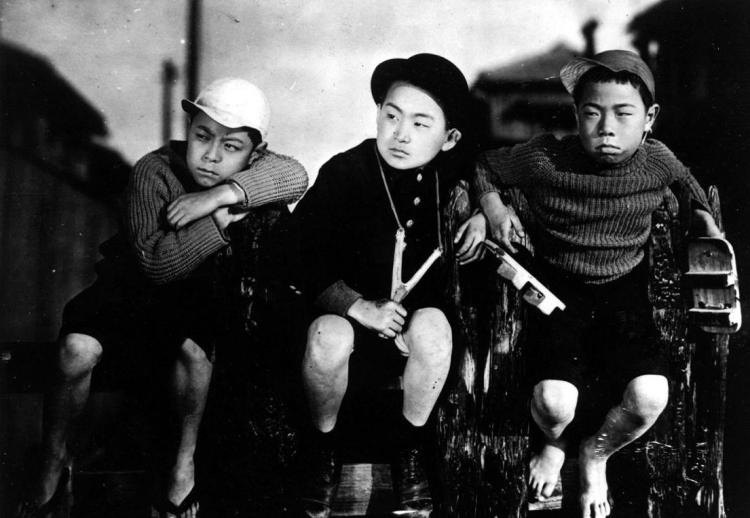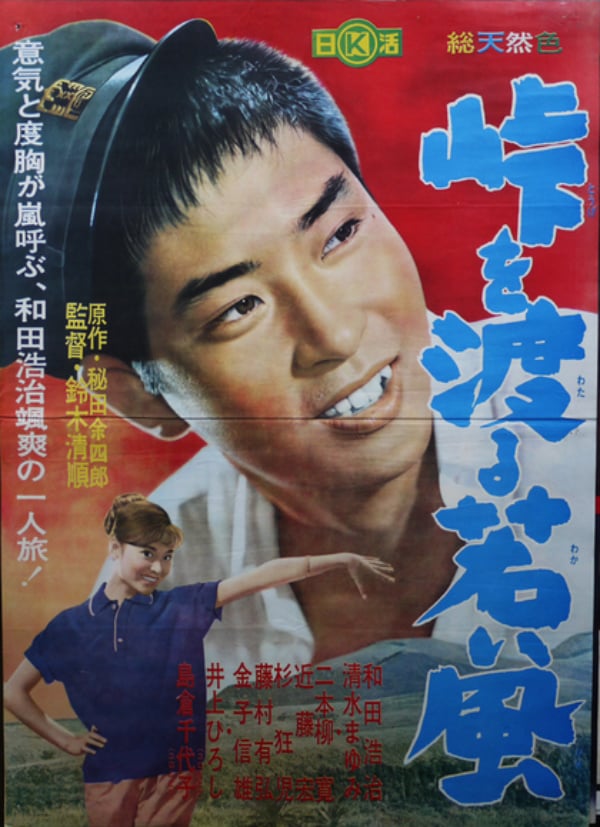
The Wind-of-Youth Group Crosses the Mountain Pass (峠を渡る若い風, Seijun Suzuki, 1961)

The Wind-of-Youth Group Crosses the Mountain Pass posterSeijun Suzuki made his first colour film in 1960 – Fighting Delinquents starred young matinee idol Koji Wada as a noble hearted construction worker with a temper who suddenly learns that he is the heir to an aristocratic fortune. Suzuki would make another two youth dramas starring Wada before getting to 1961’s The Wind-of-Youth Group Crosses the Mountain Pass (峠を渡る若い風, Toge wo Wataru Wakai Kaze, AKA Breeze on the Ridge) – this slice of colourful anarchy is a world away from Nikkatsu’s usual action fare though it does make space for the odd pop song or two.

Naive and cheerful university student Shintaro (Koji Wada) loves to travel and has taken off to wander around alone during the summer break. Getting thrown off a regular city bus for not having the cash for a ticket (his request to defer payment is not looked on kindly), Shintaro catches a lift with a group of travelling performers heading into the summer festival in the next town. Once there Shintaro showcases his lack of forethought once again when he happily sets down to start selling some of the “merchandise” he was given as a salary when the last place he worked at went bust. Not having realised that one generally needs a permit to sell goods in a market, Shintaro gets into an argument about the evils of monopolies and freedom verses regulation with the guy on the next stand all of which brings him to the attention of the yakuza. Luckily for Shintaro, he’s run into the nice kind of yakuza who just think he’s funny and invite him to travel on with them for a bit. Being so essentially good hearted and innocent, Shintaro agrees without thinking about all the reasons travelling around with a bunch of shady yakuza might not be a good idea.

Connecting with both the yakuza and the travelling players, Shintaro becomes involved in a number of interconnected crises – the biggest being the fate of the performers when a local gangster type swipes their headline act. The head of the troupe, Kinyo Imai (Shin Morikawa), is a traditional magician who performs in exaggerated Chinese dress complete with Fu Manchu moustache, but it doesn’t really matter how good he is, the rural audience is only here for the strip show. No stripper means no bookings which Kinyo knew already but it’s still a huge blow to his self esteem to realise that his magic doesn’t do the business anymore, especially as he’d always been conflicted about the strippers anyway.

Shintaro is one of Nikkatsu’s wandering heroes but unlike most he’s a cheerful soul who wanders out of a sense of curiosity and adventure rather than a need to escape something or someone at home. He likes meeting new people, even if the relationships are transitory and necessarily shallow, and treats everyone he meets with kindness and an open mind. In return he meets only kind and open people – even the yakuza are a generally decent sort who treat him like a new friend and can be relied upon to come to his aid if called. The only note of sourness arrives in the form of shady gangster Akita (Hiroshi Kondo) who pinches the troupe’s stripper, and their sometime patron who makes an indecent proposal to Kinyo as a kind of bet to decide whether he continues to fund their moribund performing career.

This being a regular program picture there’s not a lot of scope for experimentation but as it’s also a slightly odd entry to the Nikkatsu catalogue Suzuki does have the freedom to spice things up in his own particular way. Making the best use of colour film, Suzuki has a ball capturing Japan’s unique summer festival culture with its giant floats and cheerful market atmosphere. Wandering around the festival in a lengthy POV shot manages to exoticise something which would be quite ordinary to many viewers (at least those not born in large cities) but Suzuki’s other innovations are mostly relegated to one extremely interesting sequence in which Shintaro has a paint fight with yakuza he’s fallen out with (don’t worry, they both end up laughing like school boys). Every time Shintaro gets hit with paint, the entire screen tints to match neatly intensifying the effect and marking an early example of Suzuki’s love of colour play. Warm and goodnatured, The Wind-of-Youth Group Crosses the Mountain Pass is a gentle tale of youth finding its path but also one in which Suzuki takes advantage of the travelling motif to break from the regular programming and present an anarchic carnivale of music and song.


The Wind-of-Youth Group Crosses the Mountain Pass is the second of five films included in Arrow’s Seijun Suzuki: The Early Years. Vol. 1 Seijun Rising: The Youth Movies box set.

Original trailer (English subtitles)

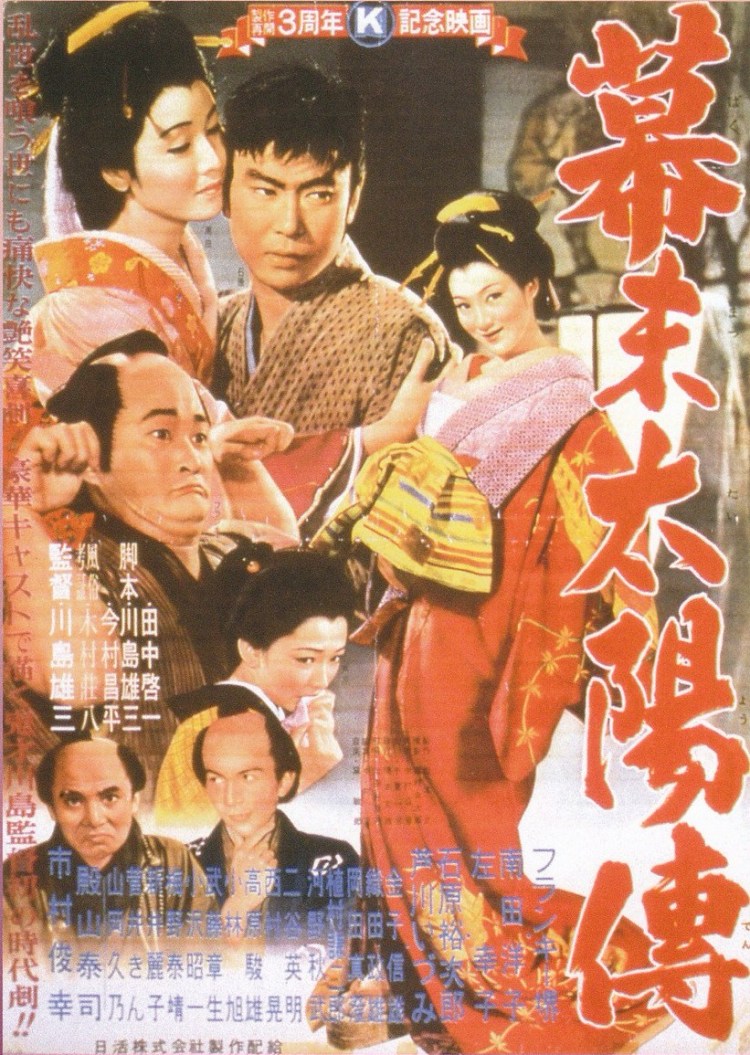
Bakumatsu Taiyoden (幕末太陽傳, Yuzo Kawashima, 1957)

bakumatsu taiyoden posterMany things were changing in the Japan of 1957. In terms of cinema, a short lived series of films known as the “Sun Tribe” movement had provoked widespread social panic about rowdy Westernised youth. Inspired by the novels of Shintaro Ishihara (later a right-leaning mayor of Tokyo), the movement proved so provocative that it had to be halted after three films such was the public outcry at the outrageous depictions of privileged young people indulging in promiscuous sex, drugs, alcohol, and above all total apathy – frivolous lives frittered away on self destructive pleasures. The Sun Tribe movies had perhaps gone too far becoming an easy source of parody, though the studio that engineered them, Nikkatsu, largely continued in a similar vein making stories of youth gone wild their stock in trade.

Yuzo Kawashima, a generation older than the Sun Tribe boys and girls, attempts to subvert the moral outrage by reframing the hysteria as a ribald rakugo story set in the last period of intense cultural crisis – the “Bakumatsu” era, which is to say the period between the great black ships which forcibly re-opened Japan to the outside world, and the fall of the Shogunate. The title, Bakumatsu Taiyoden (幕末太陽傳), literally means “legend of the sun (tribe) in the Bakumatsu era”, and, Kawashima seems to suggest, perhaps things now aren’t really so different from 100 years earlier. Kawashima deliberately casts Nikkatsu’s A-list matinee idols – in particular Yujiro Ishihara (the brother of Shintaro and the face of the movement), but also Akira Kobayashi and familiar supporting face Hideaki Nitani, all actors generally featured in contemporary dramas and rarely in kimono. Rather than the rather stately acting style of the period drama, Kawashima allows his youthful cast to act the way they usually would – post-war youth in the closing days of the shogunate.

They are, however, not quite the main draw. Well known comedian and rakugo performer Frankie Sakai anchors the tale as a genial chancer, a dishonest but kindly man whose roguish charm makes him an endearing (if sometimes infuriating) character. After a post-modern opening depicting contemporary Shinagawa – a faded red light district now on its way out following the introduction of anti-prostitution legislation enacted under the American occupation, Kawashima takes us back to the Shinagawa of 1862 when business was, if not exactly booming, at least ticking along.

Nicknamed “The Grifter”, Saiheiji (Frankie Sakai) has picked up a rare watch dropped by a samurai on his way to plot revolution and retired to a geisha house for a night of debauchery he has no intention of actually paying for. Though he keeps assuring the owners that he will pay “later” when other friends turn up with the money, he is eventually revealed to be a con-man and a charlatan but offers to work off his debt by doing odd jobs around the inn. Strangely enough Saiheiji is actually a cheerful little worker and busily gets on with the job, gradually endearing himself to all at the brothel with his ability for scheming which often gets them out of sticky situations ranging from fake ghosts to customers who won’t leave.

Saiheiji eventually gets himself involved with a shady group of samurai led by Shinshaku Takasugi (Yujiro Ishihara) – a real life figure of the Bakumatsu rebellion. Like their Sun Tribe equivalents these young men are angry about “the humiliating American treaty”, but their anger seems to be imbued with purpose albeit a destructive one as they commit to burning down the recently completed “Foreign Quarter” as an act of protest-cum-terrorism. The Bakumatsu rebels are torn over the best path for future – they’ve seen what happened in China, and they fear a weak Japan will soon be torn up and devoured by European empire builders. Some think rapid Westernisation is the answer – fight fire with fire, others think showing the foreigners who’s boss is a better option (or even just expelling them all so everything goes back to “normal”). America, just as in the contemporary world, is the existential threat to the Japanese notion of Japaneseness – these young samurai are opposed to cultural colonisation, but their great grandchildren have perhaps swung the other way, drunk on new freedoms and bopping away to rock n roll wearing denim and drinking Coca Cola. They too resent American imperialism (increasingly as history would prove), but their rebellions lack focus or intent, their anger without purpose or aim.

Kawashima’s opening crawl directly references the anti-prostitution law enacted by the American occupying forces – an imposition of Western notions of “morality” onto “traditional” Japanese culture. In a round about way, the film suggests that all of this youthful rebellion is perhaps provoked by the sexual frustration of young men now that the safe and legal sex trade is no longer available to them – echoing the often used defence of the sex trade that it keeps “decent” women, and society at large, safe. Then again, the sex trade of the Bakumatsu era is as unpleasant as it’s always been even if the familiar enough problems are played for laughs – the warring geisha, the prostitute driven in desperation to double suicide, the young woman about to be sold into prostitution against her will in payment of an irresponsible father’s debt, etc. One geisha has signed engagement promises with almost all her clients – it keeps the punters happy and most of them are meaningless anyway. As she says, deception is her business – whatever the men might say about it, it’s a game they are willingly playing, buying affection and then seeming hurt to realise that affection is necessarily false and conditional on payment of the bill.   

Playing it for laughs is, however, Kawashima’s main aim – asking small questions with a wry smile as Saiheiji goes about his shady schemes with a cleverness that’s more cheeky than malicious. He warns people they shouldn’t trust him, but in the end they always can because despite his shady surface his heart is in the right place. Warned he’ll go to hell if he keeps on lying his way though life, Saiheiji laughs, exclaims to hell with that – he’s his own life to live, and so he gleefully runs away from the Bakumatsu chaos into the unseen future.


Masters of Cinema release trailer (English subtitles)

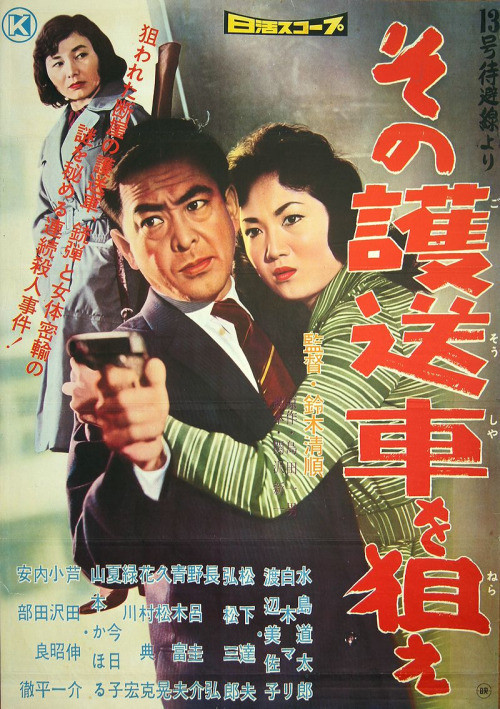
Take Aim at the Police Van (13号待避線より その護送車を狙え, Seijun Suzuki, 1960)

o0500070913581105946Nikkatsu’s main stock in trade during its 50s/60s heyday was the youth movie – films which captured the frustrations of being young (and usually male) in the scrappy post-war years. It’s a surprise then that the hero of Seijun Suzuki’s “action” movie Take Aim at the Police Van (13号待避線より その護送車を狙え, Jusango Taihisen Yori: Sono Gososha wo Nerae) is a genial middle-aged man who’s more Cary Grant in North by Northwest than Japanese James Dean. A programme picture, there’s nothing particularly interesting about the movie on paper but it’s among the first in which Suzuki indulges his talent for the surreal including a number of fantastically choreographed action sequences.

The film opens with a warning as a sniper trains his sights on a set of road signs which state that many accidents have occurred in this area. The one which is about to befall unlucky prison warden Tamon (Michitaro Mizushima) is however entirely man made. Momentarily confused by the figure of a woman watching the bus from the roadside, Tamon is blindsided when the sniper opens fire and kills several of the passengers while another, Goro (Shoichi Ozawa), cowers in the back. Tamon is suspended for six months but isn’t particularly upset about it. He’s not a detective and he knows he should leave it to the professionals, but he’s desperate to know why someone would bother attack such a lowly crew of petty criminals. Wondering who the woman was and how she fits into the case, who the snipers were aiming for and if they got them, and perhaps wanting to assuage his own feelings of powerlessness during the attack Tamon gets on the case.

Tamon is not your typical Nikkatsu action hero. He’s a little on the old side for starters – hardly the marquee face the studio was beginning to favour with its collection of “Diamond Guys”. He’s also not a policeman or a detective, he has no idea what he’s doing or what he’s getting himself into. What Tamon is is a righteous man. Almost immediately he’s sucked into the seedy underbelly of late ‘50s Tokyo with its strip clubs, trafficked women, and petty gangsters. This world is alien to him and he’s disgusted by it. Meeting the female manager of the “talent agency” which supplies in-room strippers to sleazy hotels where businessmen go when they’ve told their wives they’re at a conference, Tamon is horrified to hear her admit she thinks of the girls as “merchandise”. He pauses to explain to her that he always thought of the felons he looked after as “humans” rather than “criminals”, no matter what it was they’d done. Such naive humanitarianism is too much for Yuko (Misako Watanabe) – she’s instantly smitten, which is a problem because it means she needs to play both sides of her own game.

The pair end up in an uneasy alliance as Tamon’s goodness begins to work its magic. An unlikely white knight, Tamon finds himself wanting to save all the ladies threatened by “Akiba’s” dastardly plan from the icy charms of Yuko to Goro’s cabaret girl Tsunako (Mari Shiraki), and another young one, Shoko (Kyoko Natsu), about to get sucked into the Akiba web. What he discovers is a nasty trail of exploitation running from the bars and clubs of the city centre to the genial holiday spa towns where the moderately wealthy travel to pursue their discrete pleasures.

Tamon may be a little older than your average Nikkatsu action star, but he’s also a perfect fit for a film noir hero in wrong man mould. Tamon is not on the run, but he is out of place in this world, perhaps harking back to a presumably more innocent age where honesty and compassion still counted for something. He views his job as a prison warden as a public service, believing that there is goodness in everyone and it’s the job of people like him to find it and bring it to the surface. This he does at least seem to accomplish with Yuko who (despite her role in events so far) seems to have “reformed” and intends to follow Tamon’s lead in taking her “talent agency” in a more legitimate direction. 

Suzuki often claimed that Youth of the Beast was the first of his films where he was able to fully embrace his madcap desires, but Take Aim at the Police Van contains a fair few Suzuki touches of its own from the bold opening sequence shot through the sights of a sniper rifle, to the show girl killed by an arrow to her bare breast, bizarre murder by petrol tanker set piece, and exciting train station finale. Keeping the camera fluid, Suzuki captures a world in motion, seemingly running away from our noble hero until justice, in the form of an unstoppable steam train, finally arrives.


Attack on the police van clip (English subtitles)

https://www.youtube.com/watch?v=D2FcJY003HA

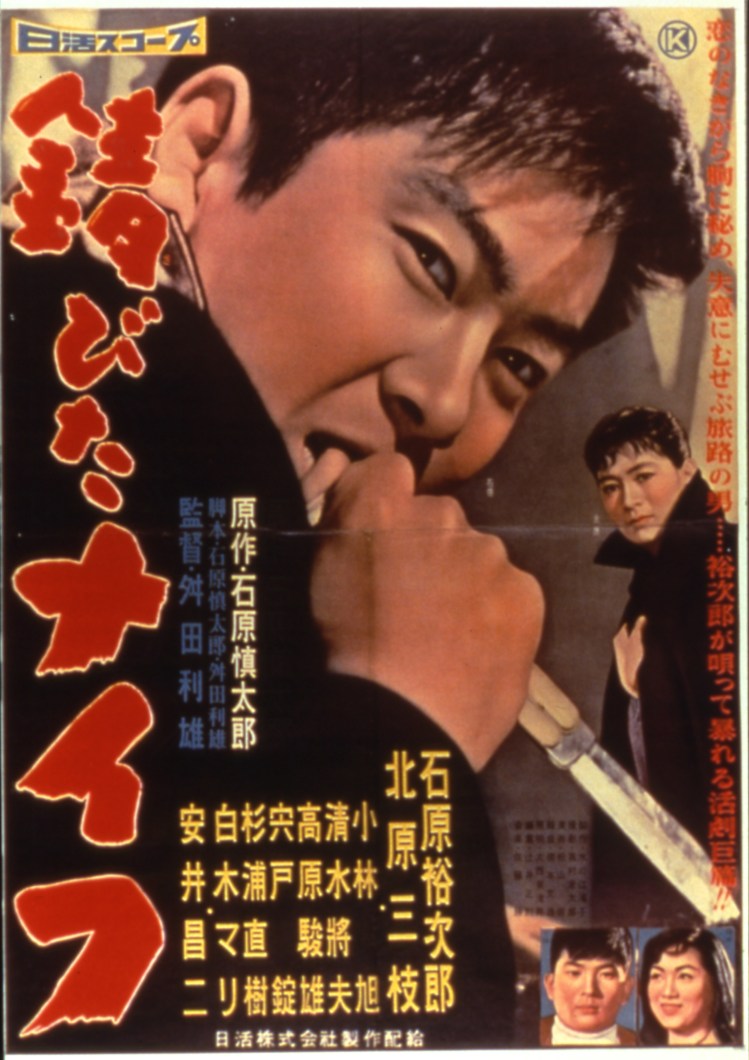
Rusty Knife (錆びたナイフ, Toshio Masuda, 1958)

rusty knife posterPost-war Japan was in a precarious place but by the mid-1950s, things were beginning to pick up. Unfortunately, this involved picking up a few bad habits too – namely, crime. The yakuza, as far as the movies went, were largely a pre-war affair – noble gangsters who had inherited the codes of samurai honour and were (nominally) committed to protecting the little guy. The first of many collaborations between up and coming director Toshio Masuda and the poster boy for alienated youth, Yujiro Ishihara, Rusty Knife (錆びたナイフ, Sabita Knife) shows us the other kind of movie mobster – the one that would stick for years to come. These petty thugs have no honour and are symptomatic parasites of Japan’s rapidly recovering economy, subverting the desperation of the immediate post-war era and turning it into a nihilistic struggle for total freedom from both laws and morals.

Public support is, largely, behind this new force of order as seen in the local uproar when top gangster Katsumata (Naoki Sugiura) is arrested in connection with an assault. Things being what they are, Katsumata is soon released to laugh at law enforcement from a safe distance but the past is coming for him. Some years ago Katsumata killed a local councillor, Nishida (Ikunosuke Koizumi), and made it look like suicide but three guys from a local gang saw him do it. He paid them to keep quiet, but now one of them feels like talking and thinks Katsumata might like to pay a little more to reseal the deal.

Chatty Tokyo thug Shima (Jo Shishido) gets pushed off a train for his pains but Katsumata is worried enough about the other two to send his guys out to make some enquires. He’s particularly worried about Tachibana (Yujiro Ishihara) – a “sleeping lion”, Tachibana is a hot head who’s now gone straight after coming out of jail for murdering a guy he thought was a direct cause of his girlfriend’s death. Luckily enough, Tachibana now runs a bar where he employs the other witness, Terada (Akira Kobayashi), to whom he acts as a stern big brother hoping to keep them both on the straight and narrow. Tachibana is unlikely to talk, he wants out of the gangster world for good, but Terada is young and ambitious with a girlfriend to impress. He takes more hush money from Katsumata, not realising what he’s getting himself into, and then lets it go to his head.

Tachibana is the rusty knife of the title. After letting his rage consume him in murdering a petty mobster in revenge for the rape of his girlfriend who later committed suicide, Tachibana has vowed to quell his anger and live a decent, peaceful life. Angry outbursts are, however, never far from the surface and following recent revelations, a rusty knife may find its cutting edge once again.

Keiko (Mie Kitahara), a customer at Tachibana’s bar, is making a documentary about violence in the city which coincidentally turns up a few clues as to Tachibana’s past, not to mention her own. The daughter of the murdered councilman, Nishida, and the niece of another powerful politician, Keiko is a figure of righteousness, charting her own course through the difficult post-war world and attempting to do so with dignity and elegance while refusing to abandon her sense of decency and compassion. Later a real life married couple, Kitahara and Ishihara were a frequent on screen romantic pairing though this time around the connection is more subtle as Keiko begins to sympathise with Tachibana’s plight and commits herself to saving him from destroying himself in becoming consumed by his barely suppressed rage.

Tachibana is indeed raging, though his rage is understandable. As someone later puts it “nothing in this city makes sense”. The systems are corrupt, the wartime generation continue to run the show and run it badly, or at least for their own ends, robbing youth of its rightful place at the forefront of economic recovery. Yet even if Ishihara is a symbol of youthful alienation, his rage is one which must be quelled. Even in this city where nothing makes sense, self control is one’s greatest weapon. If youth is to walk forward into the exciting post-war future, it will have to drop its rusty knives.


Original trailer (English subtitles)
I Am Waiting (俺は待ってるぜ, Koreyoshi Kurahara, 1957)

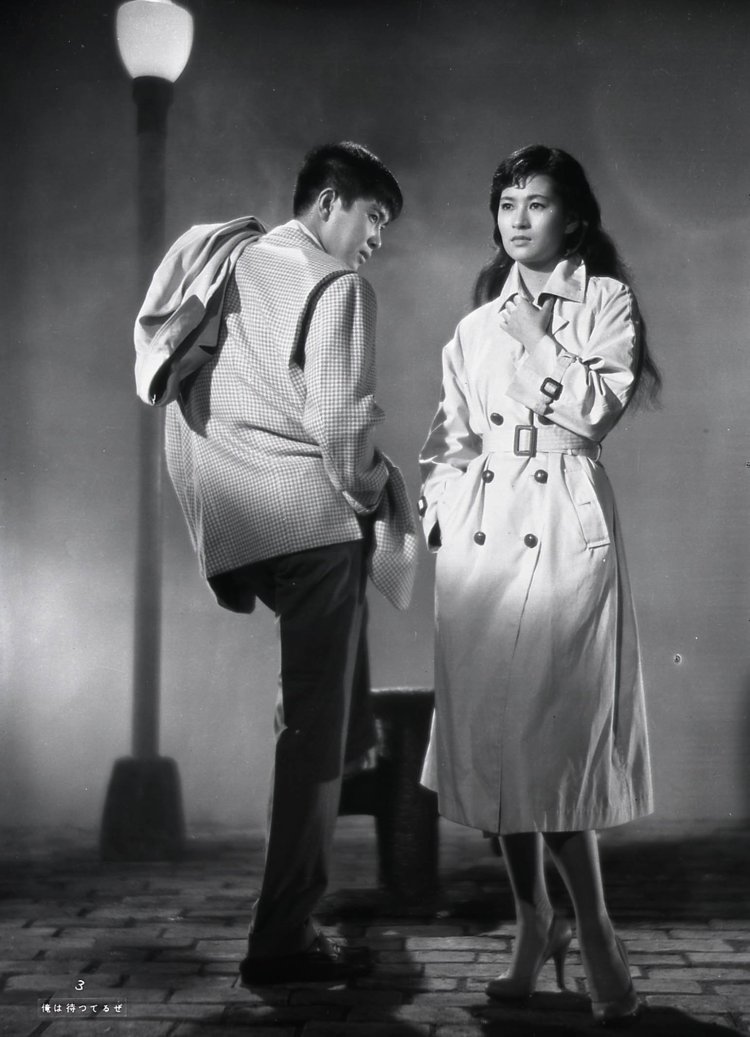
img_0Return to sender – address unknown. For the protagonists of I Am Waiting (俺は待ってるぜ, Ore wa Matteru ze), the debut feature from Koreyoshi Kurahara, all that’s left to them is to wait for uncertain answers, trapped in the limbo land of the desolate post-war landscape. With nothing to hope for and no clear direction out of their various predicaments, the pair bide their time until something, good or bad, comes for them but luckily enough what finds them is each other and suddenly a path towards resolution of their troubles. Reuniting newly minted matinee idol Yujiro Ishihara and future real life wife Mie Kitahara fresh off the red hot success of the youth on fire drama Crazed Fruit, I Am Waiting is an altogether more melancholy affair set in the down and out depression town of the American film noir.

One fateful night, Joji Shimaki (Yujiro Ishihara) steps out onto the Yokohama Harbour clutching a letter he nervously drops into a post-box, but is struck by the figure of a distressed young woman hanging around ominously close to the water’s edge. For reasons he doesn’t quite understand, Joji approaches the woman and convinces her to come back with him to the small cafe he runs right by the railway line. The girl, Saeko (Mie Kitahara), confesses to him that she thinks she may have killed a mobster who was making the moves on her and has no idea what to do now. Joji suggests she hide out with him, check the morning paper for news of a body, and then figure out the rest later. Left with no other options, Saeko agrees but it seems the past has a hold on them both which not even Joji’s powerful fists will be able to break.

Joji has been “waiting” for a letter from his older brother, supposedly in Brazil buying farmland. “Brazil” has become Joji’s main escape plan, but while he waits and waits his Japan life stagnates. A former prize fighter, Joji has been fighting his past self for the past couple of years ever since he lost his temper and killed a man in a bar brawl. Joji is afraid of his rage, convinced that he’s no good, a toxic influence to all around him, which explains why he’s so often abandoned by those he loves. When the letters he’d been sending to Brazil start coming back “no such person”, he fears the worst – that his brother has run off with their money and started a new life on his own without him.

In a noirish coincidence, Joji’s fate is bound up with that of melancholy nightclub singer Saeko. Once a respected opera singer, Saeko has been relegated to jazz cabaret in seedy harbour bars after losing her voice to illness and having her heart broken by her singing teacher whose affections were not as true as he claimed. “A canary that’s forgotten how to sing”, Saeko fears that her life is already over, there will be no escape from the gangsters who claim to own her and the only path left to her is the one she ruled out taking when she bopped the shady mobster on the head with a nearby vase. Saeko had no escape plan because she thought escape was impossible, but the unexpected nobility of a man like Joji has begun to change her mind, if only Joji’s heart weren’t already so battered and bruised.

Joji’s bar, the Reef Restaurant, is the gathering place for the battered and bruised. Located right on the railway line, it’s a literal waiting room through which pass all those who aren’t quite sure where they’re going. Everyone here is nursing the wounds of broken dreams – Joji’s chef used to be racing driver until he got injured, the doctor is a drunk, Joji’s an ex-boxer with anger issues, and Saeko’s a bird with a broken wing. This is not the departure lounge, it’s arrivals – the end of the line when there is no place else to go.

Still, a waiting room is a place you can choose to leave, no one has to wait forever. In meeting Saeko, Joji has already begun to move forward even if he doesn’t know it. Suddenly giving up on their melancholy passivity, the pair spur each other on towards a killer finale which offers them, if not exactly a way out, a possibility of a better life having resolved to leave the past in the past and reject its continuing hold over them. Kurahara co-opts the fatalism and lingering existential angst of the film noir with its rolling fog and permanent drizzle clouding the darkened horizons for our two pinned protagonists who relive their most fearful moments with the force of silent movie scored by the intense jazz soundtrack suddenly turned up to 11. An important missive to the post-war young, I Am Waiting offers the message that the past can be beaten, but only once one comes to believe in the existence of the future and makes a decision to walk towards it rather than waiting for it to arrive unbidden.   


Clip (English subtitles)

https://www.youtube.com/watch?v=7xHcW-4mZ1c

Youth of the Beast (野獣の青春, Seijun Suzuki, 1963)

youth of the beast posterSeijun Suzuki had been directing for seven years and had made almost 20 films by the time he got to 1963’s Youth of the Beast (野獣の青春, Yaju no Seishun). Despite his fairly well established career as a director, Youth of the Beast is often though to be Suzuki’s breakthrough – the first of many films displaying a recognisable style that would continue at least until the end of his days at Nikkatsu when that same style got him fired. Building on the frenetic, cartoonish noir of Detective Bureau 2-3: Go to Hell Bastards!, Suzuki once again casts Jo Shishido in the the lead only this time as an even more ambiguous figure playing double agent to engineer a gang war between two rival hoodlums.

Suzuki opens in black and white as the bodies of a man and a woman are discovered by a small team of policemen. Finding a note from the deceased female which states that she settled on taking her own life because she loved her man and thought death was the only way to keep him, the police assume it’s an ordinary double suicide or perhaps murder/suicide but either way not worthy of much more attention, though discovering a policeman’s warrant card on the nightstand does give them pause for thought.

Meanwhile, across town, cool as ice petty thug Jo Mizuno (Jo Shishido) is making trouble at a hostess bar but when he’s taken to see the boss, it transpires he was really just making an audition. The Nomoto gang take him in, but Mizuno uses his new found gang member status to make another deal with a rival organisation, the Sanko gang, to inform on all the goings on at Nomoto. So, what is Mizuno really up to?

As might be expected, that all goes back to the first scene of crime and some suicides that weren’t really suicides. Mizuno had a connection with the deceased cop, Takeshita (Ichiro Kijima), and feels he owes him something. For that reason he’s poking around in the local gang scene which is, ordinarily, not the sort of world straight laced policeman Takeshita operated in which makes his death next to a supposed office worker also thought to be a high class call girl all the stranger.

Like Detective Bureau 2-3: Go to Hell Bastards!, Youth of the Beast takes place in a thoroughly noirish world as Mizuno sinks ever deeper into the underbelly trying to find out what exactly happened to Takeshita. Also like Detective Bureau 2-3: Go to Hell Bastards!, Youth of the Beast is based on a novel by Haruhiko Oyabu – a pioneer of Japanese hardboiled whose work provided fertile ground for many ‘70s action classics such as The Beast Must Die and Resurrection of the Golden Wolf, but Suzuki’s ideas of noir owe a considerable debt to the gangster movies of the ‘30s rather than the moody crime dramas of twenty years later.

Jo Shishido’s Mizuno is a fairly typical ‘40s conflicted investigator, well aware of his own flaws and those of the world he lives in but determined to find the truth and set things right. The bad guys are a collection of eccentrics who have more in common with tommy gun toting prohibition defiers than real life yakuza and behave like cartoon villains, throwing sticks of dynamite into moving cars and driving off in hilarious laughter. Top guy Nomoto (Akiji Kobayashi) wears nerdy horn-rimmed glasses that make him look like an irritated accountant and carries round a fluffy cat he likes to wipe his knives on while his brother Hideo (Tamio Kawaji), the fixer, is a gay guy with a razor fetish who likes to carve up anyone who says mean stuff about his mum. The Sanko gang, by contrast, operate out of a Nikkatsu cinema with a series of Japanese and American films playing on the large screen behind their office.

The narrative in play may be generic (at least in retrospect) but Suzuki does his best to disrupt it as Mizuno plays the two sides against each other and is often left hiding in corners to see which side he’s going to have to pretend to be on get out of this one alive. Experimenting with colour as well as with form, Suzuki progresses from the madcap world of Detective Bureau 2-3: Go to Hell Bastards! to something weightier but maintains his essentially ironic world view for an absurd journey into the mild gloom of the nicer end of the Tokyo gangland scene.


Original trailer (no subtitles)

https://www.youtube.com/watch?v=RoruaIPA41U

I Was Born, But… ( 大人の見る絵本 生れてはみたけれど, Yasujiro Ozu, 1932)

I was born but stillWhen one thinks of the classic examples of children in Japanese cinema, Hiroshi Shimizu is the name which comes to mind but family chronicler Yasujiro Ozu also made a few notable forays into the genre. I Was Born, But… (大人の見る絵本 生れてはみたけれど, Otona no miru ehon – Umarete wa mita keredo) stars one of the premier child actors of the silent era in Tokkan Kozo (later known as Tomio Aoki) who also worked repeatedly with Shimizu (Children in the Wind, Star Athlete) and Naruse (No Blood Relation, Apart from You, Street Without End, Forget Love for Now) among many others. Like Children in the Wind, I Was Born, But… is the story of two young boys and their well meaning dad only this time the boys’ faith in their father is not entirely justified. Ozu would also revisit this theme some years later with the genial comedy Good Morning which also sees a pair of cute as a button brothers going on strike though theirs is one of silence rather than hunger and provoked by the desire for a television rather than just shock and disillusionment on discovering the unfairness and hypocrisy of the adult world.

Mr. Yoshi (Tatsuo Saito) has moved his family into a nice house in the suburbs not far from that of his boss, Mr. Iwasaki (Takeshi Sakamoto). His two sons, Keiji (Tomio Aoki/Tokkan Kozo) and Ryoichi (Hideo Sugawara) quickly make enemies of some of the neighbourhood kids and start playing truant from school in order to avoid them. Making an ally of the delivery boy from the local sake shop, Keiji and Ryoichi enlist his efforts to get back at the head bully landing themselves top of the local pack.

However, one of the boys, Taro, is none other than the son of their dad’s boss, Mr. Iwasaki. Furiously engaging in a battle of my dad’s better than your dad, the boys are dismayed to see how their father obsequiously greets his superior. Their faith is well and truly crushed when Mr. Iwasaki invites all the kids over to watch some home movies (cutting edge technology for the time) which features some of the employees goofing off, including Yoshi who enthusiastically gurns and performs silly walks for his boss’ benefit. To Keiji and Ryoichi, Yoshi had been a kind of superhero – austere, but strong, honest and inspiring. Realising he’s just another corporate stooge betraying his true self for commercial gain, the boys are thrown into a period of acute existential confusion.

Yoshi’s mantra dictates that he wants his sons to grow up to become “someone”. Keiji and Ryoichi ironically turn this back on him with the charge that he himself is a “no one”. Yoshi cannot argue with their judgement, he is “no one”, in his own mind at least, and harbours a sense of disappointment in his dull and ordinary middle class life. Checking in with his sons after they’ve fallen asleep, Yoshi offers a different kind of mantra during a speech to his wife in that he hopes neither of his sons become company men like he has. He truly wants them to be “someones” but more than that, he wants them to be their own men, living their lives on their own terms and finding a greater sense of fulfilment than he has been able to in willingly debasing himself to curry favour with a boss he doesn’t particularly like to put food on the table for his family.

Keiji and Ryoichi, in a gesture of defiance, go on a hunger strike to prove that they don’t need their father to humiliate himself daily on their behalf. Yoshi can’t get through to them, his authority is significantly damaged and the boys are stubborn but then again their mother’s rice balls are just so tasty they might eventually be persuaded to abandon their mini protest by the power of a rumbly tum. The lesson they learn is one familiar to Ozu’s general philosophy, that battles must be picked and compromises made in the name of pragmatism even if they may uncomfortable to bear.

Ozu shoots with his characteristic naturalism, allowing the boys to goof off as only children can as they pull faces, dance, and strike poses to poke fun at the other boys but also engage in a strange “resurrection” gimmick rather than a secret handshake to bond with their new frenemines. Forgiveness and reconciliation are all around as the boys learn to accept their slightly less black and white world, embrace their new friends, and stride forward towards their eventual destinies. The children occupy one world, and the adults another but perhaps they aren’t so different after all.


Short scene from the film (English subtitles)

Burden of Life (人生のお荷物, Heinosuke Gosho, 1935)

Despite being at the forefront of early Japanese cinema, directing Japan’s very first talkie, Heinosuke Gosho remains largely unknown overseas. Like many films of the era, much of Gosho’s silent work is lost but the director was among the pioneers of the “shomin-geki” genre which dealt with ordinary, lower middle class society in contemporary Japan. Burden of Life (人生のお荷物, Jinsei no Onimotsu) is another in the long line of girls getting married movies, but Gosho allows his particular brand of irrevent, ironic humour to colour the scene as an ageing patriarch muses on retiring from the fathering business before resentfully remembering his only son, born to him when he was already 50 years old.
Rather than focussing on the main narrative right away, Gosho gives us a crash course in marital relations as we meet middle sister, Itsuko (Kinuyo Tanaka), who is currently posing for a raunchy portrait her starving artist husband is painting. Itsuko dresses in Western style, smokes openly and often, and her home is a bohemian one of the kind you’d imagine a (well to do) artist from the ‘30s would live in. The couple are interrupted by their brother-in-law who has come in search of his wife, Takako (Yoshiko Tsubouchi), with whom he’s had yet another argument causing her to storm off somewhere or other in a huff.

Takako has indeed stormed off, but has gone to her mother’s where her younger sister, Machiko (Mitsuyo Mizushima) is preparing for her own wedding and now feeling quite nervous hoping that it won’t be as tempestuous as Takako’s. The three sisters also have a little brother, Kanichi, who is doted on by the women of the family but has a strained relationship with his father, Shozo (Tatsuo Saito). The main conflict occurs once Shozo has successfully married off Machiko and begins happily contemplating a burden free life only to remember that little Kanichi is only eight and so there are twelve more years of fatherhood ahead of him and he’ll be 70 before he gets any peace. In order to speed up the process, he tells his wife Tamako (Mitsuko Yoshikawa) that maybe Kanichi doesn’t need to go school and should go out and get a job instead. Tamako, rightly outraged at her husband’s persistent coldness towards their son brings things to a head by leaving the family home.

The themes are common ones as a family faces the successful marriage of its youngest daughter but the pattern is complicated by the loose end that is Kanichi. Much younger than his sisters, it’s easy to believe Shozo’s assertions that his arrival was somewhat unexpected but far from a joyous surprise Shozo still seems to regard him with a degree of mild horror. Fearing becoming an elderly father Shozo’s concerns are fair given the additional burdens placed on him in having to find good husbands for three women and then pay for their weddings and dowries never mind a college education for a son he never wanted. Kanichi seems to be aware on some level of the way his father feels about him as a poignant scene implies when he begs some of the other neighbourhood children to keep playing with him even though it’s past tea time because he doesn’t want to go home if his dad is there.

Shozo fails to reform his opinion even after his wife leaves him. Almost delighting in a late life slice of batchelorhood, Shozo heads into the bar district for a night out where he ends up drinking with some younger guys, surrounded by students singing the Keio University song. His attention is momentarily taken by a small boy of around Kanichi’s age who is selling flowers to amorous patrons but it’s only once a hostess calls him “papa” that he seems to feel aged fatherhood reassert itself. Enquiring about her age he discovers she is only 19 – much younger than any of his daughters, and consequently Shozo begins to feel more like a ridiculous old man than a young buck on the prowl.

Gosho draws a number of contrasts within his “ordinary” family from the three sisters who seem to represent the changing times in their differing attitudes to the husband and wife and the division of their home. Itsuko, Westernised and brassy, is living well beyond her means and touching her parents for money in order to do it. Talking things over with the kimono’d Takako who offers to recommend a traditional hairstylist for Machiko’s wedding, Itsuko has some advice for dealing with men which she calls “reverse psychology”. Takako and her husband may not have children and fight all the time, but she is in other ways a model wife even if she thinks married life ought to be simpler than it is. Machiko is caught on the brink, though we never see her husband, wondering what her own married life will entail. Her father, Shozo, lamenting on his responsibilities remarks that women are like products for sale, requiring investments which will eventually pay off in terms of successful marriages but any investment in a son is, in a sense, a waste. Family, for him, is less a social unit and more a mini business enterprise from which he was looking forward to retiring.

In the end of course he changes his mind though more out of loneliness or a sense of mortality than any less selfish emotion. Slight at 66 minutes, Gosho packs in as much detail as possible whilst maintaining a broadly comic, almost screwball tone filled with selfish husbands and calculating wives all making the most of the relatively stable times. Life has many burdens but sometimes it’s better to rebrand those burdens joys and make the most of them before someone else decides to carry them for you and all you’re left with is an empty sort of lightness. You’re only old once, after all.


Children in the Wind (風の中の子供, Hiroshi Shimizu, 1937)

vlcsnap-2016-12-06-23h27m52s218It would be a mistake to say that Hiroshi Shimizu made “children’s films” in that his work is not particularly intended for younger audiences though it often takes their point of view. This is certainly true of one of his most well known pieces, Children in the Wind (風の中の子供, Kaze no Naka no Kodomo), which is told entirely from the perspective of the two young boys who suddenly find themselves thrown into an entirely different world when their father is framed for embezzlement and arrested.  Encompassing Shimizu’s constant themes of injustice, compassion and resilience, Children in the Wind is one of his kindest films, if perhaps one of his lightest.
Brothers Zenta (Masao Hayama) and Sampei (Bakudan Kozo) live a fairly comfortable life in a small town with their accountancy clerk father (Reikichi Kawamura) and doting mother (Mitsuko Yoshikawa). Older brother Zenta is the stereotypically good boy who studies hard, gets good grades, and causes no trouble. Sampei, by contrast, is a handful. Running out of the house to play Tarzan with the other neighbourhood kids even though he’d promised his mother he’d stay home to study to improve his awful performance at school, Sampei is the loveable rascal that no one quite knows what to do with. Despite their mother’s protestations, the boys’ father is content to let Sampei run riot for now, he’s only young after all.

When their father is accused of embezzling company funds, sacked, and later arrested, the boys’ world begins to crumble. The other kids won’t play with them anymore, their dad isn’t home, and their mother is worrying about money now that her husband has lost his job. Sampei is packed off to an uncle’s while Zenta stays behind to try and get a job to help out. Unfortunately, Sampei does not take well to his new environment and starts misbehaving even more than usual by disappearing up trees, riding a bucket down a river, running off to meet kappa, and even trying to run away with the circus!

All of this is told more or less from Sampei’s point view meaning that the facts of his father’s case recede into the background while Sampei’s worry and confusion comes to the fore. Having been in the office to deliver his father’s lunch when the coup occurred, Sampei can tell something awful has happened and tries to comfort his dad by closing all the blinds to block out the nosy kids’ faces peeking in from outside, and grabbing his father’s hat to get him to come home. Reassuring his dad that it’s all fine because he can just start a better company of his own, Sampei puts a childishly brave face on things while his ashen faced father walks home in silence. Of course, because Sampei is a child, no one explains to him exactly what’s happened, so no one explains it to us either, but we can perhaps infer a little more from the adults’ passing conversation than the still innocent Sampei.

The boys’ relationship with their father is one of the film’s warmest elements as, in contrast to the stereotypically austere salaryman dad, he delights in playing with his children, even breaking off from worrying about his impending doom by launching into a game of sumo. Sampei and Zenta know their father couldn’t have really done anything bad, so they aren’t really worried and though they miss him, they are sure he’ll be home soon. It’s not until fairly late on that they start to realise the gravity of the situation and how difficult things are for their mother, but once they do they become determined to support her too.

This being a (happy) Shimizu film, the injustice is finally undone and everything goes back to normal which what all children always want. Children, more than adults, are apt to forget quickly and so it’s not long before the other neighbourhood kids start responding to Sampei’s Tarzan call once again. In a typically nice touch, Sampei even invites his arch rival, Kinta – the son of the man who framed his dad for embezzlement in the first place, to come and see the approaching circus with him. A final gesture of reconciliation signals the end to hostilities as a possibly life changing event becomes a humorous summer interlude in the boys’ early lives. Warm and lighthearted, Children in the Wind is perhaps not as cutting or incisive as some of Shimizu’s more socially conscious efforts, but is filled with his characteristic compassionate humanism in its childlike certainty in justice and the willingness to forgive and forget.


Star Athlete (花形選手, Hiroshi Shimizu, 1937)

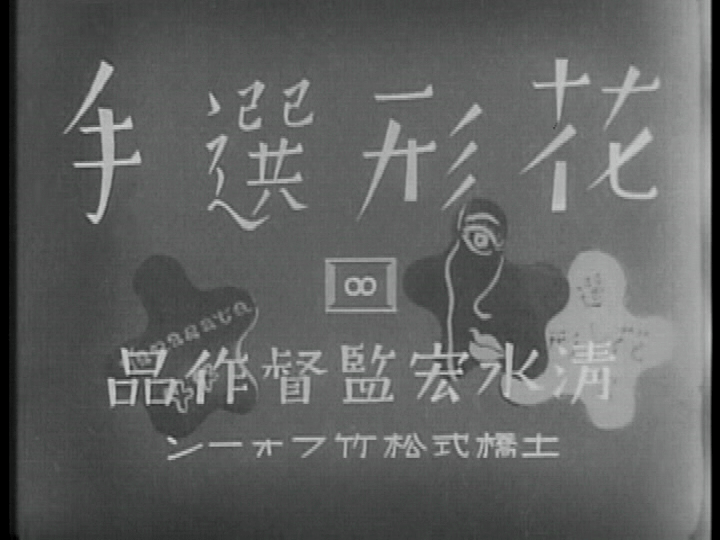
vlcsnap-2016-09-23-01h52m32s055Japan in 1937 – film is propaganda, yet Hiroshi Shimizu once again does what he needs to do in managing to pay mere lip service to his studio’s aims. Star Athlete (花形選手, Hanagata senshu) is, ostensibly, a college comedy in which a group of university students debate the merits of physical vs cerebral strength and the place of the individual within the group yet it resolutely refuses to give in to the prevailing narrative of the day that those who cannot or will not conform must be left behind.

Seki (Shuji Sano) is the star of the athletics club and shares a friendly rivalry with his best friend Tani (Chishu Ryu). Tani likes to train relentlessly but Seki thinks that winning is the most important thing and perhaps it’s better to be adequately rested to compete at full strength. While the two of them are arguing about the best way to be productive, their two friends prefer to settle the matter by sleeping. The bulk of the action takes place as the guys take part in a military training exercise which takes the form of a long country march requiring an overnight stay in a distant town. The interpersonal drama deepens as Seki develops an interest in a local girl who may or may not be a prostitute, casting him into disrepute with his teammates though he’s ultimately saved by Tani (in an unconventional way).

Far from the austere and didactic nature of many similarly themed films, Shimizu allows his work to remain playful and even a little slapsticky towards the end. These are boys playing at war, splashing through lakes and waving guns around but it’s all fun to them. Their NCO maybe taking things much more seriously but none of these men is actively anticipating that this is a real experience meant to prepare them for the battlefield, just a kind of fun camping trip that they’re obliged to go on as part of their studies. The second half of the trip in which the NCO comes up with a scenario that they’re attempting to rout a number of survivors from a previous battle can’t help but seem ridiculous when their “enemies” are just local townspeople trying to go about their regular business but now frightened thinking the students are out for revenge for ruining their fun the night before.

That said, the boys do pick up some female interest in the form of a gaggle of young women who are all very taken with their fine uniforms. The women continue to track them on their way with a little of their interest returned from the young men (who are forbidden to fraternise). Singing propaganda songs as they go, the troupe also inspires a group of young boys hanging about in the village who try to join in, taken in by Tani’s mocking chant of “winning is the best” and forming a mini column of their own. After this (retrospectively) worrying development which points out the easy spread of patriotic militarism, the most overtly pro-military segment comes right at the end with an odd kind of celebration for one of the men who has received his draft card and will presumably be heading out to Manchuria and a situation which will have little in common with the pleasant boy scout antics of the previous few days.

Physical prowess is the ultimate social marker and Seki leads the pack yet, when he gets himself into trouble, his NCO reminds him that “even stars must obey the rules” and threatens to expel him though relents after Tani takes the opportunity to offer a long overdue sock to the jaw which repairs the boys’ friendship and prevents Seki being thrown out of the group. Seki’s individuality is well and truly squashed in favour of group unity though Shimizu spares us a little of his time to also point out the sorrow of the young woman from the inn, left entirely alone, excluded from all groups as the students leave.

Employing the same ghostly, elliptical technique of forward marching dissolves to advance along the roadway that proved so effective during Mr. Thank you, Shimizu makes great use of location shooting to follow the young men on the march. Though the final scene is once again a humorous one as the two sleepyheaded lazybones attempt to keep pace with the front runners, the preceding scene is another of Shimizu’s favourite sequences of people walking along a road and disappearing below a hill, singing as they go. However, rather than the cheerful, hopeful atmosphere this conveyed in Shiinomi School there is a feeling of foreboding in watching these uniformed boys march away singing, never to reappear. Shimizu casts the “training exercise” as a silly adolescent game in which women and children are allowed to mockingly join in, but he also undercuts the irony with a subtle layer of discomfort that speaks of a disquiet about the road that these young men are marching on, headlong towards an uncertain future.