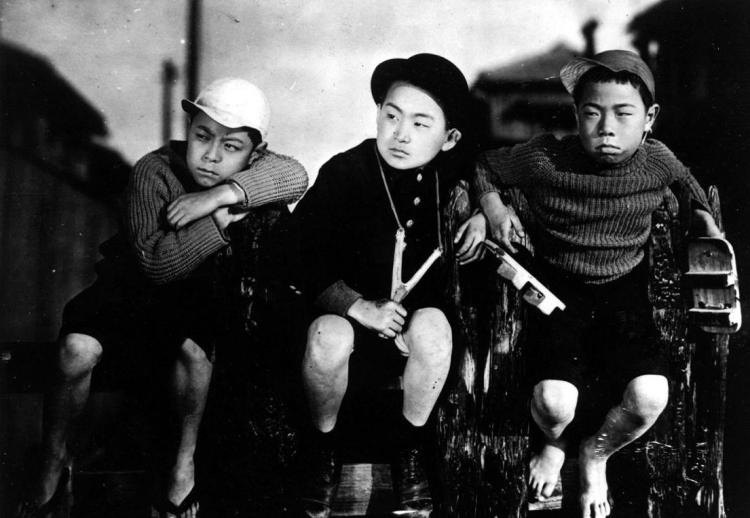
I Was Born, But… ( 大人の見る絵本 生れてはみたけれど, Yasujiro Ozu, 1932)

I was born but stillWhen one thinks of the classic examples of children in Japanese cinema, Hiroshi Shimizu is the name which comes to mind but family chronicler Yasujiro Ozu also made a few notable forays into the genre. I Was Born, But… (大人の見る絵本 生れてはみたけれど, Otona no miru ehon – Umarete wa mita keredo) stars one of the premier child actors of the silent era in Tokkan Kozo (later known as Tomio Aoki) who also worked repeatedly with Shimizu (Children in the Wind, Star Athlete) and Naruse (No Blood Relation, Apart from You, Street Without End, Forget Love for Now) among many others. Like Children in the Wind, I Was Born, But… is the story of two young boys and their well meaning dad only this time the boys’ faith in their father is not entirely justified. Ozu would also revisit this theme some years later with the genial comedy Good Morning which also sees a pair of cute as a button brothers going on strike though theirs is one of silence rather than hunger and provoked by the desire for a television rather than just shock and disillusionment on discovering the unfairness and hypocrisy of the adult world.

Mr. Yoshi (Tatsuo Saito) has moved his family into a nice house in the suburbs not far from that of his boss, Mr. Iwasaki (Takeshi Sakamoto). His two sons, Keiji (Tomio Aoki/Tokkan Kozo) and Ryoichi (Hideo Sugawara) quickly make enemies of some of the neighbourhood kids and start playing truant from school in order to avoid them. Making an ally of the delivery boy from the local sake shop, Keiji and Ryoichi enlist his efforts to get back at the head bully landing themselves top of the local pack.

However, one of the boys, Taro, is none other than the son of their dad’s boss, Mr. Iwasaki. Furiously engaging in a battle of my dad’s better than your dad, the boys are dismayed to see how their father obsequiously greets his superior. Their faith is well and truly crushed when Mr. Iwasaki invites all the kids over to watch some home movies (cutting edge technology for the time) which features some of the employees goofing off, including Yoshi who enthusiastically gurns and performs silly walks for his boss’ benefit. To Keiji and Ryoichi, Yoshi had been a kind of superhero – austere, but strong, honest and inspiring. Realising he’s just another corporate stooge betraying his true self for commercial gain, the boys are thrown into a period of acute existential confusion.

Yoshi’s mantra dictates that he wants his sons to grow up to become “someone”. Keiji and Ryoichi ironically turn this back on him with the charge that he himself is a “no one”. Yoshi cannot argue with their judgement, he is “no one”, in his own mind at least, and harbours a sense of disappointment in his dull and ordinary middle class life. Checking in with his sons after they’ve fallen asleep, Yoshi offers a different kind of mantra during a speech to his wife in that he hopes neither of his sons become company men like he has. He truly wants them to be “someones” but more than that, he wants them to be their own men, living their lives on their own terms and finding a greater sense of fulfilment than he has been able to in willingly debasing himself to curry favour with a boss he doesn’t particularly like to put food on the table for his family.

Keiji and Ryoichi, in a gesture of defiance, go on a hunger strike to prove that they don’t need their father to humiliate himself daily on their behalf. Yoshi can’t get through to them, his authority is significantly damaged and the boys are stubborn but then again their mother’s rice balls are just so tasty they might eventually be persuaded to abandon their mini protest by the power of a rumbly tum. The lesson they learn is one familiar to Ozu’s general philosophy, that battles must be picked and compromises made in the name of pragmatism even if they may uncomfortable to bear.

Ozu shoots with his characteristic naturalism, allowing the boys to goof off as only children can as they pull faces, dance, and strike poses to poke fun at the other boys but also engage in a strange “resurrection” gimmick rather than a secret handshake to bond with their new frenemines. Forgiveness and reconciliation are all around as the boys learn to accept their slightly less black and white world, embrace their new friends, and stride forward towards their eventual destinies. The children occupy one world, and the adults another but perhaps they aren’t so different after all.


Short scene from the film (English subtitles)

Burden of Life (人生のお荷物, Heinosuke Gosho, 1935)

Despite being at the forefront of early Japanese cinema, directing Japan’s very first talkie, Heinosuke Gosho remains largely unknown overseas. Like many films of the era, much of Gosho’s silent work is lost but the director was among the pioneers of the “shomin-geki” genre which dealt with ordinary, lower middle class society in contemporary Japan. Burden of Life (人生のお荷物, Jinsei no Onimotsu) is another in the long line of girls getting married movies, but Gosho allows his particular brand of irrevent, ironic humour to colour the scene as an ageing patriarch muses on retiring from the fathering business before resentfully remembering his only son, born to him when he was already 50 years old.
Rather than focussing on the main narrative right away, Gosho gives us a crash course in marital relations as we meet middle sister, Itsuko (Kinuyo Tanaka), who is currently posing for a raunchy portrait her starving artist husband is painting. Itsuko dresses in Western style, smokes openly and often, and her home is a bohemian one of the kind you’d imagine a (well to do) artist from the ‘30s would live in. The couple are interrupted by their brother-in-law who has come in search of his wife, Takako (Yoshiko Tsubouchi), with whom he’s had yet another argument causing her to storm off somewhere or other in a huff.

Takako has indeed stormed off, but has gone to her mother’s where her younger sister, Machiko (Mitsuyo Mizushima) is preparing for her own wedding and now feeling quite nervous hoping that it won’t be as tempestuous as Takako’s. The three sisters also have a little brother, Kanichi, who is doted on by the women of the family but has a strained relationship with his father, Shozo (Tatsuo Saito). The main conflict occurs once Shozo has successfully married off Machiko and begins happily contemplating a burden free life only to remember that little Kanichi is only eight and so there are twelve more years of fatherhood ahead of him and he’ll be 70 before he gets any peace. In order to speed up the process, he tells his wife Tamako (Mitsuko Yoshikawa) that maybe Kanichi doesn’t need to go school and should go out and get a job instead. Tamako, rightly outraged at her husband’s persistent coldness towards their son brings things to a head by leaving the family home.

The themes are common ones as a family faces the successful marriage of its youngest daughter but the pattern is complicated by the loose end that is Kanichi. Much younger than his sisters, it’s easy to believe Shozo’s assertions that his arrival was somewhat unexpected but far from a joyous surprise Shozo still seems to regard him with a degree of mild horror. Fearing becoming an elderly father Shozo’s concerns are fair given the additional burdens placed on him in having to find good husbands for three women and then pay for their weddings and dowries never mind a college education for a son he never wanted. Kanichi seems to be aware on some level of the way his father feels about him as a poignant scene implies when he begs some of the other neighbourhood children to keep playing with him even though it’s past tea time because he doesn’t want to go home if his dad is there.

Shozo fails to reform his opinion even after his wife leaves him. Almost delighting in a late life slice of batchelorhood, Shozo heads into the bar district for a night out where he ends up drinking with some younger guys, surrounded by students singing the Keio University song. His attention is momentarily taken by a small boy of around Kanichi’s age who is selling flowers to amorous patrons but it’s only once a hostess calls him “papa” that he seems to feel aged fatherhood reassert itself. Enquiring about her age he discovers she is only 19 – much younger than any of his daughters, and consequently Shozo begins to feel more like a ridiculous old man than a young buck on the prowl.

Gosho draws a number of contrasts within his “ordinary” family from the three sisters who seem to represent the changing times in their differing attitudes to the husband and wife and the division of their home. Itsuko, Westernised and brassy, is living well beyond her means and touching her parents for money in order to do it. Talking things over with the kimono’d Takako who offers to recommend a traditional hairstylist for Machiko’s wedding, Itsuko has some advice for dealing with men which she calls “reverse psychology”. Takako and her husband may not have children and fight all the time, but she is in other ways a model wife even if she thinks married life ought to be simpler than it is. Machiko is caught on the brink, though we never see her husband, wondering what her own married life will entail. Her father, Shozo, lamenting on his responsibilities remarks that women are like products for sale, requiring investments which will eventually pay off in terms of successful marriages but any investment in a son is, in a sense, a waste. Family, for him, is less a social unit and more a mini business enterprise from which he was looking forward to retiring.

In the end of course he changes his mind though more out of loneliness or a sense of mortality than any less selfish emotion. Slight at 66 minutes, Gosho packs in as much detail as possible whilst maintaining a broadly comic, almost screwball tone filled with selfish husbands and calculating wives all making the most of the relatively stable times. Life has many burdens but sometimes it’s better to rebrand those burdens joys and make the most of them before someone else decides to carry them for you and all you’re left with is an empty sort of lightness. You’re only old once, after all.


Children in the Wind (風の中の子供, Hiroshi Shimizu, 1937)

vlcsnap-2016-12-06-23h27m52s218It would be a mistake to say that Hiroshi Shimizu made “children’s films” in that his work is not particularly intended for younger audiences though it often takes their point of view. This is certainly true of one of his most well known pieces, Children in the Wind (風の中の子供, Kaze no Naka no Kodomo), which is told entirely from the perspective of the two young boys who suddenly find themselves thrown into an entirely different world when their father is framed for embezzlement and arrested.  Encompassing Shimizu’s constant themes of injustice, compassion and resilience, Children in the Wind is one of his kindest films, if perhaps one of his lightest.
Brothers Zenta (Masao Hayama) and Sampei (Bakudan Kozo) live a fairly comfortable life in a small town with their accountancy clerk father (Reikichi Kawamura) and doting mother (Mitsuko Yoshikawa). Older brother Zenta is the stereotypically good boy who studies hard, gets good grades, and causes no trouble. Sampei, by contrast, is a handful. Running out of the house to play Tarzan with the other neighbourhood kids even though he’d promised his mother he’d stay home to study to improve his awful performance at school, Sampei is the loveable rascal that no one quite knows what to do with. Despite their mother’s protestations, the boys’ father is content to let Sampei run riot for now, he’s only young after all.

When their father is accused of embezzling company funds, sacked, and later arrested, the boys’ world begins to crumble. The other kids won’t play with them anymore, their dad isn’t home, and their mother is worrying about money now that her husband has lost his job. Sampei is packed off to an uncle’s while Zenta stays behind to try and get a job to help out. Unfortunately, Sampei does not take well to his new environment and starts misbehaving even more than usual by disappearing up trees, riding a bucket down a river, running off to meet kappa, and even trying to run away with the circus!

All of this is told more or less from Sampei’s point view meaning that the facts of his father’s case recede into the background while Sampei’s worry and confusion comes to the fore. Having been in the office to deliver his father’s lunch when the coup occurred, Sampei can tell something awful has happened and tries to comfort his dad by closing all the blinds to block out the nosy kids’ faces peeking in from outside, and grabbing his father’s hat to get him to come home. Reassuring his dad that it’s all fine because he can just start a better company of his own, Sampei puts a childishly brave face on things while his ashen faced father walks home in silence. Of course, because Sampei is a child, no one explains to him exactly what’s happened, so no one explains it to us either, but we can perhaps infer a little more from the adults’ passing conversation than the still innocent Sampei.

The boys’ relationship with their father is one of the film’s warmest elements as, in contrast to the stereotypically austere salaryman dad, he delights in playing with his children, even breaking off from worrying about his impending doom by launching into a game of sumo. Sampei and Zenta know their father couldn’t have really done anything bad, so they aren’t really worried and though they miss him, they are sure he’ll be home soon. It’s not until fairly late on that they start to realise the gravity of the situation and how difficult things are for their mother, but once they do they become determined to support her too.

This being a (happy) Shimizu film, the injustice is finally undone and everything goes back to normal which what all children always want. Children, more than adults, are apt to forget quickly and so it’s not long before the other neighbourhood kids start responding to Sampei’s Tarzan call once again. In a typically nice touch, Sampei even invites his arch rival, Kinta – the son of the man who framed his dad for embezzlement in the first place, to come and see the approaching circus with him. A final gesture of reconciliation signals the end to hostilities as a possibly life changing event becomes a humorous summer interlude in the boys’ early lives. Warm and lighthearted, Children in the Wind is perhaps not as cutting or incisive as some of Shimizu’s more socially conscious efforts, but is filled with his characteristic compassionate humanism in its childlike certainty in justice and the willingness to forgive and forget.


Star Athlete (花形選手, Hiroshi Shimizu, 1937)

vlcsnap-2016-09-23-01h52m32s055Japan in 1937 – film is propaganda, yet Hiroshi Shimizu once again does what he needs to do in managing to pay mere lip service to his studio’s aims. Star Athlete (花形選手, Hanagata senshu) is, ostensibly, a college comedy in which a group of university students debate the merits of physical vs cerebral strength and the place of the individual within the group yet it resolutely refuses to give in to the prevailing narrative of the day that those who cannot or will not conform must be left behind.

Seki (Shuji Sano) is the star of the athletics club and shares a friendly rivalry with his best friend Tani (Chishu Ryu). Tani likes to train relentlessly but Seki thinks that winning is the most important thing and perhaps it’s better to be adequately rested to compete at full strength. While the two of them are arguing about the best way to be productive, their two friends prefer to settle the matter by sleeping. The bulk of the action takes place as the guys take part in a military training exercise which takes the form of a long country march requiring an overnight stay in a distant town. The interpersonal drama deepens as Seki develops an interest in a local girl who may or may not be a prostitute, casting him into disrepute with his teammates though he’s ultimately saved by Tani (in an unconventional way).

Far from the austere and didactic nature of many similarly themed films, Shimizu allows his work to remain playful and even a little slapsticky towards the end. These are boys playing at war, splashing through lakes and waving guns around but it’s all fun to them. Their NCO maybe taking things much more seriously but none of these men is actively anticipating that this is a real experience meant to prepare them for the battlefield, just a kind of fun camping trip that they’re obliged to go on as part of their studies. The second half of the trip in which the NCO comes up with a scenario that they’re attempting to rout a number of survivors from a previous battle can’t help but seem ridiculous when their “enemies” are just local townspeople trying to go about their regular business but now frightened thinking the students are out for revenge for ruining their fun the night before.

That said, the boys do pick up some female interest in the form of a gaggle of young women who are all very taken with their fine uniforms. The women continue to track them on their way with a little of their interest returned from the young men (who are forbidden to fraternise). Singing propaganda songs as they go, the troupe also inspires a group of young boys hanging about in the village who try to join in, taken in by Tani’s mocking chant of “winning is the best” and forming a mini column of their own. After this (retrospectively) worrying development which points out the easy spread of patriotic militarism, the most overtly pro-military segment comes right at the end with an odd kind of celebration for one of the men who has received his draft card and will presumably be heading out to Manchuria and a situation which will have little in common with the pleasant boy scout antics of the previous few days.

Physical prowess is the ultimate social marker and Seki leads the pack yet, when he gets himself into trouble, his NCO reminds him that “even stars must obey the rules” and threatens to expel him though relents after Tani takes the opportunity to offer a long overdue sock to the jaw which repairs the boys’ friendship and prevents Seki being thrown out of the group. Seki’s individuality is well and truly squashed in favour of group unity though Shimizu spares us a little of his time to also point out the sorrow of the young woman from the inn, left entirely alone, excluded from all groups as the students leave.

Employing the same ghostly, elliptical technique of forward marching dissolves to advance along the roadway that proved so effective during Mr. Thank you, Shimizu makes great use of location shooting to follow the young men on the march. Though the final scene is once again a humorous one as the two sleepyheaded lazybones attempt to keep pace with the front runners, the preceding scene is another of Shimizu’s favourite sequences of people walking along a road and disappearing below a hill, singing as they go. However, rather than the cheerful, hopeful atmosphere this conveyed in Shiinomi School there is a feeling of foreboding in watching these uniformed boys march away singing, never to reappear. Shimizu casts the “training exercise” as a silly adolescent game in which women and children are allowed to mockingly join in, but he also undercuts the irony with a subtle layer of discomfort that speaks of a disquiet about the road that these young men are marching on, headlong towards an uncertain future.


Forget Love for Now (恋も忘れて, Hiroshi Shimizu, 1937)

vlcsnap-2016-09-21-02h01m08s449Sad stories of single mothers forced to work in the world of low entertainment are not exactly rare in pre-war Japanese cinema yet Hiroshi Shimizu’s 1937 entry, Forget Love For Now (Koi mo Wasurete) , puts his on own characteristic spin on things by looking at the situation through the eyes of the young son, Haru (Jun Yokoyama). Frustrated by both social and economic woes, little Haru’s life is blighted by loneliness and resentment culminating in tragedy for all.
Oyuki (Michiko Kuwano) is a single mother and bar hostess in a port town. Her young son Haru loves his mum even though he’s often on his own but after he makes the mistake of inviting some of the other boys back to his mother’s apartment and they end up getting doused in her rather pungent perfume, the other kids’ mothers figure out what Oyuki does for a living. Predictably they forbid their kids from associating with Haru because his mother is “a bad woman”. After repeatedly trying to keep hanging out with the other children, Haru starts skipping school to avoid the constant exclusion entirely. When Oyuki finds out about this she is very upset and has him moved to another school but the old group of kids and the new group of kids are not entirely unconnected and so Haru is unable to escape the prejudice his old group of friends hold for him.

The film never goes into how Oyuki ended up on her own with a young child or what might have happened to Haru’s father but Oyuki’s role as a single mother is not the reason the pair are excluded from the other families. Lacking other opportunities, Oyuki is forced to into work as a bar hostess even though she clearly hates it and bears it only for her son’s sake.

Her job is to entertain men in the bar to keep the drinks flowing, always smiling and flirting to keep dull men trapped in the false hope of real connection. She gets paid very little for this as we find out early on when she tries to spearhead a kind of union movement in the bar by questioning why their work costs them so much – they have to pay for their outfits, food and drink out of their own wages when the girls working at other establishments get a share of the alcohol profits which they have helped to generate but Oyuki and her friends get only their meagre salaries. Their pleas fall on hard ears with the tough as nails mama-san who isn’t going to permit any kind of mutinies in her establishment. This is made clear later on when one employee tries to quit her job at the bar and move to Kobe in search of more lucrative employment but is beaten black and blue by the bar’s goons.

Oyuki’s single ray of hope comes in the form a sinister figure lurking in the shadows outside her apartment. Eventually becoming friends with Oyuki and her son, the man represents a possible happy ending in which he beats the depression, finds a better job and takes them both away from this world of poverty of degradation. Needless to say this is not to be – the man’s attempts to find a solution to everyone’s problems take to long and he is simply too late. Not only that, his well meaning words of advice to Haru that he should make sure to win against the bullies next time have disastrous consequences.

In essence, Forget Love For Now is “hahamono” in which Oyuki bravely sacrifices everything of herself in her son’s name, committed to the idea that he will progress through his education to university and repay all of her efforts by becoming a fine man. Society, whilst praising the idea of the self sacrificing mother, does not approve of the things she has to do in that very sacrifice she’s making and refuses to allow her success in her mission. The true tragedy is that the little boy, Haru, is aware on some level of everything his mother is doing for him and loves her so much that he is willing to sacrifice himself for her – rendering her long years of suffering entirely pointless.

In the end, Oyuki has nothing. As the title of the film tells us, not even love is permitted to her as she loses both her son and the possibility of romance as her well meaning man makes a now equally pointless sacrifice of his own. Forget Love For Now is somewhat atypical in Shimizu’s output as it ends with no hope in sight, strongly condemning this rigid society which forces women to act in a way of which it disapproves and then refuses to support them when they do. Shooting mostly on stage sets rather than the naturalistic settings featured in much of his other work, Shimizu crafts an emotionally devastating tale of maternal sacrifice cruelly frustrated by a cold and unfeeling society.


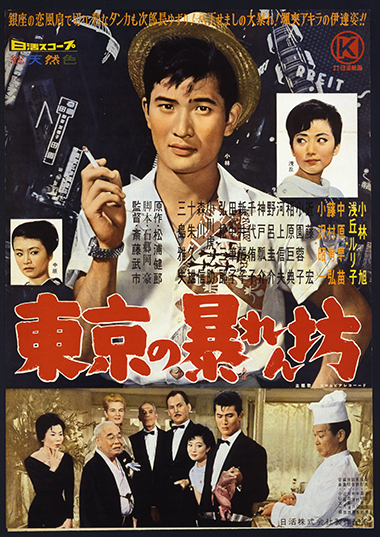
Tokyo Mighty Guy (東京の暴れん坊, Buichi Saito, 1960)

Tokyo Mighty GuyThe bright and shining post-war world – it’s a grand place to be young and fancy free! Or so movies like Tokyo Mighty Guy (東京の暴れん坊, Tokyo no Abarembo) would have you believe. Casting one of Nikkatsu’s tentpole stars, Akira Kobayshi, in the lead, Buichi Saito’s Tokyo Mighty Guy is, like previous Kobayashi/Saito collaboration The Rambling Guitarist, the start of a franchise featuring the much loved neighbourhood big dog, Jiro-cho.

In this first instalment, Jiro (Akira Kobayashi) has just returned from some overseas study in Paris where, rather than the intellectual pursuits that he planned, Jiro mostly wound up with a love of French cuisine. His parents have just opened a small French restaurant in fashionable Ginza and Jiro is now working there too despite the more lucrative paths that might be open for someone with a college education, language skills and overseas experience.

Jiro is also a hit with the ladies, and the daughter of the family that run a nearby bathhouse, Hideko (Ruriko Asaoka), has quite a crush on him though Jiro seems fairly oblivious to this fact despite her revealing to him that her family have received an offer of arranged marriage. After a high ranking official crashes his car into the family restaurant, Jiro becomes embroiled in a series of complicated local political and shady business plots which conflict strongly with his righteous and individual nature.

Tokyo Mighty Guy begins with a cute musical title sequence that would be much more at home in a glossy musical of the time than in a smalltime gangster flick which is what lurks around the edges of this feel good, youthful tale. Indeed, Kobayashi gets ample opportunity to show off those pipes as he sings to himself alone in the male side of the bathhouse and later repeats snatches of the song throughout the film. There’s a single being peddled here, but it’s being done in a fun, if unsubtle, way.

Jiro is very much a man of his age. He’s the big man in the neighbourhood – middle class, educated, studied abroad, likes the finer things such as foreign food and sharp suits, but he’s got the words social justice engraved on his heart so you know you can go to him with your troubles and he’ll help you figure them out. He doesn’t take any nonsense from anyone; he sends the yakuza protection mob packing and even convinces one of them to go straight with a trainee chef job in his restaurant. No wonder the animal loving former politician has taken such a liking to him – he’s the kind of man it’s hard not to like.

That’s not to say Jiro’s a saint, he’s out for himself just like everyone else. We can see how much distress there is for others when we venture into a rundown tenement filled with the genuine poor who have too many children and not enough resources. Actually, the film isn’t terribly kind about these people and treats them more or less as an embarrassing joke but it does demonstrate how the bigwigs have exploited the needs of the lower orders in more ways than one. Jiro, at least, won’t stand for this kind of deception and misuse of traditional social bonds but he will still use it as leverage to bring things to a fittingly ironic solution that is to the benefit of everyone aside from those that were originally in the wrong.

Cute and quirky is definitely the theme and even where there are darker elements, the cheerful atmosphere is tailor made to eclipse them. Saito doesn’t roll out any particularly impressive directorial tricks but allows the absurd humour of the script to do his work for him, highlighting it with surreal touches such as the face of an absent lover appearing in the moon or the celebratory feeling of hundreds of advertising leaflets dropping from the sky like confetti. Light and fluffy as it is, Tokyo Mighty Guy is time capsule from the socially mobile youth of Tokyo in 1960 who don’t want arranged marriages or to take over the family business. The world has opened up for them with a new vista of foreign culture and multicultural cool. The message is clear, the future belongs to guys like Jiro, and by extension to the Jiro wannabes lining up to watch him prosper from their cinema seats.


Tokyo Mighty Guy is the first of three films included in the second volume of Arrow’s Nikkatsu Diamond Guys box set.