

Caught in a space of existential limbo, a young woman struggles with the uncertain nature of life. What’s the point of living in a world that might end, she asks herself, seemingly not having realised that it’s as it always was, the world is always ending and may blink out at any given second. Ryuhei Kitamura’s adaptation of the manga by Tsutomu Takahashi The Three Sisters of Tenmasou Inn (天間荘の三姉妹, Tenma so no San Shimai) plays out a little like a mashup of Hirokazu Korea’s Afterlife and Our Little Sister, but ultimately meditates on how to live on in the shadow of loss.
After all, as the relentlessly cheerful heroine Tamae (Non) later says, life is hard but the world is not so bad and everyone has their part to play. That’s something she discovers for herself after falling into a coma following a traffic accident and arriving at Tenmasou Inn in the picturesque seaside town of Mitsuse. As is explained to her, the inn exists in a liminal space between Heaven and Earth where those caught between life and death are expected to make a choice on their direction of travel.
But Tamae begins to enjoy her time at Tenmasou in part after learning that the owner’s daughters, Nozomi (Yuko Oshima) and Kanae (Mugi Kadowaki), are her half-sisters. They are fully aware of their liminal status and that unlike Tamae they can never return to the mortal world or make any kind of life for themselves in Mitsuse where time stands still. Nevertheless, Tamae’s relentless cheerfulness and knack for human empathy prove key assets, beginning to return an energy and warmth that has those around her giving new thought to their cosmic inertia and if it’s really possible to go on living in a constant state of timelessness.
Tamae might want to stay, experiencing for the first time the sense of family that she’s searched for all her life. She considers giving up the rest of her time to stay with them, but is reminded that no one can stay in this transient place forever while this version of Mitsuse which seems to hang over the “real life” town may soon disappear. Those who live there describe it as like living in a dream, a confusing simulacrum of life in which no time passes. There are those who make the eventual decision to pass on towards rebirth while others opt to stay, still having unfinished business or perhaps just not quite yet ready.
Recalling the 2011 tsunami, the film touches on the difficult subject of survivor’s guilt and how to come to terms with loss on a mass scale while Tamae tries to process what it means to live and to not to. She resolves that “people don’t end when they die” but live on in the memories of those who remember them, though her conviction that she must live on as a kind of conduit for the souls of others may also rob her of a degree of her selfhood in her own right to live simply as herself.
Even so as she admits life is hard. An old woman suffering with liver cancer who had been blind for many years looks for beauty in the afterlife only to be reminded that there are beautiful things everywhere if you take the time to look. She too has had a life of sadness, but discovers that it might not be too late to make up for lost time, while a very young woman who felt herself to be alone learns that she has a friend and there are those who care for her even she did nearly burn the inn down in a fit of temper. Unabashedly sentimental, the film is as much about moving on as it is about learning to live in the present as the various guests contemplate whether to return to the world of the living with all of its pain and loneliness, or proceed to that of the dead knowing that there’s no guarantee the next life will be any better. Melancholy but also in its way uplifting, Kitamura’s empathetic drama eventually settles on a note of poignancy in which the act of living becomes its own memorial and defiant act of remembrance in the face of constant and unexpected loss.
The Three Sisters of Tenmasou Inn screens in New York Aug. 6 as part of this year’s JAPAN CUTS.
Original trailer (English subtitles)
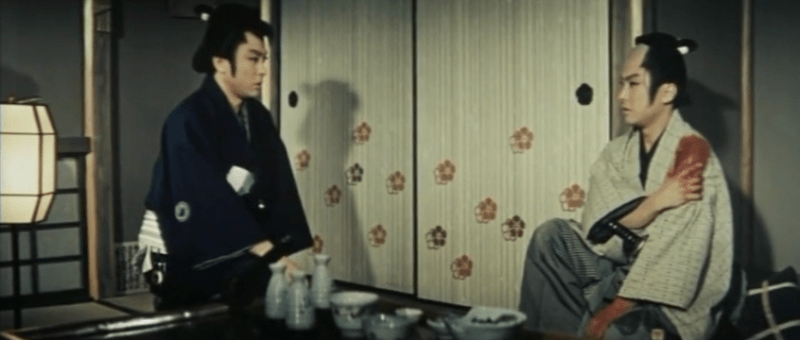





 Brutal Tales of Chivalry (昭和残侠伝, Showa Zankyo-den) – a title which neatly sums up the “ninkyo eiga”. These old school gangsters still feel their traditional responsibilities deeply, acting as the protectors of ordinary people, obeying all of their arcane rules and abiding by the law of honour (if not the laws of the state the authority of which they refuse to fully recognise). Yet in the desperation of the post-war world, the old ways are losing ground to unscrupulous upstarts, prepared to jettison their long-held honour in favour of a dog eat dog mentality. This is the central battleground of Kiyoshi Saeki’s 1965 film which looks back at the immediate post-war period from a distance of only 15 years to ask the question where now? The city is in ruins, the people are starving, women are being forced into prostitution, but what is going to be done about it – should the good people of Asakusa accept the rule of violent punks in return for the possibility of investment in infrastructure, or continue to struggle through slowly with the old-fashioned patronage of “good yakuza” like the Kozu Family?
 The Fallen Angel (人間失格, Ningen Shikkaku), based on one of the best known works of Japanese literary giant Osamu Dazai – No Longer Human, was the last in a series of commemorative film projects marking the 100th anniversary of the author’s birth in 2009. Like much of Dazai’s work, No Longer Human is semi-autobiographical, fixated on the idea of suicide, and charts the course of its protagonist as he becomes hopelessly lost in a life of dissipation, alcohol, drugs, and overwhelming depression.
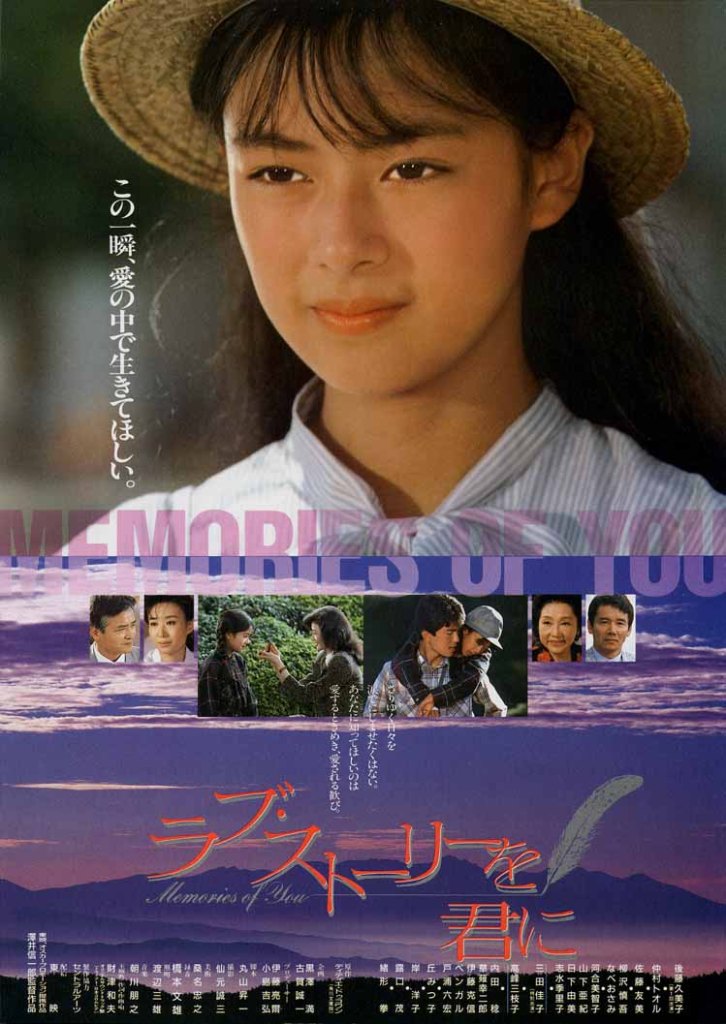 If you thought idol movies were all cute and quirky stories of eccentric high school girls with pretty, poppy voices then think again because Memories of You is coming for you and your faith in idols to make everything better. Directed by
 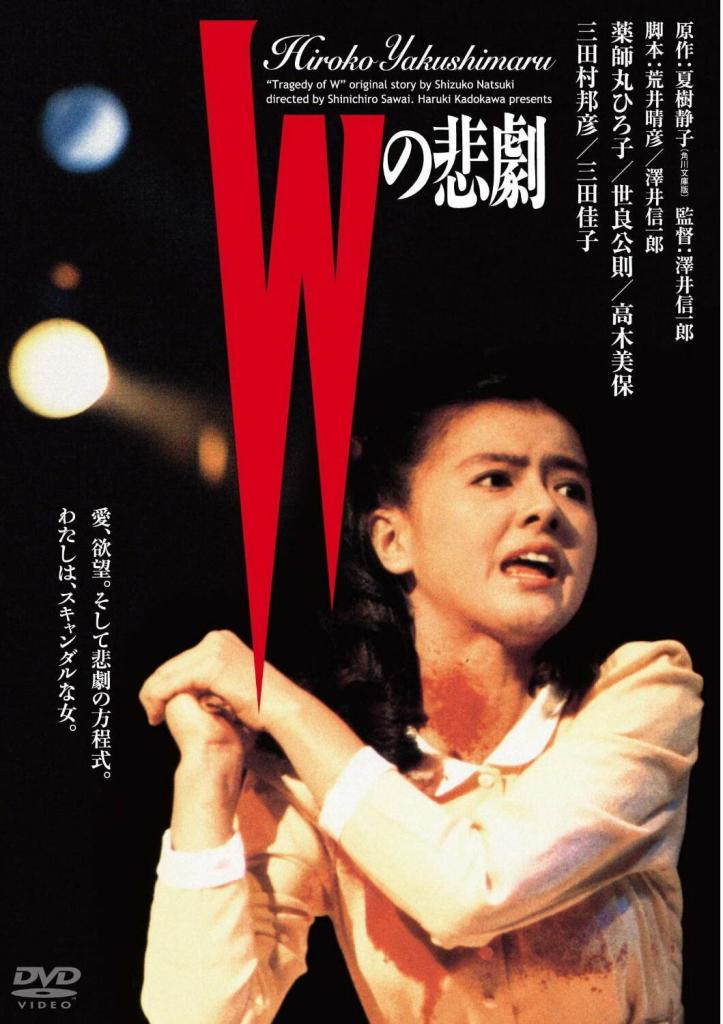 Hiroko Yakushimaru was one of the biggest idols of the 1980s. After starring in Shinji Somai’s
  Nobuhiko Obayashi may have started out as an experimental filmmaker and progressed to a lengthy narrative film career but he remains best known for his “what the hell am I watching?” cult classic Hausu. Aside from his 1983 take on The Girl Who Leapt Through Time, very little of his other work has travelled outside of Japan. In the case of 1987’s The Drifting Classroom (漂流教室, Hyoryu Kyoshitsu), this is doubly surprising firstly because it’s based on a hugely popular manga by the godfather of horror comics Kazuo Umezu and secondly because it’s set in an international school so around 80% of the dialogue is in English.
 Windows on Worlds