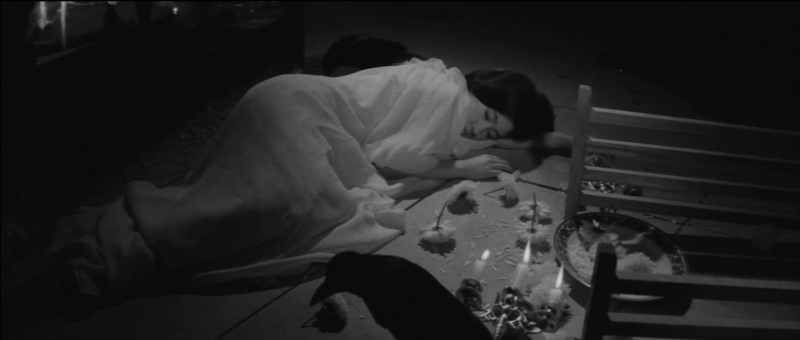
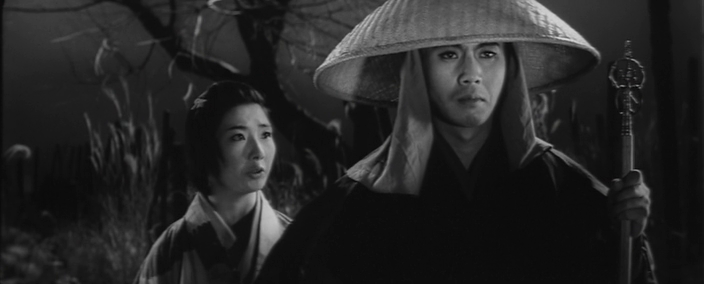
Whirlpool of Flesh (おんなの渦と淵と流れ, Ko Nakahira, 1964)

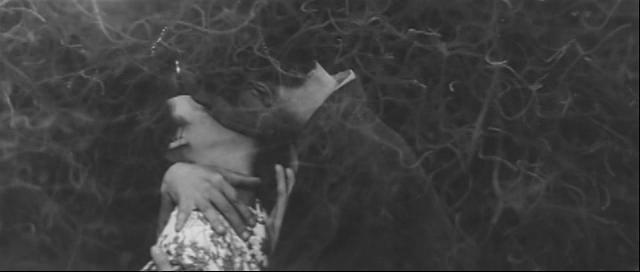
A intellectual professor and his wounded wife find themselves trapped in a toxic marriage after returning from Manchuria in Ko Nakahira’s fatalistic drama, Whirlpool of Flesh (おんなの渦と淵と流れ, Onna no Uzu to Fuchi to Nagare). Set in the late ‘40s, the film does indeed position Manchuria as a point of corruption while otherwise suggesting that Japan itself has been emasculated by the Occupation, but otherwise demonstrates how the couple drag each other into a cycling whirlpool of jealousy and obsession that it seems neither of them are really equipped to understand let alone escape.

Claiming to have been struck by her bright and smiling face in her omiai photo, Keikichi (Noboru Nakaya) married Sugako (Kazuko Ineno) in Manchuria without actually meeting her before the wedding. Apparently uninterested in sex, Keikichi was a virgin on their wedding night but harbours doubts Sugako may not have been. In any case, he seems put out that Sugako is not in his opinion his intellectual equal. He chances on her diary in which she details how bored she is by his constant lectures about English literature and that she feels him to be more schoolteacher than husband, but he merely scoffs that it’s not particularly well written. He begins to suspect that she’s sleeping with customers who come into the speakeasy she opens in their home during the days between the Russian invasion and repatriation and succumbs to a generalised sense of impotence hiding out in his room upstairs reading while she takes care of business below. 

In the present day, convinced that she’s having an ongoing affair with a merchant, Otani (Kazuo Kitamura), Keikichi pretends to go to a hot springs resort and then sneaks back to spy on her from an adjacent room. Though he feels no desire for her as his wife, through the eyes of these other men he rediscovers a sense of Sugako as the woman from the photograph for whom he does feel some attraction and satisfies his latent sexual desires through watching her sleep with Otani. As an escape from the war, he’d been working on a translation of Shakespeare’s Troilus and Cressida the heroine of which he seems to superimpose on Sugako in wondering if she is a faithless woman or true, angel or devil. 

Yet from Sugako’s point of view, she begs him for physical intimacy which he refuses to grant despite his jealousy over her relations with other men. Traumatised by her sexual abuse at the hands of her uncle, Sugako believes that she has a body designed to satisfy men’s desires and is drawn into meaningless, and often transactional, sexual relationships. When Keikichi later questions her, it seems she doesn’t remember any of them in detail for to her they were simply “men” and nothing more. The situation is somewhat complicated by the fact that her uncle was a scholar of Chinese literature, which in part aligns him with Keikichi, but also points back to Manchuria as a source of corruption though coming uncomfortably from the opposite direction. 

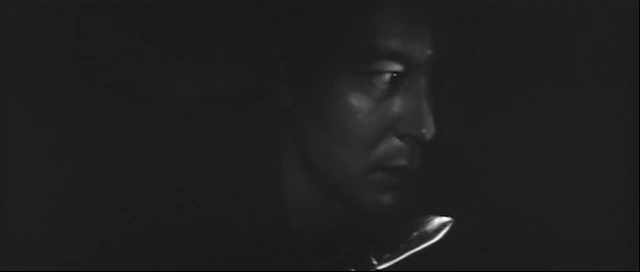
Sugako equates this corrupted sexuality with the great emptiness inside her that frequently leads to thoughts of suicide. Nakahira constantly shows us shots of Keikichi’s knife as if implying some kind of violence is inevitably going to take place, though in the end it signals nothing so much as Keikichi’s impotence. Then again, the emptiness is also linked to a sense of despair in Japan’s defeat that is manifested most obviously in the house next-door where the widowed mother may have been having an affair with Sugako’s uncle and unsubtly tries to blackmail her by threatening to expose the secret of her sexual abuse about which she had tried to tell Keikichi but he had refused to listen. The daughter has become a sex worker catering to American servicemen to support the family while her brother, Kenichi (Tamio Kawachi), allows her to sacrifice herself for him justifying himself that it’s for the greater good as he’ll eventually become a doctor and save countless other lives. He’s also masquerading as a Christian to get a scholarship to an American university through the church which is all very contradictory not to mention selfish and cynical. The sister, meanwhile, appears to have lost her mind and frequently rants and raves, blaming her mother by claiming that walking in on her with Sugako’s uncle permanently corrupted her sense of self and sexuality. Like Sugako, she exorcises her trauma through abusing her body, in her case through sex work with “nasty GIs who don’t always pay.”

Keikichi refers to this as “post-war nihilism” like the frequent strikes and workers parades that take place around him, but partially repairs his sense of masculinity after moving to Tokyo and getting a job. At work he meets another young woman who is a mirror of the young lady from next-door in that she was also repatriated from Manchuria where her father was a member of the government. With her mother dead and father unable to work, Shimura (Kaori Taniguchi) also supports her family with her secretarial job and often goes without lunch herself to make ends meet. Keikichi notices this and offers her his bento claiming to be feeling unwell, but fails to notice how his pity wounds her dignity even if he meant in kindness while acknowledging that he’s never known hunger. Unlike the mismatched Sugako, Keikichi and Shimura are an ideal match. She also wanted to study English literature and can meet him on his level discussing politics and culture though he does not seem to be aware that he is attracted to her and acts almost paternally in offering to pay her university fees to help her escape her life of poverty, echoing Sugako’s claims that he had become her “little boy” rather than her husband. 

The irony is that Sugako insists Keikichi, who does little but look down on her and alternately complain that she’s either impure or unattractive, is the only man she’s ever loved and blames his lack of sexual interest in her on the unresolved trauma of her childhood abuse. Having asked Kenichi to help her get her hands on some cyanide, she is shocked and disgusted when despite his need he rejects her money and asks for her body instead. He insists that it’s “only the friction of mucus membranes” and that she might as well sleep with him first if she’s going to die, though her refusal is in part a desire to die “pure” and finally overcome the emptiness and despair inside her. This inability to reconcile herself is also aligned with Keikichi’s vision of “post-war nihilism” and suggests that in the end this trauma can’t be healed and must necessarily lead to destruction. Meanwhile, Keikichi seems to have discovered a path towards his rebirth in his friendship with Shimura only to potentially have the rug pulled from under him. His new future too, may end up poisoned by Sugako’s unilateral decision to facilitate it. Dark and twisted in true Nakahira fashion, the film paints the post-war society itself as a deepening whirlpool from which there is no escape or at least not for those like Keikichi and Sugako forever locked in a deathly embrace and drawn ever deeper into the waves.


Wolves of the Night (夜の狼, Yoichi Ushihara, 1958)

A cold-hearted yakuza starts to get second thoughts when confronted with the misery his actions create in Yoichi Ushihara’s slice of Nikkatsu Noir, Wolves of the Night (夜の狼, Yoru no Okami). Though the hero is ostensibly Tsukida (Ryoji Hayama), the conflicted gangster unable to reconcile himself with the fact that he has fallen in love with a women he himself destroyed, it’s equally about the women who get caught in the crossfire of a burgeoning gang war and are each victims of male greed and indifference.

In any case, gang boss Tachibana (Somesho Matsumoto) brings a lot of this on himself. The secondary narrative revolves around a woman, Takako (Mari Shiraki), who borrowed money from the Manji gang to build her bar, but now that it’s complete Tachibana swindles her by calling in the debt and foreclosing on the property, passing ownership to Tsukida with instructions to kick Takako out. She, however, doesn’t take well to this and is resentful of Tachibana for screwing her over so she vows revenge. Her original attempt to get it by seducing Tsukida doesn’t work out, so she recruits a yakuza from a rival gang to extort them claiming that they have mole and he’ll only reveal their identity when they hand over the cash. This plan has some pretty tragic consequences and not least for Tachibana himself, but none of this would have happened if he hadn’t behaved so badly in cheating Takako out of the bar she worked so hard to build. He’d also told Tsukida that the bar owner was a beauty and it was understandable if wanted to try seducing her. 

But by this point Tsukida has developed a fondness for Katsumi (Izumi Ashikawa), a young woman he first meets when she’s caught by some of his guys offering herself for sex work in their territory. The other ladies describe Katsumi as “odd” and “an outsider”. It’s clear from her behaviour and the way she’s dressed, not to mention a lack of awareness of the rules of the gang, that she’s never done this before and is terrified. Tsukida calls his men off and tells her to go home, but later realises that it’s his own fault she was put in this situation because he was responsible for collecting the debt her parents owed to Tachibana taken out because her father is bedridden. Tsukida seems shaken by the old lady’s intense resentment, but still takes their money if attempting to convince Tachibana not to pursue them any further because they have nothing left to give, correctly assuming that Katsumi resorted to sex work to get the money. 

It maybe the sense of guilt that proved the last straw as the old couple then take their own lives but rather than freeing her lead Katsumi on a lonely path of self-destruction driven only by her hated for Tachibana and Tsukida. The fact that she later becomes ill further emphasises her positioning as a symbol of a despoiled nation poisoned by the ruthless inhumanity of the post-war society, along with literal a embodiment of Tsukida’s guilty conscience. Tsukida rejects Takako as a person more like himself, an example of corrupted femininity using her body to manipulate men in a world in which a woman has little other power, and instead is drawn to Katsumi who was once innocent, demure, and cheerful but who he himself has destroyed through his own greed and heartlessness.

Spending some time in hospital following a failed suicide attempt seems to heal her in body body and soul, though the total about face in Katsumi’s feelings for Tsukida seems somewhat bewildering even if he did visit her every day and presumably win her over despite her resentment towards him for contributing to her parents’ deaths. Nevertheless, it’s his feelings for Katsumi that see Tsukida longing to quit the yakuza and retreat to the country to live a small, honest life with her free of the city’s corruption. But as so often in the movies, it’s not that simple and this time it’s a tragic consequence born of male failure and insecurity that eventually costs him his shot at a normal life even as his frenemy, a local policeman he often sees in the same bar and gives him unsolicited advice about how he should quit the yakuza, remains surprisingly supportive suggesting that his redemption may merely be on hold rather than cancelled. In any case, though shooting almost entirely on stage sets, Ushihara makes good use of stock footage of contemporary Ginza as a place of bright lights and equally dark shadows where gangsters lurk on every corner and mercy is in desperately short supply.

The Nineteen-Year-Old’s Map (十九歳の地図, Mitsuo Yanagimachi, 1979)

“What should I do with my life?”, the question becomes a frequent refrain in Mitsuo Yanagimachi’s dark tale of urban alienation, The Nineteen-year-old’s Map (十九歳の地図, Jukyusai no Chizu). Adapted from a novel by Kenji Nakagami which painted a bleak picture life on the margins of the economic miracle, the film’s quiet sense of unease hints at a coming explosion but also that there will never be one because in the end the hero is too filled with despair and ennui to ever follow through on the various threats he makes during a series of prank calls to people in the neighbourhood who’ve incurred his wrath.

The nineteen-year-old of the title, Yoshioka (Yuji Honma) is in theory a student taking a year out to study for university exams while earning his keep delivering papers for a newsagent where he lives in a dorm with several other paperboys all just as defeated and aimless as he is. They all, however, look down on and make fun of him for being a bit odd not least because he hangs around with a 30-year-old man who is still stuck living a like a teenager that the other guys think is creepy. Konno (Kanie Keizo) is creepy in a way, in that he’s an obvious image of what these boys might be in 10 years’ time if they do not manage to find something that will allow them to move forward, out of the slums and into a more fulfilling life. 

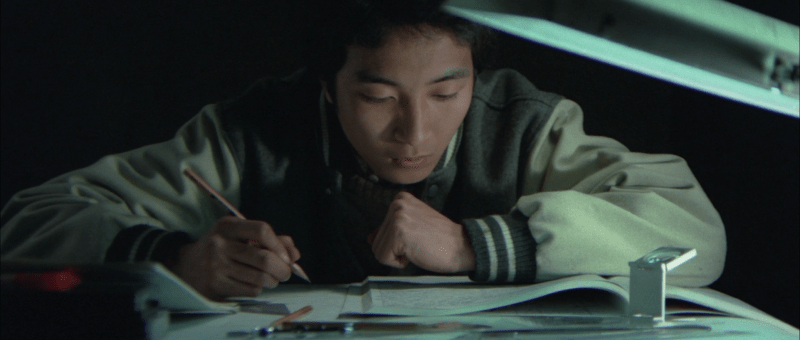
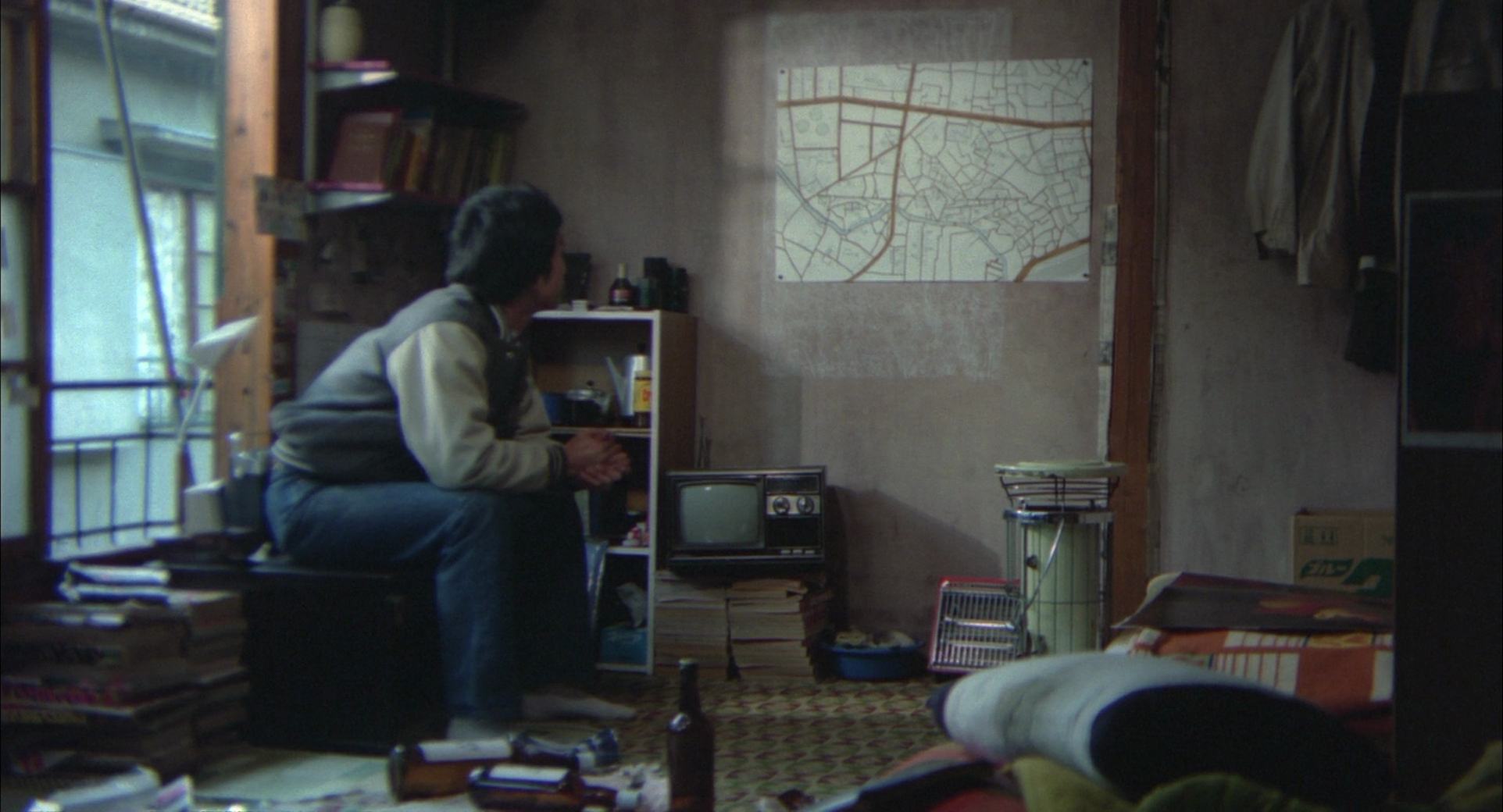
Yoshioka’s main outlet is making a map of the local area which he annotates with notes about the various people who live there, many of them on his paper round. If they do something to displease him or otherwise display something he regards as a moral failing he puts a large cross against their name, and when someone has three crosses he makes a harassing phone call threatening to burn down their house. It’s never quite clear whether his threats have any serious intent or if the threat itself is enough in allowing him to feel powerful and superior to world around him which he feels is rotten beyond repair. People often ask him where he’s from and he tells them but with slight hesitation, as if he’s not telling the entirety of the truth as perhaps confirmed by one woman’s attempt to probe his origins surprised that he doesn’t have any kind of rural accent while she’d never heard of the town he claimed to be from. 

One of the other boys at the newspaper office is an aspiring boxer, but he gets badly beaten in a fight and eventually leaves to join the Self Defence Forces. The meanest of them, Sato, has a sharp tongue but seemingly no more direction than Yoshioka finding his release through more direct forms of violence and hateful behaviour. Everyone around him is disappointed and filled with despair. Even the lady who runs the newsagent’s reflects on her unsatisfying life and the ruined hopes of her youth in which she dressed in fine kimonos and kept herself nice. Her only comfort is that she “saved a man deserted by his wife” even if she mainly treats him with contempt for his failure to repair the loose nail in the hallway she keeps catching her foot on, or fix the toilet which continually backs up and floods the bathroom. 

Yoshioka does seem to be followed around by leaky appliances while everywhere around him is dank and muddy. Konno has one ray of hope in his life in the form of a woman he calls Maria (Hideko Okiyama) who is covered in scars but still she survives. Maria is indeed a Madonna figure, a symbol of scarred purity and human suffering that Konno regards as a kind of salvation. Yet Konno’s attempt to reach her only leads to further ruin as he commits small but increasingly daring acts of crime from bag snatching to burglary to get the money to run away with her only to end up in prison still wondering what it is he should do with his life. 

Maria had told them of a dream she had in which hundreds of people emerged from her and went happily to heaven while she was left on the ground below. Some angels on a cliff tried to lift her up, but she found herself unable to reach out to them only standing immobile and looking up in jealousy. In his way, Yoshioka is much the same perhaps as Konno had said afraid to be happy and unable to envisage for himself a life outside of the slum. Konno sometimes introduces him as a student at a top university which seems to further press on his insecurity. Yoshioka rarely attends classes, spending all his time delivering papers or making his map of iniquity. He describes himself several times as a “right-winger” and at one point fantasises about taking part in a nationalist parade, but aside from his conservative takes on morality seems to have no real ideology save the fact that everyone, even the people who are actually nice to him, pisses him off. 

“Even if you’re angry at something, why should you explode the gas tanks?” a telephone operator reasonably asks after Yoshioka makes a prank call reporting a bomb threat on a train leaving Tokyo station while explaining that he also plans to blow up a set of gas cylinders to obliterate the town. The voice on the phone does not appear to take him seriously and sympathetically tries to talk him out of his strange delusion, but all Yoshioka can do is go home and cry in the utter impotence of his life. In the end, Maria is the only one who is able to feel any kind of joy. Finding a pretty dress while dumpster diving, she twirls cheerfully dancing around even with the leg which was left lame after a failed suicide attempt. This time she’s the one who tries to reach out, but Yoshioka ignores her and looks away as they head in different directions. It seems he will never really act on any of his threats, or be able to escape the futility of his life trapped on the margins of a prosperous society which he feels continues to reject him. Yanagimachi films his uneasy existence with naturalist detachment, capturing the mud and filth that cling to Yoshioka along with the strangely violent, goldfish-killing kids, the angry dads, and women who urinate in the street that occupy his round in this particular corner of the “hell” of modern Tokyo.


DVD release trailer (no subtitles)

Dodes’ka-den (どですかでん, Akira Kurosawa, 1970)

By the late 1960s, Akira Kurosawa was in the midst of a creative crisis having spent two years working on the Japanese segments of the Hollywood war film Tora! Tora! Tora before he was eventually let go by the parsimonious US producers who feared he was spending too much money and making too little progress. Meanwhile, the studio system which had supported his career was collapsing and could no longer offer the kinds of budgets necessary for his personal brand of epic cinema. Teaming up with Masaki Kobayashi, Kon Ichikawa, and Keisuke Kinoshita, he formed the Club of the Four Knights production company but the first and only film they produced, Dodes’kaden (どですかでん), was not perhaps the kind of film many were expecting.

Inspired by a novel by Shugoro Yamamoto, the film like The Lower Depths focuses on a small community living in a slum only in this case on the edge of the modern city. Shot in classical 4:3, it was also Kurosawa’s first foray into colour and makes the most of his painterly eye with its surrealist backdrops and exaggerated sunsets. Once again there is the feeling that these people are already dead or trapped in a kind of purgatory unable to escape their desperate suffering, the slum as much of a mindset as a physical place. “Life is nothing but pain to me” one man claims, stating his hope that he die as quickly as possible while relating the sad story of his life: falling into depression when his sons were killed in the war and losing his wife, business, and finally home to the Tokyo air raids. Yet he is reminded that his family live on in him as long as he does and to kill himself is to kill them too, rediscovering a desire to survive even in his suffering. 

Another man, Hei (Hiroshi Akutagawa), dresses in a soldier’s uniform and wanders around like a zombie with, as one person puts it, the eyes of a dead man. Later a woman comes to find him, but he is seemingly unable to reawaken himself and move on from his trauma, now numbed to life, an already spent force. A young woman, Katsuko (Tomoko Yamazaki), is little different. Never speaking she has been raised by her uncle who begins sexually abusing her while her aunt is in hospital. She says that she wants to die, stabbing the only boy who showed her kindness because she feared he’d forget her. 

These people have largely been forgotten, living almost in another era and entirely cut off from mainstream society in a kind of etherial purgatory. Like the residents of The Lower Depths, a degree of fantasy is necessary for their survival a case in point being that of a beggar and his son who live an abandoned car and fantasise about the kind of house they’d build, a vast modernist building in white with a swimming pool. Like Katsuko, the boy is let down by his father who remains the car and sends him out to beg for food, telling him off when he lights a fire to boil fish as the man at the sushi shop had told him to do insisting, with disastrous results, that as it’s pickled it doesn’t need to be cooked. The furthest out of the residents, the pair have an almost grotesque appearance, their faces tinged with a morbid green. 

But then the couples living at the centre seemed to have found an antidote to despair in a surreal process of wife swapping now unable to remember whose husband is whose despite being neatly colour coded in matching outfits. A man with a nervous tic defends his grumpy yet fiercely loyal wife, and another man raises several children who may not be biologically his but are loved all the same. The old man who acts as a kind of confidant giving out advice and settling disputes through benevolent trickery has evidently learned how to live in this world and gets by as best he can while the son of the melancholy woman who runs the tempura stall drives an imaginary train through the slum the rhythm of which gives the film its name in its slow and certain progress towards nowhere at all. Heartbreakingly there are moments where the young man can hear the train in the distance, but it remains forever out of reach. Dodes’kaden didn’t do very well at the box office or with critics, its lack of success of cited as a factor in Kurosawa’s attempt to take his own life the following year, yet had perhaps set him on a new artistic course of colour and light which would define the further direction of his later career.


Dodes’ka-den screens at the BFI Southbank, London on 15th & 16th January 2023 as part of the Kurosawa season.

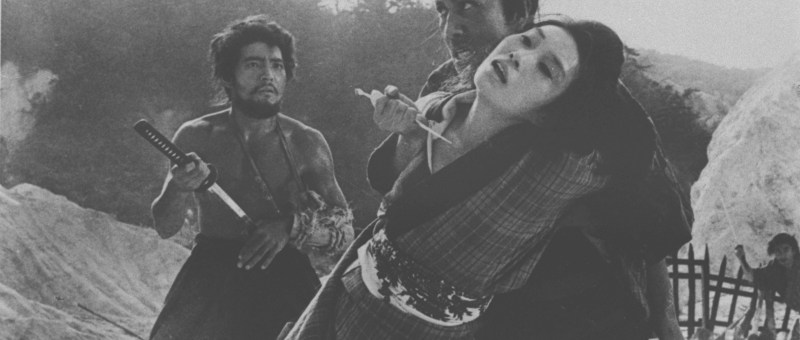
Samurai Wolf 2: Hell Cut (牙狼之介 地獄斬り, Hideo Gosha, 1967)

“We ronin must live without mercy” insists a fugitive on a quest for vengeance and riches only to meet his match in the justice-loving wanderer Kiba (Isao Natsuyagi) making his return for Samurai Wolf II: Hell Cut (牙狼之介 地獄斬り, Kiba Okaminosuke: Jigoku Giri). Like the second instalment in many series, Gosha’s avant-garde chambara largely follows the same formula picking up several familiar elements from the first film if giving them a new spin as Kiba once again finds himself caught up in intrigue provoked by the amoral venality of late Meiji society. 

In this case, he makes a rod for his own back by humiliating some swordsmen after catching them harassing a young woman, mocking them when they try to claim that their treatment of her is part of their “training”. Kiba saves the girl, Oteru (Rumiko Fuji), who has some kind of etherial quality and doesn’t quite seem to know what’s going on immediately throwing herself at Kiba who turns her down in gentlemanly fashion. Sometime later, he runs into a convoy of officials transporting criminals to the nearest judicial centre and stops to give the prisoners some of his own water explaining that that from the stream is polluted thanks to leaks from a nearby goldmine. In any case, Kiba is struck by the appearance of one of the men, Magobei (Ko Nishimura), who reminds him of the father who was killed by swordsmen he’d humiliated with his skill. 

Magobei is in chains for murdering the manager of the mine which previously belonged to the shogun but has now been shut down, its seam apparently exhausted. But like the toxins that poured into the river, the mine is a poison to society and in more ways than one. Magobei tells Kiba that he’s been set up. He was hired to kill the manager by a duplicitous gang leader named Jinroku (Bin Amatsu) who has found a new seam and has been operating the mine illegally taking all the gold for himself so obviously Magobei wants revenge. After seeing off an ambush, Kiba agrees to act as a bodyguard delivering both Magobei and the other prisoner, Kihachi (Out Yokoyama) who claims to be a big time bandit in trouble for robbing a samurai family, to the nearest city but secretly seems to sympathise with the injustice dealt to Magobei and the female prisoner who later joins them, Oren the Thistle (Yuko Kusunoki), who murdered a judge who killed her lover. 

Yet Kiba’s memories of his father cloud his judgment about Magobei who is definitely not a man worthy of his faith in him. “What good would pity do?’ Magobei asks, certain that compassion is a weakness and that if he were to give in to human feeling he would immediately be betrayed. The men misunderstand each other, assuming they are alike when in reality they are opposites. Kiba bets on Magobei’s humanity and loses, while Magobei assumes that Kiba will easily be won over by the riches to be found in the goldmine and help to wipe out Jinroku’s gang which is also a family of which Oteru is a member. “Life’s tough that’s how it is” he justifies, but Kiba cannot forgive him not least for his callous murder of a man who was only a frightened braggart and could not have harmed him and a woman who was otherwise blameless. Just as Sanai had in the first film, Magobei tells him that “one day you will be like me” a future that Kiba once again violently rejects. 

But then again he can never escape the world where goldmines pollute the rivers and money can buy anything, even the hearts of men. Just like his father, he’s pursued by the swordsmen he’s unwittingly insulted while discovering his desire to serve justice backfiring, eventually robbing him of the only thing he actually wanted just as it had at the end of the previous film. Even so, Kiba retains his sense of humanity and unlike so many jidaigeki (anti-)heroes refuses to give in to nihilism or despair. A little less avantgarde than the previous instalment, Gosha nevertheless conjures a world of dazzling violence in freeze-frame and silence while once again leaving Kiba the furious wolf to wander, a lonely figure in an unforgiving landscape.


Samurai Wolf 2: Hell Cut opens at New York’s Metrograph on Dec. 26 as part of Hideo Gosha x 3

Original trailer (English subtitles)

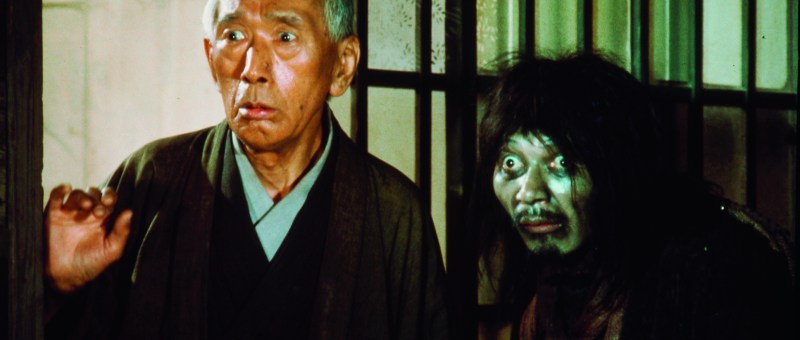
The Ghost of the Hunchback (怪談せむし男, Hajime Sato, 1965)

The old, dark house fetches up in Japan in Hajime Sato’s slice of weird, gothic horror The Ghost of the Hunchback (怪談せむし男, Kaidan Semushi Otoko, AKA House of Terrors). Long in circulation only in an Italian dub, Sato’s B-movie romp owes an obvious debt to Mario Bava but also to similarly themed gothic chillers such as Robert Wise’s The Haunting somewhat repurposing the central nexus of the cursed mansion as a black hole of morality sucking into its orbit the sinners of the post-war society each it seems both victims and embodiments of their times. 

Opening in true gothic fashion with lightning and a full moon, Sato zooms in to a strangely creepy yet ordinary Western-style villa where the soon-to-be widowed Yoshie (Yuko Kusunoki) is woken from a dream in which she had a premonition that her husband, who we learn has been in a vegetative state for some time, had something he desperately wanted to tell her. Shinichi has indeed passed away while apparently imprisoned under the care of his father, Munekata (Kazuo Kitamura), a psychiatrist who seems less than moved by his son’s death describing it as the least he could do to repay the debt he owed to his parents. It seems that Shinichi had been in the hospital following an “incident” some time previously and though Munekata insists that his brain had been “destroyed”, younger doctor Yamashita (Shinjiro Ebara) echoes Yoshie’s dream in informing her that immediately before he died it seemed that Shinichi, who had long been mute, was desperately trying to tell him something. Meanwhile, Yoshie begins hearing strange noises emanating from the coffin and opens it to find a chrysanthemum clenched between her husband’s teeth. 

After the funeral, she’s visited by a lawyer claiming that Shinichi entrusted a key to him to be given to his wife in the event of his death along with the deed for a mountain villa where “the incident” took place. Later, everyone comes to the conclusion that what Shinichi wanted to tell them was not to go to the mansion, but of course what else was Yoshie supposed to do other than investigate. A classic gothic estate swathed in fog and hidden behind ornate iron gates, the remote country house also turns out to have a hunchback custodian (Ko Nishimura) as well as a weird, demonic statue standing inconveniently in the hallway. Soon after arriving Yoshie is attacked by a crow, told of “the incident” by the hunchback, and begins to hear strange noises including disembodied laughter before she is eventually joined by Munekata, Yamashita, and her niece Kazuko (Yoko Hayama).

Yamashita tries to rationalise that the noises are just the normal kinds of creaking born of “deformation” as a building naturally ages, literally becoming warped with time, while the stress of living in such an environment, he claims, can eventually drive one mad. He’s come along to investigate believing that Shinichi’s illness is connected to the mansion. Yet the old, dark house in this case is somewhat divorced from its gothic roots in being transported to Japan where it is in a sense “new” and “foreign” rather than an ancient relic weighing heavily on the shoulders of declining aristocracy. Even so we do indeed have something of that in the later revelations of previous owner Baron Tominaga and his particular grudges which, in this case, are if only partially rooted in wartime trauma, the mansion apparently also once home to an anti-aircraft depot the remains of which can be seen in the grounds. 

The war may not be the corrupting force in play but it’s certainly a factor, especially the surprising accusation thrown at Dr. Munekata that he participated in wartime atrocity in being party to vivisection, a claim he does not dispute but defends in insisting his actions were justified in the name of science. The house has not so much called them, but each of the “guests” is in their own way morally compromised, Munekata not only a war criminal but a venal, lecherous old man hoping to get his hands on the house to open a sanatorium by fulfilling his quasi-incestuous desire for Yoshie. Yamashita, meanwhile, is not exactly pure hearted either, using what he knows about Munekata to blackmail him into standing down so he can become the director in his place and marry his wealthy girlfriend, Akiko (Keiko Yumi), who has also turned up to join in the haunted house fun. As far as sin goes, Yoshie is largely without it but perhaps pays for daring to own her sexuality, rejecting Munekata’s advances but apparently having made a habit of getting into bed with her comatose husband despite knowing of his many affairs which may be the reason for his punishment by the house. Only Kazuko remains pure and innocent save her one-sided attraction to Yamashita, the only one of the gang to show any kind of compassion towards the admittedly strange hunchback. 

In keeping with the house, Tominaga and the hunchback are later revealed to be Christians, though in a gothic inversion they are also the source of the “evil” that infects the creepy old mansion once again positioning Christianity as a foreign corruption but also in this case punishing post-war moral failure. Sato conjures an atmosphere of pure gothic chill complete with oversize cobwebs, doors which open and close on their own, a crow infestation, and even a passing shinto priestess (Mitsue Suzuki) who just had to drop in because of the powerful emanations of evil echoing from the mansion but leaves his collection of extremely flawed humans very much at the mercy of their own demons as they desperately try to escape from the House of Terrors. 


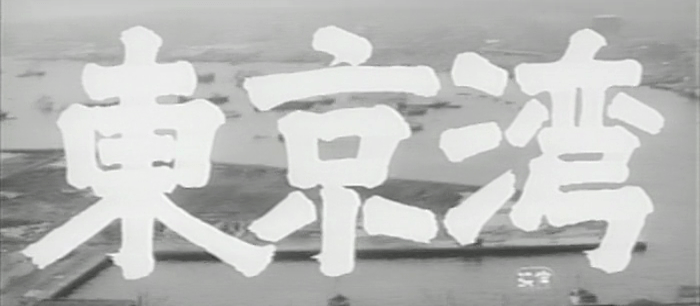
Tokyo Bay (東京湾, Yoshitaro Nomura, 1962)

Yoshitaro Nomura is most closely associated with the thriller and particularly with its lower end as a purveyor of B-movie noir, yet look a little closer and his films are perhaps not really about crime at all but about the complicated relationships between people in the ever changing post-war society. Just as Stakeout is really about a policeman’s marriage, Tokyo Bay (東京湾, Tokyowan) is less concerned with the radiating corruption of the smuggling ring at its centre than with frustrated male friendship and the wartime legacy.

Opening with an aerial pan over post-war Tokyo, a title card informs us that this is just one frame in the “intense struggle for existence” in a city of 10 million before we arrive at the titular bay and a boat which is presumably carrying drugs later passed from one hand to another. The fixer, Takeyama (Kei Sato), talks to a man in a car and instructs him to be in front of the Taiyo building before 10am to pick up a golf bag from his contact. Gazing up at a post-war construction site, however, the man, Saeki (Jun Hamamura), is shot in the head and killed by a bullet piercing the roof of his car, Nomura suddenly switching to a disorientating POV shot as he twists in a sudden death spiral. 

As it turns out, Saeki was a plant, an undercover cop with the drugs squad sent to expose the smuggling ring the shadowy owners of which will predictably turn out to have Chinese connections in another echo of post-war cinema’s continuing Sinophobia. Two officers are assigned to the case, the young and earnest Akine (Jiro Ishizaki), and the veteran Sumikawa (Ko Nishimura) who acts largely on a series of inexplicable policeman’s hunches. Their major lead, however, comes as a stroke either of dumb luck or dark fate as Sumikawa, dodging into a dodgy mahjong parlour while tailing Takeyama, runs into an old army buddy, Inoue (Isao Tamagawa), who just happens to be a left-handed sniper perfectly matching the profile of the man they’ve been looking for. 

While Sumikawa keeps tabs on his old friend, somehow feeling he has something to do with all this but ambivalent in his torn responsibilities, Akine travels to Inoue’s hometown of Onomichi and sympathetically concludes that he was merely “rather unfortunate”. His life derailed by the war, Inoue returned to discover the girl he hoped to marry had married someone else. Giving evidence at Inoue’s trial for pulling a knife on her husband, the young woman remarks that she never promised him anything and did not consider their relationship to be serious, merely treating him with the politeness due to someone about to leave for war. In any case, she asks, even if she had been in love and intended to wait for him, as an orphaned woman there were only two choices open to her to survive, marriage or sex work, what else could she have done?

Back in Tokyo, Sumikawa begins to catch up with his old friend, realising that his romantic disappointment set him on a dark course of bad relationships and a drift towards crime but that he seems to have turned himself around. He is now happily married to a woman he describes as “simple” who seems devoted to him and if he did this, he did it to start again. His one last job intended to take him back to Onomichi, a pleasant coastal town the bay of which he describes as far more beautiful than that of the grimy, industrial Tokyo and largely untouched by urban corruption. Sumikawa feels himself torn, not least on account of the debt that exists between the two men because Inoue once saved his life, but also knowing that he may have to arrest this man and destroy his attempt to return to a more innocent world leaving his wife alone. Disapproving of the nascent relationship between his younger sister Yukiko (Hiromi Sakaki) and his partner, Sumikawa worries Akine may be becoming the kind of man who cares more for making an arrest than friendship, a conflict presumably weighing on his mind, even as he agrees he’s a good man and a good police officer. Yukiko meanwhile fires back that Sumikawa’s wife left him not because he is a policeman but because he is selfish and arrogant, and more to the point incapable of understanding a woman’s feelings. 

Nevertheless, he’s acutely aware of the effect his actions or inactions may have on Inoue’s wife Yoshiko (Kyoko Aoi), especially as it’s suggested she may need a degree of looking after. Inoue, careful to admit nothing, reveals that the man who carried out the hit may not have known he was killing a police officer but may have assumed the target was fair game being, like themselves, a denizen of the underworld. Largely a MacGuffin, the smuggling ring is not as important as one might assume, the two men locked into a cycle of guilt and retribution each marked by wartime trauma and in a sense unable to claim their place in the post-war society. Twin betrayals lead to a fateful, train-bound showdown shot with fraught claustrophobia as each man engages in an intense struggle for his survival but also perhaps already defeated in a shared sense of fatalistic nihilism. Trekking through the half-constructed streets of the post-war city with shaky handheld Nomura hints at the radiating corruption exemplified by the growth of the trade in drugs, but perhaps one corruption is merely the result of another which may in turn be far less easy to cure. 


Case of the Disjointed Murder (不連続殺人事件, Chusei Sone, 1977)

Case of the disjointed murders posterJapanese cinema of the 1970s fell hard for the prestige murder mystery. Following the success of The Inugami Family, an early and unexpected hit thanks to Kadokawa’s “innovative” marketing strategy, multi-cast detective dramas dominated the box office for the rest of the decade. Meanwhile, ATG had been known for serious and high-minded avant-garde cinema throughout the 1960s but its brand of left-leaning, politically conscious, arthouse-fare was tantamount to box office poison in the increasingly consumerist post-Asama-Sanso world. ATG’s Kindaichi-centric Death at an Old Mansion, updated to the present day, pre-dated Ichikawa’s series for Toho by a whole year and perhaps signalled their resignation to shifting into the mainstream. By 1977, that transition was perhaps complete with former Nikkatsu Roman Porno director Chusei Sone’s adaptation of a classic serial penned by Ango Sakaguchi, an author of the “Buraiha“ school well known for chronicling post-war aimlessness.

Set in the summer of 1947, Case of the Disjointed Murder (不連続殺人事件, Furenzoku Satsujin Jiken, AKA Unrelated Murder Cases) is a classic country house mystery in which a series of high profile writers are invited to a mansion owned by a wealthy family, the Utagawas. Only, as it turns out, many of the letters of invitation are forgeries or have been doctored so that several unexpected guests have arrived including dissolute artist Doi (Yuya Uchida) whose presence is particularly awkward because he is the former husband of the host Kazuma’s (Tetsuro Sagawa) new wife Ayaka (Junko Natsu). Soon enough, one of the guests is murdered, and then another, and still more, seemingly for no real reason. Amateur detective Kose (Kazuya Kosaka), one of the “unexpected” guests, tries to piece the crime together to prevent its expansion but finds himself outflanked by a lack of material evidence.

Sakaguchi’s original tale ran as a newspaper serial which promised a cash prize for anyone clever enough to identify the murderer(s) before the truth was revealed as it eventually is in true country house mystery fashion with the detective explaining everything in a lengthy monologue while all the interested parties sit around a dinner table. The gamified nature of the serial is perhaps the reason for the large cast of characters comprising of Utagawa family members, the literary house guests, and staff all of whom become mixed up in the ongoing crime drama which Kose comes increasingly to believe is engineered rather than random as it might originally seem.

The “supposed” random chaos of the the “unconnected” murders is a key part of Sakaguchi’s interrogation of post-war anxiety. For a time it seems as if these mostly quite unpleasant people have taken the opportunity of being trapped within a claustrophobic environment to air out their own grievances with each other in an atmosphere already tainted with violence and resentment. Meanwhile, the moral corruption of the Utagawa household continues to come back to haunt them in the sexual transgressions of the late grandfather who apparently fathered several illegitimate children in addition to those from multiple marriages. The half-siblings bring additional strife into the Utagawa home in Kazuma’s incestuous desire for his half-sister Kayoko (Hitomi Fukuhara) who returns his affections and even hopes to marry her brother, while he has also transgressed by “buying” Ayaka from her venal first husband Doi.

As in most Japanese mysteries, however, the motives for murder turn out to be banal – simply monetary greed and seemingly nothing more even if backed up by a peculiar kind of romanticism. Such unbound desire for riches is perhaps another symptom of the precariousness of the post-war world in which individual survival is all in a chaotic environment where financial security is more or less impossible for those not already born into wealth. Kose begins to solve the crimes through the “psychological traces” the killer(s) leave behind, the various ways in which “scenes” are calculated and contrived but fail to entirely mask the truth which lies behind them.

Which is to say that the mechanics behind the killings ultimately become secondary to their psychological import in which Kose analyses superficial relationships to uncover the depths which underpin them and their implications for a conspiracy of crime. This persistent amorality in which human relationships and connections are subverted for personal gain is yet another example of post-war inhumanity in which the corruption of the war has destroyed the “innocence” of pre-modern Japan and provoked nothing more than a moral decline born of a confused anxiety and a generation struggling to adjust itself to a new reality.

Death at an Old Mansion aside, the ‘70s mystery boom had a peculiar obsession with post-war crime in the comparative comfort of the economic miracle. 30 years on, society was perhaps ready to ask more questions about an intensely traumatic moment in time but equally keen to ask what they might say about another anxious moment of social change only opposite in nature. No longer quite so burdened by post-war regret or confusion, some began to wonder if consumerism was as dangerous as poverty for the health of the national soul, but nevertheless seem content to bask in the essential cosiness of a country house mystery in which the detective will always return at the end to offer a full and frank explanation to a roomful of compromised suspects. If only real life were so easy to explain.


Original trailer (no subtitles)

The Sleeping Beast Within (けものの眠り, Seijun Suzuki, 1960)

Sleeping Beast Within posterTo those of a “traditional” mindset, a woman’s career is her home and she never gets to retire. Men, by this same logic, are killed off at 60 and reborn into a second childhood where they get to indulge their love of fly fishing or suddenly discover an untapped talent for haiku. Seeing as a man often lives at the office, being excommunicated from his corporate family can seem like a heavy penalty for those who’ve devoted their entire existence to the salaryman ideal. So it is for the old timer at the centre of Seijun Suzuki’s 1960 mystery thriller, The Sleeping Beast Within (けものの眠り, Kemono no Nemuri) in which the sudden disappearance of a model employee sparks his daughter and her dogged reporter boyfriend to investigate, unwittingly discovering a vast drug smuggling conspiracy headed by a dodgy cult leader.

Veteran salaryman Junpei Ueki (Shinsuke Ashida) has been working in Hong Kong for two years and is finally coming home, to retire. His family have come to meet him but, as his daughter’s reporter boyfriend Kasai (Hiroyuki Nagato) points out, no one much else has turned up – so it is for those who don’t play office politics, claims one of the few colleagues who has arrived to greet the recently returned businessman. Ueki isn’t very happy about his retirement and believes he’ll be getting a part-time job at the same company only to be informed position has been “withdrawn”. When he doesn’t come home after his retirement party, something surely out of character for such a straight shooting family man, his wife and daughter become worried. Keiko (Kazuko Yoshiyuki) enlists Kasai to help figure out what’s happened to her dad only for him to suddenly turn up with a bad excuse and an almost total personality transplant. Kasai keeps digging, and the reporter in him loves what he finds even if the nice boyfriend wishes he didn’t.

Suzuki sets up what a good guy Ueki is when he brings back a modest ring for Keiko only for her to mockingly ask if her dad couldn’t have brought something a bit flashier. Ueki points out that the customs people might not have liked that so she jokes that he should have just smuggled it in like everyone else. Kasai reminds her that her dad’s not that kind of man, but two years in Hong Kong have apparently changed him. Having spent two years away from his family and 30 years slaving away at a boring desk job, Ueki feels he’s owed something more than an unceremonious kiss off and a little more time for gardening. The reason he ended up entering the world of crime wasn’t the money, or that he was blackmailed – it started because of his sense of integrity. He felt he owed someone and he did them a favour. It went wrong and he ended up here. His decision to join the gang came after he tried to “pay back” the money for some missing drugs only to realise that his entire retirement plan was worth only a tiny fraction of his new debt. Ueki felt small and stupid, like a man who’d wasted his life playing the mugs game. He wanted some payback, but his life as criminal mastermind turned out not to be much of a success either.

Trying to explain her father’s actions to the wounded Keiko, Kasai explains that everyone has a sleeping beast in their heart which is capable doing terrible things when it awakens. Ueki’s sleeping beast was woken by his resentment and sense of betrayal in being so cruelly cast aside by the system to which he’d devoted his life while the guys who broke all the rules – drug dealers, gangsters, and corrupt businessmen, lived the high life. One could almost argue that a sleeping beast is stirring in Kasai’s heart as he pushes his investigation to the limit, occasionally forgetting about the harm it will do to Keiko even whilst acknowledging the greater good of breaking the smuggling ring once and for all. Keiko too finds herself torn, confused and heartbroken by the change in her father’s personality though her mother feels quite differently.  Claiming that “a woman has no say in her husband’s work”, Keiko’s mum tells her daughter that a wife’s duty is to do as her husband says and avoid asking questions. Keiko has asked a lot of questions already and shows no signs of stopping now, even once she realises she won’t like the answers.

Despite the grimness of the underlying tenet that it doesn’t take much for honest men to abandon their sense of morality, Suzuki maintains his trademark wryness as Kasai and Keiko go about their investigation like a pair of pesky kids chasing a cartoon villain. Though the tale is straightforward enough, he does throw in a decent amount of experimentation with two innovative flashback sequences in which the flashback itself is presented as a superimposition with the person narrating it hovering at edges as if referring to a slide. The beast is quelled with a shot to the heart, but not before it wreaks havoc on the lives of ordinary people – not least Ueki himself who is forced to confront what it is he’s become and who he was prepared to sacrifice to feed the hungry demon inside him.


Available as part of Arrow’s Seijun Suzuki: The Early Years Vol. 2 Border Crossings box set.

Thirst for Love (愛の渇き, Koreyoshi Kurahara, 1967)

(C) Nikkatsu 1967

Thrill for love posterIf The Warped Ones showed us a hellish, uncivilised world in which people acted on their base desires with little thought for others, Thirst for Love (愛の渇き, Ai no Kawaki) shows us the opposite as desire repressed eats away at those unable to find fulfilment in their assigned social roles. Koreyoshi Kurahara’s swirling artistry may have proved too much for studio bosses at Nikkatsu (Thirst for Love would be the last film he’d make as a regular director for the studio), but it finds a perfect match in the florid world of Yukio Mishima.  A tale of inequalities and misunderstandings, the rarefied atmosphere of Thirst for Love is just as “warped” as that of Nikkatsu’s gritty youth dramas in which desire and gratification become tools of currency in a grand game of wounds given and received.

Our heroine, Etsuko (Ruriko Asaoka), is a young widow living with her late husband’s family. Following the death of her husband, Etsuko has become the mistress of the family’s tyrannical patriarch, Yakichi (Nobuo Nakamura) – a successful businessman apparently forced out of the company he founded and into an early retirement. Yakichi resents the rest of his family whom he regards as feckless freeloaders. Oldest son Kensuke (Akira Yamanouchi) is a part-time classics professor and full-time neurotic intellectual. He and his wife Chieko (Yuko Kusunokiare unable to have children of their own (something else that annoys Yakichi), while daughter Asako (Yoko Ozono) has come back to her family home following a divorce with two children in tow. The family are all “aware” of the strange dynamic between Yakichi and his daughter-in-law but are too polite to bring it up. Nevertheless, Kensuke also has a thing for Etsuko which Chieko is aware of but not particularly worried about because she really does respect and trust her husband.

Etsuko is not particularly interested in Kensuke. There’s nothing he could really offer her. Though she keeps up a pretence of happiness with her current living standards, even going so far as to write a fake diary expressly intended for Yakichi to read, Etsuko feels nothing but contempt for and boredom with the emotionally cold and controlling family patriarch. Her faith in human emotions is low, but still she feels desire. When the teenage gardener Saburo (Tetsuo Ishidate) catches her admiring a beautiful statue and remarks on Etsuko’s own beauty, he puts untoward ideas in her head.

Even in the post-war world, women like Estuko have little agency. After her husband died, she could have stuck it out alone – found a job, supported herself. She could have remarried or perhaps have received financial support from the family while living alone, but she’s chosen to remain with them even given her somewhat degrading role as her father-in-law’s mistress-cum-plaything. When Saburo tells her she is beautiful he oversteps the established laws of class separation and Etsuko is too clever not to know how clichéd her new found lust for a peasant boy really is but she can’t unsee his broad shoulders and muscular frame or the sweat that crowds his brow as he labours on her behalf.

She begins making coy overtures which Saburo, unwittingly or otherwise, deflects. The situation is complicated by another woman, Miyo (Chitose Kurenai), who may or may not be something like Saburo’s girlfriend though as we will later find out, Saburo is a typically immature young man who regards his relationships with women as essentially inconsequential. Deferent towards his mistress, he demands to be released from her cruel games. Yet Etsuko had hardly realised that’s what they were. She cannot simply voice her desire or make her interest plain. Hers is not the first move to make. Several times Etsuko comes close to crossing a line but she always pulls back – inflicting necessary suffering on herself through her inability realise her desires.

Suffering, in a sense, becomes the point and almost a bizarre source of pleasure. In a climactic moment of drunken dinner party truthfulness, Kensuke attempts to apologise for a potentially destructive speech by revealing that he meant to smash everything to bits but has only succeeded in destroying himself. Etsuko too means to hurt others, partly as a kind of revenge, but in truth only to increase her own suffering. Her plan stumbles when she realises that Saburo is and always has been entirely indifferent towards her. He saw her as the mistress of the manor, an elegant and attractive woman, but felt no more desire for her than for any other. As he puts it, they live in different worlds – she is nothing to him, and nothing she does can change that. Etsuko has only destroyed herself, a self-immolation of repressed desire which threatens to burn the world with its ferocious intensity.

If Etsuko is to free herself from the burden of her need, she will pay a heavy price to do so. Kurahara shifts into an avant-garde register more in keeping with the more or less contemporary work of Kiju Yoshida in his anti-melodrama phase, but Kurahara’s approach is, in keeping with the source material, altogether less serious, fully embracing the melodramatic but taking pains to underpin it with deeply felt emotion. Asaoka excels as the neurotic housewife driven slowly mad in a stultifying, moribund household where she is forced to submit to the sexual whims of her bossy father-in-law and has little more to occupy her time than walking the dog and dreaming of a roll in the hay with the not yet 20 gardener.

Kurahara paints her world as one of sensations – the blood that becomes both symbol of life and death, the symbolic pleasures of a pomelo, and the fearsome flapping of chickens even as their throats are slit. Shifting to still frames for moments of high emotion – much as Shinoda had done in the finale of With Beauty and Sorrow two years before, Kurahara mixes ironic voiceover with intertitles and unexpected editing choices to capture the flightiness of Etsuko’s mind but he allows himself one luxury in letting her leave to a bright red sky, a woman on fire thirsting for love.


Original trailer (no subtitles)