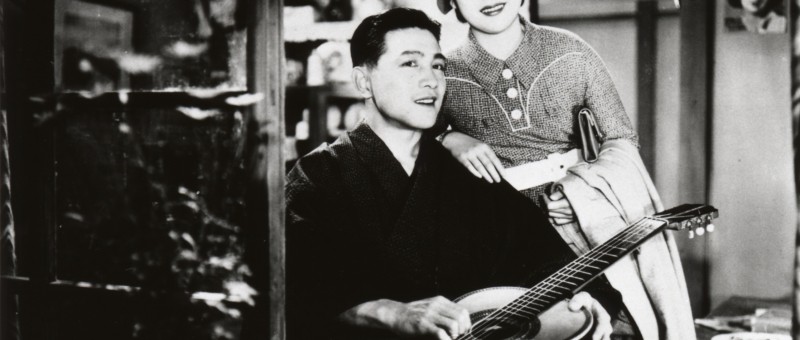
Radio Queen (ラヂオの女王, Shigeo Yagura, 1935)

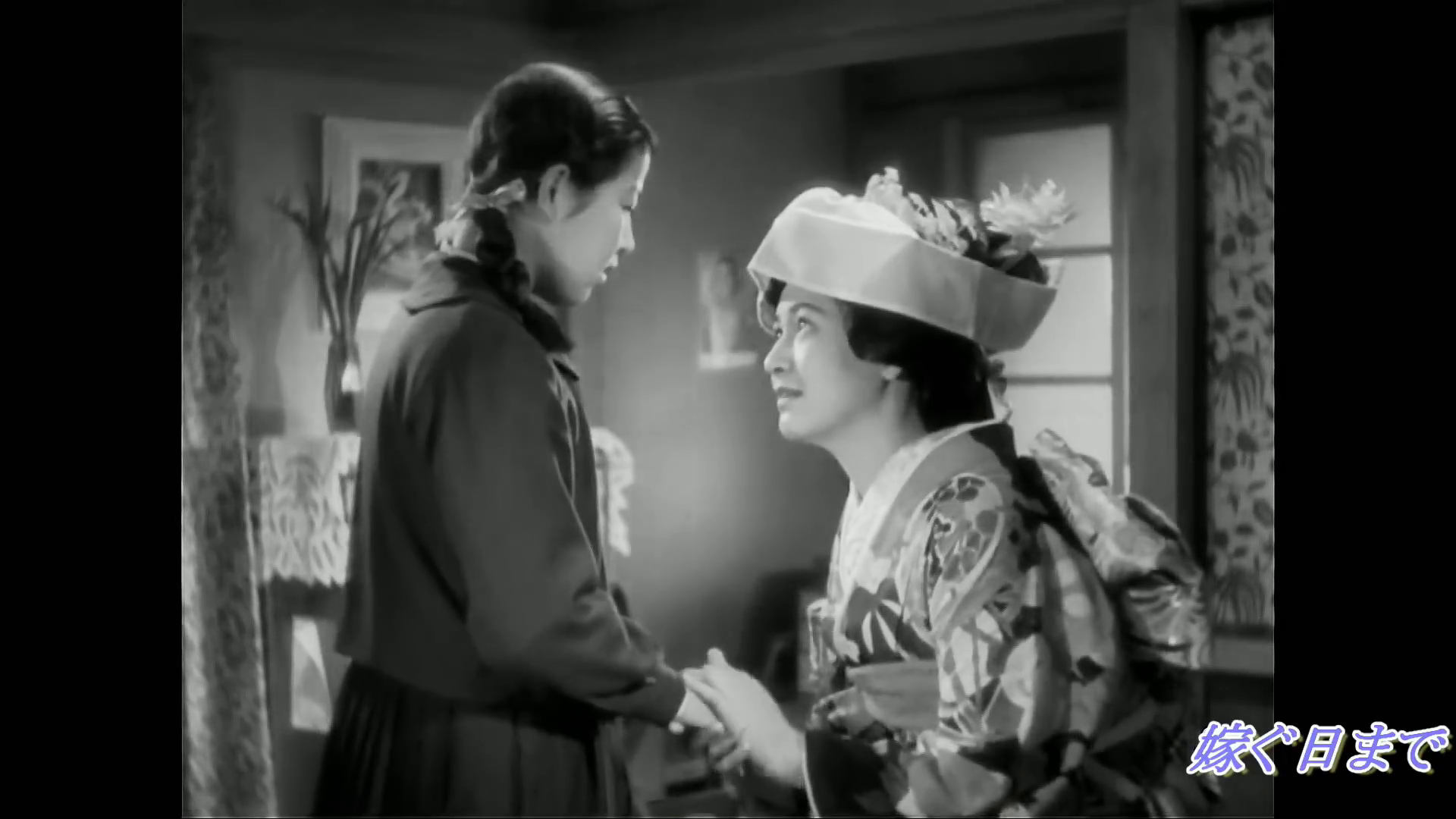
The conflict between warring neighbours of differing dispositions deepens when their children want to get married in Shigeo Yagura’s modernising comedy, Radio Queen (ラヂオの女王, Radio no Oujo). Against a backdrop of rising militarism, the film explores a generational shift in a new world increasingly dominated by mass media that quite literally speaks to the young not only through the newly established ubiquity of wireless radio but the talkie too leaving the old somewhat left behind confused by the rapid motion of progress.

In fact, the film opens with Kawamura, owner of a factory that makes aeroplanes that can’t fly, being woken up by his neighbours performing radio taiso callisthenics exercises. Kawamura dislikes radio on a conceptual level, though his dislike of it may also have a slightly subversive quality given the underlying element of coercive conformity that sees the nation performatively warm up for another day of national unity and hard work towards the growth of the empire. Then again, Kawamura is the film’s most ridiculous character finally giving a speech that he would be proud to sacrifice his son’s life for the nation by getting him to fly one of their biplanes to China as a kind of publicity stunt.

Publicity stunts are, however, a particular talent for Kingo who has very modern ideas about how to make not only his business but that of his father’s neighbour and frenemy Misome a success. Soon to finish university, Kingo plans to marry Misome’s daughter, Kimiko (Sachiko Chiba), who is currently working as a primary school teacher though both father fiercely object to the union. Kingo puts the kibosh on the idea of eloping mainly for practical reasons that they will be unable to support themselves financially on a running start but also for reasons of filial piety which probably do correspond with the censorship demands of the time. One of his ideas for winning over Misobe is to help him make his business of selling cough sweets for stage performers more successful through modern advertising and publicity techniques. Though originally rejecting his ideas, Misobe often takes his advice but pretends it was all his own idea further souring their relationship.

In any case, he wants to Kimiko to marry his chosen suitor, Kyuichi, who is training to become a pharmacist but also struggles with maths and has secretly been embezzling money in contrast to Kingo who is much more organised than his own father and has real business talent. Misome describes Kimiko’s job as a “hobby” and regards it as something she’s doing to keep busy until she gets married, a notion perhaps encouraged by social expectation given that it involves taking care of children which places her in a quasi-maternal position. She could presumably support herself, but the option is never given to her as even she tries to chivvy Kingo along by warning him that if he fails to win her father over she’ll end up married to the pharmacist as if she had no say in it at all. 

In any case, in a rather strange turn of events her singing in the school is heard by a film crew who’ve just had their lead actress pinched by a rival studio. They cast her in the part of a Christian nun who is also a schoolmistress but in contradictory fashion is involved in a romance which scandalises Kimiko and leads her to walk off set refusing to be exploited by the unscrupulous directors insisting that no such thing had been mentioned to her when she agreed to take the job. But it’s this that finally propels her to become the “Radio Queen,” taking a much more wholesome role singing nursery rhymes and reading fairytales for children across the nation through the new medium of the wireless. Kingo does not object to her fame and sees it as a positive sign that may cause his father’s opinion of her to change for the better despite his dislike of the device, though he does later become put out that the demands of her career leave her less time to spend with him.

In that sense, it’s also “modernity” that disrupts their relationship along with changing gender and social roles while there is also a necessarily problematic element of then largely unregulated mass media. An unscrupulous consumerism seems to have taken hold with the foolish Kawamura also addicted to collecting “antiques” many of which are akin to religious relics of an age of modernity. We see a man drop a piece of wood on the floor outside which is later picked up by dealers and sold as a piece of the propeller of the first of ever plane which Misome jokingly offers to buy for Kawamura in the hope his aircraft might actually fly one day. On entering an antiques fair, they’re confronted by an object claimed to be the clasp from Rockerfeller’s wallet echoing some of Misome’s frequent allusions to his success as a self-made man while Kawamura conversely frequently alludes to Mussolini as if making plain his own slightly priggish attachment to militarism. 

Misome concedes that Kingo is a bright and promising young man and objects to him only on the grounds that he is Kawamura’s son and he prefers the pharmacist because he thinks it more advantageous to himself before realising what sort of a man Kyuichi is really is. In the end, they’re both bamboozled by mass media when Kimiko rushes to the airfield where Kingo is about to take off having petulantly agreed to the test flight after arguing with her. As she petitions the already in motion plane, he manages to pull her up into the passenger seat while the radio announcer announces their engagement live on air granting it a new legitimacy neither of the fathers can really argue with. The film ends with them flying off into a blue sky which suggests a victory for youth and freedom even if it seems a little too simple leaving the older generation behind on the ground with only the wireless for comfort.


The Wolves (狼, Kaneto Shindo, 1955)

Post-war desperation drives a collection of otherwise honest men and women towards a criminal act that for all its politeness they are ill-equipped to live with in Kaneto Shindo’s biting social drama The Wolves (狼, Okami). “Wolves” is what the criminals are branded, but the title hints more at the wolfish society which threatens to swallow them whole. After all, it’s eat or be eaten in this dog eat dog world, at least according to a cynical insurance salesman hellbent on exploiting those without means. 

Each of the five “criminals” is an employee at Toyo Insurance where they’re immediately pitted against each other, reminded that in order to qualify for a full-time position they need to meet their quotas for six months. The orientation meeting is cultilke in its intensity, the boss insisting that only in insurance can you become a self-made man while recounting his own epiphany as to the worthiness of his profession. They are told that the only two things they need are “faith and honesty”, and then “faith and pursuasion”, while encouraged to think of their work as an act of “worship”, “for the salvation of everyone”. 

Yet they’re also told to exploit their friends and family by pressuring them into taking out life insurance policies in order to help them meet their quotas. As one man points out, friends and relatives of the poor are likely to be poor themselves, but these are exactly the kind of people they’re expected to target. They’re told there’s no point going after the weathly because they’re already insured, but there’s something doubly insidious in trying to coax desperate people who can’t quite afford to feed themselves into paying out money they don’t have on the promise of protecting their families from ruin. One man even asks if the policy covers suicide and is told it does if you pay in for a year, sighing that he doesn’t want to wait that long.

“Suicide or robbery, choose one,” one of the salespeople reflects after failing to make their quota once again. They each have reasons to be desperate, all of them already excluded from the mainstream society and uncertain how they will find work if the job falls through. Akiko (Nobuko Otowa) is a war widow with a young son who is being bullied at school because of his cleft palate for which he needs an expensive operation. She’s already tried working as a bar hostess but is quiet by nature and found little success with it. Fujibayashi (Sanae Takasugi) is widowed too with two children and five months behind rent for a dingy flat in a bomb damaged slum where the landlord is about to turn off her electric. Harajima (Jun Hamamura) used to work in a bank but was fired for joining a union and is trapped in a toxic marriage to woman looking for material comfort he can’t offer. Mikawa (Taiji Tonoyama) too is resented by his wife, a former dancer, having lost his factory job to a workplace injury while the ageing Yoshikawa (Ichiro Sugai) was once a famous screenwriter but as he explains people in the film industry turn cold when you’re not hot stuff any more. 

Their unlikely descent into crime has its own kind of inevitability in the crushing impossibility of their lives. They may rationalise that what they’re doing is no different from the insurance company that exploits the vulnerable for its own gain, thinking that if they can just get a little ahead they’d be alright while feeling as if robbery and suicide are the only choices left to them and at the end of the day they want to survive. Perhaps you could call them “wolves” for that, but they’re the kind of wolves that give the guards from the cash van they robbed their train fare home after bowing profusely in apology. The real wolves are those like Toyo who think nothing of devouring the weakness of others, promising the poor the future they can’t afford while draining what little they have left out of them. As the film opens, Akiko looks down at a bug writhing in the dirt attacked by ants from all sides and perhaps recognises herself in that image as the sun beats down oppressively on both of them. Breaking into expressionistic storms and unsubtly driving past a US airbase to make clear the source of the decline, Shindo paints a bleak picture of the post-war world as a land of venal wolves which makes criminals of us all. 


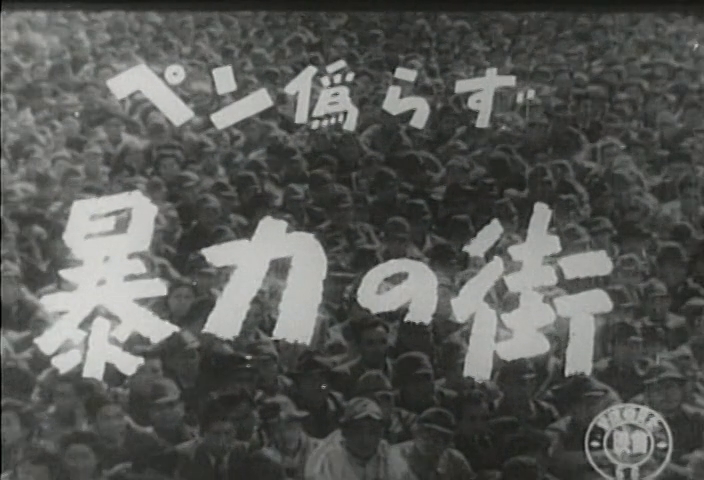
Street of Violence: The Pen Never Lies (ペン偽らず 暴力の街, Satsuo Yamamoto, 1950)

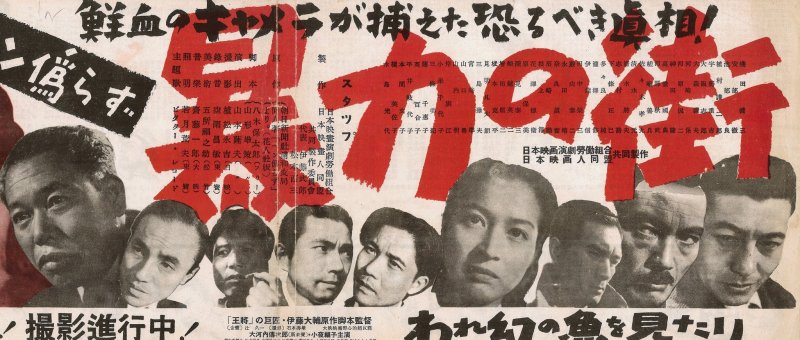
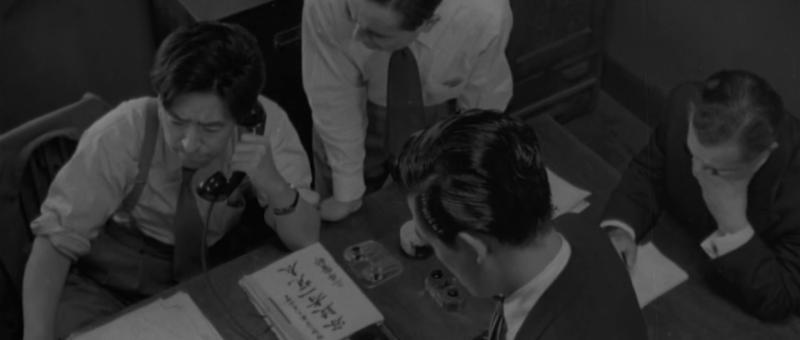
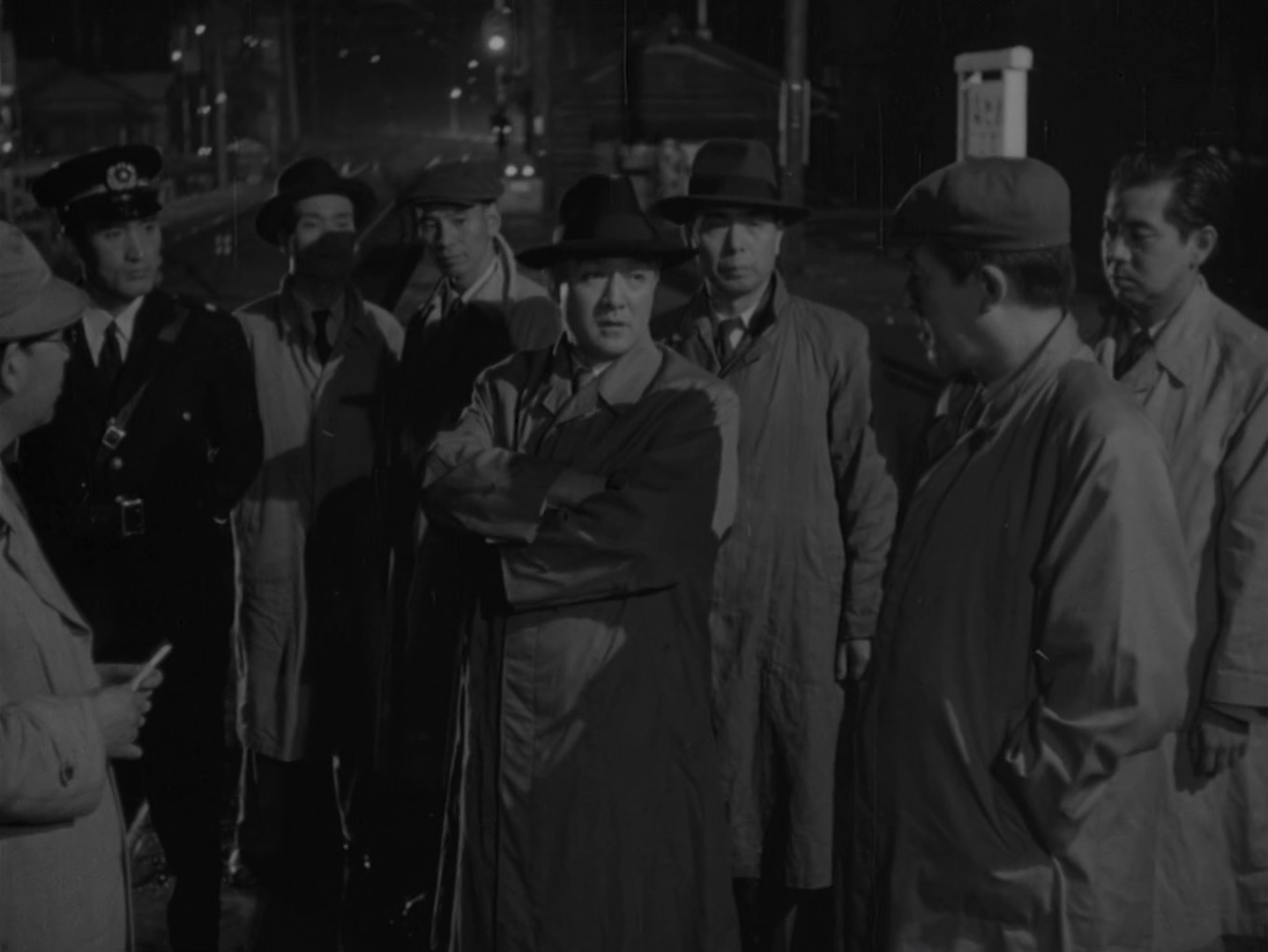
vlcsnap-2020-01-16-00h05m26s354The immediate post-war era was one marked by fear and anxiety. The world had turned upside down, food was scarce, and desperation had provoked a widespread moral decline which rendered compassion a luxury many thought they could ill afford. Yet, in hitting rock bottom there was also the opportunity to rebuild the world better than it had been before. Street of Violence: The Pen Never Lies (ペン偽らず 暴力の街, Pen Itsuwarazu Boryoku no Machi), is one of many pro-democracy films arriving in the wake of Japan’s new constitution and makes an unlikely hero of the local newspaperman as the sole means of speaking truth to power in the fierce belief that the people have a right to know.

Tojo, a small town Northwest of Tokyo, was once the centre of the silk trade but as the industry declined, it gradually became home to gangs and a hub for wartime black market shenanigans. The sad truth is that the growing nouveau riche middle-classes profiting from post-war shadiness have more or less got the town sewn up. The corrupt police force is in cahoots with the gangsters who call themselves a “police support organisation” and make a point of wining and dining the local police chief, while also making sure the local paper is firmly in their pocket. The trouble starts when rookie reporter Kita (Yasumi Hara) is invited to a policeman’s ball and figures out the whole thing is sponsored by the silk traders’ union, which he thinks is not quite right. He takes what he’s learned back to his editor and is warned off the story but publishes something anyway, quickly becoming a target for prominent “politician” Onishi (Masao Mishima).

Street of Violence opens with onscreen text taken from the press code which emphasises that mass media has a duty to preserve the truth. Kita’s paper had been in league with the police and the gangsters enabling the atmosphere of casual violence which is gradually consuming the town. Kita, a new recruit, is not yet inured to the way things are and immediately thinks his duty is to blow a whistle, most obviously on the corrupt police force and judiciary. He is only allowed to do so because the previous editor stepped down and a similarly idealistic older gentleman (Takashi Shimura) from out of town has taken over. He decides to fight back, standing up to the crypto-fascist goons by continuing to publish the truth about the links between the police, black market silk traders, gangsters, and the rest of the local press who eventually gain the courage to join him.

Onishi continues to masquerade as a “legitimate businessman” and “respectable politician” claiming that he’s “striving for democracy” to help the “downtrodden”, but is also responsible for directly targeting Kita’s mother and sister in an attempt to intimidate him. The editor assigns another reporter, Kawasaki (Ryo Ikebe), to keep Kita safe and starts trying to find locals who will consent to be interviewed about gang intimidation while Kita’s friends from the Youth Association generate a kind of resistance movement holding protests and handing out flyers condemning the atmosphere of violence which has ordinary citizens turning off their lights and avoiding going out after dark to protect themselves from thuggery.

The silent cause of all this strife is of course post-war privation which has made the blackmarket the only means of survival for those otherwise starving but has also given free rein to selfish immorality. The Onishis of the world, the spineless police chief, and the cynical local press, have all abnegated their human responsibilities in wilfully taking advantage of a bad situation to further their own cause. When the press chooses not to turn a blind eye to entrenched corruption, it raises a flag that ordinary people can follow. Too intimidated to speak out, the townspeople had been living in fear but post-war youth has the courage to say no and demand a better future. A mass rally crying out “democracy” and insisting on an end to the cronyism and the corrupt systems of pre-war feudalism produces a people power revolution that can’t be ignored, forcing Onishi into submission, and a clean out of corrupt law enforcement. But, the earnest voice over reminds us, the victory is only partial – violence still exists and will rise again when it thinks no one’s looking. The press, most of all, cannot afford to look away if “democracy” is to be maintained.


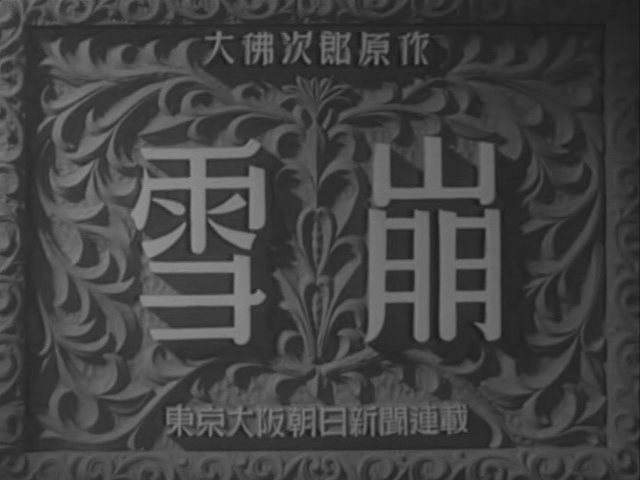
Avalanche (雪崩, Mikio Naruse, 1937)

Naruse Avalanche title cardDespite his broadly progressive outlook, it would perhaps be unfair to describe Mikio Naruse as a political filmmaker. Yet filmmaking in the late 1930s was an inherently political act if only by omission. 1937’s Avalanche (雪崩, Nadare), adapted in collaboration with left-wing intellectual Tomoyoshi Murayama from a serialised novel by the quietly anti-authoritarian Jiro Osaragi, seems to be almost in dialogue with its times as its hyper-individualist “hero” engages in a series of discussions with his humanist father about the new philosophies which for him at least spell the future.

Naruse opens, however, with the heroine – sweet and innocent bride Fukiko (Noboru Kiritachi ), dressed in kimono and sporting a traditional married woman’s haircut as she gazes lovingly on her wedding photo sighing softly that a year has gone by already. Flashing back, we realise that Fukiko eloped with wealthy scion of the Kusaka family, Goro (Hideo Saeki), who apparently forced the disapproving parents to accept the union by persuading Fukiko to accompany him to a hotel in Nagoya from which they were collected by Goro’s kindly father (Yo Shiomi). Though Fukiko remains deeply in love with Goro, it is obvious to everyone else that the marriage is not happy. Having reconnected with childhood sweetheart Yayoi (Ranko Edogawa), Goro wants a divorce, justifying his actions with the rationale that it will be better for Fukiko to end things now rather allow her to suffer years of a loveless marriage that is destined to end in separation.

Goro’s father, a little fed up with his wayward, increasingly psychopathic son, feels differently. He thinks that Goro has made his bed and must now accept his responsibility, committing to caring for Fukiko as a husband should regardless of whether or not he has romantic love for her. Goro, however, insists that this is a matter which only concerns himself and rejects any responsibility towards Fukiko, insisting that would be cowardly and dishonest to go on living with a woman he doesn’t love under the pretence that he does. Exasperatedly pointing out that one lives as a member of a society and cannot always be free to do as one pleases, Goro’s father tries to awaken him to social responsibility by reminding him that he only thinks he has the luxury of choice because he is the heir to the wealthy Kusaka family and would likely feel differently if he were just a regular salaryman. Goro doesn’t quite deny it, but (ironically) also condemns the hypocrisy of social propriety, avowing that he will not live a life of lies like those respectable married couples with lovers on the side.

Goro’s father asks if he’s not being overly literal, seeing as life is rarely as black and white as he’s painting it for the purposes of his argument but Goro counters that his father is “bound by old morality” of which he believes himself to be free. Later, trying to win back the heart of Yayoi, he reveals himself to be a hyper-individualist who believes that the only true path to happiness lies in indifference to the suffering of others. It seems that Goro’s decision to elope with Fukiko was part rebound, his ego bruised by a minor rejection by Yayoi who is also in love with him and had always believed that they would marry only to find herself disillusioned with the institution of marriage. Her sickly brother Keisuke (Akira Ubukata) worries that she turned down Goro because of him, knowing that should he die she would need to find someone to marry into their family and continue its name – something impossible for the oldest son of a noble family like the Kusakas.

That was not, however the reason. Yayoi resents her lack of options, that when a woman’s marriage is arranged people say “it’s settled” as if an unmarried woman is a problem in need of a solution. She resents that she is obliged to entrust her future to a stranger, wondering how it is she is supposed to trust one man for the rest of her life. It is this feeling that created distance between herself and Goro despite her obvious love for him. He accuses her of being “condescending” and hiding her true feelings, blaming her for the predicament they now find themselves in despite the fact that it appears to be entirely his own fault. Yayoi thinks it’s now too late for them, immediately sympathising with Fukiko who has been unfairly dragged into an awkward situation, but Goro scalds her again by insisting that she thinks too much about others when they need to be “strong” and think only of themselves.

Yayoi is half won over by Goro’s frighteningly fascist world view, but finds herself conflicted. She recognises her privilege and originally feels nothing but guilt because of it, that lack of purpose has left her with nothing but emptiness. Goro has her wondering if she’s got things backwards, that she ought to embrace the fact that she is allowed the luxury of life without worry. Putting it to Keisuke he partially agrees, affirming that happiness is only possible when one wilfully ignores the suffering of others. Yet Yayoi is dragged back towards humanism, remembering the “people left behind in the darkness” but fearful that Goro’s philosophy may win her over in the end.

Goro seems to be a perfect encapsulation of the growing evils of the age in his hyper-individualist desire to disregard the thoughts and feelings of others. The opening text, taken from Jiro Osaragi’s novel, paints Goro as the “hero” as it over-explains the film’s title by insisting that the “avalanche” we are talking about is “some sudden unknown force” present in this “precarious world” which can knock even the strong willed off their feet. The “hero” of Naruse’s film, by contrast, is clearly Goro’s kind hearted father who finds an unexpected fan in Fukiko’s dad (Sadao Maruyama) who claims to hate rich people and had no intention of marrying his daughter to one but thinks Goro’s father is one of the good ones and proves that there were some good things in the old feudal system.

Strangely reactionary as it may be, he has a point. Goro’s father is the soul of benevolent paternalism. He worries for his “desperate” son, and laments that the misfortune of the younger generation is “knowing things without understanding them”. He baits Goro, making him a mild ultimatum that if he wants to go on with his “immoral” philosophy then he’ll have to do it on someone else’s dime. Cowardly, Goro relents and chooses his wealth over his freedom but his psychopathy only deepens. To get back at his dad, he decides on a double suicide with Fukiko, before realising that there is no need for him to actually die so long as it looks like he meant to and he makes sure Fukiko goes first. This is the avalanche the film has been building to, but it’s not the one the titles teased in that it drags Goro back from an abyss towards something more human. He gives up on his plan when Fukiko, innocent as she is, is overcome with emotion on realising that she has been “wrong” about his feelings for Yayoi seeing as he has chosen to die with her. Is it love, or perhaps innocence, or just pure communication that is that “sudden unexplained force” which knocks Goro off his feet and drowns him in human feeling?

It’s a strangely “upbeat” ending for a Naruse film considering Avalanche’s overriding darkness, providing an awkward resolution as Yayoi, in an abrupt closing scene, claims something like independence in stating that she intends to remain with her brother rather than waiting for Goro or looking for a marriage. As such it reads as a rebuke of the fascistic ideology which played into, if not quite aligning with, militarist austerity as its various heroes find themselves once more returned to more responsible philosophies and authentic human connections. Cutting against the grain of the times, Avalanche is nevertheless a strange piece which seems entirely at odds with the opening statement, allowing the hero to find salvation rather than destruction in the sudden onrush of emotion.


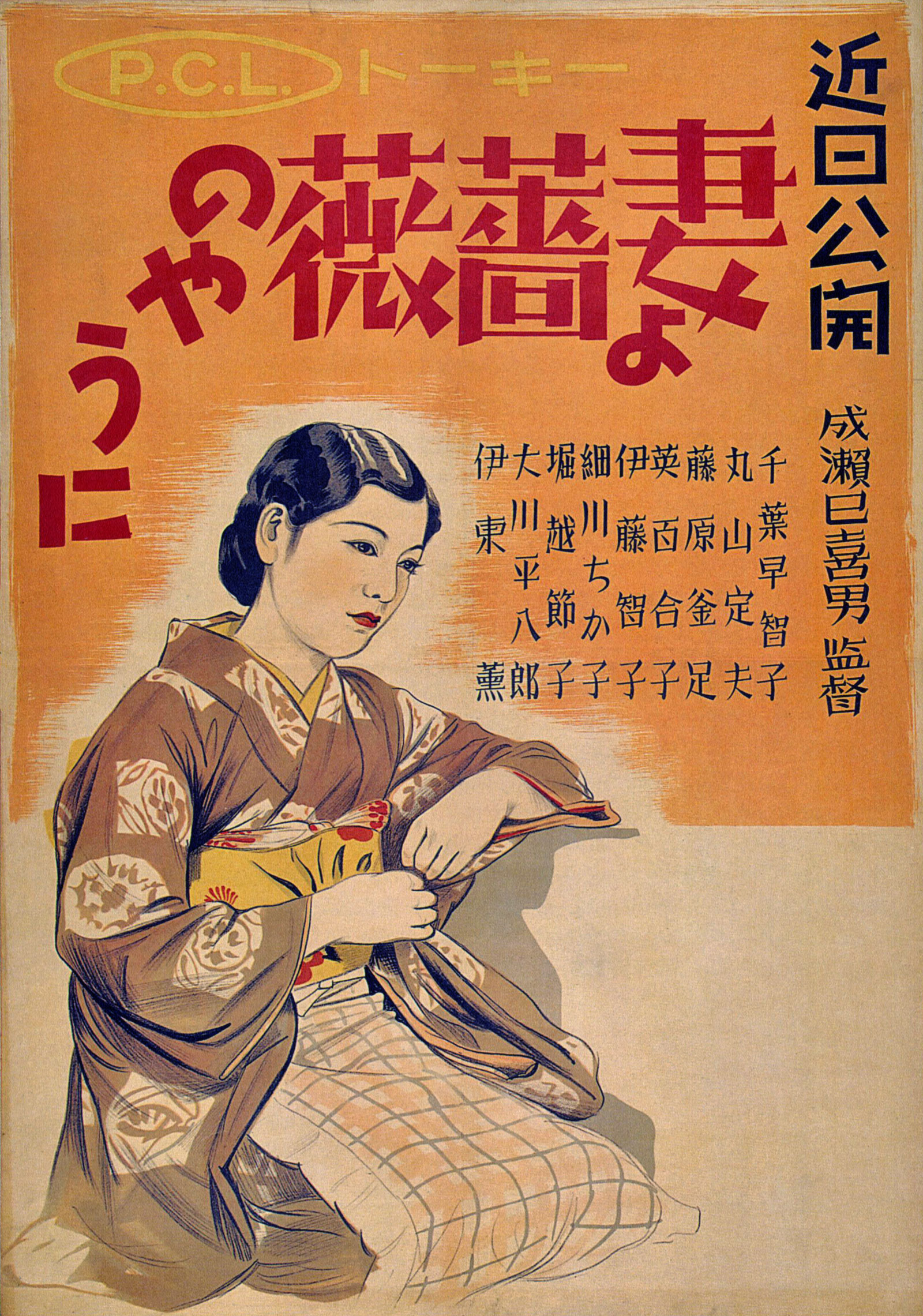
Wife! Be Like a Rose! (妻よ薔薇のやうに, Mikio Naruse, 1935)

Wife be like a rose posterIt’s tempting to view the cinema of the 1930s as a gloomy affair, facilitating the rise of militarism and increasingly at mercy of the censors, but the early sound era was nothing if not playful and generously open to international influences. It was also often surprisingly progressive, evidencing the fact that pre-war Japan was also changing or, at least, that there was an appetite for change especially among the young. Mikio Naruse’s delightfully charming (perhaps uncharacteristically so) comedy, Wife! Be Like a Rose! (妻よ薔薇のやうに, Tsuma yo bara no yo ni) dramatises just this change as its modern girl heroine tries to process the definitive end of her parents’ relationship as she prepares to marry.

Kimiko (Sachiko Chiba) has a job in an office which is more or less supporting herself and her mother seeing as her father, Shunsaku (Sadao Maruyama), left the family over 15 years previously and has been living with former geisha with whom he has two other children. Despite his long absence, Kimiko’s mother Etsuko (Toshiko Ito) has continued to pine for her absent husband and makes a little money on the side writing sad love poems for the newspapers. A request to stand as a go between at a wedding, traditionally a role only performed by married women, forces Etsuko to accept that she has been abandoned but the snag is that Kimiko and her boyfriend Seiji (Heihachiro Okawa) want to get married themselves and so his father wants to meet Kimiko’s dad which is obviously a problem.

Despite her “modern girl” appearance, Kimiko has some quite old fashioned ideas. She looks down on her maudlin mother, believing that she’s brought her apparent romantic heartbreak on herself through being a bad wife. Etsuko never seemed very interested in Shunsaku when he was around and never did any of the little wifely things Kimiko thinks a wife ought to do like vacuous chat and helping her husband change out of his work clothes. Kimiko thinks a good wife “acts childish and cajoling, or jealous sometimes, or motherly and protective”, believing that Etsuko knows this and has the ability to play the part of the ideal spouse but refuses to and therefore has only herself to blame. Kimiko’s uncle (Kamatari Fujiwara), however, corrects her. He piles the blame on the irresponsible Shunsaku who ran out on a wife and daughter to shack up with geisha.

Shunsaku, meanwhile, may be irresponsible in one sense, but perhaps it’s equally irresponsible to stay in an unhappy marriage. Now a gold prospector in the mountains, he is poor and unsuccessful but has built a happy family home with a kindly wife and two sweet children. Kimiko’s desire to drag him back to the city is partly practical in that she needs him to be her father so she can marry Seiji, but there’s also a part of her that thinks that her father’s transgression must be corrected by forcing him to resume his paternal role. Unlike Etsuko, however, Oyuki (Yuriko Hanabusa) is the classically “good” wife and Kimiko can’t deny she’s good for her father. Seeing him in the mountains and remembering him at home, Kimiko begins to realise that it would be wrong to take him away from his new family even if she thinks she has the better claim, especially when she finds out that it’s Oyuki who’s been sending her mother maintenance cheques every month for the past few years.

In fact, Oyuki feels so guilty about stealing Shunsaku away that she’s been putting money aside to pay for Kimiko’s wedding/education while keeping her own daughter home from school. Far from the gold digger Kimiko had assumed her to be, she’s been the one supporting the feckless Shunsaku as he pursues his get rich quick dream of gold prospecting. Realising that the pair of them “act in perfect harmony”, Kimiko comes to the conclusion that her father belongs in the mountains but finds her resolve wavering after returning to civilisation. She begins to wish he’d stay and hatches a plan to get her parents back together only to see how out of sync they are after 15 years apart. They swap pleasantries like strangers, and the mild-mannered Shunsaku visibly shrinks in the presence of the shrewish Etsuko who allows her pride to ruin any attempt at reconciliation.

What the modern girl Kimiko discovers is that sometimes things don’t work out like they’re supposed to, and that’s OK. Though it is in one sense a “happy” ending in that it obeys a justice born of human feeling, it’s also a melancholy moment of defeat both for the lovelorn Etsuko who has, as Kimiko says “lost”, and the now resigned Kimiko who harbours a degree of contempt towards her mother for not fighting harder for love. Standing at a crossroads of modernity, Kimiko looks both forward and back. She vows to be a “good wife” but her foundations have been shaken. Is this tragedy, or farce? She asks herself. It’s almost impossible to say.


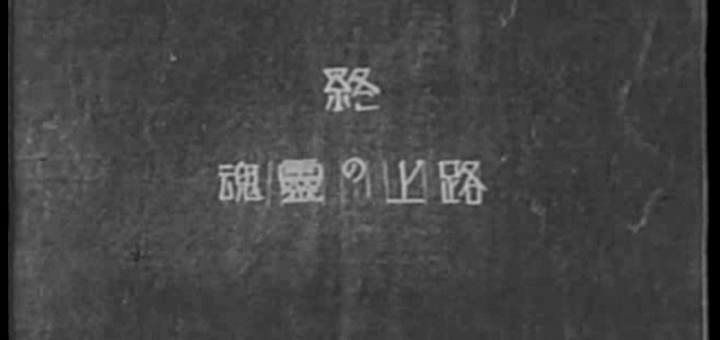
Souls on the Road (路上の霊魂, Minoru Murata, 1921)

vlcsnap-2017-12-09-00h26m35s417Minoru Murata was one of the most important figures in early Japanese cinema but as the majority of his 36 films are lost and he sadly died at the young age of 43 in 1937, his work has largely been over looked outside of scholarly circles. Starting his career as an actor in the “shingeki” movement which aimed to bring modern, naturalist theatre to Japanese stages, Murata first performed in Norimasa Kaeriyama’s “Pure Films” in 1918 before joining Shochiku’s acting school on the recommendation of playwright Kaoru Osanai. The “Pure Film” movement, like the Shingeki movement in theatre, sought to create a new more modern Japanese cinema as opposed to the overly theatrical, kubuki influenced productions of the time. Souls on the Road (路上の霊魂, Rojo no Reikon), an early directorial effort for Murata in which he also stars, was made for Shochiku and is very much influenced by the Pure Film Movement as well as foreign cinema from Europe and America.

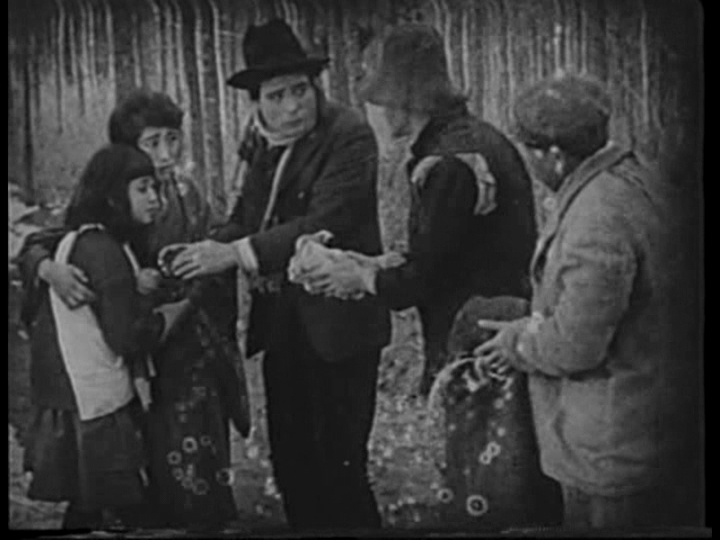
The narrative of Souls on the Road is adapted from two foreign literature sources – Gorky’s play The Lower Depths and the German novel Mutter Landstrasse, das Ende einer Jugend by Wilhelm August Schmidtbonn. Influenced by the work of D.W. Griffith, Murata cuts between the stories of four interconnected groups of people – a failed violinist who returns home to his family with a wife and daughter in tow, two escaped convicts hiding out in the woods, the local master and his servants including a young woodcutter played by the director, and a wealthy young girl.

The central drama revolves around the musician who left home under a cloud to become a concert violinist in Tokyo but failed to make a success of himself. Despite having a fiancée at home, Koichiro (Denmei Suzuki) has married a Tokyo woman (Haruko Sawamura) and has a young daughter. Desperate and starving, the trio have made the snowbound journey back to Koichiro’s Hokkaido village largely on foot but Koichiro’s father (Kaoru Osanai) who is the master of a large estate refuses to help him. The former fiancée, Mitsuko (Ryuko Date), who is also Koichiro’s cousin, still lives with the master and is distressed by Koichiro’s return. Battling her own emotional pain, she wants to help Koichiro’s wife and daughter who are obviously in a bad way, but is also conditioned by the need to obey the master’s instructions even when they seem cruel and immoral.

Murata bookends the film with direct quotes – firstly from Gorky’s play and then from the Bible emphasising the need for human compassion. The master’s refusal to help his son is directly contrasted with the fate of the two convicts who cross Koichiro’s path in the forest. The two men originally try to rob Koichiro, but seeing that they too have nothing and the little girl is close to starving, the convicts give up their own food to help them. When they chance upon house they remain conflicted about trying to rob it – they don’t want to end up back in prison and they don’t want to steal but they are also starving and have no other options. The custodian of the house catches them in the act and enacts a sadistic punishment but later changes his mind and decides to help them.

Meanwhile, one of the master’s servants, a boy named Taro (played by director Minoru Murata), runs into the rebellious young mistress of a local estate (Yuriko Hanabusa) who dresses in a sailor suit and gleefully shoots her minder with an air gun to avoid having to go home. The young mistress strikes up a cross class friendship with Taro and invites him to the Christmas party she is organising at her mansion to which pretty much everyone is invited regardless of class origins or backgrounds. The young mistress’ “Christmas Party” might seem incongruous for a rural town in the Japan of 1921 and does indeed take on the trappings of Russian literature with the mummers and balalaika players replaced with traditional Yagibashi dancers, but the party itself seems to have no particular religious dimension as the young mistress dreams of being visited by Santa and a small shot of Mitsuko seeming to pray as Koichiro’s wife and daughter lie freezing in a barn is the only hint of a real presence of Christian thought outside of the overt references in the framing sequences and overall Christianising morality of the film as a whole.

Murata’s signature approach mixes an entrenched naturalism of location shooting and realistic performances with expressionistic techniques. Literally “souls” on the road, Murata introduces as series of ghosts using dissolves and superimpositions as the protagonists are haunted by alternate pasts and futures or even by themselves as Koichiro finds himself interrogated by the hopeful violinist who left with big dreams but has brought his wife and child to the brink of starvation and death from cold in a barn steps away from his childhood home. Somewhat heavy handed in its closing moments as Taro wonders what might have been if the master had been more forgiving and welcomed his son home instead of punishing him for leaving, and the young mistress wonders what might have happened to the convicts if the custodian had not taken pity on them, Souls on the Road is an early visionary masterpiece far ahead of its time which looks forward to a new kind of Japanese cinema.