Suicide Troops of the Watchtower (望楼の決死隊, Tadashi Imai, 1943)

Produced by Toho and Chosun Film Production Corporation, Suicide Troops of the Watchtower (望楼の決死隊, Boro no kesshitai) was intended as a piece of imperial propaganda promoting a sense of unity between Koreans and the Japanese who had annexed their country in 1910 and thereafter ruled in an oppressive and often brutal fashion. Not that you would know any of that from the film which is directed by committed communist Tadashi Imai while equally surprisingly crediting Choi In-gyu as an “assistant director”, though Choi was already an established and successful director of colonial films such as Tuition (1940) and Angels on the Street (1941). 

Like Tuition the film is almost entirely in Japanese, Korean having been banned onscreen by this point, though small smatterings of Korean are heard in the background. The film is set in 1935, but there are signs visible at certain points reminding people to “use only the national language,” eg. Japanese, though one of the Japanese officers has apparently learned Korean to better communicate with the local community. Likewise, though Korean actors also appear in the film, they are mainly in smaller parts with the most prominent roles being played by well-known Japanese stars. Nevertheless, Korean characters have not generally taken Japanese names, but are referred to by the Japanese reading of the Chinese characters with which their names are written. Thus, the sister of the Korean border patrol officer who is killed is referred to as Eishuku (played by Korean actress Kim Shin-jae), rather than as Yong-suk. Meanwhile, another man remarks that if he called himself “Hayashi” he might feel more Japanese, while his wife has become accustomed to wearing Japanese kimono.

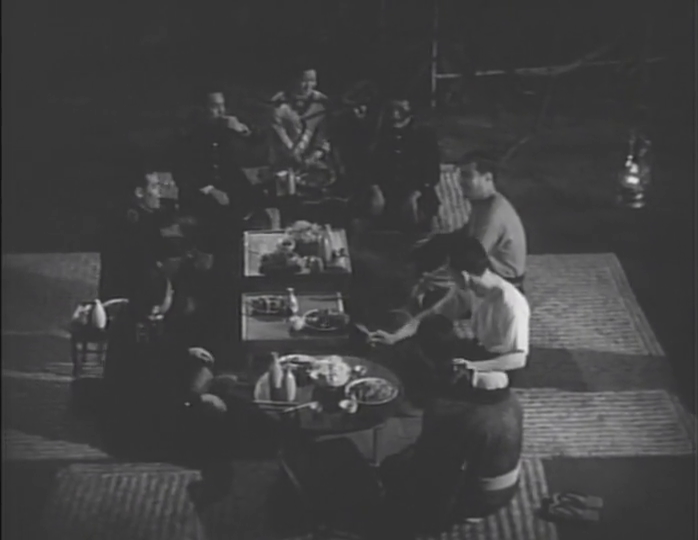
The earliest scenes of the film capture the idyllic pastorality of the Korean landscape and are intended to extend a degree of exoticism to the mainland Japanese audience who are likely less familiar with Korea or Korean culture. This is also true of the early scene in which members of the border patrol hold a welcome party for Asano (Hideo Saito) which takes place at a traditional Korean home. The men eat and drink outside sitting at low tables while the Japanese soldiers attempt to learn a Korean folksong taught to them by Kin. These scenes seek to paint colonial life as a more genial form of cultural exchange brokered by friendliness and respect even though in reality expressions of Koreanness are generally discouraged while the people are brutally oppressed and economically exploited. 

Unlike some similar films, however, Suicide Troops of the Watchtower presents Korean and Japanese people as equals who are fighting for the Japanese empire together. Though they are also portrayed as simple, rural people, the Koreans are never seen to be stupid or incapable and are overall honest and kind if grateful to the Japanese border patrol officers for protecting them from the bandits. In some surprising ways, the film at times presents a more progressive view of society than might be expected as the border patrol is universally supportive of Eishuku’s desire to become a doctor with one of the officers selling off his rice field to ensure she can continue her education after her brother’s death. The implication might be that this is an opportunity afforded to her by the “civilising” force of Japanese colonialism, but she is nevertheless encouraged to become an independent working woman who will also use her skills in support of the empire. 

On the other hand, the Chinese characters seen in the film are all played by Japanese actors and are generally viewed with a degree of suspicion. Cafe owner Wanryu (Ichiro Sugai) has crossed the border expressly to escape the violent bandits of Manchuria, but is still mistrusted by the border patrol despite repeatedly pledging his loyalty to them. When a man in stereotypical Chinese dress with a wounded arm turns up in Wanryu’s cafe and ends up killing officer Kin when challenged, suspicion falls on Wanryu. The Chinese population has essentially been characterised as the “other” and the force against which the Japanese and Koreans are unified, which somewhat undermines the final pronouncement that the bandit problem has been solved by the elimination of the border now that Japan has conquered Manchuria. 

Though they are described as “bandits” and it is said that they have been pushed into Korean territory by Japanese soldiers pursuing them, it easy to read these insurgents as Korean Independence fighters many of whom had gone into exile in China, particularly in Shanghai. Wanko, the estranged son of Wanryu, is not just a young man who ran off to live a life of banditry, but a guerrilla fighter resisting Japanese imperialism. His eventual conversion born the desire to avenge the death of his father at the hands of bandit leader Koryo who meant to kill Wanryu fearing he had betrayed them by warning his father of the imminent attack, is then depicted as a kind of homecoming as border patrol chief Takatsu (Minoru Takada) agrees to release him so that he can fight alongside them. 

To that extent, it might seem surprising that the film makes the bandits seem so powerful to the degree that they pose a genuine threat the security of the empire. Their assault is staged in a way that resembles Hollywood westerns. At the film’s conclusion, it really appears as if all is lost and the border patrol will be wiped out by the bandits, partly because they are clearly understaffed which would seem to be a strategic failure on the part of the authorities. Takatsu’s ever capable wife Yoshiko (Setsuko Hara) is seen lugging weaponry around bearing out the all hands on deck mentality. At the lowest moment, Takatsu gives his pistol to his wife with the intention that she use it on herself when they are overrun while the Korean residents make similar plans with a new mother preparing to smother her baby if the need arises. 

In the end they are saved by the timely arrival of reinforcements thanks to the efforts of the new arrival Asano who had been unable to cope with the harsh life on the border and was determined to quit. Even the one Korean who had subversively complained about being exploited as free labour by the entitled Japanese occupiers chips in to help so that the bandits are eventually defeated by the united force of Koreans and Japanese officers fighting side by side. Even so, the closing speech insists that the colonial authorities will now continue with their ideal of bringing “order” to Korea. Commander Takatsu proves his commitment by giving up  the opportunity to return home to see his dying mother, while his wife becomes a maternal figure to the local community. Released in 1943, the film is perhaps an advocation for unity born of increasing desperation as Japan suffered repeated defeat and domestic strain, preparing its audience for the necessity of defending themselves against a similar onslaught while suggesting that all must work together to save the nation.
Hiroshima (ひろしま, Hideo Sekigawa, 1953)

During the post-war occupation of Japan which lasted until 1952, the censorship regulations which replaced those of the militarist era perhaps ironically made it more or less impossible to criticise the US presence or depict the extent of wartime devastation lest it raise hostility towards American forces or reinforce a feeling of victimisation. For this reason, images of the atomic bombings were tightly controlled and the events rarely referenced in mainstream media, Hiroshi Shimizu’s Children of the Beehive being a notable if brief exception. Once the occupation was over, however, many assumed it would become easier to broach such taboo subjects. 

Hiroshima native Kaneto Shindo’s comparatively better known Children of Hiroshima, inspired by the book Children of the A Bomb: Testament of the Boys and Girls of Hiroshima, was released in 1952 shortly after the censorship regulations were lifted and stars his later wife Nobuko Otowa as a teacher who returns to Hiroshima to visit the graves of her parents killed in the atomic bombing and thereafter several of the children from a nursery school she once taught at who have survived but continue to suffer in various ways due to their experiences. Despite Shindo’s well known leftist credentials, many including the Japan Teachers’ Union who apparently owned the rights to the book though there is some dispute as to their involvement in the production, were disappointed with the film which they felt to be an overly sentimental studio melodrama that was ultimately unhelpful in supporting the anti-war political movement or accurately representing the hibakusha community. 

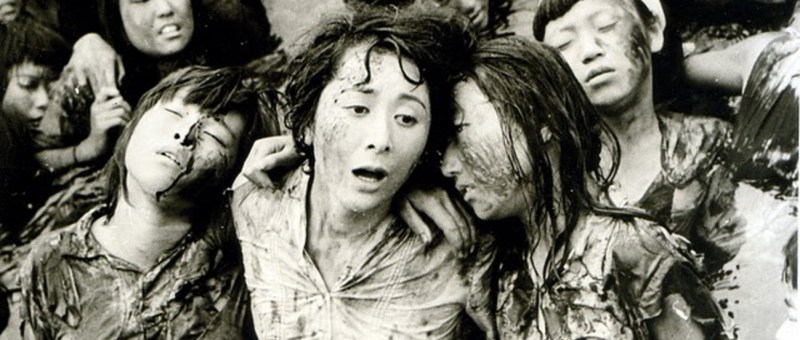
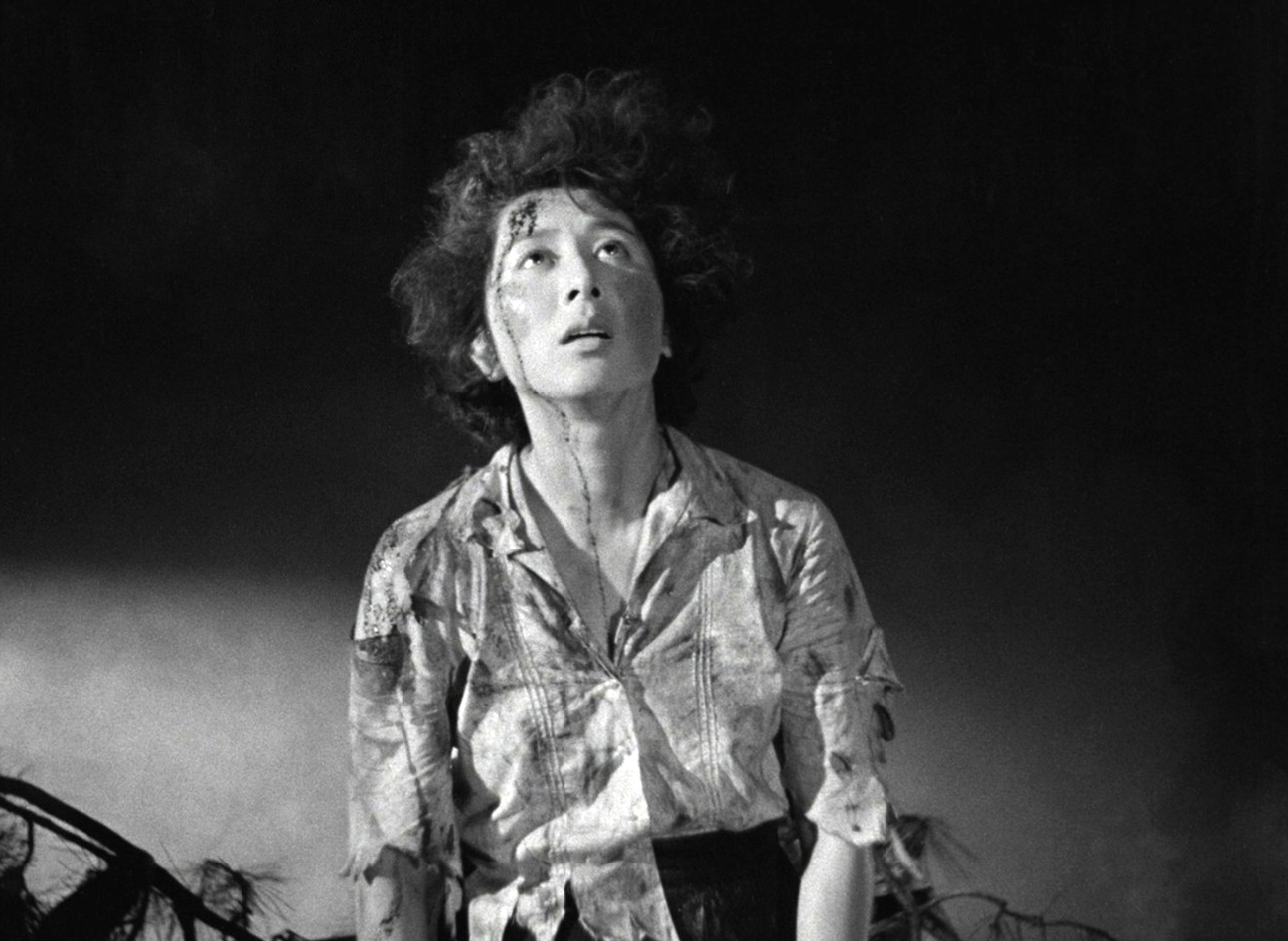
In response, the JTU commissioned a second version in order to better reflect their aims and ideals. Long unseen in either Japan or internationally prior to its recent restoration, Hideo Sekigawa’s Hiroshima (ひろしま) adopts a much more strident docudrama approach while, like Children of Hiroshima, maintaining a focus on the plight of children during the bombing and beyond though it seems somehow unlikely that teachers and parents would be wholeheartedly enthusiastic about showing such a deliberately harrowing piece to a sensitive younger audience. One criticism of Shindo’s film had been that he’d dodged dealing with the bombing itself by concerning himself only with the present-day aftermath. Sekigawa meanwhile focuses directly on the traumatic instant of the attack, utilising expressionistic techniques to recreate the living hell to which the city was reduced literally in flash. 

It’s clear however that the normal of that day was already far from normal. Rather than go about their studies, school children are working hard for the war effort helping to clear extensive bomb damage. A teacher and a class of school girls salvaging roof tiles from a ruined building pause to look at the sky. They can hear bombers but no sirens and it’s in that moment of stillness that everything changes. The world as it was implodes and is left in total collapse. Survivors search desperately for loved ones while stumbling through an unfamiliar landscape filled with crying children, charred bodies, rubble and fire. “This is hell” an injured man groans after managing to make his way to the field hospital, “hell”. 

Sekigawa bookends his tale with a contemporary framing sequence in which an idealistic teacher tries to instil compassionate values in his students some of whom are survivors of the bomb and still living with its effects including one suffering with radiation-related leukaemia who becomes very upset on listening to a radio lesson recounting the morning of the bombing from the point of view of the pilot flying the plane. Another of the students later comes to her defence, taking some of the others to task and lamenting that the suffering of those affected by the A Bomb is not taken seriously while victims still undergo a degree of social stigma even if they have no visible wounds. He is also very worried about his friend, Endo (Yoshi Kato), who later appears in the flashback to the aftermath of the bombing and has apparently gone off the rails, working in a cabaret bar and addicted to pachinko after losing his entire family. 

It’s through Endo that Sekigawa dramatises many of the secondary effects of the bombing in that he was not physically injured but is consumed by a sense of hopeless anxiety, intensely concerned about the prospect of another war and unable to envisage a successful future for himself in a world in which such horror can occur seemingly at random. It’s he who first introduces us to the parasitical disaster tourism that generates a grim trade in A-Bomb “souvenirs” as he passes a stall selling fake skulls as a child and then later attempts to sell actual human remains with inspirational stickers plastered on the top. The “better” future they have imagined for him is however in itself problematic, harking back to the traditional post-war solution of a factory job which directs aligns him with the nation’s push towards a capitalistic society, but is then undercut when he quits not because he is bored or lazy but because he discovered the factory was being used to produce artillery shells and he felt he could have nothing to do with it. 

Endo is also among a group of post-war street kids who learn to say the word “hungry” without knowing what it means to get bread and chocolate from passing Americans. A later more direct speech has them make a formal accusation that the Americans are responsible for the deaths of their parents and therefore bear a responsibility towards them which they should immediately repay with food. Some, including Shochiku who were originally set to distribute but later declined, described the film as overly anti-American, but Hiroshima largely refrains from mentioning the Americans other than a suggestion that the dropping of the bomb was itself a racist act in which they used the Japanese people as guinea pigs to test their new weapon, and focuses on the failure of the militarist authorities to respond in an appropriate fashion. We see a soldier read out a proclamation telling a ragged queue of survivors queuing up for food that the situation is “not unusual” in time of war and they should all return to their jobs despite the fact that there are no longer any buildings in which to work. Meanwhile, militarists talk of using the disaster to foment the war effort by marshalling hate and resentment towards the enemy while commanders refuse to take scientific advice that tells them Hiroshima may be uninhabitable for the next 70 years, obsessed only with continuing the war at all costs ironically insisting that their “fervent will” which “burns as brightly as a million stars” will bring them an assured victory.  

In the face of a second bombing, however, they are forced to accept that the war cannot continue, many of the victims left perplexed and defeated that despite their suffering the government has unconditionally surrendered and seemingly abandoned them. An abnegation of responsibility is also suggested by the presence of the street kids abandoned by their society and left to fend for themselves though Endo is eventually taken into a progressive care home from which he and other boys make numerous attempts to escape, in his case in the hope that he can find the sister from whom he became separated. Sekigawa does not make suggestions for the future, merely depict the difficult post-war reality while arguing for greater compassion in the contemporary era, one bomb survivor describing her despair in the knowledge that her disability is a barrier to marriage while finding work that can be done with her physical limitations is also difficult as is accessing government support. Sekigawa too may give in to a particular kind of sentimentality in the closing moments but it is indeed undoubtedly effective as a reminder of the human cost of war and our collective responsibility to ensure that it never happens again.


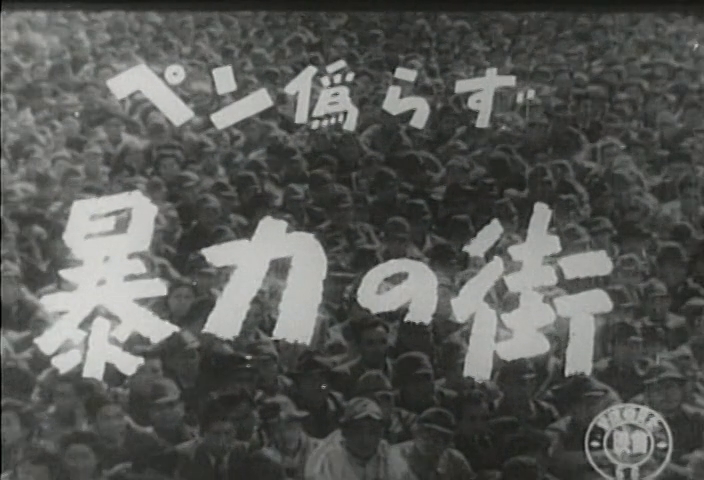
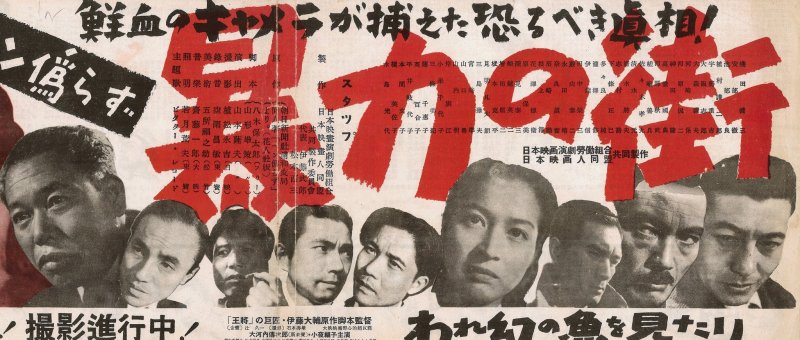
Street of Violence: The Pen Never Lies (ペン偽らず 暴力の街, Satsuo Yamamoto, 1950)

vlcsnap-2020-01-16-00h05m26s354The immediate post-war era was one marked by fear and anxiety. The world had turned upside down, food was scarce, and desperation had provoked a widespread moral decline which rendered compassion a luxury many thought they could ill afford. Yet, in hitting rock bottom there was also the opportunity to rebuild the world better than it had been before. Street of Violence: The Pen Never Lies (ペン偽らず 暴力の街, Pen Itsuwarazu Boryoku no Machi), is one of many pro-democracy films arriving in the wake of Japan’s new constitution and makes an unlikely hero of the local newspaperman as the sole means of speaking truth to power in the fierce belief that the people have a right to know.

Tojo, a small town Northwest of Tokyo, was once the centre of the silk trade but as the industry declined, it gradually became home to gangs and a hub for wartime black market shenanigans. The sad truth is that the growing nouveau riche middle-classes profiting from post-war shadiness have more or less got the town sewn up. The corrupt police force is in cahoots with the gangsters who call themselves a “police support organisation” and make a point of wining and dining the local police chief, while also making sure the local paper is firmly in their pocket. The trouble starts when rookie reporter Kita (Yasumi Hara) is invited to a policeman’s ball and figures out the whole thing is sponsored by the silk traders’ union, which he thinks is not quite right. He takes what he’s learned back to his editor and is warned off the story but publishes something anyway, quickly becoming a target for prominent “politician” Onishi (Masao Mishima).

Street of Violence opens with onscreen text taken from the press code which emphasises that mass media has a duty to preserve the truth. Kita’s paper had been in league with the police and the gangsters enabling the atmosphere of casual violence which is gradually consuming the town. Kita, a new recruit, is not yet inured to the way things are and immediately thinks his duty is to blow a whistle, most obviously on the corrupt police force and judiciary. He is only allowed to do so because the previous editor stepped down and a similarly idealistic older gentleman (Takashi Shimura) from out of town has taken over. He decides to fight back, standing up to the crypto-fascist goons by continuing to publish the truth about the links between the police, black market silk traders, gangsters, and the rest of the local press who eventually gain the courage to join him.

Onishi continues to masquerade as a “legitimate businessman” and “respectable politician” claiming that he’s “striving for democracy” to help the “downtrodden”, but is also responsible for directly targeting Kita’s mother and sister in an attempt to intimidate him. The editor assigns another reporter, Kawasaki (Ryo Ikebe), to keep Kita safe and starts trying to find locals who will consent to be interviewed about gang intimidation while Kita’s friends from the Youth Association generate a kind of resistance movement holding protests and handing out flyers condemning the atmosphere of violence which has ordinary citizens turning off their lights and avoiding going out after dark to protect themselves from thuggery.

The silent cause of all this strife is of course post-war privation which has made the blackmarket the only means of survival for those otherwise starving but has also given free rein to selfish immorality. The Onishis of the world, the spineless police chief, and the cynical local press, have all abnegated their human responsibilities in wilfully taking advantage of a bad situation to further their own cause. When the press chooses not to turn a blind eye to entrenched corruption, it raises a flag that ordinary people can follow. Too intimidated to speak out, the townspeople had been living in fear but post-war youth has the courage to say no and demand a better future. A mass rally crying out “democracy” and insisting on an end to the cronyism and the corrupt systems of pre-war feudalism produces a people power revolution that can’t be ignored, forcing Onishi into submission, and a clean out of corrupt law enforcement. But, the earnest voice over reminds us, the victory is only partial – violence still exists and will rise again when it thinks no one’s looking. The press, most of all, cannot afford to look away if “democracy” is to be maintained.