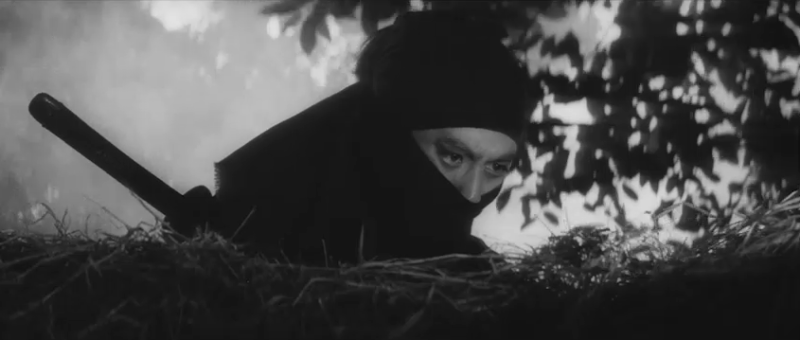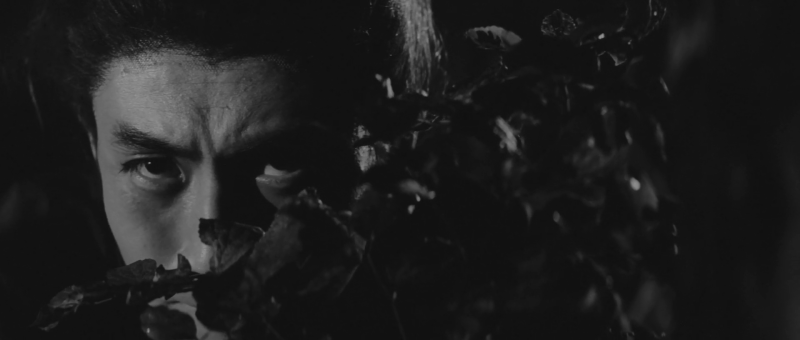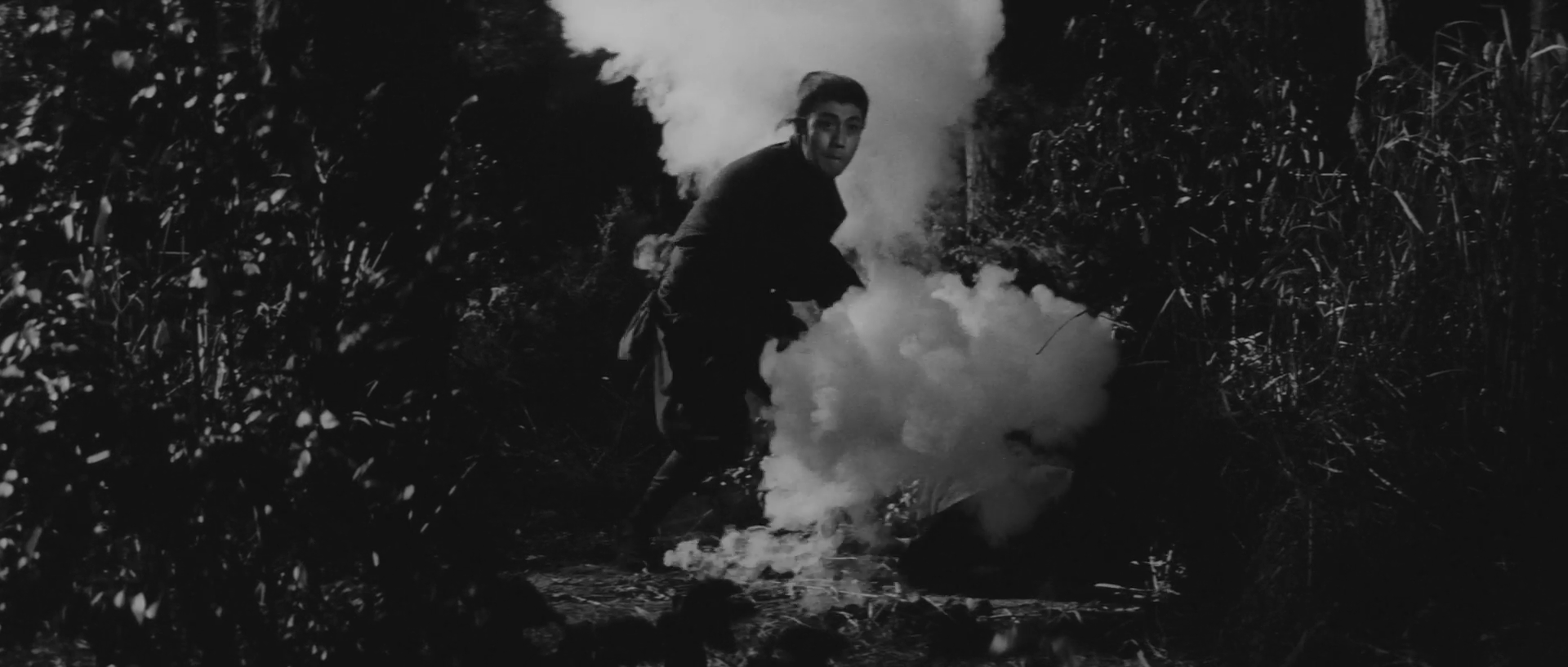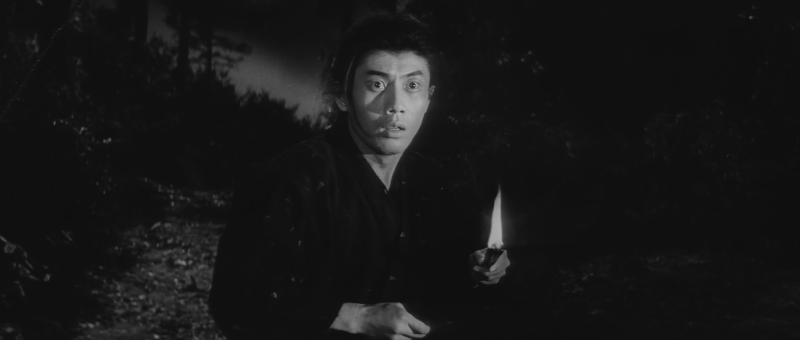
Eight Men to Kill (賞金首 一瞬八人斬り, Shigehiro Ozawa, 1972)

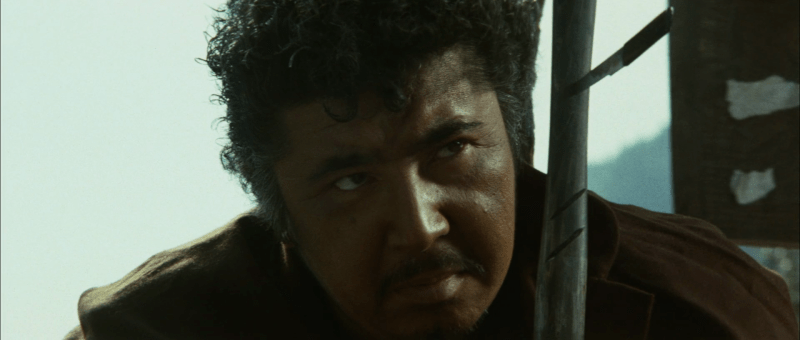
In the first instalment of the Bounty Hunter series, Shikoro Ichibei (Tomisaburo Wakayama) had been a shogunate spy intent on putting down rebellion to their oppression, but by the third, it seems he’s thoroughly fed up with the ills of feudalism and apparently no admirer of the Tokugawa who he feels to have failed in their responsibility to the people along with their personal greed and desire to hold on to their power.

Ichibei’s chief objection is their lack of healthcare provision, seeing as he is a doctor who mainly cares for the poor. That’s one reason he agrees to the job, asking for a large percentage of the gold he’s been asked to retrieve by a worried retainer who explains that the Edo government is relying on it to bridge a gap on their finances. If the gold’s not returned, the entire economy may crash. The government’s heartlessness is further borne out by the retainer’s words that it’s not the time to be concerned about one boy whose importance pales in contrast to that of the Tokugawa Shogunate when a rogue ronin kidnaps the son of the man responsible for the theft of the gold from a local mine. 

In a repeated motif, men attempt to swallow the gold as a means either of stealing or hiding it but it gets stuck in their digestive system and causes them a great deal of pain that could lead to death. The cruel mine owner Kanoke Tatsu (Minoru Oki) forces Ichibei to cut open the man’s stomach to get the gold out, while he insists on sewing him back up again because as a doctor it would be wrong not to. What he’s really performed maybe a kind of gold-ectomy, removing the toxic substance from the men’s stomachs even if he may not be able to save their lives or improve their circumstances.

Ichibei tells the bandit, Yasha the Wolf (Kenji Imai), who is held responsible for the theft of the gold, that he is as bad as him and is only looking for a fast way to make money, yet he wants it to use to build better hospitals for the poor, ironically using the government’s cash to make up for their failing. Meanwhile, he finds himself coming up against a man much like himself only inverted in the form of wandering assassin Yajuro (Shigeru Amachi), a former secret policeman in the rebellious Bishu domain who doubt crosses everyone he comes across in an attempt to get his hands on the gold. Ichibei asks the man who hired him why they don’t want to use government spies but he tells him that it’s because they’d run out. The ones they sent to investigate have all been killed, presumably by the treacherous Yajuro.

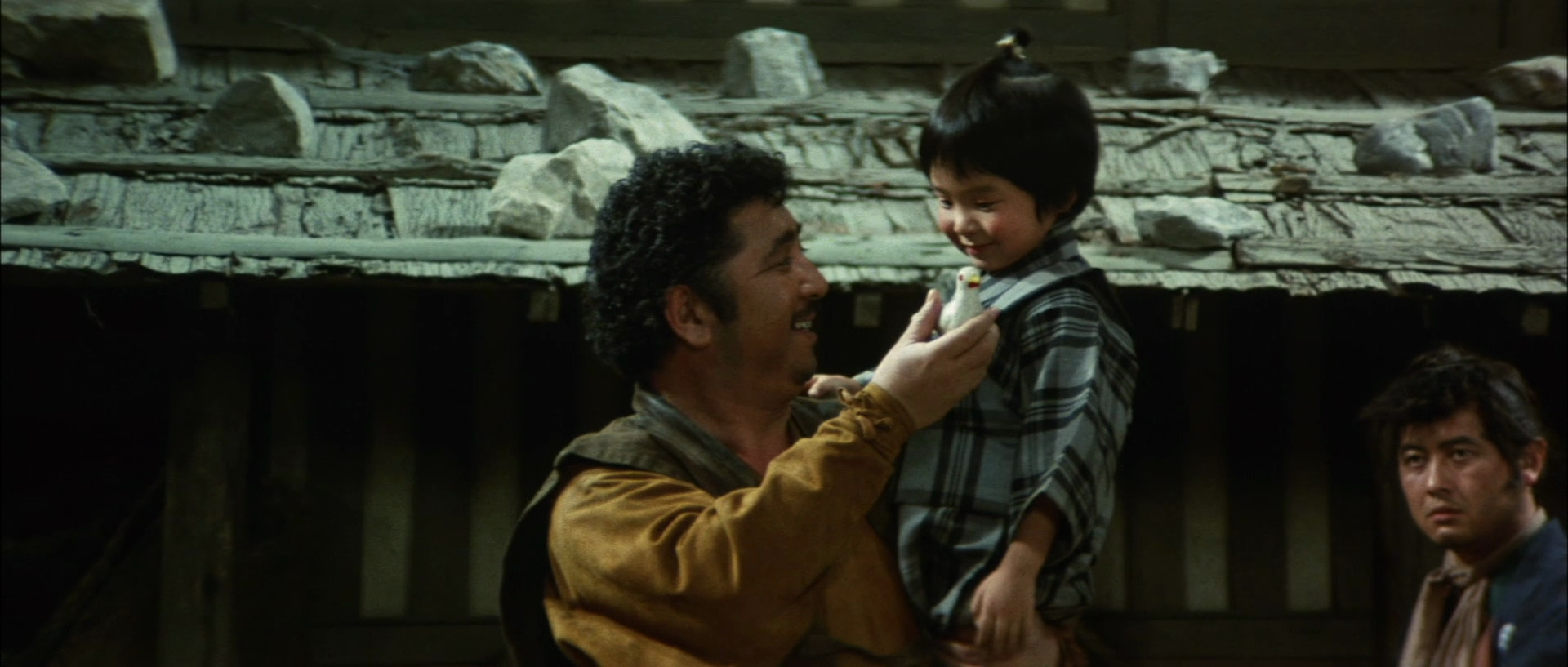
All around him, Ichibei discovers only omnipresent greed. A geisha he comes across is working with the mine owner to steal the cash, but simultaneously seducing Ichibei and the apparently won over by his bedroom prowess though it’s difficult to know which is an act, her fondness for Ichibei or pledges to sell him out to Kanoke. Meanwhile, Kanoke vacillates when presented with a binary choice by Yajuro, his adorable three-year-old son, or the gold. As always, it’s the innocent who suffer while personal greed and governmental indifference leave ordinary people little room to manoeuvre. 

This time around, the righteous Ichibei cuts a solitary figure. He no longer has a posse and is supported only by an older gentleman who is mute. As a result of his mission, he even ends up on a wanted poster himself with the shogunate, presumably unwilling recognise him, yet eventually congratulating him on a job well done, much to his shame and embarrassment having witnessed shogunate soldiers committing an atrocity. Very much in the western vein, Ozawa lends the dusty old mining town a sense of dread and decay as it rots from the inside out thanks to the corrupt authority of a weakened shogunate seeking only ways to cement its own power. The red-tinted final taking place during a solar eclipse seems to emphasise the hellishness of the situation even as Ichibei announces that they can all go to hell but he’s sending the money to heaven where it can be put to better use. 


Hoodlum Soldier (兵隊やくざ, Yasuzo Masumura, 1965)

The opening voiceover of Yasuzo Masumura’s Hoodlum Soldier (兵隊やくざ, Heitai Yakuza) explains to us that the settlement we’re looking at is effectively a huge prison in the desert inhabited only the Japanese military from which there is no escape. To ram the point home, the camera lingers on the decomposed skeleton of Japanese infantrymen half-buried in the mud only a short distance from the fort’s borders. This is the fate of the soldier, it seems to tell us with nihilistic futility as if in effect all of these men are already dead while imprisoned inside the death cult that is militarism. 

Yet, our heroes will eventually escape. At least that’s how it seems at the end of the film though there are a further eight instalments in this series. A mismatched pair who develop something akin to a sadomasochistic relationship, they each resist this system in opposing ways. “College boy” Arita (Takahiro Tamura) is just waiting out the end of his contract, continually refusing promotions so that he will be discharged at the end of his three-year term and allowed to return to Tokyo a free man. Omiya (Shintaro Katsu), by contrast, is a man who has no real concept of hierarchy or authority. As he later says, he doesn’t do anything he doesn’t want to do and it’s not so much that he resists authority but is simply indifferent to it.

As Arita explains, the the army is a hierarchy that’s founded on violence. The mildest infraction is dealt with through a process of slapping in which those of higher status assert their authority by inflicting violence on those below. We’re told that laws have recently been put in place to regulate the violence implemented as disciple with excessive force now apparently frowned upon leaving this culture of slapping as the only accepted form of judging an action right or wrong though it’s also clear that these rules are not always respected even by those who made them. The very system is then itself corrupt and unfair, which Arita knows and therefore contrives to live outside of it in so much as he does not participate in this chain of violence.

Neither does Omiya but in an opposing way. On joining the unit, he simply does not react to being slapped by his superior officer and in that way makes it clear that he cannot be controlled by violence. He does not fight back, but only uses to violence to oppose what he sees as injustice and it’s this refusal to just accept the unfairness of army life that makes him a thorn in the side to army command. They assign a reluctant Arita as his mentor, much to his chagrin because he fears that Omiya will get him into trouble and damage his chances of making it to his discharge without incident. But the funny thing is that Omiya does submit himself to Arita’s authority precisely because he does not brutalise him and never uses violence as a means of control. Omiya respects Arita, and therefore listens to him when he explains why a particular course of action is disadvantageous to himself and will only result in further violence. 

To Arita, Omiya at times seems like a bullheaded brawler who thinks a fight is over when someone is knocked out or surrenders and is unable to see the potential for reprisals, but he’s smarter than he gives him credit for and the bond between them is quite genuine even at times homoerotic as they each declare they don’t want to be parted from each other seemingly the only two sane men marooned amid the folly of war in Manchuria. Omiya respects Arita because he does not use violence against him, but in other senses perhaps craves it and is willing to inflict violence on himself in order to save Arita from being forced to do so by the system under which they live which would obviously cause him mental anguish. The power dynamics between them shift as the fortunes of the war decline with Arita eventually declaring that Omiya is now his superior and may issue him orders which he will then obey.

The statement may however be ironic in that they are in the process of escaping the hierarchal society by hijacking its most potent symbol, a train. Omiya declares themselves free of it in pointing out that China stretches to the borders of Russia and Europe as if the whole world were now open to them that they are no longer bound by the walls of the literal prison that is the army camp and the symbolic ones of the militarist society ruled by violence. As Arita had pointed out, the camp ran itself like a prison and was akin to a yakuza society with the different factions often at war with each other. Goverened by macho posturing, every transgression must be solved through violence to approve each man’s status with Omiya’s perpetually high in part because he doesn’t really care very much for the hierarchy only for what he sees as righteousness. 

The two men bond with a Japanese sex worker who they realise is just as trapped as they are by the force that underpins militarism, violent patriarchy. She also feels her situation to be futile, that even if she should return to Japan there will no future for her because of her past in sex work while she currently has no more control than they do and is simply pulled around by her employers to wherever the army goes now that the frontlines are in constant flux and the retreat south has begun. Arita and Omiya free themselves by decoupling from the train leaving the sleeping soldiers yet to awake from the cruel spell of militarism inside while they seek freer futures. Our heroes are men who in effect simply choose to remove themselves from an absurd and destructive social order which speaks just as well to the contemporary society of docile salarymen living in a different kind of prison but perhaps no more free than previous generations while tied to a feudalistic, patriarchal social hierarchy. 


Hoodlum Soldier screened as part of this year’s Camera Japan.

Original trailer (no subtitles)

A Lustful Man (好色一代男, Yasuzo Masumura, 1961)

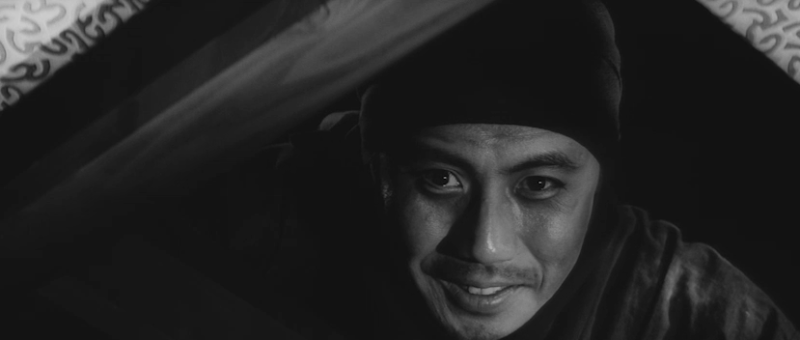
“Why are women in Japan so unhappy?” the carefree Casanova at the centre of Yasuzo Masumura’s 1961 sex romp A Lustful Man (好色一代男, Koshoku Ichidai Otoko) laments, never quite grasping the essential inequalities of the world in which he lives. Masumura is best known for extremity, a wilful iconoclast who flew in the face of golden age cinema’s genial classism, but shock was not his only weapon and he could also be surprisingly playful. Adapted from a well known novel by creator of the “floating world” Ihara Saikaku, A Lustful Man finds him indulging in ironic satire as his hero sets out to “make all the women in Japan happy” chiefly by satisfying their unfulfilled sexual desire while resolutely ignoring all of the entrenched patriarchal social codes which ensure that their lives will be miserable. 

Set in the Edo era, the film opens not with the hero Yonosuke (Raizo Ichikawa) but with his miserly father who berates a servant after discovering a single grain of rice on the hall floor. According to him, the central virtues necessary to become rich are endurance, diligence, and vitality. You must treasure each and every grain of rice in order to accumulate. A cruel and austere man who only thinks of money, Yonosuke’s father keeps his wife in earnest poverty despite their wealth, angrily grabbing an obviously worn kimono out of her hands and insisting that it’s still good for another year, apparently caring nothing for appearances in the otherwise class conscious Kyoto society. It’s this meanness that Yonosuke can’t seem to stand. He hates the way his father disrespects his mother, and her misery is a primary motivator in his lifelong quest to cheer up Japan’s melancholy women though the weapon he has chosen is sex, a convenient excuse to live as a genial libertine to whom money means essentially nothing. 

Yonosuke’s father has set him up with an arranged marriage into a much wealthier family, which is not something he’s very interested in despite the fact she seems to be quite pretty but on learning that she has transgressively found love with the family butler he determines to help her instead, ending the marriage meeting by chasing her round the garden like a dog in heat. Several similar stunts eventually get him sent away from his native Kyoto to Edo but he takes the opportunity to escape, travelling all over Japan making women “happy” as he goes. 

As the first example proves, Yonosuke genuinely hates to see women suffer. His own pleasure, though perhaps not far from his mind, is secondary and he never seeks to take advantage of a woman’s vulnerability only to ease her loneliness. Despite that, however, he remains essentially superficial opting for the transience of postcoital bliss while ignoring the very real societal factors which make an escape from misery all but impossible. During an early adventure, he spends all of the money he conned out of his new employer on redeeming a geisha (at more than three times the asking price) so that she can be with the man she loves, but he continues to visit sex workers without interrogating their existence as indentured servants, “merchandise” which is bought and sold, traded between men and entirely deprived of freedom. In fact, he proudly collects hair cuttings from the various geishas he has known as a kind of trophy only to later discover the grim truth, that the hair likely doesn’t belong to the geisha herself but is sold to them by middlemen who get it by digging up dead bodies. 

Yonosuke remains seemingly oblivious to the duplicitous hypocrisy of the yoshiwara, but is repeatedly confronted by the evils of Edo-era feudalism with its proto-capitalist cruelty where everything is status and transaction. He is often told that as he is not a samurai he would not understand, but seems to understand pretty well that “samurai are idiots” and that their heartless elitism is the leading cause of all the world’s misery. To some a feckless fool, Yonosuke refuses to give in to the false allure of worldly riches. As soon as he gets money he spends it, and does so in ways he believes enrich the lives of women (even if that only extends to paying them for sex), eventually getting himself into trouble once again reneging on his taxes after trying to prove a geisha is worth her weight in gold. 

Yogiri (Ayako Wakao) complains that women are but “merchandise”, valued only as toys for men. “Japan is not a good country for women” Yonosuke agrees, suggesting they run away together to find a place where women are respected, indifferent to Yogiri’s rebuttal “no, wherever you go, no one can change women’s sad fate”. Yonosuke’s naive attempts to rescue women from their misery often end in disaster, a runaway mistress is dragged back and hanged, the woman he was set to marry goes mad after her father and lover are beheaded for having the temerity to speak out about corrupt lords, Yogiri is killed by a samurai intent on arresting him for tax evasion, and his own mother dies seconds after his father only to be immediately praised as “the epitome of a Japanese wife”. Yet he remains undaunted, wandering around like an Edo-era Candide, setting off into exile to look for a supposed female paradise without ever really engaging with the systems which propagate misery or with his own accidental complicity with them. Nevertheless, he does perhaps enact his own resistance in refusing to conform to the rules of a society he knows to be cruel and unfair even if his resistance is essentially superficial, self-involved, and usually counterproductive which is, in its own way, perfectly in keeping with Masumura’s central philosophies on the impossibilities of individual freedom within an inherently oppressive social order.


Lone Wolf and Cub: Baby Cart in the Land of Demons (子連れ狼 冥府魔道, Kenji Misumi, 1973)

baby-cart-land-demonsOgami (Tomisaburo Wakayama), former Shogun executioner now a fugitive in search of justice after being framed for treason by the villainous Yagyu clan who are also responsible for the death of his wife, is still on the Demon’s Way with his young son Daigoro (Akihiro Tomikawa). Five films into this six film cycle, the pair are edging closer to their goal as the evil Lord Retsudo continues to make shadowy appearances at the corners of their world. However, the Demon’s Way carries a heavy toll, littered with corpses of unlucky challengers, the road has, of late, begun to claim the lives of the virtuous along with the venal. Conflicted as he was in his execution of a contract to assassinate the tragic Oyuki in the previous instalment, Baby Cart in Peril, whose story was perhaps even sadder than his own, Ogami is about to descend further still as a commission to kill a living Buddha proves even more sordid than expected.

Baby Cart in the Land of Demons (子連れ狼 冥府魔道,  Kozure Okami: Meifumado) starts as it means to go on as Ogami finds yet another coded way of touting for business when he notices the strange demonic drawing on the face mask of a resting man and correctly reads it as a message for the Lone Wolf and Cub. The Kuroda clan have despatched five of their best men wearing just such masks in order to test his skills and find out if he’s worthy of their job. Each time he defeats one, he’ll receive 100 ryou (a fifth of his fee) and part of the reasons and explanations he requires in deciding whether to take the job.

This time the assignment is to do with a mislaid yet incriminating letter from the Kuroda lord, Naritaka (Shingo Yamashiro), who has unwisely been deceiving the Shogun as to the identity of his children. Very much in love with his mistress, Naritaka has been passing off their daughter, Hamachiyo (Sumida Kazuyo), as his son Matsumaru. Meanwhile the real Matsumaru, his legitimate heir through his legal wife, has been imprisoned in the compound and kept away from prying eyes. A particularly stupid and pointless ruse, yet the lord has created even more problems for himself by allowing a letter outlining all of this to fall into the hands of a treacherous priest, Jikei (Hideji Otaki), who turns out to be the head of a ninja spy network. Ogami’s job is to kill Jikei and get the letter back but it comes with some additional spice – Jikei plans to hand the letter to Lord Retsudo, Ogami’s arch nemesis.

Ogami’s world is a feudal one where allegiance to one’s lord trumps almost everything. The lords are, however, often dishonest, selfish, and cruel. The hypocrisy of the samurai world is a phenomenon well known to all, and most particularly to Ogami who has found himself at the mercy of the ambitious Yagyu clan. Whatever else he may have become, Ogami is a man of honour to whom the way of samurai maintains a deep spiritual importance. Jikei’s attempt to unsettle Ogami by asking him what he thinks he’s going to achieve on the Demon’s Way and if killing a living Buddha is a fitting use of his talents, further pushes Ogami into a spiritual crisis regarding his quest for vengeance and ongoing career as a sword for hire.

Naritaka has, indeed, broken his code in lying to the Shogun but also in rejecting his position and creating an alternative family of his choosing by favouring the female child of his mistress over his legitimate male heir. In addition to his contract to kill Jikei and retake the letter, Ogami also receives a request to assassinate the lord himself alongside his concubine and even their daughter. This illegitimate line cannot be allowed to continue, the illicit family born of personal choice must be cut off before it begins to corrupt the future of the Kuroda clan. Actively plotting the death of one’s lord is an unthinkable concept, yet a retainer also has a responsibility to guard the honour of their house and so the lord must go, even if the retainer is bound to follow him.

The decision to execute the entire family recalls the series’ origins in which Ogami was seen to act as a second in the “harakiri” of a toddler shortly before seeing his own family fall under the sword of a Yagyu plot. Daigoro is growing older at an unnatural rate but shows a little more willingness to engage in acts of altruistic heroism than his father, such as in an episode where he decides to refuse to identify a local pickpocket even if it means he himself will be flogged in her place. Ogami looks on in inaction, yet there is the faintest flicker of pride in his otherwise impassive face as his fearless son opts to undergo a harsh punishment rather than allow someone else to suffer even as she tries to save him in turn. Daigoro also has an awkward moment of connection with the similarly aged unlucky princess but remains apparently unmoved by her fate at the end of their mission. The legitimate prince may have been liberated and the official line restored, but there has been a heavy price for all concerned and the Kuroda clan is far from saved.

Baby Cart in the Land of Demons marks the return, albeit for the last time, of the series’ original director Kenji Misumi who gets rid of the heavily exploitation leaning approach brought by Buichi Saito in the previous film, Baby Cart in Peril. No voiceovers, no musical sequences, and an overall return to quiet contemplation mixed with impressively balletic fight sequences rather than the frenetic action and sudden trickery which defined Baby Cart in Peril send the series back to its spiritual roots after a brief foray into the contemporary jidaigeki. Baby Cart in the Land of Demons is also the first in the series which contains no female nudity though it does make room for another skilled female warrior and also repeats the motif of Ogami leaving a melancholy woman behind him as he sets off into the sunset, yet this time it’s a woman who has chosen her own path in keeping with her own code and earned Ogami’s respect, and perhaps sorrow, in the process. Ogami is drawing closer to Retsudo, though his path leads him through a land of demons each more villainous than the last and justice seems like an unrealistic ideal where only men like Ogami stand at the gates of man and beast.


Original trailer (subtitles in German for captions only)

https://www.youtube.com/watch?v=utQYU-Ur8_8

Lone Wolf and Cub: Sword of Vengeance (子連れ狼 子を貸し腕貸しつかまつる, Kenji Misumi, 1972)

lone-wolf-and-cub-sword-of-vengeanceWhen it comes to period exploitation films of the 1970s, one name looms large – Kazuo Koike. A prolific mangaka, Koike also moved into writing screenplays for the various adaptations of his manga including the much loved Lady Snowblood and an original series in the form of Hanzo the Razor. Lone Wolf and Cub was one of his earliest successes, published between 1970 and 1976 the series spanned 28 volumes and was quickly turned into a movie franchise following the usual pattern of the time which saw six instalments released from 1972 to 1974. Martial arts specialist Tomisaburo Wakayama starred as the ill fated “Lone Wolf”, Ogami, in each of the theatrical movies as the former shogun executioner fights to clear his name and get revenge on the people who framed him for treason and murdered his wife, all with his adorable little son ensconced in a bamboo cart.

The first instalment in the series, Sword of Vengeance (子連れ狼 子を貸し腕貸しつかまつる, Kozure Okami: Kowokashi Udekashi Tsukamatsuru), begins with Itto Ogami’s fall from grace when he’s framed by a rival clan, Yagyu, who have their eyes on his family’s historical position as the Shogun’s official “executioner”. In fact, when we first meet Ogami he’s in the middle of an unusual job – he’s to be the “second” in the seppuku of a noble lord, only this noble lord is a toddler whom Ogami must behead (the child will obviously be spared the horror of cutting his own stomach, but not excused the execution). Returning home after completing his grim task with seemingly no reaction at all, Ogami embraces his own young son, not so different in age from the boy whose head he just removed, and talks warmly with his wife who describes to him an ominous nightmare she’s been having in which some of the lords Ogami has been the second for come back for revenge.

Though Ogami decries his wife’s fears as ridiculous, his house is indeed raided, his wife killed and a tablet bearing the Shogun’s crest placed on his memorial altar neatly incriminating him for plotting against his master. Ogami manages to defeat the Yagyu clan members who’ve been sent to arrest him and sets off on a quest for vengeance, wandering the land as a swordsman for hire with his little son, Daigoro, also apparently for rent too.

Despite his cool exterior and lack of outward expression, Ogami is clearly attached to his son both as the head of his clan and as a father. In deciding what to do with the child, he gives Daigoro a simple test in which he positions a sword and a ball on the floor and instructs his infant son to choose one, even knowing that he can’t understand well enough to make anything other than an instinctual choice. Had he chosen the ball, Ogami would have sent him to meet his mother but Daigoro chooses the way of the sword and so the pair are forced onto the “Demon Way”, a path filled with blood and violence as they journey onward to avenge the death of a wife and mother, and restore the good name of their clan unfairly tarnished by a dark plot.

Though his quest is for bloody vengeance, Ogami is not a cruel man as evidenced by the first job the pair receive which is for little Daigoro who finds himself seized by a woman driven mad by grief following the death of her own infant son but seems to calm down a little after being allowed to breastfeed Ogami’s boy. Though the woman’s mother apologises and offers to pay for “borrowing” Daigoro as it says on the large sign attached to his cart, Ogami refuses to take the money seeing as Daigoro needed feeding anyway. Similarly, when the pair find themselves swordless and trapped among vicious bandits, Ogami saves the life of a prostitute who just attempted to stick up for him by giving in to the bandits’ demands and publicly sleeping with her.

This earns him the woman’s eternal admiration, not only for “degrading” himself by sleeping with such a lowly woman as herself and in such a public way, but apparently making quite a success of it for someone supposedly terrified into silence. No one, she says, could be so considerate and bring such satisfaction to a woman in a state of fear. Indeed, Ogami has been playing the long game, pretending to be just another terrified hostage of this tiny hot spring town but when the bandits suddenly declare it’s time to get rid of anyone who’s seen their faces, Ogami leaps into action with a series of cleverly hidden tools secreted about Daigoro’s cart.

That is to say, he’s there on a job, saving the townspeople is more of a happy byproduct than his ultimate intention. On his entrance into the town, Ogami comes across the scene of a local woman failing to escape the bandits’ clutches before being stripped, molested, raped and murdered in front of the father who has come to try and save her and is also murdered for his pains. Ogami, end game in mind, does nothing. The bandits eventually find their comeuppance on the edge of Ogami’s sword, but it’s too late for a poor young woman and her elderly father.

Inhabiting a similar cinematic world to the also Koike scripted Lady Snowblood, Sword of Vengeance is a Leone-esque, western-tinged tale of a mysterious wandering assassin, albeit one pushing a baby cart. Complete with the more expressionist aesthetics of the Japanese ‘70s exploitation film from the colourful ice and fire opening to the exaggerated blood spray in the genre’s characteristically thick, too bright red, Sword of Vengeance is a worthy start to the cycle which casts Ogami downwards from his elite samurai roots and onto the “Demon Way”, bound for hell by way of vengeance, and all with a smiley faced toddler peeking out from a constantly moving cart.


Original trailer (English subtitles)