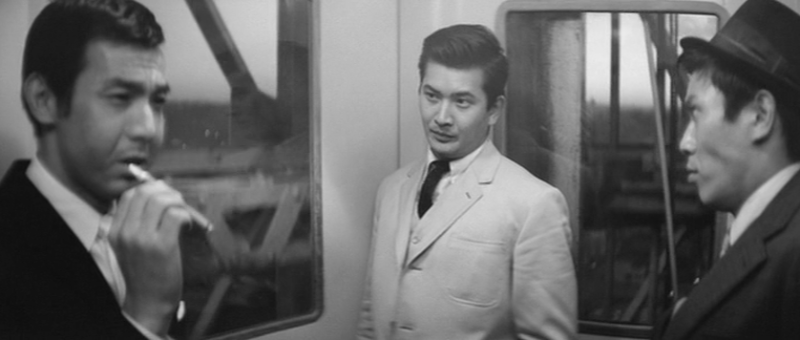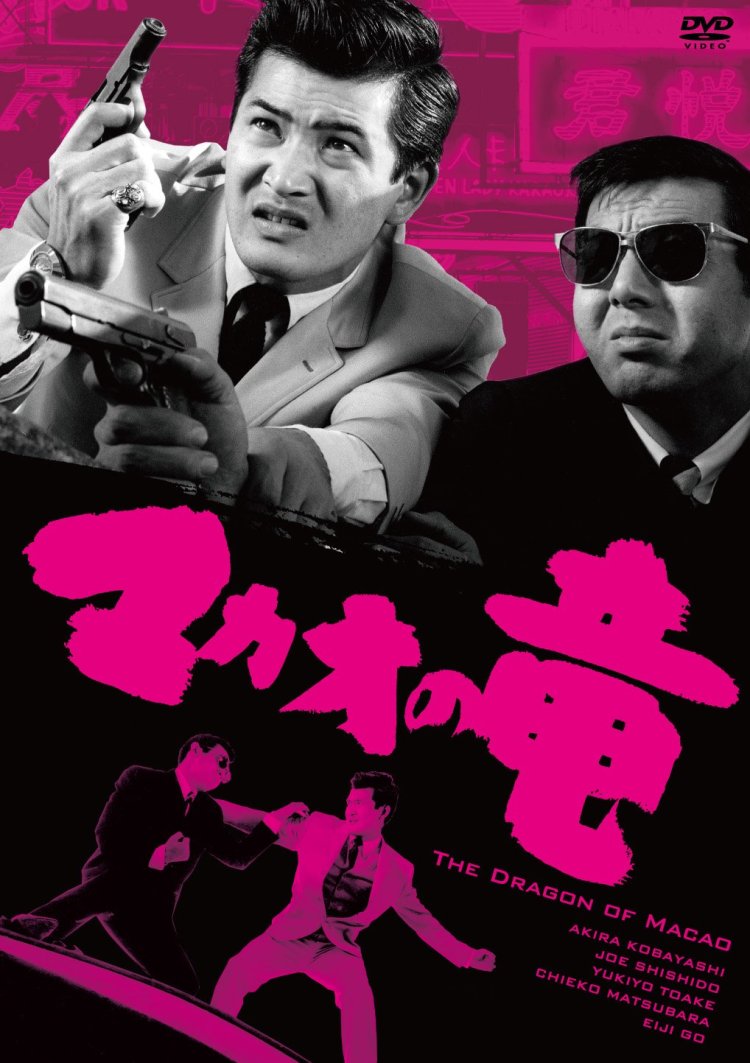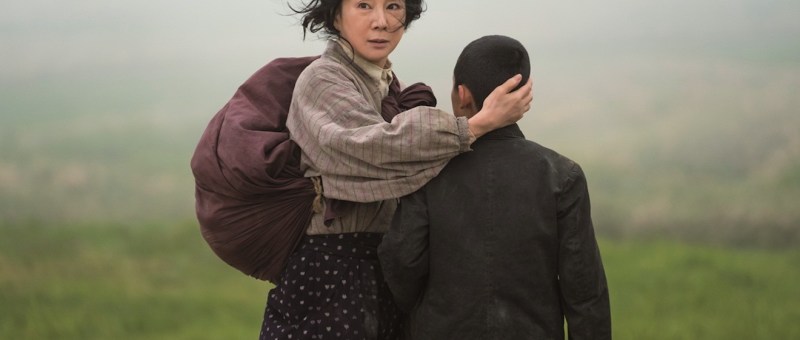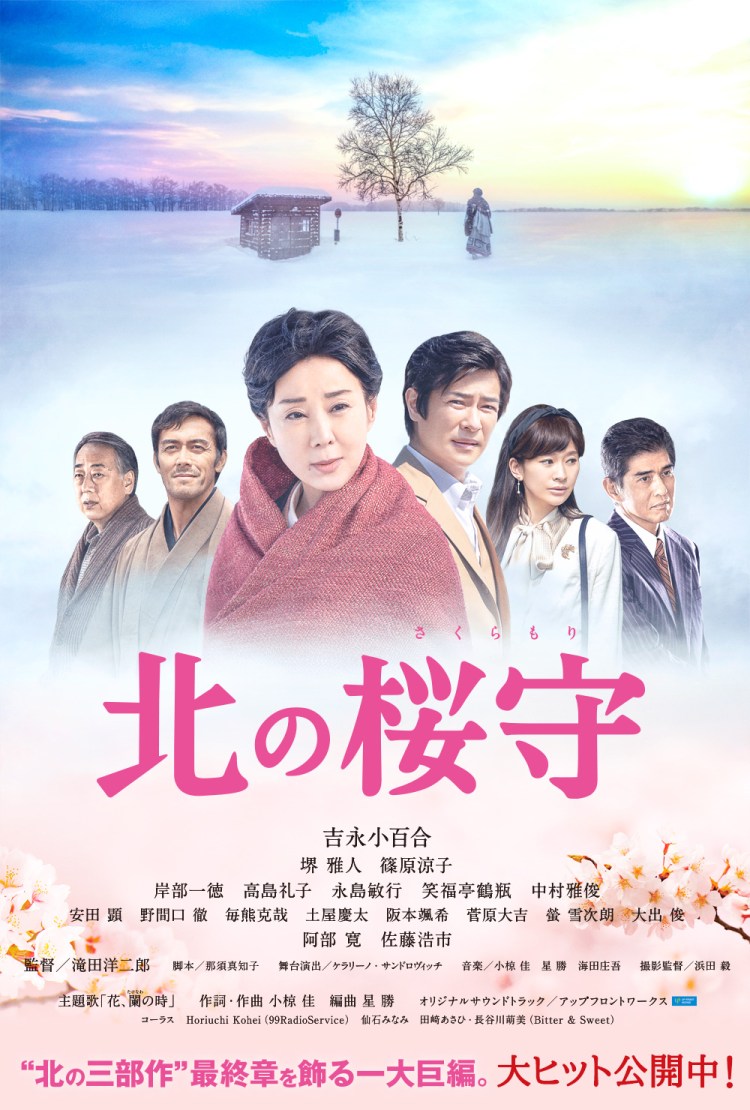
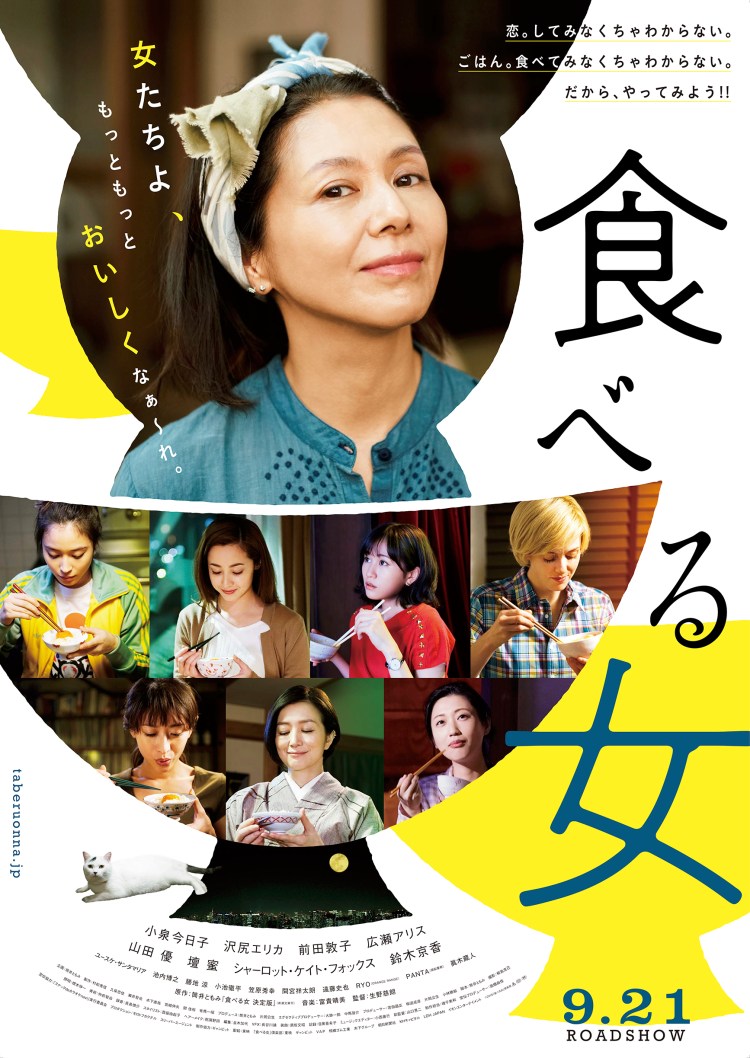
It’s Boring Here, Pick Me Up (ここは退屈迎えに来て, Ryuichi Hiroki, 2018)

SR2_teaserWhere now the dreams of youth? Japanese cinema seems to have been asking that very question since its inception but the answer remains as elusive as ever. The heroine(s) of Ryuichi Hiroki’s adaptation of a series of short stories by Mariko Yamauchi, It’s Boring Here, Pick Me Up (ここは退屈迎えに来て, Koko wa Taikutsu Mukae ni Kite), idolise Audrey Hepburn and long for urban sophistication only to find themselves hung up on unfulfilled high school promise and unable escape the wholesome romanticisation of their small-town youth to embrace the demands and possibilities of adulthood.

Hiroki follows his small-town high schoolers from 2004 to 2013, jumping freely between time periods as memories spark one another in emotional rather than chronological order. We begin with the unnamed protagonist, “I” (Ai Hashimoto), who has returned to her hometown after 10 (seemingly disappointing) years in Tokyo and now works as a freelance journalist for the provincial paper writing local culture articles on ramen shops and patisseries. She has contacted only one friend since her return, Satsuki (Yurina Yanagi), who has suggested, rather tongue in cheek, that they reconnect with former high school crush Shiina (Ryo Narita).

Back in high school, Shiina was like some kind of untouchable god. Everyone just wanted to be around him as if he alone made the sun shine. All the girls were in love with him, and the all boys wanted his approval. Asked about his hopes and dreams, Shiina just wants high school to go on forever, perhaps realising that he’ll never have it so good again. “I” meanwhile, claims that she wants to “become someone”. A small town girl who didn’t fit in, she hoped to find herself amid the hustle and bustle of the big the city but has returned with an even deeper sense of alienation than when she left with only the bright memory of her brief time as a chosen member of Shiina’s after school posse to cling to.

Satsuki, meanwhile, stayed behind but seems equally hung up on unfinished high school business. Having never been to Tokyo she is envious of her friend’s experiences and longs for the anonymity of the city. If you mess up in Tokyo, she claims, people will eventually forget whereas if you make a mistake in the country it’s all anyone will talk about for the rest of your life. That certainly seems to be true for another of the girls’ contemporaries (Rio Uchida) who left to become an idol only for it all to go wrong and come home branded as a loose woman. Cynical and calculating, she decides on an arranged marriage only to find herself shackled to an old man she doesn’t like very much while her shy friend (Yukino Kishii) seems to have found love by stealth and apparently won the jackpot without even knowing it.

Continuously travelling, the now almost-middle-aged high schoolers meander without direction as if circling around the locus of their departing youth and the sense of possibility disappearing with it. Running into another classmate, Shinpo (Daichi Watanabe), also connected with Shiina, I and Satsuki get a few more clues about their high school crush who apparently now lives a fairly ordinary life as a driving instructor thanks to Shinpo’s recommendation without which he was set to hit rock bottom after some kind of breakdown while failing to make it in Osaka. Nicknamed “Chinpo” (which means “willy”) in school, Shinpo’s dream for the future was to exist alongside someone that he loved but he seems to have given up even on this depressingly compromised desire and resigned himself to loneliness and lovelorn misery as someone who will never be able to find his place in a conservative and conformist society.

I meanwhile, like a similarly unnamed counterpart (Mugi Kadowaki) who really did date Shiina until he cruelly cast her aside, is finally able to burst her high school bubble by confronting it directly and seeing the reality rather than her romanticised impression of it. Those shining days of fun and friendship with everything still ahead will never come again, and so the memory of them remains bittersweet at best. Adult life is dull and disappointing, but there is perhaps melancholy happiness to be found in learning to embrace the present moment rather than harping on a largely imagined past or idealised future. 


It’s Boring Here, Pick Me Up was screened as part of the 2019 Nippon Connection Film Festival.

International trailer (English subtitles)

The Chrysanthemum and the Guillotine (菊とギロチン 女相撲とアナキスト, Takahisa Zeze, 2018)

Chrysanthemum and the Guillotine poster 1“I see it now, we can’t change anything” a despondent would-be-revolutionary decries in a moment of despair. Almost 100 years later, you might have to concede they have a point when the world finds itself on a tipping point once again and the same old prejudices refuse to disappear. Takahisa Zeze’s The Chrysanthemum and the Guillotine (菊とギロチン 女相撲とアナキスト, Kiku to Guillotine Onna Zumo to Anarchism) casts an unflinching eye back towards the Japan of 1923 caught in the aftermath of a devastating natural disaster which followed on from a chaotic era of rapid social change and bewildering modernisation during which a series of battles were being fought for the future direction of a nation still trying to define itself in world dominated by empires.

When the Great Kanto Earthquake struck claiming mass loss of life and extreme damage to infrastructure, the ensuing chaos gave rise to a vicious rumour that Koreans were taking advantage of the situation to foment the independence movement by poisoning wells and committing arson leading to a pogrom against anyone who failed to prove themselves Japanese enough to satisfy the mob. Meanwhile, the same forces also turned on political opponents whose influence they perceived as destructive to their own aims culminating in the murder of prominent anarchist Sanae Osugi along with his feminist wife Noe Ito and their six-year-old nephew.

We begin, however, with a different band of outsiders in the Tamaiwa itinerant female sumo wrestler troupe many of whom have taken refuge in an isolated world of female solidarity in order to escape abusive relationships. Kiku (Mai Kiryu) is one such woman who found the courage to run away from a violent husband on catching sight of the powerful female wrestlers who made her realise that she too could become strong like them. Having accepted that “weak people can’t change anything”, Kiku has vowed to become “strong” in order to claim her own agency and ensure that she can’t be pushed around ever again.

Meanwhile, an anarchist sect known as the Guillotines are fomenting a more general kind of revolution but have not been very successful and are now on the run from the authorities which is how they end up running into the female wrestlers and more or less bringing them into the struggle. Led by libertine and (as yet) unpublished poet Tetsu Nakahama (Masahiro Higashide), the Guillotines are more romantic bandits with high ideals than serious revolutionaries. They rob the rich to fund their “activism” but spend most of the money on sex and drink while plotting revenge for the murder of Osugi with various schemes which imply that at heart they aren’t so different from that which they hate.

Nevertheless, the forces of darkness are rising and history tells us that, temporally at least, they will win. The vigilante militias which carried out the massacres were largely made-up of farmer soldiers who’d served in Russia and experienced terrible hardship. Unable to bear the idea that their traumatic wartime experiences had been a senseless waste, they doubled down on militarist ideology and insisted on their nationalistic superiority. This led them to hate, to regard anything that lay outside of their code as inferior and dangerous. Though the massacres were condemned by the government and the perpetrators prosecuted for their crimes, the convictions were largely quashed a short time later which is why we see our major villains rewarded by the state and our revolutionary “heroes” imprisoned for their resistance towards state oppression and desire to create a fairer, more equal society.

Ironically enough, Nakahama’s big utopian idea is an overly idealistic vision for a future Manchuria which in hindsight proves extremely uncomfortable but is perhaps an indication of the naivety of the times. Even so, the Guillotines for all their romanticism are essentially progressive in their thinking and in full support of sexual equality, insisting on the necessity of the wrestlers to embrace their physical capabilities in order to defend themselves against an oppressive and patriarchal society fuelled by male violence. Though this in itself might be mildly problematic in implying that in order to become “equal” women must learn to be more like men, it also plays into the film’s subtle sense of irony in which the tools of militarism are being subverted in order to oppose it. The “intellectual” Guillotines find their revolutions failing, while fighting fire with fire may be the only surefire way to win even if it legitimises the problematic act of violence in the process. Then again, as another of the Guillotines puts it, the truly strong are those who have no need of killing. 

In any case, the Tamaiwa stable becomes a tiny enclave of progressive values built on female solidarity though they ultimately discover that solidarity is not quite enough and they cannot protect each other from the ravages of the times without external assistance. Even so, they attempt to hold the line, literally pushing back against the fascist incursion while insisting on their right to resist as human beings with will and agency. The prognosis seems bleak. 100 years later the same battles are still being fought and the same tensions rising in the wake of new disasters yet there are also those who will continue to resist and like the Tamaiwa wrestlers refuse to give in to those who threaten to restrict their freedom.


The Chrysanthemum and the Guillotine was screened as part of the 2019 Nippon Connection Film Festival.

Original trailer (no subtitles)

Marriage Hunting Beauty (美人が婚活してみたら, Akiko Ohku, 2018)

out_bijyo_poster_B2Is life really easier for “beautiful” people or do they simply experience a different series of problems? Some might say beauty is a nice problem to have, but however much people may scoff there is perhaps a price to be paid for physical attractiveness as the heroine of Akiko Ohku’s Marriage Hunting Beauty (美人が婚活してみたら, Bijin ga Konkatsu Shite Mitara) is at pains to point out though few are willing to sympathise. What she discovers, however, is that her beauty has perhaps been her blindspot in that it has made her self-centred and entitled while preventing her from realising what is it that has really been bothering her.

At 32, Takako (Mei Kurokawa) remains romantically naive and has wound up in a series of dead end relationships with terrible men who happened to be married (though she didn’t find out until it was too late). Her best friend, married housewife Keiko (Asami Usuda), tells her that her problem is that she’s too beautiful – single guys are too intimidated to make the first move while the married ones are emboldened by their desire to play with fire and the knowledge that the relationship is essentially meaningless because they already have “commitment” elsewhere. Hitting rock bottom, Takako suddenly has an epiphany that she wants to get married if only to prove that she is worthy of becoming someone’s wife rather just their mistress.

Takako is, it has to be said, perfectly aware that she is an attractive woman and sees little point in deflecting praise that comes her way because her of appearance – something that begins to grate on Keiko as Takako fails to submit herself to the level of socially accepted modesty which would require her to protest when called “beautiful”. Keiko’s categorising her as a sad princess is perhaps accurate in that she certainly likes to paint herself as hard done by while refusing to engage with the aspects of her life which cause her to feel miserable and empty. Entering the world of “konkatsu” – accelerated dating with a view to marriage, is then a humbling experience in which she must simultaneously raise and lower her expectations in order to work towards an “ordinary”, conventional kind of settled domesticity.

Of course, “beautiful” people aren’t supposed to need such services, and so Takako’s first few matches on a dedicated marriage orientated website are predictably depressing – a parade of strange older gentlemen hoping to bag a beauty and usually selling their social capital (houses, steady jobs etc) to do so. The one guy she does kind of hit it off with, Sonogi (Tomoya Nakamura), is a shy salaryman who seems nice but lacks confidence and remains creepily in awe of her beauty. Meanwhile, a singles mixer at an “elite” bar introduces her to cynical dentist Yatabe (Kei Tanaka) who seems to have confidence in abundance but very little kindness.

Takako is back to the familiar problem of trying to choose between two men, one nice but servile and the other selfish and indifferent but admittedly exciting. Yatabe is a walking collection of red flags, which is to say that he’s just Takako’s type, but fortunately she’s beginning to figure out that what she likes is not always what’s good for her. Then again, she’s also trying to move past her conception of herself as a “beautiful” woman so Sonogi’s constant deference and gratitude for being allowed in the presence of someone so out of his league is exactly the opposite of what she’s looking for even if she’s beginning to warm to his nice guy charms.

Meanwhile, she remains uncomfortable with her own sense of desire and struggles to reconcile it with society’s preconceived notions of what “beautiful people” should be. Despite their otherwise close friendship, Takako is unable to talk honestly even with Keiko and largely fails to take much of an interest in her friend’s life. Keiko, meanwhile, seems to be trapped in an unfulfilling marriage and secretly may not want Takako to change because she is vicariously enjoying her messy bachelorette lifestyle. Nevertheless, it’s friendship which eventually wins out as the two women agree to meet on more equal terms, sharing their essential selves honestly and without fear as they commit to supporting each other with mutual understanding.

“There are no shortcuts to love”, Takako finally acknowledges as she realises what wanted all along wasn’t superficial acceptance but recognition. What looked like haughtiness was really low self esteem. A quirky tale of a middle-aged woman finding the courage to step into herself, Marriage Hunting Beauty might be telling a familiar story but does so with genuine sympathy for its beautiful heroine as she finally finds the strength to reject the social straightjacket and reclaim her sense of self as a person worthy of respect rather than reverence or ridicule.


Marriage Hunting Beauty was screened as the opening night gala of the 2019 Nippon Connection Film Festival.

Original trailer (no subtitles)
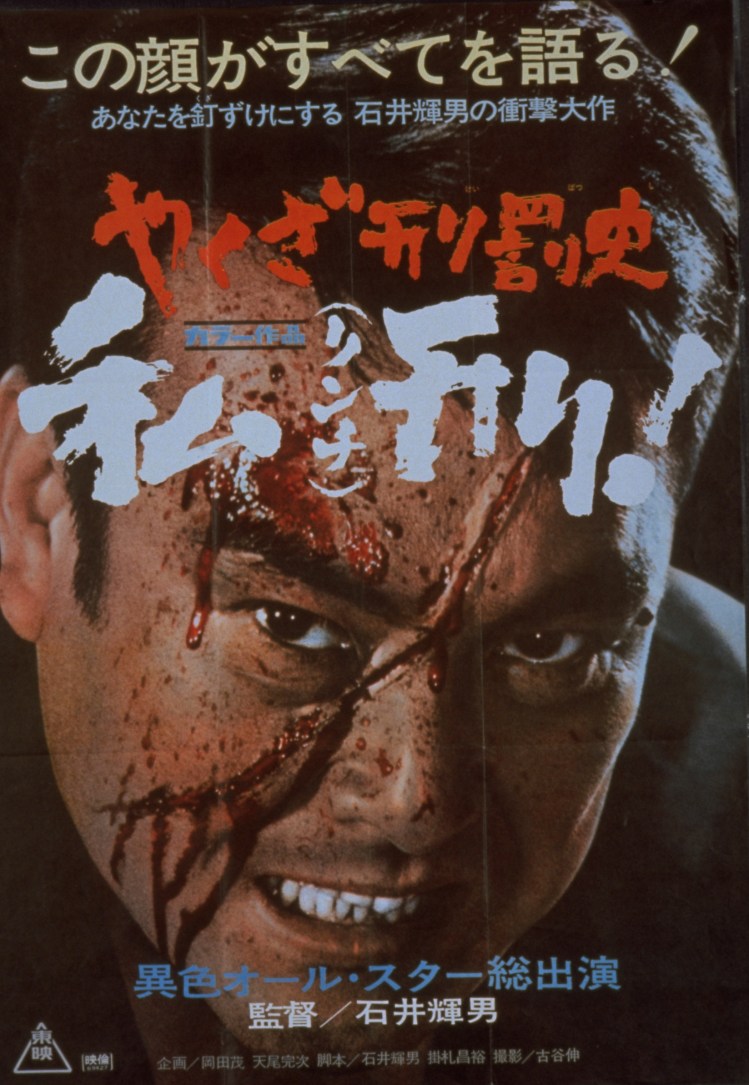
The Legend of the Stardust Brothers (星くず兄弟の伝説, Macoto Tezka, 1985)

Stardust Brothers poster 2More or less out of fashion today, concept albums were all the rage back in the ‘70s and ‘80s but few of them ever made it to the big screen. Macoto Tezka’s The Legend of the Stardust Brothers (星くず兄弟の伝説, Hoshikuzu Kyodai no Densetsu), apparently drawing inspiration from The Who’s Tommy, is a rare exception though you’d be forgiven for never having heard of it seeing as it’s been mostly forgotten since receiving a decidedly frosty reception from critics on its 1985 release. Tezka would revisit the Stardust Brothers in 2016 with a Brand New Legend, but this now fully restored “director’s cut” distributed by Third Window Films who are also co-producing Tezka’s latest work – an adaptation of a manga by his legendary father Osamu Tezuka starring Fumi Nikaido, is the first opportunity many will have to reappraise the film in 34 years.

Inspired by an “imaginary soundtrack” composed by Haruo Chicada, The Legend of the Stardust Brothers concerns itself with aspiring musicians Shingo (Shingo Kubota) and Kan (Kazuhiro Takagi) who seem to have a healthy rivalry in the intense 1980s Japanese underground club scene. Their luck changes one day when they are each handed a card for a shady-looking management company, Atomic Promotion, where the manager, Minami (played by voice of the ’70s crooner Kiyohiko Ozaki), promises to make them stars beyond their wildest dreams but only on one condition – they have to form a band of two, or it’s no dice.

On their first arrival at Atomic Promotion, the boys are introduced to a young woman, Marimo (Kyoko Togawa) – an aspiring singer who has been repeatedly kicked out of Minami’s office because he doesn’t hire girls (seemingly a satirical reference to an all powerful agency controlling most of Japan’s A-list male idols). Kan comes to her rescue and, in a throwaway comment, casts himself as Urashima Taro rescuing the “turtle” from, in this case, belligerent security guards. It is tempting, in an impish sense, to read the rest of the ongoing tale as an extended retelling of the Urashima Taro myth as the boys find themselves catching a ride to another kingdom filled with untold wealth and unimaginable pleasure only to tire of their newfound luxury and discover that while they were trapped within a tiny champagne bubble of success other stars were also rising.

It is indeed the “plateau” of success which highlights the differences between the two guys and threatens to send each of them on different paths as they contemplate the demands of showbiz life. Shingo, an insecure rocker, begins to resent the presence of the ultra modern Kan whose punkish energy and zeitgeisty features have captured the hearts of the youth. Numbing the emptiness with drink and drugs, he dreams himself swallowed whole by his sworn brother before being chased by creepy zombies emerging from their human suits to suck whatever of his soul remains right out of him.

Bored by their fame, the boys resent the implication that their “stardom” comes only at the price of their artistic integrity. They long to break free of the corporate straightjacket which attempts to strip them of their individuality in order to replace it with a manufactured, marketable persona in another jab at the increasingly commodified idol world of the burgeoning bubble era. Meanwhile, the corporate machine moves on, mass media is exposed as yet another medium of propaganda with a (perhaps conflicted) Minami propositioned by a politician with a son keen to get into the business. Fearing the Stardust Brothers are too “vulgar”, the powers that be want a new face to sell the message of love and peace to the young, which sounds much more positive than it really is. The boys’ rival, Kaworu (visual kei pioneer Issay), is very much a figure of the age – an androgynous, Bowie-like counter culture personality who is in essence the face of entrenched privilege insidiously camouflaged to infiltrate alternative youth subculture. 

Yet the political message is not perhaps the point so much as anarchic, absurdist fun. Perfectly in tune with lo-fi late punk / early New Wave sensibilities, Tezka’s script freewheels from one surreal set piece to another following the flow of Chicada’s expertly composed score which encapsulates the variety of the age while remaining absolutely of its time. Filled with youthful energy and true punk spirit, The Legend of the Stardust Brothers is the strange tale of the dust that stars are made on and its unexpected ability to find its way home even if it takes a little longer than expected.


The Legend of the Stardust Brothers is released on blu-ray later in the year courtesy of Third Window Films. It will also be screened as part of the 2019 Nippon Connection Film Festival on 1st June, 22.30.

Trailer (English subtitles)

Bonus:

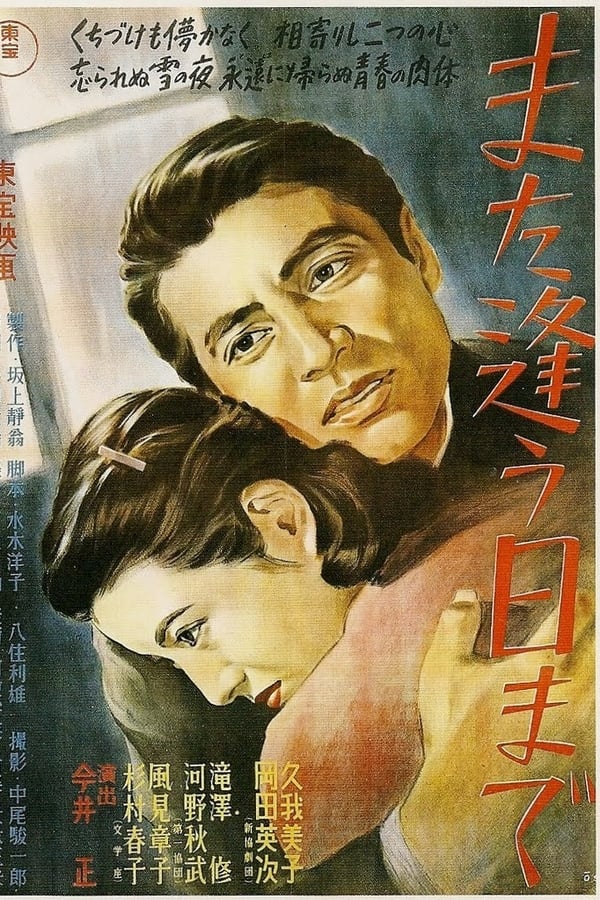
Kiyohiko Ozaki’s 1971 hit Mata Au Hi Made

And its fantastic use in Isshin Inudo’s La Maison de Himiko

JK Rock (JK☆ROCK, Shunji Muguruma, 2019)

JK Rock poster 1The heyday of the idol movie may have passed with the Showa era, but the genre proves itself alive and kicking with the infinitely charming JK Rock (JK☆ROCK). Starring the members of Drop Doll – a band formed by the three actresses from director Shunji Muguruma’s previous short Little Performer: The Pulse of Winds, JK Rock is a spunky coming of age tale in which three lost high school girls end up starting band at the behest of a strange old man (Masahiko Nishimura) who owns a rock and roll bar in bohemian Kichijoji and secretly wants to coax reluctant rocker Joe (Shodai Fukuyama) back to the stage.

Joe was once in a promising band, JoKers – a combination of his own name and that of his best friend and bandmate whose initials are also JK. A year earlier, however, he appears to have got cold feet and left music behind him for good in order to concentrate on a law degree. He still has his adoring fans though, these days he’s known as the “purple prince” because he drives round campus in an ostentatious purple Lamborghini. A fateful meet cute brings him into contact with feisty high school girl Sakura (Chihiro Hayama) when she decides to take a middle-aged man to task for queue jumping in a convenience store only for Joe to calmly point out that she’s now the one holding everyone up. Somewhat grateful for Joe’s life lesson, Sakura is non-plussed when he calls her a weirdo as he leaves. It’s no surprise to discover that Sakura is a regular at Teru’s Rock ’n Roll Cafe where Joe used to play and so fate is set in motion.

The film’s name, “JK Rock” is a witty multilayered pun in that it refers both to the multiple “JKs” and to the more obvious “Joshi Kosei” which means “high school girls”. Sakura is joined by two more frequenters of Teru’s – waitress and track star Mao (Yuina) who takes up the guitar, and fabulously wealthy Rina (Yukino Miyake) who practices bass in secret so her ultra ambitious mother won’t stop her doing what she loves. In true idol movie fashion, everyone seems to be fairly well off in an aspirational sense but each has their own problems which run from an inappropriate crush on a supportive teacher to overbearing parents keen to stamp their own view of success on their kids in order to stop them making their own mistakes.

Meanwhile, Joe is battling the usual early life crises as he weighs up following his dreams against the safety of conventionality. “You can’t fire up my rock spirit and then run away!” Sakura angrily tells him in a line that seems oddly filled with subtext, but running away does seem to be Joe’s problem. He didn’t go with his friend to America, and the other Joe is now big international star. Snapped at by the band’s manager that he had no guts and no love for rock, Joe decided he was unworthy for the stage and had no right to play, forcing himself into a dull but conventionally successful life as a lawyer. Consequently, he is a grumpy, empty shell of a man driving round in a stupidly big and colourful car with a superficial girlfriend who assumes she’ll soon be getting married to an independently wealthy professional grade husband. Through jamming with Sakura he begins to rediscover some of his rock spirit and get his mojo back to realise he’s free to play with whoever he wants on his own terms.

A musical coming of age tale, JK Rock does its best to showcase the musical talents of Drop Doll which appear to be vast. JoKers plays only a minor role in brief flashbacks of what might have been (and perhaps could be again) for the dejected Joe while the girlband studies intently under his, originally reluctant, tutorship to become fine musicians in their own right. Of course, when it comes down it, it’s not just music but youthful solidarity and the true power of friendship which eventually show the way as old wounds are repaired and new bonds formed between the variously troubled youngsters who eventually realise that they’re figuring things out and will probably be OK. A charming, sprightly youth movie filled with true punk spirit and genuine warmth, JK Rock is an improbable delight and sure to make stars of its three leading ladies.


JK Rock was screened as part of the 2019 Udine Far East Film Festival.

Original trailer (no subtitles)

Short version of the music video for the movie’s theme song – Secret Voice

Hard-Core (ハード・コア, Nobuhiro Yamashita, 2018)

Hard-Core retro poster“The world will always be corrupt”, the cynical brother of the angry young man at the centre of Nobuhiro Yamashita’s Hard-Core (ハード・コア) advises him, “you just have to work around it”. Unfortunately, Ukon (Takayuki Yamada) just wants to do “the right thing”, but it is constantly unsure of the best way to do it while remaining resentful and conflicted in his conviction that the world has already rejected him. Yamashita has made a career out of chronicling the struggles of disenfranchised young men but Ukon and his pals are less genial slackers than potentially dangerous idealists looking for a way back to a simpler time in which the world was not quite so rotten.

An opening bar scene in which Ukon gets slowly drunk and then lays into a rowdy bunch of guys bothering a middle-aged woman (Takako Matsu) just trying to enjoy a drink showcases his propensity to abruptly lose his temper and fall into a self destructive cycle while also subtly pointing out his entitlement issues in his taking the guy to task by praising himself for leaving the lady alone while he presumably had exactly the same desire not to. In any case, after getting banned from the bar, he ends up joining an ultranationalist political cell, the Crimson Hearts, which aims to teach the youth of Japan to re-embrace its traditional culture. In order to facilitate his goals, the elderly and eccentric leader, Kaneshiro (Kubikukuri Takuzo), has enlisted Ukon, along with a friend, Ushiyama (Yoshiyoshi Arakawa) who is almost entirely mute, to dig out a mysterious cavern where he is convinced there is buried Edo-era treasure.

It’s easy to see why Ukon might fall for the rather insane ramblings of Kaneshiro. They reinforce his sense of moral decline while giving him a banner to follow and a place to belong. His loyalty to Kaneshiro is as absolute as a retainer’s to his lord, though he is perhaps conflicted in his commitment to the core ideology even as he sees obvious merit in wanting to reclaim something of the old Japan. Meanwhile, his relationship with his family appears strained. His younger brother Sakon (Takeru Satoh) has become a cynical salaryman out for nothing other than greed and self interest, staring into his own empty eyes in the reflection of the full glass panelling of his high rise office as he has meaningless sex with anonymous office ladies. Ukon just wants to do the right thing, but Sakon wants to make the smart choice and doesn’t particularly care about the wider implications of his choices.

Meanwhile, Ukon is fiercely loyal to his friends and fellow outsiders in solidarity with all those who feel the world will never be willing to accept them. Ushiyama, a man laid low by familial expectation and societal pressure, lives in an abandoned factory where he has made “friends” with a broken robot that Ukon manages to repair and names “Robo-o”. Believing that Robo-o is just like them in that he would be ostracised if people discovered his true nature, Ukon and Ushiyama set about disguising him and even get him in on their gold hunting gig (where he gets paid!) at which he proves adept considering his considerable technical superiority. Ukon’s first instinct is to protect his friend, while Sakon’s is how best to exploit him.

Nevertheless, events at the Crimson Hearts begin to escalate as unpleasant underling Mizunuma (Suon Kan) considers taking the battle to the next stage to “overthrow the corrupt totalitarianism masquerading as democracy” through actions others will regard as terrorist. Meanwhile, Ukon has also begun to fall for Mizunuma’s damaged daughter Taeko (Kei Ishibashi) whom he met by chance after being inappropriately charged with spying on Mizunuma’s new girlfriend to make sure she wasn’t sleeping around (as women do, according to Mizunuma). Ukon, as the first scene implied, is not in favour of all this obvious misogyny but can only find the strength for passive resistance. What he chooses, in the end, is his friends and his precious group of outsiders, albeit with his hopes pinned on his cynical brother and the illusionary lustre of historical treasure. The power of friendship eventually enables even Robo-o to break his programming, though it’s Sakon’s cynicism that, in one sense at least, seems to triumph. Yamashita takes his troubled young heroes on a rocky, noirish path through the “rotten” world which they are increasingly convinced holds no place for them but finally finds hope in human compassion even if that compassion may be the long buried treasure of an archaic civilisation.


Hard-Core was screened as part of the 2019 Udine Far East Film Festival. It will also be screened at the 2019 Nippon Connection Film Festival on 31st May at 22.30pm and 1st June, 22.45pm.

Original trailer (English subtitles)

Lying to Mom (鈴木家の嘘, Katsumi Nojiri, 2018)

Lying to Mom posterLearning to live with loss is difficult for any family, but when the loss was caused by suicide the pain is even more acute as those left behind try to understand why it is their loved one had to die and if there was anything else they could have done to prevent it. The family at the centre of Lying to Mom (鈴木家の嘘, Suzukike no Uso) choose, initially at least, to avoid dealing with it at all. Each taking their individual paths through grief, they keep the past painfully alive by pretending that oldest son Koichi (Ryo Kase) is only temporarily absent and will eventually return.

Koichi, who has been a hikikomori for many years, takes one last look at the peaceful suburban scene outside his window and hangs himself from a storage closet in his room. His mother Yuko (Hideko Hara), out at the time, only discovers the body when trying to get him to come down to lunch. Panicked, she injures herself and ends up in a coma in hospital while nothing could be done for Koichi. When she wakes up some time later, she’s lost all her memories of the incident and the family don’t have the heart to tell her that her son is gone so they pretend he went to work for his uncle in Argentina.

This is of course very comforting to Yuko who now believes that as a result of her illness Koichi has finally been able to leave his room for a more productive life, but it places a strain on the other family members – father Yukio (Ittoku Kishibe) and daughter Fumi (Mai Kiryu), who remain conflicted about keeping up the pretence while dealing with their own grief in secret. Fumi, whose idea it was to lie in the first place, types out beautiful letters supposedly from Koichi to be handwritten in his handwriting by an associate in Argentina which detail his new life full of freedom and promise overseas.

Meanwhile, Yukio ponders on his relationship with his son with whom he admits he never quite bonded. He sets about trying to find a mysterious woman named on Koichi’s life insurance policy less for practical reasons than to ascertain some sort of evidence that his son lived, even if he lived the last years of his life alone in a room. The reasons for Koichi’s isolation are never exactly explained with Yuko blaming high school bullying and the stagnant economy, but it is clear that he never managed to find himself in Japan and perhaps if he really had gone to Argentina things might have been different.

Wracked with guilt, Fumi finds herself trying out a support group for relatives of those who died by suicide but struggles to put her own thoughts in order. Though people try their best, insensitivity reigns when they try to offer words of condolence. Only love can save people, Fumi’s colleague smugly tells her with a random story about coaxing a shy high school student out their room, little realising he’s tacitly accusing her of not trying hard enough to save her brother. People can’t be saved, Fumi retorts, and she might well have a point. Even the leader of the support group shows himself up when he considers banning a grief-stricken woman with a loud personality because her problems are “smaller” seeing as she’s wealthy. As another attendee tells him, people grieve in different ways and having money or not is unlikely to affect the degree of your emotional pain even if it might in some sense reduce the burden. Besides, his assumptions about her are mostly wrong because he’s not been paying attention to the things that really matter only to his own surface level prejudices.

Despite the prevalence of suicide, the Suzukis still find themselves embarrassed by Koichi’s passing. They tell people it was an illness or avoid mentioning it all. Meanwhile they keep the secret from Yuko and avoid talking about it amongst themselves until finally forced to deal with all of their anger, guilt, pain and confusion. A comforting lie may serve its purpose, but only an emotional reckoning can clear the air. There may be no real answer to why Koichi did what he did, but the Suzukis will have to make their peace with it, finding fresh hope in the process as they begin to repair their emotional wounds together as a family.


Lying to Mom was screened as part of the 2019 Udine Far East Film Festival. It will also be screened at the 2019 Nippon Connection Film Festival on 30th May at 7.30pm.

International trailer (English subtitles)

Melancholic (メランコリック, Seiji Tanaka, 2018)

Melancholic posterJust because you’re smart and graduated from a top university, does that necessarily mean you have to put on the salaryman straitjacket in order to become “a success”? The dejected hero of Seiji Tanaka’s Melancholic (メランコリック) isn’t quite so sure, but then he’s always been the type to amble through life going wherever the wind blows him. The time is about to come, however, when decisions must be made and priorities decided lest someone else decide them for you.

Kazuhiko (Yoji Minagawa) graduated from Tokyo University but he’s never been in full time employment and has no definite career plans. Still living at home with his parents, he floats between part-time jobs with little sense of forward motion while his mum and dad are content to let him find his way, if a little exasperated. On a rare visit to a public bathhouse he ends up running into an old high school classmate, Yuri (Mebuki Yoshida), who half-jokingly advises he apply for the open job at the baths seeing as it’s bound to be less stressful than your average salaryman gig. Smitten but too awkward to do much about it, Kazuhiko applies for the job and consents to go to a school reunion as a means of seeing Yuri again. Much to his surprise, however, the bathhouse has a second life as a yakuza kill room with on site body disposal facilities.

Asking questions about what goes on at the bathhouse after dark, Kazuhiko’s boss Azuma (Makoto Hada) tells him that it’s dangerous to know things you aren’t supposed to know, but Kazuhiko is not good with hints and his natural curiosity won’t it let it rest. After he finds out about the secret yakuza backroom deal, Kazuhiko has a “difficult” choice to make – elect to help out with the “night shift”, or die. Kazuhiko chooses to help out (he likes being helpful) and discovers that he actually doesn’t mind it all that much, especially considering the “bonus” package Azuma gave him for being a good boy.

The extra money made Kazuhiko feel as if he could grasp that swanky salaryman life without having to submit himself to the rat race. He uses the money to take Yuri to a fancy French restaurant where he’s flummoxed by the wine list and she’s uncomfortable, but still it goes well even if they both resolve to go somewhere more casual next time. Kazuhiko’s inferiority complex is only enflamed by the lingering presence of Tamura (Yuta Okubo), another old classmate made good, who is also interested in Yuri and is everything Kazuhiko feels himself not to be – handsome, successful, filthy rich, cultured, and confident.

Being allowed in on the after hours business made Kazuhiko feel as if he’d been promoted, that Azuma obviously trusted him and that there might be more overtime coming if he played his cards right. His confidence receives a further knock, however, when he realises that a punkish colleague who joined at the same time as him, Matsumoto (Yoshitomo Isozaki), is technically in a more senior position despite being a barely literate drop out with bleach blond hair. In way over his head, Kazuhiko still desperately wants to regain some of that status and approval he felt was his when the cleanup business was their little secret.

An awkward, naive, but sincere man, Kazuhiko marvels on realising how many yakuza seem to be “around” before Azuma and Matsumoto remind him that not everyone involved with crime is a bona fide yakuza. The bathhouse outfit is, more or less, run by freelancers but still at the mercy of mob boss Tanaka (Masanobu Yada) who has an iron hold over Azuma because of outstanding debts. Azuma would like to put a stop to the night shift, but can’t – or so he claims. As is later pointed out, for those getting on in years an unsatisfying status quo is often preferable to a turbulent new. Though Kazuhiko has no real objection to working the night shift as far as the clean up goes, he is not completely comfortable with its wider implications, often asking why it was someone had to die only for Matsumoto and Azuma to shrug and say it doesn’t matter. They had orders and carried them out, anything else is an irrelevance they don’t need to worry about.

Kazuhiko, however, does worry if in a fairly minor way until his gradual descent into the world of crime drags him into a vicious quagmire in which he must accept the seriousness of his situation along with its potential costs. Despite the original animosity and natural sense of distrust, what wins out is a sense of fellow feeling between unlikely allies Matsumoto and Kazuhiko who begin to see a way out of their mutual malaise through seizing their own futures and daring to pin their hopes on things they assumed unattainable, like love and friendship. Rather than chasing the salaryman dream, or climbing to the top of the yakuza tree, they pick an ordinary kind of “good enough” success in which moments of warmth and togetherness become the only things which give life meaning. A surreal ode to just muddling through and learning to be happy in the moment, Melancholic more than lives up to its name but despite all the darkness eventually finds real joy in the easy pleasures of mediocrity and mutual acceptance.


Melancholic was screened as part of the 2019 Udine Far East Film Festival. It will also be screened at the 2019 Nippon Connection Film Festival where director Seiji Tanaka and actor Yoshitomo Isozaki will be present for a Q&A.

Original trailer (English subtitles)

Nippon Connection Confirms Full Lineup for 2019!

marriage hunting beauty still 1Nippon Connection, the largest showcase for Japanese cinema anywhere in the world, returns with another fantastic selection of new and classic films screening in Frankfurt from 28th May to 2nd June. Opening with the latest quirky rom-com from Tremble All You Want’s Akiko Ohku Marriage Hunting Beauty, the festival will also welcome Guest of Honour Shinya Tsukamoto with a screening of his latest film Killing plus classics Tetsuo: The Iron Man and Tokyo Fist. Meanwhile, this year’s classics strand is dedicated to Golden Era actress Ayako Wakao. The programme in full:

Nippon Cinema

Fly Me to the Saitama still 1

  • And Your Bird Can Sing – Adapted from the novel by Yasushi Sato, And Your Bird Can Sing follows a trio of lost youngsters as they drift into an almost certainly destructive ménage à trois.
  • Another World – a middle-aged man keeps his family at a distance but the reappearance of a childhood friend begins to shake his world in the latest from Junji Sakamoto.
  • Asako I & II – A young woman finds herself torn between old love and new in Ryusuke Hamaguchi’s whimsical drama. Review.
  • The Chrysanthemum and the Guillotine – Taisho era tale of sumo and revolution in which a band of anarchists find themselves fascinated by an itinerant troupe of female sumo wrestlers shortly after the Great Kanto Earthquake of 1923 in the latest from Takahisa Zeze.
  • Dare to Stop Us – Kazuya Shiraishi’s nostalgic look back at the heyday of Wakamatsu Production through the eyes a young female AD. Review.
  • Dawn Wind in my Poncho – a trio of college kids takes a last roadtrip before graduation.
  • Fly Me to the Saitama – zany comedy from Hideki Takeuchi in which the residents of Saitama have become an oppressed minority. Review.
  • Hard-Core – a purehearted guy with a violent streak laments the cruelty of the modern world but finds friendship with a lonely homeless man and a robot they find in an abandoned factory.
  • Inuyashiki – an angry young man and mild-mannered dad get superpowers on the same day in Shinsuke Sato’s blockbuster manga adaptation. Review.
  • It’s Boring Here, Pick Me Up – ensemble drama from Ryuichi Hiroki following 10 years in the lives of a collection of lost souls from small town Japan.
  • Jam – Returning to the realms of Dangan Runner, Sabu brings three dreaming guys together through the power of cosmic coincidence. Review.
  • Killing – a samurai prefers not to pick up his sword in Shinya Tsukamoto’s first foray into the jidaigeki.
  • Love at Least – a young woman with bipolar tries to get her life together but is frustrated by the reappearance of her supportive boyfriend’s manipulative ex. Review.
  • Lying to Mom – When her son tries to hang himself, the mother of the Suzuki family knocks herself out in an effort to save him and winds up in a coma. When she wakes up, she can’t remember anything of the incident. Lacking the heart to tell her the truth, the family pretend he is alive and well and living in Argentina.
  • Marriage Hunting Beauty – manga adaptation from Akiko Ohku in which a beautiful woman with terrible taste in men decides to get married.
  • The Miracle of Crybaby Shottan – shogi drama from Toshiaki Toyoda.
  • Ramen Shop – a bereaved ramen chef travels to Singapore after finding the diary of his late mother.
  • Room Laundering – a young woman puts her ability to see ghosts to a productive use. Review.
  • Special Screening: Tetsuo: The Iron Man – classic 1989 cyberpunk from Shinya Tsukamoto.
  • Special Screening: The Legend of the Stardust Brothers – rediscovered ’80s cult classic from Macoto Tezka.
  • Special Screening: Tokyo Fist – classic boxing drama from Shinya Tsukamoto.
  • Thicker Than Water – ironic warring siblings comedy. Review.
  • We are Little Zombies – anarchic pop comedy in which four orphaned kids decide to start a band!

NIPPON VISIONS

Melancholic still 1

  • Ahum – atmospheric black and white horror film in which a nuclear plant employee begins to lose his grasp on reality.
  • Blue Hour – a young woman takes her best friend on a roadtrip to her home town but finds old wounds reopening on reuniting with her family.
  • The Call of Zon – experimental science fiction film in which a small town has been walled off by a mysterious force known as Zon for the past 20 years.
  • The Chaplin – Ren Osugi stars as a prison chaplain ministering to death row prisoners.
  • Complicity – an undocumented man from China starts working at a soba restaurant but lives in constant fear of discovery.
  • Jesus – a 10-year-old boy moves to his grandmother’s out in the country and has to attend a Christian school.
  • Life Finds a Way – the latest from Hirobumi Watanabe is a meta take on the filmmaking process.
  • Melancholic – a graduate of a top university takes a job in a bathhouse and is shocked to discover it doubles as a yakuza killing ground in Seiji Tanaka’s ironic debut.
  • Sea – a man who witnessed a rape as a teenager but did nothing to help muses on his failings when he meets the perpetrators again years later.
  • Tourism – two women take a trip to Singapore but things take a turn for the strange when one gets lost.

Nippon Docs

Kagura still 1

  • Boy Soldiers: The Secret War in Okinawa – documentary exploring the child soldiers who fought under the Japanese during the battle of Okinawa.
  • From All Corners – a young man gives up his job to become a cardboard picker.
  • I Go Gaga, My Dear – director Naoko Nobutomo follows her elderly parents and charts the development of her mother’s Alzheimer’s.
  • Japanese Documentaries Presented by NHK World-Japan – two NHK docs including the first episode of 10 Years with Hayao Miyazaki, and another about a Syrian musician’s discovery of a piano which survived the 1945 nuclear attack.
  • Kagura Troupe on the Beat – traditional shinto music and dance.
  • Portraits of the Rainbow – Ayumi Nakagawa follows photographer Leslie Kee as he photographs members of the LGBT community in order to combat their invisibility within Japanese society.
  • Sending Off – Nippon Connection regular Ian Thomas Ash returns with a documentary following a doctor and her team of nurses as they offer hospice care to patients in their homes.
  • Shinjuku Tiger – Yoshinori Sato follows the man in the tiger mask often seen around Shinjuku.
  • Tower of the Sun Love at Least director Kosai Sekine uses Taro Okamoto’s Tower of the Sun as a jumping off point to explore the evolution of Japanese culture

Nippon Animation

Penguin highway banner

Nippon Retro: Ayako Wakao – Magnificent Icon of Japanese Cinema

blue sky maiden still

  • An Actor’s Revenge – Kon Ichikawa classic in which an onnagata attempts to avenge the death of his parents.
  • The Blue Sky Maiden – cheerful melodrama in which a young woman travels to live with her birth father’s family but is fiercely resented by her step-mother and half siblings. Marks the first collaboration between Yasuzo Masumura and his later muse. Review.
  • Elegant Beast – satirical comedy from Yuzo Kawashima in which a criminal family meets their match in a wily entertainment accountant.
  • Floating Weeds – Ozu classic in which the leader of an itinerant theatre troupe reunites with his former lover in a seaside town.
  • The Goddess of Mercy – Yasuzo Masumura’s adaptation of the Junichiro Tanizaki novel in which a bored housewife enters a relationship with a woman she meets at art class who reminds her of the goddess of mercy. Review.
  • The Red Angel – Ayako Wakao stars as a frontline nurse in Masumura’s powerful anti-war drama. Review.
  • Seisaku’s Wife – a young woman marries an old man and continues to live alone after he dies suddenly becoming a social pariah until she falls in love with a model soldier.
  • Women are Born Twice – Wakao stars as a melancholy geisha in another comic drama from Yuzo Kawashima.

Nippon Connection takes place in Frankfurt, Germany from 28th May to 2nd June. Tickets are available from 11th May via the official website where you can also find full details on all the films as well as timetabling information. Unless otherwise stated, films screen in Japanese with English subtitles. In addition to the films the festival will also host a series of events including director talks and workshops in a rich cultural programme. You can keep up with all the latest information by following the festival on FacebookTwitterYouTubeFlickr, and Instagram.

Blue Spring (青い春, Toshiaki Toyoda, 2001)

Blue Spring posterJapan is a hierarchical society, but that doesn’t mean there is only one hierarchy. Every sector of life seemingly has its own way of ordering itself, including high school. Back in the ‘80s, high schools became known as violent places in which angry young men took out their adolescent frustrations on each other, each hoping to be accounted the toughest guy in town. Toshiaki Toyoda, chronicler of millennial malaise, made his one and only “youth movie” in adapting Taiyo Matsumoto’s delinquent manga Blue Spring (青い春, Aoi haru), bringing to it all the nihilistic hopelessness of his earlier work tempered with sympathetic melancholy.

The action begins with a photograph of group of boys entering their final year of high school before embarking on a dare to decide who will be the new king of the school which involves hanging off a high balcony and seeing how many times you can clap before needing to catch hold of the railing or fall to your death. Cool and apathetic Kujo (Ryuhei Matsuda) wins easily with a new record, but seems indifferent to his increased status while his best friend and underling, Aoki (Hirofumi Arai), basks in the vicarious glow of suddenly being top dog. Meanwhile, Yukio (Sousuke Takaoka) – a silent and troubled young man, keeps his minion on the hook with promises of making him a fully fledged member of the gang while squaring off against Ota (Yuta Yamazaki) who is keen to talk up his growing friendship with a local mobster.

Despite a reputation for order and discipline, Asa High School is a lawless place where ineffective authority figures run scared of the hotblooded teens. Set in entirely within the school, there is little hint of the boys’ home lives but none of them truly believe there’s very much for them out in the world and know that the last year of high school is a final opportunity to be uncivilised with relatively few repercussions. The teachers, sadly, mainly agree with them, tiredly reading out the same dull text books while letting the kids do as they please because they lack the inclination to help them. Even those who do take an interest fail to get through, trotting out tired platitudes which do little to convince the kids in their care that their time at school matters or that they should want to work on their interpersonal skills and anger issues.

“People who know what they want scare me”, Kujo explains to a strangely sympathetic teacher (Mame Yamada) whose job it is to make the flowers bloom. He’s top dog now, but being made king has only made him feel powerless and uncertain. Suddenly, being the strongest seems like an irrelevance and this pointless violence an absurd waste of time. The problem is, none of these kids have any direction or hope for the future. They don’t believe education can be a way out, and being trapped in a stagnant economy makes them inherently distrustful of the salaryman dream that might have distracted their fathers. All they have are their fists and angry, adolescent hearts.

One by one their dreams are crushed – the baseball star doesn’t make it to Koshien, the sickly kid doesn’t show up for school, the yakuza goon is betrayed by a friend, the bullied underling moves up to bullying others, and a cross word between Aoki and Kujo threatens to ruin a childhood friendship. Asked for his hopes and dreams for the future, all Yukio can offer is a dedication to world peace and the Ultraman pose. Kujo, staring confused at the flowers, wonders if some are destined to wither without ever blooming only for his teacher to console him, melancholically, that he chooses to believe that flowers are born to bloom and so bloom they will.

Meanwhile, yakuza circle the fences like baseball scouts at a championship game, knowing organised crime is the traditional next step for handy boys who won’t graduate high school. Yet the tragedies here aren’t so much ruined futures and the futility of life as the failure of friendship. The boys fight and they hurt each other in ways other than the physical but lack the maturity to deal with their pain. Violence, self inflicted and not, is their only outlet and their only means of attracting attention from the authority figures so intent on ignoring their existence. Toyoda builds on the relentless sense of hopelessness seen in Pornostar but leaves with the weary resignation of one no longer young who knows that youth is dream destined to disappoint.


Blue Spring is released on blu-ray courtesy of Third Window Films on 13th May. The set also includes a very frank and often humorous commentary from Toyoda (in Japanese with English subtitles) as well as a “making of” from the time of the film’s release.

Original trailer (English subtitles)