Seven Weeks (野のなななのか, Nobuhiko Obayashi, 2014)

“A death is a history” runs an opening title card in Nobuhiko Obayashi’s poignant existential drama, Seven Weeks (野のなななのか, No no Nanananoka). Returning to some of the director’s key themes, Obayashi’s adaptation of the novel by Koji Hasegawa takes its name from the traditional Buddhist period of mourning reminding us that life and death is a continuous cycle in which all lives are necessarily tied to one another. Some may later ask if those connections are also constraints, thinking perhaps of the sometimes onerous burdens of family, but even they later reflect on the necessity of human ties while contemplating the confluence of the eternal and the transient. 

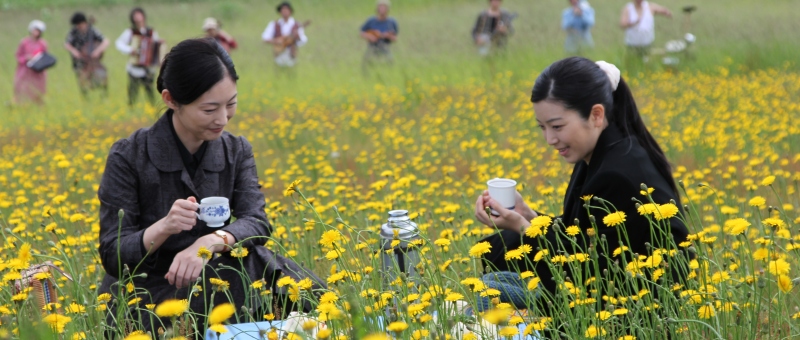
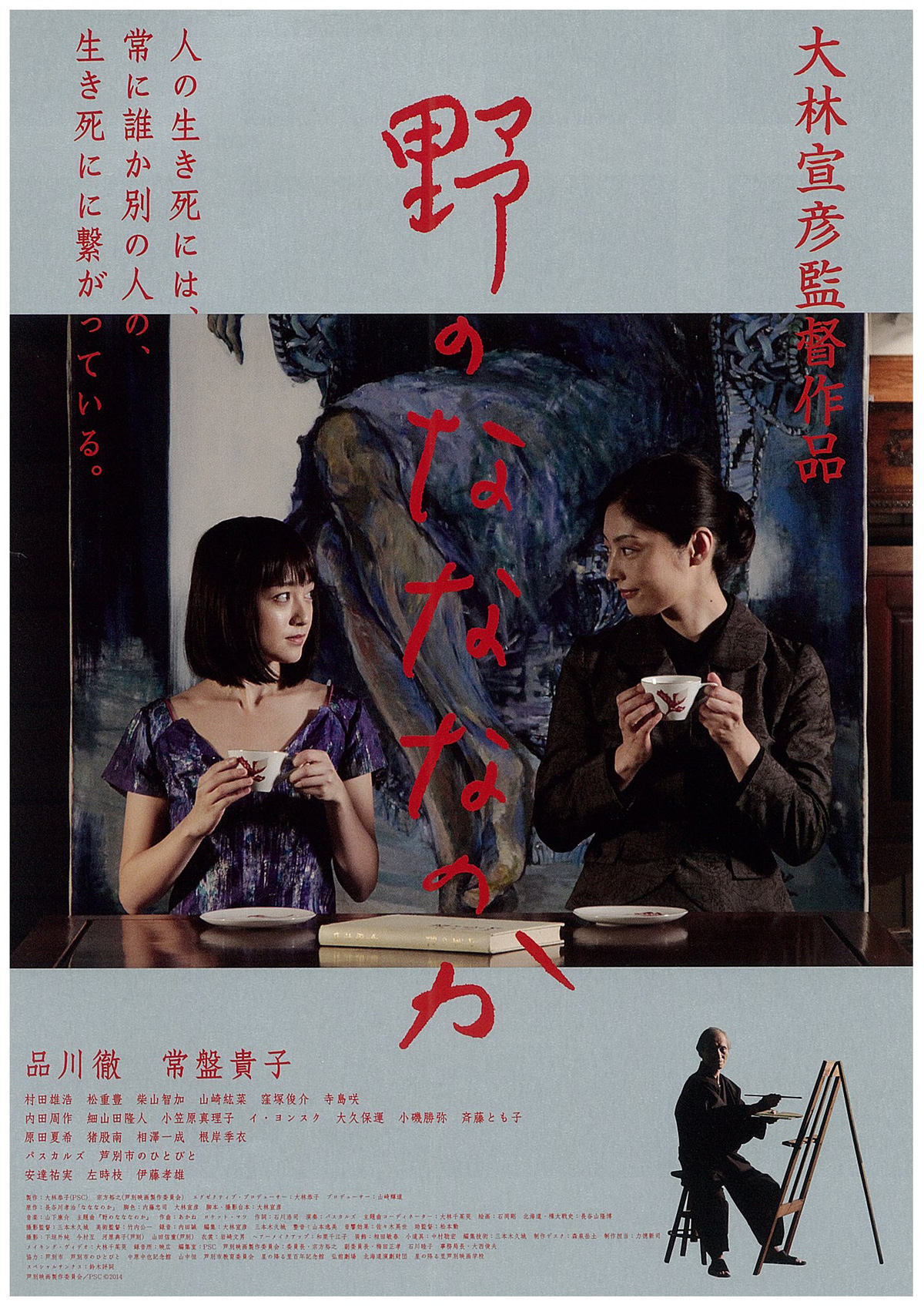
The death we’re being asked to witness is that of 92-year-old Mitsuo Suzuki (Toru Shinagawa), a former doctor and owner of what some view as a junk shop, who is discovered collapsed by his granddaughter Kanna (Saki Terashima) only to die a few days later at the time shown on his permanently broken wristwatch which also happens to be the time the Great East Japan Earthquake struck in 2011. Soon his extended family begin to arrive beginning with long widowed sister Eiko (Tokie Hidari), grandson Fuyuki (Takehiro Murata) and his daughter Kasane (Hirona Yamazaki), and Kanna’s brother Akito (Shunsuke Kubozuka) while Fuyuki’s brother Haruhiko (Yutaka Matsushige) and his wife Setsuko (Tomoka Shibayama) will make it only in time for the wake. Throwing all into confusion is the unexpected arrival of a mysterious young woman, Nobuko (Takako Tokiwa), later revealed to be a nurse who once lived with the family and fulfilled the role of mother for Kanna and Akito whose parents were killed in a car accident while they were still young. 

Nobuko is in many ways the key to a mystery yet also a cypher, more than one woman at the same time as if in a sense resurrected from Mitsuo’s traumatic memories of love and war in the time of his youth. At his wake, men of a similar age spin their own war stories, Eiko reminding the young that their youth was war and perhaps they’ve a right to romanticise it for all of its terrible cruelty. Mitsuo didn’t go to the front but found himself a victim of shifting borders, ironically a descendent of settler colonisers as a native of Hokkaido travelling to the disputed island of Sakhalin in search of a friend and in the company of the young woman who was engaged to him but with whom he was himself in love believing the war was over only to discover no one had told the Russians and that wars do not end at the same time for everyone, or for some at all. 

In an ironic touch, great-granddaughter Kasane participates in an excavation of an old mine once staffed largely by forced Korean labour, an elderly woman plaintively singing Arirang over the dig site, only to later visit a similar location which has become the “Canada World” tourist attraction including a replica of the house from Anne of Green Gables. As she, Eiko, and Kanna reflect on the changes in the town there’s a minor sadness that the mine has closed which seems somewhat incongruous, even as the wholesomeness of coal from the ground is favourably compared with the dangerously intangible qualities of nuclear energy. Nevertheless, conflicted nuclear engineer Haruhiko later stakes his future on renewable energy, neatly echoing the sense of circularity in a continuous cycle of death and rebirth in which one life is necessarily tied to another and therefore to all lives. 

“We got along with the Russians in Sakhalin before the war” Mitsuo’s friend Ono (Takao Ito) laments, musing on the senselessness of conflict in its propensity to draw lines between people which divide rather than connect. Mitsuo’s death is indeed “a history tying the past and future”, a minor allegory for that of his nation as he contemplates lost love and the end to wandering that is death which leads in turn to new beginnings. “You want to look away. You want to forget about it”, Mitsuo confesses, “but you can’t. You have to remember so that it’s never repeated”. Through their 49-day odyssey, the family members begin to edge their way towards a less anxious if still uncertain future. “We might lose people but not hope” Kanna expounds, recommitting herself to the hometown spirit while opening up to the possibility of romance, while her brother does something much the same, as does her uncle Fuyuki even as his daughter conversely gives up on a possibly inappropriate crush to shift into a more mature adulthood. “We will go on peacefully” runs the final title card, a mission statement for the foundation of a better world. 


Seven Weeks streams in the US July 9 – Aug. 6 as part of Japan Society New York’s Tragedies of Youth: Nobuhiko Obayashi’s War Trilogy season in collaboration with KimStim.

Original trailer (English subtitles)

Casting Blossoms to the Sky (この空の花 長岡花火物語, Nobuhiko Obayashi, 2012)

“There’s still time until a war” runs the title of a play for voices at the centre of Nobuhiko Obayashi’s oscillating docudrama, Casting Blossoms to the Sky (この空の花 長岡花火物語, Kono Sora no Hana: Nagaoka Hanabi Monogatari). Asking why when presented with the opportunity to create something beautiful that gives joy and hope to all who witness it mankind chooses death and destruction, Obayashi considers responses to disasters manmade and natural and finds largely kindness and resilience among those determined to avoid the mistakes of the past while building a better tomorrow. 

Set in the immediate wake of the 2011 earthquake and tsunami and inspired by verbatim interviews with local people, Obayashi’s elliptical drama sends an emotionally arrested newspaper reporter to Nagoka having received a letter from an old lover that calls her back into the past. Reiko (Yasuko Matsuyuki) broke up with Katayama (Masahiro Takashima) 18 years previously uttering only the cryptic phrase “we have nothing to do with war”, but travelling through her “wonderland” begins to realise that she and everyone else is in that sense wrong. No one is really entirely unconnected or untouched by the destructive effects of conflict and pretending that it’s nothing to do with you will not in the end protect against it. 

“To the children of the future, from the adults who lived the past” runs the opening title card, making plain a fervent hope to connect the often unknowing younger generations who assume war is nothing to do with them with the traumatic past through the voices of those who directly experienced it. The play to which Reiko is invited is in itself a play for voices, an avant-garde theatre piece inspired by the verbatim speeches of residents of Nagaoka recounting their often harrowing experiences of the war apparently penned by a strange high school girl (Minami Inomata) who rides everywhere on a unicycle. The performance is set to take place in conjunction with the local summer festivals which include a series of fireworks displays commemorating lives lost in the bombing raids and symbolising a spirit of recovery following a destructive local earthquake some years earlier. 

Obayashi draws direct comparison between the natural disasters of earthquake and tsunami, and the manmade disaster of war but discovers that ordinary people often react to them in the same way with a furusato spirit of mutual solidarity and kindness. One of Katayama’s students is a displaced young man from Fukushima who remarks on the kindness he experienced having been taken in by the town of Nagaoka, a kindness he hopes to repay someday when he is finally allowed to return to his own hometown just as the people of Nagaoka have done following kindness shown to them after the earthquake. The discrimination he faces as someone from a town affected by radiation calls back to that experienced by Reiko’s parents who were survivors of the atomic bomb that fell on Nagasaki, a location chosen by pure chance on a whim when poor weather made the primary target unavailable. Among all the horror of the wartime stories Reiko uncovers, there is also selfless heroism such as that of the young man bravely throwing water over those trapped in a burning air raid shelter. 

“If only people made pretty fireworks instead of bombs, there wouldn’t have been any wars” a poet laments drawing a direct line between these two very different uses of the same material, a connection further rammed home by twin visits to a fireworks factory and atomic bomb museum. The “phoenix fireworks” become a fervent prayer, blossoms cast to the sky, in hope of a better, kinder future without the folly of war. “There are adults who think war is necessary” Katayama explains, “but not the children, of course. That’s why it’s up to the children to make peace”. Some may complain that in the rapid economic development of the post-war society something has been lost, but in times of need people are still there for each other forging the furusato spirit in contemporary Japan. Opening with a series of silent-style title cards, Obayashi’s overtly theatrical aesthetics may be comparatively retrained even while incorporating frequent use of animation and surrealist backdrops, but lend an ever poignant quality to this humanist plea for a more compassionate world in which the only explosions in the sky are made of flowers and hope not hate or destruction. 


Casting Blossoms to the Sky streams in the US July 9 – Aug. 6 as part of Japan Society New York’s Tragedies of Youth: Nobuhiko Obayashi’s War Trilogy season in collaboration with KimStim.

Original trailer (English subtitles)

As We Like It (揭大歡喜, Chen Hung-i & Muni Wei, 2021)

“It’s the crazy madness we call love” according to a series of bemused bystanders in Chen Hung-i and Muni Wei’s modernist take on the Shakespeare play, As We Like It (揭大歡喜, Jiēdàhuānxǐ). As the reframing of the title implies, no longer pleasing “you” but “we”, Chen and Wei’s all-female adaptation is an attempt to reclaim the stage taking a swipe at the Elizabethan prohibition on actresses while undermining the notion of a gender binary as the various lovers pursue their romantic destiny in defiance of heteronormative ideas of sex and sexuality. 

Rather than palace intrigue, however, the force which sends Rosalind (Puff Kuo) into the forest is romantic failure coupled with filial and financial anxiety. Her father, the Duke, has been missing for seven years and will shortly be declared dead at which point his company will be divided between the father of her best friend, Celia (Camille Chalons), and a random young man named Orlando (Aggie Hsieh) she was previously unaware of. Hoping to locate him, she winds up at a street fight in which she becomes Orlando’s eyes and he falls in love with her at first sight. For unclear reasons and drawing inspiration from traditional Taiwanese opera, Rosalind then decides to pose as a man, taking the name of Roosevelt, and later teaming up with Orlando in the hope of finding the Duke. 

Despite its best intentions, the awkward irony at the centre of As We Like It is that it accidentally ends up re-inforcing the patriarchal ideology it otherwise seeks to critique in that Rosalind’s romantic adventure turns out to be a series of manipulations at the hands of her long absent father. A romantic exile, it is she who remains unsure of her feelings, unwilling to admit the possibility that she is finally in love with Orlando and hiding behind the mask of masculinity in order to test her would-be-lover’s sincerity. The strange scavenger hunt the pair are forced to follow in order to find their way to the Duke amounts to a forced courtship, each of the pitstops another level up in terms of romantic intimacy culminating in an oddly eroticised ear cleaning date. While Orlando vacillates over whether it’s OK to fall for a boy because he reminds you of a girl, Rosalind is tasked with rediscovering her faith in romantic love which she does but only after talking to her father first. 

Celia, by contrast, seizes her own agency by defiantly seducing sometime antagonist Oliver (Joelle Lu) and becoming pregnant by him even before marriage. In this instance, Oliver is still the villain attempting to steal the business, even going so far as to send his thugs to chase Orlando down, the implication being that Celia’s love softens and then corrects him so that he might reconcile with his brother. Yet the final showdown introduces a new villain in the figure of Charles (J.C. Lei), Oliver’s chief thug apparently harbouring an unrequited crush on his boss and therefore extremely resentful of Celia. Yet her taunting of him asserting that hers is the final victory because she has done what Charles never could in conceiving Oliver’s child seems to fly in the face of the film’s otherwise egalitarian views on love, negating not only same sex love but also love between those unable to produce children uncomfortably heading back into a gender binary which makes maternity the essence of womanhood. This message is perhaps undercut by the closing moments in which Oliver and Celia argue about whether to buy boy clothes or girl clothes for the baby only for the shop assistant to advise a neutral white and cede the “choice” to the child in time but nevertheless seems an odd means of defeating the spectre of the unexpected antagonist driven to a dark place by the “madness” of love. 

Love’s “madness” may be the central theme though the sense of a world turned upside down is undermined by Celia’s maintenance of her position as a princess rather than relegation to the role of a peasant even as it affords her unexpected agency over the surprisingly pliable Oliver. The world’s uncanniness is fulfilled by its unreachability, set in an “internet-free” district of near future Taipei enhanced with frequent onscreen graphics where people send each other “slo-express” letter-pressed telegrams in place of “text messages” delivered by the human touch, implying perhaps that our increasingly depersonalised society is actively frustrating the path to love even while the idea of the idyllic and utopian Forest of Arden seems to have been co-opted by venal developers. Nevertheless, journeys end in lovers meeting to quote another play and love’s madness is eventually cured in its fulfilment. 


As We Like It screens on July 8 and streams online in Switzerland until July 10 as part of this year’s Neuchâtel International Fantastic Film Festival (NIFFF). Readers in London will also have the opportunity to see As We Like It at Genesis Cinema on 16th July courtesy of Chinese Visual Festival & Queer East

Original trailer (English subtitles)
Hail, Driver! (Prebet Sapu, Muzzamer Rahman, 2021)

“Big city, small people, tough life” a jaded sex worker commiserates, slowly bonding with an illegal taxi driver trying to find a way to live in contemporary Kuala Lumpur. The ironically titled Hail, Driver! (Prebet Sapu) casts its cosmically unlucky hero adrift, literally roaming the city and coming in a sense to a new understanding of it thanks to his impromptu conversations with fares many of whom are only slightly more lucky than he is. Yet while his radio constantly updates him on the upcoming elections, he struggles to believe that real change is possible or that he will ever find a way out of his itinerant poverty. 

Aman (Amerul Affendi) was once a writer, but times have changed and no one buys magazines anymore. He’s been living with his sister in the city, but his brother-in-law makes no secret of his unhappiness with the situation, arguing with his wife about Aman’s inability to contribute economically to the household. Hoping to make some extra cash, he decides to make use of his sole inheritance from his late father, a rundown but reliable and recently serviced vehicle, to become a driver with ride hailing app Toompang. The only problem is that Aman has no official driver’s licence and is unable to get one because of his colour blindness, while the car is technically not of a sufficient standard to be used as a taxi. Paying a middle man for fake documents, he begins working but is quickly made homeless when his brother-in-law changes the locks while he’s out one day and announces he’s bringing his own brother to live with him instead forcing Aman to make the car his home, using public conveniences to wash and occasionally sleeping in 24-hr establishments such as laundromats. 

Aman’s plight is an encapsulation of the problems of the modern city, the radio explaining that house prices are a major point of interest in the upcoming elections. He searches for affordable accommodation but finds nothing suitable while quizzing his various fares about their living conditions, whether they rent or own their homes and how much they pay. One woman with a young son explains that of course she rents, there’s no way she could buy on her low salary while starting a business of her own is, she claims somewhat crassly, a no go because of the “flock of immigrants” in the city. Another of Aman’s fares reveals he came from Bangladesh some years ago, works in a hotel, and shares a reasonably priced apartment with his brother. Meanwhile Aman ferries sleazy politicians and their much younger mistresses to just such establishments. 

It’s his innate kindness, however, which eventually allows him to move forward after accidentally bonding with Chinese-Malaysian sex worker Bella (Lim Mei Fen) who came to the capital from Penang in search of a better future. She offers to let him use her spare room in return for his services getting to and from her clients, but even as they begin to develop a kind of mutual solidarity Bella confesses that she’s never felt a sense of belonging in the capital while her abandonment issues, her mother apparently living in the US after leaving her behind at five years old, have left her feeling spiritually homeless. “Not all dreams can be achieved” she advises Aman, each of them united in a sense of defeat as they reflect that nothing ever changes hearing the news that the party in power has again won the elections despite the ongoing problems in the city. 

Filmed in a crisp black and white, reflecting both Aman’s colour blindness and sense of hopelessness, Hail, Driver! paints an unflattering portrait of life on the margins of a burgeoning metropolis but eventually finds a degree of possibility in the unexpected, perhaps in its way transgressive, connection between the Malay taxi driver and Chinese sex worker who eventually find a sense of belonging, of home, in each other even as they bond over shattered dreams and urban disappointment. A striking debut feature Muzzamer Rahman’s empathetic drama captures the elusive city in all its unobtainable beauty, apartment blocks literally towering oppressively over the kindhearted Aman, but finally suggests that freedom may lie only outside of its repressive borders. 


Hail Driver! streamed as part of this year’s hybrid edition Udine Far East Film Festival.

Original trailer (English subtitles)

The Fable: A Contract Killer Who Doesn’t Kill (ザ・ファブル 殺さない殺し屋, Kan Eguchi, 2021)

Appearances can be deceptive. A case could be made that everyone is in a sense living undercover, pretending to be something they’re not in order to survive in a conformist society and most do indeed have their secrets even if they’re relatively benign. Others, meanwhile, are on a kind of sabbatical from a life of meticulous violence such as the hero of Kan Eguchi’s sequel to smash hit action comedy The Fable, The Fable: A Contract Killer Who Doesn’t Kill (ザ・ファブル 殺さない殺し屋, The Fable: Korosanai Koroshiya) or like his antagonist living a double life with his apparently genuine concern for the lives of disabled and disadvantaged children balanced by his business of targeting wayward youngsters for the purposes of extortion. 

Some months on from the previous action, “Sato” (Junichi Okada), formerly a top Tokyo assassin known as The Fable, is successfully maintaining his cover hiding out in Osaka as an “ordinary” person with a part-time job in a print and design shop. His cover is almost blown, however, when his colleague Etsuji (Masao Yoshii) is targeted by Utsubo (Shinichi Tsutsumi), ostensibly the leader of a local organisation advocating for the rights of children but also a shady gangster who finances his “philanthropy” by extorting the parents of young people who’ve in someway gone off the rails. Etsuji’s crime is, as was exposed in the previous film, his spy cam habit and in particular his planting of hidden cameras in the home of colleague Misaki (Mizuki Yamamoto) with whom he has an unhealthy obsession stemming from her time as an aspiring idol star. Blaming Misaki for his misfortune, Etsuji turns to violence but is shut down by Sato who risks blowing his cover in order to protect her. Realising he has a previous connection with Utsubo, Sato makes the gang an offer they can’t refuse in order to get Etsuji back but quickly finds himself drawn into another deadly battle with bad guys endangering his still in progress no kill mission. 

Focussed this time much more on action than the fish out of water comedy of Sato’s attempts learn the rules of polite society having been raised in the mountains as a super efficient killing machine, The Fable 2 nevertheless wastes no time in exposing the murkiness of the “normal” world Sato is intended to inhabit. Utsubo is a hit with the local mothers, taken with his smart suit and professionalism as he gives “inspirational” speeches about park safety while making time to converse in sign language with a deaf little girl explaining to another mother that it’s important to “listen to every voice”. As part of his patter he implies his assistant, Hinako (Yurina Hirate), who uses a wheelchair, was injured in a freak park-related accident as a child when in reality she sustained the injury while trapped in the back of a car which veered off a roof after The Fable took out its driver. Vaguely recognising her in the local park, Sato takes an interest out of guilt as the young woman attempts to rebuild her strength in the hope of walking again though that might in itself be contrary to Utsubo’s desires. 

As in the first film, Sato may be a ruthlessly efficient killing machine but at heart he’s still childishly innocent, hoping to help the young woman he unwittingly hurt but also keen not interfere with her ability to help herself. Misunderstanding the situation, Hinako asks Utsubo to lay off Sato, explaining that he gives her confidence as she begins to realise that she can stand alone, as the sometimes uncomfortably ablest metaphor would have it, and no longer needs to be complicit in Utsubo’s nefarious schemes nor need she continue to punish herself in guilt over her traumatic past. While Sato and his handler Yoko (Fumino Kimura) pose as a pair of siblings watched over by their benevolent if absent boss (Koichi Sato), Hinako and underling Suzuki (Masanobu Ando) similarly pose as brother and sister only with the comparatively dubious guidance of Utsubo who affects kindness and generosity while burying problematic youngsters alive in the forest in order to extort money from their “protective” parents. “It’s always the villain who tells the truth” Utsubo explains, insisting that it’s shame and humiliation which build self-esteem in direct contrast to the gently invisible support which seems to have re-activated Hinako’s desire for life.

Sato has at least discovered the benefits of a well functioning and supportive “family” network thanks to the, as we discover, equally handy Yoko, and his still largely oblivious workplace friends. Amping up the action value, Eguchi careers from set piece to set piece culminating in a high octane chase through an apartment block and its eventually unstable scaffolding while making space for slapstick comedy such as two guys trying to move a piano at a very inconvenient moment. A gently wholesome tale of a pure-hearted hitman kicking back against societal hypocrisy while figuring out how to be “normal” in a confusing society, The Fable 2 more than builds on the promise of its predecessor while allowing its hero the space to grow as he begins to adjust to his new and very “ordinary” life.


The Fable: A Contract Killer Who Doesn’t Kill screens on July 7 as part of this year’s Neuchâtel International Fantastic Film Festival (NIFFF)

Original trailer (English subtitles)

Death Knot (Tali mati, Cornelio Sunny, 2021)

Orphaned siblings attempt to process the dark legacy of the superstitious past in the debut feature directed by and starring actor Cornelio Sunny, Death Knot (Tali mati). Travelling from the comforting sophistication of the modern city back into the eerie darkness of the ancient forest, the pair find themselves confronted first by a filial dilemma and then a spiritual conundrum in their potential destiny which their possibly shamaness mother may have gone to great lengths in order to prevent. 

As the film opens, Hari (Cornelio Sunny) texts with his younger sister Eka (Widika Sidmore) who somewhat sexistly tells him not to stay single too long because he needs someone to cook for him. Falling asleep watching a program in which a woman remarks on the presence of jinns as manifestations of energy that can’t be seen by the naked eye, Hari has a strange dream in which he witnesses his mother hanging herself in the forest in the middle of the night uttering only the words “stay away”. As it turns out, Eka had exactly the same dream and a phone call from their estranged uncle who rather bluntly tells them that their mother is dead and as the villagers won’t have anything to do with her they need to come for the funeral, confirms their worst fears. Ignoring the warning in the dream, Hari, Eka, and her husband Adi (Morgan Oey) drive back to their home village but quickly find themselves out of their depth trying to figure out what’s going on. 

The first clue is the reaction from a previously friendly old woman who suddenly gets up and walks off after exclaiming that the body should have been burned not buried when Hari stops to ask for directions. The second clue is that only three people including their uncle turn up for the funeral. The third clue is that everyone keeps telling them to leave town right away while the fourth is that they can’t because of a mysterious storm that has apparently closed all the roads. Meanwhile, hostile uncle Rahmen immediately asks for what seems like a lot of money to cover his expenses for the clandestine funeral and then wastes no time staking his claim to their mother’s house. Though neither of the siblings want it, the request offends Hari who feels guilty that he never really got to know his mother and is wary of abandoning the last traces of her in the house she once owned. 

Described by Adi as creepy, the house does however have a dark legacy, the pair already aware that their father left and took them to the city because of their mother’s strange behaviour that saw her ostracised by the other villagers who suspected her of being a shamaness responsible for a strange phenomenon known as “The Harvest” in which spates of suicides take place across a specific month. Hari tries to rationalise it away, pointing out that it’s hard to live in rural poverty and putting a label on unexplained deaths is easier than admitting that people are taking their own lives because of economic precarity and an ongoing sense of despair, but with the increasing strangeness all around him he has to admit a degree of spiritual unease in this fiercely traditional world he is ill-equipped to understand. 

Rather than hauntings and jump scares, Cornelio Sunny concentrates on conjuring an atmosphere of supernatural dread in which anyone may suddenly become a grinning demon, performing strange ritualistic dance and odd movements only to suddenly disappear from view. An educated man from the city, Hari quickly becomes fed up with talk of ancestral deities, pacts with the devil, and black magic, only latterly accepting his role within an arcane system and understanding that his mother’s distance may have been her way of protecting him which has in the end backfired. Yet having destroyed the symbol of this spiritual oppression, Hari discovers that there may be no escape from its darkening legacy or the atavistic superstitions of the villagers, an ominous cloud always hanging over him even as he faces the final choice of whether to continue fighting or accept the inevitable. Proceeding with moody fatalism, the ironically titled Death Knot ensnares its confused hero in a tightening noose of spiritual dread and filial guilt before cutting him adrift a victim of his own sophistication. 


Death Knot streamed as part of this year’s hybrid edition Udine Far East Film Festival.

Original trailer (English subtitles)

Tonkatsu DJ Agetaro (とんかつDJアゲ太郎, Ken Ninomiya, 2020)

Among the more prolific of young indie talents currently emerging in Japan with five features released since his 2015 debut Slum-Polis, Ken Ninomiya is fast becoming the go to chronicler of Tokyo’s contemporary club scene but unlike The Limit of Sleeping Beauty or Chiwawa, Tonkatsu DJ Agetaro (とんかつDJアゲ太郎) is a surprisingly wholesome take on the same phenomenon as an otherwise clueless young man begins to step into himself after accidentally falling love with the live house vibe. 

As his slightly amusing name implies, Agetaro (Takumi Kitamura) is the third generation heir to a tonkatsu (deep fried pork cutlet) restaurant. It’s not that he doesn’t want to take over the family business, but admits that he’d largely be doing it because he doesn’t know what else to do. His rather nerdy friends, all sons of small business owners in an area of Shibuya with a distinctly small-town vibe, are in much the same position. Ironically remarking that Agetaro always loses at The Game of Life as they hang out playing boardgames, the guys eventually find him with a pair of binoculars staring at a girl in an apartment opposite they are convinced inhabits a different word where people eat prosciutto and cheese and drink fancy wine. Agetaro gets an unexpected chance to meet his unobtainable crush, Sonoko (Maika Yamamoto), when he’s summoned to deliver a bento to a dance club after hours for a moody DJ, Oily (Yusuke Iseya), who describes tonkatsu as the area’s “soul food” and rates Agetaro’s dad’s as the very best. Allowed to step onto the dance floor, he finds himself blown away by Oily’s set and determines to become the very first tonkatsu chef/DJ partly in the hope of impressing Sonoko. 

Though set very much in the present day, there’s a pleasingly retro quality to Tonkatsu DJ Agetaro that recalls old school Showa-era musical youth movies in which young guys from humble backgrounds make something of themselves by working hard and staying true to their roots. Agetaro’s problem is that he’s caught in a moment of adolescent anxiety, resentful of his father (Brother Tom) whom he feels looks down on him, refusing to let his son anywhere near the fryer while making him chop cabbage all day and reminding him he doesn’t have to take over the shop if he doesn’t want to. Agetaro’s dad won’t teach him to fry because he thinks he doesn’t take anything seriously, and he might be right, but as his sister (Natsumi Ikema) says he’s worried about him too secretly trying to be supportive by standing at the back of the room when Agetaro gets his big break at the local club. 

Despite being mentored by Oily, however, Agetaro blows his first opportunity failing to get the crowd moving with a rather naff set designed to entertain his equally nerdy friends. But failure, crucially, only endears him to Sonoko who had previously been put off by his cheesy attempts to become a viral YouTube star with a series of gimmicky videos featuring himself and his friends wearing novelty “tonkatsu” outfits. Where he thought of giving up, Sonoko’s reminder that everyone makes a mess of things once in a while and no one should expect success right out of the gate helps Agetaro realise that what he needs to do is bring all of himself to his set which in this case means understanding that the thing is learning do something well and in that there’s no difference between frying the perfect cutlet and finding the perfect beat. Simply put, he needs to become the Tonkatsu DJ for real. 

Attracted to DJing because of the freedom it offers, Agetaro eventually finds his “heaven” on the dance floor marrying both sides of himself as he accepts his tonkatsu legacy and claims his space within the club scene which here is unproblematically joyful, a warm and welcoming space in which young people come together to enjoy good music, dance, and have wholesome fun. Simply put, it’s hard not to fall in love with a film which makes space for an unironic and unapologetically joyful moment of catharsis featuring Belinda Carlisle’s Heaven is Place on Earth. Shifting away from the slick music video aesthetic of his earlier work, Ninomiya hits lowkey charm in his tale of minor slacker success as his feckless hero finally figures himself out and learns how to cook up a storm in the store and on the floor. 


Tonkatsu DJ Agetaro screens on July 4/6/9 as part of this year’s Neuchâtel International Fantastic Film Festival (NIFFF)

Original trailer (English subtitles)

Like Father and Son (拨浪鼓咚咚响, Bai Zhiqiang, 2020)

A grieving father and orphaned little boy eventually find mutual solidarity in an increasingly duplicitous society in Bai Zhiqiang’s warmhearted road movie, Like Father and Son (拨浪鼓咚咚响, Bōlànggǔ Dōngdōng Xiǎng). Travelling the modern China in search of the boy’s missing father, the pair encounter only greed and selfishness but discover perhaps something in each other that repairs their sense of despair as they bond in their shared sense of loneliness, each in their own way “left behind” and looking for someone who’ll look for them. 

Pedlar Guoren (Hui Wangjun) makes a living transporting goods from the cities and selling everyday items to customers in remote villages, even running a digital portrait service for those without access to photographic equipment most of which seem to get used for funerals. It’s in one such village that he first encounters little Madou (Bai Zeze), a “left behind child” raised by his grandmother but rejected by the other kids and longing for his absent father to return. Having overheard Guoren mention that he’s headed to the town where he believes his father is working, Madou tries to catch up to him in the hope of giving him his school report to show his dad so he’ll come back but is unsuccessful. When his grandmother suddenly passes away leaving him all alone, the other villagers seemingly rejecting him, Madou decides to take drastic action stowing away in the back of Guoren’s van only to be discovered after accidentally setting off a box of firecrackers and setting fire to half of Guoren’s stock. Though reluctant, Guoren ends up agreeing to take the boy to find his father in the hope of gaining compensation for his lost merchandise while half suspecting that Madou’s dad may have already moved on. 

Embittered and cynical, Guoren is consumed by grief for his young son who passed away of an illness, displacing his hurt by channeling his pain into anger towards an old friend who he believes cheated him out of money he could have used to pay for additional medical treatment. Perhaps for these reasons he has ambivalent feelings for Madou, at times despite himself sorry for him but also fed up, irritated to have been saddled with his boy when so cruelly robbed of his own. He doesn’t really mean it, but Guoren often cynically suggests selling Madou into China’s child trafficking network if he can’t get someone to accept responsibility for him by paying compensation for all stock that he destroyed.

The frequent, if sarcastic, references to child trafficking are only one example of the ills that plague the modern society. During their journey, the pair find themselves stuck in the mud and despite working together are unable to free the truck only for a passing motorist to stop and offer to help but only for a small fee. Stopping off in a small town, Guoren allows another shop owner to “borrow” Madou for a short period only to discover him being forced to beg in the street with all the money going straight into the shopkeeper’s pocket. Migrant workers they question looking for Madou’s father soon descend into a mass argument about unpaid debts and who owes who, while other labourers hold up cardboard signs featuring their skills in the hope of being hired by passing vans.  

Madou is himself a “left behind child” one of many in modern China raised by grandparents in the country while the parents work in the cities to provide for them. Lonely, Madou longs for his father and blames himself for his continual absence. Guoren meanwhile also blames himself for the death of his son but vows revenge on his friend in order to avoid facing the pain of his grief. They are each in a sense left behind, little Madou breaking down in despair in the realisation that he is entirely alone, that he has no more family and nobody wants him while Guoren clings fiercely to the memory of his son. Awkwardly bonding as they travel, Madou picking up a talent for market selling, the pair eventually develop a sense of connection that begins to heal their familial wounds, Gouren discovering a surrogate son while Madou finds the father figure he’d been looking for. A warmhearted yet also melancholy tale of intergenerational bonding Bai Zhiqiang’s gentle familial drama may find itself in an increasingly greedy and self-interested society but eventually allows a ray of hope in the genuine connection between the orphaned boy and grieving father.  


Like Father and Son streamed as part of this year’s hybrid edition Udine Far East Film Festival.

Original trailer (English subtitles)

OK! Madam (오케이 마담, Lee Cheol-ha, 2020)

“If I have to die I’ll die in business class” a passenger insists, refusing her hijacker’s instructions to move to the more egalitarian section of the plane. Partly a social comedy in which a cast of disparate individuals respond in their idiosyncratic ways to an airborne hostage crisis, Lee Cheol-ha’s Ok! Madam (오케이 마담) is also an unconventional family drama in which an impoverished family go to great lengths to save their very first family holiday. 

Mum Mi-young (Uhm Jung-hwa) runs a successful twisted doughnut stand at the market, while her husband Seok-hwan (Park Sung-woong) is an in-demand IT expert. Yet financially the family is strained with Mi-young apparently exasperated that Seok-hwan keeps wasting money buying vitamin drinks in the hope of winning giveaway prizes. When they finally get lucky and win a dream trip to Hawaii, the couple are originally over the moon only for the penny pinching Mi-young to reconsider. Perhaps it’s irresponsible to take time off from their businesses and selling the prize online would be the more sensible option. When their daughter, Nari, complains that the other kids make fun of her because of her parents’ professions and the fact she’s never been abroad, however, Mi-young reconsiders. She may later regret that, as their dream family getaway is quite literally hijacked by North Korean spies who believe a fugitive former agent may be aboard their plane. 

Lee keeps up a sense of suspense as to the identity of the former North Korean agent even if the twist is a fairly obvious one. The other passengers on the plane are a minor microcosm of the contemporary society, one of the most vocal a feisty mother-in-law who’s forced her son’s wife on a long haul flight in the final trimester of her pregnancy so she can give birth on American soil and guarantee her child US citizenship. Other passengers meanwhile gossip about a famous actress while an arrogant politician constantly throws his weight about and an old man travelling to meet family bitterly regrets starting a conversation with Seok-hwan. 

Much of the comedy rests, ironically, on class disparity as the penny pinching Mi-young resolves to make the most of her unexpected upgrade to business class on learning everything’s free while the snooty mother-in-law quips about trying to engineer her grandchild’s access to American citizenship only to wonder if they might end up being born North Korean. Seok-hwan even jokingly brands his wife a “communist” for her financial austerity as she contemplates passing up personal pleasure for financial gain, while North Korean agents targeting the plane are eventually torn apart by infighting with some determining to sell off the rogue agent rather than simply capture them alive as instructed. 

Nevertheless, the main draw is the awesome fighting skills of Mi-young who finds herself donning a stewardess outfit and taking out the bad guys aboard the unexpectedly cavernous aircraft. Simultaneously enforcing and undercutting conventional gender norms, Mi-young had forced her daughter to learn ballet against her will even though Nari would rather learn taekwondo and is always watching action movies on TV. In a meta touch, an actress confesses that it’s just her face someone else does the actual fighting while Mi-young effortlessly takes out rows of bad guys who, it is has to be said, are not much of an advert for North Korean special forces. 

The hostage crisis in its own way brings the family closer together as they fight not only to save the plane, and everybody’s lives, but their dream Hawaiian holiday. Discovering mutual secrets and past lives, even encountering an old flame, the couple enter a deeper level of intimacy while remaining true to themselves and solidifying their family bond, little Nari’s taekwondo dreams apparently coming true after witnessing her mum showing off her action star credentials. At heart a slapstick comedy with a touch of ironic farce, OK! Madam rejoices in sending up national stereotypes from the clueless penny pinching housewife to the feckless competition-obsessed husband, celebrity obsessives, and self-absorbed politicians but also insists the most ordinary of people have hidden talents they’ll have no hesitation exposing when their loved ones are in danger. 


OK! Madam screens on July 5/7/9 as part of this year’s Neuchâtel International Fantastic Film Festival (NIFFF)

International trailer (English subtitles)
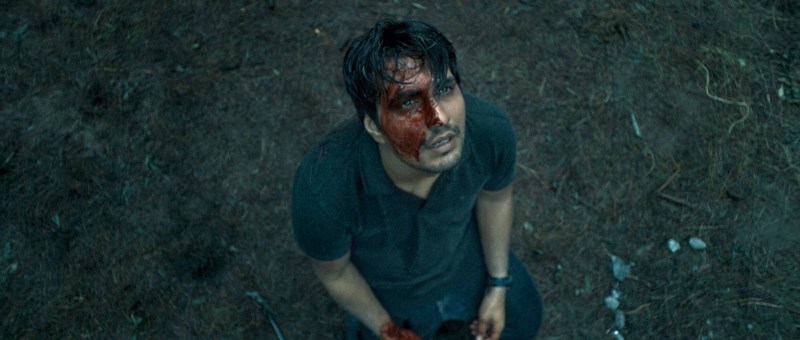
Son of the Macho Dancer (Anak ng macho dancer, Joel Lamangan, 2021)

“How many have you buried? Why?!” asks the hero of Joel Lamangan’s Son of the Macho Dancer (Anak ng macho dancer), a quasi sequel to the 1988 Lino Brocka classic. Set during the early days of the pandemic, Lamangan’s salty drama hints at the radiating effects of an authoritarian culture for those living on the margins of the contemporary society but does so with a dose of trashy telenovela camp in its eventually redemptive tale of frustrated futures, sexual exploitation, drugs and murder in a time of increasing sickness. 

19-year-old Inno (Sean De Guzman) is in a casual relationship with a woman whose tendency to refer to herself as his girlfriend clearly irritates him, especially as their sex life seems to be frustrated by her fear of his apparently giant penis. When his father Pol (Allan Paule) who has become addicted to drugs after a car accident is arrested by the police and he needs money to bail him out, Inno’s mother (Rosanna Roces) seizes on his oversize appendage as a means of saving the family by dragging him straight to a local gay club to become a go-go dancer. While reluctant at first, Inno soon takes to his new life and decides to milk it for all its worth, latching on to VIP procurer Bambi (Jaclyn Jose) and her sidekick Roldan (Emilio Garcia) in the hope of being invited to one of their elite parties all of which later drags him into the orbit of sadistic gay drug dealer Jun (Jay Manalo). 

All the while, we see Duterte on TV giving updates in the corona virus crisis and the various measures to mitigate it which threaten the survival of gay bar Mankind as well as the illicit business enterprises operated by Jun, Bambi, and Roldan. A police officer reconfirms his warning to drug dealers that they shouldn’t expect an easy ride during the pandemic because they will “destroy all of you”. The police force is shown to be resolutely corrupt, firstly in its refusal to investigate the causes of the car crash which caused Pol’s descent into addiction because, he believes, the driver was a judge and the cops have been paid off, and lastly in its complicity with criminal activity as evidenced in their cooperation with Roldan to cover up his crimes. 

Obsessed with social media clout, Inno constantly documents and uploads his existence online marvelling at his new circumstances as a kept man of Jun only latterly reflecting on the ironies of his life in discovering that his father was once also a “macho dancer” while his mother was forced to turn to sex work to feed the family after Pol’s accident. Seduced by the lifestyle of the rich and powerful that Jun can give him he doesn’t stop to consider its wider implications even when warned by predecessor Kyle (Ricky Gumera) of the dangerously oppressive regime within the house. It’s not until he finds himself burying the body of a friend murdered by Jun after unwittingly failing to play along with his voyeuristic sexual fantasies that he begins to ask why, not only why he’s living this life but why Bambi has been living it all this time enabling Jun’s predatory violence in burying the bodies of unlucky young men who fell foul of his sadistic desires. 

For Kyle at least the answer may be a lifetime of violent abuse which which has left him too traumatised to believe escape is possible. Inno vacillates between resentment towards his father for his irresponsible drug use and mistreatment of his long-suffering mother, and the filial desire to protect him which led him to become a macho dancer in the first place. Bambi and Pol, meanwhile, the heroes of Brocka’s film have been consistently brutalised by an oppressive society apparently only awakened to the possibility of changing course by Inno’s corrective questioning. 

In any case, there’s a minor irony even in the wilful subversion of positioning the young hero as a sex object valued only for the size of his penis while the frequent full frontal male nudity often feels gratuitous and the final swing towards heteronormativity can’t help but align homosexuality with the psychopathic cruelty of Jun as something dark and perverse even while ending on a joyous if tempered moment of resilience in returning to Mankind with the house full of masked clubbers continuing to shove their notes into the dancers’ briefs. Though the final resolution may in a sense be too neat, a family restoring or remaking itself in the wake of trauma, Lamangan allows the sense of unease to continue in the callback to societal corruption as the ongoing pandemic seems to stand in for other kinds of increasing sickness. 


Son of the Macho Dancer streams worldwide until 2nd July as part of this year’s hybrid edition Udine Far East Film Festival.

Original trailer (English subtitles)