Honnouji Hotel (本能寺ホテル, Masayuki Suzuki, 2017)

According to the opening quote from Otto von Bismark, fools learn from experience and the wise man from history, but in truth you’ll need a little of the former to correctly interpret the latter. The heroine of Honnoji Hotel (本能寺ホテル) is not exactly lacking in life experience, but hers has been of the passive variety. She’s blithely gone along with the path her society laid out for her, but now she’s hit an unexpected bump in the road it’s prompted her into a reconsideration of where it was she was going. Most people wouldn’t meet such a crisis by asking “what would Nobunaga do?”, but that’s where our heroine finds herself after accidentally exiting a hotel lift right into the middle of the Sengoku era. 

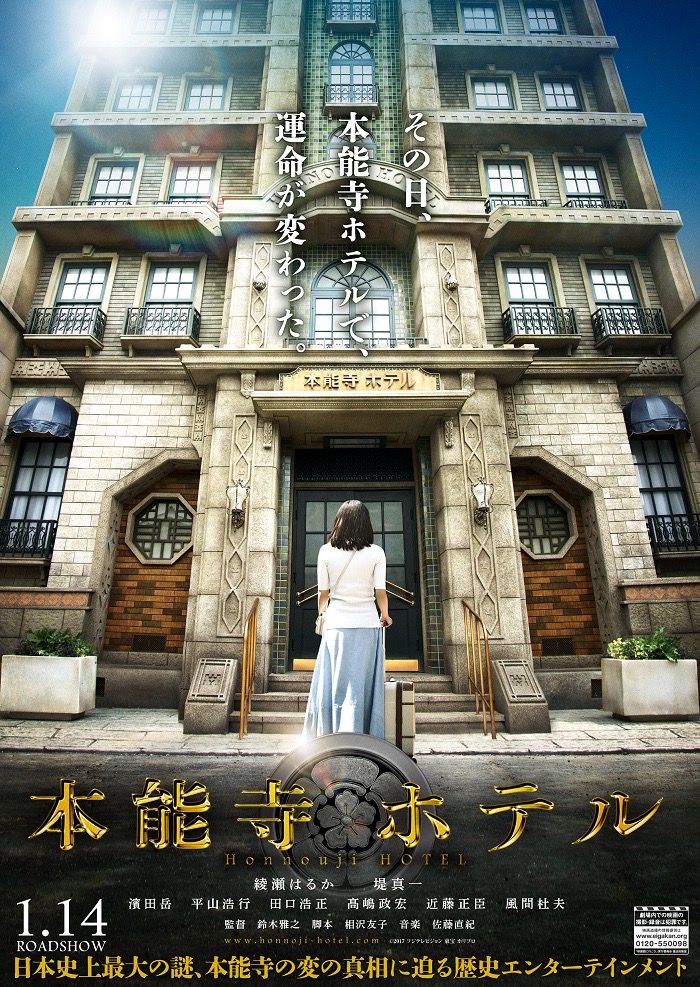
20-something Mayuko (Haruka Ayase) is in Kyoto for a short holiday and to meet up with her fiancé to be formally introduced to his family. The problem begins when it transpires that owing to an administrative error, her hotel reservation has been made for the following month and everything is currently fully booked seeing as the city is such a tourist hotspot. After wandering around a while, she stumbles across a dated, slightly musty establishment named the “Honnouji Hotel” which, she realises even given her shaky grasp of history, is a fairly inauspicious name. Everyone knows that 16th century general and noted tyrant Oda Nobunaga committed seppuku at the Honno temple after he was betrayed by one of his retainers who rose against him. Nobunaga had been primed to bring peace to Japan after more than a century of destructive warfare, paving the way for unification under the Tokugawa Shogunate, but is a somewhat ambiguous figure known for his extreme volatility and tendency towards cruel authoritarianism. 

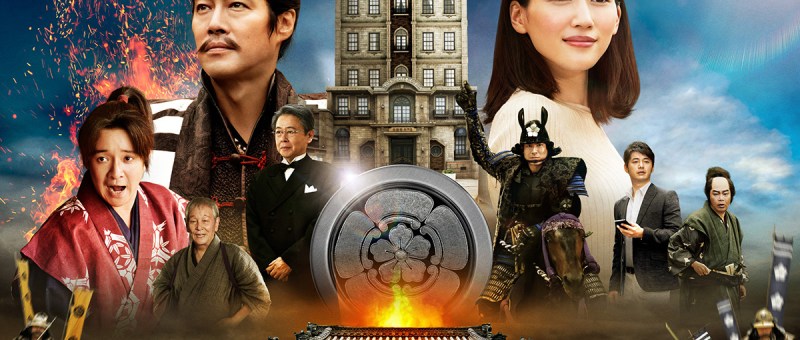
That vision of Nobunaga is indeed the one Mayuko first encounters when she finds herself accidentally thrown back into the Sengoku era after exiting the lift in her hotel. The first person that she meets turns out to be Mori Ranmaru (Gaku Hamada) with whom she bonds over a shared sense of anxiety, she over meeting her boyfriend’s family, and he over an important tea ceremony with life or death consequences. She gives him some modern-day stomach medicine while he warns her that his lord is “cruel and demonic”. Still not quite grasping that things work differently (to a point at least) in the feudal world, she advises him to quit rather than allow himself to be exploited to the point that it’s ruining his health but he exasperatedly reminds her that you can’t simply drop out of samurai society. Mayuko gets another cruel awakening when observing the tea ceremony and witnessing a man, whom she later realises to be Nobunaga (Shinichi Tsutsumi), extorting a tea caddy from a distressed master who tries to protest that he’d only been informed that the caddy would be displayed and is unwilling to give it away. Nobunaga reminds him that the nation will soon be unified under his banner, at which point he will be in control of business affairs, threatening him with economic consequences backed up with the possibility of immediate violence. 

Despite her essential passivity, Mayuko cannot bear injustice and immediately springs into action, handing the caddy back to its original owner and instructing him that he shouldn’t allow himself to be intimidated into giving up his prized possessions. In her own life, however, she’s nowhere near as certain. We find out that she’s only known her fiancé for six months, and is still ambivalent about the idea of marriage. When the company she’d been working for suddenly went bust, she found herself at a loss, told that the teacher’s certificate she’d taken as a backup is largely useless because even teaching is oversaturated in today’s difficult job market. Now, it’s not feudal times anymore, but many people in Japan still expect a woman to give up her career to get married, which is what most of her friends advise her to do especially seeing as she had no particular ambitions or goals in life. Kyoichi’s (Hiroyuki Hirayama) proposal comes at an opportune moment, but she finds herself asking opportune for whom and if this is really what she wants or if she’s just allowing herself to be railroaded into conventional “success” without really thinking it through. 

It might be going too far to read too much in to a similarity between Nobunaga’s dictatorial dynamism and Kyoichi’s domineering manliness, but that’s largely where Mayuko seems to be. Beginning to realise his mistakes, Kyoichi confesses that he cynically took advantage of the situation to manipulate Mayuko into marrying him, believing that she was “insecure and unreliable”, “unable to do anything alone” and in need of his protection. Talking with Kyoichi’s father and beginning to assert herself in opposition to Nobunaga’s injustices, she begins to realise that she can take charge of her own destiny and has a duty to find what it is she wants to do, and do that as best she can.

The lesson is, however, somewhat problematically learned in her realisation both that she can’t change “history” and that she can because history is a consequence of our collective choices. This Nobunaga, apparently wanted a peaceful society for all, one in which class divisions had been eradicated and equality ruled. He sees our world and deems it good enough to sacrifice his life for, but Mayuko by turns becomes enamoured of the past, finding her vocation as a teacher of history in a move which is both progressive in seeing her reject a marriage of “convenience” to strike out under her own steam, but also backward looking in its reevaluation of Nobunaga and his unfinished revolution as if there is no real need for change “now”. Granted, Honnouji Hotel is partly concerned with selling the charms of Kyoto as an unchanging historical centre, but it’s difficult to escape the slightly sour note of conservatism as Mayuko finds her forward path only by embracing the samurai past. 


Original trailer (no subtitles)
All’s Well, Ends Well (家有囍事, Clifton Ko, 1992)

Now an annual institution, the “New Year Movie” was only just beginning to find its feet at, arguably, the end of a golden age in Hong Kong cinema. Clifton Ko’s All’s Well, Ends Well (家有囍事) is often regarded as one of the key movies that made the genre what it is today, taking the box office by storm and spawning a small franchise with a series of sequels, the latest of which All’s Well, Ends Well 2020, is released this year. The original, however, is a classic “mo lei tau” nonsense comedy starring master of the form Stephen Chow as an improbable lothario chased into domesticity by the beautiful Maggie Cheung. 

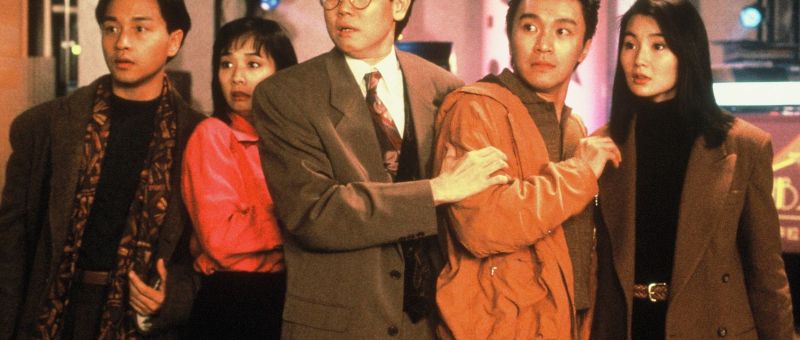
The plot, such as it is, revolves around three brothers – Moon (Raymond Wong Pak-ming), Foon (Stephen Chow Sing Chi), and So (Leslie Cheung Kwok-wing). Oldest son Moon is a regular salaryman married to devoted housewife Leng (Sandra Ng Kwan-yue). Though it’s his seventh wedding anniversary, he’s late for the family dinner at home with his parents and brothers because he’s entertaining his mistress, Sheila (Sheila Chan), instead. Foon, meanwhile, is a disk jockey on local radio filling in for a friend taking a day off to get married. Eccentric movie enthusiast Holliyok (Maggie Cheung Man-yuk) rings into the show to complain that she feels lost and lonely, so Foon takes her address and phone number under the pretext of gifting her a laserdisc. So, meanwhile, is an effeminate young man who teaches flower arranging and clashes with his tomboyish, motorcycle riding “auntie” Mo-shang (Teresa Mo Shun-kwan) who practices extremely aggressive massage techniques. 

As this is a New Year movie, the conclusion we’re moving towards is the repairing of the family unit with the two unmarried brothers eventually pairing off, culminating in a mass wedding in which mum (Lee Heung-kam) and dad (Kwan Hoi-san) can participate too. Before that, however, we’re dropped into the increasingly affluent world of Hong Kong in the early ‘90s in which men like Moon think they’re king. Leng, meanwhile, laments that she married her husband after high school and unlike him does not have the option to quit her “job”, forced to serve the two “company directors” day and night with no overtime or double pay. Quit is exactly what she does do, however, when confronted with Moon’s infidelity. After promising to take her out for a swanky dinner, he gets distracted by his mistress and ends up getting rid of Leng to have dinner with Sheila after which he is so drunk she has to carry him to his own door. Sheila may have thought she was pushing herself into a middle class way of life, but being a housewife is hard work too, especially with Moon’s rather demanding if eccentric parents who suffer separation anxiety from their TV set and prefer to be vacuumed down to keep themselves clean while they watch. 

Leng, not quite having intended to really leave, is forced to reassert herself as an independent woman. She re-embraces her love of singing, getting one of the few jobs that’s open to women in her situation – working in a karaoke box. Eventually, she glams up and becomes a “credible” rival to Sheila, who has now become the housebound “hag” resented by the regretful (but perhaps not remorseful) Moon who has learned absolutely nothing at all about being a good husband.  

Meanwhile, Foon romances Holliyok through movie roleplay, cycling through Pretty Woman, to hit of the day Ghost, before heading into the darkness of Misery, and the unexpected salvation of Terminator 2. After himself getting caught with another girl, Foon gets hit on the head with an egg and “develops” a “brain disease” that causes him to lose his mind. Holliyok swears revenge, but, inexplicably, can’t seem to give up on the idea of Foon’s love while he remains just as pompously macho as Moon, believing women are things you win and then discard. 

Counter to all that, So and Mo-shang occupy a rather ambiguous space – quite clearly coded as gay complete with offscreen lovers they communicate with only by letter until they make a surprise appearance to make a surprise announcement. First feeling a spark of unexpected attraction while making some electrical repairs in the kitchen, they are eventually shocked straight – So transforming into a pillar of conventional masculinity, and Mo-shang suddenly wearing her hair long (did it grow overnight?), putting on makeup and dressing in ladies’ fashions. Thus, their gender non-conforming natures have been in some sense “corrected” by “love’ or “electroshock” depending on how you choose to look at it, assuming of course that their newfound romance is not just a clever ruse to neatly undercut the use of their homosexuality as a punchline. In any case, as the title says, all’s well that end’s well, and the Shang household seems to have regained its harmony, rejecting Sheila and all she stands for to embrace true family values just in time for the festive season.  


Screened in association with Chinese Visual Festival.

Rerelease trailer (traditional Chinese/English subtitles)

White Beast (白い野獣, Mikio Naruse, 1950)

Though motions were made towards criminalising sex work under the American occupation from as early as 1946, not that much changed until the passing of the Prostitution Prevention Law 10 years later. In the desperation of the later war years and their immediate aftermath, many women who’d lost husbands, families, and their homes, found themselves with no other way to survive than to engage in sex work, but the existence of these women who were only doing something that though not exactly well respected was fairly normalised five years previously became an acute source of embarrassment most especially given the views of the morally conservative Occupation forces. 

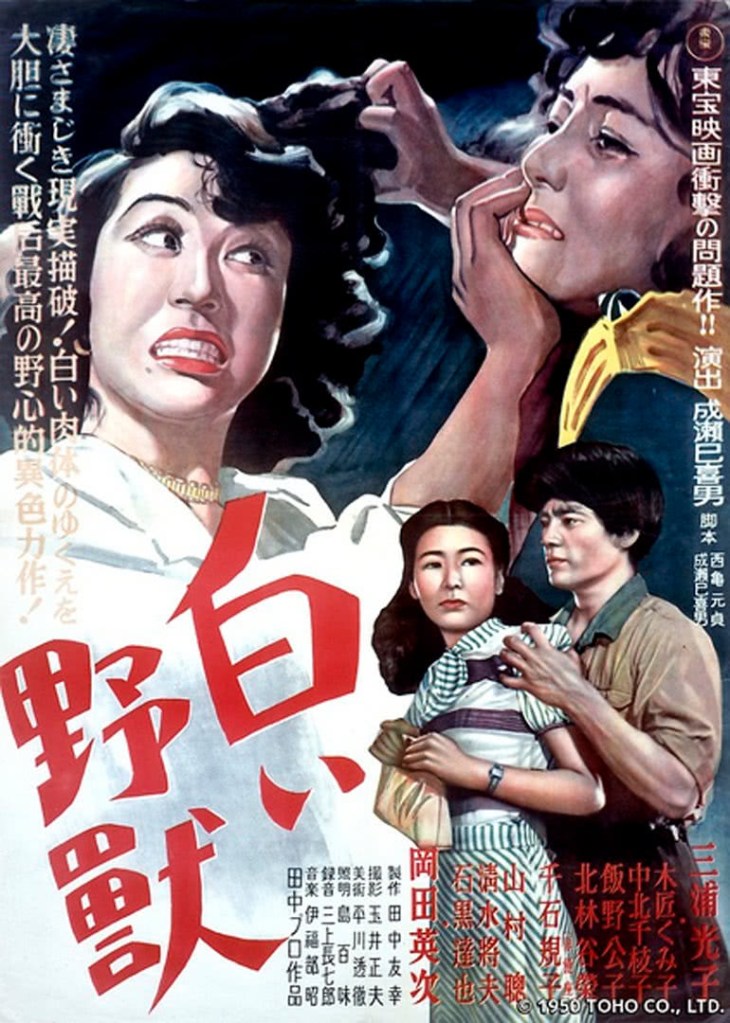
Slotting in right next to the pro-democracy films of the era, Mikio Naruse’s White Beast (白い野獣, Shiroi Yaju) is a surprisingly progressive effort which locates itself in a “home for wayward women”. The White Lily Residence is run with love and compassion and even if the older female warden is stern in a practical sort of way she is never unkind or uncaring, while the male governor Izumi (So Yamamura) is patient and supportive, always keen to tell the women in his care that they are not spoiled or dirty and are fully deserving of the bright new futures he is certain are waiting for them. Rather than lecturing the women, the home makes a point of teaching them new skills such seamstressing so that they will be able to find honest jobs on the outside, though the conviction that those jobs exist may be a little optimistic in itself. 

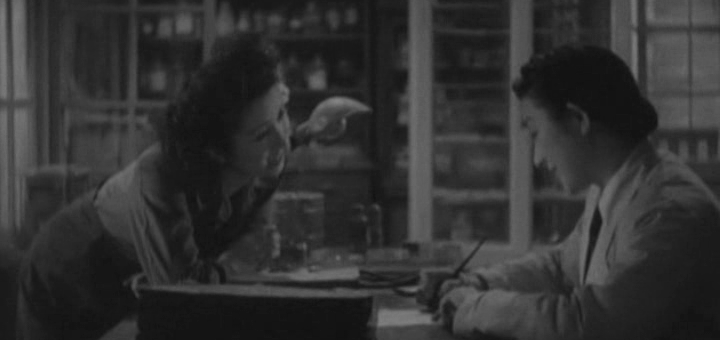
Our first introduction to the White Lily is through the eyes of Yukawa (Mitsuko Miura), an educated woman who claims she engaged in sex work simply because she enjoyed it and doesn’t see why she’s been arrested. She tries to leave and is told that she is technically free to do so, but they will have to call the police if she does. Yukawa decides to stay, especially once she locks eyes with cheerful female doctor Nakahara (Kimiko Iino). Perhaps surprisingly, the central drama revolves around an awkward love triangle between Yukawa who becomes fixated on the doctor who to be fair is unambiguously flirting back, and the bashful Izumi who has designs on Nakahara himself. 

Refreshingly direct and professional, Nakahara nevertheless has an engaging warmth that has made her a real asset to Izumi’s team as she deals with the sometimes quite difficult medical circumstances of the women at the centre, many of whom are understandably suffering with various STIs including syphilis. Never judging them she remains sympathetic and egalitarian, even joining in when Yukawa cheekily invites her to dance while some of the other women are listening to records. Appearing to understand what Yukawa is asking her, she tells her that she has remained single by choice and has no intention to marry because she’s prioritising her career. Yukawa’s confidence is, however, shaken when she hears a rumour that Nakahara and Izumi may be romantically involved. 

Yukawa looks to Nakahara to try and understand why she’s ended up at White Lily. She asks her what it means to have a “dirty” body and gets a diplomatic medical answer which nevertheless coyly places the blame on sexual repression. Nakahara admits that marital relationships can also be “dirty”, not because of infidelity but because of patriarchal inequalities – marriages in which the wife is treated as a “doll” or a “maid” for example. The answer seems to satisfy Yukawa, but Nakahara has also cut to the quick of her psychological trauma in asking her if she is not also internalising a sense of shame in secretly battling with the idea that she is somehow “dirty” because of the way she’s lived her life. 

Given her fixation with Nakahara, we might wonder what it is that Yukawa so struggles to accept about herself despite her outwardly liberated persona. Beginning to reflect on her past life, she sees the faces of the men she slept with looming over her but seems confused. Was she deflecting desire rather than embracing it, trying to prove or perhaps overwrite something? In any case, her time at the centre begins to soften her but, crucially, not towards accepting a social definition of herself as dirty but emerging with new degrees of self knowledge and acceptance. 

The one sour note in Izumi’s otherwise progressive philosophy sees him encourage one of his star pupils, Ono (Chieko Nakakita), to reunite with a man she was engaged to before the war who has just been repatriated and claims his feelings haven’t changed despite finding her at White Lily. Ono is reluctant, partly because she feels a sense of unworthiness, but also because she suspects that whatever Iwasaki (Eiji Okada) says now, he will someday hold her past against her. She’s proved right when she gets a day pass to visit him in his flat where he eventually rapes and then tries to strangle her. Ono vows not to see him again, but Izumi convinces her otherwise, as if this is all her fault, telling her that two people who love each other can work through anything, implying that it’s her job to fix his wartime trauma (if perhaps mildly implying the reverse is also true for him). For an otherwise compassionate man, telling a vulnerable woman to return to a violent partner because “love is enough” seems an oddly patriarchal gesture. 

Nevertheless, despite the late in the game swerve towards conservatism, White Beast presents a surprisingly progressive critique of an inherently misogynistic, hypocritically puritanical society. At one point, a wealthy big wig arrives to lecture the women, berating them for “bringing down Japanese womanhood” while insisting that women who justify sex work as a means of avoiding starvation are being disingenuous because most women are just “decadent” and wanting handbags etc. Yukawa, unable to control herself, fires back, asking him who it is he thinks buys their services in the first place. It’s very valid point, and one it seems few are willing to consider. 


Short clip (English subtitles)

Present.Perfect. (完美現在時, Zhu Shengze, 2019)

Live streaming has become big business in China. Locked out of the nation’s burgeoning economy, many youngsters have pinned their hopes online, seeking internet fame as a pathway towards a life less disappointing. Recent documentary People’s Republic of Desire showed us how cynical and exploitative the industry could be, how it often betrayed both viewers and stars in selling false connection and manufactured acceptance. Present, Perfect (完美現在時, Wánměi Xiànzài Shí), however, assembled from hours of live streamed content artfully regraded in crisp monochrome, shows us something else – the everyday bloggers who aren’t really in it for the money or the fame, but crave visibility and validation. 

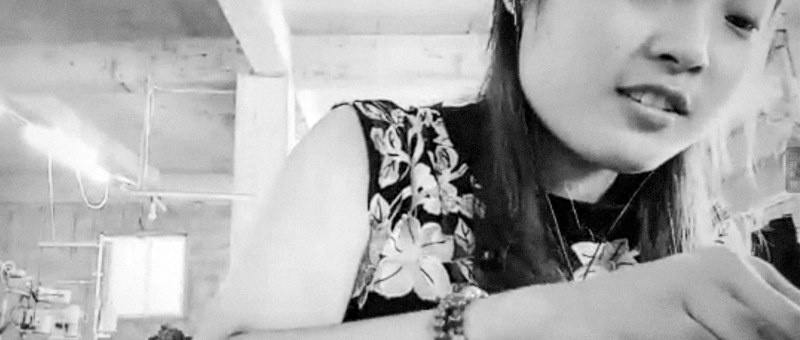
Zhu Shengze opens with a literal crane shot, scenes of construction and deconstruction as if symbolising the rapid reorganisation of the modern China. Rather than the more familiar chats, we see silent scenes of people working – men shifting bags from lorries, construction workers, later a farmer who does talk in order to tell us about his desire to found an ecological farm and invite us to experience his new “agritainment” facility. Eventually we arrive at a factory where a young woman who will recur throughout the film patiently sews underpants while chatting to her livestream followers, apparently free to do so though she admits that it decreases her productivity which is a minor problem because she’s paid by the unit. A divorced mother of a three-year-old, later seen clinging to her arm at the factory, she patiently answers repetitive questions about boyfriends and hopes for the future. 

One of many marginalised in modern China, the seamstress finds a sense of validation in the appreciation of the fans hanging out in her “showroom” and occasionally shooting her various presents by way of thanks. Not everyone is quite clear, however, about what services are exactly on offer. A dancer resists the pleas of a caller offering big bucks for a private chat hoping to persuade him to dance in the nude. The dancer offers him a different kind of ill-defined service, but encourages him to try another channel which might be more open to his particular needs. 

That kind of potential exploitation is a definite threat, but so is the callous maliciousness which all too often defines internet communication. A lonely dancer experiences trouble in the real world as a belligerent older gentleman angrily forbids him from filming in his chosen spot, but later offers a melancholy monologue about his many haters who, for some reason, are keen to insult him when all he’s ever tried to do is make them smile. The final scene of the movie finds him surrounded by a small crowd and attempting the famous Gangnam Style dance routine while the bystanders look on in silent bemusement, their eyes mostly fixed not on him but on the camera. 

Yet for all that, for those who’ve found themselves exiled from mainstream society online communication can provide an essential lifeline. One young man calmly explains that his genitals have been removed and, as a consequence, he never went through puberty and has become a 30-year-old with a child’s body. Bullied at school, he holed up at home playing video games until they too bored him. Though declaring himself “not gay”, he tells us that a crush on a male vlogger showed him a way out, that becoming a live streamer himself gave him the confidence to go out and explore the world, eventually leading a more independent life with a job in a local factory. Another man we’re introduced to was badly burned in a fire, losing his hand and sustaining significant facial scarring, itself something that attracts relentless trolling and inappropriate questions. 

In these brief windows into everyday life, what we discover is a kind of reverse voyeurism as the streamers offer up their reality in hope of connection. They are careful to remind viewers that they rely on presents, and the money comes in handy, but they aren’t planning on becoming famous or deluded into thinking they can strike it big. Some are just in it for the fun, goofing off for the camera moonwalking and sad no one seems to be interested, dancing alone to a Mandarin cover of classic ‘80s hit Dancing Hero, enlivening dull and repetitive tasks by presenting them as a kind of teaching exercise as they chat amiably with friendly strangers, calling out their names as they flash up in the showroom as if they’d just walked into a familar neighbourhood bar. Others crave a sense of validation, but all are looking for a kind of escape from a rapidly changing society built on a tenuous link to invisible strangers craving exactly the same. 


Present.Perfect. screens at the ICA from 24th January courtesy of ICA Cinema.

Festival trailer (English subtitles)

Super Express (黒の超特急, Yasuzo Masumura, 1964)

By 1964, Japan had returned to the world stage and was beginning to enter a new age of modernity as symbolised by the completion of the Shinkansen “bullet train” high speed rail network opened in time for the Tokyo Olympic Games. Behind the scenes, however, many were still trying to pull themselves free of post-war privation while others feared that the promised age of plenty had provoked a moral decline giving rise to widespread exploitation and rampant criminality. Yasuzo Masumura’s “Black” Super Express (黒の超特急, Kuro no Chotokkyu) was the last in a series of “Black” films (which also included the earlier Black Test Car) produced by Daiei in the mid-‘60s which exposed the seedy underbelly of the modern economy through tales of shady corporate shenanigans. Though in this case the hero finds himself in difficultly largely because of bad luck and his own poor judgement, he eventually exposes the cronyism and corruption which seem set to engulf the modern society. 

As the film opens, shady businessman Nakae (Daisuke Kato) approaches local real estate agent Kikyo (Jiro Tamiya) with an unusual business proposition. It seems that someone wants to build a factory on a large stretch of land currently owned by a number of farmers and other small concerns. Nakae wants to buy it up, but he’s afraid he won’t get a good price as an outsider and wants Kikyo to handle things on the ground. Kikyo is a little confused by Nakae’s intention to offer a significant sum of money to the farmers while proposing a sizeable commission to him, but eventually decides to go along with it. Everything goes to plan – it’s a not a scam, the farmers get their money, and everyone’s happy. Everyone except Kikyo, that is, who loses everything playing the stock market. It’s then he’s contacted by a disgruntled farmer who realises he might have been able to get more because it turns out the land wasn’t purchased for a factory, but for a second line on the Shinkansen. Nakae took their land and sold it on to the government at huge profit. 

Kikyo is extremely pissed off even though he was originally happy with the money he received and the reasons he lost it are nothing at all to do with Nakae. He gets straight on a train (not a Shinkansen) to Tokyo to confront him, but only gets the brush off and an offer of token hush money when Nakae realises Kikyo could cause a problem, something he is apparently keen to do because he starts connecting the dots between the elegant young woman he saw delivering envelopes to Nakae and a senior executive at the rail office. 

Needless to say, Nakae is a totally immoral, not quite conman chancer with the gift of the gab. He approached Kikyo with the job because he’d done his research and knew he’d take the bait. Kikyo already had a failed business behind him and desperately wanted to succeed. In the end he’d find it too difficult to resist the temptation of such a big contract even if he had his doubts, and his greed might prevent him asking too many questions. What Nakae didn’t bank on, however, was the depth of his resentment when he realised he’d been used and then cheated. 

“Large corporations are the new Daimyo” Kikyo tells his later accomplice, Yoko (Yukiko Fuji), Nakae’s former squeeze. He quit his salaryman job because he wanted to be his own boss, but feels like the world has pulled away from people like him, forever denying them a ticket on the Shinkansen, allowing them only to ride the now ironically named “super express”. Yoko feels something similar. She’s refused marriage after coming to the conclusion that men can’t be relied on – her father died in an accident when she was 11 after which her now bedridden mother raised her alone by working as a maid, and an ill-advised “affair” with a married university professor who took advantage of her naivety only further convinced her that she’s better off a free agent. Yoko wants total independence and the opportunity to start a business of her own, which is why she agreed to team up with Nakae to become the mistress of her boss at the rail company, Zaitsu (Eiji Funakoshi), who’d taken a liking to her and is the classic sad middle-aged salaryman with a wife suffering from TB he’d long since grown apart from. 

“There’s nothing more important than life” Nakae later grimly admits, trying to save his own skin, but it’s too little too late. Previously, he’d claimed he was “ready to commit any crime for money”, but mainly thrived on sadistic machinations setting up complex blackmail plots lined with little bombs he could set off if and when the occasion called. Kikyo takes him on at his own game, blackmailing the blackmailer, never really intending to expose the corruption only to parasitically profit from it. What he discovers is there was a much higher price to be paid than he realised because Nakae was only ever a middle man. The people at the top of the tree won’t want to pay at all and they think they don’t have to because “peasants” are expendable. Eventually turning to the police, he finds himself thanked for his service but is forced to admit that he only really wanted the money until he realised how far others were willing to go to get it. Spotting the shiny new Shinkansen rocketing past his widow seat on the super express, all he can do is lower the blind and try to get some sleep. 


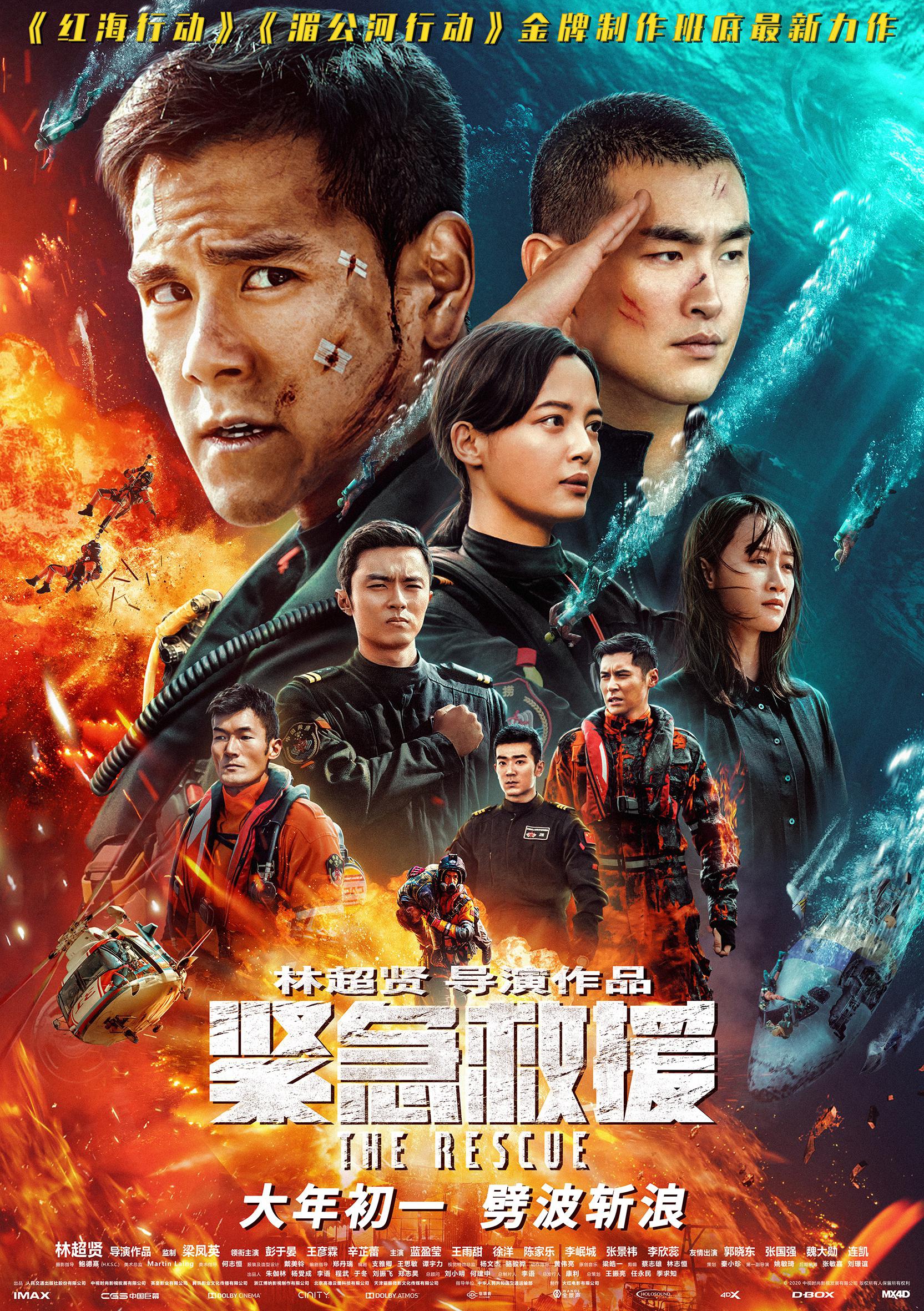
The Rescue (紧急救援, Dante Lam, 2020)

The rescue poster 3

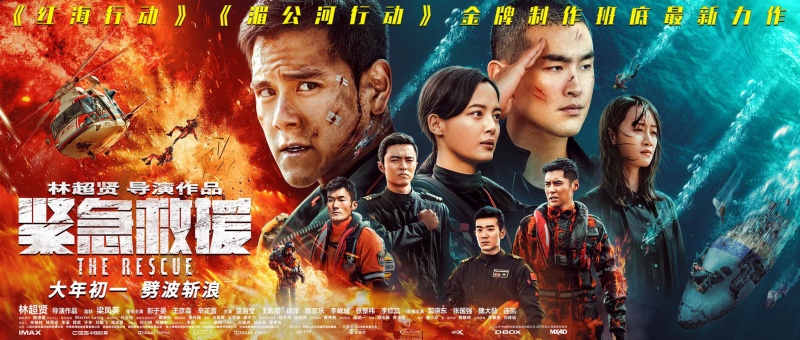
It’s tempting to see Dante Lam’s latest foray into big budget mainland action as a continuation of his previous hits Operation Mekong and Operation Red Sea which paid tribute to the police and navy respectively, but it is also the latest in a series of films featuring China’s finest bravely battling against the odds to save the day. Like Tony Chan’s The Bravest which celebrated the selfless heroism of China’s firemen as they risked their lives to stop a potentially catastrophic fire in an oil refinery, The Rescue (紧急救援, Jǐn Jyuán) pays tribute to another undersung arm of the emergency services – China’s Coast Guard.

Our hero, Captain Gao Qian (Eddie Peng Yu-yen) of China Rescue And Salvage, is a devil-may-care hero who throws himself into danger without a second thought where lives are at stake. The motto of China Rescue And Salvage is “we risk our lives to give others hope”, but some feel that Gao Qian is too reckless with his and fear that he’s forgotten that you can’t save anyone if you get yourself killed playing at heroics. That’s something that’s temporarily brought home to him when the pilot of his helicopter is badly injured during a rescue on an oil rig engulfed by flames, leaving the inexperienced co-pilot to fill-in on his behalf. Gao Qian works his magic in the nick of time, but both of the pilots quit the team immediately afterwards, the pilot struck by the proximity of death and the co-pilot by his sense of inadequacy in feeling as if he failed to live up to the job.

Luckily the team soon get a new pilot – a lady, Yuling (Xin Zhilei), who clashes with Gao Qian in true disaster movie fashion in her desire for rational action and the kind of heroics that are strictly by the book. Against the odds, however, they make a good team, eventually bonding in mutual admiration for their complementary skills. Meanwhile, Gao Qian is also dealing with some home drama in that he’s just brought his young son Congcong (Zhang Jingyi), who had been staying with his grandmother, to live with him. Congcong seems to be suffering with some kind of illness, but is otherwise cheerful enough and hoping that his dad will get him a new mum, like, for example, the beautiful Yuling.

The death of his wife, his son’s illness, and the loss of colleagues he was forced to leave behind, haunt Gao Qian like a cosmic joke, as if he’s being “punished” for snatching so many other lives from the jaws of death. No matter how hard he tries, there are lives which cannot be saved – no helicopter can rescue you from terminal illness or debilitating disease. Nevertheless, he continues to do his best no matter the personal costs. “Everyone has their own battleground, mine is rescue” he tells a superior with determination after his priorities are questioned. In training, the coach reminds the rescuers that their enemy is nature. They push their bodies as far as they can go, willingly risking all to let others know that someone is always looking out for them and will come in their time of need. Faced with certain death, Gao Qian enters an eerily beautiful existential space born of liminality in which he is perhaps able to feel everything that is to be alive while his son, fighting his own battle, does something much the same.

The strangely poetic quality of life in extremis is directly contrasted with the hokey comedy of Gao Qian’s home life and the brotherly comradeship of the base which are both much more of the typical “New Year Movie” mould. Lam fares much better than Chan in heading off the obvious melodrama, though he too resorts to the obvious foreshadowing of a young man daring to get wedding photos taken while planning to risk his life for the greater good, while the quirky production design and wholesome warmth of Gao Qian’s home life as he attempts to make the world safe for his son offer a much needed escape from the anxiety of his disaster-fuelled existence. Unlike that of Red Sea, the world of The Rescue is a more open and hopeful one in which Gao Qian does his best to save everyone who needs saving no matter their nationality, feted far and wide as a hero even if he awkwardly embodies a magnanimous China as a world protector as he does so. Nevertheless, Lam once again manages to elevate his material beyond its propagandist aims, edging towards a more ambivalent contemplation of selfless nobility and the costs of courageous endurance.


In UK cinemas from 25th January courtesy of CMC Pictures. Unfortunately, the release of The Rescue has been postponed because of the Coronavirus outbreak in China. We will update you as soon as we hear of new release date!

Original trailer (English subtitles)

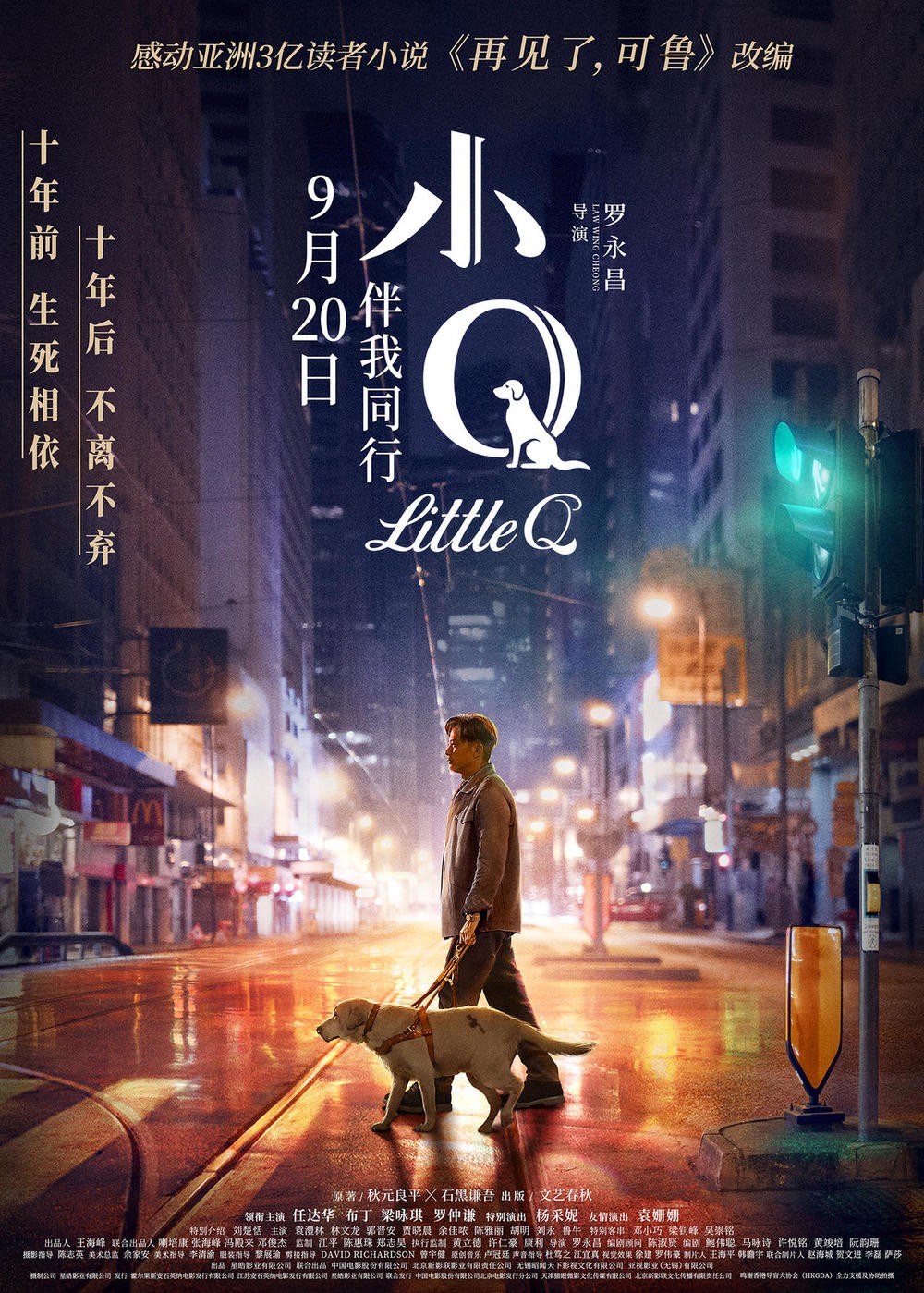
Little Q (小Q, Law Wing-Cheong, 2019)

little q poster 4You might think, in this day and age, that guide dogs are a fairly uncontroversial subject, but it might interest you to know that Hong Kong apparently has a vast guide dog deficit with fewer than 40 working in the city as of 2016 which is around one for every 4,300 visually impaired people. That might be part of the reason that Little Q (小Q, Xiǎo Q), adapted from a Japanese photobook by Ryohei Akimoto & Kengo Ishiguro, largely plays out as a feature length advert for the Hong Kong Guide Dogs Association, which is one of only two organisations training guide dogs and was set up in 2011 ending a 26-year absence of any such body.

The film charts the entire life cycle of the titular Little Q, whom we first meet literally falling into the arms of grumpy pastry chef Po-ting (Simon Yam Tat-wah). Rewinding a little, we realise that Po-ting’s sister and her vet husband are involved with the raising of guide dogs, sending Little Q off to live with his “foster family” which, perhaps irresponsibly, is in the home of plucky little girl Tsz-kiu (Jessica Liu Chutian). For those who don’t know, and as the film perhaps hopes to illuminate, guide dogs are trained in a family home by ordinary people who’ve agreed to look after them for the first 18 months of their lives, after which the dogs are given a final aptitude test and then placed with a blind person for a probationary period to assess their compatibility. Of course, agreeing to foster a dog knowing that you’ll eventually have to give it up can be emotionally difficult even for an adult, so placing that responsibility on a child is only going to lead to tears, of which there are plenty as Tsz-kiu is finally forced to accept that Little Q can’t stay with her forever because she has a greater calling.

Simon (Him Law Chung-him), the trainer/co-ordinator, promises Tsz-kiu that he’ll make sure Little Q has a lovely life with a person who truly appreciates her and that he’ll be sure to bring Little Q right back if she’s ever hurt or mistreated, but in part he knows he’s being disingenuous because they’ve already decided she’ll be going to Po-ting. Po-ting does not want a guide dog and is only getting one because of his sister’s connection to the programme. The problem is that Po-ting was always a “difficult” person. A well known TV pastry chef, he made a name for himself being mean in the way only a celebrity chef can. He has no respect for his service animal in part because he has no respect for other people, and because he was good at what he did people let him get away with it. Po-ting once cut down a contestant on the TV show by insisting that a chef must use all five senses, so he feels particularly trolled by the universe to have lost his sight and is struggling to accept his blindness. Feeling a sense of internalised shame because of his disability in addition to the fear and anxiety involved with adjusting to his new life has made him even more unpleasant and resentful than he was before. Angrily insisting he needs no additional help, he rejects and mistreats Little Q, even violently throwing her out of his well appointed home in the pouring rain.

As this is Little Q’s story, however, we only get a back seat view to Po-ting’s gradual softening as he begins to let her into his life, engineering not only a warmer relationship with his sister/partner in the pastry shop (Gigi Leung Wing-kei) but also with his apprentices, while he begins to see that the loss of his sight is only a change and not a tragedy. Through it all, Little Q is at his side, steadfastly loyal even when he tries to push her away, which is perhaps not quite the best message to be sending though it does emphasise the intense attachment that necessarily develops between a guide dog and its owner.

Law hints at an ethical dilemma in pointing out the toll taken on the dogs in the course of their work, but heads it off in reminding us that they get to “retire” and live out their final days as pampered pets while demonstrating that the reformed Po-ting breaks all the rules by playing ball with Little Q like a regular family dog. The paradox is difficult to bear as owners must act in symbiosis with their dogs, but are reminded that they’re service animals belonging to the organisation not personal pets and should something happen to them, will be shuffled on to others in need or returned to their foster families. Nevertheless, Little Q gets the best of both worlds, bonding fiercely with the grumpy Po-ting as he figures out how to live and love by following her lead.


Screened in association with Chinese Visual Festival.

Trailer (Cantonese with English subtitles)

The War in Space (惑星大戦争, Jun Fukuda, 1977)

War in Space posterThe tokusatsu movie had been Toho’s signature line since the mid-‘50s, but 25 years later it was more or less played out. The late ‘70s saw the studio diversifying into other types of populist cinema while trying to find new directions in a rapidly changing industry. 1977’s The War in Space (惑星大戦争, Wakusei Daisenso), technically a “sequel” to Ishiro Honda’s Gorath from 1962, very much exemplifies the decline while trying to meld a fairly standard Star Trek-esque tale of interplanetary conflict with Star Wars-inspired fantasy.

In the distant future of 1988, the United Nations Space Force in Japan has been having trouble contacting the space station because of continued electromagnetic interference. Miyoshi (Kensaku Morita), a former team member making an unexpected return from America, tells them that they’d been having the same problem over there and not only that, there had been a worrying increase in UFO sightings across the nation. Making brief contact with the space station confirms their fears when the pilot suddenly starts screaming about a giant Roman spaceship approaching at speed before contact is lost once again. It seems that the Earth is now under attack from an extraterrestrial invasion, and the electromagnetic interference appears to be coming from Venus.

Miyoshi reconnects with his mentor, Takigawa (Ryo Ikebe), and tries to persuade him to resume an old research project to develop a high powered spaceship known as Gohten, but he remains reluctant. Part of the reason for his lack of enthusiasm is that Miyoshi had been his best student and Takigawa still bears him some resentment for his abrupt decision to leave for America rather than staying to contribute to Japan’s future while his feelings are further complicated by the fact that Miyoshi had been in a serious romantic relationship with his daughter, Jun (Yuko Asano), whose heart was broken when he left. A Space Force employee, Jun is now engaged to fellow officer Muroi (Masaya Oki) who is glad to see his old friend Miyoshi return, but also a little anxious.

With the Earth facing imminent destruction, however, there’s little time to worry about past heartache. Takigawa finds himself forced into restarting the Gohten project when he realises that the “Venusians” can pose as regular humans by possessing their bodies. As usual, everything rests on the team pulling together to finish the mammoth project in a record three days before the aliens obliterate their base just like they’re doing to most of the Earth’s major cities. Eventually, the team realise that the aliens aren’t from Venus at all, but from another major solar system and led by a man calling himself “Commander Hell” (Goro Mutsumi) who, for some reason, is dressed like a Roman emperor. Like the Romans, their aim is colonisation. They’ve worn out their home planet and are looking to move, but want somewhere kind of the same so they’ve set their heart on one three away from the sun, like the Earth. 

Aside from the classical trappings, War in Space was apparently rushed out to cash in on the success of Star Wars and even includes a scene which seems to anticipate Leia’s capture by Jabba the Hut in Return of the Jedi when Jun is kidnapped and forced into hotpants while chained to a Chewie-esque furry minotaur carrying a giant axe, which might be mixing their classical metaphors somewhat as Jun and Miyoshi, arriving to rescue her, attempt to escape from Commander Hell’s ship. Takigawa and co. make their way to Venus to try and take out Commander Hell’s base, but are faced with a terrible choice. The reason Takigawa didn’t want to finish the Gohten project is that the ship is armed with a terrifyingly powerful, universe destroying bomb which he worries it was irresponsible of him to invent. Hypocritically, he now knows he’ll have to use it but is hoping that in doing so it will be destroyed along with everything else except perhaps the Earth.

Unlike in Star Wars, it’s the good guys who blow up a planet to save their own though at least no one seemed to be living there, only Commander Hell’s evil minions. Bowing out with a slightly more bombastic evocation of the original tokusatsu messages about the dangers of irresponsible science, War in Space is a fairly generic exercise in genre but has its moments in its bodysnatching spy aliens, groovy ‘70s production design, and charmingly earnest sincerity.


Original trailer (no subtitles)

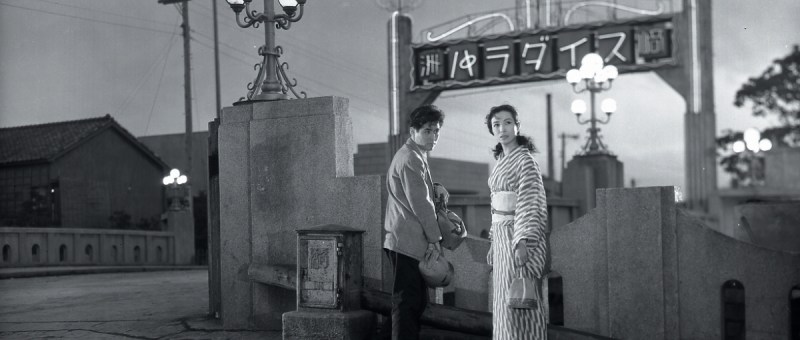
Suzaki Paradise: Red Light (洲崎パラダイス 赤信号, Yuzo Kawashima, 1956)

Suzaki paradise posterBy 1956, things were beginning to look up. Post-war privation was receding into the distance with the consumerist future already on the horizon, but as much as there were possibilities for some others found themselves floundering, unable to find direction in a world of constant change. Yuzo Kawashima’s Suzaki Paradise: Red Light (洲崎パラダイス 赤信号, Susaki Paradise: Akashingo)* was released in the same year that the anti-prostitution law came into force forever changing the face of the red light district and like its heroes finds itself hovering on a precipice caught between an old world the new.

Lovers Tsutae (Michiyo Aratama) and Yoshiji (Tatsuya Mihashi) have found themselves at a crossroads, or more accurately on a bridge, unsure whether to go forward, or back, or some other place entirely. Tsutae is disappointed in Yoshiji, expecting him as the man to have some kind of plan, while he is a little resentful of her fortitude and tendency to take the lead. Yoshiji grows maudlin and moody, berating himself for his failure of manhood, a failing for which Tsutae has little sympathy. Fed up with him, she runs off and catches a bus. He chases her, and they both get off at Susaki, home to a famous red light district. Yoshiji isn’t happy with this development, worried that Tsutae will cross the bridge and fall back into her “old self”, perhaps hinting at the kind of life she lived before. Luckily for them, Tsutae spots a help wanted sign at a tiny bar firmly on this side of the river. The landlady, Otoku (Yukiko Todoroki), is a kind woman raising her two sons alone, but is wary of handing the job to a woman the like of Tsutae. As she tells her, no one stays here long, most just see it as a stepping stone, a place where they can acclimatise themselves to the idea of crossing the bridge into the ironically named “Susaki Paradise”.   

Once you cross the bridge, most seem to say, you never really cross back. Later we learn that Tsutae is from the other side of the water and seemingly forever trying to escape her past though mostly through trying to attach herself to a man she thinks can carry her out it. Yoshiji seems to be aware that Tsutae is a former sex worker and is desperate to prevent her returning to her previous occupation, worried that he’ll lose her if she does or perhaps just unfairly judgemental. Likewise, we learn that he lost his job through some kind of impropriety, perhaps committed trying to keep Tsutae with him. Each of them is in one way or another trapped by patriarchal social codes, Tsutae believing that the only way she can save herself is by finding the right man to save her, and Yoshiji increasingly resentful for not living up to the male ideal. He can’t keep his woman, can’t provide for or protect her, most pressingly he cannot find a job but is also proud, shamed by the idea of accepting low paid manual work. He feels belittled and humiliated and is embittered by it.

Tsutae meanwhile takes to Otoku’s bar like a duck to water, quickly bringing in a host of male custom while bonding with the cheerful owner of a radio shop in nearby electronics centre Kanda, Ochiai (Seizaburo Kawazu). Otoku manages to find a job for Yoshiji delivering soba noodles in a local restaurant which he decides to take despite his intense resentment and wounded male pride. Ironically enough, the name of the soba restaurant is “Damasare-ya” which sounds like “tricked”, explaining why he might be reluctant to take the job, but the biggest problem is that he can’t trust Tsutae and is always paranoid about her meeting men in the bar or deciding to cross the bridge in his absence. Eventually, Ochiai offers to make Tsutae his mistress and provide a flat for her in Kanda, leaving her with a choice – “love”, if that’s what it is, with the feckless and jealous Yoshiji, or perfectly pleasant yet transactional comfort with Ochiai. Yoshiji, meanwhile, attracts the attentions of an earnest waitress in the soba noodle restaurant (Izumi Ashikawa) who seems to support his attachment to Tsutae but is also rooting for him to get over himself and live an honest life of hard work by knuckling down at his new job.

Yet that post-war restlessness won’t seem to let either of them go. Once you fall, you fall and it may not be possible to climb back up, or at least not without the right person to help keep you from slipping back down. Otoku has managed to keep a steady hand on the tiller, apparently waiting, we’re told, for the return of her husband who ran off with a woman from the red light district four years previously. The red light district, like toxic masculinity, cuts both ways and you’ll pay a heavy price for crossing the bridge. “People had better live honestly” a middle-aged man avows after having apparently seen the error of his ways, but it’s easier said than done.

When their worlds come crashing down, Tsutae and Yoshiji find themselves right back where they started, hovering on the bridge. “We have to live until we die” Tsutae once said, dismissing any fears we might have had that the pair might jump, but their course is both set and not. Now chastened, Tsutae’s decision to take a step back is both a reflection on the failure of her Susaki experiment, and also perhaps a mild concession to patriarchal social norms as she actively assumes the submissive role, affirming that she will follow Yoshiji’s lead while he reassumes his masculinity by finally taking charge. No longer quite so liminal they move on, another pair of floating clouds, perhaps more at home with who they are and can never be, but with no clear destination in sight.


*The reading of this place name is “Susaki” but the film has become more commonly known under the title “Suzaki Paradise”

Currently streaming on Mubi as part of an ongoing Yuzo Kawashima retrospective.

Title sequence (no subtitles)

Suspicion (疑惑, Yoshitaro Nomura, 1982)

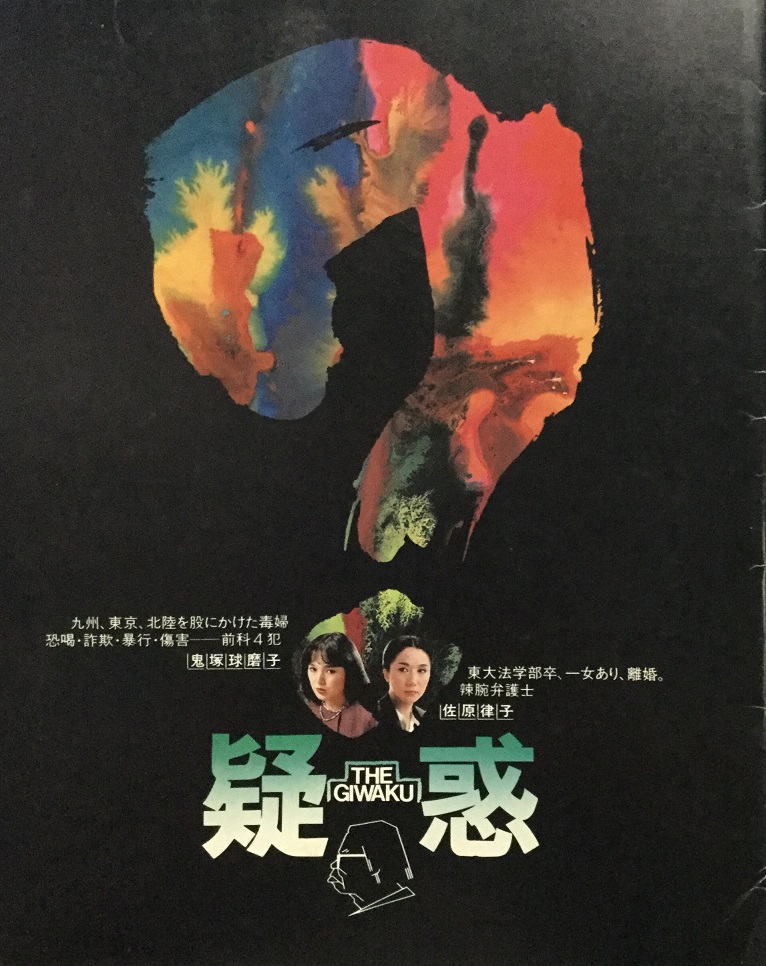
Suspicion posterBy the early ‘80s, Japan had successfully shaken off post-war desperation for burgeoning consumerism, but even as the nation rocketed into a more comfortable future, social equality proved slow to arrive. Once again adapting a novel by Seicho Matsumoto, Yoshitaro Nomura’s Suspicion (疑惑, Giwaku) makes allies of two very different women who are each in one way or another rejected by the conservative, infinitely rigid society in which they live.

Former bar hostess Kumako (Kaori Momoi) falls under suspicion when she alone survives the car accident that takes her husband’s life. A brassy, aloof woman, Kumako does not behave in the way the police might expect a recently bereaved spouse to behave which instantly turns them against her. This becomes a real problem once they discover that her husband, Shirakawa (Noboru Nakaya), was an extraordinarily wealthy man on whom she had recently taken out a number of life insurance polices. Shirakawa’s public profile ensures that the potentially salacious case is taken up by the newspapers who waste no time proclaiming Kumako a gold digging murderess while openly baying for her blood. Intimidated by the public outcry, the police are determined to charge Kumako with her husband’s murder despite the only existing evidence being extremely circumstantial.

After a prominent lawyer declines to take her case, her legal council stands down citing his poor health leaving Kumako entirely undefended. The court eventually appoints her a new lawyer, a woman – Ritsuko Sahara (Shima Iwashita), more practiced in civil than criminal law and just as much of an outcast as Kumako though in very different ways. Ritsuko has divorced her husband and he has custody of their young daughter whom Ritsuko makes a point of seeing once a month. Though the arrangement seems to suit her well enough, her status as a career woman who has “rejected” the roles of wife and mother also makes her one viewed with “suspicion” by those around her.

The central issue is indeed Kumako’s character. A former bar hostess with a traumatic childhood, Kamako has four previous convictions including assault and blackmail as well as an abrasive personality and a tendency to rub people up the wrong way. She doesn’t do herself any favours, but no kind of justice would be served if she were sentenced to death not for her husband’s murder but for the crime of being an “unpleasant” woman in a society which expects women to be docile and polite.

The papers, however, are very invested in the story of the coldblooded, gold digging murderess. Akitani (Akira Emoto), a local reporter, cosies up to the police for insider information, and does his best to root out Kumako’s sordid past including a sometime boyfriend who might have been her “pimp”. Ritsuko makes “trial by media” a key part of her defence strategy, arguing that her client’s case has been unfairly prejudiced by the image the press has sought to construct of her, but is unaware of the extent to which the police investigation has been distorted by the desire to appease the media or the various ways in which a venal press has gently perverted the course of justice in search of a better story.

Cool and efficient, Ritsuko isn’t really sure whether Kumako did it or not but is determined to ensure she is tried by the codes of law and not of conventional morality. A disgraced Akitani later barks at her that he sees no need to defend “a woman like that” in the papers, but Ritsuko’s having none of it – the purpose of the law is precisely to ensure guilt or innocence is assessed rationally on the basis of the evidence presented, as free of personal prejudice as it’s possible to be. An idealistic claim, given Japan’s famously implacable legal system, but one that sits well with a functioning democracy.

Ritsuko’s defence of Kumako is not particularly a feminist exercise, though a grudging kind of mutual respect eventually arises between the two women who have each in one sense or another rejected socially defined gender roles. While Ritsuko proclaims herself happy enough to be a mother once a month on Sundays, her husband’s new wife is a more territorial sort, eventually asking her to stop seeing her own daughter because she would rather raise her believing that she is hers alone. Kumako, however, is entirely unrepentant, even emboldened, vowing that she will continue using men until the day she dies. The two women remain mirror images of each other, both rejected, viewed with “suspicion” for the choices they have made, and forever at odds with a society which has already found them each “guilty” in the court of public opinion.


Original trailer (no subtitles)