Sada (SADA〜戯作・阿部定の生涯, Nobuhiko Obayashi, 1998)

Sada poster“Facts can easily become fiction when recounted by someone, even by oneself. But with a bit of sincerity lies can become truth”, our genial guide explains, paradoxically telling us that the heroine, a woman he regards as a loveable kid sister, wants to tell us her story herself. Apologising in advance for her “rudeness”,  he reveals to us that the woman is none other than the “notorious” Sada Abe, a woman who, apparently now forgotten, was once a front page sensation for having killed her lover and cut off his penis to carry him with her always.

Despite the narrator’s claims that Sada’s fame has faded, her story has proved fertile cinematic ground, most famously inspiring Oshima’s In the Realm of the Senses which sees her claustrophobic descent into sexual obsession as a reaction to the intense austerity of militarism. Obayashi, however, is keen to remember that that aside from the newspaper headlines, the salaciousness and peculiar romanticism of her story, Sada was a real woman who suffered in an intensely patriarchal society and was perhaps seeking something that the world was unable to give her.

As she reminds us, Sada too had a childhood. Obayashi opens the film with a young Sada innocently throwing hoops over a tall phallic object. Six years later, her life changes when a college boy drags her off the street into a nearby inn and rapes her, claiming that she is well known as a good time girl and that he is perfectly entitled to behave in the way he is behaving. Deed done, the college boy leaves but Sada (Hitomi Kuroki) is rescued by the gentlemanly figure of sickly medical student Okada (Kippei Shina) who has a patch over his eye and a romantic disposition. Okada gives her not only a lifelong and strangely erotic attachment to donuts, but a junai foundation in an eternally unrealisable longing for a pure and innocent love.

Okada, as Obayashi later tells us, is also a “real” person though he has no real evidence that he and Sada ever crossed paths. He gives her the knife she will later use to sever her lover’s penis and tells her to use it to cut out his heart, which belongs to her. Okada, claiming that he will forever watch over her, introduces a secondary theme in that he is a sufferer of Hansen’s disease, or leprosy, then thought incurable and “treated” only by exile. Sada loses her pure love and never knows why, but sadly chooses not take his advice to remember that she is an honest girl and refuse to be corrupted by her trauma. Now unable to marry and it remaining a virtual impossibility to enter any other kind of profession, Sada becomes a geisha, later giving that up for the more lucrative world of casual sex work.

Perhaps ironically, it’s through her life as a sex worker that Sada begins to find a degree of freedom amidst the impassioned atmosphere of increasing militarism. While the men are caught up in destructive games of martial glory, Sada is just trying to live her many lives and dreaming her dream of love. It’s that dream of love that brings her to Tatsuzo (Tsurutaro Kataoka), a married, poetic ladies’ man with whom she eventually retreats into an isolationist kingdom of two. Yet their intensely co-dependent relationship is never quite enough for her because it fails to marry her physical need with the emotional, and the figure of Okada, the innocent, romanticised white knight of her youth, lingers in her mind. Sada kills Tatsuzo not quite by accident, attempting to take ownership of something which can never be hers in her fiercely patriarchal world where her clients coldly chide her for not being “polite” enough and despite the earning potential of her profession, she remains dependent on men to escape it.

Sada’s “crime” might not quite be revenge for all she’s suffered but it is a pointed act of rebellion towards a conformist society. She laments that her notoriety soon faded, that if being forgotten is like dying then she died long ago, but for a short time all of Japan was captivated not by the outrageous horror of her transgression but by an idea of “romance” that stood behind it as if Sada had moved beyond double suicide into new territories of eternal love through seeking to possess her lover even in death. The narrator, Sada’s sometime pimp, tells us that few remember Sada now and suggests that Japan is once again in a dark age, stopping only to remark that people were beautiful then too despite or perhaps because of the darkness. Fittingly the figure of the “real” Sada retreats and we’re left again with her legend, an imagined future for a woman who faded into pre-war tragedy as a symbol of its dangerous intensity. Even so, Obayashi is intent to show us that there was indeed a woman named Sada Abe who found herself at the mercy of her times but tried to live all the same, dreaming of impossible love in a world of corruption.


Original trailer (English subtitles)
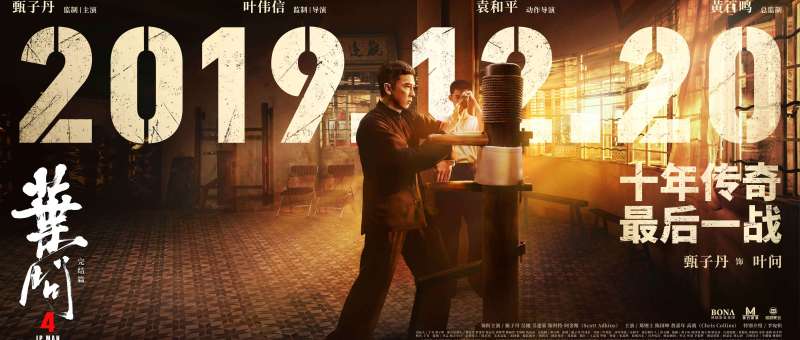
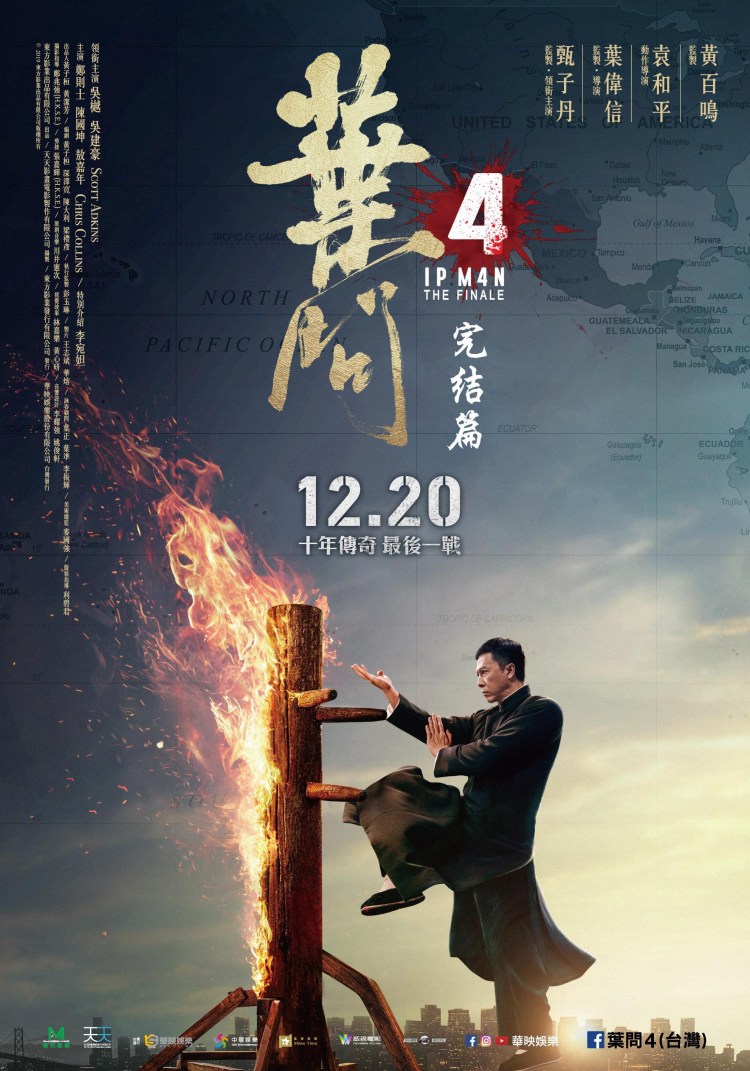
Ip Man 4: The Finale (葉問4:完結篇, Wilson Yip, 2019)

Ip Man 4 poster 1Superhero movies may be undergoing something of a complex reevaluation of late, but you can’t deny that they often come in unexpected forms. Ip Man, the man who made Bruce Lee, has himself become a mythical figure, a kind of kung fu saint defending ordinary Chinese people from oppressors and bullies. All heroes, however, must eventually meet their end. Ip Man 4: The Finale (葉問4:完結篇) brings the Donnie Yen starring series to a bombastic close with Ip seemingly facing off against the rising populism of the present day by kicking back against racist aggression in the San Francisco of 1964.

Why would Ip be in San Francisco, you ask? Because Bruce Lee (Danny Chan Kwok-kwan) invited him. Rewinding a few minutes, we discover that Ip has recently been diagnosed with throat cancer which is why he politely declines Bruce’s offer to pay for him to fly to the US to see him in a karate tournament. Personal matters, however, change his mind. His wife now passed away, Ip is struggling to connect with his increasingly rebellious son Jin (Jim Liu) who has been expelled from school for fighting. All Jin wants is to study kung fu like his dad, but Ip doesn’t approve. The headmaster advises him that unruly kids might do better abroad and so Ip decides to visit Bruce and check out schools in the US in the process, but he quickly runs into trouble on learning that the elite private institutions of the area require a recommendation from the Chinese Benevolent Association. The CBA are of the opinion that Chinese martial arts are for the Chinese people and are very angry about Bruce Lee’s determination to teach them far and wide. They were hoping Ip could talk some sense into his former pupil, but Ip is firmly on Bruce’s side. He too believes that martial arts should be a bridge between peoples, not a secret weapon preserving its mystique to intimidate.

This central divide becomes the film’s axis with head of the CBA Wan (Wu Yue) gently reminding Ip that he does not live in the city and is ill qualified to comment on local politics while advocating a gentle path of quiet appeasement. Wan clashes with his feisty daughter, Yonah (Vanda Margraf), who wants to be a cheerleader but faces constant micro aggressions from the openly racist rich kids at the same elite high school Ip wants to send Jin to. Yonah disagrees with her father’s turn the other cheek philosophy and longs to use the martial arts she didn’t particularly enjoy learning for their real purpose, later bonding with Ip after he steps in to frighten a group of posh thugs who attacked her on instruction from her rival on the cheerleading team.

The anti-racism theme slowly dovetails with the mirrored threads of failing fatherhood as Ip realises that he has made all the same mistakes as Wan. Yonah is impressed by Ip’s aura of quiet authority and spiritual power, instantly striking up a kind of paternal relationship with him, but offers cutting critique in casually echoing Jin’s words in complaining that her father has never supported her. Facing his mortality, Ip wanted to ensure his son’s independence as quickly as possible, but refused him the independence of deciding his own future. Eventually he realises that the only way to atone for his failure as a father is to pass his knowledge on while he still can, but a key part of that is that a martial artist must stand up to injustice wherever they see it, which is pretty much everywhere in San Fransisco in 1964.

Somewhat incomprehensibly, the great evil this time around is a group of massively racist karate enthusiasts who like to shout racial slurs at the practitioners of Chinese kung fu. Granted massive racists are not known for their critical thinking abilities, but no one seems to have told them that karate was not born in America which makes their animosity towards kung fu all the stranger. Yet, just as Ip and Bruce had suggested, martial arts can indeed be a bridge as Bruce discovers in besting a promising challenger in an alleyway and getting a big thumbs up in return.

Not everyone is as easily won over, however. Ip’s final battle against a crazed marine instructor (Scott Adkins) plays out as if he really has defeated racism in America by punching out a meat headed bigot with fatherly righteousness which is, however you look at it, a little on the flippant side. It also, of course, plays into the persistent “just stay in China” message of contemporary Chinese cinema, but nevertheless presents a slightly subversive front in clumsily uniting the oppressed population of the city under Ip’s revolutionary banner in opposition to entrenched racism, classism, corruption, and nepotism. Awkwardly delivered perhaps, but you can’t argue with the broadly positive plea for cultural exchange and international co-operation as the best weapons against injustice.


Currently on limited release in UK/US cinemas courtesy of Well Go USA.

International trailer (English subtitles)

Blue Ribbon Awards Announces Nominations for 62nd Edition

Katsuben still 1Presented by film critics and writers in Tokyo, the Blue Ribbon Awards has announced its nominations for the 62nd edition which honours films released in 2019. In addition to nominating a “best” picture, the best film long list will also be whittled down to a “best 10” when the polls close later this month. Winners are usually announced in advance of the prize giving ceremony which this year takes place on 18th February.
Best Film / “Best 10” 

This slideshow requires JavaScript.

  • The Great War of Archimedes – wartime drama from the director of The Eternal Zero starring Masaki Suda as a maths genius trying to expose corruption in the military.
  • Welcome Back, Tora-san – 50th anniversary tribute to Yoji Yamada’s long running Tora-san series.
  • It Feels So Good – steamy drama from screenwriter Haruhiko Arai in which a bride-to-be (Kumi Takiuchi) reconnects with an old flame (Tasuku Emoto)
  • Talking the Pictures – Masayuki Suo’s tribute to the age of the “benshi” silent movie narrator.
  • Hit Me Anyone One More Time – latest from Koki Mitani in which a man gets a blow on the head and loses his memory only to be told he is actually the prime minister of Japan!
  • Kingdom – “wuxia” manga adaptation from blockbuster maestro Shinsuke Sato.
  • The Confidence Man JP – big screen outing for a TV drama starring Masami Nagasawa as a conwoman.
  • The Bucket List – Isshin Inudo’s remake of the US comedy starring Sayuri Yoshinaga and Yuki Amami as two terminally ill women who find the bucket list of a 12-year-old girl and decide to follow it.
  • 12 Suicidal Teens – 12 depressed teens meet in a disused hospital to die but discover new will to live after investigating a murder.
  • The Journalist – political thriller starring Shim Eun-kyung as a reporter attempting to expose governmental corruption and Tori Matsuzaka as a conflicted civil servant.
  • Typhoon Family – family drama in which siblings reunite 10 years after their parents robbed a bank and disappeared.
  • Weathering with You – latest animation from Makoto Shinkai in which a boy runs away from home and meets a girl who can control the weather.
  • Fly Me to the Saitama – broad comedy in which the residents of Saitama have become an oppressed minority.
  • Sea of Revival – drama from Kazuya Shiraishi in which a man moves back to his partner’s home town but finds that trouble follows him.
  • Another World – Three high school buddies reunite in their small-town home hoping to restore the easy bond of their adolescence while battling middle-aged disappointment in the latest from Junji Sakamoto.
  • One Night – drama from Kazuya Shiraishi in which a scattered family reunites 15 years after one traumatic night.
  • Closed Ward – drama in which a murder occurs at a psychiatric hospital.
  • Masquerade Hotel – mystery starring Takuya Kimura as a detective working undercover at a hotel where he clashes with front desk manager Masami Nagasawa as they try to catch a serial killer.
  • Listen to the Universe – adaptation of Riku Onda’s novel following four aspiring concert pianists directed by Kei Ishikawa (Gukoroku: Traces of Sin)
  • From Miyamoto to You – sequel to a TV drama directed by Tetsuya Mariko (Destruction Babies) starring Sosuke Ikematsu as a shy salesman who falls for Yu Aoi’s office worker.

Best Director

Best Actor

  • Shingo Katori (Sea of Revival)
  • Masaki Suda (The Great War of Archimedes)
  • Kiichi Nakai (Hit Me Anyone One More Time)
  • Ryo Narita (Talking the Pictures)
  • Tori Matsuzaka (The Journalist, Iwane: Sword of Serenity)

Best Actress

  • Yu Aoi (A Long Goodbye)
  • Masami Nagasawa (The Confidence Man JP)
  • Fumi Nikaido (Fly Me to the Saitama)
  • Mayu Matsuoka (Listen to the Universe)
  • Riho Yoshioka (Blind Witness)
  • Sayuri Yoshinaga (The Bucket List)

Best Supporting Actor

  • Go Ayano (Closed Ward)
  • Itsuji Itao (My Father, the Bride; The 47 Ronin in Debt)
  • Kiyohiko Shibukawa (Another World, Closed Ward)
  • Ryo Narita (Chiwawa, Fly Me to the Saitama, Farewell Song, No Longer Human)
  • Tori Matsuzaka (Listen to the Universe)
  • Ryo Yoshizawa (Kingdom)

Best Supporting Actress

  • Yuki Amami (The Bucket List)
  • Chizuru Ikewaki (Another World)
  • Nana Komatsu (Samurai Marathon, Closed Ward)
  • Masami Nagasawa (Masquerade Hotel, Kingdom)
  • Mayu Matsuoka (One Night)
  • MEGUMI (Typhoon Family; Little Nights, Little Love; One Night)

Best Newcomer

Sources: Eiga Natalie, Sports Hochi

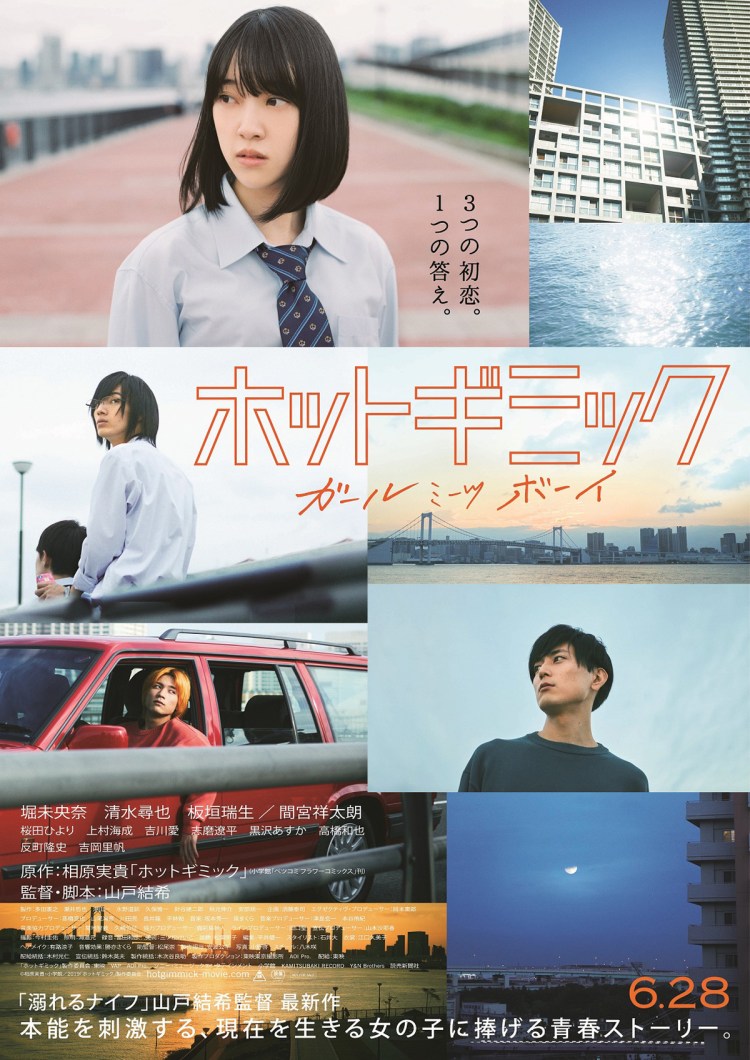
Hot Gimmick: Girl Meets Boy (ホットギミック ガールミーツボーイ, Yuki Yamato, 2019)

Hot Gimmick posterStrangely enough, shojo manga adaptations can in fact be among the most problematic exercises in contemporary Japanese cinema. Targeted very specifically at adolescent girls, the romantic world that they present is often consumed by its own sense of blind innocence as the shy heroine eventually finds love with a “handsome prince” who, though sometimes an inappropriate figure, is either improbably gentlemanly or a “difficult” Mr. Darcy type who more or less bullies her into submission. Yuki Yamato’s adaptation of Miki Aihara’s Hot Gimmick, given the subtitle “girl meets boy” (ホットギミック ガールミーツボーイ), however, seems to be well aware of the genre’s uncomfortable tendency to reinforce conservative social norms and normalise unhealthy relationship dynamics, even if it perhaps fails to entirely reject it in its broadly positive yet ambivalent conclusion.

Innocent and naive high schooler Hatsumi (Miona Hori) has been charged with secretly picking up a pregnancy test for her younger yet much more worldly sister Akane (Hiyori Sakurada) who ends up losing it on their way home from school. Unfortunately, it’s found by a schoolmate, Ryoki (Hiroya Shimizu), who uses it to blackmail her, forcing her to become his “slave” or he’ll send the test straight to her mother. For reasons not entirely clear besides her natural diffidence, Hatsumi goes along with it but is still carrying a torch for a childhood friend, Azusa (Mizuki Itagaki), who has since gone on to become a top idol. Unbeknownst to her, Azusa has in fact returned, apparently missing them all at the estate where he used to live. Increasingly terrorised by Ryoki, Hatsumi is more worried that Azusa will get the wrong idea and assume she is romantically involved with him. Meanwhile, her brother Shinogu (Shotaro Mamiya) is worried about both guys, overprotective in a disappointingly patriarchal way.

This is indeed a very patriarchal world. Unlike her sister, Hatsumi is romantically naive and terrified of the consequences of someone finding out about the pregnancy test even if Akane is fairly unfazed, simply brushing off questions from her mother by implying that someone is probably playing tricks on them. Hatsumi is preoccupied with the nature of “cuteness” and intensely insecure, which is perhaps why she allows herself to go on being manipulated by Ryoki even while knowing that is exactly what he’s doing. “I’m just stupid and unattractive” she’s fond of saying, fully believing that she has no right to her own agency because she is unable to see her own worth.

That essential insecurity seems to make her a magnet for all the creepy guys in a 10 mile radius. Talking to another somewhat imperfect boy, Akane tells him that guys like girls like Hatsumi who seem “vulnerable”, lamenting for a moment that that’s something she definitely is not (ostensibly, at least), but stopping short of reflecting on how dark a comment that might actually be or how the whole concept of “kawaii” is built on the idea of disempowered femininity. Azusa, who is originally posited as the “innocent” love interest, later turns out to be anything but, while Ryoki is later redeemed (to a point) in leading Hatsumi towards an awareness of an agency over her own body, while she, again problematically, turns to her protective brother rather than engage with the various ways in which all three guys have continually misused and manipulated her.

A intense subplot concerning the legacy of illicit romantic relations in the previous generation binds all of the troubled teens inside a net of moral resentment in which they embrace a kind of conservatism they reject their parents for rejecting. They are all, in a sense, attempting to break free of familial legacies, but find themselves paying for their parents’ mistakes while the parents themselves remain more or less absent, occasionally resurfacing to enforce obedience through shame. What Hatsumi comes to realise, however, is that the lesson they were teaching her was not quite wrong but misguided. Where they told her that she should guard her body because not to do so was shameful, she discovers that there is power in owning herself, that she is free to decide what she does and does not do with her body and has the right to grant or refuse access to it.

Nevertheless, her final sense of empowerment is undercut by her continued relationship with Ryoki who, while perhaps growing to accommodate a less misogynistic world view, is still a boy who tried to make her his slave and repeatedly calls her stupid even if eventually agreeing that the whole world turns in her. Yamato’s stylish visuals add to the sense of absurdity which defines the closing moments as Hatsumi at once affirms an awareness of herself as a being with worth and agency, yet also embraces her “stupidity” as she takes her first few diffident steps towards an assurance of adulthood.


Currently available to stream via Netflix in the UK (and possibly other territories)

Original trailer (no subtitles)

Send Me to the Clouds (送我上青云, Teng Congcong, 2019)

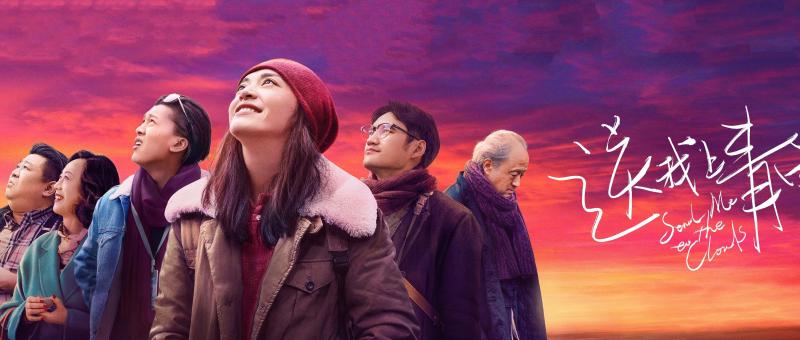
Send me to the clouds posterWomen hold up half the sky, Chairman Mao once said, but in contemporary China sexual equality is an unrealised dream of a previous era. The debut feature from Teng Congcong, Send Me to the Clouds (送我上青云, Sòng Wǒ Shàng Qīngyún) follows one “left-over” woman as she attempts to assert her independence in a world which still expects her to accept her subjugated position in a male dominated society by marrying and subsuming herself within a man’s career.

Ageing investigative journalist Shengnan (Yao Chen) whose name literally means “surpass men” has a cynical eye and fiercely independent nature but is struggling to make a living while protecting her integrity in an increasingly acquisitive culture. Getting kicked in the stomach by a “nutcase” while looking for evidence to support her theory that a local wildfire was started by a politician hoping to capitalise on successfully putting it out forces her to make a long delayed trip to the doctor who tells her that the pain in her abdomen is a result of advanced ovarian cancer and that she needs expensive surgery as quickly as possible.

As she’s been keen to ensure she acts ethically, ready money’s something Shengnan doesn’t have a lot of. Confiding in her cynical, ambitious best friend Simao (Li Jiuxiao) who has no such scruples, Shengnan finds him unwilling to help because, after all, there’s a chance Shengnan might die anyway which would mean it’s a bad investment because she won’t be able to pay him back. He does, however, offer her a job ghostwriting an autobiography for the eccentric father of the local official she was just in the business of exposing for shady double dealing. Understandably she doesn’t want to take the job and decides to try asking her parents without disclosing what the money’s for. Shengnan’s skeevy industrialist father (Shi Qiang), however, is currently losing out in the precarious Chinese economy and actually deigns to ask Shengnan for a loan before she can even broach the subject leading to a spiky father daughter argument. Shengnan has to take the job and throw her lot in with Simao even if she doesn’t feel quite right about it.

Simao cynically affirms that a problem which can be solved with money isn’t a problem, but unlike Shengnan he has no qualms about bowing before power if he feels there’s something to be gained by it. Shengnan nearly blows the gig when she takes offence to the official’s extremely condescending attitude but does after all have little choice given that her life is on the line. Meanwhile, the job is further complicated by the unexpected arrival of her mother (Wu Yufang) who decides to tag along while feeling neglected seeing as her now estranged husband is having yet another affair leaving her entirely alone in a culture which expects women to go back in their boxes until the menfolk want to take them out.

Shengnan and her mother come from very different generations, but in essence not much has changed. Shengnan’s mother married young and had her only daughter at 19 only to see her husband tire of her and the deeply entrenched idea that a woman’s career is a home and family exposed as a fallacy. Shengnan meanwhile was born during China’s reformist period and told that she had total equality only to be frequently criticised for her “manliness” in her desire to assert her independence. On visiting the doctor she displays worryingly little awareness of her health in her confusion regarding the cause of her cancer, stating that her love life ended years ago, but even if she’s quick to roll her eyes at Simao’s insensitive story about a woman who had the surgery and found it ruined her sex drive eventually decides she’d like to have one last hurrah with someone she really likes only to have her proactive stance on female desire rejected as unfeminine.

Yet this hyper capitalistic, intensely sexist environment is also harming men as Shengnan discovers in her unsatisfying encounters both with Simao and with a philosophical photographer she meets on a boat. Shengnan develops an attraction for Guangming (Yuan Hong) because of his softness and seeming desire to see further than others but eventually he disappoints her, trapped as he is by a hierarchal system to which he can offer only token resistance while hating himself for his cowardly complicity. Simao meanwhile has jumped headlong into the consumerist dream, obsessed with getting rich and not particularly caring what he has to do to make that happen.

The most meaningful connection Shengnan makes turns out to be with the subject of her biography, a randy 80-year-old poet (Yang Xinming) who quickly sets about romancing her mother with a series of cryptic text messages. The old man knows his son is a “complete moron” and even changed his name to something bland and commonplace so that the police might arrest someone else by mistake if he got caught while committing a crime, but has a sort of exasperated love for him and for the world that transcends his failing body and worldweary philosophy. Thanks to his refreshing earthiness, Shengnan starts to see a way forward, once again claiming her independence and resolving to live her life in the way she chooses for as long as it lasts while the men around her largely crumble under the weight of social expectations and a rampantly capitalist society.


Send Me to the Clouds  was screened as part of the 2019 London East Asia Film Festival.

International trailer (English subtitles)

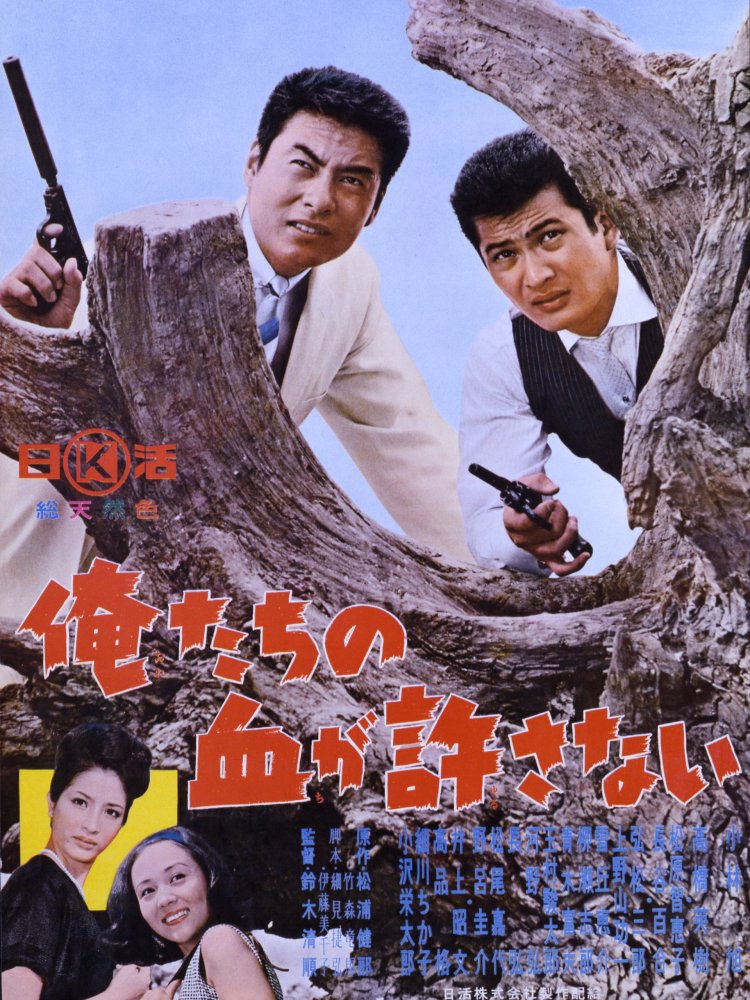
Our Blood Will Not Forgive (俺たちの血が許さない, Seijun Suzuki, 1964)

Our blood will not forgive posterIn Japan, “kaeru no ko wa kaeru”, or “a frog’s son is also a frog”, is an often heard idiom, sometimes disparaging but often affectionate. Can a yakuza’s son become anything other than a yakuza, or does your blood define you in ways you cannot defy? Our Blood Will Not Forgive (俺たちの血が許さない, Oretachi no Chi ga Yurusanai), an early semi-absurdist gangster drama from Seijun Suzuki’s mid-period at Nikkatsu, asks just that question as two brothers battle the legacy of their slain father whose dying wish it was that the yakuza line die with him.

After their father was assassinated at home by sword, the Asari brothers were raised by their mother, Hatsu (Chikako Hosokawa), who did her best to keep them out of the underworld. After the war, however, times were tough. Older brother Ryota (Akira Kobayashi) had to work as a delivery boy to keep the family fed, studying hard at the same time and getting in to a good university. Now grown up, he’s a smart suited night club manager. His younger brother Shinji (Hideki Takahashi), meanwhile, is a clownish goof-off with a good job at an ad agency he’s always in danger of losing (like a fair few jobs before). Today, Shinji was meant to collect his bonus, but he’s bunked off to take part in a local festival which is unfortunate, because he’s got a visitor – Tobita (Akifumi Inoue), the man who killed their father without knowing why and now regrets it. He’s managed to track Shinji down thanks to the fact he looks just like his dad and has a habit of doing stupid things that get his picture in the papers like winning eating competitions and getting lucky on the horses only to get mugged outside.

Tobita’s desire to apologise to the boys exposes their father’s sordid yakuza past and forces them to deal with the legacy of their gangster blood. Though Ryota is more sanguine and simply declares that he “hates all yakuza” before asking Tobita to leave and never come back, Shinji immediately attacks him but then becomes enamoured of the romanticism of the gangster life and considers restarting the Asari clan after getting fired when a picture of him fighting with thugs on the company away trip makes the papers with the headline “yakuza’s son”.

The central irony is that Ryota, who was his mother’s favourite and ostensibly the steady, respectable son, has secretly been a yakuza for quite some time. The club he runs is a yakuza front, which is why he tries to talk Shinji out of trying to get a job there, leading him to feel rejected enough to have too much to drink and start a bar fight, causing problems for Ryota with his boss.

“All yakuza are the same,” Ryota confesses to Shinji as they argue in a car incongruously surrounded by roaring waves, “they’re violent because they’re afraid”. Despite graduating from Tokyo University, Ryota couldn’t get an honest job because they always found out his dad was a yakuza. Out of other options, he decided he had no other choice but to become one too, that he could not escape his blood but might be able to make sure his brother could. Shinji has romantic dreams of the yakuza lifestyle (his bedroom wall’s covered in pictures of Al Capone et al), but Ryota knows what it means, which is why he hates all yakuza, including himself. He’s planning to marry his secretary girlfriend, Yasuko (Chieko Matsubara), but his emotions are so corrupted that he isn’t quite sure if he really loves her or is only making a bid for respectability as a kind of atonement to his mother. In any case, he also feels guilty, knowing that just as his father eventually made his mother miserable, no woman can be happy with a yakuza.

“Yakuza are so stupid, you’re all obsessed with dying – what’s the point?” Shinji eventually exclaims, finally thoroughly disillusioned as his brother goes out in search of an honourable ending rather than trying to escape from certain death at the hands of his vengeful boss. “It may not be easy to live, but there’s nothing honourable about dying!” he tells him, undercutting a series of cultural signifiers, but finally crawling out of the yakuza trap and vowing to live on muddling through with his mother and perky girlfriend, Mie (Yuri Hase) whose birthday party he’s currently missing. Blood does not forgive, but it does eventually release if only you can learn to see it for what it is and choose to be free of it.


Opening (no subtitles)

12 Suicidal Teens (十二人の死にたい子どもたち, Yukihiko Tsutsumi, 2019)

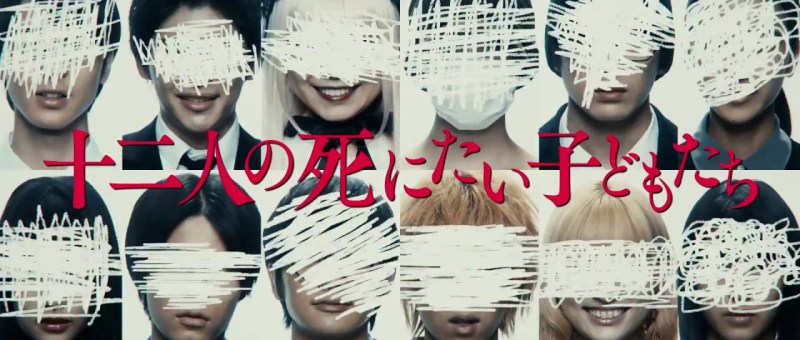
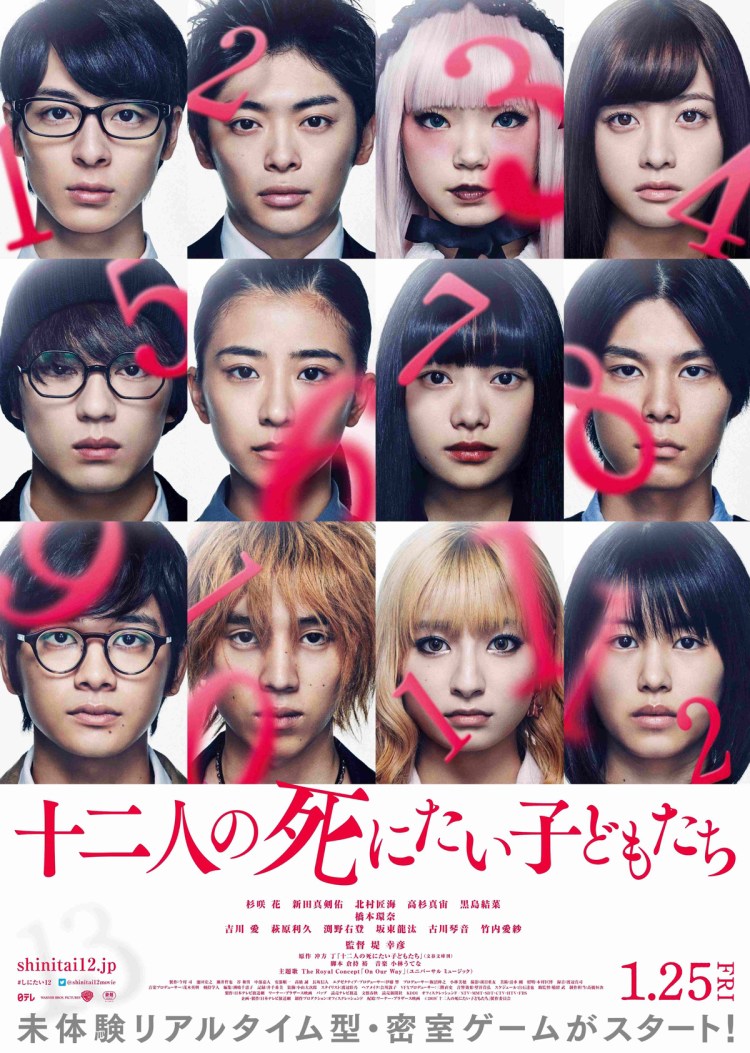
12 Suicidal Teens posterJapan has a relatively high suicide rate, but even so the number of people taking their own lives had been steadily decreasing, hitting a 22-year low in 2016. Conversely, youth suicide rates peaked, hitting a 30-year high. Inspired by Tow Ubukata’s novel, 12 Suicidal Teens (十二人の死にたい子どもたち, Juni-nin no Shinitai Kodomo-tachi), as the title implies, sees a dozen high school students forming a kind of club in which they will take the decision to live or die as a group, ironically undercutting the sense of powerlessness which has led them to the conclusion that they have no other choice other than death.

Ringleader Satoshi (Mahiro Takasugi) has recruited 11 likeminded souls and furnished them with complicated instructions involving a series of secret codes granting them access to a basement meeting room in an abandoned hospital. The 12 dutifully make their way into the building, but a surprise is waiting for them. When the first guest arrives, a young man is already lying in one of the 12 beds arranged around the edges of the room, apparently having jumped the gun, dead or dying after taking a large amount of sleeping pills. Everyone concludes he must be the event’s organiser, only for Satoshi to suddenly arrive and attempt to “open” the meeting at which they’re supposed to discuss the issues thoroughly so they can be sure they’re making the right decision. Because of the unexpected 13th guest, a decision is taken to postpone the discussion until after they figure out what’s going on.

Part of the reason for that is less curiosity than a kind of resentment. The teens are worried that their own deaths maybe misunderstood or misused if they’re discovered with this randomer in their midst. What if he’s the victim of a serial killer and everyone thinks they are too, never getting the message that each of them was desperate to send with their deaths? One young man who is dying to get back at a neglectful mother by denying her a life insurance pay out is worried it might backfire and she’d end up quids in if the police decide he’s a murder victim and not a suicide. He decides to live (for the moment at least) almost all out of spite.

Spite is, it seems, a powerful motivator in one sense or another. What most of our teens want isn’t really death but freedom, an end to pain or suffering. Suicide rates spike in September because bullied students can’t bear the thought of returning to school. Bullying is indeed the reason one of our teens wants to die, only the instigator was a teacher who led his class to victimise an innocent student solely for the crime of being an “annoying” person. Another teen, meanwhile, was bullied until he finally snapped, pushing his aggressor down a flight of stairs. Unable to live with the guilt, he too feels he can’t go on.

For the girls, the lack of control is all the more obvious. One young woman walks around with a surgical mask covering her face, not because she’s hideously burned but because she’s fantastically beautiful. One of Japan’s many celebrity idols, she’s on the cover of a thousand teen magazines but doesn’t recognise herself in the images that she sees and resents the way in which her existence is micromanaged by others. She wants to die as a means of seizing her own agency, to prove that her life and her individuality were valid and mattered as distinct from the fake persona created by her managers. Her fame endangers the mission of the group’s most emo member who declares that the mass suicide should be bomb detonated under an indifferent society, that she’s dying to reject her existence and rebelling against having been born.

Like some of the others, she’s a survivor of abusive parenting and resents having been given a “meaningless” life. A few of the other teens feel the same but for different reasons, they are suffering longterm or terminal health conditions and resent both their fates and being forced to live on without hope. They choose death now to prove they have a choice and are leaving on their own terms, not those of the universe.

Eventually the conclusion that they come to is that to live is also a choice. Working together to solve the mystery of the unexpected guest, they begin to understand a little of each other’s lives and their own, bonding in a shared sense of futility that slowly drifts into a rejection of the nihilism that had convinced them that their only choice was death. A strangely uplifting experience, 12 Suicidal Teens is a dark celebration of life that makes a virtue of endurance and finally finds meaning in commonality and the simple joy of empathic connection.


Original trailer (no subtitles)

The Wandering Earth (流浪地球, Frant Gwo, 2019)

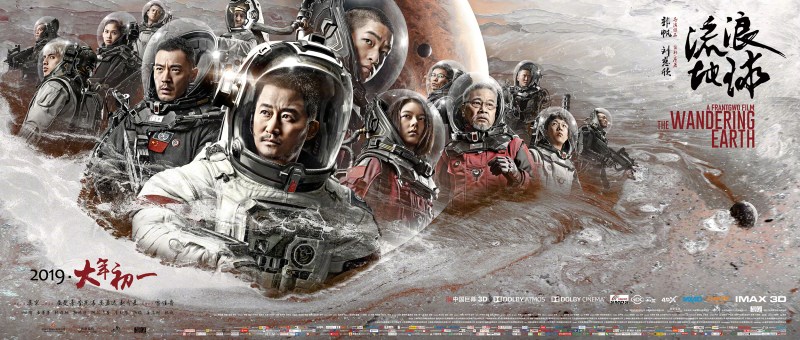
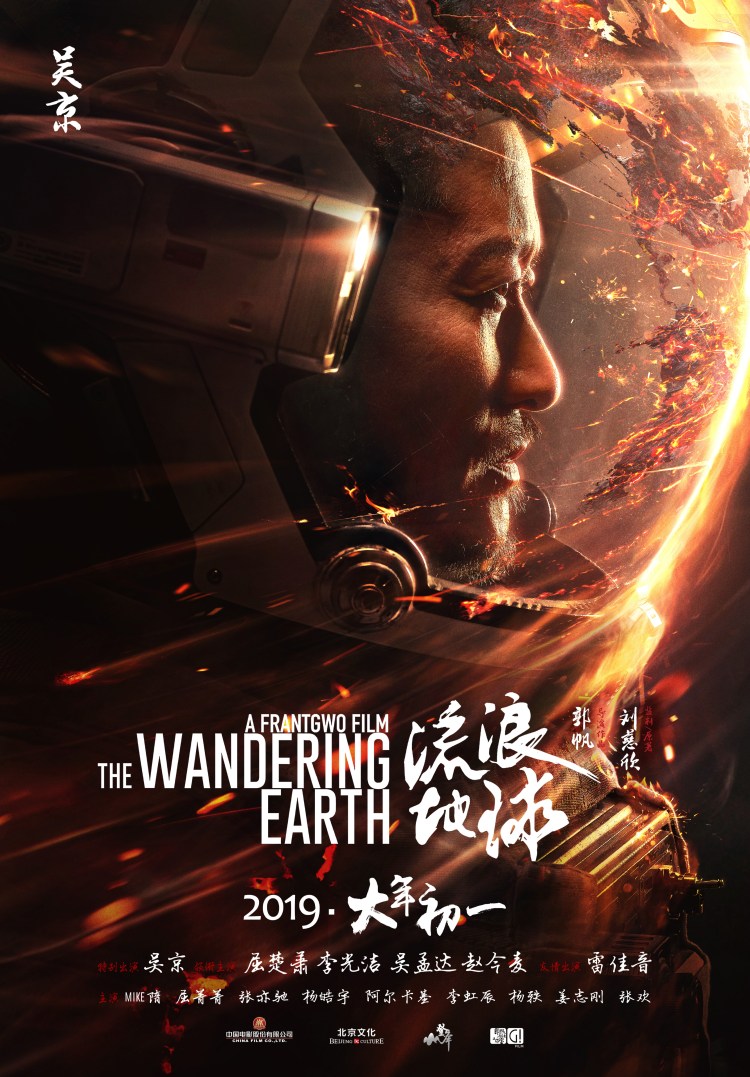
Wandering Earth poster 5Chinese cinema has not been as averse to science fiction as some would have it, but it’s true enough that The Wandering Earth (流浪地球, Liúlàng Dìqiú) marks a bold new chapter in its ambitious attempt to take Hollywood on at its own game. Adapting the novel by China’s premier sci-fi author Liu Cixin, Frant Gwo’s third feature is an interesting take on the New Year movie in which new beginnings are sought and families desperately try to reunite to see them in, only this time they do so against the backdrop of impending apocalypse as the universe threatens to swallow us whole.

Far in the future, the vast expansion of the sun will soon consume the Earth. The Wandering Earth project aims to save humanity by attaching jet thrusters to the Earth’s surface to push it out of harm’s way yet this safety measure has also had grave effects on the planet’s climate rendering the surface uninhabitable. 17 years previously, astronaut Liu Peiqiang (Wu Jing) left his 4-year-old son behind in the care of his father (Ng Man-tat) to take up a position on the space station intended to safeguard the Earth’s future. Now 21, Liu Qi (Qu Chuxiao) has grown up into a resentful, rebellious young man intent on seeing the surface for himself if only not to be home when Peiqiang finally returns to Earth. A natural disaster, however, leaves him stranded with his adopted teenage sister, Duoduo (Zhao Jinmai), just as the Earth is inconveniently drawn into a fatal collision course with Jupiter.

As much about fatherhood as it is about survival of a species, The Wandering Earth centres itself on the angry figure of Liu Qi who has been forced to live his entire adolescence underground and has come to deeply resent the memory of the father who allowed his sickly mother to die and then abandoned him. Peiqiang, meanwhile, has spent 17 years on the space station solely in order to save his son’s future, dreaming of the day they will finally be reunited. He cares little for his own life and has already spiritually handed the baton on to the next generation whose descendants, he hopes, may finally see a kinder sun rise over a new Earth.

This kind of selflessness is also reflected in the film’s refreshingly globalist outlook in which the world, no longer divided, has learned to act as one in order to combat the extreme threat from its own sun. The resistance may be China led, but depends on common endeavour and personal sacrifice. When a last ditch effort is required, the government cannot order its forces away from their families but can offer them the individual choice to keep fighting for survival, bringing teams from all corners of the Earth together as they descend on Indonesia where there just might be a one in a million chance to strike back at Jupiter and escape its gravitational pull.

Meanwhile, Peiqiang is up still up on the space station all alone and powerless while the annoyingly efficient operating system MOSS attempts to frustrate his efforts to save the Earth in service of its own mission to preserve humanity’s legacy. MOSS has made a series of calculations and given up, but giving up is not a very human trait and Peiqiang won’t do it. He makes impassioned speeches to the French-accented global authorities and ponders the best way to ensure his son’s survival even at the cost of his own but finally can only resist by literally attacking the system in overruling MOSS and acting on his own initiative.

A New Year tale through and through, The Wandering Earth is a celebration of family, togetherness, and home but is careful to dial down the patriotism for an insistence on the importance of mutual cooperation between peoples in order to combat existential threat with the spectre of climate change always on the horizon. The point, however, is that it is important to keep hope alive, if not for yourself then at least for others rather than give in to nihilistic despair. The Wandering Earth, grand and ambitious in scale, marks a new dawn of its own in terms of Chinese blockbuster sci-fi and does so with refreshing positivity as it places its hopes in human solidarity and individual sacrifice over jingoism and self-interest.


Currently available to stream on Netflix in the UK and possibly other territories.

Netflix trailer (English subtitles)

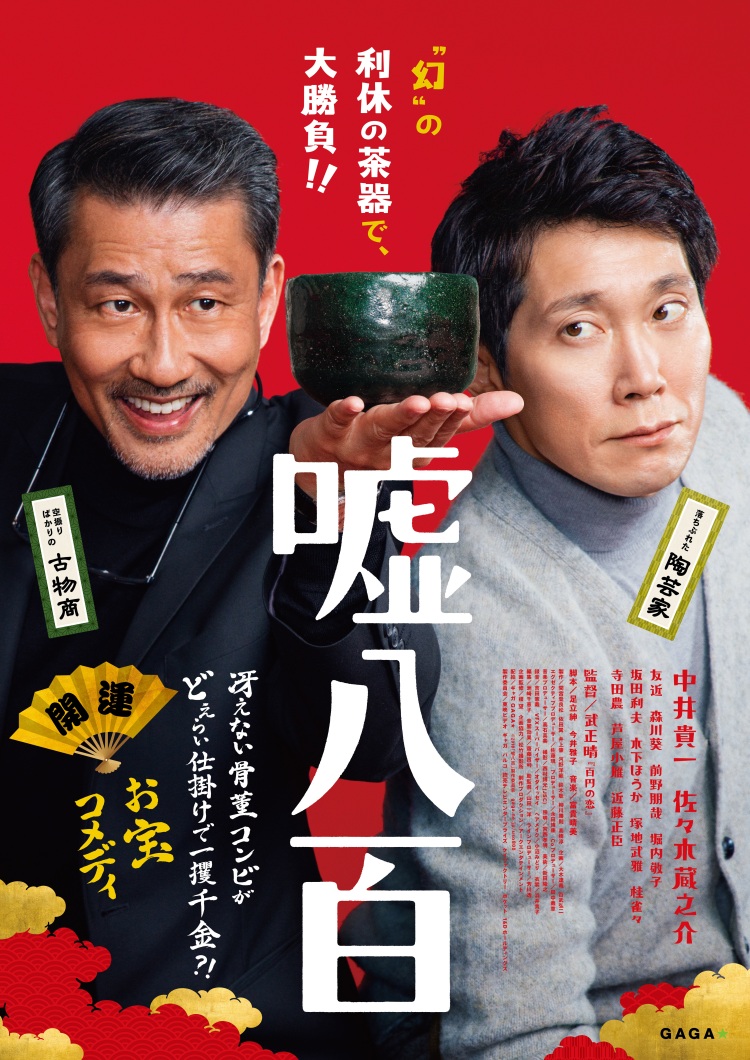
We Make Antiques (嘘八百, Masaharu Take, 2018)

We make antiques posterWho will scam the scammers? The antiques trade is a high stakes business, and at least as far as Masaharu Take’s We Make Antiques (嘘八百, Uso Happyaku) goes, one which makes use of its aura of respectability to cheat unsuspecting amateurs out of their hard earned cash for the false promise of exclusivity. Then again, does it really matter when something was made so long as it was made well and with artistic integrity? Perhaps collectors are just as happy with a nice piece as an authentic one, if only no one ever tells them the difference.

Jaded antiques dealer Norio Koike (Kiichi Nakai) prides himself on having a good eye, forced to learn to spot the inauthentic in record time after having his reputation trashed when he accidentally sold a “fake”, making the rookie mistake of taking provenance at face value without assessing all the facts. These days he’s not as precious as he used to be, mostly making his living out of buying up genuine antiques from clueless owners, convincing them their pieces are fakes and therefore worthless before selling them on at tremendous profit. It’s a trick he pulls on a wealthy man with a warehouse full of teacups that belonged to his father he’d rather get rid of so he can open a cafe, spotting an obvious fake and buying it cheap to take it straight back to where he knows it came from. Koike gets his comeuppance however when the man calls him back and says he’s found something interesting – an Edo-era letter in a box. Koike lies and says the letter is a random missive about a peasant revolt, when really it’s from grandmaster Rikyu and mentions coming with a tea bowl which Koike manages to find after searching the warehouse again.

After buying the entire stock to mask his desire for the tea bowl and letter, Koike realises he’s been had. The man he was talking to isn’t the owner of the warehouse but a caretaker, and the warehouse only exists to store fakes produced by a team of master forgers operating out of a nearby ramen joint. Noda (Kuranosuke Sasaki), who managed to scam Koike, was like him professionally embarrassed and by the same two corrupt elitists, Tadayasu Hiwatashi (Kogan Ashiya) and his celebrity authenticator Seiichiro Tanahashi (Masaomi Kondo), who picked him up as an aspiring ceramicist, giving him a fancy award but secretly using him to produce “replicas” to sell in their store. 20 years later, Noda is a cynical and jaded figure, unable to connect with his “nerdy” son (Tomoya Maeno) who spends his time building fantastically realistic military dioramas, and increasingly distanced from his patient wife who deeply resents the loss of his artistic integrity.

After a brief locking of horns, the two men decide to team up to scam the scammers, teach them a lesson, get a little ironic revenge, and become filthy rich in the process. Creating expert fakes, however, is a taxing business which requires an extreme depth of knowledge and in this case of a well known and hugely respected historical figure. Sen no Rikyu, the father of the tea ceremony, was, ironically enough, ordered to commit seppuku after speaking truth to power and, because he was an honourable man, he did it.

The reason most fakes fail is because they’re soulless replicas, often expertly crafted but essentially superficial. Creating a convincing fake allows Noda to regain the creative mojo that he’s been suppressing all these years in resentment towards Hiwatashi and Tanahashi, determined to craft something that reflects the spirit of Rikyu by virtue of the fact that it contains a piece of his own soul. Of course, the guys fully intend to exploit their own “artistic integrity”, Koike turning on the salesman’s patter to sell the dream of Rikyu to two soulless elitists too wrapped up in their sense of self-importance and blinded by greed to see things properly. Yet, there is a perverse love not only for the grift but for the craft and for Japan’s disappearing traditional culture, if only in the ironic rebuke of those who misuse it for their own gain. Bonded in revenge not only against the the venal Hiwatashi and Tanahashi but middle-age and and life itself, the guys generate an unlikely friendship, rediscovering their authentic selves through forgery as they scam the scammers and retake their sense of integrity in the form of a briefcase stuffed with cash.


International trailer (English subtitles)

Hideko, the Bus Conductor (秀子の車掌さん, Mikio Naruse, 1941)

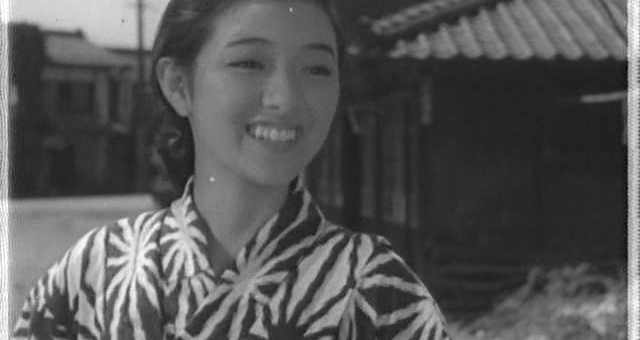
vlcsnap-2019-12-28-21h47m57s539It’s true enough that we might not have enough extant material from the pre-war and wartime eras to be as selective as some might accuse of us of being on realising that the directors we tend to remember are the ones we see as resisting. Though there were a fair few who managed simply to steer clear of the prevailing ideology, most skirted their way around the demands of the censors board by embracing the kinds of themes they could would work with. In Hideko, the Bus Conductor (秀子の車掌さん, Hideko no Shasho-san) Naruse pushes in a slightly different direction, retreating almost entirely from the troubles of the contemporary era into an idyllic vision of pastoral Japan.

Echoing Mr. Thank You, he opens with a POV shot of bus travelling a rural road accompanied by jaunty music. Neatly undercutting the cheerful atmosphere with ironic absurdity, we then cut to bus conductress Okoma (Hideko Takamine) announcing the next stop to an entirely empty bus. The problem is, the bus Okoma and the driver, Sonoda (Kamatari Fujiwara), operate is old, slow, and dirty. A new company, Kaihatsu, recently launched with shiny new buses that are cleaner and faster, if a little more expensive. Unsurprisingly, most people prefer to travel with Kaihatsu, meaning the only passengers waiting for Okoma’s bus are the kind that don’t have much money or are looking for different kinds of service – e.g. transporting live chickens or unusually large amounts of bags.

A radio programme recommended by her landlady gives Okoma an idea to boost business – performing as a kind of tour guide reading out interesting facts about the local area to entertain the passengers. Unfortunately, no one can quite think of any interesting facts or local landmarks in this tiny rural backwater. Nevertheless, Okoma and Sonoda are determined to give it a go, eventually obtaining permission from the decidedly laissez-faire boss who spends most of his days guzzling ramune and eating kakegori. To make sure the service is professional, they enlist the services of a local writer, Ikawa (Daijiro Natsukawa), whose notebook Okoma once returned when he left it on the bus. Weirdly, he doesn’t even want paying because he enjoys writing this kind of thing, and even coaches Okoma on how to get the cutest accent to really attract those customers with adorable local charm (even though Okoma is very proud to be thought of as nicely spoken young lady with nary an accent at all).

Of course, in true Naruse style, it’s not quite as idyllic as it seems. Most of the people we meet are poor and struggling, that’s why they’re taking this bus and not Kaihatsu’s. Even so, they’re all pleasant and polite, not even minding when Okoma asks the driver to stop by her house so she can chat with her mother, giving her a kimono she’s bought as a present (that her mum tells her off for spending her money on) and swapping her worn out cloth shoes for a classic pair of geta in which she seems to be more comfortable. At one stage, a chicken escapes from the bus and they stop to catch it, timetable be damned. Mind you, there don’t even really seem to be specific stops on this strangely occasional service. In need of passengers, Okoma and Sonoda seem content to stop and pick up random passersby who might be in search of a lift, taking them to wherever they might want to to go.

That might be one reason explaining why Okoma’s landlady is keen to warn her that she’s heard the bus company is no good, it’s just a front for some kind of unspecified shadiness. The truth, however, is more that the boss seems to be the feckless sort who enjoys being bossy but has no idea how to run a business. Distracted by Okoma’s monologue, Sonoda starts forgetting to stop and pick people up and eventually has to slam on the brakes when a child runs out into the street. While they’re checking on the kid, the bus rolls back over the verge, injuring Okoma and landing in farmland. Reassured that no-one has been “seriously” hurt (he’s not getting sued), the boss is then more worried about the insurance, seeing as it doesn’t cover him if the engine was running while they were stopped. Even though Sonoda explains that there’s no damage except maybe a scratch on the side, the boss suggests he scupper the engine and smash the windows so they can claim. They need a better bus, otherwise the company will have to close.

Earlier on, Sonoda and Okoma had joked about a popular slogan “When a country gets confused, loyal subjects appear”. Sonoda rolls his eyes a little and calls it “bombast”. They might not object to adding a bit about birds singing for the emperor’s long reign to their monologue, but it’s plain they aren’t going to go along with something they think is wrong because the boss says it’s a good idea. Sonoda is a little conflicted to begin with, talking it over with Ikawa who acts as the slightly patronising voice of city sophistication, he realises that if he follows the boss’ orders and lies he’ll not only be cheating the rest of society but himself too in doing something he knows to be immoral. Both he and Okoma vow they’ll quit rather than be forced into dishonesty, after all, says Okoma, there are plenty of other jobs (or perhaps not, in real terms, but still there is a choice). Suddenly, they feel quite cheerful, buoyed by their sense of moral righteousness.

An intervention from Ikawa saves their jobs, but this is still a Naruse film in which the world will always betray us, and so Okoma and Sonoda cheerfully continue their tour guiding business little knowing that the boss has gone bust and sold the bus. It might be going too far to say that Naruse envisages a fiery crash, a rude awakening for Okoma and Sonoda who will be left with only the cold comfort that they stood up against authoritarianism when it all goes to hell, but the subtle allegory is all but unmissable. Absurdly cheerful, and just a little bit depressing if you stop to think about it, Hideko the Bus Conductor is a charming jaunt through rural ‘40s Japan filled with salt of the earth types just trying to muddle through while the big bosses put their feet up and pop ramune marbles all day long without a care in the world.