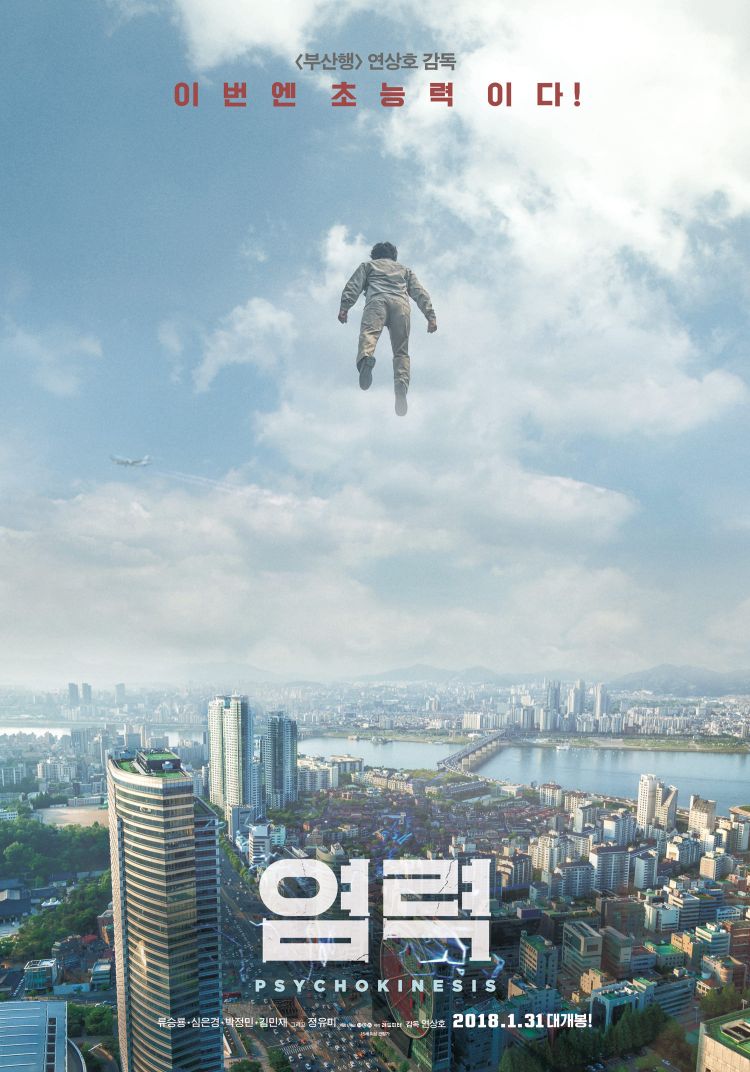
 The animated world of Yeon Sang-ho is dark and cynical, finding only fear and anger in the hopeless vision of contemporary Korea that his films continue to paint. His first live action feature, Train to Busan, began to see a little light as its jaded protagonist finally rediscovered his humanity while the innocent were eventually allowed to find a degree at least of rescue. Psychokinesis (염력, Yeomlyeok), in once sense, continues the theme in centring itself on another of Korean cinema’s bad dads, one so morally corrupted that he rejects all responsibility to others and lives only for the self-indulgent pleasure of the petty scam. Given superpowers, his thoughts turn to finance but eventually lead to an opportunity to right himself in societal eyes by reconnecting with his estranged daughter and accepting his responsibility as a family man.
Seok-heon (Ryoo Seung-Ryong) left his family when his daughter was only ten years old. These days he makes a living as a (lazy) security guard while supplementing his income by pilfering coffee and toilet paper from the company. After drinking spring water from a mountain shrine which, unbeknownst to him, has recently been struck by a mysterious meteoroid, Seok-heon realises he has developed the power of psychokinesis but is only really interested in how it might benefit him financially. That said, Seok-heon’s thoughts do not turn to crime, but to fame – he thinks it might make a good magic act and has heard there can be a lot of money to be made on the circuit.
Shortly after his magical revelation, Seok-heon gets a call from Ru-mi (Shim Eun-kyung) – his now grown up daughter who had been running her own very successful fried chicken restaurant until the shop was compulsory purchased to make way for a shopping mall intended to cater for Chinese tourists. Ru-mi and some of the other shopkeepers have been engaged in a resistance movement, refusing to let their property be taken until they have received fair compensation. During an altercation with the thugs sent in to evict them by force, Ru-mi’s mother was killed – which why is she called, to invite her long lost father to the funeral. Though Seok-heon is not exactly keen to get involved, he eventually realises that his new found abilities might prove useful and help him restore himself in his daughter’s judgemental eyes.
As in Train to Busan, Seok-heon is a cynical and jaded father but this time he’s one very much down on his luck, one of life’s losers whose decision to accept defeat has been lifelong and total. Faced with Ru-mi’s cohort of resistance members, he publicly refuses to help, pointing out that their battle is doomed to failure and it would be better to just give up now. Ru-mi, apparently still capable of additional disappointment, reminds her father that this is what he does – when things look grim he runs away. Ru-mi refuses to be like her dad, and therefore refuses to give up without a fight.
Yeon once again injects some background social criticism into an otherwise friendly tale of dead beat dads and the power of community. Echoing the Yongsan tragedy, Yeon makes the destruction of a neighbourhood to build a shopping mall for tourists his battleground as Ru-mi and her fellow resistance members hole up behind a barricade throwing Molotov cocktails at the police and trying to avoid a fight with the thugs who work for the corrupt construction company behind the whole affair. To make matters worse, Yeon takes us past the site of so much drama at the film’s conclusion, showing us an empty lot, a scar on the landscape memorialising the senselessness of corporate greed which eventually eats itself and stifles any kind of progress economic or social. Ru-mi and the others are powerless to resist their eviction but insist on the compensation they ought to be entitled to which would allow them to begin their businesses again elsewhere so they can continue to earn a living.
Seok-heon is the archetypal apathetic man who thinks it’s pointless to resist and is content to live in as corrupt a way as his society permits. He refuses his responsibility to others, walking past the cleaner being threatened for taking the “free” coffees from the lobby he convinced her were OK to take whilst lamenting her “stupidity” for inexpert pilfering. Battered and defeated, Seok-heon rejoices in pettiness, getting his kicks by shirking at work and getting one over on the bosses by stealing. His first thought on getting powers isn’t their capacity for good, but nor is it a lust for power or revenge, he merely wants to show off a little and earn big bucks – his crime is petulant self-indulgence, not active villainy. Reuniting with his daughter and witnessing her fighting for something she believes in, Seok-heon begins to rediscover his long buried heroism finally becoming a father worthy of his daughter’s respect.
It’s not all plain sailing however as the corporate stooges are not just thuggish but clever and devious. Figuring out that the twin issues to evicting the protestors are the unsolved murder of Ru-mi’s mother and Seok-heon’s superpowers, they set about undermining both – setting up a patsy for the crime and attempting to blackmail Seok-heon by leaking footage of his powers to the news in the hope that the country turns against him. Unable to explain his unusual abilities, TV news pundits do what they always do – blame North Korea, and insist he must be some kind of spy and/or infiltrator.
Working with a much lower budget, Psychokinesis is a lighter affair than might be expected, essentially mixing a hapless dad narrative with a superhero origin story but with a more cheerful tone than one usually associates with Yeon. As expected, you can’t fight city hall and Seok-heon’s assertion that the battle was always a losing one may prove to be correct but what he discovers is that is not necessarily a reason to just give up and walk away. Even if one plan fails, there may be other ways to “succeed” so long as there are enough people willing to stand up for what’s right whilst holding fast to each other, committed to building something better rather than just to tearing something down.
Psychokinesis is currently streaming worldwide via Netflix.
Original trailer (Korean subtitles only)








 The
The  Toma Ikuta stars as a failed journalist working in a small factory who befriends an introverted co-worker (Eita) only to begin to suspect that he may be connected to a series of child murders 17 years previously. One of two films released by Takahisa Zeze (
 Charming fantasy adventure from Takashi Yamazaki adapting the popular 80s manga by Ryohei Saigan in which a newlywed eccentric author finds himself travelling to the underworld to retrieve his wife who has been taken there as a result of a bizarre clerical error (and a little yokai interference).
  Comedy drama from
  Tsuchida (Asami Usuda) has decided to financially support her singer-songwriter boyfriend Seiichi (Taiga) but he doesn’t know she’s supplementing her income with a part-time job at hostess bar to make ends meet. Meanwhile, her head is turned by an old flame (Joe Odagiri) in Masanori Tominaga’s adaptation of the popular manga by Kiriko Nananan.
  Intensely shy and socially awkward, 24-year-old Yoshika (Mayu Matsuoka) lives in a fantasy world and spends her free time engaging in her favourite hobby of looking up extinct animals on the internet. Harbouring a long standing crush on a middle-school classmate she nicknames “Ichi” (no. 1), her existence is shaken by the unexpected attention of a colleague she refers to as “Ni” (no. 2). An ultimately uplifting yet sometimes heartbreaking tale of learning to forget about anxiety and just live anyway from genre veteran Akiko Ohku.
  Tadanobu Asano stars as a man who’s taken the unusual decision to prioritise family life over career but finds himself conflicted when his second wife reveals she is pregnant with their first child in Yukiko Mishima’s empathic family drama.
  Ryosuke’s life is pretty great. He’s about to open his own restaurant and marry his beautiful fiancée Misako, but his happiness is soon ended when his father is diagnosed with late stage pancreatic cancer. Going through his belongings, Ryosuke finds a worrying entry in his father’s diary which implies he may have committed a murder. To make matters worse, Misako suddenly disappears without trace. Naoto Kumazawa adapts the bestselling novel by Mahokaru Numata.
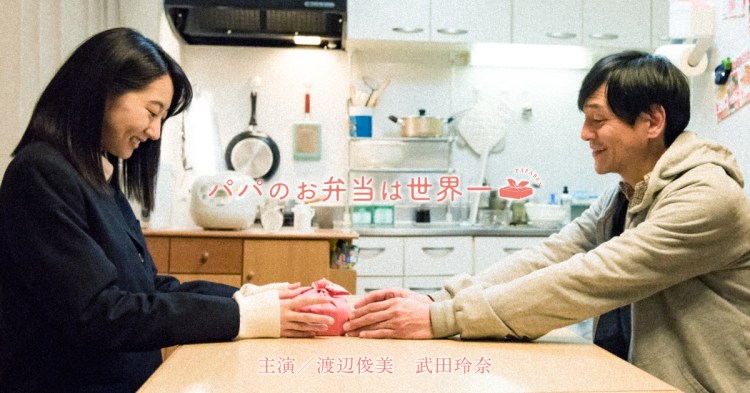 Inspired by a viral news story, Masakazu Fukatsu’s cheerful drama stars former hip hop idol Toshimi Watanabe in a role somewhat echoing his own life seeing as he too published a best selling book filled with pictures of the bento he lovingly crafted for his teenage son. Here he plays a divorced dad doing his best to master the traditionally female art of homemade lunch boxes.
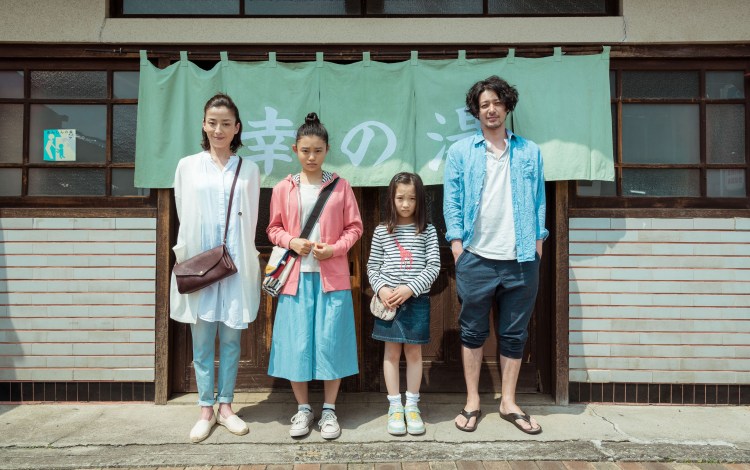 Capturing Dad’s Ryota Nakano turns his attention mum! Rie Miyazawa stars as a struggling recently single mother whose husband has run off with another woman that he supposedly got pregnant during a drunken one night stand. Diagnosed with terminal cancer, she sets herself to repairing her fractured family while also resurrecting the family bathhouse in the process.
 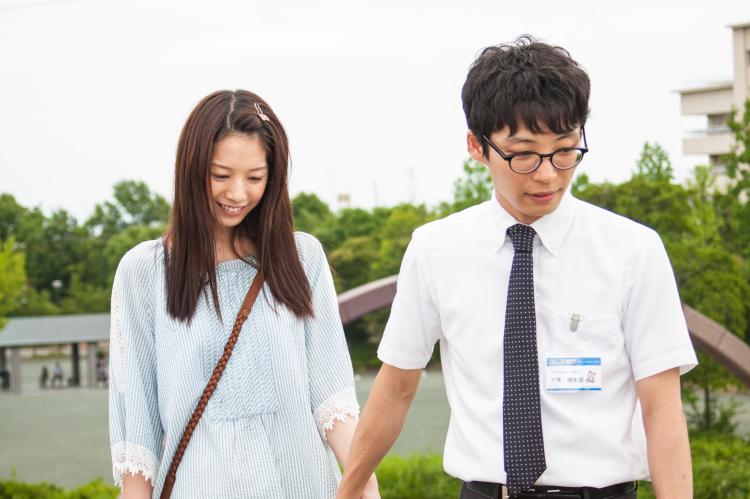 Kentaro, 30-something and single, lives a solitary and isolated life, showing little sign of finding a wife and settling down while his career continues to stagnate. Fearing he will be alone all his life, his parents decide to go to a support group for the similarly afflicted hoping to find a candidate for an arranged marriage. They find only one – Naoko, the daughter of a high ranking salaryman. Naoko’s parents do not disclose the fact that their daughter is blind and also disapprove of Kentaro whom they regard as socially inferior. Nevertheless the pair meet and fall in love but can they overcome the various obstacles to their romance?
 A small town decides to join a scheme to rehome ex-cons in order to combat rural depopulation but fearing that the local community might not accept the new arrivals if they knew where they came from, the authorities decide to keep it a secret. Prejudice and pragmatism go head to head in Daihachi Yoshida’s adaptation of the manga by Yamagami Tatsuhiko and Igarashi Mikio.
  Unmarried pregnant daughter Yuko scandalises her community when she returns home to participate in the bone washing ritual in the second feature from Okinawan comedian Toshiyuki Teruya.
 Haruka Ayase and Kentaro Sakaguchi star in a glitzy tribute to the world of golden age cinema! Sakaguchi plays a struggling assistant director failing to make it in the rapidly declining ’60s film industry while dreaming black and white dreams of a more glamorous era. Then, to his surprise, his favourite leading lady steps out of the silver screen and into his technicolor world…
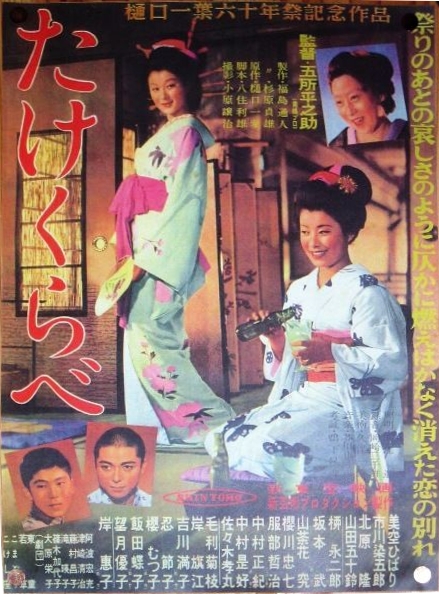
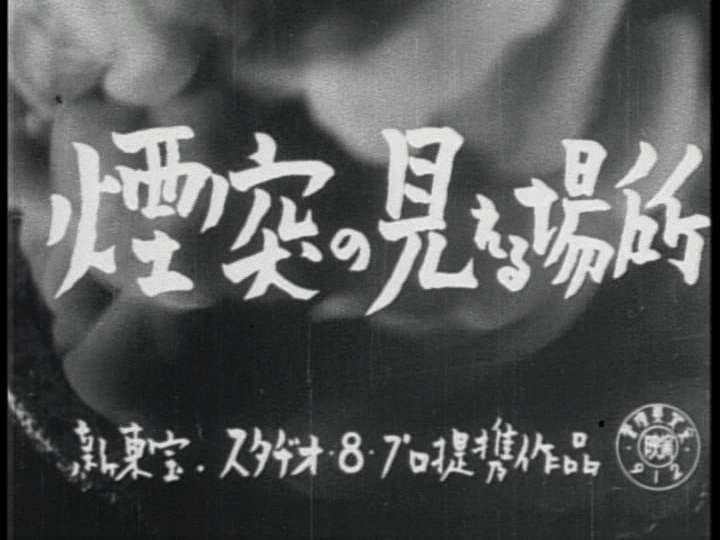 Classic from Heinosuke Gosho centring on a collection of people living in a shared house and attempting to survive in the complicated post-war landscape. Ogata (Ken Uehara) is happily married to Hiroko (Kinuyo Tanaka) but begins to doubt her when he learns that she has secretly taken a job at the bicycle races to supplement the family income while the unexpected arrival of an abandoned baby raises another series of questions.
 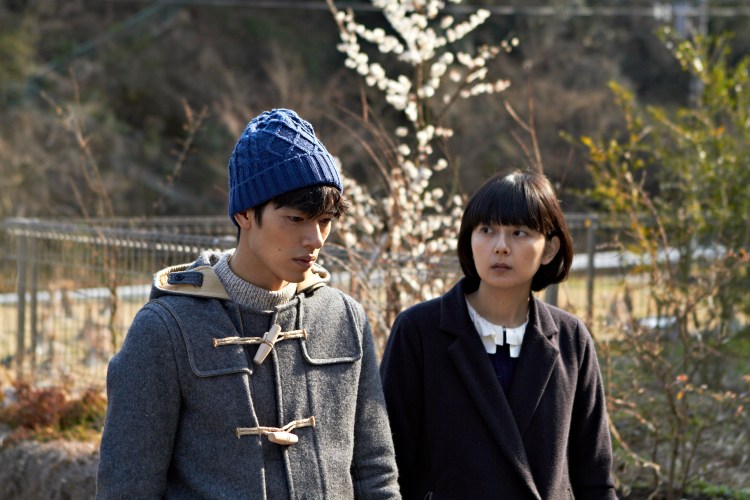 Midori and Masao are 28 years old and they’ve been a couple for four years. With the fire going out of their relationship they consider breaking up but then Midori discovers she is pregnant. Shotgun wedding in the offing, impending parenthood begins to bring them closer together as they finally take the time to get to know each other in the second feature from Yukiko Sode.
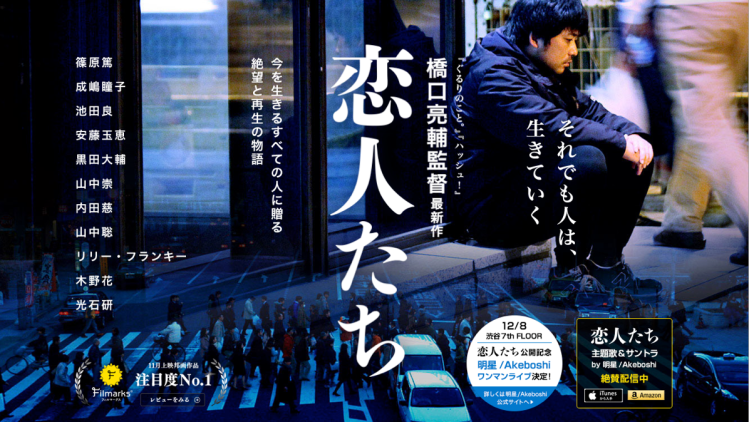 The most recent film from
  A hyperrational 10-year-old is puzzled by the sudden appearance of a bunch of random penguins in the middle of a hot Japanese summer and tries to solve the mystery all while nursing an adolescent crush on a pretty dental receptionist in Hiroyasu Ishida’s adaptation of the Tomihiko Morimi novel.
  Love Hotel’s Hikaru Toda reunites with Fumi and Kazu who run a law firm in Japan specialising in minority issues and particularly those of the LGBT community.