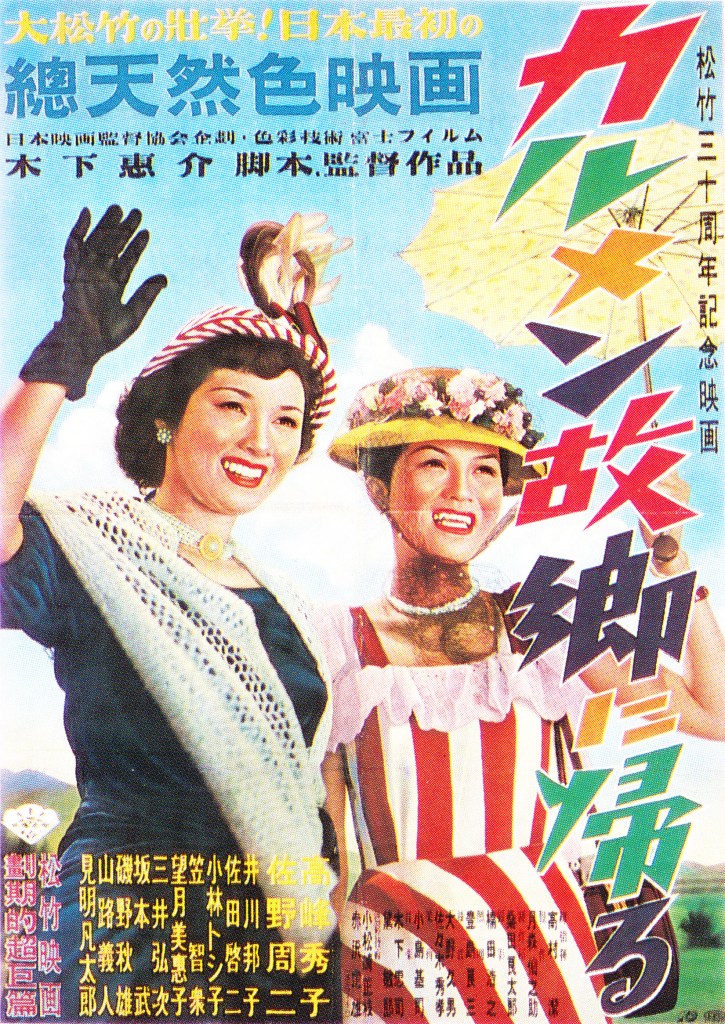
Carmen Comes Home (カルメン故郷に帰る, Keisuke Kinoshita, 1951)

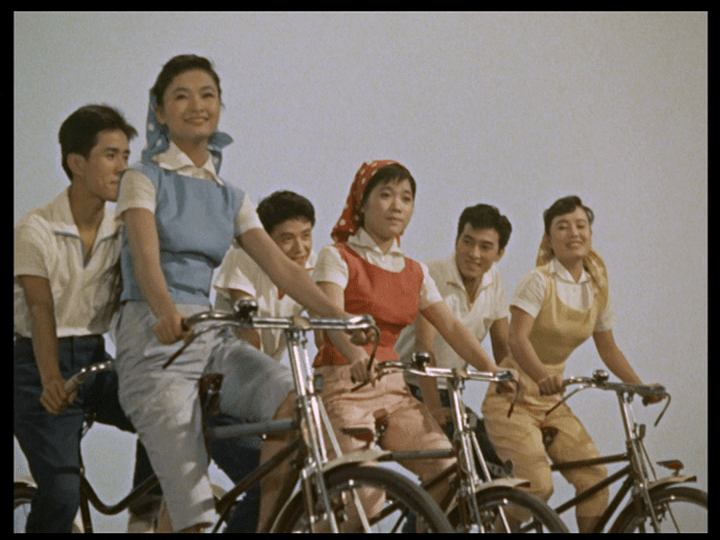
Carmen Comes HomeShochiku was doing pretty well in 1951. Accordingly they could afford to splash out a little in their 30th anniversary year in commissioning the first ever full colour film to be shot in Japan, Carmen Comes Home (カルメン故郷に帰る, Carmen Kokyou ni Kaeru). For this landmark project they chose trusted director Keisuke Kinoshita and opted to use the home grown Fujicolor which has a much more saturated look than the film stocks favoured by overseas studios or those which would become more common in Japan such as Eastman Colour or Agfa. Fujicolour also had a lot of optimum condition requirements including the necessity of shooting outdoors, and so we find ourselves visiting a picturesque mountain village along with a showgirl runaway on her first visit home hoping to show off what a success she’s made for herself in the city.

Famous Tokyo showgirl “Lily Carmen” (Hideko Takamine) was once plain old Kin from the cow farm. When the family receives a letter written in grand style and signed with Kin’s stage name explaining she’ll be coming to visit, her sister may be excited but her father has much more mixed emotions. When Carmen comes home she does so like she’s on a victory parade. Wearing her Westernised, colourful outfits fashionable in the city but like something from outer space here, Carmen becomes the show but oddly seems uncomfortable with the predictable amount of attention she’s getting around town. The presence of Carmen and her equally pretty friend, Maya (Toshiko Kobayashi), threatens to destabilise this otherwise peaceful mountain village but just what sort of chaos can two beautiful women really create over the period of a few days?

The villagers react to Carmen’s return with a series of ambivalent emotions. Of course, they’re glad to see their own girl back, especially as she’s been so successful in the city, but this Carmen is not the same as the Kin who ran away. Slightly in awe of all this visiting urban sophistication, the villagers are also scandalised by Carmen’s modern attitudes to fashion and vulgar behaviour. Striding around the village like as it were a tourist attraction and she a visiting monarch, Carmen chews gum, breaks in to song at random and dances happily in her underwear on the green mountain hillsides.

The village is smallish community but fiercely proud of their local traditions. Many of the residents are happy to think that a “great artist” of the pedigree of Lily Carmen could have been born in their little village. In fact, this tiny settlement is something of a crucible for artistic talent and the extremely pompous school headmaster has a bee in his bonnet about bringing forth the future of Japan through cultural education. However, not quite all of the residents are so liberal and many live in fear of a feudalistic money lender named Maruju (Koji Mitsui) who runs the local transportation business (such as it is) but makes most of his money out of issuing exorbitant loans to desperate local people. Recently, he’s pointlessly repossessed an organ from the home of a man who was blinded during the war.

The headmaster is very keen for Carmen to come and bring some of her city sophistication back to the village, but no one has actually asked what kind of “art” Carmen is involved in. After a lot of chat from Carmen about how seriously she takes her work, people start wondering about this cutting edge performance art that their homegirl has apparently surrendered her life to. As if it weren’t obvious from her name, Carmen is a burlesque dancer. Quite a good, high grade burlesque dancer and, in fact, an artist, but essentially a stripper who really does take it all off in the end. Ever the enterprising businessman, Maruju decides to put on a show which he advertises with a big cart bearing the slogan “wild dancing by nude beauties” plastered on the side.

Needless to say this does not go down well with pompous headmaster and his plan to create a great city of highbrow artists. Striding straight over to talk to Carmen’s father Shoichi who’s only just got up from a few days in bed after Carmen’s last embarrassing faux pas, the principal intends to talk Carmen and her friend out of their scheduled performance. Her father, however, has a surprising reaction. He had an inkling what kind of life his runaway daughter must have been living. Shoichi put much of Carmen’s lack of acumen down to being kicked in the head by a cow as a child and realised it would be hard for her to find “respectable” work. He doesn’t want to see her “indecent” show and thinks the professor shouldn’t go either, but also thinks that if she’s good at it and it makes her happy then maybe that’s OK. After all, if it was that bad they wouldn’t allow it in the city and whatever’s good enough for the city ought to be good enough for the mountains. The headmaster, momentary stunned, is now confused and wondering if stopping the performance is an infringement on Carmen’s human rights.

Kinoshita refuses to take a side, he shows the ridiculousness of both the isolated villagers and the sophisticated city dwellers to great comic effect. Hideko Takamine is something of a revelation, cast completely against type as a bubbly, airhead showgirl. As is true with a lot of early colour films, or even a lot of early talkies, Carmen Comes Home has a built in gimmick and doesn’t really worry about doing very much beyond it. As such it keeps things light and bright and breezy, emphasising its high contrast colour palate every step of the way. A gentle comedy of manners as small town comforts rival big city liberalism with the obvious trade offs involved on either side, Carmen Comes Home might lack the substance of some of Kinoshita’s other work but makes up for it with general sunniness and effortlessly timeless humour.


Original trailer(s) (no subtitles):
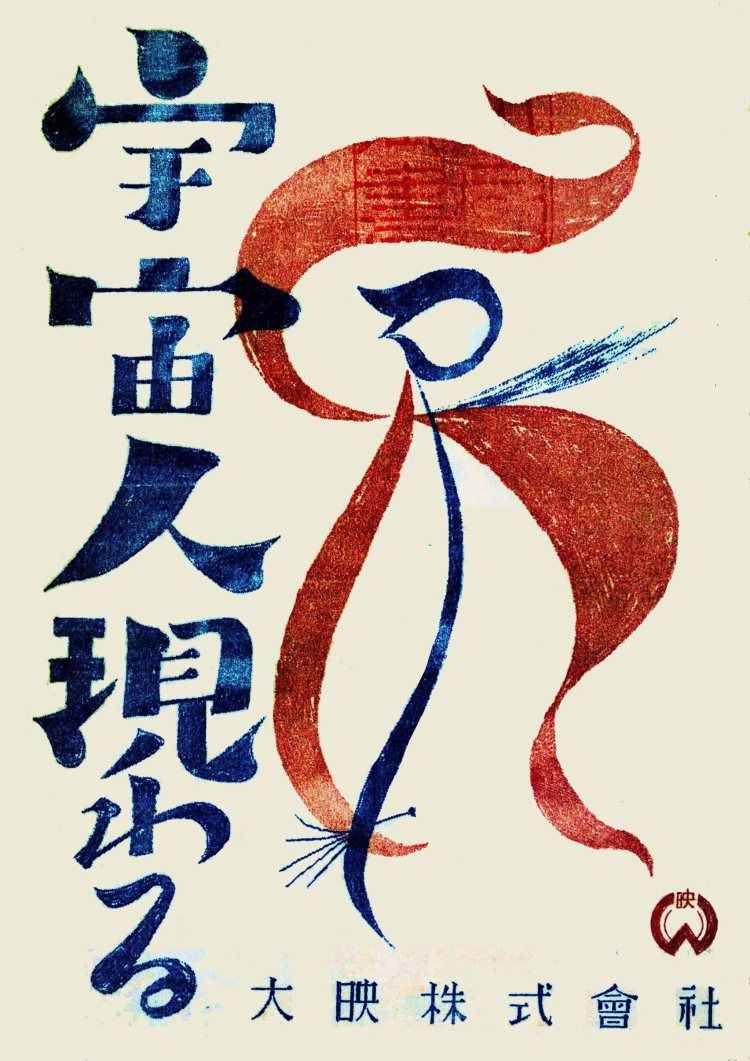
Warning from Space (宇宙人東京に現わる, Koji Shima, 1956)

Warning_from_Space_1956
Taro Okamoto illustration from Japanese DVD liner notes

Apparently the citizens of Japan are a little more cautious than some of their contemporaries when it comes to extraterrestrial contact. After all, the kindly aliens who visit with helpful advice in The Day the Earth Stood Still end up leaving in a huff because humanity is just not ready to accept their offers of interplanetary research and is constantly trying eliminate the alien “threat”. Hence, though the people of Japan recoil in horror from the Pairans in their scary starman shape, they start paying attention when they come in the form of a pretty showgirl. Somethings never change, eh?

Mysterious flying objects have been spotted above the skies of Tokyo. Nobody knows what they are with some leaning towards aliens and others becoming paranoid that Japan is under attack from another nation who are positioning spy satellites above its capital city. There have also been sightings of mysterious creatures near sources of water, usually accompanied by blue flickering lights.

These strange creatures turn out to be a scientific delegation from the planet Paira (inconveniently located directly opposite Earth but behind the sun which is why it’s never been discovered). They are a race of star shaped bipedal creatures with a single eye in the middle of their chests. Actually, they are quite cute and completely non-threatening in appearance and seem quite hurt that the Earthlings think they are ugly and are too frightened to talk to them. Consequently, they send their best scientist through a special process to change his appearance to one humans find more appealing which just happens to involve copying that of a local superstar showgirl.

The Pairans have come in peace! With their advanced technology they can see a rogue planet is about to crash into Earth and destroy it forever. This is bad news for everyone so they’ve come to warn humanity and try to help, if only they could get someone to listen to them. They also know that Doctor Matsuda has been developing a nuclear weapon which is far more powerful than the atomic bomb. The Pairans think this is a very bad idea and he should stop, but only after they’ve used it to destroy the rogue planet before it’s too late.

Warning from Space (宇宙人東京に現わる, Uchujin Tokyo ni Arawaru) is Daiei’s first colour sci-fi film though it’s actually not all that colourful aside from that weird blue light. In contrast to many other films from the era and even those previously made by Daiei, Warning From Space seems to have an oddly ambivalent view on weapons of mass destruction. The Pairans have chosen Japan because they think the Japanese are the best placed to appreciate the destructive power of an atomic bomb and will therefore share their stance on the necessity of abandonment. Yet, they also know Dr. Matsuda has been working on an even more destructive weapon – the Pairans also discovered this power at some point in their history but abandoned it over fears of its power being misused. They supposedly developed a much safer way to harness nuclear energy but now need Matsuda’s research to destroy the rogue planet. Like much of the Pairan’s behaviour, this doesn’t make complete sense (at least, to those of us used to Earth logic).

The Pairans are very friendly, but a bit shy. Their idea of “making contact” seems to be running away when the humans spot them and start screaming. Seeing something so unusual is probably quite traumatising, but the Pairans are so cute with their starfish outfits and comical waddle that it’s strange to think anyone could find them threatening. The Pairans are even a little upset that Earthlings find them “ugly”. They think the best thing to do is appear in a more pleasing form so they freak everyone out by visiting a popular musical show and stealing a picture of the star to clone. Because every scientist on Earth is going to want to listen to the advice of a cabaret showgirl, right? That’s always how it happens. She doesn’t even care very much about maintaining her disguise and keeps doing alien stuff like jumping really high in the air or dematerialising in one place and rematerialising somewhere else, but then no one seems to find this that weird anyway.

Basically, the Pairans have come to tell the Earthlings not to go ahead with their weapons research because they don’t know what they’re getting into. However, they also need to use this research to destroy the rogue planet which is a bit contradictory. The Pairans are apparently too shy to actually talk to the UN and think the other nations are kind of mean anyway so Japan will have to sort this out on their own while the Pairans nod appreciatively in the background (other than when they randomly disappear for a whole month until coming back to sort everything out because humans are rubbish). Of course, evil corporations are also after Matsuda’s super weapon but he’s a proper scientist and doesn’t want to sell, so they kidnap him and tie him to a chair out of spite while the world simultaneously floods and burns thanks to the rogue planet’s effect on the atmosphere.

Finally, science saves the day in a quiet and methodical way! All the creatures of the Earth emerge from underground. The birds are singing, turtles are swimming, racoons are doing racoon stuff again all while the sun is shining brightly and children are singing, so it’s definitely all going to be OK and Earth has probably made a whole new set of star shaped friends! All in all it was probably worth near destruction. Warning from Space is the kind of science fiction film which is always 100% serious, with the consequence that it’s not serious at all. Not as much fun as some of other B-movies of the era it nevertheless adds its own charms particularly in the form of the completely batty Pairans and their cute star shaped suits but fails to offer anything memorable beyond them.


Original trailer (poor quality, no subtitles)

The adorable starfish-like Pairans were designed by iconic Japanese artist Taro Okamoto who is probably best known for the Tower of the Sun constructed for Expo ’70.

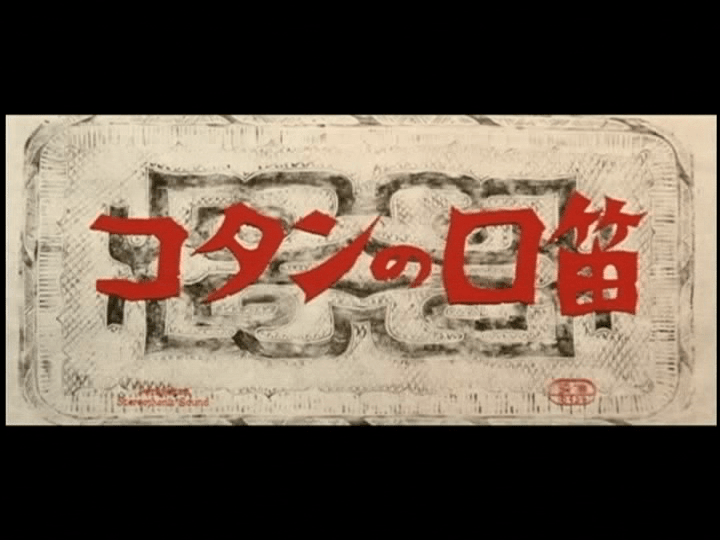
Whistling in Kotan (コタンの口笛, Mikio Naruse, 1959)

vlcsnap-2016-08-03-02h37m50s119The Ainu have not been a frequent feature of Japanese filmmaking though they have made sporadic appearances. Adapted from a novel by Nobuo Ishimori, Whistling in Kotan (コタンの口笛, Kotan no Kuchibue, AKA Whistle in My Heart) provides ample material for the generally bleak Naruse who manages to mine its melodramatic set up for all of its heartrending tragedy. Rather than his usual female focus, Naruse tells the story of two resilient Ainu siblings facing not only social discrimination and mistreatment but also a series of personal misfortunes.
Masa and Yutaka are a teenage brother and sister living with their alcoholic father who has been unable to get things together since their mother passed away. They also have their grandmother and cousin, but otherwise they’re pretty much fending for themselves. At school, both children are shunned and picked on by some of their classmates solely for being Ainu. When one girl reports that her purse has gone missing, she immediately points to Masa and though another girl defends her, the obvious racial overtones continue to get to her. Similarly, Yutaka finds himself getting into trouble with one of the other boys after he beats him on a test. Yutaka pays a heavier price (at least physically) but both children are left wondering about their place in the world and what the future might hold for them.

Masa’s bright hope revolves around her art teacher who draws a picture of her at a local watering hole which he intends to enter into a competition. The teacher has his sights firmly set on a career as an artist in Tokyo but like everyone else’s dreams, it proves harder to realise than he might have hoped. Perpetually left behind, Masa’s dreams crumble too as do those of her friend who has her romantic hopes crushed firstly by her well meaning grandmother and then secondly by an unexpectedly racist action by someone who had always been seen as a friend. If all of these difficulties weren’t enough, fate is about to deal Masa and Yutaka a very cruel blow indeed which leaves them at the mercy of an evil uncle worthy of any Dickens novel.

Like much of Naruse’s work, the outlook is extremely bleak. The children face such a hopeless future that the most they can do is affect a kind of false cheerfulness to try and raise their spirits. Masa and Yutaka are both mistreated by the general population, leaving them with a lingering sense of anger and resentment towards those that seem incapable of treating them like regular human beings. Their cousin, Koji, has apparently come to the conclusion that he has to stand up against such mistreatment, however, the ultimate harm that is done to the pair is done by a member of their own family acting with total disregard their feelings and wellbeing. At this point Koji reconsiders and says he understands now that it isn’t about Ainu or Japanese, there are just awful people everywhere. An odd, if depressingly stoic, late in the game plea for empathy and tolerance, this ironically positive statement sits very well with Naruse’s general feelings on human nature.

Whistling in Kotan is not one of Naruse’s more subtle efforts. The tone is relentlessly bleak as the children experience ever more degrading treatment solely because of their ethnic group. Even their supposed ally eventually turns on them exposing the last lingering threads of prejudice among even those who portray themselves as forthright liberals. The message is one of forbearance and patience, that times have changed and will change more but that one has to grin and bear it while they do. Pragmatic as that is, it does let society of the hook when it comes to the refusal to acknowledge and deal with consistent prejudice. Filled with Naruse’s sense of despair, Whistling in Kotan is an uneven yet interesting exploration of this sensitive subject though perhaps undoes much of its good work with its ambiguous and often blunt approach to the material.


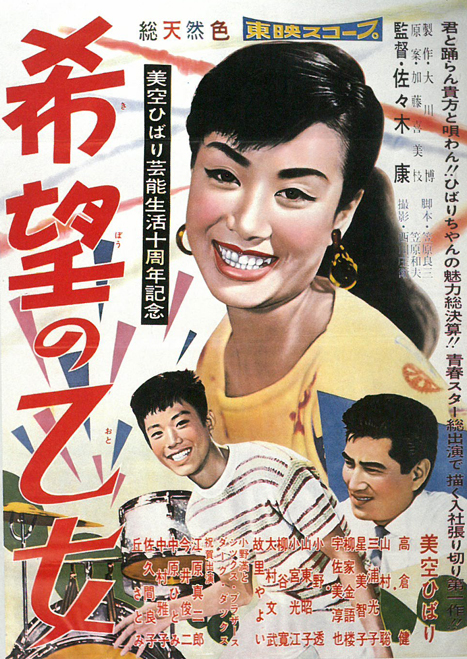
With Song in Her Heart (希望の乙女, Yasushi Sasaki, 1958)

song in her heartAnother vehicle for post-war singing star Hibari Misora, With a Song in her Heart (希望の乙女, Kibo no Otome) was created in celebration of the tenth anniversary of her showbiz debut. As such, it has a much higher song to drama ratio than some of her other efforts and mixes fantasy production numbers with band scenes as Hibari takes centre stage playing a young woman from the country who comes to the city in the hopes of becoming a singing star.
After beginning with a rural, almost cowboy-style number in which Hibari appears as the well dressed lady of the manor, Sayuri, riding her horse across the wide pastureland, the action quickly moves to the city when Sayuri’s mentor finally convinces her uncle that her future lies in showbiz and not an early marriage as he had envisioned. However, once she gets there she finds her potential tutor extremely unwilling to fulfil his promise to take her on. After winning him over, she quickly makes friends with the locals who also want the singing teacher to become the leader of a band they’ve formed in the hopes of raising some money to build a proper children’s playground to stop them playing in dirty ditch land nearby which is a well known health hazard. Soon enough the band takes off but there’s more trouble ahead for Hibari and co. as they are betrayed by those closest to them.

Working as a celebration of Hibari’s career so far With a Song on Her Heart is filled with excuses for Hibari to sing both as a music student and band vocalist as well as fantasy production numbers some of which are even bigger on dance than on song. The plot is quite simple but there is a lot of it, in contrast to other films of this kind, as Hibari sets about healing the grief stricken heart of her bandleader and fulfilling the hopes of the ordinary people turned musicians through the power of song. The romance element is a light one and not the focus of the film but bears mentioning as Hibari’s love interest is played by Ken Takakura – the archetypical star of the yakuza movie who was to marry fellow singing sensation (and frequent Hibari Misora co-star) Chiemi Eri the following year.

Despite its nature as a celebratory project, With a Song in Her Heart doesn’t quite meet the high production standards of other Misora starring films. Shot in colour and in 2.35:1, the majority of the film is studio bound (often very obviously so) with simple sets and a straightforward directing style. Nevertheless, even if it fails to impress on a technical level, With a Song in Her Heart knows what it’s about and so it makes sure to fill its relatively short duration with as many songs as possible, light romance and a cheerful atmosphere of people coming together to try and solve a social problem through spreading love and joy in the form of music. The musical styles are unusually varied embracing Hibari Misora’s regular ballads as well as mixing in world influences from mariachi to african drums with a strong big band jazz undercurrent.The overall feeling is one of goodnatured wholesomeness and even if low on impact With a Song on Her Heart is a decent showcase for Hibari Misora’s talents as she celebrates her tenth year in the business at the age of only 21.


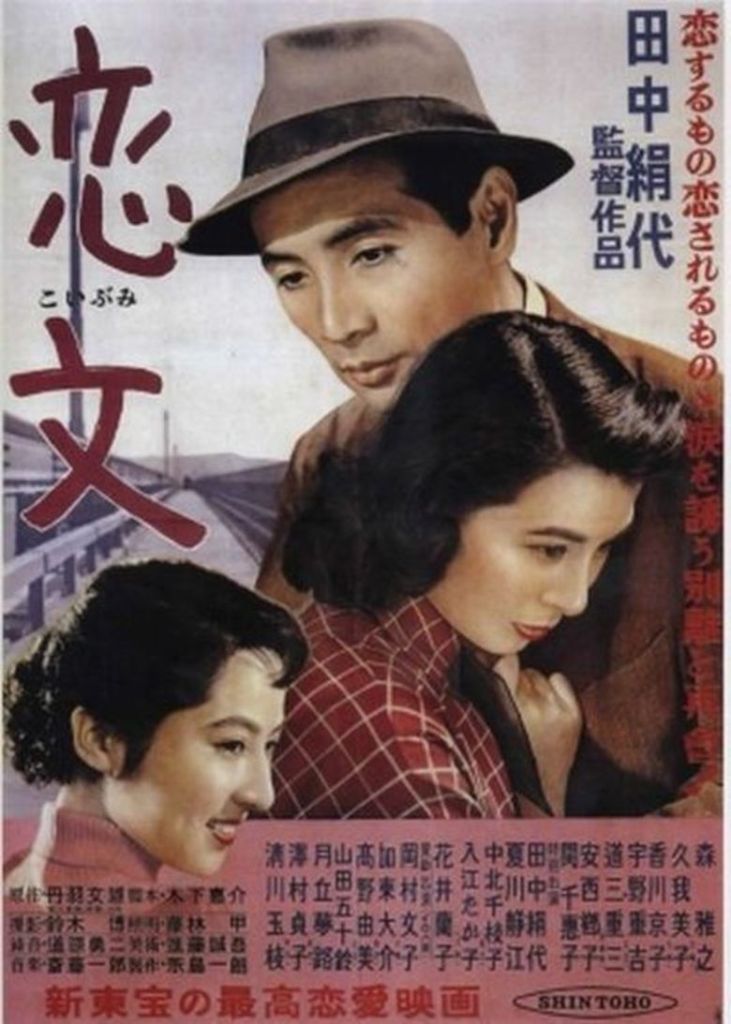
Love Letter (恋文, Kinuyo Tanaka, 1953)

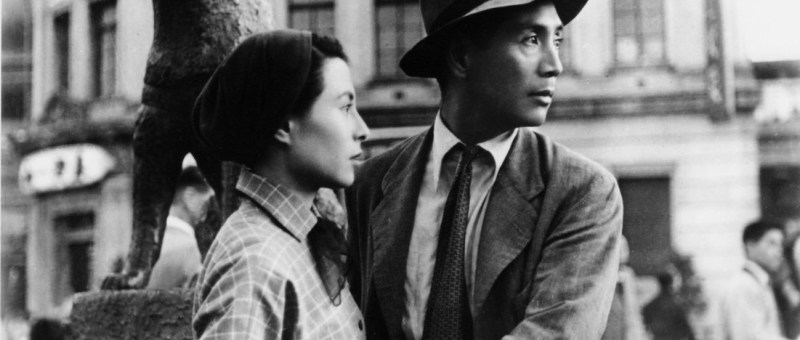
Love-Letter-1953-film-images-d67cf443-345f-409e-9cdb-26f20177f50Kinuyo Tanaka was one of the most successful actresses of the pre-war years well known for her work with celebrated director Kenji Mizoguchi including several of his most critically acclaimed works such as Sansho the Bailiff, Ugetsu, and The Life of Oharu. However, post-war Japan was a very different place and Tanaka had a different kind of ambition. With 1953’s Love Letter (恋文, Koibumi) she became Japan’s second ever female feature film director, though her working and personal relationship with Mizoguchi ended when he attempted to block her access to the Director’s Guild of Japan. No one quite knows why he did this and he tried to go back on it later but the damage was done, Tanaka never forgave him for this very public betrayal. Whatever Mizoguchi may have been thinking, he was very wrong indeed – Tanaka’s first venture behind the camera is an extraordinarily interesting one which is not only a technically solid production but actively seeks a new kind of Japanese cinema.

Based on the novel by Fumio Niwa and scripted by another of Tanaka’s frequent collaborators Keisuke Kinoshita, Love Letter takes place around 1950 just as the post-war chaos was beginning to settle down allowing individual trauma to come to the surface for the very first time. Our “hero” is Reikichi Mayumi (Masayuki Mori) – a melancholy naval veteran living with his brother Hiroshi (Juzo Dosan) and eking out a living as a translator of French literature. He spends his days hanging round train stations looking for a familiar face and constantly rereading a letter from his childhood sweetheart which informs him that, against her own wishes, she is shortly to be married to someone else. Michiko is apparently now a war widow, but despite his best efforts Reikichi has not been able to find her since being repatriated.

One day he runs into an old naval friend, Yamaji (Jukichi Uno), who has an interesting job. He drafts love letters in English and French from Japanese girls to the faithless foreigners who have abandoned them and returned home. Yamaji has developed an affection for some of these desperate women and tries to help them as much as he can with fatherly advice as he writes heartrending messages designed to get that guilt cash rolling back to Japan. Reikichi is not as well disposed the girls who he feels have sold themselves to the enemy but soon begins working there too. One fateful day, he hears a familiar voice.

Whereas you might expect this to be the end of a conventional movie, it’s only really the beginning. After a desperate chase to the train station Reikichi catches up with Michiko (Yoshiko Kuga) in a beautifully filmed, emotionally powerful scene which frames them both in a closing train door, momentarily eclipsed as it moves away. However, the elation soon fades as Reikichi’s rather backward thinking kicks in and he dwells on the reason Michiko was in the shop in the first place. After having longed for her, searching endlessly for five years, he can’t bring himself to accept this Michiko who he sees as “polluted” by her relations with an American soldier. He says some extremely cruel, and in fact unforgivable, things which Michiko accepts with a deeply internalised sense of guilt and shame. It looks as if the long awaited romantic reunion is not to take place after all.

Tanaka’s point of view is about as progressive as it was possible to be, but there is an ongoing conflict in the film in regards to its portrayal of the post-war “pan-pan” phenomenon. Great pains are taken to separate Michiko from the ranks of other desperate women who found themselves reliant on the occupying forces for their survival. Michiko became the mistress of an American man, bearing and losing his child, and though she wonders herself if it makes a difference that it was one American man and not several, the film definitely thinks it does. Later on she meets a group of women who are more obviously prostitutes and former friends whom she tries to avoid but the attitude to these women is far less sympathetic. At once we’re told that we shouldn’t judge Michiko for having done what she needed to do to survive, but we are being invited to judge these other women, all the while being reminded that Michiko is not like them.

Reikichi, however, is firmly painted as being in the wrong especially when compared to his cheerfully pragmatic brother and down to earth friend. Everybody tells him he’s being unreasonable and attempting to punish himself by also punishing Michiko for a series of things that are no one’s fault, but Reikichi persists in his oddly romanticised, absolutist way of thinking. It is he who will need to change, become less rigid and more empathetic but there is still the idea that Michiko’s past is something to be “forgiven”, and therefore a pre-determined view that she has acted in a morally incorrect way and is paying for it now.

Interestingly, Tanaka undermines the film’s inherently melodramatic quality by choosing to end on a note of ambiguous anxiety. A decision seems to have been reached, yet it is a tentative one and there will be difficulties along the way. This is new and different world, filled with broken and damaged people. A better one is possible but won’t happen with a heartfelt apology over a hospital bed, it will require a long process of mutual understanding and empathy though the wounds themselves may never be entirely healed. Tanaka’s debut is a daring wonder filmed with true visual flair and an unusual degree of assuredness. A sympathetic look at the bubbling trauma of the post-war environment, Love Letter approaches its subjects with extreme sensitivity and the hope that love and forgiveness are possible, but they will require hard work and a willingness to embrace them.


The first Japanese feature film to be directed by a woman was completed by Tazuko Sakane in 1936. Mizoguchi actually gave her a start in the industry and she was able to keep working during in the war by making documentaries as part of the Manchurian Film Association. Once the war ended she was barred from further directorial opportunites because she didn’t have a university degree and returned to continuity and editing roles at Shochiku until she retired in 1962, never making another feature film. Kinuyo Tanaka was a little luckier in this regard and was able to make a few more features becoming the first woman able to have a career in film directing through she also continued acting in other people’s films and on television until the 1970s.

The Shiinomi School (しいのみ学園, Hiroshi Shimizu, 1955)

vlcsnap-2016-07-09-01h53m10s460Hiroshi Shimizu is well known as one of the best directors of children in the history of Japanese cinema, equalled only by the contemporary director Hirokazu Koreeda. The Shiinomi School (しいのみ学園, Shiinomi Gakuen) is one of the primary examples of his genius as it takes on the controversial themes of the place of the disabled in society and especially how children and their parents can come to terms with the many difficulties they now face.
The Yamamotos are a happy family with two sons. However, their elation at the birth of their first child soon turned to tragedy as the boy became seriously ill with polio. Times being what they were, the treatment is not completely effective and although their son thankfully survived, he did so with a lamed leg. Now an older child, Yudo walks with a crutch and is constantly left out or bullied by his fellow children. After their second son, Teruhiko, also contracts the disease and is left even more seriously affected than his brother, the Yamamotos decide to open a school for survivors of polio where they can play together, learning how to live with the effects of the disease, free of the stigma which plagues them in their everyday lives.

Yudo just wants to play baseball and the other kids tell him he can if he brings a catcher’s mitt of his own but when he does they take it away from him and use it themselves while he sits and sadly watches them play. When his dad arrives and tries to tell them off, the kids form a mob and all leave together, fake limping as they go. Children are monsters, and often far less forgiving of difference than their adult counterparts (though it has to be said that the parents of other children are hardly blameless here). It’s not surprising that Mr. Yamamoto would want to protect his son by taking him out of this harsh environment where he’s constantly reminded of his disability and a target for the other kids’ cruel games.

The Shiinomi School may be at odds with modern thinking, but its heart is definitely in the right place. The Yamamotos are operating from a humanist perspective – they want to provide a place which helps the children to grow up strong and independent, fully able to cope with their various disabilities, where they can also escape the extreme prejudice which infects society in general. This prejudice is best brought out not by Yudo’s treatment by the other boys, but by the sad case of Tetsuo whose father had so little idea what to do with him that he used to tie him to a pole. Tetsuo’s dad has since remarried and his new wife has no intention of looking after a disabled child so they’ve brought him to Shiinomi with the intention of abandoning him there. Mr. Yamamoto is shocked and originally refuses to take the boy in protest at the idea of a father who wouldn’t want to try and do everything for his son, but eventually reconsiders when he thinks about what the boy is going back to.

Unintentionally segregating the children has some benefits in the short term but there are those who may feel that it sends a message that the problem is with the children and not with the society which rejects them. Perhaps by giving these children a happy childhood and protecting them from the cruelty of others it’s also leaving them unprepared to deal with that same cruelty once they come of age. In any case Shimizu shoots with his trademark humanity, valiantly showing the children singing loudly and learning to enjoy their lives despite their many hardships. From tiny acorns mighty oaks do grow, the Yamamotos want nothing more than to raise these children in love and acceptance and, if the final scene of the children walking down the lane alone with a song on their lips is anything to go by, you could say their efforts have been richly rewarded.


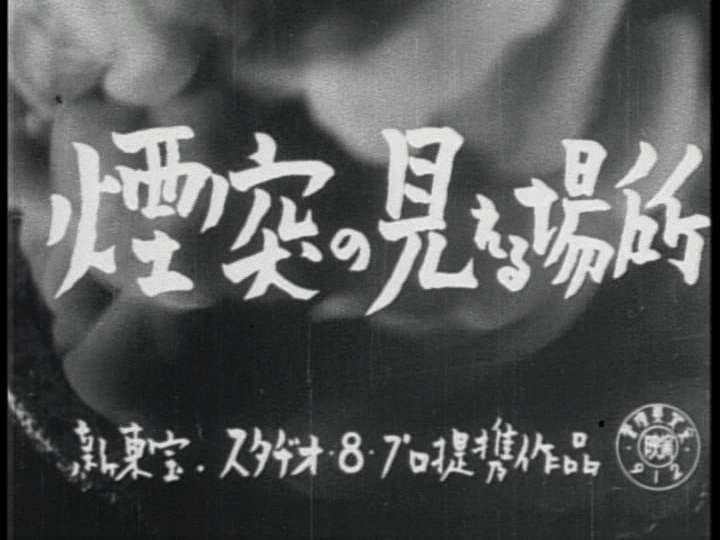
Where Chimneys are Seen (煙突の見える場所, Heinosuke Gosho, 1953)

vlcsnap-2016-07-07-01h01m06s792Where Chimneys are Seen (煙突の見える場所, Entotsu no Mieru Basho) is widely regarded as on of the most important films of the immediate post-war era, yet it remains little seen outside of Japan and very little of the work of its director, Heinosuke Gosho, has ever been released in English speaking territories. Like much of Gosho’s filmography, Where Chimneys are Seen devotes itself to exploring the everyday lives of ordinary people, in this case a married couple and their two upstairs lodgers each trying to survive in precarious economic circumstances whilst also coming to terms with the traumatic recent past.

Ryukichi Ogata (Ken Uehara) is our primary narrator, introducing us to his humble circumstances and, for the moment, happy home. He’s married to a cheerful and kindly woman, Hiroko (Kinuyo Tanaka), who was widowed during the war, and the couple rent out their upstairs to a man, Kenzo (Hiroshi Akutagawa), and a woman, Senko (Hideko Takamine) , who aren’t a couple but each rent a room separately. They’re desperately poor, so much so that they have complicated measures in place to try and avoid having any children – a luxury which they can in no way contemplate. However, unbeknownst to Ryukichi, Hiroko has taken on a part-time job outside the home by working at the bicycle races. He’s upset by this because he resents feeling as if his wife has been hiding things from him, though his pride is wounded too. The worry planted in his mind by the idea of not knowing everything there is to know about his wife’s past is brought to the fore when a baby is suddenly abandoned on their doorstep with a note claiming to be from Hiroko’s first husband which states this is “her” child and she ought to look after it from now on.

The titular “magic” chimneys belong to a large scale factory and, in truth, there are four of them, but depending on where you stand they blend into each other, increasing or decreasing in number. This rundown, backwater town is a three chimney sort of place – not quite rock bottom, but almost. All anyone can think about is trying to keep their head above the water and food on the table. Upstairs lodger Senko works as a public announcer in the shopping district along with another woman who has a rather different approach to life and is in some kind of compensatory relationship with a businessman whom she’s apparently going to marry. Senko is a little upset about this, possibly envious, but at any rate is going to lose a friend at work and in a way she doesn’t entirely approve of. At one point she declares that she envies the baby in one sense – children are allowed to cry whenever they want and make as much noise as they please, but adults are expected to grin and bear it no matter how painful it might be.

Kenzo, by contrast, is a government official in that he’s a kind of bailiff trying to enforce taxation fines and threatening to seize the property of those that can’t pay. This kind of work contrasts strongly with his sense of social justice as he can see that most of the people he visits just don’t have the means to pay but do have plenty of other problems of their own, what good will it serve turning them out onto the streets? Predictably he’s developed a bit of a crush on Senko though given both of their dire financial circumstances, he’s afraid to pursue it. His need for “justice” sends him out on a quest to track down Hiroko’s former husband and find out what’s really going on though his investigation takes far longer than expected and soon begins to depress him. When eventually uncovered, the facts of the matter shock and upset, leaving Kenzo wishing that he’d never bothered in the first place.

Having gone to so much trouble to avoid having children (they have a very prominently marked calendar hanging on the wall), that Ryukichi and Hiroko should be saddled with an abandoned child is especially ironic though the baby serves as more than a physical burden, becoming a manifestation of a hitherto buried past. Both of the women in the film have suffered heavily in the war. Hiroko lost her entire family and was reduced to stealing scraps of discarded food behind the evacuation centre. After losing everything she came to resent the whole of humanity for becoming involved in this senseless war and just wanted to live alone, but came to feel a life of mere subsistence was not worth living. She got herself a new family register and started again planning not to look back. She didn’t tell Ryukichi much about her former life because she wanted to forget it, it was painful to her.

Senko had similar experiences, losing family members in extremely cruel ways leaving her with a degree of resistance to forming new bonds. The baby, perhaps a temporary visitor, perhaps not, forces them to reconsider their choices, reawakening an emotional connection that had been severed due to the war’s hardships. The past is quite literally visited upon them, but how they decide to deal with it is very much a matter for the present. In the end, this extreme stress test on the various relationships of the central characters proves effective as their bonds eventually strengthen rather than break.

Using the four chimneys as an effective, if occasionally overworked, metaphor, Gosho remains resolutely non-judgemental, reminding us that things often look very different depending on where you stand. Everybody here is struggling, but everyone is trying to survive. If the film has a central message, it’s that you have to let the past go. The “right time” may never come, so you just have to make the best of things now. Happiness is fragile, but possible, if only you can learn to accept the various compromises which necessarily accompany it.


Utae! Seishun Harikiri Musume (歌え!青春 はりきり娘, Toshio Sugie, 1955)

vlcsnap-2016-07-04-00h41m46s630Hibari Misora was one of the leading lights of the post-war entertainment world. Largely active as a chart topping ballad singer, she also made frequent forays into the movies notably starring with fellow musical stars Izumi Yukimura and Chiemi Eri in the Sannin Musume series. This solo effort from 1955 is directed by the Sannin Musume director Toshio Sugie and follows a similar approach with the 18 year old Hibari starring as a teenage girl who looks really like Hibari Misora (but unfortunately cannot sing).
Hibari is playing a teenager here but she’s left school and is working as a bus conductoress. Bright and cheerful in her work, she takes some ribbing from the other employees because of her resemblance to the singing star (she has a large beauty mark drawn on her right cheek to make sure we know she’s not the “real” Hibari) and is a little embarrassed when they ask her to sing something because unlike her doppelganger, she’s tone deaf. Hibari lives at home with her mother and younger brother who’s still in school but their father seems to have left the household and there’s a degree of discord between the couple. Hibari tries to get her parents back together so they can live as a family whilst also maintaining her bus job, beginning a tentative romance with a former passenger, and even getting a few singing lessons from the real Hibari Misora herself!

Unlike the Sannin Musume movies, Harikiri Musume is shot in regular black and white though has pretty good production values for the time with some location shooting and outdoor scenes. Hibari is only 18 here but she’s already working at the bus company which seems like a pretty good gig all things considered (though her money is going to pay for her brother’s school fees, such is life). Her biggest problems are her no good father and her singing star doppleganger which continues to cause her embarrassment.

Harikiri Musume is a pop star vehicle but oddly Hibari doesn’t get to perform that much. Early on she laments not being able to sing as she listens to one of her bus company colleagues singing the song Rendezvous (also featured in one of the Sannin Musume movies) which is then followed by a more operatic track from a male colleague (of course, these two end up becoming a couple, united in their musical talents). She watches “herself”  on TV and later mimes to a recording of the famous Hibari at home but the main subplot of the film takes hold once the two Hibaris meet in a neat cinematic doubling trick. Famous Hibari teaches ordinary Hibari how to sing properly using Misora’s famous song Ringo Oiwake. She then turns up in the finale at the wedding celebration of two employees with a new song just for the bus company as a special gift.

As well as Rendezvous, there are even a few callbacks to Jankenbon which also appears in So Young, So Bright which was released the same year. Hibari is mostly acting with herself here and it’s altogether a more modest affair than the Sannin Musume pictures with no real production numbers or complicated staging but somehow all the more charming for it. In keeping with other similarly themed movies, Hibari has the disrupted family subplot and a very slight romance which never really gets started until near the end but the film cleverly avoids any kind of heaviness in favour of a light and breezy youthful tone. First rate fluff, but nevertheless an interesting look at the “ordinary” people of movie land in the mid fifties and an entertaining musical comedy in its own right.


No trailer but here’s a clip of Hibari Misora singing Ringo no Oiwake almost 25 years later:

On Wings of Love (大当り三色娘, Toshio Sugie, 1957)

vlcsnap-2016-06-01-01h48m32s675The Sannin Musume girls are growing up by the time we reach 1957’s On Wings of Love (大当り三色娘, Ooatari Sanshoku Musume). In fact, they each turned 20 this year (which is the age you legally become an adult in Japan), so it’s out with the school girl stuff and in with more grown up concerns, or more specifically marriage. Wings of Love is the third film to star the three Japanese singing stars Hibari Misora, Chiemi Eri, and Izumi Yukimura who come together to form the early idol combo supergroup Sannin Musume. Once again modelled on the classic Hollywood musical, On Wings of Love is the very first Tohoscope film giving the girls even more screen to fill with their by now familiar cute and colourful antics.
On Wings of Love does not have very much going for it in terms of plot (even compared to previous So Young, So Bright and Romantic Daughters). This time the three girls each work as maids in swanky households and have their eyes on the same guy who they think looks like James Dean (again played by Godzilla heartthrob Akira Takarada). Luckily, another two guys pop-up from somewhere so no one gets left on the shelf at the end when the completely non serious romantic difficulties work themselves out in time for the color coded waterskiing finale.

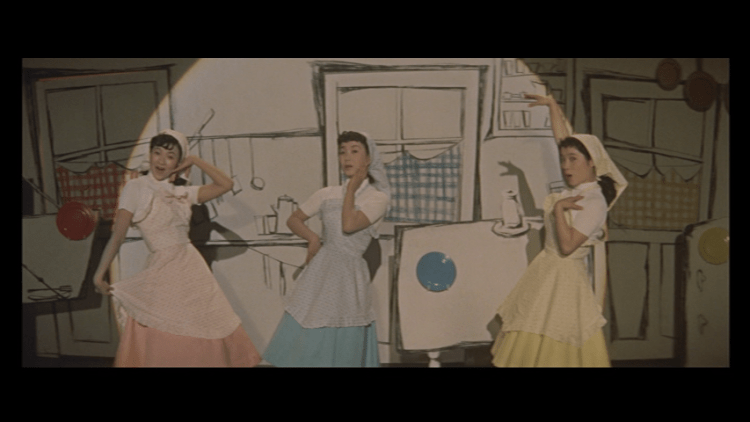
Like the other films in the series, On Wings of Love is not an integrated musical but one which is punctuated by musical numbers either given a real world context or portrayed as a fantasy sequence. In the previous two films the girls all went to the theatre and ended up watching themselves perform in one way or another, but this time the production number excuse is either a nap or a daydream whilst out on the river on a sunny day. Awkwardly, they each fantasise about Akira Takarada. Hibari goes all Madame Butterfly in an elegant sailor themed number, whereas Chiemi’s is all forlorn love with a melancholic, gothic ballad inspired by On London Bridge, but Izumi breaks all protocol here with a riotous cover of Bee-Bop-a-Lula which is sung entirely in English and becomes a high octane dance number (including the less successful involvement of Takarada).

There are fewer musical numbers included in On Wings of Love than in either of the other two movies though there are two trio sequences including the longer opening which sees the girls again color coded and drying dishes together as well as the finale which features the girls waterskiing while their boyfriends drive the boats. Each of the girls gets two numbers each, one solo and one production plus the trio stuff though interestingly there is a more “integrated” love song towards the end and Chiemi’s early song as she walks into town isn’t quite a fantasy sequence either.

Somehow, On Wings of Love isn’t quite as charming as either of the other movies in the series despite the kitch appeal of the opening number. The girls don’t actually spend much time together and the tone is a little rougher than the cutesy approach that had previously dominated with fewer humorous episodes to boot. That isn’t to say the film isn’t successful, but it doesn’t have the same kind of comforting fluffiness that dominated the previous instalments. The switch to Tohoscope gives series director Sugie a different canvas to play with though the most obvious change he makes is a split screen sequence to cover a telephone call. This time the colours appear a little muted too (though this may be down to the quality of the DVD which doesn’t seem as high as the transfers of either So Young, So Bright or Romantic Daughters which are both excellent) limiting the effect of the full on sugar rush the film seems to be aiming for. Nevertheless ,even if it doesn’t live up to the promise of either So Young, So Bright or Romantic Daughters, On Wings of Love is another suitably entertaining outing for the Sannin Musume girls only one a little less filled with laughter and song.


Hibari Misora’s Madame Butterfly inspired routine featuring her song Nagasaki no Cho Cho-san:

Also Izumi Yukimura’s quite wonderful Bee-Bop-A-Lula in its release version:

Romantic Daughters (ロマンス娘, Toshio Sugie, 1956)

vlcsnap-2016-05-30-23h55m41s358Romantic Daughters (ロマンス娘, Romance Musume) is the second big screen outing for the singing star combo known as “sannin musume”. A year on from So Young, So Bright, Hibari Misora, Chiemi Eri, and Izumi Yukimura reunite on screen once again playing three ordinary teenagers with a love of singing and being cheerful through adversity. This time the main thrust of the narrative is the girls’ friendship with a wealthy boy and his grumpy grandpa who takes a liking to them.

Michiru, Rumiko, and Eriko are three ordinary teenage girls in contemporary ‘50s Japan. Very close friends, they even have part time jobs working together at a local department store. One day Michiru decides to return some change a customer forgot to take with him directly to his home and the three girls are rewarded for their extremely high commitment to customer service by getting their pictures in the paper! This brings them to the attention of their friend Kubota’s grandfather who is very impressed with their honesty. He invites them round to his mansion where they enjoy a mini Western style feast and play a few songs on the piano. Shortly after, a man in a bow tie turns up and says he’s managed to find grandpa’s long lost daughter only she has unfortunately passed away leaving a little girl, Yukiko, with no one to look after her. Grandpa isn’t quite convinced by this story, but begins spending time with the sad little girl to try and see if she really could be his granddaughter.

Just like So Young, So Bright, Romantic Daughters is not an integrated musical but an ironic comedy with frequent musical interludes. There are plenty of excuses found for the girls to suddenly start singing, whether it’s that they’re involved in a local festival, entertaining an old man, or trying to cheer up a sullen little girl. Also like the first film, the girls (and Kubota) attend a theatrical performance but this time they do actually see “themselves” – that is Michiru, Rumiko, and Eriko head off to see Izumi, Hibari, and Chiemi. They even sit underneath a large poster of their real life counterparts in the lobby completely confusing one of their admirers who can’t believe his luck! Once again they each get a production number with Izumi getting the “sexy” routine this time which is a little bit On the Town. Chiemi gets an elegant set piece with a ball gown and a fairytale palace behind her, but Hibari’s number is just kind of nuts as she cross dresses to play a male samurai who ends up “saving” Michiru from the attentions of Chiemi who is also playing a guy complete with bald cap and top knot.

Kubota seems most interested in Rumiko and the other two girls have some kind of relationship with two other guys who work at an amusement park but are completely forgotten about for most of the film until they’re needed to fill the other two rear seats for the finale which is a trio number featuring the three girls riding bicycles with the guys on the back. At one point the girls and Kubota decide to take the little girl to the amusement park to try and cheer her up, which they eventually do by venturing into a haunted house (actually quite scary) where Chiemi decides to break protocol by using some of the judo moves she was seen practicing earlier on a couple of the ghosts and ghouls to be found in the psychedelic horror show.

Once again what’s on offer is cute and fluffy fun with some silly comedy and impressively choreographed production numbers thrown in. Like the first film there are also a number of recurring subplots of single mothers, long lost fathers, and this time also the problem of the little girl who may or may not be the granddaughter but by the time they start to reach a conclusion it may be too late to undo all the bonding that’s begin to occur in any case. Cinematic soul food, Romantic Daughters makes full use of its vibrant Eastman colours for a Hollywood inspired elegant musical feast that is undoubtedly a lot of empty calories but nevertheless extremely satisfying.


Can’t find any clips from the film but here is the English language US pop track sung by Izumi Yukimura in the movie in its release version: