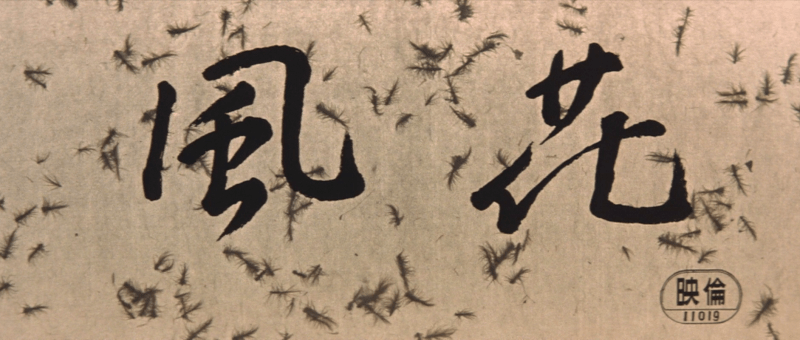

Studies of the post-war world have often made the cities their home. Filled with the starving, the ruined, and the hopeless, the cities of post-war Japan were places of defeat but also of perseverance as a betrayed generation struggled to survive in whatever way they could. Generally speaking, the rural countryside seems to fare better, coping only with the absence of lost sons and lonely daughters as life goes on much as it always has. Nevertheless things are changing even here. Recalling the subversion of his earlier Army, Keisuke Kinoshita’s The Snow Flurry (風花, Kazahana) employs a complex non-linear structure to examine the various ways in which the past continues to inform the future, trapping post-war youth in the same way their parents were trapped not only with a legacy of wartime rigour but with the weight of the feudal world pressing down upon them as they struggle to escape the authority of the generation by whom they have been betrayed.
We begin with the conventional “happy ending”. A middle-aged woman looks on with genuine happiness as a younger one leaves in a bridal outfit before running off to look for her son, Suteo (Yusuke Kawazu), who has run off towards the river with dark thoughts clouding his mind. Stepping back a little, we are told that 19 years previously Suteo’s mother, Haruko (Keiko Kishi), attempted double suicide with his father, Hideo (Masanao Kawakane) – the son of the local lords. Hideo, fearing that he would soon be sent away to war and knowing that his noble family would never approve of the woman he loved, felt death was his only solution but while his attempt succeeded, Haruko’s did not. Surviving she gave birth to a child and was eventually taken in by Hideo’s family, the Naguras, but only to avoid the gossip in town that their heartlessness was the cause of their son’s death. Haruko and Suteo, rather than living in the main house with the other family members, occupy a small shed to the side of the property and are treated as a maid and farm hand respectively. The only member of the family to treat them kindly is the grand-daughter, Sakura (Yoshiko Kuga), who is a little older than Suteo and remains unmarried at 25 while her grandmother insists on finding a wealthy man willing to marry into the family and save it from dying out altogether.
Though the main action takes place in 1959, not much has changed in the village and the eventual arrival of modern cars belonging to Sakura’s prospective suitors proves jarring in more ways than one. The Naguras, once the feudal landlords, have been greatly reduced in status thanks to the post-war agricultural reforms which limited the amount of land which could be held by one family to that which they could reasonably farm themselves. This obviously means that their income has sharply decreased which, coupled with the patriarch’s profligacy, makes their present way of life untenable unless they can find a wealthy man to marry into the family and re-inject it with cash while they figure out how to make money by farming their own land. Sadly, this will be hard because the Naguras are terrible people with a bad reputation thanks not only to their unpleasant personalities but the lingering stigma of Hideo’s death and the continuing existence of Suteo.
Nagura (Yasushi Nagata), a hard man, rejected his son’s remains out of shame for his “cowardice” in refusing to die bravely for the emperor. When Suteo is born in 1941, he takes it upon himself to register the child’s birth name without consulting the mother, insisting that the child is neither hers nor his but belongs to the nation and will be expected to sacrifice himself in his father’s place to make up for Hideo’s failure of duty. “Suteo” itself means “abandoned boy” and is hardly a warm legacy to leave to anyone let alone your own grandchild and the only offspring of your own late son.
Despite their reduced circumstances, the Naguras continue to behave like lords and are trapped within the feudal pre-war world, obsessed with status and position while those around them have entered the brave new era of promised equalities and modern possibility. Sakura, the only “legitimate” child of the last generation, is literally kept a prisoner by her hardline grandmother (Chieko Higashiyama) who has insisted on conferring various “accomplishments” such as traditional dance and learning to play the piano intended to hook an upperclass husband. Such things hardly matter now in the post-war world and any man who valued them is unlikely to make her very happy, but the Naguras care little for happiness and only for their own “good” name. Sakura wanted, like her friends, to go Tokyo for university but of course she couldn’t – her family wouldn’t even let her spend time with the other girls because there were boys around and they viewed even that as “improper” given her “position”. It’s no wonder that Sakura already feels as if her life will be “crushed by the weight of this house” and longs to leave it, as well as her cold and oppressive family, far behind her.
Suteo’s tragedy is the same has his mother’s, he has fallen in love with someone who can never be his because of outdated notions of social class and the unbreakable authority of the older generation. Sakura loves him too, though she hardly knew it until faced with her own dilemma and realises a marriage is the only way to escape her miserable existence even if she must sacrifice her feelings to do so. Despite all this lifelong suffering, grandma declares herself satisfied in having reasserted her noble status in marrying Sakura off to another prominent family, even if it is to a second son and no one could be persuaded to take on their family name. The Nagura family ends here and she gives her permission for the estates to be sold after she’s gone. All of this sacrifice in name of honour was, apparently, entirely pointless.
Employing a bold non-linear structure in which past and present inhabit the same space, Kinoshita mythologises his ordinary villagers through the repeated use of theatrical narration in the songs which accompany Sakura’s traditional dance, commenting on the action with a melancholy passivity. Trapped by circumstance and burdened by legacy, his protagonists are backed into corners with no way out other than to accept the paths before them. The future for Suteo lies in “abandonment” as he prepares to reject his cruel history and attempts to start again by walking bravely into the post-war world free of feudal oppression.
Original trailer (no subtitles)
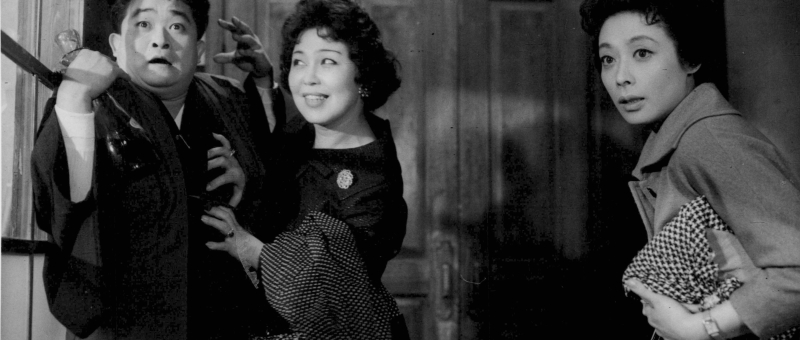

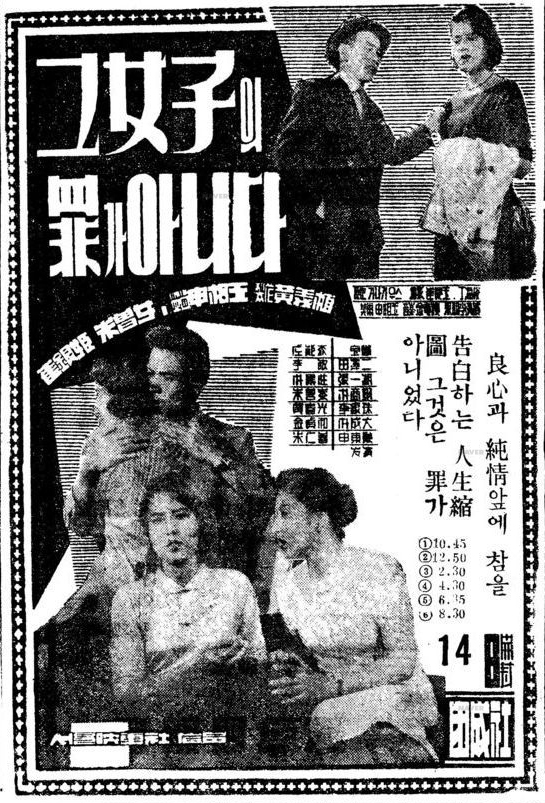 It’s Not Her Sin (그 여자의 죄가 아니다, Geu yeoja-ui joega anida) is, in contrast to its title, nowhere near as dark or salacious as the harsher end of female melodramas coming out of Hollywood in the 1950s. It’s not exactly clear to which of the central heroines the title refers, nor is it clear which “sin” it seeks to deny, but neither of the two women in question are “bad” even if they have each transgressed in some way. Drawing inspiration from the murkiness of a film noir world, Shin Sang-ok adapts the popular novel by Austrian author Gina Kaus by way of a previous French adaptation, Conflit. Shin sets his tale in contemporary Korea, caught in a moment of transition as the nation, still rebuilding after a prolonged period of war and instability, prepares to move onto the global stage while social attitudes are also in shift, but only up to a point.
 Ishiro Honda returns to outer space after The Mysterians with another dose of alien paranoia in the SFX heavy Battle in Outer Space (宇宙大戦争, Uchu Daisenso). Where many other films of the period had a much more ambivalent attitude to scientific endeavour, Battle in Outer Space paints the science guys as the thin white line that stands between us and annihilation by invading forces wielding superior technology. Far from the force which destroys us, science is our salvation and the skill we must improve in order to defend ourselves from hitherto unknown threats.
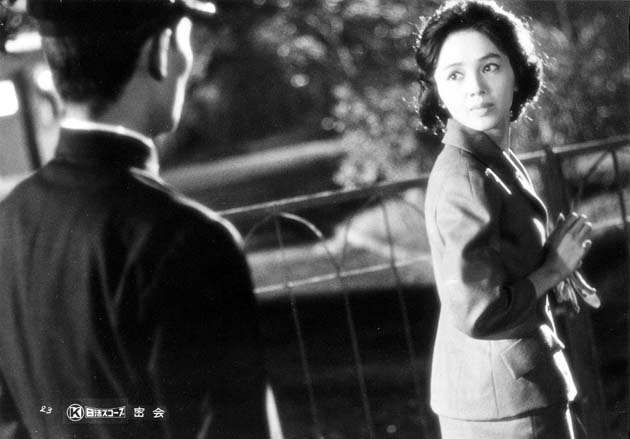 Aside from the genre defining Crazed Fruit which kick-started the era of the “seishun eiga” and, in its own way, the Japanese New Wave, Ko Nakahira has remained under seen and under appreciated outside of Japan. Completed just three years after the youth fuelled frenzy of Crazed Fruit with its freewheeling playboys and their speedboat crises, The Assignation (密会, Mikkai) is a much more measured, mature meditation on social constraint, guilt and the slow drip feed of poisonous thought. Nakahira wastes none of his characteristic energy in the necessarily tight 76 minute runtime, but this is an exercise in high tension as a pair of illicit lovers are suddenly confronted with their crime after accidentally witnessing a murder.
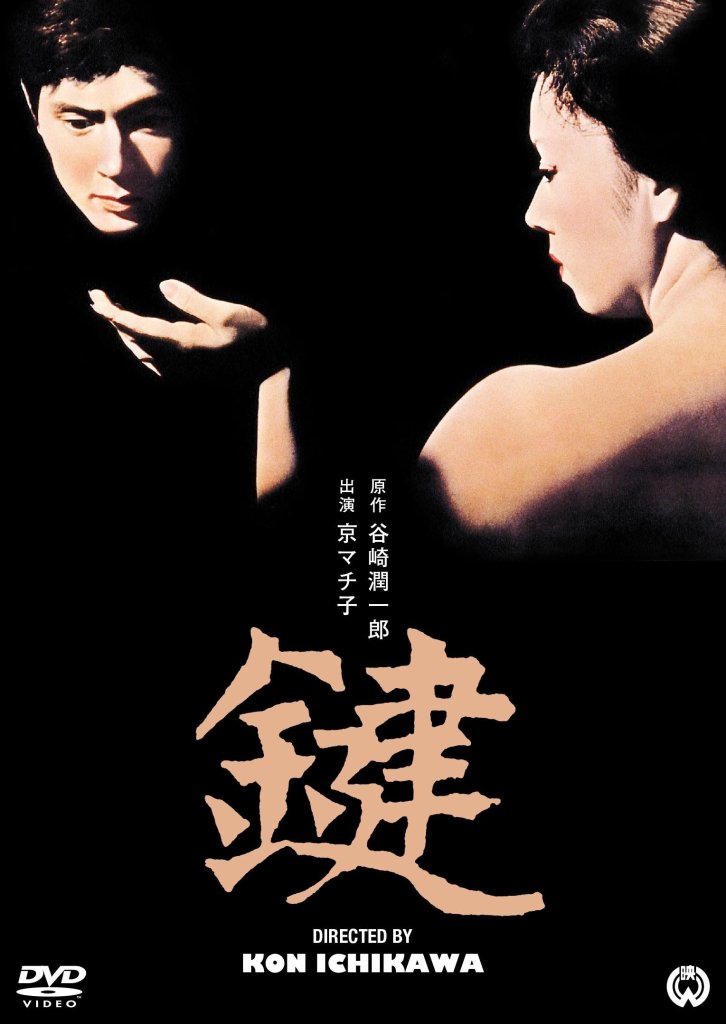 Junichiro Tanizaki is widely regarded as one of the major Japanese literary figures of the twentieth century with his work frequently adapted for the cinema screen. Those most familiar with Kon Ichikawa’s art house leaning pictures such as war films The Burmese Harp or Fires on the Plain might find it quite an odd proposition but in many ways, there could be no finer match for Tanizaki’s subversive, darkly comic critiques of the baser elements of human nature than the otherwise wry director. Odd Obsession (鍵, Kagi) may be a strange title for this adaptation of Tanizaki’s well known later work The Key, but then again “odd obsessions” is good way of describing the majority of Tanizaki’s career. A tale of destructive sexuality, the odd obsession here is not so much pleasure or even dominance but a misplaced hope of sexuality as salvation, that the sheer force of stimulation arising from desire can in some way be harnessed to stave off the inevitable even if it entails a kind of personal abstinence.
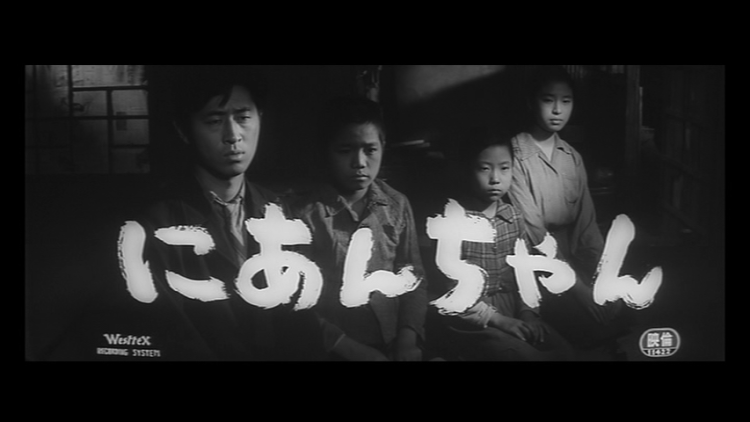 Like most directors of his era, Shohei Imamura began his career in the studio system as a trainee with Shochiku where he also worked as an AD to Yasujiro Ozu on some of his most well known pictures. Ozu’s approach, however, could not be further from Imamura’s in its insistence on order and precision. Finding much more in common with another Shochiku director, Yuzo Kawashima, well known for working class satires, Imamura jumped ship to the newly reformed Nikkatsu where he continued his training until helming his first three pictures in 1958 (Stolen Desire, Nishiginza Station, and Endless Desire). My Second Brother (にあんちゃん, Nianchan), which he directed in 1959, was, like the previous three films, a studio assignment rather than a personal project but is nevertheless an interesting one as it united many of Imamura’s subsequent ongoing concerns.
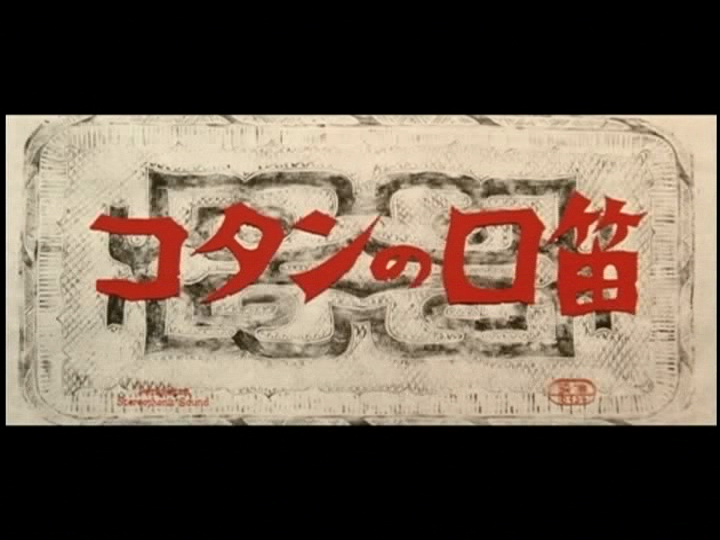 The Ainu have not been a frequent feature of Japanese filmmaking though they have made sporadic appearances. Adapted from a novel by Nobuo Ishimori, Whistling in Kotan (コタンの口笛, Kotan no Kuchibue, AKA Whistle in My Heart) provides ample material for the generally bleak Naruse who manages to mine its melodramatic set up for all of its heartrending tragedy. Rather than his usual female focus, Naruse tells the story of two resilient Ainu siblings facing not only social discrimination and mistreatment but also a series of personal misfortunes.
 After Japan was defeated and later occupied by the Americans, there came the painstaking exercise of examining what exactly had happened during the conflict and assessing is who, if anyone, could be held accountable for any wrongdoing. The so called “war criminals” were divided into classes according to the severity of their crimes with Tojo himself at the top who eventually paid with his life. However, many of the men who were given the same Class A rating were just rank and file soldiers who had been “following orders”, often because they feared for their own lives if they refused. The debut directorial effort from writer Shinobu Hashimoto who provided scripts for some of Akira Kurosawa’s most famous works, I Want to be a Shellfish (私は貝になりたい, Watashi wa Kai ni Naritai), examines just one of these tragically absurd cases.
 Sometimes, just like an aimless drifter wandering into town, you feel as if you’ve come in during the second reel and missed some vital piece of information leaving you feeling a little at odds with the current situation. So it is with Buichi Saito’s The Rambling Guitarist (ギターを持った渡り鳥, Guitar wo Motta Wataridori) which is, apparently, the first film in a series though feels a little more like the second.
