Blood End (天狗党, Satsuo Yamamoto, 1969)

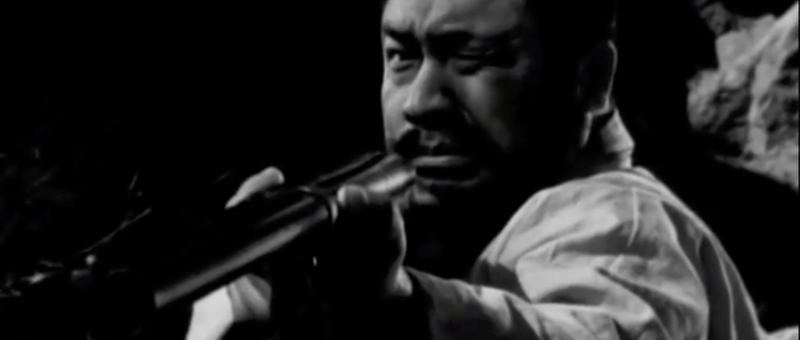
When the black ships appeared off the coast of Japan in 1853, it provoked a moment of crisis which eventually led to the fall of the Tokugawa Shogunate and the Meiji Restoration. Between those two events however lay a period of intense confusion as several groups and movements attempted to lay claim to the future direction of the nation. Many, such as the legendary figure Sakamoto Ryoma, held that above all else Japan needed to Westernise as quickly as possible in order to defend itself against foreign powers now far more technologically advanced than the Japan which had attempted to hold back time for over 200 years. Others felt quite the opposite, that what was needed was an end to the corrupt rule of the Shogunate and the restoration of power to the emperor while expelling foreign influence and going back into isolation. 

Satsuo Yamamoto’s Blood End (天狗党, Teng-to) dramatises this debate through the melancholy tale of the Mito Rebellion as a brutalised peasant farmer is sucked in by the idea of revolution but eventually betrayed by it in discovering that the samurai, even revolutionary samurai, will never change. They may claim they want an end to the feudal caste system and to live in a world where all men are equal, but continue to feel themselves entitled to more equality than others and insist on deference from those they still believe to be inferior. 

The action begins with a scene familiar from many a jidaigeki in that a small farming community is being pressed to provide the usual amount of rice despite the failure of the harvest. Revolutionary yakuza Jingoza (Kanemon Nakamura) and egalitarian samurai Kada (Go Gato) stumble on the scene of a “stubborn” peasant being subjected to 100 blows as punishment for the village’s raising the unfairness of their situation with the local lord. Surviving his ordeal, Sentaro (Tatsuya Nakadai) asks only for water but is denied by his cruel samurai tormentor. Jingoza intervenes and offers him his flask along with some money by way of an apology on behalf of these savage nobles, a gesture for which Sentaro remains grateful. While many of his friends are exiled and lose their lands, Sentaro disappears from the village and becomes a yakuza himself, learning the art of the sword in preparation for his mission of revenge. 

Meeting Jingoza by chance, he takes the opportunity to thank him and agrees to transport some money back to his family in a nearby village while he engages in urgent business in the mountains. While there, Sentaro ends up defending Jingoza’s steely daughter Tae (Yukiyo Toake) who is running something like an orphanage for children rendered fatherless by the ongoing chaos. It’s at Tae’s that he ends up running into Kada, who is a member of revolutionary movement “Tengu-to”, named for the mythical ogres with long noses and bright red faces. Sentaro ends up joining the movement, but gradually discovers that Tengo-to is not all he thought it to be. In the modern parlance, many of their actions are terrorist, they care little for human life and have no issue with looting wealthy houses as they prove after helping Sentaro assassinate the man who beat him, killing the man’s wife and servants and making off with his money as “military funds”. Sentaro is shocked, but only manages to get some of the money for himself to take back to Tae as a way of making amends. He continues to associate with Tengu-to despite his growing disillusionment with their philosophy. 

The Mito clan were perhaps outliers in the great Bakumatsu culture war, running under the “Sonno Joi” banner but doing so alone and forcefully advocating that the emperor’s instruction to expel all foreigners with immediate effect be enforced. At least as far as Yamamoto’s revolutionaries go, they advocate for this not so much because they reject foreign influence but because they resent the country’s elites maintaining a stranglehold on the riches to be gained by foreign trade. Kada, however, claims to have a more revolutionary spirit in that he wants to improve conditions for farmers like Sentaro, protecting them from the “corrupt system” but he’s still a product of his society and finds the programming increasingly hard to break. Having recruited vast numbers of peasants to their cause and witnessing the failure of their campaign, the other leaders want to go to Kyoto to talk to the emperor but are embarrassed to go there in the company of so many men who are not samurai. The solution is that they simply kill them, because peasants aren’t really people anyway. 

Sentaro thought they were “doing something good for peasants and the poor”, but samurai will always be “samurai” and eventually they will betray him. He wavers when Kada and the others ask him to assassinate Jingoza because he’s gone over to the Westernising cause, and is half talked round by his insistence that he’s acting blindly without thinking far enough ahead but himself finds it hard to break with the idea that samurai are honest and know what they’re doing. 

Yamamoto is perhaps making a direct allusion to the imminent failure of the student movement in Japan which finds itself in much the same place as the Tengu-to, torn apart by infighting and increasingly corrupted by duplicitous dogma. Kada has a lot of fine ideas but he doesn’t act on them, doubling down on ruthlessness in complaining that Sentaro is too sentimental, insisting that emotion is the enemy. Sentaro, however, has figured out that the enemy is the sword and everything it represents. Jingoza’s “Restoration” is the one he should have been fighting for if he wanted to see a classless Japan, but the Tengu-to have misused his idealism for their own ends and turned him into a defender of his own oppression. Still, the Tengu-to are the ones who pay the price, their entreaties to the emperor falling on deaf ears with 353 retainers beheaded as punishment. Sentaro lives on, vowing he will never die, as he walks towards the “Restoration” of the future and away from the Blood End of an inherently corrupt insurrection. 

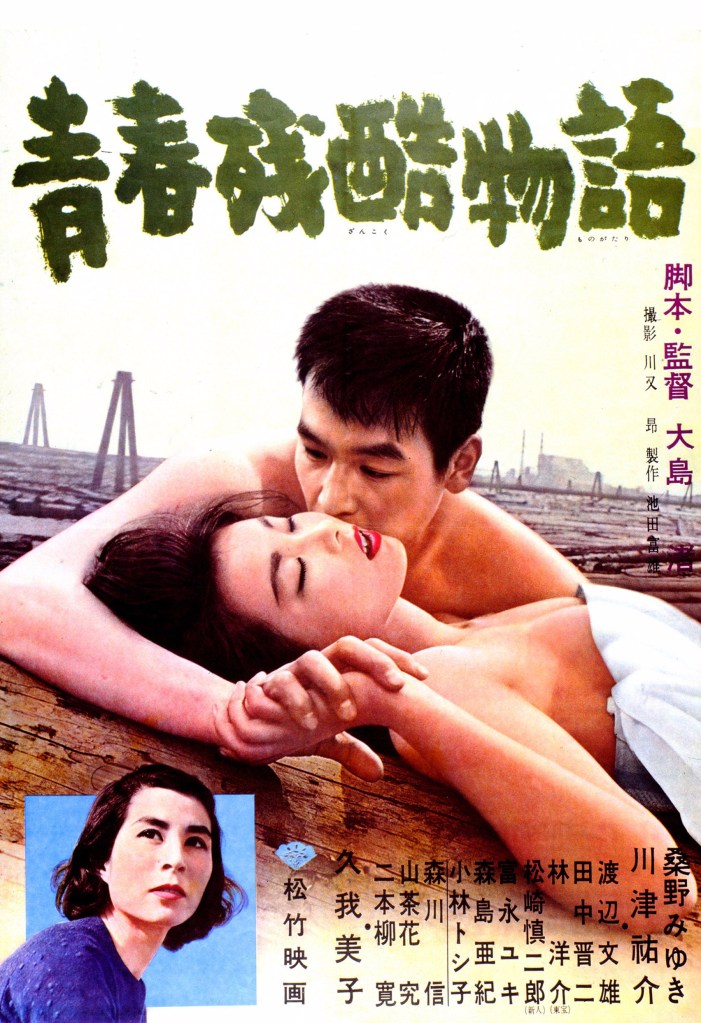
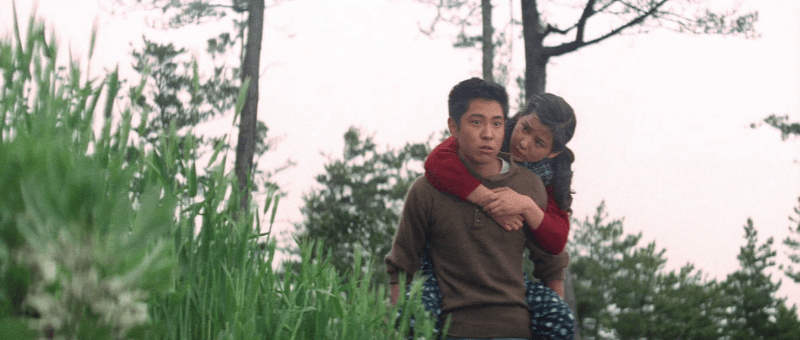
Cruel Story of Youth (青春残酷物語, Nagisa Oshima, 1960)

More interested in politics than cinema and never quite at home in the studio system, Nagisa Oshima began his career at Shochiku as one of a small group of directors promoted as part of the studio’s effort to reach a youth audience they feared their particular brand of inoffensive melodrama was failing to capture. Like The Sun’s Burial, Cruel Story of Youth (青春残酷物語, Seishun Zankoku Monogatari) is a nihilistic tale of a fracturing society, but it also looks forward to Night and Fog in Japan in its insistence that youth itself is a failed revolution and this generation is no more likely to escape existential disappointment than the last. 

The film opens with teenager Makoto (Miyuki Kuwano) and her friend Yoko (Aki Morishima) trying to get free rides from skeevy middle-aged men rather than having to pay for a cab. As you might expect, that’s a fairly dangerous game and while it might be alright while there’s two of you, as soon as Yoko has been dropped off, the driver changes course and suggests going for dinner only to park in front of a love hotel and try to drag Makoto inside. Luckily, or perhaps not as we will see, she is “rescued” by young tough Kiyoshi (Yusuke Kawazu), a student and angry if politically apathetic young man. Struck by his manly white knight act, Makoto takes a liking to Kiyoshi but he too later rapes her under the guise of satisfying her curiosity about sex to which he attributes her ride hailing activities. After this violent genesis, they fall in “love” but continue to struggle against an oppressive society.

We assume that the “cruel story of youth”, and it is indeed cruel, that we are witnessing is that of Makoto and Kiyoshi, but it’s also that of her slightly older sister Yuki (Yoshiko Kuga) and her former lover Akimoto (Fumio Watanabe) who has become a conflicted doctor to the poor betraying himself by financing the clinic through charging for backstreet abortions. Yuki complains to her apathetic father that they were strict with her in her youth, that she’d get a hiding just for coming home after dark, whereas Makoto can stay out all night and not get much more than a stern look. Her father explains that times were different then, “We thought we had new horizons. We started again as a democratic nation, and it was a responsibility that went hand in hand with freedom. What can I say to this girl today?” admitting both the failures of the past and the mistaken future of a society that actively resists change. 

Yuki and Akimoto were part of the post-war resistance, left-wing students like the older generation of Night and Fog in Japan, who’d actively fought for real social change but had seen that change elude them. Yuki, we hear, left Akimoto for an older man but perhaps now regrets it along with her half-finished revolution. She may not approve of her sister’s choices, but she also on some level admires her for them or at least for the strength of her rebellion even if it will ultimately be as fruitless as her own. “This is a cruel world and it destroyed our love” Akimoto laments, mildly censuring the youngsters in suggesting that his love was pure and chaste because they vented their youthful frustrations through political action whereas this generation is already lost to the mindless hedonism of unbridled sexuality. 

He forgives them, because he feels that their plight is a direct result of his failure to bring about the better world, but there is also a suggestion that it is a lack of political awareness which is somehow trapping the young. Oshima cuts from footage of the April Revolution in Korea which is described as a “student riot” in the news to a protest against the Anpo treaty at which Kiyoshi and Makoto look on passively from the sidelines. “I think taking part in the demonstrations is stupid”, Makoto’s friend Yoko tells a prospective boyfriend, “why don’t we think about getting married instead?”, drawing a direct line between social conservatism and political inaction. 

Makoto and Kiyoshi rebel by using, or to a point not using, their bodies as a direct attack on the society. Following their rather odd and troubling meeting, the pair earn their keep through repeating the experience. Makoto picks up men who will inevitably have an ulterior motive, and Kiyoshi rescues her, extorting money from their targets. Yet it is Kiyoshi who is forced to prostitute himself, gaining financial support as a gigalo kept by a wealthy middle-aged housewife who is just as sad and defeated as Yuki and Akimoto, dissatisfied with the path her life has taken and in her case attempting to escape it through passion and control exerted over the body of a young man. Though the consequences of a becoming a kept man may be different than those Makoto would face should the less “nice” delinquents get their hands on her, they do perhaps fuel his sense of violent emasculation which he channels into a pointless act of revenge against the society in the form of its most powerful, wealthy middle-aged men whose misogyny he claims to abhor while simultaneously mirroring and directly exploiting.

“Someone needs to be responsible” a strangely sympathetic policeman insists, chiding Kiyoshi that at heart he’s just a petty criminal who liked having money no matter how he might have tried to dress it up. “You’re just like them, you’re a victim of money too”, he adds correctly diagnosing the flaws of an increasingly consumerist society. Only, no one takes responsibility. Kiyoshi’s lady friend pulls stings. It turns out her husband does business with Horio, one of Makoto’s pick ups who despite being nice and kind still had his way with her and then reported Kiyoshi for extortion. Akimoto explained that their failures would drive them apart, but Kiyoshi swore they’d always be together only to wonder if in his love for her the only thing to do is save Makoto from his corrupting influence though she does not want to leave him. We won’t be like you, Kiyoshi countered, because we have no dreams with which to become disillusioned. But youth itself is a failed revolution, and the force which destroys them is perhaps love as they meet their shared destinies at the hands of an increasingly cruel society.


Cruel Story of Youth is currently streaming on BFI Player as part of the BFI’s Japan season.

Original trailer (no subtitles)

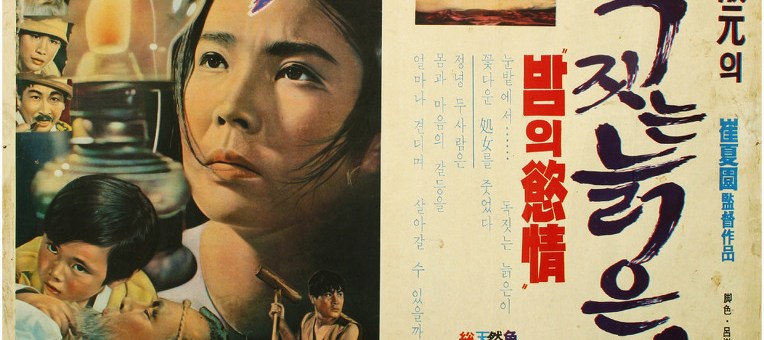
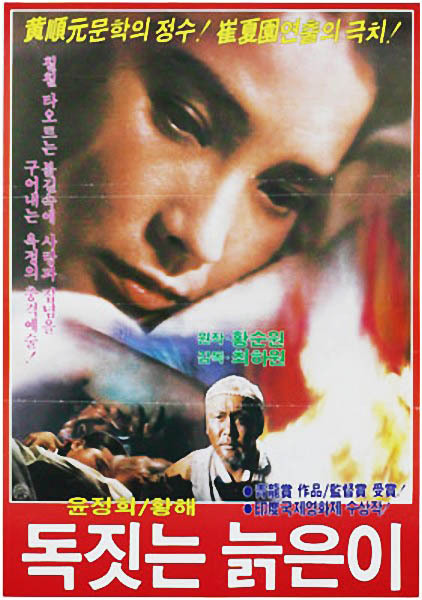
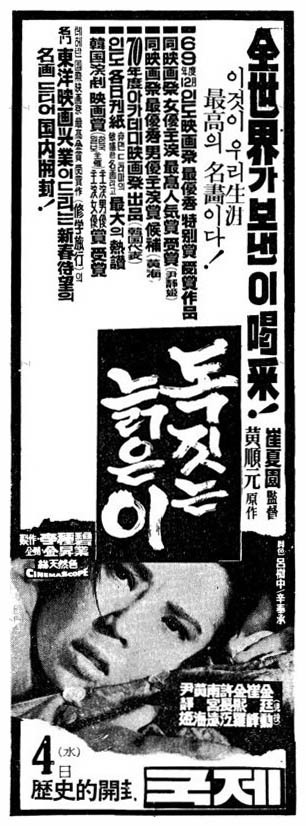
The Old Potter (독짓는 늙은이, Choi Ha-won, 1969)

“The man of the house shouldn’t covet and touch what belongs to others even if he is starving to death” laments an old potter admonishing his well-meaning son but also commenting on the folly of his life. A melancholy tale of illusionary futures, Choi Ha-won’s The Old Potter (독짓는 늙은이, Dokjitneun Neulgeuni) is a deeply felt meditation on loneliness and regret as a wandering son finally comes “home” to look for himself in the ruins of his family which seems to have existed as briefly as a dream. 

The young man (Kim Hee-ra), apparently from a nearby village, is a wandering soul struck by the familiar sight of traditional pots which he has not seen in some years seeing as he has just returned from the war. Stepping into a house he finds it not quite as empty as he thought and strikes up a conversation with an elderly gentleman (Heo Jang-gang) who invites him to stay the night among a small community of beggars congregating around a disused kiln. The old man tells him that he comes here every 15th day to spend time with a late friend of his, Song (Hwang Hae), to whom he seems to feel some sort of debt. 

Back in the 1920s, Song, the old potter, joked that he was married to his pots, living a lonely life devoted to his craft. One winter he happened upon a young woman collapsed in the snow, rescuing her and nursing her back to health in his shack. The young woman, Ok-soo (Yoon Jeong-hee), does not exactly fall in love with him but is grateful and, it turns out, has nowhere else to go and so the pair marry. The potter becomes a father to a son, Dang-son, at the age of 61. For seven years, the family is perfectly happy. Old Song truly loves the young Ok-soo and takes good care of her. He is a kind man and patient father keen to pass on his skills to his young son. 

And then, a strong and handsome young man arrives. He is is Sok-hyun (Nam Gung-won), Ok-soo’s first love for whom she left her family, heading off to look for him but fainting in the snow where she was rescued by Song. When Song’s friend made fun of him for washing Ok-soo’s clothes in a nearby stream and prompted him to ask her to stay, he said he’d let her go if that was what she chose, and to that extent he’s true to his word. Having overheard the couple talking and realised their past relationship, he says nothing but silently hopes that Ok-soo will choose to stay with them. 

Ok-soo meanwhile is torn. Her old lover has returned, the man she’d been searching for, but he’s come at an inconvenient time when she is now a wife and a mother with a settled home. She is not unhappy with the potter who, though elderly, is kind and has always taken care of her and their son, but she’s drawn back towards passion and romance with Sok-hyun who is young and strong, able to split logs with a single blow. Song hears the sound of the axe echoing in his mind as a grim reminder that Sok-hyun is everything he is not – young and handsome and full of life. He can offer only the warmth of their home and the feeling of duty towards family as reasons for Ok-soo to stay, but knows in his heart that she will choose the love of her youth over the security they have built together. 

Song’s late life happiness is shattered like one of his imperfect pots. He cautions his son that one should not covet things which belong to others as if blaming himself for daring to “borrow” Ok-soo all these years when she “belonged” to someone else. He gives Dang-son another pottery lesson which is really life philosophy, explaining that it’s fire that makes the pot, not the man. A man is made by the fires he endures, and perhaps, Song starts to think, he should give in and allow Dang-son to be adopted by a noble family so that he might live an easier life as a gentleman rather than struggle here with him with no real hope for the future seeing as all his pots are cracked. 

Of course, as we already know, the sad young man who returned from the war is Dang-son, so perhaps Song’s choice did not buy him the easy life that he hoped it would. Meanwhile, the old man explains that Ok-soo later returned and bitterly regretted her choice, begging to be told where Dang-son had been taken, but the old man turned her away which is why he feels so guilty. “I deserve the severest punishment as a woman who deserted her husband and son” Ok-soo laments, having spent the last 20 years trying to atone for her decision to choose passion over her maternal responsibility. Song’s brief moment of happiness left him unable to return to his cold and lonely life as the master potter, his hopes shattered by life’s imperfections. Fire has shaped them all, but after it’s cooled all that remains is bitter regret for the frustrated desires of youth and a painful longing for forgiveness. 


The Old Potter is available on English subtitled DVD courtesy of the Korean Film Archive in a set which also includes a bilingual booklet featuring an essay by director Choi Ha-won on the making of the film as well as writing by film critic Kim Jong-won. It is also available to stream online via the Korean Film Archive’s YouTube Channel.

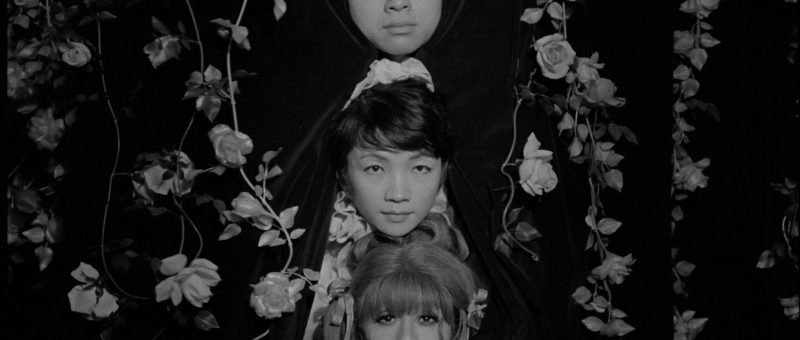
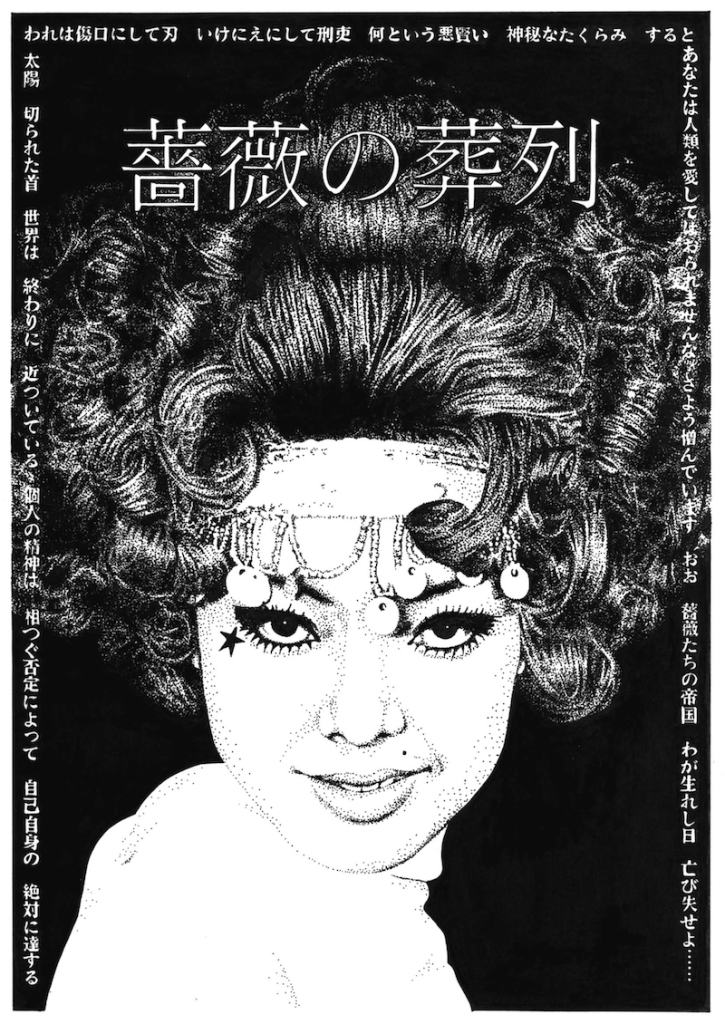
Funeral Parade of Roses (薔薇の葬列, Toshio Matsumoto, 1969)

“The spirit of an individual reaches its absolute through infinite negation” according to the title card which concludes Toshio Matsumoto’s anarchic voyage through the counter culture underworld of late ‘60s Tokyo, Funeral Parade of Roses (薔薇の葬列, Bara no Soretsu). Repurposing Oedipus Rex as mediated through Pasolini as an exploration of the crushing impossibility of true authenticity, Funeral Parade of Roses is also an atypical portrait of a city in transition. Like many a post-war melodrama, it’s a story of Tokyo bar hostesses only we find ourselves not in the comparatively upscale Ginza where unlucky women dream of escape into more conventional lives, but the grungier Shinjuku in which those who have no desire to attain conventionality, of that kind at least, have found a kind of freedom to become their truer selves. 

Our hero, Eddie (Peter), is something of an ephebe pursuing his destiny as a “gay boy” (cross-dressing bar hostess) at bar Genet where he has entered a relationship with the much older proprietor, Gonda (Yoshio Tsuchiya), who is growing tired of his current lover, Leda (Osamu Ogasawara), the bar’s mama-san. At the risk of mixing our metaphors, or at least allegories, in Greek mythology Leda was the mother of Helen of Troy, raped by Zeus in the guise of a swan. In any case, the primary crisis is one familiar from any other bar girl drama where Leda might be the melancholy heroine, facing the tragedy of her fading youth and an increasingly uncertain future. We see Eddie leave an apartment arm in arm with Gonda, a hearse passing ominously in front of them, while Leda looks on with scorn perching in front of a street corner convenience store to confirm that her suspicions are in fact correct. 

Leda is or will be the victim of Eddie’s quest for a place of his own, displaced within a world of displacement. She will eventually find her own kind of escape, dressed in a wedding dress and surrounded by white roses but drenched in romantic tragedy. Eddie meanwhile is plagued by visions of a traumatic past and a feeling of alienation. “I feel abandoned by life” he later complains to a counter culture friend, Guevara (Toyosaburo Uchiyama), who has adopted a strange fake beard in addition to his fake name. In the gallery in which Eddie meets him, a record is playing to remind us that we are each wearing a mask and that perhaps our mask may fit us so comfortably that we have forgotten the shape of our own face. We can never be sure if we are seeing those in front of us as they truly are or merely observing the masks they have chosen to wear. Beneath one mask may lie another, and another, into infinity hiding even from ourselves our truest identity in the truest form of loneliness.

Eddie too is searching for himself, though the implication that his present persona is just that may be an uncomfortable one. To undercut it, Matsumoto frequently breaks the fourth wall to interview some of his non-professional actors and other men in the street in this particular corner of Shinjuku. They tell him that perhaps they don’t have a “reason” for becoming a “gay boy”, only that it’s who they are and have always been and in that it makes them happy (aside from one self contradictory woman who gives answers only filled with nihilistic despair). The central thesis, however, is that an identity only reaches its absolute through its own negation, which is to say that Eddie must destroy himself to become himself. Something which he perhaps does on learning the ironic truth to which he was blind that has led him towards his grim destiny. 

A film critic making an unexpected, meta appearance talks to us of the “cursed destiny of man” while Eddie walks through a burial ground sinking into the sea and casually wishes that the whole country would sink to the bottom of the ocean. A student protestor justifies his use of violence as an essential good because it works towards the end of violence and not its perpetuation, but Eddie’s violence solves nothing and eventually becomes an act of self harm that propels him towards his nihilistic destiny. Yet this is a violent age in which opposition is the only sign of life. Eddie rebels against himself to rebel against the society, a rose wounded by his own thorns, whose only refuge lies in the artifice which mirrors authenticity. 


Funeral Parade of Roses is released on blu-ray in the UK on 18th of May courtesy of the BFI in a new 4K restoration. The set also includes an audio commentary by Chris D, the original Japanese trailer plus the US trailer for the 2017 restoration, and eight Toshio Matsumoto shorts including Nishijin (1961), The Song of Stone (1963), Ecstasis (1969), Metastasis (1971), Expansion (1972), Mona Lisa (1973), Siki Soku Ze Ku (1975) and Atman (1975). The two-disc edition also comes with a 34-page booklet featuring essays by Jim O’Rourke, the BFI’s Espen Bale, Hirofumi Sakamoto with Hiroshi Eguchi, and Koji Kawasaki.

Original trailer (English subtitles)

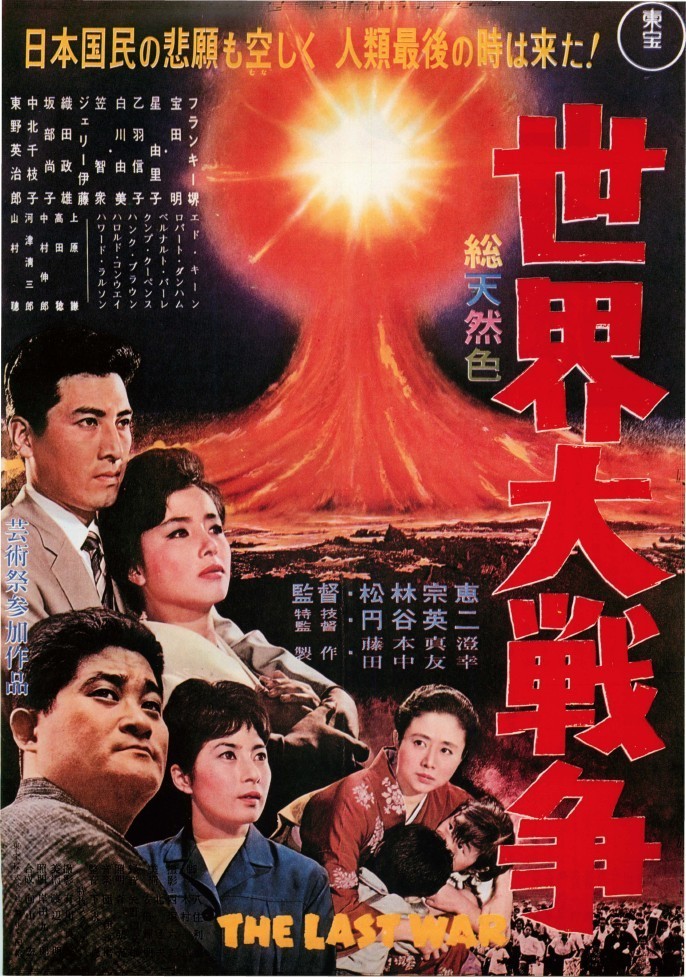
The Last War (世界大戦争, Shue Matsubayashi, 1961)

As The Last War (世界大戦争, Sekai Daisenso) points out, by 1961 16 years had passed since the end of World War Two during which Japan had begun to rebuild itself, heading into a period of unprecedented economic prosperity with the Olympics already on the horizon. But the early 1960s were also a time of increased international tension as the Cold War mounted and many in Japan feared being pulled into another conflict especially with the Korean War not quite so much in the distant past. Toho had become the home of special effects cinema and such films were often coloured with strong messages of peace and social responsibility as humanity banded together to combat an existential threat be it a giant monster or mad scientist. The Last War is no different in that regard, but sadder in showing us that the end of the world may come suddenly and without warning and that if we for a second become complacent it could already be too late to stop it. 

Patriarch Mokichi (Frankie Sakai) has made a decent life for himself after the war working as a driver. His wife, Oyoshi (Nobuko Otowa), is in poor health and he dreams of buying a house by the sea where she can live in comfort. Meanwhile, they have a grownup daughter, Saeko (Yuriko Hoshi), born before the war, and two much younger children, a girl, Haru, and boy, Ichiro. They are a very happy, very ordinary family who are beginning to think that their days of hardship are finally behind them and they have escaped the war’s shadow. The only note of potential conflict lies in the fact that Saeko wants to marry a family friend, Takano (Akira Takarada), a sailor, and is afraid of Mokichi’s reaction, especially as he keeps trying to set up matches for her. 

In fact, having lived through the war Oyoshi and Mokichi are certain that nothing like that is going to happen again, even if the younger generation is filled with anxiety. “Who could ever profit from the destruction of the Earth?” Mokichi not unreasonably asks, signalling his newly consumerist world view. Mind you, he adds, everyone knows the alternative to calamity is hard work, “you have to work hard for peace”. 

Mokichi has indeed been working hard, but has perhaps begun to neglect other areas of his life in his desire to become rich even if that desire is only to make his family more comfortable and give his children better opportunities than he had. Brought over to see a new TV set now on sale, he scoffs that he already has one, “Who needs a second TV?” he asks, but on hearing the news that tensions are rising because a military plane has gone down off the coast of Africa, his first thought is to get on the phone to his broker and junk his real estate stocks for shares in aeronautics. Mokichi is unconvinced by an old man selling potatoes on their street who apparently lost everything in Hiroshima and has since become a devoted Christian donating most of his profits to anti-nuclear charities, describing him as just “showing off”, firmly believing that nothing like that is ever going to happen again. “I cannot accept it” he says, “what would be the point of the aspirations of humble folk like us if we’re all destined to go poof into extinction?”.  

As the only nation to have directly experienced nuclear war, the intense fear of its recurrence is indeed understandable. If a nuclear war escalates, it will be the end of everything. All human endeavours over thousands of years will be mere dust. There will be no weddings, no births, no graduations, no grand discoveries, just nothing. When the bomb does indeed hit, the scenes of devastation must have proved extremely traumatic for many in the audience as buildings crumble ominously, the sky turns a fiery red, the streets run with lava, and we can see the outlines of charred bodies lying among the wreckage. The tip of the Diet building sits neatly atop the rubble as if in rebuke of the political failures which, despite the best efforts of the Japanese politicians who make an effort to govern responsibly and are honest with the electorate while advocating strongly for peace through diplomatic channels, have led to the literal end of the world. “You have to work hard for peace” the closing title card reminds us. “We can stop this before it happens, but we have to work together”. “I won’t let you destroy our happiness” Mokichi had screamed at the void, but in the end he was powerless. All it takes is a minor slip, and the world as we know it will cease to be.


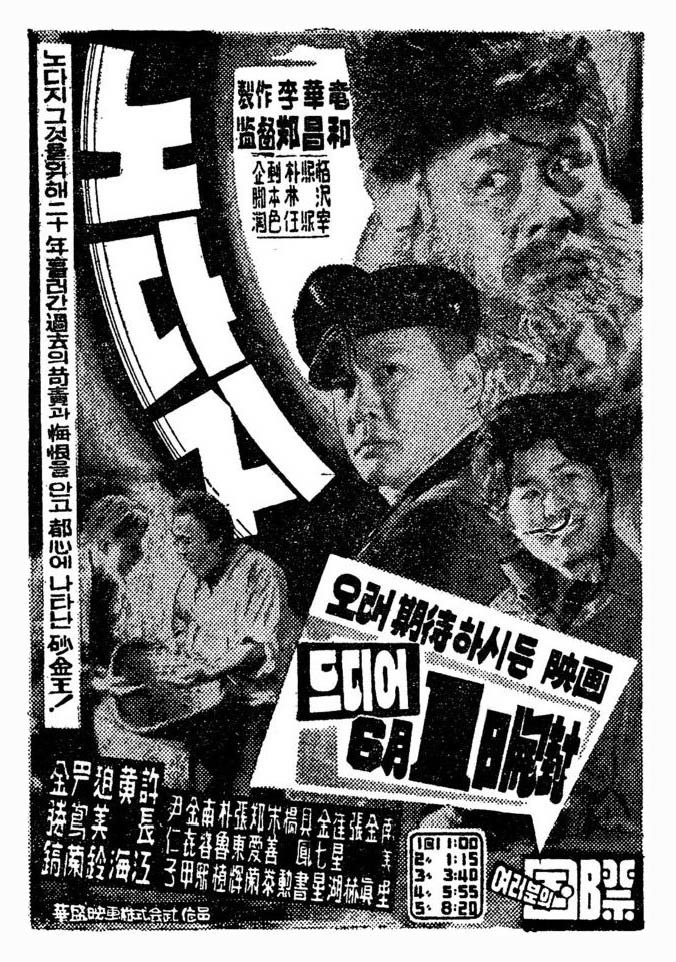
A Bonanza (노다지, Chung Chang-wha, 1961)

Chung Chang-wha is best remembered as a pioneer of Korean action cinema, eventually travelling to Hong Kong to direct martial arts movies with Shaw Brothers. 1961’s A Bonanza (노다지, Nodaji) arrives at a moment in which melodrama was the predominant genre and does in a certain way conform to contemporary tastes in its strong message of familial responsibility and reconciliation, but is also influenced by European and American crime cinema adding a touch of noir to its clearly delineated worlds of rich and poor which the hero has, perhaps incorrectly, attempted to cross through abandoning his social responsibilities to chase fortune in the wilderness. 

First on the scene, however, is lonely sailor Dong-il (Hwang Hae) who has returned to Busan after a six month voyage. He tries to visit his mother who is working in a restaurant, but finds her cold and unreceptive. We learn that prior to becoming a sailor, he’d been unemployed and embarrassed not to be able to support his ageing mother as a son should. Dong-il’s father apparently went off to the mountains to look for gold 20 years ago and hasn’t been heard from since. His mother has remarried and his step-father appears not to like him very much, so Dong-il’s longed for familial reconciliation seems unlikely to take place. Angrily leaving the restaurant, he punches an old hobo in the street in frustration. 

Unbeknownst to him, the man, Wun-chil (Kim Seung-ho), is like his father a prospector only apparently a lucky one. After 20 years living “like an animal” in the mountains, he’s struck gold and a lot of it. Wun-chil sells some of the gold to an unscrupulous dealer who immediately cheats him and turns out to be partly responsible for the marriage of the woman he loved to a much wealthier man, and thereafter sets about living as a member of the elite, taking a room at a plush hotel the staff didn’t even want to let him into after taking one look at his mountain man attire. A lengthy flashback informs us that after getting his heart broken, Wun-chil married a woman who was fond of him on the rebound but he never loved her and so the marriage floundered while he became a drunk dependent on his wife’s labour picking coal at the railway. Eventually he decided to leave for the mountains with Dong-il’s dad Dal-su (Heo Jang-gang), leaving his wife and baby daughter Yeong-ok (Yun In-ja) behind. Dal-su passed away shortly after they found the gold together and so Wun-chil is keen to track down Dong-il to ensure he gets his dad’s share of the money while also hoping to reunite with Yeong-ok. 

The gold becomes a corrupting influence in Wun-chil’s life. He has been away 20 years and no longer has any friends while those he makes after becoming rich cannot exactly be trusted. The unscrupulous jeweller has him splashed all over the papers where he talks about his desire to find Dong-il and Yeong-ok, causing a series of imposters to appear claiming to be the long lost children as well as one fake detective offering to find them. When Dong-il eventually finds Wun-chil himself, Wun-chil has all but given up and chosen to self isolate to protect himself from the virus of greed and so doesn’t believe Dong-il is who he says he is. 

Meanwhile, he’s consumed by a sense of guilt and regret in his abandonment of his family and failure as a man to behave honourably towards the woman that he married. We discover that the motivation for Dal-su and Wun-chil to go into the mountains was less economic than romantic. Dal-su’s wife had apparently left him and he hoped to win her back after getting rich, while Wun-chil was still smarting from the loss of the woman he loved to a wealthier man and thought he could gazump him by happening on a gold mine. On his deathbed, Dal-su is sure his fate is payback for the abandonment of his family, while Wun-chil’s guilt runs still deeper. His wife was eventually killed in a rail accident while he was away, leaving Yeong-ok all alone, eventually taken in as a servant and exploited by a wealthy family. Wun-chil came and got her back, but was unable to care for her, eventually tying her to a tree and walking off which is why he has no idea if she is alive or dead. 

Yeong-ok (Um Aing-ran) appears to have survived but has been further corrupted as a member of a vicious street gang, seducing men in the street and then mugging them at knife point but beholden to her boss, Hwang Hog (Park No-sik), who more or less owns her in return for the investment he has made in feeding her. In the course of her activities she encounters Dong-il who heroically fends off her attempt to rob him and prompts her into a reconsideration of her way of life. The youngsters hit it off and begin to fall in love, especially once they discover their shared trauma as children essentially abandoned by irresponsible fathers who ran off to look for gold and never came back. 

Of course, their tripartite destinies eventually converge as the gang sets its sites on Wun-chil’s millions while he starts to reflect on the meaninglessness of wealth when you actually have it. He finds himself wandering down to the railway tracks and observing the other women working there in memory of his late wife, slipping a bundle of notes inside the blanket of a baby on its mother’s back and handing more cash to those he passes on his way. That does not mean, however, that he’s willing to surrender his gold which is why he kicks off when he discovers the map to the mine and all his money has been stolen from the hotel. Culminating in a tense shootout between the righteous forces of Dong-il picking up his father’s gun, a regretful Wun-chil hoping to reunite with Yeong-ok, and the gang he hopes to free her from, the battle is not so much over the money but for Wun-chil’s frustrated paternity. Vanquishing the greedy, the family is in a sense restored as Wun-chil vows to become a “good father” to Yeong-ok, embracing Dong-il as a potential son-in-law as the kids support the wounded patriarch back towards civilisation and a presumably happier future. 


A Bonanza is available on DVD courtesy of the Korean Film Archive in a set which also includes a bilingual booklet featuring writing by Park Sun-young (Research professor, Center for Korean History at Korea University). It is also available to stream online via the Korean Film Archive’s YouTube Channel.

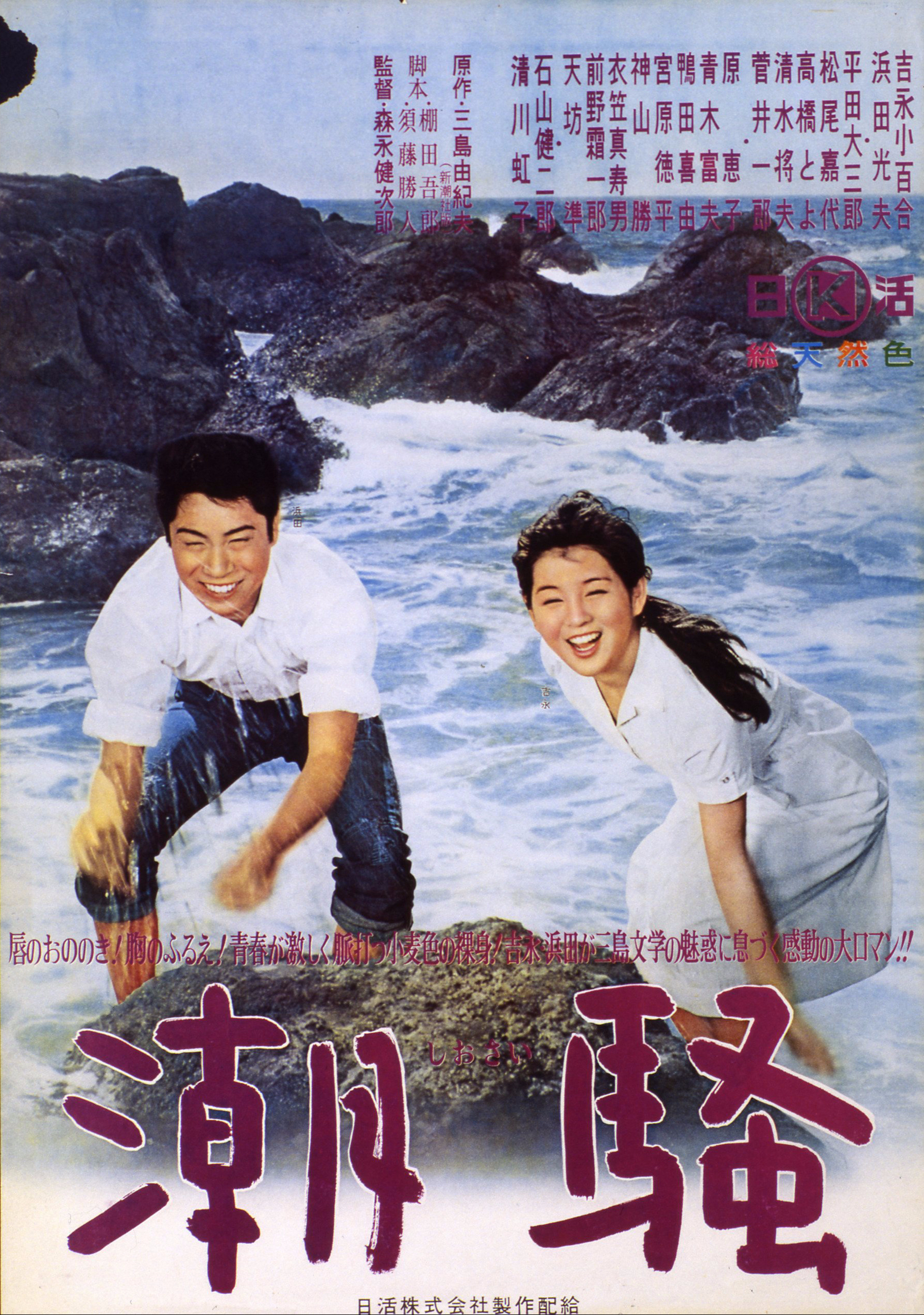
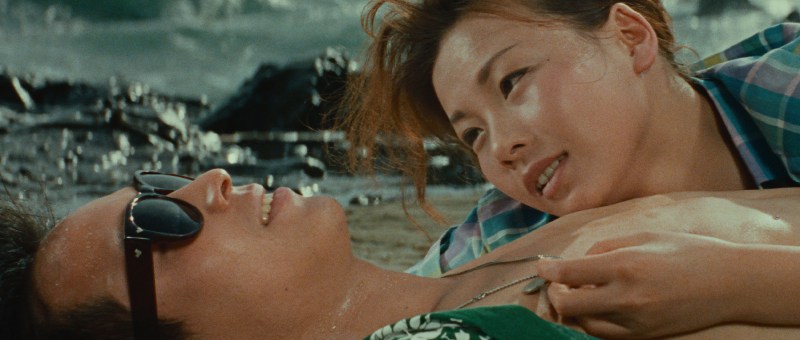
The Sound of Waves (潮騒, Kenjiro Morinaga, 1964)

Still a major marquee name well into her 70s, Sayuri Yoshinaga began her career as one of Nikkatsu’s young starlets in the early 1960s. Based on the well known novel by Yukio Mishima, The Sound of Waves (潮騒, Shiosai) finds her starring alongside regular co-star Mitsuo Hamada in another tale of love across the class divide. Usually, such forbidden love would be fodder for romantic tragedy, but Sound of the Waves is a cheerful exploration of tranquil island life where the people are simple and honest and the good will always triumph. 

Shinji (Mitsuo Hamada) is indeed good. Though still only a teenager, he’s become the man of the house following his father’s death, working hard as a fisherman to support his family and saving most of his salary to pay for his little brother’s education. The trouble starts when the beautiful Hatsue (Sayuri Yoshinaga) who had been living as a pearl diver on another island is called back to live with her father, island big man Terukichi (Kenjiro Ishiyama), after her brother dies. There have long been rumours that, as what Terukichi wants is a son to take over his business, he will soon be marrying Hatsue off and probably to the slick and handsome Yasuo (Daizaburo Hirata) who seems to be his favoured choice of son-in-law. 

When Shinji lays eyes on Hatsue helping out with the boats it’s love at first sight, and even more so when he foolishly drops his pay packet while delivering a fish to an elderly couple and Hatsue takes the trouble of finding out where he lives and delivering it to his mother safely. Though everyone in Shinji’s household is quite taken with the beautiful, kind, and responsible newcomer, they are also aware that she is far out of Shinji’s reach. Terukichi is mean and arrogant, there’s no way he’d let his daughter marry a regular fisherman, and Shinji knows he can’t compete with an eligible young man like Yasuo. Hatsue, however, seems to like him too, especially after she gets bitten by a snake and his quick thinking, immediately sucking out the poison, probably saves her life. 

This being an innocent story of pure love, the couple have the opportunity to consummate their relationship after stripping off during a rainstorm but collectively decide to wait for marriage. That doesn’t stop the rumours starting, however, when they are spotted in the forest by Chiyoko (Kayo Matsuo), a young woman sweet on Shinji who’d gone away to study at university in Tokyo. She tells Yasuo who is immediately threatened, not only feeling unjustly betrayed, but acutely aware that the bright future he’d been so proudly boosting of as Terukichi’s future son-in-law might be in jeopardy. 

Where Shinji is kind and responsible, working hard to look after his family and always supporting the other villagers, Yasuo is, like Terukichi, arrogant and self-centred. He’s perfectly aware that he’s the island’s most eligible bachelor and makes a point of swaggering around like a little prince in waiting. Perhaps for that reason he’s also a snivelling coward and intensely insecure, angrily confronting Hatsue and even attempting to rape her while she collects water at the local spring. She manages to fend him off when he’s stung by hornets coming to her defence, and all he can do is plead with her not to tell her father so he won’t mess up his bright future any further. 

Hatsue seems not to have very much say in her future, romantic or otherwise. Having heard the rumours, Terukichi keeps her prisoner in her own home, insisting that she will marry his choice of son-in-law. The islanders, however, who seem to have grown used to ignoring Terukichi as much as it is possible to do so, are fully behind the youngsters’ romance. After all, what could be more natural than two young people falling in love? Eventually the island women launch a small petition to Terukichi to convince him to end his pettiness, but the contest, it seems, comes down to a test of manliness, Terukichi embarking on a young people today speech in complaining that his boat’s come loose in a storm but no one is man enough to retrieve it. Yasuo is found wanting once again, shrinking back from real risk while Shinji puts himself in harm’s way not only to prove himself a man and win Terukichi’s approval, but simply to serve the community. Manliness is redefined not only as strength and bravery, but kindness and patience too. Shinji’s goodness is indeed rewarded allowing him to dream of a brighter future, building a life for himself alongside a woman who loves him on their idyllic island home. 


Original trailer (no subtitles)

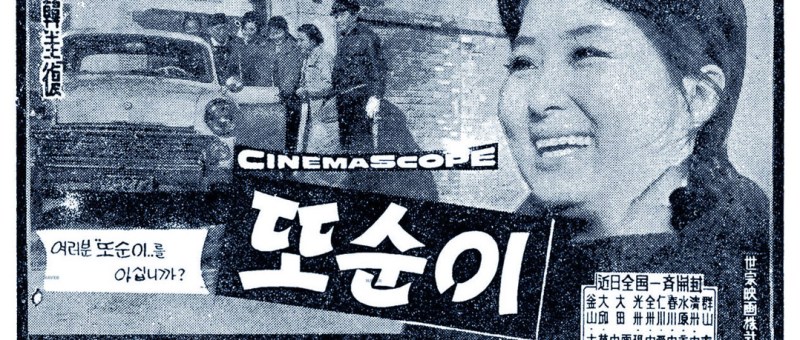
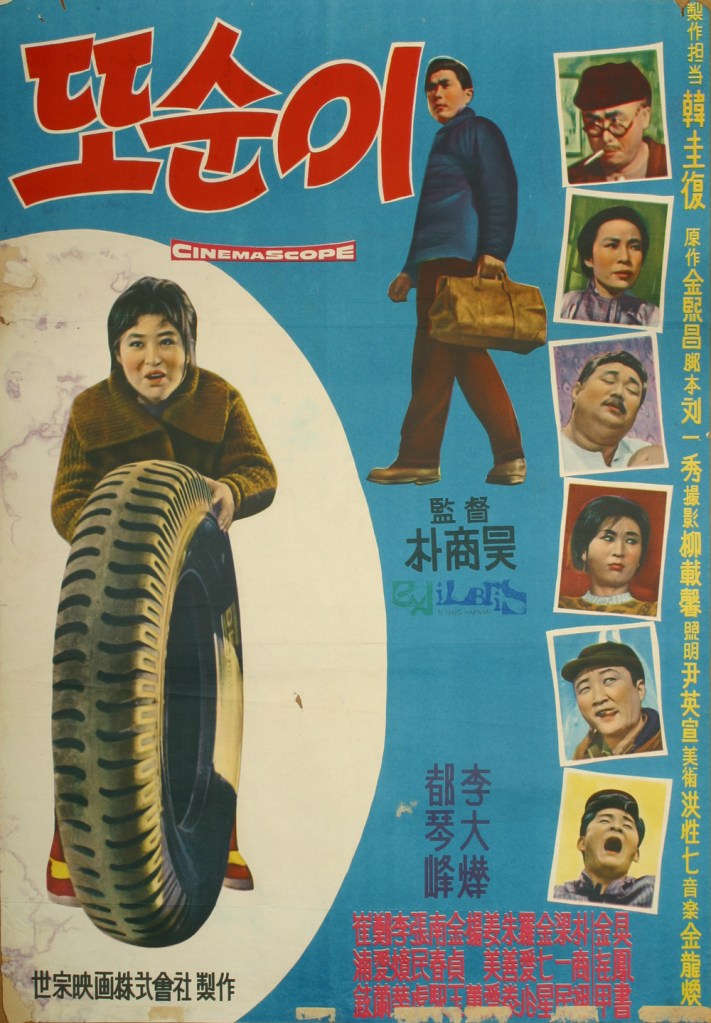
Tosuni: The Birth of Happiness (또순이, Park Sang-ho, 1963)

Korean Cinema had enjoyed a small window of freedom following the April Revolution that brought down the government of Rhee Syngman, but that window was closed all too soon by the Motion Picture Law brought in under Park Chung-hee which reformed the film industry and instituted an increasingly stringent censorship regime. Despite that, however, 1963 was something of a banner year which saw the release of such enduring classics as The Marines Who Never Returned, Bloodline, and Goryeojang. In comparison, Park Sang-ho’s Tosuni: The Birth of Happiness (또순이) seems like a much smaller film but was the fourth highest grossing that year, possibly because it was inspired by a hugely popular radio serial. Standing in direct contrast to contemporary melodrama, Tosuni puts a positive spin on go getting capitalistic individualism as its salt of the earth working class heroine defiantly makes her dream come true on her own despite the parade of useless men that attempt to drag her down. 

The cheerful Tosun (Do Kum-bong) is the daughter of Choi Jang-dae (Choi Nam-hyeon) who came from the North with nothing but the shirt on his back and now owns a bus company. A difficult, miserly old man, Jang-dae has a loathing for people who depend on others which is why he sends a young hopeful, Jae-gu (Lee Dae-yeop), packing when he turns up with a letter of recommendation and asks for a job as a temporary driver. Unbeknowst to Jang-dae, Tosun had already encountered Jae-gu on the bus where her father had sent her on an errand only to complain she’s not come back with as much money as he hoped. Tosun asks her father for a 50 won payment for her work but he refuses, leading to a blazing row during which Tosun points out that while both her parents were out working she was basically their housekeeper so he owes her around 15 years in back pay and is also in contravention of the child labour laws. Seeing as she was looking after them all these years, she feels she’s already well acquainted with the “independence” her father always seems so keen on. Eventually she storms out, vowing to become a success on her own. Jang-dae is annoyed to have lost the argument but also oddly proud, realising that he brought Tosun up right and impressed that she actually stood up to him and can obviously take care of herself. 

Tosun certainly is a very capable woman, working hard, taking every job going, and making money wherever she goes. Jae-gu, meanwhile, turns out to be something of a layabout, never really looking for a job but spending all his money drinking with the madam, Su-wol (Na Ae-sim), in a local cafe. Tosun carries on doing her own thing but also wants to help Jae-gu, not least because they pledged to try and achieve their dream of owning a modern motor car together. Jae-gu knows that Tosun is perfectly capable of getting the car on her own and is mildly put out by it, sore over wounded male pride despite her assurances that even if she’s the one who gets the money together he’s the one who’ll be driving. That’s perhaps why he’s so easily suckered by an obvious scam when he gets together with a friend who’s met a guy who needs to shift some tyres, but only after dark when there’s no one around. Tosun thinks it’s fishy, especially if they can’t take the tyres right away, but goes along with it to make Jae-gu feel better. 

Like Jae-gu, most of the other young men are also selfish and feckless, dependent on and exploitative of female labour to get them out of trouble. Tosun’s brother-in-law (Yang Il-min) is forever lying to his in-laws to get loans for spurious business opportunities which never work out, complaining that he can’t “slave away as a temporary driver forever” but taking no proactive steps to change his circumstances despite the responsibilities of being a husband and father. Jae-gu’s friend, meanwhile, takes the opportunity of his wife being in hospital waiting to give birth to their child to try it on with Tosun who manages to fend him off but has a major loss of confidence because of the shock of his betrayal. 

Tosun’s mother hadn’t wanted her to move out not only because that means she’s alone in the house with the difficult Jang-dae, but because being an “independent” woman was somewhat unheard of and she’s worried her daughter will lose her virtue, or at least be assumed to be a loose woman, after leaving home before marriage. Tosun might be a little naive and extremely good hearted, she keeps unwisely lending money to people who obviously aren’t going to pay her back, but as she keeps pointing out she didn’t move out for fun she wants her independence. That’s one reason she keeps Jae-gu at arms length even though she’s fallen in love with him despite her constant exasperation. 

Tosun is in many ways the embodiment of a capitalistic work ethic, proving that you really can make it if you just knuckle down. The car represents both independence itself and a sense of modernity, as demonstrated by the excited commotion among Tosun’s friends and neighbours when she finally gets one and arrives to take her parents for a drive. Even the brother-in-law suddenly realises he might be better off working for Jang-dae rather than living a feckless existence of constant and humiliating failures trying to get rich quick. That’s the problem with the younger men, apparently, they want everything right away, like Jae-gu and his tyre deal, and aren’t really prepared to work at it. Tosun sorted the tyre problem in her own cooly handled fashion, outwitting the unscrupulous vendor but doing it without malice and only showing him she won’t be had. Is the motor car and everything it represents the birth of happiness? Maybe not, but it doesn’t hurt, and Tosun unlike her father seems to have retained her good heart, setting off into an admittedly consumerist but hopefully comfortable future, a back seat driver but behind her own wheel. 


Tosuni: The Birth of Happiness is available on English subtitled DVD from the Korean Film Archive in a set which also includes a digital restoration before/after comparison and stills gallery plus a bilingual booklet featuring essays by Kim Jong-won (film critic & professor), and Park Yu-hee (film critic & research professor). It is also available stream online via the Korean Film Archive’s YouTube Channel.

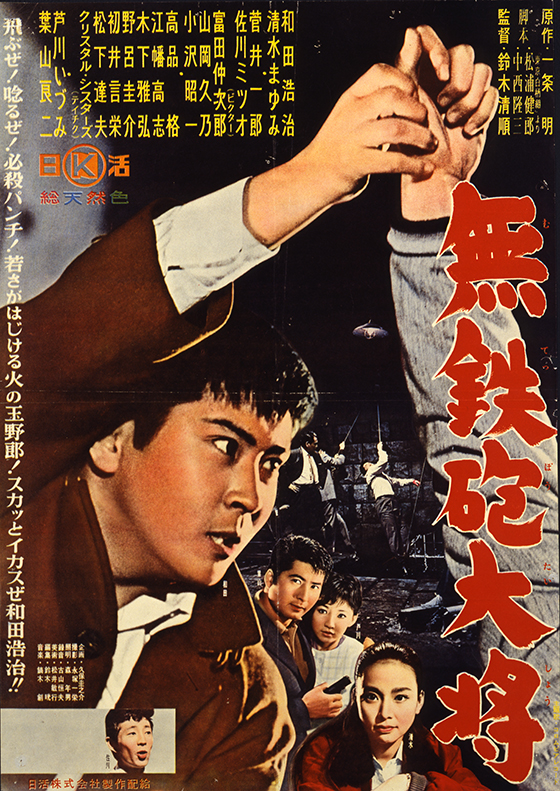
Living by Karate (無鉄砲大将, Seijun Suzuki, 1961)

Nikkatsu’s brand of youth cinema could often have a nasty edge, its damaged heroes caught up in complicated rebellion but necessarily outsiders in a changing world which they feared held no real place for them. For each of those, however, there are others filled with life and possibility, not to mention a cartoonish sense of fun and infinite safety which perhaps largely disappeared from the films of the 1960s only to be found again in Kadokawa’s similarly aspirational teen movies of the bubble era. 

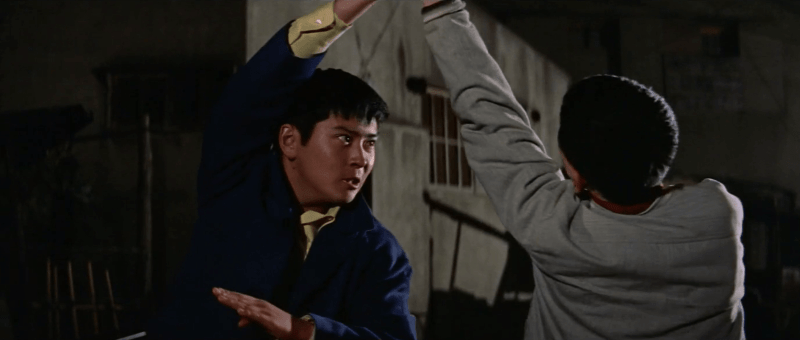
Living by Karate (無鉄砲大将, Muteppo Daisho, AKA Reckless Boss / A Hell of a Guy) once again stars Koji Wada as an earnest young man kicking back against the corrupt wartime generation. Still in high school, Eiji has a part-time job at an ice rink which he doesn’t treat quite as seriously as he ought to but his boss lets him get away with it because his handsome face is a hit with the local ladies. Eiji and two of his friends are keen members of a karate club and have decided to use their skills to fight for justice in their lawless town by going on “patrol”, clearing up the kinds of crimes the police might not make it to in time. Their plan backfires, however, when they come across the body of a recently deceased union leader and are arrested by a local bobby after getting caught with a joke knife one of the boys made for fun at his job on the family scrap yard. 

It comes as no surprise that Eiji’s arch enemy, sleazy mob boss Shinkai (Nakajiro Tomita), is behind the murder, apparently hired by a corrupt corporate CEO trying to stop his workforce exercising their legal rights. Eiji hates Shinkai because he bankrolled his widowed mother’s (Kotoe Hatsui) bar business but did so perhaps in return for being able to control her and by extension him by wielding his economic power against them. His loathing intensifies once he realises that the slightly older young woman he’s carrying a torch for, Yukiyo (Izumi Ashikawa), has fallen for one of Shinkai’s men, Goro (Ryoji Hayama). 

Goro is the classically “good” gangster who feels indebted to Shinkai because he took him in after the war, but wants to leave the underworld behind, going straight in Kobe where he intends to live a settled married life with Yukiyo. The modern yakuza is in many ways a Showa era phenomenon, a mechanism for men without families to protect themselves in the desperate post-war environment. By 1961, however, its existence was perhaps becoming harder to justify. The war orphans had grown up and had families of their own, the economy had significantly improved, and there was no need anymore to live a life of crime and heartlessness – a conclusion Goro has come to on his own after meeting the earnest Yukiyo who has similar problems with her goodhearted yet permanently drunk doctor father. 

Knowing he might have messed things up for his mother in interfering with her relationship with Shinkai, Eiji confesses that doesn’t “know what to do with the grownup world”. For him, everything is still very black and white. He hates yakuza because they prey on the vulnerable and Shinkai in particular because he does it so insidiously, forcing desperate people to accept loans on bad terms so that he can in fact “own” them and use them as he wishes. Eiji and his peer group kick back against what they see as the selfish corruption of the wartime generation, agitating for a fairer, more just world. The wealthy daughter of a corrupt CEO (Mayumi Shimizu) who has a crush on Eiji though he only has eyes for Yukiyo comes up with the idea of selling her fancy car to get money to help Eiji’s mother escape Shinkai’s control, but her father snaps at her that other people aren’t her responsibility and that she doesn’t understand how the real world works. 

Somewhat chastened by the youngsters’ pure hearted love of justice, he eventually comes up with a compromise in buying the car off her himself, but before that Eiji and his friends have to think carefully about the form they want their revolution to take. Taking him to task, Yukiyo points out that if all you do is fight with yakuza then maybe you’re a yakuza yourself, which shifts Eiji’s perspective towards ensuring that his rebellion is fully legal and involves the justice systems already in place. He comes to recognise that Goro is much like himself, and if he’s going to take down a sleazy brute like Shinkai it will take more than some fancy karate. Their resistance starts at home, giving others courage to stand up to yakuza oppression while living right themselves in the hope of creating a better, fairer world free of heartless organised crime.


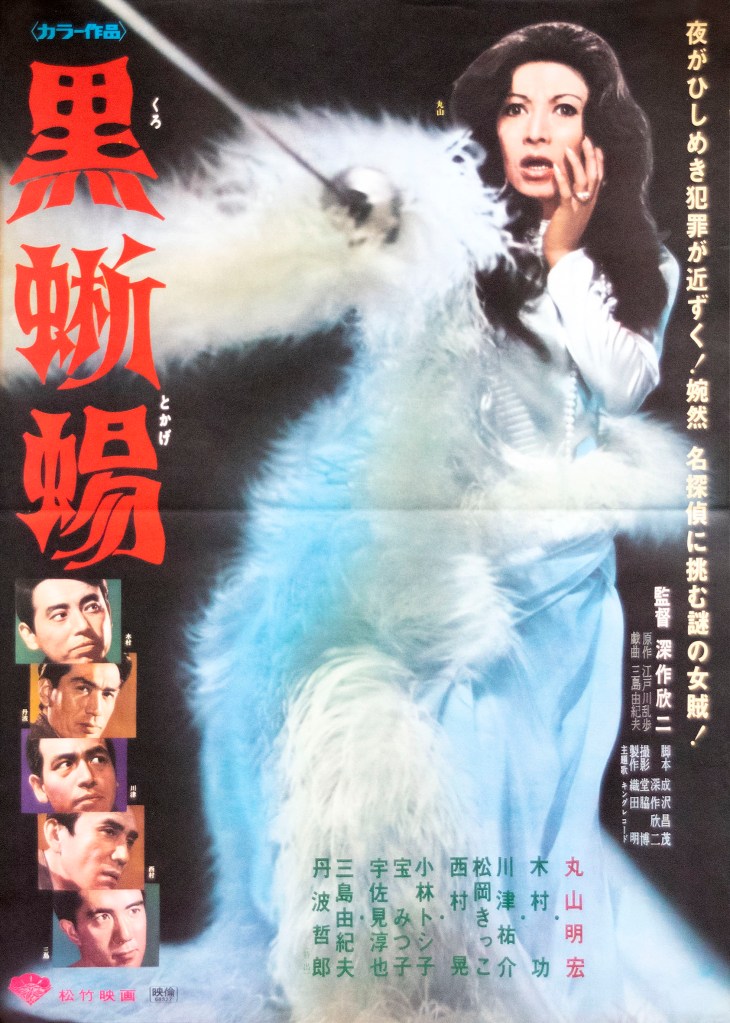
Black Lizard (黒蜥蝪, Kinji Fukasaku, 1968)

“Are you a critic?” asks the proprietress of of a lively night club, “Why?” replies a lonely man sitting at the bar, “Beauty fails to intoxicate you” she explains before wandering off to find a prettier prize. Nevertheless, a connection has been forged as two masters of the craft confront their opposing number. Black Lizard (黒蜥蝪, Kurotokage), based on the 1934 story by Edogawa Rampo, had been brought to the screen by Umetsugu Inoue in 1962 in a version which flirted with transgression but was frothy and fun, adding a touch of overwrought melodrama and gothic theatricality to Inoue’s well honed musical style.

Inoue’s version had been co-scripted by Kaneto Shindo and Yukio Mishima who had also written the stage version. Once again crediting Mishima’s stage adaptation, Fukasaku’s 1968 take on the story is, as might be expected, far less interested in class connotations than it is in notions of love, beauty, and aestheticism. Consequently, we open in a much harsher world, dropped straight into Black Lizard’s edgy nightclub which Akechi (Isao Kimura), Edogawa Rampo’s famous detective, has visited on a friend’s recommendation. He is shocked to read in the paper the next day that a young man he saw in the club has apparently committed suicide, while another article also mentions the shocking disappearance of a corpse from the local morgue. 

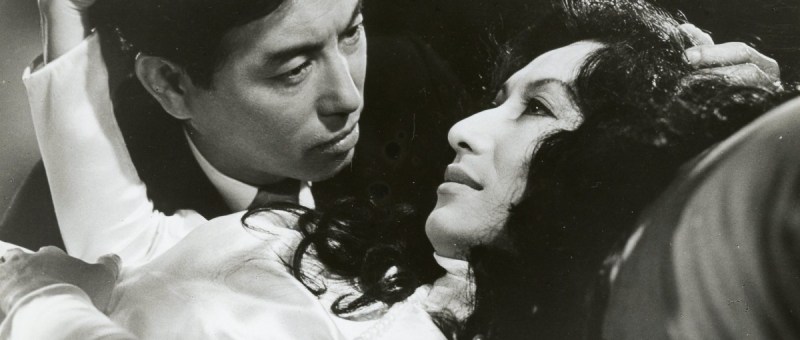
Meanwhile, Akechi is brought in on a retainer to protect the daughter of a wealthy jeweller who has been receiving threatening letters informing him of a plot to kidnap her. Unlike Inoue’s version, Iwase (Jun Usami) is a sympathetic father, not particularly demonised for his wealth. Rather than drinking too much, he simply takes his sleeping pills and gets into bed without realising that his daughter is already missing. As transgressive as ever, however, Black Lizard (Akihiro Miwa) wastes no time sizing up Sanae (Kikko Matsuoka), running her eyes over the “splendid curve” of her breasts and lamenting that beautiful people make her sad because they’ll soon grow old. She’d like to preserve that beauty forever, convinced that people age because of “anxieties and spiritual weakness”. The reason she loves jewels is that they have no soul and are entirely transparent, their youth is eternal. Now Black Lizard has her eyes on the most beautiful jewel of all, the Egyptian Star, currently in the possession of Iwase which is why she’s planning to kidnap Sanae and ask for it as a ransom. 

Though the Black Lizard of Inoue’s adaptation had been equally as obsessed with youth and beauty, she was a much less threatening presence, never actually harming anyone in the course of her crime only later revealing her grotesque hobby of creating gruesome tableaux of eternal beauty from human taxidermy. This Black Lizard is doing something similar with her “dolls”, but she’s also cruel and sadistic, not particularly caring if people die in the course of her grand plan even running a sword firstly through a body she believes to be Akechi’s, and then through a minion completely by accident. She picks up Amamiya (Yusuke Kawazu) in the bar because of his deathlike aura, his hopelessness made him handsome, but once he fell in deep love with his “saviour” she no longer found him beautiful enough to kill. 

Akechi, meanwhile, is captivated by her in the same way Holmes is captivated by Irene Adler. He admires her romanticism, and recognises her as someone who thinks that crime should come dressed in a beautiful ball gown. She, by turns is drawn to him but perhaps as to death, each of them wondering who is the pursuer and who the pursued but determined to be victorious. Casting Akihiro Miwa in the female role of Black Lizard adds an extra layer of poignancy to her eternal loneliness and intense fear of opening her heart, finally undone not by the failure of her crimes but by a sense of embarrassment that Akechi may have heard her true feelings that leaves her unable to go on living. 

Meanwhile, Amamiya attempts to rescue Sanae not because he has fallen in love with her, but because he too is drawn towards death. Showing the pair her monstrous gallery of taxidermy figures of beautiful humans, she pauses to kiss one on the lips (played by Yukio Mishima himself no less), leaving Amamiya with feelings of intense jealousy and a longing to be a cold and inanimate shell only to be touched by her. “Sanae”, meanwhile, who turns out to be a perfect mirror in having being picked up at rock bottom by Akechi for use in his plan, guides him back towards life. They did not love each other, yet their “fake” love was set to be immortalised forever as one of Black Lizard’s grim exhibitions. She wonders if the fake can in a sense be the real, that they may free themselves from their respective cages through love in accepting a romantic destiny. For Black Lizard, however, that seems to be impossible. Akechi has “stolen” her heart, but she cannot take hold of his, holding him to be a cold and austere man who has “trampled on the heart of a woman”. “Your heart was a genuine diamond” Akechi adds, lamenting that the true jewel is no more. Black Lizard meets her destiny in a kind of defeat, too afraid of love and the changes it may bring to survive it, but paradoxically grateful that her love is alive while taking her leave as a romanticist in love with the beauty of sadness. 


Opening and titles (English subtitles)