Wuthering Heights (嵐が丘, Kiju Yoshida, 1988)

Wuthering Heights poster“In this decadent age, who believes in the gods’ anger?” asks a cynical priest, willingly inviting evil into his home in the hope of brokering a change in his constraining circumstances. A key figure of the avant garde, Kiju (Yoshishige) Yoshida, like many of his contemporaries, struggled in the heavily commercialised cinema industry of the 1970s and beyond, finding the international arena more receptive to his arthouse concerns. 1988’s Wuthering Heights (嵐が丘, Arashi ga Oka), a distinctly Japanese take on Emily Brontë’s classic novel, found funding in France where it perhaps neatly sits alongside superficially similar efforts from his similarly constrained contemporaries, but as always Yoshida’s vision is darker, more disturbing than that of the big budget epics which aimed to recapture golden age glories.

Yoshida swaps the desolate Yorkshire moors for a smokey hellscape settled in ash on the side of an unpredictable volcano. The Yamabes are a priestly family in charge of conducting various rituals to keep the serpent god happy, preventing an eruption and ensuring good rains. The house is spilt in two with a feud underway between the East mansion and the West. The East mansion is where we lay our scene as old Yamabe returns from an extended sojourn in the city, bringing back with him a feral child he found starving under a bridge and later names “Onimaru” (Yûsaku Matsuda) in honour of his “demonic” appearance.

“Demonic” maybe an unkind word to use about any child and primed to become a self-fulling prophecy, but as someone later puts it Onimaru “does not belong to this world”. He is “an evil man” whose “cruelty knows no limits”, yet two women are drawn into his orbit and find themselves unable to break free of his passionate intensity. His step-sister, Kinu (Yuko Tanaka), our Cathy stand-in, bonds with him in childhood feeling a kind of elemental connection perhaps forbidden to her as a woman of feudal Japan subject to the whims of male society. Yet she alone sees through him to humanity buried below, “your curse is the proof you will never stop loving me” she offers darkly while seducing him the night before her marriage to another man (Tatsuo Nadaka). Later that man’s sister (Eri Ishida), positioning herself as potential bride, cites the fact that he is “consumed by jealousy” as further proof that he is more man than demon, but Onimaru himself seems uncertain so deep is he in rage and resentment.

That resentment is perhaps as much about class as about anything else. A feral child, living like an animal on the streets of an unforgiving city, he’s an ill fit for the rarefied mansion of a local lord with a spiritual mission, albeit one which imprisons him in his home and forbids him from associating with the world below. Yamabe took him in for his “boldness”, actively seeking his demonic dynamism while his own son, Hidemaru (Nagare Hagiwara), remains disappointingly conservative and wedded to his old-fashioned elite entitlement. Hidemaru’s resentment of Onimaru is not so much born of parental rejection in his father’s abrupt decision to go out and find a more satisfactory son than the one dutifully waiting at home, but irritation in Onimaru’s irregular status. He resents that a mere “peasant”, a man who should be among the servants, is permitted to share his space, and it seems, has usurped his position in his father’s eyes to be groomed as an heir to the illustrious Yamabe name.

Hidemaru eventually leaves in disgust, setting off to make a conventionally successful life for himself in the city, latterly returning with a wife and son to claim his birthright only after his father’s death. Yet Hidemaru suffers too. His wife is raped and murdered by bandits, agents of chaos and yet a product of the system he was so keen to uphold, leaving him a drunken, dissolute figure unable to fulfil his obligations to the god of fire while Onimaru prospers in a violent world and is eventually gifted that which he most wanted – stewardship of the Yamabe clan.

Even so, he cannot fully possess Kinu who remains lost to him, ruined by her own internal conflict between individualism and obedience. After coming of age, her father tells her women of the Yamabe clan must leave the mountain to serve as priestesses in the shrine, but Kinu wants to “live as a true woman”. She cannot have Onimaru, but does not want to leave him so she engineers a marriage with the rival West mansion and the kindly Mitsuhiko who brands his house as one of light as opposed to the gloomy shadows of the East. Kinu has attempted to seize her own future, at least in part, but finds herself conflicted, torn between her affection for Mitsuhiko who is gentleness personified and her need for Onimaru’s brooding intensity.

Yet Yoshida’s Wuthering Heights is less a story of forbidden, transgressive loves than it is of elemental destruction, the anger of the gods manifested as imploded repression and its fiery aftermath. Yamabe, the father figure, brings “evil” into his home, infecting it with dark desire and deep resentments seemingly in the knowledge it will burn it to the ground. The third generation, orphaned and finally independent, are left to make what restitution they can and so the tale begins to reset and repeat with cousins, Hidemaru’s grown and now subjugated son Yoshimaru (Masato Furuoya), and Kinu’s fiesty daughter (Tomoko Takabe), returning their ire to the force of their oppression – Onimaru, still fearsome and implacable though ageing and maddened by his unanswerable love for a dead woman whose corpse he has begun to covet.

Kinu, on her deathbed, promised to drag Onimaru to hell (assuming they weren’t already there) if only to protect her new family and finally does just that as he finds himself expelled by the next generation, dragging a coffin off into the fiery distance. “In every way, our world is accursed” insists an exasperated retainer. Everything here is corrupt, rotten, suppurating under the weight of oppressive traditions which restrict freedom and insist on order at the price of humanity. Yoshida’s noh-inspired aesthetics add to the atmosphere of fable as his embattled protagonists attempt to reconcile their natures with their civility but find there is no answer for repressed desire other than destruction and eventual rebirth.


The Enchantment (誘惑者, Shunichi Nagasaki, 1989)

“A broken romance affects everybody” a sympathetic psychiatrist tries to reassure a patient suffering a dangerous romantic obsession with a possibly imaginary woman. Like so much of his work, they’re soft words offered casually as a path towards something deeper but in this case it’s not the patient we need to worry about but the doctor. The aptly named The Enchantment (誘惑者, Yuwakusha), somewhat less subtly titled “Temptress” in Japanese, takes its “hero” on a dark journey into fascination, the male need for domination, and the self delusions of irresolvable disappointment.   

The film opens with genial psychiatrist talking to a patient, Hirayama (Tsutomu Isobe), who proclaims himself more or less cured from a nervous breakdown born of a broken heart. Hirayama’s love affair may be largely imaginary, and he seems far from “cured”, but Doctor Sotomura’s (Masao Kusakari) failure to challenge him on his new affirmation that he’s over her because he’s realised she was “just a bitch” who treated him “like trash” might be a worrying oversight. Hirayama was supposed to be his last patient of the day, but a last minute walk-in, Miyako (Kumiko Akiyoshi), piques his interest enough to keep him in the office rather than on a planned date with his receptionist fiancée and surgeon best friend.

Miyako, nervous and reticent, tells him the appointment is “about a friend” and takes some coaxing before beginning to explain that she has been physically assaulted by her female roommate apparently jealous over the unwanted attentions of a man who developed an attraction for her at her job as a tour guide. Miyako does not spell it out, but somewhat implies that her relationship with her roommate Kimie is romantic while Sotomura has the good sense not to push the issue, only to urge her that perhaps she should think about staying with a friend a while if she doesn’t feel safe at home. Miyako, however, doesn’t want to do that and is only worried about what might have provoked this sudden and unexpected change, fearing most of all that she herself will fall out of love with Kimie if her moodiness continues to intensify.

Overstepping the mark, Sotomura is fascinated with his mysterious new patient, particularly after he becomes a kind of white night rescuing Miyako from a dangerous encounter with Hirayama who is under the delusion that she is the embodiment of his romantic obsession “Junko”. The fascination only intensifies after he makes a surprising discovery – Kimie is not “real” but a secondary personality inside Miyako. Infuriated by Sotomura’s romantic overtures, Kimie takes control and stabs him in the leg while Miyako continues to visit him in the hospital, unable to remember what exactly happened between them.

Sotomura’s obsession is both sexual and professional, after all how many sufferers of MPD is he going to meet in the course of his career? He is indeed ambitious, casually dating his receptionist Harumi (Kiwako Harada) mostly because she’s the daughter of his former professor. Though the couple live together, Harumi is constantly frustrated by his indifference to their relationship and foot dragging over making it official. Sotomura’s best friend, Shinbori (Takashi Naito), is facing much the same dilemma but has resigned himself to an arranged marriage to further his career and keep his family happy. Sotomura instinctively thinks he ought to do the same and tells Harumi that he’ll sort things out with her father, but remains fixated on the mysterious Miyako and her unconventional love life. 

A more cynical friend warns him that sex is the only thing that matters and it’s essential to avoid emotional entanglements. Nevertheless, Sotomura finds himself desperate to unlock the mystery of Miyako, but it remains open to debate which part of her he wants to “fix” – her MPD, or her sexual orientation. As we find out, Sotomura might assume that Miyako’s love for another woman has driven her “mad”, but in reality it’s more that a sense of impossibility led her to believe that there was no solution to her suffering other than death. Faced with unreconcilable loss, she internalised the figure of her fixation, literally becoming one with her lost lover in order to avoid facing that she was alone once again. Uninterested in Sotomura, Miyako/Kimie becomes fascinated with Harumi who eventually becomes so intensely obsessed with Miyako that she is willing to erase her own identity and become “Kimie” for her in order to support her sense of reality and protect the integrity of the Miyako personality.

Again, Sotomura has a few issues. The first is multi-layered sexual jealousy. Now that Harumi has moved on, found someone who “needs” her, and seems to be happier he is instantly irritated that she left him (for a woman) and desperate to win her back (along with the career boost he romanced her for in the first place). He resents Harumi’s differing vision of medical care, that she is willing to embrace Miyako’s delusion in order to keep her stable while wilfully abnegating her sense of self in a profound act of love. Sotomura the clinician wants to “cure” Miyako of her delusion, but his intervention is brutal, intruding on the mental space of her traumatic memory with physical violence designed to rip her from her safety of her artificial reality. He tries to insert himself between the two women, asserting his masculine “right” to dominate, but is eventually ejected by another knife blow to the thigh as the women assert their right to their own reality in the absence of men.

A strange psychosexual odyssey, The Enchantment spins a dark tale of obsession, delusion, and jealousy but ends on a broadly positive, if perhaps uncomfortable, note, in which the dominant psychiatrist is forced to recognise his irrelevance and the legitimacy of realities outside of his own. Broken romance affects everyone, as Sotomura said, but perhaps he doesn’t have the right to intrude on the broken hearts of others or judge the various ways in which they attempt to patch them back together again. A chronicle of bubble era Tokyo bathed in garish neon and a sense of infinite possibility, Shunichi Nagasaki’s heady feature is a surprisingly subversive affair in which trauma cannot be overcome but can perhaps become integrated in a mutually beneficial whole.


Doubles Cause Troubles (神勇雙妹嘜, Wong Jing, 1989)

Doubles cause troubleWould you be willing to live with someone you hate for a whole year just to get a share in an apartment? According to the sheer prevalence of this plot device in comedies throughout the ages, the chances are most people would, especially in a city like Hong Kong where competition is fierce. In any case the duelling cousins at the centre of Wong Jing’s disappointingly normal farce Doubles Cause Troubles (神勇雙妹嘜) find themselves doing just that, only the situation turns out to be much more complicated than one might imagine.

When self-centred nurse Liang Shanbo (Carol “Do Do” Cheng Yu-Ling) receives a visit from a lawyer informing her that her grandmother has passed away she’s a little put out because the old lady owed her money. She’s comforted with the news that she’s been left an apartment, but less so when she learns there’s a catch. Shanbo’s grandma really wanted her to patch things up with her cousin, actress Zhu Yingtai (Maggie Cheung Man-Yuk), and has left the apartment to both of them with the caveat that they have to live there together for a period of one year after which they can sell it and inherit 50% of the proceeds each or else it’ll all go to charity. Neither Yingtai or Shanbo is very happy about the idea but it’s too good an opportunity to pass up and after all, it’s only for a year. When they arrive, however, they discover there’s another tenant – Ben (Poon Chun-Wai), a suave businessman who leaves them both smitten. Ben, it turns out, is not quite what he seems and staggers home on the first night to die in Yingtai’s arms after muttering something about a code.

Unlike most Hong Kong comedies of the era, Wong plays things disappointingly straight while remaining as broad as it’s possible to be. Odd couple Shanbo and Yingtai bicker and trade childish insults while throwing themselves first at the handsome Ben and then at his equally good-looking “brother” Sam (Wilson Lam Jun-Yin) without really giving too much thought to anything else that’s going on until they find themselves well and truly embroiled in a conspiracy. It turns out that Ben had been involved in a smuggling operation in which he betrayed his team and made off with a priceless Taiwanese “national treasure” that the rest of the gang would like to recover which is why Shanbo and Yingtai are being followed around by a “flamboyant” rollerskating henchman and a butch female foot-soldier.

The political realities of 1989 were perhaps very different, but there is an unavoidable subtext in the fact that the dodgy gangsters are all from the Mainland and are desperate to get their hands on a precious Taiwanese national treasure (which they intend to sell for a significant amount of money). The girls find themselves with ever shifting loyalties as they reassess Ben, come to doubt Sam, and fall under the influence of mysterious “inspector” Xu (Kwan Ming-Yuk) whose warrant card is “in the wash”. Completely clueless, they are helped/hindered by useless petty gangster Handsome (Nat Chan Pak-Cheung) and his henchman Fly (Charlie Cho Cha-Lee) who’ve been chasing Shanbo all along while Yingtai falls victim to Wong himself in one of his characteristically sleazy cameos as a lecherous businessman who has toilets instead of furniture in his living room and a boxes full of date rape drugs behind the bar (poor taste even for a Wong Jing movie).

Of course the real message is that blood ties and immediate proximity to danger can do wonders for a “difficult” friendship and so granny gets her wish after all even if not quite in the way she might have planned. Then again, why was Ben staying in her luxury apartment in the first place? Who can say. Setting a low bar it may be, but Doubles Cause Troubles is not even among Wong Jing’s funniest comedies though it does have its moments mostly born of sheer absurdity and enlivened by the presence of a young Maggie Cheung alongside a defiantly committed cast desperately trying to make the best of the often “risible” material.


Currently streaming via Netflix in the UK and possibly other territories too.

Celestial pictures trailer (English/traditional Chinese subtitles)

Bumpkin Soup (ドレミファ娘の血は騒ぐ, Kiyoshi Kurosawa, 1985)

Bumpkin soup posterLike many directors of his generation, Kiyoshi Kurosawa began his career in “pink film” – mainstream softcore pornography produced to a strict formula. His debut had been made for Director’s Company, an independent production house which offered creative freedom to young and aspiring filmmakers. He then tried to move into the studio system by directing for Nikkatsu’s Roman Porno, but the film was rejected for not quite living up to the demands of the genre. Bumpkin Soup (ドレミファ娘の血は騒ぐ, Do-re-mi-fa-musume no Chi wa Sawagu, AKA The Excitement of the Do-Re-Mi-Fa Girl) was then purchased from Nikkatsu and released independently as his second film, earning Kurosawa something of a reputation as a contrarian. Though the film contains its fair share of nudity and strange sexual shenanigans, it is easy to see why it did not fit the Roman Porno remit thanks to its bizarrely absurdist tone and often nonsensical French New Wave-inspired post-modernism.

The film begins with the heroine, Akiko (Yoriko Doguchi), walking into a Tokyo university campus in search of her small-town boyfriend, Yoshioka (Kenso Kato). Yoshioka is not, however, where he said he would be – he rarely turns up to lessons and has been absent from the music club he said he had joined for some time. Determined and undaunted, Akiko continues to look for him, encountering various strange people and events including a psychology professor intent on exploring the depths of shame.

After meeting sexually obsessed female student Emi (Usagi Aso), Akiko remarks that the university campus is like a permanent festival, or perhaps an amusement park. It certainly seems to be some sort of continuous orgy as seen though the eyes of simple country girl Akiko who has, after all, only come here in search of lost love. Carrying around a walkman with a tape featuring Yoshioka’s music, she devotes herself to finding her beau but eventually sniffing him out, discovers that he’s not the man she thought he was. Truth be told, Yoshioka does not seem like much of a catch. A randy college student, he has more or less forgotten all about Akiko while he pursues just about everyone else on campus instead of going to lessons.

Latterly, Akiko comes to the realisation that she thought she was looking for an adventure leading to love, but perhaps what she really wanted was love leading to an adventure. She left the country behind, travelled to the city, transgressed borders and entered the university where she was sure she would find answers but has discovered only more questions. Akiko feels herself at odds with her new environment, unable to understand the strange grammar of the university world where people seem to talk mostly about themselves. She does, however, seem strangely taken with the befuddled professor Hirayama (Juzo Itami) whose attempts to explore the nature of shame are derailed by the “shamelessness” of the modern student.

Hirayama’s big idea is that shame is all a sham. That the custom of hiding the parts of the body we have been taught to be ashamed of is a kind of deception in itself. He hopes that in the future people will live “nakedly” without feeling the need to hide anything at all, or at least that it will be impossible to tell from the outside which parts of themselves someone might be ashamed of. In order to pursue his theories, the professor is currently engaged in experiments to provoke an “extreme shame mutation” – something which his students later undertake alone but are unable to fulfil because their subject, Emi, appears to get off on the very things they considered shameful and embarrassing which, in turn, turns them all on. So in one way a very successful experiment, but in another not. In any case, Hirayama comes to the conclusion that only Akiko, with her innocent country ways, will be capable of showing him true shame which is how she eventually becomes mixed up in his “research”.

Most obviously inspired by mid-career Godard, Kurosawa adopts a post-modern, absurdist approach satirising left-wing student politics and youthful intensity while inserting random moments of song and dance along with explicit (and often odd) sexual  content that was likely still not quite enough to make it worthy of the Roman Porno name. A strange subplot pits the psychology student against a gang of mute performance artists led by a girl banging a bucket with a stick, which eventually leads to the act of nihilistic revolution which closes the film with a lullaby sung by a girl wielding a gun. What does it all mean? That shame is just a tool of social oppression, that one should make one’s own decisions without blindly following “thinkers”, that young people destroy themselves in pointless acts of revolution? Who can say, perhaps it isn’t very important but Kurosawa certainly has his fun while exploring the innocence/experience divide.


Ticket (티켓, Im Kwon-taek, 1986)

Ticket posterThe times may have changed but the double standard is still very much in existence in Im Kwon-taek’s Ticket (티켓). Set in a tabang ticket bar – a delivery coffee establishment in which customers may by “tickets” for unspecified “services”, Ticket follows five ordinary women in Kangwon Province who’ve found themselves trapped in the world of casual sex work for various different reasons but each dreaming of finding something better in the difficult mid-80s economy.

Im opens with stern madam Ji-suk (Kim Ji-Mi) selecting three pretty girls from an employment office to work at her bar in rural Kangwon Province. As she explains, the cafe is located in a quiet port town and mainly caters to seamen and tourists. Ji-suk views refinement as one of her selling points and so she expects her ladies to mind their manners and avoid vulgarity. The girls were given an advance on their wages as a signing bonus, but are technically indentured servants until they pay it off which may take some time seeing as Ji-suk is fond of adding fines onto their accounts should they break any of her rules or request any additional advances for work related expenses such as medical fees, clothing, or cosmetics.

While two of the new recruits, Miss Hong (Lee Hye-young) and Miss Yang (Ahn So-young), have had experience of this type of work before, Se-yeong (Jeon Se-yeong) is much younger and struggles to come to terms with the nature of the job, frequently incurring Ji-suk’s wrath by running out on clients who get fresh. Miss Ju (Myeong Hui), who has been working at the tabang for three years with ballooning debts, tries to warn the girls that in order to avoid her mistakes they should abide by three rules – cash only, no mercy, and no repeats. All quite sensible rules in theory but difficult to enforce in practice.

Unlike Miss Hong and Miss Yang who’ve come from impoverished rural backgrounds, Se-yeong is from Seoul but has found herself responsible not only for her immediate family but also for her down on his luck student boyfriend Min-su (Choi Dong-joon) who is currently studying to become a teacher but struggling to support himself. Min-su, not the sharpest knife in the drawer, hasn’t quite figured out that the girls don’t really just deliver coffee but in any case remains conflicted over his dependence on Se-yeong for money. Still struggling to accommodate herself to sex work, Se-yeong eventually decides to seduce a friendly sea captain as a means of easing herself into it while also trying to get Min-su a job on his boat.

Meanwhile, Miss Yang dreams of becoming an actress and is naive enough to think sleeping with a famous actor will help, and Miss Hong concentrates on being the best but usually ends up getting herself into trouble. Miss Ju, a divorcee, misses her son while Jin-suk turns out to have a sad story of her own in which she was driven into sex work after her husband, a dissident poet, was picked up by the authorities in less liberal times. Unable to bear the shame she left him, but still harbours hope he may find her again only to have that hope cruelly dashed with the stark message that life is like a bus – if you miss it, it won’t come back for you. Each of these women has, in a sense, already missed a bus and is stuck in Kangwon for the foreseeable future with no clear way out.

Though Jin-suk seemed the toughest and the least sentimental of the ladies, it’s she who wants “forgiveness” most of all which is perhaps why she goes to the trouble of taking Min-su to task for his unreasonable treatment of Se-yeong. Pointing out that nobody chooses this way of life freely, Jin-suk snaps on realising that there really are no sympathetic men and all now view her and her girls as “dirty” while continuing to use their services. Im closes with an improbably happy ending, if ambiguously, which promises a more positive future for each of our ladies as they manage to find ways out of the rural sex industry and into something more hopeful but even this abrupt tonal shift only serves to reinforce the miraculous nature of their sudden opportunities in a society which appears to remain hostile to their very existence.


Ticket was screened as part of the 2019 Udine Far East Film Festival. It is also available to stream online via the Korean Film Archive’s YouTube Channel.

The Legend of the Stardust Brothers (星くず兄弟の伝説, Macoto Tezka, 1985)

Stardust Brothers poster 2More or less out of fashion today, concept albums were all the rage back in the ‘70s and ‘80s but few of them ever made it to the big screen. Macoto Tezka’s The Legend of the Stardust Brothers (星くず兄弟の伝説, Hoshikuzu Kyodai no Densetsu), apparently drawing inspiration from The Who’s Tommy, is a rare exception though you’d be forgiven for never having heard of it seeing as it’s been mostly forgotten since receiving a decidedly frosty reception from critics on its 1985 release. Tezka would revisit the Stardust Brothers in 2016 with a Brand New Legend, but this now fully restored “director’s cut” distributed by Third Window Films who are also co-producing Tezka’s latest work – an adaptation of a manga by his legendary father Osamu Tezuka starring Fumi Nikaido, is the first opportunity many will have to reappraise the film in 34 years.

Inspired by an “imaginary soundtrack” composed by Haruo Chicada, The Legend of the Stardust Brothers concerns itself with aspiring musicians Shingo (Shingo Kubota) and Kan (Kazuhiro Takagi) who seem to have a healthy rivalry in the intense 1980s Japanese underground club scene. Their luck changes one day when they are each handed a card for a shady-looking management company, Atomic Promotion, where the manager, Minami (played by voice of the ’70s crooner Kiyohiko Ozaki), promises to make them stars beyond their wildest dreams but only on one condition – they have to form a band of two, or it’s no dice.

On their first arrival at Atomic Promotion, the boys are introduced to a young woman, Marimo (Kyoko Togawa) – an aspiring singer who has been repeatedly kicked out of Minami’s office because he doesn’t hire girls (seemingly a satirical reference to an all powerful agency controlling most of Japan’s A-list male idols). Kan comes to her rescue and, in a throwaway comment, casts himself as Urashima Taro rescuing the “turtle” from, in this case, belligerent security guards. It is tempting, in an impish sense, to read the rest of the ongoing tale as an extended retelling of the Urashima Taro myth as the boys find themselves catching a ride to another kingdom filled with untold wealth and unimaginable pleasure only to tire of their newfound luxury and discover that while they were trapped within a tiny champagne bubble of success other stars were also rising.

It is indeed the “plateau” of success which highlights the differences between the two guys and threatens to send each of them on different paths as they contemplate the demands of showbiz life. Shingo, an insecure rocker, begins to resent the presence of the ultra modern Kan whose punkish energy and zeitgeisty features have captured the hearts of the youth. Numbing the emptiness with drink and drugs, he dreams himself swallowed whole by his sworn brother before being chased by creepy zombies emerging from their human suits to suck whatever of his soul remains right out of him.

Bored by their fame, the boys resent the implication that their “stardom” comes only at the price of their artistic integrity. They long to break free of the corporate straightjacket which attempts to strip them of their individuality in order to replace it with a manufactured, marketable persona in another jab at the increasingly commodified idol world of the burgeoning bubble era. Meanwhile, the corporate machine moves on, mass media is exposed as yet another medium of propaganda with a (perhaps conflicted) Minami propositioned by a politician with a son keen to get into the business. Fearing the Stardust Brothers are too “vulgar”, the powers that be want a new face to sell the message of love and peace to the young, which sounds much more positive than it really is. The boys’ rival, Kaworu (visual kei pioneer Issay), is very much a figure of the age – an androgynous, Bowie-like counter culture personality who is in essence the face of entrenched privilege insidiously camouflaged to infiltrate alternative youth subculture. 

Yet the political message is not perhaps the point so much as anarchic, absurdist fun. Perfectly in tune with lo-fi late punk / early New Wave sensibilities, Tezka’s script freewheels from one surreal set piece to another following the flow of Chicada’s expertly composed score which encapsulates the variety of the age while remaining absolutely of its time. Filled with youthful energy and true punk spirit, The Legend of the Stardust Brothers is the strange tale of the dust that stars are made on and its unexpected ability to find its way home even if it takes a little longer than expected.


The Legend of the Stardust Brothers is released on blu-ray later in the year courtesy of Third Window Films. It will also be screened as part of the 2019 Nippon Connection Film Festival on 1st June, 22.30.

Trailer (English subtitles)

Bonus:

Kiyohiko Ozaki’s 1971 hit Mata Au Hi Made

https://www.youtube.com/watch?v=Jmo33gyKgaw

And its fantastic use in Isshin Inudo’s La Maison de Himiko

Rouge (胭脂扣, Stanley Kwan, 1988)

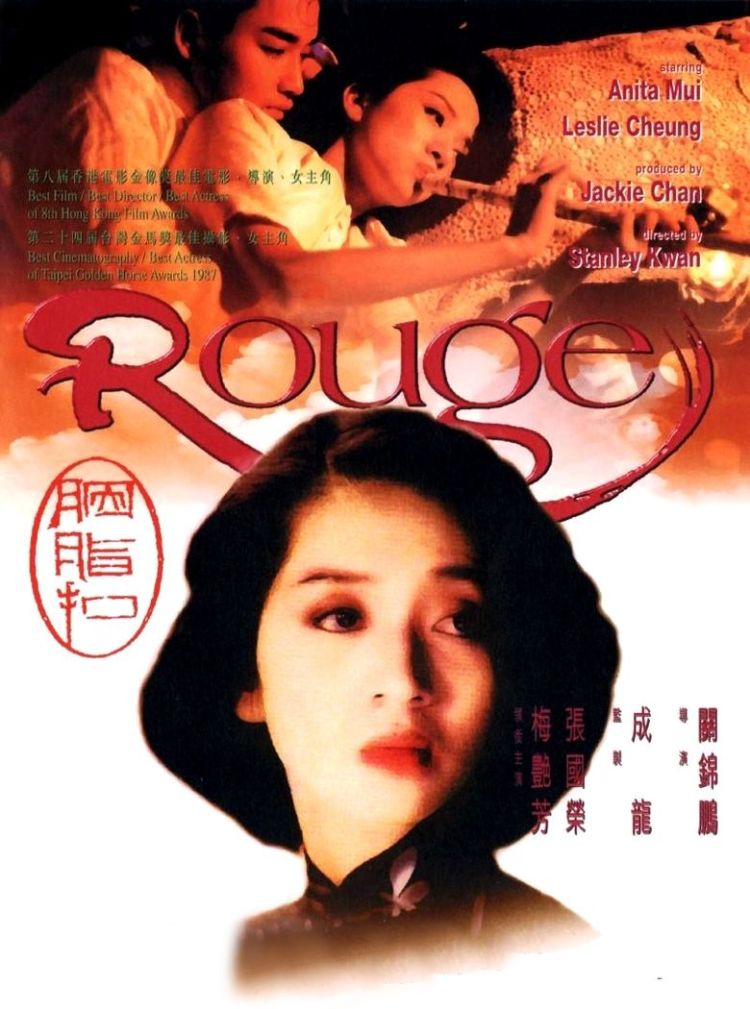
Rouge poster 2How long should you wait for love? They say every love story is a ghost story, and Stanley Kwan’s Rouge (胭脂扣) is a love story in more ways than one. A love letter to old Hong Kong, Rouge laments the passing of time and defeat of beauty by efficiency but then stops to wonder if perhaps that isn’t better and if we’re all secretly happier in world in which dying for love has gone out of fashion.

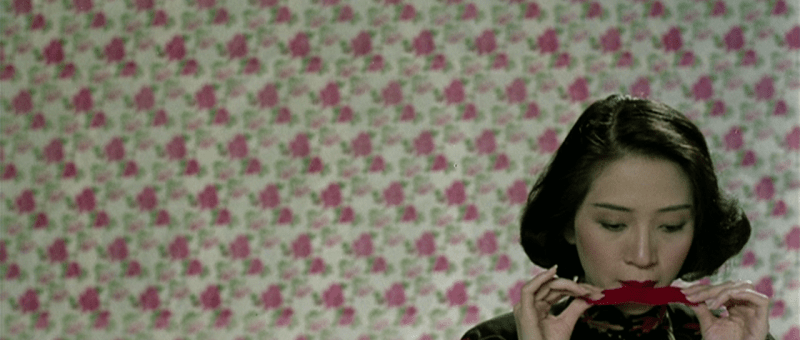
We begin in the early 1930s as courtesan Fleur (Anita Mui Yim-fong), dressed as a man and singing of doomed love, catches the eye of nobleman Master 12 Chan Chen-Pang (Leslie Cheung Kwok-wing). He lavishes gifts on her and the pair fall madly in love, but his family do not approve of the match and are set on Chen-pang marrying their chosen bride. Out of options, the pair decide on double suicide, but Fleur finds herself all alone in the afterlife and, after 50 years have passed, makes her way to the Hong Kong of the late 1980s in search of lost love.

Many things have changed in the Hong Kong of 1988, but luckily they still have classified ads which is how Fleur decides to find Chen-pang. Of course, ghosts don’t generally have need of money which means she’s still out of luck, but for some reason she finds herself attached to the kindly clerk, Yuen (Alex Man Chi-leung), who eventually agrees to “admit” her while he and his reporter girlfriend Chu (Irene Wan Bik-ha) help track down Chen-pang in the hope that Fleur can find him before the next memorial of her passing in two days’ time.

Kwan contrasts the opulence of the 1930s with the stark efficiency of the modern city in which pleasure palaces have been replaced with convenience stores. Fleur wanders through a world much changed, and sees its ghosts everywhere she goes. The Yi Hung teahouse is place of decadent delight filled with music, colour, and elegance but it’s also one built on misery in which young women are trapped and exploited as a direct result of generalised poverty. Hong Kong has moved on and is now one of the wealthiest cities in Asia, bustling with industry and ambition. The modern cityscape may be less aesthetically pleasing, but perhaps that’s not altogether a bad thing if that beauty had existed only to mask an unpalatable reality.

It is true enough that Fleur struggles to make herself understood to Yuen and Chu – her language is no longer current and her way of thinking arcane considering they are only two generations apart. Fleur wonders why the pair of them aren’t married, to which Yuen bemusedly replies that perhaps it’s that there’s no particular pressure urging them towards a more formal union. In any case their relationship seems solid enough in a pleasant, ordinary sort of way. Where Chen-pang gives Fleur the gift of an empty rouge case, Yuen notices Chu’s shoes are worn and thinks to buy her new ones seeing she’s always running about. They wonder if they’d commit suicide for love and come to the conclusion that they wouldn’t, but that doesn’t mean they don’t love each other only that life is precious and that kind of grand romanticism seems so absurd in the much more down to earth 1980s.

Still, Chu and Yuen can’t help but be captivated by the grandeur of Fleur’s romantic longing. They too want to see a happy ending to her tragic story that makes 50 years in limbo worth the wait, but what if Chen-pang was just a selfish coward who woke up from a romantic daydream and went back to his ordinary life of familial obligation and frustrated desire? Fleur died for love, but 50 years later it all seems so senseless and her return is, in a sense, an attempt to come to terms with disappointment – in love and in the world. The Hong Kong of 1988 may have been anxious too, if in a different way, as another uncertain dawn hovered on the horizon but Fleur’s parting gift is to accept that there’s no point waiting for someone who has no intention of coming. She says goodbye to the past, and walks into a new future with a lightness in her step while the past, suddenly burdened, can only look on with regret.


Rouge screens at the BFI on 4th May with director Stanley Kwan in attendance for a Q&A as part of the 2019 Chinese Visual Festival.

International trailer (dialogue free, English captions)

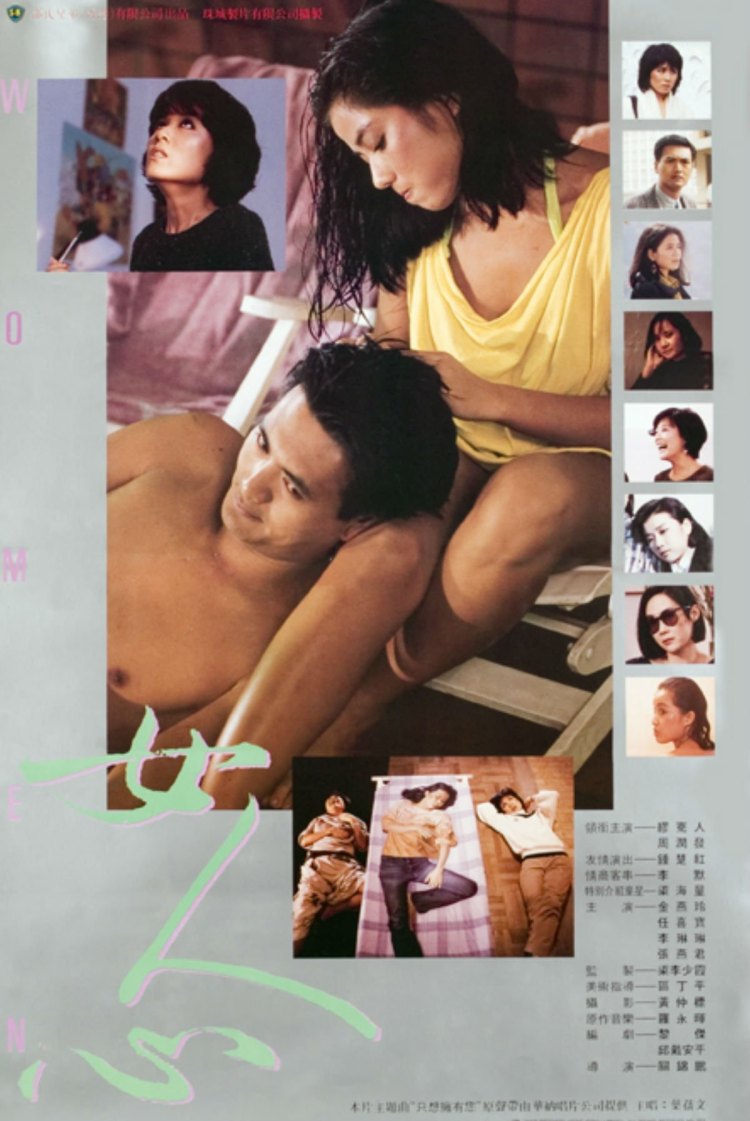
Women (女人心, Stanley Kwan, 1985)

Women posterThings are changing in ‘80s Hong Kong, but when it comes right down to it are there really any more choices than there were in the past? Stanley Kwan would become known for his fiercely female led filmmaking and his debut, Women (女人心), is indeed a statement of intent if heeling close to the Shaw Brothers house style and possessed of a particularly mid-80s kind of cynicism. Marriage falls under the spotlight but for all of its minor oppressions and petty aggravations the net seems almost impossible to escape.

Kwan opens with a strangely cheerful family scene which quickly turns sour as housewife Bao-er (Cora Miao Chien-Jen) is excluded by her husband, Derek (Chow Yun-Fat), and son, Dang-dang (Leung Hoi-Leung), who close the bathroom door on her before declaring a pissing contest. Irked, Bao-er finds herself mildly enraged by the sight of her husband’s undies and decides to take this opportunity to tell him she wants a divorce. She’s found out all about Derek’s fancy woman Sha-niu (Cherie Chung Cho-Hung) and has had enough. Decamping to her mother’s with Dang-dang in tow, Bao-er finds herself the latest member of her friends’ “forever happy single women’s club” but remains conflicted when it comes to considering the further direction of her life.

The “forever happy single women’s club” is itself somewhat confused in its outlook in that most of Bao-er’s friends are not really intending to remain single forever but are hoping to find a new partner, if perhaps also enjoying playing the field while they look. None of them are really very happy with the status quo and the various get-togethers at which they enjoy lavish buffets and copious amounts of alcohol are mostly filled with bawdy discussions about men and sex, much to the consternation of the rather uptight Bao-er. 

In fact, Bao-er’s “refinement” seems to be one of the chief issues in her marriage which is perhaps why Derek has found himself intwined with a clingy free spirit who quickly moves into the family home and does her best to stake a claim on little Dang-dang but is unwilling to keep house with the consequence that the apartment is quickly overrun with old newspapers and empty food cartons – a sight which fair breaks Bao-er’s heart when she’s forced to visit only to be presented with some of Sha-niu’s patented “spicy soup”. During a candid conversation with her mother, Bao-er reveals that throughout her married life she’d gone to great lengths to preserve her feminine mystique only for Derek to take off with a woman prepared to let it all hang out. Her mother, broadly supportive of her choices, advises her to think carefully about her future. If the marriage was unhappy then it’s best to call it quits, but if Sha-niu is just a passing fad then perhaps she’s one worth putting up with in the absence of other options.

Bao-er’s mother seems to think that ignorance is bliss when it comes to a healthy marriage, but as a “modern” woman, Bao-er expected more. Even so, despite not requesting alimony (she only wants money to cover Dang-dang’s expensive private school fees), we don’t see Bao-er looking for work though it’s also clear she isn’t looking to remarry in the immediate future. Like many of her friends, Bao-er seems to have her doubts about living as an “independent” woman and continues to be irritated by Derek’s relationship with Sha-niu even while attempting to firmly close the door on her marriage.

The end of the relationship does however give her an opportunity to consider what it is that she wants, even if middle-class conservatism ultimately wins out. This is particularly true of an unexpected attraction to a lesbian friend which she chooses not to pursue seemingly because of the social taboo. Despite being fully out and accepted by the group, Terry (Cheung Yin-Gwan) is also pitied by some of the other members who believe she is locked out of the conventional family life most of them are looking for because she is looking for a woman and not a man. Even if it’s true that Bao-er can only really be fully herself with her female friends, she and the others still hanker after male companionship and do not feel complete without it.   

The major theme which emerges is that marriage and family are essential, if imperfect, and must be maintained even if perhaps superficially as the closing text which conveniently condones Derek’s poor behaviour while allowing Bao-er her “revenge” implies. A slightly cynical point, to be sure but undercut by Kwan’s sense of empathetic irony which asks what other real choices Bao-er has while refusing to condemn her for the ones she eventually makes. Socially conservative as it may be, the fact remains that possibilities are bleak for women of a certain age in ‘80s Hong Kong which remains a playground for men like Derek while women like Bao-er and her friends are left with only complicit means of personal rebellion.


Women screens as part of the 2019 Chinese Visual Festival on 5th May at King’s College London where director Stanley Kwan will be present for a Q&A.

Celestial Pictures trailer (English subtitles)

Knockout (どついたるねん, Junji Sakamoto, 1989)

Knockout cap 1Thirty years after his debut, the career of director Junji Sakamoto has proved hard to pin down. An early focus on manly action drama gave way to character pieces, issue films, and comedy, but it was with his breakout first feature Knockout (どついたるねん, Dotsuitarunen) that something like a signature style was born. One of Japan’s many boxing movies (perhaps an unexpectedly populous genre), Knockout is once again the story of a man fighting himself as he struggles to overcome serious physical injury, emotional trauma, and his own fiercely unpleasant personality to finally become the kind of champion he has always feared himself incapable of becoming.

Dreaming dreams of boxing glory, Adachi (Hidekazu Akai) trained hard since he was a small boy and eventually became a champion of the ring. However, an ill-timed blow from a subpar opponent left him with an unexpected, life threatening injury requiring brain surgery after which he was advised to stay behind the ropes for the remainder of his days. A total asshole with a violent streak, Adachi can’t help alienating all those around him including childhood friend Takako (Haruko Sagara) whose father owns the National Brand gym where he used to train and had given vague promises of taking over once he retired. In his newly irritable state, Adachi has decided to start his own high class gym and has teamed up with a boxing enthusiast friend, Harada (Tetsuya Yuki), who runs a gay club, to buy National Brand’s promoter license to set up alone.

This being the kind of film that it is, it’s a given that Adachi will eventually want to get back in the ring despite all the inherent risks to his physical body. Nevertheless, the journey towards that realisation will be a humbling one as he is forced to confront the fact that he is a terrible person whose intense self obsession and intimidating behaviour has everyone around him walking on eggshells. Consequently, he does not make a particularly good boxing coach thanks to his didactic methods and rigid insistence on doing everything his own way. Only the kindly assistance of an older man, Sajima (Yoshio Harada), who also retired from the ring through injury, begins to show him the error of his ways but it’s not until he’s truly alienated all of his prospective pupils, as well as his patient backer, that he finally understands where it is that he belongs. 

Set in his native Osaka, Sakamoto weaves a rich tapestry of local life from the feisty Takako who dearly wanted to get in the ring herself only to be met with the constant refrain that boxing’s not for girls, to the mysterious Harada and his largely offscreen gay bar at which Adachi seems to be a frequent yet unwilling visitor who claims the place is too “weird” and fears interacting with others in the establishment. Meanwhile the applicants at his new gym which promises training with a “kindly” coach run from young toughs to softening salarymen desperate to engage with their dwindling masculinity. This is definitively a manly affair in which the frustrations of young(ish) men take centre stage though mainly through the destructive effects they have on the world around them – you’ll nary find a face around here that doesn’t have a bruise on it. While Adachi’s parents tiptoe around their own son as if he were some sort of gangster, Takako is the only one willing and able to stand up to him save the late entry of Sajima who appears to be dealing with some neatly symmetrical family issues of his own.

Starring real life boxer Hidekazu Akai, Knockout strives for realism in the ring even whilst emphasising the ongoing psychodrama that lies behind it. Adachi, like many boxing heroes, is engaged in constant battle with himself, trying to overcome the frightened little boy he once was rather than accepting him and admitting that even older he is often still scared and angry without really knowing why. Perhaps through his final, infinitely dangerous entry into the ring he will find some kind of answers to the questions he has been too afraid to ask but he has, in any case, become less of a problem for those around him in his continued quest towards becoming the best version of himself.


Prince Charming (青蛙王子, Wong Jing, 1984)

Prince charming 84 poster“This isn’t a film from the 1930s!” a confused sidekick exclaims part way through Wong Jing’s zany ‘80s comedy Prince Charming (青蛙王子). He’s right, it isn’t, but it might as well be for all the farcical goings on in Wong’s hugely populist, unabashedly zeitgeisty romp through a rapidly modernising society. Starring popstar Kenny Bee, Prince Charming also marks the feature film debut of the later legendary Maggie Cheung who would find herself making a fair few disposable comedies in the early part of her career. All the Wong trademarks are very much in evidence from the sometimes crude humour to the random narrative developments and deliberate theatricality but it has its charms, even if perhaps despite itself.

Signalling the “aspirational” atmosphere right away, Wong opens in “Hawaii” with Kenny Bee performing one of the many musical numbers which will be heard throughout the film (which is also a kind of idol movie as well as a populist Shaw Brothers Comedy). Chen Li Pen (Kenny Bee) is the son of an oil magnate and hotel chain manager but unlike his father, is a sensitive, nerdy young man who gets the hiccups around attractive women and has never had any luck with the opposite sex. Nevertheless, his mother wants to set him up with an arranged marriage – something which he vehemently opposes but understands will become harder for him fend off if he can’t find himself a love match in good time. Enter his old friend Lolanto (Nat Chan Pak-Cheung) who is a self-styled ladies man if a bit “common”. Lolanto has come to Hawaii on holiday and to hang out with Li Pen, but like any young guy he also wants to meet some girls.

The guys end up in a kind of sparring match with the two ladies staying in an adjacent room at the hotel, May (Cherie Chung Cho-Hung) and Kitty, (Maggie Cheung Man-Yuk) following a series of misunderstandings. When the girls drug them and then somehow leave them on a rock in the middle of the ocean, the boys are humiliated but don’t have too long to nurse their wounds because Li Pen’s dad sends them back to Hong Kong to investigate suspected embezzlement at head office. As luck would have it, both May and Kitty work for Li Pen’s family firm (which was perhaps why they were staying in the hotel). Another misunderstanding sees May assume Li Pen is a former triad looking for a new start, so she “bribes” the hiring department to get him a job as a chauffeur, while Lolanto ends up in the boss’ office posing as Li Pen. Hilarity ensues.

Aiming a squarely for the populist, Wong’s defiantly aspirational vision revolves around the fabulously wealthy and internationalised Li Pen who went to college in the US and lives most of his life in Hawaii, perhaps not quite understanding Hong Kong in the same way Lolanto does, both because of his outsider status and because of the freedom his wealth gives him. When the two swap roles they each get a kind of education, but their real quest (while halfheartedly investigating the embezzlement scandal) is winning over Kitty and May who think they’re dating a CEO and a chauffeur respectively. Despite their irritation when they realise their mistake, both May and Kitty perhaps come to realise that the deception is a part of what eventually drew them to the guys and they’re a better match than they might otherwise have imagined.

Meanwhile, Wong finally remembers the embezzlement plot and introduces a third woman, Puipui (Rosamund Kwan Chi-Lam), who is secretly a plant set up to seduce the pure hearted Li Pen and marry him because this will in some way prevent the embezzlement scam from coming to light. Puipui’s scheme eventually kicks off the ridiculous finale in which the gang find themselves chased by goons and having to play pool for their lives with hostages hooked up to electric chairs which will be triggered when a certain number of points are scored. Wong adds a host of cutesy touches from cartoon hearts around our lovelorn heroes and adorable doodles popping up as on screen graphics while Kenny Bee and Cherie Chung also get a completely bizarre musical number at the midway point where they pretend to be happy frogs marooned on a private lily pad. It doesn’t make any sense, but it really doesn’t matter. Completely throw away, but strangely fun.


Currently streaming on Netflix UK (and perhaps other territories)

Celestial Pictures trailer (English subtitles)