Hong Kong 1941 (等待黎明, Leong Po-Chih, 1984)

“Britain has reassured the people that it will not give up Hong Kong,” according to a radio broadcast at the beginning of Leong Po-Chih’s Hong Kong 1941 (等待黎明). The words have a kind of irony to them and not only because Britain did abandon the people following the Japanese invasion, but because the film was released on the eve of the Sino-British Joint Declaration in which it said something quite similar. 

But then again, the opening scenes are themselves quite critical of British rule as they, on the one hand, insist they aren’t going anywhere and, on the other, start evacuating women and children to “safer” areas of the commonwealth such as Australia. Out of work actor Fei (Chow Yun-fat) fled the Japanese incursion on the Mainland and came to Hong Kong, but now tries to stowaway abroad a boat going to Australia. He’s caught by a little British girl who speaks fluent Cantonese yet refers to him as her “slave” and insists that he “kowtow to me, now.” But then the girl suddenly adopts the persona of the Empress Dowager Cixi and demands the same. Fei makes the first of his many jumps into the water around Hong Kong, as if only in this liminal space can he be free. Anticipating the wave of migration occurring before and after the Handover, and also that of the present day, he and his friends Keung (Alexander Man Chi-leung) and Nam (Cecilia Yip Tung) set their sights on leaving to find Gold Mountain in Australia or America.

But they’re one day too late because the date of their departure is that the Japanese arrive in Hong Kong. Their haste to leave was in part caused by the fact that Nam’s father, Ha Chung-sun (Shih Kien), was trying to force her to go through with an arranged marriage her prospective groom didn’t want either. Nam is never really free as, as she points out, even after her father relents and allows Keung to marry her after she is raped by a police officer emboldened by the chaos and therefore worthless to him as currency, Keung never actually asked her and she’s in effect forced into a marriage with him instead. In fact, she returns to the shrine Keung lives in two find the two men constructing her marital bed for her with the double helix symbol of happiness already placed above it in an ironic expression of patriarchal oppression.

Indeed, her position is more precarious than either of the men and we see other families roughly cutting their daughters’ long hair to make them look like boys in fear of a rapacious Japanese army. But it largely turns out that it wasn’t so much the Japanese they needed to be worried about as the local population, experiencing a temporary limbo in which the social order has been suspended. Police officer Fa Wing (Paul Chun) who had acted as a lackey for Ha Chung-sun while constantly eying up Nam leads a gang of looters to Ha’s house to take their own revenge against his capitalistic oppression of them. Ha had largely made his money through rice profiteering and exploiting the local workforce. Recent layoffs at the warehouse had led to a labour riot, while Keung and his friends had been running a sideline skimming sacks of rice to sell on the black market. 

Ha and his henchmen anxiously await the arrival of the Japanese hoping that they will protect them from retribution, but the Japanese do not arrive fast enough. When they do, Ha collaborates and attempts to ingratiate himself with the Japanese officer in charge of the colony who once again takes a liking to Nam. General Kanezawa (Stuart Ong) also uses their poverty to starve them into submission, promising rice to anyone who will come and sing with him. The song he chooses is “Shina no Yoru” by Li Hsiang-lan, whom he describes as “their very own”, yet was actually a Japanese woman, Yoshiko Yamaguchi, groomed for stardom in Manchuria and marketed a Chinese star in propaganda films. Another song of hers, Ieraishan, can be heard earlier on the soundtrack as if heralding Japanese arrival. 

Though Nam tries to resist, Fei raises the trio’s arms in a cry of “banzai” in a moment of ostensible collaboration designed to buy them temporary safety. His philosophy and that of many others is to take the rice and deal with the rest later, which Fei does by becoming an enforcement officer with the Japanese to get papers that will allow all of them leave. He uses his position to help a gang of Mainlanders who are resisting the Japanese, and are, in fact, the last ones to stay behind and defend the colony, as well as well as save Keung when his attempt to rescue two friends who have been sold out for forced labour on another Japanese-controlled island by a local gangster backfires and he’s captured himself. 

Ironically enough, Fei had been the first one to try to leave and described himself as “selfish” after jumping back into the water to return to Nam and Keung who didn’t make the boat on time because they were trying to save a local eccentric everyone calls “emperor” played by the director himself. Fei is quite obviously in love with Nam, and she gradually falls for him in return though symbolically wedded to Keung, if not in the legal sense. Again, she has no say over her romantic future which is sorted out between the two men with Fei abiding to a code of honour in continuing to protect the relationship between Keung and Nam. Perhaps this echoes the way in which the Hong Kong people of 1941 or 1984 have little say in their future either as their fate is decided by two distant powers. Nevertheless, it leaves Keung feeling awkward and inadequate, realising that Nam likely prefers the smart and dynamic Fei over his constant failures and inability to protect her, though he is never jealous or resentful towards him only knowing that he is continually indebted. Yet it’s Nam who eventually strikes back for Hong Kong and for her own freedom while Fei looks on as children in the street play at beheadings as if they were Japanese soldiers. She embodies the spirit of Hong and carries it with her, and as the Chinese title of the film suggests, waits for a new dawn while accepting that just like old memories it will be replaced by what is to come. She speaks from a perspective that is both historical and uncertain, mourning the past while fearful of the future, but all the while continuing to live as one new dawn replaces another.


Hong Kong 1941 screened as part of this year’s Focus Hong Kong.

Trailer
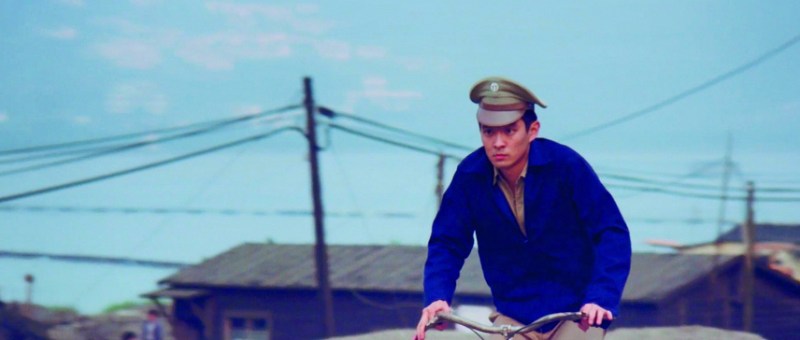
Out of the Blue (小爸爸的天空, Chen Kun-Hou, 1984)

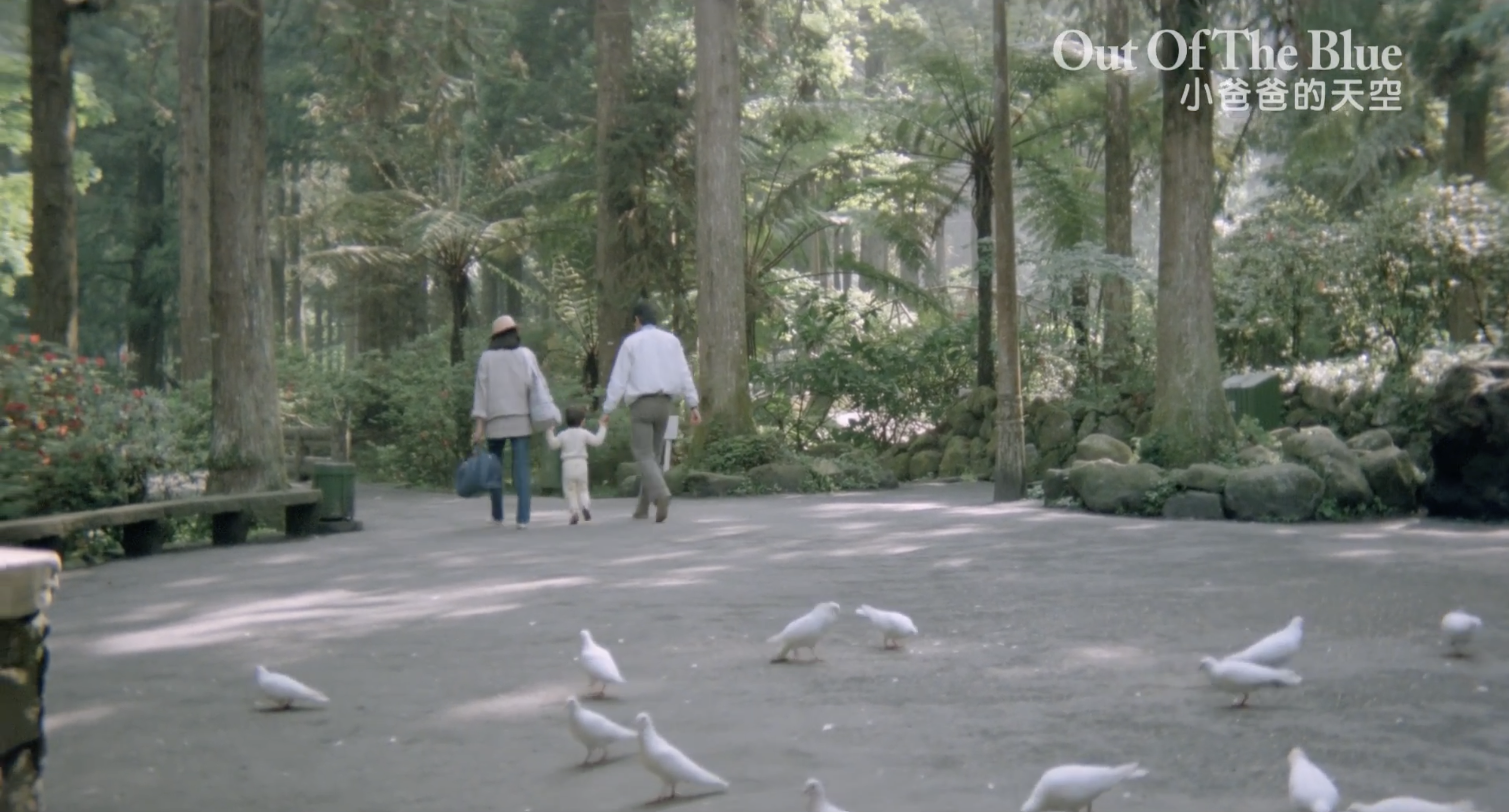
A young man begins to dream after discovering he has become a father in Chen Kun-Hou’s poignant coming of age drama Out of the Blue (小爸爸的天空, xiǎo bàba de tiānkōng). Though it could perhaps be argued that the heroine suffers unduly, the film is remarkably unjudgemental about unplanned teenage pregnancy and at heart is rooting for the young couple. But the real world is not so kind, and it seems impossible that their love could survive in the liberalising but still oppressive late martial law society.

Long is a boy from an ordinary family with a crush on a wealthy young who goes to his school, Mi. Mi gets picked up by a chauffeured car every day, while Long watches her afar from his bicycle. Eventually, the pair get together and bond over their shared sense of dissatisfaction with their families by whom they are each trapped in opposing ways. Long complains that his former policeman father beats and berates him for not living up to his expectations, while Mi alternately implies her parents don’t really care about her because they’re always working and let her do as she pleases, and that she has no free will because she’s duty-bound by the expectations of filiality.

Perhaps bearing this out, Mi rarely speaks during her courtship with Long and only later is able to talk plainly to her mother, though her mother doesn’t listen. When she becomes pregnant after sleeping with Long when he stays out all night after a beating from his father, Mi can’t bring herself to tell anyone but stays at home alone while her parents head to LA. For unstated reasons, she can’t bring herself to tell Long, either. She ignores his calls and drops out of school, instructing the servants not to answer the phone when he calls. But when her mother finally finds out, she’s unexpectedly supportive. At least, she doesn’t disown her, force her to give up the child, to marry someone else or to stop seeing Long (though she does so anyway), all of which adds an additional layer to Mi’s sense of filial obligation feeling as if she cannot disobey her mother because she has been so kind and understanding of her “scandalous” behaviour.

When Mi abruptly disappears and he’s told she’s gone abroad, Long tries to talk to his father but in the end he doesn’t say anything. He simply refills his father’s ink pot while he continues to practice calligraphy. The only really time that Long’s father actually speaks to him is on hearing that he’s got the grades to get into his chosen university. It’s at this point that his father considers him “a man,” having his first drink with him and treating him as an adult rather than a naughty boy he can beat with a belt. In a sense, Long has conformed with his father’s authoritarianism in following the conventional path and is no longer trying to resist it, but on being unexpectedly reunited with his own son, Weiwei, is a more compassionate and empathetic presence, in love with the idea of having a family, though it is currently out of his reach. When he runs into Mi and realises the toddler she’s got in a pushchair is his, he’s still a student financially unable to support a wife and child let alone keep them in comfort.

As such, Long might be the unexpectedly good man who would have married and taken care of Mi if he knew but as they each say several times, everything’s different now. After their separation, both describe themselves as having grown up. Though he didn’t know he had become a father, Long feels as if he’s now older than his friends. He’s no longer interested in playing pool with them and is bored by their teenage pastimes. It’s ironically this sense of growing up that sets him on a more conventional path by knuckling down to study. But Mi perhaps feels trapped. Her parents have accepted her, but they have also more or less adopted Weiwei as their own and refuse to see her as a grown woman. When she tries to stand up to her mother about going to LA, her mother refuses to allow her to stay behind with Weiwei because she doesn’t believe she can look after herself let alone a child. Mi snaps back that could marry Long, but her mother doesn’t take it seriously. In the end, Mi is unable to break free of her filial obligations and defy her mother by leaving to make a new family with Long.

Mi’s mother stands in the way of progress, though she is in other ways a good and compassionate person who never tries to punish her daughter for her sexual transgression and only wanted to care for her and the baby. The baby has, however, now become part of her family to which Mi is merely an accessory, so he cannot now form a new family with Long. Long is unable to assume his paternity because of his financial status, but is otherwise good with the boy and in some ways better than Mi who becomes frustrated when he fails to settle in an unfamiliar environment. She admits that her mother usually tucks him in and is otherwise lost for what to do, leaving Long quite literally holding the baby.

But on the other hand, perhaps he’s only experiencing an idealised vision of fatherhood while spared the really difficult things like the anxiety of keeping food on the table and roof over his head. His friend at university is married with a child and is constantly late because of childcare issues. He recounts having to stay up all night because his son got enteritis from eating something he shouldn’t have when he wasn’t looking and now has a serious case of the runs. Long appears to want all of this too, but is prevented from having it as the older generation won’t surrender it to him or give Mi and Long the chance to figure it out. The closing scenes have a genuine sense of tragedy as Long watches his family ride away from him while Mi looks back with sadness and an expression that suggests she knows she will likely never see Long again. With minimal dialogue and elegant, expressive composition, Chen charts the course of a love too innocent to survive in a world of oppression and conformity but has only infinite sympathy for the young couple whose simple dreams are denied by generational authoritarianism.


Out of the Blue screened as part of the BFI’s Myriad Voices: Reframing Taiwan New Cinema.

Trailer (Traditional Chinese / English subtitles)

Shanghai Blues (上海之夜, Tsui Hark, 1984)

There’s a strange kind of melancholy optimism born of false courage and desperation that colours Tsui Hark’s Shanghai Blues (上海之夜). A clown soon to become a soldier tells a woman he meets in the dark under a bridge as the city burns and Shanghai falls to the Japanese to remember that they will win. 10 years later the wounded of that same war reassure each other that their time will come, they didn’t survive just to die here now seemingly cast out by the society they risked their lives to save.

The Shanghai Stool (Sally Yeh Chian-Wen) arrives in is in a moment of euphoric liberation caught between cataclysmic revolutions with the civil war and eventual coming of the communists hovering on the horizon. A wide-eyed country girl, she’s almost lost amid the hustle and bustle of the city in which the motion never stops. Like many, she is immediately displaced on her arrival, discovering that the relatives with whom she hoped to stay are no longer at their address and she is therefore homeless and alone. The clown, Do-re-mi (Kenny Bee), now a member of a marching band unable to play his instrument, thinks she’s the girl from the bridge in part because she’s wearing the same outfit but mainly because she has the same short hair cut and so he follows but loses her. Meanwhile, she has a kind of meet cute with Shushu (Sylvia Chang Ai-Chia), now a jaded nightclub showgirl still pining for the clown, in which they each believe the other is trying to take their own life but end up becoming best friends and roommates unwittingly living directly below Do-re-mi. 

In this 30s-style screwball world, identities are always uncertain and often obscured by darkness or else the continual march of the crowd. Yet there’s a kind of romanticism in this act of seeing and not seeing. Only in darkness do Shushu and Do-re-mi finally recognise each other and when their romantic moment is interrupted by the end of a power cut, they smash the neon lights opposite to reclaim it as if to reject the intrusion of this glaring modernity. To that extent, the implication may be that this innocent kind of romantic connection can’t survive the bright lights of the big city or that light blinds as much as it illuminates. In several sequences, the characters inhabit the same space but cannot see each other while a nefarious thief lurks on the edges of the frame unseen by all. On realising that Do-re-mi is the clown/soldier for whom she’s been waiting for the last 10 years, Shushu knows that she will have to break her friend’s heart or her own and that Stool’s dream of a family of three is unrealisable amid the constant rootlessness of this transient city. 

To that extent, Stool is an echo of herself as the innocent young woman she was on meeting Do-re-mi under the bridge rather than the more cynical figure she’s become due to her experiences in the wartime city. In the film’s closing moments, Stool meets another version of herself in the form of a wide-eyed young woman in a plain dress who asks her if this is Shanghai but the only reply she can give is that she wishes her luck because for her Shanghai is now a city of heartbreak just it has been one of sadness and futility for Shushu. “I have one hope, if I give it to you I won’t have any,” Shushu tells her lovelorn boss as an expression of the despair that colours her existence in which the distant possibility of romantic fulfilment is all she has to live for. 

The fact that the lovers later flee Shanghai for Hong Kong seems to take on additional import as those in Hong Kong consider a similar trajectory with their own revolution looming while adding to the sense of continual displacement, disrupted communities, and worlds on the brink of eclipse. This Shanghai is a bleak place too with its lecherous gangsters and seedy businessmen but has a sense of warmth even amid its constant motion in its serendipitous meetings and friendships born of the desire for comfort and company in the face of so much hopelessness. In the end, perhaps romanticism is the only cure for futility just as the only thing to do in a world of chaos is to become a clown.


Shanghai Blues screens Nov. 13 as part of this year’s San Diego Asian Film Festival.

Between the Knees (무릎과 무릎 사이, Lee Jang-ho, 1984)

“We are all suffering from this Westernised lifestyle and way of thinking. They are not really meant for us,” according to a sympathetic doctor, played by the director himself, at the end of Lee Jang-ho’s erotic melodrama, Between the Knees (무릎과 무릎 사이, Muleupgwa muleupsai). The heroine does indeed find herself trapped between the Korea of the past and the modern society, but the film often seems confused in its central messages in its own use of the woman’s body as metaphor for that of the nation despoiled by foreign influence. 

This is most obviously the implication of Ja-young’s (Lee Bo-hee) flashbacks in which she is quite clearly molested by her flute teacher who is a bearded white man. When her mother walks in on the abuse, she blames Ja-young beating her and shouting what we would assume to be unpleasant words branding her as a seductress though she is a clearly a child. As is later explained, Ja-young’s mother is carrying her own baggage in that her own mother was the mistress of a married man and fearful of the same fate befalling her daughter, she has brought her up with problematic notions of bodily purity that have caused Ja-young to develop a complex surrounding her sexuality in which she is unable to process her desires as a young woman. 

She later says that through her “immoral behaviour and desire to sin” she has found “freedom” as if sexuality was her way of rebelling not only against her mother’s tyranny but social conservatism in general. However, she also characterises it as the extreme opposite, blaming her mother in insisting that her treatment of her has left her with no control at all over her sexuality. In the film’s problematic framing, she essentially allows herself to be raped by a series of men partly as an act of self-harm, partly as rebellion, and partly because she has no other way of permitting herself to satisfy her sexual desires. This is of course dangerous, portraying a woman who says no as one who is really saying yes but resisting out of shame, but there is also a completely paradoxical criticism of Korean men all of whom are rapists except for Ja-young’s sort of boyfriend Jo-bin (Ahn Sung-ki) who is so obsessed with traditional Korean culture that he has earned the nickname “antique”.

Jo-bin lives in a Korean-style home and spends his time playing the flute, training in traditional martial arts, and watching pansori in comparison to the pursuits of other young people such as Ja-young’s brother Ji-cheol who mimics Michael Jackson and spends all his time in discos. Towards the beginning of the film is seems that Ja-young will be torn between Jo-bin to whom she originally says “if you’re so old-fashioned I may have to run away with you” and an incredibly unpleasant fellow student who refuses to take no for an answer and in fact eventually rapes her during an expressionist rainstorm that violently awakens her sexuality. The battle then really becomes whether or not Ja-young will be able to accept it, despite the realisation that she is “no longer the kind of virtuous bride that Korean men expect.”

This hints at the pernicious double standard of the contemporary society in which men largely behave like animals, treating women like trophies to be conquered and then discarded while insisting on a “pure woman” for a wife. The discord in Ja-young’s home stems from patriarchal failure, not only that of the man that made her grandmother a mistress and not a wife, but her father’s in having fathered a child with a 17-year-old Korean War orphan he took into his home. Resentment over his betrayal has further embittered Ja-young’s mother and caused her to double down on her sexual conservatism while fiercely resenting her husband’s other daughter. Yet in the film’s final stretches, a degree of female solidarity arises between the women that largely excludes the father with Ja-young’s mother accepting Bo-young as another daughter and inviting her to live in their home now her still young mother has remarried. 

Violent male sexuality also rears its head in a subplot in which a mute man who had developed feelings for Bo-young’s mother while they were being raised in the same orphanage attacks Ja-young’s father for ruining her life, as he undoubtedly did even if he tried to take at least some responsibility for his transgression. Bo-young later says that her mother hated the mute man and did not want to be in a relationship with him anyway, though he too it seems could not take no for an answer. In any case, it is only the traditionalist, Jo-bin, who is willing to accept Ja-young for who she is. He knows all of her ordeal and does not reject her for her sexually active past, rather scoffing when she had described sex as being a sin with the perhaps mistaken implication that such things were not regarded as taboo in the Korea of the past even as, paradoxically, it appears that Jo-bin is drawn to Ja-young’s old-fashioned modernity in rejecting his mother’s constant attempts to set him up with an arranged marriage. 

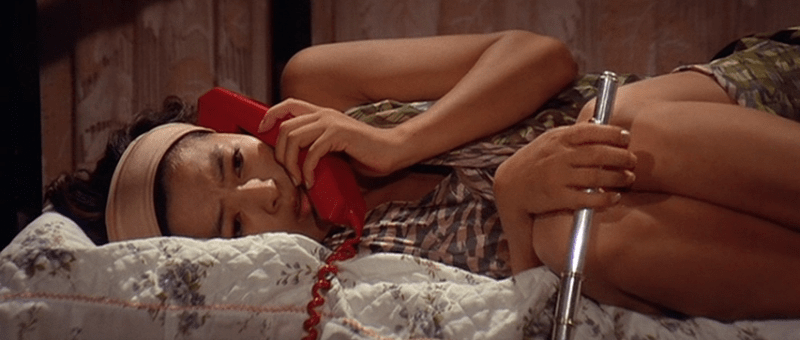
Of course, all of this is also very much informed by the climate of contemporary Korean cinema which had descended into an era of softcore pornography deliberately supported by the Chun regime as part of a bread and circuses social policy designed to distract the people from their democratic desires. Lee opens with sexually charged closeup of Ja-young’s lips on her flute, a phallic symbol also present in Ja-young’s forbidden fantasises as she idly fondles it after hearing heavy breathing on the telephone and experiences another moment of sexual crisis. Perhaps that’s paradoxical itself in that it’s learning to play this Western instrument that has led to her corruption in an allegory for a nation’s pollution by Western culture. In any case, Lee seems to imply that sexuality can be an act of resistance towards oppressive social codes but is otherwise unsure if that represents liberation or merely another form of oppressing one’s self.


Mermaid Legend (人魚伝説, Toshiharu Ikeda, 1984)

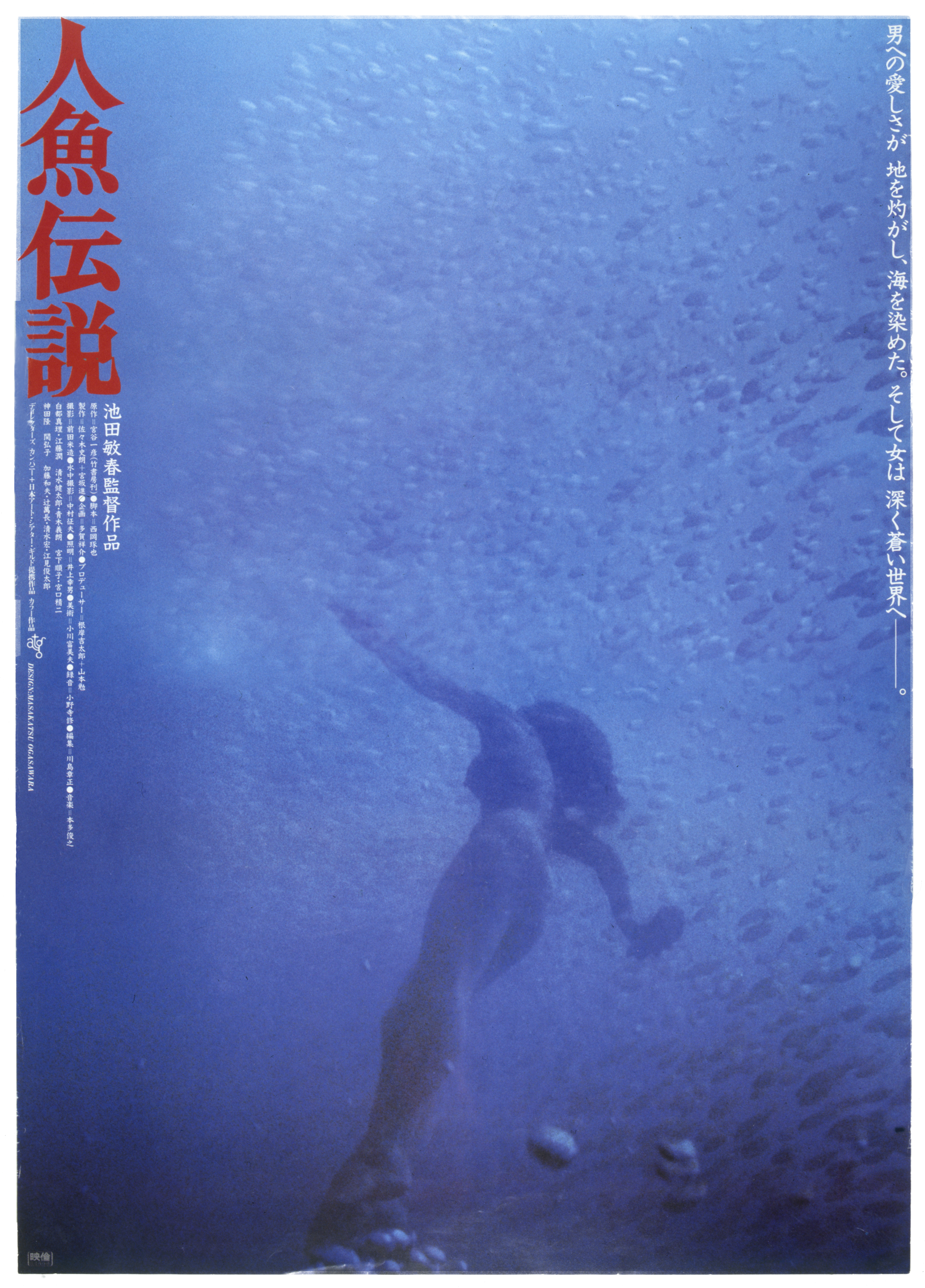
“Even if someone kills you, you wouldn’t die,” a drunken husband somewhat sarcastically replies having pledged to come back and haunt his wife if he died and she married a man who didn’t drink. His words take on a prophetic quality given that the heroine of Toshiharu Ikeda’s Mermaid Legend (人魚伝説, Ningyo Densetsu) takes on a quasi-supernatural quality as an embodiment of nature’s revenge after someone tries, and fails, to kill her having already killed her husband for witnessing their murder of another man who’d tried to resist their plans of buying up half the town to build a nuclear plant. 

By the mid-1980s, Japan’s economy had fully recovered from post-war privation and was heading into an era of unprecedented prosperity which is to say that the coming of a power plant was not welcomed with the same degree of hope and excitement as it may have been in the 1950s when it was sold not only as a new source of employment for moribund small towns but an engine that would fuel the new post-war society. Several industrial scandals such as the Minamata disease had indeed left those in rural areas fearful of the consequences of entering a faustian pact with big business, which is one reason why the guys from Kinki Electric Power sell it as an amusement park project though even this has the locals wary not just of the disruption it will bring to their lives and potential ruin of their livelihoods which are dependent on the protection of the natural environment but that what is promised simply won’t be delivered. Fisherman Keisuke (Jun Eto) says as much when lamenting a previous aquaculture programme which didn’t pan out and caused lasting damage to marine life. 

In any case, as others say there’s no money in going out to sea anymore and its clear that the old-fashioned, traditional way of life practiced by Keisuke and his newlywed wife Migiwa (Mari Shirato) is no longer sustainable. Migiwa is an abalone diver working without modern equipment but using heavy weights to dive deep enough to reach the shells. As such she’s dependent on her husband to pull her back up to the boat when she tugs the rope. She must put her life entirely in his hands though in truth, he does not seem to take his responsibility all that seriously. The couple bicker relentlessly and not even she really believes him when he says he witnessed a murder which might be understandable given the extent of his drinking. All of which is further evidence against her when she manages to escape from the assassination plot and runs straight to the nearest policeman who thanks her for turning herself in implying he believes she is responsible for Keisuke’s death. 

The possible collusion of the policeman hints as a further sense of distrust in authority which has become far too close to corporate interests. Shady industrialist Miyamoto (Yoshiro Aoki) ropes in both the mayor and the head of the fishing association in his talks with Kinki Electric Power along with Shimogawa from the local tourist board who evidently opposes the plans as he is the man Keisuke witnesses being murdered. As Miyamoto says “sometimes your hands get a little dirty” though he never “directly” involves himself matters such as these. The situation is complicated by an unresolved love triangle between Miyamoto’s spineless son Shohei (Kentaro Shimizu), a sometime photographer, who is resentful of Keisuke and in love with Migiwa complaining that Keisuke always outdrinks him and gets the girl too hinting at his sense of wounded masculinity. Isolated by his class difference, he appears not to approve of his father’s actions but later does little to stop them and eventually sides with corporate interest over his feelings for Migiwa who in any case seems to have become more attached to Keisuke following his death which she vows to avenge. 

There is there is something quite strange in the prophetical quality of Keisuke’s words also predicting the “black sweat” of the Jizo on the beach and the mystical storm which does eventually sweep everything clean destroying the signs for the new nuclear power plant already installed on the beach. In this way, Migiwa becomes a vengeful force of nature taking up arms against those who wilfully ravage and pollute the natural environment while damaging the lives of those who lived on its shores such as herself and Keisuke. She takes revenge not only for the murder of her husband by corrupt capitalists but against that corruption itself even as she laments that “no matter how many I kill, they just keep coming.” “Don’t worry, maybe all this was just a dream,” Keisuke once again prophetically intones though it’s difficult to know if it’s defeating the capitalist order that is a fantasy or the maintenance of the idealised rural life to which Migiwa seemingly finds her way back swimming into an unpolluted sea surrounded by the floating barrels of ama divers and clear blue skies, a creature of nature once again.


Mermaid Legend screened as part of this year’s JAPAN CUTS.

Zero (零戦燃ゆ, Toshio Masuda, 1984)

The Zero Fighter has taken on a kind of mythic existence in a romanticised vision of warfare, yet as Toshio Masuda’s Zero (零戦燃ゆ零戦燃ゆ, Zerosen moyu) implies its time in the spotlight was in fact comparatively short. Soon eclipsed by sleeker planes flown by foreign pilots, the Zero’s glory faded until these once unbeatable fighters were relegated to suicide missions. On one level, the film uses the Zero as a metaphor for national hubris, a plane that ironically flew too close to the sun, but on another can never overcome the simple fact that this marvel of engineering was also a tool of war and destruction. 

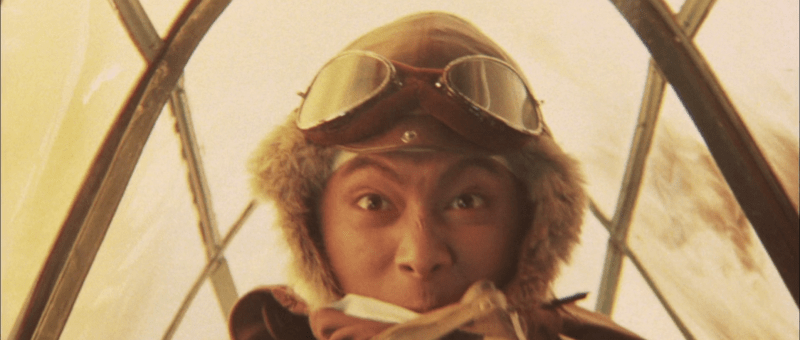
The film is loosely framed around two members of Japan’s Imperial Navy, Hamada (Daijiro Tsutsumi) and Mizushima (Kunio Mizushima), who as cadets consider deserting to escape the brutality of Navy discipline. Having left the base they’re accosted by an inspirational captain who talks them out of leaving by showing them a prototype model of the Zero and convincing them they only need to stick it out for a few more years in order to get the opportunity to fly one. Mizushima, the film’s narrator, doesn’t qualify as a pilot and is related to the ground crew while Hamada does indeed get to pilot a Zero fighter and becomes one of the top pilots in the service. 

The viewpoint is is then split between the view from the ground and that from the clouds. Mizushima makes occasionally surprising statements such as candidly telling love interest Shizuko (Yû Hayami) that they are unlikely to win the war, while becoming ever more concerned for Hamada at one point telling him there’s a problem with his plane in the hope that he won’t take off that day. Hamada meanwhile is completely taken over by the spirit of the Zero and even when given a chance to escape the war after being badly injured, chooses to return because he does not know what else to do. When he visits home after leaving hospital, no one is there. His mother eventually arrives and explains that the family has become scattered with his siblings seconded to the war effort in various places throughout the country. 

Hamada’s dedication and personal sacrifice are in some senses held up as the embodiment of the Zero. The reason for its success is revealed to lie in the decision to remove the armouring for the cockpit leaving the pilot’s life unprotected, something which the American engineers describe as unthinkable. In an early meeting, a superior officer complains that they’re losing too many pilots and need to reinstall some of the armouring, but finds little support. Not only this is a cold and inhuman decision, but it’s poor economic sense given that skilled pilots are incredibly valuable and in short supply. After all, you can’t just make more. If you start from scratch you’ll need to wait 20 years and then teach them fly, but it’s a lesson the Navy never learns that is only exacerbated with the expansion of the kamikaze squads which squander both men and pilots for comparatively little gain. 

These “philosophical differences” are embodied in the nature of the Zero which is configured to be nimble and outmanoeuvre the enemy but is quickly eclipsed not least when foreign powers figure out the way to beat it lies in numbers in which they have the advantage. There is something of a post-Meiji spirit in the feeling that Japan is lagging behind Western powers and desperately needs to develop its own military tech in order to defend itself. On hearing rumours of the Zero fighter, MacArthur scoffs and says that Japan can’t even build cars so he doesn’t believe they could design a plane that could fly such large distances while others suggest that they will still need the element of surprise if they ever go to war with America because its technology is still superior. 

Walking a fine line, the film tries to avoid glorifying “war”, but it cannot always help indulging in nationalist fantasy such as in its statement that thanks to the Zero “the Japanese flag covered a vast area of the Pacific” in the wake of Pearl Harbour. These may be fantastically well designed machines that were incredibly good at what they were created to do, only what they were created to do was kill and destroy. The plane’s fortunes and Japan’s are intrinsically linked, the sense of superiority in the air lasts only a short time before Western technological advances over take it and the war continues to go badly. The film dramatises the tragedy of war through the friendship between the two men which eventually causes Mizushima to sacrifice his love for Shizuko by convincing her marry Hamada hoping that his priorities would change and he’d decide to take a position as an instructor rather than heading back to the front. 

For her part, it seems that Shizuko was also in love with Mizushima, but also caught in a moment of confusion between love and patriotism that encourages her to think she should do as Mizushima says and embrace this man who has dedicated his life to his country. In the end, it buys them each loss and misery, but also a moment of transcendent hope even if it was based on a falsehood in the pleasant memory that Mizushima gives Hamada of the life he is giving up by rejecting it to return to the front. For Mizushima, Hamada and the Zero may become one and the same. At the end of the war he can’t bear to see the remaining Zero’s sold for scrap and asked to be “gifted” one as the Captain who’d first shown one to him said he would be, so that he can give it a proper a “funeral”, or perhaps send it to Hamada in the afterlife after he is killed mere days before the surrender. Masuda cannot help romanticising the wartime conflict with his dashing pilots and their thrilling dogfights, often depicting it more as a kind of game than an ugly struggle of death and destruction, but does lend a note of poignancy to his tale of lives thwarted by the folly of war.


Trailer (no subtitles)

The Island Closest to Heaven (天国にいちばん近い島, Nobuhiko Obayashi, 1984)

On its publication in the mid-1960s, Katsura Morimura’s autobiographical travelogue The Island Closest to Heaven (天国にいちばん近い島, Tengoku ni Ichiban Chikai Shima) became something of a publishing phenomenon and is credited with creating a romanticised image of the Pacific islands in the post-war Japanese imagination. Nobuhiko Obayashi’s 1984 film adaptation in fact prominently features adverts for the UTA New Caledonia tour and acts as something like a tourist information video showcasing the idyllic island scenery and well appointed resort accommodation if also later featuring the decidedly less well appointed establishments on the other side of town where the locals live and and work. 

It is however first and foremost a vehicle for Kadokawa idol star Tomoyo Harada who had made her debut in Obayashi’s The Little Girl Who Conquered Time and was now onto her third lead having starred in Curtain Call earlier in the year which Haruki Kadokawa had directed himself. As such, the film is only loosely based on Morimura’s novel, recasting the heroine as a recently bereaved 16-year-old embarking on a coming-of-age adventure while travelling overseas looking for herself and a sense of the safety and stability she experienced before her father’s death. 

In the prologue sequence which opens the film, shot with a muted, pink-tinted colour filter, a younger Mari sits on the edge of a bridge with her father holding her from behind. As both she and her father are dressed in yukata, as are others who pass them on the bridge, we can assume that it is summer and possibly around the time of Bon festival which adds an extra degree of poignancy to their conversation in which her father quietly clearly anticipates his own death. He tells her about a distant island far to the south and close enough to Heaven for God to call on where it is always warm and sunny and the people always happy. Mari asks for the name of the place and is told it is called New Caledonia, possibly a name her father picked out of the air without thinking but becomes to her a symbol of the bond that existed between them and place she must visit now that her father is no longer physically present in her life. 

What she’s looking for is in a sense a path back to her father or at least a means a coming to terms with his absence. Her mother (Kayo Matsuo) may appear somewhat indifferent, but it’s clear that it’s a kind of pride she feels in her daughter’s first steps into adulthood knowing that she has raised a determined young woman if one with her head in the clouds like her father. Her sentiment is later echoed by an older woman (Nobuko Otowa) who has come to New Caledonia in order to make peace with the death of her husband 39 years previously when his submarine was sunk during the war, stating that all these years later her abiding memory is pride that she fell in love with someone she could be proud of. “Love is the story of your whole life” she tells Mari, who is herself just beginning to understand that life is a process of love and loss as she searches for her island and eventually finds it in the eyes of a local boy who yearns for an island far to the north where it’s always bright and sunny and the people are always happy. 

Mari’s interactions on the island are torn between two men, the young Taro (Ryoichi Takayanagi) who is fascinated by the idea of Japan where his grandfather first came from to dig nickel, and a much older man, Yuichi (Toru Minegishi), who seems to be arrested, stuck on the island and unable to move forward with his life because of a youthful broken heart. Mari reminds him of the young woman he loved and lost, trying to recapture the magic with a moment that seems to reference Jules Verne’s The Green Ray, but of course failing to do so. There is something uncomfortable in their relationship given that Mari is only 16 and this man is perhaps already in his 40s, yet her decision to leave the safety of the tour group and venture astray with him to find what she is looking for rather than what the tour guide wants to show her demonstrates her independent spirt and impending adulthood in taking an active control over her life and future. 

In this way the island is a liminal space in more ways than one, symbolically connecting the mortal world and the other while allowing Mari to transition into adulthood as symbolised by her return home now no longer wearing her glasses in having opened her eyes to a fuller reality. Nevertheless, the film does follow the line of the book which is very of its time in its presentation of the indigenous community which is bound up with the idea of a smiling island people lazing in the sun of a tropical paradise while possessing profound spiritual knowledge. Mari’s literal coming of age is symbolised by a fever she endures after being stung by a sting ray, coming to during a tribal dance and then collapsing again to awaken as if reborn into adulthood.  

After this transition it’s implied that her relationship with Taro will have to end, that this brief summer adventure like so many in Obayashi’s films was just about making memories to carry forward in the further course of life. But then as her seemingly unburdened tour group friend had pointed out, Mari found Taro by chance twice before and so may someday find him again just as Mari’s intervention has earned Yuichi and his first love a second chance no longer so enthral to the illusionary power of the green ray but making choices informed by the realities of love that may still be “romantic” if no longer quite so naive. Shifting into a more contemplative register than other similarly themed Kadokawa idol movies, The Island Closest to Heaven is one of Obayashi’s most straightforward features save for its brief use of colour filters in the opening and closing scenes and the lengthy title sequence which draws inspiration from classic Hollywood melodrama, but engages with some of his key themes in the romantic nostalgia of love and loss as his heroine comes to a new understanding of herself while bidding goodbye to the past. 


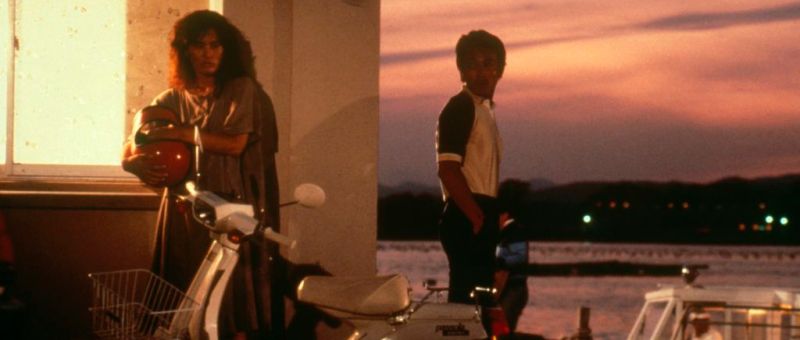
The Island Closest to Heaven is released on blu-ray on 17th October courtesy of Third Window Films as part of the Nobuhiko Obayashi’s 80s Kadokawa Years box set alongside School in the Crosshairs, The Girl Who Leapt Through Time, and His Motorbike, Her Island.

Original trailer (English subtitles)

Theme song performed by Tomoyo Harada

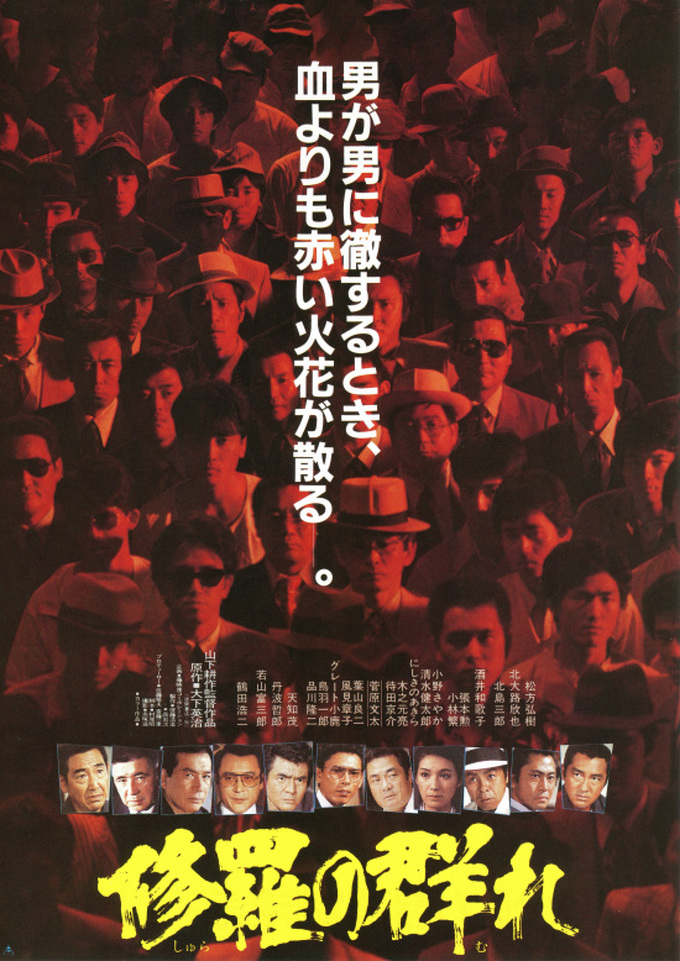
The Story of a Man Among Men (修羅の群れ, Kosaku Yamashita, 1984)

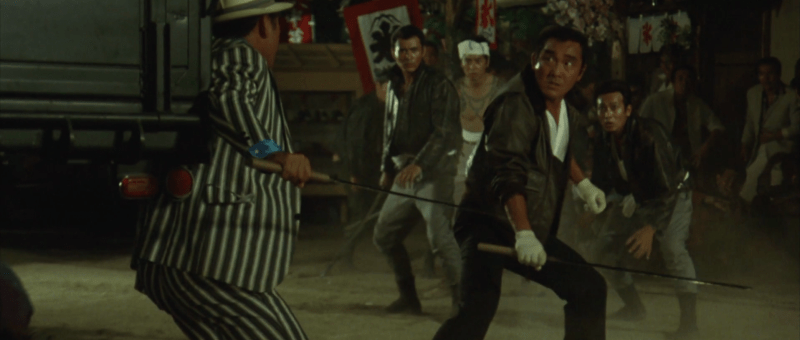
The ninkyo eiga, chivalrous tales of noble gangsters standing up for the little guy with decency and honour, had been Toei’s mainstay throughout the 1960s but a decade later the image of righteous yakuza had been well and truly imploded by the advent of the jitsuroku or “true account” movie which drew inspiration from real life tales of post-war gangsterdom using voiceover narration and onscreen text for added authenticity as it proved once and for all that there was no “honour and humanity” to be found in the gangster life only nihilism and futility. Still, the ninkyo, like many of its heroes, proved hard to kill as 1984’s Story of a Man Among Men (修羅の群れ, Shura no Mure) perhaps proves. A throwback to an earlier era with its infinitely noble hero and unexpectedly if not quite happy then defiantly positive ending, Kosaku Yamashita’s manly drama nevertheless adopts some of the trappings of the jitsuroku in its infrequent use of voiceover and emphasis on concrete historical events. 

The hero, Ryuji Inahara (Hiroki Matsukata), is like many heroes of post-war gangsterdom an orphan though his story begins in the mid-1930s as he’s recruited by a friendly yakuza at a karate dojo. As his teacher explains, Ryuji has already been offered a job with the police but given the chance to join the other side instead immediately agrees, explaining that his life’s ambition has been to gain revenge against the force that ruined his father and destroyed his family, gambling. He chooses to do this, however, not by destroying gambling dens everywhere but by becoming a gambler himself determined to be a winner which is, it seems, a textbook example of having learned the wrong lesson. Still, his noble gangster cool stands him in good stead in the yakuza world where he quickly earns the loyalty of other men, rapidly advancing up the ranks to head his own gang by the crime heyday of the mid-1950s. 

As the title implies, this is a story of a man, a very manly man, among other men. The gangster world is intensely homosocial and founded on ideas of brotherhood and loyalty. Thus, Ryuji finds a surrogate father figure in fellow gangster Yokoyama (Koji Tsuruta) who constantly gives him advice on what it is to be a proper man. “Don’t be a fool, don’t be too smart, and most of all don’t be half-hearted” he advises, later adding “you can’t be a man if you’re dirty about money”, and “taking action isn’t the only way to be a man. It takes a man to have patience.” (this last one as Ryuji hotheadedly discharges himself from hospital to get revenge on a punk who got the jump on him outside a shrine). To be a man, Ryuji intervenes when he sees some less than honourable young toughs hassling an old couple running a dango stand at the beach and the young woman from the caramel stall next-door, throwing his entire wallet on their counter to make up for the damage in what will become something of a repeated motif. His manliness earns him the eternal devotion of the young woman, Yukiko (Wakako Sakai), who eventually becomes his devoted wife against the will of her concerned mother who is nevertheless brought round on realising the love she has for him because of his intense nobility. 

Indeed, Ryuji lives in a noble world. He’s a gambler by trade but only because he hates gambling and is trying to best it. He doesn’t participate in the seedier sides of the yakuza life such as drugs or prostitution and is also in contrast to jitsuroku norms a humanist who defiantly stands up against racism and xenophobia, taking another gambler to task for using a racial slur against a Korean opponent while opting to befriend the “foreign” gangs of Atami when eventually put in charge of the lucrative area rather than divide and conquer. This is apparently a lesson he learned from his flawed but goodhearted father who hid a Korean man and his daughter from the pogroms after the 1923 earthquake because “we’re all the same human beings”. Spared the war because of an injury to his trigger finger, Ryuji kicks off against an entitled son of a gang boss for acting like a slavedriver while working at a quarry but earns only the respect of his superiors further enhancing his underworld ties because of his reputation as a standup guy willing to stand up to oppression. 

Such an intense sense of uncomplicated righteousness had perhaps been unseen since the ninkyo eiga days, and Ryuji’s rise and rise does in that sense seem improbable as his goodness only aids his success earning him the respect of over 1000 foot soldiers even as he finds himself in the awkward position of having to exile one of his most trusted associates for getting too big for his boots and disrespecting the yakuza code. His children also suffer for their connection to the gangster underworld, but are reassured that their father is a good man if with the subtle implication that he has damned them as his father did him. Shot with occasional expressionist flourishes such as crashing waves or a midnight sky, A Story of a Man among Men is not free from manly sadness and indeed ends on the sense of a baton passing from one era to another but does so with an unexpected sense of moral victory for its righteous hero who vows to bring his manly ideas with him into a new age of gangsterdom. 


Original trailer (no subtitles)

Joyful Mystery (Misteryo sa Tuwa, Abbo Q. Dela Cruz, 1984)

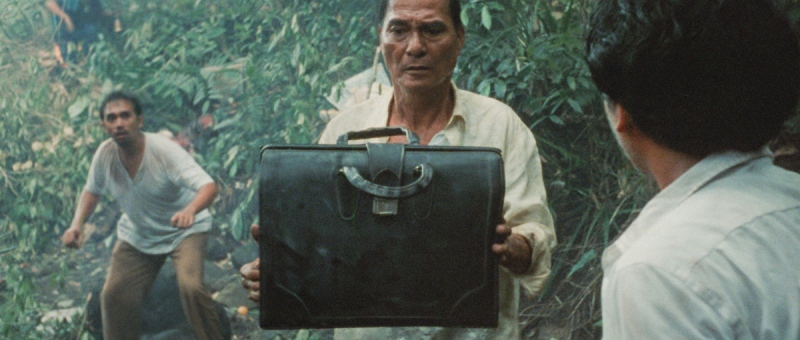
If you “found” a fancy bag full of cash and the guy who was carrying it obviously won’t be needing it anymore, what would you do, hand it in, or take it and keep quiet? Many would have little problem with option two, though as someone later points out sometimes big money can be a big problem. Rarely seen on its release during the martial law era, Abbo Q. Dela Cruz’s Joyful Mystery (Misteryo sa Tuwa) is both a tale of human greed and selfishness and of the thinly veiled feudalistic corruptions of an era. 

Clearly dated to the 19th August, 1950, the film opens with a raucous celebration for the baptism of the village chief’s youngest son Tiko (Kenneith Hutalla) which is all too soon disrupted by the harbingers of doom in the form of an aircraft trailing black smoke that duly crashes right into the forest in which we saw the villagers living and working throughout the social realist title sequence. The villagers rush to the scene, but once there they quickly start looting the wreckage largely ignoring the handful of bodies thrown out of the bisected plane despite the theoretical possibility that at least some of them may still be alive. The trouble starts when three men pick up a fancy briefcase belonging to “an American” and are spotted by a fourth man, a soldier, Castro (Lito Anzures), who claims to have found the briefcase first and laid claim to it. Soon after, the local mayor (Mario Taguiwalo) arrives with two Chinese businessmen who’ve come looking for their colleague who, they claim, was carrying a large amount of money intended to fund their business project. 

Despite the happy scene of the opening party at which it is assured there is food enough for everyone, it’s clear that the lure of the loot has exerted a corrupting force over the previously close village as each family attempts to hide whatever it was they took from the crash site for themselves so they won’t have to share. The three men, village chief Ponsoy (Tony Santos Sr.), problematic libertine Mesiong (Johnny Delgado), and earnest young man Jamin (Ronnie Lazaro), agree to share out the contents of the bag equally, all harbouring different dreams from a comfortable life in the city to owning a horse and the ability to get married, but are nervous about Castro, making a pact they won’t give up the money no matter what happens. 

That turns out to cause more of a problem once the authorities start looking for the bag. Captain Salgado (Robert Antonio), perhaps for obvious reasons the only incorruptible figure to be found, suspects that someone may have found the money already and decided to keep it, while the mayor admits he might have done the same, eventually entering into a pact with Castro to steal the bag from the villagers and split the contents between them. Living comfortably in the city, the mayor cares little for his co-conspirators, planning to blame the Huk rebels living in the forest for any negative fallout and otherwise making a patsy out of Castro to ensure he won’t have to part with too much of the money. 

At a loss for what to do, the villagers’ wives automatically suspect the mayor is involved, innately distrustful of authority figures, even doubting the captain whom they otherwise believe to be good and just. We’re repeatedly told that villagers are greedy mercenaries, they don’t agree to help the army with the bodies from the crash until offered money (nor do they seem worried about the fires) despite the fact that they will obviously encourage the encroachment of wild animals such as rats which are later seen to be enough of a problem that the mayor again offers a bounty on their heads in an effort to get the villagers involved in culling them. Yet we can also see that they’re trapped by a series of changing though outdated social codes in which the feudal relationships between peasants and landowners have crumbled but the farmers have been hung out to dry at the mercy of corrupt political figures such as the venal mayor and distrustful of the revolutionary Huk whose opposition to the feudal legacy they fail to understand. You can’t blame them for taking the money because they’re in desperate need and there are no other mechanisms by which they might improve their circumstances. It’s desperation rather than greed which begins to turn them against each other as they jealously guard the opportunity hidden in the money which points towards a better life for themselves and their families. 

Perhaps ironically, the film begins with a baptism and ends with a wedding which is to say that it travels anti-clockwise to come full circle as the villagers once again dance and celebrate, perhaps uncomfortably vindicated in their moral failing even as they “win” in overcoming the systemic corruption which otherwise oppresses them. Their victory however is only to a point, the social realism of the title sequence is repeated in the credits, the farmers returning to the forests just as they always have and perhaps always will no matter what illusionary dreams they might have had of escape fuelled only by the promise of misbegotten riches. 


Joyful Mystery streamed in its recent 4K restoration as part of this year’s San Diego Asian Film Festival.

Restoration trailer (English subtitles)

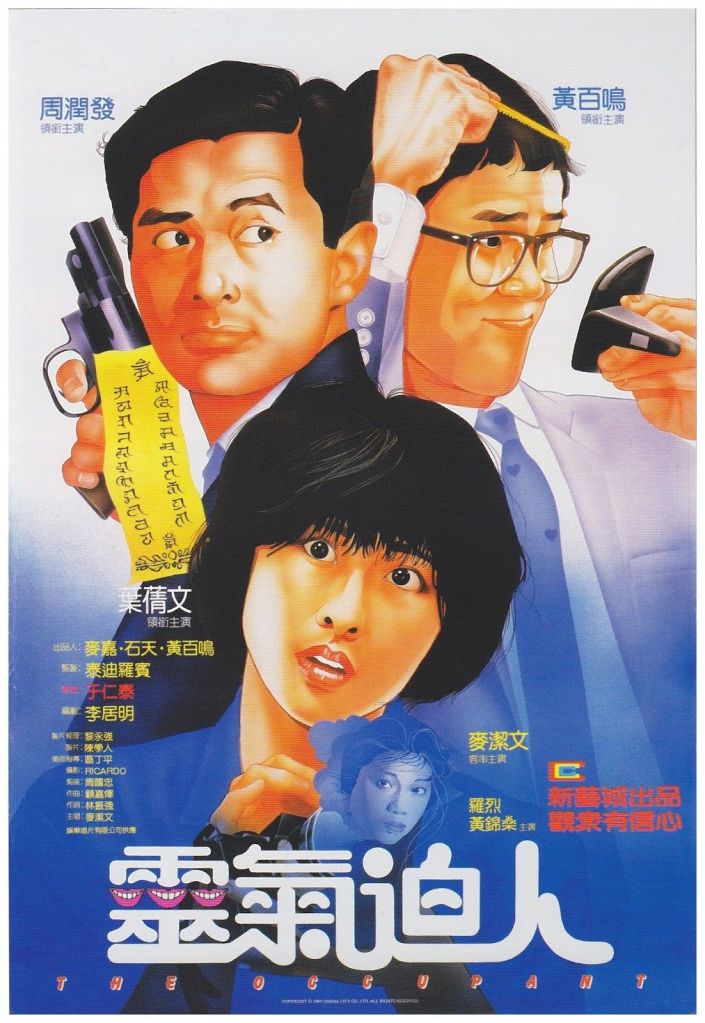
The Occupant (靈氣逼人, Ronny Yu Yan-Tai, 1984)

There’s no such thing as a reasonably priced apartment, and so when you find one that seems strangely spacious for the rent, it’s prudent to wonder why that might be. Yes, that’s right, your dream apartment may in fact be haunted! Going a bit meta, Ronny Yu Yan-Tai gets in on the comedy ghost game with The Occupant (靈氣逼人), a tale of supernatural suspense starring Taiwanese-Canadian actress and singer Sally Yeh as a young woman returning from Canada for a three week stay to work on her dissertation researching “Chinese superstition”.

Having not thought to book ahead for her accommodation, Angie (Sally Yeh Chian-Wen) is shocked to discover that hotel rooms in the Hong Kong of 1984 are in no way cheap. Locked out of even the cheapest flea pits, she decides to try renting an apartment only to run into the slimy Hansome Wong (Raymond Wong Pak-Ming), an unscrupulous estate agent/used car salesman. Angie spots an apartment sitting on his board that’s in her budget and asks to see it. Hansome is delighted because it’s been on the market ages, but what he doesn’t disclose is that the reason it’s so cheap is that the place is haunted. Angie is originally quite confused by the fact her furniture seems to move back to its original position all by itself, and irritated by loud noises such as a woman singing and a couple having an argument late at night, but on being told that she’s the only resident by the decidedly creepy caretaker (Yam Ho), decides she’s not really bothered if the apartment has another occupant besides herself and anyway it might be quite useful for her thesis. 

Very much in the Wong Jing vein, much of the early comedy revolves around Hansome’s cringeworthy attempts to worm his way into Angie’s life. Luckily for her, he says, Hansome is a very “superstitious” person and so offers to show her around all the best “superstitious” sights of the city, particularly a local temple where they seem to do every kind of taoist ritual going. The problem is that Angie can’t seem to get rid of him. He even pulls the trick of saying that he left something behind in her apartment so he can come in and retrieve it, only to get his arm trapped in a priceless vase. Hearing about the ghost he vows to stay the night and protect her from the boogeyman, but he didn’t count on the real thing turning up and expelling him from the apartment in exasperation with creepy men everywhere. 

Meanwhile, Angie is actually quite taken with a handsome policeman she runs into at the airport, but incorrectly assumes he’s a “sex maniac” because he was only hanging out with her as camouflage for surveilling another woman who turned out to be a pickpocket. Valentino (Chow Yun-Fat) is an honest cop, which is why he ends up getting asked to take some time off after discovering a fellow officer visiting an establishment they were raiding on a tip off that it was employing underage girls. Like Hansome, Valentino has also taken to Angie, if in a slightly less creepy way, and the three of them eventually get together to try and solve the ghost problem (not that Angie actually has much of a problem with it). 

On investigation, Angie discovers that the previous occupant of the apartment was a nightclub singer who apparently shot herself after a failed affair with a married man who wouldn’t leave his family. She becomes ever more obsessed with the dead woman, Lisa Law (Kitman Mak Kit-Man), despite the warnings from Valentino’s former policeman turned taoist priest buddy (Lo Lieh) who tells her that the ghost most likely bears a grudge and will try to engineer a reprise of her tragedy using a susceptible subject. Yu has fun parodying some of the genre staples like magical charms supposed to ward off ghosts which get mysteriously lost at critical moments, but edges towards a real supernatural dread as the curse takes hold, swallowing our trio in a bizarre recreation of the past which accidentally reveals a long hidden truth and helps to alleviate the ghost’s anger. In her frequent voice overs recorded on a dictaphone, Angie reveals that she came to Hong Kong with a low view of “Chinese superstition” but thanks to her experiences now has a new appreciation for the power of the supernatural. Ghosts it seems can’t be exorcised so much as appeased, ignore them at your peril.


Original trailer (no subtitles)