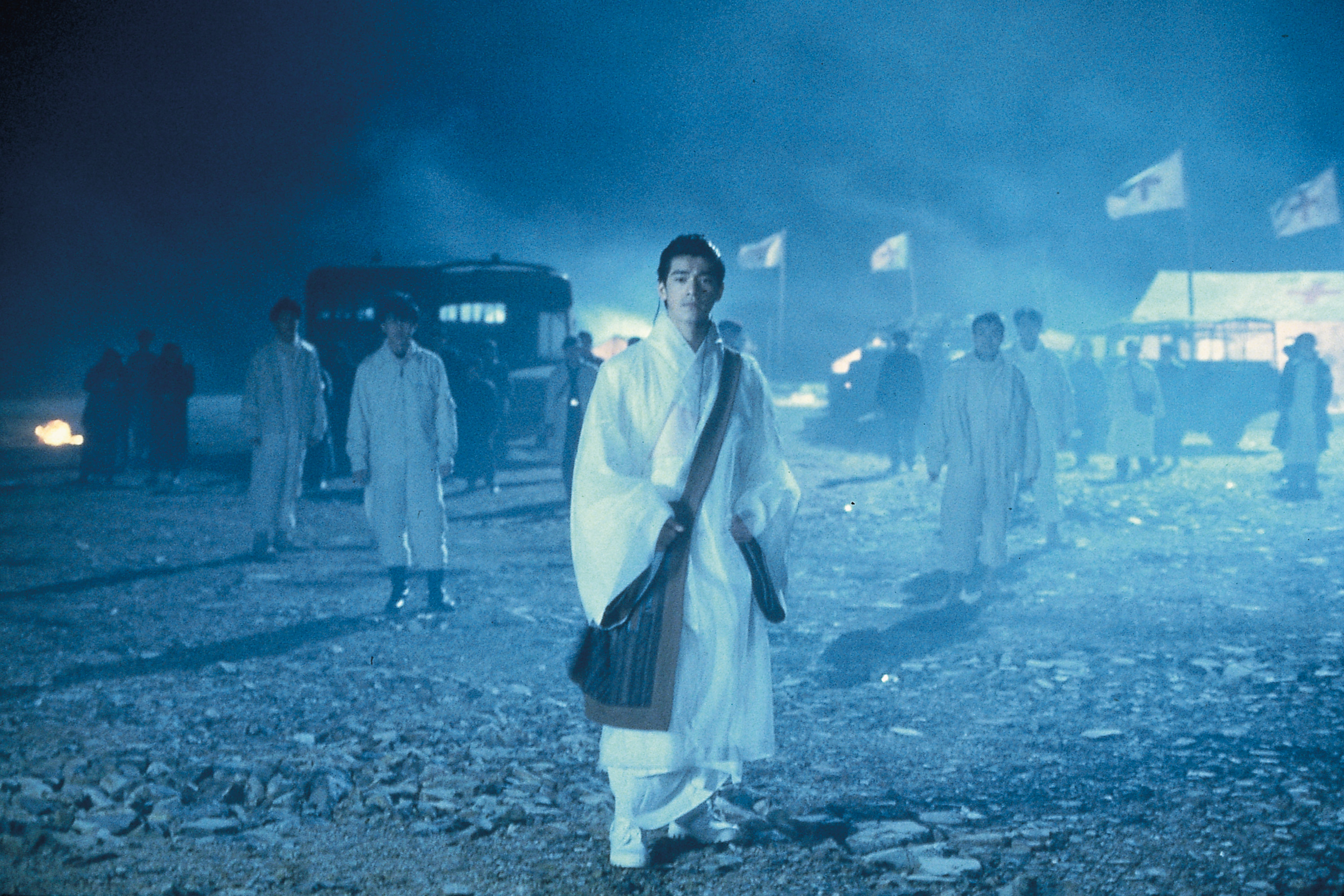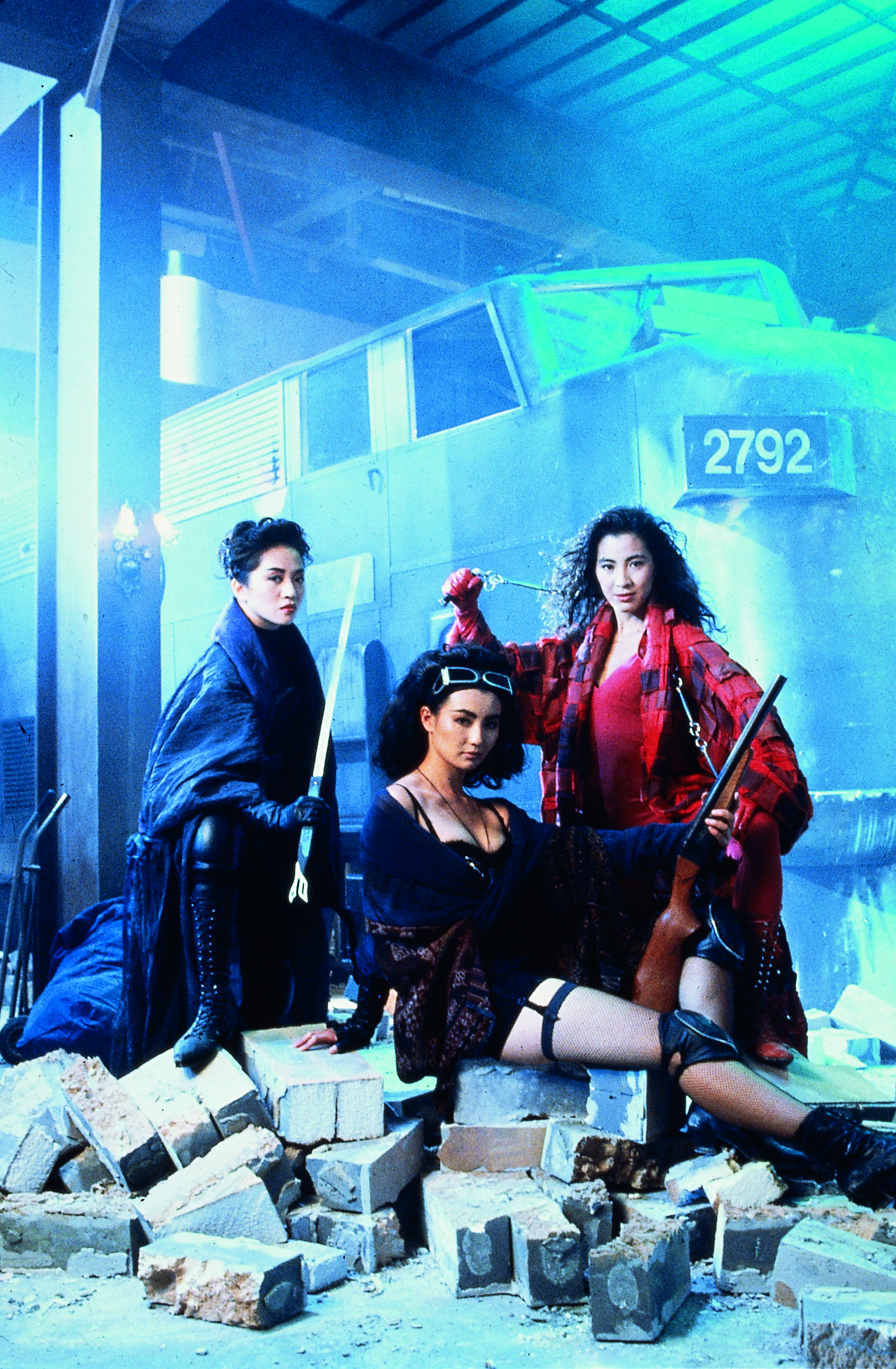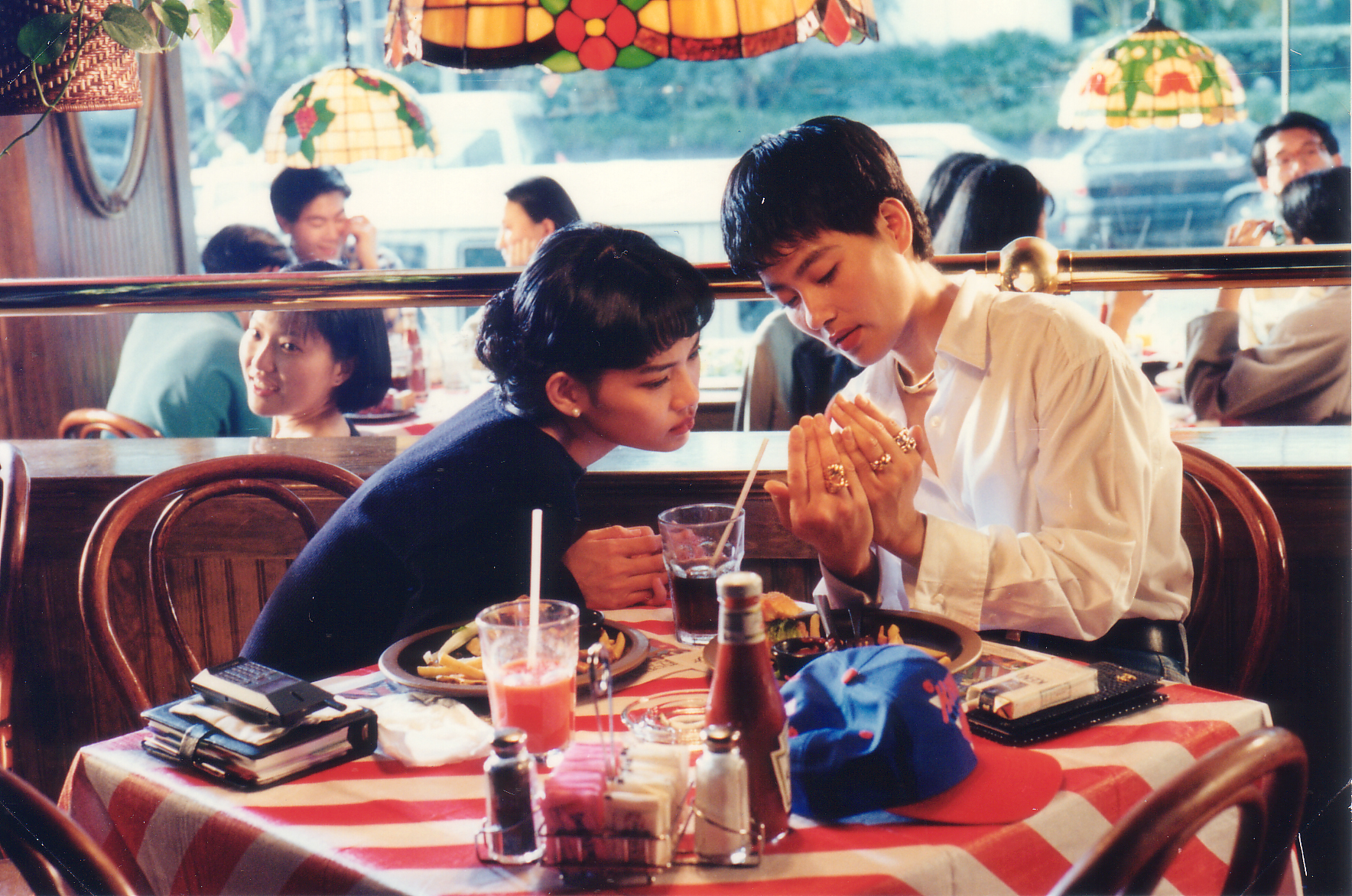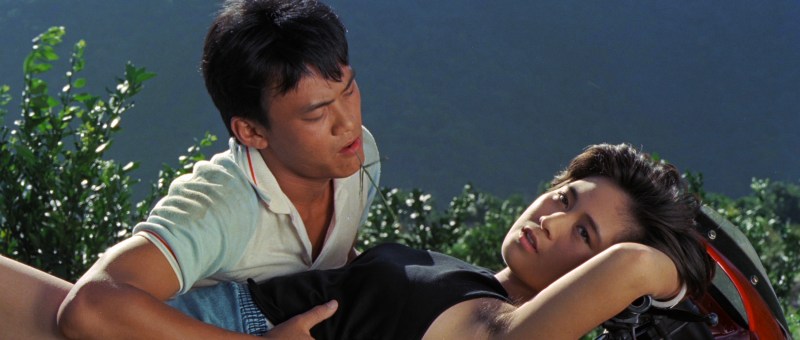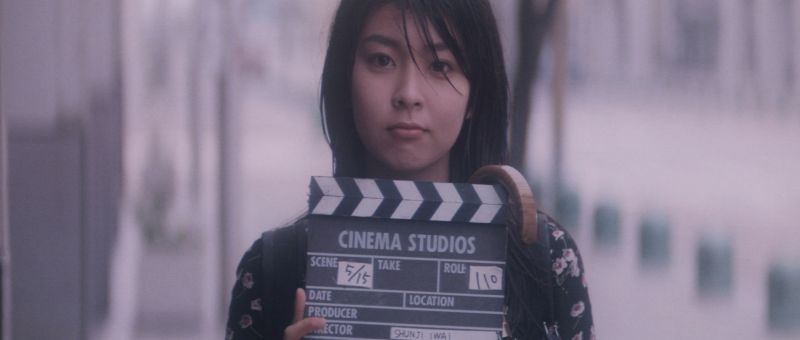
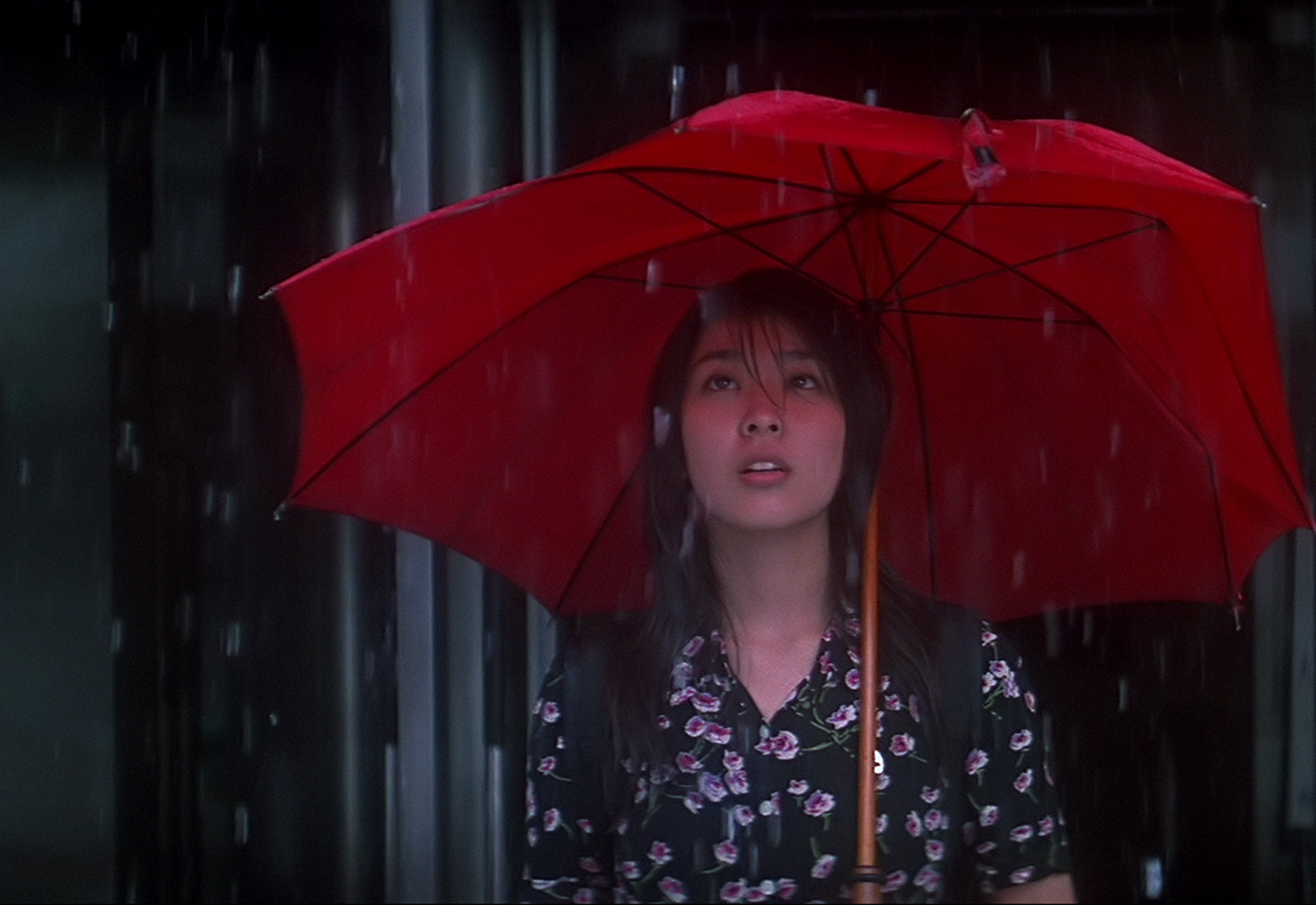
Ringu (リング, Hideo Nakata, 1998)

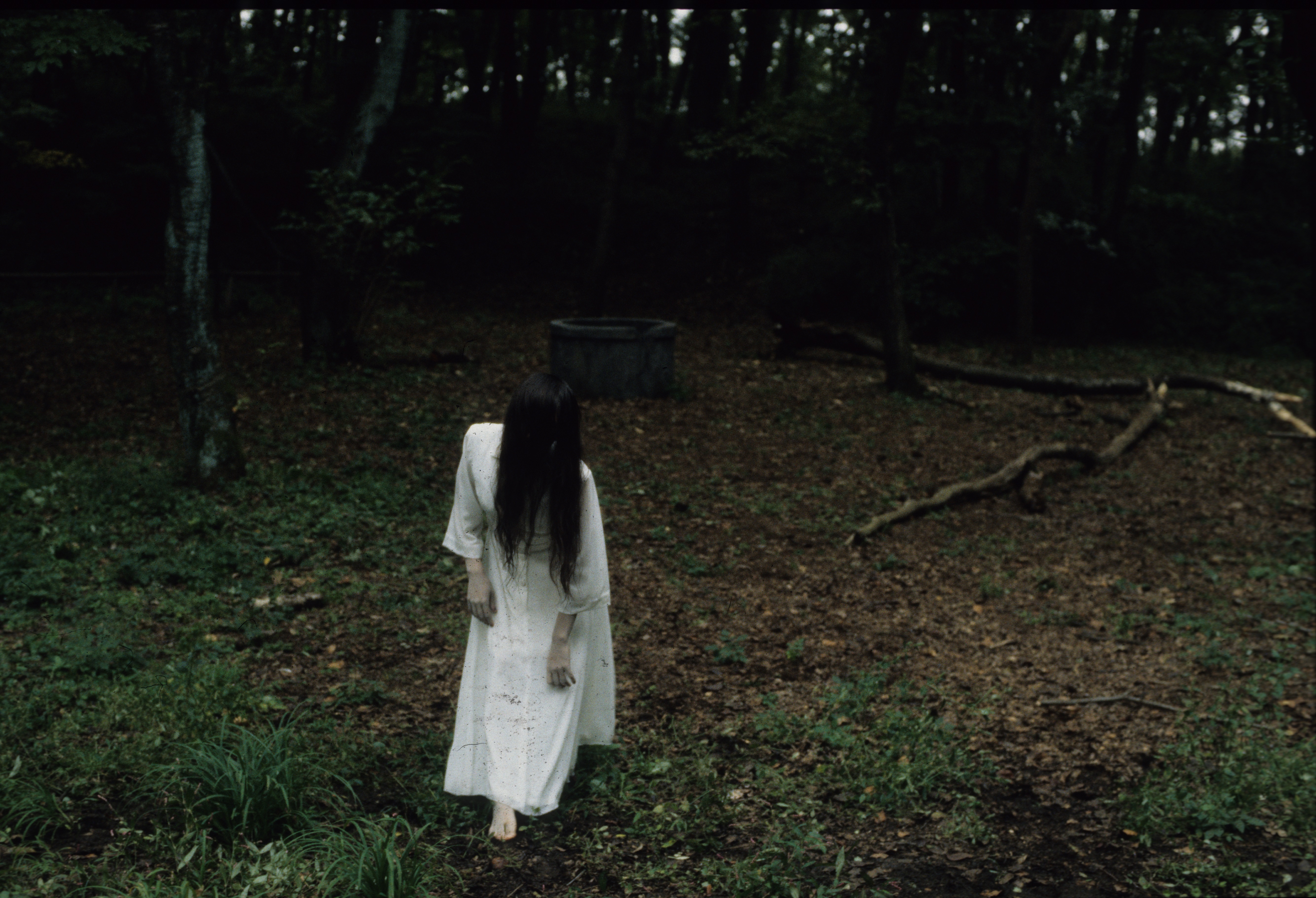
As the investigative duo at the centre of Hideo Nakata’s eerie supernatural horror Ringu (リング) begin to unlock the mystery of Sadako, we’re told that a strange woman who may have had some kind of psychic powers was loathed by those around her in part because of her habit of sitting and staring at the sea. Nakata opens the film with waves and often returns to them as if suggesting in this millennial horror that what we fear is a transmission we cannot see. In the end there may not be so much difference between the magic of an analogue TV broadcast and a message from another plane. 

In any case, perhaps the central message is that one should pay more attention to the words of those whose warnings are often dismissed on the grounds of their age and gender. Journalist Reiko (Nanako Matsushima), for example, doesn’t seem too invested in a video she’s making about a cursed video related by a trio of high school girls in a cafe who explain that they don’t personally know anyone who’s died after watching it but have been reliably informed by friends of friends who apparently do. As will later be discovered, the girls actually give Reiko crucial information but for whatever reason she does not remember it until coming to the same conclusion herself. In any case, it’s not until her own niece, Tomoko (Yuko Takeuchi), dies in mysterious circumstances that Reiko starts to wonder if this is more than a spooky story elevating the chain letter to new technological heights.

According to the urban legend, if you watch the cursed tape you’ll immediately get a phone call telling you you’ll die in seven days. The supernatural entity now synonymous with the film, Sadako, is manipulating these still analogue waves for herself. Sending her messages via television and telephone she is a literal ghost of the airwaves and as Reiko’s ex-husband Ryuji later puts it radiating her sense of rage in her own mistreatment, insisting that her story be known and that those who refuse to acknowledge it should not be allowed to survive. Just as Reiko should have listened to the high school girls, someone should have listened to Sadako and because they didn’t others now have no choice. 

In a sense Sadako represents this nascent fear of technological advancement. When Reiko answers her flip phone, it’s a reminder that there’s no escape from unwanted communication even if you can in theory try to switch it off. The girl with Tomoko when she died was driven out of her mind and now won’t venture anywhere near a television, as if you could escape Sadako’s wrath by merely keeping your distance from the portal. The two teenagers who died around the same time as Tomoko were in a car in the middle of nowhere, but cars have radios which receive radio waves. Sadako travels through the air, invisible until she chooses not to be. She may only have a direct line, but it is in one sense a call for help she’s issuing only in the very inefficient manner of a vengeful ghost whose rage has become indiscriminate or at least directed towards the society that wronged her and everyone in it rather than a single guilty party. 

In a certain sense, you can cure the curse only by spreading it. If everyone everywhere suddenly understood, learned Sadako’s painful history, then the curse would wither and die with no new hosts to go to which is perhaps what Sadako wants. Yet it leaves Reiko with a dilemma, knowing that to save the lives of those closest to her she may have to ask someone else to risk their life or even expose them without their consent. Throughout the film she’s been depicted as an imperfect mother, divorced and often leaving her small son Yoichi to fend for himself at home while the boy at one point walks past his own father in the street and does not seem to recognise him so absent had he been in his life. Through their shared quest to undo the curse, the pair in a sense reclaim their parental roles and repair their familial ties in working together to save their son’s life in contrast to the parental figures surrounding Sadako who may have done the reverse. Sadako frightens us because of her transgressive qualities, quite literally transgressing the barriers between ourselves and the stories we tell by crawling out of them and finding us here, on the other side of the screen, where we thought we were safe to remind us not to look away and to listen to those whose voices are all too often ignored. 


Ringu screens at Japan Society New York on Oct. 7 as part of the Monthly Classics series.

20th anniversary trailer (English subtitles)
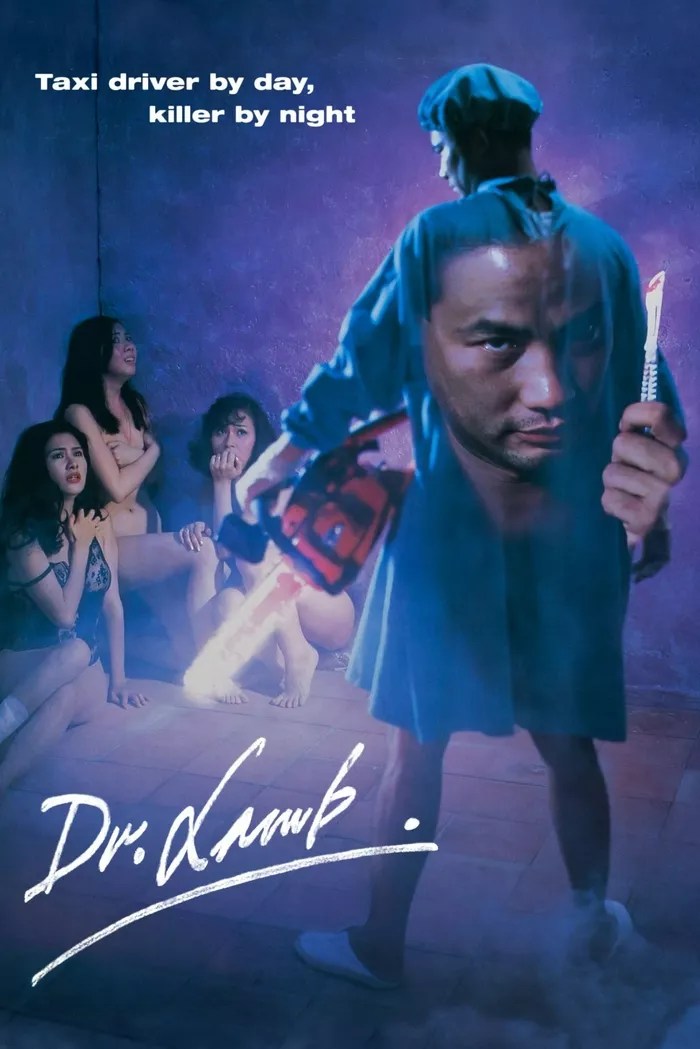
Dr. Lamb (羔羊醫生, Danny Lee Sau-Yin & Billy Tang Hin-Shing, 1992) [Fantasia 2022]

“Every good man should get revenge” the young protagonist of Danny Lee Sau-Yin and Billy Tang Hin-Shing’s depraved Cat III shocker Dr. Lamb (羔羊醫生) is told though as will become apparent, he is not a good man and if his heinous crimes are born of vengeance the target may remain indistinct. Long available only in a censored version which perhaps helped to create its gruesome reputation, the film like others in the early ‘90s Cat III boom is based on a real life case, that of taxi driver Lam Kor-wan who murdered four female passengers before being caught by police when an assistant at a photo shop alerted them to the disturbing quality of the negatives he had brought in to be developed. 

As such, the film is not a procedural. It begins with the arrest of a man here called Lin Gwao-yu (Simon Yam Tat-Wah) who claims the negatives are not his and that he brought them in on behalf of a friend named Chang (which is also coincidentally the name of the half-brother he continues to resent). On investigating the flat where he lives with his father, half-siblings, and niece, the police realise that Gwao-yu is in indeed a serial killer and the rest of the film is divided into a series of flashbacks as they try to convince him to confess and reveal how and why he committed these crimes the last of which he actually videoed himself doing. 

Nevertheless, the police themselves are depicted not quite as bumbling but certainly not much better than the criminals they prosecute in their own lust for violence, savagely beating Gwao-yu who refuses to speak in order to force him to confess. Fat Bing (Kent Cheng Jak-Si) is portrayed as a particularly bad example, encouraging the other cops to play cards rather than focus on their stakeout of the photo shop almost allowing Gwao-yu to escape and then titillated by the more normal pinups and glamour shots pinned to Gwao-yu’s wardrobe as well as some of the less normal ones before realising that the women in them are dead. There is some original controversy over whether they should be investigating at all given that taking weird pictures of nude women is not in itself illegal while the misogynistic attitudes of the police are carried over onto one of their own officers who is forced to play the part of the victim during a re-enactment and is later struck by a stray body part as a result of Fat Bing’s crime scene incompetence. One of the murders even takes place directly outside a police box where the victim had tried to ask for help but got no reply.

Pressed for a reason for his crimes Gwao-yu offers only that all but the last of his victims were bad women who deserved die, each in a repeated motif fatalistically colliding with his cab and crawling inside having had too much to drink. Flashbacks to his childhood place the blame on his wicked step-mother’s rejection along with that of his siblings while his father alone defends him if somewhat indifferently, describing him as merely “curious” on catching Gwao-yu voyeuristically spying on he and his wife having sex and disowning him only on discovering that he has also been abusing his niece who is strangely the only member of the family who seems to be fond of him. Yet it’s also this problematically incestuous living environment that has facilitated his crimes. Gwao-yu takes the bodies home to play with and dismember having the house to himself during the day because he works nights while continuing to share a pair of bunk beds with the brother he hates at the age of 28 either unwilling or unable to get a place of his own on a taxi driver’s earnings. Aside from his brother noticing a strange smell, the family who all think him weird anyway apparently remain oblivious to Gwao-yu’s crimes despite the jars containing body parts he keeps in a locked cupboard along with disturbing photographs of his dark deeds. Nevertheless it’s their police-sanctioned beating of him which eventually provokes his confessions. 

Set off by rainy nights, Gwao-yu twitches, gurns, and howls like a dog leering at his victims like a predatory wolf. In the police interrogation scenes he continues with his strange, dancelike movements as if in a trance reliving his crimes. The truth is that the police had not really investigated the disappearances of the women he killed, had no clue a serial killer was operating, and would not have caught Gwao-yu if it were not for his own lack of interest in not being caught in taking the photos to be developed publicly despite claiming to have the ability to have simply developed them himself while videoing his brutal treatment of one victim’s body and his disturbing “wedding night” with another. A final scene of Inspector Lee visiting Gwao-yu in prison visually references Clarice’s first visit to Dr. Lecter in Silence of the Lambs which might go someway to explaining the title which is otherwise perhaps ironic in Gwao-yu’s ritualistic use of a scalpel and specimen jars. In any case for all its lurid, disturbing content the film has a strange beauty in its atmospheric capture of a neon-lit Hong Kong stalked as it is by an almost palpable evil. 


Dr. Lamb screened as part of this year’s Fantasia International Film Festival and is available on blu-ray in the US courtesy of Unearthed Films.

Original trailer (no subtitles)

Labyrinth of Dreams (ユメノ銀河, Sogo Ishii, 1997)

“If both held their courses they would collide in nine seconds, and catastrophe would be inevitable” according to the voiceover which opens Sogo Ishii’s ethereal psychodrama Labyrinth of Dreams (ユメノ銀河, Yume no Ginga) though his words might as easily apply to the protagonist and her opposing number as a bus and a train locked as they are into a fateful cycle of love and death. Ishii had made his name in the ‘80s for a series of frenetic punk films such as Burst City and The Crazy Family yet adapted from the novel by Kyusaku Yumeno, Labyrinth of Dreams adopts the language of golden age cinema to tell a punk story as a young woman searching for freedom, independence, and a more exciting life finds herself drawn towards death in her inexorable desire. 

Set sometime in the 1930s, the film opens with a taste of the gothic on a stormy night all mists and confusion as a bus heads towards and then unwisely across a level crossing in front of an oncoming train. “Double suicide or accident?” a newspaper headline asks, as we’ll discover on more than one occasion as this is not an isolated incident either bizarre cosmic coincidence or the work of a mysterious serial killer. The heroine, Tomoko (Rena Komine), had always wanted to become a bus conductress, explaining that they looked so “heroic” in their uniforms but has discovered the reality to be not quite so satisfying. “The female bus conductor only looks good on the surface. We must obey the driver’s orders, put up with all displeasure and work like a slave” she writes in a letter to a friend, Chieko (Kotomi Kyono), telling her in no uncertain terms that she must never become a bus conductress. 

To a young woman from the country in the 1930s, such a job must have seemed exciting promising a way out of stultifying small-town life and a path to an independent urban future. It’s this sense of self-possession that Tomoko seems to have been seeking hoping that wearing a uniform even that of a bus conductress would grant her a level of authority she does not really have realising that she is a mere subordinate to the male bus driver and quite literally has no real control over the direction of her life. When she receives a letter from a friend who had also become a bus conductress only to die in a tragic accident explaining that she thinks her fiancé is a bus-based bluebeard rumoured to have seduced and murdered his previous conductresses Tomoko smells not danger but excitement in realising the new handsome driver with a flashy Tokyo haircut who’s just transferred to their station is none other than her friend’s possibly sociopathic former boyfriend. 

Fully embracing a sense of the gothic, neither we nor Tomoko can ever be sure if Niitaka (Tadanobu Asano) is a coldblooded killer or merely the projection of a fantasy created by Tomoko’s repressed desires and yearning for a more exciting life. Having encountered him once before sleeping on the railway tracks as a train approached, he becomes to her something like an angel of death and though she believes him to be dangerous she cannot help falling in love with him anyway. Ishii constantly flashes back to deathly images, a pair of shoes abandoned on the rocks or a bunch of drooping lilies while a literal funeral procession eventually boards the bus just before the climactic moments on which Tomoko is in effect staking her life as she and Niitaka each refuse to deviate from their course, a set of railway points and a trapped butterfly added to the film’s rich symbolic imagery. 

A policeman at the film’s conclusion makes a point of asking Chieko if Tomoko is known to be a habitual liar having found no evidence that Niitaka deliberately caused the deaths of his previous conductresses even if it seems unlikely that he is simply the victim of unhappy coincidence. “My life was miserable and lonely,” Tomoko writes, “but remember me as the one who wrestled her fate at the end”, staking her life on a “fatal romance” and in a sense overcoming existential dread by staring it down, a deathly desire leading finally to new life. Beautifully lensed in a golden age black and white with occasional onscreen text in the ornate font of the silent movies, Ishii’s ethereal drama freewheels between dreams and reality amid gothic mists and expressionist thunderstorms as it reels towards an inevitable collision. “They haven’t a clue about the truth” Tomoko sighs, perhaps all too aware. 


Comrades, Almost a Love Story (甜蜜蜜, Peter Chan, 1996)

“Fate brings people together, no matter how far” according to a wise old chef in early ‘90s New York. He’s not wrong though Peter Chan’s seminal 1996 tale of fated romance Comrades, Almost a Love Story (甜蜜蜜) is in its own way also about partings, about the failure of dreams and the importance of timing in the way time seems to have of spinning on itself in a great shell game of interpersonal connection. But then, it seems to say, you get there in the end even if there wasn’t quite where you thought you were going. 

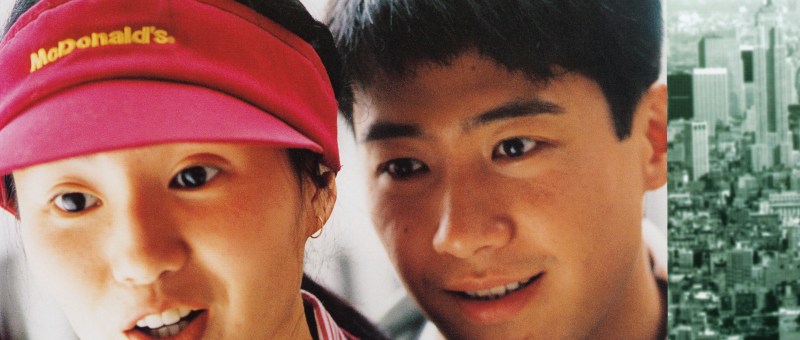
As the film opens, simple village boy from Northern China Xiaojun (Leon Lai Ming) arrives in Hong Kong in search of a more comfortable life intending to bring his hometown girlfriend Xiaoting (Kristy Yeung Kung-Yu) to join him once he establishes himself. His first impressions of the city are not however all that positive. In a letter home, he describes the local Cantonese speakers as loud and rude, and while there are lots of people and cars there are lots of pickpockets too. It’s in venturing into a McDonald’s, that beacon of capitalist success, that he first meets Qiao (Maggie Cheung Man-Yuk), a cynical young woman hellbent on getting rich who nevertheless decides to help him by whispering in Mandarin realising he doesn’t understand the menu. Hailing from Guangdong, Qiao can speak fluent Cantonese along with some English and thus has much better prospects of succeeding in Hong Kong but takes Xiaojun under wing mostly out of loneliness though accepting a kickback to get him into an English language school where she piggybacks on lessons while working as a cleaner. Bonding through the music of Teresa Teng, they become friends, and then lovers, but Xiaojun still has his hometown girlfriend and Qiao still wants to get rich. 

As we later learn in one of the film’s many coincidences, Xiaojun and Qiao arrived on the same train if facing in different directions. Hong Kong changes each of them. When Xiaojun eventually manages to bring Xiaoting across the border, he’s no longer the simple village boy he was when he arrived while Qiao struggles with herself in her buried feelings for Xiaojun unwilling to risk the vulnerability of affection but visibly pained when confronted by Xiaojun’s responsibility to Xiaoting. She finds her mirror in tattooed gangster Pao (Eric Tsang Chi-Wai) who, like her, shrinks from love and is forever telling her to find another guy but is obviously hoping she won’t as afraid of settling as she is. 

For each of them this rootlessness is born of searching for something better yet the irony is as Xiaojun says that Hong Kong is a dream for Mainlanders, but the Mainland is not a dream for most in Hong Kong who with the Handover looming are mainly looking to leave for the Anglophone West. Qiao’s early business venture selling knock off Teresa Teng tapes fails because only Mainlanders like Teresa Teng so no-one wants to buy one and accidentally out themselves in a city often hostile to Mandarin speakers as Xiaojun has found it to be. What they chased was a taste of capitalist comforts, Qiao literally working in a McDonald’s and forever dressed in Mickey Mouse clothing which Pao ironically imitates by getting a little Mickey tattooed on his back right next to the dragon’s mouth. But when they eventually end up in the capitalist homeland of New York, a driver chows down on a greasy, disgustingly floppy hamburger while Qiao finds herself giving tours of the Statue of Liberty to Mainland tourists in town to buy Gucchi bags who tell her she made a mistake to leave for there are plenty of opportunities to make money in the new China. 

Ironically enough it’s hometown innocence that brings them back together. The ring of Xiaojun’s bicycle bell catches Qiao’s attention though she’d thought of it as a corny and bumpkinish when he’d given her rides on it in their early days in Hong Kong. Xiaojun had in fact disposed of it entirely when Xiaoting arrived partly for the same reason and partly because it reminded him of Qiao. The pair are reunited by the death of Teresa Teng which in its own way is the death of a dream and of an era but also a symbol of their shared connection, Mainlanders meeting again in this strange place neither China nor Hong Kong, comrades, almost lovers now perhaps finally in the right place at the right time to start again. Peter Chan’s aching romance my suggest that the future exists in this third space, rejecting the rampant consumerist desire which defined Qiao’s life along with the wholesome naivety of Xiaojun’s country boy innocence, but finally finds solid ground in the mutual solidarity of lonely migrants finding each other again in another new place in search of another new future. 


Comrades, Almost a Love Story screens at Soho Hotel, London on 9th July as part of Focus Hong Kong’s Making Waves – Navigators of Hong Kong Cinema.

Short clip (English subtitles)

Teresa Teng – Tian Mi Mi

Embalming (EM エンバーミング, Shinji Aoyama, 1999)

“Nothing can last forever” according ironically enough to an embalmer who feels it is her calling to preserve the bodies of the dead she says to help their grieving families, but does that actually help or is she actively preventing them from moving on in enabling their desire to hold on to something beautiful that is already gone? Jumping on the J-horror boom, Shinji Aoyama’s adaptation of the mystery horror novel by Michiko Matsuda Embalming (EM エンバーミング, EM Embalming) is another millennial mediation on the loss of bodily autonomy amid the corruptions of the late 20th century. 

A predominantly Buddhist funerary culture, embalming is rare in Japan which generally favours cremation over burial. As the opening crawl explains to us, the process may be familiar from the ancient Egyptian mummy, but was also put to use during the American Civil War in order to transport bodies of fallen soldiers home to their families. It also says that through technological advances, bodies can now be preserved for up to one hundred years though according to embalmer Miyako Murakami (Reiko Takashima), the best she can do is 50 days or perhaps she’s merely decided that after the the 49th day it’s inappropriate to hold on any longer. Apparently friendly with local policeman Hiraoka (Yutaka Matsushige), Miyako is called in when the 17-year-old son of a local politician, Yoshiki, is found dead on the pavement outside a tall building having fallen from above. Having no reason to suspect foul play, Hiraoka concludes it’s most likely to be a suicide. The reason he’s called Miyako is that the mother is out of her mind with grief and insisting her son be embalmed to preserve him as he was for all eternity though his father does not agree. 

Neither does local priest Jion (Kojiro Hongo) who sends a couple of his goons to pick Miyako up so he can tell her in imposing and ritualistic tones that she must stop the “evil acts” she’s “inflicting” on Yoshiki’s body, insisting that she’s spanner in the karmic wheel of life and death holding up the cosmos by refusing to let nature take its course in returning Yoshiki’s body to the universe. “What you are carrying out is a violation of the silence of Bodhisattva, and is therefore an act of evil!” he explains though Miyako is hardly about to be swayed from her life’s work and as we later realise Jion has motives other than the spiritual in mind. Nevertheless, it’s true enough that even if Miyako insists embalming gives dignity to the dead, Yoshiki has no further say as to what happens to his body or how much longer he remains in this world. There’s no way to know how the bodies Miyako works on would have felt about the prospect of being mummified or if they would be happy with the way their bodies may go on being used after their death. 

“When a human being dies, they become an object. Human flesh becomes food for maggots and bacteria and eventually the bodies disappear completely” according to another embalmer, Dr. Fuji (Toshio Shiba), who works with shady “death dealers” and in Miyako’s opinion betrays the art of embalming by frankensteining his bodies using a series of replacement parts to achieve the appearance of perfection. He seems to regard human bodies dead and alive as inanimate entities to be treated no differently from plant matter, recounting tales of his war trauma which seems to have permanently disconnected him from his humanity. The only reason Miyako has tracked him down is because Yoshiki’s head was severed and stolen in freak burglary and she’s received word he might know where it is. Yet to Dr. Fuji and other death dealers as Hiraoka had previously mentioned, the head is the least valuable part as he proves by simply dropping one in the bin while talking to an unfazed Miyako. 

Miyako may be as some accuse her “possessed by death” and attempting to exorcise her unresolved grief and mortal anxiety through the art of embalming in search of an eternity she does not really believe exists. But then as her assistant Kurome (Seijun Suzuki) reminds her, the dead cannot be brought back to life, “you can only be a flower while alive”. Dr. Fuji hints at a dark history that recalls the crimes of Unit 731, experimentation on living bodies and total disregard for the dignity of the dead, while an even older corruption seems to stem from shady priest Jion, “some rip-off faith healer targeting society’s political and economic echelons” as Hiraoka describes him. At times darkly humorous, Aoyama’s bleak drama is filled with existential dread and a sense of the uncanny as we see corpses twitch and flicker with the absence of life while Miyako meditates on an impossible eternity rejecting her powerlessness in the face of transience in favour of the simulacrum of existence in a world ruled by death. 


Samurai Kids (水の旅人-侍KIDS-, Nobuhiko Obayashi, 1993)

“I’ve always believed that dreams and fantasies have infinite power” an eccentric teacher explains though it might as well be a mission statement for the films of Nobuhiko Obayashi. 1993’s family adventure movie Samurai Kids (水の旅人-侍KIDS-, Mizu no Tabibito: Samurai Kids) draws inspiration from the classic Japanese folktale Issun Boshi about a pint sized warrior who floats off to the city in a bowl, but is at heart a gentle coming-of-age tale as little boy grows in self-confidence and vows to protect Japan’s beautiful natural environment from human mismanagement. 

As his mother (Jun Fubuki) describes him, Satoru (Ryou Yoshida) is a little different and slow to make friends. The confusion he feels is reflected in the persistent fast cutting that adds a note of tension to the otherwise pleasant family home. Like many small boys he is obsessed with collecting mini treasures for his collection along with frogs and insects which is how he comes across a mysterious creature knocked off a log floating in the river by a flying baseball from the game his sister Chizuko (Ayumi Ito) is playing across the way. To his surprise, the bundle of rags Satoru picks up turns out to be a tiny old man in samurai clothes complete with sword who gives his name as Suminoe no Sukunahiko. Sukunahiko (Tsutomu Yamazaki) as he explains had been on his way to the sea where he plans to “evaporate”. The river only flows in one direction after all and you can’t turn back time, everyone dies eventually. 

Having lost his grandfather a couple of years previously (a photo cameo from Ishiro Honda of Godzilla fame), loss is something Satoru hasn’t quite processed though he understands that Sukunahiko has his own path to follow even if he’ll miss him when he’s gone. Nevertheless, he feels a responsibility to look after him so he can recover sufficiently to make his journey to the sea. Through his strange friendship with the tiny old man, Satoru begins to learn more of and draw closer to the natural world. When Sukunahiko’s kimono is pinched by a cheeky crow for some reason continually hanging round Satoru’s home, Sukunahiko is forced to fight him and ends up cutting off his beak but later carves the bird a new prosthetic replacement because no to do so would have been “impolite”. 

Meanwhile a visit to his father’s hometown brings home the realities of contemporary Japan in learning that the area is soon to be sunk as a giant reservoir to prevent the flooding of other nearby villages. On a school trip, Satoru is quick to take issue with some of his classmates who throw their rubbish out of the bus windows as they pass a dam, reminding them they’re being disrespectful to the town that once existed beneath the water. The climax occurs when the children are camping further up the mountain near what Satoru assumes must be Sukunahiko’s “hometown” at the source of the river. It just so happens that the trip coincides with a fading local festival dedicated to the river god which might account for why it’s raining so much. “It’s celebratory rain” an old man explains, “but when people try to control the water it causes problems like this” implying that the water is “rebelling” against humanity’s attempts to channel it. When he and his sister’s frenemy Miyuki are trapped by rockfall, Satoru has to learn to trust the healing properties of water so that he can repay her kindness in protecting him before eventually helping Sukunahiko return to source in the company of his eccentric yokai-obsessed teacher (Tomoyo Harada) and newly sympathetic sister. 

Adapted from a story by Masumi Suetani who also penned the screenplay, Samurai Kids is perfectly suited to Obayashi’s key concerns lamenting that the adults often forget the promises to nature they made while young, Satoru calling out that he’ll protect the rivers and waters of Japan with a warrior spirit like Sukunahiko’s while the Jo Hisaishi score is also reminiscent of the similarly themed movies of Studio Ghibli. Chizuko’s parallel dilemma may be less well explored leaving it unclear whether her tomboyishness is born of discontent over her looks or a part of her essential personality struggling for acceptance in a conformist and heavily gendered society but does at least allow her to find common ground with friend/rival Miyuki who is struggling with something similar stressing the importance of friendship and mutual understanding among the children. It may be the case that the special effects have entered the realms of being classic rather than merely dated but hold up surprisingly well almost 30 years later possessed of their own strange charm yet syncing perfectly with the world around them. A quietly magical tale of loyal yet laidback family cats, parental nostalgia for simpler times, and unexpected friendships between solitary boys and ancient water gods, Samurai Kids is a surprisingly poignant children’s adventure with an important message in its fierce love of a disappearing natural beauty. 


Short clip (no dialogue)

East Palace, West Palace (东宫西宫, Zhang Yuan, 1996)

“The convict loves her executioner, the thief loves her jailer. We love you. We have no other choice.” the hero of Zhang Yuan’s beguiling, transgressive drama East Palace, West Palace (东宫西宫, dōng gōng xī gōng), whispers to his no longer sleeping guard. “I love you”, he later adds, “why don’t you love me?” turning the tables on an implacable authority and demonstrating that he too wields power. Considered the first Mainland film to deal directly with homosexuality, Zhang’s theatrical chamber piece is as much about the co-dependency of the oppressor and the oppressed as it is about gay life in post-Tiananmen Beijing while suggesting that in a sense submission too can be a weapon. 

Gay travel writer A-Lan (Si Han) is first challenged by a uniformed policeman in a public toilet. Staring at him intently, he stops A-Lan for no real reason, asking for his ID followed by a series of other personal questions with seemingly no law enforcement import before double checking if the bike outside is his and that he has a proper permit for it. These acts of hostility begin a cat and mouse game between the A-Lan and law enforcement, another policeman, Shi Xiaohua (Hu Jun), almost desperate to come up with a reason to arrest him on raiding the park, a popular spot for cruising, after dark. But as he leads him away, A-Lan suddenly plants a kiss on the policeman’s cheek and taking advantage of his momentary shock makes his escape. 

During in the arrest, meanwhile, Shi and the other policemen had a made a point of insulting each of the men who have not actually done anything illegal under the Chinese law of the time, beating them or forcing them to beat themselves, ordering them to squat on the ground, and even threatening to call one frequent offender’s place of work. As Shi often will, the police refer to the men as “despicable” and the “dregs of soceity”, yet A-Lan is in a sense empowered by his submission in allowing himself to be arrested before subsequently escaping having planted the seeds of his seduction. He flirts with danger in mailing Shi a book with the inscription “To my love, A-Lan” and thereafter deliberately gets himself arrested, later running away from Shi only in the desire to be chased by him.  

Hugely reminiscent of Kiss of the Spider Woman, the majority of the film takes place within the confines of the park’s police hut occupied only by A-Lan and Shi, a prisoner and a guard. Yet as in the Peking opera story A-Lan repeatedly quotes, elegantly recreated in Zhang’s theatrical shifts into fantasy, the two roles are to an extent interchangeable. Shi thinks he’s the guard, that he exercises authority over A-Lan, but A-Lan is also manipulating him, trapping Shi within this space and drawing him towards a recognition of his own latent desires, the same desires that were aroused when he hassled him in the public toilet. While Shi, the guard though no longer in uniform, is constrained by authority, A-Lan, the prisoner, is free in embracing his essential self and weaponising the essence of his power in the choice to submit as reflected in his masochistic desires. “It is not despicable. It is love” he insists on being challenged by Shi after detailing his BDSM encounter with a wealthy man, echoing his previous reminders that “What I write might be trash. But I am not”, refusing to allow Shi to degrade him even while taking pleasure in submitting to authority. 

Even so, he declares himself conflicted in having married a woman presumably for appearances’ sake something of which many in his community do not approve and leaves him both guilty in his treatment of his wife and disappointed in himself. When Shi barks “explain yourself” he details his life as a gay man from his first sexual experience in which he pretended to be a woman to being assaulted by thugs after sleeping with a factory boss adding only that “this kind of experience makes life with living”. “We all march to a different tune” he tries to explain to Shi, individual but also identical. He mentions another regular to the park he describes as a transvestite but in the language of today might better be thought of as transgender, A-Lan explaining that she enjoys wearing women’s clothes but is different from the men in the park. She does not make love to them, and they do not bother with her, A-Lan insisting that she too has her own beat to which to march as does Shi even in his increasing confusion. 

Shi wields his handcuffs, the relationship between the pair mediated through them just as that between the guard and beautiful prisoner in his story is mediated through chains, but eventually places the cuffs on each of their hands locking them together in an intense embrace. The guard cannot exist without the prisoner, nor the prisoner without the guard. “He will no longer escape from his love for her” A-Lan ends his story, the guard releasing his beautiful charge while she decides to return to him each of them knowing they are trapped in melancholy waltz of love and hate. Highly theatrical and scored with a persistent note of dread, Zhang’s beguiling drama hints at the sadomasochistic interplay between authoritarian power and a subjugated populace while allowing its hero to mount his resistance only through deriving pleasure from submission. 


East Palace, West Palace screens at the BFI on 27th May as part of this year’s Queer East. It is also available to stream in many territories via GagaOOLala.

The New God (新しい神様, Yutaka Tsuchiya, 1999)

Yutaka Tsuchiya opens his 1999 shot on video personal doc The New God (新しい神様, Atarashii Kamisama) with a lengthy scene of performance art in which a young woman dressed in a suit explains why she was drawn to nationalist ideology while seemingly ignored by the other passersby in the street, a woman behind her even continuing to hand out flyers as she speaks. On the left himself, Tsuchiya was nevertheless struck by the raw emotion in the song of right-wing punk band Revolutionary Truth as performed by charismatic lead singer Karin Amamiya whom he eventually ended up marrying despite their conflicting views. 

In any case, it’s clear even from the film’s opening that Karin is becoming disillusioned with the version of nationalism to which she has hitherto ascribed, a feeling which is intensified after she is invited to visit North Korea in the company of a former member of the ultra-left organisation Japanese Red Army. During her time in Pyongyang, recording video diaries with Tsuchiya’s camera, she is extremely attracted to the quality of unity she sees as integral to the North Korean system while otherwise unable to process the simultaneous truth that oppression and unity are not synonymous. Children are not abused in North Korea she naively explains having been invited to tour a day care centre, reflecting on her own difficult childhood in which she experienced bullying so severe it has left her with lasting trauma which prevents her from fully connecting with the world. 

It is indeed this sense of dislocation that pushed her towards nationalism, taken in by the idea of nation as family while looking for a place to belong. To be fair to her and to her bandmate Itoh neither of them express particularly extreme views aside from their historical revisionism and their idea of nationalism seems to be inclusive rather than exclusive in which they have no particular problem with minorities or people who are not considered to be ethnic Japanese. In fact, they seem to subscribe more to a patriotic small-c conservatism in which hard work is regarded as a virtue which should always be rewarded in full. This is the reason they give for their views on the controversial Yasukuni shrine which houses the souls of those who died in war including those later convicted of war crimes, believing that the soldiers like everyone else “worked hard” during the war and their sacrifice shouldn’t be ignored. 

For his part, Tsuchiya listens patiently to their sometimes confused ideology while internally questioning his own as someone who identifies as left-wing progressive and believes that the war was wrong and the emperor system is responsible for the majority of ills in contemporary Japan. Yet as someone else puts it left and right are in themselves fairly meaningless labels as is the concept of nation. Karin gets on fairly well the guys from the Japanese Red Army but finds their impassioned speechifying off-putting while later disillusioned with her nationalist organisation after her speech about her experiences in North Korea fails to elicit much of a reaction from those she now decries as being part of a social club less interested in serious politics than getting together for drinks and chat. The issue for her is that these people don’t really care about Japan and aren’t sufficiently interested in changing society for the better. 

The implication is that Karin and Itoh were drawn towards nationalism because of their marginalisation, Karin mercilessly bullied and disconnected from her birth family, while Itoh later admits he became a nationalist to escape being a “nerd”. What Karin craves is the sense of extended family one might feel in a society such as she feels North Korea to be, the emperor a father figure of paternalistic feudalism. She feels herself to be worthless, admitting that she feels best when’s she’s needed and is attracted by the sense of purpose found in activism while politics is for her an escapist fantasy that allows her to evade the need for self-examination. The pair of them also feel a sense of ennui in a stagnant society, decrying their “boring” lives in insisting that “this suffocating peace” has endured too long as they direct their ire ironically enough towards capitalism and Japan’s geopolitical relations with America. 

Opposition to American imperialism unites both left and right, implying that they aren’t so different after all. Tsuchiya advances that the difference between them is that he thinks the emperor system is at fault, while Karin and Itoh feel it to be a solution. He doesn’t understand why they need to locate a sense of pride in something external like nationhood or emperor rather than learning to find it from within, while Karin seems to long for authoritarianism out of a lack of self-confidence essentially hoping to be freed from the burden of choice. Even so through spending so much time listening to each other the trio have discovered a sense of mutual understanding which does not require them to agree or even to share common ground though they do more than expected, becoming as Tsuchiya hopes a path to a better society in which such meaningless labels existing only to divide one person from another are no longer relevant. 


The New God streams worldwide (excl. Japan) via DAFilms until Feb. 6 as part of Made in Japan, Yamagata 1989 – 2021 (films stream free until Jan. 24)

Trailer (no subtitles)

The Weald (杣人物語, Naomi Kawase, 1997)

@KUMIE Inc.

“I wish I were younger” comes a common refrain among the cast of elderly men and women living a traditional life in the mountains and forests of rural Japan in Naomi Kawase’s 1997 documentary, The Weald. Arriving in the same year as Kawase’s Caméra d’Or-winning narrative feature Suzaku, The Weald (杣人物語, Somaudo Monogatari) continues many of the same themes in her fascination with nature and moribund ways of life while taking on a meta existential dimension as her interviewees muse on loss, loneliness, and a lifetime’s regrets. 

What they almost all say is that they wish they could be young again with all the possibilities of youth. A lumberjack dreams of becoming a timber dealer, while another man jokes that he was once handsome though you wouldn’t know it now. One heartbreakingly laments that he’d like to start over because he’s never felt true happiness in his life. Then again, another believes that “happiness depends on your way of thinking” and that a man who’s learned to be satisfied with a small portion is in his own way rich. For another man happiness lies in having people speak well of him after he’s gone, knowing he must then have lived a good life. 

Then again life has its sadnesses. A carpenter reveals his private grief in having lost a son, unable even to watch his daughter’s wedding video because it’s too painful to see him there. “In a city he wouldn’t have had a motorbike” he sighs, reflecting that he was unlucky to have been born in the country and needlessly blaming himself for something not in his control. The last man, meanwhile, speaks movingly of his late mother’s descent into dementia and his own decision to give up on marriage while still young to dedicate himself to her, only to be left on his own in the end. He wonders if he was right to sacrifice his life for her while longing to be reborn in the hope of seeing his former girlfriend, his face dissolving into an old photograph in which he is young and handsome as if to grant his wish. 

Meanwhile, an old lady meditates on loneliness in a solo life of busyness firstly claiming to feel none but then revealing the emptiness of her days with no one to cook for. “I don’t know the meaning of life, I just live day to day” she explains, insisting that it’s pointless to worry and better just to get on with things. “I am satisfied to live each day peacefully” she adds, immersing herself in the moment. She like the others is uncertain why Kawase is filming her, telling her to come back later when she’s 18 again because old people are no fun. Another man later tells her not to waste her expensive film on him in case she needs it for something more important, the elderly residents either maudlin or amused but each mystified as to why someone is so keen to listen to their stories.  

Implicitly in these stories of the elderly, Kawase hints at the effects of continuing rural depopulation with fewer young people around, an elderly couple explaining that they have come to depend on each other even more as they aged only for the wife to fall ill and need care from her husband 14 years older but in better health. They go about their lives in the same way they have for decades, wandering the forests and practicing traditional skills which may all too soon be lost. 

In keeping with her earlier documentary work, Kawase often films in extreme close up or layers dialogue on top of another scene as when old lady wanders aimlessly trough the forest while her meditations on loneliness accompany her. What she seems to have discovered in the wisdom of those who agreed to speak to her is that happiness and suffering go hand in hand while youthful regret tinged with nostalgia can in itself almost be lonely. Even so many have managed to find meaning in their lives whether it be being present in nature or the love for one’s spouse and family while longing to be reborn eager for their next lives whatever they will be. “I wish only the best for everyone” someone adds before returning at last to spring and all the brief joys it will deliver. 


The Weald streams worldwide (excl. Japan) via DAFilms until Feb. 6 as part of Made in Japan, Yamagata 1989 – 2021 (films stream free until Jan. 24)

Trailer (no subtitles)

Living on the River Agano (阿賀に生きる, Makoto Sato, 1992)

Image ©️ Murai Osamu

With a crew of seven including himself, director Makoto Sato spent three years embedded within the small communities along the Agano River capturing a disappearing way of life but also the resilience of the elderly residents many of whom are unrecognised victims of Minamata disease caused by the chemical discharge from the Showa Denko chemical plant. 

“Kids don’t care about our rivers and our mountains” 80-year-old Miyae Hasegawa reminds her husband on the phone to their oldest daughter as she once again tries to convince him that he’s too old for the intensive labour of farming their rice paddies. Like many, the Hasegawas’ children have fled the rural village for more comfortable lives in the cities while their parents attempt to preserve their traditional way of life. “Gradually we realised that these rice paddies were their entire existence” the film crew later reflect, almost pitying them as they witness these quite elderly people bent over still harvesting the rice in their 80s while discovering on trying to help them that the work is far more difficult than they could have imagined not, presumably at least, very used to physical labour at least of this kind. 

Even so, “humans are cruel” Yoshio Hasegawa laments to his son having had too much to drink, somewhat ambivalent in having become proficient at catching salmon by hook. After all, the fish are only trying to live but humans keep pulling them out of the water. Later we watch him hook fishing at the river, the camera cutting to black as another man takes a fish he’s caught on a hook and bashes its brains in. Ironically, as the voiceover explains, Miyae had worked on the construction of the Kanose hydraulic dam in the 1920s which later powered the fertiliser plant which then became Showa Denko. After completion of the Yogawa dam in 1963, the fish ominously disappeared from the river and with them the traditional practice of fishing by hook.  

Many in the small communities along the water had welcomed the arrival of modernity that the Showa Denko plant had represented, some still remaining loyal to the company despite knowing what they know unable forget that they had benefitted economically from the factory’s existence. Ebana, meanwhile, who had worked for Showa Denko for 34 years now runs regular patrols of his local area monitoring for the possibility of landslides behind the plant. He was the only employee to sue Showa Denko as a victim of Minamata disease though the company’s attempt to transfer him out of the area when he did so put others off following his example, as did the degree of animosity towards him as others feared for their own economic stability or resented him for betraying his employers. Though the chemical emissions from the plant which flowed into the Agano have been acknowledged as the cause of the disease, the government introduced increasingly strict criteria for official recognition as a Minamata victim leaving many along the Agano unrecognised and therefore ineligible for support or compensation. Those involved in the ongoing legal case were required to make an arduous journey to Niigata once a month by bus or car, a heavy imposition on a community which is often elderly and suffering physical disabilities caused by the illness. As one elderly woman talks of her arched hand which she cannot straighten, a man shows her his burned foot after treading on the heated rail for his bath and being unable to feel it because of the loss of sensation caused by the Minamata disease. 

The fact that the river by which so many lived became actively harmful contributed to the rural exodus and decline of traditional ways of life along with skills which may then die out with no one to pass them on to. Boatmaker Endo had long since retired from making boats and had never taken on any apprentices but at an advanced age finally consented to teach a local carpenter how to make boats the traditional way, a special Shinto ceremony conducted as the next generation boat is completed. Meanwhile we also see a Shinto ceremony performed for the Mushi Jizo which protects people from disease born by insects such as the tsu-tsu living in the river which both gives and takes. Gently observational, Sato captures these disappearing ways of life with a poignant lyricality while equally addressing the politicisation of life along the river in a sense poisoned by modernity as the villagers must come together to fight for justice in a society which seems to have all but forgotten them. 


Living on the River Agano (阿賀に生きる, Aga ni Ikiru) streams worldwide (excl. Japan) via DAFilms Jan. 17 to Feb. 6 as part of Made in Japan, Yamagata 1989 – 2021 (films stream free Jan. 17 – 24)

Original trailer (Japanese subtitles only)