Last Child (살아남은 아이, Shin Dong-seok, 2017)

Last Child posterPeople grieve in different ways. Some stop altogether, lost in a fog of confusion and regret, while others try to keep themselves busy or at least feel as if they are doing “something” to try and find whatever positivity they can in the midst of such terrible tragedy. The parents at the centre of Shin Dong-seok’s extraordinarily accomplished debut feature Last Child (살아남은 아이, Salanameun Ayi) find themselves on opposite sides of a grief divide after their son is killed trying to save another boy from drowning. While the mother is angry and resentful, the father finds strength in pride for his son’s act of heroism, nominating him for a local heroes award and donating the compensation money they have been awarded to their son’s school to fund a new scholarship place in his name.

Eunchan, the teenage son of Misook (Kim Yeo-jin) and Sungcheol (Choi Moo-seong), passed away some months ago leaving his parents numb and grief stricken. As far as they’re aware, Eunchan lost his life while valiantly trying to save that of another boy – Kihyun (Seong Yu-bin). Asking after the boy whom his son sacrificed his life to save, Sungcheol is dismayed to learn that he’s dropped out of school, possibly as a consequence of bullying and social stigma because of the well publicised incident he has been involved in.

Spotting Kihyun around town riding his delivery scooter, Sungcheol later decides to intervene when he catches sight of some other boys harassing him. Sungcheol buys the boy dinner and tells him to call if he ever needs anything. Kihyun, despite his obvious discomfort calls when the manager of the fast food restaurant he had been delivering for accuses him of lying about his bike being stolen. As Kihyun is a minor, he needs a responsible adult to talk to the police but his mother abandoned him years ago and though his father used to send money for his upkeep, he has now remarried and severed all connection with his son. Feeling sorry for the boy and not wanting Eunchan’s sacrifice to go to “waste”, Sungcheol offers Kihyun a job in his interior construction company as a trainee apprentice.

Though originally shy and afraid, Kihyun begins to blossom under the gentle, positive parental input of Sungcheol as he picks up the paternal reins, not only teaching him a trade but investing in him the confidence to succeed. Misook, horrified at first by her husband’s decision, begins to come around to this wounded young man who perhaps reminds her a little of her own son. Despite his lingering feelings of shame and guilt in accepting such kindness from the people he feels may continue to suffer solely because of his continued existence, Kihyun slowly starts to look on Misook and Sungcheol  as surrogate parents as they provide the love and care he has never really known from Sungcheol’s down to earth fatherly pep talks to Misook’s home cooked dinners.

Kihyun does, however, have a secret he has been withholding from Misook and Sungcheol which becomes increasingly difficult for him to keep the nicer they are to him and the more he comes to respect them. Though he might have been able to push it to the back of his mind, an unexpected meeting with another friend of Eunchan’s who was also there that fateful day convinces him he has to speak the truth no matter how much more pain it may to cause to all concerned (including himself).

Sungcheol had invested heavily in the heroic nature of his son’s death and finding out it might not have been quite so straightforwardly noble as originally described is a crushing blow for him. The reopening of a wound which had begun to scar pushes Misook and Sungcheol back into their respective corners as they each attempt to process the situation in their own particular way, beginning to mildly resent each other in the process. Meanwhile, having considered the matter closed, there is little appetite to reopen the investigation into Eunchan’s death. The other parents club together to keep their kids out of it while the school sends a polite message asking Misook and Sungcheol to leave it alone to avoid damaging the school’s reputation. Sungcheol, filled with a righteous anger and a need to find out what really happened to his son, is advised to drop the matter, that it’s better to be remembered as a “hero” rather than a “victim”, implying that Sungcheol ’s quest for “truth” is in someway sullying his son’s memory.

Kihyun, meanwhile, is a mess of conflicted emotions. Grieving himself for the family he’d begun to form with Misook and Sungcheol , he tries to move on with his life whilst hoping to somehow repair what has been broken. Kihyun is not a bad kid at heart, whether changed by his experiences or simply freed from a destructive environment, but he has done bad things which fill him with guilt and remorse compounded by the faith and kindness Misook and Sungcheol have tried to show him.

Yet good as they are, the intensity of their rage and pain threatens to consume the bereaved parents who begin to turn their thoughts towards poetic justice and exacting their own revenge even if they also know it will only bring them more suffering. Isolated by their grief, ostracised for the need for truth, and torn apart by their ambivalent emotions towards each other, the trio walk headlong into a spiralling abyss of nihilistic violence and despair, rejecting the idea of a future in which the concept of family continues to exist. Shin’s drama is bleak in the extreme but strangely hopeful in its clear hearted determination to believe in human goodness which just might be the only way back from the brink.


Screened at the 20th Udine Far East Film Festival.

Original trailer (English subtitles)

Interview with director Shin Dong-seok from the 2017 Busan International Film Festival. (scenes from the film not subtitled, interview subtitled in English)
The Name (名前, Akihiro Toda, 2018)

b5_ol

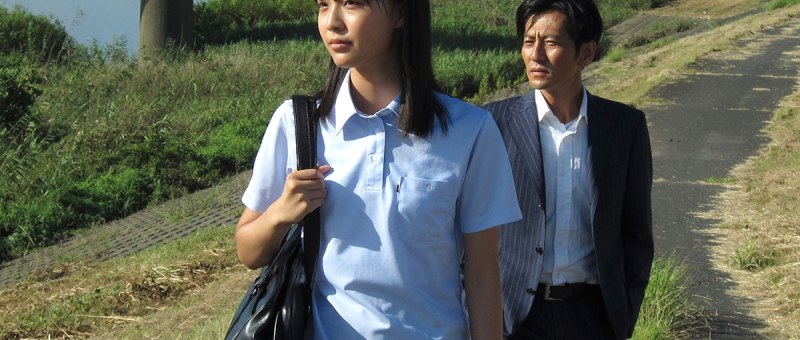
Names are a complicated business. Most people do not choose them for themselves, yet they come to define an identity or at least provide a substantial peg on which to hang one. If you give someone a fake name you are by definition shielding your essential self from view, refusing connection either in fear of discovery or intention to harm. The protagonist of Akihiro Toda’s The Name (名前, Namae) adopts several different titles as a part of his increasingly disordered everyday life in which he takes a hammer to his original identity in an ongoing act of guilt-ridden self harm. Meanwhile, his teenage would-be saviour, engages in a little role play of her own hoping to discover an essential truth about herself only to be disappointed, in one sense, and then perhaps find something better.

Masao Nakamura (Kanji Tsuda), if that is his real name, is not just leading a double life but is currently engaged in a number of iffy scams each compartmentalised under a different title and in which he plays an entirely different version of himself. Once a successful businessman, personal tragedy, marital breakdown, and bankruptcy have left him a floundering, cynical mess living in a rundown rural hovel with a pernickety neighbour and a decidedly lax approach to housekeeping. Masao’s main “job” appears to be working in a recycling plant where he’s managed to wangle a preferential contract by telling the higher-ups that his (non-existent) wife is seriously ill in hospital. Just as Masao’s scheme is about to be discovered, a mysterious teenage girl suddenly appears out of nowhere and plays along with Masao’s sob story, claiming to be his daughter come to remind him that he needs to leave earlier today because mum has been moved to a different hospital (which is why his boss’ contact had never heard of her).

Emiko Hayama (Ren Komai), as we later find out, is a more authentic soul but has decided on a brief flirtation with duplicity in observing the strange and cynical life of the morally bankrupt Masao. Facing similar issues but coming from the opposite direction, the pair meet in the middle – regretful middle-age and anxious youth each doing battle with themselves to define their own identities. Like Masao, Emiko is also living in less than ideal circumstances with her bar hostess single-mother, forced into adulthood ahead of schedule through the need to take care of herself, purchasing groceries, cooking, and keeping the place tidy. Thus her approach to Masao has, ironically enough, a slightly maternal component as she tries to get him back on his feet again – cleaning the place up and giving him something more productive to do than wasting his idle moments in bars and other unsavoury environments.

Masao’s current problems are perhaps more down to a feeling of failure rather than the failure itself. Once successful, happily married and excited about the future, he felt it all crash down around his ears through no real fault of his own. Nevertheless he blamed himself – his intensive work ethic placed a strain on his relationship with his wife and his all encompassing need for success blinded him to what it was that really mattered. By the time he realised it was already too late, and so it’s no surprise that he longs to escape himself through a series of cardboard cutout personalities, enacting a bizarre kind of wish fulfilment coupled with masochistic desire for atonement.

Now cynical and morally apathetic, Masao lets Emiko in on a secret about the grown-up world – it’s all lies. You have to put on disguise or two to get by; the world will not accept you for who you really are. Teenage girls might know this better than most, though Emiko is a slow learner. She might tell Masao that pretending to be other people is fun, but the one role she hasn’t yet conquered is that of Emiko Hayama – something which particularly irritates the demanding director of the theatre club she’s been cajoled into joining. Like Masao, Emiko’s life begins to fall apart through no fault of her own as she finds herself swallowed up by a typically teenage piece of friendship drama when her best friend’s boyfriend dumps her in order to pursue Emiko. Branded a scheming harlot and ejected from her group of friends, berated by the director of the theatre troupe, and having no-one to turn to at home, Emiko finds herself increasingly dependent on the surrogate father figure of Masao who is happy enough to play along with the ruse so long as it is just that.

Through their strange paternal bond, Emiko and Masao each reach a point of self identification, figuring out who it is they really are whilst facing the various things they had been afraid to face alone. Lamenting missed opportunities while celebrating second chances, The Name makes the case for authenticity as a path to happiness in a world which often demands its opposite. Melancholy but gently optimistic, Akihiro Toda’s peaceful drama is a heartwarming tale of the power of unexpected connection and the importance of accepting oneself in order to move into a more positive future.


Screened at the 20th Udine Far East Film Festival.

Tremble All You Want (勝手にふるえてろ, Akiko Ohku, 2017)

tremble all you want posterShojo manga has a lot to answer for when it comes to defining ideas of romance in the minds of its young and female readers. The heroines of Japanese romantic comedies are almost always shojo manga enthusiasts – the lovelorn lady at the centre of Christmas on July 24th Avenue even magics herself into a fantasy Lisbon to better inhabit the cute and innocent world of a manga she loved in childhood. The heroine of Tremble All You Want (勝手にふるえてろ, Katte ni Furuetero), Yoshika (Mayu Matsuoka), does something similar in creating an alternate fantasy world filled with intimate acquaintances each encouraging and invested in her ongoing quest to win the heart of a boy she loved in high school who became the hero of her personal interest only manga, The Natural Born Prince.

At 24 Yoshika is still obsessed with “Ichi” (Takumi Kitamura) who is forever number “One” in her affections. Working as an office lady in the accounts department, Yoshika’s fingers tip tap over the calculator all day long until she can finally go home and read about her favourite topic, extinct animals, on the internet before it’s time to head back to work. Because of her undying love for Ichi (whom she has not seen or heard from in many years), Yoshika has never had a boyfriend or engaged in “dating” – something which causes her a small amount of anxiety and embarrassment when considering the additional awkwardness of starting out at such a comparatively late age.

Yoshika’s dilemma reaches a crisis point when, much to her surprise, a colleague becomes interested in her. Kirishima (Daichi Watanabe), whom she rechristens number “Two”, is, like her, slightly shy and bumbling but also outgoing and with a need to say things out loud. Seeing as this is apparently the first time this has ever happened to Yoshika, she finds it very confusing – not least because she can’t decide if “dating” Kirishima is a betrayal of Ichi or if she is really ready to leave her Natural Born Prince behind.

The dilemma isn’t so much between man one and man two but between fantasy and reality, idealism and practicality. Yoshika, painfully shy, lives in a fantasy world of her own creation as we discover during a tentative, emotionally raw musical number in which she is forced to confront the fact that the reason she doesn’t know the names of any of the people we’ve seen her repeatedly engage with is that, despite her longing and her loneliness, she has never been able to pluck up the courage to actually speak to them. Thus they exist in her head as a series of nicknames, theoretical constructs of “friends” with whom to engage in (one-sided) conversations – a frighteningly relatable (if extreme) concept to the painfully shy. Deprived of her fluffy fantasy, Yoshika arrives home to collapse in tears and finds her world growing colder, riding the bus all alone and eventually cocooning herself in her apartment.

Thus when Kirishima starts to show an interest, Yoshika can’t quite figure out which “reality” she is really in. The idea that he might simply like her doesn’t compute so she assumes the worst and pushes him away in grand style, retreating to the entirely safe world of Ichi worship in which she, in a sense, has already been rejected so there is nothing left to fear. Coming up with a nefarious plan to meet Ichi by stealing the identity of a former classmate and organising a reunion, Yoshika’s fantasy is challenged by the man himself or more specifically his perception of events which differs slightly from her own owing to not placing herself at the centre. Though Yoshika had correctly surmised that Ichi was uncomfortable with the attention he received as the school’s “number one” and decided to ignore him as a token of her love, she remained unaware of the degree to which he suffered in her obsession with her own unrequited desires.

Wondering if she should just “go extinct” like the animals she loves so much who evolved in ways incompatible with life on Earth – literally too weird to live, Yoshika begins to lose her grip on the divisions between fantasy and reality, unable to accept the “real” attention and affection of those who would be her real world friends if she’d only let them while continuing to engage in the wilfully self destructive mourning of her illusions. Tremble All You Want (but do it anyway) seems to become Yoshika’s new mantra as she makes her first active decision to gravitate towards the land of the real despite her fear and the conviction that it will not accept her. Filled with whimsical charm but laced with a particular kind of melancholy darkness, Ohku’s tale of modern love in a disconnected world is a strangely cheerful affair even as our heroine prepares to swap her colourful fantasy for the potential comforts of the everyday.


Screened at the 20th Udine Far East Film Festival.

Original trailer (hit the subtitle button to turn on English subs)

1987: When the Day Comes (1987, Jang Joon-hwan, 2017)

fullsizephoto931939The political history of Korea is long and complex and oftentimes sad. The events depicted in 1987: When the Day Comes (1987), pivotal as they were, occurred just 30 years ago. Yet the recent past has also been one marked by protest, public anger, and political scandal though this time around with far less fear or danger. The protests of 1987 were a different story. The rule of Chun Doo-hwan, a military dictator who had seized power following the assassination of the previous dictator, Park Chung-hee, was one of extreme oppression which had already seen a widespread massacre of peaceful protestors by the state in Gwangju in 1980. Chun’s term, under the constitution, was set at seven years after which many hoped for a path to modern democracy but those hopes were dashed when he announced an intention to appoint his successor rather than call a free and fair election.

In depicting the climactic events of that summer, Jang Joon-hwan begins with chaos as a doctor is summoned to a mysterious room where a young man lies unconscious in a pool of water. The police have gone too far, and boy has died during interrogation. Aware of the potential danger of the public finding out that the state has in effect murdered a suspect in an act of torture, the head of the ACIB, Park (Kim Yun-seok), orders the body to be quickly cremated. This, however, needs a certificate signed by a prosecutor and Prosecutor Choi (Ha Jung-woo) is fed up with the ACIB and unwilling to cooperate especially as he smells a rat with the cause of death for a healthy 22-year-old listed as a “heart attack”. Not wanting to be on the wrong side of it if it does get out, Choi refuses the cremation and orders an autopsy which in itself triggers a series of other events eventually bringing the government to its knees.

The state remains cruel and duplicitous. The death of Park Jong-chul (Yeo Jin-goo) would become a catalyst and a rallying call, not just for the injustice of it but for the injustice of covering it up. Park’s family are denied their basic rights, his mother and sister literally dragged away from the morgue screaming while his traumatised father looks on in silent agony. They say that Park was a communist, that he died of fear because he weak while claiming all along to have done no wrong. Only when the “truth” begins to emerge does the ACIB decide to hang a few of its guys out to dry, urging them to “patriotically” take one for the team and head to prison for a while with a hefty compensation package to help sweeten the deal.

The death in custody becomes just one event in a situation spiralling out of control. Paranoid in the extreme, the Chun regime is also working on bringing down a “North Korean Spy Network” controlled by a democracy activist on the run who, unbeknownst to them, is also working with the Catholic Church who will eventually prove pivotal in delivering the truth to the people. Meanwhile, the press has also decided to jump ship, ignoring the government’s carefully crafted guidelines in favour of running actual news. Chun’s iron grip is slipping.

Jang’s biggest takeaway is that corrupt regimes crumble when enough people find the strength to go on saying no. It begins with Choi refusing to stamp a certificate then travels to the reporter who won’t back down, passes on to the secret revolutionaries bravely carrying messages at great personal costs, the not so secret clergy who perhaps have more protection to speak their minds (up to a point) than most, and of course the students in the streets who risked their lives to build a better future. One of the few completely fictional characters, the niece (Kim Tae-ri) of a prison guard (Yu Hae-jin) charged with conveying messages to an activist in hiding, proves the most illuminating in her inward struggle towards the democratisation movement. Afraid of the consequences and preferring to remain politically apathetic, she is eventually radicalised through witnessing the brutality of the regime first hand and suffering personal loss because of it.

Playing out as a taut thriller, 1987: When the Day Comes has a lived in authenticity from the motif of being constantly deprived of one shoe by a cruel and absurd regime to the deadly serious ridiculousness of men like Park who hate “the enemy” enough to destroy the thing they claim to love in pursuit of it. Timely and filled with melancholy nostalgia, Jang’s depiction of the pivotal events of 30 years ago is also a rallying cry in itself and an important reminder that the fight for justice is never truly won.


Screened at the 20th Udine Far East Film Festival.

International trailer (English subtitles)

The 8-Year Engagement (8年越しの花嫁 奇跡の実話, Takahisa Zeze, 2017)

8-year bride posterRomantic melodrama has long been a staple of Japanese cinema which seems to revel in stories of impossible love. The short lived boom in “jun-ai” or “pure love” romances which blossomed at the beginning of the century may have petered out gracefully after plundering every terminal or debilitating illness for traces of heartbreaking tragedy, but the genre has never quite gone away and is unlikely ever to do so. Takahisa Zeze’s The 8-Year Engagement (8年越しの花嫁 奇跡の実話, 8-nengoshi no Hanayome: Kiseki no Jitsuwa) is, however, a slightly different case in that it is inspired by a true story which became something of a hot topic in the relatively recent past. Romantic in a grand, old fashioned sense, the film shifts away from the melodrama of misery while praising the power of perseverance and the enduring potency of true love in bringing about unexpected miracles.

In 2006, shy and retiring car mechanic Hisashi (Takeru Satoh) tries and fails to get out of a party his chatty colleague is arranging for that very evening. Sullen and resentful at having been roped into a social occasion he was not mentally prepared for, Hisashi says barely anything and then manages to free himself when the others decide to go for karaoke. Just as he’s walking off mildly regretful, one of the other partygoers, Mai (Tao Tsuchiya), comes back to harangue him about his “attitude”. Hisashi explains that he’s sorry but he’s not very good at this sort of thing anyway and the truth is he wanted to go home because he’s got a killer stomach ache which being forced to eat fatty meat and down sake out of politeness has done nothing to help. Mai approves of this excuse, and even loops back after leaving to meet the others at the karaoke to hand him a heat pack she had in her bag in the hope that it might help with the stomach trouble. The pair start dating, become wildly happy, and get engaged. Three months before the wedding, Mai is struck down by a rare illness and winds up in a coma.

The romance itself is tucked up neatly into the first half hour or so and mostly conforms to genre norms – he is shy and extremely sensitive, she is extroverted and extremely kind. The love story proceeds smoothly, though there are signs of trouble to come in Mai’s increasing clumsiness followed by headaches which lead to memory loss and finally a painful hallucinogenic episode resulting in prolonged hospitalisation. Zeze wisely scales back on medical detail and focuses on Hisashi’s devotion and unwavering belief that Mai will one day open her eyes and return to him. Rather than cancel the wedding date, Hisashi decides to keep it open in the hope that Mai will be well enough to attend before booking the same date, the date of their first meeting, in every subsequent year just in case she should wake up and regret missing out on her dream wedding.

As the condition is so rare, no one is sure what the prognosis will be though the doctors admit there is a strong possibility Mai may never awaken or that if she does there may well be extensive brain damage and irreparable memory loss in addition to life long medical needs. Hisashi puts his life on hold and comes to the hospital every day, making short video messages he sends to Mai’s phone so she can catch up on what she’s missed when she wakes up. His devotion does however begin to worry Mai’s doting parents (Hiroko Yakushimaru & Tetta Sugimoto) who eventually decide to explain to him that as he’s “not family” there’s no need for him to feel obliged to stick around. They do this not because they’re territorial over their daughter’s care, or that they don’t like Hisashi, they simply worry that he’s going to waste his life waiting for a woman who will never wake up. As he’s still young and has a chance to start again, they try to push him away in the harshest way possible – through cool politeness, but are secretly pleased when he refuses to be pushed.

People making other people’s decisions for them as a means of reducing their suffering becomes a recurrent theme. Rather than say what they mean, kindhearted people say the things which they believe are for the best and will end someone else’s suffering through a moment of intense pain. Everyone is so keen to spare everyone else’s feelings, that they perhaps suffer themselves when there is no need to. Hisashi’s supportive boss remembers a rather odd comment he made during his interview – after replying that he enjoyed fixing things when asked what made him apply for the job, Hisashi’s boss asked him what he thought about while he did it to which he replied “love”. Love does it seems fix everything, at least when coupled with undying devotion and a refusal give up even when things look grim. A romantic melodrama with a positive ending The 8-year Engagement is a happy tearjerker in which love really does conquer all despite seemingly unsurmountable odds.


Screened at the 20th Udine Far East Film Festival.

Original trailer (English subtitles)

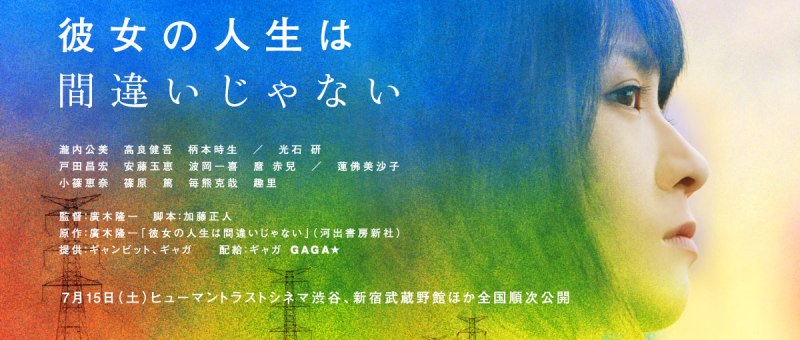
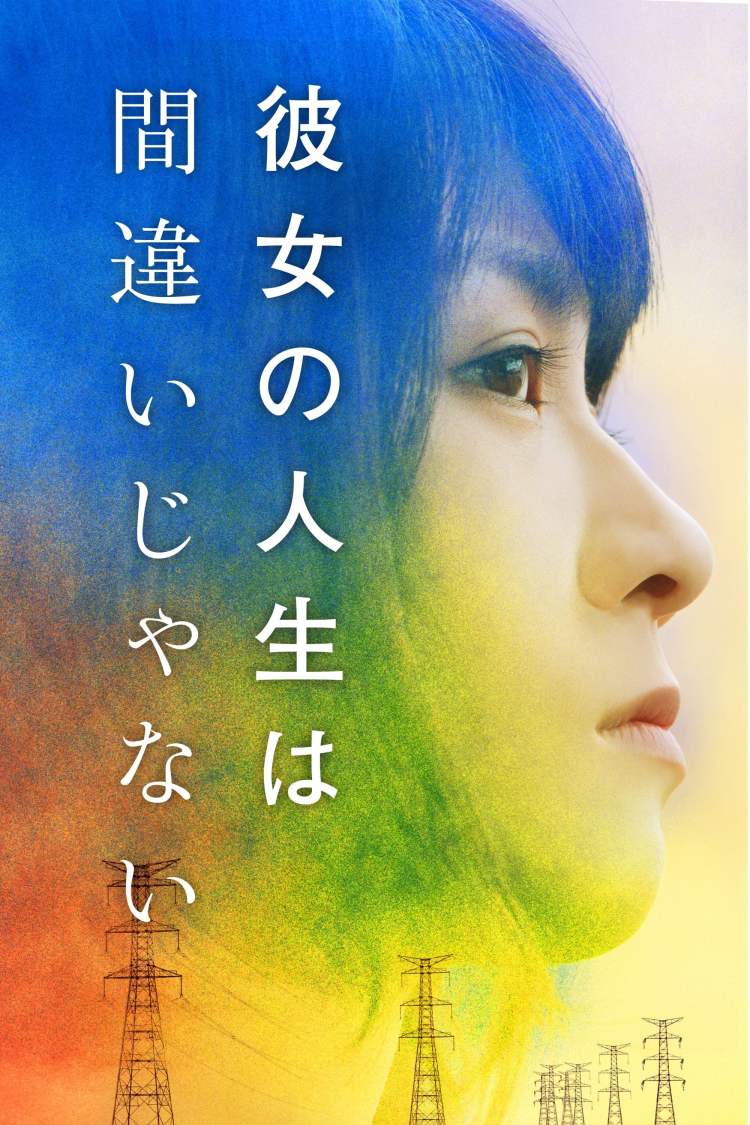
Side Job (彼女の人生は間違いじゃない, Ryuichi Hiroki, 2017)

Side JOb posterFukushima has become a focal point for recent Japanese cinema, not just as a literal depiction of an area in crisis but as a symbol for various social concerns chief among them being a loss of faith in governmental responsibility. Side Job (彼女の人生は間違いじゃない, Kanojo no Jinsei wa Machigai ja Nai) has the distinction of being helmed by a Fukushima native in Ryuichi Hiroki who also wrote the original novel from which the film is adapted. Typical of Hiroki’s work, Side Job is less an ode to the power of perseverance than a powerful meditation on grief, inertia, and helplessness. Though he offers no easy answers and refuses to judge his protagonists for the ways they attempt to deal with their situations, Hiroki does allow them to find a kind of peace, at least of the kind that allows them to begin moving forward if not quite away from the past.

Five years after The Great East Japan Earthquake of 2011, Miyuki Kanazawa (Kumi Takiuchi) is still living in a cramped prefab house with her widowed father, Osamu (Ken Mitsuishi). Miyuki’s mother was lost in the storm and her body never found, leaving the pair bereft and with an unanswered question. Having lost his farm to the exclusion zone, Osamu is left with nothing much to do and mostly spends his time idly playing pachinko and drinking much to the consternation of Miyuki who has a regular job with the city council.

Miyuki may well be angry about the way her father fritters away their money, but that doesn’t quite explain why she boards an overnight coach every Friday and spends her weekends in Tokyo engaging in casual sex work. She appears not to like the work very much and it is occasionally dangerous, but she does seem to have built up a kind of friendship with her “manager” as he drives her around the city to her various clients. Miura (Kengo Kora) claims to enjoy his work because it gives him an opportunity to observe human nature in all of its complexity though if he harbours any conflict about his role as a dispatcher of sometimes vulnerable young women, he is slow to voice it.

The “side job” of the title provides a kind of escape from a boring, conventional life in rural Iwaki, equal parts self-harm and quest for sensation. Miyuki, like many of those around her walks around with an air of irritated blankness, angry at so many things she doesn’t quite know where to begin. Yet for all that she’s also emotionally numbed, held in a state of suspended animation, longing to feel something, anything, even if that something is only shame. Through her double life Miyuki is able to find a sense of control and equilibrium that eluded her in grief-stricken Iwaki. Her manager, Miura, promises to “protect” her, though he makes clear that there are many women he feels a duty to protect rather than just Miyuki. Just as it seems Miyuki has come to depend on him, Miura drops a bombshell of his own though it maybe one which spurs Miyuki on towards a new beginning.

Everything in Iwaki is, in a sense, temporary. Miyuki and her father still live in the tiny prefab house in the hope of one day being able to go “home” while Osamu attends occasional meetings with the farming collective to try and find out what’s going on with his fields. Held in a kind of limbo, repeating the same daily tasks with relentless monotony, Miyuki and Osamu are trapped by a sense of helpless dread, forever waiting for something to happen but having lost the faith that it ever will.

While the pair struggle on, others find themselves unable to bear the weight of their tragedies. The spectre of suicide haunts Miyuki and her father from the woman next-door (Tamae Ando) who has become depressed thanks to the stigma surrounding her husband’s job with the decontamination programme, to the window at the agency which no longer opens following the suicide of one of the employees. Pushed to the edge by financial strain, there are also those who find themselves befriending the vulnerable with an intent to defraud, but it is in the end genuine human relationships which light the way for each of our struggling protagonists. Osamu bonds with an orphaned little boy through playing catch, Miyuki finds strength in Miura’s decision to break with his old life and build a new one, and her assistant at the city council, Nitta (Tokio Emoto), grows into the responsibility of being a big brother while attempting to do the best he can for the people of Fukushima.

What each of them finds isn’t an answer or a “cure” for their trauma but a path towards accepting it in such a way as it allows them to begin moving forward. New seeds are planted in the expectation of a coming future, new lives are celebrated, and the past begins to recede. Memory becomes a still frame, bottled and in a sense commodified but held close as a kind of talisman proving nothing is really ever “lost”. Filmed with an eerie sense of listless beauty, Side Job is an unflinching yet not unforgiving exploration of life after tragedy in which the only possible chance for survival lies in empathy and simple human connection.


Screened at the 20th Udine Far East Film Festival.

Original trailer (English subtitles)


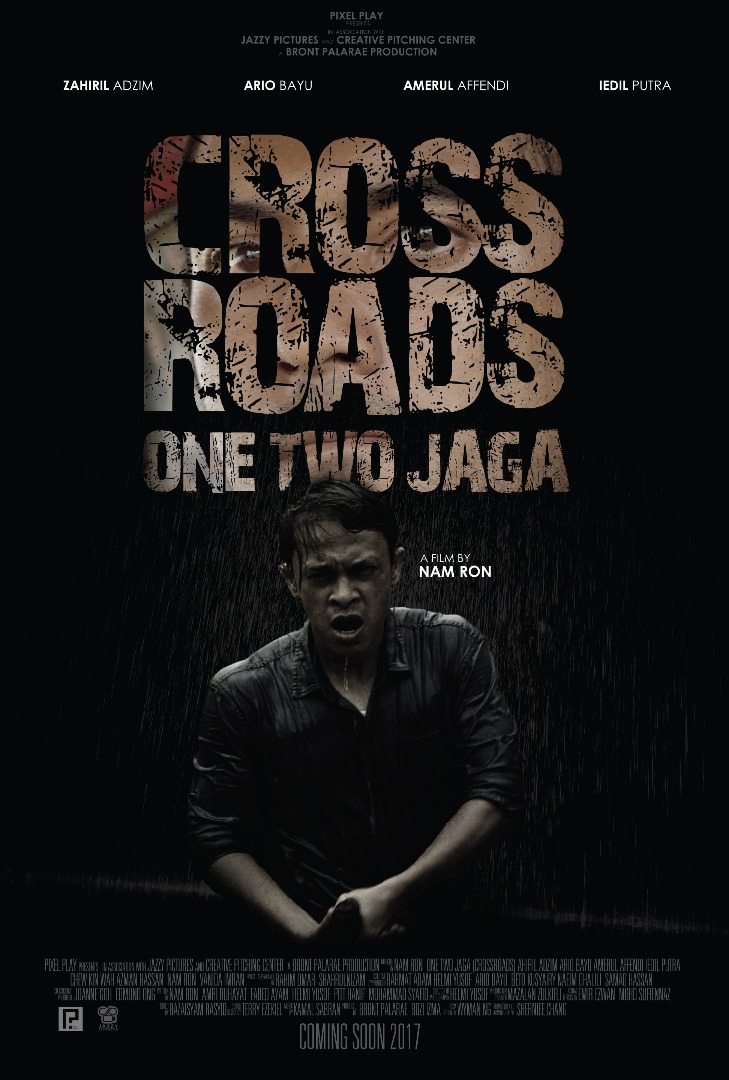
Crossroads: One Two Jaga (十字路口, Nam Ron, 2018)

crossroads one two jaga posterThe world is increasingly interconnected but far from greater freedom and increased possibilities, exploitation is often all that awaits those seeking opportunities overseas. Crossroads: One Two Jaga (十字路口) places the undocumented migrant worker at its centre and uncovers a deeply entrenched system of corruption and hypocrisy in which the line between the forces of order and chaos is so thin as to be barely discernible. The migrant worker is exploited twice over – once by the employers and again by the police who blackmail and extort, pulling in anyone who seems “suspicious” whenever they find themselves short of a few pennies. With no recourse to the “law” and no route “home”, there is little hope for a brighter future for any but those who seek to profit from other people’s misery.

Beginning at the end, we open on the bruised face of a young man who has prominent stitches on his cheek. Something tells us he is a police officer, but he is in questioning over the death of a young boy, killed by a bullet from his weapon. The officer looks stunned and claims to know nothing. As it turns out he may be telling the truth, but he alone is responsible for a child’s death, on the one hand, and exposing a corrupt police chief, on the other.

Flashing back, Joko (Izuan Fitri) – the son of Indonesian migrant worker Iman (Ario Bayu), wants to go for a ride with Adi (Amerul Affendi) – the adult son of Mr. Sarip (Azman Hassan) who runs a small construction firm (among other enterprises). Iman doesn’t really want his son to go, but he ignores him and goes anyway. Iman has another problem on his hands – his sister, Sumiyati (Asmara Abigail), who has left the family she was working for as a maid and wants to go home to Indonesia. Mr. Sarip says he can help with that (for a price) but Sumiyati is stopped by Hassan (Rosdeen Suboh) and his rookie partner Hussein (Zahiril Adzim). Hassan really just wants a bribe because his wife really needs money to avoid family embarrassment, but things goes south when Iman ropes in Adi to try and help him out only to escalate the situation into a declaration of war on the “rogue” policemen.

Undocumented workers exist in a kind of grey area which makes it possible for the unscrupulous to misuse them for their own ends. Sumiyati, like many young women, has gone abroad to work as a maid but found herself kept a virtual prisoner by her employer who holds her passport as a guarantee. With job parameters unclear, she finds herself not only maid but cook, babysitter, and office assistant and all for almost no pay. Fed up she upped and left, but lost her passport in the process leaving her with no legal way back to Indonesia which is where she’s decided she’d rather go. The only way “home” is through the back door channels operated by men like Mr. Sarip who have fingers in many pies and friends in all the right places.

Ordinarily speaking, a righteous rookie cop would be our hero, but we already know Hussein is our villain. Though he wants to enforce the letter of the law and resents the casual corruption of other officers, it’s his hotheadedness and refusal to play the long game which eventually cause so much trouble. Accidentally or otherwise, he does manage to unmask the kingpin responsible for holding together a system of corruption running from the top of the force down, collaborating with the criminals and turning a blind eye to real “crime”, but it comes at a heavy price and one to which Hussein seems worryingly indifferent.

Stylishly shot, Crossroads weaves a complex picture of interconnected exploitations in which the innocent are made to pay the price for the world in which they live. Realist in essence but expressionist in intent, gritty images of children disposing of bodies mingle with a father’s nightmare as blood colours the rain soaked ground and a young woman disappears in its miasmic haze. Malaysia maybe the crossroads of Asia, but it also finds itself at something of a junction unsure in which direction to turn, unwilling to confront the darkness that lies at the heart of the modern society.   


Screened at the 20th Udine Far East Film Festival.

Official trailer (English subtitles)

Maquia: When the Promised Flower Blooms (さよならの朝に約束の花をかざろう, Mari Okada, 2018)

maquia poster 1Perhaps because of its often adolescent target audience, the “hahamono” or mother movie is a relatively rare genre in the world of anime despite its importance in other Japanese media. Wolf Children aside, most anime prefer to focus on the problems of young people dealing with an absentee or unreasonable parent who unwittingly enables the teen to undergo the adventures shortly to ensue. Maquia: When the Promised Flower Blooms (さよならの朝に約束の花をかざろう, Sayonara no Asa ni Yakusoku no Hana wo Kazaro), is an exception to the rule in examining the complex nature of motherhood with a sideline in the legacy of familial disconnection, alienation, and the cyclical natures of life and memory. Flawed if ambitious, the first directorial feature from scriptwriter Mari Okada is a sprawling fantasy epic but one with its heart firmly on its sleeve.

Maquia (Manaka Iwami) is a member of the Separated Clan – an Iolf who weaves time and life into being. The life in Iolf is idyllic, if dull, and consists of little other than weaving. Maquia’s tomboyish friend, Leilia (Ai Kayano) rejoices in daring stunts and precocious flirtations that the shy and introverted Maquia can only dream of, while Maquia, an orphan, feels herself alone and remains somehow incapable of bonding with the other children. When Iolf is raided by Mesarte soldiers, Maquia is carried off by one of their great stone dragons. Now forced to explore the world outside of Iolf, Maquia chances on the remains of a ruined camp, stumbling over bodies only to discover a howling baby boy still held in the icy grip of his mother who tried her best to protect him even as she died. Perhaps identifying with another soul so completely alone, Maquia picks the boy up and decides to raise him though she is barely more than a child herself.

As the Iolf age much slower than the average human, Maquia’s quest to find true connection through maternity is destined to end in tragedy. Maquia christens her son Arial (Miyu Irino) and finds a home with a kindly ranch woman raising two sons of her own alone after her husband was killed by a rabid dragon, and begins to bond with her little boy. Meanwhile Leilia has been kidnapped and forced married to the Mesarte prince in the hope that his heir will inherit some Iolf lengevity. While Maquia is beginning to find connection, Leilia now tastes isolation as an imprisoned minority in the imperial court where she is also separated from the daughter born from a non-consensual union but loved all the same.

Though she already feels so alone, Maquia is warned by her Elder that if she wants to experience true loneliness she need only fall in love with a mortal. Maquia falls in love, or rather tries to, but as a mother rather than a lover. Pouring everything into her child Maquia knows the day will come when she must lose him, but for her it is in a more concrete sense than the normal breaking of a mother/son bond. The notion of mortality and differing lifespans is somewhat uncomfortably dramatised by the passing of the aged family dog who reaches the end of his journey long before his master. Though the message is sound is enough it does rather negate Maquia’s insistence that Arial is not a toy, implying that humans are almost like pets to the long-lived Iolf, something to be loved and fussed over in knowledge of its impermanence but something to which a lesser attachment is formed. 

Maquia, however, hurtles in the opposite direction, vowing to sacrifice all of herself in service of her son. Turning down a suitor in order to remain true and pure as an idealised mother figure, Maquia perhaps takes a retrograde step in agreeing to negate her own personality to become “a mother”, but like the classic hahamono, her overwhelming love proves too much for her growing son who grows tired of the burden of a mother’s expectation, longing to be free of her somewhat suffocating need to protect him while belittled by the knowledge that he, a mortal yet still a man, is incapable of protecting her. Maquia must find the strength to let her son go if she is to see him grow, but to do so will require a shift in self-knowledge born of truly learning what it means put another’s interest above one’s own.

Maquia’s struggles play out in parallel with the ongoing political drama surrounding the corrupt and oppressive Mesarte regime which seeks to rule by fear and violence, stealing the gifts of the Iolf only to abuse them. No matter the genesis, Prince Hazel seems to have formed a genuine attachment to his stolen bride (even if it is not returned) and does what he can to “protect” her, while her former love from the Iolf, Krim, has gone half mad through love denied, kidnapping Maquia to rope her into a half-baked rescue plot before threatening to burn the world if he cannot have his love for the price he is willing to pay.

The question is one of whether it is better to connect fully in the knowledge of a coming heartbreak, or hold back in self protection. In this Maquia learns the true meaning of her Elder’s instruction and begins to realise that the fabric that she weaves is spun from love and memory. Nothing is ever truly lost, merely laid down for someone else to pick up, and while parting is inevitable meeting is not and is something to be treasured no matter how painful it may be.


Distributed in the UK by Anime Limited

Original trailer (English subtitles)

Note: there seems to be some variation in the translation of the names of various characters, this review uses Anime Limited‘s list.

Little Forest (リトル・フォレスト 夏・秋 / 冬・春, Junichi Mori, 2014/15)

Divided into four hour-long segments, Little Forest (リトル・フォレスト) opens with a voice over from Ichiko (Ai Hashimoto) introducing us to Komori, her home village. High in the mountains, Komori is a community of farmers without a single store though there is a farmer’s co-op if you make the half-hour bike ride to the high street. It’s downhill so not so far on a bike on your way, but a good 90 minute walk in the winter snow. Most people do their shopping at the supermarket a few towns over but if Ichiko wants to go there it takes her the best part of a day. Ichiko, however, has a taste for doing things herself and so she grows most of her own food or barters for that which she doesn’t have with some of the other sharecroppers. Always with one eye on the future and particularly for the winter to come, Ichiko preserves her produce and makes the most of all she has.

Despite her feelings of inadequacy and incompleteness, Ichiko throws herself into the business of farming, weeding her rice field and preparing for the harvest all alone. She doesn’t seem to mind the solitude or the monotony, rejoicing in cooking the food she has grown and savouring each of its flavours. A gifted cook, Ichiko also likes to experiment, finding new ways to use each of the vegetables in her garden and trying them out on her two old school friends Yuta (Takahiro Miura) and Kikko (Mayu Matsuoka).

Yuta, like Ichiko, tried life in the city but ultimately decided to come home to the country. Despite wanting nothing but escape, Yuta found that he couldn’t adapt to the city’s insincerity. He missed real conversation and the ability to talk seriously about serious things whilst learning from others – something he so admired in the village. Ichiko, rather than empathising with him, is a little jealous. Yuta came home to face himself and discovered who he really was whereas she suspects she came back to escape doing exactly that. In short, she ran away and is living in hiding.

Yuta, adopting the gentle tones he was so in praise of, almost points this out to Ichiko albeit in a subtle way by telling her that he admires the way she does everything for herself but that he’s worried she may have missed the point. Ichiko’s need for independence is perhaps a reaction to abandonment by her mother which apparently happened quite abruptly in her teenage years. Her mother’s letters are vague and don’t include a return address or any details regarding where, how, or with whom she is currently living. Her last letter, however, seems to contain some relevant advice in the form of various excuses. Ichiko’s mother tells her that she was worried she’d just been wandering round in circles but finally realised that the arc of her life has been more like a spiral. Never taking the same path twice, she learned as she went and so finding yourself back at the start is not the same as never having set off.

Rather than actively making the choice, Ichiko merely commits to making it. Realising that it’s time to come out of hibernation and figure out where it is she wants to be rather than simply allowing Komori to become her default setting, the decision is made quickly and keenly. Yet it takes time, effort, and experience to bring something to fruition and, skilled as she is, Ichiko still has a few things to learn. Filled with wonderful food and idyllic scenery, Little Forest is perhaps an idealised view of country life – the kind of life lived by those who know how to live happily even when life is hard, but there is truth in its age old wisdom as long as you know how to harvest it.


Released as two two-part movies: Summer/Autumn (2014) & Winter/Spring (2015)

Summer/Autumn trailer (no subtitles)

Winter/Spring trailer (no subtitles)

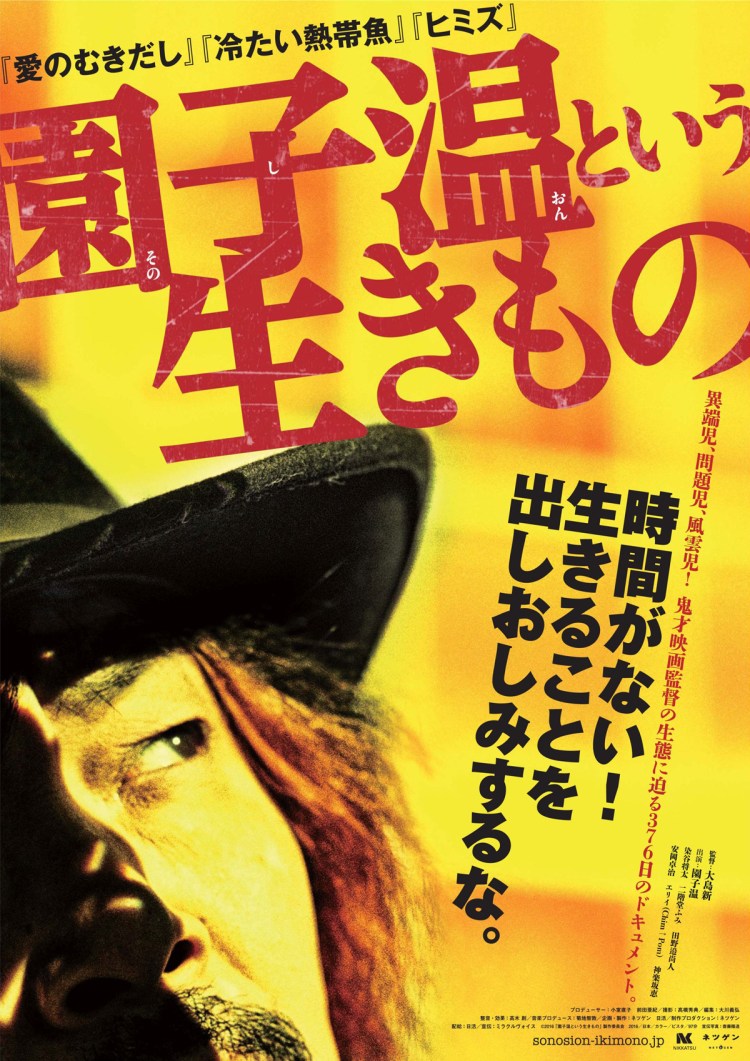
The Sion Sono (園子温という生きもの, Arata Oshima, 2016)

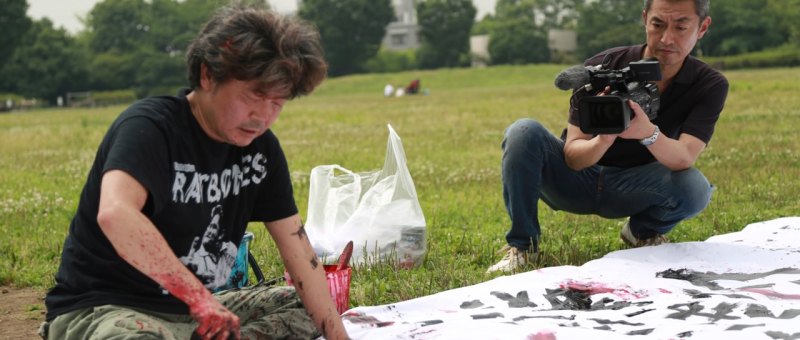
169827_01Sion Sono has acquired something of a reputation for controversy. His frequent denouncements of his nation’s cinema in which he sets himself up as a kind of “anti-Ozu” perhaps place him in line with the great 1960s iconoclast Nagisa Oshima who also proclaimed that his distaste for Japanese cinema extended to “absolutely all of it”. Funnily enough, The Sion Sono (園子温という生きもの, Sono Sion to Iu Ikimono) – a documentary exploring the director’s work, is helmed by Oshima’s son, Arata, though he is at pains to show a different side to the artist known as Sion Sono, keying in to the various aways his art reflects his life and vice versa.

Shot during 2015, the documentary follows the twin processes of the production of The Whispering Star (one of five films Sono would release that year), and a landmark art exhibition which led straight back to the director’s origins as an avant-garde street protestor with the performance art collective “Tokyo Gagaga”. These joint concerns perhaps highlight a minor conflict in Sono’s working life as he reveals during a casual conversation in referencing the “indecent” work that had been mostly occupying his time over the previous year. Expressing both fear and gratitude for finally gaining the opportunity to work a more personal project (the script for The Whispering Star had been written almost 20 years previously), Sono jokes that he’ll finally be getting “clean” only to immediately relapse by making The Virgin Psychics – the big screen adaptation of a sci-fi TV series he had also directed which largely consisted of lewd juvenile humour.

To rewind slightly, Sion Sono had been making films for almost 20 years before getting mainstream festival attention in the early 2000s with Suicide Club and Noriko’s Dinner Table. His profile was further enhanced by the international success of serial killer thriller Cold Fish and the Venice recognition of Himizu even if it’s the 4-hour epic and sleeper cult hit Love Exposure which has become synonymous with his name for many Western viewers. In the opening to camera interview, Sono is asked about his “controversial” image and overseas success to which he laments that Japanese audiences are wary of anything unconventional and particularly allergic to the “wacky Japan” tag that often dogs attempts to sell Japanese media overseas. Unorthodox views or ways of working are unwelcome, as are those who live in unorthodox ways.

Perhaps for these reasons, 2015 saw Sono diving headfirst into the populist with mixed results. Avowing at a press conference that he believes in “quantity over quality”, Sono commits himself to simply making films hoping some of them might turn out OK. Thus his more straightforwardly commercial projects, Shinjuku Swan for example, are often filled with unconventional ideas but perhaps lack the sense of attack found in his more potent work, covering a lack of substance with intentional boldness. The Whispering Star, as we see, brings him full circle. Picking up the Tarkovskian influences seen in one of his most impressive early features – the sadly neglected The Room, the minimalist sci-fi drama also encompasses his compassion for the people of Fukushima whose ongoing strife has become a recurrent concern from the ruined landscapes of Himizu to the more directly political Land of Hope.

It’s this essential sense of compassion which Oshima’s documentary seems keenest to capture. Through in person interviews with some of Sono’s frequent collaborators including Himizu’s Shota Sometani and Fumi Nikaido who characterise the director as an eccentric uncle, and his actress wife Megumi Kagurazaka (the lead in Whispering Star) who breaks down in tears remembering the sometimes difficult days of their earlier collaborations, Sono’s art emerges less as an attack on a conservative society than an exercise in melancholy sarcasm that, at heart, believes the world can be better than it is. A friend of his puts this quality best when she (part correcting herself for triteness) states that despite his sometimes controversial approach, she believes he just wants everyone to be happy and is attempting to transcend his own ideas in order to cut through to something new.

Then again perhaps Sono puts this best himself in accidentally citing a life philosophy. Art is not about good and bad; life is not about good and bad. “Paint! Express! Live!” – what better encapsulation of an artist’s credo could there be?


Released by Third Window Films as part of a double feature pack with The Whispering Star.

International trailer (English subtitles)