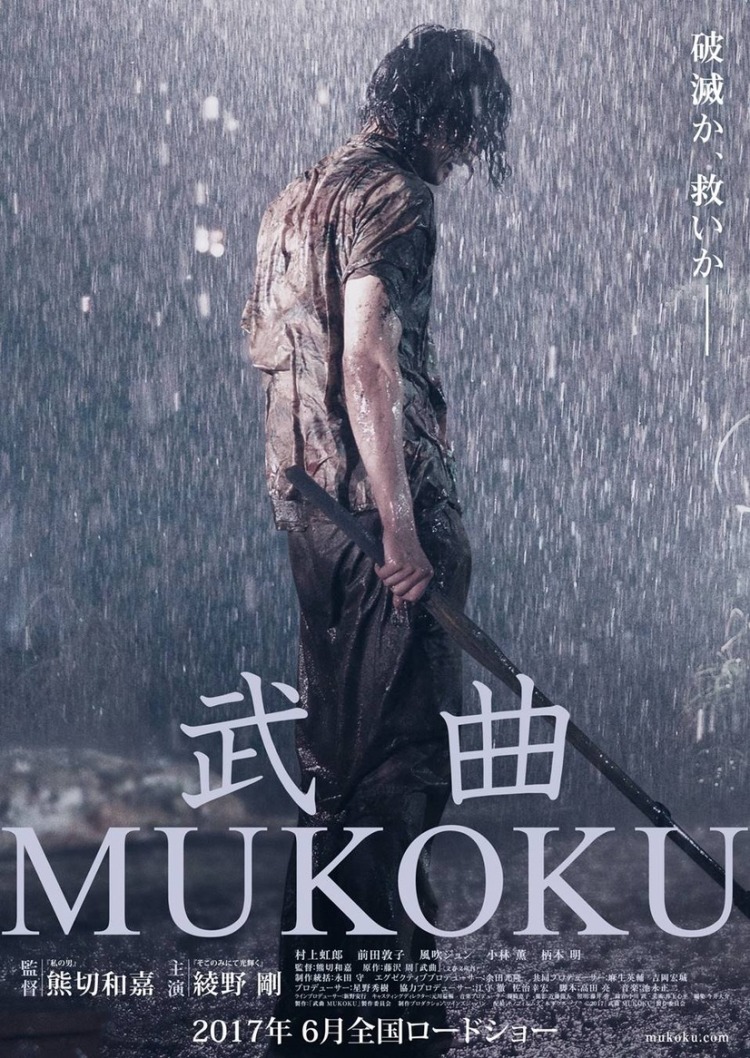
Mukoku (武曲 MUKOKU, Kazuyoshi Kumakiri, 2017)

mukoku posterThe way of the sword is fraught with contradictions. Like many martial arts, kendo is not primarily intended for practical usage but for self improvement, emotional centring, and fostering a big hearted love of country designed to ensure lasting peace between men. Nevertheless, it tends to attract people who struggle with just those issues, hoping to find the peace within themselves though mastery of the sword. Kazuyoshi Kumakiri’s long and varied career has often focussed on outsiders dealing with extreme emotions and Mukoku (武曲 MUKOKU) is no different in this regard as the two men at its centre lock swords at cross purposes, each fighting something or someone else within themselves rather than the flesh and blood opponent standing before them.

Kengo Yatabe’s (Go Ayano) life has been defined by the sword. As a young boy his father, Shozo (Kaoru Kobayashi), began training Kengo intensively but his standards were high, too high for a small boy who only wanted to please his dad but found himself beaten with the weapon he was failing to master. Twenty years later Kengo is a broken man after a long deferred violent confrontation between father and son has left Shozo in a vegetative state, neither dead nor alive, no longer a figure of fear and hate but of guilt and ambivalence. Kengo has given up kendo partly out of guilt but also as a kind of rebellion mixed with self harm and is currently working as a security guard. He spends his days lost in an alcoholic fog, trailing an equally drunken casual girlfriend (Atsuko Maeda) behind him.

Meanwhile, high school boy Toru (Nijiro Murakami) is a classic angry young man working out his frustrations through a hip-hop infused punk band for which he writes the angst ridden poetry that serves as their lyrics. Toru has no interest in something as stuffy as Kendo but when he’s set upon by a bunch of Kendo jocks he decides he’s not going down without a fight. Winning through underhanded street punk moves would normally be frowned upon but the ageing monk who runs the high school kendo club, Mitsumura (Akira Emoto), is struck by his nifty footwork and decides to convince the troubled young man that the path to spiritual enlightenment lies in mastery over the self through mastery of the sword.

The wise old monk pits the self-destructive older man against the scrappy young one, hoping to bring them both to some kind of peaceful equilibrium, with near tragic results. Kengo’s ongoing troubles are born of a terrible sense of guilt, but also from intense self-loathing in refusing to accept that he’s become the man he hated, as broken and embittered as the father who made him that way. Shozo was a kendo master, but as the monk points out, in technique only – his heart was forever unquiet and he never achieved the the true peace necessary to master his art. Knowing this to be the truth only made it worse yet Shozo also knew the burden he’d placed on his son. They say every man must kill his father, but Kengo can’t let the ghost of his go – clinging on to a mix of filial piety and resentful loathing which is slowly turning him into everything he hates.

Toru’s problem’s are pushed into the background but seeing as his enemy is not the flesh and blood threat of an overbearing father but the elements and more particularly water, it will be much harder to overcome. Water becomes a constant symbol for each man – for Toru it’s an inescapable symbol of death and powerlessness, but for Kengo it represents happiness and harmony in rediscovering the good memories he has of his father from joyful family outings to less abusive summer training sessions. Mukoku is the story of three ages of man – the scrappy rebellious teen, the struggling middle-aged man, and the elderly veteran whose own heart is settled enough to see the battles others are waging. The “warrior’s song” as “mukoku” seems to mean changes with each passing season, nudged into tune by the graceful art of kendo.

Kumakiri embraces his expressionist impulses as a young boy finds himself suddenly underwater, vomiting mud and fish while Kengo has constant visions of his father, mother, and younger self ensuring the past is forever present. The ominous score and strange occurrences including ghostly graveyard old women who appear from nowhere in order to offer a lecture on the five buddhist sins lend a more urgent quality to Kengo’s disintegration, though interesting subplots involving a possibly alcoholic girlfriend and a mamasan (Jun Fubuki) at a local bar who might have been Shozo’s mistress are left underdeveloped. Two men face each other to face themselves, trying to beat their demons into submission with wooden swords, but even if the battle is far from over the tide has turned and something at least has begun to shift.


Screened at Raindance 2017.

Original trailer (no subtitles)
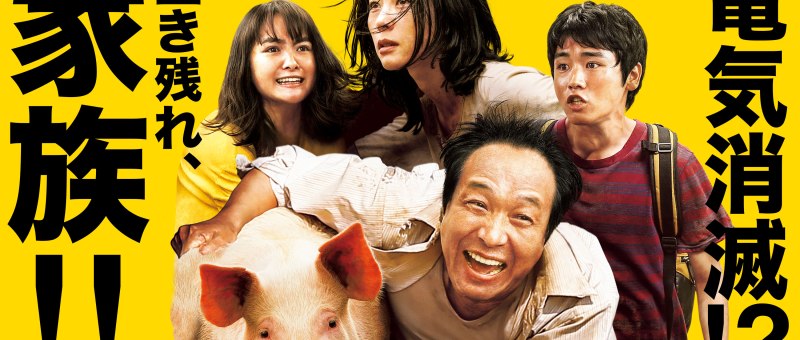
 

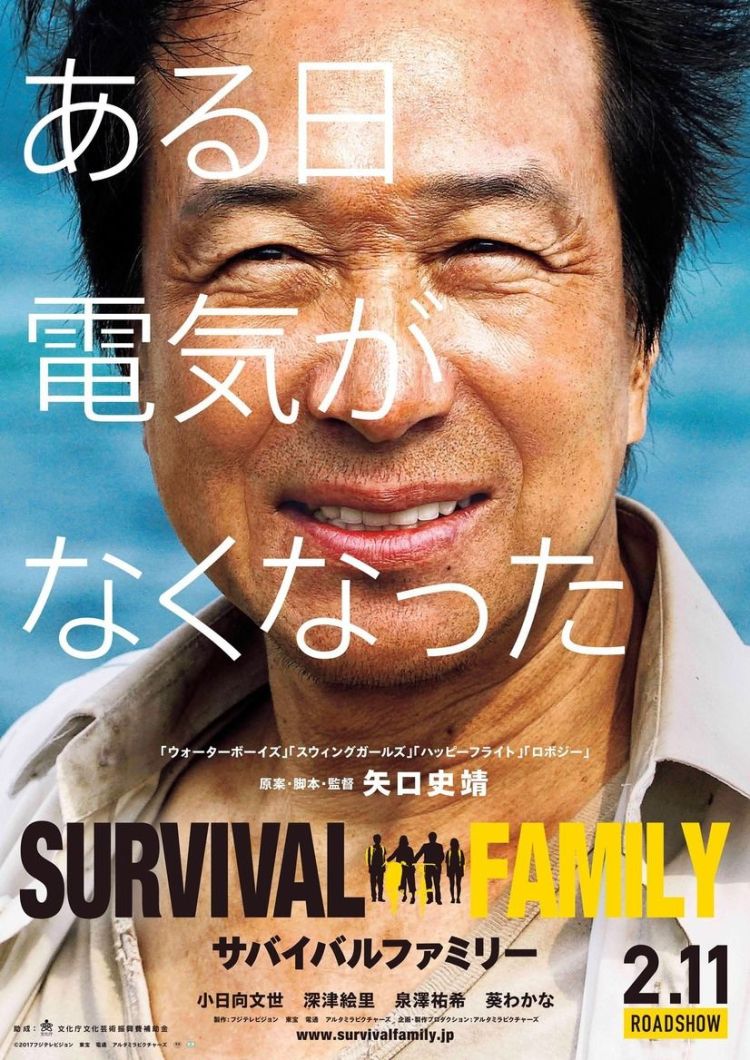
Survival Family (サバイバルファミリー, Shinobu Yaguchi, 2017)

survival family posterModern life is full of conveniences, but perhaps they come at a price. Shinobu Yaguchi has made something of a career out of showing the various ways nice people can come together to overcome their problems, but as the problem in Survival Family (サバイバルファミリー) is post-apocalyptic dystopia, being nice might not be the best way to solve it. Nevertheless, the Suzukis can’t help trying as they deal with the cracks already present in their relationships whilst trying to figure out a way to survive in the new, post-electric world.

Receiving a package from grandpa fills the Suzukis with horror more than gratitude. Mum Mitsue (Eri Fukatsu) can’t bring herself to cut the head off a fish and the sight of the giant bug that crawls out of the lettuce is just too much to bear. Her teenage daughter, Yui (Wakana Aoi), is not very excited either, tapping her smartphone with her fake nails, while her son Kenji (Yuki Izumisawa) spends all his time alone in his room with headphones permanently attached. Mr. Suzuki, Yoshiyuki (Fumiyo Kohinata) – the family patriarch, is a typical salaryman, obsessed with work and often in bed early.

All that changes one day when Yoshiyuki’s alarm clock does not go off. There’s been a power outage – nothing works, not the TV, not the phone, not even the tower block’s elevator. Being the salaryman champ he is, Yoshiyuki tries to make it into to work in other ways but the power’s out across the city and there’s nothing to be done. Everyone is sure the power will come back on soon, but days pass with the consequences only increasing as supermarket shelves become bare and water frighteningly scarce. After his boss decides to take his chances in the mountains and a neighbour dies as a direct result of the ongoing power shortage, Yoshihyuki decides to take the family on the road to find Mitsue’s country bumpkin father in the hope that he will have a better idea of how to survive this brave new world.

Yaguchi is quick to remind us all of the ways electricity defines our lives, even if we’ve begun to forget them. Not only is it a question of mobile phones being out and lifts being out of order, but gas appliances are also electric ignition as are the pumps which drive the water system. So used to the constant stream of electricity, no one quite realises what its absence means hence Yoshiyuki’s big idea is to get a plane from Haneda airport. Ridiculous as it may seem, he’s not the only one to have underestimated the part electricity plays in flight and the aviation industry as the airport is swamped by people trying to escape the rapidly disintegrating city. Credit cards no longer work leading to long checkout lines as the old ladies with their abacuses make a startling return to checkouts while bemused shoppers attempt to use the ATM machine to get more cash.

Cash itself still has worth, at least for a time. Eventually the barter system takes over as food and water become top price commodities. A very flash looking man tries to trade genuine Rolex gold watch and later the keys to his Maserati for food but is roundly informed that none of his hard won prizes is worth anything in this new back to basics era. Thanks to Mitsue’s housewife skills of frugality and haggling, the family are able to get themselves a small stockplie of resources but find themselves tested when the less fortunate ask them for help.

The crisis brings out both the best and the worst in humanity. As the family make their escape from the city on a series of bicycles, they pass a succession of salesmen all upping the price of bottled water by 100% each time. Profiteering is rife as the unscrupulous procure ordinary foodstuffs to be sold for vast amounts of money. Yet the Suzukis rarely find themselves on the wrong side of trickery and even encounter a few kindly souls willing to help them on their journey such as a gang of cycle wear clad survival experts and a very forgiving farmer who takes the family in when they help themselves to one of his escaped pigs (a sequence which allows Yaguchi to go on another Swing Girls-style pig chase only without the slo-mo and classical music).

Forced to reconnect, the family become closer, gradually coming to know and accept each other whilst finding new and unknown talents. Living simply and harmoniously has its charms, ones that don’t necessarily need to disappear if the power ever comes back on. The only certainty is that you can’t survive alone, and who can you count on if you can’t count on family?


Screened as the opening night movie of the Udine Far East Film Festival 2017.

Original trailer (English subtitles)

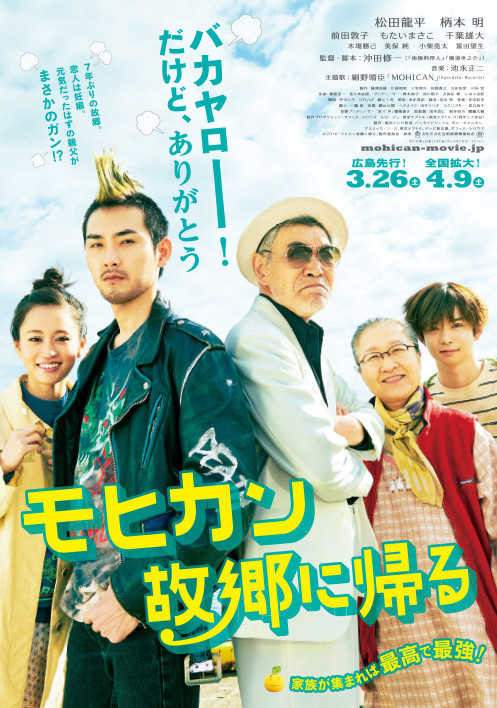
The Mohican Comes Home (モヒカン故郷に帰る, Shuichi Okita, 2016)

mohican-comes-homeJapan may be famous for its family dramas, but there is a significant substrain of these warm and gentle comedies which sees a prodigal child return to their childhood home either to rediscover some lost aspect of themselves or realise that they no longer belong in the place which raised them. Shuichi Okita’s The Mohican Comes Home (モヒカン故郷に帰る, Mohican Kokyo ni Kaeru) includes an obvious reference in its title to Keisuke Kinoshita’s colourful 1954 escapade Carmen Comes Home which cast legendary actress Hideko Takamine somewhat against type as a ditsy airhead show girl eager to show off all her city sophistications to the rural backwater she abruptly ran out of some years before. Like Carmen, the hero of Mohican Comes Home makes an unexpected trip to visit his family in the picturesque Hiroshima island village where he grew up only to find not very much has changed but an equally unexpected tragedy prompts him into a wider consideration of his past and future as he faces life’s two extremes in the very same moment.

Eikichi (Ryuhei Matsuda) left his island home some years ago for the bright lights of Tokyo where he fronts a punk band by the name of Grim Reapers. The band has some moderate underground success, but the guys are getting old for the punk scene and finding themselves with real world responsibilities from healthcare costs to the prospects of supporting wives and children. Eikichi, sporting a prominent bleached mohawk, feels this more than most as he’s soon to become a father and is intending to marry his pregnant girlfriend, Yuka (Atsuko Maeda), if only he had the money. He’s been promising to take his future wife to meet his parents for some time but so far they’ve never actually made the trip.

This time, things are different and so Eikichi makes a shocking return after seven years only to wander in during an awkward scene as his mother and younger brother try to manoeuvre his drunken father into a more convenient position whilst protecting his precious white suit from alcohol born ruin. Eikichi’s family own the village liquor store but his father’s passion is for music and he also coaches the local middle school band. A devotee of legendary Hiroshima born superstar Eikichi Yazawa, Osamu (Akira Emoto) insists the kids play his favourite tune ad nauseam to much eye rolling from the youngsters forced to associate themselves with such an uncool and old fashioned song.

Eikichi’s homecoming has not got off to the best start, especially after his father begins to sober up and recommends a hair cut and real job, both of which Eikichi resolutely refuses. Things take a more serious turn when Osamu realises his son is being financially supported by his girlfriend whom he has also got pregnant but is not yet married to. Experiencing extreme moral outrage at his responsibility shirking son, Osamu chases him around the table in what appears to be a scene often repeated during Eikichi’s childhood but the situation soon ends in an unexpected way foreshadowing Osamu’s decline into ill health.

Deciding to stay a little longer than intended, Eikichi and Yuka blend into the family home trying to help mother Haruko (Masako Motai) and boomerang younger brother Koji (Yudai Chiba) adjust while Osamu is in the hospital. The contrast between town and country, traditional and modern is never far from view whether in Yuka’s kindhearted decision to finish off preparing the family dinner though she has to consult a youtube video to find out how to gut fish, or in her astonishment at the very ordinary way in which her future in-laws met (i.e. simple propinquity). While the women begin to bond over their shared concern for their men as Haruko decides to teach Yuka some home style tips and tricks, Eikichi and his father spar with each other warmly as Eikichi takes charge of a band rehearsal and allows them to let loose on the much hated song with an energised punk fuelled twist.

Despite a strained relationship with his father, Eikichi is a good person who also wants to offer some kind of comfort to the old man in his final days. Going to great lengths to track down a particular pizza Osamu suddenly requests (the last time he ate pizza was on his 60th birthday) or eventually pretending to be Yazawa himself whom Osamu is very proud to have made eye contact with during a Tokyo concert in 1977, Eikichi comes to a kind of understanding of the man his father was as well as the man he is. Full of warm, naturalistic humour giving way to two elaborately constructed set pieces, The Mohican Comes Home is a typically well observed family drama from Okita which neatly undercuts its essentially melancholy set up with a layer of stoical perseverance.


Screened as part of the Japan Foundation Touring Film Programme 2017.

Original trailer (no subtitles)
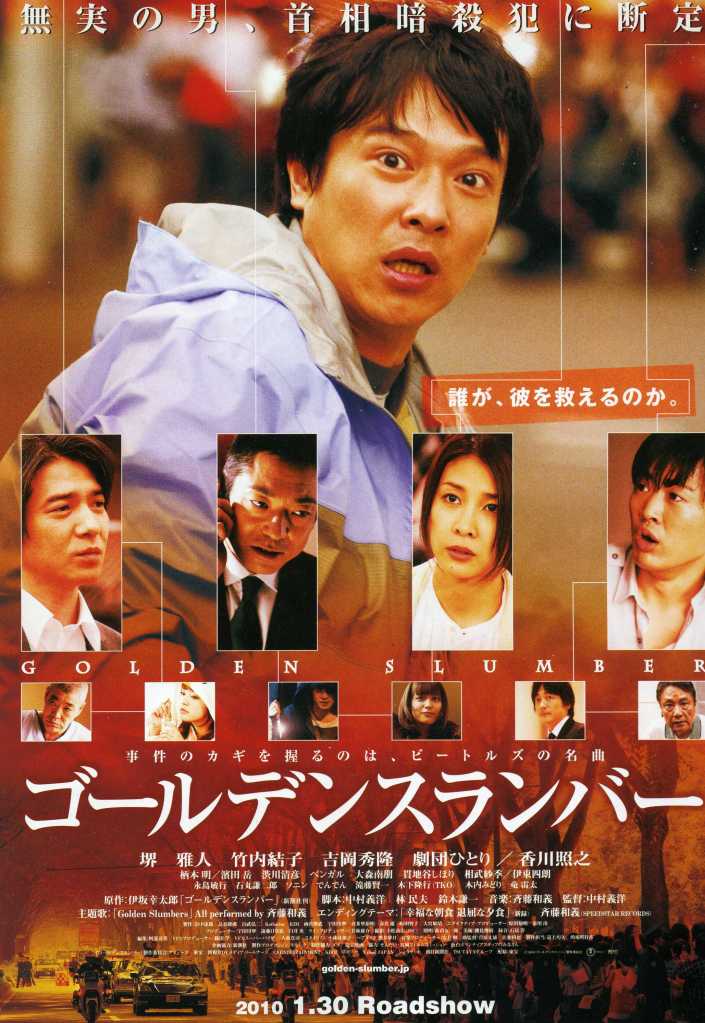
Golden Slumber (ゴールデンスランバー, Yoshihiro Nakamura, 2010)

golden-slumberYoshihiro Nakamura has made a name for himself as a master of fiendishly intricate, warm and quirky mysteries in which seemingly random events each radiate out from a single interconnected focus point. Golden Slumber (ゴールデンスランバー), like The Foreign Duck, the Native Duck and God in a Coin Locker, and Fish Story, is based on a novel by Kotaro Isaka and shares something of the same structure but is far less interested in the mystery itself rather than the man who finds himself caught up in it.
30 year old delivery driver Aoyagi (Masato Sakai) is all set for a nice day out fishing with an old college buddy, Morita (Hidetaka Yoshioka), but he’s about to discover that it’s he’s been hooked and reeled in as the patsy in someone else’s elaborate assassination plot. After grabbing some fast food, Morita takes Aoyagi to a parked car near the closed off area through which the Prime Minster is due to be paraded in an open topped car. Waking up after a brief period of drug induced sedation, Aoyagi is made aware that this has all been a trick – badly in debt thanks to his wife’s pachinko addiction, Morita has betrayed him to a set of undisclosed bad guys with unclear motives and is taking this brief opportunity to give him as much warning as he can. Sure enough, a bomb goes off at the parade and Aoyagi just manages to escape before Morita too is the victim of an explosion.

Aoyagi is now very confused and on the run. Inexplicably, the police seem to have CCTV footage of him in places he’s never been and doing things he’s never done. If he’s going to survive any of this, he’s going to need some help but caught between old friends and new, trust has just become his most valuable commodity.

At heart, Golden Slumber is a classic Wrong Man narrative yet it refuses to follow the well trodden formula in that it isn’t so much interested in restoring the protagonist to his former life unblemished as it is in giving him a new one. The well known Beatles song Golden Slumber which runs throughout the film plays into its neatly nostalgic atmosphere as each of the now 30 year old college friends find themselves looking back into those care free, joyous days before of the enormity of their adult responsibilities took hold. That is to say, aside from Aoyagi himself who seems to have been muddling along amiably before all of this happened to him, unmarried and working a dead end delivery job.

As Morita tells him in the car, it’s all about image. The nature of the conspiracy and the identity of the perpetrators is not the main the main thrust of the film, but the only possible motive suggested for why Aoyagi has been chosen stems back to his unexpected fifteen minutes of fame two years previously when he saved a pop idol from an intruder with a nifty judo move (taught to him by Morita in uni) after fortuitously arriving with a delivery. Those behind the conspiracy intend to harness his still vaguely current profile to grab even more media attention with a local hero turned national villain spin. The Prime Minister, it seems, was a constantly controversial, extreme right wing demagogue with a tendency for making off the cuff offensive statements so there are those who’d rather congratulate Aoyagi than bring him to justice, but anyone who’s ever met him knows none of this can really be true despite the overwhelming video evidence.

Throughout his long odyssey looking for “the way back home” as the song puts it, Aoyagi begins to remember relevant episodes from his life which may feed back into his current circumstances. Although it seems as if Aoyagi had not seen Morita in some time (he knew nothing of his family circumstances, for example) his college friends with whom he wasted time “reviewing” junk food restaurants and chatting about conspiracy theories are still the most important people in his life. Not least among them is former girlfriend Haruko (Yuko Takeuchi), now married and the mother of a little daughter, who seems to still be carrying a torch for her old flame and is willing to go to great lengths to help him in his current predicament.

The film seems mixed on whether these hazy college days are the “golden slumber”, a beautiful dream time enhanced by memory to which it is not possible to return, or whether it refers to Aoyagi’s post college life which impinges on the narrative only slightly when he asks an unreliable colleague for help, aside from an accidental moment of heroic celebrity. It could even refer to the film’s conclusion which, departing from the genre norms, resolves almost nothing save for the hero’s neat evasion of the trap (aided by the vexed conspirators who eventually opt for a plan B). Once there might have been a road home – a way back to the past and the renewing of old friendships, but this road seems closed now, severed by the new beginning promised to Aoyagi who has been robbed of his entire identity and all but the memory of his past. Whether this means that the golden slumber has ended and Aoyagi, along with each of the other nostalgia bound protagonists, must now wake up and start living the life he’s been given, or that the old Aoyagi has been consigned to the realm of golden slumbers, may be a matter for debate.

Though the resolution may appear ultimately unsatisfying, the preceding events provide just enough interconnected absurdity to guide it through. During his long journey, Aoyagi is aided not just by his old friends but new ones too including a very strange young serial killer (Gaku Hamada) and a hospital malingerer with one foot in the “underworld” (Akira Emoto). It speaks to Aoyagi’s character that all of those who know him trust him implicitly and are ready to help without even being asked (even if they occasionally waver under pressure), and even those who are meeting him for the first time are compelled to come to his defence.  An elliptical, roundabout tale of the weight of nostalgia and inescapability of regret, Golden Slumber is the story of a man on the run from his future which eventually becomes a net he cannot escape.


Original trailer (English subtitles – select via menu)

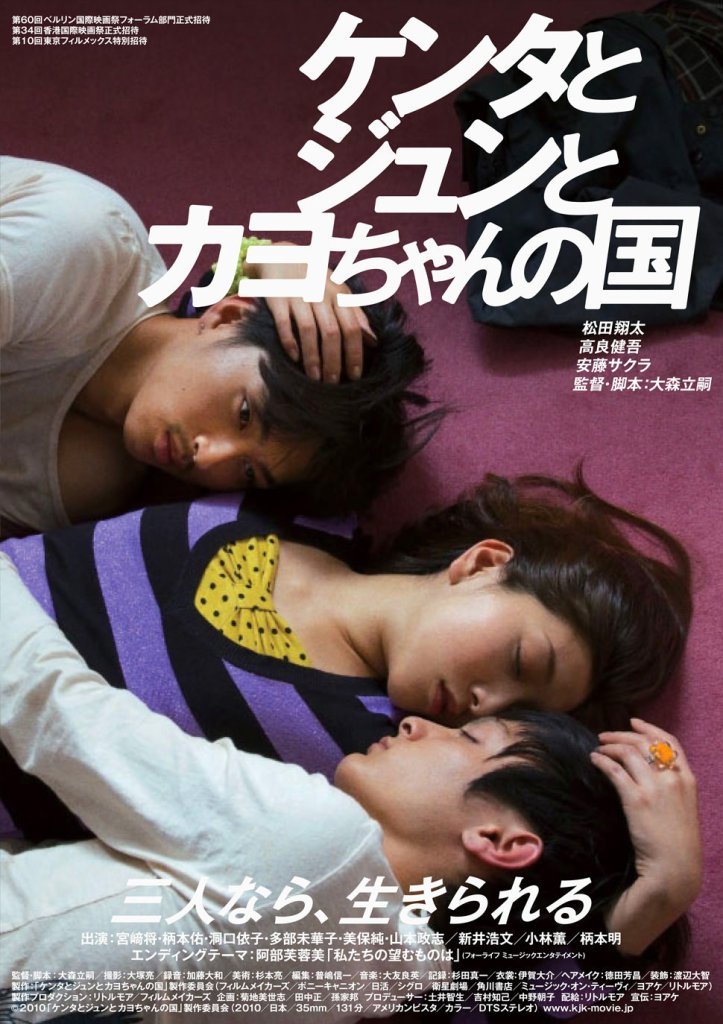
A Crowd of Three (ケンタとジュンとカヨちゃんの国, Tatsushi Omori, 2010)

crowd-of-threeTatsushi Omori’s debut feature The Whispering of the Gods proved so controversial that he was left with no choice other than to set up his own temporary cinema to screen it. Five years later he returned with another uncompromising look at modern society which is only a little less grim than its predecessor. A Crowd of Three (ケンタとジュンとカヨちゃんの国, Kenta to Jun to Kayo-chan no Kuni) takes what has become a staple of quirky indie comedy dramas – a small group of disconnected people taking a road trip to look for something better, and turns it into a depressingly nihilistic voyage to nowhere. Never quite achieving the kind of painful, angst ridden atmosphere of disaffected young men desperately trying to break out of a social straight jacket, A Crowd of Three is an oddly cold film, undercut with a pervasive layer of misogyny and hopelessness which makes its ultimate destination somewhere few will wish to travel.

Kenta (Shota Matsuda) and Jun (Kengo Kora) are young men working dead end construction jobs. Growing up together almost like brothers in the same orphanage the pair share an intense bond but also a shared sense of having been badly let down by life even at such a young age. Their main source of relief seems to be in picking up “loose women” from the street by asking random ladies on their own for their ages. One evening Jun picks up Kayo (Sakura Ando) – a melancholy woman with low self esteem who sleeps around because she is insecure about her own plain looks. After Kenta is assaulted by the foreman, he decides to take revenge by smashing up the office and his boss’ car before taking off on a journey north to see his (biological) brother who is currently in prison.

Kayo tags along with the pair after apparently having fallen in love with Jun who is only interested in her for easy sex and occasional cash tips. Despite the fact that the film’s original Japanese title is “Jun, Kenta, and Kayo’s Country”, Kayo is quickly cast aside by the pair of travellers who think it’s funny to throw all of her stuff out of the window and abandon her at a service station in the middle of nowhere. Getting thrown out of cars and left behind in remote places is something which happens to Kayo repeatedly throughout the film as she tries to follow Jun despite his obvious indifference towards her.

Kayo just wants to feel love, but at least as far as the film goes she’s looking for it in all the wrong places. Even if Jun does start to feel something more genuine for her in the end, it’s born of a kind of shared insecurity as he worries about a repetitive strain injury from using the pneumatic drill which turns his hand white at moments of stress. After literally jilting Kayo, Jun takes up with a vacuous bar hostess who does, indeed, recoil from his pale hand. The bar hostess has very ordinary dreams – a big house, wealthy husband, children. She’s even planned out her own death. These are all things which Jun could never give her, a middle school drop out with no family he already fears he has no future but at least he’s not railroaded onto a pre-determined course and is free to choose his destination even if he feels there is nowhere for him to go.

Kenta expresses this early in the film when he states that there are two kinds of people – those who choose how they’re going to live, and those who don’t. The boys feel as if they’re in the no choice category – unceremoniously kicked out of social care and expected to fend for themselves with no education or contacts, reliant on poorly paid temporary work to get by. In a slightly overworked metaphor, Kenta and Jun’s jobs on demolition projects point to their desire to dismantle their world but the more they smash away at it the less progress they make. Kenta’s literal smashing of the car and office belonging to his boss are his final act of choice but again it gets him nowhere. Even talking to his brother who is in prison for the most heinous of crimes, Kenta finds no encouragement but only cold rejection.

A Crowd of Three goes to some very dark places ranging from work place harassment to child abuse and sexualised violence, but it largely fails to capitalise on its grim atmosphere to make any kind of impact aside from the pervasive melancholia. Omori mostly sticks to a straight forward approach with some interesting editing choices and composition but largely relies on the quality performances of his leading players. Far from youth aflame with nihilistic rage, A Crowd of Three is bleaker than bleak and frozen throughout making the battling of its heroes to transcend their difficult social circumstances a forlorn hope of epic proportions.


Original trailer (no subtitles)

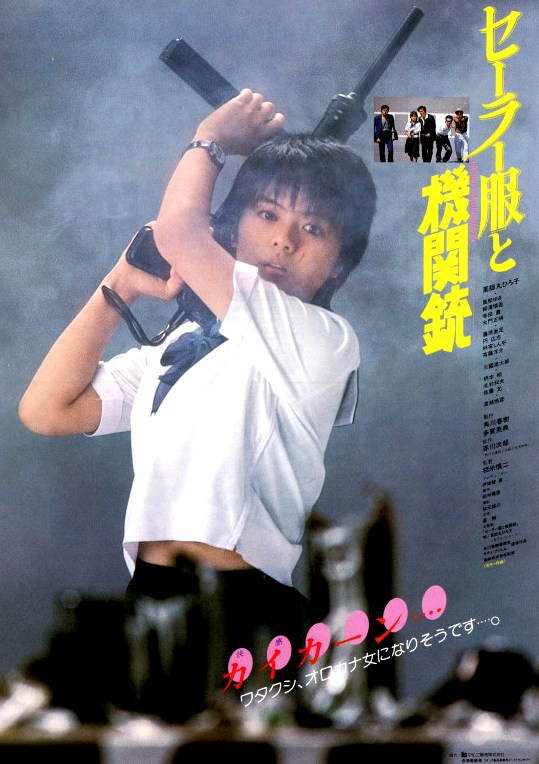
Sailor Suit and Machine Gun (セーラー服と機関銃, Shinji Somai, 1981)

sailor-suit-and-machine-gun

For good or ill, Haruki Kadokawa’s entry into the film industry was to have a profound effect both culturally and commercially. Rising from the ashes of the studio system, Kadokawa’s stable of cute and perky idols presented him with the opportunity to build a multimedia empire formed of a union between cinema, books, and music in which each could be used to sell the other.

1981’s Sailor Suit and Machine Gun (セーラー服と機関銃, Sailor-fuku to kikanju) was one of his earliest successes and helped to solidify his approach. Featuring one of the biggest idol stars of the 1980s, Hiroko Yakushimaru, in her most iconic role, the film adapts a Kadokawa teen novel as its source material and includes an end credits song with the same title sung by the film’s star. It was a winning formula, but then Sailor Suit and Machine is not just another idol movie. Directed by Shinji Somai whose work is much more well known in Japan than it is abroad, this strange story of a high school girl and her unlikely role as a yakuza boss is both a surreal coming of age tale and an arthouse-influenced character piece which came to become the defining youth movie for a generation of female cinema goers.

Izumi Hoshi (Hiroko Yakushimaru) is now an orphan. Her mother died some time ago and today is her father’s funeral. Thinking herself all alone in the world, Izumi is surprised when an older woman, Mayumi (Yuki Kazamatsuri), suddenly appears with a letter from her father claiming he asked her to look after his daughter if anything should happen to him. More surprises follow when her school is surrounded by black-suited yakuza. Prophetically, the other students are terrified, but Izumi marches straight up them to find out what’s going on. As it turns out, they’ve come for her, an uncle of Izumi’s father was the head of a yakuza clan and now that he’s dead they need a blood relative to succeed him. Izumi’s father out of the picture, the position falls to his daughter, teenage high school girl or not. At first she refuses but realising that with no boss the guys will all have to die, Izumi relents and orders them to live. So begins her long, strange, not altogether successful career as the head of moribund clan of dejected yakuza.

In many ways, Sailor Suit and Machine Gun is a parody of a standard yakuza flick in which rival groups vie for power in the crowded backstreets of a busy city. The idea of a tiny 17-year-old girl heading up an organised crime syndicate and going toe-to-toe with grizzled fifty year old veterans is an inherently absurd one as exemplified by Izumi’s courtesy visit to the area’s most powerful gang boss in which he he more or less laughs her out of the office.

Despite the incongruity, Izumi is a tough kid and more than holds her own in the very male underground world. In her father’s letter to Mayumi, he describes his daughter as tough but naive, an analysis which proves true in her tenure as a yakuza boss. There is a degree of silliness in her actions, playing the role assigned for her as if acting a part in a movie, but as her guys start getting knifed it suddenly doesn’t seem so funny after all. The film revolves around a MacGuffin of some missing heroin which belongs to a gangster named Fatso but is also sought by rival gangs. Out of her depth, Izumi has no knowledge of the whereabouts of the missing drugs or even the reason why anyone would want them. This is a situation that can’t be blustered through and Izumi does not have the ability to navigate it.

The idea of an ordinary high school girl plunged into the criminal underworld is as ridiculous as it’s intended to be. However, Izumi is not quite the ordinary high school girl she first appears. Gangly and boyish, she is supported by three male friends who often flank her as entourage but always recede into the background, bowing to her leadership. Already dominant and possessing obvious leadership potential, Izumi’s bold decision to approach the yakuza at the school gates also hints at her curious and fearless personality, even if it also speaks to her youthful recklessness.

These more masculine qualities of forcefulness and dynamism as opposed the stereotypical image of the cute and submissive school girl are perfectly suited to her new life as a crime boss but for all of that her leadership takes on an oddly maternal quality. A wounded footsoldier remarks that Izumi smells like his mother as she’s awkwardly winding bandages around his torso, and the guys flock around her like they would the family matriarch. Tellingly Izumi later tells Mayumi that part of the reason she rejected her was because of her extreme femininity, something the adolescent Izumi did not quite know what to do with, especially given the maleness of her new environment.

Izumi’s short lived career in the yakuza cannot be termed a success in the normal manner of things, she acts honourably and may win a final victory but it comes at great cost. When Izumi finally picks up the machine gun of the film’s title for the intense finale, she finds herself enjoying it a little too much as the word “fantastic” escapes her lips seconds after letting rip intro a rival gang boss’ office. Rather than the romantic awakening which is the climax of many female centred teen movies, Izumi’s major consummatory event is with her machine gun. As she puts it at the end, Izumi’s first kiss goes to a (deceased) middle aged man and she looks set to become a “foolish” woman, her path into womanhood has been an unusually transgressive and as yet unresolved one.

Somai’s camera is is both slippery and precise as he casts us as voyeur in Izumi’s world, shooting through exterior windows and even at one point from behind the shrubbery. Preferring long takes and often at extreme distances, Somai mixes static camera with unusual fluidity for an effect that’s far more arthouse influenced than your usual teen idol picture. As with many of Kadokawa’s ‘80s movies, the film is steeped in the naivety of the teenage world view as Izumi goes about her new life with a kind of fearless determination despite the inherent violence and unexpected adult sexuality. A deserved classic, Sailor Suit and Machine Gun is the archetypal Kadokawa movie, creating a vehicle for its idol star in the fascinating, iconic presence of its central heroine whilst simultaneously generating an enduring pop culture phenomenon.


Original trailer (no subtitles)

And here’s star Hiroko Yakushimaru singing the title song at her 35th anniversary celebration concert in 2013:

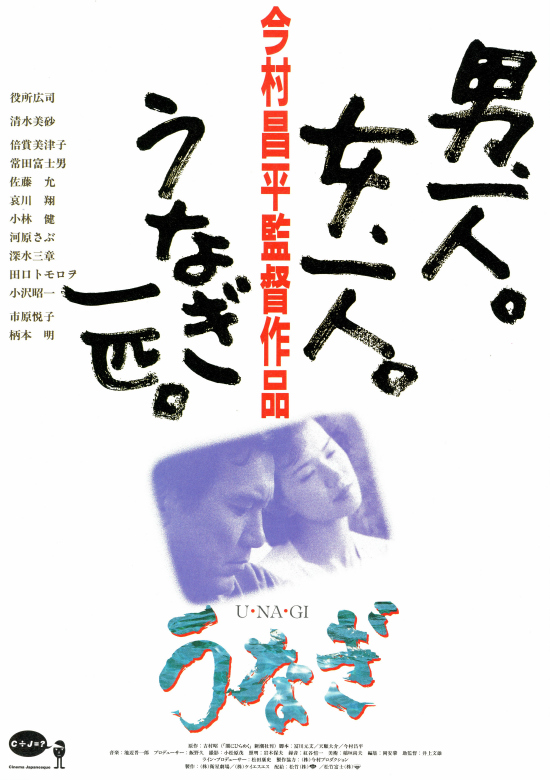
The Eel (うなぎ, Shohei Imamura, 1997)

The EelDirector Shohei Imamura once stated that he liked “messy” films. Interested in the lower half of the body and in the lower half of society, Imamura continued to point his camera into the awkward creases of human nature well into his 70s when his 16th feature, The Eel (うなぎ, Unagi), earned him his second Palme d’Or. Based on a novel by Akira Yoshimura, The Eel is about as messy as they come.

Mild-mannered salary man Yamashita (Kouji Yakusho) receives a handwritten letter filled with beautiful calligraphy delivering the ugly message that his wife has been entertaining another man whilst he enjoys his weekly all night fishing trips. Confused at first, the note begins to work its way into Yamashita’s psyche and so he decides to leave his next fishing trip a little earlier than usual. Peeping through the keyhole, he finds his beloved wife enjoying energetic, passion filled sex with another man. Drawing a knife from a nearby shelf, he enters the room and attacks the pair killing the woman but letting the lover get away.

Yamashita immediately and with perfect calmness turns himself in at the local police station, still covered in his wife’s blood and carrying the murder weapon. Released on a two year probationary period after eight years in jail, there is no one to meet Yamashita when he comes out and so he remains under the guardianship of a Buddhist priest in a nearby town. Accompanied by his only friend, a pet eel, Yamashita takes possession of a local disused barbershop and sets about trying to rebuild his life.

Things change when Yamashita comes across an unconscious woman lying in the grass while he’s out looking for things to feed his eel. The strange thing is, this woman looks exactly like his wife. Eventually, Keiko (Misa Shimizu) recovers and comes to work with Yamashita in his new enterprise but as the pair grow closer the spectres of both of their troubled pasts begin to intrude.

As the small town residents of Yamashita’s new home often remark, Yamashita is a strange man. His deepest relationship is with his eel which the prison guards, who seem quite well disposed towards him, allowed him to keep in the prison pond even though pets are not generally allowed. When asked why he likes his eel so much, Yamshita replies that the eel listens to him and doesn’t tell him the things he does not wish to hear. Like Yamashita, the eel is isolated inside his tank, content to absent himself from interacting with other creatures, both protected and constrained by transparent walls.

After his release from prison, Yamashita begins to reflect on his crime which he doesn’t so much regret but has no desire to repeat. His other double arrives in the form of fellow inmate and double murderer Tamasaki (Akira Emoto) who keeps trying to convince Yamashita that he is living dishonestly by not having visited his wife’s grave or read sutras for her. Though Yamashita pays no heed to most of his advice which is more self-pity and anger than any real concern for Yamashita’s soul, some things begin to get to him, most notably that perhaps the fateful letter never existed at all and is nothing more than the manifestation of Yamashita’s jealous rage.

Though the film presents everything that happens to Yamashita as “real”, his state of mind is continually uncertain. Not only is the provenance of the letter doubted, he doubts the existence of Keiko because she looks (to him at least) like the returned ghost of the woman he killed, and even the final confrontational arguments with Tamasaki take on an unreal quality, as if Yamashita were arguing with himself rather than another man who also represents his own worst qualities – impulsivity, violence, self doubt and insecurity. The film is so deeply embedded in Yamashita’s subjective viewpoint that almost nothing can be taken at face value.

Yamashita is, in a sense, trapped in a hall of mirrors as his own faults are reflected back at him through the people that he meets. Keiko, rather than being physically murdered by a jealous lover, attempted to take her own life after being misused by a faithless (married) man. Her past troubles are, in some ways, the inverse of Yamashita’s as she finds herself at the mercy of dark forces but internalises rather than externalises her own anger. Cheerful and outgoing, she quickly turns Yamshita’s barbershop into a warm and welcoming place which the local community takes to its heart.

Yamashita, however, remains as closed off as ever though he does strike up something of a relationship with a lonely young man who wants to use his barber’s pole to try and call aliens. When Yamashita asks him what he’s going to do if the aliens actually come, the young man replies that he wants to make friends with them. Yamashita astutely remarks that the young man’s desire to meet aliens is down to a failure to connect with people from his own planet – an idea which the young man equally fairly throws back at him. Perhaps out of fear rather than atonement, Yamashita exiles himself from the world at large though gradually through continued exposure to the genial townsfolk and Keiko’s deep seated faith in him, he does begin to swim towards the surface.

Imamura adopts his usual, slightly ironic tone to lighten this otherwise heavy tale allowing the occasional comic set piece to shine through. Yakusho delivers another characteristically nuanced performance as this entirely unformed man, unsure of reality and trapped in a spiral of self doubt and confusion. His original crime of passion is at once chilling in its calmness but also messy and violent as he gives in to animalistic rage. After showing us a street lamp glowing an ominous red, Imamura steeps us in blood as his camera becomes progressively more stained making it impossible to forget the shocking betrayal of this unexpected violence.

Yamashita remarks at one point that he died that day alongside his wife. The Eel is a story of rebirth as its protagonists begin to swim towards the shore in support of each other, though like the titular marine creature there is no guarantee that they will make there alive. Yamashita is a cold blooded murderer and creature of suppressed rage yet Imamura is not interested in moral judgements as much as he is in the messier sides of human nature. A chance offering of redemption for the unredeemable, The Eel offers hope for the hopeless in a world filled with goodhearted eccentrics where all faults are forgivable once they are understood.


Original trailer (no subtitles)

https://www.youtube.com/watch?v=yAC3KZth7E0

All Around Us (ぐるりのこと。, Ryosuke Hashiguchi, 2008)

all around usRyosuke Hashiguchi returns after an eight year absence with All Around Us (ぐるりのこと。Gururi no Koto) and eschews most of his pressing themes up this by point by opting to depict a few “scenes from a marriage” in post-bubble era Japan. Set against the backdrop of an extremely turbulent decade which was plagued by natural disasters, terrorism, and shocking criminal activity Hashiguchi shows us the enduring love of one ordinary couple who, finding themselves pulled apart by tragedy, gradually grow closer through their shared grief and disappointment.

Tokyo, 1993. Kanao (Lily Franky) and Shoko (Tae Kimura) have had an “on and off” (but seemingly solid) relationship since their art school days. She works at a publishing house and he’s kind of a slacker with a job in a shoe repair booth. Shoko worries that Kanao plays around too much (but actually doesn’t seem that bothered about it) whilst continuing to attempt to micromanage their entire existence with her clearly marked calendar planning out the most intimate of actions. When Shoko discovers she’s expecting a child, the pair decide to finally get married and begin their lives as a family. Kanao also gets an opportunity on the work side when an old college friend helps him get a job as a courtroom artist for a news agency.

However, their joy is short-lived as an abrupt jump forward in time shows us a tiny shrine underneath the calendar (shorn of its red crosses) dedicated to the memory of their infant daughter. Kanao is the keep calm and carry on sort so he just tries to bluster through but Shoko is distraught and slowly descending into a mental breakdown. If that weren’t enough to contend with, Shoko’s estranged father has been tracked down and is apparently very ill dredging up even more pain an uncertainty from the long buried past.

We follow Shoko and Kanao over a period of nine years. As well as the ever present motif of the calendar, we feel the passage of time through Kanao’s work at the court house which sees him become the artistic recorder of some of the most traumatic moments of the age. Having entered into an era of economic turmoil following the end of the bubble economy, the 1990s saw not only the devastating Kobe Earthquake but also the sarin gas attack on the Tokyo underground perpetrated by a dangerous religious cult, members of which wind up in court in front of Kanao, tasked with the thankless task of bearing witness to their testimony.

Kanao evidently decided not to discuss his personal tragedy with his work colleagues or, one would assume, his boss would not have reacted so harshly when he made the reasonable request to turn down the opportunity to sit in on yet another child murder trial – either by accident or design, the trials which present themselves to Kanao (and are all real, sensationalised media events of the time) involve the horrific murders of small children with only one of the defendants voicing any kind of regret or remorse.

Meanwhile, Shoko has been trying to get on with life as best she can but finds herself sinking ever deeper into depression. Her uptight, controlling personality cannot cope with this perceived “failure” on her part or of the destruction of all her plans by a truly unforeseen tragedy. Having had her doubts before regarding Kanao’s commitment to her, she finds his lack of reaction puzzling. Mistaking Kanao’s lack of outward emotion for indifference, Shoko finds it hard to continue believing in their shared destiny and wonders if her husband ever really cared for her at all. Kanao is a laid-back soul, someone who’s learned to become used to disappointment by accepting it quickly and then trying to move on. His more grounded approach might be just the one Shoko needs in order to come to terms with what’s happened – never pushing or complaining Kanao is contented simply by her presence and is prepared to give her the space she needs whilst always being around to offer support.

Hashiguchi relies on visual cues to help navigate the shifting dynamics including the repeated use of the calendar as a symbol of Shoko and Kanao’s marital status, the now unneeded pregnancy books bundled to be thrown out, or rice discarded in the sink as a marker of a house proud woman’s slide into crippling depression. Small moments make all the difference from a mother’s bandaged wrists and a cutback to the only person who’s noticed them, to the repeated joke of all the veteran journalists suddenly falling over themselves in an attempt to escape the courtroom and be the first to file their copy. A necessarily sad story, but an oddly warm one as two people worried they may be mismatched grow into each other in the face of their shared tragedy. Anchored by the strong performances of its two leads (particularly Tae Kimura who manages some convincing on screen crying in a difficult role) All Around Us is another beautifully pitched human drama from Hashiguchi who proves himself an adept chronicler of the human condition even whilst stepping away from his trademark themes.


Original trailer (English subtitles)

A Woman and a War (戦争と一人の女, Junichi Inoue, 2013)

a-woman-and-warJunichi Inoue is better known as a screenwriter and frequent collaborator of avant-garde/pink film provocateur Koji Wakamatsu. A Woman and a War (戦争と一人の女, Senso to Hitori no Onna) marks his first time in the director’s chair and finds him working with someone else’s script but staying firmly within the pink genre. Adapted from a contemporary novel by Ango Sakaguchi published in 1946, A Woman and a War is an intense look at domestic female suffering during a time generalised chaos.

The unnamed “Woman” (Noriko Eguchi) is a former prostitute, sold to a brothel by her father as a child, now working as a bar hostess. Times being what they are, she decides there’s no future in bar work and wants to get married. Accordingly, she finds herself moving in with a moody novelist who frequents the bar, Nomura (Masatoshi Nagase). The woman becomes Nomura’s “wife”, but the relationship is strained as she finds it difficult to derive pleasure from sex and he is of a nihilistic mindset, convinced that Japan is about to lose the war. Nomura promises to live with her until the war’s end, at which time he assumes the country will cease to exist taking him with it.

Running parallel to this is the story of recently demobbed soldier and drinker at Woman’s bar, Ohira (Jun Murakami). Having lost an arm in the war, Ohira has been “lucky”, in a sense, and been sent home early. However, he has a wife and young son he’s been away from so long that they’re virtual strangers from each other. Ohira is not the man who went away to fight, he’s embittered and angry. Unable to enjoy normal relations with his wife, he finds himself aroused after failing to rescue a woman being gang raped by thugs which he then watches after being tied up while the men finish their business. After this, he despatches his family to the comparative safety of his wife’s parents and embarks on a career of violence, rape and murder.

Despite nominally being the story of the Woman, A Woman and a War has an unbalanced tripartite structure split between the three central characters. Of the three, Nomura’s story is the least explored but then is also the most clichéd in its familiar over sensitive novelist takes hack jobs and abuses all available substances to block out his crushing depression trope. Though the story ought to belong to Woman, she is often eclipsed by Ohira’s extreme descent into violent misogyny though in actuality these two strands dovetail into each other as Woman’s story is also one of continued exploitation.

This stems back well before the war as she was, in a sense, betrayed by her father when he sold her supposedly in desperation but apparently drank the money he got for her rather than using it to feed the rest of the family. Having spent so long in the brothel her body has become nothing more than a tool to her – something to be well maintained and then traded as a commodity. After her relationship with Nomura ends, Woman finds herself once again working as a prostitute – first at a facility set up for the American military, and then as a streetwalker targeting foreign servicemen. Eventually her path crosses with that of Ohira which results in the uncomfortable realisation that she too can only reach climax through violence.

Ohira is so deeply scarred by his wartime experiences that he has a compulsion to reenact them through random acts of sexual violence on unsuspecting women. The events he recounts from Manchuria are truly horrifying but he has an uncomfortable point when he repeats that the difference between what he did in the war and what he’s doing now is that between a medal and a death sentence. The people he killed in China weren’t soldiers or those who threatened his life, they were innocent civilians no different from the women he lured into the forests of Japan, so how was it right then and wrong now? The other uncomfortable fact is that Ohira is both perpetrator and victim of the wider war, a symbol of its cannibalistic whirlwind of destruction, the effects of which continue in perpetuity.

Coming as he does from the pink film world, Inoue adopts a detached frankness when it comes to sex. However, in keeping with the film’s themes there is an abundance of sexualised violence against women which, though every bit as unpleasant as it’s intended to be, does at times feel gratuitous. It’s also an unfortunate fact that there is a lot of gratuitous female nudity in the film but absolutely no male – at one point Woman bares her genitals to the open air and urges Nomura to do the same but the camera cuts to a rear shot as though embarrassed. In an interview with Diva Review Inoue admits he regrets the way this was handled and states it’s largely down to having bigger name actors in the two central roles, but in addition to deviating from the otherwise naturalistic intentions of the film, it also presents him with a set of thematic problems which undercut his central intentions.

However, A Woman and a War is one of the few (recent) films to seriously look at the traumatic afterlife of the war both on those who served and those who stayed at home using sexuality as a curiously reflective prism. A Woman and a War is a super low budget film and, in truth, looks it, though does make an attempt to do the best it can with what it has. The performances of the three leads are also each strong though something of the film’s tone never quite coalesces beyond the persistent unpleasantness into something more deeply probing. Troubling, concerning, and disturbing, A Woman and a War is a much needed look at this murky and often avoided area but one that finds it impossible to escape its own exploitative nature.


Original trailer (English subtitles):

Sumo Do, Sumo Don’t (シコふんじゃった, Masayuki Suo, 1992)

sumo do sumo don'tConsidering how well known sumo wrestling is around the world, it’s surprising that it doesn’t make its way onto cinema screens more often. That said, Masayuki Suo’s Sumo Do, Sumo Don’t (シコふんじゃった, Shiko Funjatta) displays an ambivalent attitude to this ancient sport in that it’s definitely uncool, ridiculous, and prone to the obsessive fan effect, yet it’s also noble – not only a game of size and brute force but of strategy and comradeship. Not unlike Suo’s later film for which he remains most well known, Shall We Dance, Sumo Do, Sumo Don’t uses the presumed unpopularity of its central activity as a magnet which draws in and then binds together a disparate, originally reluctant collection of central characters.

We begin with a lecture given by Professor Anayama (Akira Emoto) in which he recounts the brief mention of sumo in the work of Jean Cocteau. It seems that Anayama is something of a sumo fanatic and had previously been a champion wrestler in his student days. Shuhei Yamamoto (Masahiro Motoki) is currently registered for Anayama’s class but he’s here on a party mandate and never attends classes – he even has someone raise their hand for him at registration. Shuhei already has a job offer for when he leaves so he needs to graduate – Anayama makes him a proposition, join the currently moribund sumo club and he’ll forget about the lack of attendance problem and fill his credits up too.

Actually, the sumo club has only one member – fanatical sumo fan and mature student, Aoki (Naoto Takenaka). Aoki takes tradition very seriously and it’s not long before he’s got Shuhei in a traditional “mawashi” sash (don’t call it a fundoshi!) and parading about the campus trying to find others they might be able to coerce into the club so they can compete in the next competition. Luckily they run into shy student Hosaku (Hiromasa Taguchi) who’s quickly convinced to help them keep the sumo club open, before also recruiting Shuhei’s younger brother Haruno (a refugee from the regular wrestling team), and even a foreign student, George Smiley, who only joins up to save on his rent. Together, they face an uphill battle but can they really conquer this demanding game with so little experience between them?

At heart, Sumo Do, Sumo Don’t is a standard sports comedy in which a rag tag collection of amateurs attempt to triumph over adversity whilst finding out more about themselves and each other.  No one, other than Aoki, really wanted to be in the sumo club with its embarrassing attire and total lack of social kudos. Shuhei is only there because he needs the grades, but after seeing how much Aoki cares about his sport he becomes determined to support his new found friend. Similarly, Hosaku had been leading quite a lonely life but enjoys being part of a team where his friends enthusiastically cheer him on.

By bringing in the foreign student (supposedly an English rugby player but played by an American with an unusually gung-ho attitude) Suo attempts to define sumo and, in a roundabout way, other aspects of Japanese culture from a more detached view point. “You Japanese never think things through” he’s fond of saying after asking a perfectly logical question that no one seems able to answer such as why they have a shrine to a household god in their clubhouse when this is a Christian university or why it’s frowned upon for him to wear shorts underneath his mawashi. Later, the group get a hanger on in the form of Masako (Ritsuko Umemoto) who has taken a liking to sumo, and more particularly to Haruno. Women aren’t allowed in the sumo ring but this is one aspect of tradition that it seems even the sumo diehards are prepared to let go. Far from the serious and rarified sumo world, the sumo club is a strictly equal opportunities enterprise built on mutual trust and acceptance. No one who loves the beautiful art of sumo is getting turned away.

Perhaps with less serious intent that some of Suo’s later works, Sumo Do, Sumo Don’t is a prime example of the ensemble comedy drama. The essence of the humour is physical leaning mainly on slapstick but with a side serving of wit and irony. Suo keeps things simple and straightforward, allowing the gentle comedy to emerge organically underpinned by strong characterisation and performances. Unashamedly feel good yet never tipping over into the mawkishly sentimental, Sumo Do, Sumo Don’t is the best kind of sports comedy where the outcome itself is almost irrelevant in light of the greater game that’s been in play right the way through.


Unsubbed trailer: