Minbo, or the Gentle Art of Japanese Extortion (ミンボーの女, Juzo Itami, 1992)

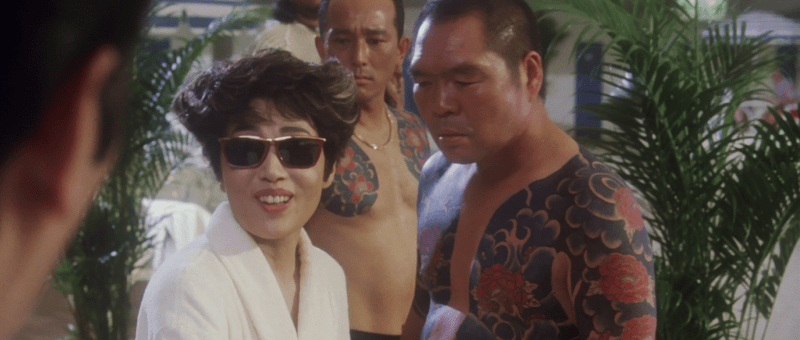
“Yakuza are vain, treat them politely,” the heroine of Juzo Itami’s 1992 comedy Minbo, or The Gentle Art of Japanese Extortion (ミンボーの女, Minbo no Onna) instructs a hapless pair of hotel employees trying to solve the organised crime problem at their hotel, but it’s a lesson Itami would go on to learn himself after he was attacked by gangsters who slashed his face and neck with knives. Itami in fact died in fairly suspicious circumstances in 1997 having fallen from the roof of a high-rise building leaving a note behind him explaining his “suicide” was intended to prove his innocence in regards to an upcoming newspaper story alleging an affair with a young actress. Given Itami’s films had often made a point of skewering Japanese traditions and that taking one’s own life is not the way most would choose to clear their name, it has long been suggested that his death was staged by yakuza who’d continued to harass him ever since the film’s release. 

It’s true enough that Minbo may have touched a nerve in undercutting the yakuza’s preferred image of themselves as the inheritors of samurai valour standing up for the oppressed masses against a cruel authority. Of course, that isn’t really how it works and getting the yakuza on your side in a civil dispute may be a case of out of the frying pan into the fire. It’s the yakuza themselves who are the oppressive authority ruling by fear and intimidation. Even so, the yakuza as an institution were in a moment of flux in the early ‘90s following the collapse of the bubble economy during which they’d shifted further away from the street thuggery of the post-war era into a newly corporatised if no more respectable occupation. This change is perhaps exemplified by “minbo”, a kind of fraud in which gangsters get involved in civil disputes underpinned with the thinly veiled threat of violence. 

The yakuza who plague the Hotel Europa, for example, pull petty tricks such as “discovering” a cooked cockroach in the middle of a lasagne, or claiming to have left a bag of cash behind which is later handed back to the “wrong” person by the front desk who probably should have asked for ID. Itami frames the presence of the yakuza as a kind of infestation, suggesting that if you do not tackle it right away it soon takes over and cannot be removed. Dealing with the problem directly may cause it to get worse in the short term, but only by doing so can you ever be rid of them once and for all. At least that’s the advice given by forthright attorney Mahiru (Nobuko Miyamoto) who demonstrated that the only way to deal with yakuza is to show them that you aren’t afraid because at the end of the day the law is on your side. 

Part of the “woman” cycle in which Itami’s wife Nobuko Miyamoto stars as a sometimes eccentric yet infinitely capable woman solving the problems of contemporary Japan through old-fashioned earnestness and everyday decency, Minbo finds its fearless heroine explaining that the yakuza themselves are a kind of con. In general they won’t hurt civilians because then they’re much more likely to be arrested. Going to prison is incredibly expensive and therefore not likely to prove cost effective. She knows that if she can catch them admitting they’ve committed a “crime” then they can’t touch her, and they won’t. They do however go after the rather more naive hotel boss Kobayashi (Akira Takarada) whom they try to frame for the rape of a bar hostess, drugging him after he unwisely agreed to meet them alone to hand over blackmail money. Then again, the hotel isn’t entirely whiter than white either. Kobayashi admits they can’t pull strings with the health ministry over the cockroach incident because they previously used them to cover up a previous instance of food poisoning. 

In any case, the yakuza end up looking very grubby indeed. It’s hard to call yourself a defender of the oppressed when you’re pulling petty stunts no better than a backstreet chancer. Yet like any kind of irritating insect, they too begin to evolve gradually developing a kind of immunity to Mahiru’s tactics in themselves manipulating law only they aren’t as good as she is and they are after all in the wrong. She’s a little a wrong too in that if pushed too far the yakuza will indeed stoop to physical violence against civilians, but she also knows that they thrive on fear and that to beat them she may have to put her safety on the line to prove they have no power over her. It seems Itami felt something similar issuing a statement shortly after his attack to the effect that “Yakuza must not be allowed to deprive us of our freedom through violence and intimidation, and this is the message of my movie”. As gently humorous as any of Itami’s movies and no less earnest, Minbo paints the yakuza as a plague on post-bubble Japan and suggests that it’s about time they were shown the door. 


Trailer (no subtitles)

A Wanderer’s Notebook (放浪記, Mikio Naruse, 1962)

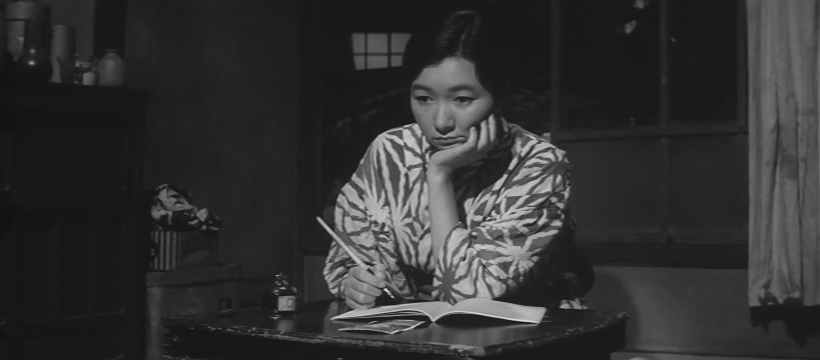
Many of Mikio Naruse’s most famous films are adapted from the work of Fumiko Hayashi, a pioneering female author who chronicled the life of a working class woman with startling frankness. Yet his dramatisation of her life, A Wanderer’s Notebook (放浪記, Horo-ki), is both a little more reactionary than one might have expected and surprisingly unflattering even in the heroine’s eventual triumph in escaping her poverty through artistry. Even so if perhaps sentimentalising the economically difficult society of the 1920s in emphasising the suffering which gave rise to Hayashi’s art, the film does lay bare the divisions of class and gender that she did to some extent transgress in pursuit of her literary destiny. 

Naruse and his screenwriters Toshiro Ide and Sumie Tanaka bookend the the film with a literal “lonely lane” which the young Fumiko walks with her itinerant salespeople parents. As a small child, she sees her father arrested for a snake oil scam peddling some kind of wondrous lotion, setting up both her disdain for men in general and her determination not to be deceived by them at least unwittingly. She has no formal education but is a voracious reader well versed in the literary culture of the time and intensely resentful of if resigned to her poverty. In the frequent sections of text which litter the screen taken directly from her novels, she details her purchases, wages, and longing for the small luxuries she can in no way afford. 

As an uneducated woman in the 1920s her working opportunities are few. She exasperatedly relates standing in a queue with hundreds of other women waiting for an interview for a company job only to be told they’ll let her know, while her other opportunity involves meeting a theatre director at a station who later takes her to his hotel/office and makes it plain he’s not really interested in her CV. She gets a job at the office of a stockbroker, but lies about being able to do accounts and is flummoxed by double entry bookkeeping getting herself fired on day one. After a brief stint in factory painting toys, she leaves with a friend to become a hostess but is also fired on her first day for getting drunk and being unwilling to ingratiate herself with the boorish men who frequent such establishments. 

Despite her animosity, she is drawn towards men who are callous and self-involved, firstly taking up with a poet and actor who praises her work but turns out to have several “wives” on the go, and then begins living with a broody writer, Fukuchi, who is insecure and violent, resentful at her success in wake of his failure. Perhaps because of her experiences, she seems to resent any hint of kindness though sometimes kind herself, lending money to her friend whose mother is in need and often ready to stand up for others whom she feels are being mistreated. A kindly widower in the boarding house where she lives with her mother, Yasuoka, falls in love with her but she repeatedly rejects him partly as someone suggests because he is not handsome, but mainly because of his goodness and kindness towards her. Nevertheless, he continues to support always ready in her time of need though having accepted that she will never return his feelings or accept his proposal. 

Perhaps her might have liked to have been kinder, but was too wounded by her experiences to permit herself. In any case at the film’s conclusion in which she has achieved success and in fact become wealthy it appears to have made her cold and judgemental. She instructs her maid to send a man away believing he is from a charity set up to help the poor, insisting that the poor must work for industry is the only path out of poverty implying that as she managed it herself those who cannot are simply not applying themselves when she of all people should know how fallacious the sentiment is. As if to bear out the chip on her shoulder, she forces her mother to wear a ridiculous kimono from a bygone era that is heavy for an old woman and makes her feel foolish because of her own mental image of the finery she dreamed of providing her on escaping the persistent hardship of their lives. 

As she says, she’s no interest in the socialist politics espoused by the literary circles in which she later comes to move, pointing out that the poor have no time for waving flags. One of her greatest supporters is himself from a noble family despite his progressive politics and in truth can never really understand the lives of women like Fumiko. He describes her work as like upending a rubbish bin and poking through it with a stick, at once fascinated and repulsed by a frankness he may see as vulgar. At one point he accuses her of writing poverty porn, playing on her humble origins for copy and becoming something of a one note writer. 

In truth, the film is not really based on the novel from which it takes its title but on the play that was adapted from it, while the novel itself was apparently reworked and republished several times in response to reader taste giving rise to a series of questions both about its essential authenticity and what it was that it was attempting to convey. In the film at least, moments after her literary success, Fumiko is challenged by a fellow female writer, Kyoko, who was once her love rival, that she cheated in a contest by failing to submit Kyoko’s entry until after the deadline had passed, though as it seems she would have won anyway. She is occasionally underhanded, perhaps because she feels she has no other choice, but then as we can see there is no particular solidarity between women save the kindly landladies who often let her delay her rent payments. Fumiko feels herself to be alone and her quest is not really for literary success but simply for her next meal, though she feels the slights of the bitchy women and arrogant men who mock her commonness while simultaneously exploiting it as entertainment. 

On the one hand, her success seems to signal a triumph of independence having freed herself from the need to depend on terrible men though she also she seems to have met and married a warmhearted painter who cares for her and supports her work while she has also been able to give her mother the level of comfort they both once dreamed of. Even so, the unavoidable fact that she dies at such a young age implies she’s worked herself into an early grave in a sense punishing her for her rejection of contemporary social norms undercutting her achievements with some regressive moralising while the one thing she still desires, rest, is given to her only in death. In Takamine’s highly stylised performance, as some have implied perhaps intended to mimic the silent screen, Fumiko is at once a carefree young woman who dances and sings and a melancholy fatalist with a self-destructive talent for choosing insecure and self-involved men, but above all else a woman walking a lonely road towards her own fulfilment while searching for a way out of poverty that need not transgress her particular sense of righteousness. 


Original trailer (no subtitles)

The End of Summer (小早川家の秋, Yasujiro Ozu, 1961)

Fathers in Ozu are usually sentimental and doting, sometimes insensitive or austere, but by and large responsible. The crises the family faces are generally emotional more than they are practical, few Ozu fathers fail in a duty of care towards their wives and children. And then, there’s Manbei (Ganjiro Nakamura). The hero of Ozu’s penultimate film, The End of Summer (小早川家の秋, Kohayagawa-ke no Aki), is quite the opposite. He does as he pleases and enjoys his life to the fullest without really noticing the effect his behaviour has those around him. But then, as his sister later puts it, he was a very happy man which is rare thing in this society so perhaps he had something right after all. 

Produced for Toho and set in Osaka rather than the usual Shochiku and Tokyo, the film opens not with Manbei but with his brother-in-law Kitagawa (Daisuke Kato) trying to set up Manbei’s widowed daughter-in-law Akiko (Setsuko Hara) with a widowed industrialist obsessed with cows. Meanwhile, the family is also trying to find a match for his youngest daughter, Noriko (Yoko Tsukasa), who is put off by the whole idea of an arranged marriage and worried that Manbei and her older sister Fumiko (Michiyo Aratama) may try to pressure her into accepting because their family sake brewery is trouble. Fumiko’s husband Hisao (Keiju Kobayashi) is technically running the brewery and favours a merger to save the business but Manbei is resistant. Manbei himself is largely absent and his increasing habit of skipping out during the day is beginning to worry the family, especially when they discover he’s been visiting an old mistress with a 21-year-old daughter he thinks is his. 

Followed to a cafe, Manbei exclaims that summer refuses to end in an accidental metaphor for his life. For him everything is sunshine and rainbows, scuttling away from the family home like a little boy sneaking out after dark while the now grownup kids are left behind to clean up his messes. Manbei is a widower, and aside from the financial dimension, perhaps it’s not a huge problem if he wants to go and hang out with an old flame, but Fumiko in particular is scandalised remembering the various humiliations he put her late mother through when she was just a child. Hisao advises her that perhaps it’s best not to bring it up. Manbei isn’t going to change his behaviour and it’s only going to create more drama whereas it might be more manageable if they all pretend not know. Fumiko, however, can’t stay silent even if she knows her father isn’t going to listen to her and in fact lies quite baldly about what he’s been doing in Kyoto. 

Fumiko is on the side of marrying Noriko off, but unlike her husband, father, and uncle, is keen to emphasise that they should move slowly and be sure to take her feelings into account. Rather than her sister, Noriko turns to Akiko for support. Originally in favour of meeting the prospective husband, after all you can always turn it down if you don’t like him, she cautions Noriko that the most important thing is character rather than behaviour and that it’s essential to marry without regret. Noriko feels as if she’s obliged to do as everyone says, but is secretly in love with a young man she met on a skiing holiday who has just been transferred to Sapporo. Akiko, meanwhile, was not altogether taken with the cow-loving widower, but in any case would prefer to maintain her present way of life as a single mother even while others pressure her to remarry. 

The conclusion Noriko comes to is, perhaps strangely, inspired by her carefree father in that she decides it’s best to do what will make her the most happy rather than simply going along with what everyone else wants her to do which may or may not be in her best interest. Fumiko grudgingly admits that though her father was often exasperating perhaps he was the only thing holding the family together. Ozu broadly lends the irresponsible but never malicious Manbei tacit approval in celebrating the fact that he lived the life he wanted to live and he was at least defiantly happy in his own eternal summer, but then ends on an uncharacteristically morbid note as two farmers wash vegetables in the river opposite a crematorium remarking on the increasing number of crows while resigning themselves to the cycle of life. Smoke and crows await us all, perhaps Manbei had it right and the thing is to be happy while you can without taking much notice of what others might have to say about it. 


The Big Boss (暗黒街の顔役, Kihachi Okamoto, 1959)

By 1959, Japan was well on the way towards economic recovery but this transitionary period brought with it its own dilemmas and particularly for those whose main line of business had in a sense depended on instability and desperation. The first of Kihachi Okamoto’s early crime capers, The Big Boss (暗黒街の顔役, Ankokugai no kaoyaku) finds the yakuza at just this moment of crisis, prescient in a sense in perhaps prematurely implying that post-war gangsterdom was already on its way out. 

The film opens, however, with a piece of yakuza thuggery as a mysterious man guns down an industrialist before barreling down the stairs and into a waiting car occupied by getaway driver Mineo (Akira Takarada) who is inconveniently spotted by a passerby, 16-year-old ramen restaurant waitress Kana (Rumiko Sasa). As we discover, Mineo is the younger brother of veteran gangster Ryuta (Koji Tsuruta), a middle-ranking member of the newly rebranded, rapidly corporatising yakuza outfit Yokomitsu Trading who seem to specialise in legal debt collection and running the entertainment district. Torn between their desire for a degree of legitimacy and their thuggish instincts, Yokomitsu have evidently knocked off a rival using an external hitman but now have a problem on their hands especially as Mineo has apparently embarked on a career as a singer in a teen jazz bar located in the same area as Kana’s restaurant which is at the very least unwise. 

Mineo is in many ways the “innocent” seen in many other similarly themed yakuza dramas, still too young to have been corrupted by the underworld and only an accomplice in the crime for which he is being asked to pay. He wants to get out of the yakuza life and sees singing as his escape route, adopting the persona of “Eddie Mineo” and styling himself as a teen idol in the vein of the rock ’n roll American pop culture which seems to be dominiating the late ‘50s youth scene. Yet Okamoto is also clearly evoking the world of Hollywood crime cinema, the environment open and dusty while everyone seems to drive massive Cadillacs and his gangsters behave much more like those in American movies than traditional yakuza even as the traditional yakuza is also changing. 

“I can’t stand it anymore” Ryuta finally exclaims, “There’s neither righteousness nor rules among mobsters”, tipped over the edge by the gang’s plan to kill the teenage witness. He wants out too, but considers himself already too far gone while pulled in two directions in his desire to save both his brother and his young son who has a lame leg and is being cared for in a hospital. Ryuta wears his wedding ring throughout though there’s no mention of what happened to his wife, while he’s also pulled between two potential love interests in the sympathetic doctor who cares for his son, Sumiko (Yumi Shirakawa), and the brassy cabaret girl, Rie (Mitsuko Kusabue), who does her best to save him, but in the end is never very much interested in either of them. He’s constantly haunted by his crimes, knowing what happens to yakuza who fall from grace in his murder of a man who limped and walked with a crutch just like his son. 

The clan are also planning to off a former foot soldier, Ishiyama, who in fact commits suicide immediately after his release from prison realising the futility of his position. Ishiyama’s suicide note directly references that of notorious post-war gangster Rikio Ishikawa whose life inspired Kinji Fukasaku’s Graveyard of Honor 15 years later “I took too big a gamble. lt’s a big laugh. It’s been a thirty year long spree.“ Ryuta realises there’s no way out of his life of crime, but finds himself conflicted even in his desire to ensure his brother and son remain free of it. His sense of futility is however wider, witnessing the death and decline of the traditional yakuza in itself the film climaxing in a moment of yakuza apocalypse as those apparently sick and tired of violence and intimidation finally fight back making it clear that organised crime is no longer welcome in the increasingly prosperous society. 

Skewing darker in tone than Okamoto’s subsequent entries into the “ankokugai” or “underworld” series, The Big Boss is lighter on his characteristically absurdist sense of humour but does feature a little of the exaggerated, cartoonish violence otherwise his hallmark while adding a note of irony as in his use of a sign outlining the numbers for police and ambulance or the sight of a bunch of children playing with guns while a hitman has a go on the swings. There is perhaps a sense of resistance to the conventionality of the material or that his relative inexperience, this being only his third film (the first two both romantic comedy vehicles for Izumi Yukimura) prevented him from fully embracing his anarchic spirit but The Big Boss nevertheless sows the seeds of his later career in its insistence on the absurdity of violence. 


Original trailer (English subtitles)

Woman of Design (その場所に女ありて, Hideo Suzuki, 1962)

“This job poisons you and deprives you of your youth” according to conflicted ad-exec Ritsuko (Yoko Tsukasa) trying her best to make it in the still very male world of adverting. A snapshot of the city in the early ‘60s, Hideo Suzuki’s workplace melodrama Woman of Design (その場所に女ありて, Sono Basho ni Onna Arite) considers the changing position of women through the eyes of four friends working at the same company, each facing challenges mainly at the hands of useless men while trying to claim a space for themselves as individuals but discovering that they are still subject to a binary choice when it comes to deciding their romantic futures. 

A woman of around 30, Ritsuko has worked her way up to a fairly senior position at Nishigin Advertising which at least appears to be a fairly progressive company run by a compassionate boss who treats his employees equally with respect for all. Nevertheless, Nishigin is very interested in its bottom line especially as the company is apparently not doing so well to the extent that they’ve unfortunately had to cut back on their “entertainment” budget which is apparently how they win and keep clients. A new opportunity has presented itself in the chance to win a contract with a pharmaceuticals company to market their brand new drug aimed at “revitalising” the lives of the over 40s. Unfortunately, they have a rival in the form of Daitsu and suave adman Sakai (Akira Takarada) who appears to have pipped Ritsuko to the post in “seducing” their sleazy PR guy.

Though focussed on her career and somewhat resistant to romance, Ritsuko finds herself attracted to Sakai if eventually wondering if he’s only using her for inside info on Nishigin which she doesn’t directly give him but their relationship does perhaps soften her attitude. Sakai’s minor betrayal in poaching the head of their art department will eventually destroy any genuine feelings they may have had for each other while leaving Ritusko painfully aware of her vulnerabilities as a female employee and of the costs of her momentary decision to break with her long-held determination to keep her professional and private lives entirely separate, admitting that her relationship with Sakai may have been a mistake but refusing to resign because of it. Meanwhile, the boss of the pharmaceuticals company with whom she seems to be on good terms tries to blackmail her into attending an omiai meeting implying he’ll be much more likely to give them the contract if she goes. Not that they necessarily mean she should give up her career, but even Ritsuko’s colleagues seem to be keen that she get married, shocked that she might determine to remain single for the rest of her life. 

That’s exactly the decision her friend Yuko (Akemi Kita) has made, dedicating herself to her career but also moody and embittered. In fact though it is no way explicit, Yuko is strongly coded as a lesbian with a possible crush on friend and colleague Mitsuko (Kumi Mizuno), herself in a difficult position apparently pushed into debt because of an attachment to a no good man whose hospitals bill she has been paying. Ritsuko’s deskmate Hisae (Chisako Hara), meanwhile, is a divorcee wondering what she’s going to do when her ex, whom she’s still hung up on, stops paying alimony, and her sister is forever badgering her for money because her brother-in-law is an irresponsible layabout who can’t hold down a steady job and has no real intention of doing so. “Men who live off women are the worst” Yuko exasperatedly exclaims thoroughly fed up with the bunch of two bit louses who seem to have ruined the lives of all her friends. 

It’s not difficult to understand why Ritsuko may be ambivalent about marriage, but even at work she’s not free of selfish, entitled men who routinely take credit for her work. Sleazy college Kura (Tsutomu Yamazaki) from the art department is forever sucking up to her only to attempt rape while discussing work at her apartment, later brushing the affair off while talking to a female colleague by affirming that older women aren’t his thing anyway. He also undercuts her by visiting the client himself to discuss ideas and changes. Kura later wins a big design prize in part thanks to the slogan Ritsuko came up with only to annoy his colleagues by implying he handled the whole campaign single-handedly. Meanwhile, though in some ways progressive her bosses are conservative when it comes to the business, shutting down the art director’s suggestion of running with an out of the box campaign (the sexier ad featuring a muscular man in his briefs which he later sells to Sakai is the one which ends up winning). Tsuboichi (Jun Hamamura) and Kura perhaps too feel constrained by a top down hierarchal structure which frustrates innovation and in their own ways rebel, but as Ritsuko later makes plain in her speech to the boss if she wants to keep her position she has to play by the rules. “Life’s short. Especially for a woman. We have no room for mistakes” as Yuko cheerfully agrees.

Yet even within that, Ritsuko manages to redefine her boundaries, making it clear that she won’t be doing the omiai. She does not, however, reject marriage entirely only state that “I will get married only when I feel the time is right”, for the moment at least entirely focused on her career. Though the future may have looked gloomy, the crisis passes and the mood brightens significantly with the news that another company is about to officially announce the launch of a long-rumoured anti-ageing cream which provides another potentially lucrative campaign opportunity for Nishigin and of course for Ritsuko should she win it. Having opened with a series of still frames followed by hazy footage of a sea of workers wandering towards their offices on an overcast morning, Suzuki closes in the twilight with the three ladies leaving the office, their friendship solidified as they head off to celebrate renewed hope for the future bolstered by a sense of female solidarity.


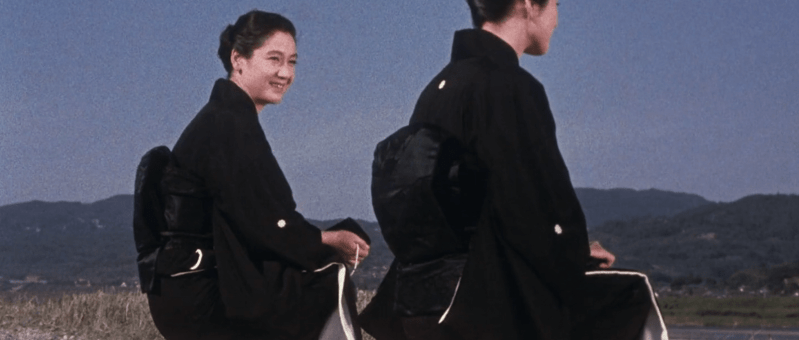
A Woman’s Place (女の座, Mikio Naruse, 1962)

“A woman’s life is so dreary” laments a disappointed woman as she sits awkwardly at a funeral in Mikio Naruse’s A Woman’s Place (女の座, Onna no Za, AKA The Wiser Age). What exactly is “a woman’s place” in the changing post-war society? The continuing uncertainties of the age begin to burrow into the Ishikawa household as it becomes plain that the house is already divided, in several senses, as daughters and sons find themselves pulled in different directions, each of them perhaps banking on an inheritance to claim a different future. 

As the film opens, the sons and daughters of the Ishikawa family have been sent telegrams to come home at once because dad is at death’s door. Thankfully, that turns out to be premature. All he’s done is put his back out overdoing it in the garden by trying to lift a big rock in defiance of his age. Oldest daughter Matsuyo (Aiko Mimasu), who runs a boarding house, is quite put out to have rushed over for nothing, but everyone is obviously relieved that there turned out to be nothing to worry about after all. Widowed daughter-in-law Yoshiko (Hideko Takamine) realises that she needs to wire Michiko (Keiko Awaji) who moved to Kyushu when she got married that there’s no need to come, but she later turns up anyway along with her goofy husband Masaaki (Tatsuya Mihashi), claiming they’ve decided to make the trip a kind of honeymoon though it seems obvious to everyone that there must be reasons they seem intent on overstaying their welcome. 

“They depend on us, everyone does when they return home” mother/step-mother Aki (Haruko Sugimura) chuckles as Matsuyo and only remaining son Jiro (Keiju Kobayashi) pocket some paper towels from the family shop on their way out. Everyone is indeed depending on the family, not least for a clue as to where they stand as much as for a permanent place to return to. Three daughters of marriageable age still live at home. The oldest, Umeko (Mitsuko Kusabue), the daughter of patriarch Kinjiro’s (Chishu Ryu) first wife, has renounced the possibility of marriage and has made a career for herself as an ikebana teacher, a traditionally respectable occupation for “independent” women. In her 30s, she has become cruel and embittered, sniping at her sisters and always smirking away in a corner somewhere being aggressively miserable (nobody in the family seems to like Umeko very much, but still they accept her). Later she offers a sad, surprisingly romantic explanation for her decision in her unrequited love for a middle school classmate who died in the war, but is in someway revived by an unexpected attraction to a young man Matsuyo brings to the house who claims to be the infant boy Aki was forced to give up when she left her former husband’s family and married Kinjiro. 

The unexpected reappearance of Musumiya (Akira Takarada) destabilises the family across several levels, firstly in highlighting Aki’s awkward status as a second wife and step-mother to the two oldest children, and then by inciting a false romantic rivalry between the widowed Yoshiko and the unmarried Umeko. Umeko at one point cruelly describes Yoshiko as the only “outsider” in the household, viewing her connection to them now that her husband has died solely through the lens of being the mother of the only male grandchild, Ken (Kenzaburo Osawa). Yoshiko, only 36 years old, is repeatedly urged to remarry, but she like Aki would be forced to leave Ken behind if she did, though he is now a teenager and perhaps old enough not to feel abandoned. Ken in fact joins in encouraging his mother to find a second husband, but partly because she is always nagging him to study harder (something which will have have tragic, unexpected consequences). Yoshiko’s “place” in the household is therefore somewhat liminal, part of the family and yet not, because her status depends on solely on her relationships to others rather than blood. 

Nevertheless, Yoshiko is clearly in charge as we witness all of the other women disturbing her while she’s cooking to enquire after missing items, whether the bath is ready, or to attend to something in the store. Umeko has built her own smaller annex on another part of the property and mostly keeps to herself, while the two younger daughters busy themselves with a series of romantic subplots. Despite her sister Matsuyo’s eye-rolling that she should “forget about working and get married”, Natsuko (Yoko Tsukasa) is trying to find another job after being laid off when the company she worked for went bankrupt. Her brother, meanwhile, is experiencing the opposite problem in that it’s impossible to find and keep delivery staff at his ramen shop and he desperately needs help because his wife is pregnant again. Natsuko is convinced to “help out” though it’s clear that working in a ramen shop wasn’t what she had in mind, but it does bring her into contact with an eccentric friend of her sister Yukiko’s (Yuriko Hoshi) while she works on the box office of a nearby cinema. 

A crisis occurs when Natsuko is presented with the prospect of an accelerated arranged marriage to a man who took a liking to her while working at the company which went bust and has since got a job which requires him to relocate to Brazil. The ramen shop guy, Aoyama (Yosuke Natsuki), meanwhile is also getting a transfer but only to the top of Mount Fuji. Natsuko is torn, but also wonders if Yukiko actually wants Aoyama herself and only tried to set them up as a sort of test. In any case, both of these younger women also feel that their “place” is defined by marriage and their status conferred by their husbands even if they are exercising a personal preference in their choice, Yukiko’s in romance while Natsuko’s is perhaps a little more calculation in that she knew and liked her suitor but would not go so far as to call it “love”. 

In her own strange way, Umeko may be the most radical of the women in that she has attempted to define her own place through rejecting marriage and making enough money to buy her own home (albeit still on the family property) in a kind of independence, later deciding that perhaps she does want marriage after all but only on her own terms. Unfortunately, she is drawn to Musumiya whose presence poses a threat to the family on several levels, the most serious being that he is quickly exposed as a conman guilting Aki into assisting him financially while also trying some kind of car sale scam on the smitten Umeko who wants to add to her independence through learning to drive. Musumiya, it seems, prefers Yoshiko and his affection may well be genuine, but she is trapped once again. While she and Aki privately express their doubts about Musumiya, they have no desire to hurt Umeko’s feelings and cannot exactly come out and say that he is no good seeing as he is Aki’s son. Yoshiko stoically keeps the secret, perhaps also attracted to Musumiya but loyal to the Ishikawas and wanting no trouble from such a duplicitous man. Still, Umeko regards Yoshiko’s attempts to discourage her as “jealousy” and wastes no time embarrassing them both in a nasty public altercation. 

While all of this going on, there has been some talk that the shop may be compulsory purchased to make way for an Olympic road, and each of the Ishikawa children is eagerly awaiting their share of the compensation money, not least Michiko and her feckless husband who turns out to have fled Kyushu after getting fired from his job for assaulting a client. The “heir”, technically is Ken as the only male grandchild and Yoshiko’s tenuous status in the household is entirely conferred on her as his mother. When that disappears, her “place” is uncertain. Most of the others are for kicking her out, she’s not a “real” member of the family and so deserves none of the money with only Natsuko stopping to defend her. But, as so often, the widowed daughter-in-law turns out to be the only filial child. Mum and dad feel themselves displaced in their own home, somehow feeling they must stand aside, but it turns out they have plans of their own and Yoshiko is very much included. They want to take her with them, and if one day she decides to marry again then that’s perfectly OK and they will even provide a dowry for her as if she were one of their own daughters. 

“We have many children but they only think of themselves” Kinjiro laments, “let’s not worry about them and live peacefully by ourselves”. It’s easy to see their decision as a strategic retreat, as if they’re being left behind by a future they cannot be a part of, but it’s also in some ways an escape from the increasingly selfish post-war society. Yoshiko may not have actively chosen her “place” but she does at least have one and reserves the right to choose somewhere else in the future. The older Ishikawas choose to be happy on their own, freeing their children and giving them their blessing so long as they’re “doing their best”. It’s a strangely upbeat conclusion for a Naruse film, if perhaps undercut with a mild sense of resignation, but nevertheless filled with a hope for a happier future and an acknowledgement that “family” can work but only when it is defined by genuine feeling and not merely by blood. 

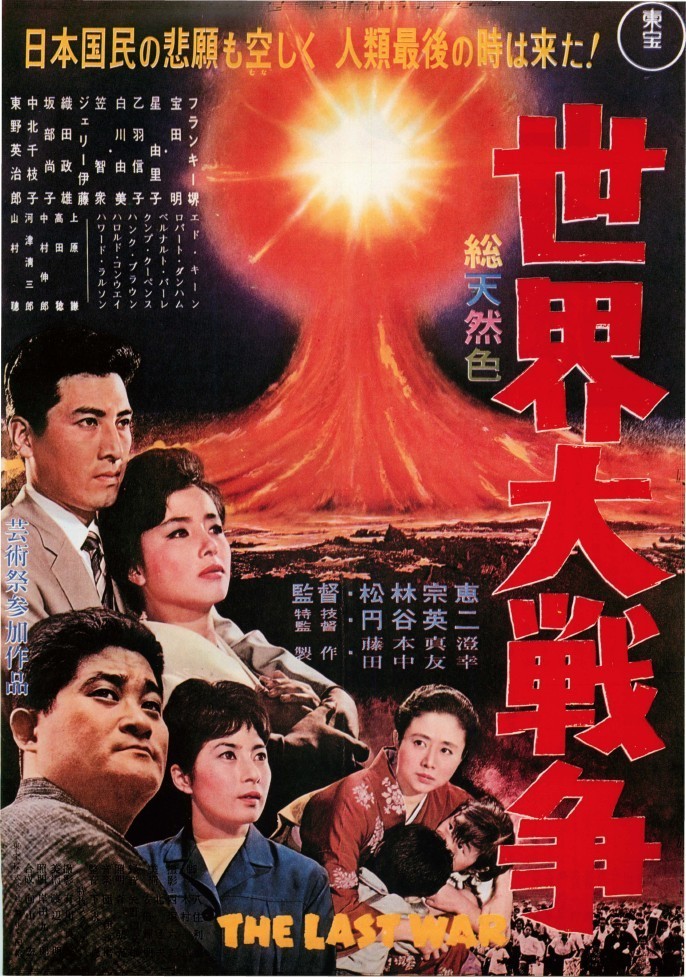
The Last War (世界大戦争, Shue Matsubayashi, 1961)

As The Last War (世界大戦争, Sekai Daisenso) points out, by 1961 16 years had passed since the end of World War Two during which Japan had begun to rebuild itself, heading into a period of unprecedented economic prosperity with the Olympics already on the horizon. But the early 1960s were also a time of increased international tension as the Cold War mounted and many in Japan feared being pulled into another conflict especially with the Korean War not quite so much in the distant past. Toho had become the home of special effects cinema and such films were often coloured with strong messages of peace and social responsibility as humanity banded together to combat an existential threat be it a giant monster or mad scientist. The Last War is no different in that regard, but sadder in showing us that the end of the world may come suddenly and without warning and that if we for a second become complacent it could already be too late to stop it. 

Patriarch Mokichi (Frankie Sakai) has made a decent life for himself after the war working as a driver. His wife, Oyoshi (Nobuko Otowa), is in poor health and he dreams of buying a house by the sea where she can live in comfort. Meanwhile, they have a grownup daughter, Saeko (Yuriko Hoshi), born before the war, and two much younger children, a girl, Haru, and boy, Ichiro. They are a very happy, very ordinary family who are beginning to think that their days of hardship are finally behind them and they have escaped the war’s shadow. The only note of potential conflict lies in the fact that Saeko wants to marry a family friend, Takano (Akira Takarada), a sailor, and is afraid of Mokichi’s reaction, especially as he keeps trying to set up matches for her. 

In fact, having lived through the war Oyoshi and Mokichi are certain that nothing like that is going to happen again, even if the younger generation is filled with anxiety. “Who could ever profit from the destruction of the Earth?” Mokichi not unreasonably asks, signalling his newly consumerist world view. Mind you, he adds, everyone knows the alternative to calamity is hard work, “you have to work hard for peace”. 

Mokichi has indeed been working hard, but has perhaps begun to neglect other areas of his life in his desire to become rich even if that desire is only to make his family more comfortable and give his children better opportunities than he had. Brought over to see a new TV set now on sale, he scoffs that he already has one, “Who needs a second TV?” he asks, but on hearing the news that tensions are rising because a military plane has gone down off the coast of Africa, his first thought is to get on the phone to his broker and junk his real estate stocks for shares in aeronautics. Mokichi is unconvinced by an old man selling potatoes on their street who apparently lost everything in Hiroshima and has since become a devoted Christian donating most of his profits to anti-nuclear charities, describing him as just “showing off”, firmly believing that nothing like that is ever going to happen again. “I cannot accept it” he says, “what would be the point of the aspirations of humble folk like us if we’re all destined to go poof into extinction?”.  

As the only nation to have directly experienced nuclear war, the intense fear of its recurrence is indeed understandable. If a nuclear war escalates, it will be the end of everything. All human endeavours over thousands of years will be mere dust. There will be no weddings, no births, no graduations, no grand discoveries, just nothing. When the bomb does indeed hit, the scenes of devastation must have proved extremely traumatic for many in the audience as buildings crumble ominously, the sky turns a fiery red, the streets run with lava, and we can see the outlines of charred bodies lying among the wreckage. The tip of the Diet building sits neatly atop the rubble as if in rebuke of the political failures which, despite the best efforts of the Japanese politicians who make an effort to govern responsibly and are honest with the electorate while advocating strongly for peace through diplomatic channels, have led to the literal end of the world. “You have to work hard for peace” the closing title card reminds us. “We can stop this before it happens, but we have to work together”. “I won’t let you destroy our happiness” Mokichi had screamed at the void, but in the end he was powerless. All it takes is a minor slip, and the world as we know it will cease to be.


Dance with Me (ダンスウィズミー, Shinobu Yaguchi, 2019)

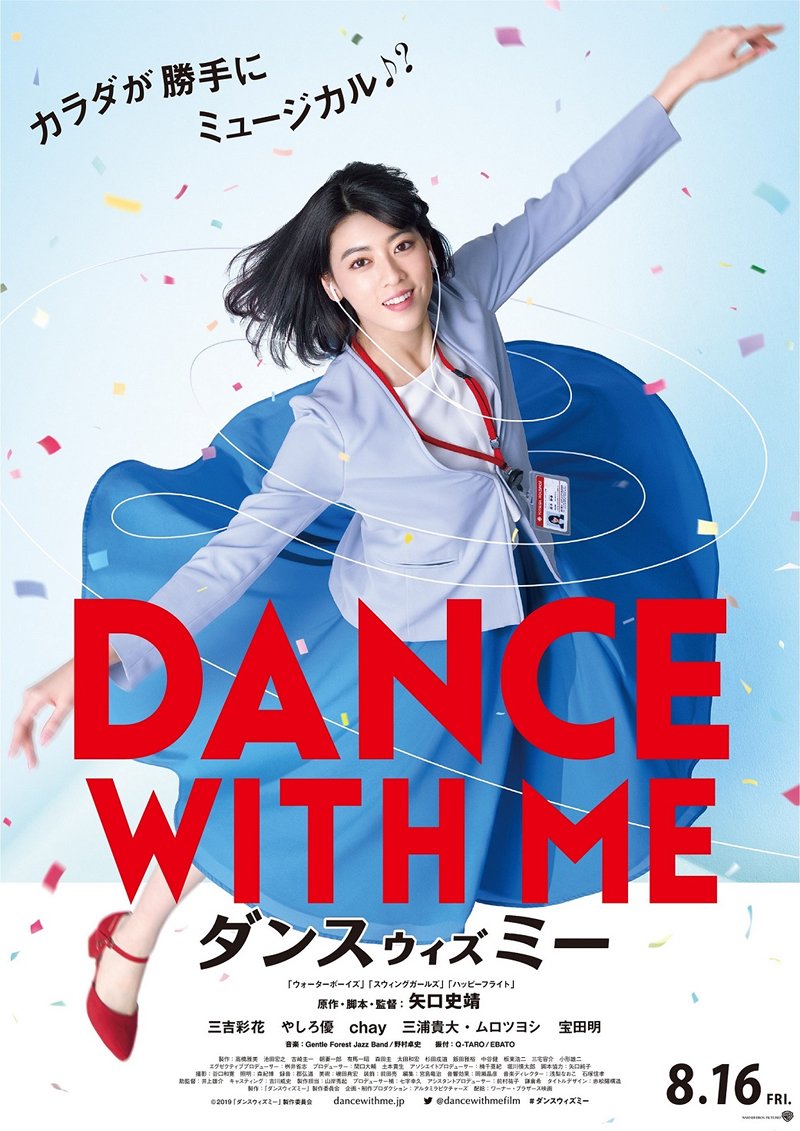
Dance With Me posterYou might be rich and successful, but are you really being true to yourself? The heroine of Shinobu Yaguchi’s latest comedy Dance With Me (ダンスウィズミー) thinks that she is, cynically rolling her eyes at her colleagues mooning over the cute new boss but jumping at the opportunity to join his elite team. Meanwhile, she’s ignoring her family, has few friends, and seems distinctly uptight. Is there more to Shizuka (Ayaka Miyoshi) than meets the eye, or is she really destined for the life of a dull office drone?

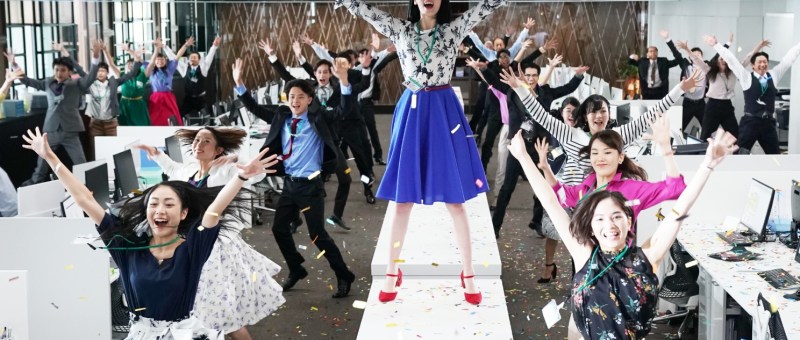
Everything starts to change for her one day when she’s bamboozled into looking after her teenage niece and decides to take her to a weird theme park she noticed on a flyer that got stuck to her shoe. It’s there, in Fortune Land, that Shizuka ends up visiting a shady hypnotist named “Martyn” (Akira Takarada) who offers to give her niece some treatment so she can perform to her full potential in an upcoming high school musical. This comes as news to Shizuka, because they were just mocking the art of the musical on the bus, but when she steps out to answer her phone she notices the cheapo ring Martyn gave her on the way in won’t come off. Sure enough, his “treatment” seems to have worked, only on the wrong person. Now whenever Shizuka hears any kind of music at all she can’t resist breaking into song and dance like the heroine of an old Hollywood musical.

It seems in her youth Shizuka loved singing and dancing, but a traumatic bout of stage fright put her off for life. While her family are all cheerfully energetic and easy going, she is uptight and reserved. Now a middle-rank executive at a top rated company, she’s dedicated herself to achieving the idealised image expected of female businesswomen – elegant, professional, and above all quiet. Her new affliction is therefore a major problem, as she proves to herself by breaking into song during an important meeting with the magic Mr. Murakami (Takahiro Miura) who might be able to take her career to the next level.

Luckily, the incident isn’t really quite so bad as she thought seeing as Murakami’s business idea was a little left of centre so her strange behaviour looked like an unusual pitching technique that makes her seem an attractive asset to Murakami’s new team which is currently a member down after the last girl took too much vacation time and then quit. Offered the post, Shizuka asks for a week’s grace and determines to track down Martyn so he can undo the hypnotism, but Martyn is currently on the run from loan sharks so it’s going to be more difficult than she thought.

Forced to sell all her worldly possessions to make up for a restaurant she accidentally trashed, Shizuka takes to the road armed only with her niece’s piggy bank and accompanied by Martyn’s former shill, Chie (Yu Yashiro). Despite herself, she begins to shake off her carefully crafted corporate persona and open herself up to the pleasures of music and movement, freeing both her body and her mind. Her total opposite, Chie is a laidback woman who loves to have a good a time and doesn’t generally think too much beyond the present moment. Though obviously very different and united only by their quests to track down Martyn, the two women develop an awkward friendship in which they begin to see their own flaws as reflected in each other and shift into the centre as they learn to work together while chasing Martyn all the way to Hokkaido.

A chance encounter with a crazy hippie singer-songwriter (Chay) who claims she broke up with her last band because she couldn’t bear to hide from herself anymore pushes Shizuka (whose name literally means “quiet”) into a reconsideration of her life choices, feeling that perhaps she was wrong to reject the frightened little girl she was so completely out of embarrassment and insecurity, wilfully suppressing her sense of fun and freedom for the safety and security of corporate button-down respectability. As the mental health specialist she visited in hope of a cure suggested, maybe the reason she was so suggestible is that, deep down, she always wanted to sing and dance anyway. A musical celebration of the pleasure of living life to its fullest, Dance With Me is a cheerful exploration of one woman’s gradual emergence from emotional repression into a richer, fuller existence as she rediscovers her essential self through the medium of song and dance.


Dance with Me screens in New York on July 19 as the opening night gala of Japan Cuts 2019.

Original trailer (English subtitles)

Playlist:

Tonight -Hoshi no Furu Yoru ni- (Kumiko Yamashita, 1991)

ACT-SHOW (Spectrum, 1979)

Happy Valley (Orange Pekoe, 2002)

Neraiuchi (Linda Yamamoto, 1973)

https://www.youtube.com/watch?v=TyfsYwojpjk

Yume no Naka e (Yosui Inoue, 1973)

https://www.youtube.com/watch?v=EelHcHwnEdA

Toshishita no Otoko no Ko (Candies, 1975)

https://www.youtube.com/watch?v=pM9lajx6IPQ

Wedding Bell (Sugar, 1981)

https://www.youtube.com/watch?v=SLvbAMvnEZE

Time Machine ni Onegai (Sadistic Mica Band, 1974)

Woman in Witness Protection (マルタイの女, Juzo Itami, 1997)

woman in witness protection posterJuzo Itami’s fearless taste for sending up the contradictions and hypocrisies of his home nation knew no bounds, eventually bringing him into conflict with the very forces he assumed so secure it was safe to mock – his 1992 film Minbo led to brutal attack by a gang of yakuza unhappy with how his film portrayed the world of organised crime. Woman in Witness Protection (マルタイの女, Marutai no Onna), continuing the “Woman” theme from previous hits A Taxing Woman and the more recent Supermarket Woman, would be Itami’s final feature as he died in mysterious circumstances not long after its completion and like Minbo it touched an open nerve. In 1997, crazy cult violence was perhaps no laughing matter nor as ridiculous as it might have seemed a few years earlier, yet Itami makes the actions of brainwashed conspirators the primary motivator of a self-centred actress’ gradual progress towards accepting the very thing his previous films might have satirised – her civic duty as a Japanese woman.

Itami breaks the film into a series of vignettes bookended by title cards beginning with the first which introduces us to our leading lady – Biwako Isono (Nobuko Miyamoto). Biwako is currently in rehearsals for an avant-garde play about giving birth (“a woman’s moment of glory”) during which she reduces her assistant to tears prompting her resignation, decrying Biwako’s self-centred bitchiness as she goes. Chastened, Biwako spends the evening doing vocal exercises outside her apartment which is how she comes to witness the botched murder of a lawyer by a crazed cultist (Kazuya Takahashi) during which she is almost murdered herself and only survives because the killer’s gun jams. As the only witness Biwako suddenly becomes important to the police which works well with her general need for attention but less so with her loathing for hassle. Seeing as Biwako is a famous actress, her involvement also precipitates increased press interest for the murder and accidentally threatens the ongoing police investigation not least because Biwako likes to play up for the camera and isn’t quite sure how best to deal with her divided responsibilities. With the killer still at large, the police decide to give Biwako protection in the form of two detectives – Chikamatsu (Yuji Murata), a cultured man who’s a big fan of Biwako’s stage career, and Tachibana (Masahiko Nishimura), a rather stiff gentleman who never watches films and rarely indulges in entertainment.

Bringing up cult violence in 1997 just two years after Japan’s only real terrorist incident perpetrated by a crazed cult, might be thought taboo but taboo was not something that Itami had ever run away from. Crazed cults had also popped up during A Taxing Woman’s Return though back then they mostly represented the hypocrisy of the new yakuza as a front for organised crime that thought nothing of bleeding vulnerable people dry while feeding them a lot of semi-religious claptrap to make them feel a part of something bigger while the bubble economy continued its puffed up attempts to make them feel inadequate. This time around our cultists are less well drawn but clearly a collection of unlucky people duped into believing the strange philosophies of the “Sheep of Truth” which teach that the world can only be saved by its followers dividing the world into white sheep and black sheep. Like the policeman and later Biwako, the killer believes he is only doing “that which must be done” in the best interests of the world. He is unaware of the cult’s shadiness and shocked when their lawyer threatens his family in an effort to convince him not to talk once the police have managed to break his programming, ironically through exactly the same methods – manipulating his feelings towards his wife and son.

The cult is however merely background to Biwako’s ongoing character drama. Despite experiencing emotional trauma from witnessing a murder and then being threatened herself, Biwako enjoys being the centre of the attention with the police as well as the warm glow she feels in being able to help them with their enquiries, but balks at the additional hassle of having to be involved in the trial (even if she would be given quite a sizeable platform as a witness in a high profile court case). She resents having the two policemen follow her around – especially as she has quite a busy schedule which includes an affair with her married manager. Nevertheless she gradually allows them into her life with Tachibana even making his stage debut as spear carrier in a production of Anthony and Cleopatra. Tachibana’s steadfast defence of her person even at the risk of his own life begins to teach Biwako a few things about civic responsibility and the importance of duty, even if her final moment of realisation is another of her staged set pieces in which she conjures a poignant monologue from the accidentally profound mutterings of Tachibana, a little of Cleopatra, and the earlier line from the maternity play repurposed as she affirms that testifying against the cultists will be her “moment of glory”.

Rather than end on Biwako’s sudden moment of enlightenment, Itami cuts to an ironic epilogue in which a police detective watching the movie we have just seen complains about its authenticity while emphasising that no one in protective custody has ever been attacked. A little tongue in cheek humour from Itami that is followed by the more usual disclaimer before the credits resume, but perhaps anticipating another dose of controversy from both law enforcement and cult devotees. Lighter in tone and noticeably less surreal than some of Itami’s earlier work, Woman in Witness Protection is the story of a vacuous actress learning the purpose of her stage as her particular brand of artifice meets that of the less innocently self-centred cultists head on and eventually becomes the best weapon against it.


Original trailer (no subtitles)

Ironfinger (100発100中, Jun Fukuda, 1965)

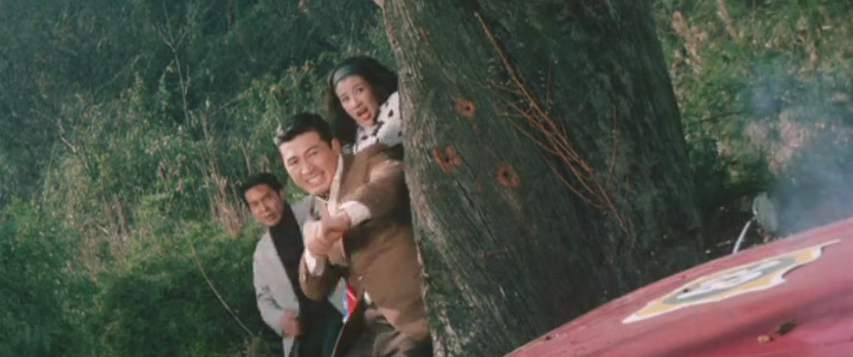
Ironfinger posterBy 1965, Japan was back on the international map as the host of the last Olympics. The world was opening up, but the gleefully surreal universe of Toho spy movies isn’t convinced that’s an entirely good thing. Jun Fukuda had begun his career at Toho working on more “serious“ fare but throughout the 1960s began to lean towards comedy of the absurd, slapstick variety. 1965’s Ironfinger (100発100中, Hyappatsu Hyakuchu) boasts a script by Kihachi Okamoto – Okamoto might be best remembered for his artier pieces but even these are underpinned by his noticeably surreal sense of humour and Ironfinger is certainly filled with the director’s cheerful sense of cartoonish fun with its colourful smoke bombs, cigarette lighters filled with cyanide gas, and zany mid-air rescues. The English title is, obviously, a James Bond reference (the Japanese title is the relatively more typical “100 shots, 100 Kills”) and the film would also get a 1968 sequel which added the spytastic “Golden Eye” (though it would be given a more salacious title, Booted Babe, Busted Boss, for export). Strangely the unlikely villains this time around are the French as Tokyo finds itself at the centre of an international arms smuggling conspiracy unwittingly uncovered by a “bumbling vacationer”.

We first meet our hero as he’s writing a postcard to his mum in which he details his excitement in thinking that he’s made a friend of the nice Japanese man in the next seat seeing as he’s finally stopped ignoring him. When they land in Hong Kong, our guy keeps shadowing his “friend” until he decides to ask him about “Le Bois” to which his “friend” seems surprised but is gunned down by bike riding assassins before he can answer though he manages to get out the word “Tokyo” before breathing his last. Picking up his friend’s passport and swanky hat, our guy becomes “Andrew Hoshino” (Akira Takarada) – a “third generation Japanese Frenchman” and “possibly” a member of Interpol.

The bumbling “Andy”, who can’t stop talking about his mother and is very particular about his hat (for reasons which will become clear), is obviously not all he seems. Despite his penchant for pratfalls and cheeky dialogue, he also seems to be a crack shot with a pistol and have an ability to talk himself out of almost any situation – at least with the aid of his various spy gadgets including his beloved cigarette lighter and a knife concealed in his wristwatch for cutting himself free should he get tied up. Andy “said” he was just here on holiday, but are all those postcards really for his dear old mum waiting for him in Paris or could they have another purpose? Why is he so keen on finding out about “Le Bois” and why does he always seem to end up at the centre of the action?

These are all questions which occur to one of his early antagonists – Yumi (Mie Hama), the ace explosives expert who often feels under-appreciated in the otherwise all male Akatsuki gang. Apprehending Andy, Yumi originally falls for his bumbling charm only to quickly see through his act and realise she might be better hedging her bets with him – hence she finally teams up with Andy and straight laced streetcop Tezuka (Ichiro Arishima) who’s been trying to keep a lid on the growing gang violence between the Aonuma who now run the town and the Akatsuki who want to regain control. Andy doesn’t much care about sides in a silly territorial dispute, but it might all prove helpful in his overall mission which is, it turns out, very much in keeping both with that of the gang-affiliated Yumi and law enforcement officer Tezuka.

There isn’t much substance in Ironfinger, but then there isn’t particularly intended to be. There is however a mild degree of international anxiety as our heroes become, in a sense, corrupted by French sophistication whilst “relying” on “Interpol” to solve all their problems (“Interpol” is frequent presence in Toho’s ‘60s spoofs providing a somewhat distant frontline defence against international spy conspiracies). Fukuda keeps things moving to mask the relative absence of plot as the guys get themselves into ever more extreme scrapes before facing certain death on a mysterious island only to save themselves through a series of silly boys own schemes to outwit their captors. Perhaps not as much fun or not quite as interesting as some of Toho’s other humorous ‘60s fare, Ironfinger is nevertheless a good old fashioned espionage comedy filled with zany humour and a cartoonish sense of the absurd.


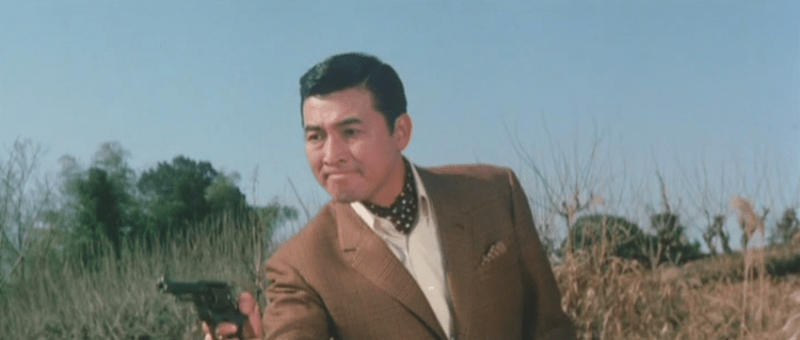
Akira Takarada shows off his French