Odd Obsession (鍵, Kon Ichikawa, 1959)

odd-obsessionJunichiro Tanizaki is widely regarded as one of the major Japanese literary figures of the twentieth century with his work frequently adapted for the cinema screen. Those most familiar with Kon Ichikawa’s art house leaning pictures such as war films The Burmese Harp or Fires on the Plain might find it quite an odd proposition but in many ways, there could be no finer match for Tanizaki’s subversive, darkly comic critiques of the baser elements of human nature than the otherwise wry director. Odd Obsession (鍵, Kagi) may be a strange title for this adaptation of Tanizaki’s well known later work The Key, but then again “odd obsessions” is good way of describing the majority of Tanizaki’s career. A tale of destructive sexuality, the odd obsession here is not so much pleasure or even dominance but a misplaced hope of sexuality as salvation, that the sheer force of stimulation arising from desire can in some way be harnessed to stave off the inevitable even if it entails a kind of personal abstinence.

Our narrator for this sardonic tale is an ambitious young doctor, Kimura (Tatsuya Nakadai), who opens the film in an unusually meta fashion with a direct to camera address taking the form of a brief lecture on the decline of the human body (which begins at age ten and then gets progressively worse). Kimura reminds us that we too will grow old, but his warning is intended less to engender sympathy for the elderly patriarch who will become our secondary protagonist than it is to raise a grim spectre of the inescapability of death.

The story Kimura wants to tell us of a man who fought against senility centres on antiques expert and respected cultural critic Kenmochi (Ganjiro Nakamura). Advanced in years, Kenmochi is beginning to feel the darkness encroaching along with the desire to resist it through restored virility. For this reason, he’s been making regular appointments at Kimura’s clinic which he keeps secret from his wife who would be unhappy to know he’s been getting mysterious injections to help with his sex drive but which also come with a number of side effects including dangerously raising his blood pressure.

Eventually Ikuko (Machiko Kyo), Kenmochi’s slightly younger wife and mother of his grown up daughter Toshiko (Junko Kano), does indeed find out though what she does not appear to know is that Kenmochi has also been drugging her so that he can take photos of her naked body and enjoy his rights as her husband without her needing to be 100% present at the time. Kenmochi’s plan is to lure Kimura into having an affair with his wife so that the resultant jealousy will stimulate his system, staving off senility and other unwelcome effects of ageing. This would be strange enough on its own were it not that Kenmochi has also been trying to set up a marriage between Toshiko and Kimura who are already engaged in a discreet affair.

In contrast with the source material which takes the form of a number of diary entries providing differing perspectives on events, the film takes the point of view of the cynical and morally bankrupt doctor Kimura who feels himself above this “pathetic” old man with his sexual preoccupations and diminished prospects. As the narrator, Kimura evidently believes himself in control but Ichikawa is keen to play with our sense of the rules of storytelling to show him just how wrong he could be. Intrigue is everywhere. Kenmochi may think he’s using all around him in a clever game to prolong his own life but he’s entirely blind to a series of counter games which may be taking place behind his back.

Sex is quite literally a weapon – aimed at the heart of death. Kimura recounts a dream he sometimes has in which he is shot through the heart in an arid desert, only for this same scene to invade the mind of a paralysed Kenmochi on gazing at the naked body of his wife. The marriage of Kenmochi and Ikuko has apparently been a cold (and perhaps unhappy) one with Kenmochi berating his wife for remaining “priest’s daughter” all these years later, prudish and conventional. Nevertheless, Ikuko – the kimonoed figure of the traditional Japanese wife, subservient yet mysterious and melancholy, becomes the central pivot around which all the men turn, eclipsing her own daughter – a Westernised, sexually liberated young woman rendered undesirable in her very availability. Kimura is not quite the destructive interloper of Pasolini’s Theorem so much as he is a “key” used by Kenmochi to “unlock” a hidden capacity within himself but one which, as it turns out, opens many doors not all of them leading to intended, or expected, destinations.

Ichikawa continues with a more experimental approach than was his norm following the bold opening scene in which Kimura directly addresses the audience with a straight to camera monologue. A pointed symbolic sequence of a train coupling, freeze frames, dissolves and montages add to his alienated perspective as he adopts Kimura’s arch commentary on the ongoing disaster which is the extremely dysfunctional Kenmochi family home. Middle class and well to do, the Kenmochis’ lives are nevertheless empty – the house is mortgaged and the beautiful statues which taunt Kenmochi with their physical perfection have all already been sold though Kenmochi refuses to let the buyer take them home. Old age should burn and rave at close of day, but as the beautifully ironic ending makes plain it will be of little use, death is in the house wearing an all too familiar face which you will always fail to recognise.


Screened as part of the Japan Foundation Touring Film Programme 2017.

Opening scene (no subtitles)
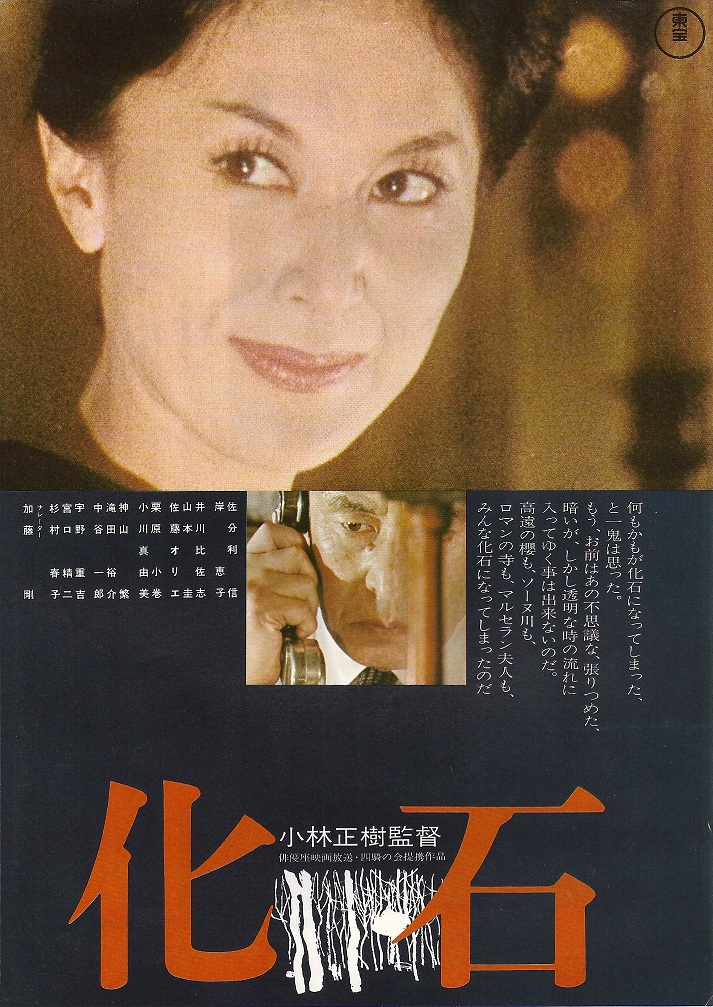
The Fossil (化石, Masaki Kobayashi, 1975)

fossilThroughout Masaki Kobayashi’s relatively short career, his overriding concern was the place of the conscientious individual within a corrupt society. Perhaps most clearly seen in his magnum opus, The Human Condition, Kobayashi’s humanist ethos was one of rigid integrity in which society’s faults must be spoken and addressed in service of creating a better, fairer world. As might be expected, his often raw, angry social critiques were not always what studios were looking for, especially heading into the “difficult” 1970s which saw mainstream production houses turning on the sleaze to increase potential box office. Reluctantly, Kobayashi headed to TV on the condition he could retain some of his footage for a feature film. Adapted from the 1965 novel by Yasushi Inoue, The Fossil (化石, Kaseki) revisits many of Kobayashi’s recurrent themes only in a quieter, more contemplative way as an apparently successful man prepares to enter the final stages of his life, wondering if this is all there really is.
Itsuki (Shin Saburi), a selfmade man who hit it big in Japan’s post-war boom town by founding his own construction firm which currently employs over 1000 people, is about to catch a plane to Europe for a trip that’s pleasure disguised as business. As he leaves, his younger daughter informs him he may be about to become a grandfather for the second time after the birth of her niece, though she is worried and is not sure she wanted a child at this precise moment. Brushing aside her nervousness with an odd kind of fatherly warmth, Itsuki seems pleased and states that he hopes it’s a boy this time. Nevertheless he leaves abruptly to catch his plane. During the flight he begins to become depressed, reflecting that since his wife has died and both of his daughters have married and have (or are about to have) children of their own he is now totally alone. Never before has he faced a sensation of such complete existential loneliness, and his arrival in Paris proves far less invigorating than he had originally hoped.

Wandering around with his secretary, Funazu (Hisashi Igawa), who has accompanied him on this “business” trip, Itsuki catches sight of an elegant Japanese woman in a local park and is instantly captivated. Improbably spotting the same woman several times during his stay, Itsuki later discovers that she is the wife of a local dignitary though not universally liked in the Japanese ex-pat community. At this same work dinner where he discusses the merits of Madame Marcelin (Keiko Kishi), Itsuki experiences a severe pain in his abdomen which makes it difficult for him to stand. Feeling no better back at the hotel, Funazu arranges a doctor’s visit for him. The doctors seem to think he should head straight home which Itsuki is not prepared to do but when he masquerades as Funazu on the phone to get the full verdict, he finds out it’s most likely inoperable intestinal cancer and he may only have a year or so to live.

This unexpected – or, perhaps half sensed, news sends him into a numbing cycle of panic and confusion. At this point Itsuki begins his ongoing dialogue with the mysterious woman, arriving in the guise of Madame Marcelin only dressed in the traditional black kimono of mourning. Telling no one, Itsuki embarks on a contemplative journey in preparation for a union with his dark lady in waiting which takes him from the Romanesque churches of the picturesque French countryside back to Japan and the emptiness, or otherwise, of his settled, professionally successful life.

Like the hero of Kurosawa’s similarly themed Ikiru, Itsuki’s profound discovery is that his overwhelming need for personal validation through work has led him to neglect human relationships and may ultimately have been misplaced. On his return to Japan, Itsuki makes the extremely unusual decision to take a day off only to receive a phone call regarding an old friend and former colleague who, coincidentally, has aggressive cancer and has been asking to see him. Not wanting to mention his own illness, Itsuki parts with his friend feeling it may be for the last time but eventually returns for a deeper conversation in which he probes him for his views about his life so far and what he would do if he had, say, another year to live. His friend has come to the same conclusion, that his working life has largely been a waste of time. What he’d do differently he couldn’t rightly say, things are as they are, but if he had more time he’d want to do “good” in the world, make a positive change and live for something greater than himself.

Itsuki isn’t quite as taken with the idea of “goodness” as a life principle, though he does begin to re-examine himself and the way he has treated the people in his life from apologising to the stepmother he failed to bond with as a child to reconnecting with an old army buddy who maybe the closest thing he’s ever had to a “true friendship” – something which the mysterious woman reminded him he’d been missing for a very long time. Meeting Teppei again, Itsuki is introduced to his walls of fossilised coral and all of their millions of years of history frozen into one indivisible moment. Feeling both infinite and infinitesimal, Itsuki is reminded of his immediate post-war moment of survivor’s guilt in which he and his friend agreed that they’ve each been living on borrowed time ever since.

Given a sudden and unexpected chance of reprieve, Itsuki is even more confounded than before. Having made a friend of death, he may now have to learn to live again, even if his mysterious lady reminds him that she will always be with him, even if he can no longer see her. Though he’d wanted nothing more than to live to see the cherry blossoms in the company of the living Madame Marcelin whose vision it was that so captivated him, his old life is one he cannot return to and must be preserved in amber, frozen and perfect like Teppei’s fossilised coral.

Tonally European, perhaps taking inspiration from Death in Venice, and bringing in a Christianising moral viewpoint pitting the values of honest hard work against genuine human feeling, The Fossil is the story of a man realising he has been sentenced to death, as we all have, and makes his peace with it only to learn that perhaps his sentence will be suspended. Yet for a time death was his friend and her absence is a void which cannot be filled. This life, this new life so unexpectedly delivered, must be lived and lived to the full. Itsuki, who had prepared himself to die must now learn to live and to do so in a way which fulfils his own soul. Originally filmed as a 13 part TV series now reduced to three hours and twenty minutes, The Fossil’s only consolation to its medium is in its 4:3 frame which Kobayashi’s unobtrusive style fully embraces with its ominous distance shots, slow zooms and eerie pans backed up by Toru Takemitsu’s sombre score. Kobayashi, who’d given us a career dedicated to railing against the injustices of the system, suddenly gives us the ultimate rebellion – against death itself as a man who’d prepared himself to die must judge the way he’s lived on his own terms, and, finding himself wanting, learn to live in a way which better fits his personal integrity.


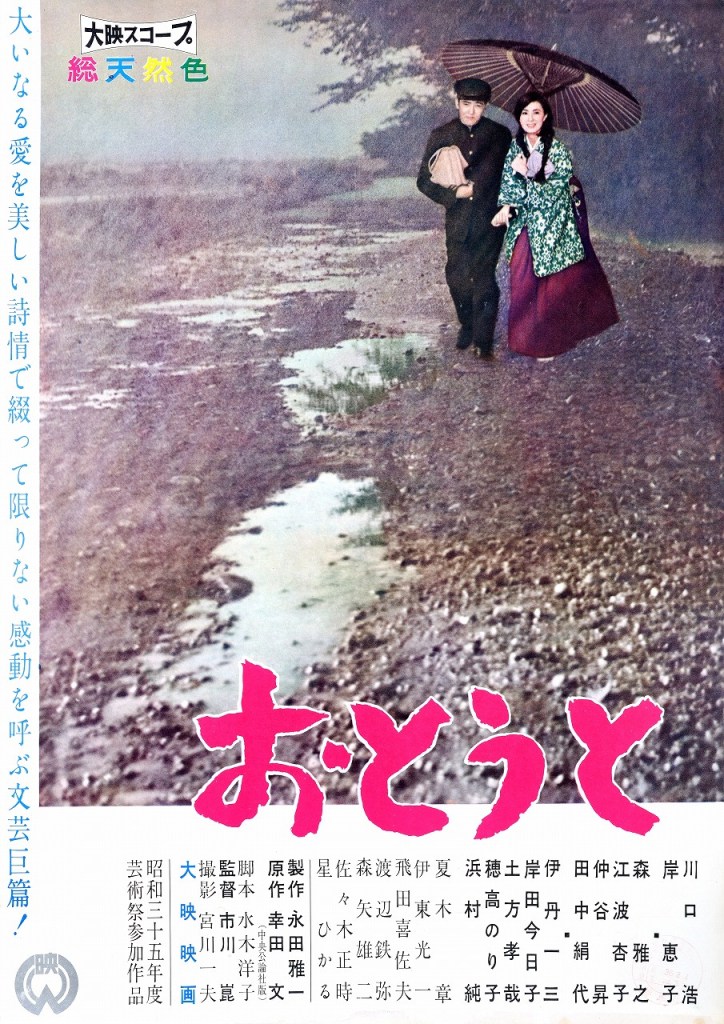
Her Brother (おとうと, Kon Ichikawa, 1960)

ototoPerhaps oddly for a director of his generation, Kon Ichikawa is not particularly known for family drama yet his 1960 effort, Her Brother (おとうと, Ototo), draws strongly on this genre albeit with Ichikawa’s trademark irony. A Taisho era tale based on an autobiographically inspired novel by Aya Koda, Her Brother is the story of a sister’s unconditional love but also of a woman who is, in some ways, forced to sacrifice herself for her family precisely because of their ongoing emotional neglect.
Oldest daughter Gen (Keiko Kishi) is still in school though she’s more or less running the household seeing as her invalid step-mother (Kinuyo Tanaka) spends most of her time bedridden with rheumatism and the rest of it pontificating about religion and listening to her poisonous friend (Kyoko Kishida) who likes to stir up trouble in this already difficult family environment. Gen’s father (Masayuki Mori) is a well known writer who needs a lot of quiet time for his work. As fathers go he’s very laid back and content to think his kids will be OK because they’re his kids, which isn’t to say he doesn’t care but he’s not exactly present most of the time. It’s no surprise then that care of the family’s youngest, Hekiro (Hiroshi Kawaguchi), has largely fallen to his sister. Where Gen is naturally responsible and practically minded, Hekiro is reckless and always in search of adventure. Eventually this lands him in trouble when he gets involved with a bad crowd but whatever his family might have been feeling towards him, everything changes once they discover that he’s facing a serious illness.

Because of the family’s odd arrangement, Gen has become almost a maternal figure towards Hekiro despite only being a couple of years older than he is. In fact, the pair have an almost comically childish physical fight at one point which is quite undignified considering their ages, especially when it involves staining their tatami mat floor with a puddle of bright red ink. Gen does her best but like her father she more often than not lets Hekiro off the hook by bailing him out, much of the time with her own rather than her father’s money. Not having the kind of authority a parent, uncle, or aunt might have all she can really do is ask him to think about behaving better, but Hekiro constantly pushes the boundaries to get a more concrete form of attention than his sister’s well meaning attempts to help are able to provide.

Hekiro’s stunts  eventually threaten to pull his sister into his darkening world, especially when a man claiming to be a detective starts more or less stalking Gen before pulling her into a shrine on the pretext of talking about her brother’s case before trying to have his wicked way with her. Luckily Gen is saved by a flock of geese cunningly released by some of her brother’s friends which gives her enough time to escape and finally get rid of the odious little man.

Similarly, Hekiro deliberately introduces his sister to the local pool hall. Though Gen seems to enjoy the game and is even good at it, she quickly realises she’s been brought as a sort of guarantor for her brother’s mounting debts. Add in other expensive and dangerous hobbies like his boat habit (he can’t swim) and it’s not surprising everyone’s had enough of Hekiro before he’s even left school. When he has an accident which results in the death of a horse (again, very expensive), it does at least lead him to reflect on the negative effect his actions can have on those around him, even if all he wanted and continues to want is an escape from his boring and miserable family life.

Even Hekiro’s illness fails to arouse very much in the way of concern from his well meaning father and grumpy step-mother who is hellbent on marrying Gen off against her wishes. Gen is, again, the only one to nurse Hekiro in hospital, managing the household as well as looking after her brother on his sickbed. When the illness becomes more serious it provides a last opportunity for the family members to bond and make amends for the various ways they’ve failed each other. The step-mother’s visit is not as altruistic as it seems when it transpires she’s only really come to “convert” Hekiro to her religion, but she begins to feel something more for him on believing that Jesus has already saved him thanks to his outwardly calm and polite manner. The final irony is that the idealised family is only born as it is destroyed, Gen puts her pinny back on and takes the reins from her stepmother who is presumably headed straight back to bed.

Gen’s devotion can’t save her brother either from himself or his fate and it may even be the end of her too. Vowing never to marry and rising from her own sickbed stopping only to instruct her stepmother to rest, she’s very clearly chosen her path even if Ichikawa’s camera and musical cues seem to find the ironic comedy of the situation rather than the sadness of her possibly tragic plight. Ichikawa and his cinematographer invented a whole new technique for this picture – the bleach bypass, which appropriately robs the environment of its vibrancy, dulling even bright colours with a sort of heavy leaded effect perfectly reflecting Hekiro’s increasingly depressed mindset as he reflects on being someone who has no firm anchor or place to feel at home. A strange, comically melancholic piece, Her Brother is a characteristically sideways swipe at the family drama from the master of irony though one which does not altogether escape his taste for the sentimental.


Original trailer (not subtitles)

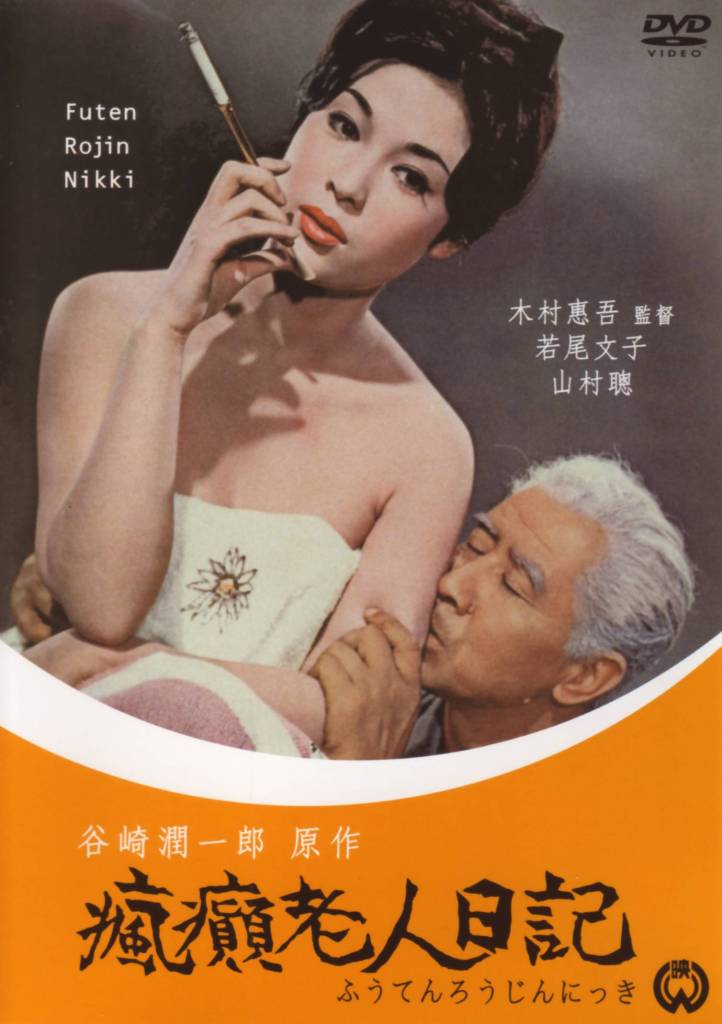
Diary of a Mad Old Man (瘋癲老人日記, Keigo Kimura, 1962)

e0022344_20155095Junichiro Tanizaki is giant of Japanese literature whose work has often been adapted for the screen with Manji alone receiving four different filmic treatments between 1964 and 2006. His often erotic themes tallied nicely with those of the director of the 1964 version, Yasuzo Masumura who also adapted Tanizaki’s The Tattooist under the title of Irezumi, both of which starred Masumura’s muse Ayako Wakao. Preceding both of these, Keigo Kimura’s Diary of a Mad Old Man (瘋癲老人日記, Futen Rojin Nikki) adapts a late, and at that time extremely recent, work by Tanizaki which again drew some inspiration from his own life as it explores the frustrated sexuality of an older man facing partial paralysis following a stroke. Once again employing Wakao as a genial femme fatale, Kimura’s film is a broadly comic tale of an old man’s folly, neatly undercutting its darker themes with naturalistic humour and late life melancholy.

Tanazaki’s stand in is a wealthy old man, Utsugi (So Yamamura), who has recently suffered a stroke which has paralysed his right hand and significantly reduced his quality of life. He currently operates a large household with a number of live-in staff, including a round the clock nurse, his wife, son, daughter-in-law, and grandson. The son, Joukichi (Keizo Kawasaki), is a successful executive currently having an affair with a cabaret dancer, leaving his extremely beautiful wife, Sachiko (Ayako Wakao), herself also formerly a dancer, at a loose end. Though approaching the end of his life and possibly physically incapable of acting on his desire, Utsugi is consumed with lust for Sachiko and thinks of little else but how to convince her to allow him even the smallest of intimacies. Sachiko, for her part, is not particularly interested in pursuing a romantic entanglement with her aged father-in-law but is perfectly aware of her power over him which she uses to fulfil her material desires. Meanwhile, Utsugi’s rather pathetic behaviour has not gone unnoticed by the rest of the household who view his desperation with a mix of pity, exasperation, and outrage.

Kimura’s film takes more of an objective view than the subjective quality of the title would suggest but still treats its protagonist with a degree of well intentioned sympathy for a man realising he’s reached the final stages of his life. Utsugi’s sexual desire intensifies even as his body betrays him but this very life force becomes his rebellion against the encroaching onset of decay as he clings to his virility, trying to off-set the inevitable. As such, conquest of Sachiko becomes his last dying quest for which he is willing to sacrifice anything, undergo any kind of degradation, simply to climb one rung on the ladder towards an eventual consummation of his desires.

Sachiko, instinctively disliked by her mother-in-law, is more than a match for Utsugi’s finagling. A young, confident, and beautiful woman, Sachiko has learned how to do as she pleases without needing permission from anyone for anything. In this, the pair are alike – both completely self aware yet also in full knowledge of those around them. The strange arrangement they’ve developed is a game of reciprocal gift giving which is less a war than a playful exercise in which both are perfectly aware of the rules and outcomes. Sachiko allows Utsugi certain privileges beginning with slightly patronising flirtation leading to leaving the bathroom door unlocked when she showers (behind a curtain) and permitting Utsugi to kiss and fondle her leg (even if she hoses it down, complaining it feels like being licked by a slug).

Tanizaki’s strange fetish is again in evidence as Utsugi finally deifies Sachiko in creating a print of the sole of her foot which he intends to have carved into his grave so he can live protected beneath her forever, as insects are under the foot of Buddha. This final act which takes the place of a literal consummation goes some way towards easing his desire but may also be the one which pushes him towards the grave he was seeking to avoid. Notably, Sachiko is bored and eventually exhausted by the entire enterprise even whilst Utsugi is caught in the throws of his dangerous ecstasy.

Other members of the household view the continuing interaction of Sachiko and Utsugi with bemusement, pitying and resenting the old man for his foolishness whilst half-admiring, half disapproving of Sachiko’s manipulation of his desires. Utsugi had been a stingy man despite his wealth and even now risks discord within his own family by refusing to assist his grown-up daughter who finds herself in financial difficulty and in need of familial support, yet lavishing vast sums on Sachiko for expensive trinkets even as she continues an affair with a younger man right under his nose. Still, Sachiko uses what she has and gets what she wants and Utsugi attempts to do the same only less successfully, completely self aware of his foolishness and the low probability of success yet buoyed with each tiny concession Sachiko affords him. A wry and unforgiving exploration of the link between sex and death, Diary of a Mad Old Man undercuts the less savoury elements of its source material with a broadly humorous, mocking tone gradually giving way to melancholy as the old man begins to accept his own impotence, the light around him dwindling while Sachiko’s only brightens.


Temple of the Golden Pavilion (金閣寺, Yoichi Takabayashi, 1976)

temple-of-the-golden-pavilionYukio Mishima’s Temple of the Golden Pavilion has become one of his most representative works and seems to be one of those texts endlessly reinterpreted by each new generation. Previously adapted for the screen by Kon Ichikawa under the title of Enjo in 1958,  Yoichi Takabayashi’s 1976 ATG adaptation Temple of the Golden Pavilion (金閣寺, Kinkakuji) moves away from Ichikawa’s abstract examination of the tragic idealist towards the more heated concerns of the day in its dissection of one man’s continued frustrations and his subsequent literal desire to burn the world.
According to Mizoguchi’s father (Yusaku Terashima), Kinkakuji – the Golden Pavilion, is the purest, most beautiful object the world has ever seen. After his father’s death, Kinkakuji becomes Mizoguchi’s (Saburo Shinoda) touchstone and it’s enough for him simply to be near it. Becoming a monk at a nearby temple, Mizoguchi comes under the care of an older priest who had been a friend of his father’s and is determined to look after his interests.

Interfering with his love for the temple is the spectre of a local girl, Uiko (Yoshie Shimamura), from his home town who spurned his affections due to his ugliness, stammer, and difficulty with communication. Mizoguchi’s resentment grows inside him until he begins to pray for Uiko’s death. Tragically, Uiko is indeed killed by her lover, a deserter from the army, after she first betrayed and then tried to warn him about the encroaching military police. Uiko and Kinkakuji become inextricably linked as each time Mizoguchi finds a woman willing to sleep with him, thoughts of Uiko and the temple cloud his mind, preventing him from fulfilling his sexual desires leading him to become obsessed with the idea of arson. The temple is less something too beautiful for an ugly world, than a too perfect mirror for Mizoguchi’s own faults and inadequacies, a constant reminder of the rest of the world’s baseness to which Mizoguchi would like to drag it down.

Quite clearly mentally disturbed from the outset, Mizoguchi is remains obsessed with the prophecies from his divination sticks and experiences various flashbacks to the often traumatic events of his past, all the while offering glimpses of his strange philosophy through his often poetic voice over. Largely friendless thanks to his unapproachable nature, Mizoguchi bonds with the softening influence of a fellow student at the monastery Tsurukawa (Toshio Shiba), but later falls under the spell of the cynical student Kashiwagi (Katsuhiko Yokomitsu) who uses his own disabilities to manipulate the sympathies of various women in order to sleep with and and then exploit them.

Through Kashiwagi’s tutelage, Mizoguchi begins to have more success with women but his original failure with Uiko and his attachment to the temple prevent him from fully venting his desires. Mizoguchi is also carrying a deeper seated resentment after witnessing his mother having sex with another man, seemingly with his father’s knowledge. Unable to reconcile his sexual desires with his feelings towards women by whom he feels rejected, both by his mother’s betrayal and because of his own internalised consciousness of his lack of looks and strange behaviour, Mizoguchi becomes increasingly frustrated, both sexually and politically.

With the end of the war came a new era, the old gods fell – the Emperor is but a man, but now men rule in this “strange” new democracy. Yet, in real terms, Mizoguchi feels no more empowered than he was before. Trapped inside this closing circle of impotence, Mizoguchi fantasises about murdering his mentor, the temple priest, who has since lost faith in him thanks to his cruel and unthinking behaviour. Killing the priest would change nothing, or so Mizoguchi thinks. The temple is eternal, but if he burns it, does he burn the tyranny of eternity? Calling on the ancestral spirits to destroy this venal world but receiving no reply, Mizogichi invokes Uiko and starts a new revolution born in flames designed to bring power to the powerless, burn the ignorant world away and begin again free of the temple’s tyrannous perfection.

Takabayashi’s approach is a surreal one in which Mizoguchi’s delusions are manefested as reality, climaxing as the creature atop the temple’s ornate apex suddenly begins to beat its wings. Shooting in 4:3 and switching into black and white as Mizoguchi relives painful memories, but remaining in colour for his embellished dreams of them, the atmosphere is an uncertain one which drifts from fantasy to reality without warning. Very much a youth movie of the day, the 1976 The Temple of the Golden Pavillion is less an abstract contemplation of the place of beauty in a world of ugliness, than a story of self destructive male insecurity as sexual and political impotence drive a man to destroy the symbol of his oppression. Dark and cynical as the times which produced it, Takabayashi’s Temple is an ugly tale, but a good lesson in the results of failing to listen to unheard voices.


Original trailer (no subtitles)

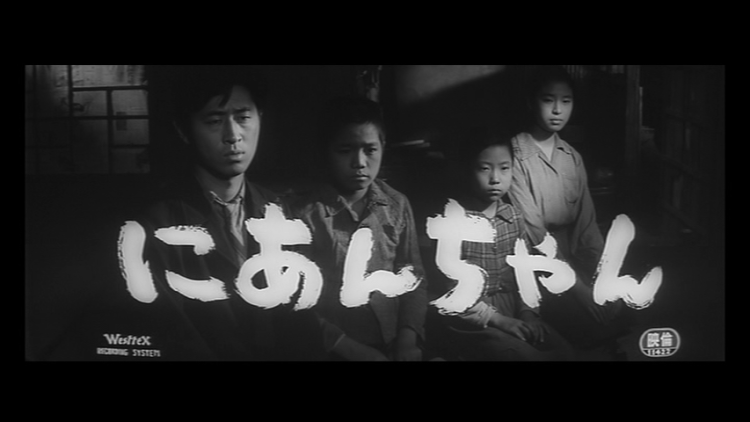
My Second Brother (にあんちゃん, Shohei Imamura, 1959)

vlcsnap-2017-01-07-22h53m01s073Like most directors of his era, Shohei Imamura began his career in the studio system as a trainee with Shochiku where he also worked as an AD to Yasujiro Ozu on some of his most well known pictures. Ozu’s approach, however, could not be further from Imamura’s in its insistence on order and precision. Finding much more in common with another Shochiku director, Yuzo Kawashima, well known for working class satires, Imamura jumped ship to the newly reformed Nikkatsu where he continued his training until helming his first three pictures in 1958 (Stolen Desire, Nishiginza Station, and Endless Desire). My Second Brother (にあんちゃん, Nianchan), which he directed in 1959, was, like the previous three films, a studio assignment rather than a personal project but is nevertheless an interesting one as it united many of Imamura’s subsequent ongoing concerns.
Set in the early 1950s, the film focuses on four children who find themselves adrift when their father dies leaving them with no means of support. The father had worked at the local mine but the mining industry is itself in crisis. Many of the local mines have already closed, and even this one finds itself in financial straits. Despite the foreman’s promise that he will find a job for the oldest son, Kiichi (Hiroyuki Nagato), there is no work to be had as workers are being paid in food vouchers rather than money and strike action frustrates what little production there is. After receiving the unwelcome suggestion of work in a “restaurant” in another town, Yoshiko (Kayo Matsuo) manages to find a less degrading job caring for another family’s children (though she receives only room and board, no pay for doing so). With younger brother Koichi (Takeshi Okimura) and little sister Sueko (Akiko Maeda) still in school, it seems as if the four siblings’ days of being able to live together as a family may be over for good.

Based on a bestselling autobiographical novel by a ten year old girl, My Second Brother is one of the first films to broach the Zainichi (ethnic Koreans living in Japan) issue, even if it does so in a fairly subtle way. The four children have been raised in Japan, speak only Japanese and do not seem particularly engaged with their Korean culture but we are constantly reminded of their non-native status by the comments of other locals, mostly older women and housewives, who are apt to exclaim things along the lines of “Koreans are so shiftless” or other derogatory aphorisms. Though there are other Koreans in the area, including one friend who reassures Kiichi that “We’re Korean – lose one job, we find another”, the biggest effect of the children’s ethnicity is in their status as second generation migrants which leaves them without the traditional safety net of the extended family. Though they do have contact with an uncle, the children are unable to bond with him – his Japanese is bad, and the children are unused to spicy Korean food. They have to rely first on each other and then on the kindness of strangers, of which there is some, but precious little in these admittedly difficult times.

In this, which is Imamura’s primary concern, the children’s poverty is no different from that of the general population during this second depression at the beginning of the post-war period. The film does not seek to engage with the reasons why the Zainichi population may find itself disproportionately affected by the downturn but prefers to focus on the generalised economic desperation and the resilience of working people. The environment is, indeed, dire with the ancient problem of a single water source being used by everyone for everything at the same time with all the resultant health risks that poses. A young middle class woman is trying to get something done in terms of sanitation, but her presence is not altogether welcome in the town as the residents have become weary of city based do-gooders who rarely stay long enough to carry through their promises. The more pressing problem is the lack of real wages as salaries are increasingly substituted for vouchers. The labour movement is ever present in the background with the Red Flag drifting from the mass protests in which the workers voice their dissatisfaction with the company though the spectre of mine closure and large scale layoffs has others running scared.

One of the most moving sequences occurs as Koichi and another young boy ride a mine cart up the mountain and talk about their hopes for the future. They both want to get out of this one horse town – Koichi as a doctor and his friend as an engineer, but their hopes seem so far off and untouchable that it’s almost heartbreaking. Sueko skipped school for four days claiming she had a headache because her brother didn’t have the money for her school books – how could a boy like Koichi, no matter how bright he is, possibly come from here and get to medical school? Nevertheless, he is determined. His father couldn’t save the family from poverty, and neither could his brother but Koichi vows he will and as he leads his sister by the hand climbing the high mountain together, it almost seems like he might.


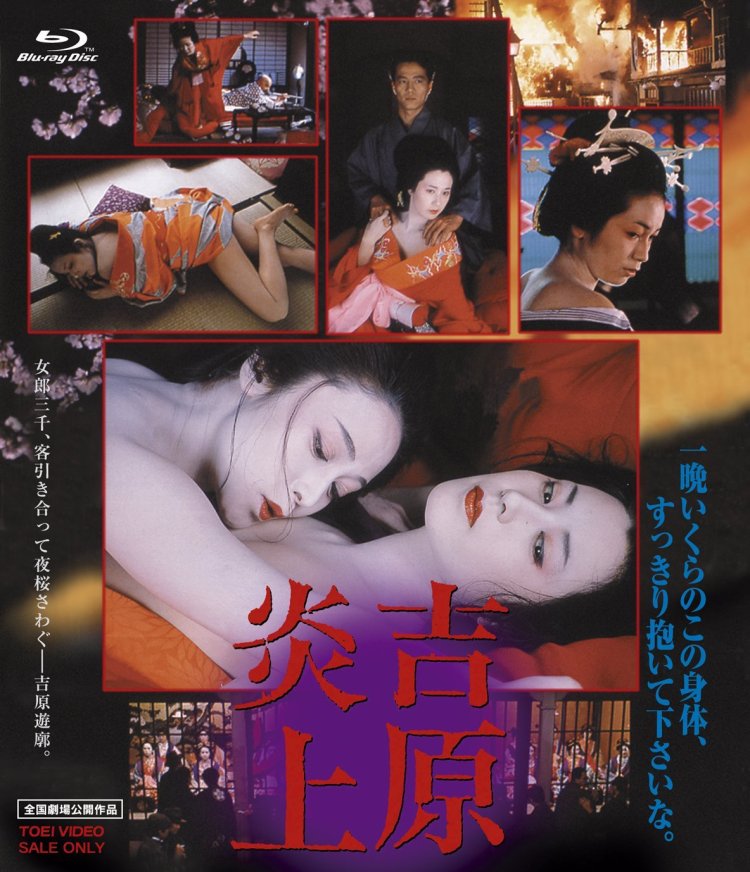
Tokyo Bordello (吉原炎上, Hideo Gosha, 1987)

yoshiwara-enjoHideo Gosha maybe best known for the “manly way” movies of his early career in which angry young men fought for honour and justice, but mostly just to to survive. Late into his career, Gosha decided to change tack for a while with a series of female orientated films either remaining within the familiar gangster genre as in Yakuza Wives, or shifting into world of the red light district as in Tokyo Bordello (吉原炎上, Yoshiwara Enjo). Presumably an attempt to get past the unfamiliarity of the Yoshiwara name, the film’s English title is perhaps a little more obviously salacious than the original Japanese which translates as Yoshiwara Conflagration and directly relates to the real life fire of 1911 in which 300 people were killed and much of the area razed to the ground. Gosha himself grew up not far from the location of the Yoshiwara as it existed in the mid-20th century where it was still a largely lower class area filled with cardsharps, yakuza, and, yes, prostitution (legal in Japan until 1958, outlawed in during the US occupation). The Yoshiwara of the late Meiji era was not so different as the women imprisoned there suffered at the hands of men, exploited by a cruelly misogynistic social system and often driven mad by internalised rage at their continued lack of agency.

Opening with a voice over narration from Kyoko Kishida, the film introduces us to the heroine, 19 year old Hisano (Yuko Natori), as she is unwillingly sold to the red light district in payment for her father’s debts. After a strange orientation ceremony from the Yoshiwara police force where one “kindly” officer explains to her about the necessity of faking orgasms to save her stamina, Hisano is taken to the brothel which is now her home to begin her training. Some months later when Hisano is due to serve her first customer, she runs from him in sheer panic, leaping into a lake where a young Salvation Army campaigner, Furushima (Jinpachi Nezu), tries and fails to help her escape.

Taken back to the brothel and tied up in punishment, Hisano receives a lesson in pleasure from the current head geisha, Kiku (Rino Katase), after which she appears to settle into her work, getting promoted through various ranks until she too becomes one of the top geisha in the area. Sometime later, Furushima reappears as a wealthy young man. Regretting his inability to save her at the river and apparently having given up on his Salvation Army activities, Furushima becomes Hisano’s number one patron even though he refuses to sleep with her. Though they eventually fall in love, Hisano’s position as a geisha continues to present a barrier between the pair, forcing them apart for very different reasons.

Despite having spent a small fortune accurately recreating the main street of the Yoshiwara immediately prior to the 1911 fire, Gosha is not interested in romanticising the the pleasure quarters but depicts them as what they were – a hellish prison for enslaved women. As Hisano and Furushima later reflect, the Yoshiwara is indeed all built on lies – a place which claims to offer freedom, love, and pleasure but offers only the shadow of each of these things in an elaborate fake pageantry built on female suffering. Hisano, like many of the other women, was sold to pay a debt. Others found themselves sucked in by a continuous circle of abuse and exploitation, but none of them are free to leave until the debt, and any interest, is paid. Two of Hisako’s compatriots find other ways out of the Yoshiwara, one by her own hand, and another driven mad through illness is left alone to die like an animal coughing up blood surrounded by bright red futons in a storage cupboard.

As Kiku is quick to point out, the Yoshiwara is covered in cherry blossoms in spring but there is no place here for a tree which no longer flowers. The career of the courtesan is a short one and there are only two routes forward – become a madam or marry a wealthy client. Kiku’s plans don’t work out the way she originally envisioned, trapping her firmly within the Yoshiwara long after she had hoped to escape. Hisano is tempted by a marriage proposal from a man she truly loves but finds herself turning it down for complicated reasons. Worried that her lover does not see her as a woman, she is determined to take part in the upcoming geisha parade to force him to see her as everything she is, but her desires are never fully understood and she risks her future happiness in a futile gesture of defiance.

Defiance is the true theme of the film as each of the women fight with themselves and each other to reclaim their own freedom and individuality even whilst imprisoned and exploited by unassailable forces. Hisano, as Kiku constantly reminds her (in contrast to herself), never accepts that she is “just another whore” and therefore is able to first conquer and then escape the Yoshiwara even if it’s through a second choice compromise solution (albeit one which might bring her a degree of ordinary happiness in later life). Land of lies, the Yoshiwara promises the myth of unbridled pleasure to men who willingly make women suffer for just that purpose, further playing into Gosha’s ongoing themes of insecurity and self loathing lying at the heart of all physical or emotional violence. Though the ending voiceover is overly optimistic about the climactic fire ending centuries of female oppression as the Yoshiwara burns, Hisano, at least, may at last be free from its legacy of shame even whilst she watches the object of her desire destroyed by its very own flames.


Oiran parade scene (dialogue free)

The Little House (小さいおうち, Yoji Yamada, 2014)

the-little-houseIf there is a frequent criticism directed at the always bankable director Yoji Yamada, it’s that his approach is one which continues to value the past over the future. Recent years have seen him looking back, literally, in terms of both themes and style with remakes of films by two Japanese masters – Ozu in his Tokyo Story homage Tokyo Family, and Kon Ichikawa in Her Brother. While he chose to update both of those pieces for the modern day, 2008’s Kabei sent him back to the traumatic years of militarism and warfare for a story of maternal sacrifice and national tragedy. The Little House (小さいおうち, Chiisai Ouchi) brings this recent meandering around the past full circle with its deliberately Ozu-esque aesthetic and flashback tale of atonement as one woman leaves the truth she could never bear to speak on paper as a last dying confession.
After the death of his great-aunt Taki (Chieko Baisho), who never married and has no other family besides himself, his sister, and father, Takeshi (Satoshi Tsumabuki) discovers a biscuit box with his name on it filled with keepsakes and the conclusion of a kind of autobiography he’d been encouraging Taki to write in the last few months of her life. Cutting back and forth between the contemporary interactions of the older Taki and her great-nephew, and the younger Taki’s (Haru Kuroki) life as a Tokyo maid from the mid-1930s to the end of the war, The Little House takes its cues from The Go Between as an innocent bystander becomes the unwilling guardian of a secret the holding of which will prove to be a lifelong burden.

An 18 year old girl in 1935 from a poor family in Japan’s frozen North, Taki’s options are few – early marriage, geisha house, or maid. All things considered, maid is the best option and Taki is thrilled to be travelling to the big city with all of its untold excitements. After a spell working for a famous novelist, Taki becomes the housekeeper of the “Little House” – a curiously cute Western style cottage with a bright red roof out in the suburbs. Her mistress, Tokiko (Takako Matsu), is an oddly flighty woman, fiercely independent of spirit but living within the confines of her time. Crisis approaches the family not with the onset of war but with the arrival of Mr. Hirai’s sensitive, artistic, colleague, Shoji (Hidetaka Yoshioka), whose softly spoken ways quickly find their way into Tokiko’s heart.

In fact, The Little House, is not a million miles away from an expansion of a similar narrative device previously employed in Kabei but this time Tokiko is no pillar of strength, singlehandedly upholding the traditionally saintly virtues of the Japanese mother but a flesh and blood woman caught in the storm of a turbulent era. Taki becomes our passive observer as she sits, almost invisibly, in the corner of every scene, unwilling chaperone or accidental accomplice. As she witnesses the growing attraction between Tokiko and Shoji begin to spark into something more dangerous she finds herself conflicted, not knowing the best way to help her mistress. Should Tokiko be discovered, it wouldn’t just be a scandal leading to the end of a marriage, but considering the stringency of the times the outcome could be far more serious for all concerned.

When Takeshi eventually meets Tokiko’s son Kyoichi (Masakane Yonekura), he echoes many of the older Taki’s sentiments but adds that it was an era in which everyone was “forced to make an unwilling choice”. Taki finds herself forced to choose between action and inaction and does something she thinks is for the best, but is then forced to live with the suffering of wondering if she did the right thing.

The film does not seem entirely clear on her motives for her choice – it half commits to a possible love triangle between Taki, Tokiko, and Shoji by emphasising Taki and Shoji’s shared Northern roots and by Shoji’s subsequent inclusion of both women in his artwork. Taki, however, seems to be looking more to her mistress than her suitor, wanting nothing other than to stay in the Little House with Tokiko and Kyoichi for evermore. A later scene featuring a “mannish” university friend of Tokiko seems to reinforce the directions of Taki’s unspoken desire, though if her declaration of loyalty to the Little House following a disastrous marriage proposal was intended to voice it, it falls on deaf ears.

This being the case, Taki and Shoji become almost mirrors of each other – each somehow on pause, still living inside the Little House long after it ceased to exist. The loss of the Little House is not just the destruction of a building but the obliteration of everything it stood for, not only in terms of Taki’s investment in the family who live there, but in its evocation of early Showa dreams, individuality and innocence.

As the well educated Takeshi points out, Taki’s memories are often too rosy to tally with the history books, but even given the grimness of the times as they seem in hindsight, she has a right to the romanticism of her youth. The increasingly difficult political circumstances rarely impinge on the female centred domestic environment, but are made felt firstly through the husband’s toy business which begins by chasing the Chinese market and then is reduced to making wooden toys only and trying to marry off its eligible employees to woo more investment, and through the family’s excitement about the upcoming Tokyo Olympic games which are subsequently canceled. Tokiko’s later exclamation of “Isn’t it awful everything’s disappearing” does not just refer to the sudden absence of luxury from soaps to previously ordinary foodstuffs, but to her whole bourgeois way of life suddenly brought crashing down by a series of events she has no control over.

Yamada channels Ozu with initially distracting obviousness both in the contemporary and period sequences, matching his famous compositions from the straight to camera dialogue to the mid level tatami mat view and propensity for shooting through corridors and doorways. The world of the Little House is a curiously artificial one as Yamada shoots on an obvious stage set complete with tiny twinkling lights for stars which both looks forward to the artwork at the film’s conclusion and signals its nature as an unreal, constructed, environment existing only within Taki’s memory. Were it not that the Ozu compositions creep into the contemporary sequences, it could almost be read as a representation of Takeshi’s internal dramatisation of Taki’s memoirs as mediated through classic cinema.

The Little House is, indeed, resolutely old fashioned. Far too subtle for its own good, The Little House is an exercise in restraint in which the central love triangle never even hits the simmer, let alone the boil. Given the well trodden nature of the narrative, even the most inattentive viewer will have correctly guessed the big reveal well before Takeshi puts two and two together, rendering the final explanatory segment entirely redundant. Never quite as affecting as it would like to be, The Little House is a muted experience, perpetually pulling back each time it approaches doing something more interesting with its material. Nevertheless, it does provide an interesting perspective on its period setting as its collection of tragically romantic heroes march forward blindly into a maelstrom of oncoming destruction.


HK trailer (English/traditional Chinese subs)

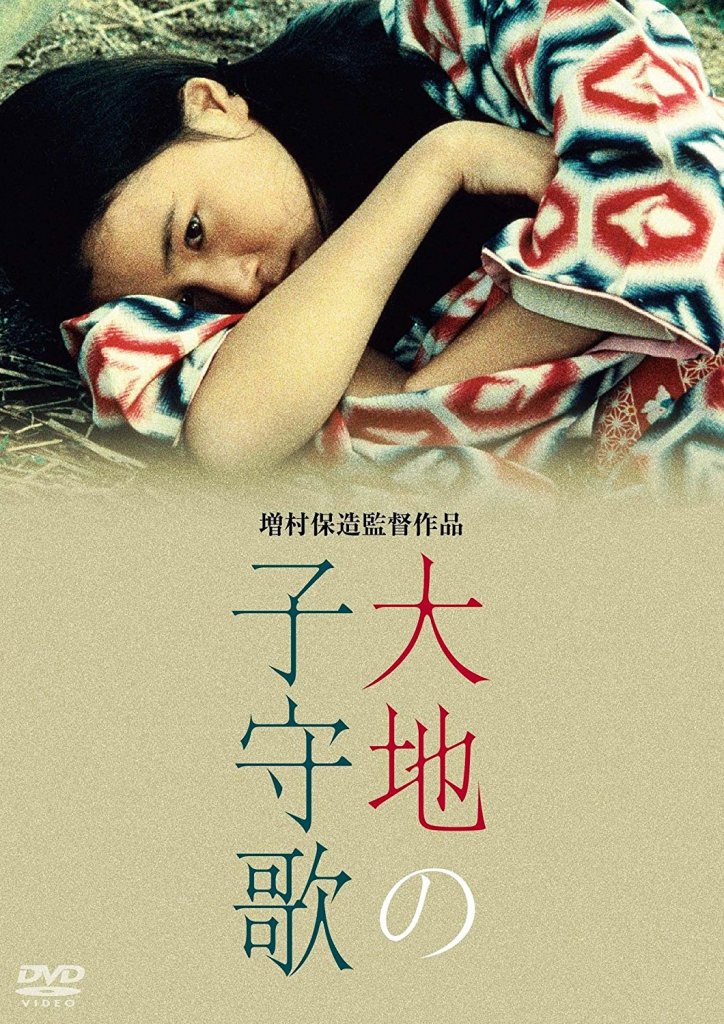
Lullaby of the Earth (大地の子守歌, Yasuzo Masumura, 1976)

lullaby-of-the-earthYasuzo Masumura is best remembered for his deliberately transgressive, often shockingly grotesque critiques of Japanese society and its conformist overtones. Lullaby of the Earth (大地の子守歌, Daichi no Komoriuta) is one of his few completely independent features, filmed after the bankruptcy of Daiei where Masumura had spent the bulk of his early years. As such, it is quite an exception in terms of his wider career both in terms of its production and in its earthy, spiritual themes. Adapted from the 1974 novel by Kukiko Moto, Lullaby of the Earth is the story of an abandoned and betrayed woman but one who also draws her strength from the Earth itself.
13 year old Rin (Mieko Harada) has been living with her adopted grandmother in a remote mountain community. Returning home one day triumphantly carrying a rabbit for dinner, Rin discovers that her grandmother has passed away. Being just a child and now alone and frightened, Rin does not know what to do and later receives harsh treatment from the villagers from whom she temporarily conceals her grandmother’s death. With no one to look after her, Rin is approached by a kind seeming man in Western dress who offers her a good job on a nearby island which, he says, pays well and offers a much better quality of life than Rin’s current survivalist setup in the mountains. Rin has heard tales of men like him before and is not taken in by his arguments, even when he suggests she could use the money to buy a proper grave for her grandmother. She is, however, caught when he mentions taking her to see the sea – something she has been longing for for most of her life.

However, Rin’s pure joy at the waves and endless horizons of the shoreline is short lived when reality hits home and she realises she has been sold to a brothel. The brothel owners are not a bad sort, considering, and intend on using her as a servant until she comes of age but Rin is not having any of it. Refusing to eat, work, or wear her new clothes, Rin is proving to be a very bad investment but changes her tune when she strikes up a friendship with a girl who works at a local store who convinces her that her rebellion is misplaced. Work hard and pay off your debt, she says, and they’ll let you go home. Rin decides to do just that, and with her characteristic energy, but her journey home is not to be such a straight forward experience.

Lullaby of the Earth maybe unusual in Masumura’s filmography due its period setting and gentler, more spiritually orientated progression but Rin is, in many ways, a typical Masumura heroine. A true child of nature, Rin is athletic, at home in the forests and woods trapping rabbits and building fires. Her downfall is brought about precisely because of her desire for total freedom. Longing to see the sea with all of the freedom and possibilities that it suggests, Rin allows herself to be taken in by the false promises of a procurer (presumably alerted by a less than helpful villager), little knowing that she’s damned herself for a period of at least three years.

Made to suffer numerous degradations from the humiliation of her servitude, to a beating that leaves her half dead and her final forced prostitution, Rin maintains her resistance in whichever way she can. Striving for control, Rin takes on a masculine quality defined by strength and agility rather than elegance and beauty. Once again longing for the sea, Rin begs to be allowed to row the boat that takes the girls out to find business from passing ships. “If you take my oar you’ll be in trouble” she later exclaims, clinging to her source of male power even whilst being forced into the gaudy brothel kimono. Displaying her own ability for active choice even within her controlled environment, Rin takes the scissors to her own hair, cutting it short like a man’s.

Given the chance to escape the brothel for a comfortable life as the mistress of a wealthy man, Rin refuses. A decision which seems bizarre to many of the other girls, but Rin will have her freedom back in its entirety – she will not swap one cage for another as the prized possession of a some other authority. Meeting a man who claims he may be able to help her, Rin starts working overtime to save the money to escape with the consequence that her health suffers, leading to almost total blindness followed by listless depression. Only at this point does her inner fire start to waver, but it is never extinguished allowing her to finally make a break for it even if she literally cannot see where she is headed.

Rin’s guiding voices come from the Earth itself as mediated by the kindly internal presence of her grandmother. The soil is sacred, as her grandmother told her. Rub soil into your wounds and you’ll soon be healed. In times of trouble, lie against the Earth’s surface and you will know what to do. Rin wants to find the way back to her mountain, but it may no longer exist for her. Nevertheless, the Earth itself is singing and will tell her where to go, so long as she can find the strength to listen.

Masumura begins the film with Rin at prayer, dressed in the white clothes of a pilgrim and dutifully following the temple paths around the island of Shikoku. Suffering a final PTSD flashback of all she’s suffered since her grandmother’s passing, Rin is once again comforted by the sounds of the Earth, beginning with her grandmother’s voice to which more are slowly added, cheering her on with chorus of support as she walks towards the end of her journey. A wonderful, early leading performance for Mieko Harada, Lullaby of the Earth is a far more new age exercise than Masumura’s generally cynical approach to human spirituality would usually allow but neatly tallies with his primary concerns in its heroine’s eternal quest for her own autonomy, body and soul, as she traverses a cold and unforgiving world.


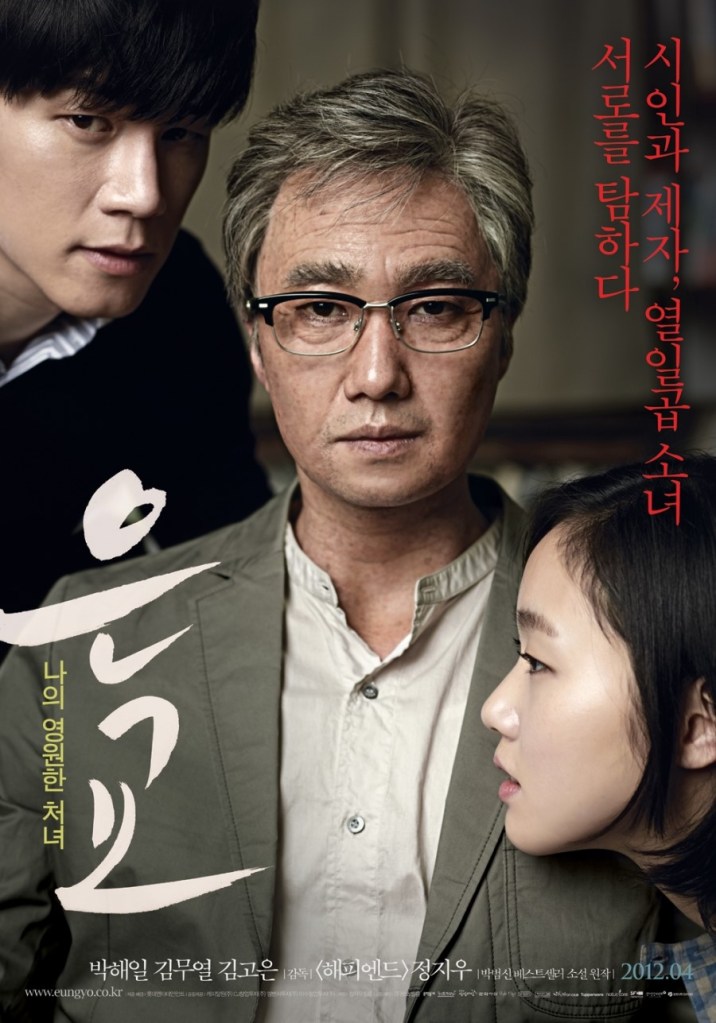
Eungyo (AKA A Muse, 은교, Jung Ji-woo, 2012)

eungyoStories of old men trying to recapture their lost youth through projecting their fantasies onto pretty young women are not exactly rare and the protagonist of Jung Ji-woo’s Eungyo ( AKA A Muse, 은교) is just as aware as most that his dreams of youthful romance border on the ridiculous. A tale of loss, nostalgia, and jealousy both professional and personal, Eungyo is a poetic exploration of the burdens and benefits of age which are often invisible to those who can only look forwards.

At 70, Lee Jeok-yo (Park Hae-il) is a respected professor and literary giant who lives a quiet and solitary life in an out of the way villa. His only companion is his apprentice-cum-assistant, Seo Ji-woo (Kim Moo-yul), who is currently experiencing a period of success as his genre crossing novel Heart is topping the best seller list. When the pair return home one day to find pretty teenager Eungyo (Kim Go-eun) asleep in their garden chair, it sparks off a three way relationship which sees her working as part-time housekeeper for Jeok-yo.

Eungyo is a lively young girl and brings a little light and laughter into the otherwise stuffy villa but when she runs away from home one stormy night and stays over, the situation changes. Catching sight of Eungyo emerging from Jeok-yo’s bed, Seo jumps to the obvious conclusion and is filled with moral outrage in thinking his aged boss is conducting an inappropriate relationship with a schoolgirl. Or, perhaps, Seo himself is attracted to the girl and is angry that Jeok-yo has once again “beaten” him and proved himself superior on the fields of both literature and romance. Eungyo’s presence deepens the divide between master and pupil, threatening to change both of their lives forever.

Jeok-yo is under no illusions and never contemplates the idea of real relationship with Eungyo. His life had been a quiet and solitary one, though there’s little indication exactly how he felt about that. What is clear is that Jeok-yo dislikes his ageing body and the loss of his youth. In his fantasy romance, Jeok-yo is young, running and playing like a naive teenager in love but as soon as he wakes up the spell is broken, he’s old again and the idyllic world he’d conjured for himself no longer exists.

Even if he dreams another world for himself, Jeok-yo is perfectly aware of how things are in this one. Ji-woo, by contrast, attempts to solve all his problems by deluding himself into believing his future is brighter than it really is. His professional relationship with Jeok-yo turns out to have an unexpected dimension and Ji-woo’s literary success is a hollow pillow for his self esteem. Insecure about his talent, especially in comparison to his mentor, Ji-woo sets about casting himself as morally superior through his objection to Eungyo’s new role in their lives but this too is a thinly veiled way of trying to eclipse his master. All Ji-woo has to offer is his youth but even this cannot heal his loneliness and lack of self worth.

Eungyo becomes a symbol of something else for both men but she is also a young woman with a number of problems of her own. Faced with an apparently difficult home environment, Eungyo is seeking a connection from these two men but her borderline status as an adolescent girl means that the water is always coloured with both men viewing her as a potential lover rather than a child in need of shelter. Coming to admire Jeok-yo for his poetic soul and literary talent and siding with him against Ji-woo, Eungyo later makes a self destructive decision which ends her relationship with both men.

There are no happy endings here, even if the idea of a “happy ending” is not quite as ironic as in Jung’s previous film centring on marital infidelity, Happy End. Nobody gets what they wanted or what the audience wanted for them and each end up unable to come back from the whirlwind of self destruction which they’ve each helped to generate. A nuanced character piece in which age competes with youth, loss competes with gain, success competes with personal fulfilment, and true feeling is sacrificed for a relief from loneliness, Eungyo is deceptively named not for the young woman at its centre but for the collection of hopes, dreams and aspects of self which each of the men have imbued her with, eclipsing the real woman with an imagined prize and losing her in the process.


International trailer (English subtitles)