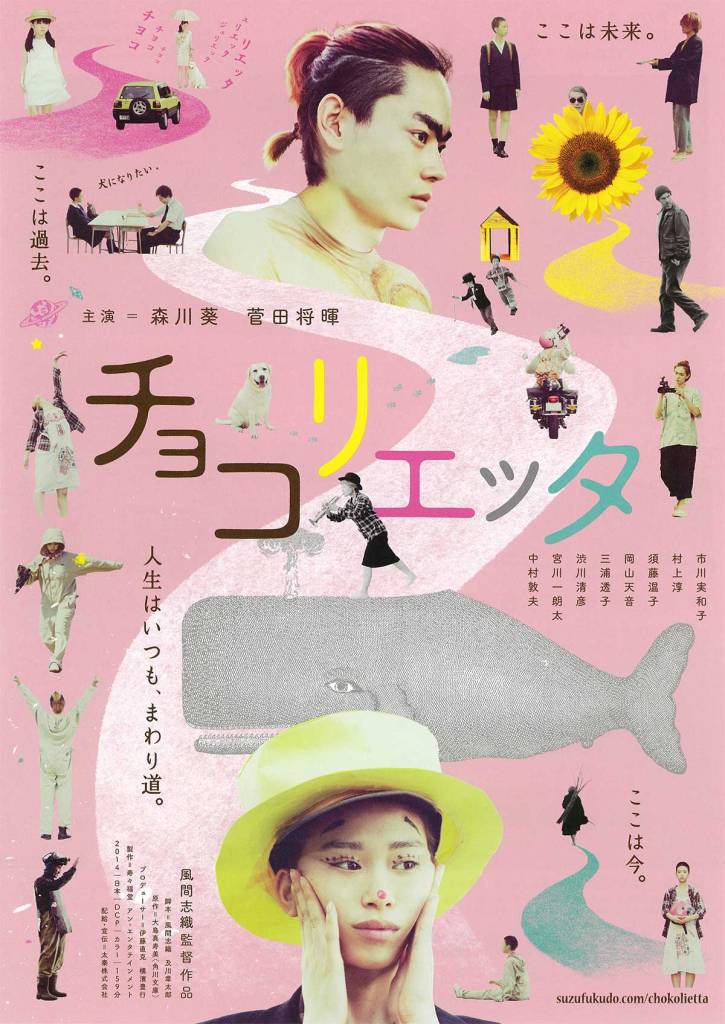
Chokolietta (チョコリエッタ, Kazama Shiori, 2014)

ChokoliettaWhen examining the influences of classic European cinema on Japanese filmmaking, you rarely end up with Fellini. Nevertheless, Fellini looms large over the indie comedy Choklietta (チョコリエッタ) and the director, Shiori Kazama, even leaves a post-credits dedication to Italy’s master of the surreal as a thank you for inspiring the fifteen year old her to make movies. Full of knowing nods to the world of classic cinema, Chokolietta is a charming, if over long, coming of age drama which becomes a meditation on both personal and national notions of loss.

The story begins in the summer of 2010 when five year old Chiyoko (Aoi Morikawa) is involved in a car accident that results in the death of her mother. Flash forward ten years and Chiyoko is a slightly strange high school girl and a member of the film club. Her parents, as far as she knows, were both big fans of Federico Fellini – in fact the family dog is named “Giulietta” after Fellini’s muse and later wife Giuletta Masina. As a child, Chiyoko also received the strange nickname of “Chokolietta” from her mother which also seems to be inspired by the star. Sadly, their Giulietta has also recently passed away removing Chiyoko’s final link to her late mother and once again forcing her to address the lingering feelings of grief and confusion which have continued to plague her all these years.

At this point Chiyoko goes looking for the DVD of La Strada they watched in film club last year which leads her to the now graduated Masamura Masaoka (Masaki Suda). Masaoka is an equally strange boy with possible sociopathic tendencies though he does own a large collection of classic DVDs and the pair settle down to return to the world of Fellini. Eventually Masaoka convinces “Chokolietta” to star in a movie for him and the two take off on a crazy road trip recreating La Strada where Masaoka stands in for the strong man Zampanò and Chiyoko plays the fragile Gelsomina.

Thankfully, the partnership between Chiyoko and Masaoka is not quite as doom laden and filled with cruelty as that between Gelsomina and Zampanò. Though Masaoka often talks of the desire to kill and Chiyoko the desire to die, both appear superficial and are never presented as actual choices either will seriously act on. Masaoka is cast in the role of the strong man but he more closely resembles The Fool as he gently guides Chiyoko onto a path of self realisation that will help her finally learn to reach a tentative acceptance with the past and begin to move forward rather than futilely trying to remain static. Of course, he’s also forcing himself into a realisation that he doesn’t have to play the role he’s been cast in either and so it doesn’t follow that one has to behave in the way people have come to expect simply because they expect it.

Technically speaking the bulk of the story takes place in a putative future – around 2020, or ten years or so after the death of Chiyoko’s mother in 2010. 2010 is also a significant date as it’s the summer before the earthquake and tsunami struck the Japan the following March causing much devastation and loss of life as well as the resultant nuclear meltdown which has continued to become a cultural as well as physical scar. The journey the pair make takes them on a fairly desolate route past no entry signs into ghostly abandoned shopping arcades still strewn with the remnants of a former, bustling city life but now peopled only by a trio of silent, stick bearing men. This is a land of ghosts, both literal and figural but like most things, the only way out is through.

Taking a cue from Fellini, Chiyoko has frequent visions of her her deceased mother and fantastical sequences such as boarding a whale bus like the whale in Casanova or suddenly seeing Gelsomina and an entourage of dwarfs trailing past her. Her world is a fantastical one in which her daydreams have equal, or perhaps greater, weight to the reality. Her now empty indoor dog house comes to take on a symbolic dimension that represents an entirety of her past her life as if she herself, or the dog she claimed to want to become, had been hiding inside it all along. The film returns to La Strada in its final sequence only to subvert that film’s famous ending as where Zampanò’s animalistic, foetal howling spoke of an ultimate desolation and the discovery of a truth it may be better not to acknowledge, here there is a least hope for a brighter future with the past remaining where it belongs.

However, Chokolietta runs to a mammoth 159 minutes and proves far too meandering to justify its lengthy running time. Truth be told, the pace is refreshingly brisk yet the central road trip doesn’t start until 90 minutes in and there are another 30 minutes after it ends. It’s cutesy and fun but runs out of steam long before the credits roll and ultimately lacks the necessary focus to make the desired impact. That said there are some pretty nice moments and a cineliterate tone that remains endearing rather than irritating all of which add up to make Chokolietta an uneven, if broadly enjoyable, experience though one which never quite reaches its potential.


Unsubtitled trailer:

Bonus – here’s an unsubtitled trailer for La Strada (which is possibly the most heartbreaking film ever made).

Also the other two Fellini movies mentioned in the film:

Casanova

and Amacord (original US release trailer)
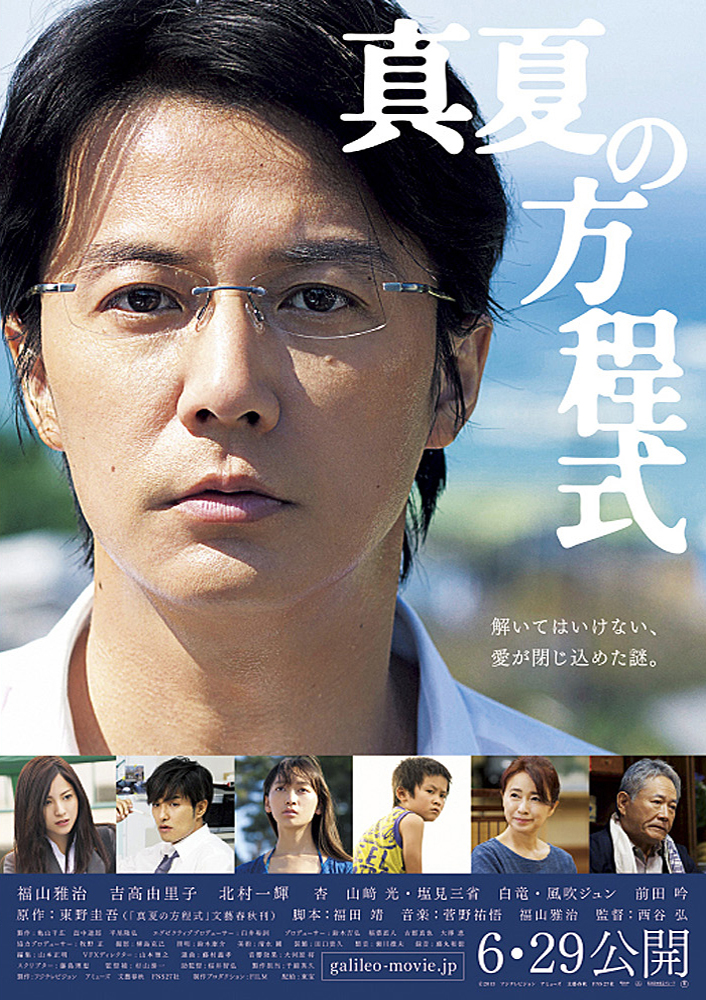
Midsummer’s Equation (真夏の方程式, Hiroshi Nishitani, 2013)

midsummer's equationSometimes it’s handy to know an omniscient genius detective, but then again sometimes it’s not. You have to wonder why people keep inviting famous detectives to their parties given what’s obviously going to unfold – they do rather seem to be a magnet for murders. Anyhow, the famous physicist and sometime consultant to Japan’s police force, “Galileo”, is about to have another busman’s holiday as he travels to a small coastal town which is currently holding a mediation between an offshore mining company and the local residents who are worried about the development’s effects on the area’s sea life.

As fans of the series will know, Manabu Yukawa is a fastidious and difficult man who likes things just so. On the train he ends up encountering a small boy who annoys the other passengers by answering his phone. Apparently he can’t turn it off because all sorts of notifications will be sent to his parents and they’ll go into panic overdrive. The old man across from him doesn’t believe this and grabs the phone away from the small boy after an undignified tussle. In an uncharacteristic move, Yukawa comes to the boy’s rescue by taking back the phone and wrapping it in foil so it won’t go off again – problem solved.

The boy, Kyohei, turns out to be the nephew of the inn owners at the place where Yukawa is staying. After another guest is found dead in mysterious and suspicious circumstances, little Kyohei immediately raises several doubts of his own which endears him to Yukawa who is sad to hear that the boy hates science classes at school. Still, Yukawa concedes there are some odd details in this case especially as the dead man is an ex-Tokyo policeman. Before long Detective Kishitani has been dispatched to assist in  the investigation of another strange mystery.

Again based on a novel by Keigo Higashino, the fourth in his Galileo series, Midsummer’s Equation (真夏の方程式, Manatsu no Houteishiki) is something of a departure as it takes place in an idyllic summer seaside town and is more like some of Higashino’s other mysteries as it places secrets of the heart at its core. Yukawa is generally a difficult man who can’t stand children, in fact they bring him out in a rash. However, for some reason Kyohei doesn’t seem to have this effect on him and he becomes determined to teach the boy the joy of science through a series of experiments while also investigating the central mystery. The incurably curious little tike becomes almost like a mini deputy to Yukawa as he begins to piece together what exactly has happened but it turns out Kyohei may have a different part to play than had originally been suspected.

In the usual mode, it’s not so much a whodunnit as a whydunnit and a how will they catch them. The mystery’s solution is heavily signposted from the beginning and there aren’t a lot in the way of twists. In contrast with some of the other Yukawa mysteries, particularly those from the TV drama, there aren’t a lot of clever scientific shenanigans either and though the central murder is plotted in quite an elaborate way, it’s also a panicked adaptation to circumstances which could be enacted by anyone, anywhere.

Long term series director Hiroshi Nishitani pulls out all the stops here and leaves the small screen far behind as he creates a surprisingly artistic take on a fairly run of the mill murder mystery. Beginning with the repeated motif of the falling red umbrella, he takes care to create a nuanced visual poetry which is quite different in approach both to the construction of the TV series and the other big screen outing which adapted Higashino’s most famous novel, The Devotion of Suspect X. Suspect X never quite managed to marry its roots as the theatrical adaptation of a TV drama and as an adaptation of a hugely popular and award winning book into something which was convincing on both levels. Midsummer’s Equation has an easier time with this as it’s slightly separated from the TV drama series and largely succeeds in becoming a standalone adventure for its famous detective.

Masaharu Fukuyama returns to the role with which he’s become most closely associated and once again captures Yukawa’s detached, though not necessarily uncaring, exterior with ease. He’s ably assisted by a fairly starry supporting cast which includes veteran actress Jun Fubuki, Tora-san’s Gin Maeda and the relatively young actress Anne (Watanabe) as well as the returning Yuriko Yoshitaka as the reluctant Detective Kishitani and cameo appearances from Kazuki Kitamura and Tetsushi Tanaka as Kyohei’s father.

Midsummer’s Equation is Higashino in a more forgiving mood as his hardline moralism never really kicks in and he’s content to merely be sorry for this rather complicated mess of affairs. Here, there’s hope for the future and the possibility of a path forward now that long buried secrets have been uncovered and the truth set out to bloom in the sunlight. He makes it plain that secrets are the root of all evil and that only by embracing the truth, and all of the truth, can you ever be able to make informed choices about your future. This is a lesson that Yukawa wants to pass on to little Kyohei who might be too young to understand the exact implications of his role in the affair (though he seems to have figured some of it out), but will undoubtedly have a few questions as he grows up. A well crafted addition to the series, Midsummer’s Equation proves another enjoyable excursion for Yukawa which succeeds not only in terms of its intricately plotted mystery but also as an intriguing and emotionally satisfying character drama.


The Hong Kong release of Midsummer’s Equation includes English subtitles.

A Chorus of Angels (北のカナリアたち, Junji Sakamoto, 2012)

chorus of angelsAs you read the words “adapted from the novel by Kanae Minato” you know that however cute and cuddly the blurb on the back may make it sound, there will be pain and suffering at its foundation. So it is with A Chorus of Angels (北のカナリアたち, Kita no Kanariatachi) which sells itself as a kind of mini-take on Twenty-Four Eyes (“Twelve Eyes” – if you will) as a middle aged former school mistress meets up with her six former charges only to discover that her own actions have cast an irrevocable shadow over the very sunlight she was determined to shine on their otherwise troubled young lives.

Haru has been working as a librarian in the city for the last twenty years and has finally reached retirement age but before that she was a school teacher in Japan’s frozen north. Before she can even think about enjoying her new found freedom, a pair of policeman turn up at her door to ask her a few questions about one of her former pupils, Nobuto, who is a suspect in a murder case. It seems that they found Haru’s address amongst Nobuto’s possessions and are keen to find out what kind of relationship she had with him and anything she might know about his current whereabouts. Haru is shocked to the core but remembers that she always gets a New Year card from one of Nobuto’s classmates, Manami, and decides to return home at long last to try and put to rest some wandering ghosts.

Like much of Kanae Minato’s work, A Chorus of Angels is a perfectly constructed mystery only this time much more of the heart than of the head. Consequently, it would be wrong to reveal too much of the plot but suffice to say that a traumatic incident twenty years ago left a profound effect not only on each of the children but also on their teacher and others in the surrounding area. Re-encountering each of her six pupils again, Haru discovers that each of them has been harbouring a deeply buried sense of guilt and shame, believing themselves to have been responsible for what happened that day. That sense of unresolved trauma has prevented each of them from fully getting on with their lives, as if some part of each of them was frozen in time when they were just primary school children singing in a choir and feeling proud of themselves for the first time in their lives.

Their teacher, Haru, also left a part of herself behind in that snowy northern landscape. Having committed something which some would regard as a sin, she’s hounded off the island – or perhaps allows herself to be, giving in to a punishment that she sees as befitting her own sense of guilt. However, as is customary for Minato, Haru’s “crime” is not such a black and white affair. If she betrayed someone, that person understood and, ultimately, only wanted the best for her. That she sacrificed the things that might have allowed her to go on living a happy life is the kind of tragic irony Minato is known for and the lonely, cold and shut off appearance of Haru’s twenty years of librarianing exile is another perfect example. She didn’t really do anything wrong except for try to live, and yet she’s paid for that with the next twenty years of her life and not only that, in robbing the young children who’d come to see her as something of a guardian angel of her very presence, she’s left them to pay too. Guilt grows like a mountain until it eclipses even the brightest of suns.

Despite its unfeasibly starry cast which radiates around veteran actress Sayuri Yoshinga and includes such young talents as Hikari Mitsushima, Mirai Moriyama, Ryuhei Matsuda, Ryo Katsuji, Aoi Miyazaki and Eiko Koike, A Chorus of Angles is actually fairly ordinary in terms of its directorial style and though it manages to stay on the right side of saccharine, never quite manages to make its tear-jerking set-up quite as moving as it seems to want to be. That said, it does boast some extraordinarily beautiful scenes of the Hokkaido snowscape which is a perfect setting for this chilling, frozen ghost story in which no actual ghosts appear. The children’s childhoods are all blissful blue skies and sunny summer days but in the future there’s only snow and cold winter sunshine. Just stay alive, it would be enough – to live is to suffer, but you have to go on. The important thing to learn is that it’s one thing to forgive everyone else, but there comes a time when you have to forgive yourself, too.


The Hong Kong release of A Chorus of Angels includes English subtitles!

Unsubtitled trailer:

Main Theme (メイン・テーマ, Yoshimitsu Morita, 1984)

main themeDespite being one of the most prolific directors of the ‘80s and ‘90s, the work of Yoshimitsu Morita has not often travelled extensively overseas. Though frequently appearing at high profile international film festivals, few of Morita’s films have been released outside of Japan and largely he’s still best remembered for his hugely influential (and oft re-visited) 1983 black comedy, The Family Game. In part, this has to be down to Morita’s own zigzagging career which saw him mixing arthouse aesthetics with more populist projects. Main Theme is definitely in the latter category and is one of the many commercial teen idol vehicles he tackled in the 1980s.

A tale of two intersecting love stories, Main Theme begins with nursery nurse Shibuki getting close to the father of one of her pupils, Omaezaki, who will shortly be transferred to Osaka. Omaezaki also has a long running thing with a cabaret jazz singer, Kayoko, which seems to be a messy situation to begin with. Shibuki then ends up running into magician with a pick-up truck Ken who drives her to Osaka where she’s set to meet up with Omaezaki to become some kind of nanny living with him and his wife. En route, the pair pick up Kayako little knowing of her relationship with Omaezaki. Eventually, everyone ends up in Okinawa where Ken lives and Shibuki has an older sister each hoping to sort out their romantic difficulties under the blue island skies.

Main Theme stars popular idol of the time Hiroko Yakushimaru (star of Sailor Suit and Machine Gun) and is, unsurprisingly, centred around her chart topping song of the same name. A neat, new Japanese arrangement of the classic jazz standard Sway, the song fits neatly into the movie’s soundtrack which also features a number of other jazz hits such as The Man I Love and most notably Bei Mir Bistu Shein (or Shoen, or Shön depending on which version you’re looking at) courtesy of our cabaret singer (and her rivals) but being an ‘80s movie there’s still a bit of pop synth in there too though our central couple do seem to have oddly sophisticated tastes.

Though it is, as it’s intended to be, a teen romantic comedy, Morita tries (not entirely successfully) to put a little more substance into the background by also showing us the unhappy romance of middle-aged jazz singer Kayoko and the non-committal Omaezaki. It seems the pair have had an entailment probably stemming back years, perhaps even before Omaezaki’s marriage. Mrs. Omaezaki is a fairly ditzy and neurotic woman who loves shopping and seems to be more interested in the appearance of things than the reality. The status of the marriage itself is difficult to discern and it’s not quite clear if Omaezaki’s problem is a lack of will to leave his wife or that he’s already “left” and is trying to find a way to support her. In any case, introducing Shibuki, a 19yr old with an obvious crush on him, to the household is not one of his better ideas.

Needless to say, Ken also ends up forming an attraction to the older, melancholy musician who doesn’t seem to know what it is she wants (or knows but chooses to run away from it) leaving us in an odd kind of love square with the couples really each wanting their age appropriate partners but getting distracted by foolish dalliances with age and youth respectively. It does feel as if Morita could have made more of this dramatically interesting idea as Kayoko in particular is drawn in by Ken’s youthful innocence, but this isn’t what the film is for so it remains an intriguing yet perverse addition to the film’s otherwise straightforward narrative.

The “perversity” or strangeness of the film doesn’t end there as Morita has also added a number of quirky, absurd touches to offset the flatness of the teenage love drama. Perhaps because he’s a magician we get these odd flashes of Ken where he’s suddenly got crazy eyebrows (just for one 15 second shot) or crazy hair and there’s another charming scene where he’s pulling artificial flowers out of his suit only to have the magic bouquet suddenly droop as his heart starts to break. In another intriguing trope there’s also a strange illustrated map which lead’s Shibuki to her sister’s house by outlining common scenes from the area and when she gets there the gates are covered in light up ornamental tropical fruits. Add to this that the backing behind Kayoko’s final cabaret reads “Bates Motel Live” and there’s definitely a very strange mind behind the production design on this run of the mill, idol pop pushing rom-com.

Undoubtedly of its time, there is probably a reason Main Theme has not proved a big overseas hit though it seems to have been massively popular at the time and is fondly remembered for nostalgic reasons even if not particularly well regarded today. This is perhaps how the film is best approached – as a monument of its times and as a prime example of the 80s idol dramas studios such as Kadokawa put out to push their inoffensive pop music. However, Morita does add his own quirky touches to the film which does provide its fair share of youthful fun even if it isn’t always successful.


Unsubtitled trailer:

And a more recent version of Hiroko Yakushimaru singing the title song:

The March of Fools (바보들의 행진, Ha Kil-Jong, 1975)

March of FoolsAside from the original 1960 version of The Housemaid (and this perhaps only because of its modern “remake”), mid 20th century Korean Cinema has been severely neglected overseas. Ha Kil-jong’s The March of Fools (바보들의 행진, Babodeul-ui haengjin) is almost unknown abroad but consistently tops Korean lists of the country’s best cinema and has been both enormously influential on later filmmakers and fondly remembered by audiences.
The story centres around two philosophy students, Byeong-tae and Yeong-cheol who are making the most of their youthful freedom. Beginning as a camp comedy, the film follows the pair as they rub up against oppressive squares who take issue with their longish hair (as in one comical sequence where they amusingly escape from a policeman who could do with a trim himself) or berate them for smoking on campus. They’re pretty broke most of the time but they each pay a couple of bucks to go to a mixer to meet girls and they both spend the rest of the movie chasing their respective ladies. Byeong-tae ends up leaving the party to meet his date, Young-ja, outside but she makes him wait for her at a snack stand before flirting with her professor to try and get a better grade. Only partially succeeding, she then asks Byeong-tae to write the paper for her in return for a proper date. Yeong-cheol has much less luck with Young-sook who declares him “boring” and walks out, but the pair meet again a few times later.

Yes, there are drinking parties and sports – the authentic “college” experience, but these are turbulent times and though Ha Kil-jong is prevented from including as much political action as he’d have liked, the subtext of student rebellion hangs in the background. The film caused trouble with the censors at the scripting stage and even once completed was subject to a number of cuts which removed all references to student protests or so called “immoral behaviour”.

The cheerfulness of the early part of the film is there to deepen the despair present in its later moments, though this same despair and desperation were the things the censorship office sought to dampen with their frighteningly effective yet often minimal cuts and changes to the innovative editing structure. All of these young people talk about their dreams for the future and mostly these are small personal things, no one talks about changing the world or getting into politics. However, all are also facing the fact that the dreams they’re chasing are unattainable. They have no positive future or freedom to change their own path – a job, a marriage, children, death. All mapped out already, but if you fall from one of the branches, there’s nowhere to go but down.

Young-ja sort of knows this, she jokes around by saying she wouldn’t marry Byeong-tae because they’re the same age. He’ll be drafted into the army, then have to finish university, so she’ll be “an old maid” before their lives can even get started. She would be better off to find an older man who’s already been through the army, finished his education and has a steady a job. Byeong-tae is also a philosophy student which doesn’t exactly scream employment potential either. Yet, when the couple are to be separated at the end of the film in a scene which has become a landmark in Korean cinema history, she shows her true feelings for the first time as, perhaps, she is about to watch her dream pull away from her.

Yeong-cheol keeps repeating the same strange dream of going whale hunting after he becomes rich. He also always rides a bicycle but every time someone asks him about it he looks confused and says “this is my car”. Yeong-cheol is the weedier of the pair and has failed the military examination which takes place at the beginning of the film because of his poor eye sight. He couldn’t go into the military even if he wanted to and is much less equipt in terms of his personality to cope with the quite turbulent environment of 1970s student radicalism with the constant university shutdowns and pressure from above to conform to the standards of the time.

The “Fools” of the title are the young people like Byeong-tae and Yeong-cheol who know everything is pointless but somehow persist with their ideals and maintain the idea, at least, of a brighter future even if not actively pursuing any kind of “revolution”. Ha Kil-jong was educated in America alongside such contemporaries as Francis Ford Coppola and brought some of that mid 1960s radicalism back with him when he returned to Korea in 1970. Because of the effects of the censorship placed on the film which not only required dialogue to be erased or scenes to be cut entirely but even disrupted the sequence of the editing, the finished film is not necessarily the one which Ha was trying make but does place him among one of the most innovative directors working in the comparatively difficult 1970s Korean Cinema environment. Sadly, after making two sequels to this film Ha Kil-jong died of a stroke at the tragically young age of only 38 robbing us of the masterpieces which would surely have followed. At least with the stunning restoration completed by the Korean film archive which presents the film in the “most complete” form possible, his vision might be more clearly seen by viewers around the world.


The March of Fools is the second film in the Korean Film Archive’s series of blu-ray releases and like the other films in the collection includes English subtitles for the main feature as well as for the commentary track but also features an English language commentary from Korean film expert Darcy Paquet as well as some of the censored footage and comes with a 42 page booklet in both Korean and English.

Unsubtitled extract from towards the end of the film:


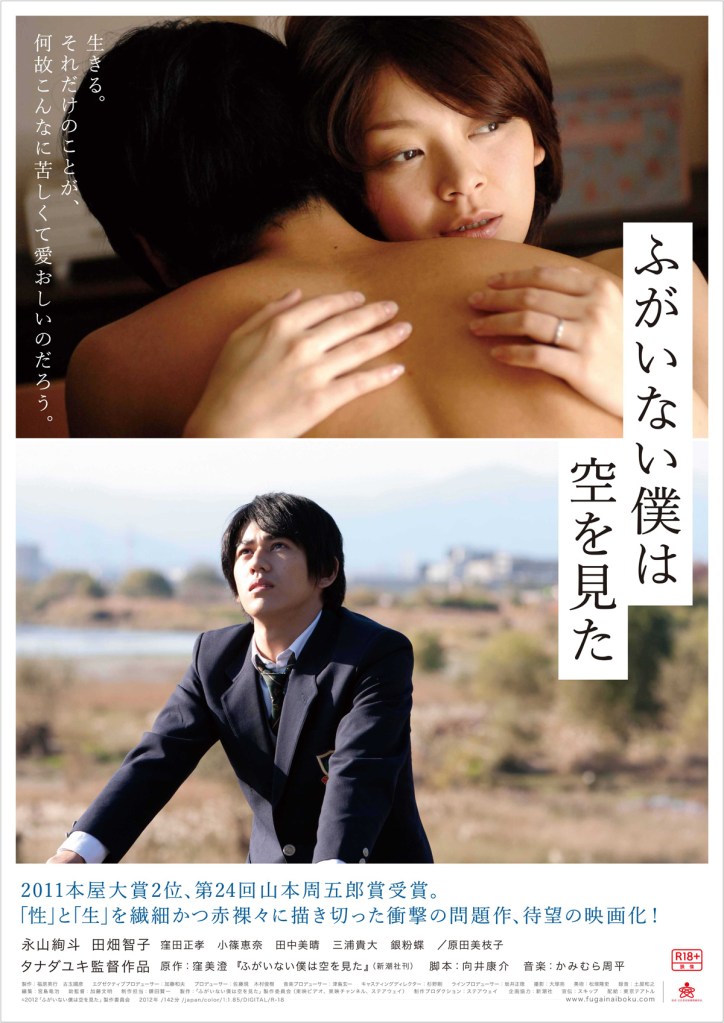
The Cowards Who Looked to the Sky (ふがいない僕は空を見た, Yuki Tanada, 2012)

Cowards who looked to the sky posterThe work of director Yuki Tanada has had a predominant focus on the stories of independent young women but The Cowards Who Looked to the Sky sees her shift focus slightly as the troubled relationship between a middle aged housewife who escapes her humdrum life through cosplay and an ordinary high school boy takes centre stage. Based on the novel of the same name by Misumi Kubo, The Cowards Who Looked to the Sky (ふがいない僕は空を見た, Fugainai Boku wa Sora wo Mita) also tackles the difficult themes of social stigma, the power of rumour, teenage poverty, elder care, childbirth and even pedophilia which is, to be frank, a little too much to be going on with.

Told in a non-linear, overlapping structure the central spine of the film follows unfulfilled housewife Satomi who likes to dress up as her favourite character from the retro anime Magic Girl. Whilst dressed as its heroine, Anzu, she spots a high school boy at a convention who looks eerily like the anime’s hero, Muramasa. Takumi is only at the convention with a friend and has no particular interest in anime but as the two live in the same area “Anzu” convinces Takumi to come and try on a Muramasa outfit at her place. One thing leads to another and the pair embark on a proxy affair which takes the form of role-play between the two anime characters carefully scripted by Satomi. However, Satomi’s hitherto disinterested husband begins to notice a change in her behaviour and has spy cameras installed catching the hot cosplay action for all to see. When he uploads the video to the internet it causes a serious problem for the young and impressionable Takumi.

Actually, there’s a third person in Satomi’s marriage to her feckless husband Keiichiro in the form of his overbearing mother. So far, the couple have no children despite having been married for some time and this has distressed Michiko to the point that she’s the one dragging the couple in for IVF treatment and getting upset when it doesn’t work. Her son, Keiichiro, has weak swimmers and actively doesn’t want children but this doesn’t stop Michiko taking all her frustrations out on Satomi whom she brands as “defective” and gives the impression that she’d like to “fire” her if she could. A shy woman and probably quite bored as a stay at home housewife, Satomi retreats into fantasy by cosplaying as the familiar character from her favourite childhood anime Magic Girl. Becoming Anzu and having an affair with Muramasa isn’t quite cheating, after all, and perhaps she even hopes to have the child that her mother-in-law so desperately wants her to have even if her husband and medical science won’t help her.

Among the younger generation, Takumi lives with his mother, Sumiko, in a residential maternity clinic that she runs where pregnant women can come and be looked after in a more natural and homely environment than the comparatively cold and sterile hospital. Takumi is best friends with a boy who lives near by who, like him, has no father but unlike Takumi his mother is also an absent figure too so Ryota must work part-time at the combini whilst also looking after his grandmother who is suffering with dementia.

Sumiko tries to support Ryota by giving him occasional food parcels but as a young man Ryota sometimes finds this a little embarrassing and is offended by the idea of receiving charity. When it comes right down to it, he resents Takumi’s happy relationship with his mother and their relative financial security. The manager at the store brands Ryota a “ghetto kid” and even blames him for the increase in shoplifting by kids from the estate. He has little time to study even if he wanted to, but all he sees for his future is a great big dead end. Another worker at the store who previously worked as a teacher offers to help Ryota improve his grades and maybe even try for a university scholarship but turns out to have a dark side of his own.

Simply put, there are far too many plot strands in rotation here and the screenplay never manages to corral them into any kind of satisfying arrangement. There is a moment of unity where Ryota’s story meets Takumi’s but it’s a fairly brief point of intersection (though a hugely important one both in terms of themes and storyline) leaving Ryota’s entire subplot feeling like a distraction to the main high school boy meets damaged older woman narrative. That’s without all of the goings on at the clinic, the brief appearance of Takumi’s father and the disappearing act of Ryota’s deadbeat mother who makes off with all his savings. The film’s scope and ambition is admirable but it ultimately fails to unify its disparate plot strands into a convincingly focused form.

That said, other than running too long the The Cowards Who Looked to the Sky does have a lot of interesting elements and is always beautifully shot showing off a rarely seen side of suburban Tokyo. The performances are also of a high quality particularly given the film’s frank erotic content which is played with refreshing realism by the veteran former child actress Tomoko Tabata and the comparatively less experienced Kento Nagayama as the confused high school boy caught in the fire of his first affair. At once too superficial and too deep, The Cowards Who Looked to the Sky spreads itself too thin to make a lasting impact though does offer enough rewards to justify its lengthy running time.


Reviewed as part of the Japan Foundation Touring Film Programme 2016.


Being Good (きみはいい子, Mipo O, 2015)

Being Goog J poster“Being good”. What does that mean? Is it as simple as “not being bad” (whatever that means) or perhaps it’s just abiding by the moral conventions of your society though those may be, no – are, questionable ideas in themselves. Mipo O follows up her hard hitting modern romance The Light Shines Only There by attempting to answer this question through looking at the stories of three ordinary people whose lives are touched by human cruelty.
The film begins with newbie teacher Okano (Kengo Kora) who is still trying to adjust to the extremely stressful life of a primary school teacher in charge of 38 little guys and girls. As he’s young and he’s only just started he’s filled with enthusiasm and is intent on doing his best to make a difference. On the other hand, he’s a young man with a private life of his own to think about and sometimes he’s just too tired to want to be bothered with a bunch of kids intentionally trying to push his buttons. When he notices one of the pupils hanging around the schoolyard everyday long after he should have gone home, he begins to worry about the boy’s life outside of school.

Strand two also features the life of an abused child as stressed out mother Masami (Machiko Ono) struggles to cope with her three year old daughter Ayane while her husband is frequently abroad on business. Having been an abused child herself, Masami enters a vicious cycle of hating herself for treating her daughter the way she does and resenting Ayane even more for making her feel this way. After becoming friends with a cheerful woman who seems completely at ease with her two rowdy kids, there may be a better way out on offer for Masami and Ayane.

The third tale is a little different than the other two as it encompasses themes of lonely older people in Japan’s rapidly ageing society and the position of those who are different from the norm. Akiko lost her entire family during the war and never had children of her own so she’s all alone now. Every evening while she’s sweeping the steps a young boy says “hello, goodbye” to her as he walks past. One day the boy is in a terrible panic because he’s somehow lost his house key but Akiko calms him down and takes him inside until his mother can come and fetch him.

Okano is full of good intentions. He wants to think himself a “good” person and genuinely wants to look after the young lives placed in his care. However, he is still young, inexperienced and a little bit vain so that the slightest bit of criticism niggles at him. Simply put, he just doesn’t really know what to do and several of his ideas backfire quite spectacularly or appear extremely ill-conceived. Some of this is still about him and his own idea of his being a “good person” rather than an altruistic desire to help the children under his care.

The same, however, cannot be said of the elderly lady who still takes such delight in the falling cherry blossoms which waft down from the school to her small suburban house. Akiko might be lonely, but there’s nothing selfish in the warmth she extends to others. When Hyato’s mother, Kazumi, arrives to fetch him, she’s immediately mortified, convinced that her son must have caused immense levels of trouble for this little old lady. Akiko claims not even to have noticed Hyato’s differences but remarks on how polite he is greeting her every evening and that he’s been the perfect houseguest – in fact she was enjoying herself so much she’s a little sorry Kazumi has turned up so quickly. Kazumi is completely overwhelmed by Akiko’s kindness – it’s the first time she’s ever heard anyone say something nice about her son rather than having people criticise him for being different. In fact, sometimes even she begins to forget how “good” he can be.

In the case of Masami and her daughter Ayane, it’s not that Masami is “bad” person but is responding to a cycle of violence that she finds impossible to escape. Masami doesn’t cope well with stressful situations, dislikes noise and disorder and has impossibly high (and arbitrary) standards for her daughter which result in “discipline” through physical violence. Nevertheless, Ayane loves her mother and, even if Masami recoils when Ayane tries to hug her, reacts with horror to cheerful friend Yoko’s joke of adopting her into their family. Ayane wants to be like her mum, taking delight in wearing a matching pair of shoes even if that means she can’t play with the other kids. As Masami was abused, so she abuses – will the cycle continue with Ayane? Luckily, the pair may have found a more gentle solution in the form of the kindly Yoko who proves far wiser than one would suspect.

As Okano’s sister tells him, when you’re nice to children, they’re nice to others. If everyone could be nicer to their children perhaps we could have a nicer world. The young boy whom Okano is trying to save has come to believe that he’s a “bad kid” – proven by the fact that Santa never comes to their house. He can’t bring himself to talk about his step father to his teachers and Okano’s interventions only make things worse for the boy. He needs someone to show him that he’s not at fault and that the world is not a bad place but it will take more than just “good will” to solve the problem. Sometimes, all you can do is knock on the door.


Reviewed as part of the Japan Foundation Touring Film Programme 2016.

This is the original trailer for the film but in my opinion it contains a few spoilers so bear that in mind if you plan on watching in the near future:

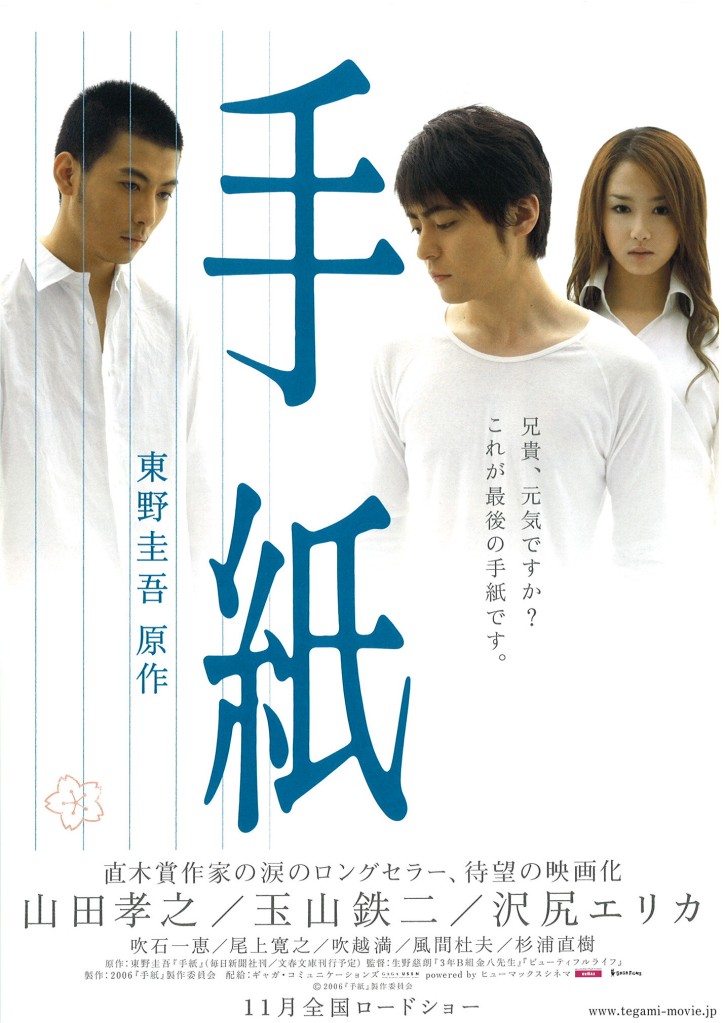
The Letter (手紙, Jiro Shono, 2006)

The Letter PosterWhen it comes to cinematic adaptations of popular novelists, Keigo Higashino seems to have received more attention than most. Perhaps this is because he works in so many different genres from detective fiction (including his all powerful Galileo franchise) to family melodrama but it has to be said that his work manages to home in on the kind of films which have the potential to become a box office smash. The Letter (手紙, Tegami) finds him in the familiar territory of sentimental drama as its put upon protagonist battles unfairness and discrimination based on a set of rigid social codes.

Nao (Takayuki Yamada) is a bright young man who had the chance to go to university and progress into a normal middle class life but is now slumming it as a blue collar worker at a factory. It transpires that his dismal circumstances began when he and his brother were orphaned meaning that his older brother Takashi (Tetsuji Tamayama) left school to get the money for Nao’s education. Working himself to the bone, Takashi was injured in a workplace accident and subsequently laid off. Desperate to provide for his brother, he turned to crime and unfortunately ended up killing an elderly woman during a burglary gone wrong and will spend the rest of his life in prison. The once close brothers now communicate through letters alone. With his university dreams shattered, Nao moves from place to place, forced out of employment and friendship groups each time someone finds out about his brother. Increasingly he comes to resent Takashi for the shadow his foolish actions continue cast over his life.

It is sadly true that this kind of social stigma towards the relatives of criminals is more prevalent in a society like Japan’s which prizes the overall harmony of the group (though I wouldn’t say it’s entirely absent here either). Every time Nao thinks he’s about to get somewhere, a background check throws up his imprisoned brother and it’s all over. Especially considering that his brother’s crime is a violent one perpetrated against an elderly lady, nobody is prepared to extend an understanding hand to Nao even though the crime itself has nothing to do with him (save being committed in his name) and its price should not be hanging on his shoulders.

It’s unsurprising then that Nao tries to conceal his brother’s existence, often claiming to be an only child with no living family. Though originally communicating warmly with Takashi in the letters, his growing resentment leads to a decline in their frequency and he rarely visits in person. The desire to hide his problematic past becomes a trigger in itself which leads to his having to give up on a dream of becoming a TV comedian just when it looked like his career was about to take off, and failure to tell a fiancée that he lied about being an only child also presents a serious crack in the couple’s relationship. Had he been more upfront and faced out the resulting reaction, he might have been able to work through it but once you’ve tried to lie sympathy dissipates entirely.

At the end of the day Nao is a young man with no one to guide him. He’s angry and he’s ambitious so he’s filled with resentment that he can’t have everything he thinks he deserves simply because of a series of things which happened to him none of which were his fault. Because of this, he makes a series of poor choices failing to see the things that are right in front of him. The dowdy girl next-door type from the factory is clearly in love with Nao but he isn’t interested – she doesn’t fit his slightly arrogant view of himself with her plainness and straightforward goodness. On the other hand, he’s immediately captivated by a beautiful and wealthy socialite who’s way out of his league. Of course, this is likely to end in tears – even if Nao didn’t already have skeletons in the closet the girl’s father has other plans for her which don’t include a marriage to a jumped up poor boy comedian.

The Letter suffers slightly in its focus on Nao and his troubles rather than being evenly split between the brothers. Takashi has paid a heavy price for his crime – he’ll be in prison for the rest of his life and the bright future he tried to buy for his brother has been ruined forever precisely because of the actions he was taking to ensure it. His only lifeline is the letters and the news he gets of Nao’s prospering in the outside world. Nao’s final decision to stop writing and not even tell his brother his new address so that the letters will no longer reach him is therefore a doubly cruel and selfish one. However, Takashi is only presented in relationship to his brother and his own pain and struggle becomes an undeveloped facet of the film.

As in all of Keigo Higashino’s work, secrets are the great enemy. The film only partially addresses the extreme unfairness of Nao’s plight as he’s continually persecuted for something that’s nothing to do with him. Guilty by association only, he is also in prison with no parole board to consider his case. The film even states that this kind of stigma is a perfectly natural thing which just has to be accepted – accept the truth, it says, and the world will open up to you. On balance this is a good message, but the idea that prejudice and social discrimination are things which just have to be endured is an uncomfortable one which sits at odds with the film’s otherwise positive messages of personal redemption and the importance of familial bonds. Uneven and occasionally tipping over into sentimentality, The Letter is something of a missed opportunity but nevertheless offers a thought provoking and emotionally satisfying melodrama in the best traditions of the genre.


Reviewed as part of the Japan Foundation Touring Film Programme 2016.

The Elegant Life of Mr. Everyman (江分利満氏の優雅な生活, Kihachi Okamoto, 1963)

81zKsQWUtKL._SL1442_Kihachi Okamoto might be most often remembered for his samurai pictures including the landmark Sword of Doom but he had a long and extremely varied career which saw him tackle just about every conceivable genre and each from his own characteristically off-centre vantage point. The Elegant Life of Mr. Everyman (江分利満氏の優雅な生活, Eburi Man-shi no Yugana Seikatsu) sees him step into the world of the salaryman comedy as his hapless office worker reaches a dull middle age filled with drinking and regret imbued with good humour.
The film opens with an exciting, strangely edited setup of young people having fun singing, dancing and playing sports on a rooftop while a middle aged man sits apart from them looking gloomy with his head in his hands. Eburi is a depressed ad exec who laments that nothing really interests him anymore. It’s all so crushingly dull that he’s taken to drink, only he’s not very good at it so no one wants to join him. When Eburi drinks, he tends to go off on long and often non sensical rants which is probably quite funny for the first half hour but perhaps less so at 3am. One day he runs into some people from a magazine and gets so roaring drunk that he accidentally promises to write them the best magazine serial they’ve ever seen. Only problem being Eburi’s a copywriter, not a novelist, so he’s no idea what he’s doing. Going with “write what you know” he turns his everyday life into a humorous exposé of modern society and ends up becoming one of the most popular writers around.

The Elegant Life of Mr. Everyman is based on the prize winning magazine serial by Hitomi Yamaguchi which was also inspired by the author’s own life. Yamaguchi and Eburi are both of the generation who came of age around the end of the war, spared the front lines but not the post-war chaos. Somehow, they were the ones who were supposed to rebuild their nation whilst trying to make a life for themselves in the difficult post-war economic environment. Eburi spins a humorous yarn about how he ended up marrying his wife for reasons of financial necessity and the pair didn’t even get a proper honeymoon because they hadn’t bothered to book ahead so all of the inns in the resort town they ended up at were full. Eburi also lost his job twice when the companies he worked for went under and seems a little mystified that he has this pretty good position in the ad agency (even if he doesn’t like it much and no one seems to think he’s very good at it).

There’s an awful lot of social comedy here as the Eburis try to lead their “elegant” lifestyle on his relatively modest salary. The family – Eburi, his wife, son, and father, all live in “company accommodation” which is a complex of small homes where all the employees live close to each other. Eburi’s neighbour works in his office and is a much younger man who’s been married for six months and, in contrast to Eburi, comes straight home at 6pm to have dinner with his wife whom he adores. Eburi is wearing army surplus suits, cheap underwear from the thrift store and a vest which is full of holes in contrast to his neighbour who is wearing swanky sports underwear and fashionable outfits including unshined shoes – unthinkable to Eburi (though his own footwear is in such a state that the shoeshine boys send him packing). Eburi’s wife is also quite excited when she realises their garden might just be a little bigger than next door’s, something which also gives Eburi a lot of pleasure.

In keeping with the source material, Okamoto opts for a first person narrative style with Eburi narrating his life in the manner of his book only employing a fair few other devices in addition to the wild and radical editing. When Eburi goes further back into the past to tell the story of how his no good father became a rich man by exploiting the populace during the years of militarism, the film suddenly becomes a chaplin-esque silent comedy complete with over emphasised acting and pantomime-like painted sets before turning into a full on cartoon. He mixes montage with onscreen graphics which appear way ahead of their time considering this is a film from 1963 and a fairly mainstream comedy at that.

The Elegant Life of Mr. Everyman is also extremely funny. Obviously owing a lot to its source material, the script is one of the wittiest ever written and even if it’s talking about early 1960s social mores, the humour has barely dated at all. Much of the success of this is owed to the committed performance of the leading man, Keiju Kobayashi, who is able to give Eburi a sort of soulful weariness as his cynical rants take on an odd quality of warmth, appearing both strangely energetic and endlessly tired.

Whatever else he says and does, Eburi loves and has a duty to his family that proves extremely stressful for him as he feels the pressure to provide though he only wants the best for them (even at one point lamenting that he’s had to give up thinking about suicide because of the responsibilities he now has). These simple things must have struck a cord with the men of Eburi’s age who found themselves in a similar position of feeling eclipsed by the younger generation coupled with resentment towards their parents who had lead Japan into the folly of war and left the mess for their kids to clean up. Keenly observed, hilariously recounted and brilliantly brought to the screen, The Elegant Life of Mr. Everyman might just be one of the funniest films ever made and an unjustly neglected masterpiece of early 1960s Japanese cinema.


Reviewed at the Japan Foundation Touring Film Programme 2016 at London’s ICA 10th February 2016.


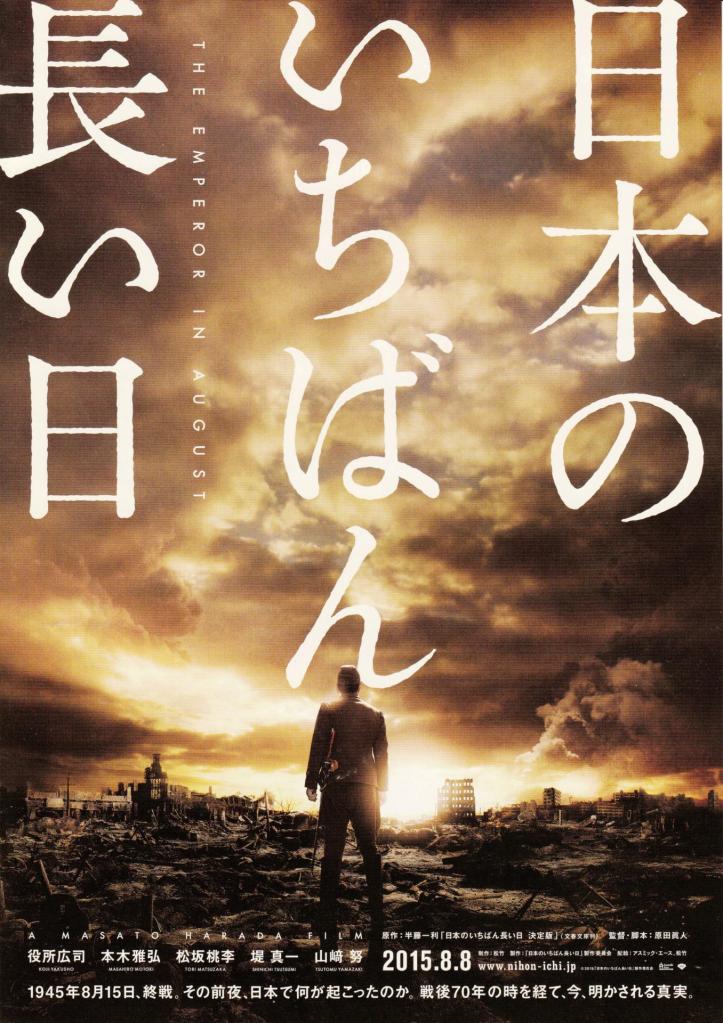
The Emperor in August (日本のいちばん長い日, Masato Harada, 2015)

bbc56b4fff657dfc4fcc0499f8be9741How exactly do you lose a war? It’s not as if you can simply telephone your opponents and say “so sorry, I’m a little busy today so perhaps we could agree not to kill each other for bit? Talk later, tata.” The Emperor in August examines the last few days in the summer of 1945 as Japan attempts to convince itself to end the conflict. Previously recounted by Kihachi Okamoto in 1967 under the title Japan’s Longest Day, The Emperor in August (日本のいちばん長い日, Nihon no Ichiban Nagai Hi) proves that stately events are not always as gracefully carried off as they may appear on the surface.

By the summer of 1945, it’s clear that the situation as deteriorated significantly and Japan can no longer cling to any kind of hope of victory in the wider scale. Tokyo has been firebombed almost out of existence leaving only the Imperial Palace untouched – even the Emperor and his wife have been reduced to eating gruel. Everyone knows it’s time for a solution, but no one is quite ready to say it. In the wake of the atomic bomb, the situation becomes ever more desperate and even if the Emperor himself advocates a surrender, he needs the approval of his advisors. The Prime Minister, Navy and other officials are in favour but the Army, represented by General Anami, is committed to fighting on to the last man. Eventually, Anami comes around to the Emperor’s point of view but some of his men prove much harder to convince…

It might seem like a strange time to make a film about grace in the face of defeat given the recent political troubles stemming back to Japan’s wartime activities, but director Masato Harada is not lamenting the course of the war or trying to advocate for any rightwing agenda so much as trying to make plain the final absurdity of recognising when the battle is over. The civilians and even the Navy might be in favour of accepting the terms of the Potsdam Declaration and ending the war as quickly as possible but a soldier is a soldier and the Army wants to go down fighting. They aren’t alone, of course, there are ordinary people who feel this way too but the writing is well and truly on the wall here.

The bulk of the film takes place within the palace, debating halls or army buildings all of which have escaped major damaged but every time we venture outside we’re shown a scene of utter desolation. A great, gaping hole where once there was a city. Anami’s wife undertakes a four hour walk to try and get in contact with a man who knew their son and can tell them how it was that he fell somewhere in Manchuria. She sees people fleeing, some thinking the enemy are about to descend any minute or that Tokyo will be the next target for an atomic bomb, and walks on through a barren, eerie landscape emerging soot covered and, finally, too late.

Closer to home, the situation among the soldiers is reaching boiling point. Originally committed to rejecting the terms of the treaty, Anami is now in favour of a surrender (with a few caveats) and is desperately working against the threat of an internal coup. Though the top brass have seen enough of warfare to know when it’s time to put down your weapons, the young hotheads have not yet learned the value of pragmatism. Seeing themselves as a second incarnation of the February 26th rebels, a cadre of young officers breaks ranks to try and stop the Emperor’s message of surrender from hitting the airwaves, hoping instead to spread the false message that the Russians have invaded and it’s all hands on deck. Needless to say, they don’t fare any better than the young officers of 1936 and if anything their bullheaded refusal to see sense becomes a microcosmic allegory for the years of militarism as a whole.

In the midst of all this chaos, the real heart of the film is Koji Yakusho’s conflicted general who feels his era passing right in front of him. Grieving for his fallen son yet also clinging to his military duty which dictates no surrender, no retreat he finally sees each of his ideals crumbling and comes to the realisation that the only way to save Japan is to abandon the military. Making a sacrifice of himself, he ensures the safe passage of his nation along a road on which he cannot travel.

The Emperor is a sympathetic figure here, gentle, soft, wanting the suffering to end for everyone but being more or less powerless to effect it despite his title. All he can do is advocate and try to convince his council that surrender is the right course of action as his country burns all around him.

Harada manages to keep the tension high even though a lot of the film comes down to a group of men discussing the proper wording for a treaty. A timely and beautifully photographed exploration of the last days of a war, The Emperor in August is another much needed reminder that decisions which will affect millions of lives are made by handfuls of men in tiny, closed up rooms that most people will never get to see.


The Japanese blu-ray/DVD release of The Emperor in August includes English subtitles.

Unsubtitled trailer: