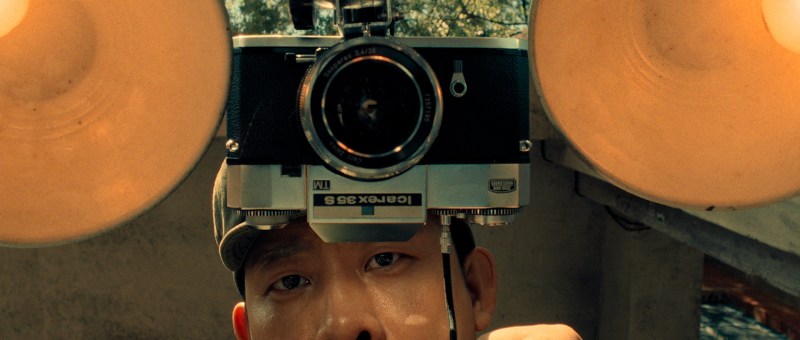
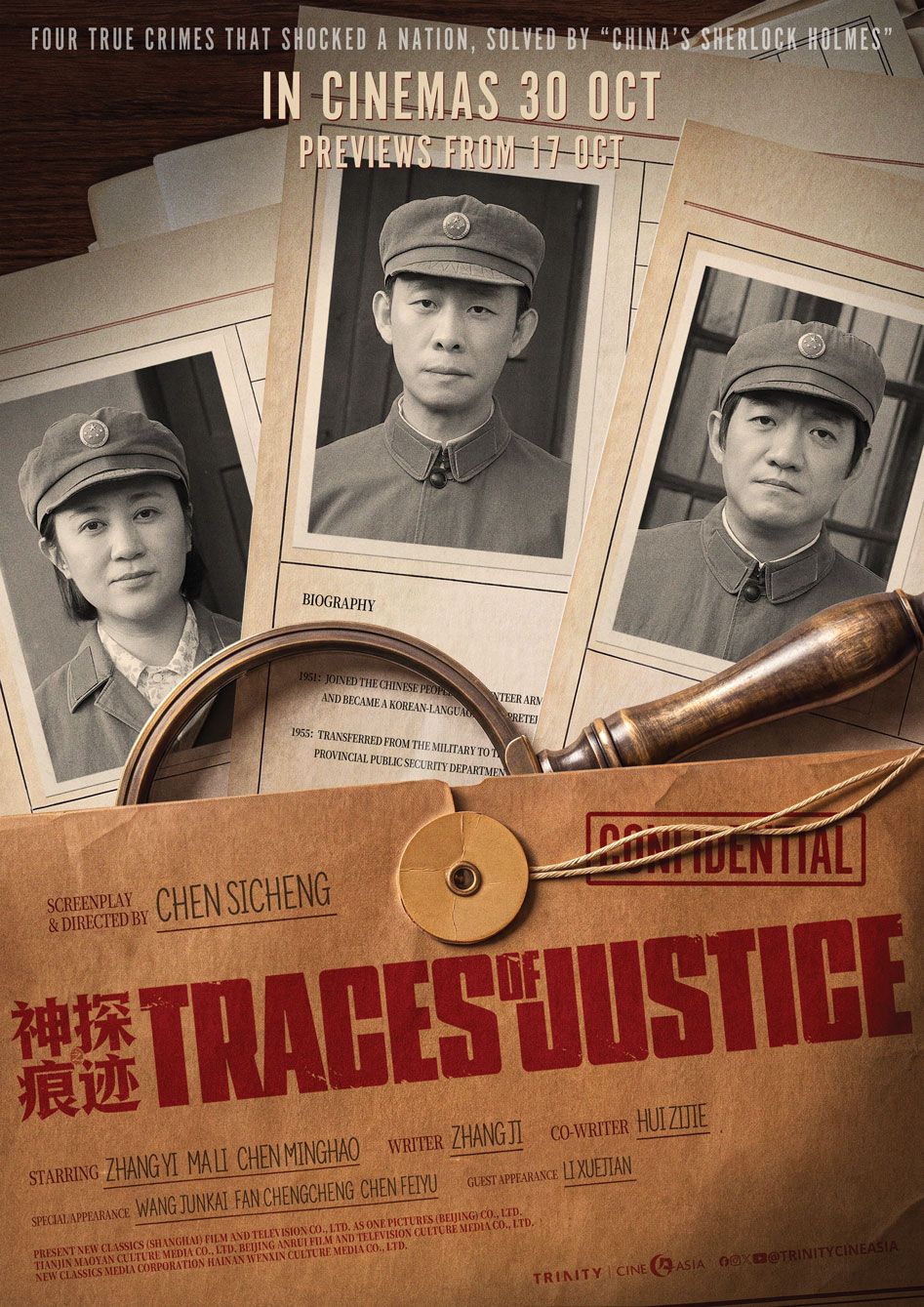
Best known for comedy including the incredibly popular Detective Chinatown series, actor/director Chen Sicheng has been in a more serious mood recently. Like 2024’s literary adaptation Decoded, Traces of Justice (神探之痕迹 shéntàn zhī hénjì) examines China’s 20th-century past but this time through the lens of forensics. Essentially a propaganda piece in praise of the scientific side of law enforcement, the film is in some ways surprising in its implications in hinting at the reasons why these crimes may have occurred along with difficulties of solving them which are often down to political realities.
In 2016, Cui Xun (Zhang Yi) prepares to accept a national honour for his contribution to police sciences while asked to consult on a serial killer case in which the police are struggling to find evidence to charge the suspect with the last remaining victim despite his confession. As evidence of law enforcement’s care for each and every citizen, the policeman in charge brushes off another’s insistence that they don’t need to charge him with the last case because the other 10 are watertight and enough to secure the death penalty. If they don’t officially link him to this case too, the little girl he killed and her family will not receive justice.
The serial killer case reminds Cui of one he investigated back in 1971 in which he pioneered dental indentations being used to identify suspects in the same way as fingerprints. 1971 is, of course, right in the middle of the Cultural Revolution and so Cui is hampered by persistent anti-intellectualism and distrust of science. The first thing he has to do is get his mentor out of a re-education camp, while a girl who narrowly escaped being caught by the killer was vulnerable in that she was currently living alone as both her parents had been “sent down”. The new local police squad leader, Wang (Chen Minghao), also gets in Cui’s way with his “old-fashioned” policing. His officers refuse to let forensics on site first and ruin the crime scene by stomping all over the evidence. One even triumphantly brings a nearby bicycle to dust for prints though his own hands have now been all over it, paying no heed to Cui’s rational response that they’ve no way of knowing if the bike even belonged to the killer.
By 1983, things are quite different. Wang no longer dresses in military uniform while Cui and his team have been given civilian outfits. Cui now has a sizeable team of assistants and students, while a school has been set up to teach modern forensics techniques. Wang secures the crime scene and grants access for the forensics team first. The issue this time around is the chaotic circumstances of the economic reforms. The prime suspect is a man with a rich and influential father who tries to frame a colleague as he had argued with the now murdered boss about black market profiteering. The suspect resents people mentioning the fact that he’s his father’s son, while simultaneously playing the rich kid card with the police by telling them they’re making a big mistake keeping him locked up. Cui is determined to use a broken fingernail found on one of the victims as an identification method, but again faces an uphill battle to have his ideas taken seriously.
One might think that these problems have then been resolved, but the 1998 sequence depicts much of the same anxiety as it begins to become clear that one of the men suspected of blowing up a bus was a disgruntled worker laid off amid the economic changes of the ’90s which saw many factories close. In an ironic touch, Cui’s investigation HQ is located in a disused factory. Like We’re Nothing At All which is inspired by the same incident, the film also suggests the two men involved were a romantic couple and that societal homophobia was a factor in their decision to end their lives.
Cui once again posits new methods of forensic investigation, but at the same time ends up alone with even his assistant leaving him to take up a position in Beijing. His dedication places a strain on his marriage as his wife, a doctor, is forced to pick up his slack given that he is often absent from the domestic space. Nevertheless, his contributions to science are well noted as is his legacy as “China’s Sherlock Holmes”. In some ways, the subtle implication is that the authorities will stop at nothing to catch wrongdoers, so the Chinese citizen is well protected, though this is, in other ways, a little oppressive in the “everything leaves a trace” messaging and may not reflect the reality of modern policing even if the film is surprisingly critical of law enforcement in places, depicting corruption and hinting at violence and forced confessions. Even so, it is at least keen to insist that the police force is a modern institution defined by science and rooted in forensics rather an irrational “gut feeling” or prejudice. Meanwhile, there is also something comforting in the idea that we all leave traces of ourselves in the world when we are gone that transcends a noirish sense of fatalism to become something richer and warmer in the positive impact our lives can have on those around us in whom we live on.
International Trailer (English subtitles)

