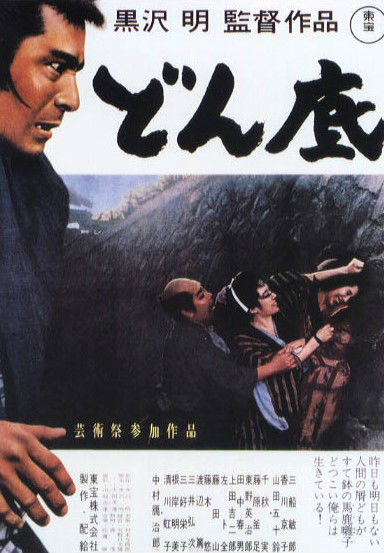
The Lower Depths (どん底, Akira Kurosawa, 1957)

“How can you go to hell if you’re already there?” quips a stoical gangster, perhaps the only denizen of a rundown tenement block no longer looking for escape in Akira Kurosawa’s adaptation of the Gorky play The Lower Depths (どん底, Donzoko). In general, much of Kurosawa’s post-war work decries deliberate falsehood but paradoxically suggests that some degree of self-delusion is essential for surviving an otherwise hopeless world. The wandering pilgrim who arrives like some kind of emissary from the land above says as much as he offers what may turn out to be false promises of a better world to come, but as one of his charges points out he does so “out of pity for those beyond hope.”

Then again, perhaps spirituality won’t save you either. As the film opens, it’s two monks who are seen throwing leaves over a cliff describing the settlement below as “just an old rubbish dump”, which in a sense it is if that were not such a cruel thing to say. In any case, the people who live here are all those who have already fallen into desperation, exiled from mainstream society and caught between a fierce desire to claw their way back up and the despair of knowing that in all likelihood they never will. A man who claims to be a former samurai waxes on his illustrious past, while a melancholy sex worker meditates on the lost love that reduced her to current position, and a stage actor laments his failing memory his mind now fogged by years of alcohol abuse that he says have already poisoned his “bitol organs”. A tinker secretly thinks he’s better than those around him. He’s only been here six months and insists that he’s a skilled craftsman who can continue working, but blames his desperate circumstances on the sickly wife whose death he quietly awaits assuming it will free him of this burden and thereafter this place.

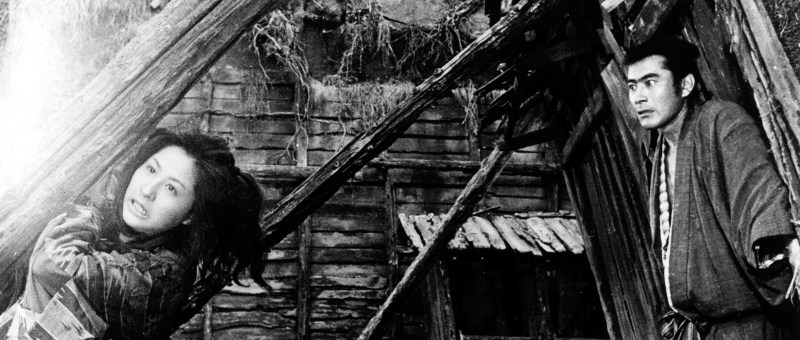
It doesn’t, of course. He sells his tools to pay for her funeral, and otherwise appears lost no longer a husband to a dying wife. In essence the film revolves around a confrontation between the pilgrim who offers what may well be an illusion of salvation and the thief Sutekichi (Toshiro Mifune) who challenges him but begins to believe that it really may be possible for him to leave this place and take the woman he loves, Okayo (Kyoko Kagawa), with him or else fall further and remain trapped in this mortal hellscape. The problem there is that Sutekichi had previously been having an affair with the landlord’s wife Osugi (Isuzu Yamada) who is Okayo’s sister. Though Osugi, whose hope of escape through romance is dashed, first takes against her sister, she later offers to surrender her to Sutekichi if only he will assist her by killing her greedy husband Rokubei (Ganjiro Nakamura). 

In this cold and austere place which is in effect a living hell, there is a sense that many of the residents are already dead. Rokubei’s face is the palest of them all, suggesting that he is already too far gone ever to be saved and most likely doesn’t want to be anyway for in this terrible place he is in effect the king. Osugi is the queen, but often framed behind bars now a prisoner already too corrupt to leave the tenement behind. Her uncle, Deputy Shimazo (Kichijiro Ueda), has a largely illusionary sense of power in his position in a policeman which he prosecutes selectively and mostly at the service of the landlord. In the climactic closing scenes, his policeman’s baton is stolen by the drunkard Unokichi (Yu Fujiki) who dances through the streets with it demonstrating just how little authority he actually wields finally losing his position when the landlord is deposed and his familial connections become irrelevant. He inherits the landlord’s residence, but is reduced to the husband of the sweet seller Otaki (Nijiko Kiyokawa) whose status as a working woman is perhaps higher than his. 

Yet the pilgrim seems to think there is still time to save Sutekichi who at heart wants to go straight but is also resentful admitting that in a world where swindlers prosper perhaps it is foolish not to be a swindler. The pilgrim promises all of them a “better place”. “As long as you believe you’ll find it, you surely will”, he explains telling the actor about a temple that can help him cure his alcoholism while simultaneously urging the tinker’s suffering wife to give in to her fate and go to Buddha’s embrace as soon as possible. Perhaps he sincerely believes these things to be true, but also seems to have a sense that even if they weren’t these hopeless people could not go on if they knew there was no way out. They all say they’ll leave, but discover there are only two means of escape, to die or fall still further in banishment from this already banished place. Only Okayo whose final whereabouts remain unknown may finally have been able to free herself. Staying almost exclusively with the claustrophobic confines of the drafty tenement as wind the whistles through it, Kurosawa frames the space of one of existential purgatory but perhaps suggests that in the absence of salvation a comforting falsehood is the only means of survival.


The Lower Depths screens at the BFI Southbank, London on 19th & 30th January 2023 as part of the Kurosawa season.
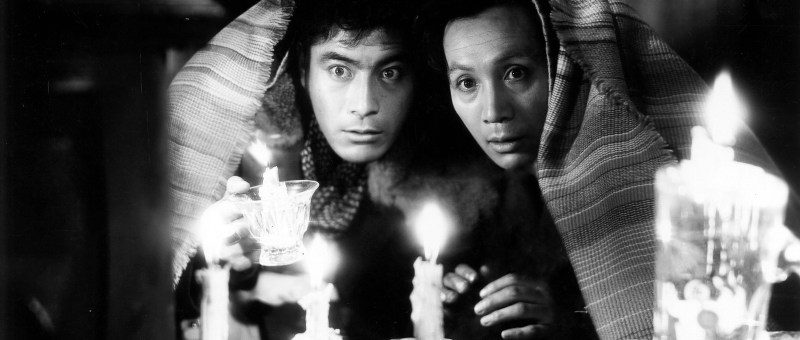
The Idiot (白痴, Akira Kurosawa, 1951)

“He was too good for this world” a matriarch finally concedes of the pure soul at the centre of Akira Kurosawa’s The Idiot (白痴, Hakuchi), though like most she had found his goodness unnerving. Adapted from the Dostoyevsky novel, Kurosawa’s poetic morality play is like much of his contemporary work a meditation on the post-war future but perhaps also an admission that this “faithless world” isn’t meant for pure souls and that goodness too can be destructive in its incompatibility with a world ruled by cruelty and selfishness. 

Relocated to a wintery Hokkaido, the film opens with former soldier Kameda (Masayuki Mori) travelling north to stay with a relative after a spell in a psychiatric hospital in Okinawa. Having been sentenced to death for war crimes in what he claims was a case of mistaken identity and then unexpectedly reprieved, Kameda suffered a nervous breakdown but also describes himself as having been reborn, as if everything that had happened to him up to that point had happened to someone else. Ever since then he’s been a pure soul, selfless and ethereal but also with, as someone later puts it, an eerie power to see into people’s hearts that leaves some feeling shamed or uncomfortable in the stinging light of his goodness. 

In the outdated language of the time, he is called an “idiot” because of his epilepsy which has he says caused him epileptic dementia. In the title cards that open the film, it is said that goodness is often conflated with idiocy as if to be good is only to be naive for sophistication necessarily favours calculation over feeling. He is an outcast firstly because of the stigma surrounding his condition and secondly because of the way his goodness reflects on others, leaving them feeling exposed or perhaps judged and found wanting. 

He finds his mirror in a young woman, Taeko (Setsuko Hara), who is loved by a man he met on the train, Akama (Toshiro Mifune), but is herself an outcast because she has been the mistress of a wealthy man, Tohata (Eijiro Yanagi), since she was only 14 years old. On seeing a photograph of her in a shop window near the station he remarks that she seems very unhappy, later explaining that in her eyes he saw only long years of lonely suffering that reminded him of the eyes of a young soldier executed by firing squad who looked back at him with eyes filled with reproach that he must be sacrificed for the folly of the war. But whereas Kameda’s awakening as a pure soul has opened him up to the world, Taeko’s internalised shame has made her cold and indifferent. Kameda’s recognition of her as another pure soul grants her the courage to escape one kind of suffering in abandoning the wealthy man who has ruined her life, but only provokes further destruction in her conviction that Kameda is the one man she can never love for she will only ruin him. 

Kameda, meanwhile, falls in love with the daughter of his relative, Ayako (Yoshiko Kuga), who is proud and largely unable to express her feelings honestly often saying the direct opposite of what she actually means. She too has her idea of goodness, breaking with her childhood sweetheart Kayama (Minoru Chiaki) when he is tempted by an offer from Tohata to enter into a sham marriage with Taeko for appearance’s sake in return for a large sum of money and guaranteed social advancement. Though Ayako originally rejects Kameda because of the shame and humiliation she would feel married to a man with a disability, she nevertheless fails in love with him but is unable to accept the equality of his love in his inability to abandon Taeko to whom he has come to represent a kind of salvation. 

Ayako later comes to believe that it was she who was truly the “idiot” in her petty jealousy lamenting that “if only we could all love without hatred” as Kameda had done though it was in the end his selfless love that sealed his fate, while for Akama it was perhaps the opposite in realising that he would never possess Taeko’s heart and that the only reason she returned to him was because she thought him to be a man of so little importance that ruining him was of no consequence and ruin him she did in the madness of his love. Guileless, Kameda is also a pauper cheated out of his inheritance by a relative and then again exploited by a duplicitous businessman, his poverty another proof of his goodness while others squabble over money. Having escaped an authoritarian father and come in to his inheritance, Akama wagers his fortune trying to buy Taeko from Tohata by gazumping Kayama who later redeems himself by letting the money burn but never really escapes the stain of his temptation. 

Kurosawa frames the tale as high gothic, filled with eerie winds and mist and fire in the midst of snow. The stove of Akama’s otherwise dark and gloomy mansion seems to flare with the intensity of confrontation as the passions of these four tortured souls rise and fall while each seeking a kind of salvation which necessarily cannot satisfy all. Originally intended to run in two parts over 265 minutes, the film was famously too big for producers at Shochiku for whom Kurosawa was working outside of his regular studio Toho. They cut 100 minutes to suit their exhibition needs, excising most of the prologue and inserting a number of clumsily placed intertitles absent from the rest of the film while undercutting the sense of mounting dread in the tragic backstories of each of these doomed romantics. But even in this compromised version, Kurosawa captures something of the gothic fatalism that surrounds Kameda, an innocent lamb in a world of wolves as Akama describes him, whose boundless, selfless love has no place in this faithless world. 


The Idiot screens at the BFI Southbank, London on 13th & 21st January 2023 as part of the Kurosawa season.

No Regrets for Our Youth (わが青春に悔なし, Akira Kurosawa, 1946)

“Freedom is something you have to fight for” a young woman is ironically reminded by her progressively-minded father as she finds herself torn between the conservatism of her upbringing as an upper middle class daughter of an academic family and a bid for independence in the freedoms of the post-war society. In part a lament for a lost generation whose resistance towards rising militarism had been all but forgotten, No Regrets for Our Youth (わが青春に悔なし, Waga Seishun ni Kuinashi), is also the story of a post-war woman seeking new directions which in this case eventually send her back to the land.

Then again, there’s no denying that Yukie’s (Setsuko Hara) dilemma is framed as romantic, torn between a dynamic communist and a spineless conservative while otherwise in her youth fairly vacuous. As the film opens, she frolics with some of her father’s students at a local mountain that overlooks Kyoto University. Caught on a stepping stone she awaits help from either the charismatic Noge (Susumu Fujita) or the diffident Itokawa (Akitake Kono) before Noge boldly dashes forward and carries her to the bank. Seeing Itokawa looking sheepish and embarrassed, she tugs on his student cap as if she hasn’t quite yet made up her mind which path she will take. “If I married you, my life would be calm and peaceful,” Yukie later reveals to Itokawa, “but it would also be a bit boring”, whereas if she married Noge “my life would burn so brightly that I might be blinded.” 

Even so, her outlook as the professor’s daughter leans towards the conservative. During the picnic on the mountain, the students suddenly hear the sound of cadets training with firearms Yukie exclaiming that it makes her heart race before ominously discovering the body of a wounded solider in the overgrowth. She declares that she hates “leftists” and that her father is a “liberal” not a “red” but will any case eventually be vindicated. Though attracted to Noge’s passionate nature, she seems to find him dull company, “boring” in his constant conversation about the rise of fascism while visibly bristling when he all but calls her a vacuous socialite and says she needs a “slap in the face to grow up” which is in a sense what he’s just given her. Her life had been that of a privileged upperclass girl cosseted from the world, engaging with refined pursuits such as playing the piano and learning traditional flower arrangement. Her epiphany seems to come when she realises she’s been doing as she’s told, reminded that flower arrangement is a means of self-expression suddenly tearing the heads off chrysanthemums and crafting something truly avant-garde that is in its own way quietly shocking. Notably her flower arrangements while living with Noge are much more harmonious. 

Still she wavers, wondering if she should give in to the quiet life she’d have with a man like Itokawa, a man with no ideology who sides with the militarists and becomes a prosecutor because it is expedient to do so, or continue to wait for Noge who by this point has been in prison and ostensibly renounced his socialist beliefs to join the army. What she chooses independence, breaking with the conventional life her mother wanted for her to support herself with a job at a trading company in Tokyo. Running into Itokawa in the city, he strongly hints to her that Noge is, from his point of view, up to no good running a kind of think tank as an expert on China. 

When Yukie chooses Noge she implies it’s because she wants “something I can throw myself into body and soul”, hoping to join him in his new cause prepared as her father had warned her to make sacrifices in the struggle for freedom. In the one sense, it’s Yukie making up her own mind to abandon her privileged background to live her life with no regrets, but it’s also impossible to ignore that the cause she dedicates herself to is that of her husband. Committed to making Noge’s parents, both peasant farmers, understand that he was not an “ungrateful” son but a man who did his best to oppose the war and fight for peace and prosperity in Japan, she commits herself to the land and wins them over with the strength of her resolve. The hands that once played piano are now rough with work and it is in this she has found her purpose. Yet it’s difficult to say if the austerity of her new life represents ultimate freedom or only further constraint in the imperative of her continued suffering. Perhaps it doesn’t really matter, if as she says she has no regrets for her youth as she joins hands with the peasant farmers leaving her privileged upbringing behind her even as her mother remarks that with her father reinstated at the university it’s as if nothing had changed. There is then something quite poignant as she sits by the stream and sees the students file past her singing their song of protest that in the end went unheeded while she prepares to reject modernity in its entirety and return to the simplicity of the land.


No Regrets for Our Youth screens at the BFI Southbank, London on 2nd & 10th January 2023 as part of the Kurosawa season.
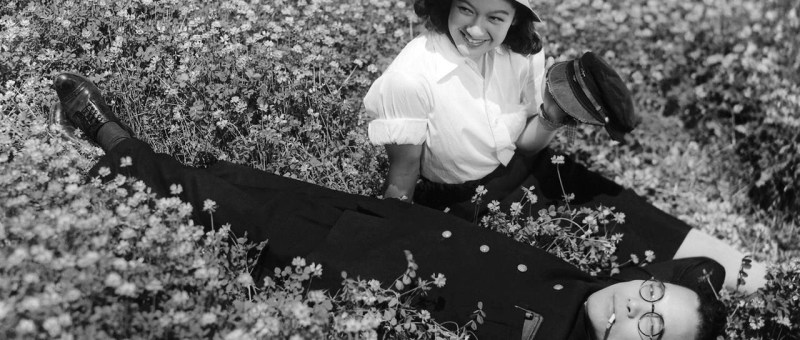
Mother (おかあさん, Mikio Naruse, 1952)

The hahamono or mother movie is a mainstay of post-war cinema, obsessed as it is with self-sacrificing maternity. Mikio Naruse, however, is not a name you’d expect to see associating itself with the genre and his 1952 film Mother (おかあさん, Okaasan), adapted from a child’s essay, is indeed subtly subversive, transgressively questioning the institution of motherhood itself while ostensibly remaining faithful to genre norms even as it makes an accidental villain of its teenage heroine who closes the film plaintively praying for her mother’s happiness having not so long ago shut down perhaps her only real hope of achieving it. 

The Fukuhara family ran a successful laundry before the war, but these days father Ryosuke (Masao Mishima) works at a factory and is nicknamed Papa Popeye by his kids because of his finely tuned muscles born of a lifetime training the iron. Matriarch Masako (Kinuyo Tanaka) and 18-year-old daughter Toshiko (Kyoko Kagawa), our narrator, help the family finances by running street food stalls, while oldest son Susumu (Akihiko Katayama) has become ill with a lung complaint caused by poor conditions at the wool factory where he was working. In addition to youngest daughter Chako who is still in school, the family has also taken in little Tetsu (Takashi Ito) the son of Masako’s sister Noriko (Chieko Nakakita) who is now a widow recently repatriated from Manchuria. 

Like many films of the occupation period, the family at the centre of Mother is determined to rebuild, pinning all their hopes on being able to renovate their home in order to be able to reopen the laundry. The war is very much a background presence but its influence is still deeply felt not least in the ruins and devastation glimpsed around the house and the constant references to loss and widowhood which seem to plague Masako, so many women having lost sons and husbands in the conflict. The tragedy is that Masako will eventually in one sense or another lose all her children by the end of the picture, Susumu succumbing to his illness after having discharged himself from hospital out of guilt and loneliness missing his mother, Chako eventually taken in by wealthier relatives who lost their son in the war, Tetsu soon to be retrieved by his mother, and Toshiko herself clearly heading towards marriage with the cheerful and surprisingly progressive baker Shinjiro (Eiji Okada) with whom she has become close. 

Perhaps surprisingly Toshiko seems remarkably immature for her age, her voiceover taken as it is from a child’s essay has a slightly stilted quality that nevertheless makes plain her poor grasp of the adult world and most particularly the reality of her mother’s life. Masako later tells us that she started working at 14 and continued until she married at not so much older than Toshiko is now despite later stating that Toshiko is too young to marry only to find her self shocked when confronted by the sight of her in a wedding dress stifling a brief wave of despair that her daughter may soon be a wife. Originally complaining about not being able to take dressmaking classes like some of the other girls, Toshiko belatedly swears to help support the family firstly to prevent Chako going to stay with relatives and secondly because her boyfriend inadvertently gives her the impression there’s truth in a local rumour that her mother plans to remarry following her husband’s death from overwork and poverty with a friend of their father’s who’s been helping them out in the shop, “Uncle POW” Mr. Kimura (Daisuke Kato). 

Shinjiro is quick to tell her that she’s being unreasonable. In the modern world parents shouldn’t be expected to sacrifice their personal desires for their children, her mother is also a woman and has the right to pursue happiness in marrying again if she chooses. On the other hand, there is nothing particularly concrete between Masako and Mr. Kimura besides a genial domesticity, the rumour is partly local wishful thinking in knowing that remarriage is sensible economic choice and the pair seem well suited. Toshiko objects strongly to the idea out of fear, jealousy, and outdated moralising resenting her mother for betraying her father’s memory but also fearing further changes in her familial relationships in an already uncertain world. 

In this her otherwise saccharine closing monologue in which she looks on as her mother plays with Tetsu and wonders if she’s really “happy” achieves its final irony, transgressively undercutting the primacy of the self-sacrificing mother to question the ideology of motherhood itself when it requires women to sacrifice their lives and desires in service of an ideal of “family”. Nevertheless, Mother is among the most ostensibly cheerful of Narusean dramas in the gentle comedy and naturalistic depiction of a warm and loving family committed to compassion, kindness, and mutual support as pathways towards a better post-war future.  


Mother is currently available to stream in the US via Criterion Channel

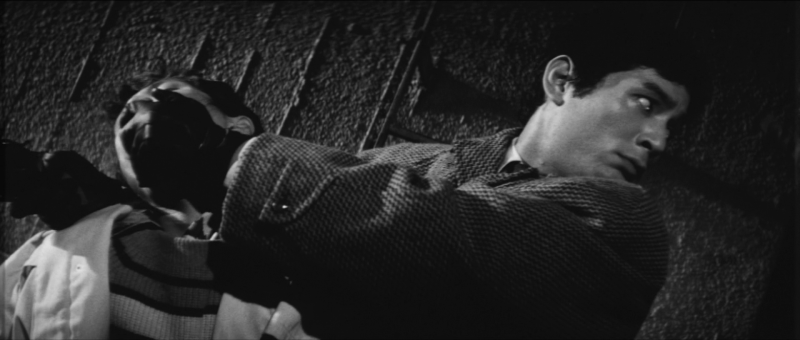
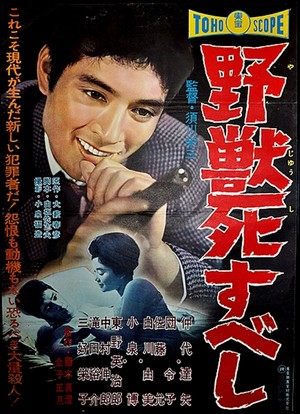
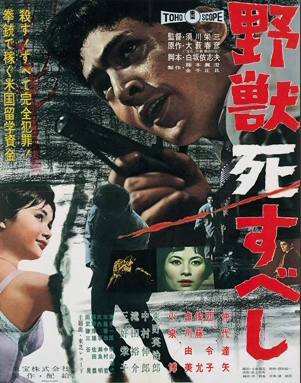
The Beast Shall Die (野獣死すべし, Eizo Sugawa, 1959)

“He’s not a beast. No, he’s a robot. A machine created by a modern, twisted society” according to a frustrated policeman acknowledging that a sociopathic killer is going to get away with his crimes because when it comes right down to it he’s just that good. Eizo Sugawa’s The Beast Shall Die (野獣死すべし, Yaju Shisubeshi) is the first of several adaptations of the hardboiled novel by Haruhiko Oyabu, Sugawa would himself direct a “sequel” 15 years later while a better-known version would prove a hit for Toru Murakawa in 1980 with action star Yusaku Matsuda in the leading role, and a two-part V-cinema adaptation would follow in 1997. The 1959 edition however is very much an expression of the anxiety of its times, a slightly reactionary take on the post-Sun Tribe phenomenon hinting at a generational divide between the nihilistic, hyper individualist post-war generation and their confused though morally compromised forbears. 

As the film opens, three policemen meet in a pub one of whom proudly shows off a Robby the Robot toy he’s picked up for his young son and is intending to give him on returning home from work. Sadly, however, Okada (Akira Sera) will never make it home because, for largely unexplained reasons, he is shot dead by nihilistic American literature student Date (Tatsuya Nakadai) who bundles the body into the boot of a car which he then simply abandons. Date never reveals much of a motive for this first murder, but he does later use Okada’s warrant card and service weapon to facilitate later crimes. 

The problem, at least for earnest policemen Kawashima (Eijiro Tono), a veteran cop and father of seven, and idealistic rookie Masugi (Hiroshi Koizumi) who is engaged to barmaid Yoko (Yumi Shirakawa) but drags his feet over the marriage because of his precarious life as a law enforcement officer, is an ideological divide within the contemporary police force. “Investigations are about science. And science is the best” according to their boss, reflecting a new faith in forensics prioritising physical evidence from the crime scene over a policeman’s intuition. From a modern perspective, this seems to be the right call though Kawashima and Masugi appear to find it both restrictive and mildly insulting as if their experience on the job now counts for nothing. They also worry that such rigid thinking prevents thorough investigation, and they might have a point in the boss’ continued insistence that the crimes must be down to “gang activity” even though the evidence clearly points at someone connected to the university or perhaps a disgruntled salaryman with access to the uni gun club. 

Kawashima and Masugi lament that they feel powerless to act because they don’t have the right to arrest someone on the basis of a “hunch”, and the film seems to agree with them as Date continues to commit his crimes unbothered by law enforcement though really who wants to live in such an authoritarian society that the police can haul you in solely because they think there’s something odd about you and “feel” you must be guilty of a crime even in the absence of conclusive evidence? Nevertheless it’s precisely these ideological divides that Date wilfully exploits while planning his hits, his second targets also reflecting the continuing Sinophobia of post-war cinema in impersonating a police officer to rob, but interestingly not kill, a pair of Chinese gangsters running an illegal gambling racket. 

Hearing Date’s back story, we realise that society has in a sense warped him in witnessing an injustice done to his father which later led to his suicide while his mother was apparently engaging in an affair with the man who framed him. He strongly argues that the only response to the “chaos, madness, and contradictions” of the modern society is to “show our beastly nature”, wilfully abandon humanistic morality and conventional civility in favour of an individualistic satisfaction of one’s personal desires above all other concerns. Date is certainly an amoral man who has no problem with sacrificing those he determines to be lesser beings for his own gain, but as even Masugi reveals his thinking may not be out of line with that of his generation. Many people are driven to murderous rage, he argues, but do not act on it because of a social taboo. 

As the film opens, a group of left-wing students is holding a rally in support of the anti-ANPO protests ahead of the treaty’s imminent renewal, though the professors mock them from inside insisting that their politics is not genuine only a reflection of the despair they feel in their society knowing that even if they graduate all that awaits them are low-level salaryman jobs with little promise of advancement. Those who can’t even manage that, they joke, turn to academia. Date’s professor (Nobuo Nakamura) affects sympathy with his poverty but also wilfully exploits him, getting him to do translations of novels which will later be published under his own name while it seems to be an open secret that he owes much of his success to the fact that he married into a prominent family which allowed him to spend five years studying abroad in America. 

Meanwhile, his students philosophise on the psychology of crime insisting that a “robotic, truly ruthless personality” can only come from a “mechanistic society like the US” while Japanese criminals are generally “emotional” in that crimes are committed because of “love affairs, resentment, finances”, “petty humanistic motives” which society can easily understand if not exactly condone. Date, admittedly a student of American literature with his eyes firmly set on going abroad, entirely disproves this theory. His crimes appear to be dispassionate and committed largely for practical reasons, the later ones at least with money as the motive even if he also derives a thrill from his amoral rebellion against the system. His poverty is offered as a justification yet we also see him abuse and manipulate those weaker than himself, humiliating an old lady trying to sell flowers in the bar where Yoko works while later talking a fellow student suffering with TB and unable to pay his tuition into helping him commit a robbery. 

Perhaps in someways uncomfortably in continuing a motif associating homosexuality with sadistic criminality, it’s also heavily implied that Date is bisexual, encountering an effeminate young man on the street with whom it is clear from their conversation he has previously been intimate to later use him as cannon fodder when engaging in a firefight with Chinese gangsters, while there is also an obvious homoerotic charge to his relationship to the student who later becomes a temporary accomplice. His relations with women are somewhat caddish and perfunctory, his sometime girlfriend Tae (Reiko Dan) telling the police that Date is a player who only sleeps with the same woman three times before becoming bored with her. Date’s attitude, though interestingly enough not his crimes, may reflect a societal misogyny, impoverished medical student Tae later refused access to the morgue because it’s not something a woman should see, though Tae herself later claims that it’s Date’s coldness and cruelty that draw her to him. Seemingly unable to feel genuine emotion for others, it nevertheless appears that Date is in a sense moved enough by Tae’s ability to embrace his inner darkness to eventually decide to alleviate her poverty on realising he no longer needs his ill-gotten gains because he’s secured his passage to America through more legitimate means. 

A reaction to the post-Sun Tribe sense of moral panic about disillusioned post-war youth, The Beast Shall Die suggests that for the moment at least those like Date are in an unassailable position thanks to an overly liberal justice system as the two policemen lament their inability to prevent his escape through judicial means while turning their attention to Tae though there’s no real way they can know that Date gave the stolen money to her rather than taking it with him or depositing it in some other location even if she’s walking around with an ugly handbag that might be full of cash. Alternating between an acceptance of Date’s nihilistic, crypto-fascist philosophy in implying that those who obey the rules of civility are doing so solely because they are too weak to break them, and advocating for a more authoritarian society in which policemen are free to act on their “hunches”, Sugawa’s take on Oyabu’s hard boiled tale of societal corruption and warped post-war morality has its reactionary qualities even as it ends on a note of ambiguity that implies order will eventually triumph though not, it seems, today. 


Original trailer (no subtitles)

Snow Country (雪国, Shiro Toyoda, 1957)

Closely associated with literary adaptation, Shiro Toyoda had been wanting to adapt Yasunari Kawabata’s Snow Country (雪国) since its serialisation and apparently spent four years preparing his treatment ahead of the 1957 film starring Ryo Ikebe as the solipsistic aesthete at the novel’s centre. Characteristically, however, he takes several liberties with the source material, notably introducing an entirely different conclusion which perhaps helps in re-centring the tale away from the hero Shimamura to the melancholy geisha who apparently falls for him because of his intense loneliness. 

A brief reference to a failed military insurrection in Manchuria sets us firmly in the mid-1930s as do repeated mentions of the ongoing depression which causes additional anxiety to local business owners in a small holiday resort town. Mimicking the novel’s famous opening, Toyoda opens with a POV shot of a train exiting a tunnel into the snow-covered landscape, the hero Shimamura (Ryo Ikebe) sitting sadly gazing out of a window and eventually captivated by the reflection of a young woman devotedly caring for a young man who appears to be in poor health. Meanwhile, another young woman, Komako (Keiko Kishi), gazes at her own reflection in a train station window, waiting once again as if unable to depart. As we discover, Shimamura has returned with the intention of seeing Komako with whom he’d struck up a relationship during a summer trip but is somewhat disappointed to learn that she has since become a geisha.

In a flashback to their first meeting, Komako asks Shimamura if he has come for “escape”, a question he doesn’t exactly answer while petulantly complaining about his lack of artistic success as someone who paints pictures apparently out of step with his times. When the head of the local commerce association tries to involve him in conversation about the failed insurrection, he bluntly tells him that he’s an artist and as such has no interest in such things, but it does indeed seem that he is looking for some kind of escape from the turbulent times, expressing that here the war seems very far away as does “the depression”. Komako, a more modern and perhaps prophetic figure than it might at first seem, is the only one to bring up the war directly speculating that it may be about to intensify while the frustrated affair between the two seems to be informed by the mounting tensions against which they are attempting to live their lives. 

Rather self-absorbed, Shimamura in a sense may even identify with Komako explaining that he too has a “patron” and implying that his flight is perhaps a response to his sense of powerlessness, that he feels constrained by his financial dependency presumably on his father-in-law though his relative economic superiority which leads Komako to frequently remark on his “extravagance” obviously affords him the freedom to make these random solo trips to ski resorts and indulge his career as a painter regardless of its capacity to support himself and his family. Komako must know on some level that the relationship is a fantasy, yet she believes in it enough to end her connection with an elderly patron on suspecting that she is carrying Shimamura’s child only to have her hopes dashed when he does not turn up for a local festival as promised with the consequence that all of her dependents are turfed out of the home he had provided for her. 

Komako is not “free” in the same way that Shimamura evidently is, her entire life dictated by the fact that she is poor and female. Fostered by a shamisen teacher, she may have been technically engaged to the young man, Yukio (Akira Nakamura), Shimamura saw on the train being cared for by Yoko (Kaoru Yachigusa), Komako’s foster sister in love with him herself, but intensely resents the burdens she is expected to bear quite literally with her body. She later tells Shimamura that she didn’t become a geisha for Yukio in order to pay his medical bills but out of a sense of obligation, while she is also responsible for her birth family, the now bedridden shamisen teacher, and Yoko who intensely resents her for her callous treatment of Yukio and generally “dissolute”, selfish way of living. During the famous fire in a cinema that closes the novel (but not the film), Komako even exclaims that her life would be easier if Yoko burned to death, but on witnessing her either fall or jump from the burning building she can do nothing other than run to her side. 

Indeed, the novel’s climax finds Shimaura standing alone indifferent to the fate of Yoko, a young woman he had come to admire if only for her contrary qualities, admiring instead the beauty of the night sky. In Toyoda’s characterisation, Yoko is in one sense the conventionally good woman whose selfless devotion to the sickly Yukio so captivates Shimamura, but her goodness is nevertheless undercut by the degree of her animosity towards Komako even as the two women remain trapped in a complex web of frustrated affection and intense resentment, each perhaps knowing they neither can have the man they want and are condemned to an eternal unhappiness as the snow mounts all around them in this perpetually cold and depressing moribund resort town. Switching between studio matte paintings ironically mimicking Shimamura’s art and on-location footage of the deepening snows, Toyoda’s sense of near nihilistic melancholy evoking the atmosphere of Japan in the mid-1930s hints at grand tragedy but finds resolution only in stoicism as the heroine picks up her shamisen and trudges onward amid the quickening blizzard.  


Tokyo Twilight (東京暮色, Yasujiro Ozu, 1957)

Closely associated with the family drama, Yasujiro Ozu is perhaps the most socially conservative of golden age directors. Unlike Naruse or Mizoguchi, he cheerfully reinforces patriarchal social norms and foregrounds the paternal experience while upholding the primacy of the traditional family in a rapidly modernising society. In his later career he’d come to sympathise more strongly with the young, but 1957’s Tokyo Twilight (東京暮色, Tokyo Boshoku), perhaps his bleakest take on familial failure, is essentially a treatise on the legacy of corrupted motherhood and rebuke to growing post-war freedom in which a young woman is made to feel that her future is impossible because of maternal betrayal while her sister is forced back into an unhappy marriage to an abusive husband in order to avoid the same fate befalling her own daughter. 

Unlike most Ozu families, the Sugiyamas do not seem to be particularly happy in each other’s company, living in superficial politeness rather than true intimacy. This may partly be because the sisters had a brother who passed away young in a mountain climbing accident, but it also seems that Mr. Sugiyama (Chishu Ryu), though kind and polite, is a typically authoritarian, distant father. Oldest daughter Takako (Setsuko Hara) has returned home declaring herself unable to go on living with her professor husband Numata (Kinzo Shin) who, she says, has become increasingly erratic, taking out his petty professional disappointment on their small daughter Michiko whom he seems to resent. Younger sister Akiko (Ineko Arima) meanwhile is sullen and introverted. Unmarried, she lives at home and is studying to become a stenographer. 

As we later discover, the girls’ mother Kikuko (Isuzu Yamada) left the family during the war after falling in love with the junior officer Mr. Sugiyama enlisted to look in on the family while he was away in Seoul. Akiko was only three when their mother left and barely remembers her. Takako attributes her wayward behaviour to “loneliness”, that she has been forever corrupted through never knowing a mother’s love. Mr. Sugiyama admits he tried his best, but both agree that children need two parents and no matter how much he wants to a father cannot make up a mother’s share. 

This atmosphere of alienation is perhaps why Akiko feels as if she has no one to turn to in her own moment of maternal crisis. She has become pregnant by her college student boyfriend who has been avoiding her and even has the audacity to ask if the baby’s his when Akiko finally manages to pin him down. Trying to borrow money for an abortion, Akiko visits her aunt who declines to give it to her without knowing why, eventually turning to a family friend who apparently provides no questions asked. The woman at the clinic assumes she is a bar girl, as does a policeman who eventually “arrests” her for loitering in a sleazy cafe where her boyfriend has obviously stood her up which is quite openly being used as a place for men to pick up call girls. All of this contributes to Akiko’s increasing sense of shame and worthlessness. She sees herself as a fallen woman, convinced that she is all her mother’s child contaminated by her “bad blood” which makes a conventionally successful life as an ordinary wife and mother an impossibility. 

Akiko’s aunt wants to set her up with arranged marriage matches, but Akiko declares she has no intention of marrying or having children. Without knowing anything of Akiko’s circumstances, Takako assumes this is because of her obviously unhappy marriage, trying to convince her sister that there are plenty of happy couples she is merely unlucky. Mr. Sugiyama attempts to talk to his son-in-law but finds him strange and indifferent, offering treatises on familial love while implying that he has little of it. He regrets pressuring Takako to marry him when he knew that she preferred someone else while Takako is once again haunted by the spectre of corrupted maternity in her mother’s decision to leave the family for emotional fulfilment and is fearful of making the same mistake creating another troubled daughter just like Akiko in denying her a father’s love (which seems a moot point given that Numata does not care for the child). 

Neither woman is able to escape paying for their mother’s transgression. Akiko is punished firstly for embracing her sexuality and secondly for the rejection of motherhood in choosing to have an abortion. Alone and humiliated by her unreliable boyfriend, she is denied the opportunity to start over, while Takako meditates on female failure and believes that her only option is to live in misery with a cruel and narcissistic husband because that is the “proper” thing to do and the only way to bring her daughter up “right”. The absent mother, meanwhile, is denied reconciliation and left only with the painful separation from her daughter who finally rejects her in order to reclaim the image of the good wife and mother by returning to her unhappy home. Bleak as it is, all of this is presented as a kind of happy ending in that it restores the idea of the traditional family, increasingly threatened by post-war modernity, to its original primacy. We leave with Mr. Sugiyama rehiring his maid and heading cheerfully back to the male world of work, making the fresh start that his daughters have been so cruelly denied.  


Currently streaming in the UK via BFI Player as part of Japan 2020. Also available to stream in the US via Criterion Channel.

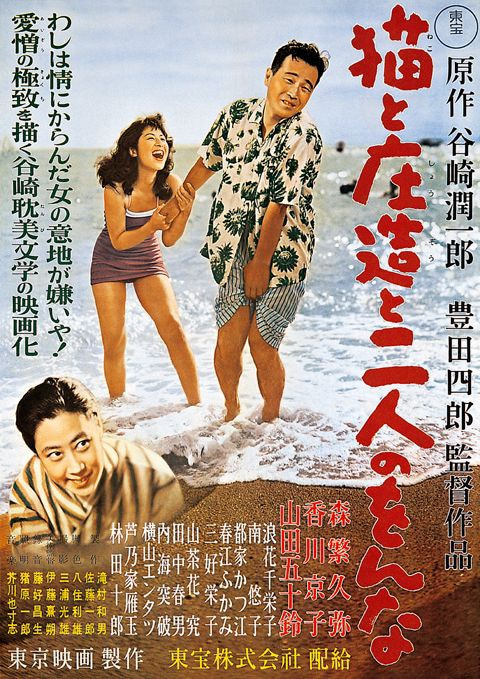
Shozo, a Cat and Two Women (猫と庄造と二人のをんな, Shiro Toyoda, 1956)

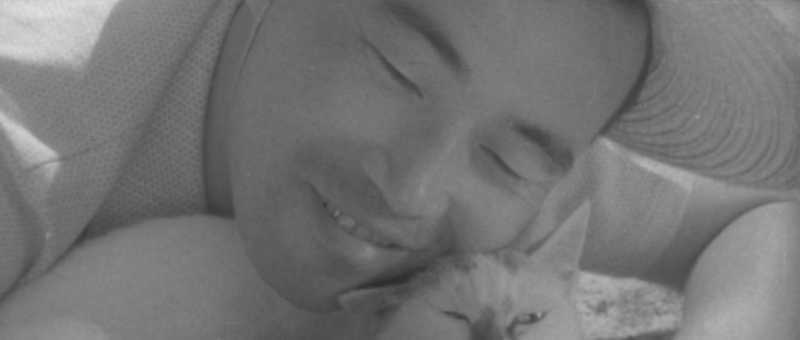
Post-war melodrama is largely concerned with the place of women, in particular, in a rapidly changing society, but given the centrality of domestic life, were men yearning for “independence” too? Shiro Toyoda was closely associated with comedic tales of strong women and weak men, and Shozo, a Cat and Two Women (猫と庄造と二人のをんな, Neko to Shozo to Futari no Onna) is as its title implies no exception. Adapting the novel by Tanizaki, Toyoda offers a subtle critique of the traditional family as its hapless hero finds himself caught between the conflicting demands of his feudalistic mother, stoic first wife, hedonistic second, and his much loved but perhaps mercenary feline, Lily. 

Shozo (Hisaya Morishige) is perhaps a typical spoiled only son, lazy, feckless, and essentially passive. Shinako (Isuzu Yamada) who agreed to an arranged marriage with him four years previously is walking out, thoroughly fed up with her mother-in-law Orin’s (Chieko Naniwa) constant complaints not least among them that the couple have no children. Unbeknownst to Shinako, however,  Shozo has been carrying on with his slightly younger cousin, Fukuko (Kyoko Kagawa), who is a free spirited modern woman. In fact, Fukuko has already run away from home three times in the company of various men so her wealthy father would be only too pleased to see her settle down and is so desperate to offload her that he’s even offering a huge dowry. All of this is complicated by the fact that Fukuko’s father already owns the mortgage on Shozo’s family store, which presents a serious challenge to typical family dynamics. 

Shozo, meanwhile, is only really interested in his pet cat, Lily, something which was a bone of contention in his failed marriage to Shinako (and perhaps a reason they have not been blessed with children). On learning that Orin has already moved Fukuko into the family home mere seconds after she vacated it, Shinako is suddenly struck by remorse and feels the need to vindicate her pride through revenge. Plotting how best to drive a wedge between Fukuko and her new husband, she settles on petitioning Shozo to give her custody of Lily, and then suggests the same thing to her rival knowing that whatever happens it will cause a series of problems in the Oyama household. 

The irony is, in a sense, that it’s Shozo who has been displaced from his own home. Perhaps surprisingly, he often tries to help out with household tasks but his mother always stops him, insisting that housework isn’t something a man should pay attention to. Orin is of course perpetuating outdated ideas of traditional gender roles, but there is also an obvious anxiety in her need to protect her territory from possible incursion. She doesn’t necessarily trust the idea that she and Shozo are connected by anything deeper than practicality and filial obligation and her only currency is her ability to provide the services that Shozo “cannot” provide for himself. His learning to take care of himself is an existential threat to her position as his caregiver even though he is a grown man in his 30s perfectly capable of doing his own laundry and preparing his own meals (as he already does for Lily who particularly enjoys grilled chicken). 

When they brought Shinako into the house, they did so apparently because she was known to be a “good worker” at her job as a maid for a wealthy family. Since then she has indeed worked hard, but is viewed as little more than a glorified servant by Orin who has delegated much of the feminine labour to the younger woman, while Shozo emotionally neglects her in favour of the cat and apparently satisfies his carnal urges outside the home. They accept Fukuko for her money, but take the opposite approach, treating her as the lady of the manor. Fukuko does no housework (a cupboard is later discovered where she’d thrown all the washing she couldn’t be bothered to do), but Orin simply picks up her share and more, becoming maid to her daughter-in-law who frequently reminds them that it’s her money paying for everything so she is the one who is really in charge. 

Shozo does not seem to react too closely to these assaults on his masculinity, but only wants to escape to be alone with Lily whom he believes is the only one who really loves him. In this he is perhaps the truly modern man who wanted his family relations to be “real” rather than defined by social obligation, but he’s also self-centred and childish, still seeing the women (even Lily) as providers of service rather than fellow human beings. His mother satisfied his hunger, Shinako kept him financially by managing the business, and Fukuko sated his passion, but he feels oppressed by all of them in different ways and in the end does not want the responsibility of dealing with human emotions. Lily may be capricious, but her needs are easily satisfied and to that extent she is dependent on him. His desire to be “independent” and find emotional fulfilment only with his cat is just as much of a challenge to the social order as a woman who rejects marriage or seeks to fulfil herself outside of the home. 

Shozo’s dilemma is however presented as comedic until its unexpectedly melancholy conclusion which reduces him to the status of a stray cat as the women come to literal blows, fighting not quite over him (he isn’t worth fighting over) but for their own self-esteem and particular brand of womanhood. Shinako sits at home and calculates all the back pay she’d be entitled to for the labour she performed at the Oyama household in recognition that being a wife is also a job and they treated her as a maid anyway (which is to say as an outsider with no intention of love or loyalty), while Fukuko begins to see the “emptiness” in her party girl lifestyle but prefers to be pampered and resents being “beaten” by a mere housemaid. This system traps everyone, forcing them to manipulate the desires of others while suppressing their own. Shozo and his cat are left out in the cold, trapped between tradition and modernity but no more free than they were before even in their mutual dependency.


An Inn at Osaka (大阪の宿, Heinosuke Gosho, 1954)

inn at osaka cap 2Heinosuke Gosho may be most closely associated with the Chekhovian interplay between laughter and tears, but what are you to do when life is so unutterably miserable that levity seems almost offensive? By 1954, many might have assumed that society was on the way to recovery, that the promises of the new democracy so proudly affirmed in the post-war constitution would be available to all paving the way for a freer and fairer society. Of course, that wasn’t quite the case and many found themselves trapped on the periphery of the burgeoning economic miracle in which unemployment was high and the bitterness of the times had led many to believe that human decency was a luxury they couldn’t afford.

Made a year after his renowned masterpiece Where Chimneys are Seen, An Inn at Osaka (大阪の宿, Osaka no Yado) is a much less cheerful affair in which suicide and degradation linger permanently on the horizon. The hero, Mita (Shuji Sano), has been exiled from Tokyo, demoted to the Osaka office after slapping his boss in argument over immoral business practices. Much reduced in circumstances, he has been unable to find a lodging house that suits his budget, the local barman lamenting that these days most of the hotels in the area have been co-opted by sex workers. Just at that moment, a dishevelled old man pops up and says he knows of a good place where the rent is reasonable and the innkeeper kind. As you might expect, it turns out that he works there. The innkeeper is his sister and though she is not particularly nice, the place is warm and friendly with three kindly maids – Orika (Mitsuko Mito) who is constantly pressed for money by her no-good husband, Otsugi (Hiroko Kawasaki) who is forced to live apart from her son, and “modern girl” Oyone (Sachiko Hidari) who is much younger and having a fling with the inn’s other longterm resident, Noro (Jun Tatara), a sleazy gentleman who likes to throw his weight around because he co-signed the loan on the hotel.

In one sense, the city of Osaka itself is being painted as a “fall” from sophisticated Tokyo, an earthier place where people do what they have to to survive. This Mita learns to his cost when drunken geisha Uwabami (Nobuko Otowa) picks up his “luxury English-made blanket” and peels off a thread which she burns to expose its smell. Wilier than the innocent Mita she tells him he’s been had, lamenting that it’s “Osaka’s shame” that they wilfully trick people from Tokyo. Mita is irritated, slightly hurt and embarrassed to have been deceived, but affirms that it hasn’t damaged his views on Osaka because in the present society everyone is being cheated by someone somewhere. In any case, he allows himself to be bamboozled by the innkeeper’s brother (Kamatari Fujiwara) into tracking down the teenage girl who sold it to him, Omitsu (Kyoko Anzai), who seems upset, explaining that she bought the blanket in good faith and has been tricked herself. During their visit, Mita notices that they’re in the middle of some sort of shamanistic ritual over the sickbed of her ailing father and feels pity for her but stops short of cancelling the debt there and then.

Not cancelling the debt even though he can see Omitsu never meant to trick him and cannot afford to pay him back, is part of his rather sanctimonious rebellion against the immoralities of the post-war society. He feels wronged and thinks that getting the money back for the blanket will somehow put things right, but like many of his attempts to help those in need it eventually backfires. Mita is a good man, compassionate and honest, but he’s also disappointingly conservative in ways he hasn’t quite realised. Uwabami, who has fallen in love with him, later chides Mita that he is like a star looking down on everything from above. He doesn’t quite understand what she means, failing to grasp that what she’s telling him is that though she can see that he cares, he has a tendency to view himself as somehow “better” than the world around him and lives in silent judgement of those he believes to be fundamentally different from himself.

After a brief argument, Uwabami confesses that she feels trapped and miserable in her impossible geisha existence, just trying to make enough money to survive when too old to ply her trade. She can’t quit because she’s responsible for her whole family – her younger brother has just been laid off from his railway job and his children will go hungry without her money. She provokes Mita a little, chastising him for not caring about her on a human level only for Mita to counter that he likes her but they live in “different worlds”. Disappointed, she laments that she thought they were the same, realising that Mita’s conception of the world is defined by ideas of middle-class respectability and that he views her as occupying a lower order, forever walled off from “decent” people like himself. Though he treats her warmly and regards her as a friend, there can never be anything more between them than that.

Omitsu later shows him something similar. Having scraped together some of the money to pay him back, she arrives at the inn only for Mita to try to refuse it. Otsugi offers her some sewing work for Noro who later takes advantage of her, gossiping with the maids that she was a “bargain”. To make matters worse, Omitsu gets caught on the way out and is berated by the innkeeper for bringing the hotel into disrepute. Mita starts to feel guilty. This is, after all, largely his fault – he pushed her about the blanket out of pettiness and brought her to the inn where she has debased herself to get back the money he took from her. He tries to return it but it’s already too late. “Why do you always insist on being good?” she asks him, partly offended that he won’t take her money because he now thinks it’s tainted by immorality. “I just want to trust in people” he tells her, beginning to realise that his well-meaning gesture is both patronising and futile because if he’d really cared about helping Omitsu, he could have done it before.

Mita is good person, but like everyone else he’s flawed and human. He genuinely wants to help, for the world to be better than it is, but in his goodness allows himself to be self-involved and insensitive. The reason he didn’t get fired from his job even for so great a transgression as slapping the boss, is that his grandfather founded the company. In an effort to break with the past, he decides to sell his grandfather’s expensive French pocket watch, but retains the chain as if unable to definitively sever the connection to his privilege. To prove that he’s done it for symbolic and not financial reasons, he spends the money taking Otsugi and Orika on a day trip to Osaka castle after Orika declines his offer of money of which she is in desperate need.

“Money’s everything, what happened to humanity?” Mita asks himself, still not quite aware of his position within the system. Mita refuses to conform to the demands of the post-war era as exemplified by his boorish boss who sneeringly asks if he’s a “socialist” while dismissing him as an “intellectual” and doing illicit backroom deals to get ahead, but he does so largely passively and with little more than resentment. At his farewell dinner, he reflects that had he not come to Osaka he might have quit his job but now he’s determined to stay and try to make things better. There might be something a little sanctimonious in his new found fire born of living among the poor now he’s on his way back to Tokyo, but he has perhaps awakened to his failings and is resolving to do better.

Meanwhile, the innkeeper finds the strength to break with the odious Noro, but unlike Mita decides to throw herself into the abyss of modernity by turning the hotel in a rent by the hour kind of place complete with Western beds and tacky decor. She too feels there are two kinds of people, refusing Otsugi time off to see her son, barking that “a dog doesn’t forget what it owes its master”, while Otsugi remains powerless, aware she’s entirely out of options as a young widow in the cruel post-war economy. Orika too gives up on changing her life after finding herself unable to separate from her no-good, drunken, violent, husband, while Oyone alone seems excited by the new job possibilities at the inn, and Omitsu, despite having coldly exclaimed that she’d do whatever it takes to survive, throws herself into “honest” work, unable to attend Mita’s leaving do because now her life is one of ceaseless industry which provides her no opportunity for rest. “None of us can say we’re really happy”, Mita laments, “let’s have the dignity to laugh in the face of unhappiness”. Everybody’s tired, everybody’s disappointed and afraid, but they haven’t lost their humanity and when there’s really nothing else, all you can do is laugh. 


Short clip (no subtitles)

Boyhood (少年期, Keisuke Kinoshita, 1951)

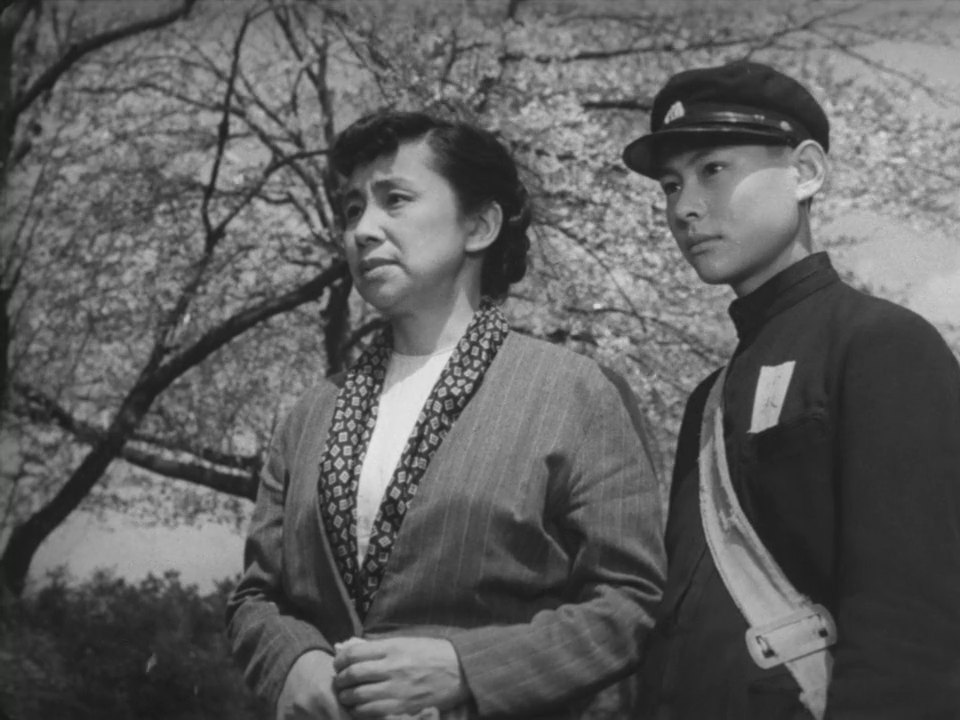
Boyhood (Kinoshita) screencapIt’s easy to look back in judgement with the benefit of hindsight, but much less so to see clearly in the moment. Keisuke Kinoshita’s Boyhood (少年期, Shonenki), arriving just six years after the events that it depicts, is a painful if sympathetic look at the conflicts of the age seen through the eyes of a conflicted adolescent as he struggles to understand his place in a world which is becoming ever colder.

In the spring of 1944, 16-year-old Ichiro (Akira Ishihama) and his mother (Akiko Tamura) investigate the possibilities of retreat, back to the country and away from the increasingly fraught and dangerous city. Their first prospect which offered the comfort of family nevertheless proves too inconvenient and so Ichiro’s mother decides perhaps Suwa, a rural area not quite so out of the way, might be better even if it would mean starting all over again with no friends or family to offer support. Ichiro, however, doesn’t want to leave at all. He is afraid of being thought a coward and doesn’t see why he should have to leave his school and classmates behind just because there’s a war on. If he had his druthers, he’d be a pilot dropping bombs, not a resentful schoolboy torn between his feelings for his family and the increasingly austere demands of militarism.

Ichiro may be 16, and if it were not for his poor health perhaps he might already have been drafted, but he seems younger and is trapped in the difficult gulf between boy and man which makes him petulant and occasionally unreasonable. His father (Chishu Ryu), a professor of English literature, is a well known social liberal which is a problem that eventually makes it impossible for the family to stay on in the city. They decide to sell the house and move to Suwa, allowing Ichiro to stay behind alone as a lodger for the family of greengrocers who are the new occupants, but despite his insistence on his independence Ichiro is not yet ready for self sufficiency and misses his family, especially his mother, dearly, while he also experiences harsh treatment from the military instructors at school thanks to his general lack of soldiering aptitude.

Like his nation, Ichiro is lost in a fog of confusion – torn between the prevailing ideology of the age and that of his gentle hearted father. His problem is that as he is still “a child” and the conditions in which they find themselves make openness difficult, nobody is willing to talk to him seriously about the issues at hand – his father perhaps less out of fear or reticence than because he is acutely aware that his son must come to his own conclusions even if those conclusions prove contrary to his own. Thus, much to Ichiro’s consternation, he refuses to allow him to enrol at a military academy but does not explicitly state why, leaving him with only the vague idea that his father is “anti-war” and therefore a social pariah in a nation where everyone is expected to do their duty.

Ichiro begins to resent his father for the family’s plight, certain that he is the reason they were forced out of their home and also the ongoing cause of his mother’s suffering as she finds herself becoming the family breadwinner as an unlikely milk lady – a job she was only able to get thanks to the friendship of a gregarious neighbour, herself a fellow evacuee in a similar position. Far from the community spirit such situations are said to engender, Ichiro and his family find themselves perpetually excluded, viewed with suspicion as “outsiders” and at the bottom of the pile when it comes to the distribution of resources. “Extra” people get only the extra after the real villagers have had their fill. Meanwhile, Ichiro is bullied by the full on fascists at school, one of whom is the son of a local military commander and has fallen completely under the militarist spell.

Everyone is always telling Ichiro that he will come to understand when he is older. Being young, he resents this intensely but eventually comes to see that they were right, some things can only be understood with the weight of experience. With the war’s end and the eventual defeat of militarism, the fog begins to lift, allowing him to see that the prevailing ideology is not always the correct one and that there’s something to be said for quiet resistance and sticking steadfastly to one’s principles even if it would be much easier to go along with the majority. His father, however, reminds him that those who chose to do just that can hardly be blamed and will likely suffer in whatever is to come. They will need the all love and compassion in the world in order to find a new, less destructive path than the one they had been obliged to walk through a time of fear and madness. Using imperialistic song and propaganda to ironic, somewhat chilling effect Kinoshita presents a characteristically empathetic portrait of a “difficult age” in the life of a young man and his country who each find themselves emerging from chaos and confusion into something completely unknown and perhaps frightening but open and filled with possibility.


Title sequence and opening (no subtitles)